Electrostatics
Structure of the Atom All matter is made of atoms
Protons, neutrons & electrons
The protons are held tight in the nucleus
The electrons move around outside the nucleus
Normally, atoms have the same number of protons & electrons
The protons & electrons cancel each other out and there is no net charge, or neutral.Static Electric ChargeThe result of transfer of electrons.The electrons in the atoms can be removed or added.Lose electrons – positive net chargeGain electrons – negative net charge
Electric Charge-Force LawOpposites attract.  Likes repel.Electrostatics
Ways to Charge an ObjectFriction:When two objects come in contact, one object may lose electronsThe other object will gain them!How easily an object gains or loses electrons depends on what it is made of!
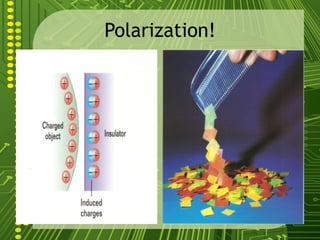
Charge by PolarizationSeparation of charge in an objectThe overall net charge of the object is still neutral
Polarization!
Ways to Charge an ObjectConductionElectrons can be transferred from one object to another by touching.When a charged object touches another object, some charge will transfer.If the charged object is negative, some of the electrons will leave the negatively charged object to the neutral object – leaving both objects with a negative charge!They repel each other!!!!
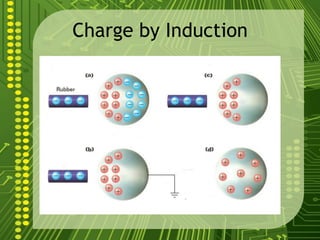
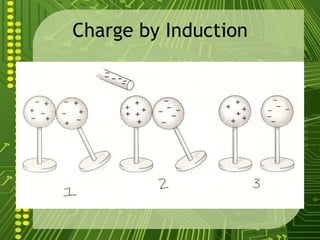
Charge by InductionObjects can be charged by bringing a charged object near a neutral objectThe charged object will attract unlike charges in the neutral object and repel like chargesRemember only electrons can move around!!!If the neutral object is grounded, the repelled charges will leave the object (go into the ground!)

Electrostatics

  • 1.
  • 2.
    Structure of theAtom All matter is made of atoms
  • 3.
  • 4.
    The protons areheld tight in the nucleus
  • 5.
    The electrons movearound outside the nucleus
  • 6.
    Normally, atoms havethe same number of protons & electrons
  • 7.
    The protons &electrons cancel each other out and there is no net charge, or neutral.Static Electric ChargeThe result of transfer of electrons.The electrons in the atoms can be removed or added.Lose electrons – positive net chargeGain electrons – negative net charge
  • 8.
    Electric Charge-Force LawOppositesattract. Likes repel.Electrostatics
  • 9.
    Ways to Chargean ObjectFriction:When two objects come in contact, one object may lose electronsThe other object will gain them!How easily an object gains or loses electrons depends on what it is made of!
  • 10.
    Charge by PolarizationSeparationof charge in an objectThe overall net charge of the object is still neutral
  • 11.
  • 12.
    Ways to Chargean ObjectConductionElectrons can be transferred from one object to another by touching.When a charged object touches another object, some charge will transfer.If the charged object is negative, some of the electrons will leave the negatively charged object to the neutral object – leaving both objects with a negative charge!They repel each other!!!!
  • 13.
    Charge by InductionObjectscan be charged by bringing a charged object near a neutral objectThe charged object will attract unlike charges in the neutral object and repel like chargesRemember only electrons can move around!!!If the neutral object is grounded, the repelled charges will leave the object (go into the ground!)