1
Dr. Y. S. THAKARE
M.Sc. (CHE) Ph D, NET, SET
Assistant Professor in Chemistry,
Shri Shivaji Science College, Amravati
Email: yogitathakare_2007@rediffmail.com
CHEMICAL DYNAMICS
RRK AND RRKM THEORY
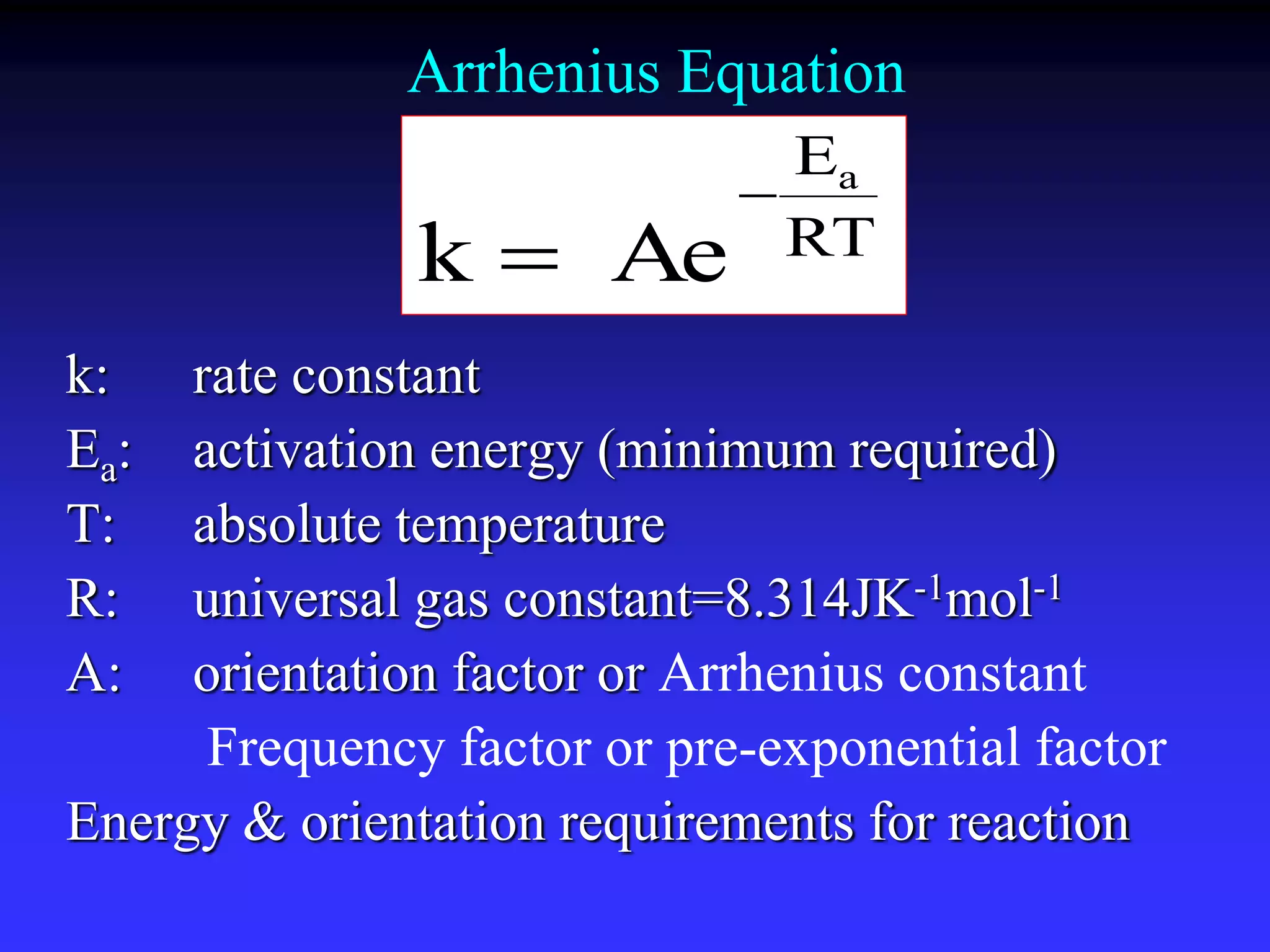
Arrhenius Equation
k: rate constant
Ea: activation energy (minimum required)
T: absolute temperature
R: universal gas constant=8.314JK-1mol-1
A: orientation factor or Arrhenius constant
Frequency factor or pre-exponential factor
Energy & orientation requirements for reaction
RT
Ea
Ae
k


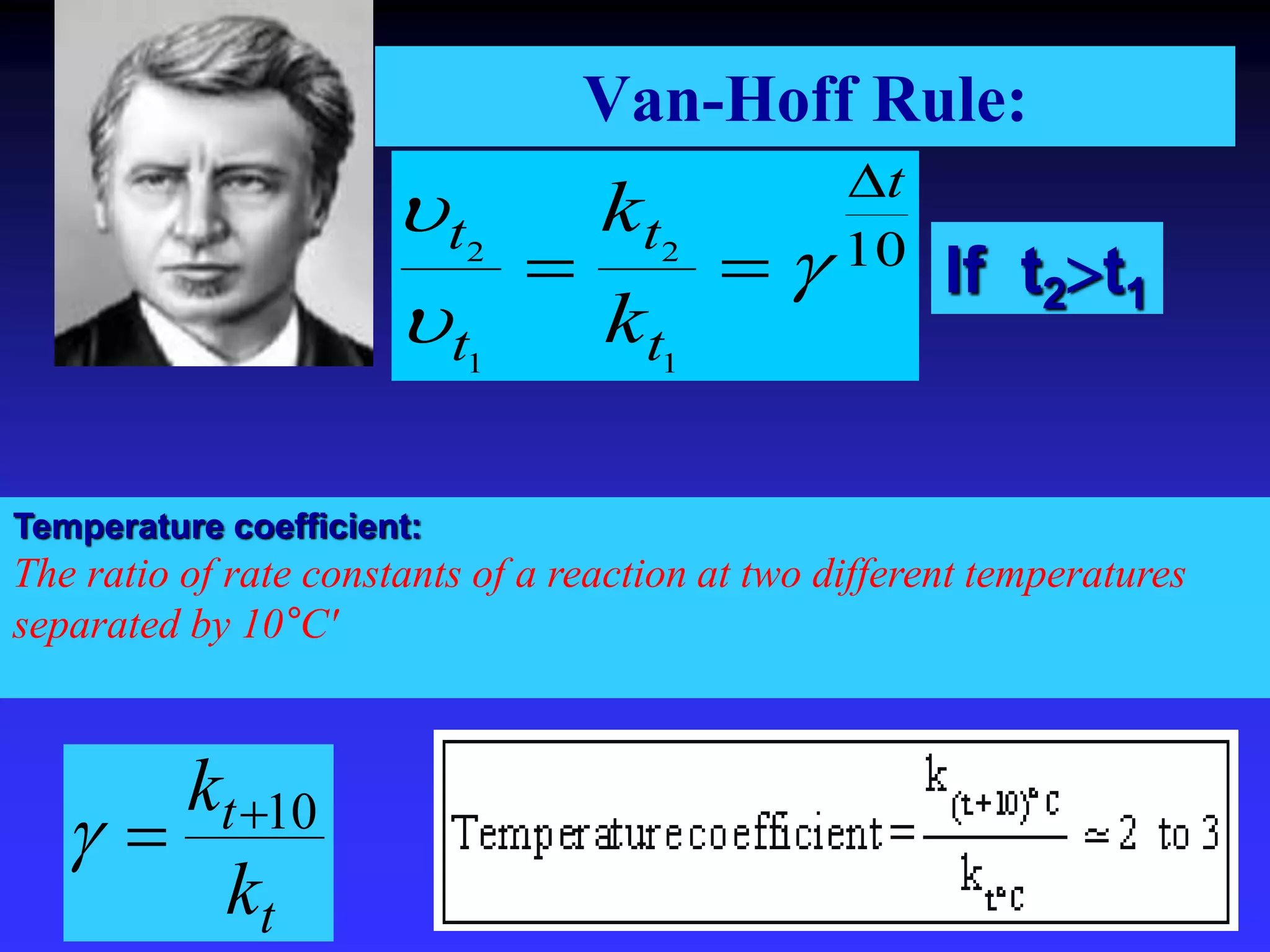
Van-Hoff Rule:
10
1
2
1
2
t
t
t
t
t
k
k 

 


If t2t1
t
t
k
k 10



Temperature coefficient:
The ratio of rate constants of a reaction at two different temperatures
separated by 10°C'
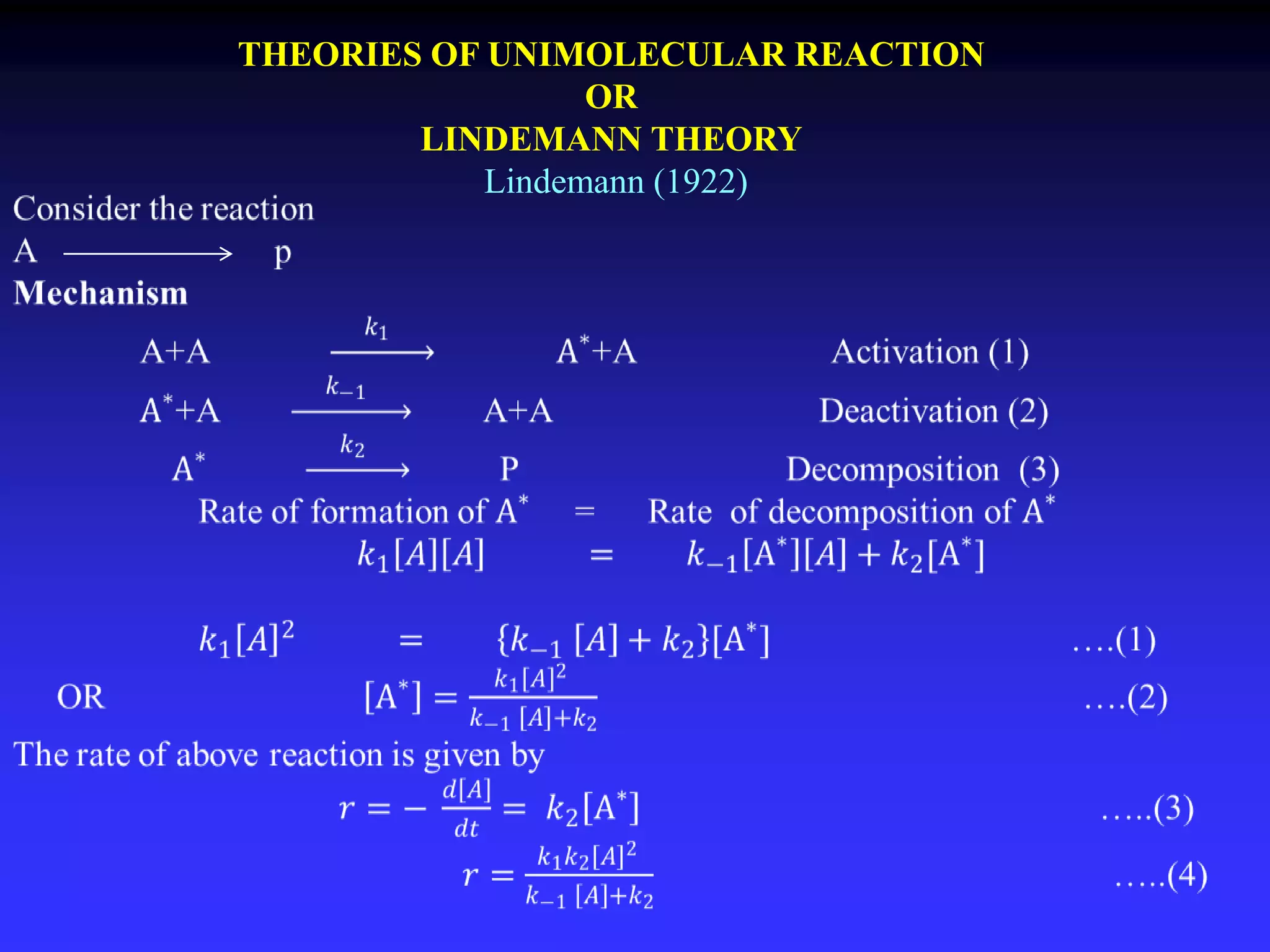
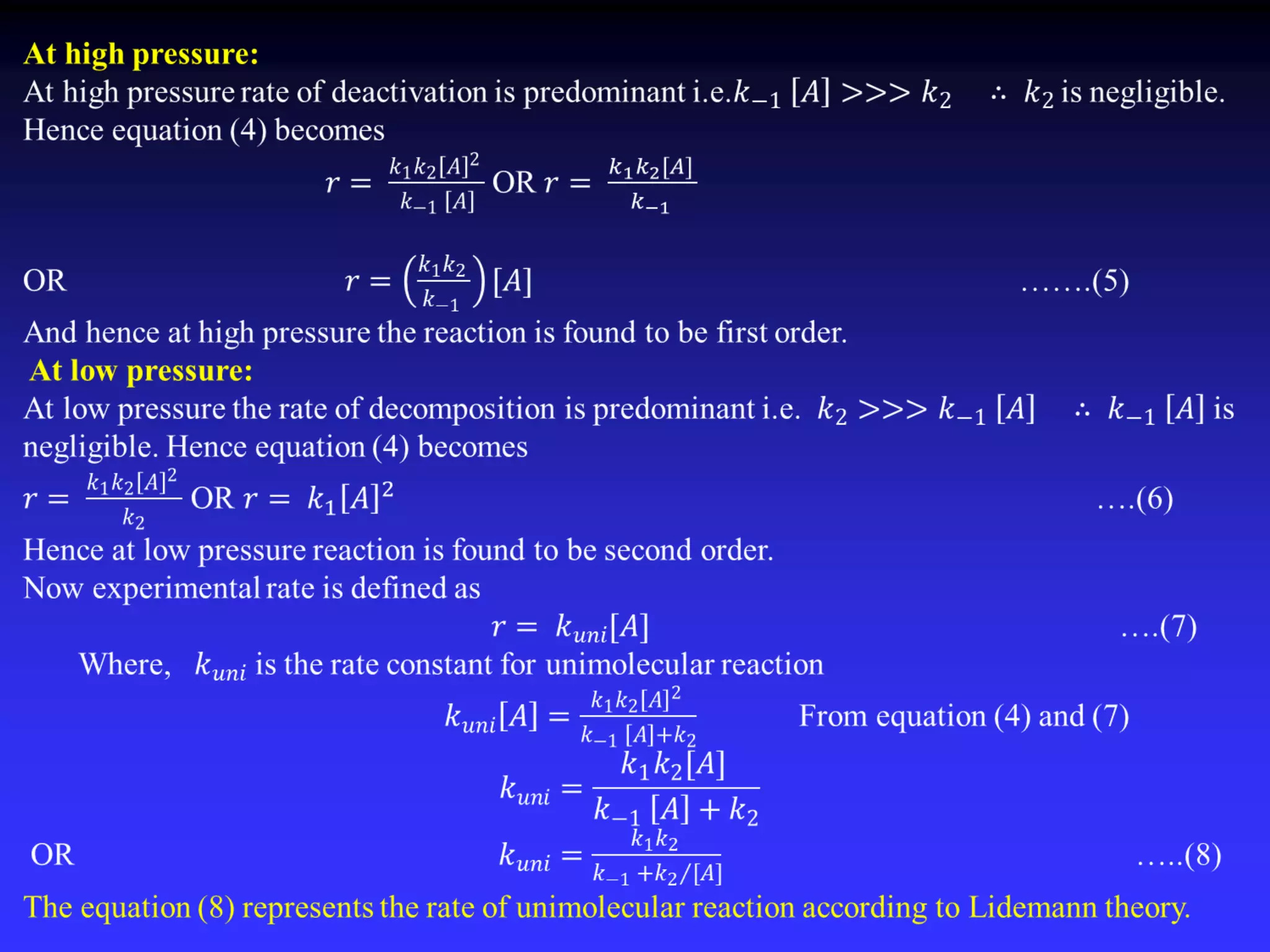
THEORIES OF UNIMOLECULAR REACTION
OR
LINDEMANN THEORY
Lindemann (1922)
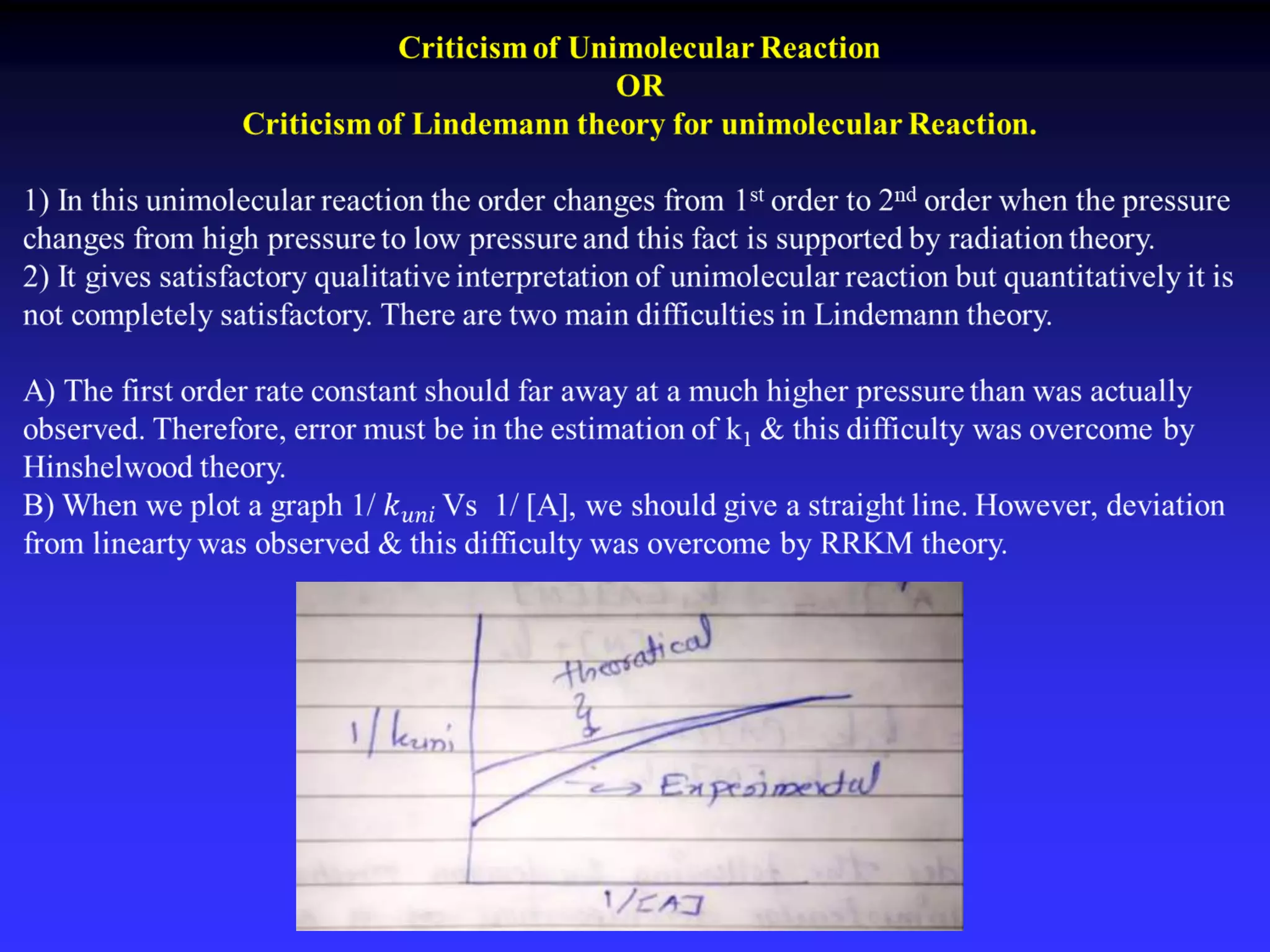
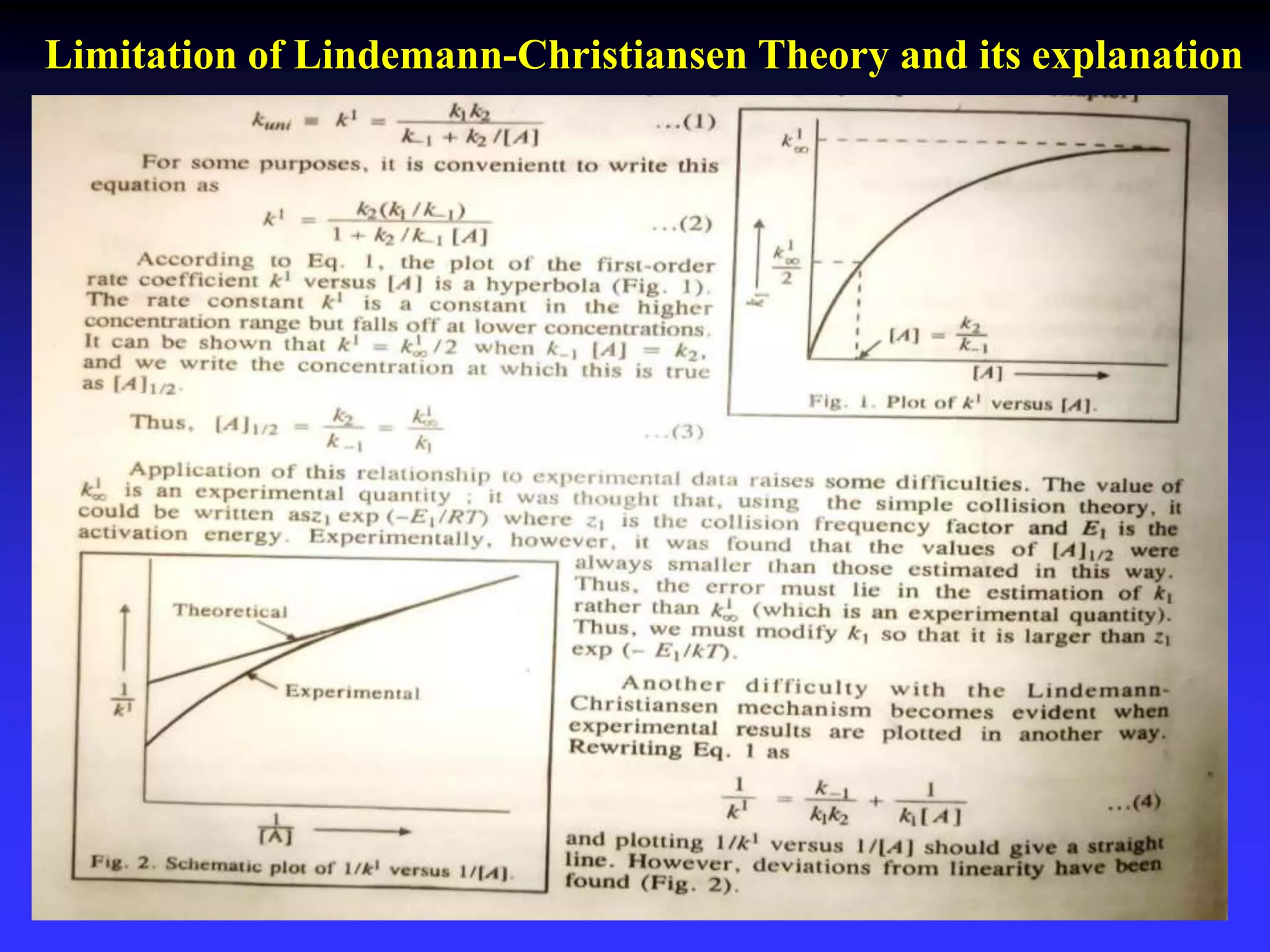
Limitation of Lindemann-Christiansen Theory and its explanation
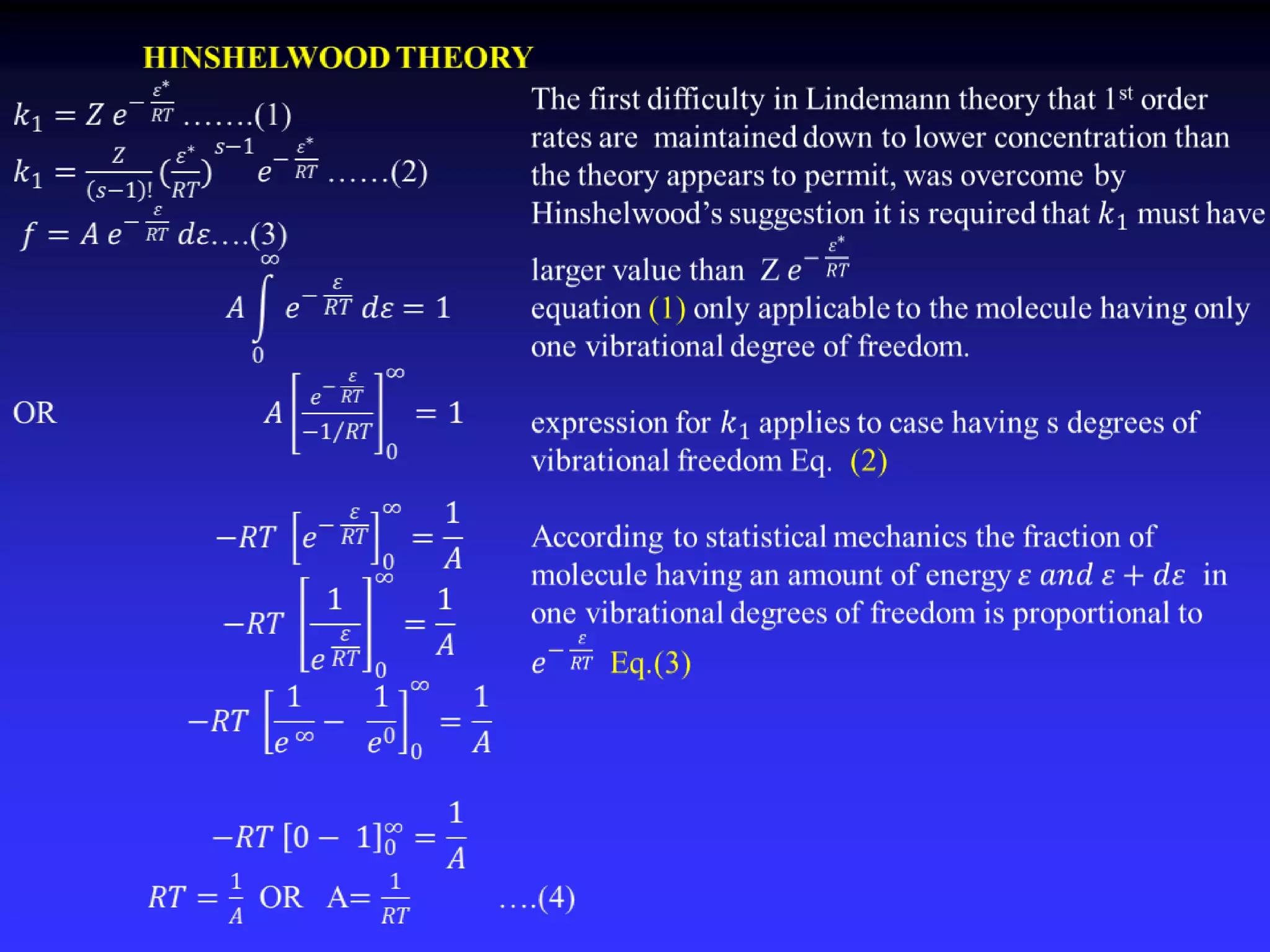
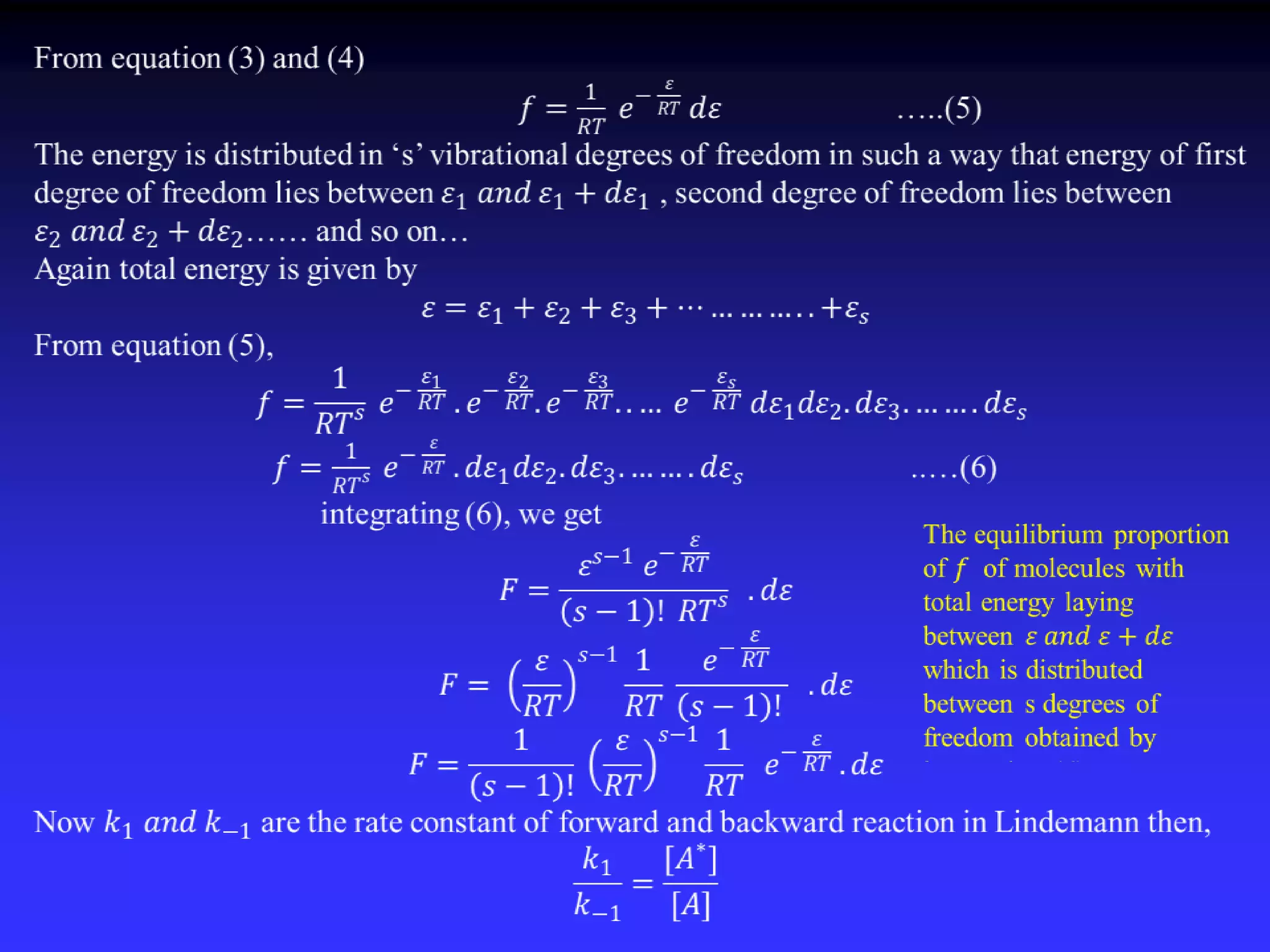
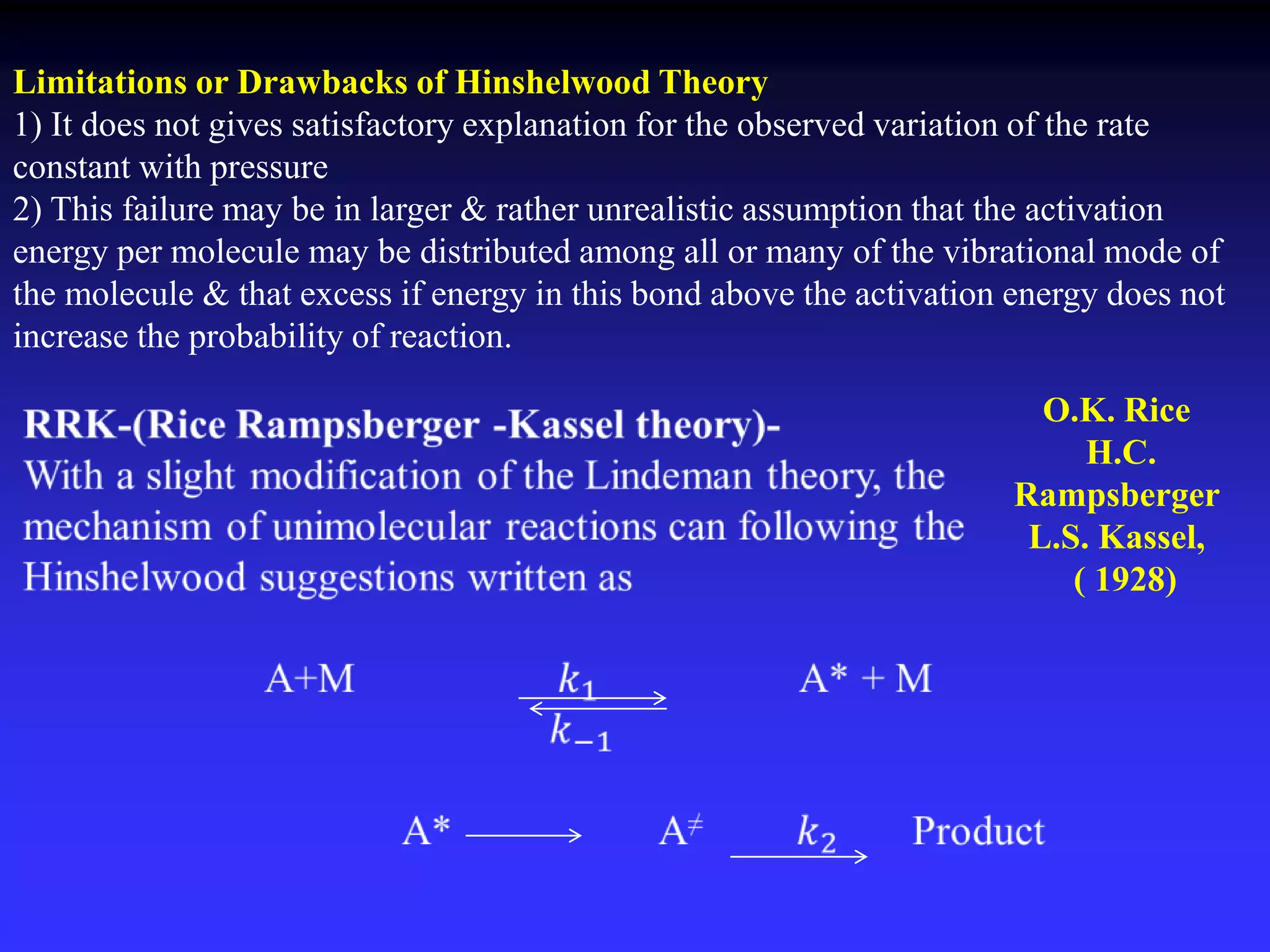
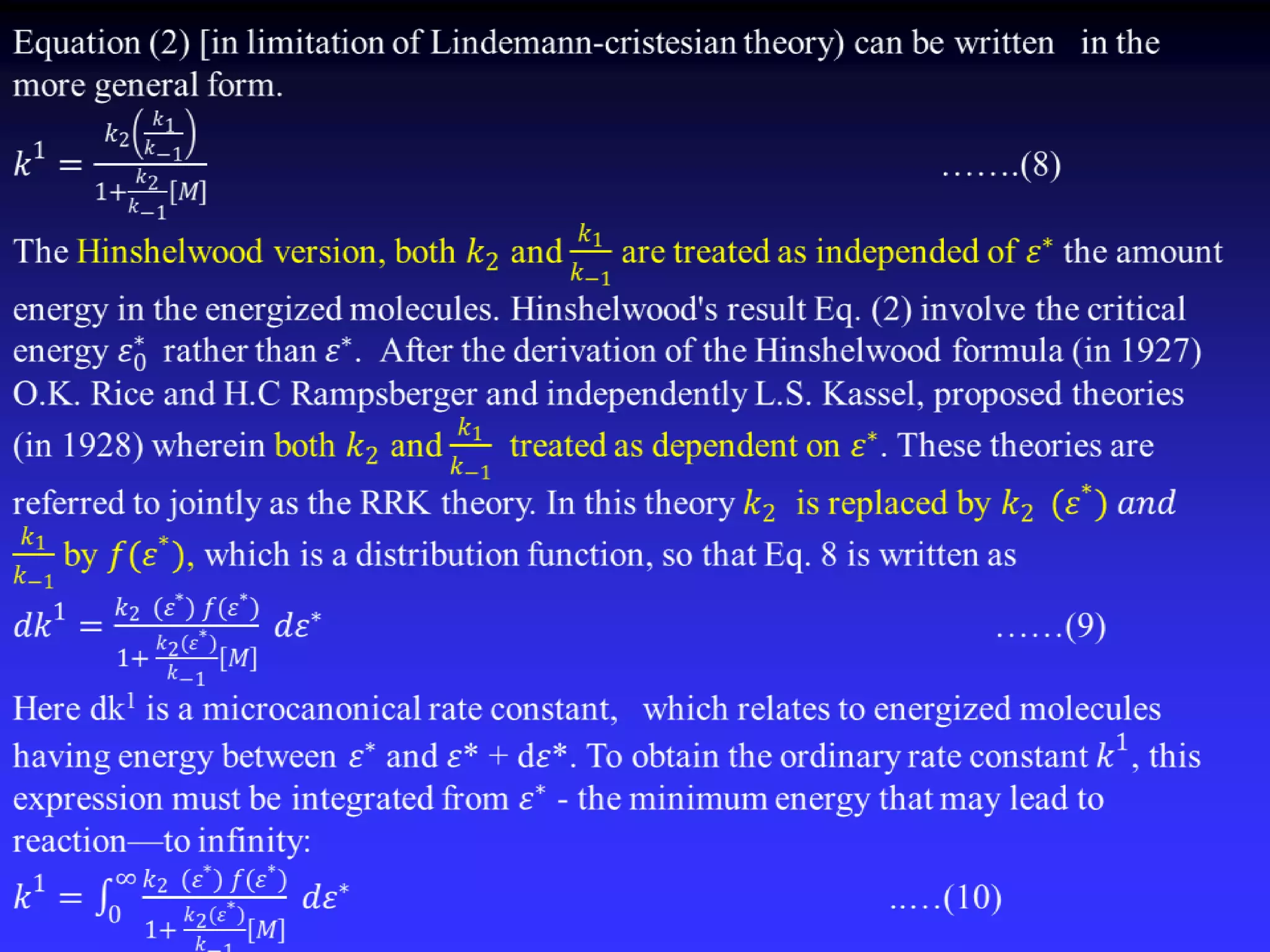
Limitations or Drawbacks of Hinshelwood Theory
1) It does not gives satisfactory explanation for the observed variation of the rate
constant with pressure
2) This failure may be in larger & rather unrealistic assumption that the activation
energy per molecule may be distributed among all or many of the vibrational mode of
the molecule & that excess if energy in this bond above the activation energy does not
increase the probability of reaction.
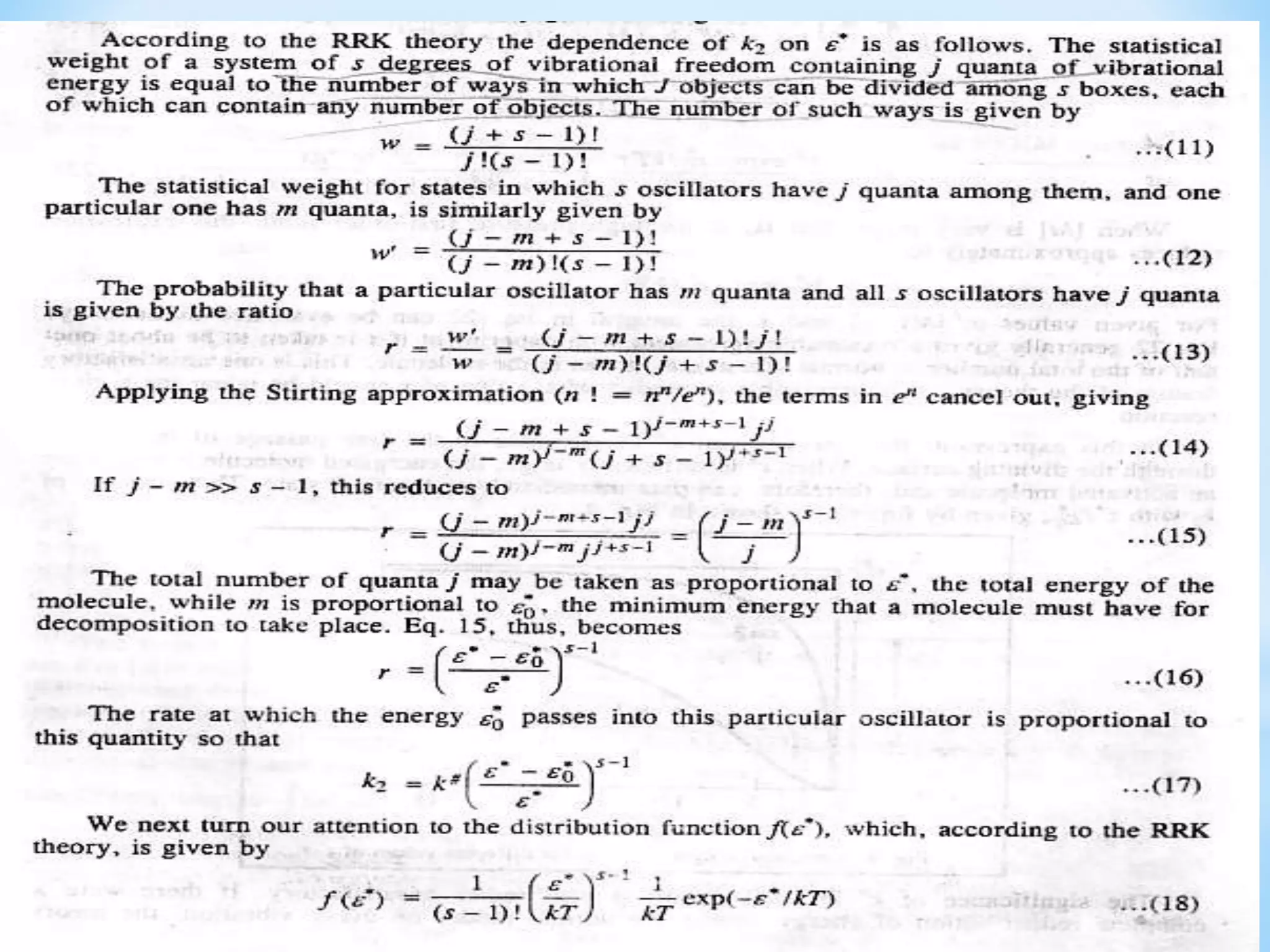
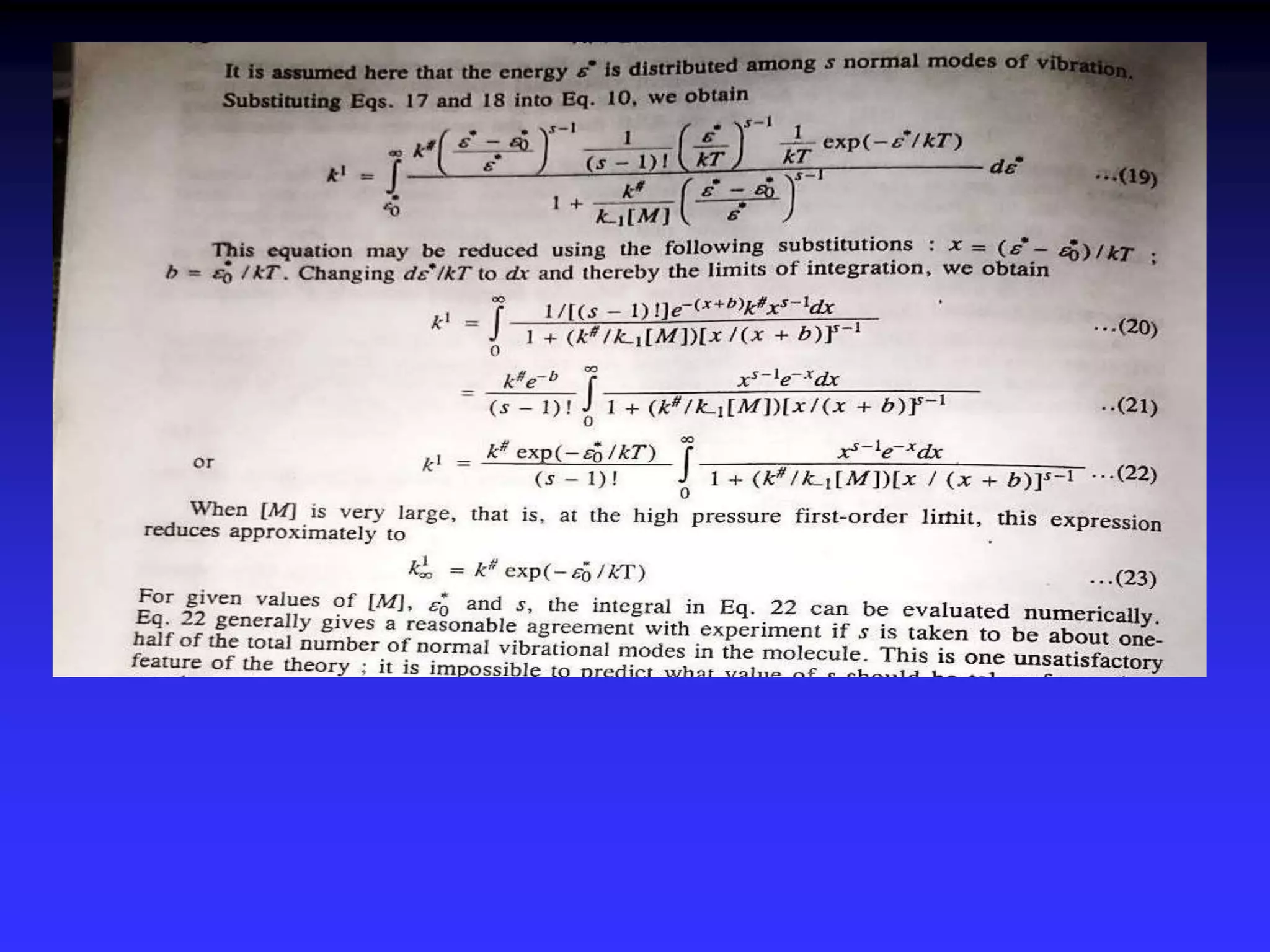
O.K. Rice
H.C.
Rampsberger
L.S. Kassel,
( 1928)
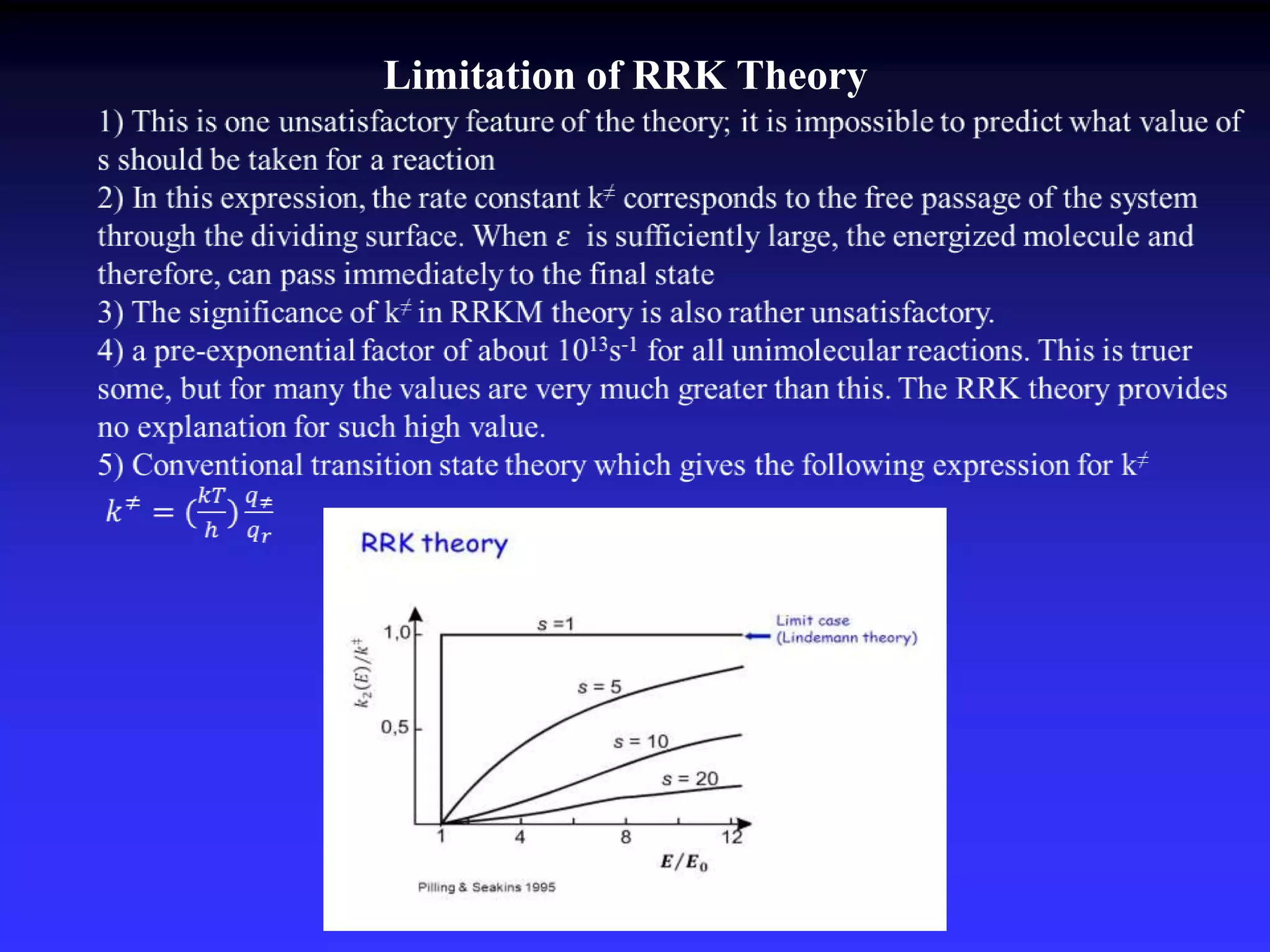
Limitation of RRK Theory
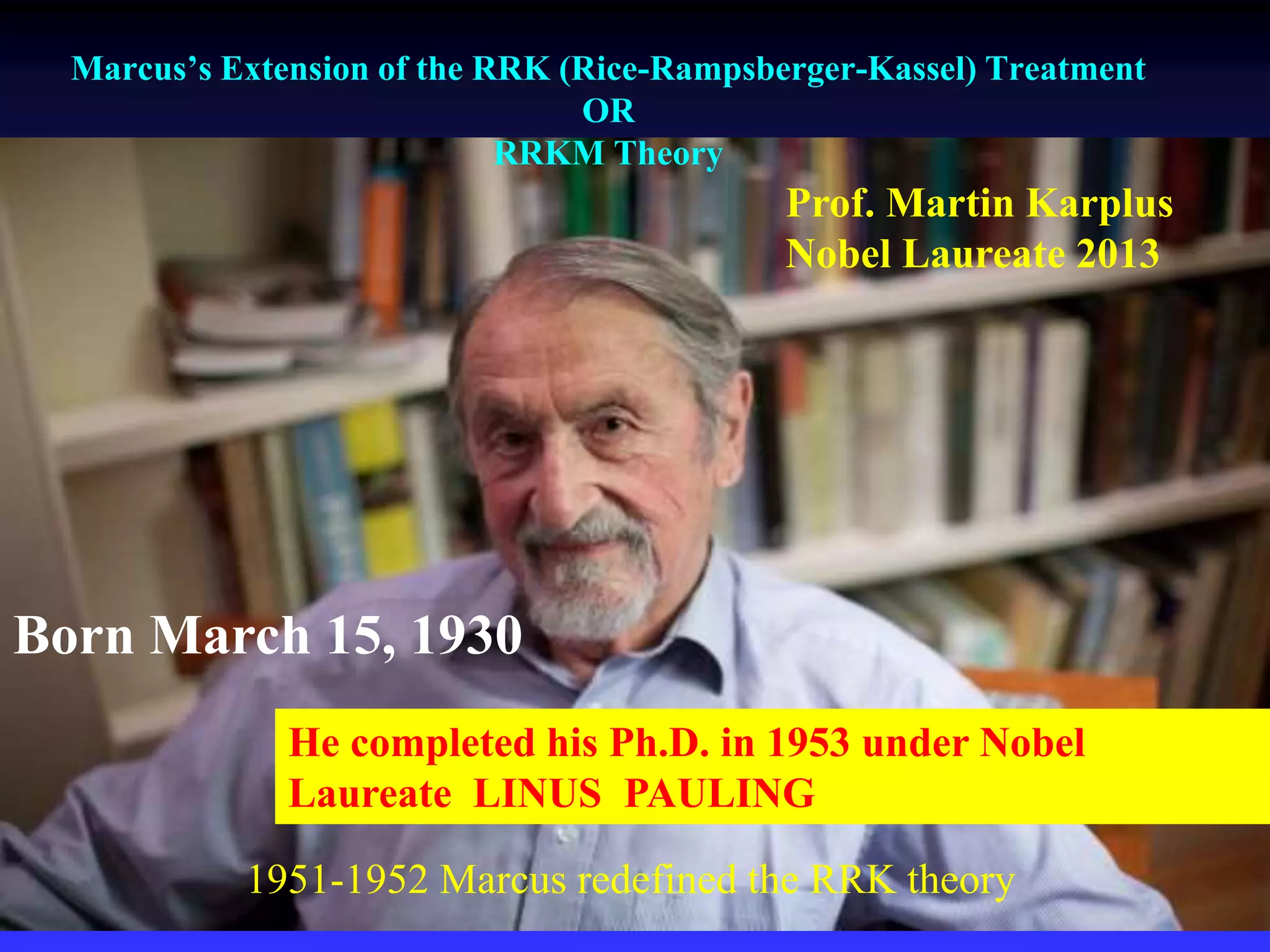
Born March 15, 1930
He completed his Ph.D. in 1953 under Nobel
Laureate LINUS PAULING
Prof. Martin Karplus
Nobel Laureate 2013
Marcus’s Extension of the RRK (Rice-Rampsberger-Kassel) Treatment
OR
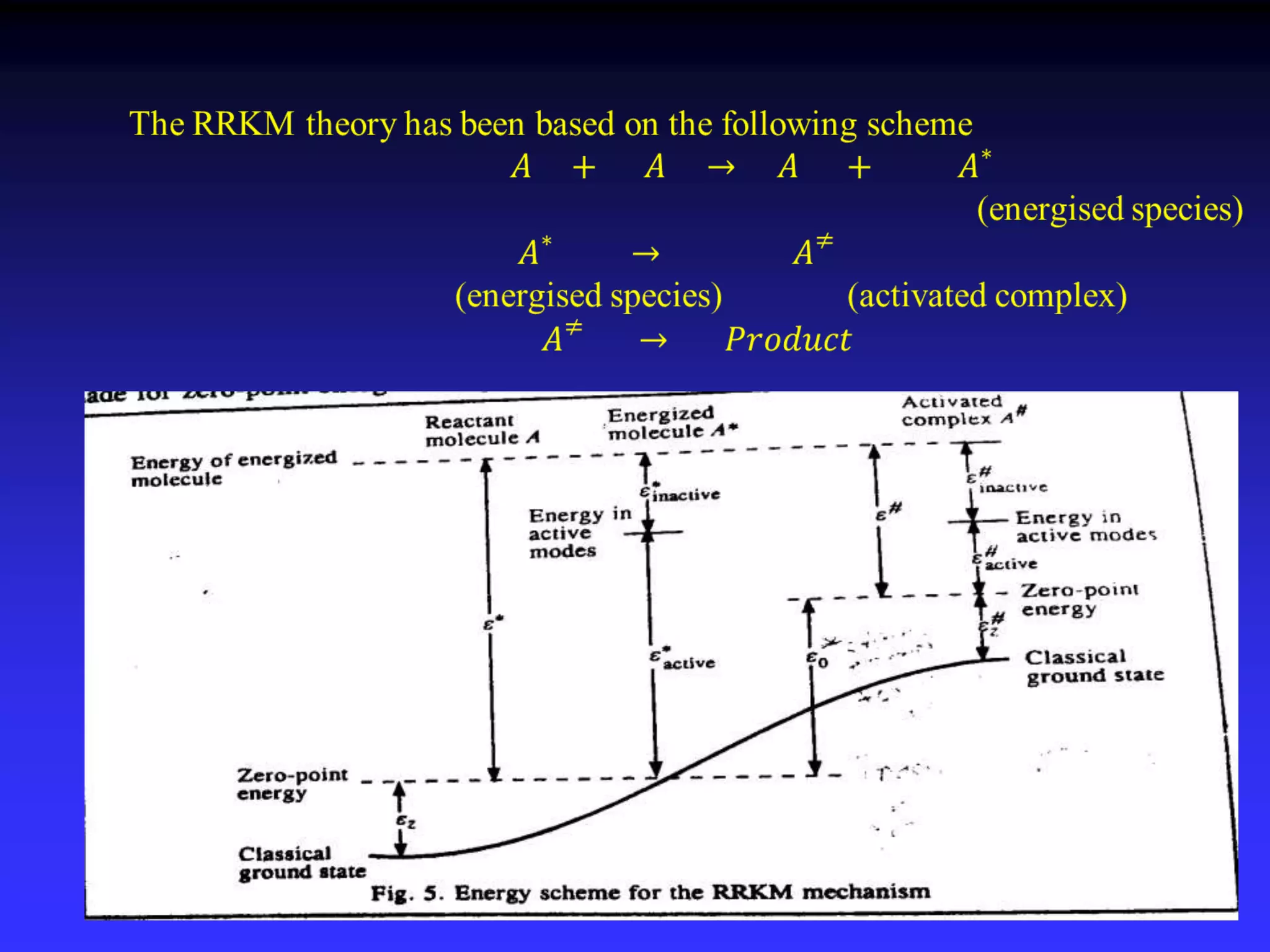
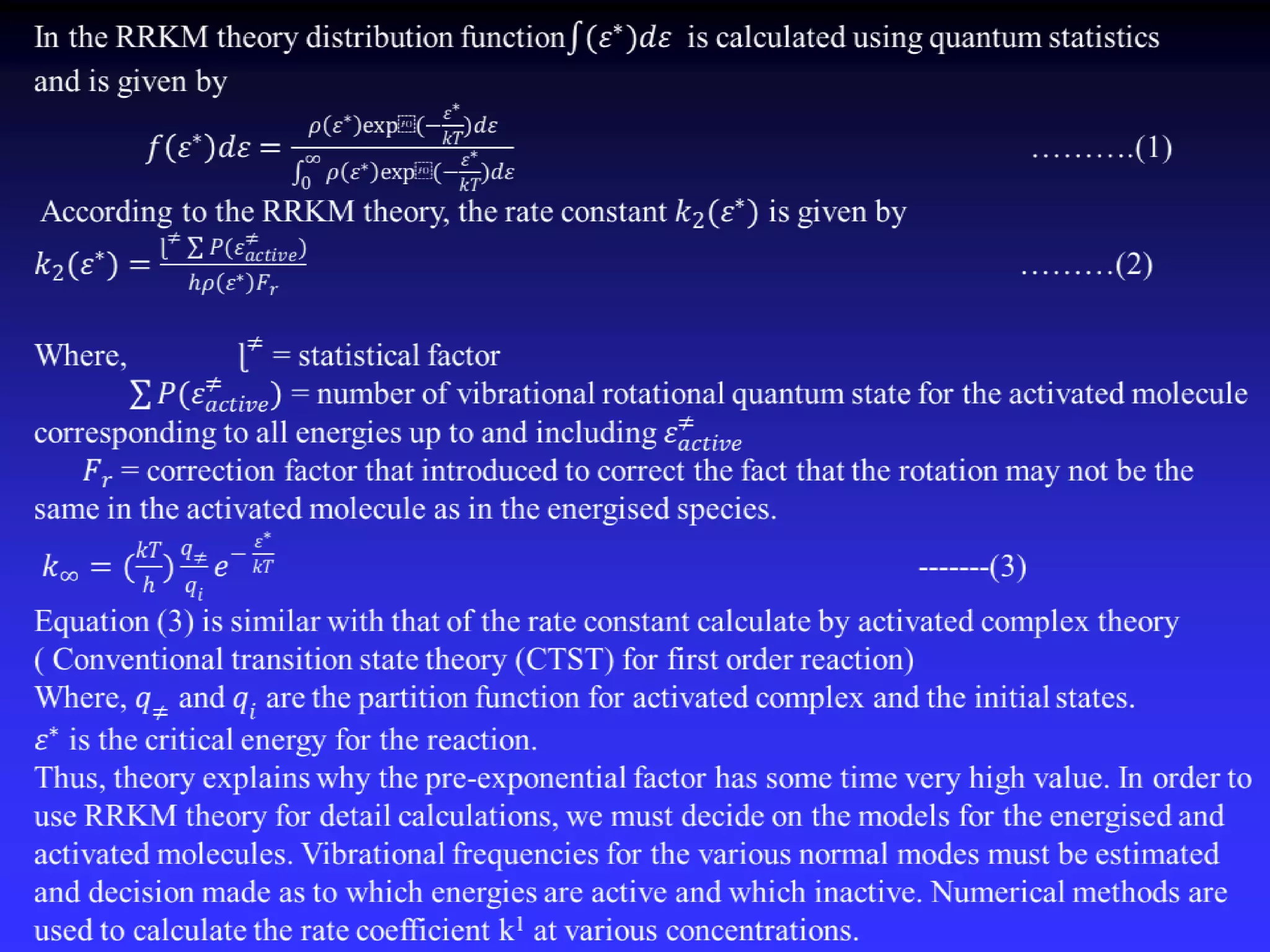
RRKM Theory
1951-1952 Marcus redefined the RRK theory
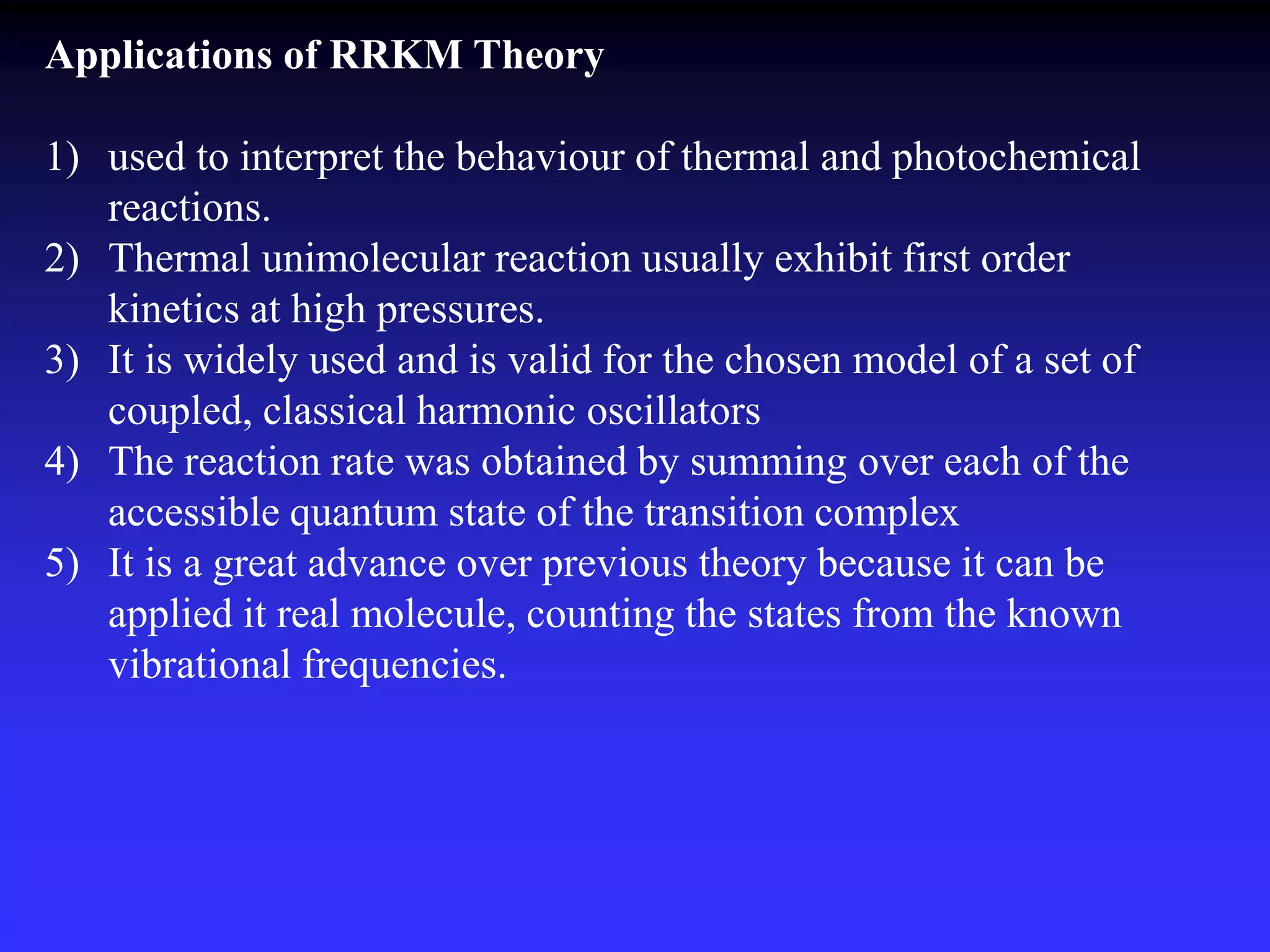
Applications of RRKM Theory
1) used to interpret the behaviour of thermal and photochemical
reactions.
2) Thermal unimolecular reaction usually exhibit first order
kinetics at high pressures.
3) It is widely used and is valid for the chosen model of a set of
coupled, classical harmonic oscillators
4) The reaction rate was obtained by summing over each of the
accessible quantum state of the transition complex
5) It is a great advance over previous theory because it can be
applied it real molecule, counting the states from the known
vibrational frequencies.

Chemical dynamics, intro,rrk, rrkm theory

  • 1.
    1 Dr. Y. S.THAKARE M.Sc. (CHE) Ph D, NET, SET Assistant Professor in Chemistry, Shri Shivaji Science College, Amravati Email: yogitathakare_2007@rediffmail.com CHEMICAL DYNAMICS RRK AND RRKM THEORY
  • 2.
    Arrhenius Equation k: rateconstant Ea: activation energy (minimum required) T: absolute temperature R: universal gas constant=8.314JK-1mol-1 A: orientation factor or Arrhenius constant Frequency factor or pre-exponential factor Energy & orientation requirements for reaction RT Ea Ae k  
  • 4.
    Van-Hoff Rule: 10 1 2 1 2 t t t t t k k      If t2t1 t t k k 10    Temperature coefficient: The ratio of rate constants of a reaction at two different temperatures separated by 10°C'
  • 5.
    THEORIES OF UNIMOLECULARREACTION OR LINDEMANN THEORY Lindemann (1922)
  • 8.
    Limitation of Lindemann-ChristiansenTheory and its explanation
  • 12.
    Limitations or Drawbacksof Hinshelwood Theory 1) It does not gives satisfactory explanation for the observed variation of the rate constant with pressure 2) This failure may be in larger & rather unrealistic assumption that the activation energy per molecule may be distributed among all or many of the vibrational mode of the molecule & that excess if energy in this bond above the activation energy does not increase the probability of reaction. O.K. Rice H.C. Rampsberger L.S. Kassel, ( 1928)
  • 17.
  • 18.
    Born March 15,1930 He completed his Ph.D. in 1953 under Nobel Laureate LINUS PAULING Prof. Martin Karplus Nobel Laureate 2013 Marcus’s Extension of the RRK (Rice-Rampsberger-Kassel) Treatment OR RRKM Theory 1951-1952 Marcus redefined the RRK theory
  • 21.
    Applications of RRKMTheory 1) used to interpret the behaviour of thermal and photochemical reactions. 2) Thermal unimolecular reaction usually exhibit first order kinetics at high pressures. 3) It is widely used and is valid for the chosen model of a set of coupled, classical harmonic oscillators 4) The reaction rate was obtained by summing over each of the accessible quantum state of the transition complex 5) It is a great advance over previous theory because it can be applied it real molecule, counting the states from the known vibrational frequencies.