Dr. Pradeep Samantaroy
Department of Chemistry
Rayagada Autonomous College, Rayagada
pksroy82@gmail.com; pksroy82@yahoo.in
9444078968
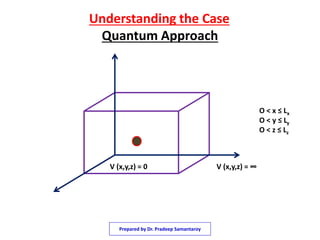
V (x,y,z) = 0 V (x,y,z) = ∞
O < x ≤ Lx
O < y ≤ Ly
O < z ≤ Lz
Understanding the Case
Quantum Approach
Prepared by Dr. Pradeep Samantaroy
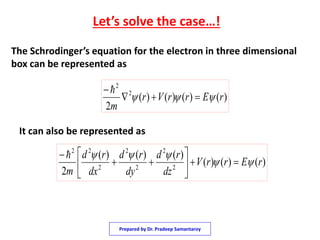
Let’s solve the case…!
)()()(
)()()(
2 2
2
2
2
2
22
rErrV
dz
rd
dy
rd
dx
rd
m










The Schrodinger’s equation for the electron in three dimensional
box can be represented as
)()()()(
2
2
2
rErrVr
m
 

It can also be represented as
Prepared by Dr. Pradeep Samantaroy
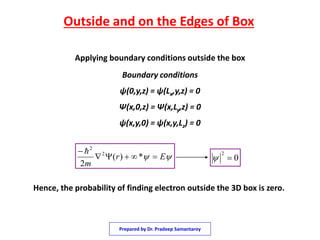
Outside and on the Edges of Box
Applying boundary conditions outside the box
 Er
m


*)(
2
2
2

0
2

Hence, the probability of finding electron outside the 3D box is zero.
Boundary conditions
ψ(0,y,z) = ψ(Lx,y,z) = 0
Ψ(x,0,z) = Ψ(x,Ly,z) = 0
ψ(x,y,0) = ψ(x,y,Lz) = 0
Prepared by Dr. Pradeep Samantaroy
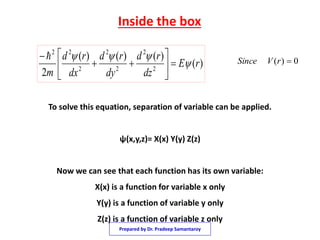
Inside the box
)(
)()()(
2 2
2
2
2
2
22
rE
dz
rd
dy
rd
dx
rd
m









 0)( rVSince
To solve this equation, separation of variable can be applied.
ψ(x,y,z)= X(x) Y(y) Z(z)
Now we can see that each function has its own variable:
X(x) is a function for variable x only
Y(y) is a function of variable y only
Z(z) is a function of variable z only
Prepared by Dr. Pradeep Samantaroy
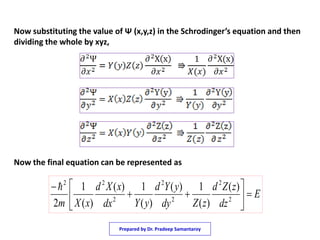
Now substituting the value of Ψ (x,y,z) in the Schrodinger’s equation and then
dividing the whole by xyz,
E
dz
zZd
zZdy
yYd
yYdx
xXd
xXm








2
2
2
2
2
22
)(
)(
1)(
)(
1)(
)(
1
2

Now the final equation can be represented as
Prepared by Dr. Pradeep Samantaroy
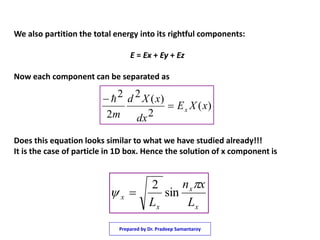
We also partition the total energy into its rightful components:
E = Ex​ + Ey​ + Ez​
Now each component can be separated as
Does this equation looks similar to what we have studied already!!!
It is the case of particle in 1D box. Hence the solution of x component is
)(
2
)(2
2
2
xXE
dx
xXd
m
x
 
x
x
x
x
L
xn
L

 sin
2

Prepared by Dr. Pradeep Samantaroy
)(
2
)(2
2
2
yYE
dy
yYd
m
y
 
y
y
y
y
L
yn
L

 sin
2

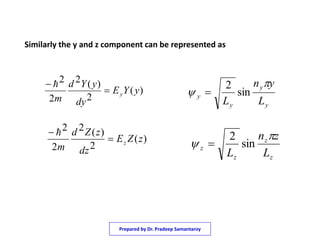
Similarly the y and z component can be represented as
)(
2
)(2
2
2
zZE
dz
zZd
m
z
 
z
z
z
z
L
zn
L

 sin
2

Prepared by Dr. Pradeep Samantaroy
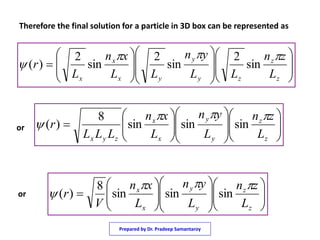
Therefore the final solution for a particle in 3D box can be represented as

























z
z
zy
y
yx
x
x L
zn
LL
yn
LL
xn
L
r

 sin
2
sin
2
sin
2
)(





















z
z
y
y
x
x
zyx L
zn
L
yn
L
xn
LLL
r

 sinsinsin
8
)(





















z
z
y
y
x
x
L
zn
L
yn
L
xn
V
r

 sinsinsin
8
)(
or
or
Prepared by Dr. Pradeep Samantaroy
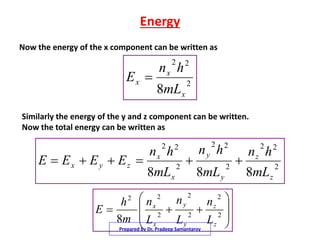
Energy
2
22
8 x
x
x
mL
hn
E 
Now the energy of the x component can be written as
Similarly the energy of the y and z component can be written.
Now the total energy can be written as
2
22
2
22
2
22
888 z
z
y
y
x
x
zyx
mL
hn
mL
hn
mL
hn
EEEE 








 2
2
2
2
2
22
8 z
z
y
y
x
x
L
n
L
n
L
n
m
h
E
Prepared by Dr. Pradeep Samantaroy
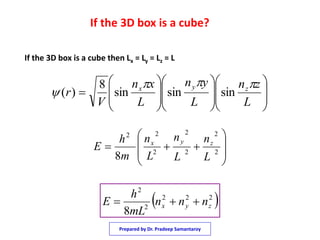
If the 3D box is a cube?
If the 3D box is a cube then Lx = Ly = Lz = L

























L
zn
L
yn
L
xn
V
r zyx 
 sinsinsin
8
)(








 2
2
2
2
2
22
8 L
n
L
n
L
n
m
h
E zyx
 222
2
2
8
zyx nnn
mL
h
E 
Prepared by Dr. Pradeep Samantaroy
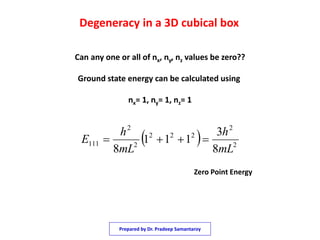
Degeneracy in a 3D cubical box
Can any one or all of nx, ny, nz values be zero??
Ground state energy can be calculated using
nx= 1, ny= 1, nz= 1
  2
2
222
2
2
111
8
3
111
8 mL
h
mL
h
E 
Zero Point Energy
Prepared by Dr. Pradeep Samantaroy
Degeneracy in a 3D cubical box
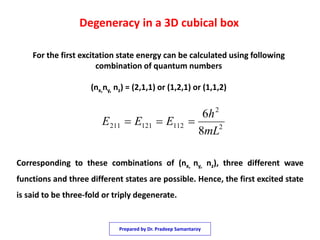
For the first excitation state energy can be calculated using following
combination of quantum numbers
(nx,ny, nz) = (2,1,1) or (1,2,1) or (1,1,2)
2
2
112121211
8
6
mL
h
EEE 
Corresponding to these combinations of (nx, ny, nz), three different wave
functions and three different states are possible. Hence, the first excited state
is said to be three-fold or triply degenerate.
Prepared by Dr. Pradeep Samantaroy
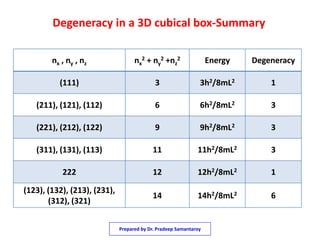
nx , ny , nz nx
2 + ny
2 +nz
2 Energy Degeneracy
(111) 3 3h2/8mL2 1
(211), (121), (112) 6 6h2/8mL2 3
(221), (212), (122) 9 9h2/8mL2 3
(311), (131), (113) 11 11h2/8mL2 3
222 12 12h2/8mL2 1
(123), (132), (213), (231),
(312), (321)
14 14h2/8mL2 6
Degeneracy in a 3D cubical box-Summary
Prepared by Dr. Pradeep Samantaroy
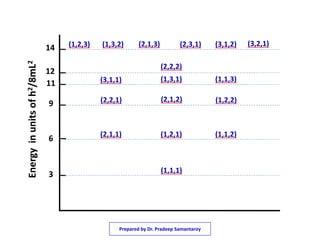
12
9
6
3
14
11
(1,1,1)
(1,2,1)(2,1,1) (1,1,2)
(2,1,2)(2,2,1) (1,2,2)
(1,3,1)(3,1,1) (1,1,3)
(2,2,2)
(1,3,2)(1,2,3) (2,1,3) (3,1,2)(2,3,1) (3,2,1)
Energyinunitsofh2/8mL2
Prepared by Dr. Pradeep Samantaroy

Particle in 3D box

  • 1.
    Dr. Pradeep Samantaroy Departmentof Chemistry Rayagada Autonomous College, Rayagada pksroy82@gmail.com; pksroy82@yahoo.in 9444078968
  • 2.
    V (x,y,z) =0 V (x,y,z) = ∞ O < x ≤ Lx O < y ≤ Ly O < z ≤ Lz Understanding the Case Quantum Approach Prepared by Dr. Pradeep Samantaroy
  • 3.
    Let’s solve thecase…! )()()( )()()( 2 2 2 2 2 2 22 rErrV dz rd dy rd dx rd m           The Schrodinger’s equation for the electron in three dimensional box can be represented as )()()()( 2 2 2 rErrVr m    It can also be represented as Prepared by Dr. Pradeep Samantaroy
  • 4.
    Outside and onthe Edges of Box Applying boundary conditions outside the box  Er m   *)( 2 2 2  0 2  Hence, the probability of finding electron outside the 3D box is zero. Boundary conditions ψ(0,y,z) = ψ(Lx,y,z) = 0 Ψ(x,0,z) = Ψ(x,Ly,z) = 0 ψ(x,y,0) = ψ(x,y,Lz) = 0 Prepared by Dr. Pradeep Samantaroy
  • 5.
    Inside the box )( )()()( 22 2 2 2 2 22 rE dz rd dy rd dx rd m           0)( rVSince To solve this equation, separation of variable can be applied. ψ(x,y,z)= X(x) Y(y) Z(z) Now we can see that each function has its own variable: X(x) is a function for variable x only Y(y) is a function of variable y only Z(z) is a function of variable z only Prepared by Dr. Pradeep Samantaroy
  • 6.
    Now substituting thevalue of Ψ (x,y,z) in the Schrodinger’s equation and then dividing the whole by xyz, E dz zZd zZdy yYd yYdx xXd xXm         2 2 2 2 2 22 )( )( 1)( )( 1)( )( 1 2  Now the final equation can be represented as Prepared by Dr. Pradeep Samantaroy
  • 7.
    We also partitionthe total energy into its rightful components: E = Ex​ + Ey​ + Ez​ Now each component can be separated as Does this equation looks similar to what we have studied already!!! It is the case of particle in 1D box. Hence the solution of x component is )( 2 )(2 2 2 xXE dx xXd m x   x x x x L xn L   sin 2  Prepared by Dr. Pradeep Samantaroy
  • 8.
    )( 2 )(2 2 2 yYE dy yYd m y   y y y y L yn L   sin 2  Similarlythe y and z component can be represented as )( 2 )(2 2 2 zZE dz zZd m z   z z z z L zn L   sin 2  Prepared by Dr. Pradeep Samantaroy
  • 9.
    Therefore the finalsolution for a particle in 3D box can be represented as                          z z zy y yx x x L zn LL yn LL xn L r   sin 2 sin 2 sin 2 )(                      z z y y x x zyx L zn L yn L xn LLL r   sinsinsin 8 )(                      z z y y x x L zn L yn L xn V r   sinsinsin 8 )( or or Prepared by Dr. Pradeep Samantaroy
  • 10.
    Energy 2 22 8 x x x mL hn E  Nowthe energy of the x component can be written as Similarly the energy of the y and z component can be written. Now the total energy can be written as 2 22 2 22 2 22 888 z z y y x x zyx mL hn mL hn mL hn EEEE           2 2 2 2 2 22 8 z z y y x x L n L n L n m h E Prepared by Dr. Pradeep Samantaroy
  • 11.
    If the 3Dbox is a cube? If the 3D box is a cube then Lx = Ly = Lz = L                          L zn L yn L xn V r zyx   sinsinsin 8 )(          2 2 2 2 2 22 8 L n L n L n m h E zyx  222 2 2 8 zyx nnn mL h E  Prepared by Dr. Pradeep Samantaroy
  • 12.
    Degeneracy in a3D cubical box Can any one or all of nx, ny, nz values be zero?? Ground state energy can be calculated using nx= 1, ny= 1, nz= 1   2 2 222 2 2 111 8 3 111 8 mL h mL h E  Zero Point Energy Prepared by Dr. Pradeep Samantaroy
  • 13.
    Degeneracy in a3D cubical box For the first excitation state energy can be calculated using following combination of quantum numbers (nx,ny, nz) = (2,1,1) or (1,2,1) or (1,1,2) 2 2 112121211 8 6 mL h EEE  Corresponding to these combinations of (nx, ny, nz), three different wave functions and three different states are possible. Hence, the first excited state is said to be three-fold or triply degenerate. Prepared by Dr. Pradeep Samantaroy
  • 14.
    nx , ny, nz nx 2 + ny 2 +nz 2 Energy Degeneracy (111) 3 3h2/8mL2 1 (211), (121), (112) 6 6h2/8mL2 3 (221), (212), (122) 9 9h2/8mL2 3 (311), (131), (113) 11 11h2/8mL2 3 222 12 12h2/8mL2 1 (123), (132), (213), (231), (312), (321) 14 14h2/8mL2 6 Degeneracy in a 3D cubical box-Summary Prepared by Dr. Pradeep Samantaroy
  • 15.
    12 9 6 3 14 11 (1,1,1) (1,2,1)(2,1,1) (1,1,2) (2,1,2)(2,2,1) (1,2,2) (1,3,1)(3,1,1)(1,1,3) (2,2,2) (1,3,2)(1,2,3) (2,1,3) (3,1,2)(2,3,1) (3,2,1) Energyinunitsofh2/8mL2 Prepared by Dr. Pradeep Samantaroy