QUANTUM MECHANICS
500 Problems with Solutions
G. Aruldhas
Formerly Professor and Head of Physics
and Dean, Faculty of Science
University of Kerala
PHI Learning P fcte taftM
New Delhi-110001
2011
1295.00
QUANTUM MECHANICS: 500 Problems with Solutions
G. Aruldhas
© 2011 by PHI Learning Private Limited, New Delhi. All rights reserved. No part of this book may be
reproduced in any form, by mimeograph, or any other means, without permission in writing from the
publisher.
ISBN-978-81-203-4069-5
The export rights of this book are vested solely with the publisher.
Published by Asoke K. Ghosh, PHI Learning Private Limited, M-97, Connaught Circus,
New Delhi-110001 and Printed by V.K. Batra at Pearl Offset Press Private Limited,
New Delhi-110015.
To
my wife, Myrtle
Our children
Vinod & Anitha, Manoj & Bini, Ann & Suresh
and
Our grandchildren
Nithin, Cerene, Tina, Zaneta, Juana, Joshua, Tesiya, Lidiya, Ezekiel
for their unending encouragement and support
r
Contents
Preface
1. QUANTUM THEORY
1.1 Planck’s Quantum Hypothesis 1
1.2 Photoelectric Effect 1
1.3 Compton Effect 2
1.4 Bohr’s Theory of Hydrogen Atom 2
1.5 Wilson-Sommerfeld Quantization Rule 4
Problems 5
2. WAVE MECHANICAL CONCEPTS
2.1 Wave Nature of Particles 17
2.2 Uncertainty Principle 17
2.3 Wave Packet 18
2.4 Time-dependent Schrodinger Equation 18
2.5 Physical Interpretation of t) 18
2.5.1 Probability Interpretation 18
2.5.2 Probability Current Density 19
2.6 Time-independent Schrodinger Equation 19
Problems 21
3. GENERAL FORMALISM OF QUANTUM MECHANICS
3.1 Mathematical Preliminaries 44
3.2 Linear Operator 45
3.3 Eigenfunctions and Eigenvalues 45
3>4 Hermitian Operator 45
3.5 Postulatesjof3Quantum Mechanics 46
3.5.1 Postulate 1—Wave Function 46
3.5.2 Postulate 2—Operators 46
viii • Contents
3.5.3 Postulate 3—Expectation Value 47
3.5.4 Postulate 4— Eigenvalues 47
3.5.5 Postulate 5—Time Development of a Quantum System 47
3.6 General Uncertainty Relation 47
3.7 Dirac’s Notation 48
3.8 Equations of Motion 48
3.8.1 Schrodinger Picture 48
3.8.2 Heisenberg Picture 48
3.8.3 Momentum Representation 49
Problems 50
4. ONE-DIMENSIONAL SYSTEMS 84-125
4.1 Infinite Square Well Potential 84
4.2 Square Well Potential with Finite Walls 85
4.3 Square Potential Barrier 86
4.4 Linear Harmonic Oscillator 86
4.4.1 The Schrodinger Method 86
4.4.2 The Operator Method 86
4.5 The Free Particle 87
Problems 88
5. THREE-DIMENSIONAL ENERGY EIGENVALUE PROBLEMS 126-158
5.1 Particle Moving in a SphericallySymmetric Potential 126
5.2 System of Two InteractingParticles 127
5.3 Rigid Rotator 127
5.4 Hydrogen Atom 127
Problems 129
6. MATRIX FORMULATION AND SYMMETRY 159-175
6.1 Matrix Representation of Operators and Wave Functions 159
6.2 Unitary Transformation 159
6.3 Symmetry 160
6.3.1 Translation in Space 160
6.3.2 Translation in Time 160
6.3.3 Rotation in Space 161
6.3.4 Space Inversion 161
6.3.5 Time Reversal 162
Problems 163
7. ANGULAR MOMENTUM AND SPIN 176-214
7.1 Angular Momentum Operators 176
7.2 Angular Momentum CommutationRelations 176
7.3 Eigenvalues of J2 and J7 177
1
Contents • IX
7.4 Spin Angular Momentum 177
7.5 Addition of Angular Momenta 178
Problems 179
#8. TIME-INDEPENDENT PERTURBATION 215-247
8.1 Correction of Nondegenerate Energy Levels 215
8.2 Correction to Degenerate Energy Levels 215
Problems 217
9. VARIATION AND WKB METHODS 248-270
9.1 Variation Method 248
9.2 WKB Method 248
9.3 The Connection Formulas 249
Problems 250
#10 TIME-DEPENDENT PERTURBATION 271-286
10.1 First Order Perturbation 271
10.2 Harmonic Perturbation 272
10.3 Transition to Continuum States 272
10.4 Absorption and Emission of Radiation 273
10.5 Einstein’s A and B Coefficients 273
10.6 Selection Rules 273
Problems 274
11. IDENTICAL PARTICLES 287-307
11.1 Indistinguishable Particles 287
11.2 The Pauli Principle 287
11.3 Inclusion of Spin 288
Problems 289
12. SCATTERING 308-329
12.1 Scattering Cross-section 308
12.2 Scattering Amplitude 308
12.3 Probability Current Density 309
12.4 Partial Wave Analysis of Scattering 309
12.5 The Bom Approximation 310
Problems 311
13. RELATIVISTIC EQUATIONS 330-342
13.1 Klein-Gordon Equation 330
13.2 Dirac’s Equation for a Free Particle 330
Problems 332
X • Contents
14. CHEMICAL BONDING 343-357
14.1 Bom-Oppenheimer Approximation 343
14.2 Molecular Orbital and Valence Bond Methods 343
14.3 Hydrogen Molecule-ion 344
14.4 MO Treatment of Hydrogen Molecule 345
14.5 Diatomic Molecular Orbitals 345
Problems 347
APPENDIX 359-360
INDEX 361-363
Preface
This comprehensive, in-depth treatment of quantum mechanics in the form of problems with
solutions provides a thorough understanding of the subject and its application to various physical and
chemical problems. Learning to solve problems is the basic purpose of a course since it helps in
understanding the subject in a better way. Keeping this in mind, considerable attention is devoted to
work out these problems. Typical problems illustrating important concepts in Quantum Mechanics
have been included in all the chapters. Problems from the simple plugged-ins to increasing order of
difficulty are included to strengthen the students’ understanding of the subject.
Every effort has been taken to make the book explanatory, exhaustive, and user-friendly.
Besides helping students to build a thorough conceptual understanding of Quantum Mechanics, the
book will also be of considerable assistance to readers in developing a more positive and realistic
impression of the subject.
It is with a deep sense of gratitude and pleasure that I acknowledge my indebtedness to my
students for all the discussions and questions they have raised. I express my sincere thanks to the
Publishers, PHI Learning, for their unfailing cooperation and for the meticulous processing of the
manuscript. Finally, I acknowledge my gratitude to my wife, Myrtle, and our children for the
encouragement, cooperation, and academic environment they have provided throughout my career.
Above all, I thank my Lord Jesus Christ who has given me wisdom, knowledge, and guidance
throughout my life.
G. Aruldhas
r
L
Chapter
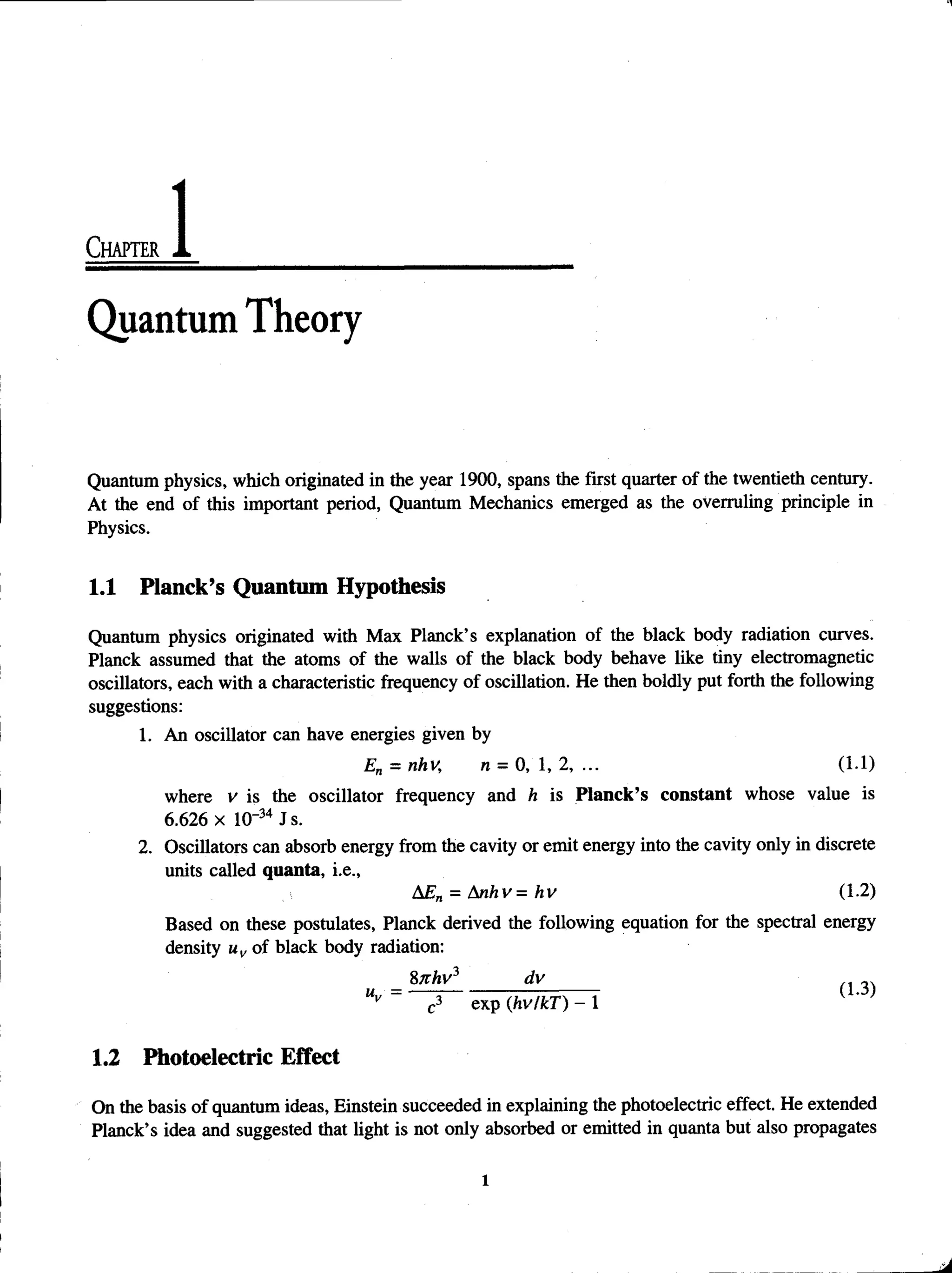
Quantum Theory
Quantum physics, which originated in the year 1900, spans the first quarter of the twentieth century.
At the end of this important period, Quantum Mechanics emerged as the overruling principle in
Physics.
1.1 Planck’s Quantum Hypothesis
Quantum physics originated with Max Planck’s explanation of the black body radiation curves.
Planck assumed that the atoms of the walls of the black body behave like tiny electromagnetic
oscillators, each with a characteristic frequency of oscillation. He then boldly put forth the following
suggestions:
1. An oscillator can have energies given by
En = nhv, n = 0, 1, 2, ... (1.1)
where v is the oscillator frequency and h is Planck’s constant whose value is
6.626 x 10⁻³⁴ Js.
2. Oscillators can absorb energy from the cavity or emit energy into the cavity only in discrete
units called quanta, i.e.,
AEn = Anhv= hv (1.2)
Based on these postulates, Planck derived the following equation for the spectral energy
density uv of black body radiation:
8Khv* _______________________________________________dv__3.
Uy c3 exp (hv/kT) - 1
1.2 Photoelectric Effect
On the basis of quantum ideas, Einstein succeeded in explaining the photoelectric effect. He extended
Planck’s idea and suggested that light is not only absorbed or emitted in quanta but also propagates
l
2 • Quantum Mechanics: 500 Problems with Solutions
as quanta of energy h v, where v is the frequency of radiation. The individual quanta of light are
called photons. Einstein’s photoelectric equation
1 9
hv = hvf j +—mv (1.4)
explained all aspectsof photoelectric effect. In Eq. (1.4), h vis the energy of theincident photon, hv0
is thework function of the metallic surface, and v0 is the thresholdfrequency. Since the rest mass
of photon is zero,
E hv h
E = cp or p = — = — = — (1.5)
C C A
1.3 Compton Effect
Compton allowed x-rays of monochromatic wavelngth K to fall on a graphite block and measured
the intensity of scattered x-rays. In the scattered x-rays, he found two wavelengths—the original
wavelength X and another wavelength X which is larger than X. Compton showed that
h
X' - X = ----- (1 - cos 0) (1.6)
m0c
where m0 is the rest mass of electron and <
f>is the scattering angle. The factor hlmyc is called the
Compton wavelength.
1.4 Bohr’s Theory of Hydrogen Atom
Niels Bohr succeeded in explaining the observed hydrogen spectrum on the basis of the following
two postulates:
(i) An electron moves only in certain allowed circular orbits which are stationary states in the
sense that no radiation is emitted. The condition for such states is that the orbital angular
momentum of the electron is given by
mvr - nh, n = 1, 2, 3, ... (1.7)
where h = h tln is called the modified Planck’s constant, v is the velocity of the electron
in the orbit of radius r, and m is the electron mass.
(ii) Emission or absorption of radiation occurs only when the electron makes a transition from
one stationary state to another. The radiation has a definite frequency vmn given by the
condition
hvmn = Em - E n (1.8)
where Em and E„ are the energies of the states m and n, respectively.
According to Bohr’s theory, the radius of the nth orbit is
r" = ^ 7 ’ k = (L9)
where £q is the permittivity of vacuum and its experimental value is 8.854 x 10~12 C2 N_1 m-2.
Quantum Theory • 3
The
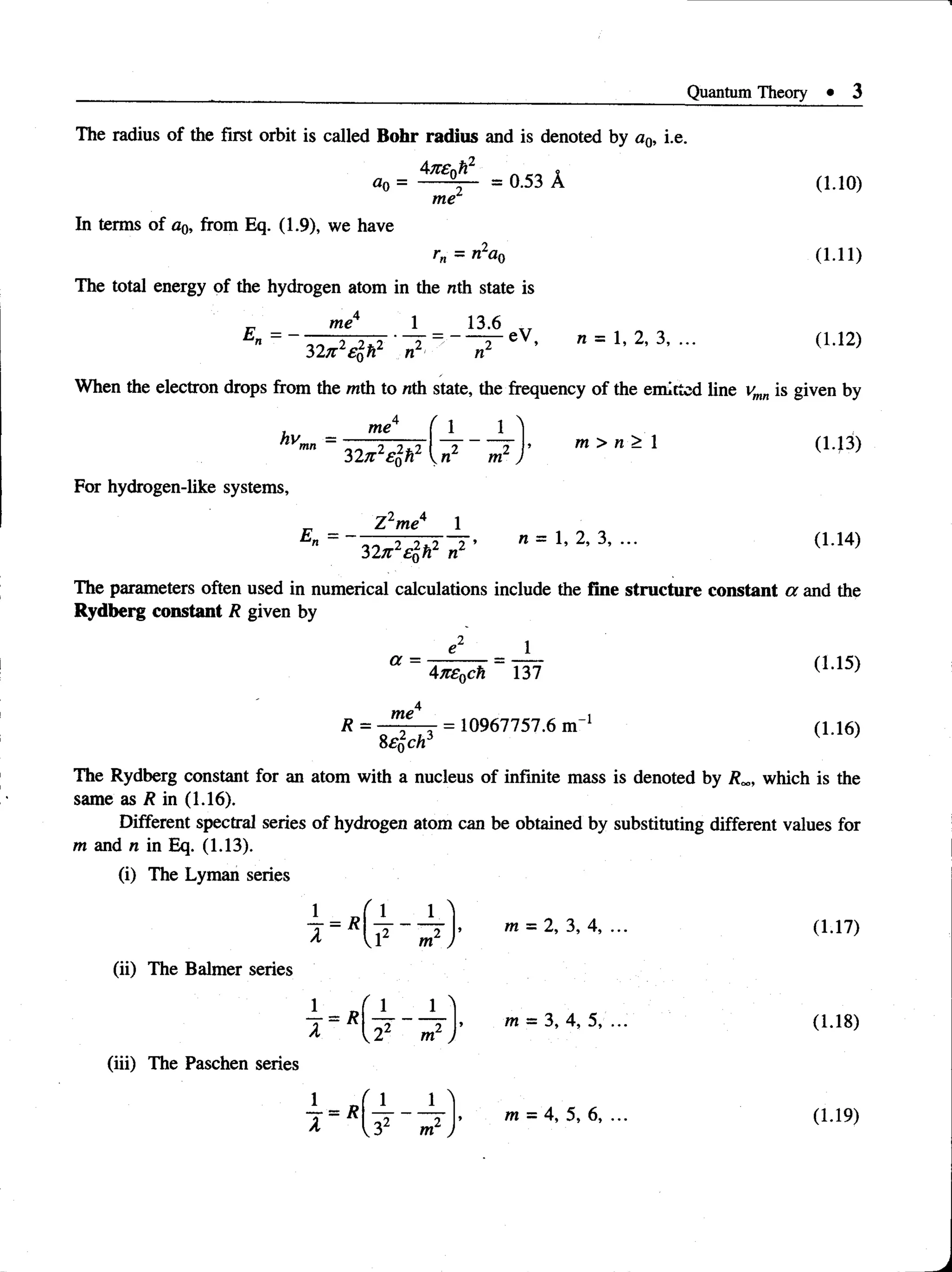
= 0.53 A
me
radius of the first orbit is called Bohr radius and is denoted by a0, i.
_*2
a0 =
In terms of a0, from Eq. (1.9), we have
r„ = nla0
The total energy of the hydrogen atom in the nth state is
1 13.6
e.
E - - me
32n 2e$h2 n
eV, n = 1, 2, 3, ...
(1.10)
(1.11)
( 1.12)
When the electron drops from the with to nth state, the frequency of the emitted line vmn is given by
, me
hv = -------------
mn 9 7 . i
32j z SqH 2 2
n m )
m > n > 1
For hydrogen-like systems,
E„ =
Z 2me4 1
32jr2£&h2 n2 ’
n = 1, 2, 3, ...
(1.13)
(1.14)
---- —
U
The parameters often used in numerical calculations include the fine structure constant a and the
Rydberg constant R given by
a =
47c£0ch 137
(1.15)
4
R = = 10967757.6 m"1 (1.16)
Sewell
The Rydberg constant for an atom with a nucleus of infinite mass is denoted by R„, which is the
same as R in (1.16).
Different spectral series of hydrogen atom can be obtained by substituting different values for
m and n in Eq. (1.13).
(i) The Lyman series
(ii) The Balmer series
(iii) The Paschen series
92
VL m )
m
m
= 2, 3, 4, ...
= 3, 4, 5, ...
(1.17)
(1.18)
4 • Quantum Mechanics: 500 Problems with Solutions
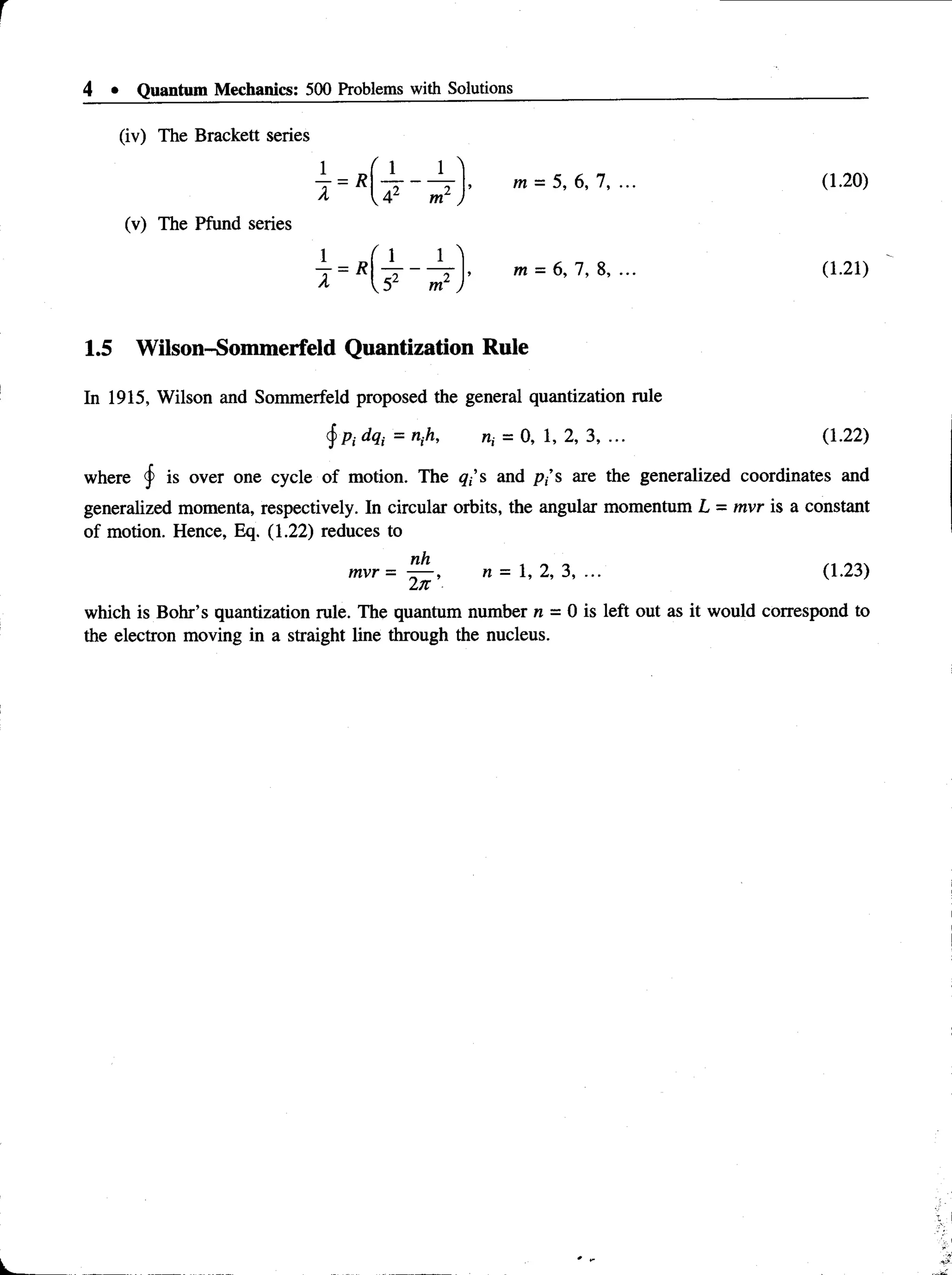
(iv) The Brackett series
J = R f i r
—7 , m = 5, 6, 7,
(v) The Pfund series
m
5 m y
m = 6, 1 , 8, ...
(1.20)
(1.21)
1.5 Wilson-Sommerfeld Quantization Rule
In 1915, Wilson and Sommerfeld proposed the general quantization rule
j Pi dqt = nth, n, = 0, 1, 2, 3, ... (1.22)
where § is over one cycle of motion. The qf s and p,’s are the generalized coordinates and
generalized momenta, respectively. In circular orbits, the angular momentum L = mvr is a constant
of motion. Hence, Eq. (1.22) reduces to
n.h
mvr = —
—, n = 1, 2, 3, ..
2k
(1.23)
which is Bohr’s quantization rule. The quantum number n = 0 is left out as it would correspond to
the electron moving in a straight line through the nucleus.
Quantum Theory • 5
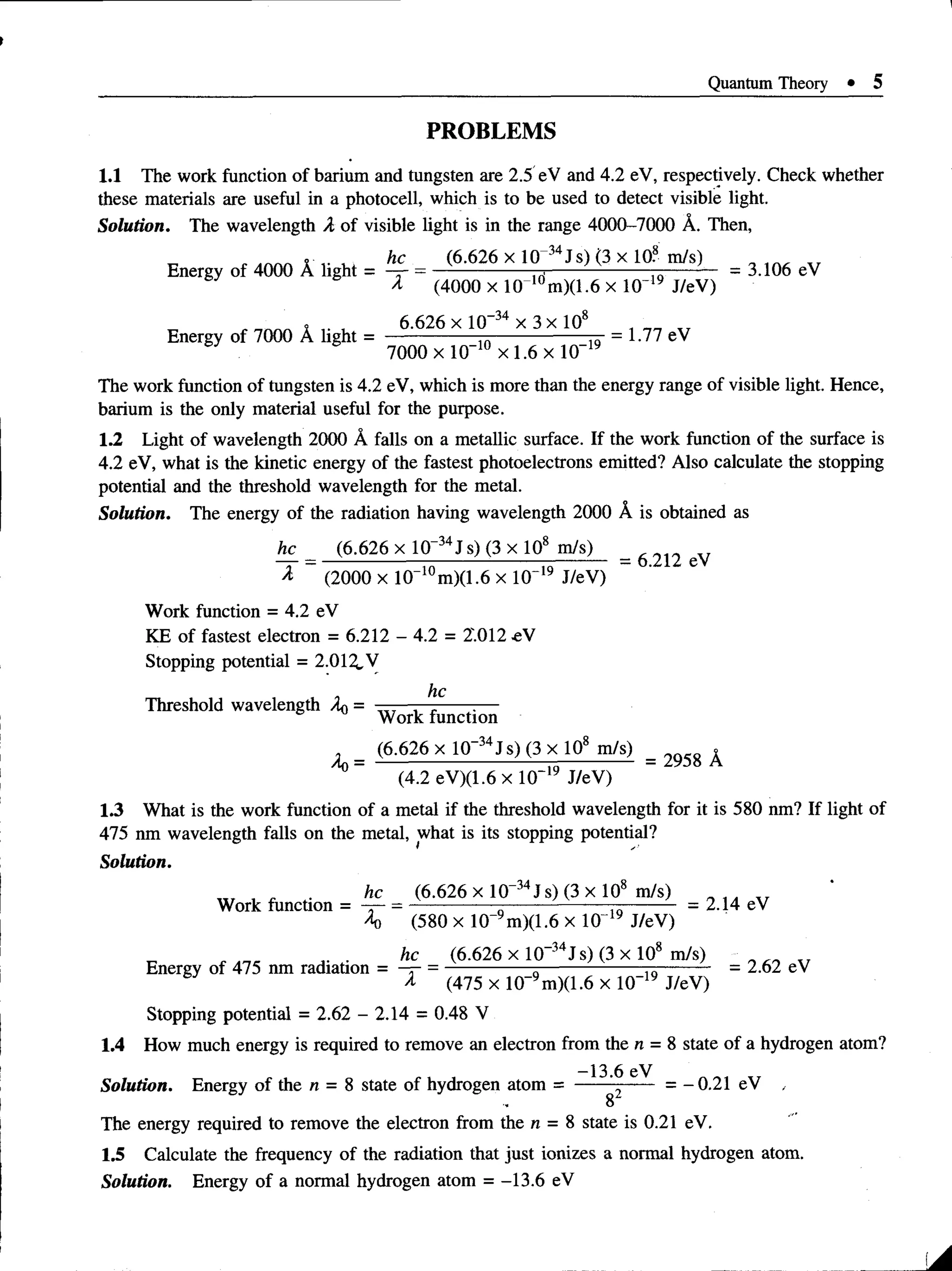
PROBLEMS
1.1 The work function of barium and tungsten are 2.5 eV and 4.2 eV, respectively. Check whether
these materials are useful in a photocell, which is to be used to detect visible light.
Solution. The wavelength A. of visible light is in the range 4000-7000 A. Then,
...........i - , . , , he (6.626 x 10 34Js) (3 x 10? m/s) „ _ „
Energy of 4000 A light = — = -----------------j----------------- —
-------- = 3.106 eV
A (4000x 10 10m)(l.6 x l 0 ~19 J/eV)
. . , 6.626 x 10”34 x 3x 108 , „
Energy of 7000 A light = ---------------^ = 1.77 eV
7000 xlO “10x 1.6 xlO -19
The work function of tungsten is 4.2 eV, which is more than the energy range of visible light. Hence,
barium is the only material useful for the purpose.
1.2 Light of wavelength 2000 A falls on a metallic surface. If the work function of the surface is
4.2 eV, what is the kinetic energy of the fastest photoelectrons emitted? Also calculate the stopping
potential and the threshold wavelength for the metal.
Solution. The energy of the radiation having wavelength 2000 A is obtained as
he (6.626 x 10⁻³⁴J s) (3 x 10⁸ m/s)
A (2000 x 10“10m)(1.6 x 10“19 J/eV)
Work function = 4.2 eV
KE of fastest electron = 6.212 - 4.2 = 2'.012 eV
Stopping potential = 2.012.V
he
Threshold wavelength Aq =
= 6.212 eV
Work function
in n/n x ill ^
^0
(6.626 x 10 J s) (3 x 10⁸ m/s) x
= ----------------------------— - 2958 A
(4.2 eV)(1.6 x 10~'y J/eV)
1.3 What is the work function of a metal if the threshold wavelength for it is 580 nm? If light of
475 nm wavelength falls on the metal, what is its stopping potential?
Solution.
„ T , ^ .. he (6.626 x 10⁻³⁴J s) (3 x 10⁸ m/s) „ , „
Work function = -r- = ---------- — ----- ------- — —
-------- - 2.14 eV
4) (580 x 10 m)(1.6 x 10"19 J/eV)
he (6.626 x 10_34Js) (3 x 10⁸ m/s)
Energy of 475 nm radiation = —
r- = -------------- „-----------------7
7
;-------- - 2.62 ev
& (475 x 10_9m)(1.6 x 10⁻¹⁹ J/eV)
Stopping potential = 2.62 - 2.14 = 0.48 V
1.4 How much energy is required to remove an electron from the n = 8 state of a hydrogen atom?
-13.6 eV
Solution. Energy of the n = 8 state of hydrogen atom = ----- ------ = -0.21 eV .
8
The energy required to remove the electron from the n = 8 state is 0.21 eV.
1.5 Calculate the frequency of the radiation that just ionizes a normal hydrogen atom.
Solution. Energy of a normal hydrogen atom = -13.6 eV
6 • Quantum Mechanics: 500 Problems with Solutions
Frequency of radiation that just ionizes is equal to
| , 13.fre V (1. 6 x 10--»J/eV) = 3 2 8 4 x l0 ,SH z
h 6.626 x 10“34 Js
1.6 A photon of wavelength 4 A strikes an electron at rest and is scattered at an angle of 150° to
its original direction. Find the wavelength of the photon after collision.
Solution.
AA = X - A= — (1 - cos 150°)
moc
6.626 x 1(T34Js x 1.866 ,
= 0.045 A
(9.11 x 10 kg)(3 x 10 m/s)
A + 0.045 A = 4.045 A
1.7 Whenradiation ofwavelength 1500A is incident on a photocell, electrons are emitted. If the
stoppingpotential is4.4 volts,calculate the work function, threshold frequency and threshold
wavelength.
he
Solution. Energy of the incident photon = —
A
(6.626 x 10“34 J s) (3 x 10⁸ m/s) o „
= 8.28 ev
(1500 x 10“10m)(1.6 x 10~19 J/eV)
Work function = 8.28 - 4.4 = 3.88 eV
3.88 eV (1.6 x l0 - 19J/eV) _ _ 14 „
Threshold frequency vf, = ------------ :--------- —
---------- = 9.4 x 10 Hz
6.626 X 10“34Js
Threshold wavelength Ao = — = ^ ^ = 3191 A
v0 9.4 x 10¹⁴ s_1
1.8 If a photon has wavelength equal to the Compton wavelength of the particle, show that the
photon’s energy is equal to the rest energy of the particle.
Solution. Compton wavelength of a particle = h/m0c~
he
Wavelength of a photon having energy E = —
/ E
Equating the above two equations, we get
h he
m{)c ~ T O
T E = n w
which is the rest energy of the particle.
1.9 x-rays of wavelength 1.4 A are scattered from a block of carbon. What will be the wavelength
of scattered x-rays at (i) 180°, (ii) 90°, and (iii) 0°?
Solution.
A = A + - ^ - ( 1 - c o s 0), A = 1.4 A
m0c
Quantum Theory • 7
h 6.626 x 10 34 Js nMA i
— rj - —0.024 A
9.1 x 1(T31kg (3 x 10⁸m/s)
(i) A' = A + — x 2 = 1.45 A
m0c
(ii) A '= A + — = 1.42 A
m0c
(iii) A' = A + — (1 - 1) = 1.4 A
moc
1.10 Determine the maximum wavelength that hydrogen in its ground state can absorb. What
would be the next smallest wavelength that would work?
Solution. The maximum wavelength corresponds to minimum energy. Hence, transition from
n = 1 to n = 2 gives the maximum wavelength. The next wavelength the ground state can absorb is
the one for n = 1 to n = 3.
The energy of the ground state, E = -13.6 eV
__ 2 3 ^
Energy of the n = 2 state, E2 = — eV = -3.4 eV
_^
Energy of the n = 3 state, E3 = — eV = -1.5 eV
Maximum wavelength =
E2 - E 1
_ (6.626 x 10 J s) (3 x 10s m/s)
10.2 eV x 1.6x10 19 J/eV
= 122 x 10~9 m = 122 nm
he
Next maximum wavelength = —----- tt =103 nm
£3 - *1
1.11 State the equation for the energy of the nth state of the electron in the hydrogen atom and
express it in electron volts.
Solution. The energy of the nth state is
E„= -
me4 1
8e^h2 n2
-(9.11 x 10~31 kg) (1.6 x 10~19 C)4
8(8.85 x 10_12C2 N"1m“2)2(6.626 x 10“34J s ) V
-21.703 x 10“19 j _ 21.703 x 10⁻¹⁹ J
n2 1.6 x 10⁻¹⁹n2 J/eV
13.56
n
eV
8 • Quantum Mechanics: 500 Problems with Solutions
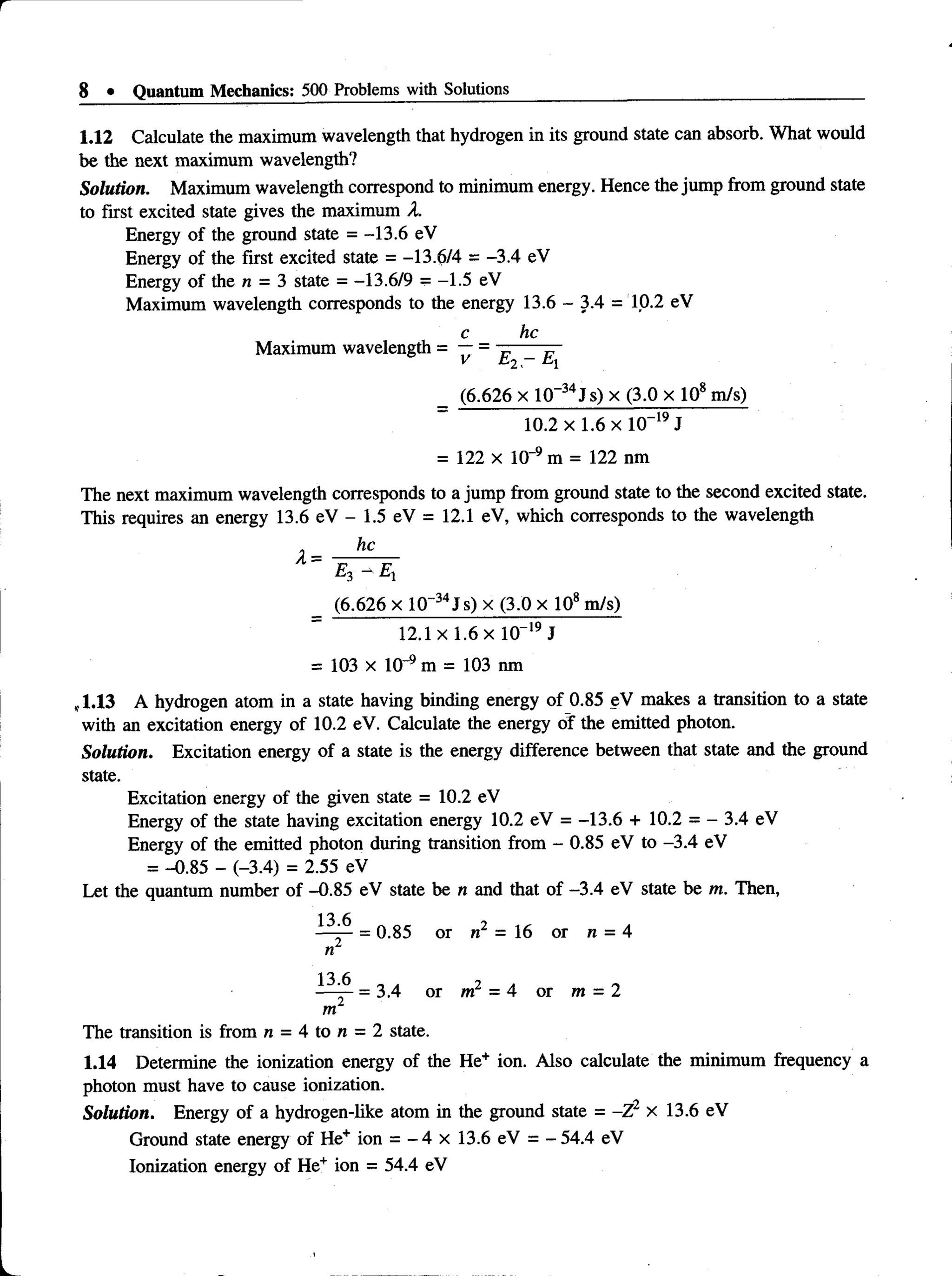
1.12 Calculate the maximum wavelength that hydrogen in its ground state can absorb. What would
be the next maximum wavelength?
Solution. Maximum wavelength correspond to minimum energy. Hence the jump from ground state
to first excited state gives the maximum X.
Energy of the ground state = -13.6 eV
Energy of the first excited state = -13.6/4 = -3.4 eV
Energy of the n = 3 state = -13.6/9 = -1.5 eV
Maximum wavelength corresponds to the energy 13.6 - 3.4 = 10.2 eV
c he
Maximum wavelength = —= —----- —
_ (6.626 x 10~34J s) x (3.0 x 10⁸m/s)
10.2 x 1.6 x lO “19J
= 122 x 10~9 m = 122 nm
The next maximum wavelength corresponds to a jump from ground state to the second excited state.
This requires an energy 13.6 eV - 1.5 eV = 12.1 eV, which corresponds to the wavelength
_ (6.626 x 10~34J s) x (3.0 x 10⁸m/s)
12.1 x 1.6 x 10“19J
= 103 x 10~9 m = 103 nm
,1.13 A hydrogen atom in a state having binding energy of 0.85 eV makes a transition to a state
with an excitation energy of 10.2 eV. Calculate the energy of the emitted photon.
Solution. Excitation energy of a state is the energy difference between that state and the ground
state.
Excitation energy of the given state = 10.2 eV
Energy of the state having excitation energy 10.2 eV = -13.6 + 10.2 = - 3.4 eV
Energy of the emitted photon during transition from - 0.85 eV to -3.4 eV
= -0.85 - (-3.4) = 2.55 eV
Let the quantum number of -0.85 eV state ben and that of -3.4 eVstate be m. Then,
= 0.85 or n2 = 16 or n = 4
«2
13 6
— -r- = 3.4 or m2 = 4 or m = 2
m2
The transition is from n = 4 to n = 2 state.
1.14 Determine the ionization energy of the He+ ion. Also calculate the minimum frequency a
photon must have to cause ionization.
Solution. Energy of a hydrogen-like atom in the ground state = -Z2 x 13.6 eV
Ground state energy of He+ ion = - 4 x 13.6 eV = - 54.4 eV
Ionization energy of He+ ion = 54.4 eV
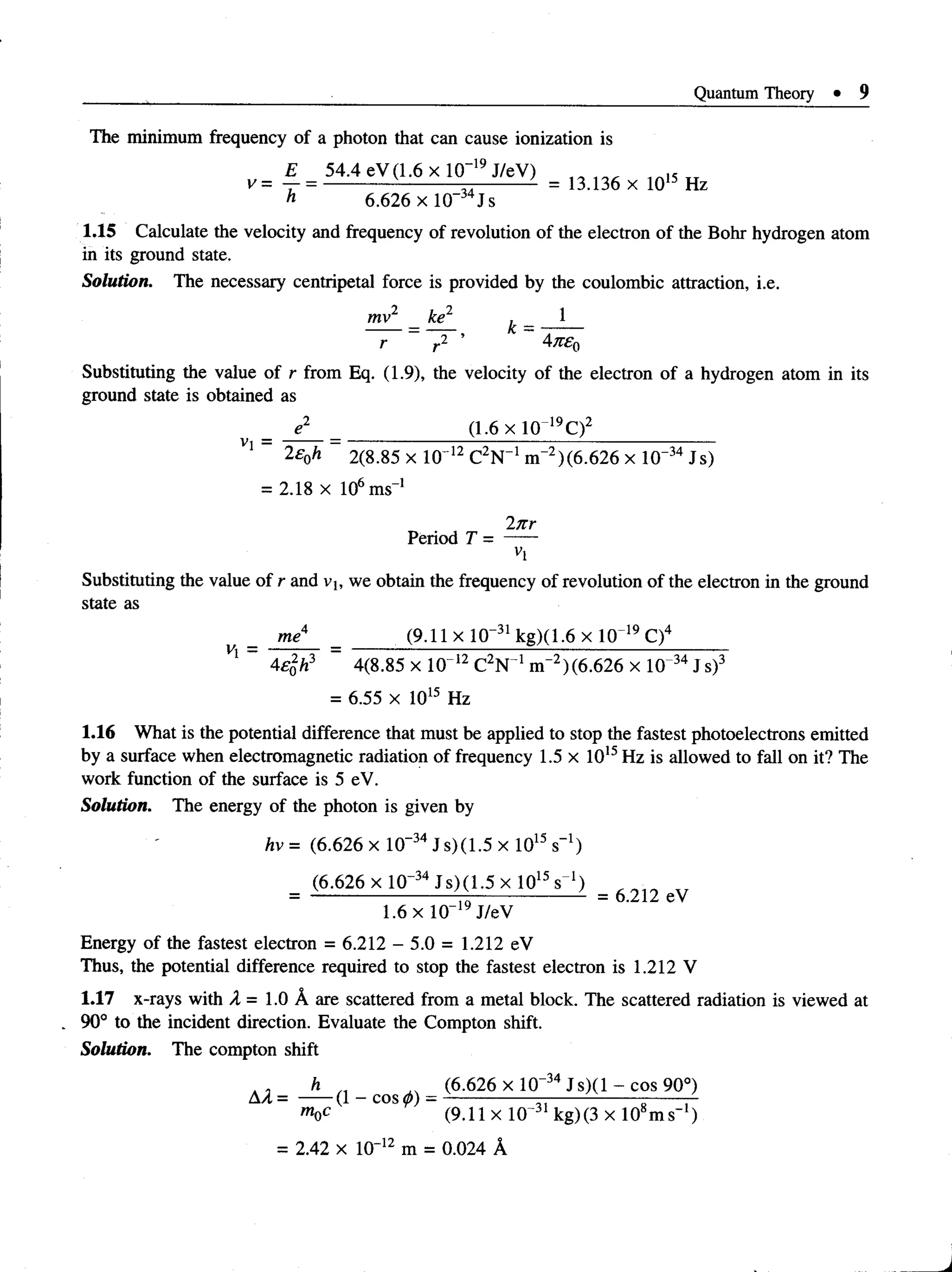
Quantum Theory • 9
The minimum frequency of a photon that can cause ionization is
il J‘+.‘+ CVU.UAH1 ^
V =
* j±leyq:6xlO-'»JteV) = , 3 , 3 6 x 1 Q „ H z
h 6.626 xlO _34Js
1.15 Calculate the velocity and frequency of revolution of the electron of the Bohr hydrogen atom
in its ground state.
Solution. The necessary centripetal force is provided by the coulombic attraction, i.e.
mv2 ke1 , 1
r2 ’ * 4ne.
o
Substituting the value of r from Eq. (1.9), the velocity of the electron of a hydrogen atom in its
ground state is obtained as
Vi =
e2 (1.6 x 10 19C)2
2£0h 2(8.85 x 10' 12 C2N_1 m-2)(6.626 x 10"34 Js)
= 2.18 x 10⁶ms-1
In r
Period T = —
n
Substituting the value of r and vj, we obtain the frequency of revolution of the electron in the ground
state as
me4 (9.11xlO “31kg)(1.6xlO 19C)4
v'i - “
4£%h3 4(8.85 x 10~12 C2N 1m"2)(6.626 x 10 34 Js)3
= 6.55 x 10¹⁵ Hz
1.16 What is the potential difference that must be applied to stop the fastest photoelectrons emitted
by a surface when electromagnetic radiation of frequency 1.5 x 10¹⁵Hz is allowed to fall on it? The
work function of the surface is 5 eV.
Solution. The energy of the photon is given by
hv = (6.626 x 10~34 Js)(1.5 x 10¹⁵ s-1)
= (6-626 x IQ"34 J s )(1 .5 x l0 15s 1) = 6 2 U
1.6 x 10⁻¹⁹ J/eV
Energy of the fastest electron = 6.212 - 5.0 = 1.212 eV
Thus, the potential difference required to stop the fastest electron is 1.212 V
1.17 x-rayswith A = 1.0 A are scattered from a metal block. Thescattered radiation is viewed at
90° to theincidentdirection. Evaluate the Compton shift.
Solution. The compton shift
h „ ^ (6.626 x lO “34J s ) ( l - c o s 90°)
Aa = ----- (l-cos<*>) = --------------- -----------------------—
moc (9.11 x 10 kg)(3 x 10 m s )
= 2.42 x 10~12 m = 0.024 A
10 • Quantum Mechanics: 500 Problems with Solutions
1.18 From a sodium surface, light of wavelength 3125 and 3650 A causes emission of electrons
whose maximum kinetic energy is 2.128 and 1.595 eV, respectively. Estimate Planck’s constant and
the work function of sodium.
Solution. Einstein’s photoelectric equation is
he he
— = — + kinetic energy
A Aq
he he
3125 x 10~10m 4)
+ 2.128 eV x (1.6 x 10~19J/eV)
he
3650 x 10“10m 4>
hr
= + 1.595 eV (1.6 x 10~19J/eV)
1
he
lO"10 1 3125 3650
= 0.533 x 1.6 x lO-19 J
0.533 x 1.6 x 10"19 x 10“10 x 3125 x 3650 _
h= ------------------------------------ 5— ---------------- Js
525 x 3 x 108
= 6.176 x lO' 34 Js
From the first equation, the work function
he = (6.176 x 10~34 J s)(3 x IQ8 m/s) _ ^ x Lfi x 1(J_I9 ;
A) 3125 x 10-10 m
= 2.524 x 1.6 x 10-19 J = 2.524 eV
1.19 Construct the energy-level diagram for doubly ionized lithium.
Solution.
Z2 x 13.6 „ 9x1 3 .6 „
E --------------------eV = ---------- -— eV
n
122.4
n2
eV
Ei = -122.4 eV
E3 = -13.6 eV '
E2 = -30.6 eV
£4 = -7.65 eV
These energies are represented in Fig. 1.1.
E(eV)
0
-7.65
-13.6
-30.6
-122.4
Fig. 1.1 Energy level diagram for doubly ionized lithium (not to scale).
Quantum Theory • 11
1.20 What are the potential and kinetic energies of the electron in the ground state of the hydrogen
atom?
Solution.
Potential energy =
1 e2
4t
c
£q r
Substituting the value of r from Eq. (1.9), we get
4
me
Potential energy =
-
—— - = -2E, = -27.2 eV
16n £qH
Kinetic energy = total energy - potential energy
= -13.6 eV + 27.2 eV = 13.6 eV
1.21 Show that the magnitude of the potential energy of an electron in any Bohr orbit of the
hydrogen atom is twice the magnitude of its kinetic energy in that orbit. What is the kinetic energy
of the electron in the n = 3 orbit? What is its potential energy in the n - 4 orbit?
Solution.
Radius of the Bohr orbit rn = n2a0
1 e2 1 e2 27 2
Potential energy = - - — = - - — = --— eV
4 ^ 0 rn n 0 O n 2
Kinetic energy = Total energy - Potential energy
13.6 „ 27.2 w 13.6 , T
= -----5- eV + — — eV = — — eV
n n n
13 6
KE in the n - 3 orbit = ——— = 1.51 eV
27 2
Potential energy in the n = 4 orbit = ------— = - 1.7 eV
16
1.22 Calculate the momentum of the photon of largest energy in the hydrogen spectrum. Also
evaluate the velocity of the recoiling atom when it emits this photon. The mass of the atom =
1.67 x 10⁻²⁷ kg.
Solution. The photon of the largest energy in the hydrogen spectrum occurs at the Lyman series
limit, that is, when the quantum number n changes from °° to 1. For Lyman series, we have
2 2 m = 2, 3, 4, ...
For the largest energy, m = Hence,
U r
£ ' " ’ 'r-?' ! ^ ^ •
hv h
Momentum of the photon = — = — = hR
c A
= (6.626 x 10~34 Js) (1.0967 x 10⁷ n r 1)
= 7.267 x IQ"27 kg m s~'
12 • OiiantumMechanics: 500 Problems with Solutions
momentum
Velocity of recoil of the atom = ---------------
J mass
= 7-266 x l 0 - 27kgm£ ^ ^ 4 35m s- 1
1.67 x 10⁻²⁷ kg
1.23 Show that the electron in the Bohr orbits of hydrogen atom has quantized speeds v„ = coin,
where a is the fine structure constant. Use this result to evaluate the kinetic energy of hydrogen atom
in the ground state in eV.
Solution. According to the Bohr postulate,
mvr = nh, n = 1, 2, 3, ...
The coulombic attraction between the electron and the proton provides the necessary centripetal
force, i.e.,
mv2 ke2 ^ _ 1
ke2
mvr = -----
v
Combining the two equations for mvr, we obtain
ke ke
-----= nh or v = ——
v nh
ke2 c ac . ke2
v = ------- = — since a = ——
ch n n cn
.2~2
1 2 1 c a
Kinetic energy = —my = —m— j-
l n
1 (9.1 x IQ-31 kg)(3 x 10⁸ms x)2 1
2 1372 n2
21.8179 x 10_19J 21.8179 x 10"19J
n2 n2(1.6 x 10⁻¹⁹ J/eV)
= 13.636- y eV
n
Kinetic energy in the ground state = 13.636 eV
1.24 In Moseley’s data, the K„ wavelengths for two elements are found at 0.8364 and 0.1798 nm.
Identify the elements.
Solution. The K„ x-ray is emitted when a vacancy in the K-shell is filled by an electron from the
L-shell. Inside the orbit of L-electron, there are z-protons and the one electron left in the K-shell.
Hence the effective charge experienced by the L-electron is approximately (Z - l)e. Consequently,
the energy of such an electron is given by
(Z - l)213.6 eV
Quantum Theory • 13
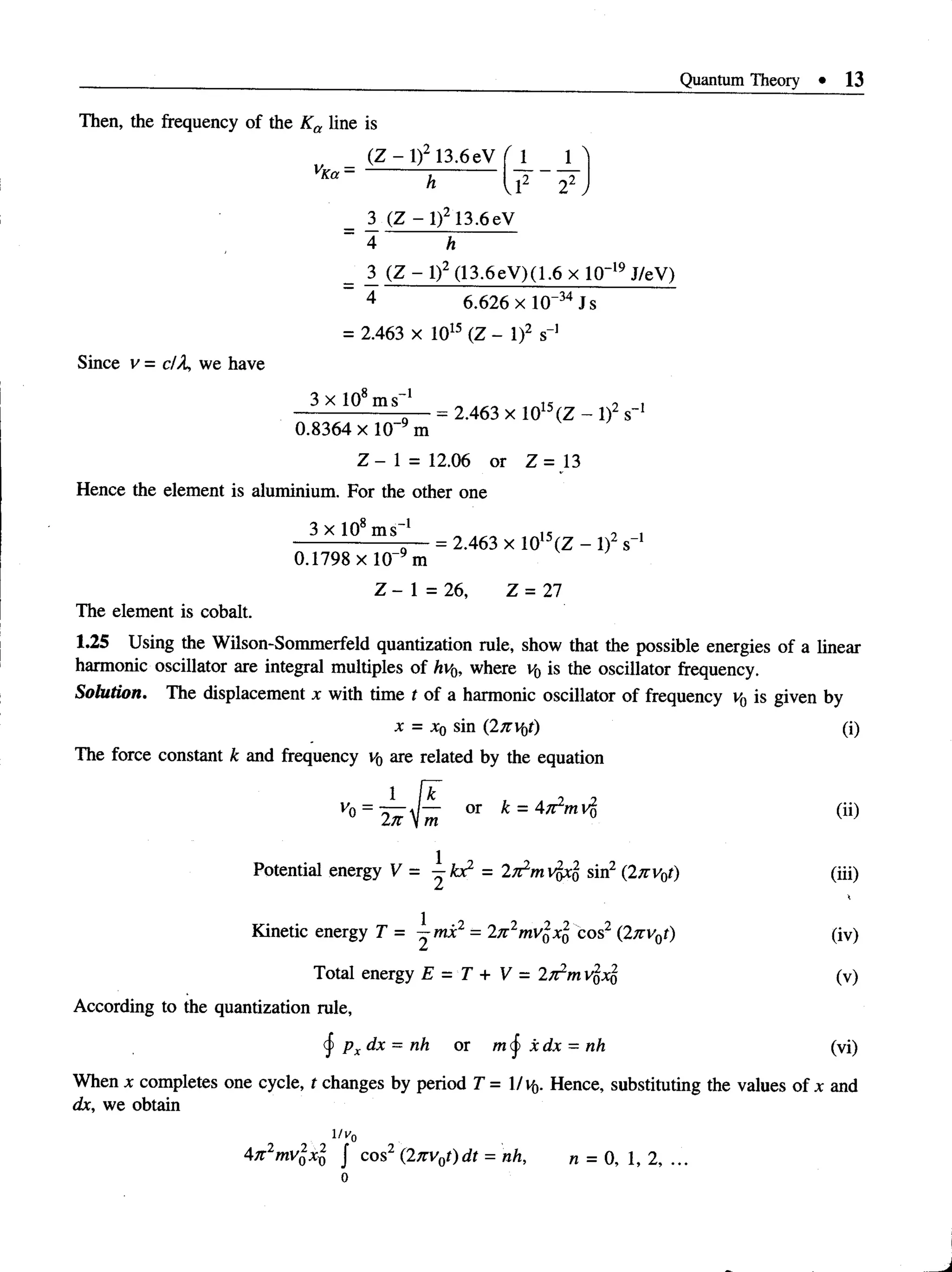
Then, the frequency of the Ka line is
Since v = dX, we have
(Z - l)2 13.6eV ( 1 1 A
vKa - ;---------- ------ ~
h v1 2 .
3 (Z - l ) 2 13.6eV
4 h
_ 3 (Z - l)2 (13.6eV)(1.6 x 10~19J/eV)
4 6.626 x l(T34Js
= 2.463 x 10¹⁵ (Z - l)2 s”1
3 x 10⁸ms 1 „ is 9 i
--------------------= 2.463 x 10¹⁵(Z - l)2 s_1
0.8364 x l 0 “9 m
Z - 1 = 12.06 or Z = 13
Hence the element is aluminium. For the other one
3 x 10⁸m s-1 _ is 9 i
----------------- 5— = 2.463 x 10¹⁵(Z - l)2 s"1
0.1798 x l 0 _9m
Z - 1 = 26, Z = 27
The element is cobalt.
1.25 Using the Wilson-Sommerfeld quantization rule, show that the possible energies of a linear
harmonic oscillator are integral multiples of hv0, where v0 is the oscillator frequency.
Solution. The displacement x with time t of a harmonic oscillator of frequency v{) is given by
x = x0 sin (2nv0t) (i)
The force constant k and frequency v0 are related by the equation
V
° = i ^ O
T * = 4^ (“)
Potential energy V = ^ k x 2 = 2T^mvfixjf sin2 (2/rvy) (iii)
Kinetic energy T = ^ m i2 = 2n2m vlxl cos2 (2nv0t) (iv)
Total energy E = T + V = l ^ m VqXq (v)
According to the quantization rule,
px dx = nh or m § xdx = nh (vi)
When x completes one cycle, t changes by period T = 1/vf,. Hence, substituting the values of x and
dx, we obtain
lv 0
47t2mv%xl J cos2 (2jrv0t)dt = nh, n = 0, 1, 2, ...
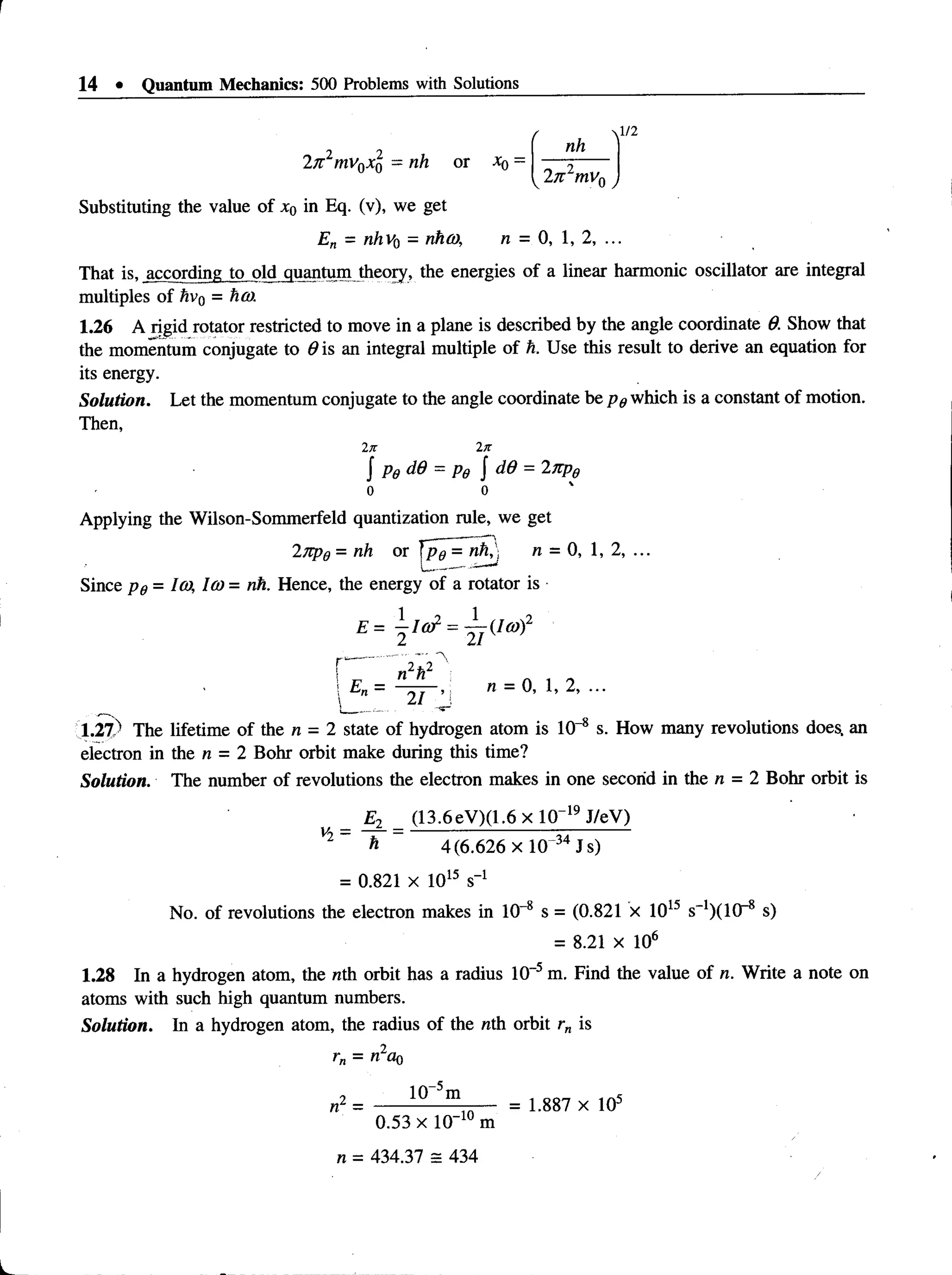
14 • Quantum Mechanics: 500 Problems with Solutions
2ft2mv0x0 - nh or x0 =
r , ^/2
nh
 2n 2mv0 j
Substituting the value of x0 in Eq. (v), we get
En - nhv0 - rihco, n = 0, 1, 2, ...
That is, according to old quantum theory, the energies of a linear harmonic oscillator are integral
multiples of hv0 = ha).
1.26 A rigid rotator restricted to move in a plane is described by the angle coordinate 9. Show that
the momentum conjugate to 6 is an integral multiple of h. Use this result to derive an equation for
its energy.
Solution. Let the momentum conjugate to the angle coordinate be p# which is a constant of motion.
Then,
In 2n
J pg dd = Pg J dd = 27C
pg
0 0
Applying the Wilson-Sommerfeld quantization rule, we get
—
-----—
i
27tpe = nh or Jpe = nh^j n =0, 1,2, ...
Since p e = Ico, 1(0 = nh. Hence, the energy of a rotator is
U „ = 4 r - . : n = 0, 1, 2, ...
_ ... 21 ,J
1.27 -
' The lifetime of the n - 2 state of hydrogen atom is10-8 s. How many revolutionsdoes, an
electron in the n = 2 Bohr orbit make during this time?
Solution. The number of revolutions the electron makes in onesecond in the n = 2 Bohr orbit is
E2 (13.6eV)(1.6 x 10~19 J/eV)
Vl~ h ~ 4(6.626 x 10 34 Js)
= 0.821 x 10¹⁵ s_1
No. of revolutions the electron makes in 10-8 s = (0.821 x 10¹⁵ s_1)(10r8 s)
= 8.21 x 10⁶
1.28 In a hydrogen atom, the nth orbit has a radius 10“5m.Find the value of n. Write a note on
atoms with such high quantum numbers.
Solution. In a hydrogen atom, the radius of the nth orbit rn is
Quantum Theory • 15
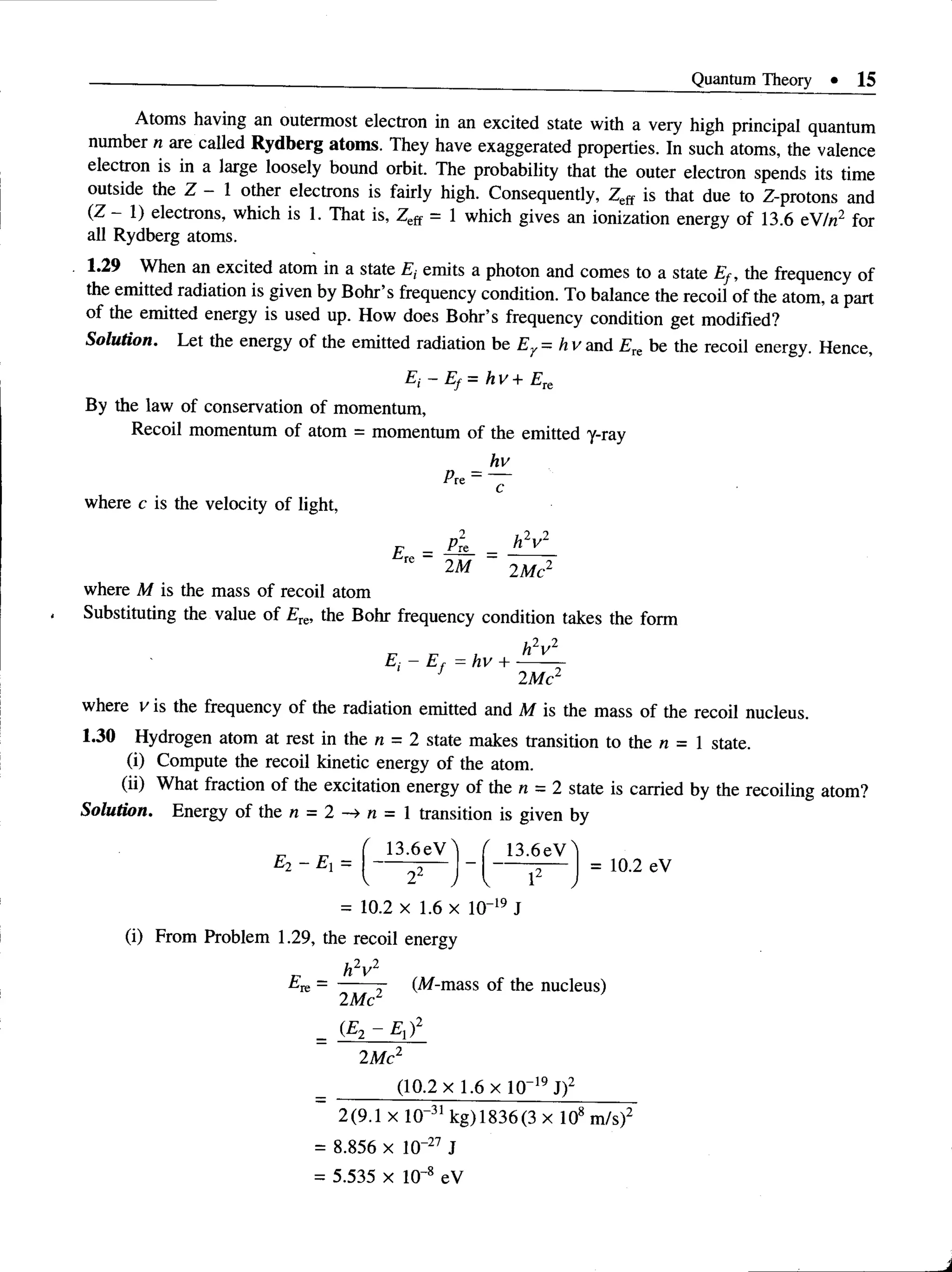
Atoms having an outermost electron in an excited state with a very high principal quantum
number n are called Rydberg atoms. They have exaggerated properties. In such atoms, the valence
electron is in a large loosely bound orbit. The probability that the outer electron spends its time
outside the Z - 1 other electrons is fairly high. Consequently, Zeff is that due to Z-protons and
(Z —1) electrons, which is 1. That is, Zeff = 1 which gives an ionization energy of 13.6 eV/n2 for
all Rydberg atoms.
1.29 When an excited atom in a state £, emits a photon and comes to a state Ef , the frequency of
the emitted radiation is given by Bohr’s frequency condition. To balance the recoil of the atom, a part
of the emitted energy is used up. How does Bohr’s frequency condition get modified?
Solution. Let the energy of the emitted radiation be Ey = h v and Eie be the recoil energy. Hence,
where M is the mass of recoil atom
Substituting the value of Ete, the Bohr frequency condition takes the form
where v is the frequency of the radiation emitted and M is the mass of the recoil nucleus.
1.30 Hydrogen atom at rest in the n = 2 state makes transition to the n = 1 state.
(i) Compute the recoil kinetic energy of the atom.
(ii) What fraction of the excitation energy of the n = 2 state is carried by the recoiling atom?
Solution. Energy of the n = 2 -> n = 1 transition is given by
E, - Ef = h v + Ek
By the law of conservation of momentum,
Recoil momentum of atom = momentum of the emitted y-ray
hv
where c is the velocity of light,
= 10.2 x 1.6 x 10“19 J
(i) From Problem 1.29, the recoil energy
Ek = ------- (M-mass of the nucleus)
1 AA~2 '
2Me
(E2 - E rf
2Me2
(10.2 x 1.6 x 10“19J)2
2(9.1 x 10“31 kg) 1836(3 x 10⁸ m/s)2
= 8.856 x lO' 27 J
= 5.535 x 10⁻⁸ eV
16 • Quantum Mechanics: 500 Problems with Solutions
(ii) Excitation energy of the n = 2 state is 10.2 eV. Then,
Recoil energy 5.535 x l 0 _8eV 9
------------------—— = ----- ----------------= 5.4 X10*
Excitation energy 10.2 ev
1.31 In the lithium atom (Z = 3), the energy of the outer electron is approximated as
(Z - a )2 13.6 eV
n2
where <7is the screening constant. If the measured ionization energy is 5.39 eV, what is the value
of screening constant?
Solution. The electronic configuration for lithium is 1s2.2 s1. For the outer electron, n = 2. Since
the ionization energy is 5.39 eV, the energy of the outer electron E = -5.39 eV. Given
( Z - c r)2 13.6eV
n2
Equating the two energy relations, we get
1.32 The wavelength of the La line for an element has a wavelength of 0.3617 nm. What is the
element? Use (Z - 7.4) for the effective nuclear charge.
Solution. The La transition is from n = 3 to n = 2. The frequency of the La transition is given by
(Z - a )2 13.6eV
22
= - 5.39eV
(Z - o f
Z - £7= 1.259
<7= 3 —1.259 = 1.741
£ _ (Z - 7.4)2 13.6eV f j ____ 1_'
A ~ h v 22 32 ,
0.3617 x 10“9m
3 x 10⁸m/s (Z - 7.4)2 (13.6eV x 1.6 x 10~19J/eV)
6.626 x 10~34 J s
5
x —
8.294 x 10¹⁷ s’1 = (Z - 7.4)2 (0.456 x 10¹⁵ s”1)
Z - 7.4 = 42.64 or Z = 50.04
The element is tin.
Chapter
Wave Mechanical Concepts
2.1 Wave Nature of Particles
Classical physics considered particles and waves as distinct entities. Quantum ideas firmly
established that radiation has both wave and particle nature. This dual nature was extended to
material particles by Louis de Broglie in 1924. The wave associated with a particle in motion, called
matter wave, has the wavelength X given by the de Broglie equation
where p is the momentum of the particle. Electron diffraction experiments conclusively proved the
dual nature of material particles in motion.
2.2 Uncertainty Principle
When waves are associated with particles, some kind of indeterminacy is bound to be present.
Heisenberg critically analyzed this and proposed the uncertainty principle:
where Ax is the uncertainty in the measurement of position and Apx is the uncertainty in the
measurement of the x-component of momentum. A more rigorous derivation leads to
Two other equally useful forms are the energy time and angular momentum-polar angle relations
given respecting by
h h
p m  (2.1)
Ax ■Apx ~ h (2.2)
(2.3)
h
AE ■At > -
2 (2.4)
ALz A</>> %
r ~ 2
17
(2.5)
18 • Quantum Mechanics: 500 Problems with Solutions
2.3 Wave Packet
The linear superposition principle, which is valid for wave motion, is also valid for material particles.
To describe matter waves associated with particles in motion, we requires a quantity which varies
in space and time. This quantity, called the wave function 'F(r, t), is confined to a small region in
space and is called the wave packet or wave group. Mathematically, a wave packet can be
constructed by the superposition of an infinite number of plane waves with slightly differing ^-values,
as
'P(jc, t) = JA(k) exp [ikx - ia>(k)t] dk (2.6)
where k is the wave vector and a) is the angular frequency. Since the wave packet is localized, the
limit of the integral is restricted to a small range of ^-values, say, (k0-A k )< k < (k0+ AA;). The speed
with which the component waves of the wave packet move is called the phase velocity  p which is
defined as
v = — (2-7)
p k
The speed with which the envelope of the wave packet moves is called the group velocity vg given
by r
v = — (2.8)
* dk
2.4 Time-dependent Schrodinger Equation
For a detailed study of systems, Schrodinger formulated an equation of motion for 'F(r, t):
2m
V2 + V(r) ¥ ( r ,0 (2.9)
The quantity in the square brackets is called the Hamiltonian operator of the system. Schrodinger
realized that, in the new mechanics, the energy E, the momentum p, the coordinate r, and time t have
to be considered as operators operating on functions. An analysis leads to the following operators for
the different dynamical variables:
E —
» ih ^ - ,p —
>-iftV,
at
r r, (2.10)
2.5 Physical Interpretation of 'F(r, 0
2.5.1 Probability Interpretation
A universally accepted interpretation of >
F(r, t) was suggested by Bom in 1926. He interpreted 'P*'P
as the position probability density P (r, t):
|2
P(r, t) = ¥*(!■, t) ¥(r, t) = ^ (r, t) (2.11)
Wave Mechanical Concepts • 19
The quantity^ ( r , f)| dr isthe probability of finding the system at time t in the elementary volume
d t surrounding the pointr.Since the total probability is 1,we have
J |'P ( r , 0 |2 dT = l (2.12)
If ¥ is not satisfying this condition, one can multiply Y by a constant, say N, so that N*¥ satisfies
Eq. (2.12). Then,
N2 ]'¥ (r,t)1 dr =l (2.i3)
The constant N is called the normalization constant.
2.5.2 Probability Current Density
The probability current density j (r, t) is defined as
ih
j(r ’ t ) = 2iH ('FV'r * " ^ V4/) (2‘14>
It may be noted that, if Y is real, the vectorj (r, t) vanishes. The functionj (r, t) satisfies the equation
of continuity
Yt p (r,t) + V j ( r ,t) = 0 (2.15)
Equation (2.15) is a quantum mechanical probability conservation equation. That is, if the probability
of finding the system in some region increases with time, the probability of finding the system
outside decreases by the same amount.
2.6 Time-independent Schrodinger Equation
If the Hamiltonian operator does not depend on time, the variables r a
nd tof the wave function
*F(r, f) can be separated into two functions y/(r) and (pit) as
*F(r, t) = y/(r) (pit) (2.16)
Simplifying, the time-dependent Schrodinger equation, Eq. (2.9),splits into the following two
equations:
1 dtp _ iE
~ ~ Y
(p{t) dt
- A v 2 + y (,)
(2.17)
y/(r) = Ey/(r) (2.18)
The separation constant E is the energy of the system. Equation (2.18) is the time-independent
Schrodinger equation. The solution of Eq. (2.17) gives
(p(t) = Ce~iEm (2.19)
where C is a constant.
20 • Quantum Mechanics; 500 Problems with Solutions
'Ptr, f) now takes the form
*F(r, t) = y/(r)e-4Etm (2-2°)
The states for which the probability density is constant in time are called stationary states, i.e.,
P(r, t) = I'FCr, f)l2 = constant in time (2.21)
Admissibility conditions on the wave functions
(i) The wave function v
F(r, t) must be finite and single valued at every point in space.
(ii) The functions 'F and V^must be continuous, finite and single valued.
Wave Mechanical Concepts • 21
PROBLEMS
2.1 Calculate the de Broglie wavelength of an electron having a kinetic energy of 1000 eV.
Compare the result with the wavelength of x-rays having the same energy.
Solution. The kinetic energy
2
T = ~ = 1000 eV = 1.6 X 10~16 J
2m
6.626 x 10“34js
P [2 x (9.11 x 10 31 kg) x (1.6 x 10⁻¹⁶ J]1/2
For x-rays,
= 0.39 x 10~10m = 0.39 A
c hc
Energy = —
A =
(6.626 x 10 J s) x (3 x 10⁸m/s)
1.6 x 10 -16
Wavelength of x-rays
= 12.42 x 10~10 m = 12.42 A
12.42 A
= 31.85
de Broglie wavelength of electron 0.39 A
2.2 Determine the de Broglie wavelength of an electron that has been accelerated through a
potential difference of (i) 100 V, (ii) 200 V.
Solution.
(i) The energy gained by the electron = 100 eV. Then,
_2
A--
IX
2m
= 100 eV = (100 eV)(1.6 x 10~19 J/eV) = 1.6 x 10“17 J
p = [ 2 (9.1 x 10“13 kg)(1.6 x 10⁻¹⁷ J)]1/2
= 5.396 x 10⁻²⁴ kg ms
^-1
(ii)
P 5.
= 1.228 x
l _ =
2m
p = [2(9.1 :
= 7.632 x
6.626 x 10“34Js
96 x 10 24 kg ms 1
10"10 m = 1.128 A
>00 eV = 3.2 x 10⁻¹⁷ J
10-31 kg)(3.2 x 10⁻¹⁷ J)]1/2
1CT24 kg ms"1
6.626 x 10“34Js
A= - =
P 7.632 x 10“24 kg ms"1
= 0.868 x 10“10 m = 0.868 A
22 • Quantum Mechanics: 500 Problems with Solutions
2.3 The electron scattering experiment gives a value of 2 x 10 15m for the radius of a nucleus.
Estimate the order of energies of electrons used for the experiment. Use relativistic expressions.
Solution. For electron scattering experiment, the de Broglie wavelength of electrons used must be
of the order of 4 x 10' 1
5m, the diameter of the atom. The kinetic energy
T = E - m%c2= yjc2p 2+ m%c4 - m0c2
('.T + mf]c2)2 = c2p 2 + m^c4
m
^c4
 2
1+
m0c2 j
c2
/?2 = m$c4
2 2 , 24
c p + m0c

1+
p = M qC
*0
*- y
 2
1+
m0c y
 2
1+
X2m^c2
hl 2 2
IT = ^
+ 1
-1
2
1/2
1+
(6.626 x lO _34Js)
(16 x 10-30 m2) x (9.11 x 10”31 kg)2 x (3 x 108 m/s)2
= 3.6737 x 10⁵
T = 605. lni(fi2
= 605.1 x (9.11 x 10“31 kg) x (3 x 10⁸ m/s)2
= 496.12 x 1 0 - J = 496-12X |1
9
° '13j
1.6 x 10“ J/eV
= 310 x 106 eV = 310 MeV
2,4 Evaluate the ratio of the de Broglie wavelength of electron to that of proton when (i) both have
the same kinetic energy, and (ii) the electron kinetic energy is 1000 eV and the proton KE is
100 eV.
-31
+ 1
Wave Mechanical Concepts • 23
Solution.
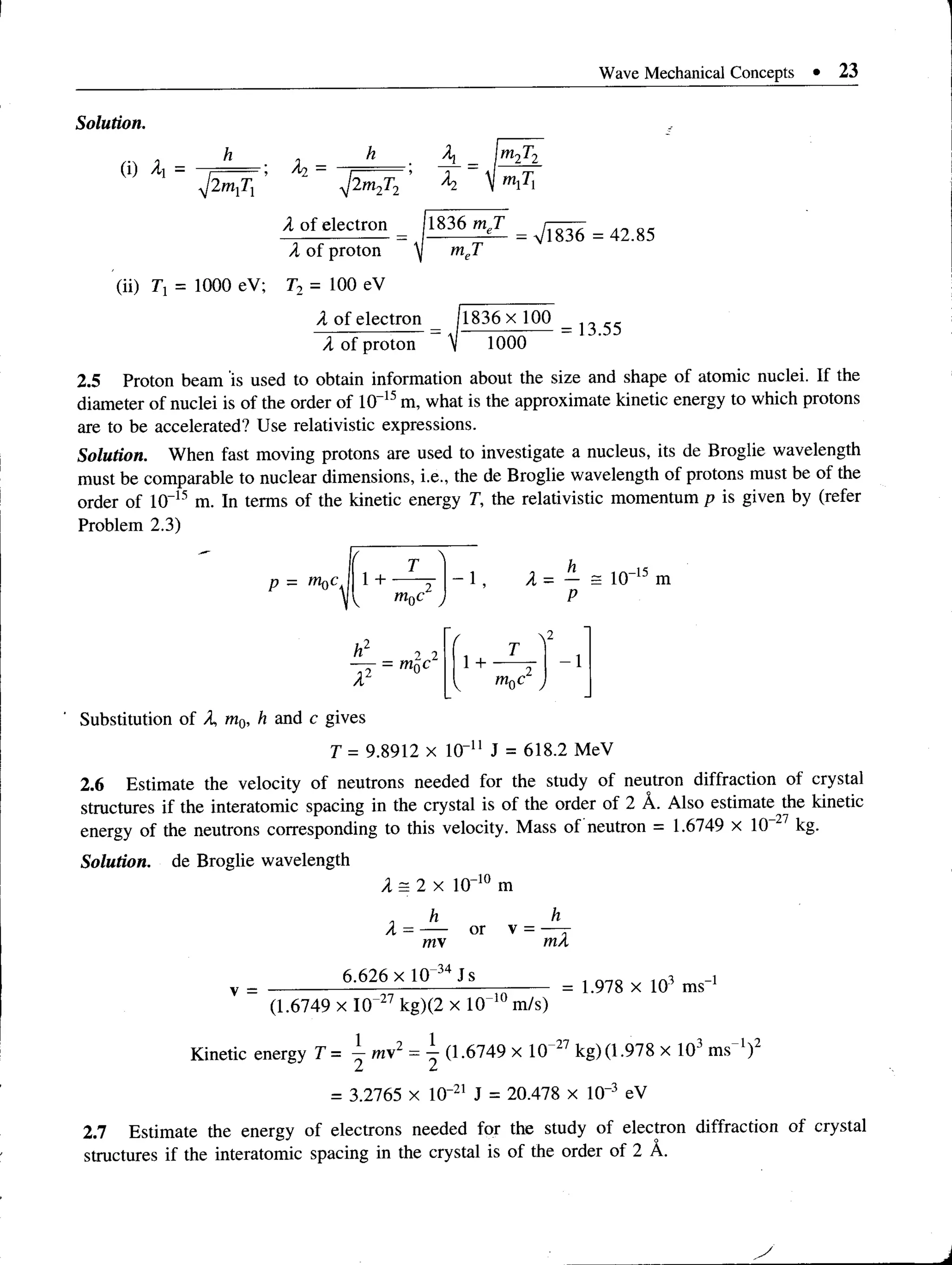
(i) A =
V2"1
!7!
A
2
ini Tx = 1000 eV;
•y/2m2T2
X of electron
X of proton
T2 = 100 eV
A
x1
m
2T2
mxTx
1836 meT
m
JT
= V1836 = 42.85
X of electron (1836x 100
1000
= 13.55
X of proton
2.5 Proton beam is used to obtain information about the size and shape of atomic nuclei. If the
diameter of nuclei is of the order of 10“15m, what is the approximate kinetic energy to which protons
are to be accelerated? Use relativistic expressions.
Solution. When fast moving protons are used to investigate a nucleus, its de Broglie wavelength
must be comparable to nuclear dimensions, i.e., the de Broglie wavelength of protons must be of the
order of 10“15 m. In terms of the kinetic energy T, the relativistic momentum p is given by (refer
Problem 2.3)
p = rriQc, 1+ - 1 X - — = 10“15 m
P
/ 2
T
- 1
1 + 2"
1 c
h2 2 2
-7Y = moc
Substitution of X, m0, h and c gives
T = 9.8912 x 10“u J = 618.2 MeV
2.6 Estimate the velocity of neutrons needed for the study of neutron diffraction of crystal
structures if the interatomic spacing in the crystal is of the order of 2 A. Also estimate the kinetic
energy of the neutrons corresponding to this velocity. Mass of neutron = 1.6749 x 10 27 kg.
Solution, de Broglie wavelength
X = 2 x 10
X = —
my
6.626 x 10 34 Js
-10
m
or v =
h
mX
(1.6749 x IQ 27 kg)(2 x 10 1
Um/s)
= 1.978 x 10³ ms' 1
-t, 1 2
Kinetic energy T = —my -
1 12
(1.6749 x 10 2/ kg) (1.978 x 10J m s'1)
= 3.2765 x 10“21 J = 20.478 x 10“3 eV
2.7 Estimate the energy of electrons needed for the study of electron diffraction of crystal
structures if the interatomic spacing in the crystal is of the order of 2 A.
24 • Quantum Mechanics: 500 Problems with Solutions
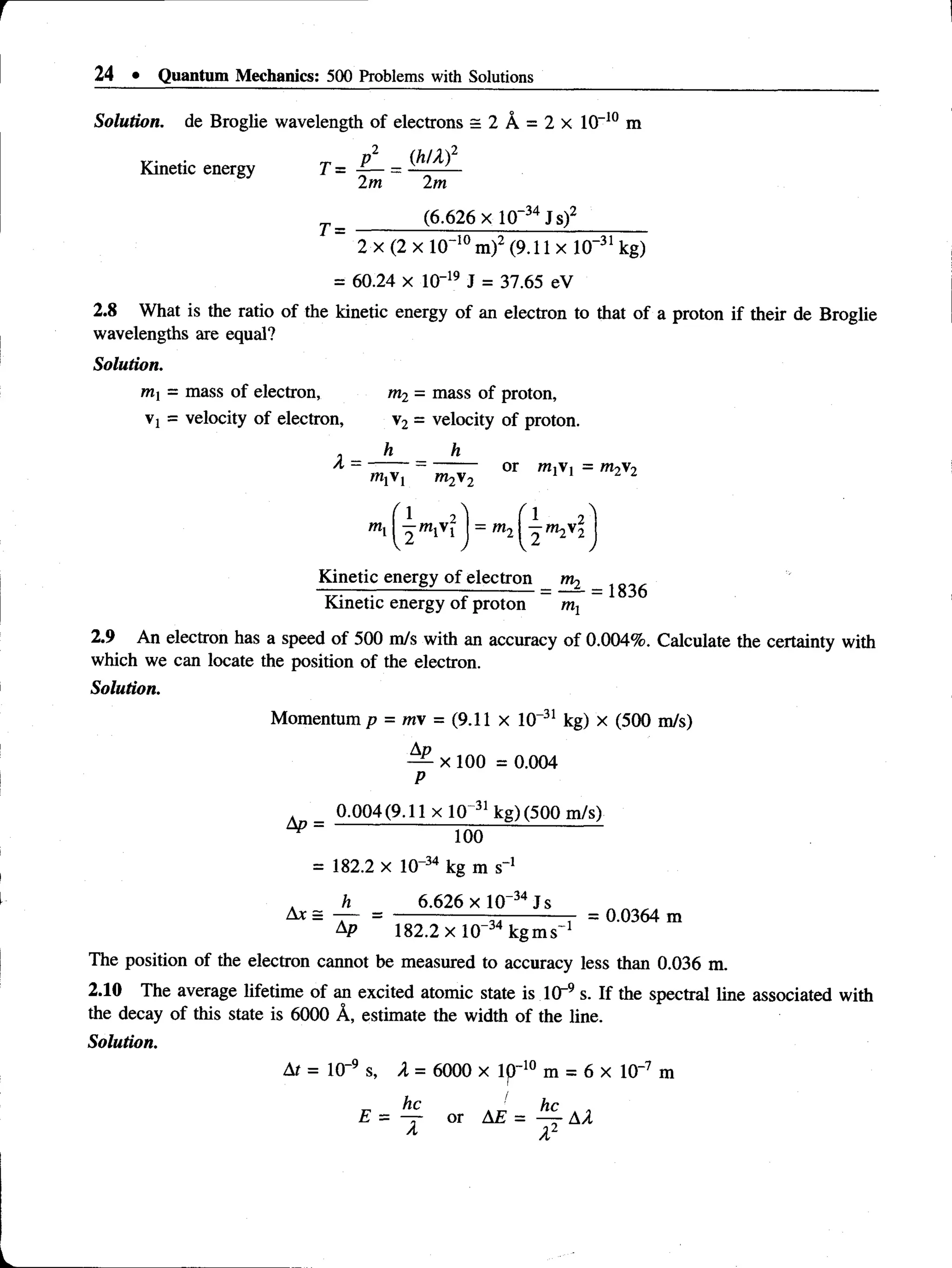
Solution, de Broglie wavelength of electrons = 2 A = 2 x 10⁻¹⁰ m
p 2 (MX)2
Kinetic energy T =
T =
2m 2m
(6.626 x 10~34Js)2
v*l° rn i 1 ^ 1n~31
2 x (2 x 10 m) (9.11 x 10 kg)
= 60.24 x lO-19 J = 37.65 eV
2.8 What is the ratio of the kinetic energy of an electron to that of a proton if their de Broglie
wavelengths are equal?
Solution.
mi = mass of electron, m2 - mass of proton,
Vj = velocity of electron, v2 = velocity of proton.
, h h
A - --------- or mxVi = m2v2
m2 2
mi I ^ mivi
^ f 1 2^
= ml  2 ^ 2
Kinetic energy of electron m,
_ _ — -------------- ---------- = — = 1836
Kinetic energy of proton m1
2.9 An electron has a speed of 500 m/s with an accuracy of 0.004%. Calculate the certainty with
which we can locate the position of the electron.
Solution.
Momentum p = m  = (9.11 x 10⁻³¹ kg) x (500 m/s)
Ad
— x 100 = 0.004
P
0.004(9.11 x10 31 kg) (500 m/s)
^ 100
= 182.2 x 10“34 kg m s"1
h 6.626 x l 0“34Js
Ax = — = --------------- ------------ - = 0.0364 m
AP 182.2 x 10 kgms^
The position of the electron cannot be measured to accuracy less than 0.036 m.
2.10 The average lifetime of an excited atomic state is ICr9s. If the spectral line associated with
the decay of this state is 6000 A, estimate the width of the line.
Solution.
At = 10~9 s, A = 6000 x Ip"10 m = 6 x 10~7 m
Wave Mechanical Concepts • 25
AE ■At = AA ■At = —
A1 2 An
A2 36 x KT14 m2 „ „ ,4
AA = - — — = ----------------------------------------------------------- — = 9.5 x 10 m
AncAt An (3 x 10 m/s) x (1O' 9s)
2.11 An electron in the « = 2 state of hydrogen remains thereon the average of about 10~8 s, before
making a transition to n = 1 state.
(i) Estimate the uncertainty in the energy of the n = 2 state.
(ii) What fraction of the transition energy is this?
(iii) What is the wavelength and width of this line in the spectrum of hydrogen atom?
Solution. From Eq. (2.4),
/•x h 6.626 x 10"34Js
(l) AE > ------- = ----------------------
AnAi 4tt x 10-8 s
= 0.527 x 10~26 J = 3.29 x 10"8 eV
(ii) Energy of n = 2 n = 1 transition
= -13.6 eV
' ___l_x
22 l2j
= 10.2 eV
AE 3.29 x 10⁻⁸ eV
Fraction —
— = = 3.23 x 10 9
E 10.2 eV
, he (6.626 x 10⁻³⁴ Js) x (3 x 10⁸ m/s)
' ' 1
7 ” IQ
E (10.2 x 1.6 x 10”19J)
= 1.218 x 10~7 m = 122 nm
AE AA . . AE ,
— = x or U =
AA= (3.23 x 10⁻⁹) (1.218 x 10"7 m)
= 3.93 x 10~16 m = 3.93 x 10“7 nm
2.12 An electron of rest mass m$ is accelerated by an extremely high potential of V volts. Show
that its wavelength
he
A = - 2m1/2
[eV (eV + 2m0c )]
Solution. The energy gained by the electron in the potential is Ve. The relativistic expression for
mQ
cl 2 ^
kinetic energy = -------- —_ - m0c . Equating the two and rearranging, we get
(1 -  z/cz)ul
moC2 2 yj
---------------------m0c = Ve
(1 - v2/c2)1/2
(1 - v2/c2)1/2 = — ^
2
Ve + m0c2
26 • Quantum Mechanics: 500 Problems with Solutions
2 2 4
j _ v m0c
c2(Ve + m0c2)2
v2 (Ve + m0c2)2 - m^c4 _ Ve(Ve + 2m0c2)
c2 (Ve + m0c2)2 (Ve + m0c2)2
c[Ve(Ve + 2m0c2) f 2
v = -
de Broglie Wavelength
Ve + m^c2
A= _h_ = h(1 - v2/c2)1/2
M V OT0 V
ft m0c2 Ve + O
T
qC
2
"Jo Ve + m0c2 c[Ve(Ve+ 2m0c2) f 2
he
[Ve (Ve + 2m0c2)]1/2
2.13 A subatomic particle produced in a nuclear collision is found to have a mass such that Me2
= 1228 MeV, with an uncertainty of ± 56 MeV. Estimate the lifetime of this state. Assuming that,
when the particle is produced in the collision, it travels with a speed of 108 m/s, how far can it travel
before it disintegrates?
Solution.
Uncertainty in energy AE = (56 X 106 eV) (1.6 X 10⁻¹⁹ J/eV)
_ h 1 (1.05 x 10~34 J s ) ________ _________
2 AE 2 (56 x 1.6 x 10“13J)
= 5.86 x l(r24 s
Its lifetime is about 5.86 x 10⁻²⁴ s, which is in the laboratory frame.
Distance travelled before disintegration = (5.86 X 10⁻²⁴ s)(108 m/s)
= 5.86 x 10~16 m
2.14 A bullet of mass 0.03 kg is moving with a velocity of 500 m's-1. The speed is measured up
to an accuracy of 0.02%. Calculate the uncertainty in x. Also comment on the result.
Solution.
Momentum p - 0.03 x 500 = 15 kg m s~*
Ap
— x 100 = 0.02
P
0.02 x 15 „ ^ , ,
Ap = — — — = 3 x 10 kg m s
h 6.626 x 10"34Js , ^
Ax ~ —
— = ----------------- -------- = 1.76x10 m
2Ap 4 x 3 x 10 km/s
Wave Mechanical Concepts • 27
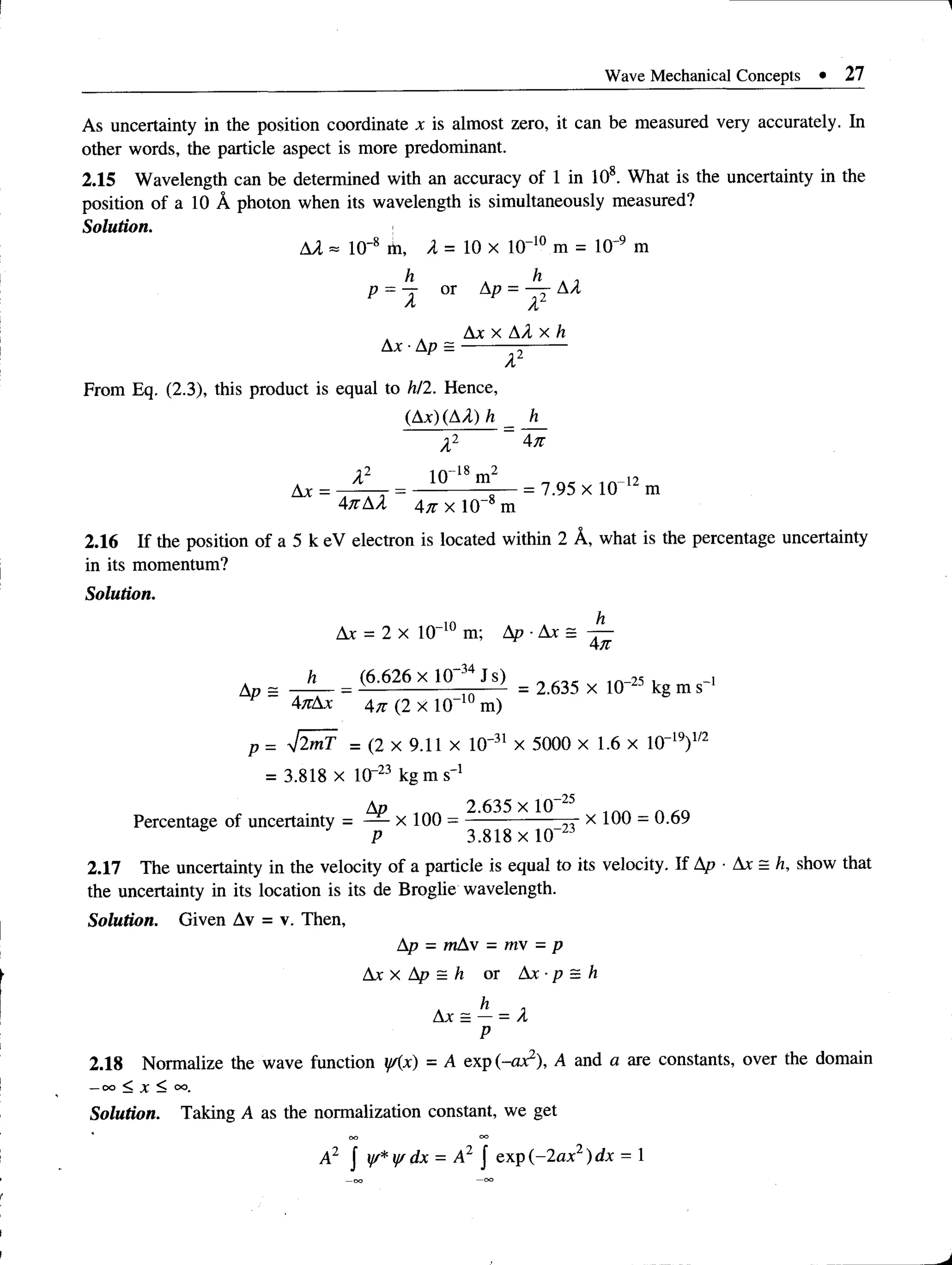
As uncertainty in the position coordinate x is almost zero, it can be measured very accurately. In
other words, the particle aspect is more predominant.
2.15 Wavelength can be determined with an accuracy of 1 in 108. What is the uncertainty in the
position of a 10 A photon when its wavelength is simultaneously measured?
Solution.
AA ~ 10'8 m, A = 10 x 10“10 m = 10'9 m
h h ,
p = J or Ap = — AA
Ax x AA x h
Ax -Ap = ---------;-------
A
From Eq. (2.3), this product is equal to h/2. Hence,
(Ax) (AA) h _ h
A2 ~ An
Ax = t 4 t = 10 ^ mg = 7-95 x 1 0 12 m
AnAA4n x 10“8m
2.16 If the position of a 5 k eV electron is located within 2 A, what is the percentage uncertainty
in its momentum?
Solution.
Ax = 2 x 10“10 m; Ap ■Ax = -p-
An
= (6,626 x U T * is ) = 2 635 x 10_2J kg m s_,
AnAx 4n (2 x 10“10 m)
p = V2mT = (2 x 9.11 x 10' 31 x 5000 x 1.6 x 10“19)1/2
= 3.818 x 1(T23 kg m s' 1
Ap 2.635 x 10 25
Percentage of uncertainty = — x 100 = --------------- x 100 - 0.69
P 3.818 x l0 “23
2.17 The uncertainty in the velocity of a particle is equal to its velocity. If Ap ■Ax = h, show that
the uncertainty in its location is its de Broglie wavelength.
Solution. Given Av = v. Then,
Ap - mAv = mv = p
Ax x Ap = h or Ax •p = h
Ax = — = A
P
2.18 Normalize the wave function y/(x) = A exp (-ax2), A and a are constants, over the domain
—
O
O< X < oo.
Solution. Taking A as the normalization constant, we get
A2 J y/* ff dx = A2 J exp (-2ax2) dx = 1
28 • Quantum Mechanics: 500 Problems with Solutions
Using the result (see the Appendix), we get
f exp ( - 2ax2)dx = J —
J u In
2a
* - ( t )
1/4
y/(x) = exp (-ax )
2.19 A particle constrained to move along the x-axis in the domain 0 < x < L has a wave function
yAx) = sin (nnx/L), where n is an integer. Normalize the wave function and evaluate the expectation
value of its momentum.
Solution. The normalization condition gives
L
2 nnx
N 2 J sinz dx = 1
L 1 2nnx ^
1 - cos—- — Iax = 1
N 2 4 = 1 or A
T
The normalized wave function is yj2/L sin (nnx)IL]. So,
-ih —
dx
y/dx
nrtx nTtx ,
j sin —
— cos — —dx
Lj Li q Li Li
.. tin f . 2nnx ,
= -in —
r- sin —-— dx = 0
1} J
0 L
2.20 Give the mathematical representation of a spherical wave travelling outward from a point and
evaluate its probability current density.
Solution. The mathematical representation of a spherical wave travelling outwards from a point is
given by
y/(r) = — exp (ikr)
where A is a constant and k is the wave vector. The probability current density
Wave Mechanical Concepts • 29
ih
j= v * v Y)
ih I , i2
2 ^ IAI
ih I i2
2^IAI
Ixl2
J*r
ikr
-ikr
r
v y
-ikr Jkr
r
 J
( i k _ - i k r e - i k r )
^
1
1
{ i k A r
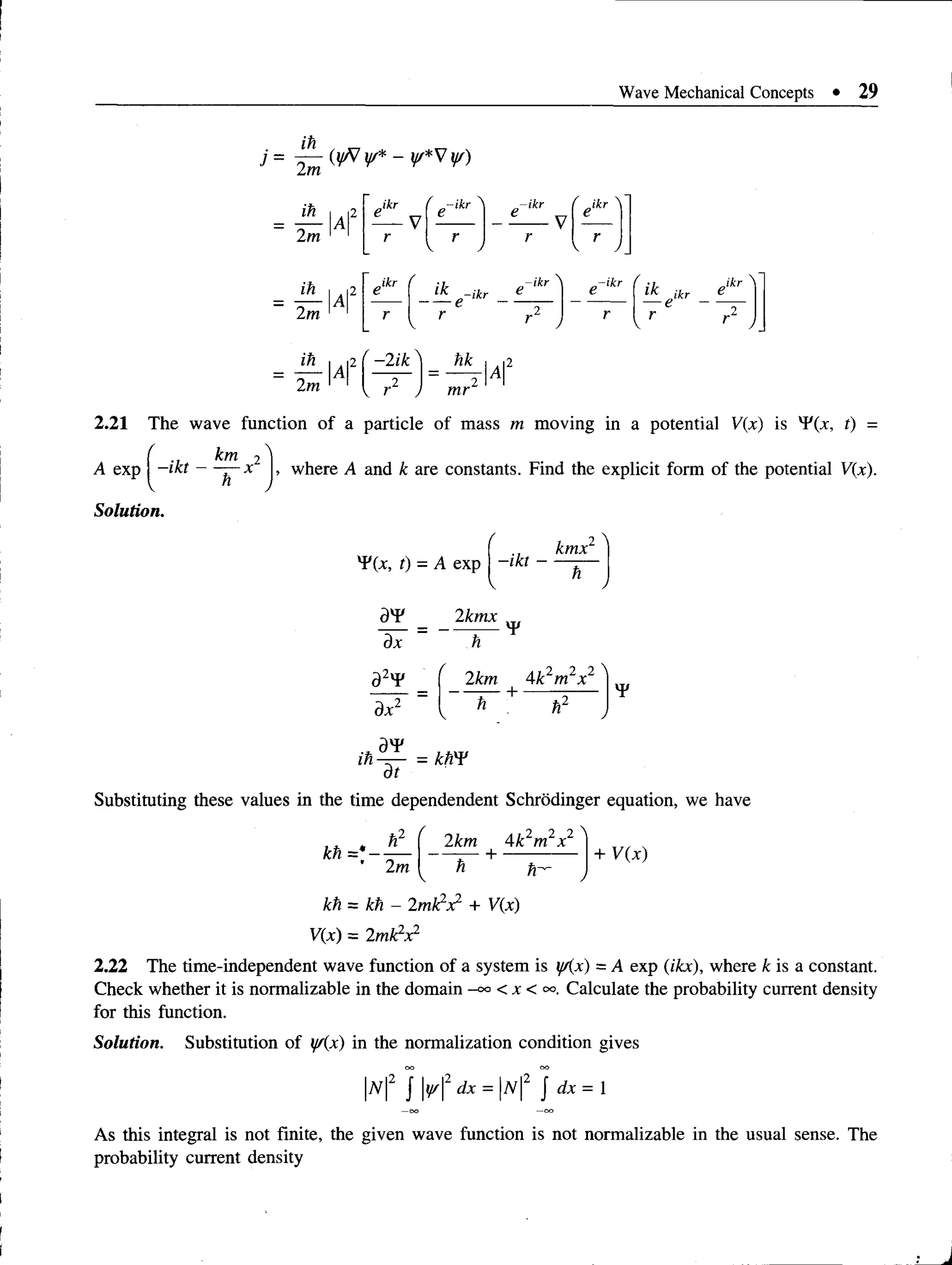
-s
V 1 )
r r
V r 2 J
r -2 ik^ hk
 r J 4
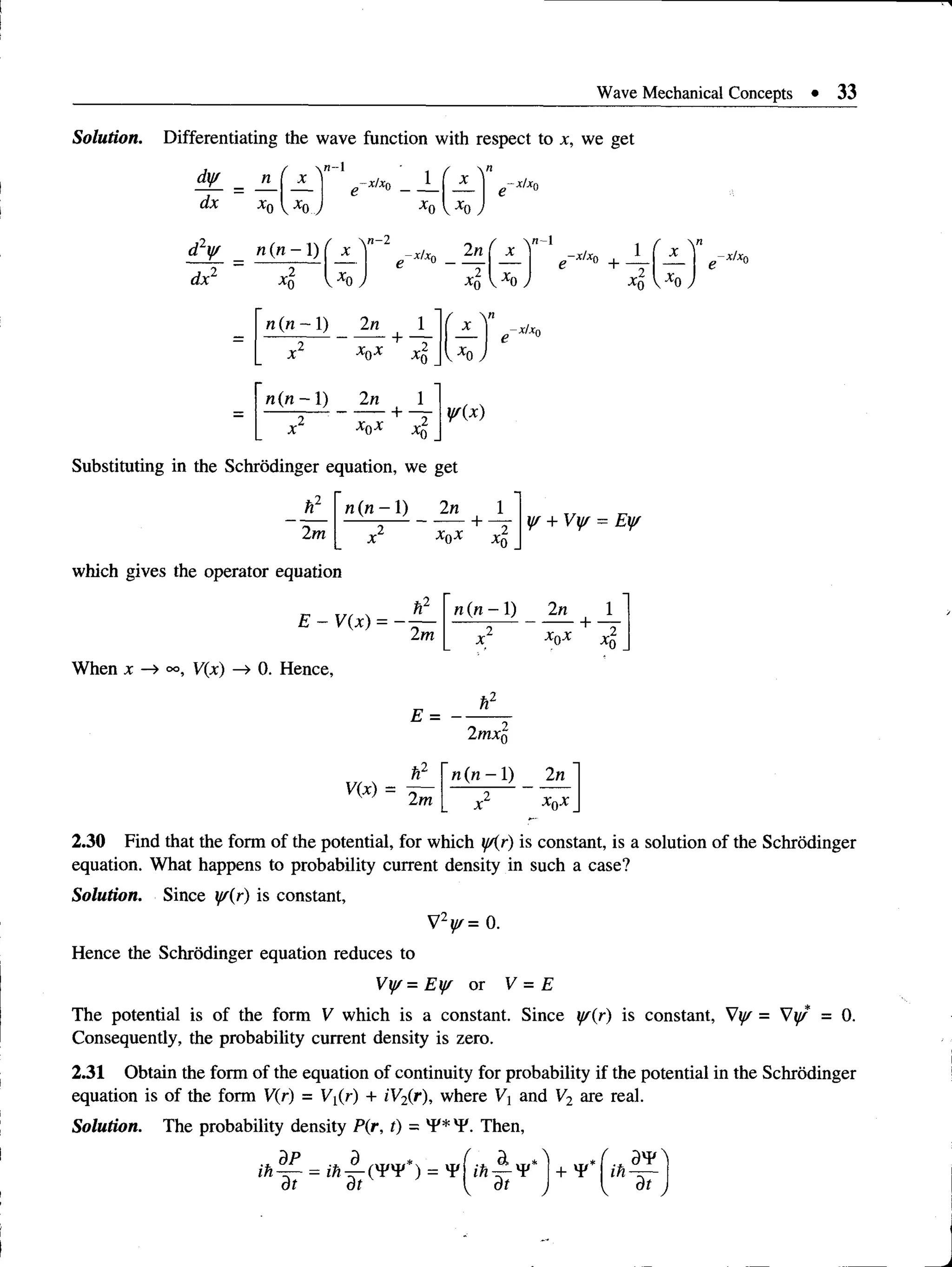
2.21 The wave function of a particle of mass m moving in a potential V(x) is ^(x, t) =
( km 2 ^
A exp | -ikt — — x , where A and k are constants. Find the explicit form of the potential V(x).
Solution.
TCx, t) - A exp —
ikt —
kmx
a r
dx
d2y¥
dx2
2kmx
¥
f 2km Ak2m2x2 '
K' ~ + h2
!)T/
m — = km>
dt
Substituting these values in the time dependendent Schrodinger equation, we have
kh ='
2m
2km 4k2m2x2
— + ------------ + V(x)
kh= kh - 2mk1x1 + V(x)
V(x) = 2mk2x2
2.22 The time-independent wave function of a system is yAx) —A exp (ikx), where £ is a constant.
Check whether it is normalizable in the domain < x < oo. Calculate the probability current density
for this function.
Solution. Substitution of y/(x) in the normalization condition gives
|7V|2 J y/2 dx = |w|2 J dx = 1
As this integral is not finite, the given wave function is not normalizable in the usual sense. The
probability current density
30 • Quantum Mechanics: 500 Problems with Solutions
j = <*Vw* - V)
= ^ -  A  2 [eikx(-ik)e~ikx - e ~ ikx(ik)eikx]
2m 1 1
2m 11 m 1 1
2.23 Show that the phase velocity  p for a particle with rest mass w0 is always greater than the
velocity of light and that  p is a function of wavelength.
Solution.
(O h
Phase velocity  p = — = vA A = —
k P
Combining the two, we get
pvp = hv= E = (c2p2 + r^c 4)112
P*p = C
P 1 +
Nl/2
= cp 1 +
2 2
m0c
P2 j
vp = c
1+
™
p
2c2
p2 /
l/2
or  p > c
1 +
mQC2A2
ft2
Hence vp is a function of A.
2.24 Show that the wavelength of a particle of rest mass m^ with kintic energy T given by the
relativistic formula
A =
he
yjr2 + 2m0c2T
Solution. For a relativistic particle, we have
Now, since
E2 = c2p 2 + m^c4
E = T + rtiff
(T + m0c2)2 = c p2 + mfcc4
T2 + 2m0c2T + m£c4 = c2p 2 + m^c4
cp = yfr2 + 2m0c2T
de Broglie wavelength A = — =
he
4-Tl + 2m0c T
Wave Mechanical Concepts • 31
2.25 An electron moves with a constant velocity 1.1 x 10⁶ m/s. If the velocity is measured to a
precision of 0.1 per cent, what is the maximum precision with which its position could be
simultaneously measured?
Solution. The momentum of the electron is given by
p = (9.1 x 10“31 kg) (1.1 x 10⁶ m/s)
= 1 x 10-24 kg m/s
Av _ Ap _ 0.1
v p 100
Ap = p x 10 3 = 10 z/ kg m/s
,-27
Ax
h 6.626 x 10"34 Js
= 6.6 x 10“' m
4nAp  n x 10 27 kg m/s
2.26 Calculate the probability current density j(x) for the wave function.
y/(x) - u{x) exp [i<f>(x),
where u, <
pare real.
Solution.
y/(x) = u(x) exp dtp); y/*(x) - u(x) exp (-it,V)
dw du . dtp
exp (itp) + ih — exp (itp)
ox ox ox
dyf* du . dtp
— — = — exp ( - 10) - i u - ^ exp (itp)
j(x) =
ih
2m ¥
dx dx
d y ^ _ dy_
dx
I//*
dx
ih
2m
ih
2m
ih
2m
du _i$ . d(j) _
— e * - iu-z— e
dx dx
du
dx
id , • dtp
e v A- i u — —
dx
du
dx
-2iu'
du
■2 d<
P
IU -----U-z:—
O X OX
dtp
dx
2 d<
P
dx
h
- u 2^ -
m dx
2.27 The time-independent wave function of a particle of mass m moving in a potential V(x) - a 2x2
is
yAx) = exp
m a2 7
— T x
2h
, a being a constant.
Find the energy of the system.
S o lu tio n We have
32 • Quantum Mechanics: 500 Problems with Solutions
dy/
dx
2ma
x exp'
i
m a 2
---- T x
2h
d2yf
dx2
2m a
1 -
2m a
exp
m a
I 2n2
Substituting these in the time-independent Schrodinger equation and dropping the exponential term,
we obtain
2m
+ a2x2 = E
$vx2 + t£ x2 = E
E =
h a
4 2m
2.28 For a particle of mass m, Schrodinger initially arrived at the wave equation
1 92y g2y m2c2
c2 dt2 dx2 ft2
Show that a plane wave solution of this equation is consistent with the relativistic energy momentum
relationship.
Solution. For plane waves,
4'Cx, t) = A exp [/ (kx - mt)]
Substituting this solution in the given wave equation, we obtain
-C
O 2„2
= - r
m c
Multiplying by c2h2 and writing ha>= E and kh = p, we get
E2 = c2p2 + m2c4
which is the relativistic energy-momentum relationship.
2.29 Using the time-independent Schrodinger equation, find the potential V(x) and energy E for
which the wave function '
y/(x) =
f 
X
x0
-X /X n
where n, x0 are constants, is an eigenfunction. Assume that V(x) —
>0 as x
Wave Mechanical Concepts • 33
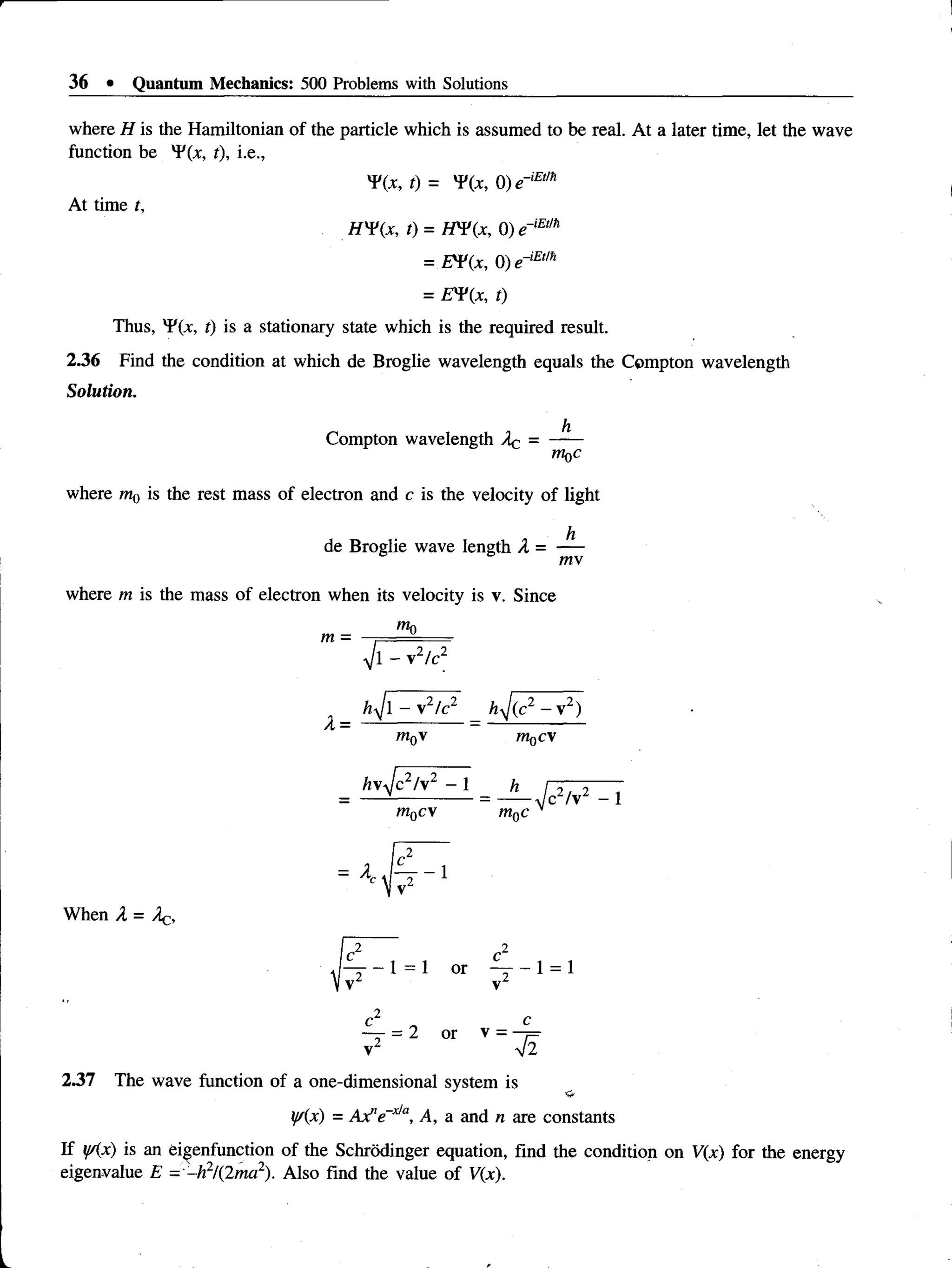
Solution. Differentiating the wave function with respect to x, we get
d y
dx
n--1
-x/xn
d2y _ n ( n - 1)
dx2 r 2
x0
f  n~2
X
1
/ 
X
x0
—
jc
/jc
q 2n
xl
1
'JL
r2
x0 l xoJ
1
2
y(x)
-jr/jtn
/ A
" '1
~X
/X
n +
-An
Substituting in the Schrodinger equation, we get
2m
n(n —1) 2n 1
x2 + xl
y + V y = E y
which gives the operator equation
E - V(x) = - —
2m
n(n —1) 2n 1
x2 + xl
E =
2m
2mxl
n(n —1) 2n
x2
2.30 Find that the form of the potential, for which y(r) is constant, is a solution of the Schrodinger
equation. What happens to probability current density in such a case?
Solution. Since y(r) is constant,
V2jif= 0.
Hence the Schrodinger equation reduces to
V y = E y or V = E
The potential is of the form V which is a constant. Since y(r) is constant, V y = V y = 0.
Consequently, the probability current density is zero.
2.31 Obtain the form of the equation of continuity for probability if the potential in the Schrodinger
equation is of the form V(r) = V^r) + iV2(r), where V and V2 are real.
Solution. The probability density P(r, t) = ¥ . Then,
34 • Quantum Mechanics: 500 Problems with Solutions
The Schrodinger equation with the given potential is given by
ih
d ¥ _ - T
dt 2m
V2xV + (Vj + iV2) ¥
a y 3'?* .
Substituting the values of ih and ih , we have
ih
aP
dt
hl
2m
ih^ = -^ -[V ('PV'F* -'¥ * ¥ '¥ )+ 2iV2P]
at 2m
dt
ih
2m h
2.32 For a one-dimensional wave function of the form
'Vix, t) = A exp [itp (x, f)]
show that the probability current density can be written as
j = -  A f ¥
m ' ' dxi
Solution. The probability current density j(r, t) is given by
ih
j(r, f)= — ('PV'P* - T V *)
x
P(x, t) = A exp [itj>(x, t)}
vF*(x, t) = A* exp [-10 (x, f)]
VT = ^ - = iAe'f
O X ox
V¥* =
dx dx
Substituting these values, we get
ih
J = 2m
ih
2m
Ae1
* -iA*e~i*
dtj)
dx
A e~ iAe* ^
OX
-'■
w
2--w2
l!K w 2
!?
dx
2.33 Let y/o(x) and y/(x) be the normalized ground and first excited state energy eigenfunctions of
a linear harmonic oscillator. At some instants of time, Ay/G+ By/j, where A and B are constants, is
the wave function of the oscillator. Show that (x) is in general different from zero.
Wave Mechanical Concepts • 35
Solution. The normalization condition gives
<(A% + B y ) | (Ay0 + B y )) = 1
A2(Wo I Vo) + B2{y i I V) = 1 or A2 + S2 = 1
Generally,the constants A and B are not zero. The average value of x is givenby
<x> = ((Ay0 + B y )x (A i//0 + B y ))
= A2{y/0x y0) + B2{yx  x  y x) + 2AB{y0 |x| y{)
since A and B are realand (% |x| y x) = ( y |x| y0). As the integrands involved is odd,
(VoxVo) = (Vi 1*1 Vi) = 0
<x> = 2AB(y/0 |x| y/)
which is not equal to zero.
2.34 (i) The waves on the surface of water travel with a phase velocity vp - ^gA /2n, where g is
the acceleration due to gravity and X is the wavelength of the wave. Show that the group velocity
of a wave packet comprised of these waves is Vp/2. (ii) For a relativistic particle, show that the
velocity of the particle and the group velocity of the corresponding wave packet are the same.
Solution.
(i) The phase velocity
v/>=
where k is the wave vector.
By definition, p = calk, and hence
The group velocity
= = I 1 = 1 l
V* dk 2  k 2
. da> dE
(n) Group velocity v„ = ——= ——
s dk dp
For relativistic particle, E2 = c2p2 + m^c4, and therefore,
dE c2p _ c2w0v-^/l - v2/c2 _
v„ =
dP Em 0 C2 y] 1 - v2/c2
2.35 Show that, if a particle is in a stationary state at a given time, it will always remain in a
stationary state.
Solution. Let the particle be in the stationary state <
F(x, 0) with energy E. Then we have
/m x , 0) = E'F(x, 0)
36 • Quantum Mechanics: 500 Problems with Solutions
where H is the Hamiltonian of the particle which is assumed to be real. At a later time, let the wave
function be *F(x, t), i.e.,
Yix, t) = T(x, 0) e~iE,m
At time t,
HY(x, t) = HY(x, 0) e~lE,m
= EV(x, 0) e~,Etm
= £T(x, t)
Thus, 'FCx, t) is a stationary state which is the required result.
2.36 Find the condition at which de Broglie wavelength equals the Compton wavelength
Solution.
h
Compton wavelength Ac = -----
W
qC
where m{) is the rest mass of electron and c is the velocity of light
h
de Broglie wave length A = ----
mv
where m is the mass of electron when its velocity is v. Since
mo
m =
A =
Vi - v2/c2
h j l - v2/c2
m0v
h 1
/c2/v2 - 1
m0cv
m0cv
— ^ c 2/v2 - 1
mnc
= A . £ - i
When A = Aq,
£ _ _ 1 = 1 or ^ - 1 = 1
°2 C
— = 2 or v = —
j=
v2 V2
2.37 The wave function of a one-dimensional system is
y/(x) = Axf'e~x/a, A, a and n are constants
If y/(x) is an eigenfunction of the Schrodinger equation, find the condition on V(x) for the energy
eigenvalue E - ~h2/(2ma2). Also find the value of V(x).
Wave Mechanical Concepts • 37
Solution.
y/(x) = Axne-X
la
= Anxn le xla - - x ne x,a
dx a
d yz
dx2
= Ae -xJa
n(n - l)xn -2 2n
With these values, the Schrodinger equation takes the form
- — Ae~xla
2m
n (n - )xn~2 ~ — xn~x + V{x)Axne~xla = E A xne
n -x la
2m
n ( n - 1) 2n 1
x2 ax + a2
= E - V(x)
From this equation, it is obvious that for the energy E — -h 2/2ma2, V(x) must tend to zero as
x —
>oo. Then,
V(x) =
hl
2m
2ma2 2m
n ( n - 1) 2n
n ( n - 1) 2n 1
x2 a a2
ax
2.38 An electron has a de Broglie wavelength of 1.5 x 10"'2 m. Find its (i) kinetic energy and
(ii) group and phase velocities of its matter waves.
Solution.
(i) The total energy E of the electron is given by
E = J,c2p 2 +m
gC
4
Kinetic energy T = E - mgc2 = ■
Jc2p 2 + “■
2'-4 -— 2
m0c —m0c
he
de Broglie wavelength X = — or cp = .
P A
(6.626 x 10~34Js) (3 x 10s ms-1)
cp =
1.5 x 10⁻¹² m
= 13.252 x 1(T14 J
2-
E0 = rrtffi = (9.1 x 10 kg) (3 X 10s m s *)
= 8.19 x 10~14 J
T= 7(13.252)2 + (8.19)2 x 10~14 J - 8.19 x 10~14 J
= 7.389 x 10~14 J = 4.62 x 10⁵ eV
38 • Quantum Mechanics: 500 Problems with Solutions
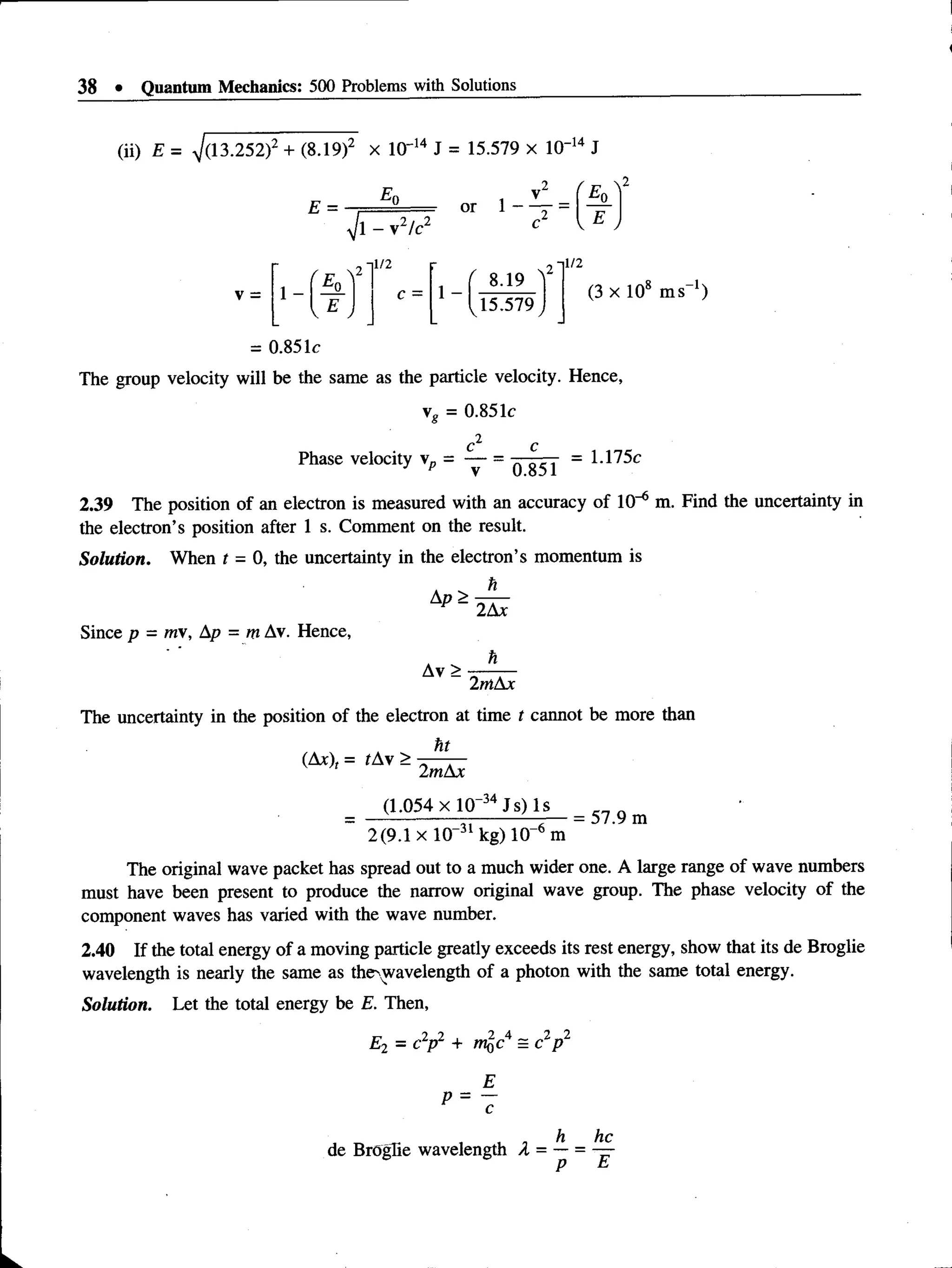
(ii) E = 7(13.252f + (8.19)2 X 10' 14 J = 15.579 x 1(T14 J
E =
V l - v 2/c2
V =
1/2
c =
1/2
1 -
8.19
15.579
(3 x 10⁸ m s-1)
= 0.851c
The group velocity will be the same as the particle velocity. Hence,
vg = 0.851c
Phase velocity v„ = = 1.175c
v 0.851
2.39 The position of an electron is measured with an accuracy of 10-6 m. Find the uncertainty in
the electron’s position after 1 s. Comment on the result.
Solution. When t - 0, the uncertainty in the electron’s momentum is
h
Since p = mv, Ap = m Av. Hence,
Ap >
Av>
2Ax
h
2mAx
The uncertainty in the position of the electron at time t cannot be more than
ht
(Ax), = tAv >
2mAx
(1.054 xlO~34Js) Is
2(9.1 x 10“31 kg) 10-6 m
57.9 m
The original wave packet has spread out to a much wider one. A large range of wave numbers
must have been present to produce the narrow original wave group. The phase velocity of the
component waves has varied with the wave number.
2.40 If the total energy of a moving particle greatly exceeds its rest energy, show that its de Broglie
wavelength is nearly the same as the'wavelength of a photon with the same total energy.
Solution. Let the total energy be E. Then,
E2 = c2p2 + m^c4 = c2p 2
p = 7
h he
de Broglie wavelength X = — = —
Wave Mechanical Concepts • 39
For a photon having the same energy,
. he
or X = —
E
which is the required result.
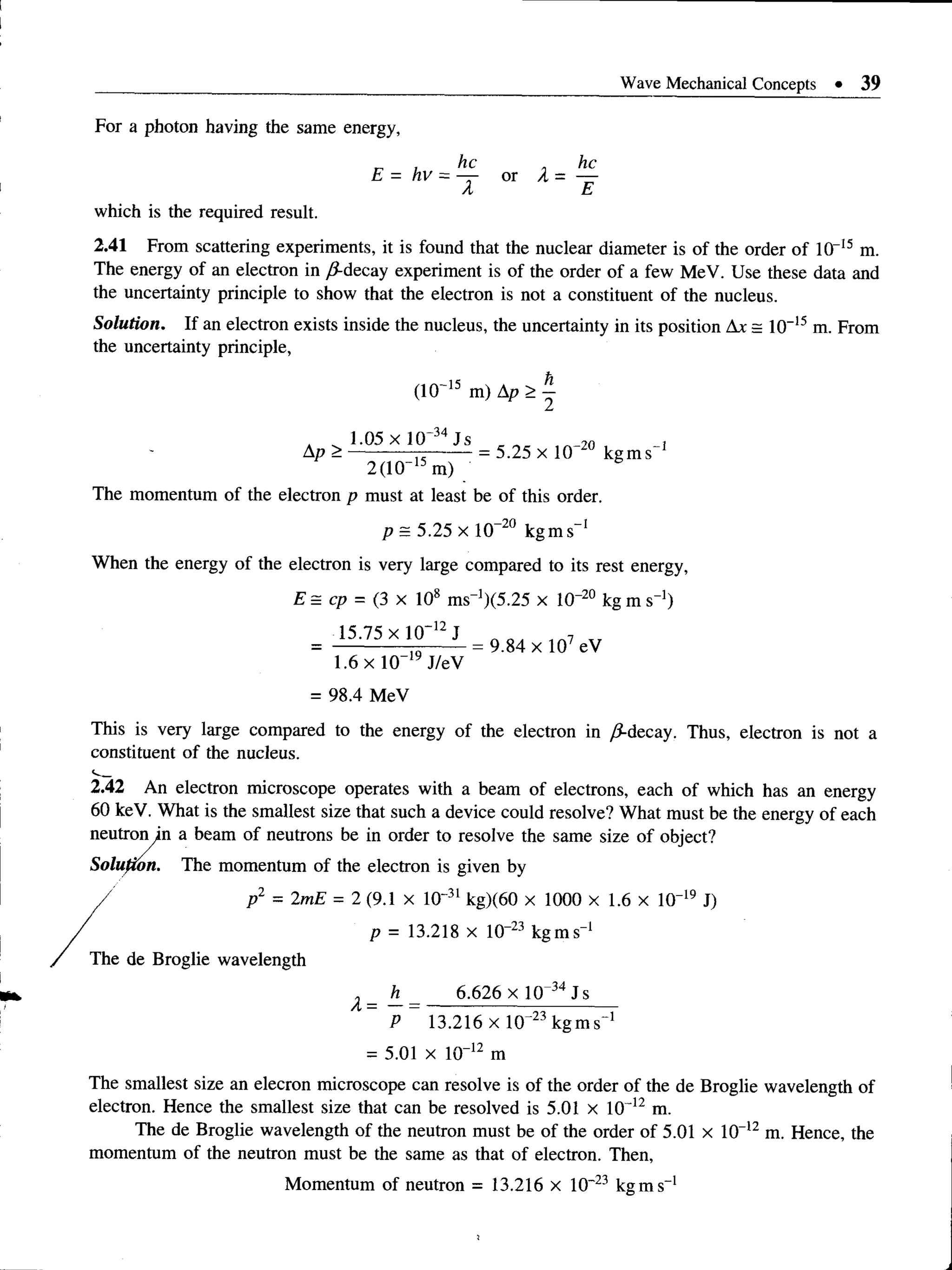
2.41 From scattering experiments, it is found that the nuclear diameter is of the order of 10“15 m.
The energy of an electron in yS-decay experiment is of the order of a few MeV. Use these data and
the uncertainty principle to show that the electron is not a constituent of the nucleus.
This is very large compared to the energy of the electron in /9-decay. Thus, electron is not a
constituent of the nucleus.
<
■
__
2.42 An electron microscope operates with a beam of electrons, each of which has an energy
60 keV. What is the smallest size that such a device could resolve? What must be the energy of each
The smallest size an elecron microscope can resolve is of the order of the de Broglie wavelength of
electron. Hence the smallest size that can be resolved is 5.01 X 1 0 12 m.
The de Broglie wavelength of the neutron must be of the order of 5.01 x 10"12 m. Hence, the
momentum of the neutron must be the same as that of electron. Then,
Solution. If an electron exists inside the nucleus, the uncertainty in its position Ax = 10"15m. From
the uncertainty principle,
(10~15 m) Ap > |
The momentum of the electron p must at least be of this order.
p = 5.25 x 10⁻²⁰ kgms-1
When the energy of the electron is very large compared to its rest energy,
E= cp = (3 x 10⁸ ms_1)(5.25 x 10“20 kg m s-1)
= ------------ rj-------= 9.84 x 10⁷ eV
1.6 x 10"19 J/eV
= 98.4 MeV
Momentum of neutron = 13.216 x 10~23 kg in s_1
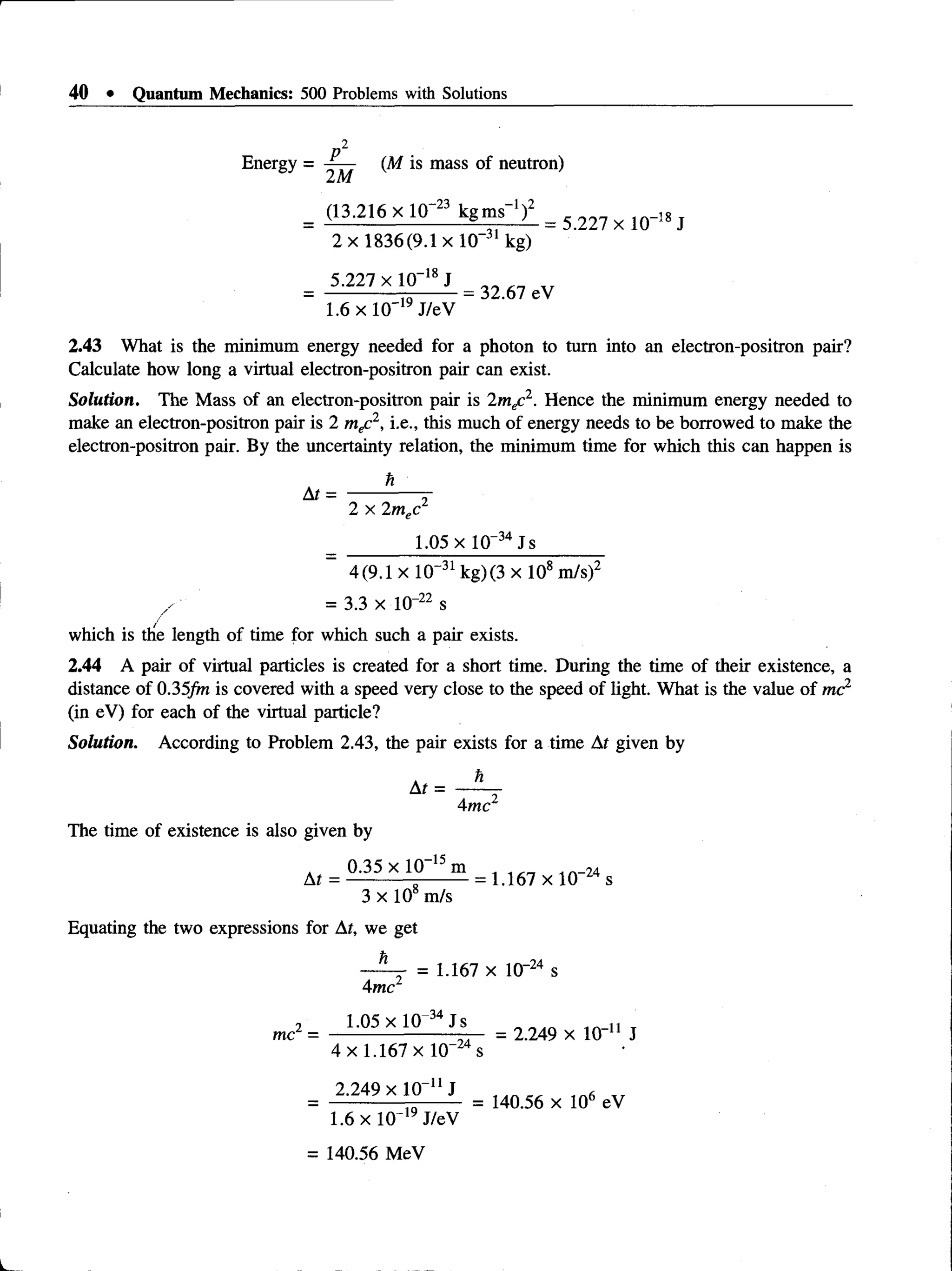
40 • Quantum Mechanics: 500 Problems with Solutions
2
Energy = (M is mass of neutron)
(13.216 x IQ-23 kgms- 1)2 _ 18
2 x 1836(9.1 xlO -31 kg)
5.227 x 10~18J
1.6 x 10"19J/eV
= 32.67 eV
2.43 What is the minimum energy needed for a photon to turn into an electron-positron pair?
Calculate how long a virtual electron-positron pair can exist.
Solution. The Mass of an electron-positron pair is 2mec2. Hence the minimum energy needed to
make an electron-positron pair is 2 m f 1, i.e., this much of energy needs to be borrowed to make the
electron-positron pair. By the uncertainty relation, the minimum time for which this can happen is
h
At
2 x 2m x 2
1.05 x 10“34 Js
4(9.1 x 10~31kg) (3 x 10⁸m/s)2
/ = 3.3 x 10⁻²² s
which is the length of time for which such a pair exists.
2.44 A pair of virtual particles is created for a short time. During the time of their existence, a
distance of 0.35/m is covered with a speed very close to the speed of light. What is the value of mc2
(in eV) for each of the virtual particle?
Solution. According to Problem 2.43, the pair exists for a time At given by
At =
4mc2
The time of existence is also given by
. 0.35 x 10⁻¹⁵ m t .n_u
At = --------------------= 1.167 x 10 s
3 x 10 m/s
Equating the two expressions for At, we get
h
. = 1.167 x lO' 24 s
4 mc
2 1.05 x 10 34 Js T
me = ---------------------t— = 2.249 x 10 1
1 J
4 x 1.167 X 10 s
2.249 xlO _11J «
= 140.56 x 10⁶ eV
1.6 x 10~19J/eV
= 140.56 MeV
Wave Mechanical Concepts • 41
2.45 The uncertainty in energy of a state is responsible for the natural line width of spectral lines.
Substantiate.
Solution. The equation
(A £ ) (A r )> | (i)
implies that the energy of a state cannot be measured exactly unless an infinite amount of time is
available for the measurement. If an atom is in an excited state, it does not remain there indefinitely,
but makes a transition to a lower state. We can take the mean time for decay t, called the lifetime,
as a measure of the time available to determine the energy. Hence the uncertainty in time is of the
order of T. For transitions to the ground state, which has a definite energy E0 because of its finite
lifetime, the spread in wavelength can be calculated from
E - E 0 =
|AE|
he
T
he |AA |
~ x 2
AA AE
A ~ E - E 0 (ii)
Using Eq. (i) and identifying At = r, we get
AA h
A ~ 2t ( E - E0) (iii)
The energy width h/r is often referred to as the natural line width.
2.46 Consider the electron in the hydrogen atom. Using (Ax),(Ap) - h, show that the radius of the
electron orbit in the ground state is equal to the Bohr radius.
Solution. The energy of the electron in the hydrogen atom is the given by
B - J t * k . 1
2m r ’ 4ke,
;o
where p is the momentum of the electron. For the order of magnitude of the position uncertainty, if
we take Ax = r, then
fi
Ap = — or (Ap)2
Taking the order of momentum p as equal to the uncertainty in momentum, we get
(Ap)2 = (p2) =
r
Hence, the total energy
E = h k£l
2mr.2
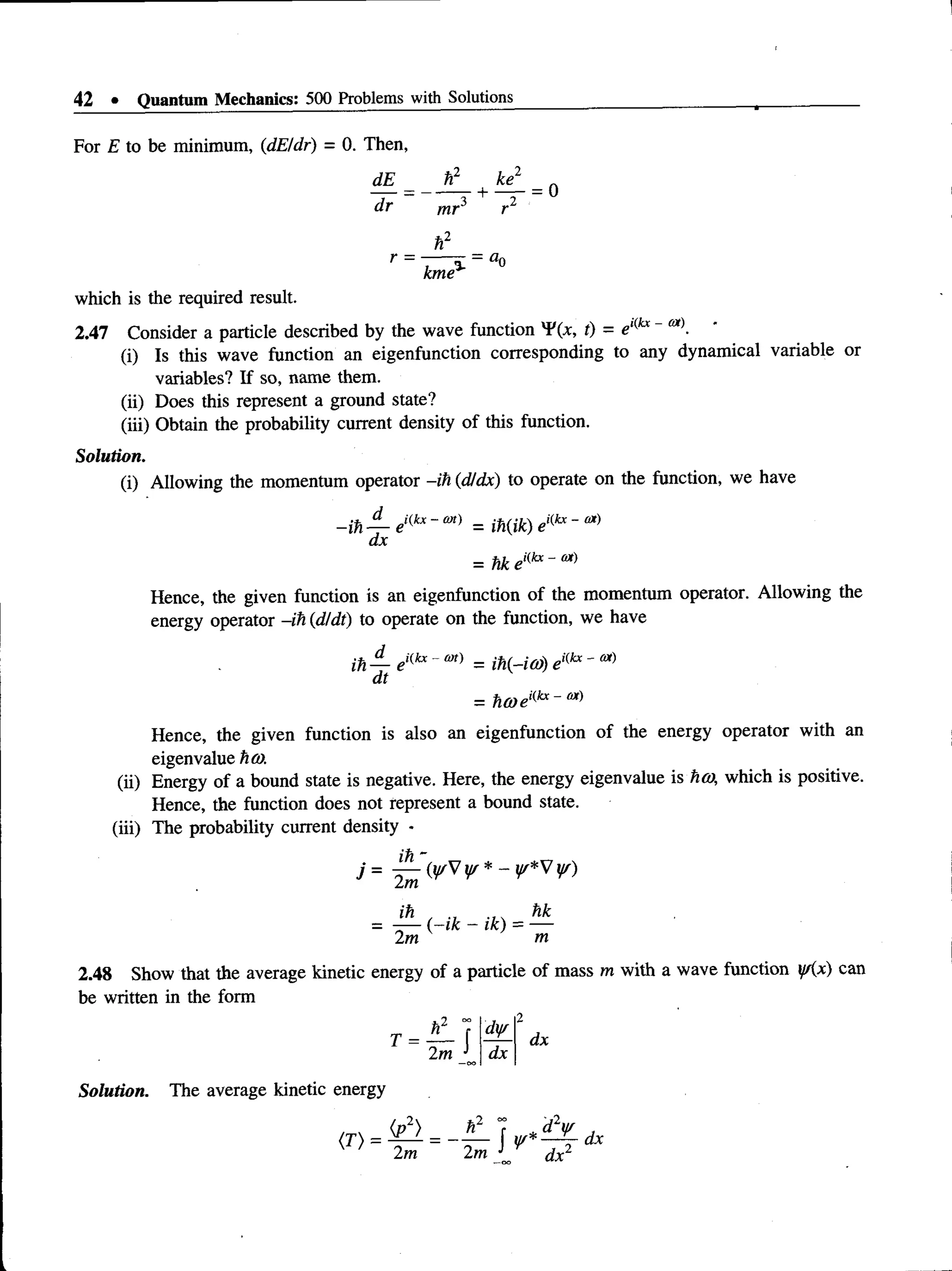
42 • Quantum Mechanics: 500 Problems with Solutions
For E to be minimum, (dE/dr) = 0. Then,
dE__
dr
h2
1
^
1
4
mr3 r2
h2
kme*'
= a0
which is the required result.
2.47 Consider a particle described by the wave function ¥(*, t) = e,(kx~ eot).
(i) Is this wave function an eigenfunction corresponding to any dynamical variable or
variables? If so, name them.
(ii) Does this represent a ground state?
(iii) Obtain the probability current density of this function.
Solution.
(i) Allowing the momentum operator -ih (dJdx) to operate on the function, we have
-ih — ei(kx~ = ih(ik) ei(kx-
dx
= hk ei<
kx- m
Hence, the given function is an eigenfunction of the momentum operator. Allowing the
energy operator -ih (d/dt) to operate on the function, we have
ih — eKkx~m) = ih(-io)) eKkx'
dt
= h(aeKkx- M
)
Hence, the given function is also an eigenfunction of the energy operator with an
eigenvalue ho).
(ii) Energy of a bound state is negative. Here, the energy eigenvalue is ha, which is positive.
Hence, the function does not represent a bound state.
(iii) The probability current density -
ih"
J = 2^ {y/V ¥ * ~ V *V ¥)
2m m
2.48 Show that the average kinetic energy of a particle of mass m with a wave function y/(x) can
be written in the form
h
2
„ K r
T = —
— f
2m J
Solution. The average kinetic energy
dy/ 2
dx
dx
Wave Mechanical Concepts • 43
Integrating by parts, we obtain
c n - f
2m
yr*
dy/
dx
+
h2 7 dyr* dy/
J dx
2m dx dx
As the wave function and derivatives are finite, the integrated term vanishes, and so
<7> = £ r J
2m
dyr
dx
dx
2.49 The energy eigenvalue and the corresponding eigenfunction for a particle of mass m in a
one-dimensional potential V(x) are
A
W(x) = -j,----- 2
x + a
E = 0,
Deduce the potential V(x).
Solution. The Schrodinger equation for the particle with energy eigenvalue E = 0 is
fi2 d2y/ A
dy/
dx1
2Ax
(.x2 + a2)2
d2y/
dx2
= -2 A
4x
(x2 + a2)2 (x2 + a2)
.2x3
2A(3x2 - a 2)
(x2 + a2)3
Substituting the value of d2y/ldx1, we get
h2 2A(3x2 - a2) V(x)A
2m (x2 + a2)3 x2 + a2
V(x)
h2(3x2 - a 2)
m (x2 + a2)2
Chapter
General Formalism of
Quantum Mechanics
In this chapter, we provide an approach to a systematic the mathematical formalism of quantum
mechanics along with a set of basic postulates.
3.1 Mathematical Preliminaries
(i) The scalar product of two functions F(x) and G(x) defined in the interval a < x < b , denoted
as (F, G), is
b
(F, G) = J F*(x)G(x)dx (3.1)
a
(ii) The functions are orthogonal if
b
(F, G) = I F*(x)G(x)dx = 0 (3.2)
a
(iii) The norm of a function N is defined as
1/2
N = (F, F)m = F (x)2 dx (3.3)
a
(iv) A function is normalized if the norm is unity, i.e.,
b
(F, F) = J F*(x)F(x) dx = 1 (3.4)
a
(v) Two functions are orthonormal if
(Ft, Fj) = Sy, i,j= 1 , 2 ,3 , .. . (3.5)
44
General Formalism of Quantum Mechanics • 45
where Sy is the Kronecker delta defined by
(3.6)
(vi) A set of functions Fx(x), F2(x), ... is linearly dependent if a relation of the type
I crfCx) = 0 (3.7)
exists, where c,’s are constants. Otherwise, they are linearly independent.
3.2 Linear Operator
An operator can be defined as the rule by which a different function is obtained from any given
function. An operator A is said to be linear if it satisfies the relation
A [cJiix) + c2f 2(x)] = CjA/j(x) + c2Af2(x) (3.8)
Thecommutator of operators A and B, denoted by [A, B], is defined as
[A, B] = AB - BA (3.9)
It follows that
[A, B] = -[B, A] (3.10)
If [A, B] = 0, Aand B aresaid to commute. If AB + BA = 0, A and Bare said to anticommute. The
inverse operator A~l is defined by the relation
where a is a constant with respect to x. The function i//(x) is called the eigenfunction of the operator
A corresponding to the eigenvalue a. If a given eigenvalue is associated with a large number of
eigenfunctions, the eigenvalue is said to be degenerate.
3.4 Hermitian Operator
Consider two arbitrary functions jfm(x) and ffn{x). An operator A is said to be Hermitian if
AA"1 = A_1A = I (3.11)
3.3 Eigenfunctions and Eigenvalues
Often, an operator A operating on a function multiplies the function by a consant, i.e.,
Ay/(x) = ca//{x) (3.12)
(3.13)
An operator A is said to be anti-Hermitian if
(3.14)
46 • Quantum Mechanics: 500 Problems with Solutions
Two important theorems regarding Hermitian operators are:
(i) The eigenvalues of Hermitian operators are real.
(ii) The eigenfunctions of a Hermitian operator that belong to different eigenvalues are
orthogonal.
3.5 Postulates of Quantum Mechanics
There are different ways of stating the basic postulates of quantum mechanics, but the following
formulation seems to be satisfactory.
3.5.1 Postulate 1—Wave Function
The state of a system having n degrees of freedom can be completely specified by a function 'P of
coordinates qh q2, ■
■
■
, qn and time 1 which is called the wave function or state function or state
vector of the system. X
P, and its derivatives must be continuous, finite and single valued over the
domain of the variables of V
P.
The representation in which the wave function is a function of coordinates and time is called
the coordinate representation. In the momentum representation, the wave function is a function
of momentum components and time.
3.5.2 Postulate 2—Operators
To every observable physical quantity, there corresponds a Hermitian operator or matrix. The
operators are selected according to the rule
[Q, R] = ih{q, r] (3.15)
where Q and R are the operators selected for the dynamical variables q and r, [Q, R] is the
commutator of Q with R, and {q, r] is the Poisson bracket of q and r. /
Some of the important classical observables and the corresponding operators are given in
Table 3.1.
Table 3.1 Important Observables and Their Operators
Observable Classical form Operator
Coordinates x, y, z x, y, z
Momentum P -ihV
Energy E
dt
Time t t
Kintetic energy £ _
2m 2m
Hamiltonian H
ti2 9
- T ~ V 2 + V(r)
2m
Genera] Formalism of Quantum Mechanics • 47
3.5.3 Postulate 3—Expectation Value
When a system is in a state described by the wave function Y, the expectation value of any
observable a whose operator is A is given by
{ a )= '¥ * A Y d t (3.16)
3.5.4 Postulate 4— Eigenvalues
The possible values which a measurement of an observable whose operator is A can give are the
eigenvalues a, of the equation
A'Fi = a,'F„ i = l , 2, ..., n (3.17)
The eigenfunctions form a complete set of n independent functions.
3.5.5 Postulate 5—Time Development of a Quantum System
The time development of a quantum system can be described by the evolution of state function in
time by the time dependent Schrodinger equation
a y
! dt
where H is the Hamiltonian operator of the system which is independent of time.
3.6 General Uncertainty Relation
The uncertainty (AA) in a dynamical variable A is defined as the root mean square deviation from
the mean. Here, mean implies expectation value. So,
(AA)2 = <(A - (A))2) = (A2) - (A)2 (3.19)
Now, consider two Hermitian operators, A and B. Let their commutator be
[A, B] = iC (3.20)
The general uncertainty relation is given by
(AA)(AB ) > ^ - (3.21)
In the case of the variables x and px,[x, px] - ih and, therefore,
(.Ax)(APx) > | (3.22)
48 • Quantum Mechanics: 500 Problems with Solutions
3.7 Dirac’s Notation
To denote a state vector, Dirac introducted the symbol | ), called the ket vector or, simply, ket.
Different states such as ffa(r), y/b(r), ... are denoted by the kets |a), b), ... Corresponding to every
vector, |a), is defined as a conjugate vector |a)*, for which Dirac used the notation (a|, called a bra
vector or simply bra. In this notation, the functions y/a and y/b are orthogonal if
(ab) = 0 (3.23)
3.8 Equations of Motion
The equation of motion allows the determination of a system at a time from the known state at a
particular time.
3.8.1 Schrodinger Picture
In this representation, the state vector changes with time but the operator remains constant. The state
vector |y/s(t)) changes with time as follows:
= n ¥ s( 0> (3.24)
Integration of this equation gives
y,(t)) = e-iHtm¥sm (3-25)
The time derivative of the expectation value of the operator is given by
= + ^ (3.26)
3.8.2 Heisenberg Picture
The operator changes with time while the state vector remains constant in this picture. The state
vector |y/H) and operator AH are defined by
y/H) = e‘HM m ) (3.27)
An(t) = eiHmA / Hm (3.28)
From Eqs. (3.27) and (3.25), it is obvious that
 ¥ h ) = l^(0)> (3.29)
The time derivative of the operator AH is
General Formalism of Quantum Mechanics • 49
3.8.3 Momentum Representation
In the momentum representation, the state function of a system t) is taken as a function of the
momentum and time. The momentum p is represented by the operator p itself and the posistion
coordinate is represented by the operator «Wp, where V, is the gradient in the p-space. The equation
or motion in the momentum representation is
2m + V(r)
For a one-dimensional system, the Fourier representation *F(x, t) is given by
¥ 0 , t) = -= L | 4>(k,t) exp(ikx)dk
V 2x
1 °°
^(k, t) = —
j= r j '¥(x,t)exp (-ikx)dk
•42k
Changing the variable from k to p, we get
The probability density in the momentum representation is |<&(p, t)|2.
(3.31)
(3.32)
(3.33)
(3.34)
(3.35)
50 • Quantum Mechanics: 500 Problems with Solutions
PROBLEMS
3.1 A and B are two operators defined by Ay/{x) = y/ix) + x and BifAx) —{dlfridx) + 2 y/{x). Check
for their linearity.
Solution. An operator O is said to be linear if
O [cj/iCx) + c2f 2(x) = cxOfx{x) + c20 f 2(x)
For the operator A,
A [ci/i(x) + c2f 2(x)] = [c]/i(x) + c2f 2(x)] + x
LHS = c,A/i(x) + c2A f2(x) = Cf(x) + c2/ 2(x) + c:x + c2x
which is not equal to the RHS. Hence, the operator A is not linear.
B [cifi(x) + c2/ 2(x)] - ~ Lt'i/iW + c2/ 2(x)] + 2[cfi(x) + c2/ 2(x)]
= cx—
—f(x) + c2A f 2(x) + 2c1
/ 1(x) + 2c2/ 2(x)
dx ax
= cif(x) + 2c]fi(x) + — c2f 2(x) + 2c2/ 2(x)
= c fiM x ) + c2Bf2(x)
Thus, the operator B is linear.
3.2 Prove that the operators i(d/dx) and d2/dx2 are Hermitian.
Solution. Consider the integral J ^*1 *'-£:] Wn dx- Integrating it by parts and remembering that
y/m and y/n are zero at the end points, we get
,d_
dx
J V * i £ ) Wn dx = i ty * VnF~ - i J dx
which is the condition for i(d/dx) to be Hermitian. Therefore, id/dx is Hermitian.
] ¥ * ^ - d x =
dx
¥,n
dVn
dx - J
dWn d¥ l
dx dx
■dx
dx Wn ♦ j r
ax dx‘
Thus, d2/dx2 is Hermitian. The integrated terms in the above equations are zero since y/m and y/„ are
zero at the end points.
General Formalism of Quantum Mechanics • 51
3.3 If A and B are Hermitian operators, show that (i) (AB + BA) is Hermitian, and (ii) (AB - BA)
is non-Hermitian.
Solution.
(i) Since A and B are Hermitian, we have
JK A P n dx = J A*K Vn dx; J ¥ *Bvndx = JB* yr* y/n dx
JV%(AB + BA) y/n dx = j yr* ABy/ndx + J yr*BAy/ndx
= J B*A* yr%y/n d x +  A*B* yr* yrn dx
= J (AB + BA)*yf*y/n dx
Hence, AB + BA is Hermitian.
(ii) J W*(AB - BA) y/n dx = J (B*A* - A*B*)y/* y/n dx
= - J (AB - BA)* y/* yrn dx
Thus, AB - BA is non-Hermitian.
3.4 If operators A and B are Hermitian, show that i [A, 6] is Hermitian. What relation must exist
between operators A and B in order that AB is Hermitian?
Solution.
J y/fi [A, B] y/n dx = i j yrn
*AByn d x - i f y'*BAy/n dx
= i J B*A* y/*y/n d x - i j A*B* yr* yrn dx
= ](i[A: B}y/m)*y/n dx
Hence, i [A, B] is Hermitian.
For the product AB to be Hermitian, it is necessary that
j yr*AByrndx = J A*B* yr* yrn dx
Since A and B are Hermitian, this equation reduces to
J B*A* yr* yrn dx = j A*B* yr* yrn dx
which is possible only if B*A*yr* = A*B*yr*. Hence,
AB = BA
That is, for AB to be Hermitian, A must commute with B.
3.5 Prove the following commutation relations:
(i) [[A, B], C] + [[B, C], A] + [[C, A], B] = 0.
52 • Quantum Mechanics: 500 Problems with Solutions
«A, f t q ♦ [I* c . A, ♦ nc. a ,, B - CA.8 , C- C £ * ♦ V. C] A - A [*, q
= ABC - BAC - CAB + CBA + BCA - CBA - ABC
+ ACB + C A B - ACB - BCA + BAC = 0
' 3 32 " r d d2 32 3 ]
(ii) dx ’ dx2
¥ = Kdx dx2 dx2 d*J
¥
Kdx3 dx3 j
y/ = 0
(iii) T " ’ F{X)
OX
Thus,
I/
/+ 7
A - i A = — V
d x ¥ + F dx F dx d x W
dF
SF
dx
3 6 Show that the cartesian linear momentum components (Pl, p* pi) and[ the
i i t t r .^ obev the commutation relations (l)[Lk>Pi - m p m,
components of angular momentum <L1( L3) ooey me unuu
(ii)[I*, Pk = 0, where k, I, m are the cyclic permutations of 1, 2, 3.
Solution.
k I m
(i) Angular momentum L - rk r, rm
Pk Pi Pm
I 3 _3_
Lk = rlPm - rmPl = -ift| r, ^ rm ^
[Lh pi W= - n  ri
= - ft2
d dy/ d2yr dy/ d d ^ _ ^ ¥ _
r^ 3 l d n * rm dr2
Hence, [Lk, pi = ihpm-
J d 3
(ii) Lh pkW = ~ h b a T ~ r'” aT
3 fc
2 3
— y/ + ft 3 —
drk Y drk
r, —---- r — 1^ = 0
r
'3rm m3 ^
= -ft2 r,
d d f d dyi_ _ d ^ w _ , r
r‘ d ^ drk rmdr,drk 1 drk drm mdrk drt
= 0
General Formalism of Quantum Mechanics • 53
3.7 Show that (i) Operators having common set of eigenfunctions commute; (ii) commuting
operators have common set of eigenfunctions.
Solution.
(i) Consider the operators A and B with the common set of eigenfunctions y/h i = 1, 2, 3, ...
i.e., By/i is an eigenfunction of A with the same eigenvalue a,. If A has only nondegenerate
eigenvalues, By/, can differ from y/t only by a multiplicative constant, say, b. Then,
By/i = bty/i
i.e., y/i is a simultaneous eigenfunction of both A and B.
3.8 State the relation connecting the Poisson bracket of two dynamical variables and the value of
the commutator of the corresponding operators. Obtain the value of the commutator [x, px] and the
Heisenberg’s equation of motion of a dynamical variable which has no explicit dependence on time.
Solution. Consider the dynamical variables q and r. Let their operators in quantum mechanics be
Q and R. Let {q, r} be the Poisson bracket of the dynamical variables q and r. The relation
connecting the Poisson bracket and the commutator of the corresponding operators is
as
Ay/i = aM , By/i =
Then,
ABy/t = Abjy/i = a,b,y/t
BAy/f = Bay/i = albly/t
Since ABy/i = BAy/i, A commutes with B.
(ii) The eigenvalue equation for A is
Ay/i = a ,^ , i = 1, 2, 3, ...
Operating both sides from left by B, we get
BAy/j = afiy/i
Since B commutes with A,
ABy/i = aft Vi
[Q, /?] = ih {q, r}
The Poisson bracket {;t, px) - 1. Hence,
[x, px] = ih
The equation of motion of a dynamical variable q in the Poisson bracket is
(ii)
(i)
(iii)
Using Eq. (i), in terms of the operator Q, Eq. (iii) becomes
(iv)
which is Heisenberg’s equation of motion for the operator Q in quantum mechanics.
54 • Quantum Mechanics: 500 Problems with Solutions
3.9 Prove the following commutation relations (i) [Lk, r2] = 0, (ii) [Lk, p2] = 0, where r is the radius
vector, p is the linear momentum, and k, I, m are the cyclic permutations of 1, 2, 3.
Solution.
(i) [Lh r2] = [Lk, r2 + r2 + r2] .
= [Lk, rk ] + [Lk, r2] + [Lk, r2]
= rk^f-,k' rk "
*
■tLk, rk]rk +riLk>r{ + .Lkiri]ri+ rm.Lk, rm + [Lk, rm]rm
= 0 + 0 + nihrm + ihrmrt - rmihri - ihrtrm = 0
(ii) [Lk, p2] = [Lk, p] + [Lk, pf ] + [Lk, p2 ]
= p k [ L k , p k ] + [ L k , p k ]p k + P i [ , P i ] + .L k>P i ] P i + P m [ E k,
p m ] + [ L k,p m ]p m
= 0 + 0 + ihpipm + ihpmpi - ihpmpi - ihptpm = 0
3.10 Prove the following commutation relations:
(i) [x, px] = [y, py] = [z, pz = ih
(ii) [x, y]= [y, z] = [z, x] = 0
(iii) [px, py] = [py, pz] = [pz, px] = 0
Solution.
(i) Consider the commutator [x, px]. Replacing x and px by the corresponding operators and
allowing the commutator to operate on the function ip(x), we obtain
x , - i h —
dx
iff(x) = -ihx^j- + mdW
dx dx
= -ihx^f- + ihlff + itix^f-
dx dx
= ihyr
Hence,
Similarly,
x, - ih
dx
= [x,px] = ih
[y, py] = lz, pz] = ih
(ii) Since the operators representing coordinates are the coordinates themselves,
[x, y] = tv, z] = [z, x] = 0
(iii) px, py] yKx, y) = - i h — , - ih
dx dy
i/r(x,y)
= - h2
dx dy dy dx
yr(x,y)
The right-hand side is zero as the order of differentiation can be changed. Hence the
required result.
General Formalism of Quantum Mechanics • 55
3.11 Prove the following:
(i) If y/1 and y/2 are the eigenfunctions of the operator A with the same eigenvalue, q y/x+ c2y/2
is also an eigenfunction of A with the same eigenvalue, where c, and c2 are constants.
(ii) If j/x and y/2 are the eigenfunctions of the operator A with distinct eigenvalues, then cxffx
+ c2y/2 is not an eigenfunction of the operator A, ct and c2 being constants.
Solution.
(i) We have
A V = aYb Ay/2 = al y/2
McW + c2t/f2) = Acjj/j + Ac2y/2
= ai (cl¥l + c2y/2)
Hence, the required result.
(ii) Ay/l = a l y/u and Ay/2 = a2y/2
A(c|i//x + c2y/2) = Acxy/x +m Ac2yr2
= + a2c2y/2
Thus, c^y/j + c2f/2 is not an eigenfunction of the operator A.
3.12 For the angular momentum components Lx and Ly, check whether LxLy + LyLx is Hermitian.
Solution. Since i (d/dx) is Hermitian (Problem 3.2), i (d/dy) and i (d/dz) are Hermitian. Hence Lx
and Ly are Hermitian. Since Lx and Ly are Hermitian,
J Vm (LxLy + LyLx)V n dx = J (L*L* + L*L*)y/*y/n dx
= j ( LxLy + LyLx)*V%V„dx
Thus, LxLy + LyLx is Hermitian.
3.13 Check whether the operator - ihx (d/dx) is Hermitian.
Solution.
Hence the givenoperator isnot Hermitian.
3.14 If x and p x are the coordinate and momentum operators, prove that [x, p x ] = n ih p x ~l .
Solution.
[x, px ] = [x, px~lpx = [x, px] px"-[ + px [X, pn
x-ll
= ihp?-1 + px ([x, px] p n~2 + px [x, p n
f 2)
= 2 ih p " ~ l + p x
2([x, p x p " - 3 + p x [x,
= 3 ihpZ ”1 + p 3 [x, p ”~3]
Continuing, we have [*, p x ] = n ih p x~x
56 • Quantum Mechanics: 500 Problems with Solutions
3.15 Show that the cartesian coordinates (rh r2, r3) and thecartesian components of angular
momentum (Lh L^, Lg) obey the commutation relations.
(i) [Lh r{] = ihrm
(ii) [Lh rk] = 0, where k, I, m are cyclic permutations of1, 2, 3.
Solution.
(i) [Lh r{y/= (Lkr, - r,L^)i//= -ih
( d d ) ( a a >
**rm rmdrt/
¥
= -ih
= ihrmys
2dyr ^ ¥ _ _ r2 ^¥_ + rr ^
' drt J
Hence, [Lh r,] = ihrm.
(ii) [Lh rk]yf = -ih
n drm rmdrt
¥ = 0
. Thus, [Lk, rk = 0.
3.16 Show that the commutator [x, [x, H]] = -h 2lm, where H is the Hamiltonian operator.
Solution.
Hamiltonian H =
(P 2
X + Py + P z )
2m
Since
we have
[x, P y ] = [X, pz] = o, [x, px] = ih
[ x , H ] = ^ [x, P2
X] = ^ P x i x , Px] + [x,px]px )
= b ' hhp- ^ p'
[x, [x, H]] = x, ifiPx
m
3.17 Prove the following commutation relations in the momentum representation:
(i) [x, px] = [y, py] = [z, Pz] = ih
(ii) [x, y] = [y, z] = [z, x] = 0
Solution.
(i) [x,px] f ( Px) =
[x, Px] = ih
Similarly, [y, py = [z, pz] = ih
General Formalism of Quantum Mechanics • 57
(ii) [x, y] A p x, py) = (ih)2
= - h l
d d
9PX ’ dPy
d d
f ( P x ’ Py)
d d
f ( P x > Py) = 0
dpx dpy dpy dpx
since the order of differentiation can be changed. Hence, [jt, y - 0. Similarly, [y, z] = [z, x] = 0.
3.18 Evaluate the commutator (i) [x, px], and (ii) [xyz, px].
Solution.
(i) [x, p 2] = [x, px]px + px [x, px]
= ihpx + ihpx = 2ihpx
= 2ih —
ih
dx
. d
= 2h2 —
dx
(ii) [jryz, px] = [xyz, px]px + px [xyz, px]
= xy [z, px] px + [xy, px] zpx + pxxy [z, px] + px [xy, px] z
Since [z, px], the first and third terms on the right-hand side are zero. So,
[xyz, pi] = x[y, px] zpx + [x, px] yzpx + pxx[y, px]z + px [x, px] yz
The first and third terms on the right-hand side are zero since [>’, px] = 0. Hence,
[xyz, px] = ihyzpx + ihp^z = 2ihyzpx
where we have used the result
dx
[yzfix)] y z - ^ A x )
Substituting the operator for px, we get
[xyz, px] = 2hzyZ
dx
3.19 Find the value of the operator products
(i)
(ii)
dx
+ x
d N
d ^ + X ,
 U* J
+ X
— X
Solution.
(i) Allowing the product to operate on j{x), we have
d f
58 • Quantum Mechanics: 500 Problems with Solutions
Dropping the arbitrary function f(x), we get
(ii)
d x
d_
d x
+ x
J
 r
+ x
d x
d_
d x
+ x
d x 2
+ ' l x —-----h X + 1
d x
- x
V = T x + x
df_
d x
x f
d x z d x
d x
• + x
d x d x
x 2 - l
3.20 By what factors do the operators (x 2p 2
x + p 2
xx 2) and l/2 ( x p x + p xx ) 2 differ?
Solution. Allowing the operators to operate on the function /, we obtain
{x2p 1
x + p 2
xx 2) f = - h 2
2 d2f d2(x2f )
dx2 dx2
= -W -x
H
2..2 92/ h2 3 d (x2f )
dx2 dx dx
2J2 d2f d { , J2 df
dx1 dx
2x f + x
dx
= -h*
= - h 1
j # L + 2 f + 2 x % . + I? U + 1 I M-
dx2 Sx Sx2 Sx
2
2x2 — —+ 4 x ^~ + 2
dx*
d_
dx
f
1 ih
- ( x p x + p x x ) 2 f = - y ( * P * + Pxx )
ih
= - y (XP X + P XX)
9/ d(xf)
X dx dx
24 x * f
x ^ _ ( 2 x^ - ) + x ^ + —
3*1 dx J dx dx 2x2 ¥ -
ox dx
2x2 ? £ + 2x ¥ + x f + 2x 2 ? { + 4 x f + x i f
dx2 dx dx dx2 dx dx
&x^~ + 2jc2 ~ y + f
dx dx2
l 2 a2 . a i
2x —y + 4* 3—+ —
dx2 dx 2
= - h
{ dxL
The two operators differ by a term -(3/2)h 2
f
General Formalism of Quantum Mechanics • 59
3.21 The Laplace transform operator L is defined by Lfix) = J e sxf(x ) dx
o
(i) Is the operator L linear?
(ii) Evaluate Le“* if s > a.
Solution.
(i) Consider the function/(x) = c-J{x) + c2f 2(x), where cj and c2 are constants. Then,
oo
L[ci/,(x) + c2f 2(x)] = j e~sx[c,/,(x) + c2f 2(x)]dx
0
= ct J e~sxf i x ) dx + c2 J e~sxf z(x)dx
o o
= CLf(x) + c2Lf2(x)
Thus, the Laplace transform operator L is linear.
“ “ -~ (s-a )x 1 °° ,
(ii) Leax = f e sxeaxdx = f e~(s~a)x dx = ---------- = — —
o o _ ( i _ a ) Jo
3.22 The operator is defined by
A - . A2 A3
e ~1+ a + 1a + ^ t + -
Show that e° = Tu where D = (d/dx) and Tx is defined by Tx
f(x) =fix + 1)
Solution. In the expanded form,
D ,d I d 2 I d 3
e = 1 + ^ + T T T T + ^T T T + - 0)
dx 2 ! dx2 V. dx3
= f(x ) + f ( x ) + ~ f '  x ) + l / " '( x ) + ... (ii)
where the primes indicate differentiation. We now have
Tifljc) = /(x + 1) (iii)
Expanding f ix + 1) by Taylor series, we get
/(* + 1) a f(x ) + f  x ) + A f " (x) + ... (iy)
From Eqs. (i), (iii) and (iv), we can write
eDAx) = Tlf{x) or eD = Tx
3.23 If an operator A is Hermitian, show that the operator B = iA is anti-Hennitian. How about the
operator B = -iA?
Solution. When A is Hermitian,
Jy/*Ay/ dr = j iAy/)* y dr
For the operator B = iA, consider the integral
60 • Quantum Mechanics: 500 Problems with Solutions
J y/*By/ dr = J y/*iAyr dr
i J y/*Ay/ d t = i^ A*y/*y/ dr
= - J (iAyr)* y/dt = - J (By/)* y/ dr
Hence, B = iA is anti-Hermitian. When B = -iA,
| y/*By/ dz = -i^A *yr*yr d t
= J (iA)* y/* y/ dr
Thus, B = -iA is Hermitian.
3.24 Find the eigenvalues and eigenfunctions of the operator dldx.
Solution. The eigenvalue-eigenfunction equation is
where k is the eigenvalue and yKx) is the eigenfunction. This equation can be rewritten as
where c and k are constants. If k is a real positive quantity, yf is not an acceptable function since it
tends to oo or -°o as x -» °° or When k is purely imaginary, say ia,
The function yr will be finite for all real values of a. Hence, y = ce** is the eigenfunction of the
operator d/dx with eigenvalues k = ia, where a is real.
3.25 Find the Hamiltonian operator of a charged particle in an electromagnetic field described by
the vector potential A and the scalar potential <
j>
.
Solution. The classical Hamiltonian of a charged particle in an electromagnetic field is given by
Replacing p by its operator -ihV and allowing the resulting operator equation to operate on function
f(r), we obtain
¥
Integrating In yf = kx + In c, we get
kx
General Formalism of Quantum Mechanics • 61
m r ) - J - U v - U -ih V ---- A
c
f( r ) + e<pf(r)
2m
-ihV - —A -ih V f ~ ~ A f | + e<pf
1
2m
-h2V2f + ~ V ( A f ) + — AV/ + ~ jA 2f
c n -L
ieh
c
+ e<pf
1
2m
k2V2/ + — (V-A )f + — A -V / + — A V f + ^ - A zf
ieh ieh ieh
+ e0f
h ieh ieh
— V2 + -^— V-A + — A •V +
2m 2me me 2me
-A + /
Hence, the operatoi>representing the Hamiltonian is
h2 ieh „ . ieh e2
H = - ~ V 2 + - — V - A + A-V + -— - A + e
<
j)
2m
ieh
2me 2me
3.26 Th^ wavefunction of a particle in a state is N exp (- x2/2d), where N - (l/7ta)y4. Evaluate
(Ax) (Ap).
Solution. For evaluating (Ax) (Ap), we require the values of (x), (x2), (p) and ip2). Since iff is
symmetrical about x = 0, (x) = 0. Now,
(x2) = N 2 j x 2 exp
(p) = - //iA^2 J exp
- x
a
v y
d x
dx
a
exp
2a
v
d x
= constant J x exp
A -x2A
a

d x
= 0 since the integral is odd.
(p2) = (-ih)2 N2 J exp
J exp
-x
2a
v j dx
exp
f 2 A
-X
2a
v
d x
h2N 2
a a
v /
d x
h2N 2
a
J x2 exp
( -
>
-x
a
v
d x
h2 h2 h2
a 2a 2a
62 • Quantum Mechanics: 500 Problems with Solutions
Refer the Appendix. Also,
(Ax)2 (Ap)2 = <
X
2} (p2) = 
(Ax) (Ap) = -
3.27 Show that the Unear momentum is not quantized.
Solution. The operator for the ^-component of linear momentum is -ih (d/dx). Let y/k(x) be its
eigenfunction corresponding to the eigenvalue ak. The eigenvalue equation is
~ih~(L ^ k^X) = ^
dyfk(x)
y/k(x) h
T ak dx
Integrating, we get
yrk(x) = C exp j - akx
where C is a constant. The function f/k(x) will be finite for all real values of ak. Hence, all real values
of ak are proper eigenvalues and they form a continuous spectrum. In other words, the linear
momentum is not quantized.
3.28 Can we measure the kinetic and potential energies of a particle simultaneously with arbitrary
precision?
Solution. The operator for kinetic energy, T = -(h2/2m) V2. The Operator for potential energy,
V = V(r). Hence,
- y - V 2,V
2m
¥ , . — v  v ¥ ) V2
2m ¥
h ■
>
Since the operators of the two observables do not commute, simultaneous measurement of both is
not possible. Simultaneous measurement is possible if V is constant or linear in coordinates.
3.29 If the wave function for a system is an eigenfunction of the operator associated with the
observable A, show that (A") = (A)n.
Solution. Let the eigenfunctions and eigenvalues of the operator A associated with the observable
A be ^and a, respectively. Then,
(A") = J y/*An¥ dr = Jy/*A"~lAy/ dr
= a J y/*An~ly/ dr = a 2jy*A "~V dr
= a nf y/*y/ dr = a n
General Formalism of Quantum Mechanics • 63
(A") = (J W * A ¥ d r f = (a J ¥* ¥ d T )n = a n
Thus, <A"> = (A)".
3.30 The wave function y/ of a system is expressed as a linear combination of normalized
eigenfunctions $, i = 1, 2, 3, ... of the operator a of the observable A as j/= X c;$- Show that
Solution.
(A") = X k ,|2 a”, cupi = arfi, i= 1, 2, 3, ...
i
¥ = X c«$> c«= J <!>?¥*dr, i = 1, 2, 3, ...
I -o
o
(A") = J y/*any/d r = X X ct cs / <
Ptan<t>
j dr
i j -<*>
= E X ct cjaj J QTtj dr = X k ,l2 a,"
since the <
/>
’s are orthogonal.
3.31 The Hamiltonian operator of a system is H = -(d2/dx2) + x2. Show that Nx exp (-x1/!) is an
eigenfunction of H and determine the eigenvalue. Also evaluate N by normalization of the function.
Solution.
y/ = Nx exp (-x?/2), N being a constant
Hyr =
r A1
d 2
— r + *
dx
Nx exp
( 2 ^
X
'~2
v /
_TT
. r *2 i d r *2 i 2
( i 
X
= Nx exp
2 dx
exp
2
- x exp
“ T
V . V V -
= 3Nx exp = 3j^
Hence, the eigenvalue of H is 3. The normalization condition gives
N 2 J x2e~x dx = 1
N 2 = 1 (refer the Appendix)
N =
Jn
The normalized function y/ =
'_ 2j
1/2 ( X
x exp
~~2
 J
64 • Quantum Mechanics: 500 Problems with Solutions
3.32 If A is a Hermitian operator and y/ is its eigenfunction, show that (i) (A2) = J IAy/1
2 d t and
(ii) (A2) > 0.
Solution.
(i) Let the eigenvalue equation for the operator be
Ay/= ay/
Let us assume that y/ is normalized and a is real. Since the operator A is Hermitian,
(A2) = J y/'*A2y/ dr = j A* y/*Ay/ d t
= J |Ay/2 dr
(ii) Replacing A y /by ay/, we get
(A2) = ]ay/2 dT = a 2y/?dr
= a2y/2 d t = a
2
> 0
3.33 Find the eigenfunctions and nature of eigenvalues of the operator
d2 | 2 d
dx2 x dx
Solution. Let y/ be the eigenfunction corresponding to the eigenvalue A. Then the eigenvalue
equation is given by
/ ■
y 
d2 | 2 d
Kdx2 x dx
y/ = Xy/
Consider the function u = xy/. Differentiating with respect to x, we get
du dy/
dx W + X -d^
d2u _ d y / dy/ d2y/ ^ dy/ d2y/
— + “I" X — it " ^ X
dx dx dx dx dx dx2
Dividing throughout by x, we obtain
1 d2u
X dx2
2 d_ df_
x dx dx2
¥
Combining this equation with the first of the above two equations, we have
1 d2u d2u
,= A y / or ^ = Xu
x dx2 J-2
The solution of this equation is
where cx and c2 are constants.
m= c,e + c-,e
dx
-VJjt
General Formalism of Quantum Mechanics • 65
For u to be a physically acceptable function, VA must be imaginary, say, Also, at x = 0, u = 0.
Hence, Cj + c2 = 0, c( = -c2. Consequently,
u = Ci (e'P* - e ‘P
x), y/= —ci (e'^x - e '&
*)
sm Bx
w - c ---------
x
3.34 (i) Prove that the function y/ = sin (kx) sin (k2y) sin (k$z) is an eigenfunction of the Laplacian
operator and determine the eigenvalue, (ii) Show that the function exp (ik ■r ) is simultaneously an
eigenfunction of the operators -ihV and ~h2V2 and find the eigenvalues.
Solution.
(i) The eigenvalue equation is
V > =
92 d2 d2 '
dx2 + dy2 + dz2
sin k]X sin k^y sin k3z
= - (ki + k2 + k3 ) sin kx
x sin k2y sin k3z
Hence, y/ is an eigenfunction of the Laplacian operator with the eigenvalue -(k + k + k).
(ii) -ihVe‘(kr}= hkeikr
-h 2V2e'<kr) = +h2k2e,(kr]
That is, exp (ik ■
r) is a simultaneous eigenfunction of the operators -ihV and -h2V2, with
eigenvalues hk and h2k2, respectively.
3.35 Obtain the form of the wave function for which the uncertainty product (Ax) (Ap) = h/2.
Solution. Consider the Hermitian operators A and B obeying the relation
[A, B] = iC (i)
For an operator R, we have (refer Problem 3.30)
J|/?(H2 r f r > 0 (ii)
Then, for the operator A + imB, m being an arbitrary real number,
J(A - imB)* yr*(A + imB) y/ d t > 0 (iii)
Since A and B are Hermitian, Eq. (iii) becomes
J yr*(A - imB) (A + imB) yr d t > 0
J yr*(A2 - mC + m2B2)yr d t > 0
(A2>- m(C) + m2(B2>> 0 (iv)
The value of m, for which the LHS of Eq. (iv) is minimum, is when the derivative on the LHS with
respect to m is zero, i.e.,
0 = -(C) + 2m (B2) or m = (v)
2(B)
66 • Quantum Mechanics: 500 Problems with Solutions
When the LHS of (iv) is minimum,
Since
Eq. (vi) becomes
(A + itnB) yr = 0
[A - (A), B - <B>] = [A, B] = iC
[(A - (A)) + im (B - {B))]y/= 0
Identifying x with A and p with B, we get
[(jc - (x» + im {p - <p»] yr= 0, m -
2(4P)
Substituting the value of m and repalcing p by -ih{d!dx), we obtain
d y
dx
diff
¥
2(Ap f
(x - (x)) -
i(p )
h
y = 0
h2 n
dx
Integrating and replacing Ap by ti/2(Ax), we have
+ !<£>i + 1„ a,
hz
y/= N exp
h
(.x - { x ))2 , i (p)x
-----------r----h — :----
4(Axy
Normalization of the wave function is straightforward, which gives
¥ =
1
l/4
^T tiA xY
3.36 (i) Consider the wave function
exp
(x - (x))2 + i(p)x
4(Ax)2 h
y/{x) = A exp exp (ikx)
(vi)
(vii)
where A is a real constant: (i) Find the value of A; (ii) calculate (p) for this wave function.
Solution.
(i) The normalization condition gives
General Formalism of Quantum Mechanics • 67
(ii) (P) =  v *  - m — y d x
= (-ih)A2 J exp
= i-iti)
f *2 ] e ,kx ( ~ + ik exp
2 2
V « J v a I a )
e~ikx dx
r 2
) /
exp
( ~ 2 
- 2 x
2 2
V a '-oo I a J
xdx + (~ih)(ik) A2 J exp
—
2x
dx
In the first term, the integrand is odd and the integral is from to °°. Hence the integral vanishes.
(p) = hk (refer the appendix)
-2 x
since A2 J exp dx = 1.
3.37 The normalized wave function of a particle is y/{x) = A exp (iax - ibt), where A, a and bare
constants. Evaluate the uncertainty in its momentum.
Solution.
ifK
x) = Ae‘(a
x- b
t)
(Ap)2= (p2
) - (p)2
(p) = -ihJy/* — yfdx = ha Jy*yf dx = ha
(p2
)= -h2Jy/* iffdx
dx
= -h2A2fe~K
a
x
-b
,) ei(ax~b
,) dx
J dx2
- -h2(ia)2J yr*yfdx = h2a2
(Ap)2 = (p2
) - (p)2= h2
a2- h2
a2= 0
(Ap) = 0
3c38 Two normalized degenerate eigenfunctions y/(x) and y
f2
(x) of an observable satisfy the
condition J y/*y/2dx = a, where a is real. Find a normalized linear combination of y
rKand y
r2
,
which is orthogonal to yf - ifo
.
Solution. Let the linear combination of y
f and y
f2be
y/-cx
y/ + c2y
/2(cj, c2 are real constants)
J (c,y/i + c2yr2)* (cj^i + c2y/2)dx = 1
ci + c2 + 2qc2a = 1
68 • Quantum Mechanics: 500 Problems with Solutions
As the combination y/ is orthogonal to - y/2,
J (¥ ~ ¥ 2)* (c¥i + c2y/2)dx = 0
q - c2 + c2a - cxa = 0
(ci - c2)(l - a) = 0 or C= c2
With this condition, the earlier condition on ci and c2 takes the form
1
L2 T c 2 T ^ L2
Then, the required linear combination is
c? + c? + 2c?a = 1 or c2
^J2 ~+
~2~
a
¥ =
¥ + ¥ i
y]2 + 2a
3.39 The ground state wave function of a particle of mass m is given by yKx) = exp (-a2x4/4), with
energy eigenvalue h2a 2/m. What is the potential in which the particle moves?
Solution. The Schrodinger equation of the system is given by
. ! L £ -
2m dx2
+ V e ~a2x4/4 _ ^ _ ^ _ e - a 2x4/4
m
2 J2 . -a * x* /4
2m
(-3a x + a x ) e + Ve
- a 2x4/4h 2a 2 —
cc2x414
m
h2 4 6 3 h222 h2a 2
V = —— e rr" - a l xl + -------
2m 2 2m m
3.40 An operator A contains time as a parameter. Using time-dependent Schrodinger equation for
the Hamiltonian H, show that
Solution. The ket |y/s{tj) varies in accordance with the time-dependent Schrodinger equation
ihj-t yss(t)) = H y s{t)) (i)
As the Hamiltonian H is independent of time, Eq. (3.24) can be integrated to give
Iy/s{t)) = exp (~iHt/h) y/s(Q)) (ii)
Here, the operator exp (-iHt/h) is defined by
(iii)
Equation (ii) reveals that the operator exp (-iHt/h) changes the ket | ^(0)) into ket |yss(t)). Since H
is Hermitian and t is real, this operator is unitary and the norm of the ket remains unchanged. The
Hermitian adjoint of Eq. (i) is
' iHt iH t' " 1
exp
< n ,
_ V
1
n=0 V h J n
General Formalism of Quantum Mechanics • 69
whose solution is
= ( Ws(0)Iexp
r iHt's
v * /
(iv)
(v)
Next we consider the time derivative of expectation value of the operator As. The time
derivative of (As) is given by
(vi)
where As is the operator representing the observable A. Replacing the factors — ¥ s(t)) and
— (^(f)l and using Eqs. (i) and (iv), we get
i t {As) = Jh < ^(t)A sH - HAsWs(t)) + {¥ s(t)
dA,
dt
V jt))
(v
ii)
3.41 A particle is constrained in a potential V(x) = 0 for 0 < x < a and V(x) = °o otherwise. In the
x-representation, the wave function of the particle is given by
. . [2 . 2n x
W(x) = . — sin ------
Va a
Determine the momentum function 0(p).
Solution. From Eq. (3.35),
®(p) = .J-— J ¥ (x) exp
j2nh
In the present case, this equation can be reduced to
1 _
ipx
dx
yfnha
where
sin
2nx
dx
Integrating by parts, we obtain
h . 2nx
-----sin -------
ip a
( - ipx/h) e(-ipx,K) 2£ cos 2nx_
dx
70 • Qiinntiim Mechanics: 500 Problems with Solutions
Since the integrated term is zero,
/ =
27th 27tx(
cos------ 1 1 1 fl ff: n ' e(-ipM) I 2n s
ipa a lP J■
v ;■
''■
» ip j J K a )
. x ,
sin dx
a
2ith
ipa ^ ip
4x 2tir
a p
1 -
/ =
2 2
a P J
je(-ipm _
ap2
1]
2k ah
a2p2- 4nlh
.2 * 2
[e(-ipalh) _ j]
With this value of /,
®(p) =
2nah
[e'
(-ipalh) _
Jjtha a2p2- 4jr2h2
[e(-,pa/h) _ JJ
1]
2KV2aV2hm
a2p2 - 4n2h2
3.42 A particle is in a state | jh = (1/*)1/4 exp (-^12). Find Ax and Ap, Hence evaluate the
uncertainty product (Ax) (Apx).
Solution. For the wave function, we have
/ -  1/2 o
o -  ■
W = - J x e x2dx = 0
since the integrand is an odd function of x. Now,
l/2 ~ , l/2
& = ' '
1 Y'‘ ~
r 7 -J- , „[ 1 J * _ 1
Jt
J x2e X
‘dx = 2 [ I ^ (see Appendix)
General Formalism of Quantum Mechanics • 71
(Px) =
n
1/2
J exp
' X2 ' / -^2 d1
( 2 
X
2
V /
(-ih) — - exp
dx ~~2
 /
dx
x2e x dx
 l / 2
h27C
m - | !
Jt
1/2 ^ 1/2 ^2
ft2 —y— = — (see Appendix)
(APx)2 = </>*> - (Px)2 = - y
The uncertainty product
(Ax)(Apx) = -
3.43 For a one-dimensional bound particle, show that
(i) ~r f 'P*(*> t) Vfx, t)dx = 0 , need not be a stationary state.
/it *'
dt
(ii) If the particle is in a stationary state at a given time, then it will always remain in a
stationary state.
Solution.
(i) Consider the Schrodinger equation and its complex conjugate form:
h2 d2
3*F(x, t)
in----r-----
dt dx7
+ V(x) ¥(*, t)
9'P*(x, t)
- i n ---- -------
dt
~ - f l + V i x )
2m fa 2
¥*(jc, t)
Multiplying the first equation by 4/* and the second by ¥ from LHS and subtracting the second from
the first, we have
ih
d y
dt dt
_ _ r _
2m
d '
^2m
dx2
d2y *
dx2
dx
dY d T * A
U/* 1 _ TJU
dx dx
Integrating over x, we get
72 • Quantum Mechanics: 500 Problems wife Solutions
Since the state is bound, Y = 0 as x -> ±°°. Hence, the RHS of the above equation is zero. The
integrated quantity will be a function of time only. Therefore,
dt
J *P*(x, t)dx = 0
(ii) Let the particle be in a stationary state at t = 0, H be its Hamiltonian which is time
independent, and E be its energy eigenvalue. Then,
H ¥(x, 0) = E'Vix, 0)
Using Eq. (3.25), we have
^(x.O = exp -
iHt
'P(^O )
Operating from left by H and using the commutability of H with exp (-iHt/h), we have
, iHt
H Vix, t) = exp| — — H'V (x,0)
- ^ - | ' P ( x , 0) = £'P(x,r)
= E exp
Thus, 'F(x, t) represents a stationary state at all times.
3.44 The solution of the Schrodinger equation for a free particle of mass m in one dimension is
Y(x, t). At t = 0,
^(x, 0) = A exp
- x
Find the probability amplitude in momentum space at t = 0 and at time t.
Solution.
(i) From Eq. (3.35),
1
4 lizh
A
yjlTCh
A
dx
 exp
x _ lEL
*
dx
4 ln h _
J exp cos
px
dx
Here, the other term having sin (px/h) reduces to zero since the integrand is odd. Using the standard
integral, we get
Aa
®(p, 0) = -7==- exp
J m
.2 2
p a
4h2
General Formalism of Quantum Mechanics • 73
The Schrodinger equation in the momentum space equation (3.31) is
ih- W p .o - £ « • (? .< )
JO
<
&
• 2 N
IP
2mh
dt
Integrating and taking the exponential, we obtain
O (p ,t) = B exp
-ip t
2mh
At t = 0, <&
(/?, 0) = fi. Hence,
= V2T exp
2 2 . 9
- p a -ip l t
4h2 2mh
3.45 Write the time-dependent Schrodinger equation for a free particle in the momentum space and
obtain the form of the wave function.
Solution. The Schrodinger equation in the momentum space is
.. d& (p,t) p2
Integrating, we get
d&
l i
d<
fr
~iP
2hm
_ -ip
2hm
<b(p,t)
dt
i a ~lP 1
In O = —-— + constant
2nm
® (P>t) = A exp
When t = 0, <
1
>(p, f). Hence,
^ . 2 ^
-ip t
2hm
, with A as constant
<&(/>, 0 = <&(/>,0) exp
-ip t
2hm
which is a form of the wave function in the momentum space.
3.46 The normalized state function (j>of a system is expanded in terms of its energy eigenfunctions
^ - X (r) , Cj s being constants. Show that |c,|2 is the probability for the occurrence of the
i
energy eigenvalue Et in a measurement.
74 • Quantum Mechanics: 500 Problems with Solutions
Solution. The expectation value of the Hamiltonian operator H is
<H> = <^| H <f) = £ X cfej (Vi H V j)
i J
= X X c?cj(W iE jV j)
i J
= X IC
i |2 Ei
i
Let a>
i be the probability for the occurrence of the eignevalue Then,
(W)= X
I
Since E,’s are constants from the above two equations for (H),
^ = k , l 2
3.47 Show that, if the Hamiltonian H of a system does not depend explicitly on time, the ket | y/(t))
varies with time according to
|^ f))= e x p f-^ W O ))
Solution. The time-dependent Schrodinger equation for the Hamiltonian operator H is
y/it)) = H v(t))
■
t. d
in —
dt
Rearranging, we get
d¥(t))_= H dt
|y/(t)) ih
Integrating, we obtain
Ht
In | y/(t)) = — + C, with C as constant,
C = ln |<K0)>
Substituting the value of C, we have
1 1^ ( 0 ) _ Ht
n l^ (0)> ih
y(t))
T ~ = exp
1^ (0))
|^ ( 0 >= exp - - ^ | l ^ ( 0)>
3.48 Show thaif; if P, Q and R are the operators in the Schrodinger equation satisfying the relation
[P, Qi — the*
1 the corresponding operators Qa and °f the Heisenberg picture satisfy the
relation [PH>6 h1 = ^h-
General Formalism of Quantum Mechanics • 75
Solution. The operator in the Heisenberg picture AH corresponding to the operator As in the
Schrodinger equation is given by
AH(t) = eiH
tlh Ase-iH
tm
By the Schrodinger equation,
P Q -Q P = R
Inserting e~
iHme-'Hm = j between quantities, we obtain
Pg-iH l/h e ‘HtltiQ _ Q e-iHt/fi giH tltip _ p
Pre-multiplying each term by elHm and post-multiplying by e~lHl/n, we get
e iH t/hpe ~iHtlhQe ~iHtlh _ e iHtlhQe -iHtlhe iH tlhpe -iHtlh _ ^H tlh p ^-iH tlh
P h 2 h - Q»PH - R r
[^H> G h ] = Rtf
3.49 Show that the expectation value of an observable, whose operator does not depend on time
explicitly, is a constant with zero uncertainty.
Solution. Let the operator associated with the observable be A and its eigenvalue be a„. The wave
function of the system is
The expectation value of the operator A is
(A) = | w*(r) exp
Wn(r) exp
f iE„t)
h J
( iE t
V J
( iE t
n
{ h J
Aysn(r) exp ^ £ dr
o
o oo
= J v t( r ) Ay/n(r)dr = an J y/*(r) y/n(r)dT
= a„
That is, the expectation value of the operator A is constant. Similarly,
(A2) = J W t(r) A2yrn{r)dT = a
Uncertainty (AAj = (A2) - (A)2 = a 2 - a2 = 0
3.50 For the one-dimensional motion of a particle of mass m in a potential V(x), prove the
following relations:
d{x) = (px) d{px) ^ /dV^
dt m dt d x
Explain the physical significance of these results also.
Solution. If an operator A has no explicit dependence on time, from Eq. (3.26),
ih — (A) = ([A, //]), H being the Hamiltonian operator
76 • Quantum Mechanics: 500 Problems with Solutions
Since H = ~ + V(x), we have
2m
=
2m
JI
x , i s- + V
2m
Consequently,
For the second relation, we have
= — [x, p2
x] + [x, VW]
2m
= ^ lx-<’J p‘ + h p‘ u - p ''i
= p* =
2m m
d(x) (px}
dt m
ih j i (px) = ([px, H 1>
lpx, n } = ^ tpx, p 2
J + Ipx, v ] = Ipx, v(x)]
Allowing [px, V(x)] to operate on y/(x), we get
-(ft 5- , V(x)
ox
3 9
w = -ih — {Vw) + ihV^—y/
dx ox
= - ih —-w
dx
Hence,
In the limit, the wave packet reduces to a point, and hence
(x) = x, (px) = px
Then the first result reduces to
dx
which is the classical equation for momentum. Since - (dV/dx) is a force, when the wave packet
reduces to a point, the second result reduces to Newton’s Second Law of Motion.
General Formalism of Quantum Mechanics • 77
3.51 Find the operator for the velocity of a charged particle of charge e in an electromagnetic field.
Solution. The classical Hamiltonian for a charged particle of charge e in an electromagnetic field
is
H = ± p - i A
2m I c
+ e
<
/>
where A is the vector potential and <
/>is the scalar potential of the field. The operator representing
the Hamiltonian (refer Problem 3.23)
e2A 2
ti h2 V
72 v-7 „ ieh t „
H = - — V2 + - — V •A + — A •V +
2m 2me me 2mc
+ e
<
f>
For our discussion, let us consider the x-component of velocity. In the Heisenberg picture, for an
operator A not having explicit dependence on time, we have
dt ih
Applying this relation for the x coordinate of the charged particle, we obtain
As x commutes with the second, fourth and fifth terms of the above Hamiltonian, we have
dx
~dt ih
-h 2 d2 ieh , d
x , - ------ - + --- A —
2m dx mc dx
ih
x,
- h2 d2
x,
- h 2 d2
2m dx2
2m dx2
'2.
+ ih
ieh d
x ,----A —
mc dx
v _ ** x d2^ | %1 d d(Mr)
2/n dx2 2m dx dx
hL dLy/ h
= x — ^- +
2m dx2 2m
2 f x i ! L + 2 * L '
tor dx
h2 dy/
m dx
ieh A d
x ,----Ax —
ieh ' A d¥ , d(W )
mc dx ~ mc x dx dx
ieh
mc
Substituting these results, we get
78 • Quantum Mechanics: 500 Problems with Solutions
Including the other two components, the operator for
3.52 For the momentum and coordinate operators, prove the following: (i) {p^c) - (xpx) = -ih,
(ii) for a bound state, the expectation value of the momentum operator (p) is zero.
Solution.
If y/n is odd, V y/n is even and the integrand becomes odd. The value of the integral is then zero.
If % is even, V y/n is odd and the integrand is again odd. Therefore, (p) = 0.
3.53 Substantiate the statement: “Eigenfunctions of a Hermitian operator belonging to distinct
eigenvalues are orthogonal” by taking the time-independent Schrodinger equation of a one­
dimensional system.
Solution. The time-independent Schrodinger equation of a system in state n is
(i)
= —ih + (xp)
(px) - {xp) = -ih
(ii) The expectation value of p for a bound state defined by the wave function yfn is
(p) = ¥ * (~ih^ )¥ n d r
(i)
The complex conjugate equation of state k is
(ii)
Multiplying the first by %* and the second by y/n from LHS and subtracting, we get
General Formalism of Quantum Mechanics • 79
Integrating Eq. (iii) over all values of x, we obtain
2m
( 4 - £ „ ) j v itv .d x = j
d -V t
dx2
dx
, * d¥n dWt
~dx ~ y/n dx
Since y/ —
> 0 as x —
» <», the RHS is zero. Consequently,
/ VtVn dx = 0
Hence the statement.
3-54 Find the physical dimensions of the wave function y/(r) of a particle moving in three
dimensional space.
Solution. The wave function of a particle moving in a three-dimensional box of sides a, b and c
is given by (refer Problem 5.1)
¥(.r)
8 . n,nx . n^ny .
— sin —— sin sm ——
abc a b c
As the sine of a quantity is dimensionless, ifKr) has the physical dimension of (length)"3'2.
3.55 A and B are Hermitian operators and AB -B A = iC. Prove that C is a Hermitian operator.
Solution.
Operator C = - (AB - BA) - - i (AB - BA)
C* = i (A*B* - B*A*)
Consider the integral
| ¥*cy/n dr = - i J (AB - BA) y/n dr
= - i J (B*A* - A*B*) y/*y/„ dr
= i J (A*B* - B*A*) y/*y/n dr
= C*W*Wn dr
Thus the operator C is Hermitian.
3.56 Consider a particle of mass m moving in a spherically symmetric potential V = kr, where k
is a positive constant. Estimate the ground state energy using the uncertainty principle.
Solution. The uncertainty principle states that
(Ap)(Ax) > -
Since the potential isspherically symmetric, (p) = (r) = 0. Hence,
<Ar)2 = (r2), (Ap)2 = (p2)
We can thenassume that
Arb r, Ap = p
h h
(ApKAr) = - or Ap = 2(AO
Energy E= -%- + kr= (
4 ~ + k(Ar)
80 • Quantum Mechanics: 500 Problems with Solutions____________
2m 2m
+ Jk(Ar)
n2
~ Sm(Ar)2
For the energy to be minimum, [9E/3(Ar)] = 0, and hence
h2 . „ A ( h2 )
1/3
• + k = 0 or Ar =
------------ _ -t- * = u ui - I A ,
4m (Ar) V
Substituting this value of Ar in the energy equation, we get
( k2h2 >|1/3
4m
V /
3.57 If the Hamiltonian of a system H = (p2J
2m) + V(x), obtain the value of the commutator
[x, H. Hence, find the uncertainty product (Ax) (AH).
Solution.
_2 '
[x, H] = x A .
’ 2m
= ^ I * , pJ p , + ^ p J ‘ .pJ
= ‘ — P x (
i
)
m
Consider the operators A and B. If
[A, B = iC (ii)
the general uncertainty relation states that
/r )
(AA)(A£0 = Y - (iii)
Identifying A with x, B with H and C with px, we can write
(A x )(A H )> ^ -(p x)
General Formalism of Quantum Mechanics • 81
3.58 If Lzis the z-component of the angular momentum and <
j>is the polar angle, show that [
<
/>
, L ]
= ih and obtain the value of (ti)(l  z
Solution. The z-component of angular momentum in the spherical polar coordinates is given by
d
<
/>
, Lz] =
d ] d 1
= -ih
Allowing the commutator to operate on a function fitp), we get
/ = ^ df
d
<
/> d<
p
Hence,
d
<
/> dtp
d
= - l
With this value of [<
p
, (d/d#)], we have
[<
P
, Lz] = ih
Comparing this with the general uncertainty relation, we get
[A,B] = iC, (AA) (AB) >
(C)
(A<f>)(ALz) > -
3.59 Find the probability current density j(r, t) associated with the charged particle of charge e and
mass m in a magnetic field of vector potential A which is real.
Solution. The Hamiltonian operator of the system is (refer Problem 3.23)
 2
e'-A2
. £ v * + “ L (V .,1) + “ V v ) + . ,
2m 2me me2mc
The time-dependent Schrodinger equation is
., 3Y h2 .
ih—-= '
dt 2m
Its complex conjugate equation is
e2A2
ih^ = ~ l r V 2'¥ + - ^ ( V .A ) '¥ + — A V '¥ +
ot 2m 2me me 2mc
'P
e2A2
- — v 2^ - ^ i ( v •Ayr* - ~ A •VT* +
ot 2m 2mc me 2mc
Multiplying the first equation by from left and the complex conjugate equation by ¥ and
subtracting, we get
82 • Quantum Mechanics: 500 Problems with Solutions
dt dt
~ ['F*V2*P - 'FV2'F*] + •A)»F + ¥(V •A)V*]
2m 2me
ipfl
+ - - —[v
P*(V'P) •A + X
P(V'F*) •A]
2me
ih p p
^-0F*'F) = [V •(’F*V'F - 'PV'F*)] + — 'F*'P (VA) + — [¥*A • + 'FA V'P*]
dt 2m me me
1 ('F*'F) = V- j l - TVY*) + —
2m me
Defining the probability current density vector j(r, t) by
ih p
j(r, t) = — (T V y* - ^ * V 'F )-------('P*‘PA)
2m me
the above equation reduces to
which is the familiar equation of continuity for probability.
3.60 The number operator Nk is defined by Nk = a ak, where a and ak obey the commutation
relations
[ah a] = 4 /. [ak, at] = [4 , a] = 0
Show that (i) the commutator [A^, Nt] = 0, and (ii) all positive integers including zero are the
eigenvalues of Nk.
Soultion. The number operator Nk is defined by
Nk = a  ak
(i) [Nk, N,] = [a ak, a atJ = [a ak, af;] a, + a [a ak, a,]
= a  [ah a] a, + [a, a)] ak a, + a a  [ak a;] + a [a, a,] ak
= a <
%
/ai + 0 + 0 + a (-Sy) ak
= a a k - a  a kj 0
(ii) Let the eigenvalue equation of Nk be
NkV(nk) = nki//(nk)
where nk is the eigenvalue. Multiplying from left by y/*(nk) and integrating over the entire
space, we get
nk = JV*(«*) Nky/(nk)dt
= J V* (nk) akak W(nk)d t
= J akyr(nk)2 dr > 0
Thus, the eigenvalues of Nk are all positive integers, including zero.
General Formalism of Quantum Mechanics • 83
3.61 For a system of fermions, the creation (4 ) and annihilation (a) operators obey the
anticommutation relations
tak>a/]+ = [ak, aj]+= fal, a/]+ = 0
Show that theeigenvalues of the number operator Nk defined by Nk = a  ak are 0 and 1.
Solution. Since [ak, ak ]+ = Sy, we have
[ak, o/]+ —ak + ctkak — 1
ak a l =  - a t a k (i)
Also, v
^kl+ — = 0
a* ak = 4 4 = 0 (ii)
Nk = akak alak = al(ak al)ak
- at (1 ~ akak) ak - alak- alalafflf,
= Nk
since thesecond termis zero.If nk is the eigenvalue of Nh Eq (iii) is equivalent to
nk = nk or n l - nk = Q
nk(nk - 1) = 0 (jv)
which gives
nk = 0, 1
Thus, the eigenvalues of Nk are 0 and 1.
(iii)
4
Chapter JL
One-Dimensional Systems
In this chapter, we shall apply the basic ideas developed so far to some simple one-dimensional
systems. In each case, we solve the time-independent Schrodinger equation
h2 d2y/(x)
+ V(x)y/(x) = Ey/(x)
2m dx2
to obtain the energy eigenvalues E and the energy eigenfunctions.
4.1 Infinite Square Well Potential
f0, -a < x < a
(a) Potential V(x) =
[oo, otherwise
This potential is illustrated in Fig. 4.1(a). Now, the energy eigenvalues are given by
7C
2h2n2
E =
&ma
n = 1, 2, 3, ...
V(x)
0 a
(a)
a x
(b)
Fig. 4.1 The infinite square well potential: (a) of width 2a; (b) of width a.
(4.1)
(4.2)
84
One-Dimensional Systems • 85
and the energy eigenfunctions by
V«(x) =
1 rrnx
—
j= cos—— , n = 1,3,5..
Va 2a
1 . nnx „ , ^
—
i= s in —— , n = 2,4,6.
Va 2a
(4.3)
A general solution is a linear combination of these two solutions.
f0, 0 < x < a
(b) Potential V(x) =
l°°, otherwise
which is illustrated in Fig. 4.1(b). Again, the energy eigenvalues
/ r W
2ma
and the energy eigenfunction
En = —— — , n = 1, 2, 3, ...(4.4)
ffn = J - sin — , n = 1, 2, 3, ... (4.5)
a a
4.2 Square Well Potential with Finite Walls
Potential V(x) =
V0, x <-a
0, —a < x < a(4.6)
V0, x >a
Case (i): E < V0. The wave function insidethe well can either besymmetric or anti-symmetric
about the origin. The continuity of the wavefunction and derivative give
Symmetric case: ka tan ka = aa (4.7)
Antisymmetric case: ka cot ka = -a a (4.8)
where
2mE 2 2m (Vo - E)
k ^ - r , (4-9)
The energy eigenvalues are obtained by solving Eqs. (4.7) and (4.8) graphically. The solutions give
the following results regarding the number of bound states in the well:
n 2h2
One (symmetric) if 0 < V0a2 <
8m
Two (1-symmetric, 1-antisymmetric) if -------< Vna2 < ---------- (4 10)
8m 8m
4/r2h2 o 9 x 2h2
Three (two-symmetric, one anti-symmetric) if ---------< Vna < ---------
8m u 8m
86 • Quantum Mechanics: 500 Problems with Solutions
Case (ii): E > V0- In this case, the particle is not bound and the wave function is sinusoidal in all
the regions.
4.3 Square Potential Barrier
The potential is defined by
(4.11)
V(x) = V0 f°r 0 < x < a
V(x) = 0, otherwise
Consider a stream of particles of mass m, the energy E < V 0approaching the square barrier from the
left. A portion of the particles is reflected back and the rest is transmitted. For a broad high barrier,
the transmission coefficient T is given by
2„ 2„-2aa
16k a e 16E(V0 - E ) e -2 a a
(a 2 + k2)2 Vn
(4.12)
where k and a have the same definitions as in Eq. (4.9).
4.4 Linear Harmonic Oscillator
4.4.1 The Schrodinger Method
The solution of the Schrodinger equation for the linear harmonic oscillator potential V = (l/2)£r
where k = ma>2, gives the energy eigenvalues
1
hv =  n + hti), n = 0, 1, 2, ...
The normalized eigenfunctions are
¥n(y) =
a
where
l nn 4 n
y = ax and a =
Hn(y)e
~ h )
,-y2n
yr0(x) =
Vii*) =
a
1/2
 1/2
exp
2 JZ
a x

a
{la x) exp
f 2 2 ^
a x
(4.13)
(4.14)
(4.15)
(4.16)
(4.17)
4.4.2 The Operator Method
The operator method is based on the basic commutation relation [x, p] = ih, where x and p are the
coordinate and momentum operators. The creation (a1
) and annihilation (a) operators are defined by
One-Dimensional Systems • 87
 l / 2 , .  l / 2
a1= I -r-r- I x - i (4.18)
moj
a =  ;n ,
2h j  2mh<o
1/2 ^ j y /2
P (4.19)
X + *iK2mha)
2h
In terms of cP and a, the Hamiltonian of a linear harmonic oscillator
H = —
^ (aa+ + a a) (4.20)
Also, we have
a| n) = [n  n - 1), a^ n) = ~Jn + 1 | n + 1) (4.21)
With these concepts, one can easily get the energy eigenvalues of a linear harmonic oscillator.
4.5 The Free Particle
The free-particle Schrodinger equation
£HL = _ * y , e = ^ (4.22)
dx1 I f
has the solutions
y{x) = Ae,kx and yAx) = Ae~lkx (4.23)
As the normalization in the usual sense is not possible, one has todo either box normalization or
delta function normalization, which are, respectively,
yr(x) = -= elkx and w(x) = - ) = e ikx (4.24)
V2tt
where L is the size of the box.
88 • Quantum Mechanics: 500 Problems with Solutions
PROBLEMS
4.1 Obtain the energy eigenvalues and eigenfunctions of a particle trapped in the potential
V(x) = 0 for 0 < x < a and V(x) = °° otherwise. Show that the wave functions for the different energy
levels of the particle trapped in the square well are orthogonal.
Solution. The Schrodinger equation is
h2 d2y(x)
2m dx2
d2y/(x)
+ Vy/{x) = Eyf{x), 0 < x < a
2mE
kyr(x), k2 =
y/(x) = A sin kx + B cos kx, 0 < x < a
y/(0) = 0 gives B = 0 or y/{x) = A sin kx
if/{a) = 0 gives A sin ka = 0 or sin ka = 0
ka = n7T or E„ =
„2_212
n jt n
2ma2
n = 1 , 2 , ...
yj(x) = 421a sin
njtx
r * , 2 % . mjzx . nnx ,
J W* Wn dx = — f sin ------ sin -------dx
o a o a a
j t
J sin ny sin my dy, y
J tx
a
1
= — J [cos (n - m)y - cos (n + m)y] dy = 0
J t
4.2 Consider a particle of mass m moving in a one dimensional potential specified by
[0, —
2a < x < 2 a
ioo. otherwise
Find the energy eigenvalues and eigenfunctions.
Solution. The time-independent Schrodinger equation for the region -2a < x < 2a (Fig. 4.2) is
V(*) =
d2V , 2
— + k2y = 0,
dx2
V(x)
2 _ 2mE
h2
-2a 0 2
a
Fig. 4.2 Infinite square well of bottom.
One-Dimensional Systems • 89
Its solution is
iff(x) = A sin kx + B cos kx
At x = ±2a, V(x) = oo. Hence, y/(±2a) = 0.
Application of this boundary condition gives
A sin (2ka) +B cos (2ka) = 0
-A sin (2ka) +B cos (2ka) = 0
From the above two relations,
Asin (2ka) = 0, B cos (2ka) = 0
Now, two possibilities arise: A = 0, B * 0 and A * 0, B = 0.
The first condition gives
M
ir
cos (2ka) = 0; 2ka = — , n = 1, 3, 5,
£2 _ n2n 2 2mE„
Normalization yields
16a2 h2
n27t 2h2
£ l = l W ' " = 1 . 3 . 5 , . . .
¥ n = B c o s ~ - , n = 1 , 3 ,5 ,...
1 M IX
The condition A * 0, B = 0 leads to
n W
32ma
1 . n/rjt „ , ,
Wn /— sin ~j > n = 2, 4, 6, ...
V2a 4«
4.3 For an electron in a one-dimensional infinite potential well of width 1 A, calculate (i) the
separation between the two lowest energy levels; (ii) the frequency and wavelength of the photon
corresponding to a transition between these two levels; and (iii) in what region of the electromagnetic
spectrum is this frequency/wavelength?
Solution.
(i) From Eq. (4.2),
En = , 2a = l A = l ( r 10m
8ma2
E - E = 3;r2?*
2 3 x n 2 x (1.055 x 10~34 J s)2 x 4
2 1 8ma2 8(9.1 x 10⁻³¹ kg) 1(T20 m2
= 1.812 x 1(T17 J = 113.27 eV
90 • Quantum Mechanics: 500 Problems with Solutions
(ii) hv= 1.812 x lCT17 J
v= 2.7 x 10¹⁶
A = c = S x l O W = U x l 0 - 8 m
v 2.7 x 10¹⁶ s_1
(iii) This frequency falls in the vacuum ultraviolet region.
4.4 Show that the energy and the wave function of a particle in a square well of finite depth V0
reduces to the energy and the wave function of a square well with rigid walls in the limit V0 ->
Solution. For a well of finite depth V
q> Eq- (4-7) gives
2m
tiz ' ft2
tan ka =
a
k ’
, 2 2mE
kz = « 2 = T f ( yo ~ E )
tan ka =
Vn - E
E
n x
or Lt tan ka-> °°
n 27i2
ka = or k?a2 =
2 4
E„ =
7t2h2n2
8ma2
[which is the same as Eq. (4.2).]
The wave functions in the different regions will be
Aeax, x < -a
lf/(x) = •B sin kx+ C cos kx, - a < x <a
De~ax, x > a
When Vb a -» and the wave function reduces to
0, x < -a
y/(x) = ■
A sin kx+ B cos kx, —a < x <a
0, x > a
which is the wave function of a particle in a square well with rigid walls.
4.5 Calculate the expectation values of position (x) and of the momentum (px) of the particle
trapped in the one-dimensional box of Problem 4.1.
Solution.
2 r .
<*>= t J s1
sin
nnx
x sin
nnx
dx
2 [ .2 nax
= — x sin ------
a J
0 a a 0
2nffx
2n ffx  ,
■cos------- dx
a J
1 a 1 a
= — fx d x -----fx cos
a I a I a
dx
One-Dimensional Systems • 91
As the second term vanishes when integrated by parts,
< * ) - §
, , 2 f . nnx  .. d ^ . nnx ,
(pr) = — I sin------ -in — sin ------- dx
x a - a  “XJ a
.. 2nn f . n7tx nnx ,
= -in —— sin------c os-------dx
a2 I a a
nn r . ±nnx , .
-in—7- sin------- dx = 0
a2 J
0 a
4.6 An electron in a one-dimensional infinite potential well, defined by V(x) = 0 for -a < x < a
and V(x) = °° otherwise, goes from the n = 4 to the n = 2 level. The frequency of the emitted photon
is 3.43 x 10¹⁴ Hz. Find the width of the box.
Solution.
7 t2 h 2n 2 j ,
En = -------— , m = 9.1 x 10 kg
8ma
 l j t 2h2
%ma2
Ea - E 2 = —— — = hv
a2 =
3h 3(6,626 xlO _34Js)
8mv 8(9.1 xl0~ 31kg)(3.43xl014s_1)
= 79.6 x lOr20m2
a = 8.92 X 10⁻¹⁰ m or 2a = 17.84 x 10' 10 m
4.7 A particle of mass m trapped in the potential V(x) = 0 for -a < x < a and V(x) = °° otherwise.
Evaluate the probability of finding the trapped particle between x = 0 and x = aln when it is in the
nth state.
_ nTtx
Solution. Wave function y/(x) = J — sin ------ (refer Problem 1)
s 2 . 2 rwx
Probability density P(x) = —sm
a a
aln r a/n _
p ,2 r , 2 nTtx j
Required probability P = j P(x) dx = — J sin ------dx
o a o a
1 alr
n ( 2nJix 1
P = — J 1 - cos — -— | dx = —
92 • Quantum Mechanics: 500 Problems with Solutions
4.8 An alpha particle is trapped in a nucleus of radius 1.4 x 10⁻¹⁵ m. What is the probability that
it will escape from the nucleus if its energy is 2 MeV? The potential barrier at the surface of the
nucleus is 4 MeV and the mass of the or-particle = 6.64 x 10~27 kg.
Solution. Transmission coefficient T = 16-^- ( 1 - -4- Iexp ~ ^ -y ] 2m(V0 - E)
Mass of alpha particle = 6.64 x 10 27 kg
yj2m (V0 - E) = [2(6.64 x 10“27 kg)(2 x 10⁶ eV) (1.6 x 10' 19J/eV)]1/2
= 6.52 x 10⁻²⁰ kg ms”1
2a
~h
p m (V 0 ~ E ) = 2(2'8 X l ° m) x 6.52 x lO"20 kg m s"1 = 3.477
1.05 x 10 Js
T= 16 x i x j x exp (-3.477) = 0.124
4.9 The wave function of a particle confined in a box of length a is
, . [2 . n x
yc(x) = J - s m — , 0 < x < a
Va a
Calculate the probability of finding the particle in the region 0 < x < a/2.
2 0/2 n x
Solution. The required probability P = — f sin2 — dx
n J a
1 T f , 2n x )
— 1 - co s------ dx
a t  a )
0
a ll
■
t C
M
Z -
a ft/2rs1
I f , l r 2x x l
= — a x ---- co s-----------dx = —
a 0 a 0 a 2
4.10 Find (x) and (p) for the nth state of the linear harmonic oscillator.
Solution. For the harmonic oscillator, y/n(x) = AHn(x) exp (-m(O^I2K)
(x) = A2 | H 2 ( x ) xexp
since the integrand is an odd function of x.
(p) = - ihA2 J Hn(x) exp
( 2 '
mcox
dx = 0
( 2 
mcox d f 2 ^
mcox
2h dx
Hn exp
2h
V _ V J_
dx
= -ihA 2 / HnH„ exp
mcox mcox
— H 2 exp
mcox
h
dx
= 0
since both the integrand terms are odd functions of x. Here, H'n = dHJdx.
One-Dimensional Systems • 93
4.11 For the nth state of the linear harmonic oscillator, evaluate the uncertainty product (Ax) (Ap).
Solution. According to the Virial theorem, the average values of the kinetic and potential energies
of a classical harmonic oscillator are equal. Assuming that this holds for the expectation values of
the quantum oscillator, we have
Hence,
k = ma
ip l) = mhco j n + 1 1 , (x2) = —
2 j mco
n +
(At)2 = (x2) - <x)2 = (x2) [refer Problem 4.10]
i&Pxf = (p2
x)
(Ax)2(Apx)2
4.12 A harmonic oscillator is in the ground state, (i) Where is the probability density maximum?
(ii) What is the value of maximum probability density?
Solution.
(i) The ground state wave function
2
¥ 0(x)
r  i / 4
ma) |
h7t J
exp
/ "
) ~

-ma)x
2h
The probability density
P(x) will be maximum at the point where
P(x) = WoWn =
/ l/2 r 2 l 
moo
e x p
m c o x
tl7T h
V / K J
f 2 2 ^
moo x
h
dP ( m a )n ( mco} „
* = o = U f J { - —
x = 0
Thus, the probability density is maximum at x = 0.
f  V1
[ mco ]
4.13 A 1 eV electron got trapped inside the surface of a metal. If the potential barrier is 4.0 eV
and the width of the barrier is 2 A, calculate the probability of its transmission.
Solution. If L is the width of the barrier, the transmission coefficient
94 • Quantum Mechanics: 500 Problems with Solutions
4.14 An electron is in the ground state of a one-dimensional infinite square well with a = 10"10m.
Compute the force that the electron exerts on the wall during an impact on either wall.
Solution. The force on the wall
dE„
F = -
The energy of the ground state
Ex=
da
7C
2h2
2ma2
and hence the force on the wall
F= -
dEx
da
n 2h2
fl=10-io ma a = v r
_ (1.054 x 10~34 J s)2
" (9.1 x 10“31 kg)(10“10 m)3
= 1.21 x 10⁻⁷ N
4.15 Show that the probability density of the linear harmonic oscillator in an arbitrary superposition
state is periodic with the period equal to the period of the oscillator.
Solution. The time-dependent wave function of the linear harmonic oscillator in a superposition
state is
¥ (* ,0 = X Cnyf„(x) exp(~iEntlh)
n
where y/„(x) is the time-independent wave function of the harmonic oscillator in the nth state. The
probability density
P{x,t) = I'POr.OI2 = X X C*C„y/*yn exp[i(Em - En)tlh)]
m n
It is obvious that P(x, t) is dependent on time. Let us investigate what happens to P{x, 0 if t is
replaced by t + In/co. It follows that
exp
i{Em - E n) ( t | 2n
h [ o)
= exp
= exp
i(Em ~ E n)t
h
i(Em - E n)t
h
exp
i(Em - E n) 2x
h <
o
since (Em- En) is an integral multiple of hto, i.e., P(x, t) is periodic with period 2n1m, the period of
the linear harmonic oscillator.
4.16 For harmonic oscillator wave functions, find the value of (y/k, xy/n).
Solution. For Hermite polynomials,
Hrl+
1(y) - 2yHn(y) + 2nHn_l(y) = 0
One-Dimensional Systems • 95
Substituting the values of Hn+l, Hn and HnA in terms of the oscillator wave functions, [(Eq. 4.14)],
and dropping ey l2(hjvlmco)X
IA from all terms, we get
[2n+n + DlfVn+i - 2y(2nn!)1/V« + 2n[2'-1(n - D lfV n-i = 0
(n + D fV n+ i - 4 ly y /n + n^V n-i = 0
Since y = (mcolh)112x, the inner product of this equation with y/k gives
(n + 1)1/2 (y/k, y/n+l) - (2mco/h)112 (y/k, xy/n) + nm (y/k, y/n^ ) = 0
(¥k> Vn) ■
(« + l)ft
2mco
1/2 l/2
(W t. XVn) =
f nh Y'
yjh{n + 1)/2mco if k = n + 1
'JhtiHmco if k = n - 1
0 if k £ n ± 1
4.17 Evaluate (jc2), (p2), (V) and (T) for the states of a harmonic oscillator.
Solution. From Problem 4.16,
(n + 1)1/2 </„+1 - j xysn + nm Vn_x = 0
Multiplying from left by jc and then taking the inner product of the resulting equation with yrn, we
get
■1/2
0Vn- *V „) + »!/V „ , xy/n_i) = 0
.si/2 ,• x ( 2md)
(n + 1)1/2 (y/ n, xy/n+x) -
V n
Using the results of Problem 4.16, we obtain
I Ift (n + 1) llmco 2  I
^ r s s r ~ f o r >v- x *'■>+ r "-
hn
Imco
= 0
(X2) = (¥„’ *V „) = W— (2n + 1)
(P2) = -ft"
2mco
' d2w„ ^
The Schrodinger equation for harmonic oscillator is
d wn 2mEn m co x
— — = ------ ^r-Wn + ----- ^
l2 *2 Vn
dxz hl
96 • Quantum Mechanics: 500 Problems with Solutions
Substituting this value of d2ij/Jdx2 and using the result for (x2), we get
(P2) = 2rnE„ (ysn, yrn) - m2m2 (y/„, x2y/n)
h
(p2) = 2mE„ - m2ct)2 —
-----(In + 1)
2mco
.. . (2n + 1)
= (2n + 1)m hco------- ---- mtico
(2n + 1) ( 1N
mnco = ml n + hco
Expectation value of potential energy = — )
< V > = |
( 1A
The expectation value of kinetic energy
4.18 Show that the zero point energy of (1/2) hco of a linear harmonic oscillator is a manifestation
of the uncertainty principle.
Solution. The average position and momentum of a classical harmonic oscillator bound to the
origin is zero. According to Ehrenfest’s theorem, this rule must be true for the quantum mechanical
case also. Hence,
(Ax)2 = (x2) - <x>
2 = (x2)
(Ap)2 = (p2) - (p)2 = (p2)
For the total energy E,
<£> = <P2) +  k (x2)' k = m<y2
= - t {Ap2) + ^ k{Ax)2
Replacing (Ap)2 with the help of the relation
2
(Ap)2 (Ax)2 > ^j-
(E)> — ^ — + h ( A x )2
8m (Ax)2 2
For the RHS to be minimum, the differential of (E) with respect to (Ax)2 must be zero, i.e.,
h2 1 , n 2 h2
+ yfc = 0 or (Ax) ; -
8m(Ax)L 2 2mco
One-Dimensional Systems • 97
4.19 A stream of particles of mass m and energy E move towards the potential step V(x) = 0 for
x < 0 and V(x) = Vq for x > 0. If the energy of the particles E > V0, show that the sum of fluxes
of the transmitted and reflected particles is equal to the flux of incident paricles.
Solution. The Schrodinger equation for regions 1 and 2(see Fig. 4.3) are
d2Vi ,2 r> ,2 2mE
+ kyr = 0, kl = — — , x < 0
dxz h1
d ¥ i ,2 « ,2 2m ( E - V n)
— ^ + k2ys = 0, k2 = -— a i,x > 0
dx2 h
* - '0
Region 1 Region 2
o
II
0 X
Fig. 4.3 Potential step.
The solutions of the two equations are
y/x = e,k,)X+ Ae~lk
<
>
x
, x < 0
y/2 = Beikx, x > 0
For convenience, the amplitude of the incident wave is taken as 1. The second term in y/x, a wave
travelling from right to left, is the reflected wave whereas y/2 is the transmitted wave. It may be noted
that in region 2 we will not have a wave travelling from right to left. The continuity conditions on
yr and its derivative at x = 0 give
Simplifying, we get
1 + A = B ,
kn, - k
M l - A ) = kB
A = B =
2fci
k0 + k
k h
Flux of particles for the incident wave (see Problem 2.22) =
m
k h
Magnitude of flux of particles for the reflected wave = 1A
I2
m
kfi
Flux of particles for the transmitted wave = — IBI2
m
The sum of reflected and transmitted flux is given by
 k 0 - k )2
- [ k 0A 
2 + kB 2] = ^ -
m m
+ ■
4kkn
(k0 + k f (k0 + k f
hkc
m
which is the incident flux.
98 • Quantum Mechanics: 500 Problems with Solutions
4.20 A stream of particles of mass m and energy E move towards the potential step of
Problem 4.19. If the energy of particles E < V0, show that there is a finite probability of finding the
particles in the region x > 0. Also, determine the flux of (i) incident particles, (ii) reflected particles,
and (iii) the particles in region 2. Comment on the results.
Solution. The Schrodinger equation and its solution for the two regions (see Fig. 4.3) are
d2Wi 9 ~ ,7 2fnE r.
+ klwi = o, ko= — T ’ x < 0
dx n
d2Wo ? 2 2m(V0 - E)
~ n . - Y2¥ 2 = 0, r = ^ j - 2— •x > 0
dx1 h
¥l = elk°x + Be~lk°x, x < 0
¥2 = Ce"yx, x > 0
The solution eyx in region 2 is left out as it diverges and the region is an extended one. The continuity
condition at x = 0 gives
1 + B = C, ik o (l-B ) = -rC
Solving, we get
B _ iko + Y c _ 2iko
The reflection coefficient
i k a - y ’ ikQ- y
Reflected flux = ----- - | B 2 = — —
m m
The negative sign indicates that it is from right to left. Since y/2 is real, the transmitted flux = 0
and, therefore, the transmission coefficient T = 0. However, the wave function in the region x > 0
is given by
Therefore, the probability that the particle is found in the region x > 0 is finite. Due to the uncertainty
in energy, the total energy may even be above Vo-
4.21 A beam of 12 eV electrons is incident on a potential barrier of height 30 eV and width
0.05 nm. Calculate the transmission coefficient.
Solution. The transmission coefficient T is given by
^ p m i V o - E )
h
1 6 £ (V o -£ ) 1 6 x 1 2 x 1 8
Yq ~ 30 x 30 “
One-Dimensional Systems • 99
2a nr—
.~— — 2(0.05 x 10_9m)
— yj2m(V0 - E ) = x 2 x (9.1 x 10~31kg) (18 x 1.6 x 10“19J)
(1.054 xlO~34Js)
= 2.172
3.84
-19 t1/2
T =
3.84
exp (2.172) 8.776
= 0.44
4.22 For the nth state of the linear harmonic oscillator, what range of x values is allowed
classically? In its ground state, show that the probability of finding the particle outside the classical
limits is about 16 per cent.
Solution. At the classical turning points, the oscillator has only potential energy. Hence, at the
turning points,
1 2 2
—nu o x =
2
n + — | hO)
x ~ ±
(2n + 1) h
ill
mo)
The allowed range of x values are
 2n + X)h
1/2
(2n + 1) h
1/2
ma> mco
When the oscillator is in the ground state, the turning points are -
The ground state wave function is
r 0W =
1/2
mco
and
- 1
mco J
1/2
' m(0
1/4 f 2 
nuox
( n h J
exp
2h
j
The probability for the particle to be outside, the classical limits are
oo / O
O
/>=2 J ¥ oU x = 2 [ ^ ) j
(to®)1
'2 ^ n J
exp
mcox
dx
J e yldy = — x 0.1418 = 0.1599 = 16%
jt
4.23 An electron moves in a one-dimensional potential of width 8 A and depth 12 eV. Find the
number of bound states present.
Solution. If follows from Eq. (4.10) that, if the width is 2a, Then
(a) One bound state exists if 0 < V0a2 < 7i 2h2l%m.
(b) Two bound states exist if n 2f^l%m < V0a2 < 4n2h2l%m.
(c) Three bound states exist if 4n2h2/%m < Vtfi2 < 9n2h2l%m.
(d) Four bound states exist if 9n2h2
/Sm < V0a2 < lS ^/f/S m , ...
100 • Quantum Mechanics: 500 Problems with Solutions
In the given case, the width is 8A, and hence a - 4A = 4 X 10 10 m. Therefore,
V0a2 = (12 x 1.6 x 10“19 J) (16 x 10“20m2) = 307.2 x 10“39kg m4 s' 2
n 2h2 ;r2(1.05 x 10“34 J s)2
8m 8(9.1 x 10~31 kg)
14.96 x l 0 ~39 k g m V 2
16 n h
8m
and
25 n 2h2
8 m
V0a2 = 307.2 x 10 39 kg m4 s 2 lies between
Thus, the number of bound states present is 5.
4.24 A linear harmonic oscillator is in the first excited state, (i) At what point is its probability
density maximum? (ii) What is the value of maximum probability density?
Solution. The harmonic oscillator wave function in the n = 1 state is
Wi(x) =
a
 1/2
2-Jn
2a x exp
f 2 2 )
-a x
a =
mo)
I T
l/2
/
2(x
(i) Probability density P(x) = y/i/r* = —f=- x2 exp ( - a 2x2)
In
P(x) is maximum when dPIdx - 0, and hence
2q}
0 = —— (2x - 2a 2x3) or
yfn a
(ii) Maximum value of P(x) *
2a 1 2a 1
4 n
= 0.415«r
4.25 Sketch the probability density y/L of the linear harmonic oscillator as a function of x for
n = 10. Compare the result with that of the classical oscillator of the same total energy and discuss
the limit n —
»
Solution. Figure 4.4 illustrates the probability | |2 (n = 10: solid curve). For n = 0, the
probability is maximum at x = 0. As the quantum number increases, the maximum probability moves
towards the extreme positions. This can be seen from the figure. For a classical oscillator, the
probability of finding the oscillator at a given point is inversely proportional to it s velocity at that
point. The total energy
or v
2/. - kx2
m
Therefore, the classical probability
P, -
2E - kx1
This is minimum at x = 0 and maximum at the extreme positions. Figure 4.4 also shows the classical
probability distribution (dotted line) for the same energy. Though the two distributions become more
and more similar for high quantum numbers, the rapid oscillations of | y/w |2 is still a discrepancy.
One-Dimensional Systems • 101
Fig. 4.4 The probability density |^ |2for the state n = 10 (solid curve) and for a classical oscillator of the same
total energy (broken curve).
4.26 Calculate the energy levels and wave functions of a particle of mass m moving in the one­
dimensional potential well defined by
oo for x < 0
V(x) = 1 , 2
—mco x for x > 0
Solution. The harmonic oscillator wave function is given by Eq. (4.14). As Hx(x), H3(x), H5(x)...
are zero at x = 0, y/{0) = 0 for odd quantum numbers. However, for n = 0, 2,4, ...,^(0) * 0, but
finite. The given potential is the same as the simple harmonic oscillator for x >0 andV(x) =oofor
x < 0. Hence, i/A0) has to be zero. Therefore, the even quantum number solutions are not physically
acceptable. Consequently, the energy eigenvalues and eigenfunctions are the same as the simple
harmonic oscillators with n = 1, 3, 5, ...
4.27 The strongest IR absorption band of 12C160 molecule occurs at 6.43 x 10¹³Hz. If the reduced
mass of 12CI60 is 1.385 x 10⁻²⁶kg, calculate (i) the approximate zero point energy, and (ii) the force
constant of the CO bond.
Solution. Zero point energy £g = (l!2)hv0, and hence
£o = ^ (6.626 x 10' 34Js) (6.43 x 10¹³s~‘)
= 21.30 x 10"21 J = 0.133 eV
The force constant k = 4tc2$ju, and therefore,
k = 4x2 x (6.43 x 1013 s"1)2 (1.1385 x 10“26 kg)
= 1860 N m' 1
102 • Quantum Mechanics: 500 Problems with Solutions
4.28 A particle of mass m confined to move in a potential V(x) = 0 for 0 < x < a and V(x) = °°
otherwise. The wave function of the particle at time t = 0 is given by
, ^ . • 5nx 2n x
y/{x, 0) = A sin —
— cos —
—
(i) Normalize y{x, 0), (ii) Find ys(x, t), (iii) Is y/(x, t) a stationary state?
Solution. Given
. . 5nx 2n x A
w(x,0) = A sm ------co s-------= —
a a 2
. In x 3n x
sin ------- v sm ------
(i) The normalization condition gives
2 “
r f . 2
^ r
0
In x
a
sm
7n&-
a
3nx
+ sm
3n x
a
dx = 1
, ___ „ . In x . 3n x
+ sin ----- + 2 sin-------sm ------
a a a
dx = 1
4 I 2 + 2
Normalized yKx, 0) is
W(x, 0)
1
f i
= 1 or A =
. In x
sin ------- 1
- sm
f i
3nx N
For a particle in an infinite square well, the eigenvalues and eigenfunctions are
n W
E =
2ma2
/ 2 U/2 . nnx
sm ------
a I a
n = 1, 2, 3, ...
Hence,
(ii) The time dependence of a state is given by
y(x, 0) = (0j + ^ ) = ^ ( sin + sin
In x 3n x
iff(x, t) = fKx, 0) e (-iEt/h)
Hence, ifKx, t) in this case is
y/(x, t) = A=[<j>
7exp (-iE-jtlh) + fo exp (-iE 3tlh)]
V2
(iii) It is not a stationary state since y/(x, t) is a superposition state.
4.29 Consider a particle of mass m in the one-dimensional short range potential
V(x) = -V Q
S(x), Vq > 0
where S(x) is the Dirac delta function. Find the energy of the system.
JL
One-Dimensional Systems • 103
Solution. The Schrodinger equation for such a potential is
h2 d2y/(x)
2m dx2
V W M = Ey/(x)
d y r 2mEy/ 2mV
n
S(x)y/
Since the potential is attractive, when E < 0, the equation to be solved is
k2y/ = ™ ° n x ) v .
dx r
k2 _ 2mE
The solution everywhere except at x = 0 must satisfy the equation
d2y/
k yf = 0
and for the solution to vanish at x
dx2
±°°, we must have
¥(x) =
-k x
J x
x > 0
x > 0
(i)
The normalization factor is assumed to be unity. Integrating the original equation from -X to +X, X
being an arbitrarily small positive number, we get
dyr
dx
2mV,
k2 j yf dx = ------ J W(x)dx
The integral on the RHS becomes -(2mV{
jti1) yAfi) (refer the Appendix). Hence, in the limit
X —
» 0, the above equation becomes
f dyr^
dx fx= 0 +
2mVr
—^ (0)
Substituting the values of the LHS from Eq. (i), we get
2mVr
-ky/{0) - M 0) = - 2V ( 0 )
or
E =
mVp
2h2
2m |E | _ m2V
0
2
h2 ~ n4
or E = -
m %
2h2
4.30 Consider the one-dimensional problem of a particle of mass
m in a potential V = °° for x < 0; V = 0 for 0 < x < a, and V =V0
for x > a (see Fig. 4.5). Obtain the wave functions and show that
the bound state energies (E < V0) are given by
V(x)
y}2mE
tan — r— a =
h V0 - E
Fig. 4.5 Potential defined in
Problem 4.30.
104 • Quantum Mechanics: 500 Problems with Solutions
Solution. The Schrodinger equation for the different regions are
^ + * V = o,
dx2
r =
2mE
d2y/
dx2
kyf = 0,
2m
T T (Vo - £ )’
w
0 < x < a
x > a
The solution of these equations are
yr = A sin kx + B cos kx, 0 < x < a
yr = Ce~hx + Dek'x, x > a
where A, B, C and D are constants. Applying the boundary conditions yr = 0 at x = 0 and yf —>0
as x —
> we get
y/ = A sin kx, 0 < x < a
C e'klX, x > 0
The requirement that yr and dyddx are continuous at x = a gives
A sin ka = Ce~kl“
Ak cos ka = Ckle~kia
Dividing one by the other, we obtain
*
tan ka = —
—
tan
-JlmEa ( E ^
1/2
h
V j
4J I Consider a stream of particles of mass m, each moving in the positive x-direction with kinetic
energy E towards the potential barrier. Then,
V(x) = 0 for x < 0
3E
V(x) = — for x > 0
4
Find the fraction of the particles reflected at x = 0.
Solution. The Schrodinger equations for the different regions are
One-Dimensional Systems • 105
The solution of equation (i) is
where r is the amplitude of the reflected wave since e lkxrepresents a wave travelling in the negative
x-direction. The solution of equation (ii) is
where t is the amplitude of the transmitted wave. It is also oscillatory since the height of the barrier
is less than the kinetic energy of the particle. As the wave function is continuous at x = 0,
1 + r = t
Since the derivative dy/tdx is continuous at x = 0,
a - r ) 4
Solving the two equations, r = 1/3 and hence one-ninth of the particle is reflected at x = 0.
4.32 An electron of mass m is contained in a cube of side a, which is fairly large. If it is in an
electromagnetic field characterized by the vector potential A = B0xy, y being the unit vector along
the y-axis, determine the energy levels and eigenfunctions.
Solution. The Hamiltonian operator of the electron having charge -e is
2 B0ex '
2
2
Px + P>+ c + Pz
_  J
where px, py, pz are operators. We can easily prove the following commutation relations:
j/ = teihc/2
x > 0
[H, py] = [H, pz] = 0, [H, px] * 0
Hence, py and pz are constants. The Schrodinger equation is
{ Bpe2x2 Be
2m dx2 2me2
V J
we now introduce a new variable x, defined by
C T )
Multiplying by B^e2/(2mc2) , we get
Ble2x2 _ Ble2x2 | B0epyx ^ p
2me2 2me2 me 2r
.
2m
106 • Quantum Mechanics: 500 Problems with Solutions
In terms of the new variable, the Schrodinger equation takes the form
h2 d2Y , 1 BoA V ( t? 1 _2
------------+ " -------— - [ E ¥
2m dx2 2 me2
The form of this equation is similar to that of the Schrodinger equation for a simple harmonic
oscillator. Hence, the energy eigenvalues are
l » 4 hco,
E = n + i  h o ) + - l
- p 2,
>
2„2
where
n = 0, 1, 2, ...
n = 0, 1, 2, ...
ma? =
_
or co=
mc
B0e
mc
The eigenfunctions are given by
¥n(xi) =
where
1/2 ll/2
2”n !
Hn(sfaxx) exp (-ccx212)
a =
ma) B0e
ft ch
4-33 An electron is confined in the ground state of a one-dimensional harmonic oscillator such that
Ax = 10“10m. Assuming that (T) = <V>, find the energy in electron volts required to excite it to its
first excited state.
Solution. Given (T) = (V). Hence,
£o = (7’) + (V) = 2 ( V ) = m 0 2{x2)
ho) o . 2v ft
= mar {x ) or ea =
2 2m (x )
For harmonic oscillator, (x) = 0 and, therefore,
A x= y]((x - (x))2 = t
J(x2) = 10-10 m
The energy required to excite the electron to its first excited state is
fc2
AE = hco =
2m (x )
(1.05 x 10~34 J s)2
2(9.1 x 10⁻³¹ kg) 10~20m2
6.05769 x 10~19J
= 6.05769 x 10~19J
1.6 x 10⁻¹⁹ J/eV
3.79 eV
One-Dimensional Systems • 107
434 An electron having energy E = 1 eV is incident upon a rectangular barrier of potential energy
Vq = 2 eV. How wide must the barrier be so that the transmission probability is 10“3?
Solution. The transmission probability
T = l6- (V°2 E) e~2aa, a = ± p m ( V 0 - E )
T = 4 e -2aa
or In — = -2 aa
-8.294 = -2aa
a =
^2(9.1 X 10"31kg) 1 eV(1.6 x 10~19J/eV)
1.05 x 10⁻³⁴ J s
= 5.1393 x 10⁹ m"1
8.294
a =
2 x 5.1395 x 109 m"1
= 8.1 x 1(T8 cm
= 0.8069 x 10“9 m
4.35 A particle of mass m confined to move in a potential V(x) = 0 for 0 < x < a and V(x) = «>
otherwise. The wave function of the particle at time / = 0 is
y/(x, 0) = A
„ . nx . 3nx ^
2 sin — + sin -----
a a J
(i) Normalize y/(x, 0); (ii) find y(x, t).
Solution. For a particle, in the potential given, the energy eigenvalues and eigenfunctions are given
by
(i)
En =
n W _
2ma2
s l /2
sin
nnx
a
n = 1, 2, 3, ...
1= A2J
nx . 3n x 'f
2 sin — + sin ----- I dx
a
1 = A
. a a
4 I + 2
a
5a a2 !
or =1
(ii)
A =
'PC*, 0) =
¥(*, t) =
1
s
1
s
1
s
( [2 . n x [2 . 3nx
2.1—sin ------1
- J —sm -----
Va a va a
(2<
/ + ^ )
(2#le-iEl,lh + foe-'E^ h)
108 * Quantum Mechanics: 500 Problems with Solutions
4.36 The force constant of HC1 molecule is 480 Nm4 and its reduced mass is 1.63 x 10 27 kg. At
300 K, what is the probability that the molecule is in its first excited vibrational state?
Solution. The vibrational energy of the molecule is given by
Ev =  + ~  hco, v = 0, 1, 2, ...
-i
k _ I 480 Nm
0)~ ^ _ ‘
y i . 6 3 x 1(r 27kg
= 5.427 x 10¹⁴ s_1
The number of molecules in a state is proportional to
exp j = exP (_v*)
where x = hca/kT, where k is the Boltzmann constant. Now,
ha> (1.054 x 10~34 J s)(5.427 x 10¹⁴ s"1)
X ~ ~ kT ~ (1.38 x 10“23 J/k) 300 K
The probability that the molecule is in the first excited state is
=13.8
P, =
(1 - O
l + e~x + e-2x + •••
— = *-*(1 - 0
= e* = <T13'8 = 1.02 x 10"6
4.37 For a one-dimensional harmonic oscillator, using creation and annihilation operators, show
that
(Ax) (Ap)
Solution. From Eqs. (4.18) and (4.19),
n + h
x =
h
-(a + af), p = i
mho) , +
(a ~ a)
12ma)v ’' ^ V2mO)
where a and are annihilation and creation operators satisfying the conditions
a | n ) - V n | n - l ) and a+|n) = *Jn + ln + l)
We have the relations
(Ax)2 = (x2) - (x)2
<x)= (nxn) =
2 mco
[{na n) + {nla^n)}
2mco
[•Jn (nn - 1) + -Jn + l (nn + 1)] = 0
One-Dimensional Systems • 109
Similarly,
2mco
{n(a + a})(a + af) | n)
2mco
h
2mco
h
2mco
[(naan) + (naa*n) + (nafan) + <n|aV|n>]
[0 + yjn +1 V« +1 + -v/n-v/n + 0]
(2n + 1)
mtico
{npn) = 0, {np2n) = —-— (2n + 1)
(Ap)2 = (p2) = (2n + 1)
)2( A p f = ^ L ± l > . ™he° ( 2n + 1) = f w+ j | hi
(Ax) (Ap)
2ma>
(Ax) (Ap) = n +
1
4.38 A harmonic oscillator moves in a potential V(x) = (1/2)kx2 + cx, where c is a constant. Find
the energy eigenvalues.
Solution. The Hamiltonian of the system is given by
H= -
h2 d2 l , 2
+ —kx + CX
Defining a new variable x by
2/w dx2 2
n2 d2 1 '
2m dx2+ 2 k
2 2
C  C
x + T ------
k I 2k
we get
The Schrodinger equation is
which can be modified as
Xl=X+I
h2 d2 1 2 c2
2^ 3 ? + 2 b ' - 2t
H
h d2i/f l l 2 c2
o------- T + ’
KkxiW - - Ew
2m dx 2 lY 2k *
110 • Quantum Mechanics: 500 Problems with Solutions
The form of this equation is the same as the Schrodinger equation for a simple Harmonic oscillator.
The energy eigenvalues are
E'. = I n + h<o
E =
v” + 2 h m ~ k
4.39 An electron confined to the potential well V(x) = (1/2) fcx2, where k is a constant, is subjected
to an electric field e along the jt-axis. Find the shift of the energy levels of the system.
Solution. The potential energy due to the electric field is = -fi £ = <-ex) = e e x.
Total Hamiltonian H = - ~ — ^—
r +  k x 2 + e e x
2m dx2 2
h2 d21 . ( eeY e V
+ -^k x +
" " 2^ ^ 2 T U 2fc
Proceeding as in Problem 4.38, the energy eigenvalues are
E =  n + ^  h a ) -
2 ) 2k
Hence, the energy shift due to the electric field is e2^/2k.
4.40 A particle of mass m is confined to a one-dimensional infinite square well of side 0 < x < a.
At t = 0, the wave function of the system is
. 7tx 2nx
^ (x , 0) = Cj sin — + c2 sin —— ,
where C and c2 are the normalization constants for the respective states.
(i) What is the wave function at time f?
(ii) What is the average energy of the system at time tl
Solution. In an infinite square well 0 < x < a, the energy eigenvalues and eigenfunctions are
n V ft2 [2 . nnx _ .
— y/ = J — s in ----- * n —1, 2, 3, ...
_2 ’ Vn  a a
E =
2ma
(i) The wave function at time t is
One-Dimensional Systems • 111
(ii) The average energy of the system at t is
<E) = / m f)
i ^ h
a  / d
ihf-
dt
m t)j = aI T
dt
*F
ih d i'¥ = ih  2ma

. nx
+ ift
/
i2x?h . 2nx -ir fh t
c, sin — exp — c2 sin------exp
a
/ ^ 2ma j  ma j a
I ma y
Writing *P = + c2fa, we get
(E) = ((c1 + c202) I(E'lCl^l + £ 2c2^2))
= ^ ( c ^ l c ^ , ) + £2<c2^ | c 2^ )
= E + E2
4.41 A particle in a box is in a superposition state and is described by the wave function
¥(*, t)
1
exp
-iE,t 1 nx
—- | cos —
— t- exp
-iE 2t
sin
2nx
2a
-a < x < a
where E and E2 are the energy eigenvalues of the first two states. Evaluate the expectation value
of x.
Solution.
(x) = J 'P*(;t, t) x'P(x, t) dx
Substituting the values of 'P and *F*, we get
/v 1 ? 2 nx - I f , 2
(x)= .— I x cos —
—dx + — I x sin
' ' a ' n n
dx
2a a 3 2a
- a -a
1 ^ *
_
+ —{exp [«(£[ - E2)tlh)] + exp [i(E2 - E,)t/h)]} f x cos —:
- sin — - dx
a 1 2a 2a
-a
The integrands in the first two terms are odd and hence will not contribute.
nx . 2nx
2a 2a
—
a
Integrating each term by parts, we get
r ax Z.JIX , t x I 3nx .... , ,
J x cos — sin —— dx= J — | sin —---- (- sin | dx
2a
nx
2a
r 3nx 2a ( 3nx Y2a ( 2a . 3nx X
x sin —— dx = - — x cos ——+ —- — sin ——
J 2a 3n 2a I 3n I 3n 2a J
J - a  J - a
= o+
4a2
-
9n2
(-1 - 1) = -
8a
9n2
Similarly,
112 • Quantum Mechanics: 500 Problems with Solutions
Substituting the values of the integral, we obtain
r t c x . 2n x , 1
J x cos -r—sm —— dx = —
2a 2a
8a2 8a1
9n n2
32a2
97,r2
Replacing the exponential by the cosine function, we get
/s 2 (£2
<x> = - cos — —
' a «
^ 32a2 N
9 k2
64a (E2 - Ex)t
= — T cos— r------
4.42 For a particle trapped in the potential well, V(x) = 0 for -o/2 < x < al2 and V(x) = °° otherwise,
the ground state energy and eigenfunction are
n 2h2
Ex =
2ma2 ' Vi
[2 nx
- . — cos —
 a a
Evaluate (x), (x2), (p), (p2) and the uncertainty product.
Solution.
1 0 /2 *rr
(x) = — f x cos2— dx = 0
a -l,2
since the integrand is an odd function.
0 0/2 0 0/2 r 2 f
(x2) = — f x2 cos2 — dx = — J — 1 + cos
a - L a a -a/2
2nx
dx
1 1 a^ *
■
)-rrv
= — f x2 dx H
— f x2 cos-----
a -i/2 a -a/2 a
dx
When integrated by parts, the integrated quantity in the second term vanishes.
= £1_ 2.2-7
at2
12 a 2n
. 2nx ,
x sm ----- dx
■a/2
a 2 a a
12 a 2n 2n
x cos-
2nx
a /l a!2
r 2nx
+ J cos----- dx
a/2 -a/2
a
The integral in the third term vanishes, and hence
„2 „ 2
(*?)=- ----------------—
W 12 2 ^
a/2
J
xx ( d  nx ,
cos— -in — cos— dx
a -a/2 ° V d x ) «
2ih ?nx . nx ,
— cos— sm— dx = 0
n 3n a a
-a/2
One-Dimensional Systems • 113
since the integrand is an odd function. Now,
/ 2 ^ nx
< p > = - I c o s -
—a /2
-ih
dx
d
-ih —
dx
nx ,
cos — dx
a
Using the Schrodinger equation, we get
h2 d2
2^ ^ ^ (x) = E^ (x)
a/2
(p2) = 2mEl J yrfyty dx = 2mEx
-a/2
= 2m
T^h2 _ n^h2
2ma2 a2
(Ax)2 = (x2) - (x)2 = - 2-_ (n 2 - 6)
(4P)2 = {p2) - { p )2 =
I 2x2
n 2h2
The uncertainty product
( Ax x / w= x i * =
12n2 12
4.43 In the simple harmonic oscillator problem, the creation (af ) and annihilation (a) operators are
defined as
a* =
Show that (i) [a, af] - 1; (ii) [a, H] = h m , where H is the Hamiltonian operator of the oscillator;
and (iii) (n a a | n) > 0, where | n) are the energy eigenkets of the oscillator.
Solution.
(i) aa* =
mco V/2 / 1 V/2
~
2h ) X + l ( 2^  P
V2 / .
— I 'I 1
2h J X 2mho)
mco 2 1
~ ^~ x + ——
—
2h 2mhco p 2 ~ i h (xp ~ px)
114 • Quantum Mechanics: 500 Problems with Solutions
where H is the Hamiltonian operator of the simple harmonic oscillator. Simlarly,
t H 1 (ii)
a'a = 7------— w
ho) 2
[fl* at] = a a t - a+fl = (U1)
(ii) From Eqs. (i) and (ii),
t t 2 H
a a + a a = h ^
(iv)
[a, H] = aH - Ha
=(aaa' + act'd) - - r - (aa^a + a'aa)
2 ^
=(a2a* - afa2) = ^ [a [a, a1] + [a, a1
'] a}
Substituting the value of [a, af] = 1, we get
[a, H] = hcm (v)
Similarly,
[af, # ] = (V
1)
(iii) (n la^ ln ) = <«|«f |m) (m an)
= (mlaln^ (m|a|n)
= |<m|a|n)|2 > 0 (vii)
4.44 Particles of mass m and chargee approach a square barrierdefinedby V(x) = V0 for
0 < x < a andV(x) = 0 otherwise. The wave function inthe region 0 < x < a is
y/= Be0
* + O r 0*, a = ^ 2m(^° — , E < V0
(i) Explain why the exponentially increasing function Bem is retained in the wave function,1
(ii) Show that the current density in this region is (Itiaelm) [Jm(BC*)].
Solution. , ,
(i) It is true t h a t —
» °° as x —
>°°. However, it is also an acceptable solution since the barrier
is of finite extent.
(ii) The probability current density
ih ( dy/* * dy/
One-Dimensional Systems • 115
since
(Br + iBi){Cr + iCt) = (BrCr + + i(B,Cr - BrCt)
2hae
Current density J = (Im(BC*))
4.45 Consider particles of mass m and charge e approaching from left a square barrier defined by
V(x) = V0for 0 < x < a and V(x) = 0 otherwise. The energy of the particle E < V0. If the wave function
V{x) = eikx + Be~ikx, x < 0 , k2 = —
h2
Show that the current density
ehk -i
/ , = — ( 1 - |B |2)
Solution. The probability current density
For the region x < 0, the Schrodinger equation is
Here, the parameter k is real.
= ik(eikx + Be~ikx)(-e~ikx + B*eikx)
= /Jt(—
1+ B2 + B*e2ikx - Be~2ikx)
= ik(e~ikx + B*eikx)(eikx - Be~,hc)
= ik (1 - | B2- Be~2ikx + B*elikx)
Hence,
jx = + 2 = — d ~ l#l2)
lm m
Current density
116 • Quantum Mechanics: 500 Problems with Solutions
4.46 Define the creation (af) and annihilation (a) operators for a harmonic oscillator and show that
(i) Han) = (En - hco)an) and Ha^ « = (£„ + ha))ain).
(ii) a | n) = yfn n - 1) and a* n) = Jn + l n + 1).
Solution.
(i) Creation and annihilation operators are defined in Problem 4.43, from which we have
[a, H] = hcoa, [af, H] = -hcoa'
From the first relation,
H an)= aH n) - h(Oan)
= (En - hco) a n) (i)
Similarly, from the second relation,
H af|n) = (En + hco) a+|n) (ii)
Since E„ = [n + (1/2] hco, from Eq. (i),
Ha n) = [n - (1/2] h(oa n) (iii)
For the (n - 1) state, we have
( o
H  n -  ) = E„_x n -  ) =  n -  + - h O )n -l>
(iv)
n - - | ha)n - 1)
Relations (iii) and (iv) are possible only if an) is a multiple of n - 1), i.e.,
an) = a n - 1)
(n | a* = (n - 11«*
Hence,
(n|a fa|n) = (n - l ||a | n - 1)
Substituting the value of a*a, we get
H 1
ho) 2
n ) = (n n) = n
Consequently,
Similarly,
a = yfn
an) = y jn n -l)
a*| n) — yin + 1 1n + 1)
(v)
(vi)
(vii)
4.47 In the harmonic oscillator problem, the creation (a1
) and annihilation (a) operators in
dimensionless units (h = co= m = l)a re defined by
t x - i p x + ip
One-Dimensional Systems • 117
An unnormalized energy eigenfunction is y/n = (Ik2 - 1) exp (-x2/2). What is its state? Find the
eigenfunctions corresponding to the adjacent states.
Solution. We have
a | n) = Vn |n - 1), a^ti) = yjn + l n + l)
aa n) = a yjn +1 n + 1) = (n + 1)|«)
Operators for a' and a are
o' =
f i dx
a =
f i
X +
dx
In the given case, substituting the values of a, a'' and | n),
a a *
I W n ) = 4  x +
dx
x — — | (2x - l)exp (-x 12)
dx '
x +
dx
(4x - 6x) exp (-x 12)
= ^-(12x2 - 6) exp ( - x2I2) = 3 (2x2 - l)exp (-x 2/2)
= (2 + l)|^„>
Hence, the quantum number corresponding to this state is 2. The adjacent states are the n = 1 and
n = 3 states. Therefore,
ff = 11) = -
J j a 2)
= + - £ ) (2*2 - !) exP ( ^ 2/2)
= ^ [2x3 - x + 4x + (2x2 - l)(-x)] exp (~x2/2)
- 2x exp (-x 12)
Substituting the values of a and 12 ), we get
(2x2 - 1) exp - —
1 v
= [2x3 - x - 4x - (2x2 - 1)(—
x)] exp - —
V6 2
2 3 X2
= —
j= (2x - 3x) exp — —
V 6 ^
118 • Quantum Mechanics: 500 Problems with Solutions
Except for the normalization constant, the wave functions are
x2 x2
y/x = xexp - — , W3 = (2*3 “ 3*) exP “
4.48 In harmonic oscillator problem, the creation (a1
) and annihilation (a) operators obey the
relation
t H 1
a'a = ----- —.
hco 2
Hence prove that the energy of the ground state E0 = 1/2 ho) and the ground state wave function is
iffQ= N0 exp (-max2/2ft).
Solution. Given
t H 1
a a = ----- —
hot 2
The annihilation operator a annihilates a state and it is known from (Eq. 4. 21) that
a | n) = 4n n - 1) (i)
Hence,
a 10) = 0 or o'a 10) = 0 (ii)
Substituting the value of o'a, we get
(iii)
Since 10) 0,
(iv)
Substituting the value of a in a 10) = 0, we get
Multiplying by (ma/2h)1/2, we obtain
mcox + h —~
dx
dyr0 _ mG)xyf0
dx h
dy/0 _ mcox
Wo h
One-Dimensional Systems • 119
Integrating and taking the exponential, we get
/
Wo = No exP
mcox
2h
4.49 Consider the infinite squarewell of width a. Let ui(x) and u2(x) be itsorthonormal
eigenfunctionsin the first two states. If yAx) = Au(x) + Bu2(x), where AandB are constants, show
that (i) |A |2 + |B |2 = 1; (ii) (E) = |A |2£, + B2E2, where Ex and E2 are the energy eigenvalues of
the n = 1 and n = 2 states, respectively.
Solution. The energy eigenfunctions and energy eigenvalues of the infinite square well are
[2 . nnx ^ ji2h2n2 , „ „
un(x) = J — sin -------- , En = ----------- — , n = 1 ,2 ,3 ,... (1)
Va a 2ma2
(i) The normalizaiton condition gives
(¥nW n) = 1 (ii)
((Amj + Bu1)(Au1+ Bu2))= 1 (iii)
Since the eigenfunctions are orthonormal, Eq. (iii) becomes
IA |2 (wj | Ui) + B2(u2 u2)= 1
|A |2 + |£ |2= 1
(ii) <£) = <(A«! + Bu2) IEop | (Aw, + Bu2))
= (( A « [ + Bm2 ) K ^ ^ '1mi + B E 2u 2 ))
= |A |2£, + B 2E2
4.50 Electrons with energies 1 eV are incident on a barrier 5 eV high 0.4 nm wide, (i) Evaluate
the transmission probability. What would be the probability (ii) if the height is doubled, (iii) if the
width is doubled, and (iv) comment on the result.
Solution. The transmission probability T is given by
J W " ',
tf
, _ 2(9.1 x 10~31 kg) (4 eV) (1.6 x 10~19J/eV)
(1.054 xlO “34Js)2
a = 10.24 x 10⁹ m"1
oca = (10.24 x 10⁹ m_1)(0.4 x 10“9 m) = 4.096
j ' = ^ = 7 W = 2-77>!i(r4
(ii) a = 15.359 x 10⁹ nT1
2cm = 2(15.359 x 10⁹ m"1) ^ X 10“9 m) = 12.287
(i)
120 • Quantum Mechanics: 500 Problems with Solutions
(iii) a = 15.359 x 10⁹ m 1
2 m = 2(10.24 x 10⁹ nT1) ^ x 10~9 m) = 16.384
r = ; r n s f = T 6 9 x l0 "‘
e
(iv) When the barrier height is doubled, the transmission probability decreases by a factor of
about 100. However, when the width of the barrier is doubled, the value decreases by a
factor of about 104. Hence, the transmission probability is more sensitive to the width of
the barrier than the height. In the same manner we can easily show that T is more sensitive
to the width than the energy of the incident particle.
4.51 Consider two identical linear oscialltors having a spring constant k. The interaction potential
is H = Axi*2, where Xj and x2 are the coordinates of the oscillators. Obtain the energy eigenvalues.
Solution. The Hamiltonian of the system is
& a2 ft2 d2 1 2 2 1 2 2 a
H = - - - z - —j + -m ® *i +
2m dxf 2m dxj 2 2
Writing
We have
Oi + yi)> x2 = (y ~ ?2)
3^ tP" 1 2 / 2 2 ^ t 2 2
" = - 2 ^ 5 ? “ 2 ^ + 2 mm + + 2 '^
i f a2 i
- —m
/
, a  2 h2 d2 l
or + — |yx - --------- + —m
2m d-yj2 2 ^ m ) 2m dy 2
/
e t -
A
m y
Hence the system can be regarded as two independent harmonic oscillators having coordinates y! and
y2. The energy levels are
4.52 The energy eigenvalue and the corresponding eigenfunction for a particle of mass m in a one­
dimensional potential V(x) are
£ = 0, y/=
x + a
Deduce the potential V(x).
Solution.
One-Dimensional Systems • 121
<*y
dx2
= -2 A
1 x(-2) 2x
/„2 , 2x2 + , 2 . 2n3
(jc + ) (x + a )
= -2 A
[x2 + a2 - 4x2]
(x2 + a2)3
Substituting in the Schrodinger equation, we get
h2 (a2 - 3x2)
2m /-2 , „2,3
-2A
VA
a2 - 3x
(x2 + a2)3
(xz + a^Y x2 + a2
= 0
V(x)
ft2 (3x2 - a2)
™ (x2 + a2)2
4.53 A beam of particles having energy 2 eV is incident on a potential barrier of 0.1 nm width and
10 eV height. Show that the electron beam has a probability of 14% to tunnel through the barrier.
Solution. The transmission probability
T _ 16E (Y0 - E ) e~2aa __
2 2m (V
0 - E)
v0
2 h2
where a is the width of the barrier, VQis the height of the barrier, and E is the energy of the electron.
« 2 - 2(9.1 x 10~31 kg)(8 eV x 1.6 x 10~19 J/eV)
(1.05 x 10⁻³⁴ Js)2
= 211.3 x 10¹⁸ n r2
a= 14.536 x 10⁹ m_1
aa = (14.536 x 10⁹ m_1)(0.1 x 10⁻⁹ m) = 1.4536
16 X 2 oW X 8 cV —
29072 r 1 a
T = ----------------------- e 29072 = 0.14
(10 eV)2
The percentageprobability totunnel through the barrier is 14.
4.54For the ground state of a particle of mass m moving in a potential,
V(x) = 0, 0 < x < a and V(x) = oo otherwise
Estimate the uncertainty product (Ax)(Ap).
Solution. The energy of the ground state
„ a 2h2
2ma
This must be equal to p12m. Hence,
p 2 n 2 n 2
2m 2ma2
or p =
n 2h2
(Ap2) = (p)2 - ( p ) 2
122 • Quantum Mechanics: 500 Problems with Solutions
Since the box is symmetric, (p) will be zero and, therefore,
(Ap ) = {p ) = — —
For the particle in the box Ax is not larger than a.
Hence,
(A p)(A x) = — — a2 = ^ h 2
(Ap)(Ax) = —
4.55 Let i/f() and ifc denote, respectively, the ground state and second excited state energy
eigenfunctions of a particle moving in a harmonic oscillator potential with frequency (o. At t = 0,
if the particle has the wave function
V(x) = fo W + ¥ i(x)
(i) Find y/(x, t) for 0, (ii) Determine the expectation value of energy as a function of time,
(iii) Determine momentum and position expectation values as functions of time.
Solution. Including the time dependence, the wave function of a system is
¥„(/% t) = v
P„(r, 0) exp
h
(i) In the present case,
'F(x, t) = - j= x¥ 0(x) exp
V3
r -iE 0t '
+ J j Y i(x) exP
~iE2t
(ii) (E) = (¥ (* , t)
1
ih
dt
'P(x, t)
= ih J J - y/G(x, t) + y - y/2{x, t)
iE0 iE2 .
0 dx
E0 2 _ _ 1 . 5 .
——(- —e 2 ——hco + —hco
2 3 3
3 3
= 2hco
The cross-terms are zero since (%(.*) | y/2(x)) - 0.
(iii) The momentum expectation value is
d
(p) = ¥ (* , t) -ih-
dt
¥ ( * ,0
The functions i
//q
(x) and i//2(x) are even functions of x. When differentiated with respect to x, the
resulting function will be odd. Consequently, the integrand will be odd. This makes the integral to
vanish. Hence, ip) = 0.
One-Dimensional Systems • 123
The position expectation value is
( x ) = ( 4 , ( x , t ) | x | ' ? ( * , 0 )
Again, %(x) and y/2(x) are even. This makes the integrand of the above integral odd, leading to zero.
Hence, {x) = 0.
4.56 For a harmonic oscillator, the Hamiltonian in dimensionless units (m = h = o)= 1) is
H = aa* -
where the annihilation (a) and creation (a1
) operators are defined by
a =
x + i p
~ 4 T '
f x - i p
2 = ~ i r
The energy eigenfunction of a state is
yrn = ( 2 x - 3 x ) exp
- x
~ Y

What is its state? Find the eigenfunctions corresponding to the adjacent states.
Solution. We have the relations
a n )= y fn n -l), a*n)= yjn + ln + l)
1
aaf | n) = —
p-
V2
( d ) l
/
d "
f - * 2 l
x + ~ r
l d x ) .42
x -
 d x j
( 2 x 3 - 3 x ) exp
2
 J
' d '
x +
V dXJ
d x
= (8jc3- 12x) exp
= (3 + l)| n)
( 4 x a -  2 x 2 + 3 )exp
2
 J
2
 J
4 ( 2 x - 3) exp
2
V J
We have aaf = H + -^ and H | n) = n + -i. Then,
-.t i
1 1 1
= (n + l)|n)
Hence, the involved state is n = 3. The adjacent states are n = 2 and n = 4. consequently,
124 • Quantum Mechanics: 500 Problems with Solutions
4.57 A beam of particles, each with energy E approaches a step potential of V0.
(i) Show that the fraction of the beam reflected and transmitted are independent of the mass
of the particle.
(ii) If E = 40 MeV and V0 = 30 MeV, what fraction of the beam is reflected and transmitted?
Solution. Details of particles approaching a potential step are discussed in Problem 4.19. We have
the relations:
k h
Incident flux of particles = (i)
m
Reflected flux of particles = |A |2 (ii)
m
k h
Transmitted flux of particles = -2—| fi| (iii)
m
where
2 _ 2mE 2 _ 2 m (E -V 0)
h2 ' h2 ^ j
kn - k „ 2kn
A = l , (v)
k0h | A| /m
k0 + k ’ kQ+ k
2
(i) Fraction reflected = , . , — = IA|
k0nlm
(k0 - k)2 _k% + k2 - 2kk0
(/cq + k)2 kq + k2 + 2kk0
(:2mElh2) + [2m (E - V0)/h2] - 2(2m/h2)^E (E - V
0)
(2mElh2) + [2m(E - VQ)/h2] + 2{2m!h1)^E (E - V
0)
E + ( E - V 0) + 2^E(E - V0)
That is, the fraction reflected is independent of mass.
E + ( E - V 0) - 2 ^ E(E - V0)
(vi)
_ . . , khB2lm k 1Dl2
Fraction transmitted = ———
— == — |B|
ktfilm Kq
k 4kl_ 4kk0
k0 (k0 + k)2 (k0 + k)2
4(2m/h2)yl(E - V 0)E
(2m/h2) [E + ( E - V 0) + 2^E(E - V
0)]
E + (E - V
0) + 2JE (E - V
0)]
i.e., the fraction transmitted is independent of mass.
- V0)E
(vu)
One-Dimensional Systems • 125
(ii) Fraction reflected =
40 + 10 - 2^40 x 10
40 + 10 + 2^/40 X 10
10 meV
Fraction transmitted =
9 meV
4 x 20
= 0.111
80
40 + 10 + 40 90
= 0.889
4.58 A simple pendulum of length I swings in a vertical plane under the influence of gravity. In
the small angle approximation, find the energy levels of the system.
Solution. Taking the mean position of the oscillator as the zero of potential energy, the potential
energy in the displaced position (Fig. 4.6) is
V = mg (I - I cos 9) = mgl (1 - cos 9)
When 0is small,
&
cos 9 = 1 -
2 ’
sin 9 = 9 =
I
Substituting the value of cos 9 and replacing 9 = x/l, we get
V = j mgld1 = j m g ^ j-
1 2 2
= —mco x ,
Fig. 4.6 Simple pendulum in
the displaced position.
In plane polar coordinates,
v0 = l^ j- = W
0 dt
1 r..., 1
Kinetic energy = —ml o = —ml
L I I
2*1
2
—mx
2
Px
2m
The Hamiltonian
H = ^r~ + —m o fx
1 ,2 „2
2m 2
which is the same as the one-dimensional harmonic oscillator Hamiltonian. The energy eigenvalues
are
a>= J f , n = 0 ,1 ,2 ,...
Chapter
Three-Dimensional Energy
Eigenvalue Problems
In this chapter, we apply the basic ideas developed earlier to some of the important three-dimensional
potentials.
5.1 Particle Moving in a Spherically Symmetric Potential
In a spherically symmetric potential V(r), the Schrodinger equation is
VV (r) + ^ - ( E - V ) w(r) = 0 (5.1)
nz
Expressing Eq. (5.1) in the spherical polar coordinates and writing
yr(r, 0, <
j>
) = R(r) 0(0) 4 ( 0 (5.2)
the Schrodinger equation can be divided into three equations:
= -m 2<
S
> (5.3)
dtp2
1
sin 0 d0
( 2 
sin 0 j
© = 0 (5.4)
7 U r' - f y w ( E - v ) R - 7 R - ° <5-5)
where m and A are the constants to be determined. The normalized solution of the first two equations
are
$ ( 0 = - 1 = eim
* , m = 0, ±1, ±2, ... (5.6)
V2n
126
Three-Dimensional Energy Eigenvalue Problems • 127
© r (*) = g J (2 /* ,1K, J . m|)! Pi" (cos / = 0, 1, 2, ... (5.7)
2(Z + |m|) !
where P™ (cos are the associated Legendre polynomials and the constant A, in Eq. (5.4) =
1(1 + 1). The spherical harmonics Ylm (9, $) are the product of these two functions. Hence,
Y,JA <
P
)= £
(2/ + 1)(Z - |m |) !
4k (I
P,m(cos d) e'im
<
P
where
+  m  ) !
e = (~l)m for m > 0; £ = 1 for m < 0
(5.8)
5.2 System of Two Interacting Particles
The wave equation of a system of two interacting particles can be reduced into two one particle
equations: one representing the translational motion of the centre of mass and the other the
representing relative motion of the two particles. In the coordinate system in which the centre of mass
is at rest, the second equation is given by
h , m, m
iz/VW /'-'i — F ii r t r  f l
V y/(r) + V(r)y/(r) = Ey/(r),
1 2
mj + m2
(5.9)
5.3 Rigid Rotator
For free rotation, V(r) = 0. As the rotator is rigid, the wave function will depend only on the angles
6 and <
p
. The rigid rotator wave functions are the spherical harmonics Ylm(d, <
p
). The energy
eigenvalues are
1(1 + 1) r
21
1 = 0,1, 2, ... (5.10)
5.4 Hydrogen Atom
The potential energy of a hydrogen-like atom is given by
V(r) =
Ze
47te0r
where Z is the atomic number of the nucleus. The Schrodinger equation to be solved is
Ze
_ ^ l v 2______
2// 4ne0r
y/(r) = Ey/(r) (5.11)
In spherical polar coordinates, the angular part of the wave function are the spherical harmonics
Ylm(9, <
p) the radial equation to be solved is
_ d _
r2 dr
I (I + 1)H2 Ze
E - —------ i— + ■
2fir 4K£0r
R = 0 (5.12)
I
128 • Quantum Mechanics: 500 Problems with Solutions
The energy eigenvalues are
E -■ » Z e 1
32fl?e?.fr2 n2
n = 1,2, 3, ...
The normalized radial wave functions are
Rnl(r) =
2Z
na,
•o
(n —I —1)!
2n[(n + I) !]3
-pH J t2/+1 /
e P Ln+l (P)
I = 0, 1, 2, 1)
X
i*'
^n+l(P) are the associated Laguerre polynomials. The wave function is given by
Wnim ('•- <9. </>) = -K„; M <t>)
n= 1 ,2 ,3 ,...; I = 0, 1, 2.......(« - 1); m = 0, ±1, ±2, ...,
The explict form of the ground state wave function is
Y m '■
1
/r172
3/2
(5.13)
(5.14)
(5.15)
(5.16)
(5.17)
The radial probability density, P„,(r) is the probability of finding the electron of the hydrogen atom
at a distance r from the nucleus. Thus,
Pni(r) = r2Rnl2 (5.18)
Three-Dimensional Energy Eigenvalue Problefns • 129
PROBLEMS
5.1 A particle of mass m moves in a three-dimensional box of sides a, b, c. If the potential is zero
inside and infinity outside the box, find the energy eigenvalues and eigenfunctions.
Solution. As the potential is infinity, the wave function ^outside the box must be zero. Inside the
box, the Schrodinger equation is given by
d2W d2W d2w 2mE
3 ? + 3 ? " + “ s5” ^ '
The equation can be separated into three equations by writing
y/(x, y, z) = X(x) Y(y) Z(z)
Substituting, this value of j/and simplifying, we get
+ 2* = 0
dx2 h2
d2Y(y) 2m
d /
£ m + * » £ z w = o
dz h
where E = Ex + Ey + Ez. Use of the boundary condition X(x) = 0 at x = 0 and at x = a and the
normalization condition give
nljc2%
2
Ex = —— —, nx = 1, 2, 3, ...
2 ma
/2 nt7
T
.
= 4 — sin -----
Va a
where nx = 0 is left out, which makes X(x) zero everywhere. Similar relations result for the other two
equations. Combining t^e three, we get
2m
f 1 2 2
n n n
—
~r + —
— H
---
v a b c
i 3 . nr7cx . n xy . n.nz
y/(x, y, z) = J —
j— sin—— sin-^-— sin ——
V abc a b c
5.2 InProblem 5.1, if the box is a cubical one of side a, derive the expression for energy
eigenvaluesand eigenfunctions. What is the zero point energy of the system? What is thedegeneracy
of the first and second excited states?
Solution. The energy eigenvalues and eigenfunctions are
130 • Quantum Mechanics: 500 Problems with Solutions
V W (*, * *) = J- T sin ^ sin — sm
nrxx . nynx nznx
a
3
Zero point energy = EU1 = ------—
2mo
The three independent states having quantum numbers (1,1,2), (1,2,1), (2,1,1) for (nx, nr n7) have the
energy
^ r- .
^112 = *121 - *211 - ~ T
2ma
which is the first excited state and is three-fold degenerate. The energy of the second excited state
is
^ 9ft2ft2
*122 ~ *212 ~ *221 - . 2
2ma
It is also three-fold degenerate.
5.3 A rigid rotator is constrained to rotate about a fixed axis. Find out its normalized
eigenfunctions and eigenvalues.
Solution. As the axis of rotation is always along a fixed direction, the rotator moves in a particular
plane. If this plane is taken as the x-y plane, 8 is always 90°, and the wave function y/is a function
of p only. The Schrodinger equation now reduces to
1 d2y/(p)
r2 d
<
t>
2
= Ey/(p)
V' “r j
d2yr(p) _ 2/ur2Eyr _ 2IEy/
dp2 ~ h2 ~ h2
d2y/(p) i 2 2IE
2 = ~m y/(p), m = —
d<
/)2 h2
The solution of this equation is
yA^p) = A exp (imp), m = 0, ±1, ±2, ...
The energy eigenvalues are given by
h2m2
E~ = ^ > m = 0 ,± l,± 2 , ...
The normalized eigenfunctions are
y^p) = -L=
- exp (imp), m = 0, ±1, ±2, ...
V 2n
5.4 Calculate the energy difference between the stationary states 1 = 1 and / = .2 of the rigid
molecule H2. Use theBohr frequency rule to estimate the frequencyof radiationinvolved during
transition between thesetwo states. Suggest a method for determining the bondlengthof hydrogen
molecule.
Three-Dimensional Energy Eigenvalue Problems • 131
Solution. The energy of a rigid rotator is given by
1 = 0, 1 ,2 ,...
E - hl £ - 1*1
e ' ~ T ' E 2~ i
According to Bohr’s frequency rule,
v =
E2 - E{2h2 _ h
~ h
? m m 2 m 2
Moment of inertia I = ur = ---------r =-^-r
m + m 2
Here, m is the mass of hydrogen atom and r is the bond length of hydrogen molecule. Substituting
this value of /, we get
h ( h
V = —— - or r = — ----
it2mr2 7tzm v )
5.5 Solve the time independent Schrodinger equation for a three-dimensional harmonic oscillator
whose potential energy is
v =  (M 2 + k2y2 + k3z2)
Solution. The theory we developed for a linear harmonic oscillator can easily be extended to the
case of three-dimensional oscillator. The Schrodinger equation for the system is
-h2
V 2y/(x,y,z) + V y(x,y ,z) = Ey/(x,y,z)
2m
This equation can be separated into three equations by writing the wave function
yAx, y, z) = X(x) Y(y) Z(z.)
The Schrodinger equation now separates into three equations of the form
= o
r ‘ 2
Y(y) = 0
dx h
l2Y(x) 2m ( _ 1 2 : '
— + E - —mcOyY
dy2 h2 I y 2 y
d2Z(z) 2m ( 1 o 2) x n
_ + jz(Z
) . o
where Ex + Ey + Ez = E, the total energy of the system and
=IK
 m ’
132 • Quantum Mechanics: 500 Problems with Solutions
Using the results of linear harmonic oscillator (Eq. 4.13), we get
Er =
Ey =
Ez =
n x + 2 I n x = °> 2 > •••
Hy + 2 1(° r Uy = 2’
nz + — ](O
v nz = 0, 1, 2, ...
The eigenfunctions are given by Eq. (4.14), and so
V n v n, = N H n r ( « * ) H ( P y ) H „ ( / z ) e x p - j (a 2x2 + P 2x 2 + y2x2)
where N is the normalization constant and
a ■
f l/2
m(Ov
Normalization gives
/ l/2
m(oy
a m p m y V2
/ l/2
m0)z
N ■
5.6 For the ground state of the hydrogen atom, evaluate the expectation value of the radius vector
r of the electron.
Solution. The wave function of the ground state is given by
i f i V/2 r
W va~~!= — exP
1 “ j r  7
1
ir) = j Y m fV im d? = — j j ^ e x p ------dr J J sin ddddQ
V ao J
na.o o o o
The integration over the angular coordinates gives An. Using the relation in the Appendix, the
/•-integral can be evaluated. Thus,
<r) =
3!
«o (2/«0)4
The expectation value of r in the ground state of hydrogen atom is 3ao/2.
5.7 Neglelcting electron spin degeneracy, prove that the hydrogen atom energy levels are n2 fold
degenerate.
Solution. In a hydrogen atom, the allowed values of the quantum numbers are n = 1, 2, 3, ...;
I = 0, 1, 2, ..., (n - 1); m = 0, ±1, ±2, ..., ±1. For a given value of n, I can have the values 0, 1,
2, ...,( « - 1), and for a given value of /, m can have (21 + 1) values. Therefore, the degeneracy of
the nth state is
X (21 + 1) = ”
£ 21 + n =
1=0 1=0
2(n - 1) n 2
„ + n = n
Three-Dimensional Energy Eigenvalue Problems • 133
5.8 Calculate the expectation value of the potential energy V of the electron in the Is state of
hydrogen atom. Using this result, evaluate the expectation value of kinetic energy T.
Solution. Substituting the ground state wave function from Eq. (5.17) and carrying out the angular
integration, we get
<V> = J W w o I
-ke1 , , 2 4 / r °? ( 2 r
Yiw d* = ~ke — t J exP
I a0 ;
0
r dr
Using the standard integral (see appendix), we obtain
<V> =
- ke2 - k2me4
= 2£,
«o ft
where E, the ground state energy, is equal to (T) + (V) and, therefore,
Ex = (T) + 2£,
or
(T) = -E x
me
hlTp'e^h1
5.9 Evaluate the most probable distance of the electron of the hydrogen atom in its 3d state.
Solution. From Eq. (5.18), the radial probability density
Pm(r) = Rni2 i2
R32 -
21 Vio
1
3a0
3/2 / ^2
r
- constant r exp
Vuo
exp
f 
r
v 3ao j
_ 6 | 2r
P32 = constant r exp | - - —
To find the most probable distance, we have to set dP32/dr = 0, and
dP,
__ 32_
dr
= 0 - 6 r5exp
2 r X
_2r_ j _ 2r_ _
„ 3oo J 3a0 ( 3a0
where
r = 9a0
The most probable distance of a 3d electron in a hydrogen atom is 9a0.
5.10 In a stationary state of the rigid rotator, show that the probability density is independent of
the angle (j).
Solution. In stationary states, the wave functions of a rigid rotator are the spherical harmonics
yimift <
P
) given by
yim(6, <
f>
) = constant Ptm(cos ff) e,m*
134 • Quantum Mechanics: 500 Problems with Solutions
Probability density = Y!m2 = constant IP™(cos 0)|2
vdiich is independent of the angle <
p
.
5.11 Calculate the energy difference between the first two rotational energy levels of the
CO molecule if the intermolecular separation is 1.131 A. The mass of the carbon atom is
19.9217x 10~27 kg are the mass of oxygen atom is 26.5614 x 10⁻²⁷ kg. Assume the molecule to be
rigid.
Solution. The energy of a rigid rotator is given by
E,=
1(1 + 1)h2
21
Eq - 0, E — j , AE —Ei Eq — j
The reduced mass
19.9217x26.5614x 10,-27
11.3837 x l 0 “27 kg
19.9217 + 26.5614
1 = = (11.3837 x 10⁻²⁷ kg) (1.131 x lO-10 m)2
= 14.5616 x 10^7 kg m2
# = q.054)2 xj0_!!_JV = 7 63 x 10-23 j
I 14.5616 x io -47 kgm2
5.12 What is the probability of finding the ls-electron of the hydrogen atom at distances (i) 0.5 a0,
(ii) 0.9 a0>(i“ ) ao
> (iv) 1-2 a0from the nucleus? Comment on the result.
Solution. The radial probability density P„i (r) = | Rnl2r2. Then,
(i) P10(0.5a0):
2
”3/2" e x p
ao
0.37
r
%
«0
(ii) Pi0(0.9a0) = ^ L e- ls
0.536
«o
(iii) Pw(a0) =
4e 0.541
-‘o
(iv) P10(1.2a0) =
4(1.2 f _ 0.523
«o ao
Pio(r) increases as r increases from 0 to oq and then decreases, indicating a maximum at r = a0. This
is in conformity with Bohr’s picture of the hydrogen atom.
Three-Dimensional Energy Eigenvalue Problems • 135
5.13 What is the probability of finding the 2s-electron of hydrogen atom at a distance of (i) a0 from
the nucleus, and (ii) 2a0 from the nucleus?
Solution.
^20 ~
P2o(r) =
1
3/2
2a,o
' 1
2a,o
2 -
0.37
r 1 f r '
~ ^ J exT 2^0 j
2 /
r 1 2 r
— r exp
«o ) < a0
8ao 8a0
P20(2a0) = o
5.14 For hydrogen atom in a stationary state defined by quantum numbers n, I and m, prove that
(r) = ] r 3Rnl |2 dr
o
Solution. In a stationary state,
o
o n 2n
<r) = jjj WtimrWnim d t = J R J 2 r3dr j f Ylm2 sin 0 dd d<
p
0 0 0
Since the spherical harmonics are normalized, the value of angular integral is unity, i.e.
<r> = J R J2 r3dr
o
5.15 Calculate the size, i.e., (r2)1/2, for the hydrogen atom in its ground state.
Solution.
Vm) '■
v J
-rlao
(r2) = JJJ exp
xao
' 2
v a o J
r4 sin 0 d0 dtp dr
The angular integration gives An. Use of the integrals in the Appendix gives
/ 2 4 7 4 ( 2r^ 4 4 ! 2
<r2>= — j r exp dr = — = 3aQ
Oq 0 V ao J ai ^
ao (2/a0)
136 * Quantum Mechanics: 500 Problems with Solutions
5.16 Estimate the value of (Ar)2 for the ground state of hydrogen atom.
(Ar)2 = (r2) - (r)2, <r> = j Rnl2r3dr
o
Solution. From Problem 5.6, for the ground state,
3
a0 0
We now have (Problem 5.15)
<r2> = 3«q
(Ar)2 = 3 a%
5.17 Calculate the number of revolutions per second which a rigid diatomic molecule makes when
it is in the (i) I = 2 state, (ii) 1 = 5 state, given that the moment of inertia of the molecule is I.
Solution. Rotational energy of a molecule is
HJ + )h2
El = ~ 21
Classically
Rotational energy = la / = 2k 2! v2
2
Equating the two expressions for energy, we get
l(l + l)tl2 ~_2 T 2 J l(l + l)h
-----—-----= 23T lr or V = — --------
21 2x1
(i)1= 2 state: v =
2tc
1
.... . _ 730 h
(n) I = 5 state: v =
2x1
Note: The result can also be obtained by equating the expressions for angular momentum.
5.18 In Problem 5.5, if the oscillator is isotropic: (i) What would be the energy eigenvalues?
(ii) What is the degeneracy of the state n?
Solution.
(i)For an isotropic oscillator kx = k2 = k3 and n„ ny, nz = 0, 1, 2, ... Hence, the energy
expression becomes
E - E x + E y + Ez = n + — ha), n = nx + nY + nz = 0, 1, 2, ...
Three-Dimensional Energy Eigenvalue Problems • 137
(ii) Degeneracy of the state n : The various possibilities are tabulated:
nx ny nz
n 0 0 1 way
n - 1 1 0
n - 1 0 1
2 ways
n - 2 1 1
n 2 0 2 3 ways
n - 2 2 0
1 n - 1 0
1
n ways
0
0
n
0
0
n
(n: + 1) ways
Total no. of ways = l + 2 + 3 + - - + ( « + l )
= (ra + l)(n + 2)12
Degeneracy of the state (n) = (n + l)(n + 2)12
5.19 Find the number of energy states and energy levels in the range E < [15/?2/(8 ma2)] of a
cubical box of side a.
Solution. For a particle in a cubic box of side a, the energy is given by (refer Problem 5.2)
r* ft2h 2 2 2 ^ / 2 2 2
E = - — f K + n + nz ) = - — j( n x + n2 + n2)
2ma 8ma
Comparing with the given expression, we get
n2 + n2 + n2 < 15
The number of possible combinations of (nx ny nz) is
( 1 1 1 ) 1 way
(1 1 2), (1 2 1), (2 11) 3 ways
(1 1 3), (1 3 1), (3 11) 3 ways
(1 2 2), (2 1 2), (2 2 1) 3 ways
(2 2 2) 1 way
(1 2 3), (1 3 2), (2 1 3), (2 3 1), (3 2 1), (3 1 2) 6 ways
Total 17 ways
Hence the No. of possible states = 17. The No. of energy levels = 6.
5.20 Show that the three 2p eigenfunctions of hydrogen atom are orthogonal to each other.
^210 = cre rl2a° cos 8, C! being constant
^ 21,±i = °7re~rl2a° sin 8 et,<
l>
, c2 being constant
138 • Quantum Mechanics: 500 Problems with Solutions
Solution. The ^-dependent part of the product y / y / i  A giyes e 2
>
*
The corresponding 0 integral becomes
The <
t>integral of
The <
j>integral of
2n
J ^2*10^211 dT = J = 0
2k
J ^210 ^21,-1 = J « “
"d# = 0
0
Thus, the three 2p eigenfunctions of hydrogen atom are orthogonal to each other.
5.21 Prove that the Is, 2p and 3d orbitals of a hydrogen-like atom show a single maximum in the
radial probability curves. Obtain the values at which these maxima occur.
Solution. The radial probability density P„i = A R J 2. Then,
( z A
Rl0 = constant x e x p ------
V ao
Zr
R2 = constant X r exp -
2«o
/?32 = constant x r exp
Zr
3a,o J
P„i will be maximum when dP Jdr = 0, and hence
dR
dr
15- =0 = constant 2r -
dP7
dr
— =0 = constant 4r
2Zr
«o
Zr4
exp
exp
2Zr
oo
Z r'
ao J
r =
fo
Z
4ao
Similarly, dP32/dr = 0 gives r = 9a^Z.
In general, rm
ax = r^a^Z.
Note: The result rm
ax = a^Z suggests that the ls-orbital of other atoms shrinks in proportion to the
increase in atomic number.
5.22 If the interelectronic repulsion in helium is ignored, what would be its ground state energy and
wave function?
Solution. Helium atom has two electrons and Z = 2. The ground state energy and wave function
of hydrogen-like atom are
Ei = t Z m e = -13.6 Z2 eV, J 2 = '
2h
Wioo '
1
3/2
exp
Zr
Three-Dimensional Energy Eigenvalue Problems • 139
When the interelectronic repulsion is neglected, the energy of the system is the sum of the energies
of the two electrons and the wave function is the product of the two functions, i.e.
Energy E = -13.6 Z2 - 13.6 Z2 = -108.8 eV
Wave function ¥ = ¥fa) ¥ i(r2) =
n
' z " f
KU
0 ,
exp
V
~Z(r{ + r2)
where rx and r2 are the radius vector of electrons 1 and 2, respectively.
5.23 Evaluate the most probable distance of the electron of the hydrogen atom in its 2p state. What
is the radial probability at that distance?
Solution. The radial probability density
Pn,(r) = r2Rn,2
and
^21 -
1
v 2ao
3/2
1
£
r exp
2dr.
P21(r) = r2i?|j = r4 exp
24«n
For P21 to be maximum, it is necessary that
dP-
21 1
dr 24ao5
( 4 ^ / 
4r3 ------ exp
r
= 0
V «0 ,
r = 4an
The most probable distance is four times the Bohr radius, i.e.
32
*2i(4^0) = 3^- exP M )
5.24 A positron and an electron form a shortlived atom called positronium before the two annihilate
to produce gamma rays. Calculate, in electron volts, the ground state energy of positronium.
Solution. The positron has a charge +e and mass equal to the electron mass. The mass ju in the
energy expression of hydrogen atom is the reduced mass which, for the positronium atom, is
me me
2m„ 2
where me is the electron mass.
Hence the energy of the positronium atom is half the energy of hydrogen atom.
E =
k2mee4
4h2n2
n = 1, 2, 3, ...
Then the ground state energy is
13.6
eV = - 6.8 eV
140 • Quantum Mechanics: 500 Problems with Solutions
5.25 A mesic atom is formed by a muon of mass 207 times the electron mass, charge -e, and the
hydrogen nucleus. Calculate: (i) the energy levels of the mesic atom; (ii) radius of the mesic atom;
and (iii) wavelength of the 2p —
> Is transition.
Solution.
(i) The system is similar to that of hydrogen atom. Hence the energy levels are given by
F ^ 1 * - 1 9 3
"(A n e ,f2 h2 n2 ’
where fi is the proton-muon reduced mass
207me x 1836me
u = e— e = 186me
207me + 1836me
(ii) The radius of the mesic atom will also be similar to that of Bohr atom, see Eq. (1.9).
Radius of the nth orbit r„ =
fc2
2*2
n n
kjie2
h
k = 8.984 x 10⁹ N m 2 Or2
kfle2
a .0 5 x lO "34J s r 1 1
(8.984 x 10 Nm C ) (186 x 9.1 x 10“31 kg) (1.6 x 10~1SC)2
= 2.832 x 10⁻¹³ m = 283.2 x 10~15 m = 283.2 fm
2 . . A f
..... k fie
(m) E2 - Ey = —
2h
1____1_
l2 22
_ (8.984 x 10⁹ Nm C ) (186 x 9.1 x 10~31 kg) (1.6 x 10~19C)4 3^
2(1.05 x 10”34Js)2 4
= 304527.4 x 10'21 J = 1903.3 eV
he _ (6.626 x 10⁻³⁴ J s) (3 x 10⁸ m/s)
X= E2 - E x ~ 304527.4 x 10“21 J
= 0.65275 x 10~9 m = 0.653 nm
5.26 Calculate the value of (1/r) for the electron of the hydrogen atom in the ground state. Use the
result to calculate the average kinetic energy (p2/2m) in the ground state. Given
J dx =
Solution. For the ground state,
n!
„«+l
o a
us = * e~r/ao F = -
x>/2a3'2 ’ 1 32n2e2h2
Three-Dimensional Energy Eigenvalue Problems • 141
1 1 1 °° f 2r* ^ ^ 2.7t
- ) = 1^100-^100^ = — r J rexP -----dr J J ^ n d d d d p
r I KQo o V flo J o o
The angular part of the integral gives An. The r-integral gives ajjA. Hence,
l  471 flo _ 1
/ / Ttal 4 a0
(V(r)) =
2  e2 l l  e2
Therefore,
Since
We have
4;r£0r / Ak£0  r / A7T£0a0
^2m j 327V1^ h 247T£0a0
A7t£nh2
ao - r
lie
/ 327Z2£lh2 ^/T2^ 2
fieA
32n2£^h2
In other words, the average value of kinetic energy (KE) = - ( V)I2. In fact, this condition is true for
all states (see Problem ...)
5.27 A rigid rotator having moments of inertia I rotates freely in the x-y plane. If <
pis the angle
between the x-axis and the rotator axis, (i) find: the energy eigenvalues and eigenfunctions,
(ii) the angular speed; and (iii) yKf) for t > 0 if yAG) = A cos2 (p.
Solution.
(i) The energy eigenvalues and eigenfunctions (refer Problem 5.3) are
m2h2 1
2/ ’
y/= .— exp (imp), m = 0, ±1, ±2, ...
At t = 0,
m = ~ + ^ ( e i2* + e-i2*)
The first term corresponds to m = 0. In the second term, one quantity corresponds to m = 2 and the
other to m = -2.
142 • Quantum Mechanics: 500 Problems with Solutions
(ii) The angular speed <
/> is given by
1 ' *2
21 2
mh
~T
(iii) W )= f + j ■exp
iE-)t -2 i#
h  + ~4 e “ r ' exP I *
iE .t
ht
2 i$ ~ —
A
+ - e x p —2i
ht_
I
5.28 A particle of mass m is confined to the interior of a hollow spherical cavity of radius R xwith
impenetrable walls. Find the pressure exerted on the walls of the cavity by the particle in its ground
state.
Solution. The radial wave equation (5.5), with V(r) = 0, is
J d_( 2 dR_
r2 dr  j dr
For the ground state, 1 = 0. Writing
2mE 1(1 + 1)
h2 r2
R(r) =
r
R = 0
the radial equation reduces to [refer Eq. (5.17)]
d2X ,2 n 12 2mE
, + k y = 0, k = — — ,
.2 t.2 ’ r < R
dr1 r
whose solution is
X = A sin kr + B cos kr, A and B are constants.
R is finite at r = 0, i.e., at r = 0, % = Rr = 0. This leads to B = 0. Hence,
X = A sin kr
The condition that R = 0 at r = Rx gives
0 = A sin kRx
As A cannot be zero,
kRx = nit or k =
Hence the solution is
Normalization gives
nn
V
n = 1, 2, 3, ...
X = A sin
n/rr
n = 1, 2, 3, ...
nnr
Three-Dimensional Energy Eigenvalue Problems • 143
with the condition that
rm
k = —- or E„ =
R] 2mRf
The average force F exerted radially on the walls by the particle is given by
F _ , _ d V  _ / d H  _ d{H) _ dE
dR j  dR j dR dR
The particle is in its ground state. Hence, n = 1 and
p - _ n 2tt2
dR ~ mRf
The pressure exerted on the walls is
F 7th2
P
AtcR  AmR.1
5.29 At time t = 0, the wave function for the hydrogen atom is
'P(r’ 0) = (2'Fl0° + 'P21° + ^ 2U + ^ '* <21’“l)
where the subscripts are values of the quantum numbers n, /, m. (i) What is the expectation value
for the energy of the system? (ii) What is the probability of finding the system with I = 1, m = 1?
Solution.
(i) The expectation value of the energy of the system
<E> =
1
10
<(2yi00 + *2,0 + fi 'V 2ll + V3'P21_1)|flr|(2'P100 + T 210 + V2'F211 + ^ 'P 2W »
= ^ ^ i o o +^210 + ^ 2 i i + V3'P2
1
>
_1)|(2£1'P 100+ £ 2T 210 + V2£2'P211+
= ^ ( 4 £ , + E2 + 2E2 + 3E2) = ^ (AEl + 6E2)
Since Et = -13.8 eV and E2 = -3.4 eV,
(E) = ^ ( - 5 4 .4 eV - 20.4 eV) = -7.48 eV
(ii) The required probability is given by
P = 10 <
211l211>= Jo = 5
5.30 Evaluate the radius for which the radial probability distribution P(r) is maximum for the Is,
2p, 3d orbitals of hydrogen atom. Compare your result with that of Bohr theory. Prove that, in
general, when / = n - 1, P(r) peaks at the Bohr atom value for circular orbits.
Solution. Evaluation of P(r) for these orbitals is done in Problem 5.21. For Is, 2p and 3d orbitals,
the values are a0, 4a0, 9a0, respectively. According to Bohr’s theory, the radiis of the Bohr orbits
are given by (see Eq. 1.9)
144 • Quantum Mechanics: 500 Problems with Solutions
n2h2
kme,2 ’
k =
4/r£n
From Eq. (1.10),
kme
This gives
r, = a0, r2 = 4a0, r3 = 9a0
which is in agreement with the quantum mechanical results. Hence, the maximum radial probability
peaks at
'•m
ax = n2ao
The above values are for s (/ = 0), p (/ = 1), and d (/ = 2) orbitals. Generalizing, when I = n - 1, P(r)
peaks at the Bohr atom value.
5.31 Evaluate the difference in wavelength AX = XH - XD between the first line of Balmer series
for a hydrogen atom (XH) and the corresponding line for a deuterium atom (XD).
Solution. The first line of the Balmer series is the tranisition n = 3 —
» n = 2. Then,
2n 2k2fie*
I 2 32
2/r2fc2>
«e4 5
-------r - — X
36
36ch
Hi 5 x 27V1k2fiHe4
Aj):
36ch3
5 x 2n2k2n De>
'
AX —X^ —Xp —
36ch3
■ U
Mh ~
mpme
mp + me
J _____1_
Mh Mv
10*2*2*4
Md =
Mu ~ Mh
Md
2mpme
2mp + me
1
MhMd 2mp
AX = Xfl ~
~Xj) —
36ch* 1
10n 2k2e4 2m
36(3 x 10⁸m/s)(6.626 x 10“34 Js)3
10/^(8.984 x 109 Nm 2C 2)2 (1.6 x 10“19C)4 2(1836 x 9.1 x 10~31kg)
= 0.18 x 10~9 m = 0.18 nm
Three-Dimensional Energy Eigenvalue Problems • 145
5.32 A quark having one-third the mass of a proton is confined in a cubical box of side
1.8 X 10⁻¹⁵ m. Find the excitation energy in MeV from the first excited state to the second excited
state.
Solution. The energy eigenvalue for a particle of mass m in a cubical box of side a is given by
(refer Problem 5.2)
E n n n ~ + «2 + « ? )
ni"2"3 2ma * 3
£ 2^2
First excited state: E2U = Em = En2 = ------ —
2 ma
9Ti^h2
Second excited state: £ 221 = ^212 = ^122 = ------ T
2 ma
1.67262 x 1(T27 kg , /4_27l
m _ ----------------------- g. _ 0.55754 x 10 kg
AE =
2ma2
(1.05 x 10“34 Js)2
2(0.55754 x 10'27 kg) (1.8 x 10“15 m)2
9.0435 xlO -11J
= 9.0435 x 10~n J =
= 565.2 MeV
1.6 x 10⁻¹⁹ J/eV
5.33 A system consisting of HC1 molecules is at a temperature of 300 K. In the vibrational ground
state, what is the ratio of number of molecules in the ground rotational state to the number in the
first excited state? The moment of inertia of the HC1 molecule is 2.3 x 10"47 kg m2.
Solution. The factors that decide the number of molecules in a state are the Boltzmann factor and
the degeneracy of the state. The degeneracy of a rotational level is (2J + 1). If Na is the number of
molecules in the / = 0 state, the number in the 7th state is
Nj = (2 / + 1) N0 exp
Hence,
kT
N0 1
i exp kT
Rotational energy E} = J = 0, 1, 2, ...
146 • Quantum Mechanics: 500 Problems with Solutions
(1.054 x 1(T34 Js)2
E±_
_ r x l ___________
~kT ~ IkT ~ (2.3 x 10”47 kg-m 2)(1.38 x 10“23 JK”1) 300 K
= 0.117
^ = 4 e ° ' n7 =0-375
3
Note: Due to the factor (27+1) in the expression for N j, the level 7 = 0 need not be the one having
the maximum number.
534 An electron of mass m and charge -e moves in a region where a uniform magnetic field
B = V x A exists in the z-direction.
(i) Write the Hamiltonian operator of the system.
(ii) Prove that py and pz are constants of motion.
(iii) Obtain the Schrodinger equation in cartestian coordinates and solve the same to obtain the
energy values.
Solution.
(i) Given B = V x A. We have
B = i
3A7 dAv
dy dz
Since the field is in the z-direction,
J 3z dx
 r
+ k
dAy ()AX
dx dy
= 0
dAL _dA L
dy dz
dAx dAz
dz dx
dAy dAx
Ibc 3 7
On the basis of these equations, we can take
Ax = Az = 0, Ay = Bx or A = Bxj
The Hamiltonian operator
" = s r ( ' + f * ) ' f’ =-'7,v
Im
1
2m
1
2m
0 7 2 & j & a a
PX + P y + P z + -p~A + - p A + - A p
/ 2 2 2 e2B2x 2 e e N
Px +Py + Pz + ------— +-P yB x + - BxPy
 /
P x+ P y +
eBx
+ Pz
where pr py, pz are operators.
Three-Dimensional Energy Eigenvalue Problems • 147
(ii) Since the operator py commutes with px, pz and x,
[py, H ] = [pz, H = 0
Hence py and pz are constants.
(iii) The Schrodinger equation is
1
2m
7 i eBx
P x +  P y + — + Pz iff = Eff
1
2m
Let us change the variable by defining
2 eBx f ( ^
„ Pz
Px + py + —
E -----—
2m V
_
 /  _
X = * +
CPy
eB ’
eBx eB
Py + - — = Py + —
Pz = P

x - C
l l
eB
^ X
J
In terms of the new variables, pz] = ih. Hence, the above equation reduces to
2m 2 [ me I ¥ = E —
2m V
Since pz is constant, this equation is the same as the Schrodinger equation of a simple harmonic
oscillator of angular frequency co = eB/mc and energy eigenvalue E - (pz/2m). Therefore,
2m I 2
Pz_
2 I ' 2m
n + — ha> +
ha>, n = 0, 1, 2, ...
n = 0, 1, 2, ...
5.35 Consider the free motion of a particle of mass M constrained to a circle of radius r. Find the
energy eigenvalues and eigenfunctions.
Solution. The system has only one variable, viz. the azimuthal angle <
j>
. The classical energy
equation is
„ 2
E =
2m
where p is the momentum perpendicular to the radius vector of the particle. Since the z-component
of angular momentum Lz = pr,
E =
2Mr1
The operator for Lz is -ih (3/30).
148 • Quantum Mechanics: 500 Problems with Solutions
Replacing E and Lz by their operators and allowing the operator equation to operate on the
eigenfunction *F(p, t), we have
dt 2Mr I d p j
= -h 2 32¥
” 2Mr2 dp2
A stationary state solution with energy eigenvalue E has the form
where yKp) is the solution of
2Mr dpA
d2ys(p) _ 2Mr2Ey/(p)
dp2 ft2
= _*V , k2= ™ p L
This equation has the solution
y/(p) = Aer'W
For y/ to be single valued,
y/(p + 2 x)= yf(p)
This requirement leads to the condition
k = m, m = 0, 1, 2, ...
2Mr2Em 2
= m
h2
r n2m2 n 1
Em= _ _ 2 , m = 0 , 1 , 2 , . . .
2Mr
The normalization of the eigenfunction leads to
yr(P) = ~ ^ = j m*,m = 0, 1, 2, ...
V2n
536 A particle of mass m is subjected to the spherically symmetric attractive square well potential
defined by
-Vq, 0 < r < a
V ( r ) = Z In
[0, r > a
Find the minimum depth of the potential well needed to have (i) one bound state of zero angular
momentum, and (ii) two bound states of zero angular momentum.
Three-Dimensional Energy Eigenvalue Problems • 149
Solution. The radial equation for a state with zero angular momentum, A =1(1+ 1) - 0 in Eq. (5.5)
is
J _ d _ ( 2 dR
r2 dr [^r dr j
+ ( E - V ) R = 0
h2
Since the potential is attractive, E must be negative. Hence,
- r 4 f r2T r l + ^ T (Vo ~ E )R = 0, 0 < r < a (i)
r2 d r { dr J h2
J _ A f r2 ^ _ 2m ] £ | /? = 0> r > Q (ii)
r2 d r { dr J h2
To solve Eqs. (i) and (ii), we write
R = « H , i f = ^ (v0-|£D. (iii)
r h2 h
In terms of these quantities, equations (iii) reduce to
^ + k2u = 0, 0 < r < a (iv)
dr
^ - fc2M= 0, r > 0 (v)
dr 2
The solutions of these equations are
u(r) = A sin kxr + B cos kxr (yi)
u(r) = C exp (-k2r) + D exp(k2r) (vn)
As r -> 0, u(r) must tend to zero. This makes B zero. 1}ie solution exp (k2r) is not finite as r
Hence, D = 0, and the solutions are
u(r) - A sin k^r, 0 < r < a (viii)
u(r) = C exp (~k2r), r > 0 (ix)
Applying the continuity conditions on u(r) and du/dr at r = a, we get
A sin (kd) = C exp (-k2a)
Aki cos kd = —
k2C exp (~k2a)
Dividing one by the other and multiplying throughout by a, we obtain
ka cot kid = -k2a (x)
Writing
kxa = /}, k2a = y
150 • Quantum Mechanics: 500 Problems with Solutions
which is the equation of a circle in the plane with radius (2mV0a2/h2)m . Equation (x) becomes
P cot P= - y
To get the solution, P cot p against p is plotted along with circles of radii (2mVQ
a2/ti2)irz for different
values of V(s
a2 (Fig. 5. 1). As P and yean have only positive values, the intersection of the two curves
in the first qijadrant gives the energy levels.
(i) From Fig. 5.1, it follows that there will be one intersection if 7d2 < radius < 3>id2
Tt2 2mV0a2 9n 2
— < ------2— < -----
4 h2 4
it2h2
Q
n
*
Sma
< -----
r
o Jd2 J
C 3xf2
P = kxa
Fig. 5.1 Graphical solution of Eqs. (x) and (xi) for four values of V
qa2.
(Dashed tJurve is kta cot ka = - ya.)
(ii) Two intersections exist if
Radius > —
2
2mVQ
a2 9n2
h2 4
Three-Dimensional Energy Eigenvalue Problems • 151
5.37 Write the radial part of the Schrodinger equation for hydrogen atom. Neglect the terms in
1/r and 1/r2 in the equation. Find the solution under these conditions in terms of the energy
eigenvalues and hence the radial probability density. For the ground state, when is the probability
density maximum? Comment on the result. Use the energy expression for the ground state.
Solution. The radial part of the equation is
r2 dr
1 d ( ri d R ) + 2fi
dr hz
„ l(l + l)h2 ke2
E ------------— + ----
2fir r
R = 0
where k - 1 = 0, 1, 2, .... Simplifying, we get
d2R 2 dR 2fi
+ ----—+ r
dr‘ r dr tf-
„ /(/ + l ) r ke1
E -----------j - + —
2f i r
R = 0
Neglecting the terms in 1/r and 1/r2, we obtain
dlR 2uER „
—T + ~ - = 0
dr2 h2
For bound states, E is negative. Hence,
- A 2 R = 0 ,
d2R 2fiE
dr
where solution is
R(r) = Q e + C2e- A r
where C: and C2are constants.
The physically acceptable solution is
The radial probability density
P = RLr
For P to be maximum, it is necessary that
R(r) = C2e Ar
2..2
C2rh2e~2Ar
dP
= C2 (2re
- 2 Ar
dr
1 - Ar = 0 or r
2Ar e
_ j_
“ A
2 - 2 Ar
) = o
n
*j2m | E |
For the ground state, we have
E =
i I 4
k me
2h2
Substituting this value of | £ | in the expression for r, we get
/r
kfle2 fie 2
— d r 
(i)
(ii)
(iii)
(iv)
(v)
152 • Quantum Mechanics: 500 Problems with Solutions
where a0 is the Bohr radius, i.e., for the ground state, the radial probability density is maximum at
the Bohr radius. The Bohr theory stipulates that the electron will be revolving at a distance a0 from
the origin. Here, the probability density is maximum at the Bohr radius with the possibility for a
spherical distribution.
5.38 A crystal has some negative ion vacancies, each containing one electron. Treat these electrons
as moving freely inside a volume whose dimensions are of the order of lattice constant. Assuming
the value of lattice constant, estimate the longest wavelength of electromagnetic radiation absorbed
by these electrons.
Solution. The energy levels of an electron in a cubical box of side a is (refer Problem 5.2)
7t2h2
E n n n = ---------J + « y + « * )> Hr = U 2, 3, ...
y' z 2ma y
Lattice constant a = lA = 1(T10 m.
The energy of the ground state is given by
n 2# „ *2(1.05 X l( r 34Js)2 x 3
£ „ , = ------t x 3 =
111 2ma2 2(9.1 x 10~31 kg)(10-10 m)2
= 1.795 xl O"I7J
The longest wavelength corresponds to the transition from energy Em to E2u , and hence
= fl2*2 * 6 = 3.59 x 10"17 J
211 2ma
c ch
Longest wavelength A = —=
X =
v E2U ~ E1U
(3 x 10⁸ ms-1) (6.626 x 10~34 Js)
1.795 x 10~17J
= 11.07 x 10 m = 11.07 nm
5.39 A particle of mass m is constrained to move between two concentric spheres of radii a and
b (b > a). If the potential inside is zero, find the ground state energy and the form of the wave
function.
Solution. When the system is in the ground state and when V = 0, the radial wave equation (5.5)
takes the form
J _ d _ ( 2 dR
r2 dr 1T dr
+ k2R = 0, k2 = ^ (i)
h2
Writing R(r) = %(,r)lr, Eq. (i) takes the form
d2Z
dr2
+ k x = 0, a < r < b (ii)
The solution of this equation is
X = A sin kr + B cos kr (iii)
where A and B are constants.
Three-Dimensional Energy Eigenvalue Problems • 153
The function %(r) must be zero at r = a and at r = b. For % to be zero at r - a, Eq. (iii) must be
of the form
%(r) = A sin k (r - a) (iy )
# f) = 0 at r = (b) gives
This is possible only if
0 = A sin k (b - a)
k(b - a) = nK or k
nit
Substituting the value of k, we get
2anE rit'Jt2
ft2(
b - a)2 '
n = 1, 2, 3, ...
J h 2- 2
En~ 2
The ground state energy
Tfhn---- (v)
" 2m(b - a)2
-
1 2m(b —a)2
Substituting the value of k in Eq. (iv), for the ground state,
, . nir - a)
K ^ A s i n —
(vi)
y(r)A . K(r - a)
^ — — c in ---------------
r r
*(r) = ^ = T sm b _ a
5.40 What are atomic orbitals? Explain in detail the p-orbitals and represent them graphically.
Solution. The wave function y/nlm(r, 6, <
p), which describes the motion of an electron in a hydrogen
atom is called an atomic orbital. When I = 0, 1, 2, ..., the corresponding wave functions are s-orbital,
p-orbital, d-orbital, and so on, respectively. For a given value of I, m can have the values 0, ±1, ± ,
..., ±Z, and the radial part is the same for all the {21+ 1) wave functions. Hence, the wave functions
are usually represented by the angular part Ylm(9, (j)) only. Thus, the states having n = 2 ,1= 1 have
m = 1, 0, -1, and the states are denoted by 2p h 2p0, and 2p_x. The Ylm(Q, <
/>
) values for these three
states are
!'" =- ( s f sin c o s *
i v , = (^)
For m * 0, the orbitals are imaginary functions. It is convenient to deal with real functions obtained
by linear combination of these functions. For the p-orbitals,
154 • Quantum Mechanics: 500 Problems with Solutions
WiPy) =
_ -ity { p = i) -y s(p = - 1)]
¥(PZ) = ¥(Po) =
■
ait.
4 n j
3_
4n
cos 9
sin 9 sin <
p
The representations of orbitals are usually done in two ways: in one method, the graphs of
W(Px)> WiPy) ancI y(p:) are plotted and, in the second approach, contour surfaces of constant
probability density are drawn. The representations of the angular part for the p-orbitals are shown
in Fig. 5.2. The plot of probability density has the cross-section of numeral 8.
Any axis _
Lto Jt-axis Any axis _
Lto y-axis
2Py
Any axis ± to z-axis
(a) (b)
Fig. 5.2 Representation of the angular part of wave function for p-orbitals;
(a) Plot of Ylm
{£), tf); (b) Plot of |Ylm
{9, 0)2.
Each p-orbital is made of two lobes touching at the origin. The pA
-orbital is aligned along the
*-axis, the pv-orbital along the y-axis, and the p-.-orbital along the z-axis. The two lobes are separated
by a plane called nodal plane.
5.41 The first line in the rotation spectrum of CO molecule has a wave number of 3.8424 cm-1.
Calculate the C = 0 bond length in CO molecule. The Avagadro number is 6.022 x 10²³/mole.
Solution. The first line corresponds to the / = 0 to / = 1 transition. From Eq. (5.10),
P h2 h2
Ex - E 0 = — - or hv =
■— —
f i r f i r 1
2 h h
r =
An1ft v An1five
M= (12 g/—ol)(15-9949 g/mol) = , ^ x ig_ls
(27.9949 g/mol)(6.022x 10 /mol)
= 1.1385 x lO -26 kg
r 2 =
6.626 x 10 34Js
4jt2 (1.1385 x 10 26 kg)(384.24 m_1)(3 x 10⁸m/s)
= 1.2778 x 10⁻²⁰ m2
•= 1.13 x 10~w m
Three-Dimensional Energy Eigenvalue Problems • 155
5.42 The I = 0 to I = 1 rotational absorption line of 13C160 molecule occurs at 1.102 X 10¹¹ Hz
and that of C160 at 1.153 x 101
1 Hz. Find the mass number of the carbon isotope in ClsO.
Solution. For a diatomic molecule from Eq. (5.10),
fir2
where // is the reduced mass.
Writing Ex - E0 = hvx for the first molecule and hv2 for the second one, we obtain
vi _ Mi
Mi =
13 x 16
Mi
Mi =
m x 16
29 x N ’ ™ (m + 16) N
where N is Avagadro’s number. Substituting the above values, we get
iii 29m
Solving, we get
1.102 x 1 0 ____________
1.153x10" 13 (m + 16)
m = 12.07 5 12
The mass of the carbon in CieO is 12.
5.43 An electron is subjected to a potential V(z) = -e2/4z. Write the Schrodinger equation and
obtain the ground state energy.
Solution. The Hamiltonian operator
H = -
2m
d2 d2 d2
dx2 dy2 dz2
e
4z
The Schrodinger equation is
h2
2m dx2 dy2 dz2
y/ - ~rW = Ey/(x, y, z)
4 Z
Writing
yAx, y, z) = <
/>
&
) Py(y) &(z)
and substituting it in Eq. (i), we get the following equations:
h2 d2
2m dx
(i)
(ii)
d
l
x‘
d2
- <
/>
x(x) = - k 2
J x(x 
dxz
2mEr
dy
^v(y) =
2 Yy
ki =
_ 2mEy
K
y _
h2 d2<
j).
2m dz
(iii)
(iv)
(V)
156 • Quantum Mechanics: 500 Problems with Solutions
where E = Ex + Ey + Ez. Since the potential depends only on z, k2 and k2 are constants. Hence,
Er =
k2h2 P2
x
2m 2m
Therefore,
E - £ -
y 2m
P2
x Py
F = F - — --------—
z 2m 2m
(vi)
For hydrogen atom with zero angular momentum, the radial equation is
- L A
r2 dr
dR
dr
2m
Writing
we have
E +
R =
kez
Z(r)
R = 0, k =
4neo
d X 2m
dr2 + h2
E + -
ke
o
h2 d2x _ ke,2_
2m dr2 r
X = E X
(vii)
(viii)
Equation (v) is of the same form as Eq. (viii) with 1/4 in place of k. The hydrogen atom ground state
energy is
E -
Hence,
From Eqs. (x) and (vi),
k2me4
2h2
me
32h2
E = £ + p’-
me
(ix)
(xi)
2m 2m 32h2
5.44 Write the radial part of the Schrodinger equation of a particle of mass m moving in a central
potential V(r). Identify the effective potential for nonzero angular momentum.
Solution. The radial equation for the particle moving in a central potential is
b2 '
l_d_
r2 dr
2 dR ) 2m
r ~d7
E - V(r) -
Ki + i ) r
2mr2
R = 0
Three-Dimensional Energy Eigenvalue Problems • 157
Writing
the above equation reduces to
R(r) =
Zir)
d x 2m
T s + V
E - V(r)
1(1 + 1) h2
2mr2
This equation has the form of a one-dimensional Schrodinger equation of a particle of mass m
moving in a field of effective potential
Kff = V(r)
1(1 + 1)h2
2mr2
The additional potential 1(1 + )h2/(2mr2) is a repulsive one and corresponds to a force
1(1 + 1)h2/mr', called the centrifugal force.
5.45 A particle of mass m moves on a ring of radius a on which the potential is constant.
(i) Find the allowed energies and eigenfunctions
(ii) If the ring has two turns, each having a radius a, what are the energies and eigenfunctions?
Solution.
(i) The particle always moves in a particular plane which can be taken as the xy-palne. Hence,
0 - 90°, and the three-dimensional Schrodinger equation reduces to a one-dimensional
equation in the angle <
/). (refer Problem 5.3). Thus, the Schrodinger equation takes the form
*1
2m
1 d WW)
a2 d<
p2
Since ma = /, the moment of inertia i
is
d2y/(0) _ 2IEy/
d
<
/>
2 ~ h2
The solution and energy eigenvalues (see Problem 5.3) are
E =
h2n2
21 ’
n = 0, ± 1, ±2, ...
¥„(<!>) =
42k
exp (in0), n = 0, ± 1, ±2, ...
(ii) The Schrodinger equation will be the same. However, the wave function must be the same
at angles <
f>and 4n, i.e.,
tK
<
p) = yK<i>+
g i n # _ e in(</> + 4K)
emAn = 1 or cos (n An) = 1
1 3
n = 0, ± —, ± 1, ± —
2 2
158 • Quantum Mechanics: 500 Problems with Solutions
Hence, the energy and wave function are
Defining m = 2n, we get
c- ^2" 2 n , 1 , ,
= w= 0’ 2 ’ ±1’ -
y/n = Aein
i)>
, n = 0, ± i , ±1,...
y/m = A exp [>'(m/2)0], m = 0, ±1, ±2, ...
Normalization gives
4;r j
A2 f ' F * ' F # = l or A = - p =
o v4/r
i/m = - 4 = exp [i(m/2)0]
/4/r
Chapter
Matrix Formulation
and Symmetry
6.1 Matrix Representation of Operators and Wave Functions
In this approach, the observables are represented by matrices in a suitable function space defined by
a set of orthonormal functions u, w
2, M
3, •••, un. The matrix element of an operator A is defined as
AtJ = <«, AUj) (6.1)
The diagonal matrix elements are real and for the offdiagonal elements, Ay, = Ay. The matrix
representation with respect to its own eigenfunctions is diagonal and the diagonal elements are the
eigenvalues of the operator. According to the expansion theorem, the wave function
IY(x)) = X C
, |M
;>, c,- = («,-1y/)(6.2)
i
The matrix representation of the wave function is given by a column matrix formed by the expansion
coefficients cb c2, c3, ..., cn. If one uses the eigenfunctions of the Hamiltonian for a representation,
then
( iE„t 
*
*
'n (x, t) = yrn{x) exp — — J
w ) = a . ( » « p ( ^ ) , <63)
6.2 Unitary Transformation
The transformation of a state vector y/ into another state vector y/ can be done by the unitary
transformation
yf'=Uyr (6.4)
159
160 • Quantum Mechanics: 500 Problems with Solutions
where t/is a unitary matrix obeying Ulfi = l/’U = 1. Then the linear Hermitian operator A transforms
as
A' = UAU1 or A = U^A'U (6.5)
The Schrodinger equation in matrix form constitutes a system of simultaneous differential equations
for the time-dependent expansion coefficients ct(t) of the form
ih = X HijCj(t), « = 1, 2, 3, ... (6.6)
where Hy are the matrix elements of the Hamiltonian.
6.3 Symmetry
Symmetry plays an important role in understanding number of phenomena in Physics. A
transformation that leaves the Hamiltonian invariant is called a symmetry transformation. The
existence of a symmetry transformation implies the conservation of a dynamical variable of the
system.
6.3.1 Translation in Space
Consider reference frames S and S' with S' shifted from S by p and x and x being the coordinates
of a point P on the common x-axis. Let the functions yrand y / be the wave functions in S and S'.
For the point P,
y/(x) = y/(x'), x' = x - p (6.7)
The wave function y/(x) is transformed into y/(x) by the action of the operator ippjh, i.e.,
y/'{x) ■
■ l + l
£ p L  y,{x) (6.8)
Let |x) and x') be the position eigenstates for a particle at the coordinate x measured from O and
O', respectively. It can be proved that
l*>' = 1 -
lPPx
h
|x> (6.9)
From a generalization of this equation, the unitary operator that effects the transformation is given
by
ip p
UT = I (6.10)
The invariance of the Hamiltonian under translation in space requires that p must commute with H.
Then the linear momentum of the system is conserved.
6.3.2 Translation in Time
For an infinitesimal time translation T,
v
P'(x, t) - 1 + it
-H
¥(*, 0 (6.11)
Matrix Formulation and Symmetry • 161
The unitary operator that effects the transformation is
U = 1 - - ^ (6-12)
n
From the form of U, it is obvious that it commutes with H. Hence the total energy of the system is
conserved if the system is invariant under translation in time.
6.3.3 Rotation in Space
Letoxyz and ox'y'z be two coordinatesystems. The system ox'y'z'is rotated anticlockwisethrough
an angle 0 aboutthez-axis. Thewavefunction at a point P has adefinite value independent of the
system of coordinates. Hence,
y/(r) = yAr) (6.13)
It can be proved that
( BJ ^
yf’(r) = 1 + —
—
- y/(r) (6.14)
I h
where Lz is the z-component of angular momentum. For rotation about an arbitrary axis,
i9 n -L  1c
y/(r) (6.15)
¥ '(r) = 1 +
h /
where n is the unit vector along the arbitrary axis. The unitary operator for an infinitesimal rotation
0 is given by
1 + ^ - 1 (6.16)
H,■ m , Ii, =
where J is the total angular momentum. This leads to the statement that the conservation of total
angular momentum is a consequence of the rotational invariance of the system.
6.3.4 Space Inversion
Reflection through theorigin isspace inversion or parityoperation. Associated with such an
operation, there isa unitaryoperator, called the parity operator P. For a wavefunction yAr), the
parity operator P is defined by
PyAr) = yA~r) (6.17)
P2yAr) = PyA-r)yAr) (6.18)
Hence, the eigenvalues of P are +1 or -1, i.e., the eigenfunctions either change sign (odd parity) or
remains the same (even parity) under inversion. The parity operator is Hermitian. The effect of parity
operation on observables r, <
/>and L is given by
PrP = -r, PpP' = -p, PLP1= L (6.19)
If PHP^ = H, then the system has space inversion symmetry and the operator P commutes with the
Hamiltonian.
6.3.5 Time Reversal .
Another important transformation is time reversal, t' = -t. Denoting the wave function after time
reversal by x
P'(r, /'), we get
¥'(#-, 0 = r ¥ (r, t), f = - t (6.20)
where T is the time reversal operator.If A is a time-independent operator and A' its transform, then
A '= T AT~l (6.21)
To be inconformity with the time reversal invariance in classical mechanics, it is necessary that
r' = T r T [ = r, / = T p T 1 = -p , L' = T L T '1 = -L (6.22)
The operator T commutes with the Hamiltonian operator H.
Another interesting result is that T operating on any number changes it into its complex
conjugate.
162 • Quantum Mechanics: 500 Problems with Solutions____________________________________
Matrix Formulation and Symmetry • 163
PROBLEMS
6.1 The base vectors of a representation are
v
and
J ,
. Construct a transformation matrix U
for transformation to another representation having the base vectors
( - l l S
and
, W 2 ,
Solution. The transformation matrix U must be such that
V f i '
1/V2
U Ul2
V^21 ^22 J
A /qA - W T '
1/V2
^11 ^12
U 2
1 U22J
Solving we get
Uu = 1/V2, U2
X = 1/yJ2,
(l4 l - 1/V2 ^
U =
ui2= -1/V2, u2
2= 1/V2
1/V2 1/VT
-1/V2 1/V2
^1/V2 1/V2
It follows that [/[/t = 1. Hence 1/ is unitary.
6.2 Prove that the fundamental commutation relation [x, px = ih remains unchanged under unitary
transformation.
Solution. Let U be the unitary operator that effects the transformation. Then,
/ = U xJf, p’
x = U p p
[x px = x’px - pxx
= (UxLT) (Upxl f ) - WpxUv) (UxU')
= U x p jf - Upxx t f = U(xpx - pxx) i f
= U ihlf = ihUU' = ih
Hence the result.
6.3 The raising (a*) and lowering (a) operators of harmonic oscillator satisfy the relations
a  n ) = Vn| n - 1), a*|n) = ^/» + 11n + 1). « = 0, 1, 2, ...
Obtain the matrices for a and o '.
Solution. Multiplying the first equation from left by (n |, we get
( r i  a  n ) = yfn ( n ' n - 1) = 4 n S „ ' ^ x
This equation gives the matrix elements of a. Hence,
(0 |a 11) = 1, <11a| 2) = V2 , <21a 13) = S , ■
■
■
164 • Quantum Mechanics: 500 Problems with Solutions
Multiplying the second equation from left by {n |, we obtain
(n'afn) - 7n + 1 (nn + 1) = ^Jn+ 1 5n’n
The matrix elements are
<11^10) = 1 , <21af 11) = f i , <3|«+|2) = V3; ...
The complete matrices are
a =
"0
"0 0 0 0 ..."
1 0 0 0 ...^
f i
1 0 0 0 ...
0 0 0 0 ...
f i
f i
o' = 0 0 0 ...
0 0 0 0 ...
f i
0 0 0 ...
 * • /
V • * )
6.4 Show that the expectation values of operators do not change with unitary transformation.
Solution. Let A and A! be an operator before and after unitary transformation. Then,
A' = U A lf, UfU = U rf = 1
(A) = { y/A if/) = {y/U^UAlfU y/)
= {Uff U A lfU y )
= (y/A 'y/) = {A’)
That is, the expectation value does not change with unitary transformation.
6.5 A representation is given by the base vectors and . Construct the transformation
S*) w
matrix U for transformation to another representation consisting of basis vectors
f . . r z  r
and
1/V2
'/ f i
- l / f i
-u42
Also show that the matrix is unitary.
Solution. The transformation matrix U must satisfy the conditions:
/fi? 'un un " ' 1> '1/ f i ' 'un ul2N"o'
J /fi, 2
1 ^
2
2y,0,
>
-i/ f i, U21 c/22y J,
Un =
f i '
u2l = I
f i ’
u =
l / f i l / f i
i / f i - i / f i
U12 =
f i ’
l / f i - i / f i
l / f i i / f i
U22 =
f i
Matrix Formulation and Symmetry • 165
' 1/ V 2 W 2 " "1/V2 -u4i 0"
J1J2 -uji, , W 2 J , 0 K
U lf =
Thus, U is unitary.
6.6 For 2 x 2 matrices A and B, show that the eigenvalues of AB are the same as those of BA.
Solution.
/
aii
Va21
/
a12l T
, f^ll ^12 ^
yb2l b22)
•*22
AB =
an bn + an b2
X an bi2 + al2b22
 a2bn + a22^2 a2l^l2 + a22^22J
= 0
The characteristic equation of AB is given by
au bll + a12b2i~ A abi2 + a2^22
a 2b + a22^2l a 2 lh 2 + a22^22 ~
~ ^
A2 - A Ti(A B ) + AB = 0
Since AB = |A||fi|, AB  = BA. As Tr (AB) = Tr (BA), the characteristic equation for AB is the
same as the characteristic equation for BA. Hence, the eigenvalues of AB are the same these of BA.
6.7 Prove the following: (i) the scalar product is invariant under a unitary transformation; (ii) the
trace of a matrix is invariant under unitary transformation; and (iii) if [A, B] vanishes in one
representation, it vanishes in any other representation.
Solution.
(i) (<pAyr) = (4>tfUAtflJyr) = {U $U AtfU yf) = (<
/>
'|A'|^'>
Setting A = /, the above equation reduces to
(0V) = (</>'v')
i.e., the scalar product is invariant under unitary transformation.
(ii) Am
m = (VmA Wm) = (V'mUtUAUtU ¥ m) = (U¥mUAU'Uwm)
= { V ' m  A ’  V 'm ) = A 'mn
Thus,
S Anm —^
m m
In other words, the trace is invariant under a unitary transformation.
(iii) A'B' - B'A' = U A tf UBU' - UBU' U A lf = UABU' - UBAU'
= U(AB - BA)Uf
If AB - BA = 0, then A'B' - B'A'. Hence the result.
166 • Quantum Mechanics: 500 Problems with Solutions
6.8 Show that a linear transformation which preserves length of vectors is represented by an
orthogonal matrix.
Solution. Let x and x be the n-dimensional and transformed vectors, respectively. Then,
x' = Ax, X x '2 = X xf
i=i ;=i
where A is the n x n transformation matrix. Substituting the value of x'h we get
n /  /  n
I I A ijx j ' L A ikx k
ii
M
i=l  J JV k ) 1=1
r n n n
I I I AijAikxjxk = XA
',2
i=i j=i i ;=i
This equation, to be valid, it is necessary that
X AyAik = Sjk or (A'A)jk = Sjk
i=i
where A' is the transpose of the matrix A. Therefore, A is an orthogonal matrix.
6.9 Prove that the parity of spherical harmonics Ytm (6, <
/>
) is (—
iy.
Solution. When a vector r is reflected through the origin, we get the vector -r. In spherical polar
coordinates, this operation corresponds to the following changes in the angles 6 and0, leaving r
unchanged:
d -* ( iz - Q ) and <
f>-* (<
/>+ 7r)
We have
Yl m(8, (f>
) = CP™(cos 9) exp (imp), C being constant
Yi m( n - 0, p + it) = CP™[cos ( it- 0) exp [im (0+ it)]
= CP"1(-cos 0) exp (imp) exp (ivnii)
= CP? (cos 6)(-l)l+
mexp (im0)(-)m
= ( - j Y lm (9, 0)
During simplification we have used the result P™(-x) = (-1)n+mP™(x). That is, the parity of spherical
harmonics is given by (-1)*.
6.10 If y/+(r) and y/_(r) are the eigenfunctions of the parity operator belonging to even and odd
eigenstates, show that they are orthogonal.
Solution. From definition we have
Py/+(r) = y/+
(r), Py/Sf) = -yi_(r)
( y/+
(r) IV lr)) = (y/+(r) | P P I y/_(r))
Here, we have used the result P2 = 1. Since P is Hermitian,
(V+
(r) y lr)) = (Py/+(r)P y/_(r)) = -< ^ +(r)| y/_(r))
Matrix Formulation and Symmetry • 167
This is possible only when
<y/+(r) | y/Jr)) = 0
Here, y/+
(r) and y/Ar) are orthogonal.
6.11 Use the concept of parity to find which of the following integrals are nonzero, (i) {2sx2py),
(ii) (2pxx2py). The functions in the integrals are hydrogen-like wave functions.
Solution. We have the result that the integral J f(x)d x is zero iff(x) is an odd function and finite
if it is an even function. In (2sx2Py), the parity of the function (2s is (-1)° = 1. Hence the parity
is even. The parity of the function 12py) is (-1)' = -1, which is odd. Hence the parity of the given
integral is even x odd x odd, which is even. The value of the integral is therefore finite. The parity
of the integrand in {2pxx2py) is odd x odd x odd, which is odd. The integral therefore vanishes.
6.12 Obtain the generators Gv Gx and Gvfor infinitesimal rotation of a vector about z, x and y axes
respectively.
Solution. The generator for infinitesimal rotation about the z-axis (Eq. 6.14) is the coefficient of
id in (1 + i0G Z
), where 0 is the infinitesimal rotation angle. Let A be a vector with components Ax,
Ay, Az. If the vector rotates about the z-axis through 0, then
A'x = Ax cos 0 + Ay sin 0
Ay = -Ax sin 0+ Ay cos 0
K = A:
Since rotation is infinitesimal, cos 0= 1 and sin 0= 0, and the above equation can be put in matrix
form as
1 0 O'
0 1 0
0 0 1.
' 4 '
a;
kK j J
Comparing the coefficient on RHS with 1 + i0Gz, we get
o ' f 0 0 O' V
0 + - 0 0 0 Ay
b , 0 0 0, _
get
' 1 0 o ' f 0 —
i o '
i0Gz = -e i 0 = 10 i 0 0
, 0 0 b ,0 0 o,
Hence,
-i 0A
i 0 0
0 0 0
Proceeding on similar lines, the generators Gx and Gy for rotation about the x and y-axes are given
by
^0 0 o ' < 0 0 i'
n
0 0 —
i
II
0 0 0
,0 ( 0, 0 0y
168 • Quantum Mechanics: 500 Problems with Solutions
6.13 Prove that the parity operator is Hermitian and unitary.
Solution. For any two wave functions ^ (r) and y/2(r), we have
O
O p
o
J y/f(r)Pyr2(r)dr = J ys?(r) y/2(r)d(-r) dr
On the RHS, changing the variable r to -r, we get
C
O —
O
O
/ yr*(r)Py/2(r)dr = J y/f(-r)y/2(r)d(-r)
= J y/*(—
r)y/2(r)dr
= °]lPVi(r)fyr2(r)dr
Hence the operator P is Hermitian, i.e., P = P  We have P2 = 1 or PP* = 1. Thus, P is unitary.
6.14 Use the concept of parity to find which of the following integrals are nonzero: (i) <2^1jc2!2px);
(ii) (2px|x2!2px); and (iii) (2p x |3d). The functions in the integrals are hydrogen-like wave functions.
Solution.
(i) <
2.y
|x22px).
The parity of the integrand is even x even x odd = odd. Hence the integral vanishes
(ii) {2pxx22px).
The parity of the integrand is odd X even X odd = even. Hence the integral is finite.
(iii) {2pxid).
The parity of the integrand is odd x odd X even = even. Hence the integral is finite.
6.15 For a spinless particle moving in a potential V(r), show that the time reversal operator T
commutes with the Hamiltonian.
Solution.
H = £ + Vlr>
From Eq. (6.22),
T rT ' = r
Multiplying by T from RHS, we get
TrT~xT = rT or Tr = rT
Using the relations Tr = rT and Tp = ~pT, we obtain
Matrix Formulation and Symmetry • 169
6.16 Show that the time reversal operator operating on any number changes it into its complex
conjugate.
Solution. From Eq. (6.22),
jl = TxT a = x, p'x = TpxT~l = -p (i)
We now evaluate the fundamental commutation relation [x p'x.
[x, p ’
x = TxT- TpxT~l] = [x, -Px] = -ih (ii)
The value of x , p'x can also be written as
[x p' = T[x, pxT'' = T (ih )rl (iii)
From Eqs. (ii) and (iii),
T(ih)Tx = -ih
which is possible only if T operating on any number changes it into its complex conjugate.
6.17 For a simple harmonic oscillator, co is the angular frequency and x„,(0) is the nlth matrix
element of the displacement x at time t = 0. Show that all matrix elements xnl(0) vanish except those
for which the transition frequency = ±a>, where (>
)nl = (En - Et)/h.
Solution. The Hamiltonian of a simple harmonic oscillator is
H = ^ — + ma>2x2 (i)
2m 2
The equation of motion for the operator x in the Heisenberg picture is
ih ^ - = [x, H] = [x, p2] + - J - m(02[x, x2]
dt 2m 2m
= (P[x, P] + lx, PP)
2m
iti , s -t- P
= -z— (p + p) = lh —
2m m
P
X = —
m
(ii)
Similarly,
p = -mco2x (iii)
Differentiating Eq. (i) with respect to t and substituting the value of p from Eq. (ii), we obtain
x + a?x = 0 (iv)
In matrix form,
X nl + 0)2 X nl = 0 (V)
From Eq. (6.3),
xni(t) = xnl(0)exp(iconlt) (vi)
Differentiaing twice with respect to t, we get
xnl(t) = -C02
nlxnl(0) exp(iconlt)= -co2
nlxnl(t) (vii)
170 • Quantum Mechanics: 500 Problems with Solutions
Combining Eqs. (v) and (vii), we obtain
{mh - 6)2) *n/(0 = 0
When t = 0,
{co2
nl - G
)2) xn,(0) = 0
That is, if a>h - a? = 0 or conl - ±co, then xnl (0) * 0. Thus, xnl (0) matix elements vanish except
those for which the transition frequency ai = ±co.
6.18 When a state vector ^transforms into another state vector y/ by a unitary transformation, an
operator A transforms as A'. Show that (i) if A is Hermitian, then A' is Hermitian; (ii) the eigenvalues
of A' are the same as those of A.
Solution.
(i) We have
A' = U A tf
(A')r = (t/Ai/t)t = £/At t/t
where we have used the rule (ABCf = C^B^A^. Since A is Hermitian, A = A Then,
(A 'f = UAUf = A'
i.e., A1
*is Hermitian.
(ii) The eigenvalue equation of A is
Ay/n = any/n
where an is the eigenvalue. Since U^U = 1,
AUfUy/n = anUf U(Uy/n)
Operating from left by U, we get
(UAU'YUy/J = anUUHUy/n)
AUffn) = an(Uy/n)
Denoting Uf/n by y/n, we obtain
A'y/n = any/n
Thus, the eigenvalues of A are also eigenvalues of A'.
6.19 Prove that (i) a unitary transformation transforms one complete set of basis vectors into
another, (ii) the same unitary transformation also transforms the matrix representation of an operator
with respect to one set into the other.
Solution.
(i) Let the two orthonormal sets of basis functions be {u,} and {v,}, i = 1, 2, 3, Vi Since any
function can be expanded as a linear combination of an orthonormal set,
un —^ m — 1, 2, 3, ...
m
where the expansion coefficient
Umn = (ymnn)
Matrix Formulation and Symmetry • 171
Next consider the product i.e.,
= I UmkU l = I u mku*nk
k k
= X =X(VJU^WK)
k k
= (v Iv ) = S
 ’ m ' n ' mn
Similarly,
(tfU )mn = sm
n (ill)
Hence, U is a unitary matrix. Let a wave function ¥ be represented in thebasis {u„} by the
coefficientsc„ forming a column vector c, and in thebasis {vm} by thecoefficients bm forming a
column vector b, i.e.,
I^ ) = l c j u n), c„ = <M
nW ) (iv)
n
l^ ) = X fo
mlVmX bm= (ymV) (v)
m
Substituting (y/ from Eq. (iv), we get
bm= —
X^ mnC
n
n n
In matrix form,
b = Uc (vi)
which is the required result.
(ii) Let A and A' be matrices representing an operator A in the bases {u} and {v}, respectively.
Then,
Au = (uk|A | u,), A'mn = <vm|A | v„) (vn)
Expanding |vm
> and |v„) in terms of |u) and replacing the expansion coefficients, we get
IO =X4lu/)=X(uJvm
>
lu)
t>
k k
|v
„
>=X//!“/>=I <
u;K>l“/>
I i
Substituting these values of |vm
) and |v„) in Eq. (vii), we get
A'mn= 'L Z ('a k^m)*(akM ui)(u,yn)
k I
= XX<V
m
K
><U
JA
lU
/>
<
U
/lV
n
>
k I
In matrix form,
Hence the result.
= XI UmkAkl( t f ) ln
k I
A’ - UAJf or A = ifA ’U
172 • Quantum Mechanics: 500 Problems with Solutions
6.20 (i) Evaluate the fundamental commutation relation [x', p'x], where x' and p are the coordinate
and momentum after time reversal, (ii) Find the form of the time-dependent Schrodinger equation
after time reversal (t —
>t' = -t).
Solution.
(i) The commutator is evaluated in Problem 6.16, Hence,
[x p'J = [TxT~‘, TpxT -1]
= lx, ~PX] = ~ih (i)
(ii) The time-independent Schrodinger equation of a particle moving in a potential V(r) is
ar
Since T commutes with the Hamiltonian H,
T
.* t)
in--- r----
dt
= HTWir, t)
(ii)
(iii)
T operating on any number changes it into its complex conjugate. Hence, T(ih)T~l = -ih, i.e.,
T(ih) = -ihT. Equation (iii) now reduces to
- i h ^ ' ( r , t') = W ¥ r ,t')
ih ^-V X r, t') = H'V'ir, t')
at
That is, the Schrodinger equation satisfied by the time reversed function ¥'(/•> t’) has the same form
as the original one.
6.21 Consider two coordinate systems o x y z and o x ! y 'z '. The system o x ' y z is rotated anticlockwise
through an infinitesimal angle 9 about an arbitrary axis. The wave functions y/(r) and y/(r) are the
wave functions of the same physical state referred to o x y z and o x 'y ’z and is related by the equation
ysr) =  l + ~ n -J ¥(r)
where n is the unit vector along the arbitrary axis and J is the total angular momentum. Find the
condition for the Hamiltonian H to be invariant under the transformation.
Solution. The operator that effects the transformation is
U = I + l
- ^ - n J
h
= H + *4-n (JH - HJ)
n
id
= // + — « • [ / , / / ]
n
Matrix Formulation and Symmetry • 173
For H to be invariant under the transformation, H' = H. This is possible only when [J, H] - 0, i.e.,
the total angular momentum must commute with the Hamiltonian. In other words, the total angular
momentum must be a constant of motion.
6.22 Show that the parity operator commutes with the orbital angular momentum operator.
Solution. Let P be the parity operator and L = r x p be the orbital angular momentum operator.
Consider an arbitrary wave function /(r). Then,
PLf(r) = P(r x p)f(r)
= (~r) x
= (r) X (p)f(-r)
= LPf(r)
(PL - LP) j{r) = 0
Thus, P commutes with L.
6.23 A real operator A satisfies the equation
A2 - 5A + 6 = 0
(i) What are the eigenvalues of A?
(ii) What are the eigenvectors of A;
(iii) Is A an observable?
Solution.
(i) As A satisfies a quadratic equation, it will have two eigenvalues. Hence it can be
represented by a 2 x 2 matrix. Its eigenvalues are the roots of the equation
X2 - 5 A + 6 = 0
Solving, we get
(A - 3) (A - 2) = 0 or A = 2 or 3
The simplest 2 x 2 matrrix with eigenvalues 2 and 3 is
'2 O'
,0 3
A =
(ii) The eigenvalue equation corresponding to the eigenvalue 2 is
r
a,
0 3
/ 
= 2
yu2
which leads to ax = 1, a2 = 0. The other eigenvalue 3 leads to ax = 0, a2 = 1, i.e., the eigenvectors
are
fo"
1
(iii) Since A = Af, the matrix A is Hermitian. Hence, it is an observable.
f
and
V
174 • Quantum Mechanics: 500 Problems with Solutions
6.24 The ground state wave function of a linear harmonic oscillator is
( 2 ^
. . , m ax
y 0(x) = A e x p ------- —
V J
where A is a constant. Using the raising and lowering operators, obtain the wave function of the first
excited state of the harmonic oscillator.
Solution. The lowering (a) and raising (af) operators are defined by
Imo) . 1
a = J^rr-x + I --
2" j2mho)
+ ma)
a = J-=rr-x - i
yj2mho>
From the definition, it is obvious that
[a, a ^ = 1, a*a =
H 1
ha) 2
Allowing the Hamiltonian to operate on a'l 0) and using Eq. (iii), we have
(i)
(ii)
(iii)
Ha'| 0 ) = o'a + | hcoa*| 0)
= hcoa'aa' |0) + —ho)a'Qi)
Since [a, af] = 1 or aa' - a*a + 1,
Ha^O) = ho)a'{aia + 1) |0> + ^ hcoa^Q)
= hcoa*a?a0) + ho)a*Q) +
Hence,
= 0 + —hcoa'Q>)
1)= aU 0) =
1
ma)
2^ -
n
/2mho)
10)
-ma)x2/2h
V ' yj2mh(o dx
exp (-m a x 12h)
= A
2m a
2n
-xexp
f 2 'N
m ax
2h
Matrix Formulation and Symmetry • 175
6.25 If Emand En are the energies corresponding to the eigenstates jm ) and | n ), respectively, show
that
*2
J d{Em- En){mxn)2
2M
where M is the mass of the particle.
Solution.
H, x], x] = Hx2 - 2xHx + x2H
{m  H, x], x |m) —{mHx1m} - 2{m xHx m) + (m x"H |m)
= Em(mxl m) - 2(mxHxm) + Em{mx1m)
= 2Em(m |x21m) - 2(m xHx m)
where the Hermitian property of H is used. Now,
(mx2m)= £ {mxn){nxm)
n
= 2 (m x n )2
n
{mxHxm) = ^ (mxHn){nxm)
n
= 'EE„(mxn)2
Hence,
For the Hamiltonian,
(m[[H, x], x] |m) = 2X(£m
“En) (m I*I«
>P
2
2M
[H, x] = + MX), x]
[ [ H , x ] , x ] = - - M = - m
Equating the two relations, we get
Chapter / _________________________________
Angular Momentum and Spin
Angular momentum is an important and interesting property of physical systems, both in classical
and quantum mechanics. In this chapter, we consider the operators representing angular momentum,
their eigenvalues, eigenvectors and matrix representation, we also discuss the concept of an intrinsic
angular momentum, called spin, and the addition of angular momenta.
7.1 Angular Momentum Operators
Replacing px, py and pz by the respective operators in angular momentum L = r x p , we can get the
operators for the components L# Ly and Lz, i.e.,
<7''>
Ly = -ih
Lz = -ih
d d
ZT~ ~ x ~ r
dx dz
(7.2)
j
Instead of working with Lx and Ly, it is found convenient to work with L+ and L_ defined by
L+= Lx + iLy, L_ = Lx - iLy (7.4)
L+and L_ are respectively called raising and lowering operators andtogether referred to as ladder
operators.
7.2 Angular Momentum Commutation Relations
Some of the important angular momentum commutation relations are
[Lx, Ly] = ihLz, [Ly, Lz] = ihLx, [Lz, Lx] = ihLy (7.5)
[L2, Lx] = [L2, Ly] = [L2, LJ = 0 (7.6)
176
Angular Momentum and Spin • 177
From the definition of L+ and L_, it is evident that they commute with L2:
[L2, L+
] = 0, [L2, L J = 0 (7.7)
As the components L„ Ly, Lz are noncommuting among themselves, it is not possible to have
simultaneous eigenvectors for L2, Lx, Ly, Lz. However, there can be simultaneous eigenvectors for L2,
and one of the components, say, Lz. The eigenvalue-eigenvector equations are
L2Ylm(0, <
f>
) = 1(1 + 1)h2Ylm(0, p), 1 = 0, 1, 2, ... (7.8)
LzYim (0, <
t>
) = mhYtm(6; <
/)), m = 0, ±1, ±2, ..., ±1 (7.9)
Experimental results such as spectra of alkali metals, anomalous Zeeman effect, Stem-Gerlach
experiment, etc., could be explained only by invoking an additional intrinsic angular momentum,
called spin, for the electron in an atom. Hence the classical definition L = r x p is not general enough
to include spin and we may consider a general angular momentum J obeying the commutation
relations
[Jx, Jy] = ihJz, [Jy, Jz = ihJx, [/,, Jx] = ihjy (7.10)
as the more appropriate one.
7.3 Eigenvalues of J 1 and J z
The square of the general angular momentum J commutes with its components. As the components
are non-commuting among themselves, J2 and one of the components, say Jz, can have simultaneous
eigenkets at a time. Denoting the simultaneous eigenkets by |jm), the eigenvalue-eigenket equations
of J2 and J. are
J 2jm) = j( j + l)h2jm), j = 0 , - | , l , (7.11)
Jzjm) = mh | jm), m = - j , - j + 1,..., (j - 1), j (7.12)
7.4 Spin Angular Momentum
To account for experimental observations, Uhlenbeck and Goudsmit proposed that an electron in an
atom should possess an intrinsic angular momentum in addition to orbital angular momentum. This
intrinsic angular momentum S is called the spin angular momentum whose projection on the z-axis
can have the values Sz = msh, ms = ±1/2. The maximum measurable component of S in units of h
is called the spin of the particle s. The spin angular momentum gives rise to the magnetic moment,
which was confirmed by Dirac. Thus,
Hs = - - S (7.13)
m
For spin -1/2 system, the matrices representing Sx, Sy, Sz are
1 7 8 * Quantum Mechanics: 500 Problems with Solutions
Another useful matrix is the a matrix defined by
where
S = j h t r
a r =
"0 r ' o - f o"
» <7V— crT=
J o,
y
J ° , ,0 - 1,
(7.15)
The ax, G
y and az matrices are called Pauli’s spin matrices.
7.5 Addition of Angular Momenta
Consider two noninteracting systems having angular momenta J xand J 2, let their eigenkets be jmx)
and jj 2m2), respectively, i.e.,
■
^
l2! = JiO'i + W 2hm x) (7.16)
Jzhm) = mh 3yin) (7.17)
Ih™2) = h O2 + 1)h21 ) (7.18)
J2zj2m2) = m2h j1m1) (7.19)
where
= i b h ~ 1
. ~j, m2 = j 2, j 2 - 1
, ..., —
j 2
Since the two systems are noninteracting,
[•A, J2i = 0, t-/|2, J  = 0 (7.20)
Hence the operators Jx, Jlz, J2, J2xform a complete set with simultaneous eigenkets jlmi j 2m2).
For the given values of j x and j 2,
Ijmj2m2) = !./>!> j2m2) = |m ,^ ) (7.21)
For the total angular momentum vector J = Jx+ J2,
[J2, Jz] = [ J  J 2] = IJ2, / |] = 0 (7.22)
Hence, J 2, J Z,J?,J% will have simultaneous eigenkets and let them be jm jj2). For given values
ofji and 72, this becomes |jm). The unknown kets |jm) can be expressed as a linear combination
of the known kets m1m2) as
|jm )= X Cjmmim2mim2) (7.23)
mi ,m2
The coefficients Cjnmi]mi are called the Clebsh-Gordan coefficients or Wigner coefficients.
Multiplying Eq. (7.23) by the bra (mlm2 , we get
<
nhm2jrn) = CJmm
im
2 (7.24)
With this value in Eq. (7.23), we have
|jm )= £ (7.25)
mi,m2
Angular Momentum and Spin • 179
PROBLEMS
7.1 Prove the following commutation relations for the angular momentum operators Lx, Ly, Lz
and L:
(i) 1 -Ly] —ihLz,1Lv. L ] = ihl.x. |I-y. L, ] —ihLy
(ii) [L2,Lx =[L2, Ly] = [L2, Lz = 0
Solution. The angular momentum L of a particle is defined by
L = r x p = (ypz - zpy)i + (zpx - xpz) j + (xpy- ypx)k
(i) [Lx, Ly]=[yp, - zpy, zpx - xpz,] = [ypz, zpx] - [ypz, xpz] - [zpy, zpx] + [zpy, xp, 
In the second and third terms on RHS, all the variables involved commute with each other. Hence
both of them vanish. Since y and px commute with z and pz,
ypz, zpx] = ypx[pz, z] = -ihypx
[zpy, xpz] = xpy[z, pz] = ihxpy
Therefore,
Similarly, we can prove that
[Lx, L ] = ih(xp - y p x) = ihL
[Ly, L z  = ih L x, [L z, L x  = ih L y
(ii) [L Lx] = [L + L2
y + L2
Z,L X]
= [L2
x, Lx] + [L2
y, Lx] + [L2, Lx]
= 0 + Ly [Ly, Lx + [Ly, LJL,, + L, L ^ + [Lz, LX]LZ
= Ly(-ihLz) + ( - ihLz)Ly + Lz(ihLy) + (ihLy)Lz
= 0
Thus we can conclude that
[L2, Lx] - [L2, Ly] = [L2, Lz = 0
7.2 Express the operators for the angular momentum components Lx, Ly and Lz in the spherical
polar coordinates.
Solution. The gradient in the spherical polar coordinates is given by
V = r — + 6»-^— + <
b--------- —
d r r d d r sin 6 6<f>
where r , 6 and <
f) are the unit vectors along the r, 0 and <p directions. The angular momentum
L = r x p = -ih(r x V)
/
= -ih r x r - — I
- r x 0--^— + r X
3r r 3 9 rsin6 3 (j)
180 • Quantum Mechanics: 500 Problems with Solutions
Since r = rr, r x r = 0, r x 9 = p and r x ^ = - 9,
( a . i d 
L = -ih  ^ 3— - 0 . - 3 —
^ d9 sin 9 dp J
Resolving the unit vectors 9 and p in cartesian components (see Appendix), we get
9 = cos 9 cos pi + cos 9 sin p j - sin 6k
p = - sin 9i + cos pj
Substituting the values of 9 and p , we obtain
L = —
ih
d 1 g
(-s in Si + cospj) -zr— - (cos 9 cos pi + cos 9 sin pj - sin pk)~ —-•=—
d9 sin 9 op
Collecting the coefficients of i, j and k, we get
L. = ih sin + cos p cot 9 ^ —
39 dp
a a x
/ _ -iftl cos ■- sin p cot 9 - —
h ~ I Y d9 Y dp
7.3 Obtain the expressions for L+, L_ and L2 in the spherical polar coordinates.
Solution. To evaluate L+ in the spherical polar coordinate system, substitue the values of Lx and Ly
from Problem 7.2 in L+ = Lx + iLy. Then,
L+= ~ih
■ , d „ . a N
sin P^rr + cot 9 cos p^rr
op op
a a
+ h I cos prr— - cot 9 sin p-zr—
1 69 op
= h (cos p + i sin p) + ih cot 9 (cos p + i sin p)
L+L_= —fee1
* j + i cot 9 -
Vo9 ' a 9
- i cot 9
dp
d2 a d2
+ cot 9 ^ — + cot2 9 — r- + i(cosec20 - cot2 9)
d92 dp a r dp
= - h
21 a2 _ a 2 -j a2 . a
— r + c o t # ^ + cot20 — T +
a<92 a # a ^2
Angular Momentum and Spin • 181
L_L+= - i
V
d2 „ 9 2n 32
—- + cot <
9— + cot 6 — -
'2 5(9 dip2
de dtp
T2 _ r2
/
a # 2
+ COt^T— + cot2#-
dd dip2 dip2
= - h 2
= - h 2
d cos 8 d 1
+ —— - — +
-2 
Kdd2 sin 6 dd sin2 6 dtp' j
1 d I • a d +
1
sin2 0 dip2
7.4 What is the value of the uncertainty product (ALx) (ALy) in a representation in which L1 and
Lz have simultaneous eigenfunctions? Comment on the value of this product when / = 0.
Solution. If the commutator of operators A and B obey the relation [A, B] = iC, then
(AA)(AB) > ®
In the representation in which L2 and Lz have simultaneous eigenfunctions,
[Lx, Ly = ihl.y
Therefore, it follows that
(ALx) (ALy) > ^ |<L )| > ^ m h
(ALx) (ALy) >
z/i - 2
2
mh
This is understandable as Yim(6. ip) is not an eigenfunction of Lx and Ly when I ^ 0. When / = 0,
m = 0, igo = 1 /V ^ . Hence,
(ALJ(ALy)> 0
7.5 Evaluate the following commutators.
Solution.
(i) [Lx, [Ly, LJ] = [Lx, ihLx] = ih[Lx, Lx = 0.
(ii) [L2, Lx] = Ly [Ly, Lx + [Ly, Lx]Ly = -ih(L yLz + LzLy).
(iii) [L2, L2] = Lx [Lx, L2] + [Lx, L2
y]Lx = LX{[LX, Ly]Ly+ Ly[Lx, Ly]}
+ {[Lx,L y]Ly+ L y[Lx,L y]}Lx
- ih(LxLzLy + LxLyLz + L,LyLx + LyLzLx).
182 • Quantum Mechanics: 500 Problems with Solutions
7.6 Evaluate the commutator [Lx, Ly] in the momentum representation.
Solution.
L x = ypz — zP y, L y = zpx ~ xP z * = x p y — ypx
[L x, Ly] = [ypz ~ ZPy, zpx - xpz] =  y P z , zpx] - [ypz, xpz] - [zpy, zpx] + [zpy, xpz]
= yPx Pz,z ] ~ 0 - 0 + pyx [z, pz]
In the momentum representation [z, pz = ih,
[L„ Ly] = ih (xpy - ypx) - ihLz
7.7 Show that the raising and lowering operators L+ and L_ are Hermitian conjugates.
Solution.
{mL+n) = (mLx n) + i(mLy n)
= (nLxm)* + i(nLym)*
= (n |(Lx —iLy)m)* = (nL_m)*
Hence the result.
7.8 Prove that the spin matrices Sx and Sy have ±h/2 eigenvalues, i.e.,
- h
'0 r ' q -C
2 J o,
y 2 J
Solution. The characteristic determinant of the Sx matrix is given by
- X hi2
hi2 -X
h2 1
0 or A2 - — = 0 or A = ± - h
4 2
Similarly, the eigenvalues of Sy are ±
7.9 The operators /+ and J_ are defined by J+= Jx + iJy and J_ = Jx + iJy, where Jx and Jy are the
x- and y-components of the general angular momentum J. Prove that
(i) j+1j, m) = [j (j + 1) - m(m + 1)]1/2h j, m + 1)
(ii) j- Ij, m) = [j (j + 1) - m(m - 1)]1/2h j, m - 1)
Solution. Jz operating on |jm) gives
(i)
Operating from left by J+
, we get
1 Jzl
Since
we have
Jzjm) = mhjm)
J+Jzjm) = mhJ+jm)
[J,, J+
] = HJ+ or J+Jz = JZJ+- hJ+
(JZJ+ - hJ+)jm) = mhJ+jm)
J,J+jm) = (m + 1)hJ+jm) (ii)
Angular Momentum and Spin • 183
This implies that J+jm) is an eigenket of Jz with eigenvalue (m + 1)ti. The eigenvalue equation for
Jz with eigenvalue (m + )ti can also be written as
Jz |j, m + 1) = (m + )h j, m + 1) (iii)
Since the eigenvalues of Jz, see Eqs. (ii) and (iii), are equal, the eigenvectors can differ at the m
by a multiplicative constant, say, am. Now,
J+jm) = amj, m + 1) (iv)
Similarly,
J_jm) = bmj, m - 1> (v)
= (j,m +  J+ jm) or a* = {jmJ_ j,m + 1) (vi)
bm= { j,m - lJ _  jm) or bm+l = {jm J_j,m + 1> (vii)
Comparing Eqs. (vi) and (vii), we get
= bm+ (viii)
Operating Eq. (iv) from left by J_, we obtain
J J +jm) = amJ_j, m + 1)
It is easily seen that
J J + = J 2 - J: - hJz
Using this result and Eq. (v), we have
(J2 ~ J: - hJz)jm) = ambm+l |jm)
[;(; + 1) - m2 - m] h2 Ijm) = Ian|2 |jm)
am= U(j +1)~ m ( m + 1)]1/2h (ix)
With this value ofam,
J+ IM ) = [j(j + 1) - m (m + 1)]1/2h j, m + 1) (x)
(j'm' J+jm) = [j(j + 1) - m (m + 1)]1/2h 5M'Sm>m+i (xi)
Similarly,
{j'm'J_ jm) = [j(j + 1) - m ( m - l)]1/2/j^'<?m',m
^i (xii)
7.10 A particle is in an eigenstate of Lz. Prove that (Jx) - (Jy) = 0. Also find the value of (J2) and
(Jy2)-
Solution. Let the eigenstate of Jz be |jm). We have
184 • Quantum Mechanics: 500 Problems with Solutions
(Jx) = j (jm |J+1jm) + j (jm J_  jm)
= ^ Vj(j + l ) - m ( m + l)h (jm j,m + 1) + ^ j ( j + 1) - m(m - l)h (jm j,m - 1) = 0
since (jm j, m + 1) = (jm j, m - 1) = 0. Similarly, (Jy) = 0. We have the relation
J 2
X + J) = J 2 - J
In the eigenstate |jm), this relation can be rewritten as
(jm(J2
X + J 2
y )jm) = (jm(J 2 - J 2) jm)
{jm |j  |jm) + {jm J2 jm) = j( j + 1)h2 - m2h2
It is expected that (J2
X) - (Jy) and, therefore,
(J2
x) = (J2
y) =  [ j ( j + )h2 - m 2h2]
7.11 Ytm(0, form a complete set of orthonormal functions of (6, 0). Prove that
I 2  Y , J { Y lm = l
I m ~ - l
where 1 is the unit operator.
Solution. On the basis of expansion theorem, any function of 6 and 0may be expanded in the form
V ( W ) = 1 2 ClmYlm(6,<t>)
l m
In Dirac’s notation,
 r ) = I I c , m  Y lm)
I m
Operating from left by (Ylm and using the orthonormality relation
(Yfm’ IYIm) ~ Sll'dmm
we get
Clm=(YlmW)
Substituting this value of Ctm, we obtain
= 1 1 W i M J v )
I m = - l
From this relation it follows that
I £ Y
lm
)<
Y
,m
=l
I m = ~ l
7.12 The vector J gives the sum of angular momenta Jxand J2- Prove that
[JX' Jy - ihj,, [Jy, J-  - ifhJx, [7j, Jy] — ihjy
Is J i ~ J 2 an angular momentum?
Angular Momentum and Spin • 185
Solution. Given J - J t + J 2.
IA' A 1 ['/1
a Jy '^Zx1
= UX
f 1y1+ i 1V
, '/?v1 1
-12x' jy] [J2xi ^2y
= ihJiz + 0 + 0 + ihJx-
= ih{Jiz + J2;) = ihJz
By cyclic permutation of the coordinates, we can write the other two commutation relations. Writing
Ji - J 2 = J'
[J'x, -A I = x ~ Jlx’ Jy ~ Jly
= [-Ax> ■ /i,] - [-/ia■ 'A;, ] [ i vI + I-^2v' -^2 1
—ihJ[z —0 —0 + ihJx- = (J- + Jx.)
which is not the operator for f z.Hence - J 2 is not an angular momentum.
7.13 Write the operators for the square of angular momentum and its z-component in the spherical
polar coordinates. Using the explicit form of the spherical harmonic, verify that Yn{d, <
j>
) is an
eigenfunction of L2 and Lz with the quantum numbers 1= 1 and m = 1.
Solution. The operators for L2 and Lz are
l 2 = - h 2
sin d dd
d2
sin * a ?
i
dd2
n 9 1
+ cot 6 +
sin2 9 d(j>
2
d2
The spherical harmonic r„ = -
 l / 2
8it
sin Oe"^
L Y n = | —
8n
_3_
8it
8n
- ]
8
n J
 l / 2
/
V/2
J
 m
a2 , d i
+ cot 9-^— +
d d 2
- sin 9 + cot 9 cos 9
dd Sin2 9 d92
1
sin de%
*
sin 9
sin 9
- sin 9 +
1
cos2 9
sin d sin d
1/2
- sin29 + cos2 0 - 1
sin d
_3_
%it
>,1/2
r (-2 sin d )e‘* = 2h %ii
186 • Quantum Mechanics: 500 Problems with Solutions
1/2
sin 9 e'*
1/2
sin 0 = yu
Hence the required result.
7.14 The raising (/+) and lowering (/_) operators are defined by J+=JX+ iJy and J_ = JX- iJy. Prove
the following identities:
(i) [Jx, J ±] = + hJz
(ii) [Jy, J±] = -ih J z
(iii) [Jz, J+] = ±hJ+
(iv) J+J = J 2 - J + hJz
(v) J J+ = J 2 - J: - hJz
Solution.
(i) [jX
, j ±] = [ j ^ j ^ l V ^ j y ]
= 0 ± i(ih)Jz
—+1iJz
(ii) [jy,j±] = [Jy, Jx]± i[Jy, Jy]
-- -ihj,
(iii) [Jx, J± = [JZ, J X]± i[Jz, Jy]
= ihJy ± i(-ihJx) = h(±Jx + iJy)
= +hJ±
(iv) J+Jj = ( J x + iJy ) ( J x ~ iJy )
= J 2 - J 2 + i[Jx, Jy] = J 2 - J 2 - hJz
7.15 In the |jm) basis formed by the eigenkets of J2 and Jz, show that
(jmJ_J+jm) = (j - m ) ( j + m + l)h2
where J+ = Jx + Uy and J_ = Jx - iJy.
Solution. In Problem 7.14, we have proved that
= J  + J ; - i ( J xJy - J y J X)
= j 2 ~ j  - iU ,, j y] = j 2 - J 2 +
(v) J J + = ( J X ~ i J y ) ( J X ~~ i J y ) = J X + J y + i ( J XJ y ~ J y j X )
J J+ = J 2 ~ J2 - hjz
(jmJ_J+jm) = (jm J2 - J 2 - hJz jm)
= lj(j +1) - m 2 -m ] h2{jm |jm)
Angular Momentum and Spin • 187
Since (jm jm) = 1,
(jmJ_J+jm) = [j2 - m2 + j - mh2
= [O' + m)(j - m ) + O' - m)] h2
= O '- m) + 0 + m + Y)h2
7.16 In the |jm) basis formed by the eigenkets of the operators J2 and Jz, obtain the relations for
their matrices. Alsoobtainthe explicit form of the matrices for j = 1/2 and j = 1.
Solution. As J2commuteswith Jz, the matrices for J2 and Jzwill be diagonal.The eigenvalue-
eigenket equations of the operators J2 and Jz are
J 21jm) = j( j + 1) h2jm) (i)
Jz| jm) = mhjm) (ii)
where
j = 0,1/2, 1, 3/2, ...; m = j, j - 1, j - 2, ..., -j
Multiplicationof Eqs.(i) and (ii) from left by (j'm' gives the J2 and Jz matrix elements:
(j'm J2jm) = j (j + 1)h2Sjr5mm'
(j'm Jzjm) = mhSjj'Smm'
The presence of the factors Sg and 8„m>indicates that the matrices are diagonal as expected. The
matrices for J2 and Jz are:
1 1 1
J = 2 ' m = 2 ’ ~ 2
7 = 1, m = 1, 0, -1
7.17 Using the values of J+jm) and J-jm), obtain the matrices for Jx and Jy for j - 1/2 and
j = 1-
Solution. In Problem 7.9, we have proved that
J+ Ijm) = [j(j + 1) - m (m + 1)]1/2h j,m + 1) (i)
|jm) = [j(j + 1) - m (m - 1)]1/2h j, m - 1) (ii)
Premultiplying these equations by (fm '|, we have
{j'm 'J+jm) = [j(j + 1) - m ( m + l ) f 2hSjfSm’m+l (iii)
(j'm |/ .| jm) = [j(j + 1) - m (m - 1)]1/2tiS ^ S ^ ^ (iv)
Equations (iii) and (iv) give the matrix elements for J+ and J_ matrices. From these, Jx and Jy can
be evaluated using the relations
188 • Quantum Mechanics: 500 Problems with Solutions
J+= h
ro r 'o oN
J_ = h
,0 0, ,1 0,
h '0 r i f
t 'o -C
— = —
2 J o, y 2
J o,
(
0 t i 0 ' ' 0 0 o '
For j = 1: J+= h 0 0 t i /_ = n t i 0 0
0
V
0 0
J , 0 t i 0,
j = J l
X t i
0 1 0
1 0 1
0 1 0
Jy= t i
r0 - i 0 A
i 0 —
i
0 i 0
7.18 State the matrices that represent the x, y, z components of the spin angular momentum vector
S and obtain their eigenvalues and eigenvectors.
Solution. The matrices for Sx, Sy and Sz are
h " 0 n
, s = -
' 0 - i ] r l o '
2
v 1 o ,
y 2
J 0 )
z 2
v 0 - i ,
Let the eigenvalues of Sz be X. The values of X are the solutions of the secular determinant
1
- h - X 0
~ h - X
2
= 0
X - —h
2
X + —ti
2
= 0
X = ^-h or
2 2
Let the eigenvector of Sz corresponding to the eigenvalue ^ be
Then,
 u2j
( 1
h
0
V

a 
~ a 2 ,
fl2
 u2)
or a2 = 0
Angular Momentum and Spin • 189
The normalization condition gives
ax|2 = 1 or = 1
i.e., the eigenvector of ^corresponding to the eigenvalue —h is
vOy
Following the same
procedure, the eigenvector of ^corresponding to the eigenvalue ^ is
can be followed for the Sx and Sy matrices. The results are summarized as follows:
vly
. The same procedure
Spin matrix Sx: Eigenvalue —ft Eigenvector
Eigenvalue- —ft Eigenvector
J2
1
4~2
v b
' b
v 'ly
Spin matrix Sy: Eigenvalue
1
Eigenvector —
j=
Eigenvalue - —h Eigenvector
r i
7.19 Derive matrices for the operators J1, Jz, Jx and Jy for j - 3/2.
Solution. For j = 3/2, the allowed values of m are 3/2, 1/2, -1/2 and -3/2. With these values for
j and m, matrices for J2 and Jz are written with the help of Eqs. (7.11) and (7.12). Then,
72 - — h2
(  0 0 o ' r3 0 0 o '
0 1 0 0
Jz =  h
0 1 0 0
0 0 1 0 z 2 0 0 -1 0
,0 0 0 b ,0 0 0 -3 ,
Equations (8.44) and (8.45) give the matrices for J+and J_ as
J+= h
/
0 0

0 r 0 0 0 o '
0 0 2 0
J = h
0 0 0
0 0 0 0 2 0 0
,0 0 0 V 0 0 S 0,
The matrices for Jx and Jy follow from the relations
J
Jy = Ti{J++J- )
/
0 0 0^ r 0 0

0
1 s 0 2 0 n - S 0 2 0
J x = -2 h 0 2 0
J~ ~ 2 1 0 -2 0 ■ S
, .0 0 S O
y V 0 0 ->/3 0,
190 • Quantum Mechanics: 500 Problems with Solutions
7.20 If the angular momentum operators obey the rule [Jx, Jy] = -ihJz and similar commutation
relations for the other components, evaluate the commutators [J2, Jx and [J2, JJ. What would be
the roles of J+and J_ in the new situation?
Solution.
[J2, Jx] = [J2, Jx] + [J2, Jx] + [J2, Jx]
—Jy Jy, Jx] + [Jy, 7J Jy + Jz JZ
, / J + [Jz, / J Jz
= ihJyJZ + ih jjy - ihjzjy ~ = 0
Similarly, [J2, Jy] = 0. Hence,
[J2, J+
] = [J2, Jx] + i[J2, Jy] = 0
Let us evaluate [Jz, J+] and [Jz, J_]:
J+] = JZ>Jx ] + i[Jz, Jy] = -ihJy - hJx = -hJ+
Similarly, [Jz, J_] = hJ_.
Thus, with the new definition, J+ would be a lowering operator and /_ would be a raising
operator.
7.21 For Pauli’s matrices, prove that (i) [ax, <
ry] = 2iaz, (ii) axayaz = i.
Solution.
(i) We have
S = —ha, [5X
, 5y] = ihSz
Substituting the values of Sx, Sy and Sz, we get
1* 1*
2 2 y
ih-h(7z or [ax, Oy] = 2icrz
(ii)
/ 0 iVo -iA
G
XOyOZ—
vl 0y y i 0j
1 0
0 -1
f i 0A
0 -i
' I 0^
,0 - h
= I
7.22 Prove by direct matrix multiplication that the Pauli matrices anticommute and they follow the
commutation relations [ax, ay] = 2ioz, xyz cyclic.
Solution.
<
7
x(Ty + C
T
yC
T
x =
0 1
1 0
 "0 -i:>
+
ro -r ro r
) J o, J 0, o,
i 0
v°
- i 0
0 i
= 0
Angular Momentum and Spin • 191
f ■ a 
i 0
0 -i
f -i 0 N
0 i
"2i o' ( 1 o '
= 2i
,0 - 2«
‘,
T
“H
1
0
= 2/(j,
7.23 The components of arbitrary vectors A and B commute with those of ff. Show that (ff • A)
(ff • B) = A • B + iff • (A x B).
Solution.
(ff • A) (cr • B) = (axAx + oyAy + cr,A,) (axBx + ayBy + azBz)
= axAxBx + ay AyBy + azAzBz + oxoyAxBy + o,ox A,BX
■
*
" + &y&zAyBz + (Tz<
yvA,.By + <
7
ZC
7
XAZ
BX
Using the relations
1
ffv=ff„=ff. =1
we get
a xa y = Oy<Jz
o xo y + o yo x = ffyffz + ff,ffv = o zo x + ffxffz = 0
(ff ■
A) (ff •B) = (A ■B) + iaz (AxBy - AyBx) + i(Jy (AZ
BX- AX
BZ
) + iax (AV
BZ- AzBy)
= (A •B) + ia •(A x B)
7.24 Obtain the normalized eigenvectors of ax and ay matrices.
Solution. The eigenvalue equation for the matrix s* for the eigenvalue +1 is
0 1
V1 0A « 2y
= 1
«2
a
 U2J
or flj - a2
vly
Normalization gives 1«i|2 + | a22 = 1 or at = a2 - 1/V2.
The normalized eigenvector of ax for the eigenvalue +1 is —
j=
The normalized eigenvector of ax for for the eigenvalue -1 is —
j=
The eigenvalue equation for the matrix <
J
y for the eigenvalue +1 is
v b
0 - i
i 0 l2j
or a.]i = a2
 U
2J
Normalization gives
192 • Quantum Mechanics: 500 Problems with Solutions
The normalized eigenvector of <
7 for the eigenvalue +1 is
The normalized eigenvector of ay for the eigenvalue -1 is —
!=
V2
7.25 Using Pauli’s spin matrix representation, reduce each of the operators
(i)S ,V z2; (ii) S 2S 2S2’
, (iii) SxSySl
Solution.
(i) s2
xsys2=
(ii) s2
xs2
s2
v2 y
h
° x 2 ° 2
o f =
h .
2 | a y
 2 / f 2
 2 /
 2
2 I fl
1 2
h h
(m) SxSySz = —a x —a
. 3
2 | OxOy<
T
z ■ J .
7.26 Determine the total angular momentum that may arise when the following angular momenta
are added:
(i) h = I-72 = 1; (ii) j = 3, ,/2 = 4; (iii) A = 2, j 2 = 1/2.
Solution. When the angular momenta j and j 2 are combined, the allowed total angular momentum
(j) values are given by(j, + j 2), (./', +j 2 - 1), ..., jt - j 2.
(i) For j i= 1, /2 = 1, the allowed j values are 2, 1, 0.
(ii) For j |= 3, j 2 = 4, the allowed j values are 7, 6, 5, 4, 3, 2, 1.
(iii) For = 2, y2 = 1/2, the allowed j values are 5/2, 3/2.
7.27 Determine the orbital momenta of two electrons:
(i) Both in d-orbitals; (ii) both in p-orbitals; (iii) in the configuration p 'd 1.
Solution.
(i) When the two electrons are in d orbitals, l = 2, l2 = 2. The angular momentum quantum
number values are 4, 3, 2, 1, 0. The angular momenta in units of h are
4 (1 + 1) = V20, Vl2, V6, v 2, 0
(ii) When both the electrons are in p-orbitals, lx = 1, /2 = 1. The possible values of I are 2,
1, 0. The angular momenta are V6, V2 , 0.
(iii) The configuration p'd1means lx = 1, l2 = 2. The possible I values are 3, 2, 1. Hence, the
angular momenta are 42, 4&, 42.
7.28 For any vector A, show that [<x, A • 0] = 2;A x a.
Solution. The x-component on LHS is
1°*’ K<Tx + Ay<?y + A ° z  = Ax [<
Tx, (7x] + Ay [<TX, C
T
y] + A, [<TX, ffz]
0 + 2iAya z - 2iAza y
Adding all the three components, we get
[cr, A cr] = i 2/ (Ay(7z - Azo y) + j 2i (Azox - Axa z) + k 2i (Axa y - Ay<
rx) = 2iA x cr
Angular Momentum and Spin • 193
7.29 The sum of the two angular momenta Jxand J2are given by J = J+ J2. If the eigenkets of
J~ and J2 are jtnx) and j2m2), respectively, find the number of eigenstates of J2.
Solution. Let the orthogonal eigenkets of J2 and Jz be |jm). The quantum number; can have the
values O', + /2), (j, + 72 - 1), ■
■
■
, ji ~ j2l We can have (2i + 1) independent kets for each of the
values of j. Hence the total number of jm) eigenkets are
h+h
I (27 + 1) =
J=l7i—
721
Jt+h
2 I ; + 2j2 + 1 if j { > j2
h~ii
h +h
2 X i + 2j + 1 if 72 > 7i
h ~h
It may be noted that the first line corresponds to j t >j2■While taking the summation, each term in
it contributes 1 which occurs (ji +j 2) - (ji - ji) - 2j2times. Since both 71 —
j 2and71 +j2 are included
in the summation, an additional 1 is also added. Similar explanation holds for the 72 >ji case. Taking
j >j 2, we get
0 ’
i + j 2)Ui + h + 1) _ + 2j2 +1
2 2
= 4Ji72 + 27i + 2j2 + 1 = 2ji(2j2 + 1) + (2j2 + 1)
= (27! + 1) (272 + 1)
The number of simultaneous eigenstates of J 2 and Jz = (2/i + 1) (2j2 + 1).
7.30 If the eigenvalues of J2 and J. are given by ,/2lXm) = X IXm) and JzXm) = m Xm), show
that X > m2.
Solution. Given J 2Xm) = XXm). Find
(.J2
X + J 2
y)Xm) + J 2Xm) = XI Xm)
(Xm |J 2
X|Xm) + (Xm |J 2Xm) = X(Xm |Xm) - (Xm J 2Xm)
(XmJ2
x Xm) + (XmJ2Xm) = X - m 2
Since Jr and Jv are Hermitian, the LHS must be positive, i.e., X - m2 > 0.
7.31 The eigenfunctions of the Pauli spin operator <
J
Z are a and fi. Show that (a + P)i42 and
(a - fi)lti are the eigenfunctions of <
jx and (a + if$)l42 and (a - iji)lti are the eigenfunctions
of (Jy.
Solution. The Pauli operators are
'0 r '0 -r ' 1 0 '
* 0»“ a z =
vi 0,
* y
j °, ,0 - K
The eigenvalues of ax are +1 and -1. The eigenfunction corresponding to +1 eigenvalue is (refer
Problem 7.24)
1
t i h i
1
t i
^1 + 0^
0 + 1
1
t i vOy  1/ t i
(a + /?)
194 • Quantum Mechanics: 500 Problems with Solutions
( a - 0 )
The eigenfunction corresponding to the eigenvalue -1 is
M - j J f M - f 0! ] - J L f 1! ___ ____
V2 V- V ~
~ V2 |_(oJ
Similarly, the eigenvectors of ay are (a + iP)/42 and (a - iP)/42.
7.32 An electron in a state is described by the wave function
yr = i — (e,(S sin 9 + cos 9) R{r), J |/?(r)|2r2rfr = 1
V4n 0
where 9 and p are the polar and azimuth angles, respectively.
(i) Is the given wave function normalized?
(ii) What are the possible values expected in a measurement of the z-component Lz of the
angular momentum of the electron in this state?
(iii) What is the probability of obtaining each of the possible values in (ii)?
Solution. The spherical harmonics
l/2 f ^ ^1/2
cos 9,
yw = i m e ‘ "
Hence the wave function of the given state can be written as
V R(r)
(i) jy/*if/dr = J |/?(r) |2 r2 dr f f
0 0
-I'll + '10 sin 9 d 9 d p
Hence,
V 3 r *
1 + ^ ri°
2 ■
■
‘ii 1 + -5^10 ^11^10 r V i l
2 , 1
|F” ' + 3
4 2 ,
3
= (sin2 9 + cos2 9) + sin# + cos 9(el* + e
An An
- (1 + sin 29 cos p)
An Y
j Jt 2t
z
y/*y/dT = — J J (l + sin 29 cos p) sin 9d9 d
<
j>
An 0 0
Y x 2k j k 2k
= -j— J J sin 9 d9 dp + —
—J J sin 29 sin 9 cos pd9 dp
0 0 0 0
Angular Momentum and Spin • 195
As the <
j>-part of second integral vanishes,
107
T ^
^y/*y/ d t = J sin 6 dd = 1
Therefore, the wavefunction y/ is normalized.
(ii) The m; value in Fn is 1 and in y10 it is zero. Hence the possible values in a measurement
of Lz are h and zero.
(iii) The probabilty density P = y/'f. Since the wavefunction is normalized, the probability of
and that of
Lz = m
Lz = 0
3
V J
7.33 The rotational part of the Hamiltonian of a diatomic molecule is
± ( 4 + L 2
y ) + ) L  , I
which is moment of inertia. Find the energy eigenvalues and eigenfunctions.
Solution.
Hamiltonian H = {l} + i l ) +  l l
21 y I
- — (I2 + L 2 + L 2 ) + — L 2 = — I 2 + — I 2
~ 2j KLX + Ly + Lz) + ^ Lz 2J L + 2[ Lz
The eigenkets are the spherical harmonics. Hence energy E is obtained as
E = (H) = - ( L 2
X + L2
y) + -L<
A , 1= 0, 1, 2,...
= — [/(/ + 1) + m ] ^
21 I m = 0, ± 1, ± 2,..., ± I
7.34 The spin functions for a free electron in a basis in which S2 and Sz are diagonal are
' 1'
vOy
and
'O '
v l/
1 1
, with Sz eigenvalues —h and - — respectively. Using this basis, find the eigenvalues and
normalized eigenkets of Sx and Sy.
Solution. We have
h ro i> h ' o - i ' N
s v = -
~ 2
A o ,
y 2
J ° >
196 • Quantum Mechanics: 500 Problems with Solutions
In the diagonal representation of S2 and Sz, the eigenvalue eigenket equation for Sx is
0 1
V1 07
where A is the eigenvalue. Simplifying, we get
a a2
Ady — 2 a2’ A a2 — —
hh ax 2 h2
= 2 2~A "
■ A = ±-
With +h/2 eigenvalue, the above equations become
or ax = a2
The normalization condition gives
a, + ct2 = 1 or 2a2 =1 or ax= a2 = —
j=
s2
Hence, the normalized eigenket corresponding to the eigenvalue (1/2)h is
Similarly, the normalized eigenket corresponding to -(1/2)h eigenvalue is
1
t i v - 1/
Proceeding on similar lines, the eigenvalues of Sy are (1/2)/? or -(1/2)h and the eigenkets are
1
t i
and
1
t i
1
respectively.
7.35 Consider a spin (1/2) particle of mass m with charge —
e in an external magnetic field B.
(i) What is the Hamiltonian of the system?
(ii) If S is the spin angular momentum vector, show that
^ = - - < S x B )
dt m
Angular Momentum and Spin • 197
Solution.
(i) The magnetic moment of the particle is
The interaction energy E of the moment fi in an external magnetic field B is given by
E = - u B = — S B
m
e
Hamiltonian H = — S B
m
(ii) In the Heisenberg picture,
% = ^ [ S ,f f ] = ^ [ S , S - B ]
at in inm
= 1^ ^ S xBx + SyBy + SzBz]
The ^-component of the commutator on RHS is
[5,, S B] = [Sx, SXBX] + [Sx, SyBy] + [Sx, SZBZ]
Since Bx, By and Bz are constants,
[Sx, S ■B] = [Sx, SX]BX + [Sx, Sy]By + [Sx, SZ]BZ
= 0 + ihSzBy - ihSyBz
= -ih(SyBz - SzBy) = -ih (S x B)x
Similarly,
[Sy, S B]= -ih(S x B)y
SZ
,S B]= -ih(S x B)z
Substituting these values, we get
[ S ,S B ] = - i h ( S x B )
§ = - - < S x * >
at m
7.36 The sum of two noninteracting angular momenta J and J 2 is given by J = J x + J2. Prove the
following: (i) [Jx, Jy] = ihJz, (ii) [J2, J2 = [J2, J2] = 0.
Solution.
(i) [7x, Jy] = _JX+ J2x, Jy + J2y] = [JX1Jy] + Ulx’ + + ^2 x’ Jy}
Since the two angular momenta are noninteracting, the third and the fourth terms are zero. Hence,
[Jx, Jy] = ihJlz + ihJ2z = ih(Jlz + J2z)
= ihJ,
198 • Quantum Mechanics: 500 Problems with Solutions
(ii) [J2, i,2] = [(/, + J2f , i f j = [j2, j 2] + [J, j f ] + [7^2, yf] + [y2y,, yfj
Since J x and J 2are noninteracting, all term, except the first are zero. The first term is zero since both
are j  in the commutator. Hence,
[ J  Jf] = 0
Similarly, [J2, /f ] = 0
7.37 Consider two noninteracting systems having angular momenta J x and J 2with eigenkets |j xmj)
and j2m2), respectively. The total angular momentum vector J = J x + J 2. For given values of j
and j 2, the simultaneous eigenket of J 2,J Z, j  , j  is |jm). Show that (i) m = mx + m2; (ii) the
permitted values o f; are (Ji + ji), O'i +j 2 ~ 1), O'i +j 2 - 2) ..., jx - j 2.
Solution.
(i) From Eq. (7.25), we have
Ijm) = X mxm2){mxm2jm) (i)
mx,m2
where {mxm2 jm) are the Clebsh-Gordan coefficients. Operating Eq. (i) from left by Jz, we get
JZM )= X (Jlz + J2z) Imlm2)(mlm2 1
jm)
mi,m2
mhjm) - X (mi + m2)h m lm2)(mlm2 |jm)
W
j,m
2
Replacing |jm) on the LHS by Eq. (i) and rearranging, we obtain
X (m - mx- m2)mlm2)(mlm2 1jm) = 0 (ii)
mi,m2
Equaton (ii) will be valid only if the coefficient of each term vanishes separately, i.e.,
(m - m, - m2) = 0 or m = + m2
which is one of the rules of the vector atom model.
(ii) mxcan have values from;'! to -jxand m2 from j2to -j2 in integral steps. Hence, the possible
values of m are ( jx + j 2), (jx + j 2 - 1), (jt + j 2 - 2), ..., - (jl + j2). The largest value of m =
(ji + y'2) can occur only when mx= j and m2 =j 2. The value of j corresponding to this value of m
is also {ji + ji)-
The next largest value of m is j x + j2 - 1 which can occur in two ways: mx= j h m2= j2 - 1
or mx —ji —1, m2 = j 2. We can have m =j x +j 2 - 1 when j = j x + j 2 or j = j x + j 2 - 1 as can be
seen from the following. When j = (y, + j 2), m can have the values ( j x + j 2), { jx + j 2 - 1),
- O'i + j2): and when <j1 + j 2 - 1), m = {jx + j 2 - l), (;, + j 2 _ 2), ..., ~ {jx + j 2 - 1). That is,
m = (ji +ji ~ 1) can result from j = {jx + j2 ) and from j = {j x + j 2 - 1). This process is continued
and the results are summarized in Table 7.1.
Angular Momentum and Spin • 199
Table 7.1 Values of j and m for Different Values of m, and m2
my m2 m j
j h 7i +72 7i + 72
j h ~ 1 7i +72
ii - 1 h 7l + 7 2 - 1 7i + 72 ~ 1
j 7 2 - 2 7i +72
j - 1 jz ~ 1 7i + 7 2 - 2 7i + 72 - 1
Ji ~ 2 J2 7l + 7 2 - 2
j ji ~ k 7i +72
jl - 1 72 - k + 1 7i + 7 2 ~ 1
j  : 2 72 - k + 2 7i + j i - k 7l + 7 2 - 2
ji - k 72 7i + 72 - k
The smallest value of j occurs for j - k = -jy or j2 - k = —
j2, i.e., when k = 2jy or 2j2. The smallest
value of j is then jy +j 2 - k =jy + j2 - 2jy =j 2 - j or jy + j 2 - 2j2 = jy - j 2. In other words, the
permitted values of j are
O
'l + ji)> (ji +J2 ~ 1
), 0'i +y2- 2), |jy -721
7.38 Consider a system of two spin-half particles, in a state with total spin quantum number
5 = 0. Find the eigenvalue of the spin Hamiltonian H = A S y S2, where A is a positive constant in
this state.
Solution. The total spin angular momentum S of the two-spin system is given by
S = Sy + S2
s2=sf + si +2S
y■
s2
s2-s2- s2
12 - 2
1 3 3
Eigenvalue of S2 = —x —h1 = —h2
3
Eigenvalue of S2 = —h2
Eigenvalue of S2 = 0
r 0 -(3 /4 )ft2 -(3 /4 )h2
Eigenvalue of ASt •S2 = A  a %
2
4
7.39 Consider two noninteracting angular momenta Jy and J 2 and their eigenkets jniy) and l72m2).
Their sum J = Jy + J 2. Derive the expressions used for the computation of the Clebsh-Gordan
coefficients with 7'! = 1/2, j 2 = 1/2.
Solution. We shall first derive the expressions needed for the evaluation of the coefficients. In
Problem 7.17, we derived the relation
|jm) = [7(7 + 1) - m {m - 1)]1/2 h |j, m - 1> (i)
200 • Quantum Mechanics: 500 Problems with Solutions
The Clebsh-Gordan coefficients (m1
m21jm) are given by
|jm )= £ mlm2){mlm2 jm) (ii)
ni,nt2
Operating from left by J_, we get
J- Ijm) = X (Ji- + h ~)Immi ) (m{m'2 jm)
m
{,rri2
Using Eq. (i) and remembering that mm2) stands for jj2mm2)>we obtain
[ j(j + 1) - m(m - 1)]1/21
j , m - 1> = ^ [j,0  + 1) - m[(m[ - )]m hm[ - , m2) | jm)
m
[,ni2
+ X U 2 U 2 + !) ~ m2 (m2 - 1)]1/2 hm[,m2 - l)(m{m2 jm)
m
,ni2
Operating from left by bra (m1
m2|, we get
U U +1)- m(m - [)]U2 (m]m2  j , m - l ) =[./,(7,+1)- +l)]1
/2
<
m
j+1,np,  jm)
+ [./2O2 + 1) - O
T
2(m2 + 1)]1/2<m1,m2 + 1|jm) (iii)
Repeating the procedure with J+instead of J_, we have
l j ( j + 1) - m(m + l)ll/2(m,m2j,m + l) = [jx(j{+ 1) - m,(m, - l)]1/2<w1- 1,  jm)
+ r./2O2 + 1) - m2(ni2 - 1)]1/2(m1, m2 - 1|jm) (iv)
The Clebsh-Gordan coefficient matrix has (2/j + 1) (2j2 + 1) rows and columns. For the
ji = 1/2, j 2 = 1/2 case, this will be a 4 x 4 matrix. It breaks up into smaller matrices depending on
the value of m. The first such matrix will be a 1 x 1 submatrix for which m = j + jo and
j = j + j2. Then we have a 2 x 2 submatrix for which m = ji + j 2 - 1 and j = j x + j 2 or
j - ji + 72- I (refer Table 7.1). Obviously, next we get a 1 X 1 submatrix. For convenience, the first
l x l submatrix is selected as +1, i.e., the Clebsh-Gordan coefficient
<7i. h  j  + in h + j2) = 1 (v)
To compute the 2 x 2 submatrix, set my =j u m2 = j2 - 1,7 = j + j2 and m = j +j 2 in Eq. (iii). On
simplification we get
O
'l+i i ) m <
7i>ii ~1IA+72>
j +72 - 1)=j l
2 2 0 'i72 l7i+7*
2’7i+h )
Using Eq. (v), we obtain
( ' V/2
<7i> 72 — I I A + 7'2 . 7i + 72 - 1) = h ^ r H (v i )
Proceeding on similar lines with m ] = 71 - 1, m2 = j 2, j = 71 + j 2 and m = j x + j 2, we get
<7i -1. 7 2 IA + 7 2 . A + 72 -1) =
/ ■  1/2
T + x ) <vii)
Angular Momentum and Spin • 201
Using the unitary character of the Clebsh-Gordan coefficient, the condition
(jmmlm2) = (mxm2 jm)*
and Eqs. (vi) and (vii), we can obtain
7i
{j i >ji 11 ./j + j'2 j + ji 1) ~ ■
Ui - 1 ii Iit + ji - i + h - f) =
h + h
h
1/2
1/2
J  + h
The results are summarized in Table 7.2.
Table 7.2 Clebsh-Gordan Coefficients for = |y,, j 2 - 1) and ji - 1, j2)
(viii)
(ix)
m2 Ijm)
Iii + ji^ j + h - 0 Iii + ji ~ !’ j + ji ~ !>
J1
J r
72-1
72
72
7i + 72
7i
7i + 72
7i + 72
72
7i + 72
7.40 Evaluate the Clebsh-Gordan coefficients for a system having j x = 1/2 and j2 = 1/2.
Solution. The allowed values ofj are 1, 0. For j = 1, m = 1, 0, -1 and for / = 0, m = 0. The number
of eigenstates is 4. The 4 x 4 matrix reduces to two 1 x 1 and one 2 x 2 matrices, details of which
are given in Table 7.2. The values of the elements (1/2, 1/2 11, 1) and (-1/2, -1/2 11, -1) are unity.
The elements (1/2, -1/2 11, 0>, (1/2, -1/2 10, 0), (-1/2, 1/2 11, 0) and (-1/2, 1/2 10, 0> are easily
evaluated with the help of Table 7.2. All the Clebsh-Gordan coefficients are listed in Table 7.3.
Table 7.3 Clebsh-Gordan Coefficients for j x = 1/2, j2 = 1/2
m 1 1 0 1
mi 1 0 0 -1
1/2 1/2 1 0 0 0
1/2 -1 /2 0 JU2 0
-1 /2 1/2 0 - t i n 0
-1 /2 -1 /2 0 0 0 1
7.41 Obtain the Clebsh-Gordan coefficients for a system having j] = 1 and j2 = 1/2.
Solution. The system has two angular momenta with j = 1 and j 2 = 1/2. The allowed values of
j are 3/2 and 1/2. For; = 3/2, m = 3/2, 1/2, -1/2, -3/2 and for j = 1/2, m = 1/2 and -1/2. The number
of jm) eigenstates is thus six, and the 6 x 6 matrix reduces to two 1 x 1 and two 2 x 2 matrices,
202 • Quantum Mechanics: 500 Problems with Solutions
details of which are given in Table 7.4. The elements (1, 1/2 | 3/2, 3/2), (1, -1 /2 13/2, 1/2),
(0, 1/213/2, 1/2), (1, -1/2 11/2, 1/2) and (0, 1/211/2, 1/2) are easily evaluated (refer Problem 7.39)
and are listed in Table 7.4. Evaluation of the remaining elements is done as detailed now.
Table 7.4 Clebsh-Gordan Coefficients for ji = 1 and ji =1/2
(0, -1/2 | 3/2, -1/2):
Setting j = 3/2, m = 1/2, mx = 0 and m2 = -1/2 in Eq. (iii) of Problem 7.39, we get
2(0, -1/2 | 3/2, -1/2) = 21
/2(1, -1/2 | 3/2, 1/2) + (0, 1/2 | 3/2, 1/2)
Substituting the two coefficients on RHS from Table 7.4, we obtain
(0, -1/2 | 3/2, -1/2) = ^2/3
(-1, 1/2 | 3/2, -1/2):
Setting j = 3/2, m = 1/2, tmj = -1 and m2 = 1/2 in Eq. (iii) of Problem 7.39 and proceeding as in
the previous case, we get
2 (-1, 1/2 | 3/2, -1/2) = 2m (0, 1/2 | 3/2, 1/2)
(-1, 1/2 | 3/2, -1/2) = 1/V3.
(0, 1/2 | 1/2, - 1/2):
Setting j = 1/2, m = 1/2, Wj = 0, m2 = -1/2 in Eq. (iii) of Problem 7.39, we obtain the value as l/yjs.
(-1, 1/2 r1/2, -1/2):
Again, by setting j = 1/2, m = 1/2, ml = - 1, m2 = 1/2 in Eq. (iii) of Problem 7.39, we get the value
as -yfl/3.
Obviously, the last element (-1, -1/2 | 3/2, -3/2) = 1 . '
Angular Momentum and Spin • 203
7.42 Obtain the matrix of Clebsh-Gordan coefficients for j x - 1 and j2 - 1.
Solution. The nonvanishing Clebsh-Gordan coefficients can be evaluated with the help of
Tables 7.2 and 7.5. These coefficients are
<1, 112, 2) = <-1, - 112, - 2) = 1
<1, 0 | 2, 1) = <1, 0 | 1, 1) = <
0, 112, 1) = <
0, 1 | 2, - 1) = <1, - 111, - 1)
= <-1, 0 |2 - 1) = <1, - 111, 0) = W 2
<
0, 111, 1) = <-1, 111, 0) = <-1, 0 | 1, - 1) = - 1/V2
<1, - 1 12, 0) = <-1, 112, 0) = W 6
<1, - 1 10. 0) = <-l, 1| 0, 0) = 1/^3
Table 7.5
<
0, 0 12, 0) = V'2/3; <
0, 0 10, 0) =
Clebsh-Gordan Coefficients for mxm2) =
= -l/>/3 ;
iv j i ~ 2X
<
0, 0 | 1, 0) = 0
1Ji - ii - !> and 1j - 2,y 2>
mi m2 jm)
O’
i + h ’ h + h - 2) jx+ j2- 1, jx+ j2 - 2) |y, + h - 2»j + 72 - 2>
Ji j i - 2 "7 2 (2 7 2 -1 )'
. O'l + 72)A
1/2
r 7, (272 - D "
.O’i + 72) s .
1/2
*
i
1
I
1/2
71 - 2 j 2 - 1
ji ~ 2 ji
47i72
C
/'i + ii)a
h ~ h
K/i + h ) m
1/2
(2jx- 1)(2j2 - 1)
AB
71(27,-1)'
1/2
[72(271 -1)1
1/2
72(272 - 1)"
1/2
O'i + j2)A_ . O'l + 72)B _ AB
A - 2jx + lj2 - 1, B - j x + y2 - 1
7.43 An electron is in a state described by the wave function
y/ = —X = (cos 9 + e~ s i n 9)R{r),| | R(r)|2 r1 dr = 1
V4n 0
where 9 and <
f>are, respectively, the polar and azimuth angles: (i) What are the possible values of
Lz? (ii) What is the probability of obtaining each of the possible values of LZ1
Solution.
(i) From Table 5.2 we have
1-10 = cos e.
V/2
sin * ,
Hence the given wave function can be written as
W = - ^ ( Y xo + 4 2 Y ^ i ) R (r)
The possible values of Lz are 0 and ti.
204 • Quantum Mechanics: 500 Problems with Solutions
(ii)   W2 dr = j j|/?(r)|2 |(r10 + ^ F w )|2 r2 sin 0d0d<pdr
(Y10 + V2yw )|2 = (r10 + (F10 + S y^ )
= ^ r 10 + lY Z -iY ^ + + yt* !F10)
= (cos2 0 + sin20) + -j— cos 0 sin# (e-1^ + e
4n 4n
3
= - — (1 + sin 20 cos (j>
)
4 71
, O
O Jt Ijt
J |ff |2 d t = — J |/?(r) |2r2dr J sin 0 d0 J (1 + sin 20 cos 0) d
<
/>
o o o
1 *
= — f sin 0 d0 = 1
2 ;
i.e., the givenwave function is normalized. The probability density is then P = |^ |2.Hence, the
probability of obtaining Lz = 0 is (1/V3)2 = 1/3. The probability of obtainingLz = -1 h is
(V2/3)2 = 2/3.
7.44 An operator P describing the interaction of two spin-half particles is P = a + bG ■(%, where
a, b are constants, with a x and <
J2 being the Pauli matrices of the two spins. The total spin angular
momentum S = Si + S2= (l/2)ft (oj + <
J2). Show that P, S2 and Sz can be measured simultaneously.
Solution. P, S2 and Sz can be measured simultaneously if
[P, S2] = [P,SZ] = [52,S Z] = 0
We know that [S2, Sz] = 0. From the definition
h2
S2 = — (of + <x2 + 2cr, •cr2)
we have
2 S2 1 2 2
CTi-cr2 = — - - K + cr2
z)
7r 1
Since for each particle,
cr2 = <72 + cr2 + <72 = 31
where I is the unit matrix, we have
| « r 2 + a 2) =  (31 + 31) = 31
Hence,
Angular Momentum and Spin • 205
[S2, P] = [S2, a] + b[S2, a l -a 2] = b
2 2Sz
SA, 31
= b
2 2S2
S  b[S , 37] = 0
[Sz, Pi = [Sz, a] + b
2 f
SZ, - - 3 I
z h2
= 0
Since S2 and Sz commute with P, all the three can be measured simultaneously.
7.45 Obtain the Hamiltonian operator for a free electron having magnetic moment in an external
magnetic field Bz in the z-direction in the electron’s reference frame. If another constant magnetic
field By is applied in the y-direction, obtain the time rate of change of fi in the Heisenberg picture.
Solution. The magnetic moment of the electron is given by
e _ eh
u = -----S = - - t—cf = -U rC
F
m 2m
where S = 1/2 hij and jU
B is the Bohr magneton. The Hamiltonian
H '= - / i - B = - /izBz = w zb z
With the total magnetic field applied B = Byy + Bzz, the total Hamiltonian
H = MB iOZ
BZ+ (JyBy)
From Eq. (3.30),
^ m = M*(CTZBZ + a yBy)]
ih 1
Mb
= [oxx + a yy + a zz, a ZBZ+ a yBy]
Mn -
= [<rx , <yz  B ZX + [<
7X, <Jy ] Byx + [ a y , CXZ] Bzy
+ [ay, <
7
y] Byy + [az, a z] Bzz + [az, crv] Byz
Using the commutation relations among ax, cry, <
7
Z
, we get
~b [~2i(7yBzx + 2i<?zByx + 2i<JxBzy - 2iaxByz]
=§/*B UVyBz - o zBy)x - a xBzy + o xByz]
=[O' XB] = -  n  [B x cr]
m
[B x fi]
which is the time rate of change of the magnetic moment.
206 • Quantum Mechanics: 500 Problems with Solutions
7.46 Obtain the energy levels of a symmetric top molecule with principal moments of inertia
h = h ~ I * 13-
Solution. Let (x, y, z) be the coordinates of a body-fixed coordinate system. The Hamiltonian
H =
1 ' 4 4 LV
— + — + —
h h h = Y ^ +l}y) + 2 T *
1 r2 1 [ 1 1 I ,2
= I I
|Im) are the simultaneous eigenkets of L2 and Lz. The Schrodinger equation is
1 r2 1
— L H
—
21 2
|Im) = E |Im)
_ L _ 1
h ~ h
which is the energy equation for symmetric top. This energy equation can be expressed in the
familiar form by writing
21
_ r
2U
=c
Elm = B l ( l +  ) + (C -B )r n 2
The constants B and C are rotational constants.
I = 0, 1, 2, ...; m = 0, ± 1, ±2, ..., ±1
7.417 The kets |j, m) are the simultaneous eigenkets of J1and Jz. Show that |j, m) are also eigenkets
of [Jx, J+
] and of [Jy, /+]. Find the eigenvalues of each of these commutators.
Solution. Operating [Jx, 7+] on the eigenkets |jm), we obtain
[Jx, J+
l |jm) = JxJ+jm) - J+
Jxjm)
-  ( J ++ J-)J+ jm) - J+| ( 7 + + J_)jm)
= j J+J+ Ijm) - ^ J J+ Ijm) - j J+J+|jm) - ^J+J. Ijm)
=  J J +Jm) ~  J+J- I
From Problem 7.14,
Hence,
J_J+= J2 - J 2 - hJz, = J2 - + hJz
[Jx, J+
] Ijm) =  ( J 2 ~ J 2
z - fiJz)jm) -  ( J 2 ~ J  + *JZ) jm)
- -h J |jm) = —
mti2 |jm)
Angular Momentum and Spin • 207
i.e., |jm) are eigenkets of JX
, J+] with eigenvalues -mh1. Now,
[Jy, /+] |/m) = (JyJ+ - J +Jy)jm )
= Y i^ J+~ J+ ~ Yi J+^J+ _
- ~Yi J - J + 1 i™}+ Yi J+J~* ^
= - - ( J 2 - J ~ hJz)jm ) + ~ (J2 —J 2 + hJ: ) |jm)
1 1 2
= - h J 7) jm) = - mh |jm)
i i
- -im h 2jm)
That is, |jm) are eigenkets of the commutator |J V
, J+] with the eigenvalue -imfi2.
7.48 Thestateof the hydrogen atom is 2p state. Find the energy levels of the spin-orbit interaction
Hamiltonian AL ■
S, where A is a constant.
Solution. The 2p state means s = 1/2,1= 1 and j = 1 + (1/2) = (3/2) or 1 - (1/2) = (1/2). The total
angular momentum
J - L + S (i)
J2 = L2 + S2 + 2L ■S
Hso = A L -S = j (J2 - L 2 - S 2) (ii)
The eigenvector associated with the variable J 2, J,, L2, S2 be |jmls). In this space,
J 2jmls) = j(J + )h2jmls) (iii)
S21
jmls) = s(s + 1)h21jmls) (iv)
L21jmls) = 1(1 + 1) h21jmls) (v)
Using Eqs. (ii)-(v), the energy eigenvalue of Hso is given by
208 • Quantum Mechanics: 500 Problems with Solutions
7.49 The Hamiltonian of a system of 3 nonidentical spin-half particles is
H = ASr S2 - B(Si + S2) ■S3
where A and B are constants are St, S2 and S3 are the spin angular momentum operators. Find their
energy levels and their degeneracies.
Solution. Writing S = S x + S2 + S3 and S 12 = Sj + S2, we have
since 5j = 1/2 and S2 = 1/2, the possible values of the quantum number 512 = 0 and 1. When
512 = 0, the possible values of S = 1/2 and 1/3. The Hamiltonian
H = ASr S2 - B(S1 + S2) •S3
S2 —5j2 + Sf + 2S12■S-
Sl2 ■S3 — 2 (S2—52
2 - Sj)
Similarly,
S1■S2 —^ (S2 ~ 52)
In the basis 15MS
51253)>
HSMsSl2Si) = j (Sf2- Si - S2) |5A#,5,253>+ | ( 5 2 - 5,2
2 - 53
2) |5M,51253>
The energy is then,
E = f f i 2[S12(S12 + 1) - 5,(5, + 1) - 52(52 + 1)]
+ |f c 2[5(5 + 1) - 5,2(512 + 1) - 53(53 + 1)]
since 5i = S2 = 53 = 1/2. Now,
E,
■
sn ,s ~ 2 hl 5i2(5i2 + 1) - y + y ^2 5(5 + 1) - 5,2(5,2 + 1 )- —
As 5 = 1/2 when S2 = 0,
which is 25 + 1 = 2-fold degenerate. As 5 = 1/2 and 3/2, when 512 = 1,
Angular Momentum and Spin • 209
which is 25 + 1 = 2-fold degenerate. We also have
A *2
^1,3/2 - 9 ^
fr, 3^1 B 2 '15 „ 3 ^
2 ---- + — h - 2 ----
I 2 j 2 , 4 4 J
( A B ) 2
= T + *
V 4 2 )
which is four-fold degenerate.
7.50 Two electrons having spin angular momentum vectors Si and S2 have an interaction of the
type
H = A(Si S2 - 3SlzS2z), A being constant
Express it in terms of S = Sx + S2 and obtain its eigenvalues.
Solution. The sum of the angular momenta S! and S2 is
S —S + iS2
From Eq. (i),
S2 = Sf + S2
2 + 2S,S2
S r S 2 = | ( 5 2 - Sf - S2)
- Slz + $2z
S2 = (5U + S2z)2 = 52 + S2z + 2S1
zS2z
(i)
(ii)
Hence,
Sr S2 - 3SlzS2z = - ( S 2- S2 - S2) - - ( S 2 - S2 - S2z)
(iii)
(iv)
In the simultaneous eigenkets | SM) of 52 and Sz.
A(Sl -S2 - 3 S lzS2z)SM )
= ^ ( S 2 - S2 - S2) |5M) - ~ ( S 2 - S2 - S2z) |5M)
A
2
1 3 1 3
5(5 + 1 )- —x —- —x —
2 2 2 2
h2 SM)
3A
M --- -
1 1
ti2 |SM)
[5 (5 + 1) —3M ] h |SM) (v)
Since S = S x + S2, the quantum number 5 can have the values ^- + ^ = 1 or = 0. When
5 = 0, M = 0 and when 5 = I, M - 1, 0, -1. The eigenkets and the corresponding eigenvalues, see
Eq. (v), are as follows:
210 • Quantum Mechanics: 500 Problems with Solutions
| SM) Eigenvalues
|0 0) 0
111) - 1 Ah2
11 0> 1 Ah2
11,-1) -  A h 2
7.51 The wave function y/= cxy/niiinh + t'2^«2;2m
2is a combination of the normalized stationary state
wave functions y/nim. For y/ to be normalized, show that Cj and c2 must satisfy | cj|2 + | c22 = 1.
Calculate the expectation values of L2 and Lz.
Solution. Let us evaluate the value of
(y  W)= ((Cxy n^my +C2VniI2m2)(C
Vn[
l[mt + ))
= M 2{Wnxhm
, IWnxlm ) + IC
2P<W
n2l2m2IVn2l2m2)
= Icil2 + Ic22
For y/ to be normalized, it is necessary that
{y/yf) = | Cl|2 + |c2|2 = 1
The expectation value of L2 is
{y/L2y/)= {{Clyfnjm + + CiVn2i2m
2)>
= kll2(W„lhmi IL21W„ihmi)+ |c21
2{Wn2l2m2IL21Wnlhm
2)
= Ictfhik + W 2 +c22l2(l2 + l)h2
The expectation value of Lz is
(WLzy/)= {{cxyfnxhm
x+ c2y/^hmi)Lz{cxy/nAmi + c ^ ^ ) )
= lclP ILzI«%/,», >+ IC
21
2(Wn2l2m
2ILzIWn^m, )
= + |c2|2m2ft
7.52 Verify that y/= A sin d?exp (iip), where A is a constant, is an eigenfunction of L2 and Lz. Find
the eigenvalues.
Solution. The operators for L2 and Lz are
Angular Momentum and Spin • 211
L2y/= - h 2
= -A h ‘
= - A h 1
= -A h 1
= -A h 1
1 d ( . a d ) 1
sin 0 I+
30 J sin28 dp2
sin 0 30
—-— ^ -( s in 0 cos 0 ) ------^— sin 0
sin 0 30 v ' sin 0
A sin 8e
- sin 0 +
1
cos2 0
sin 8 sin 0
1 •
>
-sin0 + —
—- (cos 0 - 1)
sin 0
- s in 0 +
1
= 2Ah sin0 e,f
r2
sin 0
2h2yr
(- sin 0)
That is, y/ is an eigenfunction of L with the eigenvalue 2h , and hence
L w = - ih-^—(A sin 0 el<
t>
) = hA&inde'^ = tix/f
z d<p
The function yf is an eigenfunction of L- also with an eigenvalue h.
7.53 State Pauli’s spin matrices and their eigenvectors. For Pauli’s spin matrices, prove the
following relations:
a t = 1.
(ii) a xa y = ia, o yo z = iax; a za x = iay.
(iii) a xa y + a ya x = a ya z + a za y = o zo x + a xa z = 0.
Solution. The Pauli spin matrix a is defined by
S = h<y
2
1 0
0 -1
(Xx , Oy , a z are the Pauli spin matrices. From the definition it is evident that their eigenvalues are ±1.
Their eigenvectors are (refer Problem 7.21).
fo lA '0 —
A /
—
II
II
[l oj J
Matrix ax. eigenvector for +1 eigenvalue
eigenvector for -1 eigenvalue
1
1
42 l - l
212 • Quantum Mechanics: 500 Problems with Solutions
Matrix (Jy eigenvector for +1 eigenvalue —=
■
V2
e i g e n v e c t o r f o r - 1 e i g e n v a l u e - 4 =
V2
Matrix crz: eigenvector for +1 eigenvalue —
j=-
v 2
eigenvector for -1 eigenvalue
ro r "0 'I o '
a x = —
o, ,1 o, ,0 K
Similarly, a 2 = 1.
(ii) (Jxct =
^0
1 0
0 -i
i 0 0 - i
1 0
0 -1
= icr,
The same procedure gives the other relations.
(iii) o x(Jy + (Jy(Jx =
y~x
0 1
1 0
i 0
0 -i
 fo - i ) '0 - f 'o r
+
J I i O j J 0 , J o.
—
i 0
0
= 0
The same procedure proves the other relations too.
7.54 The kets |jm) are the simultaneous eigenkets of J 2and Jz with eigenvalues j( j + 1)h2 and mh,
respectively. Show that:
(i) J+1jm) and J jm) are also eigenkets of J 2 with the same eigenvalue.
(ii) J+jm) is an eigenket of Jz with the eigenvalue (m + 1)h.
(iii) J-jm) is an eigenket of Jz with the eigenvalue (m - 1)h.
(iv) Comment on the results.
Solution. Given
J2jm) = j(j + )h2jm) (i)
Jzjm) = mhjm) (ii)
(i) Operating Eq. (i) from left by J+ and using the result [J2, J+ = 0, we have
J+J2jm) =j(j + )h2J+jm)
J2J+jm) = j(j + l)h2J+1
jm)
Similarly,
J2J-jm) =j( j + )h2J_jm)
Angular Momentum and Spin • 213
(ii) Operating Eq. (ii) from left by J+, we get
J+Jzjm) = mh J+jm)
Since [ . •/+! = h J J + J z —JZJ+ hJ+.
we have
(Jv J+- hJ+
)jm) = mhJ+jm)
JzJ+jm) = (m+ )hJ+jm)
(iii) Operating Eq. (ii) from left by /_ and using the result [/,, JJ = - hJ_, we get
JzJ_jm) = (m - 1)hJJjm)
(iv) J+1jm) is an eigenket of Jz with the eigenvalue (m + 1)h and of J 2with the same eigenvalue
j(j + l )h2. Since operation by J+ generates a state with the same magnitude of angular
momentum but with a z-component higher by h, J+is called a raising operator. Similarly,
J_ is called a lowering operator.
7.55 The two spin - half particles are described by the Hamiltonian
H = A (5lz + S2z) + B(S ■
S2)
where A and B are constants and Sj and S2 are the spin angular momenta of the two spins. Find the
energy levels of the system.
Solution. Let the total angular momentum
S = Si + S2, Sz = 5lz + S^
Si-Si = ^ ( S 2 ~ S 2 ~ S 2)
Let the spin quantum number associated with Sj be and that with S2 be S2. Since Si = 1/2 and
S2= 1/2, the possible values of 5 are 0 and 1. When 5 = 0, the possible values of Ms = 0. When
5 = 1, the possible values of Ms = 1, 0, -1. The Hamiltonian
H = A(Su + S2z) + B {Si-S2)
ASZ+ y ( 5 2 - Sf - S2)
S e l e c t i n g | S M J S ^ a s t h e e i g e n k e t s , w e g e t
H  S M s S i S 2 ) = A S z  S M s S i S 2 ) + f ( 5 2 - S f - S 2 )  S M s S ]S 2 )
T h e e n e r g y
2
E sM , = A M ' h + — h
E o . o -
E i , i = A h + f f c 2
214 • Quantum Mechanics: 500 Problems with Solutions
Ei _i = -A h + 4 -h 2
4
E qq i s a s i n g l e t w h e r e a s t h e o t h e r t h r e e f o r m a t r i p l e t .
Chapter
Time-Independent
Perturbation
The potential energy of most of the real systems are different from those considered, and an exact
solution is not possible. Different approximate methods have therefore been developed to obtain
approximate solutions of systems. One such method is the time-independent perturbation.
8.1 Correction of Nondegenerate Energy Levels
In the time independent perturbation approach, the Hamiltonian operator H of the system is written
as
H = + H’ (8.1)
where H° is the unperturbed Hamiltonian, whose nondegenerate eigenvalues E°, n = 1, 2, 3 ..., and
eigenfunctions y/^ are assumed to be known. The functions yfi, n = 1, 2, 3 ..., form a complete
orthonormal basis. The time-independent operator H' is the perturbation. The first-order correction
to the energy and wave function of the nth state are given by
E ^ = (¥ °„H'¥ 0
n) = (n H 'n ) (8.2)
K }= * ~b - o l^m> (8.3)
m FT —E
where the prime on the sum means that the state m = n should be •excluded. The second order
correction to the energy
( 2) _ , {mH'n)2
n I e « - e » (8'4)
8.2 Correction to Degenerate Energy Levels
When a degeneracy exists, a linear combination of the degenerate wave functions can be taken as
215
216 • Quantum Mechanics: 500 Problems with Solutions
the unperturbed wave function. As an example, consider the case in which is two-fold degenerate.
Let y/® and y/f be eigenfunctions corresponding to the eigenvalues = E f and let the linear
combination be
<
f>
= Cnyfi + Qy/P (8.5)
where Cn and Q constants. The first order correction to the energies are the solutions of the
determinant
H ' —E®
n nn *^n
K i
K i = o
The cprrected energies are
E„ = El + E0 ) E, = El + El1
}
(8.6)
Time-Independent Perturbation • 217
PROBLEMS
8.1 Calculate the first order correction to the ground state energy of an anharmonic pscillator of
mass m and angular frequency co subjected to a potential V(x) = 1/2 ma?x2 + bx4, where b is a
parameter independent of x. The ground state wave function is
y /4
exp
,o _ mco
/ 2 ^
mcox
2h
Solution. The first order correction to the ground state energy
o°i h ' w D =
mco
nh.
 l / 2
b j x4 exp
mcox
dx
Using the result given in the Appendix, we get
E$> = b
mti) V/2 34 k ( h v /2 3bh
ah J 8 mcoJ Am2co1
8.2 A simple harmonic oscillator of mass m0 and angular frequency is perturbed by an additional
potential bx1
. Evaluate the second order correction to the ground state energy of the oscillator.
Solution. The second order correction to the ground state energy is given by
(2) , K 0|/rim ))2 H, _ by?
^ rO ^ ’ H - bx-
FX —
"(J n
In terms of and a,
x =
2m0ct)
1/2
(a + a?)
(01x31m) =
h
3/2
2m0ci)
h
(0|(a + a^){a + a^)(a + a*)m), m = 1, 2, 3, ...
3/2
[(0|oaa|3) + {0aaat + aa*a)
2m0O
)
The other contributions vanish. For the nonvanishing contributions, we have
(0 1aaa 13) = -^6 ,(01aaat + aa'a 11) = 2 + 1 = 3
e£2) = b2
2m0d)
6 9
+ ■
-3ho) -hcd
11b2h2
8mo®4
8.3 Work out the splitting of the 'P ‘S transition of an atom placed in a magnetic field B along
the z-axis.
Solution. For 'P level, 5 = 0 and, therefore, the magnetic moment of the atom is purely orbital. The
interaction energy between magnetic moment and the field is
H ' = - n zB =
2m,
-L7B
218 • Quantum Mechanics: 500 Problems with Solutions
mQis the mass of electron and Lz is the z-component of the orbital angular momentum. The first order
correction to energy of the lP state is
- ( Im
2m,
Im
eh
2mn
Bm,, mi = 1, 0, -1
The ]P level thus splits into three levels as shown in Fig. 8.1. The *5 level has neither orbital nor
spin magnetic moment. Hence it is not affected by the field and the [P —
» 'S' transition splits into
three lines.
mi
- 1
- 0
--1
B = 0 B * 0
Fig. 8.1 Splitting of 'P —
> 'S transition of an atom in a magnetic field.
Note: (i) If the system has more than one electron, /, = (7j- + l2z + •••).
(ii) Splitting of a spectral line into three components in the presence of a magnetic field is
an example of normal Zeeman effect.
8.4 The unperturbed wave functions of a particle trapped in an infinite square well of bottom a are
yfn = (2la)h sin (nnxta). If the system is perturbed by raising the floor of the well by a constant
amount V0, evaluate the first and second order corrections to the energy of the nth state.
Solution. The first order correction to the energy of the nth state is
( V n  H ’  W n ) = ¥ n 1 ^ 1 V n ) = V0 <Vn I V n ) = ^ 0
Hence, the corrected energy levels are lifted by the amount V0. The second order correction to the
energy is
p(2) = ^ { ¥ lH ’¥ l )  2 _ y , ^  { w l  ¥ n )  2 _ n
" „ E° - E° m E° - E°
n ■
‘-'m t-‘n
The second order correction to the energy is zero.
8.5 A particle of mass m0 and charge e oscillates along the x-axis in a one-dimensional harmonic
potential with an angular frequency a). If an electric field e is applied along the jc-axis, evaluate the
first and second order corrections to the energy of the nth state.
Solution. The potential energy due to the field e = -eex.
The perturbation H' - -eex.
First order correction E'nl} = -ee (n x n)
In terms of a and a
Time-Independent Perturbation • 219
£„a) = - ee
E P = X
h
1/2
2m06)
,{n H'm)2
( n |(a + a 1) n ) = 0
E(
1 - El
{n H' m) = - ee
h
a /2
2m0co
(n a + a* m)
Here, m can take all integral values except n. The nonvanishing elements correspond to m = (n +
1) and (n - 1). Hence,
£l2) = e V -
2m^a)
(ln + 1)2 (Vn)2
-hco hco
e2e2
2tn0co2
8.6 Evaluate the first and second order correction to the energy of the n = 1 state of an oscillator
of mass m and angular frequency w subjected to a potential
V(x) = j ma)2x2 + bx, bx <
sc mO)2x2
Solution. Thefirst order correction to energy for the n = 1state is given by
n 1/2
2mm
(lR a + a1)!!)
= b
l/2
2mm
Since a |n) = %/n|(n -1)) and a in) = j n + l(n + 1)),
El2) = b2
= bl
2m(0
h
2m a >
V/ l < l | ( a + a )  k )  , 2
J ___ 2_
ha> hco
2mo) E ?-E °0 E? - E?
2ma)
8.7 Calculate the ground state energy up to first order of the anharmonic oscillator having a
potential energy V = 1/2 maPx2 + ax3; ax3 1/2 ma)2}?, where a is independent of x.
(0|a*3|0). The integrand of this integral is an odd function of x and, therefore,
Solution. 7(1
) _
the first order correction tothe groundstateenergy is zero.
8.8Evaluate the firstordercorrection tothe energy of the nth state of the anharmonic oscillator
having the potential energy
1 1
V = —ma)2x2 + bx4, bx4 <K —mco2x2
2 2
220 • Quantum Mechanics: 500 Problems with Solutions
Solution.
= (nH'n) = b{nx*n)
2
= b ( ■
- -) {n{a + a*)(a + a^)(a + af)(a + af )|«)
2ma>)
The six nonvanishing matrix elements are
1. (n(aaa!a*n) = (n + 1)(« + 2)
2. (n|(aataat |n) = (n + l)2
3. (n |(« flV a|n ) = n{n + 1)
4. (n |(a'aaa n) = n(n + X)
5. (n | (a^aa a |«) = n2
6. (n |(atataa |n) = n (« - 1)
Now,
= b
= 3b
h
2moo
[(n + l)(n + 2) + (n + l)2 + 2n(n + V) + n2 + n(n - 1)]
2mo) j
8.9 A simple harmonic oscillator of mass m and angular frequency <
wis perturbed by an additional
potential 1/2 foe2. Obtain the first and second order corrections to the ground state energy.
Solution.
4 !> = ^ b ( 0  x 20) = ^ b ( ^ A { 0  ( a + a')(a + af )0 )
2 ^  2mo) 4mm
4 2) = *
,K 0 | f l W
» $ - El
(0 |ff'|n ) = ^ b y - ^ ^  ( 0  a a + aa^ + a^a + afat n), n * 0
bh
4mo)
flbh
4mO)
(0 |aa|n), n = 2
e P
2b2n2 1 b2h
16 m2cd2 2ha> I6m 2a>3
since E0 ~ E2 = - 2ftft)
Time-Independent Perturbation • 221
8.10 A rotator having a moment of inertia I and an electric dipole moment Executes rotational
motion in a plane. Estimate the first and second order corrections to the energy levels when the
rotator is acted on by an electric field £ in the plane of rotation.
Solution. The energy eigenvalues and eigenfunctions of a plane rotator (Problem 5.3) are
- exp (im
</)), m = 0, ± 1, ±2, ...
E =
h2m2
, 21 V(0) =
~j2n
The perturbation H' = - / h e cos 0 = - (e^ + e ,lp)
ue 2n
£ „ (1 ) = ( n | H '  n ) = ~ ~ J c o s f d f = 0
l i t Q
m E° - E°
n L-‘m
jxe 2n
{n H 'm ) = - | + e ,4>
) elm$ dtp
A n J ■
A n
.E L
A n
In 2n
J d (j) + J e ''* " * - 1- " * ,
o o
E (2) =
0n
n m = n - 1 (first one) and m = n
An2: An2
I 4* j
|
p° _ p p° _ p
_ n t-'n-l n JO
jn+1 _
y e V A n 2 2 1 ( 1
A n 2n —l 2n + l J h2(4n2 -  )
S e 2!
8.11 The Hamiltonian matrix of a system is
H =
/ 1 e O'
e 1 0
0 0 2
Find the energy eigenvalues corrected to first order in the perturbation. Also, find the eigenkets if
the unperturbed eigenkets are |^ ) and |^).
Solution. The Hamiltonian matrix can be written as
(i)
r l 0 0^ ' 0 £ o '
H = 0 1 0 + £ 0 0
, 0 0 2 , 0
V 0 0 ,
222 • Quantum Mechanics: 500 Problems with Solutions
In this form, we can identify the unperturbed part #° and the perturbation f f as
A 0 o' ' 0 £ o '
H° = 0 1 0 H' = £ 0 0
0 2, 0 0,
(ii)
The unperturbed energies are 1, 1,2 units. The energy 1 units are two-fold degenerate. The secular
determinant corresponding to H' is
= 0 or £ (1)2 - e1 = 0 and Ef-1
'*= 0
E(1
) £ 0
£ 0
0
!
0 - E m
where £n) is the first order correction. The solution gives
= e, -e, 0
J
(iii)
Hence, the state | (fc) is not affected by the perturbation. The eigenkets corresponding to states 1 and
2 can easily be obtained. Let these states be
& = q l ^ ) + c2|^> , n = 1,2
The coefficients must obey the condition
+ ec2 = 0
For the eigenvalue £<1) = e, this equation reduces to
-£C] + ec2 = 0 or C[ = c2
Normalization gives q = c2 = ll-Jl . Hence,
With the value E?l>= -e, Eq. (v) reduces to
eci + ec2 = 0 or cj = —
c2
Normalization gives cx = -c 2 = 1/V ?. This leads to
$2 = [I01) —101)]
(iv)
(v)
(vi)
(vii)
Thus, the corrected energies and eigenkets are
1 + e
1 - £
1
i
[I01>+I02>1
Time-Independent Perturbation • 223
8.12 A rigid rotator in a plane is acted on by a perturbation represented by
H'= ~ (3 cos2 0 - 1), V0 = constant
Calculate the ground state energy up to the second order in the perturbation.
Solution. The energy eigenvalues and eigenfunctions of a plane rotator (refer Problem 5.3) are
given by
£ - = ■
m2h2
~ 2 T '
m = 0, ± 1, ±2, ...
V m W ) =
exp (imp)
Except the ground state, all levels are doubly degenerate. The first order correction to the ground
state energy is
(3 cos2 p - 1) ¥
= [V
3Vn
¥ ¥ ¥
- I v _ 3 l = 25l
4 0 2 4
The second order energy correction
E<
2) = I
<01
2 1
cos 0 - 1) t —
= e'
J i n
4#
V 2,1
-P- f eim*d0
4k {
We can write cos 0 = (1 + cos 20)12. Also, the second integral vanishes. Hence,
w w 2n
<0| jy'l m) = - p - f (1 + C0S20)eim*d0 = ?P- f cos 20 eim* d0
57T J 8,r
8;r
0 0
since the other integral vanishes. Putting cos 20 in the exponential, we get
3V0
2n
16n
J (ei2^ + e~i2*)eim* d0
3Vf
0
In
16n
(m
+2)<j>
224 • Quantum Mechanics: 500 Problems with Solutions
The first integral is finite when m = -2, the second integral is finite when m = +2 and their values
are equal to 3Vo/8. E±1 = 2ft2//, E0 = 0. Hence,
1
7
O 1
7
O_ pO pO _
Thus,
r«> (3Vb 18) , (3V
q 18) 9 /
E d f —
- 2ft2// —
2ft2// 64
8.13 A plane rigid rotator in the first excited state is subjected to the interaction
H '= ^ L (3 c o s2(Z>-1)
where V0 is constant. Calculate the energies to first order in H'.
Solution. For a plane rotator,
E„ =
h2m2
21 ’
1 im# m = 0, ±1, ±2, ...
Except the m = 0 state, all states are doubly degenerate. The energy and wave function of the first
excited state are
*2
E±1 21 ’
1 ,±i>
The first order energy corrections are given by the roots of Eq. (8.6):
H'n ~ E[l) H[2
H '21 h ’
22- e ■
O
)
= 0
1 2n v
H'n = H22= — j - f (3 cos2 <
j>-1)d<
/>
= A
2n
2ti lie
3 | cos2<
f>d
<
/>- J = (3n - 2n) = ^7-
2tt 4
1 2Jt y
H 'u = H 21 = 2 ^ J ^ - f (3 cos2 <t>-X)e
2-
3Vo_
8
The secular determinant takes the form
Time-Independent Perturbation • 225
The roots of this equation are -(Vq/8) andTjr(5Vo/8). The corrected energies are
8.14 A one-dimensiorlal box of length a contains two particles each of mass m. The interaction
between the particles is described by a potential of the type V(xx, x2) = AS(X] - x2), which is the
<J-Dirac delta function. Calculate the ground state energy to first order in A.
Solution. The interaction between the particles can be treated as the perturbation. The Hamiltonian
without that will be the unperturbed part. Without the J-potential
From the results of an infinitely deep potential well, the energy and wave functions are
0 < xx, x2 < a
Otherwise
2ma
. ( kjzx-, '
sm ----- -
For the ground state, n = k = 1, we have
H' = AS(xj - x2)
The first order correction to the ground state energy
AE = (lllH'Ill)
/ oo  a J
The corrected energy
3A
+ —
226 • Quantum Mechanics: 500 Problems with Solutions
Using the first order perturbation theory, calculate the energy of the first two states of the potential
well if a portion defined by V(x) = V0xla, where V0 is a small constant, with 0 < x < a being sliced
off.
Solution. From Problem 4.1, the energy eigenvalues and eigenfunctions of the the unperturbed
Hamiltonian are
8.16 The energy levels of the one-electron atoms are doublets, except the s-states because of spin-
orbit interaction. The spin-orbit Hamiltonian
n = 1, 2, 3, ...
The perturbation H' = V0x/a which is depicted in Fig. 8.2.
oo CO
V(x)
x
0 a
Fig. 8.2 Sliced infinite potential well.
The first order correction to the energy for the n = 1 state is
— cos —
{ 2 a
a
c x 2n x ,
— co s------dx
The first order correction to the n = 2 state is
The corrected energies are
2n 2h2 V0
----- r - + -z-
Time-Independent Perturbation • 227
Treating Hso as a perturbation, evaluate the spin-orbit interaction energy. For hydrogenic atoms,
assume that the expectation value is
1  2z
3
h / n3al 1(1 + 1)(2/ + 1)
where a0 is the Bohr radius.
Solution. For the valence electron in a hydrogen-like atom, the potential
Ze2 dV Ze2
V(r) = - ~ ------ or — = --------r- (i)
4xe0r dr 4 ^ r2
Substituting the value of dV/dr, we get
Ze2 L S
S
° 8n£nm2c2 r3 ®
Since J = L + S,
J2 = L2 + S2 + 2L S or L S = -
7 - ~ -
^2 -7 (iii)
Using the basis | Isjm), the expectation value of J2 - L2 - S2 is given by
((J2 - L 2 - S 2)) = [ j ( j + l ) - l ( l + l ) - s ( s + 1)] h2 (iv)
Since the first order correction to the energy constitutes the diagonal matrix elements, substituting
the values of (1/r3) and ((J2 - L2 - S2)}, we get
F z W 7 (J + 1) - /( / + 1) - s(s + 1)
S
O '>'11 1 V
)
8^-f0m c2a^ n3Z(Z + 1)(2Z+ 1)
The Bohr radius oq and the fine structure constant a are defined as
4jcenh2 e2
a° me2 a 47T£0ch (vi)
Using Eq. (vi), we get
E z W y'O' + l) - 1(1 + V)~ s(s + 1)
s°8n£0m2c2al n3l(l + 1)(21 + 1) V
U
This makes the state j = I - (1/2) to have a lower energy than that with j = I + (1/2).
8.17 The spin -orbit interaction energy
_ z4a 4mc2 j ( j + 1) - 1(1 + 1) - s(s + 1)
2 n 3 i ( Z + l ) ( 2 / + l )
Calculate the doublet separation AEso of states with the same n and I. Apply theresult to the 2p state
of hydrogen and obtain the doublet separation in units of eV.
Solution. For a given value of l,j can have the values j = I + (1/2) and j = I - (1/2).The difference
in energy between these two is the doublet separation AES0. Hence,
228 • Quantum Mechanics: 500 Problems with Solutions
AEm =
4 4 2
z (X me
2n I (I + 1) (21 + 1)
I + V i
z a me (21 + 1) z a mc1
2n3l (I + 1) (21 + 1) 2n3l(l + 1)
For the 2p state of hydrogen, n = 2, / = 1, z = 1. So,
-1-31 w i r i8 ___-1
^ . 1 A H
Jso ~
= (9.J. x_10J kg) (3 x 10_ m s_) = ? ^ x ^ ,
(137) x2 x 2 x 2
1.765 x 1(T24 J
1.6 x 10⁻¹⁹ J/eV
= 4.5 x 10⁻⁵ eV
' E 0 + e 0 n " o
A )
-
V 0 E o - £ ; o ,
8.18 The matrices for the unperturbed (H°) and perturbation (H') Hamiltonians in the orthonormal
basis | and | ^ ) are
H°
Determine (i) the first order correction to energy, (ii) second order correction to energy, and (iii) the
wave function corrected to first order.
Solution.
(i) The first order correction to the energy is zero since the perturbation matrix has no diagonal
element.
{nH'm)2
- E l
E2) =
K H / r i 2>i2 |A|2
£? - E
°2 2e 2e
(2H'l)2
E
°2 - E° ~ 2 e
£, - E0 + £ + — , E2 = E0 - e
2e
The wave function corrected to first order is given by
Time-Independent Perturbation • 229
8.19 Given the matrix for H° and H'
H° =
^ 0 0 >
H’ =
<
I
o
=
1 ° Eo, -A 0,
In the orthonormal basis |1) and |2), determine (i) the energy eigenvalues, and (ii) energy
eigenfunctions.
Solution. This is a case of degenerate states |1) and |2) with energy eigenvalue E0. The secular
determinant is, then,
- £ (1)
= 0 or & l'>= ±4
- A
-A - E (1)
The eigenfunctions corresponding to these eigenvalues are obtained by a linear combination of |1)
and |2). Let the combination be c,|l> + c2|2). For +A eigenvalue, the equation (//,', - f f V i
+ H2c2 = 0 reduces to
^ = -1
Cn
-Aci —Ac2 = 0 or
Normalization gives Cj = 1A/2 , c2 = lA/2 . Hence, the combination is (|1) - |2))A/2. The other
combination is (|1) + |2))A/2. The energy eigenvalues and eigenfunctions are
E0 + A and (|1> - |2))A/2
Eq - a and (|1) + |2))A/2
8.20 Prove the Lande interval rule which states that in a given L-S term, the energy difference
between two adjacent J-levels is proportional to the larger of the two values of I.
Solution. For a given L-S term the total orbital angular momentum J can have the values
J = L + S, L + S - 1, ... | L - S | . The spin-orbit coupling energy Eso, Problem 8.16 for a given
L-S term is
Eso = constant [J(J + 1) - UL 4 1) —S(S + 1)]
The energy difference between J - 1 and J levels is AEm given by
AEso = constant [/(/ + 1) - L(L + 1) - S(S + 1) - J(J - 1) + UL + S) + S(S + 1)]
= constant x 2J
That is, the energy difference between two adjacent J-levels is proportional to the larger of the two
values of J.
8.21 An interaction of the nuclear angular momentum of an atom (/) with electronic angular
momentum (J) causes a coupling of the / and J vectors: F = I + J. The interaction Hamiltonian is
of the type Hm = constant I ■J. Treating this as a perturbation, evaluate the first order correction
to the energy.
Solution. Though the unperturbed Hamiltonian has degenerate eigenvalues, one can avoid working
with degenerate perturbation theory (refer Problem 8.16). The perturbing Hamiltonian
H’ = costant I ■J
230 • Quantum Mechanics: 500 Problems with Solutions
The first order correction to energy is the diagonal matrix element of H' = (H1
) which can be obtained
as
F2 = (/ + J)2 = I2 + J 2 + 21 J
I J =
F2 - ! 2 - J 2
(.H'} = constant [F(F + 1) - 1(1 + 1)V J(J + 1)] —
Hence, the first order correction
Em = a [F(F + 1) - 1(1 + 1) - J(J + 1)]
where a is a constant.
8.22 A particle in a central potential has an orbital angular momentum quantum number / = 3. If
its spin 5 = 1, find the energy levels and degeneracies associated with the spin-orbit interaction.
Solution. The spin-orbit interaction
Hso = Z ( r ) L S
where t;(r) is a constant. The total angular momentum
Hence,
J = L + S or L ■S = i (J2 - L2 - S2)
Hso= - t ( r ) ( J 2 - L 2 - S 2)
In the |jntjls) basis, the first order correction
Es0 = ( jntjls - # ( r ) (J2- I 2 - S2) jntjls
*  f r ) [j O' + 1) - 1(1 + D - s(s + 1)] h2
Since I = 3 and s = 1, the possible values of j are 4, 3, 2, Hence
£ so =
3Z(r)h2, j = 4
-Z(r)h2, ; = 3
-44(r)h2, 7=2
The degeneracy d is given by the (2j + 1 ) value
% j = 4
^ = 7, y = 3
j = 2
Time-Independent Perturbation • 231
8.23 Consider the infinite square well
V(x') = 0 for -a < x < a
V(x) = oo for | x | > a
with the bottom defined by V(x) = V0x/a, where V0 constant, being sliced off. Treating the sliced-
off part as a perturbation to the regular infinite square well, evaluate the first order correction to the
energy of the ground and first excited states.
Solution. For the regular infinite square well, the energy and eigenfunctions are given by Eqs. (4.2)
and (4.3).
_o n 2h2 o 1 n x
E = ------W i= ~ i= c os —
8ma 4a 2a
n 2h2 n 1 . n x
o_ n n o
2 - - — - , r 2 - —
j=
2ma Va a
The portion sliced off is illustrated in Fig. 8.3.
Fig. 8.3 Infinite square well with the bottom sliced off.
V x
Perturbation H '= -^ —
a
The first order correction to the ground state energy is
E[l) = (H ') = ^ ~ f x cos2 dx = 0
fl2 i 2a
since the integrand is odd. The first order correction to the first excited state is
E(
2,}= { ¥ 2
V0x
r ! 4 !
• 2 XX
x sin — dx = 0
since the integrand is odd.
8.24 Draw the energy levels, including the spin-orbit interaction for n = 3 and n = 2 states of
hydrogen atom and calculate the spin-orbit doublet separation of the 2p, 3p and 3d states. The
Rydberg constant of hydrogen is 1.097 x 10⁷ m-1.
232 • Quantum Mechanics: 500 Problems with Solutions
Solution. Figure 8.4 represents the energy level for n = 3 and n = 2 states of hydrogen (Z = 1),
including the spin-orbit interaction.
j i j
5/2
3/2 3d-------------------- 3/2
-i 3p
3 s-------------------- 1/2 r ---------------------- 1/2
-------------------- 3/2
2p
2s -------------------- 1/2 -------------------- 1/2
Fig. 8.4 Energy levels for n = 3 and n = 2 states of hydrogen.
The doublet separation
AE =
Z4a 2R
n3l(l + 1)
For the 2p state, n = 2,1 = 1, and hence
(1/137) (1.097 x 10 m )
(A£)2p-----------------g-^ 2 -------------- ~ 36’53 m
For the 3p state, n = 3, I = 1, and so
= (1/137)2(1.097 X 107 nT1) =
3p 27 x 2
For the 3d state n = 3, I = 2 and, therefore,
2/i nm ^ m l
( A ^ d = ( i / i 37)i L09: x ,i 0 m" x 3.6i m-
/3d 27 x 2 x 3
/Vofe; The doublet separation decreases as I increases. The 2p doublet separation is greater than the
3p doublet which will be greater than the 4p separation (if evaluated), and so on. The d-electron
doublet splitting are also similar.
8.25 A hydrogen atom in the ground state is placed in an electric field e along the z-axis. Evaluate
the first order correction to the energy.
Solution. Consider an atom situated at the origin. If r is the position vector of the electron, the
dipole moment
fi = -er
The additional potential energy in the electric field e is -fi ■e, where 0is the angle between vectors
r and £ This energy can be treated as the perturbation
H' = er e cos 9
The unperturbed Hamiltonian
Time-Independent Perturbation • 233
The unperturbed wave function
^100 -
„-r/an
_l/2^3/2
n a0
The first order correction to the energy
£ ;(1) = (100 | ere cos 6 1100)
The angular part of this equation is
J cos 6 sin 6 dd = 0
i.e., the first order correction to the energy is zero.
8.26 A particle of mass m moves in an infinite one-dimensional box of bottom a with a potential
dip as defined by
V(x) = oo for x < 0 and x > a
V(x) = -V0 for 0 < x < %
V(x) = 0 for —< x < a
Find the first order energy of the ground state.
Solution. For a particle in the infinite potential well (Fig. 8.5) defined by V(x) = 0 for 0 < x < a
and V(x) = oo otherwise, the energy eigenvalues and eignfunctions are
n27t2fi2
2ma2
2 . nnx
3, ...
The perturbation H' = -V0, 0 < x < (a/3). Hence, the first order energy correction to the ground state
is
a/3
# » = - ± v 0 j sin
2 XX
dx
0
a/3
2 1
• - M x l l - C O S
2nx
a
T
o
+ v
j l «
a a 2n
+ -A x 0.866
sin
dx
2n x
a/3
V(X)
0
-V0
-a/3
_L.
a
3 4 n ------------- ° '264yo
The energy of the ground state corrected to first order is
n 2h2
Fig. 8.5 Infinite square well with
potential dip.
£ =
2ma
0.264Ko
234 • Quantum Mechanics: 500 Problems with Solutions
8.27 A particle of mass m moves in a one-dimensional potential well defined by
0 for —
2a < x < —
a and a < x <2a
°° for x > 2a and x < -2a
V(x) =
K for - a < x < a
Treating V0 for -a < jc < a as perturbation on the flat bottom box V(x) = 0 for -2a < x < 2 a and
V(x) = oo otherwise, calculate the energy of the ground state corrected up to first order.
Solution. The unperturbed energy and wave function of the ground state is
n 2h2
£? =
32ma
Vi
1 jtx
—
f = cos —
a 4a
The first order correction to the energy
-n V
n r 2 n x , V0 “
r 1 (.
& = - 2- | cos —
— dx = -S- f — l +
2a J ?n J 9: I
4a 2a J 2
-a
n x I j
cos —
— | dx
2a
2 n
The corrected ground state energy
E =
V0 V0 2a ( . n x
= -r~ (x)-a+ -r -— sin-s-
4a 4a n I 2a
n 2h2
32ma2
n
+ Vn| 4 + —
7t
8.28 A particle of mass m moves in an infinite one dimensional box of bottom 2a with a potential
dip as defined by
V(x) = oo for x < -a and x > a
a
V(x) = -V0 for —
a < x < ——
V{x) = 0 for < x < a
Find the energy of the ground state corrected to first order.
Solution. The unperturbed part of the Hamiltonian is that due to a particle in an infinite potential
defined by V(x) for -a < x < a and V(x) = °° otherwise. The unperturbed ground state energy and
eignfunctions are
_2fc2
Ex= n
8ma,2 ’
l n x
= —
j= cos
Vfl 2a
Time-Independent Perturbation • 235
The perturbation I f = -V0, -a < x < -(a/3). The first order correction is
£0 >= - 2 .
a
a/3 _ t/ -a/3
2 1ZX , V
r
I cos* —
— dx =
2a 2a
J j 1 + cos — J d *
a 2a /r I a
-a/3
sin 60° = —
3 I n
E ^ = 0.195V0
The ground state energy corrected to first order is
n 2h2
2n
x 0.866
E = 2 - 0.195^
8ma
8.29 A hydrogen atom in the first excited state is placed in a uniform electric field e along the
positive z-axis. Evaluate the second order correction to the energy. Draw an energy level diagram
illustrating the different states in the presence of the field. Given
3 /2 ,
^200 “
n
Y iw -
1 r i )
1/2 U a 0 J
1 ( 1
n
m
{2
a
,
J x
n
e
-a
x
0
1 -
2a0
5 /2
rer rl2aa
-r/2an
cos 6
0
dx =
n !
rt+i
Solution. The first excited state (n = 2) is four-fold degenerate. The possible (/, m) values are (0,0),
(1,0), (1,1) and (1,-1). The four degerate states are | nlm): (200), 1210), 1211), and 121, -1). The
additional potential energy in the field can be taken as the perturbation, i.e.,
I f = ere cos 6 (i)
The energy of the n = 2 state, E  is the unperturbed energy. Out of the 12 off-diagonal elements,
in 10 we have the factor
2n
J d(j>
0
which is equal to zero if m' * m. Only two off-diagonal elements will be nonvanishing; these are
2 7 t K <
*
»
(2001e rf cos #|210) =
ee
16/ra, fJJ
0 0 0 0
1 - —
;— Ir4e r/a° cos26 sin# dr dddd)
2an
e e ln
16^a^
jcos2 6 sin Odd j
2ao
e-H
a° dr (ii)
236 • Quantum Mechanics: 500 Problems with Solutions
The integral in #is very straightforward. The integral in the variable r can be evaluated with the data
given. Then,
2
,
J cos2 6 sin 6 dd = — (iii)
r
2oq
e- r,a° dr = -3 6 a5
0 (iv)
Substituting these integrals in Eq. (ii), we get
<200| H ’210) = — x - (3 6 ^ ) = -3ea0£
8a0
Then the perturbation matrix is
ee
(nlm) —
> (200) (210) (211) (21,-
1
(200) 0 -3ea0s 0 0
(210) -3eaQ
£ 0 0 0
(211) 0 0 0 0
(21,- 1) 0 0 0 0
secular determinant is
- E ? -3 ea0£ 0 0
-3 ea0£ —
E ^ 0 0
= 0
0 0 0
0 0 0
(v)
(vi)
(vii)
The four roots of this determinant are 3ea0£, -3ea0£, 0 and 0. The states 1200) and 1210) are affected
by the electric field, whereas the states |211) and 121, -1) are not. Including the correction, the
energy of the states are
E® —3ea0£, E and E® + 3ea0£
This is illustrated below (The eigenstates are also noted these).
£ = 0 £ * 0 Energy Eigenstate
1 ____ _ _____
1211),121,-1)
1
(| 200) + 1210»
Time-Independent Perturbation • 237
Note: The electric field has affected the energy means that the atom has a permanent magnetic
moment. The states 1211) and 121, —
1) do not possess dipole moment and therefore do not have first
order interaction.
8.30 The ground state of the Hydrogen atom is split by the hyperfine interaction. Work out the
interaction energy using first order perturbation theory and indicate the level diagram.
Solution. Hyperfine interaction is one that takes place between the electronic angular momentum
and the nuclear spin angular momentum. Hydrogen atom in the ground state has no orbital angular
momentum. Hence the electronic angular momentum is only due to electron spin and the interaction
is simply between the intrinsic angular momenta of the electron (Se) and proton (Sp); both are
spin-half particles. The resultant angular momentum
/ = Se + Sp
Se-Sp = l ( I 2 - S ? - S 2
p)
Since both are spin half particles, the possible values of 7 are 0 and 1.7 = 0 corresponds to a singlet
state and / = 1 to a triplet state.
1 . . . i 3 1 3
7(7 + 1)- —x —- —x —
2 2 2 2
3 ,
h , I = 0 (singlet state)
" 1 ,
—h , 7 = 1 (triplet state)
The hyperfine interaction causes the ground state to split into two, a singlet (7 = 0) and a triplet
(7 = 1), see Fig. 8.6.
/ 7= 1 (triplet)
'------------------------1 =0 (singlet)
(a) (b)
Fig. 8.6 Energy level: (a) without hyperfine interaction; (b) with hyperfine interaction.
8.31 Consider an atomic electron with angular momentum quantum number 1 =3 , placed in a
magnetic field of 2 T along the z-direction. Into how many components does the energy level of the
atom split. Find the separation between the energy levels.
Solution. For / = 3, m can have the values 3, 2, 1, 0, -1, -2, -3. The interaction Hamiltonian
H' = -fi ■B, where fi is the magnetic moment of the electron which is given by
238 • Quantum Mechanics: 500 Problems with Solutions
Here, L is the orbital angular momentum of the electron and m0 is its rest mass.
In the | Im) basis, the energy
where //B is the Bohr magneton which has a value of 9.27 x 10 24 J/T. Since m can have seven
values, the energy level splits into seven. The energies of these seven levels are
3 2jUnB, 1MbB, 0, -1//B
S, -2/ibB, -3j
U
bB
The lines are equally spaced and the separation between any two is
j
UbB = (9.27 X 10“24 J/T) x 2T
= 18.54 x 1(T24 J
8.32 A system described by the Hamiltonian H = aL2, where L2 is the square of the angular
momentum and a is a constant, exhibits a line spectrum where the line A represents transition from
the second excited state to the first excited state. The system is now placed in an external magnetic
field and the Hamiltonian changes to H = aL2 + pLz, where Lz is the z-component of the angular
momentum. How many distinct lines will the original line A split into?
Solution. The Hamiltonian H = aL2. The eigenkets are lm), 1 = 0, 1, 2, ..., m = 0, ±1, ±2, ...
The first excited state is I - 1, m = 0, ±1. The second excited state is / = 2, m = 0, ±1, ±2. In the
presence of magnetic field, H = aL2 + j3Lz. The perturbation I f = pLz.
First order correction = {lm IpLzIIm)
= fimti for a given value of I
For the first excited state,
0mh = ph, 0, -ph
For the second excited state
ffmh = 2ph, ph, 0, -ph, -2ph
Figure 8.7 illustrates the splitting of the two energy levels. The allowed transitions
AI = ±1, Am = 0, +1
m
-1
-2
I = 1,
Fig. 8.7 Transitions in the presence of magnetic field.
Time-Independent Perturbation • 239
T r a n s i t i o n s a r e a ls o s h o w n i n F i g u r e 8 . 7 . T h e e n e r g i e s o f t h e l e v e l s a r e a l s o g i v e n , f r o m w h i c h t h e
t r a n s i t i o n e n e r g i e s c a n b e e v a l u a t e d . T h e o r i g i n a l l i n e w i l l s p l i t i n t o e i g h t l i n e s .
8.33 T h e H a m i l t o n i a n o f a t w o - e l e c t r o n s y a t e m i s p e r t u r b e d b y a n i n t e r a c t i o n a S ] ■ S 2, w h e r e a
i s a c o n s t a n t a n d S, a n d S 2 a r e t h e s p i n a n g u l a r m o m e n t a o f t h e e l e c t r o n s . C a l c u l a t e t h e s p l i t t i n g
b e t w e e n t h e S = 0 a n d S = 1 s t a t e s b y f i r s t o r d e r p e r t u r b a t i o n , w h e r e S i s t h e m a g n i t u d e o f t h e t o t a l
s p in .
S o l u t i o n . W e h a v e 5 = 5 ; + S 2 . T h e n ,
s2= S
f +si + 2S
i■
s2
S . • S 7 —
S i n c e t h e s p i n o f e l e c t r o n i s 1 / 2 w h e n t h e t w o e l e c t r o n s c o m b i n e , t h e t o t a l s p i n S = 0 o r 1 . T h e s t a t e ,
f o r w h i c h S = 0 , i s c a l l e d a s i n g l e t s t a t e w i t h m s = 0 . T h e s t a t e , f o r w h i c h S = 1 , i s c a l l e d a t r i p l e t
s t a t e w i t h m s = 1 , 0 , - 1 . T h e f i r s t o r d e r c o r r e c t i o n t o S = 0 s t a t e i n t h e | s m s) b a s is
£0) _
0 -
(,S2 - S i ) a
s m e
a
+ 1 ) - + 1 ) - 52 (52 + 1 ) ] f t 2
- a h 2
4
T h e f i r s t o r d e r c o r r e c t i o n t o t h e S = 1 s t a t e is
a
1 ^ 0 1 3 1 3
1 x 2 - — x --------------- x —
2 2 2 2
a
S p l i t t i n g b e t w e e n t h e t w o s t a t e s = — h l -
4
= a h 2
8.34 T h e u n p e r t u r b e d H a m i l t o n i a n o f a s y s t e m i s
2
I f a s m a l l p e r t u r b a t i o n
u P 1 2 2
H° = 2 ^ + 2 m(° X
V '
A x f o r x > 0
0 f o r x < 0
a c t s o n t h e s y s t e m , e v a l u a t e t h e f i r s t o r d e r c o r r e c t i o n t o t h e g r o u n d s t a t e e n e r g y .
240 • Quantum Mechanics; 500 Problems with Solutions
Solution. The given H0 is the one for a simple harmonic oscillator. Hence the unperturbed ground
state energy is
mm
l/4
exp
( i 
tncox
2h
The first order correction to the energy is
(^ 0(x )U x |^ 0U »
p(i)
*0
 1/2
mco )
tin j
l/2
mu)
x exp
2mo)
m(Dx
h ~
dx
= A I h
~ 2 VJtmo)
835 Consider an atomic state specified by angular momenta L, S and J = L + S placed in a
magnetic field B. Treating the interaction representing the magnetic moment of the electron in the
magnetic field as the perturbing Hamiltonian and writing L + 2S = gjJ, obtain an expression for
(i) the g factor of the /th state are (ii) the corrected energy.
Solution. When placed in the magnetic field B, the interaction Hamiltonian
I f = -f J - ■ B = A p .L + Ms ) ■ B ®
where Ml 311(1 M s are the orbital and spin magnetic moments of the electron. We have
Ms = 2m
(ii)
L is the orbital angular momentum and S is the spin angular momentum. Substituting these values
of Ml 311(1 M
s* we i et
e
H '= — (L + 2 S ) B
m
Given
gjJ —L + 2S
where gj is a constant. Taking the dot product with J, we obtain
gjJ2 = / • ( £ + 2S) = J ■(L + S + S)
= j v + s ) = j j + j s
= J2 + J S
Since L = J - S,
L2 = J2 + S2 - 2 J S
J S =
J 2 + S2 - 1}
fi _ j2 J + S
2 . P2 L 2
Time-Independent Perturbation • 241
In the simultaneous eigenkets of J2, Jz, L2, S2,
g j{J2) = ( J 2) + ~ (J 2 + S2 ~ L 2}
gjJ(J + l)h2 = J(J + l)h2 + i [J(J + 1) + S(S + 1) - L(L + 1)]h2
= i •/(■/ + !) + S(S + 1) - L(L + 1)
gj 2J(J + 1)
where J, L and S are the quantum numbers associated with the angular momenta J, L and S,
respectively.
(ii) The interaction Hamiltonian
H' = g j B = gJB cos 6
2m 2m
The first order correction to the energy is the diagonal matrix element
The corrected energy
Since Mj can have (2J + l)-fold degenerate, each energy level is split into 2J + 1 equally spaced
levels.
8.36 The nuclear spin of bismuth atom is 9/2. Find the number of levels into which a 2D5/2 term
of bismuth splits due to nuclear spin-electron angular momentum interaction. If the separation of
7^ 5/2 term from |D 5/2 is 70 cm-1, what is the separation between the other adjacent levels?
Solution. 2D5/2 term means 25 + 1 = 2, S = (1/2), L = 2 and J = (5/2). Given I = (9/2). The total
angular momentum is F = I + J. The possible values of the quantum number F are 7, 6, 5, 4, 3, 2.
Hence, the 2D5/2 level splits into six sublevels corresponding to the F values, 7, 6, 5, 4, 3,and 2.
From Problem 8.21, we have the correction to energy as
Em = a [F(F + 1) - 1(1 + 1) - J(J + 1)]
Hence, the energy difference AE between successive levels (F + 1) and F is given by
AE = a [(F + 1)(F + 2) - / ( / + 1) - /( / + 1)] - a [F(F + 1) - / ( / + 1) - J(J + 1)]
Given the separation between 7 = 7 and J = 6 is 70 cm-1, i.e.,
70 cm-1 = 2a X 7 or a = 5 cm-1
Hence,
6^5/2 ~ 5®5/2 = 60 Cm 1
5^5/2 ~ 4^5/2 = 50 Cm 1
242 • Quantum Mechanics: 500 Problems with Solutions
4^ 5/2 3^ 5/2 - 40 cm
3^ 5/2 —2^ 5/2 - 30 cm
8.37 Discuss the splitting of atomic energy levels in a weak magnetic field and show that an energy
level of the atom splits into (2/ + 1) levels. Use L-S coupling and L + 2S = gj, where g is the Lande
g-factor, L, S and J are respectively the orbital, spin and total angular momenta of the atom.
Solution. Let // be the magnetic moment of the atom. Its orbital magnetic moment be fiL and spin
magnetic moment be fis. The Hamiltonian representing the interactionof the magnetic field B with
// is
where //B = eh/2m is the Bohr magneton. As rtij can have (2J + 1) values, each level splits into
2{J + 1) equally spaced levels. Hence the energy of the system
8.38 Discuss the splitting of atomic energy levels in a strong magnetic field, (the Paschen-Back
effect).
Solution. In a strong magnetic field, the magnetic field interaction energy is stronger than the spin-
orbit interaction energy. Hence the L-S coupling breaks. The Hamiltonian representing the
interaction of the magnetic field with // is
//' = -//■ B = - (jiL + /is) ■B
Since
Since (J, B) = (/,//),
The first order correction to energy in the common state of J2 and Jz is
fiBgBrttj
E -E „ i + mBgBMj
H' = -fi- B = - ( p L + Ms) ' B
- LB cos (L, B) +2SB cos (S, B)
2m 2m
Time-Independent Perturbation • 243
e
2m
e
2m
L B ^ + ~ 2 S B ^
A
s
e e
— BLZ + — 2BS7
2m 2m z
•
z. u and Sz is
The first order correction in the common eigenstate of L2, Lz, S
- Hv,B(mL + 2ms)
The energy of the level becomes
E = Em + MBB(mL + 2ms) ^
fhfsm ai t S P“ Kl"Illm ° f 1
“ g"'' SW
i"8S ta “ venical Plane “" 0 " of gravity to
® - Jgfi where I is the length of the pendulum. While evaluating the energy eigenvalues we
Retaining one^more^term,' le g e t ^ Sm311 ^ tW° ^ in the exPansion of cos «
The potential is, then,
cos * = ! - £ + £ .
2 24
Since 6 = x/l,
V = mgl (1 - cos G) = mgl I —
— —
{ 2 24
mgld2 mgie4
2 24
Perturbation H ' = -
mglO
~2A~
The first order correction to the ground state energy is
E (l) 0 -
mgx
24/
In terms of the raising and lowering operators, we have
mgx
24/3
244 • Mechanics: 500 Problems with Solutions
With this value of x,
p(D
mg
24/3 2mo)
(01 (a + af)(a + a^)(a + af)(a + a^lO )
In all, there will be 16 terms on the RHS. However, only two will be nonvanishing. They are
(01aaa'c? | 0> and <0la af a a+|0). Consequently,
(0 la a W |0 > = 1, (0 1aaatat 10 ) = 2
Hence,
g r
SrnPo)2
8.40 Obtain the hyperfine splitting in the ground state of the hydrogen atom to first order in
perturbation theory, for the perturbation
If = ASP•SeSr),. A being constant
where Sp and Se denote the spins of the proton and electron, respectively.
Solution. The hydrogen ground state wave function is
xl/2
71Oq
„~rla0
The perturbation If =ASV-SeSr). Denoting the spin function by the total wave function of the
ground state is
W io o Z s
The first order correction to energy
4 ° = <^ioo*JASp * SeS 3(r)W i o o Z s )
= (yrl00IAS3(r)|^100 ){XsIS
p • seI^ )
A
(Zs  S ' S e Xs)
Writing
F - Sr, + S. or Sp • Se=
F2 - S l - S?
41J = — ( x,
7ia0
F2 - Si - S2
[F(F + 1) - Sp(Sp +1) - Se(Se + 1)]h2
As Sp = (1/2) and 5e = (1/2), the possible values of F are 1, 0. The separation between the two F
states is the hyperfine splitting AE. Thus,
Time-Independent Perturbation • 245
AE =
, „ 1 3 1 3 ¥ n 1 3 1 3
1 x 2 - —x —- —x — 0 - —x —- —x —
2 2 2 2 2 2 2 2
2mal
_ _A_
* 4
8.41 In the nonrelativistic limit, the kinetic energy of a particle moving in a potential
V(x) = 1/2map- is p 2
/2m. Obtain the relativistic correction to the kinetic energy. Treating the
correction as a perturbation, compute the first order correction to the ground state energy.
Solution. The relativistic expression for kinetic energy is
....• "T"
C .....c ■
L * i n
'. p.Vr f ■
V m 0 c 4 + c 2p 2
( n2
c 2 j 1 + 2 2
i, m o c
( » 2
O
TqC2 1 + 2
^ I iTIqC
 1/2
mnc
- mnc
8n$c2
Perturbation H'
8mlc2
The operators a and o' are defined by
_ mo) i
j2mhco
where
_
P =
moj
42mfi(0
•J2mha>
~2i
(a - a')
The first order correction to the ground state energy is
E ^ = 0
8WqC2
0 =
1
8mgc2
x 0
/ 2
/ 2mha> )
8m,
m
1 ( 2mti(0 Y
~4~ J
(ia - af )(a - af )(a - af )(a - a*) 0J
(0 |(a - a^)(a - af )(a - af )(a - af ) |0)
246 • Quantum Mechanics: 500 Problems with Solutions
When expanded, the expression will have 16 terms. Only two terms will be nonvanishing; these
terms are
(0 1a a a V 10) and (0 1aa'aa' 10)
Since
a 1 1n ) = -Jn + l In + 1) , a In ) = fn In - 1)
we have
(0 1aaa}a* 10) = 2, (01 aa'aaf10) = 1
Hence,
Eil) = ■
3 {h m f
32 ntQC2
8.42 The Hamiltonian matrix of a system in the orthonormal basis
r r V V
0 J 1 9 0
,0, A
/
1 l£ 0
= 2£ 2 + £ 3£
is given by
^ 0 3£ 3 + £ ^
Find the energy levels corrected up to second order in the small parameter £.
Solution. The matrix H can be written as / ''' "
1 " J- r
'l 0 °1 ( 1 2£ 0 '
H = 0 2 0 2£ 2 + f 3£
,0 0 3; 3£ 3 + £ /
= H° + H'
o
11 $
o
Identifying H° and H' as the unperturbed and perturbation part, the eigenvalues of the unperturbed
Hamiltonian H° are 1, 2 and 3. The first order correction to the energy is given by the diagonal
matrix element of I f. Then,
£ = 0
"o 2 0" V
H'n = (1 0 0) 2 1 3 0
,0 3 K
r0 2 o '
H'22 = (0 1 0) 2 1 3 1
0 3 K ,0,
r0 2 o ' V
o
ii
0 1) 2 1 3 0
3 K
£ = l£
£ = l£
Time-Independent Perturbation • 247
The first order correction to the energies are 0, e, If, respectively. The second order
correction is given by
, (mH'n)2
m E° ~ E°
H ' = ( 1 0 0)
H ’
n = ( 1 0 0)
#23 = (0 1 0 )
e 2) =
'o 2 o"
/
2 1 3
3 K V
'o 2 0^
f
2 1 3
3 b V
"0 2 0^
f
2 1 3
3 b V
£ = (1 0 0)
£ = (1 0 0)
£ = (0 1 0)
vly
2£
£ =
E{2) =
H'2l2 . I«3l|2
1 - 2 ' 1 - 3
R h2 . I^32|2
2 - 1 ' 2 - 3
H'n2
<
N
______
C
O
M!
-i
3 - 1 3 - 2
-Ae2 + 0 = - Ae2
£ - 9£ = - 5£
0 + 9e = 9£
The energies of the three levels corrected to second order are
Ex = 1 + 0 - 4e2 = 1 - 4£2
Ez = 2 + £ - 5e2
Ei, = 3 + £+ 9£2
Chapter J
Variation and WKB Methods
The variation method is usually applied to obtain the ground state energy and wave functions of
quantum mechanical systems. Extension to excited states is also possible. The WKB method is based
on the expansion of the wave function of a one-dimensional system in powers of h.
9.1 Variation Method
The essential idea of the method is to evaluate the expectation value (H) of the Hamiltonian operator
H of the system with respect to a trial wave function <
p
. The variational principle states that the
ground state energy
In practice, the trial function is selected in terms of one or more variable parameters and the value
of (H) is evaluated. The value of (H) is then minimized with respect to each of the parameters. The
resulting value is the closest estimate possible with the selected trial function. If the trial wave
function is not a normalized one, then
The WKB method is based on the expansion of the wave function in powers of h. This method is
applicable when the potential V(;c) is slowly varying. When E > V(x), the Schrodinger equation for
a one-dimensional system is given by
E x < (H) = {<
/>IH I <
p
) (9.1)
(9.2)
9.2 WKB Method
k2 = — [ E - V(x)] (9.3)
The solution is given by
(9.4)
248
Variation and WKB Methods • 249
where A is a constant. The general solution will be a linear combination of the two. When E < V(x),
the basic equation becomes
f l L - f r , o, ^ . 2 = 1 (».5)
dx h
Then the solution of Eq. (9.5) is
if/ = -^L- exp (± Jyd xj (9.6)
where B is a constant.
9.3 The Connection Formulas
When E = V(x), both the quantities k and y —
» 0. Hence, y/ goes to infinity. The point at which
E = V(x) is called the turning point. On one side the solution is exponential and on the other side,
it is oscillatory. The solutions for the regions E > V(x) and E < V(x) must be connected. The
connection formulas are as follows:
Barrier to the right of the turning point at x.
4k
i
4k
cos
sm
j k d x - ^
J A
<-
1
exp -J ydx
V x
X
i T
T
J kdx - —
fr
exp J ydx
V
*1
Barrier to the left of the turning point at x2:
r 
1
fr
exp
x2
J
v *
J ydx —
>—
^ c o s
4k
J kdx ——
 x2
'fr
exp
•*
2
J ydx
4k
sin f kdx —-y
3 4
 x2
(9.7)
(9.8)
The approximation breaks down if the turning points are close to the top of the barrier. Barrier
penetration: For a broad high barrier, the transmission coefficient
T = exp
x2
-2 J y d x (9.9)
250 • Quantum Mechanics: 500 Problems with Solutions
PROBLEMS
9.1 Optimize the trial function exp (-or) and evaluate the ground state energy of the hydrogen
atom.
Solution. The trial function <
/>= exp (-or).
h2 _-_2 ke2
Hamiltonian of the atom H = - —
—V -------
2n r
The trial function depends only on r. Hence, V2 in the spherical polar coordinates contains only the
radial derivatives. So,
V2 = — —
,2 dr
f j ^
dr
d 2 2 d_
dr2 + r dr
From Eq. (9.2),
2u
r/ d2  / 2 d  L ke2
r dr2 r dr
7 i *
r
The angular part of d t contributes a factor An to the integrals in the above equation. Hence,
d2
dr2
I o
o
<
/>
) = Ana2J r2 exp (-2ar) dr = —
2 d_
r dr
 r 2n
</)) = - 8 n a J rexp(-2orr) dr = ——
ke2
0  = Ane1 J r exp (-2 ar) dr =
nke
a
U
>d
>
) = An f r2 exp (-2 ar) dr = ~^r
o «r
Substituting these integrals, we get
(H)
n
a '2/1
n 2n
a a
nke2
a 2
<„> = is L _ ^
2 ^
Minimizing with respect to a , we obtain
n h2<x , 2
0 = -------- ke or a
M
_ k/Je2
With this value of a,
2 A
Emin = (H)„
Mk e
2h2
Variation and WKB Methods • 251
and the optimum wave function is
f j  1/2
exp
f 
—
r
%
where oq is the Bohr radius.
9.2 Estimate the ground state energy of a one-dimensional harmonic oscillator of mass m and
angular frequency (o using a Gaussian trial function.
Solution. The Hamiltonian of the system H = —^— ~ r + 4 m(02x2
2m dx* 2
Gaussian trial function <
/Xx) = A exp (-ax2)
where A and a are constants. The normalization condition gives
1 = |A  2 J exp (-2a x 2 ) d x =  A  2 — 1
2 a )
1/2
sl/4
f 2a }' , 2 ^
Normalized trial function fix) = I — I exp (-a x )
dx1
<
/>
J+  ma>2 <^l*24>
)
d2  /
dx2
I
II
2a 
1/2
^ j 2a J exp (-2 a x 2)dx + | ^ ~ j 4«r2 J x 2 exp (- 2ax2)dx
1/2
2ar
1/2 1/2
2 a  ~  +
 U Z 
- 1 * T
1/2
2a )
4 a 2
4a
jc
2a )
 l / 2
■a
■- Nl/Z so
{<
t>
x2<b) =»| —
—I f x2exp (—
2ax2)dx = —
1 J ■
» 4/'
4or
<H) =
fc2or 1 , 1 fc2« mffl2
+ —mm ,
2m 2 4a 2m %a
Minimizing with respect to a, we get
d (//) h2 mo) mco
0 = - 3—^ = ------------r or a = —
d a 2m 8a h
With this value of a,
(H)n ]rh(D
which is the same as the value we obtained in Chapter 4. Thus, the trial wave function is the exact
eigenfunction.
252 • Quantum Mechanics: 500 Problems with Solutions
9.3 The Schrodinger equation of a particle confined to the positive x-axis is
- h2 d2y/
2m dx2
+ mgxifr = Eyr
with y/(0) = 0, y/(x) —
> 0 as x —
»and E is the energy eigenvalue. Use the trial function
x exp (-ax) and obtain the best value of the parameter a.
Solution.
„ „ -ft2 d 2
Hamiltonian H = —--------—+ mgx
2m dx2
Trial function <p(x) = x exp (-ax)
(010) = f x 1 exp (-2ax) dx = —
^-r-
n 4a3
-h 2 d2
2m dx2
n a
4
>j = — a Jx exp (~2ax) dx — -— Jx 1 exp (~2ax) dx
ti1
2m
hl
Ama 8ma Sma
(<
/>Imgx |(j>
) = mg Jx3 exp (-2ax) dx =
3mg
8a4
{</>H<j)) [h2/(8ma)] + (3mg/8a4) » V 3 mg
V-n) = ^------------ = —-----+ —-
<0I0> 1/4a3
Minimizing (H) with respect to a, we get
2m 2 a
0 = - — 2a - or a =
2m 2 a2
3 m g
2
1
/3
which is the best value of the parameter a so that (H ) is minimum.
9.4 A particle of mass m moves in the attractive central potential V(r) = -g 2/ ^ 2, where g is a
constant. Using the normalized function (k3/8#)1/2e~kr/2 as the trial function, estimate an upper bound
to the energy of the lowest state. Given
n!
„»+1
we have
J x ne ax dx = if n is positive and a > 0
Solution. The expectation value of the Hamiltonian
Variation and WKB Methods • 253
The factor 4n outside the integral comes from the integration of the angular part, and r2 inside the
integral comes from the volume element d z Then,
_d_
r2 dr
r2— | e~kr'2
dr
d ' -fcr/2
{ 'j
k2
ydr2 + dr
J
e =
4
V
r
J
Hence,
(H) =
2 ^ 2m
h2k5
r2e~kr/2
r _ _ k
4 r
-k rl2
h2k4
2
-kr/2
rll2e~kr dr
- J r2e krdr + —— J re krdr -
16m J 4m J 2 Q
j r 1/2e-krdr
h2k5 2 ^ h2kA 1
16m k3 4m k2
o
1
,3 2
2 2k  k
n2k2 4 k g k 312
8m 4
For (H) to be minimum, d(H)/dk = 0, i.e.,
h 2 k _ 2 . 1 / 2 _ q
4m 8 8
This leads to two values for k, and so
k = 0, kU2 =
3J n g ‘
2h2
m
The first value can be discarded as it leads to y/ = 0. Hence the upper bound to the energy of the
lowest state is
S17V2gsm3
128ft6
27n 2gim3
32n6
21n2£ ‘mi
128ft2
9.5 A trial function <
pdiffers from an eigenfunction y/E so that <p= y/E+ afa, where y/E and 4
>
 are
orthonormal and normalized and cc« 1. Show that (H) differs from E only by a term of order a?
and find this term.
Solution. Given Hj/E = Ey/E. We have
(</>H</>) _ ( { y /E + a ( f c ) H { if E + a < t))
{ ( y / E + a < t  )  { y / E + a < l  ) )
<H> =
Since H is Hermitian,
m )
{ y /E  H  y / E ) + a { y E H < l)} ) + a{(t>x  H  y / F) +
( W e W e ) + a ( ¥ e ' A ) + oc{ < ! ¥ e ) + ^ < ^ 1
(yrE H tl) = E (y B tl) = Q
254 • Quantum Mechanics: 500 Problems with Solutions
(H) = E ± a2(<hH fa) = E + ^ |g
1 + o r
as 1 + er = 1. Hence the result, (If) differs from E by the term a 2{<
p
xHfa).
9.6 Evaluate the ground state energy of a harmonic oscillator of mass m and angular frequency (O
using the trial function
Solution.
=
( nx
“ I s .
0,
-a< x < a
Ix I > a
(H) {W 4>)
(0 <
!>
)
2m
 dx2
9 ) + j m a 2(0lx20)
( 0 # > = J COfi2~ ^ dx = a
2m
V J dx“
h2JtL f 2 7TX . h2/!2
— Jco s — dx = -------
8ma Sma
/. i 2 i j r 2 2 j r x t 1 r 2 ftx
{(j)x <
j>
) = J x cos -— dx = J — dx + ~
~J x cos — dx
£Cl Z Z d
7I2
= 2a3
6 /r2
tfn 2 2 2
(H) = ----- 7 + mo) a
8ma
I _ J _
6 j?-
For (If) to be minimum, d(H)/da = 0. Minimizing a4 =
6 » V
/ _2 ->1/2
/ T - 6
8m2a)2(n;2 - 6)
= 0 .5 6 8 /i< y
, we get
9.7 For a particle of mass m moving in the potential,
ffcr, x > 0
I °o, X < 0
V(x)
where k is a constant. Optimize the trial wavefunction <
j>= x exp (-ax), where a is the variable
parameter, and estimate the groundstate energy of the system.
Variation and WKB Methods • 255
Solution. In the region x < 0, the wave function is zero since V(x) = <
*
>
. The Hamiltonian of the
system
+ x > 0 ,
2m dx2
{<
/>
[(/>
) = j x 2e 2axdx =
n 4a
dx
-(xe ax) = a2xe ax - 2ae
o
o ,2 0
0 0
0
j xe~ax— j(xe~ ax)d x = Ja2x2e~2axdx - 2a Jxe~2axdx
o dx o o
____ 1_
4a 2a 4a
3k
JxtT0* (kx)xe~axdx = k Jx3e~2ax dx = ~
{.H) =
Minimizing with respect to a, we get
' n2 3k
+ -
%ma 8a4
, 3 h2a2 3k
4a =
2m 2a
a =
( 3km
12h2
1/3
f 2k2h2
3m
1/3
9.8 The Hamiltonian of a particle of mass m is
h d2 , 4
H = -----TT + bx
2m dx2
where b is a constant. Use the trial function <p(x) = Ae-"2
*2, where a is the variable parameter, to
evaluate the energy of the ground state. Given
f ^ 1
J exp (-a x ) dx = —
1 ( n
vl/2
2 I a
f 2 / 2 j V # 1
I x exp (-a x ) dx = —-----—
i 4
J x4 exp (~ax2)dx
a
3[n 1
a
,5/2
256 • Quantum Mechanics: 500 Problems with Solutions
Solution. The Hamiltonian H and the trial function (/>
{x) are
H = -
t i _ d 2
_
2m dx2
+ bx4 (fix) = Aee
The normalization condition gives
1 = |A |2 J dx
(H)= (4>H4>) = U
1 = |A|-
h2 d2
2m dx2
' 71
1/2
. A,1
2^1
2 a
2 a 2
or IA |
it
 J
1/2
+ bx
— |A I2 2a2 f e 2c^xldx ~ ^ — A2 4a4 f x 2e dx + Z
?|A I2 f x 4e dx
2m J 2m J J
_ h2a 2 t f a 2 3b 1
m 2m 16 a 4
_ h2a 2 3 b
2m + 16 a 4
Minimizing (H) with respect to a, we have
d(H)
d a
= 0
h2a 3 b
m 4 a 5
1/3
2 ( 3 bm')
“ =
Substituting this value of a, we get
l/3
v m2 ,
4/3 / , .4  1/3
bn
v m2 j
9.9 An anharmonic oscillator is described by the Hamiltonian
h2 d2 a 4
H = - --------- + Ax
2m dx2
Determine its ground state energy by selecting
A1/2
^ = exP
71
r -X 2x2 ^
2
v y
/I being a variable parameter as the variational trial wave function.
Variation and WKB Methods • 257
Solution. With the trial function y/, the expectation value of H is
a j2
{ H ) - X n 1/2 J e
-xlx2n t f d‘ . 4
■-------- t + Ax4
2m dx2
e - ^ 12 dx
Using the values of the first three integrals from the Appendix, we obtain
<«> = ^ +3
A
Am ' U 4
Minimizing (H) with respect the variable parameter A, we get
= 2>
A
d k 2m A5
f 6mA V/6
Substituting this value of X, we obtain
(H) =
n2 6mA
Am [ h2
3m r h2 )
2 2m
V /
34/3
f
4 2m
,1
/3
+
3A
6mA
Am + 3
,1
/3 f
Y v
2/3
Am =1.082
2 /3
/
h 2 '
2/3
2 m
J
( h
2
 2 m
*1
/3
2
/3
A1
/3
It may be noted that numerical integration gives a coefficient of 1.08, illustrating the usefulness of
the variation method. It may also be noted that perturbation technique is not possible as there is no
way to split H into an unperturbed part and a perturbed part.
9.10 The Hamiltonian of a system is given by
- h2 d2
H = aS(x)
2m dx2
where a is a constant and S(x) is Dirac’s delta function. Estimate the ground state energy of the
system using a Gaussian trial function.
Solution. The normalized Gaussian trial function is given by fix) = (2b!it)w exp (-fox2). Then,
(H)= -
2m dx2
<p) - a<0|£(.x)|0}
258 • Quantum Mechanics: 500 Problems with Solutions
<*!#*) |*> =
'■2b ' m
J S(x) exp (-2bx2) dx
“ ) exp (-2
1/2
'?)
1/2
Minimizing (H) with respect to b, we get
2m2a2
7th4
b = o r >min =
ma
xh2
9.11 Evaluate the ground state energy of hydrogen atom using a Gaussian trial function. Given
J^n (2ri)!
K CAp y—
/lA ) UA = —
0 ^
j x 2n exp (-A x2)dx =■
1 2 n A
J x 2n+
1 exp (-A x2)dx =
2An+
1
Solution.
Hamiltonian H = - — V2 - —
2n r
The Gaussian trial function <
p(r) = exp (-br2), where b is the variable parameter. Since <
j>depends
only on r, only the radial derivative exists in V2. However, the angular integration of dT gives a factor
of An. Hence,
Variation and WKB Methods • 259
(j) = 4ire2 Jre 2br dr =
Tie
1/2
/TT ^ ri 2 I1/2 i 2
(H) = —— + 2 e V /z —
2// I n
8u 2e4
Minimizing (H) with respect to b given by b = ------—, we get
9ith
-Ve
2h2
= -11.59 eV
9.12 A particle of mass m is moving in a one-dimensional box defined by the potential V = 0,
0 < x < a and V = °° otherwise. Estimate the ground state energy using the trial function ifAx) =
Ax(a - x), 0 < x < a.
Solution. The normalization condition gives
a
(ifry/) = A2 J x 2(a - x)2 = 1
o
a a a
Ja2x2dx - 2 a Jx3dx + Jx4dx = 1
A2« 5
30
= 1 or A =
The normalized trial function is
V(x) = i ~ r x ( ° - x ) ,
V a
The Hamiltonian of the system is given by
H =
2m dx2
0 < x < a
b2 30 f
l
f/ 2x d 2 , 2 j
(H) = ---------- (ax - x ) — T (ax - x ) dx
2m a ->
~2
dx
30h2 a
C/ 2 w 5h2
---- —J (ax - x ) dx = -----
ma o
ior
ma2 2ma2
which is the ground state energy with the trial function. It may be noted that the exact ground state
energy is 7^h2/(2ma2), which is very close to the one obtained here.
260 • Quantum Mechanics: 500 Problems with Solutions
9.13 Evaluate, by the variation method, the energy of the first excited state of a linear harmonic
oscillator using the trial function
(j) = Nx exp (-Ax2)
where is the A variable parameter.
Solution. The Hamiltonian
H = -
h2 d2 1 , 2
+ —kx
The trial function
<
j>= Nx exp (-Ax2)
where A is the variable parameter. The normalization condition gives
1 = A
T
2 J x2e 1X*2dx = N 2 x 2 x
%
/^r 1
4 (2A)V2
N
O5'2 1-
2__A
n
h2
.1/2
dx1
dx1
= N 2 J (-6A x2 + 4A2x 4) e x dx
= N
.1/2
23/2^1/2 25/2 ^1/2 5/2 -jl/2
Substituting the value of N2, we get
dxz
3 n m 25/2A3/2
2512Am Km
- 3 A
{</>x2 |*> = N 2 ] x Ae~Ux2dx = N 2 = ~rr
4(2A)5/2 4A
Substituting these values, we obtain
(H) =
2m
Minimizing (ii) with respect to A, we obtain
Variation and WKB Methods • 261
Substituting this value of X in (//), we get
W m i =
2 Vm 2
9.14 Estimate the ground state energy of helium atom by taking the product of two normalized
hydrogemc ground state wave functions as the trial wave function, the nuclear charge Z'e being the
vanaWe parameter. Assume that the expectation value of the interelectronic repulsion term is
(5/4) ZWH, WH = 13.6 eV.
Solution. The Hamiltonian of the helium atom having a nuclear charge Ze (Fig. 9.1) is given by
/ — .  /
where
H = r ^ l v 2 _ ^ £
2m 1
r>
k -
f *2
T - V 2 -
2m 2
kZe
4*3)
2 ke1
+ ----
J
(i)
In terms of the variable parameter Z'e, it is convenient to write the Hamiltonian as
H I V
72 kZ’e
2m 1 r,
'1 V
2m
'2
V2 _
2 + ( Z '- Z ) £ e 2 - + — ) + —
r r2 ) hi
The product of the two normalized hydrogenic ground state wave functions is
¥ = ¥ x (» i) ¥ 2 ( 'a ) = — J exP
xa$
Z '
~ — +r2>
. “0
(ii)
(iii)
where ^ (r,) and yr2{r2) are the normalized hydrogenic wave functions with Z replaced by Z'. The
expectation value of H with the trial wave function, as seen from Eq. (iii), is
_ * 1 V2 kZ'el
2m 1 r,
+ (Z' - Z)( ^
(H) = ¥ 1 + ( ¥ 2
_ tf_ v 2 kZ'e2
2m 2 r, ^2
ke2
¥1 ) + (Z' - Z)(
/re2  1 ke2
>
2
¥2 ) + { ¥ i¥ 2
rn
262 • Quantum Mechanics: 500 Problems with Solutions
The value of the first and second terms are equal and each is -Z'2WH, where WH = k2me4/2h2.
ke2
Wi
 Z '3ke2 2n K
V ) = ----- 3—  d(h  sin di d<
h J ri exp
/ XOo 0 0 0
drr
Z '3ke2
-An-
1
Z'ke2
«o
= 2Z'Wfj
where the value of a0 is substituted. Given
ke2
V1V2 YV 2] = j Z ’Wh
Summing up, we have
(H) = - 2Z '2Wh + 4 (Z ' - Z ) Z'W H + jZ 'W ,,
Minimizing (H) with respect to Z', we get
- 4 Z'W H + 8Z'W H - 4ZWH + j W H = 0
Z ' = Z - I 6
With this value of Z”, Eq. (vi) gives
E = {H) = - 2
Z ~ J 6
WH
(iv)
(v)
(vi)
(vii)
Substitution of WH = 13.6 eV leads to a ground state energy of -77.46 eV.
9.15 The attractive short range force between the nuclear particles in a deuteron is described by the
Yukawa potential
e-np
V{r) = - V* ~ w
where V0 and (3are constants. Estimate the ground state energy of the system using the trial function
„3
-arip
where or is a variable parameter.
Solution. The Hamiltonian for the ground state is
Variation and WKB Methods • 263
As the trial function depends only on r, we need to consider only the radial derivative in V2:
V2 = ~ - ^  r
Consequently,
r2 dr dr
d L 2 d_
dr2 + r dr
2n
d2  h2 / 2
dx2 r
(ii)
(iii)
While evaluating integrals in Eq. (iii), the factor dr gives the angular contribution 4it. Using the
integrals in the Appendix, we get
dx
* =
4>) =
a 3 a 2
K03 fi2
a? a 2
np3 P2
ar3 f
Kp3
. r 2 I 2or
4n J r exp — —
o v P
dr
(2a!p)s p
%na "
l 7 ( 2ar  ,
J r exp I — f I dr
fi
8a4 fi1
4a 2
2a 2
<*|V (r)|*> = -^ r- (~4npV0) J r exp f - 2a£ 1 r | dr
xfi o V P
a 3
rep3
(-4 nV0p) fi2
(2a + I)2
4V0a 3
(2a + I)2
Adding all the contributions, we here
/u  ft2 a 2 2h2a 2 4V0a 3
W = + ---------------
2M fi2 2nP2 (2a + l)2
h2 a 2 ^ ~3
4V0a
p 2 (2a + l)2
Minimizing with respect to a, we obtain
h2a 4V0a 2(2a + 3)
0 =
M01 (2a + l)3
h2 ' _ 2V0a(2a + 3)
2Mfi2 ( 2 a + l)3
(iv)
(v)
(vi)
(vii)
(viii)
264 • Quantum Mechanics: 500 Problems with Solutions
Repairing h2/2/i{? in Eq. (vii) using Eq. (viii), we get
(H>= 2V0or3(2« + 3) 4V0o t
(2a + l)3 (2a + l)2
-
2
= — [Q a + 3) - 2(2a + 1)]
(2a + 1)3
2V0a 3(2a -1 )
(2a +1)
where a is given by Eq. (viii).
9.16 Consider a particle having momentum p moving inside the one-dimensional potential well
shown in Fig. 9.2. If E < V(x), show by the WKB method, that
Solution. Classically, the particle will oscillate back and forth between the turning points x and
x2. Quantum mechanically, the particles can penetrate into regions 1 and 2. The wave functions in
regions 1 and 2 are exponentially decreasing. When we move from region 1 to region 2, the barrier
is to the left of the turning point and, when we move from region 2 to region 3, the barrier is to the
right of the turning point. The wave function in region 1 is
Kx)
Fig. 9.2 A potential well with linear turning points at xx and x2.
,2 2m [V (x )-E ]
h2
(i)
Applying Eq. (9.8), we get
Variation and WKB Methods • 265
The wave function that connects region 2 with the decreasing potential of region 3 being of the type
cos l k d x - %
J A
Hence, Eq. (ii) should be modified as
x2
yf2 = -j= cos J k dx + J k dx - — (iii)
J
V T 0S
■fk
cos
x2
J k dx
Vxi
x2
J k dx
 xi
V *1 x2
Since cos (-0) = cos 6 and sin (-0) = -sin 0, Eq. (iii) can be rewritten as
( r   fx.f
K 2 }
cos I k dx + —
J A
y V *
 r
sin
V * J
** IT
 k d x - -
+ —
pr sin
4 k
H
— pr sin
4 k
 xi
7t
^ k dx sin J /: dx + —
J v *
I f * 2 n
j k dx cos J k dx - —
V
-M v *
(iv)
Comparison of Eqs. (iv) and (9.7) shows that the second term of Eq. (iv) is the one that connects
with the decreasing exponential of region 3, while the first term connects with the increasing
exponential. Since an increasing exponential in region 3 is not acceptable, the first term has to be
zero. This is possible if
x2 x2 f J 
cos j kdx = 0 or J kdx = n + — n , n = 0, 1, 2, ...
Substituting the value of k, we get
2m V ‘
h2 J
x2
j [ E - V(jc)]1/2 dx = n = 0, 1, 2, ...
(v)
(vi)
which gives the allowed energy value. Classically, since the linear momentum p = [2m (E - V)]1/2,
Eq. (vi) can be rewritten as
2 J p dx = f n + h, n = 0, 1, 2, ... (vii)
*
1
The LHS is the value of the integral over a complete cycle.
9.17 Obtain the energy values of harmonic oscillator by the WKB method.
Solution. The classical turning points of the oscillator are those points at which the potential V(x)
= E, i.e., l2mofx1 = E o rx l = -(2E/m(t?)]l2 and x2= (2Elmo?)112. For a particle constrained to move
between classical turning points x and x2in a potential well, the energies can be obtained from the
condition (vii) of Problem 9.16. We then have
-il/2
P 1 2 2
E = + —m a x or P
2m 2
2m E
1
maPx2
266 • Quantum Mechanics: 500 Problems with Solutions
Substituting this value of p in Eq. (vii) of Problem 9.16, we get
*2
J
*
1
2m (E - l~m(02x2
-1/2
dx -
I 2 J V
n + — | ith, n = 0, 1, 2, ...
Writing sin 0 = {maP-/2E)mx, the above integral reduces to
jtn
J (2mE)m cos2 8
-nil
2E
mm
1/2
d0 = I n + — Jth
2E
*n ( in
J cos2 6 dd = n + — nh
2E n ( 1
— X — = n + —
(O 2 2
 /
lih or E = n + — I
9.18 Solve the following one-dimensional infinite potential well:
V(x) = 0 for -a < x < a; V(x) = for |x | > a
using the WKB method and compare it with the exact solution.
Solution. V(x) = 0 for -a < x < a and V(x) = <
=
° for | x | > a. The turning points are xj = -a and
x2 = a. The allowed energies can be obtained using the relation
J kdx = n + j | 7
C
,
2mE
h2
n = 0, 1, 2, ...
2mE
,1/2 a
The exact solution gives
*2 J i
[n + (U2)2n 2h2]
8ma2
r^nth2
E„ =
j dx = n + ^ n
n = 0, 1, 2,
n = 1, 2, 3, ...
8ma2
The WKB solution has n + (1/2) in place of n. Another major difference is in the allowed values
of n.
9.19 Estimate the energy levels of a particle moving in the potential
x < 0
(A*, x > 0
A being a constant.
Solution. The classical turning points are at xj = 0 and at x2 = E/A. Now,
V(x) =
Variation and WKB Methods • 267
In the given case,
l/2
0 l/2 E/A f
i n
n
2 m 
h2 j
1/2
(E - Ax)
A3/2
,3/2
E/A
= n + —  x
E„ =
1/3
'bizA (2n + 1)
2/3
2m
V
4
n = 0, 1, 2
9.20 Find the energy levels of a particle moving in the potential V(x) = V01*1, V0 being a positive
constant.
Solution. The turning points are given by
£ = ¥ 0 1*1 or |x| = E/V0 or x = ±E/V0
f , 
( E - V 0 x)m
J kdx n + ^  n , k =
2m V
~ ¥ )
2m
J
1/2 E/V0
0 ( 1
J ( E - V 0 x)m dx = n + i
-£/V„
7
T
As the integrand is even,
2m Y/2 .
fc2- 2 J
' 0
f2m f ■
2
J .
2 J (E - VGx)m dx n + — n
2
E ~ Vq|*|
3Vn/2
 { n +  * V o
0
2/3 r
2m
V
E/V0 f
0
1/3
n + 7
C
n = 0, 1, 2, 3,
9.21 Consider a particle of mass m moving in a spherically symmetric potential V = kr, k being a
positive constant. Estimate the ground state energy using a trial function of the type 0 = exp (-or),
where a is the variable parameter.
Solution. The Hamiltonian operator
268 • Quantum Mechanics: 500 Problems with Solutions
As the trial wave function is not normalized,
((/><j>)= fe 2arr2dr -
2!
(2a)3 4a3
(see Appendix). Now,
2m
ft2a 2
2m
f r 2£ 2ar^ r + f re 2ar^r + £ f r 3g 2ar ^
' m i i
2dr + k J ?e~2ar dr
o o
Using the standard integral in the Appendix, we get
2m (2a)3 m (2a)2
h2 3k
+ ■
8ma 8a4
ft2®2 . 3*
W = T^TIT- - ~2m~ 2 a
For (//) to be minimum, it is necessary that
9(H)
3 a
= 0
h2a 3k „ (3 km
------------- - = 0 or a. = — t-
m 2a 2 V2h
1/3
With this value of a, the ground state energy
E =
r
2m
3
2 h2 J
2/3
+ ■
3k 2r
3&m
2/3
4m
9.22 Using the WKB method, calculate the transmission coefficient for the potential barrier
V(x) = ■
Solution. The transmission coefficient
0,
x< A
x> A
Variation and WKB Methods • 269
where xl and x2 are the turning points. At the turning points,
E = V(x) = V
0 1
x = A,
1*1
A
or — = 1
1*1
A
' V o - E '
V
r
or x = ±A
x, = - A
o y
Yo y
V n ~ E
2m xi '
-2 J ydx = -2 J
*i ' 1 xi
_ 2yj2m f 2
t r ( 3
16[m A
3 h ~ V n
V
nJ
C
dx
v0
Vn - E
VnX
3 /2 x2
(V0 - E)
3/2
T = exp
16yfm A
7r<V0 - E)
3/2
3h v0 ' 0
9.23 Use the WKB method to calculate the transmission coefficient for the potential barrier
V0 - ax, x > 0
V(x) =
Solution. The transmission coefficient
0, x < 0
T = exp
*2
-2 J ydx
 *i
r 2 = ^ iv(x) - e ]
From the value of V(x), it is clear that the turning point JC
] = 0. To get the other turning point, it is
necessary that
E = V(x) = Vq - ax2
*2 =
V0 - E
•Jim
T
7 = - h P (Y0 - a x - E f 2
270 • Quantum Mechanics: 500 Problems with Solutions
*2
- i j y d x
xi
T
- - 2 ~ - J (V0 - E - ax)m dx
= -2
•Jim 2
h 3
4l2m
3ha
4-Jim
3ha
[(V0 - £ - o*)3/2 - (Vo - £)3/2]
[V0 - £]
,3/2
exp
3/2
~ ^ {Vq~ E)
10
Chapter
Time-Dependent Perturbation
In certain systems, the Hamiltonian may depend on time, resulting in the absence of stationary states.
The Hamiltonian can then be written as
H (r, t) = H°(r) + H'(r, t), H' « i f (10.1)
where i f is time independent and H' is time dependent. The time-dependent Schrodinger equation
to be solved is
ih = (H° + H') ¥ (r, t) (10.2)
ot
Let 'P®, n = 1, 2, 3, ... be the stationary state eigenfunctions of H° forming a complete orthonormal
set. ’s are of the form
'¥°n = W
°n(r) exp | | n = 1, 2, 3, ... (10.3)
and obey the equation
ih ^ '¥ ° n = H0'P°, n= 1 ,2 ,3 ,...(10.4)
10.1 First Order Perturbation
In the presence of H’, the states of the system may be expressed as a linear combination of V
P °’s
as
(10.5)
where c„(t)’s are expansion coefficients. The system is initially in state n and the perturbation I f is
switched on for a time t and its effect on the stationary states is studied. The first order contribution
to the coefficient is
271
272 • Quantum Mechanics: 500 Problems with Solutions
t (
C
T (0 = - r J H'kn (r *O exP (“% *') dt' (10.6)
0
where
(10-7)
The perturbation H' has induced transition to other states and, after time t, the probability that a
transition to state k has occurred is given by |c(
k }(t) |2.
10.2 Harmonic Perturbation
A harmonic perturbation with an angular frequency co has the form
H '(r,t) = 2H'(r) cos cat = H r ) (eim + e~iim)
With this perturbation, we get
.(i) (0 =
HL
h
exp [i(a>
kn + c o )t]- exp [; (cokn - a)) t] - 1
6)k„ + 6) o)kn-co
(10.8)
(10.9)
The first term on the RHS of Eq. (10.9) has a maximum value when co^ + ffl= 0 o r£ t s £ „ - hco
which corresponds to ind u ced or stim u lated em ission . The second term is maximum when
Ek = En + %cd which corresponds to absorption. The probability for absorption is obtained as
>->*(0 = S
n
i^ 0))t/2
cC»kn - a )
(10.10)
10.3 Transition to Continuum States
Next we consider transitions from a discrete state n to a continuum of states around Ek, where the
density of states is p(Ek). The probability for transition into range dEk is
P(t) = ^ - t  H 'kn2 p(Ek) (10.11)
The transition probability cois the number of transitions per unit time and is given by
a>= ^  H ' kn2 p(Ek) (10.12)
which is called F erm i’s G olden Rule.
Time-Dependent Perturbation • 273
10.4 Absorption and Emission of Radiation
In dipole approximation, kr= 1, k being the wave vector 2jdX of the incident plane electromagnetic
wave. Under this approximation, the probability per unit time for absorption is given by
2n o
® = -^T|tfb,rp(®ta) (io.i3)
3n
where //te is the transition dipole m om ent defined by
Mkn = <kerA n) (10.14)
er being the dipole moment of the atom.
10.5 Einstein’s A and B Coefficients
The transition probability per unit time for spontaneous emission, called Einstein’s A coefficient, is
defined by
A = ~ j  M kn2 (10.15)
3 he
The transition probability per unit time for stimulated emission or absorption, called Einstein’s B
coefficient, is defined by
2n
3 h2
From Eqs. (10.15) and (10.16),
A 2hmln _ 87Thv3
kn
nc c
It can easily be proved that
Spontaneous emission rate f
„ = — f = — ( i o . i 7 )
ts 7Tr r*
Stimulated emission rate
= exp
hco .
dO.18)
10.6 Selection Rules
Transitions between all states are not allowed. The selection rules specify the transitions that may
occur on the basis of dipole approximation. Transitions for which is nonzero are the allowed
transitions and those for which it is zero are the forbidden transitions. The selection rules for
hydrogenic atoms are
An = any value, Al = ±1, Am = 0, ±1 (10.19)
The selection rule for electric dipole transitions of a linear harmonic oscillator is
An = ±1 (10.20)
274 • Quantum Mechanics: 500 Problems with Solutions
PROBLEMS
10.1 A system in an unperturbed state n is suddenly subjected to a constant perturbation
H'(r) which exists during time 0 —
>t. Find the probability for transition from state n to state k
and show that it varies simple harmonically with angular frequency (Ek - En)/2h and amplitude
4H'kn2/(Ek - E n)2.
Solution. Equation (10. 6) gives the value of c(
kl)(t). When the perturbation is constant in time,
H'icir) can be taken outside the integral. Hence,
H'kn(r)  .................. HL
ih
H i
j exp (tt»tef') dt' = - t - ~ [exp (iC
O
knt) - 1]
nlOfa
kn
ho),kn
exp (irn^t/I) [exp (ico^t/2) - exp (io)kntl2)]
kPW12 =
2iHi
exp (i(ok„t/2) sin (ia>knt/2)
n(°kn
' |2
4 Igfa
h2 0)1
sin2 (0) ^ / 2)
'kn
which is the probability for transition from state n to state k. From the above expression it is obvious
that the probability varies simple harmonically with angular frequency (0^12 = (Ek - En)/2h. The
amplitude of vibration is
4H'kn2 _ 4H'kn2
tfco l (Ek - E n)2
10.2 Calculate the Einstein B coefficient for the n = 2, / = 1, m = 0, —
»n = 1, / = 0, m = 0 transition
in the hydrogen atom.
Solution. Einstein’s B coefficient is given by
2n , l2 2nel
- J = -------
B. I(m lrln)|2
3h 3n
To get the value of (2101r 1100), we require the values of (2101x 1100), (2101y 1100), (2101z 1100).
In the spherical polar coordinates, x - r sin 6 cos (j), y = r sin 6 sin <
p
, z = r cos 6.
l/2
^210
^100 -
1
K32na0 j
f {  1/2
r r
— exp - - —
Oq ^ 2oq
cos 6
K*al J CXP|- ^
2/T
<2101jc1100) = constant x r-part x #-part x | cos 0 dtp = 0
o
in
(2101y 1100) = constant x r-part x 0-part x J sin <
j>d
<
/> = 0
Time-Dependent Perturbation • 275
(210 Iz I100) = (2101r cos (9|100)
2 °° k in
= —j =— —Jr4e~3r,2a° dr Jcos2 6 sin 6 dd J d
<
/>
4v2^ra0 o o o
4!
4 > / 2 ( 3 /2 o o ) 5 3
2n = 4-/2 oo
|(210|r|100)|2 = 32j | | 4 = 0.1558 x 10“20 m2
10
_ 2n_ (1.6 x 10~19C)2(0.1558 x 10~2Um2)
B =
(1.054 x 10_34Js)
= 7.5 x 10⁹ N-1m2s-2
10.3 Calculate the square of the electric dipole transition moment |(3101//1200)|2 for hydrogen
atom.
Solution.
¥100 -
¥ iw -
n
.1/2
32;ra;
2 — —
21(2n)m c%2
(3101z 1200) = <310| 1
- cos 01200)
1
1 -
exp
6O
n
r
2oq
8 r 5 r 6 N
2r4 - T ~ + “4
6a<) 6flg
exp
_5r
exp —
— dr J cos2Q sin 6 dd J d
<
/>
« —
00 n
3an
cos 6
In
Using standard integrals (see Appendix), we get
1 144
(310 Iz 1200) = ^ - j X y
54#aS
2 „
x — x 2n
= 1.7695an
(3101
/4 1200) = -1.7695ace
|<3101
//j. 1200)|2 = 3.13a2e2
Since the 0-part of the integral is given by (3101x1200) = <310y 1200) = 0 (refer Problem 10.2),
we have
|<3101//I200)!2 = 3.13a2e2
10.4 What are electric dipole transitions ? Show that the allowed electric dipole transitions are
those involving a change in parity.
Solution. When the wavelength A of the electromagnetic radiation is large, the matrix element H'^
of the perturbation H' between the states k and n reduces to the dipole moment matrix {kern) times
the other factors. This approximation is called d ip ole approxim ation. Physically, when the
wavelength of the radiation is large, it ‘sees’ the atom as a dipole and, when A is small, the radiation
‘sees’ the individual charges of the dipole only.
276 • Quantum Mechanics: 500 Problems with Solutions
The parity of an atomic orbital with quantum number I is (-I)*. Hence, s (1 = 0) and d (l = 2)
orbitals have even parity, whereas p (/ = 1) and f(l = 3) orbitals have odd parity. A transition is
allowed if the dipole matrix element ju^ = (y/ker %) is nonvanishing. For that to happen, the
integrand of the dipole moment matrix must have even parity. The parity of the integrand is governed
by
(- i)'* (-i)a y " = (-i),i+,"+l
If /* + /„ + 1 is odd, the integrand of //te will be odd and Hkn vanishes. Hence, for to be
nonvanishing, lk + ln + 1 = even or lk + l„ = odd. That is, for Him to be finite, the two orbitals must
have opposite parity. This is often referred to as L aporte selection rule.
10.5 For hydrogenic atoms, the states are specified by the quantum numbers n, I, m. For a transition
to be allowed, show that
An = any value, AI = ±1, AI = 0, ±1
Solution. The form of the radial wave functions are such that the radial part of the integral
(n'l'm'ernlm) is nonvanishing, whatever be the values of n', n and I. Hence,
An = any value is allowed.
By the Laporte selection rule (see Problem 10.4), for a transition to be allowed, it is neccessary that
lk + ln = odd
Therefore,
lk - l n = Al = ±1
To obtain the selection rule for the quantum number m, the matrix element may be written as
(n'l'm 'rnlm ) = i(n'l'm 'xnlm ) + j(n'l'm 'ynlm ) + k{nl'm 'znlm )
If the radiation is plane polarized with the electric field in the z-direction, the z-component is the only
relevant quantity, which is (n'l'm' r cos 6 nlm). The 0-part of this integral is
In
J exp [i(m - m')<j>]d$
o
which is finite only when
m - tri = 0 or Am = 0
If the radiation is polarized in the xy-plane, it is convenient to find the matrix elements o fx ± iy since
it is always possible to get the values for x and y by the relations
x = ^ [ (x + iy) + ( x - iy)], y = ^ [(* + iy) ~ (x - iy)]
In the polar coordinates,
x ± iy = r sin 6 cos <
/)± ir sin 6 sin <
f>= r sin 6 e±l^
The matrix elements of x ± iy are
2ic
(n'l'm ' | r sin de±l*| nlm) = /(r, d) J exp [i (m - m' ± 1)(/>]d<p
o
Time-Dependent Perturbation • 277
This integral is nonvanishing only when
m - m' ± 1 = 0 or m' - m = ±1 or Am = ±1
For arbitrary polarization, the general selection rule is
Am = 0, ±1
Thus, the selection rules for hydrogenic atoms are
An = any value, AI = ±1, Am = 0, ±1
10.6 Find the condition under which stimulated emission equals spontaneous emission. If the
temperature of the source is 500 K, at what wavelength will both the emissions be equal? Comment
on the result.
Solution. Stimulated emission equals spontaneous emission when (Eq. 10.18). Hence,
ehvlkT -1 = 1 or ehv,kJ = 2
Taking logarithm on both sides, we get
hv v 0.693 K
— = In 2 = 0.693 or - = - —
v_ _ 0.693 x 1.38 x 10~23 J/K
T ~ 6.626 x 10“34 Js
= 1.44 x 10¹⁰ K rV 1
v= (1.44 x 10¹⁰ K_1s_1) 500 K
= 7.2 x 10¹² s '1
c 3 x 10⁸ ms-1
A — — :
When T = 500 K,
v 7.2 x 10¹²s_1
= 4.17 x 10"5 m
Wavelength of the order of 10~5 m corresponds to the near infrared region of the electromagnetic
spectrum.
10.7 Spontaneous emission far exceeds stimulated emission in the visible region, whereas reverse
is the situation in the microwave region. Substantiate.
Solution. Visible region: Wavelength ~ 5000 A. So,
Spontaneous emission rate _ v/kT ^
Stimulated emission rate
hv _ he _ (6.626 x 10~34 J s) (3 x lO ^ s " 1)
T T ~ XkT ~ (5000 x 10~10m)(1.38 x 10~23J/K) 300 k
= 96.03
Spontaneous emission rate = (e9603 - 1) x stimulated emission rate
= 4.073 x stimulated emission rate
278 • Quantum Mechanics: 500 Problems with Solutions
Microwave region: Wavelength ~ 1cm. Therefore,
hv_ _ (6.626 x 10~34 Js)(3 x lt/m s -1)
kT ~ 0.01m (1.38 x 10~23J/K) 300 k
= 0.004
e0-004 - l = 1.004 - 1 = 0.004
Spontaneous emission rate = 0.004 X stimulated emission rate
Hence the required result.
10.8 Obtain the selection rule for electric dipole transitions of a linear harmonic oscillator.
Solution. Consider a charged particle having a charge e executing simple harmonic motion along
the x-axis about a point where an opposite charge is situated. At a given instant, the dipole moment
is ex, where x is the displacement from the mean position. The harmonic oscillator wave function
is
{kyn) is finite only when k = n -  or k = n+ , i.e., the harmonic oscillator selection rule is
10.9 Which of the following transitions are electric diploe allowed?
(i) Is —
» 2s; (ii) Is —
> 2p; (iii) 2p -» 3d; (iv) 3s —
> 5d.
Solution.
(i) Is —
>2s: The allowed electric dipole transitions are those involving a change in parity. The
quantum number 1= 0 for both Is and 2s. Hence both the states have the same parity and
the transition is not allowed.
(ii) Is —
> 2p: The quantum number I for Is is zero and for 2p it is 1. Hence the transition is
allowed.
(iii) 2p —
» 3d: The I value for 2p is 1 and for 3d it is 2. The transition is the refue allowed.
(iv) 3s —
>5d: The I value for 3s is zero and for 5d it is 2. As both states have same parity, the
transition is not allowed.
The dipole matrix element is given by
<jfc|;ylrt> = constant J Hk(y) yHn(y) exp (~y2)dy
For Hermite polynomials,
y Hn(y) = riHn l(y) + j H n+1(y)
Substituting this value of y Hn(y), we get
f r i i ?
(kyn) = constant J Hk(y) nHn l(y) + - Hn+
1(y) exp (-y )dy
In view of the orthogonality relation, we have
J Hk(y) Hn(y) exp (~y2)dy = constant
k - n = ±1 or - An = +1
Time-Dependent Perturbation • 279
10.10 A hydrogen atom in the 2p state is placed in a cavity. Find the temperature of the cavity at
which the transition probabilities for stimulated and spontaneous emissions are equal.
Solution. The probability for stimulated emission = Bp(v). The probability for spontaneous
emission = A. When the two are equal,
A = Bp{v)
P(v)
A _ 8nhv?
5 = c
21
3
The radiation density piy) is given by Eq.(1.3). Hence,
%7thvlx 1 _ %nhvlx
c3 exp (hv^/kT )^ c3
1 (hv.
--------------—— = 1 or exp
exp (hv2l/kT)_{ i
21
T = 1
v kT
hv~
= 2
k In 2
hv2l = (10.2 eV) (1.6 x 10“19J/eV) = 16.32 x 10“19J
16.32 x lO '19 in 4 „
T = -------------------------------- = 17.1 x 10⁴ K
(1.38 x lO ”23J/K) 0.693
10.11 A particle of mass m having charge e, confined to a three-dimensional cubical box of side
2a, is acted on by an electric field
E = E0e-at, t > 0
where a is a constant, in the x-direction. Calculate the prbability that the charged particle in the
ground state at t = 0 is excited to the first excited state by the time t = °o.
Solution. The energy eigenfunctions and eigenvalues of a partcile in a cubical box of side 2a are
given by
Ejk, =(j 2 + k2 + I2), j, k, 1= 1, 2, 3,
1 . jn x . kny . lnz . , ,
’ V = 7 7 s,n 4 r sm - 2 T s,n a T = ,Jkl}
yja
The ground state is |111> and the first excited states are |211>, |121), |112>. Since the electric field
is along the x-axis, the dipole moment = ex and the perturbation are given by
H' = -ju -E = -eE()xe~a‘
The transition probability for a transition from state n to state m is obtained as
280 • Quantum Mechanics: 500 Problems with Solutions
where (o^ = (Em - En)/h, and H'mn is the transition moment.
f C = <lll|fl'|2 11>= < lll|-e E o ^ ‘“'l2 11>
= -eE 0e~m {U lx2 U )
„ ir 2a _ _ 2a _ 2a _
- e t 0e r . n x . n x , r . 2 ny , ( . 2 ,
------ 5
----- x sin —
—sin — axsin -r—dy sin —
—dz
a o 2fl a i 2a I
2 "
N
-eE0e
2b
<111|J
W'|121> =
a
32a
v 9/r2 J
- a t 2a
x a x a =
32aeE0e
9n2
f . 2 n x . 2? . ny . n y , 2? . 2 n z ,
J xsin — ax J sin sin - f -d y J sin — dz = 0
o 2*> - J - 2* 2i>
Similarly,
°h =
<111|//'|112> = 0.
_ E 2 - E x _ n 2h2
, (22 + l2 + l2 - l2 - l2) =
8/na 8wa
Consequently,
P =
32aeE0
{ 9n1h
J exp (-a t + ia^itydt
32aeE0
9n 2h 2 2
a + a%x
10.12 Calculate the electric dipole transition moment (2pz fiz 2s) for the 2s —
» 2pz transition in
a hydrogen atom.
Solution.
Time-Dependent Perturbation • 281
10.13 Calculate Einsten’s A coefficient for the n = 2, l= l,m = 0 —
> n = l,l = 0, m = 0 transition
in the hydrogen atom.
Solution.
Einstein’s A coefficient
4or.
V m -
f  l /2
1 -r/ao
3hc
^210
mn  (2
'rmn 1
3hc3
l/2
3271
r _r/2ao
«0
To evaluate <2101r 1100), we require the values of (210 x 100), (210 |y | 100), and (210 |z| 100).
In the spherical polar coordinates, x = r sin 9 cos <p,y = r s m d sin <
pand z = r cos 0. The x- and
^-components of the matrix element vanish since
In 2it
| cos <
t>d(j>= 0 and j sin 0 d
<
f>= 0
o o
- o
o o
o 2n
(210 U | 100) = (210 |r cos 0 100) = j - - — J r V 3r/2a° dr J cos2 6 sin 9 d6 J d<
p
4j2na0 o o o
1 _ 4 ! 4 , ^ 2
4 V 2^4 (3/2oq) 3 V3
10
|(2 1 0 |r| 100)I2 = 3 2 x | | ] c
% = 0.1558 x lO"20 m2
For n = 2 —
» n = 1 transition,
Et -E , 10.2 eV
'= 2 , ...l
- = ----------- = 2.463 x 10¹⁵ Hz
h h
co= 2n v = 15.482 x 10¹⁵ Hz
e2 =
Anen
1.6 x 10~19 x 1.6 x 10~19
An x 8.854 x 10-12
= 2.3 x 10⁻²⁸ Nm2
A =
4 x (15.482 x 1015 s"1)3
3 x 1.055 x 10~34 Js x (3 x 108ms-1)3
x 2.3 x 10“28 Nm2 x 0.1558 x 10~20m2
= 6.2 x 10* s '1
10.14 Prove the following:
(i) If the source temperature is 1000 K, in the optical region (A = 5000 A), the emission is
predominantly due to spontaneous transitions.
(ii) If the source temperature is 300 K, in the microwave region (A = 1 cm), the emission is
predominantly due to stimulated emission. The Boltzmann constant is 1.38 x 10⁻²³ JK_1.
282 • Quantum Mechanics: 500 Problems with Solutions
Solution
Spontaneous emission _ ( k v '
—
--------------------------- = exp —
Stimulated emission k T J
(i) In the optical region,
3x 108
= 6 x 10¹⁴ Hz
A 5000 x 10-10
h v 6.626 x l0 ~ 34 6 x 10¹⁴
k T ~ 1.38 xlO "23 X 1000
exp (28.8) - 1 = 3.22 x 10¹²
Thus, spontaneous emission is predominant.
(ii) In the microwave region,
Therefore, stimulated emission is predominant.
10.15 Obtain Einstein’s A coefficient for a one-dimensional harmonic oscillator of angular
frequency co in its nth state.
Solution.
For linear harmonic oscillator, (fc|x|n) is finite only when k = n - 1 ov k = n + 1.
For emission from state n, k must be n - 1. Hence,
h v 6.626 x l0 ~ 34
kT ~ 1.38 x 10 23 x 300
exp (4.8 x 10“3) - 1 = 0.0048
An^ k = ^  H kn2 = ^ -  { k  x  n )  2
3nc 3nc
{k |x | n) = (n - 11x | n) =
1/2
(a + c^) n
k = n - 1
Substituting this value of {kxn),
An^ k3hc3 2mm 3mci
4e2G? nh 2e2ct)2n
Time-Dependent Perturbation • 283
10.16 Calculate the rates of stimulated and spontaneous emission for the transition 3p - 2s
(Ha line) of hydrogen atom, essuming the atoms are at a temperature of 1000 K.
Solution.
2n
3h2
From Problem 10.3, | <2001/ / 1310) I2 = 3.13a(,e2
Stimulated emission rate = p(v) = |2 p(v)
Since e2 = 2.3 x 10 Z
BN m'
28
|<200ju1310)lz = 3.13 (0.53 x 10~10m)2 x 2.3 x 10“Z5N m z = 2.0222 x 10“™Nm'
-2 8 , -48
V =
E ,~ E 2 _ 1.89 x 1.6 X 10-19
6.626 x 10
-3 4
= 4.564 x 10¹⁴ Hz
1
ehv!k, _ j e2i.9i4 _ j 3 289 x 109
P =
8nhv 1
c 3 e hv!kt _ x
87t x 6.626 x 10”34 (4.564 x 10¹⁴)3
----------------T “ X “
(3 x 10⁵)J 3.289 x 10y
= 178.3 x 10⁻²⁵ J m-3 s
2n x 2.0222 x lO ^ N m 4 x 178.3 x 10-25 J m“3s
Stimulated emission rate =
3 x (1.055 x 10-34 Js)2
= 6.79 x 10-J s
■
3 o-l
Spontaneous emission rate A = m" |/Jm
n
3hc
40)3
mn , „ |2 _ 32n3v3 2
I "m n I
3hc
A =
32n 3 x (4.564 x 101 )3 _ ^ 2 m 2 2 x 10-48 = 2_
235 x 1Q7 s-i
3 x 1.055 x 10~34x (3 x 108)3
10.17 A harmonic oscillator in the ground state is subjected to a perturbation
H' = - x exp from t = 0 to t = oo.
Calculate the probability for transition from the ground state, given that
J exp (- a t2 + icot) dt = - i J ~ exp
f 2 
-ar
4a
v v
Solution. The probability that a transition to state k has occurred is |ck (t) I
284 • Quantum Mechanics: 500 Problems with Solutions
Since the only transition possible is 0 —
» 1,
(°°) - ~ 'J" | (0 1* 11} eim exp
- t
a
dt
(0U|1> -
V2m<y ’
4 "< -) -
1
.'2
dt
llmho)
The probability for the 0 —
» 1 transition is
7ctn exp
,2*2
art;
|ca f = J ^ _ e x p
2 mho)
10.18 The time varying Hamiltonain //'(f) induces transitions between states |j ) and | k). Using
time-dependent perturbation theory, show that the probability for a transition from state |j ) to state
| k) is the same as the probability for a transition from state | k) to state j).
Solution. The probability for a transition from state |y) to state | k) at time t is
PH k (t) =  C ^ k(t)2
The relation for Cj_>k is
I *
C
-Hk (t)= — { k H ’j ) exp (iO)kjt) dt
in Q
See Eq. (10.6). The coefficient for transition from state | k) to state |_/> is given by
1 1
CHk (t) = k) exp (iO)jkt) dt
0
Since H' is Hermitian, (kH ’j) = (jH ' k). Also, it follows that hoj = Ek - Ej = -ho>jk. As the
integrand of the second integral is the complex conjugate of that of the first one, we have
CH k (t)2 = Ck^ {t)2
i.e.,
PHk (t) = Pk^j (t)
10.19 A quantum mechanical system is initially in the ground state | 0). At t = 0, a perturbation
of the form H'(t), where a is a constant, is applied. Show that the probability that the system
is in state | 1) after long time is
|<0|//0 |1>|2 _ _ El - E0
no ■
h 2( a 2 + <y,0):
2 ’ ®10 =
Time-Dependent Perturbation • 285
Solution. In the first-order perturbation, the transition probability amplitude is given by Eq. (10.6).
So,
1
C[l)(t) = — J H ’
kn exp (i(Ok/ ) dt'
where
H ’
kn = {kH ’n),
*kn = « - l“ I " / > Mkn ~ ft
Substituting the value of H' and allowing t —
> we get
C(
k t) =  J exp (io)l0t) e~m (lH 0 0) dt
El - E„
ih U
< i|g 0 |Q)
ih
exp [ - ( a - io0)t]
- ( a - i m w )
1
ih a - ioQ
The probability for a transition from state | 0) to state | 1) after a long time is
|<0|ff0 |l)|2
rio ■
c
:
h2(a2 + 6)}a)2
10.20 A hydrogen atom in the ground state is subjected to an electric field
E - E0e~tlr, t > 0, r being constant
along the z-axis. Calculate the probability for transition to the (200) and (210) states when it is very
large.
Solution. The interaction Hamiltonian
H' = - / / • £ = - / / £ cos 9 = erE0e~’/T cos 6
Wioo-
/  1/2
V J
-rtao
1
f 1 1
3/2 ,
^ 0 0 - 1/2
7t
Q
5
(N
V
1 - — I
2a0
y/2W = -4^- { -J— ] re r/2a° cos 9
7im V^O
The probability for transition from n —
>k state is
286 • Quantum Mechanics: 500 Problems with Solutions
(100) to (200) transition:
= <2001 1 100) = J y/200(erE0e~tlT cos 8) y/m dt
The 0-part of the integral is
X
J cos 6 sin Q d6 - 0
o
Hence, H'1
X is zero. Therefore, the probability - 0.
(100) to (210) transition:
rp -tlX 00 K 2JC
H2l(t) = <2001
H' 1
100) = C °J2 4 Jr V 3
r/2
fl°dr | cos2 d sin 6 dd J d0
jc2 oq o o o
Writing y = cos 0, dy = - sin 9 d
O
,
we have
x -i 2
Jcos26 sin 6 dd = - Jy2dy = —
o 1
H
2iW
' * * * 4 (3/2ao)5 3
_ 256e£0a0e~t/f _ A ^ t,x
where
243 X V2
256eE0a0
243 x ^2
A =
J H21 ei0
>
2
i'd t = A je ,lTeia)2,,dt = A je ,lr (cos 0)2lt + i sin a>
21t) dt
o o o
As t is very large, we can assume the limits of integral as 0 to Then,
J #21 e1
®
2
1
' dt = A
0
/ 
1/7 | ■ Ohi
(1/r2) + (1/t2) +
Chapter
Identical Particles
Systems of identical particles are of considerable importance for the understanding of structures of
atoms, molecules and nuclei.
11.1 Indistinguishable Particles
Particles that can be substituted for each other with no change in the physical situation are said to
be indistinguishable or identical. For example, n electrons are strictly indistinguishable. Since the
interchange of coordinates of any two electrons does not change the Hamiltonian, we have
H (1, 2, ..., i, j, ..., n) = H (1, 2, i, j, ■
■
■
, n) (U -l)
A particle exchange operator Py is defined such that when it operates on a state, the coordinates
of particles i and j are interchanged. The eigenvalue of the particle exchange operator is either +1
o r -1, i.e., , . n /■
>
-
,
p i j (i , 2>•••> '’J’ •••’ n) = ±1^ ( 1>2> n)(’
Consequently, the indistinguishability requires that the wave function must be either symmetric or
antisymmetric with respect to the interchange of any pair of particles. The symmetry character of a
wave function does not change with time. .
The solution of the Schrodinger equation of an n-identical particle system gives yrwhich is a
function of the coordinates of the n particles. This leads to n ! solutions from one solution since
„ . permutations of the n arguments are possible. All these n ! solutions correspond to the same
energy The degeneracy arising due to this interchange is called exchange degeneracy.
11.2 The Pauli Principle
From simple considerations, Pauli has shown that the symmetry of a system is related to the spin of
the identical particles:
287
288 • Quantum Mechanics: 500 Problems with Solutions
1. Systems of identical particles with half odd integer spins (spin 1/2, 3/2, 5/2, ...) are
described by antisymmetric wave functions. Such particles obey Fermi-Dirac statistics and
are called fermions.
2. Systems of identical particles with integer spins (spin 0, I, 2, ...) are described by
symmetric wave functions. Such particles obey Bose-Einstein statistics and are called
bosons.
One form of Pauli s exclusion principle is that two identical fermions cannot occupy the same
state. For electrons, this is stated as “No two electrons can have the same set of quantum numbers”.
For a system having n particles, if ua(1), uh(2), ..., u„(n) are the nl particle eigenfunctions, the
normalized antisymmetric combination is given by the Slater determinant
«a(D «„(2) •• ua(n)
^ as(l, 2, 3,...,n) = -jL=
ubm ub{2) . • “b(n)
»„(!) «„(2) ■■ u„(n)
The factor l4n~ is the normalization constant.
11.3 Inclusion of Spin
The spin can be included in the formalism by taking the single particle eigenfunctions of both
position wave function (/>{r) and spin function %ims), i.e.,
y/(r, ms) = <p(r)tfjns) (11.4)
The spin functions of spin -1/2 system are discussed in problem
Boson states: jr.(spatial) J s(spin)
i^as (spatial) J as(spin)
Fermion states: y/ = f ^ sPatial) ^as(sPin) (116)
W- V „(spaU al) j.fspm ) < n '6)
Here, s refers to symmetric and as refers to antisymmetric
For a system with two identical electrons, the possible spin product functions alongwith the
eigenvalues are given in Table 11.1.
Table 11.1 Two Electron Spin Product Functions
Spin product Junctions Symmetry character Eigenvalue of Eigenvalue of
_____________________________________________________ Sz = Slz + s2z S2 = (S, + S2)2
aa Symmetric h 2k
(afi + f3a) Symmetric 0 2k
PP Symmetric . -h 2k
{a/3 - Pa) Antisymmetric 0 0
Identical Particles • 289
PROBLEMS
11.1 Consider a system having three identical particles. Its wave function ^(1,2,3) is 3 ! fold
degenerate due to exchange degeneracy, (i) Form symmetric and antisymmetric combinations of the
degenerate functions, (ii) If the Hamiltonian H (,2,3) = H(1) + H(2) + 7/(3) and ^(1,2,3) =
«a(l) «*(2) uc(3), where ua(1) ub{2) and uc(3) are the eigenfunctions of Hx, H2, H3respectively, what
are the symmetric and antisymmetric combinations?
Solution.
(i) In the three-particle system the wave function ^(1,2,3) = 6-fold degenerate. The six
functions are y/( 123), ^(132), y/{321), ^(213), 231), and ^(312).
The symmetric combination is the sum of all functions:
% = yr(123) + ^(132) + ^(321) + ^(213) + ^(231) + $/(312)
The antisymmetric combination is the sum of all functions with even number of interchanges-the
sum of all functions with odd number of interchanges.
yfw = ^(123) + 5^(231) + y/{32) - ^(213) + j/(132) + yf(321)
(ii) ^(1,2,3) = u jl) u„(2) uc(3)
The six product functions are
ua(1) ub(2) uc(3), ua(1) ub(3) uc(2), ua(2) ub{1) uc{3)
u a (2 ) U
b(3) uc(1), ua(3) ub(2) uc(1), ua(3) ub(1) uc(2 )
The symmetric combination of these is simply the sum. The antisymmetric combination
W
as = M
a(l) ub(2) uc(3) + ua(2) ub(3) w
c(l) + ua(3) ub{1) uc(2)
- w
a(l) w
b(3) uc(2) - ua(2) «h(l) w
c(3) - ua{3) u„(2) w
c(l)
is the normalization constant
“a(l) ua(2) «-(3)
ub(1) ub(2) ub(3)
«c(D uc(2) uc{3) &
11.2 Consider a one-dimensional infinite square well of width 1 cm with free electrons in it. If its
Fermi energy is 2 eV, what is the number of electrons inside the well?
Solution. In an infinite square well, energy
jz2h2n2
E n = — — n = 1 ,2 ,3 ,...
2ma
Each level accommodates two electrons, one spin up and the other spin down. If the highest filled
level is n, then the Fermi Energy EF = E„.
9 Ep2ma2
n = ----- -
. n 2h2
= (2 x 1.6 x 1(T19J) x 2 x (9.1 x 1(T31 kg)(0.01 m)2
tt2(1.05 x 10 34 Js)2
= 5.3475 X 10⁴
n = 2.312 x 10⁷
The number of electrons inside the well = 2n = 4.62 x 10⁷.
290 • Quantum Mechanics: 500 Problems with Solutions
11.3 N noninteracting bosons are in an infinite potential well defined by V(x) = 0 for 0 < x < a
V (je) = °° for x < 0 and for x > a. Find the ground state energy of the system. What would be the
ground state energy if the particles are fermions.
Solution. The energy eigenvalue of a particle in the infinite square well (Problem 4.1) is given by
x 2h2n2
2ma
n = 1, 2, 3, ...
As the particles are bosons, all the N particles will be in the n = 1 state. Hence the total energy
_ N n 2h2
2ma2
If the particles are fermions, a state can have only two of them, one spin up and the other spin down.
Therefore, the lowest N/2 states will be filled. The total ground state energy will be
2 x 2a2
2ma2
x 2fi2 1
2 6
ma
N
+ 1 ^ N ,
2 y + 1
2 * 2
n h
N (N + 1) (N + 2)
24ma
11.4 Consider two noninteracting electrons described by the Hamiltonian
2 2
H = + V(Xl) + V(x2)
2m 2m
where V(x) = 0 for 0 < x < a; V(x) = « f o r x < 0 and for x > a. If both the electrons are in the same
spin state, what is the lowest energy and eigenfunction of the two-electron system?
Solution. As the electrons are noninteracting, the wave function of the system y/(, 2) can be
written as
y/( 1 , 2) = y/{) W(2)
With this wave function, the Schrodinger equation for the system breaks into two one-particle
equations:
*2 j2
^(1) + VOtO ^(1) = -E0 * ^(1)
^(2) + V(x2) = E<2) 11/(1)
2m dx
2m dxI
where E^X
] + E(2) = E, which is the total energy of the system. The energy eigenvalues and
eigenfunctions for a single particle in such a potential (see Problem 4.1) are
Identical Particles • 291
K(l) 5
7t W
Wn, (1) = 2 •
J - sin
"1 2ma Va
£(1) =
"2
7C
2ti2n
2mo2
^ 2(2) = ! si"
nxn x x
n27zx2
«i = 1, 2, 3, ...
n2= 1, 2, 3, ....
As both the electrons are in the same spin state, the possible combinations of spin functions are a ()
a ( 2) or /?(l)/?(2), both being symmetric. Hence the space function must be antisymmetric. As the
electrons are either spin up (act) or spin down (fi/3), n = «2 = 1 is n°t possible. The next possibility
is «! = 1, n2 = 2.
n 2h2 An2h2 _ 57t2h2
Energy of the state (nx=1, n2= 2) = - —-y + — j- - —
2 ma2ma 2ma
2 . nx, . 2n
Energyeigenfunction y/( 1, 2) = —sin —
— sin —- —
When the two electrons are interchanged, the eigenfunction
2 . n x 2 . 2nxx
i/(2, 1) = —sin — - sin -------
r a a a
Since both the states have the same energy, the space wave function of the system must be a linear
combination of the two functions. The antisymmetric combination is
W(, 2) - y/(2, 1)
To get the complete energy eigenfunction, this space part has to be multiplied by a a or P/3. Since
the energy depends only on the space part,
5k 2 Ti 2
Energy eigenvalue E = ------ r-
2 ma
11.5 Show that for a system of two identical particles of spin 7, the ratio of the number of states
which are symmetric under spin interchange to the number of states which are antisymmetric under
spin interchange is (I + 1)1I.
Solution. We shall denote the m7 values of the two spins by m, and m',. The spin states of the
combined system are given by |/n/(l)) | m’
j (2)). The products |m /(l)) |m/(2)) corresponding to
mj —m) will be symmetric and we will have (21 +1) such product functions. The number of product
functions corresponding to mj & m'j will be 21 (21 + 1). With these we have to form combinations
of the type
|m/(l)> m,(2)) ± W ,( ) ) |m,(2)>
where the plus sign gives symmetric and the minus sign gives antisymmetric functions. As we take
two product functions to form such a combination, we will have (1/2) 21 (21 + 1) symmetric and
(1/2) 21 (21 + 1) antisymmetric combinations. The total number of symmetric combinations =
(21 + 1) + (1/2) 21 (21 + 1) = (/ + 1) (21 + 1). Hence,
No. of symmetric combinations _ (I + 1) (21 + 1) _ 7 + 1
No. of antisymmetric combinations 1(21 + 1) I
292 • Quantum Mechanics: 500 Problems with Solutions
11.6 Show that if a wave function y/{1, 2, 3, n) is an energy eigenfunction of a symmetric
Hamiltonian that corresponds to a nondegenerate eigenvalue, it is either symmetric or antisymmetric
Solution. The eigenvalue equation of the Hamiltonian is
H(1, 2, ..., i,j, ..., n) p (l, 2, ..., i,j, ..., n) = Eyr(1, 2, ..., i,j, ..., n)
Interchange of the indistinguishable particles i and j does not change the energy. Hence,
H(l, 2, i, ..., n) y/{1, 2, j, ..., n) = £ y ( l, 2, i, ..., n)
Since H is symmetric,
H{1, 2, ..., i,;, ..., n) y/{1, 2V
, i, ..., n) = £ ^ (1 , 2,i, ..., n)
//(l, 2, ..., i,j, ..., «) PyiffH, 2, ..., i,y,..., n) = EPyl/f(1, 2, ..., i,y, ..., n)
= / y / ( l , 2, ..., i,;, ..., «) y/{ 1, 2, ..., ..., n)
- P,//) y/= 0 or [//, P,y] = 0
Since Py commutes with the Hamiltonian, 1, 2, ..., i, j, ..., n) is an eigenfunction of Py also.
PijVi 1, 2, ..., i,j, ..., n) = ^ j/( l, 2.......i j , ..., n)
^(1, 2, ...,y, /, ..., «) =pj/( 1, 2, ..., j,;, ..., n)
Operating both sides by Py, we get
^(1, 2, ..., i j , ..., n) = p2y/{, 2, ..., i,;, ..., n)
Hence, /r2 = 1 or p = ±1, i.e.,
P yV il, 2, ..., /•,/, ..., ri) = ± { /(l, 2, ..., /,/, ..., «)
which means that the wavefunction must be eithersymmetric or antisymmetric with respect to
interchange of two identical particles.
11.7 Sixteen noninteracting electrons are confined in a potential V(x) = °° for x < 0 and x > O'
V(x) = 0, for 0 < x < a.
(i) Whatis theenergy of the least energeticelectron inthegroundstate?
(ii) Whatis theenergy of the most energeticelectron inthegroundstate?
(iii) Whatis theFermi energy Ef of the system?
Solution.
(i) The least energetic electron in the ground state is given by Ex = — ^
2ma2
(ii) In the given potential, the energy eigenvalue
As two electrons can go into each of the states n = 1, 2, 3, ..., the highest filled level will
have n = 8 and its energy will be
„ _ n 2h2%
2 32x2h2
8 — — -—
-
2ma ma2
Identical Particles • 293
(iii) The energy of the highest filled state is the Fermi energy EF. Hence,
32n2h2
EF —
ma
11.8 What is the ground state energy and wave function for two identical particles in the potential
defined in Problem 11.7 if the two particles are (i) bosons, and (ii) fermions?
Solution. The solution of the Schrodinger equation of a particle in the given potential gives
n 2h2nz
2ma
12 . nnx
Vn(x) =  ~ sm ------<
'la a
n = 1, 2, 3, ...
(i) Bosons: Both the particles can be in the same state. Hence,
jt2h2
Ex(1)
£i(2) =
2ma
2*2
V(x{)
n ti
2ma,2 ’
12 n x j
— s in -----
a a
[2 . n x 7
1- sin — -
a a
The energy and wave function of the combined system are
E = ^(1) + £,( 2) =
n 2h2
ma
¥
r 2^ . 7CXi . JtX-,
sin — - sm — -
a a
Interchange does not change y/. Hence it is symmetric. Therefore, the spin function of the two-
particle system must be symmetric. The wave function of the system including spin is
7ZX X X 2
sin — - sin
a a
a a
PP
(
■
a p + Pa)/[2
(ii) Fermions: In the ground state, one particle has to be spin up and the other spin down.
Hence the energy and wave functions are
7t2h2
ma
k x 2 1
2 i 7ZX
y/{x, m,) = | — sin — - sin -^= (aP - Pa)
a ) a a V2
11.9 Consider two identical particles described by the Hamiltonian
1 ,2 2 1
n Pl(xl) , P2(xl) ,
Obtain the energy spectrum of this system. Discuss its degeneracy.
Solution. The Schrodinger equation of the system splits into two equations:
294 • Quantum Mechanics: 500 Problems with Solutions
2m dx2
The solution of these equations is
W(x2) = E2y/(x2)
„1 + i W ¥ni(xl) = NHn(yl)e - y'n , vi ft )
X
«2 +
1
tior, Wn2^x1) —NHn(y2) e
-yin
yt
ma)
n )
r . x2
where = 0, 1, 2, «2 = 0, 1, 2, 3, ...
Total energy En = En
x + En2 = (nx + n2) hm + ha) = (n + 1) ha)
Wave function of the system y/n (xh x2) = V„xC*i) Vniixz)
Each level is (n + l)-fold degenerate.
11.10 Prove that the three column vectors
'1] 'o' 'o'
0 » 1 » 0
,0, ,0,
are the spin eigenfunctions of Sz of a spin 5 = 1 system. Also prove that they are mutually orthogonal.
Solution. The Sz matrix of a spin s = 1 system is given by
flh 0 0 ^
sz = 0
0
0
0
0
-1ft
'l h 0 0 ' t rlft- rl'
0 0 0 0 = 0 = lft 0
0 ,0, <0 , A
'lft 0 0 ' 'o' 'o' 'o'
0 0 0 1 = 0 = Oft 1
,0 0 - 1ft, ,0, ,0, . 0,
'lft 0 o ' 'o' ' 0 ' 'o'
0 0 0 0 = 0 = -lft 0
^o 0 -lft, X
Identical Particles • 295
As expected, the eigenvalues of Sz are lh, 0 and -1 h. Thus,
'o ' 'o '
(1 0 0) 1 = 0, (0 1 0) 0 = 0, (0 0 1) 0
,0, J ; ,0,
Hence the result.
11.11 Give the zeroth order wave functions for helium atom (i) in the ground state (Is2), and
(ii) in the excited state Is 2s. Also, express them in the form of Slater determinants.
Solution.
(i) The ground state of helium is Is2. As both the electrons are in the ^qo state, the space part
of the wave function is 00(^1
)V^iooC^)- The spin part that multiplies this must be antisymmetric so
that the total wave function is antisymmetric. Hence, the zeroth order wave function for helium atom
in the Is2 state is
ls(l) Is (2)
In terms of the Slater determinant, this takes the form
1 ls(l)« (l) Is (2) «(2)
V2 Is(1)AD Is(2) 0(2)
(ii) For the Is 2s state, taking exchange degeneracy into account, the possible product
functions are
ls(l)2s(2) and ls(2) 2s(l)
The symmetric combination y/s and the antisymmetric combination are given by
yr, = [ls(l) 2s(2) + ls(2) 2s(l)]
V2
^as = 4 = tls(l) 2s(2) - ls(2) 2s(l)]
V 2
Combining these with the spin wave function for a two-electron system, with the condition that the
total wave function must be antisymmetric, we get
1 " '1) 2s(2) + ls(2) 2s(l)] [a{ 1) J3{2) - J3{1) a (2)]-^,
n =
S
1
¥2 =
1
¥i =
42
1
^4 =
S
296 • Quantum Mechanics: 500 Problems with Solutions
For Is 2s configuration, we have the following spin orbital combinations: Isa, Is/?, 2sa and 2sp,
leading to the four Slater determinants (the normalization factor 1/ yjl not included.):
A comparison of the above wave functions with these determinants shows that y/, ifo, % are
equal to the determinants (D2 - D3)/2, Dj/V2, (D2 + D3)/2 and DA
l 4 l , respectively.
11.12 Prove that it is impossible to construct a completely antisymmetric spin function for three
electrons.
Solution. Let a, b, c stand for three functions and 1, 2, 3 for three identical particles. In the function
a(l) b (2) c (3), particle 1 is in a, particle 2 is in b, and particle 3 is in c. Let us proceed without
specifying that these functions correspond to space or spin functions. The third-order Slater
determinant for the case is
This is completely antisymmetrized as interchange of two spins amounts to interchanging two
columns of the determinant, which multiplies it by -1. Let us now specify the functions a, b, c as
that due to electron spins. Let a = a, b = p and c = P in the above determinant. The determinant
reduces to
As the second and third rows of the determinant are identical, its value is zero. In whatever way we
select a, b, c, the two rows of the determinant will be equal. Therefore, we cannot construct a
completely antisymmetric three-electron spin function.
11.13 Two particles of mass m are in a three-dimensional box of sides a, b, c (a < b < c). The
potential representing the interaction between the particles is V = A S(rx - r2), where «?is the Dirac
delta function. Using the first-order perturbation theory, calculate the lowest possible energy of the
system if it is equal to (i) spin zero identical particles, (ii) spin half identical particles with spins
parallel. Given
Solution. The energy eigenvalues and eigenfunctions of a particle in a rectangular box of side a,
b, c are given by (Problem 5.1)
Is (1) a(l) Is (2) a(2)
2s (1) a(l) 2s (2) a(2) ’
Is (1)/9(1) Is (2) P(2)
2s (1) a{) 2s (2) a(2) ’
Is (1) a(l) Is (2) a(2)
2s (1) P(l) 2s (2) P(2)
Is (1) P(V) Is (2) P(2)
2s (1) >9(1) 2s (2) p(2)
a(l) a(2) a(3)
b{1) b{2) b(3)
c(l) c(2) c(3)
a{1) g(2) a (3)
P(1) P(2) p{3)
p{1) p{2) p (3)
Identical Particles • 297
n^itx
V(x, y, z) = W-j— sm
Iabc a
sin
nyn y
sm
b c
(i) For a system of spin zero particles, the total wave function must be symmetric for
interchange of any pair of particles. Hence, for the two-particle system, the unperturbed wave
function can be taken as the product of two single-particle wave function which is symmetric, i.e.,
Vs Oi, r2) = y/(r) V(rz)
J t x , Tty, n zx n x
—r~ sin — - sin —~ sm — - sin
abc a b c a
sm
n y2 n z2
sm
b c
The unperturbed energy
7t2h2 ( l
m
1 1
a2 + b2 + c2
The Hamiltonian representing the interaction between the two particles is
H' = A 8 {rl - r 2)
where A is a constant, can be taken as the perturbation. The first order correction to the energy
EX
) = J ¥ f ( ru r2) AS(r - r2) y/s{rx, r2) drx dr2
= A j |^ ( r „ ri)|2 drx
= A
= A
abc
2 a b c
H i
0 0 0
2 a
. K X X . Tty, . JtZ
sm — - sin —r~ sin — -
a b c
dxj dy{dzx
—
r - ! J sin4 dxx f sin4 dyx J sin4 dzx
abc) b a o b o c
- A ( — — — 2 1 A
^ ^abc J 8 8 8 8abc
Consequently, the energy corrected to first order is
2 * 2
jtAh
m
1 1 n 27A
-^r+ -7- + -T +•
b2 c2 8abc
(ii) For a system of spin half particles, the total wave function must be antisymmetric for
interchange of any pair of particles. As the spins are parallel, the spin wave function is symmetric
and, therefore, the space part must be antisymmetric. One of the particles will be in the ground state
y/n, and the other will be in the first excited state y/2u since 1la2 < Mb2 < He2. The antisymmetric
combination is then given by
Va (»i, r2) = -j= W u M ) V n M ) - W u M )
298 • Quantum Mechanics: 500 Problems with Solutions
The unperturbed energy
„ n 2h2 f 1 1 1 4 1 l )
Ea = —
:— t + T ^— 7 + T — T + ~T
2m Va2 b2 c2 a2 b2 c2 J
jt2h2 ( 5 2 2 "l n 2h2 ( 5 1 1
+ — + — = ----— — -r + —
T + ~T
~ 2m U 2 b2 c2 J "i U a 2 b2 c2
The first-order correction to the energy is
E(
al) = J y*{rlt r2) A S(r, - r2) y/a(ru r2) d tx dr2
which reduces to zero when y/* and y/a are substituted. Hence,
_ x 2h2 ( 5 1 1
m
11.14 A one-dimensional infinite potential well of width a contains two spinless particles, each of
mass m. The potential representing the interaction between the particles V = aS(x{ - x2). Calculate
the ground state energy of the system corrected to first order in A.
Solution. The energy eigenvalues and eigenfunctions of a particle in an infinite square well of
width a are given by
1*2 2
_ it n n
2 ma2
n = 1, 2, 3, ...
. nitx
V n (x )
[2 . nn
_ sin —
Va a
For the two-particle system, the unperturbed wave function
2 rutx , . k n x 2
W
nk (*1. x2) = y M y k (x 2 ) = - sin sin —
Enk = ——r +n ,k = 1 ,2 ,3 ,...
2ma2
For the ground state, n = k = 1. The unperturbed ground state energy is, then,
7t2h2
' H ~ 2
ma
Next we consider the perturbation I f = AS[xi - x2). The first-order correction to the ground state
energy
Identical Particles • 299
Hence, the first-order corrected ground state energy
*11 =
7t2h2 | 3A
ma2 2a
11.15 Two identical bosons, each of mass m, move in the one-dimensional harmonic potential
V = (1/2) m d/x2. They also interact with each other via the potential
Vint = a exp [-/?(*! - x2)2]
where a and fi are positive parameters. Compute the ground state energy of the system to first order
in the parameter a.
Solution. Since the particles are bosons, both of them can remain in the ground state. The Vint term
can be treated as a perturbation. The ground state wavefunction of a harmonic oscillator is
'm m
vl/4 f 2 A
mmx
<*n
J exp
2ti

Hence the unperturbed wavefunction of the ground state for this two-particle system is
W
o (*!’ *2) =
mm
tin
exp
mmx

'mco
r
( 2 ^
mo)x2
/ J * .
exp
2h
 /
i
m m )
tin J
The first-order correction to the energy
mma
tin
moxx
J J exp
exp
met)
2h
mco , 2 2n
+ ^ )
2 2
(xt + *2) “ P (X + *2)' dxl dx2
1
yjimmlti) + 2/?
The ground state energy of the system is, therefore,
moxx
E = ho) +
hn y/imm/h) + 2/3
11.16 Consider the rotation of the hydrogen molecule H2. How does the identity of the two nuclei
affect the rotational spectrum? Discuss the type of transition that occurs between the rotational levels.
Solution. The rotational energy levels of hydrogen molecule are given by
ti2l(l + 1)
21
1 = 0 ,1 , 2, ...
The total wave function of the molecule y/ is the product of electronic (%), vibrational (ysv),
rotational (y/t) and nuclear {iffn) wave functions.
y/ =
300 • Quantum Mechanics: 500 Problems with Solutions
The spin of proton is half. Hence the total wave function ^m ust be antisymmetric to nuclear
exchange. Since y/e and y/v are symmetric to nuclear exchange, the product y/ryfn must be
antisymmetric. For I = 0, 2, 4, ..., the rotational wave function y/r is symmetric with respect to
nuclear exchange and for / = 1, 3, 5, ..., it is antisymmetric. Hence, the antisymmetric y/n combines
with yrTof even I states and the symmetric lffn combines with y/r of odd I states. As there is no
interconversion between symmetric and antisymmetric nuclear spin states, transitions can take place
between odd I and even / values. Since three symmetric nuclear spin functions and one anitsymmetric
functions are possible (similar to electron product functions), the transitions between odd I values are
considered to be strong. In other words, there will be an alternation in intensity of the rotational
spectrum of H2 molecule.
Note: The hydrogen molecules corresponding to antisymmetric nuclear spin states are called para-
hydrogen, and those corresponding to symmetric spin states are called ortho-hydrogen.
11.17 Obtain the zeroth-order wave function for the state Is2 2s of lithium atom.
Solution. The Is orbital accomodates two electrons with opposite spins and 2s orbital the third
electron. The third-order Slater determinant is given by
1
where a, b, c stands for the three functions and 1, 2, 3 for the three identical particles. Identifying
a, b, c with the spin-orbitals: a(l) = ls(l) ar(l), 6(1) = ls(l) 0(1), c(l) = 2s(l) a ( 1), the above
determinant becomes
a(1) a(2) a(3)
b(1) b(2) b(3)
c(l) c(2) c(3)
Ls(l)a(l) ls(2) a(2) la(3) ar(3)
l s ( l ) m ls(2) 0(2) ls(3)b(3)
2s(l) a(l) 2s(2) a(2) 2s(3) a(3)
An equally good ground state is when we take c(l) = 2y(l) b(l).
11.18 Consider a system of two identical particles occupying any of three energy levels A, B and
C having energies E, 2E and 3E, respectively. The level A is doubly degenerate (Aj and A2) and the
system is in thermal equilibrium. Find the possible configurations and the corresponding energy in
the following cases:
(i) the particles obey Fermi statistics;
(ii) the particles obey Bose statistics; and
(iii) the particles are distinguishable and obey Boltzmann statistics.
Solution. Denote the two states with energy £ by A! and A2 and the states with 2£ and 3E by B
and C, respectively.
If particle 1 is in A] and particle 2 is in A2, the configuration is marked as (A1( A2). Thus, the
symbol {B, C) indicates that one particle is in B and the other is in C.
(i) If the particles obey Fermi statistics, the system has the following configuration and energy:
Configuration: (A,, A2), (A1; B), (A2, B), (A1; C), (A2, C), (B, Q
Energy: 2E 3E 3E 4E 4E 5E
Identical Particles • 301
(ii) If the particles obey Bose statistics, the additional configurations: (Aj, A,), (A2, A2), (B, B)
and (C, C) are also possible. Hence the configuration and energy are
(Ai, A 2)
, (Aj, B), (A2, B), (A„ Q , (A2, O , {B, O , (A1; A!), (A2, A2), (B, B), (C, C)
2E, 3E, 3E, 4E, 4E, 5E, 2E, 2E, 4E, 6E
(iii) Since the particles are distinguishable, the following configurations are also possible:
Configuration: (A2, Aj), (B, A,), (B, A2), (C, Aj), (C, A2), (C, 5)
Energy: 2E, 3E, 3E, 4E, 4E, 5E
11.19 Consider the rotational spectrum of the homonuclear diatomic molecule14 N2. Show that the
ratio of intensities of adjacent rotational lines is approximately 2:1.
Solution. The rotational energy levels of N2 molecule are given by
„ h2l(l + 1)
E[ —---- —---- , I —0, 1, 2, ...
The spin of W
N is 1; hence it is a boson. The possible values of the total nuclear spin I of N2
molecule are 0, 1, 2, making it a boson. The total wave function must be symmetric to nuclear
exchange. The rotational functions corresponding to I = 0, 2, 4, ... combine with the symmetric spin
functions (/ = 0, 2), and the functions for / = 1, 3, 5, ... combine with antisymmetric spin function
1= 1. The total degeneracy of symmetric spin functions = ( 2 x 0 + 1) + (2 x 2 + 1) = 6, and of
antisymmetric spin functions = (2 x 1 + 1) = 3. Since transitions are allowed only between symmetric
or antisymmetric rotational states, AI = 2. The first line will be Z= 0 —
> / = 2 and the second one
} = 1 —
> I = 2. The nuclear spin I usually remains unchanged in optical transitions.
The energy difference between adjacent rotational levels is very small, the effect due to this
in intensity can be neglected. Hence, the intensity of the lines will be in the ratio 6:3 or 2:1.
11.20 Ignoring the interaction between the electrons and considering exchange degeneracy and
spin effects, write the wave functions for the ground and the excited states (Is)1 (2p)J of helium
atom.
Solution. The Hamiltonian
H =
( h2 „ 2 Ze2 ^
V f -
v 2m 1 47T£0r,
+
2m 4/r£0r2
where V! and V2 refer to the coordinates of electron 1 and 2, respectively. Distances r, and r2 are
those of electron 1 and electron 2. The electrostatic repulsion between the two electrons is neglected.
G round state. The ground state of helium is Is2. As both the electrons are in the |100) state, the
space part of the wave function is
i^space = UOO)! |100)2
The subscripts 1, 2 refer to the two electrons. Exchange degeneracy does not exist as both the
electrons are in the same state. Since the system is of fermions, the total wave function must be
antisymmetric. The space part of the wave function is symmetric. Hence the spin part must be
antisymmetric. Multiplying y/s?act by the antisymmetric spin combination, the wave function of the
ground state is obtained as
y/= |100)! |100)2 [a(1)^(2) - /?(l)ar(2)]
302 • Quantum Mechanics: 500 Problems with Solutions
(Is)1 (2p)’ state: Since / = 1, m = 1, 0, -1. Therefore, the states obtained are
|100>, |211)2, 1100), |210)2, |100), |21, - 1)2
Taking exchange degeneracy into account, the symmetric and antisymmetric combinations of the
space part are
tl100), 1211>2 + 1100)2 |211),]
^asl = ^ =Ui00)1121 !>2 - 1100>21211),]
fllOO), |210)2 + |100)2 1210),]
W
*s2 = ^ = [ |1 0 0 ),|2 1 0 )2 -|1 0 0 )2 |210),]
^s3 = = [| 100), 121, - 1)2 + 1100)2 121, -1), ]
Was3= ^ = [ 1 1 0 0 ) , |2 1 ,-1 )2 - |1 0 0 )2 121,-1),]
Combining these with the spin functions, we get
«K*i) = H h ) = WaslZs
VKs2) = WslXas </Kh) = VaslZs
VK*3) = V th) = WaslXs
where 5,, S2, S3 refer to singlet states and t2, t3refer to triplet states.
11.21 The excited electronic state (Is)1 (2s)1 of helium atom exists as either a singlet or a triplet
state. Which state has the higher energy? Explain why. Find out the energy separation between the
singlet and triplet states in terms of the one-electron orbitals {/,s(r) and iff2s{r).
Solution. The electrostatic repulsion between the electrons e1l(A7t£0rn ) can be treated as
perturbation on the rest of the Hamiltonian. Here, r12 is the distance between the electrons. Taking
exchange degeneracy into account, the two unperturbed states are
Pis(ri) W2S(r2) and y/u(r2) ^ 2s(r,) (i)
As the spin part of the wave function does not contribute to the energy, the perturbation for these
two degerate states can easily be evaluated [refer Eqs. (8.5) and (8.6)]. The energy eigenvalues of
the perturbation matrix can be evaluated from the determinant
= 0 (ii)
J - Em K
K J - Em
where
2
J= J V i M ) d t  d r 2 (iii)
Identical Particles • 303
e2
K =   v * M ) V * M ) d_P - - y s J h ) V i M ) dTi dTi (iv)
47T£0rt2
Both J and K are positive. The solution of the determinant gives
(.J - Ew )2 - K2 = 0
(/ - Em + K) (J - Ew - K)
Em = J + K or Em = J - K (v)
These energies correspond to the normalized eigenfunctions
m s (A)Wis (r2) + y/H(r2) i//2s(/j)] (vi)
W
as, = - J j Ws (n)Wi, (r2) - y/u (r2)y/2s(r})] (vii)
The total wave function must be antisymmetric. Hence yr%
combines with the antisymmetric spin part
and y'as combines with the symmetric spin part, i.e.,
y /s {a /3 - P a ) ..
yXs) = Ys r r — (vm)
W ) = ^as
a a
a p + P a
V2
PP
(ix)
The Eq. (viii) is the wave function for the singlet state as S = 0 for it. The Eq. (ix) refers to the triplet
state as S = 1 for the state. The energy of % is / + K and that of yAt) is J - K. Hence the singlet
lies above the triplet. The energy difference
AE = (J + K) - (J - K) = 2K
where the value of K is given by Eq. (iv).
11.22 The first two wave functions of an electron in an infinite potential well are Ufa) and U2(x)
Write the wave function for the lowest energy state of three electrons in this potential well.
Solution. By Pauli’s exclusion principle, two electrons can go into the n = 1 state and the third
electron must go in the n = 2 state. The spin of the third can be in an up or down state with the same
energy. We shall assume it to be in the spin up state. The antisymmetric combination of the two
electrons in the n = 1 state multiplied by the function of the third electron gives
[tflT(*l) Uxi{x2) - t/j|(Xj) t/ji~(x2)] ^ 2 t(X3) ®
This product would not be antisymmetric under the interchange of any pair of electrons. To make
the product function antisymmetric, we take the product in Eq. (i) and subtract from it the same
expression with x2 and x3 interchanged, as well as a second expression with Xj and x3 interchanged.
We then get
304 • Quantum Mechanics: 500 Problems with Solutions
U^(x2) (X)) t/j-f(x2)] U2f (x3) [f/j|(Xj) [/^(x^) Uj^(xi) Utf-(x3)] U2f(x2)
- [ UlT(x3) Ua (x2) - Ua (x3) Ul f (x2)] U2t(xj)
Multiplying, we obtain
^it(*i) Uxl(x2) Utf(x3) —U^ (-Cj) Utf (x2) U2^ (x3) — U^ (x3) U2^(x2)
^ ii( xi) Uir(x3) U2i~(x2) —UrfCxj) Uj^(x2) U2-j-(Xj) + t/j-f-(^2) ^ 2T ^
This expression changes sign under the interchange of any two electrons.
11.23 Consider two identical fermions, both in the spin up state in a one-dimensional infinitely
deep well of width 2a. Write the wave function for the lowest energy state. For what values of
position, does the wave function vanish?
Solution. The wave function and energies of a particle in an infinite potential well of side 2a is
1 T17IX
Wn = ~ r sin - 5— ’ - a < x < a
la 2a
_ * w
En 2 * w —1, 2, 3
8 ma
In the given case, both the fermions are in the spin up states. Hence, one will be in n = 1 state and
the other will be in the n = 2 state. Taking exchange degeneracy into account, the two product
functions are
^l(l) W Z) and y/{{2) ^(1 )
For fermions, the function must be antisymmetric. The antisymmetric combination of these two
functions is
¥a = 7 ? ¥2{2) ~ ¥[(2) ¥z(1^
1 . 1CX . TtXj . JZX<y 7tX
sin sin — - - sin — £- sin — 1
2a a 2a a
sfla
The function y/a will be zero at x = 0, a/2, a.
11.24 Consider a system of two spin half particles in a state with total spin quantum number
S = 0. Find the eigenvalue of the spin Hamiltonian H = AS) •S2, where A is a positive constant in
this state. ,
Solution. The total spin angular momentum S of this two spin-half system is
S = Si + S2
S2 = sf +S2+ 2Sj •S2
o2 _ r*2 o2
S. • s, = - ----- a----
Hence,
ft =
2
H = 4 (S2 - S2 - S2)
Identical Particles • 305
Let the simultaneous eigenkets of S2, Sz, S 2 and S2 be | sms). Then,
H sm ,)= ± ( S 2 - S ? - S l )  Sms)
h2
3-Ah2
2 4 '
The eigenvalue of the spin Hamiltonian H' is -(3/4)Ah2.
11.25 The valence electron in the first excited state of an atom has the electronic configuration
3s1 3p*.
(i) Under L-S coupling what values of L and S are possible?
(ii) Write the spatial part of their wavefunctions using the single particle functions y/Jr) and
VP(r)-
(iii) Out of the levels, which will have the lowest energy and why?
Solution.
(i) Electronic configuration Ss^p1. Hence,
h = 0, l 2 = 1, si = (1/2), j2 = (1/2)
L = 1, S = 0, 1
(ii) Taking exchange degeneracy into account, the two possible space functions are
W ri) Vp(r2) and y/%
(r2) ^ (r,)
The symmetric combination
W
*= M
s IW
siri) Vv(r2) + W
s(ri) V
P
(ri)]
Antisymmetric combination
W
as = W
as t^O l) W
p(r2) ~ ^p(r,)]
where Ns and /Vas are normalization constants.
(iii) Since the system is of fermions, the total wave function must be antisymmetric. Including
the spin part of the wave function, the total wave function for the singlet (5 = 0) and triplet
(S = 1) states are
_
a(l) a(2)
%ing = Ns [iffsf t )y/v(r2) + y/s(r2)i//pf t )][«(!)/?(2) - 0(1)a(2)]-
[ys%
f t ) y/(r2) - y/s(r2) x/r ft)] [or(l)/9(2)-/0(l)flr(2)]-^
PH)P{2)
The spin function associated with the antisymmetric space function is symmetric with
5 = 1 . When the space part is antisymmetric for the interchange of the electron 1 <-> 2, the
probability for the two electrons gets closer, is very low and, therefore, the Coulomb
repulsive energy is very small, giving a lower total energy. Thus, the triplet state (5 = 1 )
is the lower of the two.
306 • Quantum Mechanics: 500 Problems with Solutions
11.26 A one-dimensional potential well has the single-particle energy eigenfunctions yf(x) and
y/2(x) corresponding to energies E and E2for the two lowest states. Two noninteracting particles are
placed in the well. Obtain the two lowest total energies of the two-particle system with the
wavefiinction and degeneracy if the particles are (i) distinguishable spin-half particles, (ii) identical
spin half particles, and (iii) identical spin zero particles.
Solution.
(i) Distinguishable spin-half particles. The particles have spin = half. Hence the total spin
S = 0, 1 when S = 0, Ms = 0 and when S = 1, Ms = 1, 0, -1. Let us denote the spin wave
functions by the corresponding | SMs). As the particles are distinguishable, the two particles
can be in yrx even when S = I. The different wave functions and energies are
yf(x2) 100), Ei + Ei = 2EX
V(xy) y/i(x2) 11 Ms), Ms = 1, 0, -1, Ei + Ei = 2Ex
The degeneracy is 1 + 3 = 4.
(ii) Two identical spin-half particles. Again, the total spin S = 0 or 1. When S = 0, the two
praticlesare in y/x with their spins in the opposite directions. The total wavefunction must
be antisymmetric. The space part of the wave function is symmetric. Hencethespinpart
must be antisymmetric. The wave function of the system is
V i ( * i ) V i ( * i ) [ « ( D fi<2) - f iO ) « ( 2 ) ]
with energy Ex + E = 2Ex.
When S = 1, one particle will be in level 1 and the other will be in level 2. Hence, the
symmetric and antisymmetric combinations of space functions are
{y/i{xi) yr2{x2) + W(xi) ¥ i(xi)l
¥as= ~^2 y/^ X2) ~ V'l(X2)
As the total wave function has to be antisymmetric, the wave functions including the spin
are
fla) = if
f
* [0(1) PV) ~Pi1)a(2)]
W ) = Was
a (1) a(2)
— [«(1) p(2) - p{) a(2)]
V 2
P(DP(2)
The first equation corresponds to a singlet state and the second equation to a triplet state.
As the energy does not depend on spin function, the energy of both are equal to Ex+ E2.
Identical Particles • 307
11.27 Consider two identical linear harmonic oscillators, each of mass m and frequency 0) having
interaction potential Axjx2, where xx and x2 are oscillator variables. Find the energy levels.
Solution. The Hamiltonian of the system is
k2 d2 k2 d2 1 2 2 1 2 2 i
Setting
X  = (X + x), X 2 = — r = ( X ~ X )
V2 v 2
In terms of X and x,
H = r- - + lr(mo)2 + A )X 2 + ]r(mm2 - X ) x 2
2m dX2 2m j)x2 2 2 K
Hence the system can be regarded as two independent harmonic oscillators of coordinates X and x.
Therefore, the energy
= r + i ) hi r 2+ i J + + i ) ^ r 2- i
where nx, n2 = 0, 1, 2, ...
11.28 What is the Slater determinant? Express it in the form of a summation using a permutation
operator.
Solution. For the Slater determinant, refer Eq. (11.3). The determinant can also be written as
^as = ^ T l ( - D P P»a(D«>(2)... «„(«)
where P represents the permutation operator and p is the number of interchanges (even or odd)
involved in the particular permutation.
C h a p t e r 12
Scattering
In scattering, a beam of particles is allowed to pass close to a scattering centre and their energies and
angular distributions are measured. In the process, the scattering centre may remain in its original
state (elastic scattering) or brought to a different state (inelastic scattering). We are mainly interested
in the angular distribution of the scattered particles which in turn is related to the wave function.
12.1 Scattering Cross-section
Let N bethe number of incident particles crossing unit area normal to the incident beam in unit time
and n be thenumber of particles scattered into solid angle dQ
. in the direction (6, <
/>
)inunit time,
9 being the angle of scattering. The differential scattering cross-section is
a(.e,<P) = ^ (12.1)
The solid angle dSl in the directon (8, #) is
r sin dd</>rdd . n ^
----------5---------= sin 6 dd d
tp
r
x 2
.8
-
Total cross-section a = J0(0, <
t
>
)d£l = J J a(0, <
!>
) sin 0 dd d
<
p (12.2)
o o
For spherically symmetric potential, a(6, <
t>
) becomes <J(0).
12.2 Scattering Amplitude
If the potential V depends only on the relative distance between the incident particle and scattering
centre, the Schrodinger equation to be solved is
- Y r .V 2V + V(r)W = Ey/, n = (12.3)
L/A m + M
308
Scattering • 309
where m is the mass ofthe incident particle and M is the mass of thescattering centre. For incident
particles along the z-axis, thewave function is represented by theplane wave
Vi — r - > ~ ' >Ae‘kz (12-4)
The spherically diverging scattered wave can be represented by
eikr
Vs — Af{0, <
p
) — (12.5)
where fid, <
/>
) is the scattering amplitude.
12.3 Probability Current Density
The probability current density corresponding to y/i ar|d Vs can be calculated separately as
_ M |A f = pA l_ = 2
V M
(12.7)
M rl rl
= j, per uni. solid angle = v | / i f | / M = 2 ( n g)
js of the incident wave v |A 
Partial waves. The incident plane wave is equivalent to the superposition ofan infinite number of
spherical waves, and the individual spherical waves are called the partialwaves. The waves with
1 = 0, 1, 2, ... are respectively called the s-waves, p-waves, d-waves, and so on.
12.4 Partial Wave Analysis of Scattering
As the incident particles are along the z-axis, the scattering amplitude is given by
m = ^ I <
2/ + « <
exp 2iSi - « P‘ <
cos (12-9)
f(9 ) = 7- y , (2Z + 1) exp iS; P, (cos 0) sin <
5
; (12.10)
* 1=0
The scattering cross-section <J(d) is given by
0(0) = |/(0 ) I2 =
[2_
_ 1
k2
(21 + 1) exp iS , Pf (cos 9) sin 8t
1=0
(12.11)
k2= ^ - (12.12)
h2
310 • Quantum Mechanics: 500 Problems with Solutions
p i ( cos 9) are Legendre polynomials and St are the phase shifts of the individual partial waves. The
total cross-section
Expression for phase shifts. For weak potentials,
sin 6, = 6, = J V(r) j,(kr) r2dr (12.14)
" o
where j, (kr) are the spherical Bessel functions.
12.5 The Born Approximation
The wave function ff(r) is in the form of an integral equation in which y/ appears inside the integral.
In the first Bom approximation, yf(r') in the integral is replaced by the incoming plane wave,
exp (ik ■/•'). This leads to an improved value for the wave function yAr) which is used in the integral
in the second Bom approximation. This iterative procedure is continued till both input and output
^ s are almost equal. The theory leads to
, yr
a - 2n I o(d) sin 6 dd - Y, (21 + 1) sin2 S, (12.13)
/(#) = -----y f exp (iqr) V(r') d r'
2n fr o
(12.15)
(12.15a)
where
q = 2k sin ^ (12.16)
Scattering • 311
PROBLEMS
12.1 A beam of particles is incident normally on a thin metal foil of thickness t. If N0is the number
of nuclei per unit volume of the foil, show that the fraction of incident particles scattered in the
direction (0 , (f>
) is <7(0, ())) /V
0f dQ, where dQ. is the small solid angle in the direction (0, <
j>
).
Solution. From Eq. (12.1), the differential scattering cross-section is
n/dQ
0(0, <
p
)
N
where n is the number scattered into solid angle dQ, in the direction (0, 0) in unit time and N is the
incident flux. Hence,
n = 0(0, (j>
)NdQ.
This is the number scattered by a single nucleus. The number of nuclei in a volume At = NQ
At. The
number scattered by N0 At nuclei = a (0, <
/>
)NdQ NfyAt. Thus, Number of particles striking an area
A = NA.
0(0, <
j>
) N dQ NnAt
Fraction scattered in the direction (0, <
p
) = ------------—-----------
NA
= 0(0, (j>
)NntdQ
12.2 Establish the expansion of a plane wave in terms of an infinite number of spherical waves.
Solution. Free particles moving parallel to the z-axis can be described by the plane wave
i,r — J k z _ J k r cos 6
¥k - e - e
When the free particles are along the z-axis, the wave function must be independent of the angle <
j).
This reduces the associated Legendre polynomials in Ytm (0, <
j>
) to the Legendre polynomials
Pi (cos 0). Equating the two expressions for wave function, we get
X Atji(kr) Pi (cos 6) = e'
1=
0
ikr cos 6
Multiplying both sides by Pi (cos 0) and integrating over cos 0, we obtain
AUi(kr) 2 ^ - j - = J eikrC0S9 pi (cos * ) d (cos
2
1 ”
-1
+1
f ——
----- P{(cos 0) d (cos 0)
J i k r
P, (cos 0) e,krcose
ikr
+1gikr cos6
The second term on the RHS leads to terms in Hi2 and, therefore, it vanishes as r —
¥ °°. Since
P,( 1) = 1, Pi ( - 1 ) = ( - 1 ) ' P,(l) = eil* as r - > » ,
312 • Quantum Mechanics: 500 Problems with Solutions
Consequently,
A, = (21 + 1) e,M2 = (21 + 1) il
e'fe = ^ ( 2 l + 1) i'jt(kr)Pl (cos 0)
1=0
This is Bauer’s form 'la.
12.3 In the theory of scattering by a fixed potential, the asymptotic form of the wave function is
A
ikr
e,kz + m <
/>
)
(i)
Obtain the formula for scattering cross-section in terms of the scattering am plitude/(ft (j)).
Solution. The probability current density j (r, t) is given by
J (r’ = Yii ~ ^
Ifj (r, t) is calculated with the given wave function, we get interference terms between the incident
and scattered waves. In the experimental arrangements, these do not appear. Hence we calculate the
incident and scattered probability current densities j, and j s separately. The value of /, due to
exp (ikz) is
hkA2
j , = ^ m 2 (-ik )-A H -ik )] =
Lfl fl (ii)
The scattered probability current density
j.= ^  A  2 m m 2
2M
hk
ik 1 ik 1
2 3 2 3
r r r r
A2 m m 2 4- (iii)
<r(d) =
V r-
In the above equation, l/r2 is the solid angle subtended by unit area of the detector at the sacttering
centre. The differential scattering cross-section
Probability current density of the scattered wave per unit solid angle
Probability current density of the incident wave
= ( h m  A  2  m m 2
(hk/ju)A2
= im ®2
12.4 In the partial wave analysis of scattering, the scattering amptitude
Scattering • 313
Obtain an expression for the total cross-section a. Hence show that
4/r
o ——
~ - im /(0 )
k
where Im /(0) is the imaginary part of scattering amplitude f ( 9 ) at 0 = 0 .
Solution. The differential scattering cross section
v(0 ) =  m  2 = -t
K
£ (21 + 1) exp (iS,) Pt (cos 0) sin S,
1=0
o = jcr(0) dQ, dQ. = sin 0 d0 d<
j)
7
1 l7l k
- J J <7(0) sin 0 d0 dtp = 2n j a(0) sin 0 d0
(i)
_ 2n*'
k2 •'
A
C o
(21+ l) e ‘ P, (cos 0) sin St
t=o
Y, (2/' + l)e iSr Pr (cos 0) sin Sv
i’=o
For Legendre polynomials, we have the orthogonality relation
+l 2
J Pl ( x ) P m ( x ) d x = - ^ - —^ d l
sin 0 d0 (ii)
Im
Changing the variable of integration from 0 to x by defining cos 0 = x and using the orthogonal
property of Legendre polynomials, Eq. (ii) reduces to
4n
a = — X (2/ + 1) sin St
k /to
For 0 - 0, P;(l) = 1 and the scattering amptitude
/(° ) = T X (2l + exP ^ sin Si
^ 1=0
The imaginary part of /(0) is
From Eqs. (iii) and (v),
Note: Equation (vi) is referred to as the optical theorem.
Im /(0 ) = -r X (2/ + 1) sin Si
k (=0
4JT
<
7 = - j - Im /(0 )
k
(iii)
(iv)
(v)
(vi)
314 • Quantum Mechanics: 500 Problems with Solutions
12.5 Write the radial part of the Schrodinger equation that describes scattering by the square well
potential
f—
Vo, 0 < r < a
V(r)= 0
[0, r > a
and solve the same. Assuming that the scattering is mainly due to s-waves, derive an expression for
the s-wave phase shift.
Solution. The radial part of the Schrodinger equation is
1 d ( 2 d R  2n l« + l - n
~d?) V 1 o )R - — ^ — R - ° «
Writing
we get
R = - (u)
dR 1 du u 2 dR du
dr r dr r2 ’ dr T dr U
d_
dr
d Lu
r dr2
For s-waves, 1 = 0. Equation (i) now takes the form
d2u 2u
+ J i {E + Vo)u = o
dr n
d2u ,7 ^ t 2u
— - + kxu = 0, k{ = -z-(E + Vo), r < a (iii)
dr /r
d2u , 2 „ 2 2ME
— - + k u = 0, k = — — , r > a(iv)
dr2 h2
The solutions of Eq. (iii) and (iv) are
u =A sin kxr + B cos k^r, r < a (v)
u =C sin kr + D cos kr, r > a (vi)
In the region r < a, thesolution R= u/r = (Hr) cos kr can beleft out as it is not finite at r = 0.
Thesolution in the region r > a can be written as
u = B sin (kr + So) r > a (vii)
u = A sin kr, r < a (viii)
where we have replaced the constants C and D by constants B and The constant is the s-wave
phase shift. As the wave function and its derivative are continuous at r = a.
A sin kxa = B sin (ka + S0)
Aki cos k^a = Bk cos (ka + <%
)
Scattering • 315
Dividing one by the other, we get
k
tan (ka + S0) = — tan kxa (ix)
k
'o
 K
tan k^a
k
- ka (x)
12.6 In a scattering problem, the scattering length a is defined by
a = lim [-/(# )]
£->0
Show that (i) the zero energy cross-section <
T
0 = Am 2, and (ii) for weak potentials S0 = -ka.
Solution. When E is very low, only s-state is involved in the scattering. Consequently, from
Eq. (12.10), the scattering amplitude
/ 0(6>) = j e,S" sin S0
(i) In the limit E —
> 0,
a = - y e,S° sin <
5
q
sin Sn = - kae
From Eq. (12.13) we have
. 2 c /2 2 a 2
<
T
q = — r sin = — k a = Ana
k 2 k 2
(ii) If the potential V(r) is weak, will be small. Then exp (/<%) = 1 and sin 4 = 4i- Hence,
m = Y
a = or <
%= -ka
k
12.7 Consider the scattering of a particle having charge He by an atomic nucleus of charge Ze. If
the potential representing the interaction is
ZZ'e2
V(r) = ---------- e
r
-ar
where a is a parameter. Calculate the scattering amplitude. Use this result to derive Rutherford’s
scattering formula for scattering by a pure Coulomb potential.
Solution. In the first Bom approximation, the scattering amplitude f(Q) is given by Eq. (12.15).
Substituting the given potential
316 • Quantum Mechanics: 500 Problems with Solutions
The value of this integral is evaluated in Problem 12.7. Substituting the value of the integral, we get
I fiZZ'e2 q 2/uZZ'e2
qh2 q2 + a 2 h2(q2 + a 2)
The momentum transfer
q = 2 k s m ^ (iii)
If the momentum transfer » a, then
q2 + a2 = q2 = 4k2 sin2^ (iv)
With this value of q2, the differential scattering cross-section is
..2O
’27/2 4
a(d) = If(6 ) I2 = ------7------- (v)
4h k sin (612)
which is Rutherford’s scattering formula for Coulomb scattering.
12.8 In a scattering experiment, the potential is spherically symmetric and the particles are
scattered at such energy that only s and p waves need be considered.
(i) Show that the differential cross-section <7(6) can be written in the form <
7(6) = a + b cos 0
+ c cos26.
(ii) What are the values of a, b, c in terms of phase shifts?
(iii) What is the value of total cross-section in terms of a, b, c?
Solution.
(i) The scattering amplitude
1
f(6 ) = ± £ (21 + 1) eiSl Pt(cos 6) sin 8X
k 1=0
= ~ [elS° sin S0 + 3elS' cos 6 sin Sx]
,J /C
0
since
P0(cos 0) = 1, / ’[(cos 6) = cos 6
s(6) = |/(0 )|2 = — [sin2 S0 + 6 sin S0 sin Si cos (<
5j) - ^ ) cos 0 + 9 sin2 S cos2 0]
kl
<7(0) = a + b cos 0 + c cos2 0
sin2 #0 6 . . 9 - 2 s
(11) a = -----b = — sin S0 sin ot cos (o0 - Sx), c = — sin Sx
kl kz kl
4it 72
(iii)Total cross-section <
7 = —r- (sin S0 + 3 sin <J,)
k1
Scattering • 317
12.9 Consider scattering by a central potential by the methods of partial wave analysis and Bom
approximation. When St is small, prove that the expressions for scattering amplitude in the two
methods are equivalent. Given
£ (21 + 1) Pt (cos 0) jf (kr) = —'a gr
i q
where q = 2k sin (6/2).
Solution. In the case of partial wave analysis, the scattering amplitude is given by Eq. (12.9), and
hence
/( * ) = 2k I (2/ + 1} {e2lSl ~ 1} P‘(cos 9)
Since S, is very small, e2,s‘ - 1 = 2iSt, and, therefore,
m =  I (21 + 1) S,P, (cos 6)
K 1
Substituting the value of Si from Eq. (14.75), we get
f(d ) = X (2* + 1) Pi (cos 6) J V(r) j}(kr) r2dr
h 1 0
Using the given result in the question, we obtain
h- i V
which is the expression for the scattering amplitude under Bom approximation (12.15).
12.10 Evaluate the scattering amplitude in the Bom approximation for scattering by the Yukawa
potential
—
a r
V(r) = V
0 exp —
where V0 and a are constants.
Also show that o(0) peaks in the forward direction (0= 0) except at zero energy and decreases
monotonically as 0 varies from 0 to n.
Solution. Substituting the given potential in the expression for f(0), we get
f(0 ) = - —
^5- J V(r) r sin qr dr, q = 2k sin 0/2
qh 0
f(0 )= - ^ - ] e ~ ar sin q rd r
qh 0
318 • Quantum Mechanics: 500 Problems with Solutions
Writing / = J e ar sin qr dr and integrating by parts, we obtain
o
J sin qr e ar dr
■
2) h2(a 2 + 4k2 sin2 6/2)
2juV0
0 (6 )= 1/(0) I2 =
h  a 2 + 4k2 sin2 d/2)2
(7(6) is maximum when 4k2 sin26/2 = 0, i.e., when 6 = 0 except at k or E is zero. 0 (6 ) decreases
from this maximum value as 6 n.
12.11 Obtain an expression for the phase shift for s-wave scattering by the potential
foo for 0 < r < a
V(r) = j
[0 for r > a
Assuming that the scattering is dominated by the Z = 0 term, show that the total cross-section
Solution. For the s-state, as V = oo, the wave function = 0 for r < a. For r > a, from Eq. (iv) of
Problem (12.5),
When scattering is dominated by Z= 0, E/k is very small and, therefore, sin ka = ka. The total cross-
section
d2u 2mEu
dr2 + h2 r
As u = 0 at r = a,
B sin (ka + S0) = 0, or sin (ka + S0) = 0
ka + <5j> = nn, (n being an integer)
4) = njt - ka
Scattering • 319
12.12 Using Bom approximation, calculate the differential and total cross-sections for scattering of
a particle of mass m by the ^-function potential V(r) = g S (r), ^-constant.
Solution. From Eq. (12.15), the scattering amplitude
f(6 ) = — J exp (iq ■
r') V(r') d t ’
llth
where q = k - k' and 0 - 2k sin 612. Here, k and k' are, respectively, the wavevectors of the
incident and scattered waves. Substituting the value of V(r), we get
f(6 ) = — J exp (iq ■r') 8(r') d t'
27th1
Using the definition of ^-function given in the Appendix, we get
mg
f(6 ) = -
2 /r r
The differential scattering cross-section is
a(6) = f(6)2 = m2g2
2* 4
A n h
Since the distribution is isotropic, the total cross-section is given by
o = Ana(d) =
2 2
m g
nh4
12.13 For the attractive square well potential,
V(r) = -Vq for 0 < r < r0
V(r) = 0 for r > r0. Find the energy dependence of the phase shift Sqby Bom approximation. Hence
show that at high energies,
S0(k) ->
mr0V0
h2k
2mE
hl
Solution. In the Bom approximation for phase shifts, the phase shift Si is given by Eq.(12.14).
Then the phase shift
c 2mk ? ,2 . 2 j
K) j Jo (kr) r dr,
hl o
since j Q(kr) = sin (kr)/kr. Now,
2mkV0 r?
hzk o
<
$
>=
r *2 /i  j 2mkV0 1- cos (2kr)
= -----------------„r
2mkVr
h2k2
sin (2kr0)
4k
mVo
h2k2
kro ~ ^ sin ( 2fcro)
320 • Quantum Mechanics: 500 Problems with Solutions
which is the energy dependence of the phase shift S0. At high energies, k —
>°°. When k —
» °°, the
second term
sin (2kr0) —
>0
Hence at high energies,
mV0
-
-
-- — S
i
l
l »<w0
/
l
2h k
12.14 In the Bom approximation, calculate the scattering amplitude for scattering from the square
well potential V(r) = -V0 for 0 < r < r0 and V(r) = 0 for r > rQ
Solution. In the Bom approximation, from Eq. (12.15a), the scattering amplitude
f(0 ) = - ^ - j V ( r ) r
sin qr
dr
h
where q = 2k sin (0/2), k2 = 2iE/h2, <9is the scattering angle. Substituting V(r) in the above equation,
we get
2juV0 r? .
f(0 ) = — J r sin qr dr
2//V0
ti2q
r cos qr 1 r°
H
— f cos qr dr
« o '
2/iVp
h2q
r0 cos qr0 sin qr0
2MV0 , • v
= 7 T T ^sin ^r0 _ Vo cos ?ro)
h q
12.15 In Problem 12.14, if the geometrical radius of the scatterer is much less than the wavelength
associated with the incident particles, show that the scattering will be isotropic.
Solution. When the wavelength associated with the incident particle is large, wave vector k is small
and, therefore, kr0 « 1 or qr0 «: 1. Expanding sin qr0 and qr0 cos qr0, we get
m =
2MV0
h2q3
(qr0)
m i -
_ 2//V0r0
3h2
which is independent of 0. Thus, the scattering will be isotropic.
12.16 Consider scattering by the attractive square well potential of Problem 12.14. Obtain an
expression for the scattering length. Hence, show that, though the bombarding energy tends to zero,
the s-wave scattering cross-section tJ0 tends to a finite value.
Scattering • 321
Solution. From Eq. (ix) of Problem 12.5,
tan (kr0 + S0) - — tan k{r0
k
where
_ 2flE
t? -
h2 h
Expanding tan (kr0 + (%) and rearranging, we get
k tan ktr() —kx tan kr0
tan Sq =
kt + k tan kr0 tan ktrQ
In the zero energy limit, k —
* 0, kr0 —
>kr0. Hence,
 1/2
Vo
2//V0
h2
r0 = k0r0,
k tan kr0 tan V o —
> k2r0 tan k0r0
which may be neglected in comparison with k0. Therefore,
c k tan k0r0 - k0kr0 x '
tan S0 = --------- V ----- or O0 = -
k0 «
S0
The scattering length a = - — = r0
tan k0r() - kr0
tan k0r0
Ana2 = Anri I 1
tan k0r0
Vo
2
That is, the s-wave scattering cross-section cr0 tends to a finite value.
12.17 Use the Bom approximation to calculate the differential cross section for scattering by the
central potential V(r) = air2, where or is a constant. Given
J sin dx
n
Solution. In the Bom approximation,
2// 7 sin qr . 0
m = - i f f V(r) r2 dr, q = 2k sin ^
h2 n 2
2fia 7 sin qr
n2 I <
ir
dr
2u a 7 sin x f
J -------dx,
qh2 I X
x = qr
2jxa n -n/xa
qh2 2 qh2
322 • Quantum Mechanics: 500 Problems with Solutions
2 2 2
n (X a
12.18 Consider scattering by the Yukawa potential V(r) = Vo exp (-ar)/r, where V0 and a are
constants. In the limit E —
* 0, show that the differential scattering cross-section is independent of 6
and <
(
)
■
Solution.
2 / / 7 S in V .7 / X 2 J
/« ?) = — f j -----V(r) r dr
h2 i qr
2//V0
J e ar sin qr dr =
-2//V0 2{iV0
qhL J * 0"9 + a
As E —
>0, k -» 0 and q = 2k sin 612 —
>0. Hence,
h2(q2+ a A)
&(6) - f{6) |2
tfa r
which is independent of 8 and <
j>
.
12.19 Consider the partial wave analysis of scattering by a potential V(r) and derive an expression
for the phase shift in terms of V(r) and the energy E of the incident wave.
Solution. The radial part of the Schrodinger equation that describes the scattering is
1 d r , dRA ~2juE 2fiV 1(1 + 1)'
r2 dr I dr J h2 h2 r2
R ,= 0
Writing
we get
u,
Ri = —
1 r
d2U
;
dr2
2juE _ 2//V _ 1(1 + 1)
h2 h2 r2
In the incident wave region V = 0 and, therefore,
d2ul
dr2
|2 Kl + 1) ut(r) = 0,
ut = 0
, 2 2mE
k = ---r—
whose solution is
Assymptotically,
U[(kr) = krji (kr)
uAkr) sin kr -
lJt
Similarly, the approximate solution of
d 2y l
dr2
k2 _ 2flV(r) _ 1(1 + 1)
v , = 0
(i)
(ii)
(iii)
(iv)
(v)
(vi)
(vii)
Scattering • 323
i(kr) -» sin
l7t ~
k r --------1
- 8,
2 1
Multiplying Eq. (iv) by v,, Eq. (vii) by ut and subtracting, we get
d2u
1 dr2
, d2, 2/iV
U t---------r- = -----------— M /V
(viii)
(ix)
Integrating from 0 to r and remembering that w
;(0) = v/(0) = 0, we obtain
duf
dr
i, j V(r') ut(r') v;(r') dr'
ar n n
Allowing r —
>°° and substituting the values of ut(r) and v;(r), we have
k sin ( Ix c "l (, 1 , ■ l* )
f
k r --------1
-8, CO
S kr — — - k sin kr - — CO
S
2 1
V ^ I 2 J I 2J V
kr
In
2//
J V(r) ut(kr) vt(kr) dr
Since
the equation reduces to
In c
k r - — + Sf
k sin 8, = - ~ y  v (r) ui(kr) v/(fer)
ft o
which is the equation for the phase shift <
5
,.
12.20 Show that an attractive potential leads to positive phase shifts whereas a repulsive potential
to negative phase shifts.
Solution. From Problem 12.19, the equation for phase shift 8t is given by
sin 8, = f V(r) u,(kr) v,(kr) dr
kh2 n
kr - y | = 8,
where
kl =
2mE
At high energies, for weak potential, the phase shifts are small and
Ufikr) = v:(kr) = krji(kr)
The spherical Bessel function j^kr) is related to ordinary Bessel function by
324 • Quantum Mechanics: 500 Problems with Solutions
sin Si= St
2juk
J V(r) j 2(kr)r2dr
= ~*7Y J Vir) [ji+(M2)(kr)]2 r dr
n o
From this equation it is obvious that an attractive potential (V < 0) leads to positive phase shifts,
whereas repulsive potential (V > 0) to negative phase shifts.
12.21 Use the Bom approximation to obtain differential scattering cross-section when a particle
moves in the potential V(r) = -V0 exp (~r/r0), where Vq ar>d r0 are positive constants. Given
J x exp (-ax) sin (bx) dx =
2ab
.22
(a1 + bz)
a > 0
Solution. The scattering amplitude
f(6 ) = — J gr V(r)r2 dr = fre rlr° sin qr dr
h2 i qr qh2 I
2ab
f xe ax sin bx dx = ,
J
o (a + b )
a > 0
_ 2juVq 2q(l/r0) 4MV0
qh2 [(1lr0)2+ q2]2 h 
2
1 + q2r2
a(d) = f(d )2 = ^
h  1 + q2r2f
12.22 Calculate the scattering amplitude for a particle moving in the potential
c - r l r
V(r) = V
q — exp - —
ro
where V0 and r0 are constants.
Solution.
m =
2flV0 7 c - r _r/r .
■ „ -------e 0 r sin qr dr
qh2 o r
m = -
2flVo
qh2
2M
qh2
2fiV0
J ce r/r° sin qr dr - j re rlr° sin qr dr
o o
2q 1
q2 + (Hr2) r0 [(l/r2) + q2]2
cro 2rl
1 + q2r2 (1 + q2r2)2
Scattering • 325
12.23 In scattering from a potential V(r); the wave function yAr) is written as an incident plane
wave plus an outgoing scattered wave: iff = e‘kz +f(r). Derive a differential equation for fir) in the
first Bom approximation.
Solution. The Schrodinger equation that describes the scattering is given by
Writing
we get
Substituting y/, we obtain
Since (V2 + k2) eikz = 0,
V V + V(r) y/ = Ey/
k2 = 2ME U(r) =
2MV(r)
r r
(V2 + k2)y / = U(r) iff
(V2 + k2) (eikz + / ) = U(e'kz + f )
(V2 + k2) f(r) = U(eikz + f )
In the first Bom approximation, e,kz +fir) - elkz, and hence the differential equation forf(r) becomes
(v 2 + k ) m
2m
Vel
,ikz
12.24 Use the Bom approximation to calculate the differential scattering cross-section for a particle
of mass m moving in the potential V(r) = A exp (-rL
la2), where A and a are constants. Given
7 - a 2x2 u , J n
J e cos bx ax = —— exp
-b z
v 4a2 ,
Solution. In the Bom approximation, we have
2m 7 sin (qr')
K 0 )= — r J — ^
h2 o qr
V(r') r'2dr'
2mA
qh2 o
J r sin (qr) exp dr
k l = 2k sin —
Integrating by parts, we get
2mA
m =
qh2
a2 exp (-r2/a2)
sin qr
2mA a2q 7
— ^ ~ T >exp
o qh o V a l J
cos qr dr
326 • Quantum Mechanics: 500 Problems with Solutions
As the integrated term vanishes
mAa 7 _r2/a2
f{d ) = ------- I e cos (qr) dr
ft2 J
0
mAa2 ylfta exp (-q 2a2l4) _ mAa^n.1/2
2 r
exp
2„2
-q a
i ,2 m A a n
a ( 6 ) =  f ( 0 )  = — — 4— exp
Ah
2 2 
-q a
12.25 A particle of mass m and energy E is scattered by a spherically symmetric potential
AS(r - a), where A and a are constants. Calculate the differential scattering cross-section when the
energy is very high.
Solution. At high energies, the Bom approximation is more appropriate. From Eq. (12.15a), the
scattering amplitude
Substituting the value of V(r), we get
hl j qr
2 m a f s
^
n q r g r x 2 J
f(d ) = ---- —A J -----— S(r - a) r dr
hz J
0 qr
2mA a sin qa
h2 q
The differential scattering cross-section
2 Am2A2a2 sinz qa
o o ) =  m  2 fc4
ql n
12.26 For the attractive square well potential,
V = -Vo for 0 < r < a,
V = 0 for r > a
Calculate the scattering cross-section for a low energy particle by the method of partial wave
analysis. Compare the result with the Bom approximation result. Given
0
0 b
f exp (-ax) sin bx dx = —----- -
0 a, + b
Solution. The scattering of a particle by an attractive square well potential of the same type by the
method of partial wave analysis has been discussed in Problem 12.5. The phase shift ^ is given by
Scattering • 327
where
k2 = ^ .
k2 2n(E + V0)
K
i ~ ^
For low energy particles,
Consequently, the above relations reduce to
Sn - ka
tan (k0a)
koa
The total scattering cross-section
4* -.2 , _ i £ 2
0 ~ ,,2 ^0
If &oa «: 1,
= A n a
tan (k0a)
cr~ 47ra
ftpfl | (k0a)
k0a 3/^a
4;ra
(k0a)3
3k0a
16na6/i2V
Q
9h4
In the Bom approximation, the scattering amplitude (refer Problem 12.14)
/(0 )
2//K, •
———[sin (qa) - qa cos (qa)
h q
,2 i/2
(7(0) = f(0 )2 = .......... '- - " 2
4 6
[sin (ga) - cos (#a)]
where
,2 2nE
q = 2k sm --, k = - ±
2 fc2
where ft is the scattering angle. At low energies, £ 0, q -» 0, and hence
1 a 1
sin (^a) ~ qa - — (9a)3, cos (?a) = 1 - — (qa)2
Hence,
<j(ft) =
4//2V
0
2a6
9h4
328 • Quantum Mechanics: 500 Problems with Solutions
The total cross-section for scattering is
n 2n
<
7= J<x(0 ) dQ = J J <7(0) sin Q dd
0 0
l6n/i2Voa6
9h4
At low energies the two methods give the same result.
12.27 In partial wave analysis of scattering, one has to consider waves with I = 0, 1, 2, 3........For
a given energy, for spherically symmetric potentials having range tq, up to what value of I should
one consider?
Solution. The wave vector k = sjl/uE/h, where E is the energy and /i is the reduced mass.
The linear momentum of the particle p = kh
Angular momentum = lh
If b is the impact parameter, classically, then
Angular momentum = pb = khb
Equating the two expressions for angular momentum, we get
ktib = lh or I = kb
When the impact parameter b > r0, the particle will not see the potential region and a classical
particle will not get scattered if / > kr,q. Hence we need to consider partial waves up to / = kr^.
12.28 (i) Write the asymptotic form of the wave function in the case of scattering by a fixed
potential and explain.
(ii) What is Bom approximation?
(iii) What is the formula for the first Bom approximation for scattering amplitude /(# )?
(iv) Under what condition is the Bom approximation valid?
Solution.
(i) The general asymptotic solution is
elkz + m #) *'b
r
(i)
where A is a constant.
In this, the part e,kz represents the incident plane wave along the z-axis. The wave vector k is
given by
,2 2mE
______
h2
where E is the energy.
The second term of Eq. (i) represents the spherically diverging scattered wave. The amplitude
factor f(6, <
j>
) is called the scattering amplitude.
(ii) A general analysis of the scattering problem requires expressing the wave function in the
form of an integral equation. In this expression for the wave function, the wave function appears
under the integral sign. In the first Bom approxiamtion, ifAr) in the integrand is replaced by the
incoming plane wave exp (ik ■r). This leads to an improved value for the wave function which is
used in the integral in the second Bom approximation. This iterative procedure is continued till the
input and output i//s are almost equal.
Scattering * 329
(iii) In the first Bom approximation, the scattering amplitude
h2 o 0r
where qh is the momentum transfer from the incident particle to the scattering potential and
q = 2k sin y
with angle 9 being the scattering angle, V(r) the potential, and // the reduced mass.
(iv) The Bom approximation is valid for weak potentials at high energies.
12.29 In the scattering experiment, the measurement is done in the laboratory system. Discuss its
motion in the centre of mass system and illustrate it with a diagram.
Solution. Consider a particle of mass m moving in the positive z-direction with velocity vL and
encountering a scattering centre of mass M which is at rest at O. After scattering, it gets scattered
in the direction (6^, (pL). The velocity of the centre of mass
mv,
We shall now examine the situation with respect to an observer located at the centre of mass. The
observer sees the particle M approaching him from the right with velocity -m xL/(m + At), the particle
m approaching him from left with velocity
mv, m s,
V . = V , - V„m = V , -------------— = ---------—
m + M m + M
After encounter to keep the centre of mass at rest, the two particles must be scattered in the opposite
directions with speeds unchanged (elastic scattering). The collision process in the centre of mass
system is illustrated in Fig. 12.1.
/
Centre Centre /
of mass M of mass ,
y _ Mw
l mv- !
m + M m + M
Ildas *
-'£
?T
C
---- ---------------------- z-axis
/
/
/
' mvL
i m + M
i
t
( a ) ( b )
Fig. 12.1 Motion of the particles in the centre of mass system: (a) before collision; (b) after collision.
Chapter
Relativistic Equations
The quantum mechanics discussed so far does not satisfy the requirements of the Special Theory of
Relativity as it is based on a nonrelativistic Hamiltonian. Based on the relativistic Hamiltonian, two
relativistic wave equations were developed, one by Klein and Gordon and the other by P.A.M. Dirac.
13.1 Klein-Gordon Equation
The Klein-Gordon equation is based on the relativistic energy expression
E2 = c2
/)2 + m2c4 (13.1)
where m is the rest mass of the particle and p its momentum. Replacing p by -ihV and E by
ih(d/dt), we get
v2-.1 32
c2 dt2
m2c2
V
p(r ’ (13-2)
which is the Klein-Gordon equation.
To get the equation of continuity (2.15) in the relativistic theory, we have to define the position
probability density by
and the probability current density by the same definition, Eq. (2.14). This definition of P(r, t) leads
to both positive and negative values for it. By interpreting eP as the electrical charge density and ej
as the corresponding electric current, the Klein-Gordon equation is used for a system of particles
having both positive and negative charges.
13.2 Dirac’s Equation for a Free Particle
To get a first derivative equation in both time and space coordinates, Dirac unambignously wrote the
Hamiltonian as
Relativistic Equations • 331
E = H = c(axpx + OyPy + azpz) + p me2
E = H = c a p + ySmc2
(13.4)
where ax, Oy, az and ft are matrices. Replacing E and p by their operators and allowing the resulting
operator equation to operate on !F(r, t), we obtain
ih — ------ = -ich  a r — + a x + a x —  y (r' t) + p mc2^ (r, t)
dt (13.5)
which is Dirac’s relativistic equation for a free particle. The or and P matrices are given by
=
0
OL =
' 0
o ,
y
0
0 a,'
P=
'1 0 '
<7Z ° , ,0 - K
(13.6)
where ax, cry and az are Pauli’s spin matrices and I is a unit 2 x 2 matrix. Since ax, ay, n: and
P are 4 x 4 matrices, the Dirac wave function v
F(r, t) must be a 4-coulumn vector
¥ (r, t) =
*1
*2
*3
(13.7)
The probability density P(r, t) and the probability current density j(r, t) are defined by the relations
P(r, t) = V 'y , j(r, 0 = (13.8)
332 • Quantum Mechanics: 500 Problems with Solutions
PROBLEMS
13.1 Starting from the Klein-Gordon equation, obtain the equation of continuity.
Solution. The Klein-Gordon equation and its complex conjugate are
92y
dt2
-h z = - c2ft2V2y/(r, t) + mL
c'if(r, t)
2„4.,
-h
2 d2x¥*
dt2
= ~ c2Ti2V2yV* + m2c4x¥*
Multiplying the first equation from the LHS by *F* and the second equation from the LHS by 'P and
subtracting, we get
-2vI/*
_ vpii_L_ —c2^vp*y2vp —tp y 2*?*)
dt2
d_
dt
a4
? 2
dt dt J
= -c V ('J'V'P* - 'P*V'F)
dt
P(r, t) + V ■j(r, t) = 0
2me dt dt
ih
13.2 Show that the Dirac matrices ax, oty, a, and fi anticommute in pairs and their squares are unity.
Solution.
" o < 7 / ' 0 V
£
ii
II
0
J
a „ =
I 0
0 - I
c^Oy + Oyax =
0 o x
y<*x 0 ,
0 Oy
Oy 0
v y y
0 (Ty
° ,
0 Ox
0 /
0 "
+
'O y < * x
0 N
—
0
V
0
 O y < * x ,
Since oxoy = iOz, 0y0x = -io z, we have
Oy.Oy + (XyO, =
i.e., Ot and Oy anticommute. Similarly,
Oy,az + a,Oy = azax + = 0
' i<yz 0 "
+
'~ ia z
0
= 0
l o ia z, I 0 ~ia z)
Relativistic Equations • 333
(*xP + POx =
0 <
7
X
(Tr 0
0 - a xI
ya xl 0

' 1 0 "
+
( I 0" ( 0 <*x'
J ,0 - / , ,0 0J

' 0 i<y.
+
) ~ l a *
0
J
As I commutes with ax, RHS of the above vanishes, and hence
O yP + fi
c c y = a 7
f i + jia z = 0
-
0 a x
(Tr 0
0 <*x
0 . 0 v 0 <
rx j v0 1,
since ox = 1. Similarly, a 2 = a  - 0 1 =1. Hence, «x, a v, az and /? anticommute in pairs and their
squares are unity.
13.3 Write Dirac’s equation for a free particle. Find the form of the probability density and the
probability current density in Dirac’s formalism.
Solution. Dirac’s equation for a free particle is
ih — 'F(r, t) - -icha ■V'P + /3mc2y¥
dt
(i)
Here, a and p are 4 x 4 matrices and *F(r, t) is a four-column vector. The Hermitian conjugate of
Eq (i) is
-ih V1 = ichVV1 ■a + x
F1
>w c2
dt
(ii)
Multiplying Eq (i) by 'Pt on left, Eq (ii) by on the RHS, and subtracting one from the other, we
get
ih
t 3 ¥ _ d ^ _
dt dt
4 - + V •(c 'F W ) - 0
at
^ P(r, t) + V ■j(r, t) = 0
where
(iii)
(iv)
j(r, t) = c'V'a'V, P(r, t) = 'Pt'P
Equation (iii) is the continuity equation and the quantities P(r, t) andy(r, t) are the probability density
and probability current density, respectively.
13.4 In Dirac’s theory, the probability current density is defined by the relation 7 (r, t) = a 4/,
where 'F is the four-component wave vector. Write the relations for jx, jy and j, in terms of the
components of *F, i.e.,
334 • Quantum Mechanics: 500 Problems with Solutions
j(r, t) = c'Tor'F, jx =
^0 0 0 1
j x = c CVf H'J *PJ)
= c CFf *FJ ‘Pf T f )
0 0 1 0
0 1 0 0
1 0 0 0
*2

*2
^3
J 1*4 J
= c OFf ¥ 4 + ¥£¥3 + '¥%'¥? + 'F2'F1)
Proceeding on a similar line, we have
j y = ic (-'P f ^4 + 'Pf'Pj - 'P?'P2 + 'F3'P1)
j z = c ('F f’Fj - + 'V ffy - f'S ’Fj)
13.5 Prove that the operator ca, where orstands for Dirac matrix, can be interpreted as the velocity
operator.
Solution. In the Heisenberg picture, the equation of motion of the position vector r, which has no
explicit time dependence, is given by
H = ca- p + fimc1
Since a commutes with x, the ^-component of the above equatiqp reduces to
a xPx*)
ih « x ( XP x - P x x ) = c a x
Similarly,
tiy_
dt
COy,
dz
dt ~ C
C
C
z
Thus, car is the velocity vector.
13.6 Show that (or • A) (or • B) = (A • B) + i<r' • (A x B), where A and B commute with or and
G =
a 0
0 a
Solution.
(or • A) (or • B) = (axAx + OyAy + azAz)(a xBx + OyBy + azBz)
= a  AX
BX+ a y AyBy + a z AZ
BZ+ a ^ A J iy + axazAxBz
+ ayaxAyBx + ayazAyBz + azaxAzBx + azayAzBy
Relativistic Equations • 335
Since a  = a 2
; = a 2 = 1, a xa y = - a ya x and the cyclic relations
( a - A) ( a - B) = (A ■B) + a x a y ( A xB y - A yB x ) + a va z ( A vB r - A zB y)
+ azax( A ZB X - A XB Z)
OxOy =
vo, 0
< ° x a y 0 >
—I '° z 0 N
0
y
0
V OxVy,
—1
0 ° z ,
Using this results and the cyclic relations, we get
(a- A)( a -B) = (A ■B) + ia ' • (A x B)
13.7 Consider the one-dimensional Dirac equation
d y
ih = [cap, + /5mc“ + V(z)] y ,
at ‘
f 0 crz ) 'l 0 N 'I 0 '
a =
z
a z = P =
S z ° ,
O
1
O
1
■
—
N
Show that
(i) a =
f °z 0 '
0 a.
commutes with H; (ii) The one-dimensional Dirac equation can be written as two coupled first order
differential equations.
Solution. The Hamiltonian
9 A
H = ca -ih
dz
+ /3mc~ + V(z)
The commutator
[a, a] =
^ O' ' 0 ° z ) ^ O' ' 0 <7z ' ' 0 a z ' r a l 0 N
,0 S z oj ,0 ° z , S z 0, oj ,0
' 0 a 2) ' 0
_2 A
a z
o j o J
Similarly,
Hence,
[O’, =
= 0
v° Gz j 
= 0
,0 - / ,
[cr, H] = c[<7, a] p, + [<r, /?] me2 = 0
336 • Quantum Mechanics: 500 Problems with Solutions
As [<7, # ] = 0, the two operators <7and H have common eigenfunctions cris a diagonal matrix whose
eigenfunction is
V , A
¥ 2
Wi
v¥ a j
¥ i ( I 0 0 0 " vr ' V i vr ' 0 '
¥ i 0 - 1 0 0 ¥ 2 - ¥ 2 0 ¥ 2
¥ 3 0 0 1 0 ¥ 3 ¥ 3 ¥ 3 0
¥ a , ,0 0 0
- K , ¥ a , - ¥ a , , 0 ,
From the form of <r, it is obvious that
vr f
0
and
¥ 2
¥ 3 0
, o ,
are the eigenfunctions of (Twith the eigenvalues +1 and -1, respectively. Substituting these functions
in the Dirac equation, we get
ih
dt
vr
¥ 3
0
d A
—
ihca — + Bmc2 + V
dz
vr
o
¥3
ih
dt
' 0 > ' 0 N
¥ 2
0
=
f d
-ihca^r- + Bmc2 + V
[ d z J
¥ 2
0
,¥ 4/ <¥Aj
a
'dy/^ldz "
0 0 1 oN dy/ldz Vs'
0 0 0 0 -1 0 _ d _ 0
d Iff^/dz 1 0 0 0 3l/f3/dz dz ¥1
, 0 , ,0 -1 0 0, , 0 , ,0 J
fi
v r (10 0 0 ' v r ' ¥
1
N
0 0 1 0 0 0 0
¥
3 0 0 - 1 0 ¥
3 -¥
3
U J ,0 0 0 -K1 0 J , 0 J
Relativistic Equations • 337
Similarly,
a
' 0 ' '0 0 1 o ' ' o N < o N
dys2/dz 0 0 0 -1 d i/f2/dz _ d -v *
0 1 0 0 0 0 dz 0
-1 0 0, Idzj ~ ¥ i,
Substituting this equation in the Dirac equations, we have
in —
dt
v r
/ 
r 3 ' ¥i ' V i"
0 a 0 0 0
= - ihc — + me2 + V(z)
¥3 dz ¥i ~~¥3 ¥3
, o J , 0 , V 0 , l o ,
ih
dt
' 0 N r 0 N f 0 N ' 0 "
¥2
0
■
* 3
= -in c ^ —
az
~ ¥a
0
+ me2
- ¥ 2
0
+ V{z)
¥ 2
0
^ 4 J - ¥ 2 , - ¥ 4 j , ¥ 4 ,
Each of these two equations represents two coupled differential equations.
13.8 For a Dirac particle moving in a central potential, show that the orbital angular mom
is not a constant of motion.
Solution. In the Heisenberg picture, the time rate of change of the L = r x p is given by
Its .x-component is
= [L, H ]
ih— Lx = [Lx, H] = [ypz - zpy, ca p + fimc2]
Since a and /? commute with r and p,
ih^ft Lx = lyPz’ cayPy} ~ UPy> cazPz
= c[y, py] pza y - c[z, pz] pya z
= cihpzOy - cihpyaz
= ich (pza - pyaz)
which shows that Lx is not a constant of motion. Similar relations hold good for Ly and Lz
components. Hence the orbital angular momentum L is not a constant of motion.
13.9 Prove that the quatity L + (V2)ha', where L is the orbital angular momentum of a particle,
and <f =
V 0 N
0 a '
is a constant of motion for the particle in Dirac’s formalism. Hence give an
interpretation for the additional angular momentum 1/2 her'.
338 • Quantum Mechanics: 500 Problems with Solutions
Solution. In Dirac’s formalism, the Hamiltonian of a free particle is
H - c a ■p + Pmc2
In the Heisenberg picture, the equation of motion for an operator M is given by
ih ^ - M = [M, H ]
at
(i)
(ii)
Hence, for a dynamical variable to be a constant of motion, it should commute with its Hamiltonian.
Writing
M = L + ^ h a '
wiiere equation of motion is
d
ifi-
dt
L + - her'
2
L + ca p + /3mc2
The v-componunl (>
>
’ Eq. liv) is
ih
d_
dt L, + Lx + —h<y'x, ca p + pm c2
= LK
, ca ■p + Pmc2] + ^ ft [a'x, c a p + pm c2]
Let us now evaluate the commutators on the right side of (v) one by one
[L„, ca p + Pmc2} - yp: - zpx, caxpx + caypy + cazpz + Pmc2]
Since a and P commute with r and p,
[Lx, ca p + Pmc2] - [ypz, caypy] - [zpz, cazp,]
= c [y ,p yp.,ay - c[z, pz]pya z
= ich (a ypz - a zpy)
The second commutator in Eq. (v) is
[<
7X, ca p + pm c2] = [o'x, caxpx + caypy + cazp7 + Pmc2]
= caxPx 1+ lo'x’ caypv] + [a ’
x, cazpz] + [a’
x, Pmc2]
From Problem 13, we have
[ax, P] = 0, [ax, a x] = 0, [ax, a y] = 2iaz, [ax, a,] = -2 iay
Substituting these commutators in the above equation, we get
[<t', ca- p + Pmc2] = c [crx, a y] py + c [a'x, a z] pz
= 2icazpy - 2icaypz
(iii)
(iv)
(v)
(vi)
(vii)
Relativistic Equations • 339
From Eqs. (v)-(vii),
ih'lt +  = ich(ayPz ~ azPy) +  hX 2ic^a zPy ~ a yP?)
= 0
Lx + ^ h a ’
x - constant (ix)
Similar relations are obtained for the y- and z-components. Hence,
L + ^ h a ' = constant (x)
From the structure of the a ' matrix, we can write
<r;2 = < = < 2 - 1
This gives the eigenvalues of ~-ho' as + ^ h or - ^ - h . Thus, the additional angular momentum
can be interpreted as the spin angular momentum, i.e.,
o 0
v ° a ,
13.10 If the radial momentum pr and radial velocity ar for an electron in a central potential are
defined by
r ■p - ih a - r
P r = — — - , a r = —
show that
ihkfiar
where k =
( a p ) = a r p r +
/3 (a ’-L + h)
h
Solution. The relativistic Hamiltonian of an electron in a central potential V(r) is given by
H = c(a-p) + pmc2 + V(r)
If A and B are operators, then
(a ■A)(a • B) = (A ■B) + o ' -(A X B)
Setting A = B = r, we have (a - r)2 = r2. Taking A = r and B =p, we get
(a ■r)(a ■p) = (r •p) + i( f L
Given
340 • Quantum Mechanics: 500 Problems with Solutions
Substituting this value of a ' ■L and multiplying by a ■r, we obtain
(a - r) (a ■p) = (a ■r)
•i kh .
(r - p ) + i  — - h
Since
we have
(a ■ rf = r2
a- p
a ■r , , ikh
( r - p ) - i h + —
a ■r (r ■p) - ih ikh
r + fir
Using the definitions of p r and an we get
ihkar ihkB2a r
a p = a rPr + = a rPr +
= <XrPr +
Pr
itikpar
Pr
13.11 If one wants to write the relativistic energy £ of a free particle as
E 2
— = (a p + P m cf,
c
show that d s and P's have to be matrices and establish that they are nonsingular and Hermitian.
Solution. The relativistic energy (£) of a free particle is given by
E2 = c2
p2 + m2c4 = c2{p2 + m2c2)
When E2!c2 is written as given in the problem,
p2 + m2c2 - (a ■p + Pmc)2 = a 2p 2 + a 2p 2
y + a 2p 2
+ p 2m1c2 + (axa y + a ya x) PxPy + (axa z + a za x) PxPz
+ (aya z + a za y) pyp, + {axP + P ax) mcpx
+ («yP + Pa y) mcpy + (azP + P az) mcpz
For this equation to be valid, it is necessary that
„2 ___2 _ „2 _ a2
a z
x = a l
y = a l
z = p l = 1, [ax, a y]+ = 0, [ay, a z]+ 0
[ax, a z]+ = 0, [a x, p]+ = 0, [ay, p}+ = 0, [az, p  = 0
It is obvious that the ots and P cannot be ordinary numbers. The anticommuting nature of the 0 ’s
and p suggests that they have to be matrices. Since the squares of these matrices are unit matrices,
they are nonsingular. As the o ’s and P determine the Hamiltonian, they must be Hermitian.
Relativistic Equations • 341
13.12 If o ' = , show that
(i) o'x = o'y = o z2 = 1 .
(ii) [o ', a x] = 0, [a ’
x, a y] = 2iaz, [o', a z] = -2 ia y,
where cr is the Pauli matrix and ax, ay, azare the Dirac matrices.
Solution.
o =
a 0
0 o
(i) o
a x 0
0 <7 r
Or 0
V ° <*xj
< 0
v 0 j
f  0A
v0 1,
A similar procedure gives the values of o yl and o ’2 . Hence the result
(ii) [cr' a x] =
'°x f 0 o x )
, 0 a x , * 0 ;
' 0 o 2 f 0 I
K o j ^ x O J
0 o x
Or 0
= 0
Ox 0
0 tTr
[ o ' , a y] =
Or 0
V ° < * X J
0 Oy
o 0
v y
0 o y
° y Oy
Ox 0
0 o r
0 o xo y
Ko xo y 0
0 o yo x
yo yo x 0
®x®y OyOx
yOxOy - OyOx
0 2ioz
v2ia: 0
2ia.
Proof of the other relation is straightforward.
13.13 Show that matrix o ' = is not a constant of motion.
Solution. The equation of motion of o ' in the Heisenberg picture is
m ~ = [ o  h ]
at
Hence for o ' to be a constant of motion, o'x, o'y and o'z should commute with the Hamiltonian.
Thus,
[o', H ] = [ o ', ca p + /3mc2]
342 • Quantum Mechanics: 500 Problems with Solutions
Since cr' commutes with /?,
[o'x, H ] = [ < , caxp j + (_<, cayPy + [ o'x, cazpz]
From Problem 13.12,
j^x > ~ ,f
l
T
yJ— 2
z
6
?
z, _Ox’ ]= —
[<r', //] = 2ic (azpy - a ypz) * 0
Hence the result.
13.14 Show that Dirac’s Hamiltonian for a free particle commutes with the operator a ■
p, where
p is the momentum operator and eris the Pauli spin operator in the space of four component spinors.
Solution. Dirac’s Hamiltonian for a free particle is
H = p) + Pmc2
where
a =
f o cr} ( I o '
■
te
a
II
^ o J
0
1
*
*
*
"0 cr' ' 0 cr p '
a ■p =
o,
■P =
K
o p 0 ,
a •p = a ■p i =
ro p 0 ^
0 cr ■p
[a ■p, H] = [a •p, c a ■p + Pmc1]
= c [(cr •p  a ■p] + [a ■p, Pmc1]
o p 0 " 0 o p ' 7 O p 0 ^
'
rl 0 " ■
= C
v 0 ° P,
y + me
K
o p 0 , I 0 O P)
1
—
H
1
o
= 0 + 0 = 0
Hence the result.
C h a p t e r
Chemical Bonding
With the advent of quantum mechanics, elegant methods were developed to study the mechanism that
holds the atoms together in molecules. The molecular orbital (MO) and valence bond (VB) methods
are the two commonly used methods. Recent computational works mainly use the MO methods.
14.1 Born-Oppenheimer Approximation
In molecules, one has to deal with not only the moving electrons but also the moving nuclei. Bom
and Oppenheimer assumed the nuclei as stationary and in such a case, the Hamiltonian representing
the electronic motion is
i a i ice i j>i ij a fi>a cxfi
where i, j refer to electrons, a, /? to nuclei and k = IKAns^).
14.2 Molecular Orbital and Valence Bond Methods
In the molecular orbital method, developed by Mulliken, molecular wavefunctions, called molecular
orbitals, are derived first. In the commonly used approach, the molecular orbital y/ is written as a
linear combination of the atomic orbitals (LCAO) as
W = CV + c2y/2 +... (14.2)
where y/x, y^, ... are the individual atomic orbitals. The constants ch c2, ... are to be selected in such
a way that the energy given by yr is minimum.
In the valence bond approach, atoms are assumed to maintain their individual identity in a
molecule and the bond arises due to the interaction of the valence electrons. That is, a bond is formed
when a valence electron in an atomic orbital pairs its spin with that of another valence electron in
the other atomic orbital.
343
344 • Quantum Mechanics: 500 Problems with Solutions
14.3 Hydrogen Molecule-ion
Hydrogen molecule-ion consists of an electron of charge -e associated with two protons a and b
separated by a distance R (see Fig. 14.1). The electron’s atomic orbital, when it is in the
neighbourhood of a is
(14.3)
1/2 r 
1 ( -ra 1
Wa ~ exp
V°0
Fig. 14.1 The Hj molecule,
and when it is in the neighbourhood of b, it is
Wb =
r V/2
no,o
exp
f 
~rb
ao
A reasonable MO will be
i/f= C M +
where c, and c2 are constants. Then the energy E of the system is given by
(wHys)
E =
(ww)
Substituting the value of y/ and simplifying, we get the energies as
^ „ Vaa + V
ab ke2
E, = E„ - — rr- + —
1 H 1 + S R
VL - V
ab ke1
E0 = E„ - + —
H 1 - 5 R
where
K a = W*
ke2
W* ).
ii
ke2
rb /
Wb
S = (Wz'Wb) = (Wb'Wa)
(14.4)
(14.5)
(14.6)
(14.7)
(14.8)
(14.9)
(14.10)
Chemical Bonding • 345
The normalized wavefunctions corresponding to these energies are
W l= & ± J^L , =(14.11)
V 2 + 2 S y J 2 - 2S
The wavefunction y/x corresponds to a build-up of electron density between the two nuclei and is
therefore called a bonding molecular orbital. The wavefunction y/2is called an antibonding orbital
since it corresponds to a depletion of charge between the nuclei.
14.4 MO Treatment of Hydrogen Molecule
In MO theory the treatment of hydrogen molecule is essentially the same as that of H+
2 molecule.
One can reasonably take that in the ground state both the electrons occupy the bonding orbital y/x
(Eq. 14.1) of H+
2 which is symmetric with respect to interchange of nuclei. The trial wave function
of H2 molecule can then be taken as
= + + (14-12)
With this wave function, the energy is calculated.
14.5 Diatomic Molecular Orbitals
Figure 14.2 illustrates the formation of bonding and antibonding orbitals from two Is atomic orbitals.
Both are symmetrical about the intemuclear axis. Molecular orbitals which are symmetrical about the
intemuclear axis are designated by a (sigma) bond, and those which are not symmetrical about
the intemuclear axis are designated by n (pi) bond. The bonding orbital discussed is represented by
the symbol lscrsince it is produced from two Is atomic orbitals. The antibonding state is represented
by the symbol ls<7*, the asterisk representing higher energy.
^a(ls) + n(!s)
Fig. 1 4 .2 Combination of Is orbitals to form (a) bonding orbital Is<
7, and (b) antibonding orbital IsO ’* .
346 • Quantum Mechanics: 500 Problems with Solutions
If an inversion of a molecular orbital about the centre of symmetry does not change the sign
of % it is said to be even and is denoted by the symbol g as a subscript. If the sign changes, the
orbital is said to be odd and a subscript u is assigned to the symbol. In this notation, the bonding
and antibonding orbitals are respectively denoted by lsc^ and Isa*. Two 2s atomic orbitals combine
to form again a bonding 2sag and an antibonding 2sa* molecular orbitals. The terminology followed
for labelling MOs in the increasing order of energy is
Isa < Isa* < 2sc < 2sa* < 2pxa < (2pyjt = 2pzJt) < (2pyn* = 2pzit*) < 2pxa* (14.13)
Chemical Bonding • 347
PROBLEMS
14.1 Illustrate, with the help of diagrams the combination of two p-orbitals, bringing out the
formation of bonding ag, antibonding a*, bonding nu and antibonding xc* orbitals.
Solution. The two lobes of each of the p-orbitals have opposite signs. If the intemuclear axis is
taken as the ^-direction, two px atomic orbitals combine to give the molecular orbitals 2pxag and
2Px°if >which is illustrated in Fig. 14.3 Both have symmetry about the bond axis. The combination
!^(P,) + W
>(p,)
Fig. 14.3 Formation of (a) bonding orbital 2pxcg, and (b) antibonding 2pxa * molecular orbitals from two px
orbitals.
of two py orbitals gives the molecular orbitals 2pynu and 2pyn*, see Fig. 14.4. The pyKu MO consists
of two streamers, one above and one below the nuclei. In this case, the bonding orbital is odd and
the antibonding orbital is even, unlike the earlier ones. Formation of n molecular orbitals from
atomic pz orbitals is similar to the one from atomic pv orbitals.
Fig. 14.4 The formation of (a) bonding orbital 2pynu, and (b) antibonding 2p}
1
7t* from two 2pvorbitals.
Atomic Orbitals Molecular Orbitals
V^iPx) ~
Atomic Orbitals Molecular Orbitals
^a(P>) + W>(Py) 2Py1tU
Vj-Py) ~
348 • Quantum Mechanics: 500 Problems with Solutions
14.2 Outline the Heitler-London wavefunctions for hydrogen molecule. What are singlet and triplet
states of hydrogen?
Solution. Hydrogen molecule is a system of two hydrogen atoms and, therefore, can be described
by the wave function
{Kl, 2) = ^a(l) %(2) (i)
where a and b refer to the two nuclei, 1 and 2 to the two electrons. The function ^a(l) ^ (2 ) meafos
electron 1 is associated with the atom whose nucleus is a and electron 2 is associated with the atom
whose nucleus is b. The electrons are indistinguishable. Hence,
yK2, 1) = %(2) % () (ii)
is also a wave function. The wave function of the two-electron system is a linear combination of the
two.
Since an exchange of electron 1 and electron 2 leaves the Hamiltonian of the system
unchanged, the wavefunctions must either be symmetric or antisymmetric with respect to such an
exchange. The symmetric yss and antisymmetric i//as combinations are
Vs = N d V M W>(2) + W(2) y'b(l)] (iii)
V as = Vb(2 ) ~ V &
{ 2 ) (/'b(l)] (iv )
where Ns and /Vas are normalization constants. The spin functions of a two-spin half system is given
by
1
(V)
Xs =
a(1) a(2)
4* [<*(1) Pi2) + 0(1) a i 2)]
V2
m p ( 2)
(vi)
As the total wave function has to be antisymmetric, the symmetric space part combines with the
antisymmetric spin part and vice versa. Hence, the inclusion of electron spin leads to the Heitler-
London wave functions
1
Ns[^a(DVbV) +^a(2) ^b(l)]^ [«(D /?(2) - P(1)«(2)] (vii)
/Vas [^a(l) ^b(2) - ^ a(2) y/bm =
a i 1) ai 2)
[a(l) pi2) + pH) a i 2)1
V2
P(1) P(2)
(viii)
Equation (vii) corresponds to a singlet state since 5 = 0, whereas Eq. (viii) is a triplet state as
5 = 1 .
Chemical Bonding • 349
14.3 In the hydrogen molecule ion, the wave functions corresponding to energy Ex and E2 are
jfx = C}(y/,d + %) and y/2 = c2(yra- %), where and y/bare hydrogenic wave functions. Normalize
the functions. What will be the normalization factor if the two nuclei are at infinite distance?
Solution. Given
¥ =cl(^a + Vb)> ¥ l = c2(^a ~ ¥b)
The normalization of ff gives
cx 2 ((ysa + V b )W * + Vb)) = 1
Iq I2 ^ a > + <¥b W b) + (Va W b) + <¥b ^a>] = 1
Writing {y/aIWb) = (Vb W* )> refer Eq. (14.10),we get
^ [ 1 + 1 + S + S] = 1
1 ... ¥a + Wb
Cl = . = , ■
■
V2+ 25 V2+ 25
Normalization of J^2 gives
lc2 I2 [<^a l^a> + <^b l^b) - <^a l^b) ~ <^b !^a>] = 1
1 _ ^a - ^b
c2 ~ r - > ¥2 ~
V2- 25 ’ V2-25
When the two nuclei are at infinite distance, the overlap integral ( I!%) = ( HI !^a) - 0- Hence the
normalization factor for both jf and ff2 is l/yjl.
14.4 The Heitler-London wave functions for hydrogen molecule are
¥s = K l¥ a ( l ) ¥b(2) + ¥a(2) ¥b( 1)1
¥as = K iW a W VbV) ~ ¥a(2) W,(l)]
Evaluate the normalization constants Ns and N.d. What will be the normalization factor if the nuclear
separation is infinite.
Solution. The normalization condition of the symmetric Heitler-London trial function gives
Nt I2 <[^a(l) ¥b(2) + ¥a&) ^bd)]l[^a(l) ^b(2) + ^a(2) ^b0)]> = 1
IN s I
2 [<^a(l) ^ b (2 )l^ a(l) ¥ b V )) + (^a(l) ¥ b ( W ¥ a ( V ^b(D)
+ <^a(2) r b(l)l^ a(l) ¥ b (2)) + ^b(D |^a(2) fb d ))] = 1
1
|iVs|2[1 + 52 + 52 + 1] = 1, -Ns =
V2 + 2S2
since
<^a(l)| ^a(l)> = (W 2 ) ¥i>(2)) = <¥a(2)I ¥a(2)) =X%(DI %(!)> = 1
<^a(l)^ (2 )| {/.(2)^(1)> = {¥a()W,(D)(h(2)I ^(2)> = 5 • 5 = 52
350 • Quantum Mechanics: 500 Problems with Solutions
Similarly,
1
2 - 2 S2
For infinite nuclear separation, S = 0, Ns = Na = 1/^2.
14.5 Write the electronic configuration of N2 molecule in the MO concept and explain the
formation of the triple bond N = N.
Solution. The 14 electrons in the nitrogen molecule are distributed as
KK (2sog)2(2sa* )2(2pxa g)2(2pyn = 2pzn)4
The presence of two electrons in the bonding orbital 2sag and two electrons in the antibondiong
2so * leads to no bonding. The remaining bonding orbitals (2pxag)2 (2pyn = 2pzn f are not canceUed
by the corresponding antibonding orbitals. These six bonding electrons give the triple bond N = N,
one bond being cs and the other two are 7
1 bonds.
14.6 Write the electronic configuration of 0 2 and S2 and account for their paramagnetism.
Solution. The sixteen electrons in the 0 2 molecule are distributed as
KK (2sag)2(2sa* )2(2pag)2(2Ptc„)4(2pji* )2
where KK stands for (ls<j^)2(lso*)2. The orbital 2p7t* is degenerate. Hence the two electrons in
that antibonding orbital will go one each with parallel spins (Hund’s rule). Since the last two
electrons are with parallel spins, the net spin is one and the molecule is paramagnetic.
The electronic configuration of S = Is2 2s2 2p6 3s2 3p4 and, therefore, the electronic
configuration of S2 is
KKLL (3sg)2 (3sa*)2 (3pxo)2 (3py = 3p,7t)4 (3pyn* = 3pzn*)2
where LL stands for the n = 2 electrons. The orbitals 3pyjt* = 3pz7i* can accommodate four electrons.
By Hund’s rule, the two available electrons will enter each of these with their spins parallel, giving
a paramagnetic molecule.
14.7 The removal of an electron from the 0 2 molecule increases the dissociation energy from
5.08 to 6.48 eV, whereas in N2, the removal of the electron decreases the energy from 9.91 to
8.85 eV. Substantiate.
Solution. The bonding MOs produce charge building between the nuclei, and the antibondig MOs
charge depletion between the nuclei. Hence, removal of an electron from an antibonding MO
increases the dissociation energy De or decreases the bond length of the bond, whereas removal of
an electron from a bonding MO decreases De or increases the bond length. The electronic
configuration of 0 2 is
KK (2sag)2(2sa* )2(2pxa g)2(2pynu = 2Pzjt„)4(2P7c|)2
The highest filled MO is antibonding. Hence removal of an electron increases the De from 5.08 to
6.48 eV. The electronic configuration of N2 is
KK (2s<Tg)2(2sct*)2(2pxa g)2(2pynu = 2pznu)4
Chemical Bonding • 351
Removal of an electron from the highest filled bonding orbital decreases the dissociation
energy from 9.91 to 8.85 eV.
14.8 Discuss the type of bonding in the heteronuclear diatomic molecule NO. Why is the bond in
NO+ expected to be shorter and stronger than that of NO?
Solution. Nitrogen and oxygen are close to each other in the periodic table and, therefore, their
AOs are of similar energy. The nitrogen atom has seven electrons and the oxygen atom eight. The
energy levels of the various MOs are the same as those for homonuclear diatomic molecules.
Therefore, the electronic configuration of NO molecule is
KK (2scg)2( 2 s g * )2(2pxo g)2(2py7tH= 2pz7tli)4(2p7i£)1
The inner shell is nonbonding, the bonding and antibonding (2sog) and (2sa*) orbitals cancel.
Though the four electrons in (2pynu = 2p,nu)4 orbital can give two n bonds, a half-bond is cancelled
by the presence of oi.e electron in the antibonding 2pn* orbital. This leads to a a-bond (2ptog)2 a
full 7t-bond and a half rc-bond form 2p electrons. The molecule is paramagnetic since it has an
unpaired electron. Removal of an electron from the system means the removal of an electron from
the antibonding orbital. Hence, the bond in NO+ is expected to be shorter and stronger.
14.9 Compare the MO wavefunction of hydrogen molecule with that of the valence bond theory.
Solution. Equation (14.12) gives the MO wavefunction and the Heitler-London function for
hydrogen molecule is given in Problem 14.4. So,
Vmo = constant [^a(l)^ a(2) + ^ (1 )^ (2 ) + yra(1)^(2) + ^,(1)^(2)]
Vhl = constant f^a(1)^(2) ± */a(2 )^(l)]
The first two terms in iffmo represent the possibility of both the electrons being on the same proton
at the same time.These represent the ionic structures Ha H^ and Ha HJ,. The third and the fourth
terms represent the possibility in which the electrons are shared equally by both the protons, and
hence they correspond to covalent structures. Both the terms in the valance bond wavefunction
correspond to covalent structures as one electron is associated with one nucleus and the second
electron is associated with the other nucleus.
14.10 Write the electronic configuration of Na2 and S2 molecules in the MO concept.
Solution. The electronic configuration of Na: Is2 2s2 2p6 3s1.
The electronic configuration of Na2 molecule is
Na2 [KK (2sa)2 (2sc*)2 (2p/c = 2p,jr)4 (2pxa)2 (2pv7t* = 2pz?c*)4 (2p*a*)2 (3sa)2]
= Na2 [KK LL (3sc)2]
This result may be compared with the electronic configuration of Li2, another alkali metal.
The electronic configuration of S: Is2 2s2 2p6 3s2 3p4. The electronic configuration of S2
molecule is
S2 [KK LL (3sa)2 (3sa*)2 (3pxc)2 (3py7t = 3pz7t)4 (3p/c* = 3p,n*)2]
Though the orbitals 3pv7C
* = 3p,jt* can accomodate four electrons, there are only two. Hence by
Hund’s rule, one electron will enter each of these with their spins parallel giving a paramagnetic
molecule.
352 * Quantum Mechanics: 500 Problems with Solutions
14.11 (i) Write the electronic configuration of N2 molecule and N2+ ion
(ii) explain the type of bonding in them.
(iii) which one has the longer equilibrium bond length?
(iv) which one has larger dissociation energy.
Solution. Nitrogen molecule has 14 electrons. They are distributed among the MOs as
N?[KK (2sag)2(2so* )2(2pag)2(2Ptch)4]
The electron configuration of N2 is
N2[KK (2scg)2(2sa* )2(2pag)2(2pjt„)3]
The two electrons in 2sag and the two in 2sa„* antibonding orbital together leads to no bonding. The
(2pcs)2 and (2pjt„)4 bonding orbitals together give a triple N = N bond, one bond being a and the
other two being 7t-bonds, in N2 molecule. In N2 ion the two electrons in 2pag gives rise to a single
a-bond, two electrons in 2pjc„ gives a jr-bond, and the third electron in 2p?c„ makes a half-bond.
Bonding MOs produce charge building. Hence removal of an electron from 2pjt„ orbital
decreases the charge building . Hence, N2 has larger equilibrium bond length. Since charge density
is less in N2, the dissociation energy in it is less, or N2 has larger dissociation energy.
14.12 Using the MO concept of electronic configuration of molecules, show that (i) oxygen is
paramagnetic, (ii) the removal of an electron from 0 2 decreases the bond length, and (iii) evaluate
the bond order of the 0 2 molecule.
Solution. The 16 electrons in oxygen molecule gives the electronic configuration
0 2[KK (2sog)2(2so* )2(2pog)2(2pnu)4(2pjc|)2]
The antibonding MO, 2png is degenerate and can accomodate four electrons. As we have only two
electrons in that orbital, the two will align parallel in the two-fold degenerate orbital (Hund’s rule).
Aligning parallel means, effective spin is 1. Hence the molecule is paramagnetic.
(ii) Removal of an electron from an antibonding orbital increases charge building/ Hence, bond
length decreases and the equilibrium dissociation energy increases.
(iii) The bond order b is defined as one-half the difference between the number of bonding
electrons («), between the atoms of interest, and the antibonding electrons (n*):
b = ^ ( n - n * )
Since 2sag, 2pag and 2prc„ are bonding orbitals and 2sg* and 2pjr* are anti-bonding orbitals, the
bond order
= 4) = 2
14.13 Write the electronic configuration-of the F2 molecule and explain how the configurations of
Cl2 and Br2 are analogous to those of F2.
Solution. The electronic configuration of F2 molecule is
F2[KK (2sag)2(2soJ)2(2pni;)4(2pa,)2(2pTC|)4]
Chemical Bonding • 353
The inner shell is nonbonding and the filled bonding orbitals (2sog)2 (2pKj4 are cancelled by the
antibonding orbitals (2sa*)2 (2pjt*)4. This leaves only the o-bond provided by the 2pog orbital. For
Cl2 and Br2, the electronic configurations are
Cl2 [KK LL(3sog)2(3so*)2(3p7c„)4(3pag)2(3pjtp4]
Br2 [KK LLMM (4scg)2(4sa*)2(4p7iJ4(4pcg)2(4prc|)4]
All the three molecules have similar electronic configurations leading to a a bond.
14.14 On the basis of directed valence, illustrate how the /7-valence shell orbitals of nitrogen atom
combine with the 5-orbitals of the attached hydrogen atoms to give molecular orbitals for the NH3
molecule.
Solution. In NH3, the central nitrogen atom has the electron configuration
Is2 2s2 2p* 2Py 2pl
The maximum overlapping of the three p orbitals with the Is hydrogen orbitals are possible along
the x, y and z-directions (Fig. 14.5). The bond angle in this case is found to be 107.3°, which is again
partly due to the mutual repulsion between the hydrogen atoms.
Fig. 14.5 The formation of ammonia molecule. (The singly occupied 2px, 2pyand 2p. orbitals of nitrogen
overlap with the hydrogen Is orbitals).
14.15 A gas consisting of B2 molecules is found to be paramagnetic. What pattern of molecular
orbitals must apply in this case?
Solution. The 10 electrons in this molecule are expected to be distributed as
B2 [KK (2scg)2(2sa*)2(2pag)2]
The next orbital is 2pjr„ which has nearly the same energy as that of 2pog. Hence, instead of (2pog)2,
the alternate configuration (2pag)‘ (2pjt„)1, leading to a total spin of one is possible. These two
unpaired electrons per molecule lead to the observed paramagnetism of B2. The molecular orbital
pattern of B2 is, therefore,
B2 [KK (2sag)2(2sa* )2(2pcg)* (2Pt
c
„)1]
354 • Quantum Mechanics: 500 Problems with Solutions
14.16 Find the relative bond strengths of (i) F2 molecule and F2+ ion; (ii) F2 and 0 2 molecules.
Solution.
(i)The electronic configaration of F2is
Removal of an electron means, only three electrons in the antibonding orbital 2pjt|. Removal of an
electron from an antibonding orbital means an increase in charge building in the bond. Hence bond
strength increases in F^. The electronic configuration of 0 2 is
(ii) In 0 2, there is an excess of four bonding electrons over the antibonding ones, whereas
in F2 there is an excess of only two bonding electrons over the antibonding ones. Hence the bond
in 0 2 is stronger than that in F2
14.17 In sp hybridization, show that the angle between the two hybrid bonds is 180°.
Solution. As the two hybrids are equivalent, each must have equal s and p character. Hence the
wave function of the first hybrid is
Solution. Of the 3p-orbitals we leave one, say the pz, unmixed and the other two to mix with the
combination of these two p-orbitals
<
P= aPx + bpy
which gives rise to pj in the direction of the first hybrid bond. Then the wave function of the first
hybrid can be written as
F2 [KK (2 s a gf (2sa* )2(2p7tM
)4(2 p o g ) 2 (2pre* )4 ]
0 2 [KK(2sog)2(2sa*)2(2pa^)2(2pn„)4(2pn*)2]
and that of the second hybrid is
Since (^ 1 ^ ) = 0,
^ < s |s > + y < P i |p 2 > + j < s | p 2 ) + ^ p , |s ) = 0
The last two terms are zero. If 0y2 is the angle between the hybrids,
2 + ^ COS ®
12 = 0 °r COS ®
12 = _ 1
On. = 180°
14.18 Show that the three hybrid bonds in sp2 hybridization are inclined to each other by 120°.
s-orbital. Hence, the three hybrid orbitals should be directed in the xy-plane. Consider the linear
Yx = q s + c2p]
Chemical Bonding • 355
where c, and c2are constants. As all the three hybrids are equivalent, each one must have the same
amount of s-character and the same amount of p-character. Hence, each bond will have one-third
s-character and two-third p-character, i.e., f/ must have (l/3)s2 and (l/3)p2. Therefore,
The hybrid orbital of the first bond is
^1=T + V3Pl
The hybrid obrital of the second bond is
Since y/x and iff2 are orthogonal,
^ 2 = ^ S + V 3 P2
1 / I "if 1 [2
r + v 3 pv
P2 = 0
^-<s|s> + |< P i |p2>+ p2>+ <Pi Is) = 0
Since the net overlap between an s and a p orbital centred on the same nucleus is zero, the third and
the fourth terms are zero. Writing
p2 = p! cos 012
we have
1 2
3 +y<PilPi> cos 012 = 0 or cos012
012 = 120°
14.19 Prove that the angle between any two of the sp3 hybrids is 109° 28'.
Solution. It can be proved that the linear combination of three p-orbitals <
p= ap* + bpv + cp, can
give rise to another p-orbital oriented in a direction depending on the values of the constants a, b,
and c. Consider an appropriate combination p! of the three p-orbitals in the direction of the first
bond. Then the wavefunction of the hybrid of the first bond can be written as
y/x = c,s + c2pj
where c1( c2 are constants.
As all the four hybrids are equivalent, each one must have the same amount of s-character and
the same amount of p-character. Hence each bond will have 1/4 s-character and 3/4 p-character, i.e.,
must contain l/4s2 and 3/4p2. Therefore, c2 = 1/4 and c2 = 3/4.
Hybrid orbital of the first bond:
1
1 >/3
Hybrid orbital of the second bond: y/2 = —s + - y p2
356 • Quantum Mechanics: 500 Problems with Solutions
Since yfx and ff2 are orthogonal,
^<s|s> + !<P! |p2>+ (s|p2>+ —^-<Pi |s) = 0
The net overlap between a s-and a p-orbital centred on the same nucleus is zero, which makes the
third and the fourth terms zero. Writing p2 = P cos 0n , we have
14.20 Sketch the molecular orbital formation in ethane and ethylene.
Ethane (CjHg): In ethane each atom is sp3 hybridized. Three of these hybrid orbitals in each
corresponding one of the other carbon atom. All the bonds are of s type. The molecular orbital
formation is illustrated in Fig. 14.6.
Ethylene (C2H4): Each carbon atom is sp2 hybridized. Two of these form localized a-type MO by
overlapping with Is orbital of hydrogen atom and the third overlaps with the second carbon forming
another localized 0 MO (Fig. 14.7a). These three a-bonds lie in a plane, the molecular plane. Each
carbon atom is left with a singly occupied p-orbital with its axis perpendicular to the plane of the
molecule. The lateral overlap of these two p-orbitals give a 7t-bond (Fig. 14.7b), the second bond
between the two carbon atoms. The plane of the molecule is the nodal plane of the jc-orbital.
carbon atom overlap with the s-orbitals of three hydrogen atoms and the fourth one with the
(a) sp3 hybrids of C and Is atomic orbitals of H (b) Molecular orbitals
Fig. 14.6 Molecular orbital formation in ethane.
Chemical Bonding • 357
F o r m a t io n o f
o - o r b i t a l s
(a)
F o r m a t io n o f
a - o r b i t a ls
H . , H
H H
7 t- o r b it a ls
( b )
F i g . 1 4 . 7 F o r m a t io n o f ( a ) a - o r b i t a l s ( b ) 7 t - o r b it a ls i n e t h y le n e .
Appendix
Some Useful Integrals
1 f K
,1/2
1. f exp (~ax2) dx .
o 21 a
2. J x 2 exp (-a x2) dx = r i ^
4 l a 3/2J
3-v/^
( 1 '
8 U 5/2^
I 5 y fx ( 1
16 [ a 112
7 2 1
5 . J x e x p (-ax ) dx = —a
o
6. J x3 exp (-ax2) dx = -^-a2
o 2
7. | x 5 exp ( - a x 2) dx = —
r
o a
8. J x n exp (-ax2) dx = 0 if n is odd
9. J x" exp (-ax) dx =
n !
„ n + 1’ n > 0, a > 0
360 • Appendix: Some Useful Integrals
11. j
x dx n
12. [ cos bx exp (-ax) dx = — ° - ,
o (a2 + b2)
13. J sin bx exp (—
ax) dx =
(a2 + b2) '
a > 0
a > 0
14. J cos bx exp (-a 2x2) dx =
o
15. J xem dx = (ax - 1) —j-
16. / x 2eaxdx -
4 ft exp (-b 2/4a2)
2a
a > 0
Index
Absorption, 273
Angular momentum(a), 55, 56, 81, 176-178, 229
addition, 178, 184, 193, 197, 198, 199
commutation relations, 176, 179, 190
eigenvalues, 177
operators, 176, 190
spin, 177, 196, 199, 209
Anharmonic oscillator, 256
Annihilation operator, 83, 113
Antibonding orbital, 345, 347
Anti-Hermitian operator, 45, 59
Antisymmetric spin function, 296, 303
Atomic orbital, 153
Bauer’s formula, 312
Bohr
quantization rule, 4
radius, 3
theory, 2-4
Bonding molecular orbital, 345, 347
Bom approximation, 310, 315, 317, 319-321,
324-328
Bom-Oppenheimer approximation, 343
Bose-Einstein statistics, 288
Boson, 288, 290, 293, 299
Bra vector, 48
Centrifugal force, 157
Chemical bonding, 343-346
Clebsh-Gordan coefficients, 178, 199-203
Compton
effect, 2
wavelength, 2, 6, 36
Connection formulas, 249
Coordinate representation, 46
Correction to energy levels, 215, 219-221, 232, 235
Creation operator, 83, 113
Cubic well potential, 129, 145, 279
De Broglie
equation, 17
wavelength, 17, 36, 38
Diatomic bonding orbital, 345
Dipole approximation, 275
Dirac delta function, 225
Dirac matrix, 341
Dirac’s equation, 330, 333, 335
Dirac’s notation, 48
Eigenfunction, 34, 42, 45, 53, 55, 60
Eigenvalue, 45, 47, 55, 60, 210
Einstein’s A and B coefficients, 273, 274, 281
Electric dipole moment, 275
Electron diffraction, 23
Equations of motion, 48
Exchange degeneracy, 287
Expectation value, 47, 75
Fermi’s golden rule, 272
Fermi-Dirac statistics, 288
361
362 • Index
Fennion, 288, 293, 304
Fine structure constant, 3
Free particle, 87
General uncertainty relation, 47
Group velocity, 18, 35, 37
Hamiltonian operator, 18, 35, 56, 60
Harmonic oscillator, 86, 93, 99, 113, 116, 131, 169,
174, 217, 254
electric dipole transition, 278
energy eigenfunctions, 122
energy eigenvalues, 109
energy values, 265, 307
Heisenberg representation, 48, 334, 337, 341
Heitler-London wavefunctions, 348, 349
Helium atom, 138, 261, 295
Hermitian operator, 45, 46, 50, 51, 55, 59, 79, 160
Hybridization, 354, 355
Hydrogen atom, 2-4, 127-128, 132-141, 151, 232,
244, 250, 258
Bohr theory, 2-4
electric dipole moment, 280
spectral series, 3, 4
Hydrogen molecule, 130, 299, 348, 349, 351
ion, 344, 349
Hyperfine interaction, 237
Identical particles, 287-288, 291, 293
Infinite square well potential, 84
Ket vector, 48, 74
Klein-Gordon equation, 330, 332
Kronecker delta, 45
Ladder operators, 176
Lande interval rule. 229
Laplace transform operator, 59
Laporte selection rule, 276
Linear harmonic oscillator, 86, 93, 94, 96, 99
Linear operator, 45, 50
Linearly dependent functions, 45
Lithium atom, 300
Lowering operator, 163, 174, 176, 182, 186
Matrix representation, 159
Matter wave, 17
Molecular orbital (MO), 343, 350-353, 356
Momentum
operator, 78
representation, 46, 49, 182
Natural line width, 41
Norm of a function, 44
Number operator, 82
Orbital momentum, 92
Orthogonal functions, 44
Ortho-hydrogen, 300
Orthonormal functions, 44, 184
Para-hydrogen, 300
Parity operator, 161, 166, 168, 173
Partial wave, 309, 312, 317, 322, 326
Particle exchange operator, 287
Pauli
principle, 287
spin matrices, 178, 190, 192, 204, 211, 341
spin operator, 193
Perturbation
time dependent, 271-273
time independent, 215-216
Phase velocity, 18, 37
Photoelectric effect, 1, 2
Einstein’s photoelectric equation, 2
threshold frequency, 2
work function, 2
Photon, 2
Planck’s constant, 1, 2
Probability current density, 19, 28, 29, 31, 34, 309,
333
Raising operator, 163, 174, 176, 182, 186
Relativistic equations, 330-331
Dirac’s equation, 330, 333, 335
Klein-Gordon equation, 330, 332
Rigid rotator, 127, 130, 133, 141, 123, 224
Rotation in space, 161
Rutherford’s scattering formula, 315
Rydberg
atoms, 15
constant, 3
Index • 363
Scalar product, 44, 165
Scattering, 308-310
amplitude, 308, 316, 317, 324, 328
cross-section, 308, 316, 318. 319, 321, 324-326
isotropic, 320
length, 315, 320
Schrodinger equation, 126
time dependent, 18, 68, 73
time independent, 19, 31, 32, 78
Schrodinger representation, 48
Selection rules, 273, 278
Singlet state, 239, 302
Slater determinant, 307
Space inversion, 161
Spherical Bessel function, 310
Spherically symmetric potential, 126-127, 148, 326,
328
Spin angular momentum, 177, 196, 199, 209
Spin function, 195
Spin-half particles, 304
Spin-zero particles, 304
Spontaneous emission, 277, 279, 283
Square potential barrier, 86
Square well potential, 84—
85
finite square well, 85, 90
infinite square well, 84, 89, 94, 102, 119, 226, 231,
289, 304
State function, 46
Stationary states, 20, 35
Stimulated emission, 272, 277, 279, 283
Symmetric transformation, 160
System of two interacting particles, 127
Time dependent perturbation, 271-273, 283, 284
first order perturbation, 271, 296
harmonic perturbation, 272
transition to continuum states, 272
Time independent perturbation, 215-216
Time reversal, 162, 168, 169
Transition
dipole moment, 273
probability, 272
Translation in time, 160
Triplet state, 239, 302
Uncertainty principle, 17, 38, 39, 41
Unitary transformation, 159, 163, 164, 170
Valence bond method, 343
Variation method, 248, 260
principle, 248
Virial theorem, 93
Wave function, 18, 194, 210, 218
normalization constant, 19
probability interpretation, 18
Wave packet, 18
Wigner coefficients, 178
Wilson-Sommerfeld quantization, 4, 13
WKB method, 248, 264, 265. 266, 268, 269
Yukawa potential, 262, 317, 321
Zeeman effect, 218
Aruldas-500-problems.pdf

Aruldas-500-problems.pdf

  • 1.
    QUANTUM MECHANICS 500 Problemswith Solutions G. Aruldhas Formerly Professor and Head of Physics and Dean, Faculty of Science University of Kerala PHI Learning P fcte taftM New Delhi-110001 2011
  • 2.
    1295.00 QUANTUM MECHANICS: 500Problems with Solutions G. Aruldhas © 2011 by PHI Learning Private Limited, New Delhi. All rights reserved. No part of this book may be reproduced in any form, by mimeograph, or any other means, without permission in writing from the publisher. ISBN-978-81-203-4069-5 The export rights of this book are vested solely with the publisher. Published by Asoke K. Ghosh, PHI Learning Private Limited, M-97, Connaught Circus, New Delhi-110001 and Printed by V.K. Batra at Pearl Offset Press Private Limited, New Delhi-110015.
  • 3.
    To my wife, Myrtle Ourchildren Vinod & Anitha, Manoj & Bini, Ann & Suresh and Our grandchildren Nithin, Cerene, Tina, Zaneta, Juana, Joshua, Tesiya, Lidiya, Ezekiel for their unending encouragement and support
  • 4.
  • 5.
    Contents Preface 1. QUANTUM THEORY 1.1Planck’s Quantum Hypothesis 1 1.2 Photoelectric Effect 1 1.3 Compton Effect 2 1.4 Bohr’s Theory of Hydrogen Atom 2 1.5 Wilson-Sommerfeld Quantization Rule 4 Problems 5 2. WAVE MECHANICAL CONCEPTS 2.1 Wave Nature of Particles 17 2.2 Uncertainty Principle 17 2.3 Wave Packet 18 2.4 Time-dependent Schrodinger Equation 18 2.5 Physical Interpretation of t) 18 2.5.1 Probability Interpretation 18 2.5.2 Probability Current Density 19 2.6 Time-independent Schrodinger Equation 19 Problems 21 3. GENERAL FORMALISM OF QUANTUM MECHANICS 3.1 Mathematical Preliminaries 44 3.2 Linear Operator 45 3.3 Eigenfunctions and Eigenvalues 45 3>4 Hermitian Operator 45 3.5 Postulatesjof3Quantum Mechanics 46 3.5.1 Postulate 1—Wave Function 46 3.5.2 Postulate 2—Operators 46
  • 6.
    viii • Contents 3.5.3Postulate 3—Expectation Value 47 3.5.4 Postulate 4— Eigenvalues 47 3.5.5 Postulate 5—Time Development of a Quantum System 47 3.6 General Uncertainty Relation 47 3.7 Dirac’s Notation 48 3.8 Equations of Motion 48 3.8.1 Schrodinger Picture 48 3.8.2 Heisenberg Picture 48 3.8.3 Momentum Representation 49 Problems 50 4. ONE-DIMENSIONAL SYSTEMS 84-125 4.1 Infinite Square Well Potential 84 4.2 Square Well Potential with Finite Walls 85 4.3 Square Potential Barrier 86 4.4 Linear Harmonic Oscillator 86 4.4.1 The Schrodinger Method 86 4.4.2 The Operator Method 86 4.5 The Free Particle 87 Problems 88 5. THREE-DIMENSIONAL ENERGY EIGENVALUE PROBLEMS 126-158 5.1 Particle Moving in a SphericallySymmetric Potential 126 5.2 System of Two InteractingParticles 127 5.3 Rigid Rotator 127 5.4 Hydrogen Atom 127 Problems 129 6. MATRIX FORMULATION AND SYMMETRY 159-175 6.1 Matrix Representation of Operators and Wave Functions 159 6.2 Unitary Transformation 159 6.3 Symmetry 160 6.3.1 Translation in Space 160 6.3.2 Translation in Time 160 6.3.3 Rotation in Space 161 6.3.4 Space Inversion 161 6.3.5 Time Reversal 162 Problems 163 7. ANGULAR MOMENTUM AND SPIN 176-214 7.1 Angular Momentum Operators 176 7.2 Angular Momentum CommutationRelations 176 7.3 Eigenvalues of J2 and J7 177
  • 7.
    1 Contents • IX 7.4Spin Angular Momentum 177 7.5 Addition of Angular Momenta 178 Problems 179 #8. TIME-INDEPENDENT PERTURBATION 215-247 8.1 Correction of Nondegenerate Energy Levels 215 8.2 Correction to Degenerate Energy Levels 215 Problems 217 9. VARIATION AND WKB METHODS 248-270 9.1 Variation Method 248 9.2 WKB Method 248 9.3 The Connection Formulas 249 Problems 250 #10 TIME-DEPENDENT PERTURBATION 271-286 10.1 First Order Perturbation 271 10.2 Harmonic Perturbation 272 10.3 Transition to Continuum States 272 10.4 Absorption and Emission of Radiation 273 10.5 Einstein’s A and B Coefficients 273 10.6 Selection Rules 273 Problems 274 11. IDENTICAL PARTICLES 287-307 11.1 Indistinguishable Particles 287 11.2 The Pauli Principle 287 11.3 Inclusion of Spin 288 Problems 289 12. SCATTERING 308-329 12.1 Scattering Cross-section 308 12.2 Scattering Amplitude 308 12.3 Probability Current Density 309 12.4 Partial Wave Analysis of Scattering 309 12.5 The Bom Approximation 310 Problems 311 13. RELATIVISTIC EQUATIONS 330-342 13.1 Klein-Gordon Equation 330 13.2 Dirac’s Equation for a Free Particle 330 Problems 332
  • 8.
    X • Contents 14.CHEMICAL BONDING 343-357 14.1 Bom-Oppenheimer Approximation 343 14.2 Molecular Orbital and Valence Bond Methods 343 14.3 Hydrogen Molecule-ion 344 14.4 MO Treatment of Hydrogen Molecule 345 14.5 Diatomic Molecular Orbitals 345 Problems 347 APPENDIX 359-360 INDEX 361-363
  • 9.
    Preface This comprehensive, in-depthtreatment of quantum mechanics in the form of problems with solutions provides a thorough understanding of the subject and its application to various physical and chemical problems. Learning to solve problems is the basic purpose of a course since it helps in understanding the subject in a better way. Keeping this in mind, considerable attention is devoted to work out these problems. Typical problems illustrating important concepts in Quantum Mechanics have been included in all the chapters. Problems from the simple plugged-ins to increasing order of difficulty are included to strengthen the students’ understanding of the subject. Every effort has been taken to make the book explanatory, exhaustive, and user-friendly. Besides helping students to build a thorough conceptual understanding of Quantum Mechanics, the book will also be of considerable assistance to readers in developing a more positive and realistic impression of the subject. It is with a deep sense of gratitude and pleasure that I acknowledge my indebtedness to my students for all the discussions and questions they have raised. I express my sincere thanks to the Publishers, PHI Learning, for their unfailing cooperation and for the meticulous processing of the manuscript. Finally, I acknowledge my gratitude to my wife, Myrtle, and our children for the encouragement, cooperation, and academic environment they have provided throughout my career. Above all, I thank my Lord Jesus Christ who has given me wisdom, knowledge, and guidance throughout my life. G. Aruldhas
  • 10.
  • 11.
    Chapter Quantum Theory Quantum physics,which originated in the year 1900, spans the first quarter of the twentieth century. At the end of this important period, Quantum Mechanics emerged as the overruling principle in Physics. 1.1 Planck’s Quantum Hypothesis Quantum physics originated with Max Planck’s explanation of the black body radiation curves. Planck assumed that the atoms of the walls of the black body behave like tiny electromagnetic oscillators, each with a characteristic frequency of oscillation. He then boldly put forth the following suggestions: 1. An oscillator can have energies given by En = nhv, n = 0, 1, 2, ... (1.1) where v is the oscillator frequency and h is Planck’s constant whose value is 6.626 x 10⁻³⁴ Js. 2. Oscillators can absorb energy from the cavity or emit energy into the cavity only in discrete units called quanta, i.e., AEn = Anhv= hv (1.2) Based on these postulates, Planck derived the following equation for the spectral energy density uv of black body radiation: 8Khv* _______________________________________________dv__3. Uy c3 exp (hv/kT) - 1 1.2 Photoelectric Effect On the basis of quantum ideas, Einstein succeeded in explaining the photoelectric effect. He extended Planck’s idea and suggested that light is not only absorbed or emitted in quanta but also propagates l
  • 12.
    2 • QuantumMechanics: 500 Problems with Solutions as quanta of energy h v, where v is the frequency of radiation. The individual quanta of light are called photons. Einstein’s photoelectric equation 1 9 hv = hvf j +—mv (1.4) explained all aspectsof photoelectric effect. In Eq. (1.4), h vis the energy of theincident photon, hv0 is thework function of the metallic surface, and v0 is the thresholdfrequency. Since the rest mass of photon is zero, E hv h E = cp or p = — = — = — (1.5) C C A 1.3 Compton Effect Compton allowed x-rays of monochromatic wavelngth K to fall on a graphite block and measured the intensity of scattered x-rays. In the scattered x-rays, he found two wavelengths—the original wavelength X and another wavelength X which is larger than X. Compton showed that h X' - X = ----- (1 - cos 0) (1.6) m0c where m0 is the rest mass of electron and < f>is the scattering angle. The factor hlmyc is called the Compton wavelength. 1.4 Bohr’s Theory of Hydrogen Atom Niels Bohr succeeded in explaining the observed hydrogen spectrum on the basis of the following two postulates: (i) An electron moves only in certain allowed circular orbits which are stationary states in the sense that no radiation is emitted. The condition for such states is that the orbital angular momentum of the electron is given by mvr - nh, n = 1, 2, 3, ... (1.7) where h = h tln is called the modified Planck’s constant, v is the velocity of the electron in the orbit of radius r, and m is the electron mass. (ii) Emission or absorption of radiation occurs only when the electron makes a transition from one stationary state to another. The radiation has a definite frequency vmn given by the condition hvmn = Em - E n (1.8) where Em and E„ are the energies of the states m and n, respectively. According to Bohr’s theory, the radius of the nth orbit is r" = ^ 7 ’ k = (L9) where £q is the permittivity of vacuum and its experimental value is 8.854 x 10~12 C2 N_1 m-2.
  • 13.
    Quantum Theory •3 The = 0.53 A me radius of the first orbit is called Bohr radius and is denoted by a0, i. _*2 a0 = In terms of a0, from Eq. (1.9), we have r„ = nla0 The total energy of the hydrogen atom in the nth state is 1 13.6 e. E - - me 32n 2e$h2 n eV, n = 1, 2, 3, ... (1.10) (1.11) ( 1.12) When the electron drops from the with to nth state, the frequency of the emitted line vmn is given by , me hv = ------------- mn 9 7 . i 32j z SqH 2 2 n m ) m > n > 1 For hydrogen-like systems, E„ = Z 2me4 1 32jr2£&h2 n2 ’ n = 1, 2, 3, ... (1.13) (1.14) ---- — U The parameters often used in numerical calculations include the fine structure constant a and the Rydberg constant R given by a = 47c£0ch 137 (1.15) 4 R = = 10967757.6 m"1 (1.16) Sewell The Rydberg constant for an atom with a nucleus of infinite mass is denoted by R„, which is the same as R in (1.16). Different spectral series of hydrogen atom can be obtained by substituting different values for m and n in Eq. (1.13). (i) The Lyman series (ii) The Balmer series (iii) The Paschen series 92 VL m ) m m = 2, 3, 4, ... = 3, 4, 5, ... (1.17) (1.18)
  • 14.
    4 • QuantumMechanics: 500 Problems with Solutions (iv) The Brackett series J = R f i r —7 , m = 5, 6, 7, (v) The Pfund series m 5 m y m = 6, 1 , 8, ... (1.20) (1.21) 1.5 Wilson-Sommerfeld Quantization Rule In 1915, Wilson and Sommerfeld proposed the general quantization rule j Pi dqt = nth, n, = 0, 1, 2, 3, ... (1.22) where § is over one cycle of motion. The qf s and p,’s are the generalized coordinates and generalized momenta, respectively. In circular orbits, the angular momentum L = mvr is a constant of motion. Hence, Eq. (1.22) reduces to n.h mvr = — —, n = 1, 2, 3, .. 2k (1.23) which is Bohr’s quantization rule. The quantum number n = 0 is left out as it would correspond to the electron moving in a straight line through the nucleus.
  • 15.
    Quantum Theory •5 PROBLEMS 1.1 The work function of barium and tungsten are 2.5 eV and 4.2 eV, respectively. Check whether these materials are useful in a photocell, which is to be used to detect visible light. Solution. The wavelength A. of visible light is in the range 4000-7000 A. Then, ...........i - , . , , he (6.626 x 10 34Js) (3 x 10? m/s) „ _ „ Energy of 4000 A light = — = -----------------j----------------- — -------- = 3.106 eV A (4000x 10 10m)(l.6 x l 0 ~19 J/eV) . . , 6.626 x 10”34 x 3x 108 , „ Energy of 7000 A light = ---------------^ = 1.77 eV 7000 xlO “10x 1.6 xlO -19 The work function of tungsten is 4.2 eV, which is more than the energy range of visible light. Hence, barium is the only material useful for the purpose. 1.2 Light of wavelength 2000 A falls on a metallic surface. If the work function of the surface is 4.2 eV, what is the kinetic energy of the fastest photoelectrons emitted? Also calculate the stopping potential and the threshold wavelength for the metal. Solution. The energy of the radiation having wavelength 2000 A is obtained as he (6.626 x 10⁻³⁴J s) (3 x 10⁸ m/s) A (2000 x 10“10m)(1.6 x 10“19 J/eV) Work function = 4.2 eV KE of fastest electron = 6.212 - 4.2 = 2'.012 eV Stopping potential = 2.012.V he Threshold wavelength Aq = = 6.212 eV Work function in n/n x ill ^ ^0 (6.626 x 10 J s) (3 x 10⁸ m/s) x = ----------------------------— - 2958 A (4.2 eV)(1.6 x 10~'y J/eV) 1.3 What is the work function of a metal if the threshold wavelength for it is 580 nm? If light of 475 nm wavelength falls on the metal, what is its stopping potential? Solution. „ T , ^ .. he (6.626 x 10⁻³⁴J s) (3 x 10⁸ m/s) „ , „ Work function = -r- = ---------- — ----- ------- — — -------- - 2.14 eV 4) (580 x 10 m)(1.6 x 10"19 J/eV) he (6.626 x 10_34Js) (3 x 10⁸ m/s) Energy of 475 nm radiation = — r- = -------------- „-----------------7 7 ;-------- - 2.62 ev & (475 x 10_9m)(1.6 x 10⁻¹⁹ J/eV) Stopping potential = 2.62 - 2.14 = 0.48 V 1.4 How much energy is required to remove an electron from the n = 8 state of a hydrogen atom? -13.6 eV Solution. Energy of the n = 8 state of hydrogen atom = ----- ------ = -0.21 eV . 8 The energy required to remove the electron from the n = 8 state is 0.21 eV. 1.5 Calculate the frequency of the radiation that just ionizes a normal hydrogen atom. Solution. Energy of a normal hydrogen atom = -13.6 eV
  • 16.
    6 • QuantumMechanics: 500 Problems with Solutions Frequency of radiation that just ionizes is equal to | , 13.fre V (1. 6 x 10--»J/eV) = 3 2 8 4 x l0 ,SH z h 6.626 x 10“34 Js 1.6 A photon of wavelength 4 A strikes an electron at rest and is scattered at an angle of 150° to its original direction. Find the wavelength of the photon after collision. Solution. AA = X - A= — (1 - cos 150°) moc 6.626 x 1(T34Js x 1.866 , = 0.045 A (9.11 x 10 kg)(3 x 10 m/s) A + 0.045 A = 4.045 A 1.7 Whenradiation ofwavelength 1500A is incident on a photocell, electrons are emitted. If the stoppingpotential is4.4 volts,calculate the work function, threshold frequency and threshold wavelength. he Solution. Energy of the incident photon = — A (6.626 x 10“34 J s) (3 x 10⁸ m/s) o „ = 8.28 ev (1500 x 10“10m)(1.6 x 10~19 J/eV) Work function = 8.28 - 4.4 = 3.88 eV 3.88 eV (1.6 x l0 - 19J/eV) _ _ 14 „ Threshold frequency vf, = ------------ :--------- — ---------- = 9.4 x 10 Hz 6.626 X 10“34Js Threshold wavelength Ao = — = ^ ^ = 3191 A v0 9.4 x 10¹⁴ s_1 1.8 If a photon has wavelength equal to the Compton wavelength of the particle, show that the photon’s energy is equal to the rest energy of the particle. Solution. Compton wavelength of a particle = h/m0c~ he Wavelength of a photon having energy E = — / E Equating the above two equations, we get h he m{)c ~ T O T E = n w which is the rest energy of the particle. 1.9 x-rays of wavelength 1.4 A are scattered from a block of carbon. What will be the wavelength of scattered x-rays at (i) 180°, (ii) 90°, and (iii) 0°? Solution. A = A + - ^ - ( 1 - c o s 0), A = 1.4 A m0c
  • 17.
    Quantum Theory •7 h 6.626 x 10 34 Js nMA i — rj - —0.024 A 9.1 x 1(T31kg (3 x 10⁸m/s) (i) A' = A + — x 2 = 1.45 A m0c (ii) A '= A + — = 1.42 A m0c (iii) A' = A + — (1 - 1) = 1.4 A moc 1.10 Determine the maximum wavelength that hydrogen in its ground state can absorb. What would be the next smallest wavelength that would work? Solution. The maximum wavelength corresponds to minimum energy. Hence, transition from n = 1 to n = 2 gives the maximum wavelength. The next wavelength the ground state can absorb is the one for n = 1 to n = 3. The energy of the ground state, E = -13.6 eV __ 2 3 ^ Energy of the n = 2 state, E2 = — eV = -3.4 eV _^ Energy of the n = 3 state, E3 = — eV = -1.5 eV Maximum wavelength = E2 - E 1 _ (6.626 x 10 J s) (3 x 10s m/s) 10.2 eV x 1.6x10 19 J/eV = 122 x 10~9 m = 122 nm he Next maximum wavelength = —----- tt =103 nm £3 - *1 1.11 State the equation for the energy of the nth state of the electron in the hydrogen atom and express it in electron volts. Solution. The energy of the nth state is E„= - me4 1 8e^h2 n2 -(9.11 x 10~31 kg) (1.6 x 10~19 C)4 8(8.85 x 10_12C2 N"1m“2)2(6.626 x 10“34J s ) V -21.703 x 10“19 j _ 21.703 x 10⁻¹⁹ J n2 1.6 x 10⁻¹⁹n2 J/eV 13.56 n eV
  • 18.
    8 • QuantumMechanics: 500 Problems with Solutions 1.12 Calculate the maximum wavelength that hydrogen in its ground state can absorb. What would be the next maximum wavelength? Solution. Maximum wavelength correspond to minimum energy. Hence the jump from ground state to first excited state gives the maximum X. Energy of the ground state = -13.6 eV Energy of the first excited state = -13.6/4 = -3.4 eV Energy of the n = 3 state = -13.6/9 = -1.5 eV Maximum wavelength corresponds to the energy 13.6 - 3.4 = 10.2 eV c he Maximum wavelength = —= —----- — _ (6.626 x 10~34J s) x (3.0 x 10⁸m/s) 10.2 x 1.6 x lO “19J = 122 x 10~9 m = 122 nm The next maximum wavelength corresponds to a jump from ground state to the second excited state. This requires an energy 13.6 eV - 1.5 eV = 12.1 eV, which corresponds to the wavelength _ (6.626 x 10~34J s) x (3.0 x 10⁸m/s) 12.1 x 1.6 x 10“19J = 103 x 10~9 m = 103 nm ,1.13 A hydrogen atom in a state having binding energy of 0.85 eV makes a transition to a state with an excitation energy of 10.2 eV. Calculate the energy of the emitted photon. Solution. Excitation energy of a state is the energy difference between that state and the ground state. Excitation energy of the given state = 10.2 eV Energy of the state having excitation energy 10.2 eV = -13.6 + 10.2 = - 3.4 eV Energy of the emitted photon during transition from - 0.85 eV to -3.4 eV = -0.85 - (-3.4) = 2.55 eV Let the quantum number of -0.85 eV state ben and that of -3.4 eVstate be m. Then, = 0.85 or n2 = 16 or n = 4 «2 13 6 — -r- = 3.4 or m2 = 4 or m = 2 m2 The transition is from n = 4 to n = 2 state. 1.14 Determine the ionization energy of the He+ ion. Also calculate the minimum frequency a photon must have to cause ionization. Solution. Energy of a hydrogen-like atom in the ground state = -Z2 x 13.6 eV Ground state energy of He+ ion = - 4 x 13.6 eV = - 54.4 eV Ionization energy of He+ ion = 54.4 eV
  • 19.
    Quantum Theory •9 The minimum frequency of a photon that can cause ionization is il J‘+.‘+ CVU.UAH1 ^ V = * j±leyq:6xlO-'»JteV) = , 3 , 3 6 x 1 Q „ H z h 6.626 xlO _34Js 1.15 Calculate the velocity and frequency of revolution of the electron of the Bohr hydrogen atom in its ground state. Solution. The necessary centripetal force is provided by the coulombic attraction, i.e. mv2 ke1 , 1 r2 ’ * 4ne. o Substituting the value of r from Eq. (1.9), the velocity of the electron of a hydrogen atom in its ground state is obtained as Vi = e2 (1.6 x 10 19C)2 2£0h 2(8.85 x 10' 12 C2N_1 m-2)(6.626 x 10"34 Js) = 2.18 x 10⁶ms-1 In r Period T = — n Substituting the value of r and vj, we obtain the frequency of revolution of the electron in the ground state as me4 (9.11xlO “31kg)(1.6xlO 19C)4 v'i - “ 4£%h3 4(8.85 x 10~12 C2N 1m"2)(6.626 x 10 34 Js)3 = 6.55 x 10¹⁵ Hz 1.16 What is the potential difference that must be applied to stop the fastest photoelectrons emitted by a surface when electromagnetic radiation of frequency 1.5 x 10¹⁵Hz is allowed to fall on it? The work function of the surface is 5 eV. Solution. The energy of the photon is given by hv = (6.626 x 10~34 Js)(1.5 x 10¹⁵ s-1) = (6-626 x IQ"34 J s )(1 .5 x l0 15s 1) = 6 2 U 1.6 x 10⁻¹⁹ J/eV Energy of the fastest electron = 6.212 - 5.0 = 1.212 eV Thus, the potential difference required to stop the fastest electron is 1.212 V 1.17 x-rayswith A = 1.0 A are scattered from a metal block. Thescattered radiation is viewed at 90° to theincidentdirection. Evaluate the Compton shift. Solution. The compton shift h „ ^ (6.626 x lO “34J s ) ( l - c o s 90°) Aa = ----- (l-cos<*>) = --------------- -----------------------— moc (9.11 x 10 kg)(3 x 10 m s ) = 2.42 x 10~12 m = 0.024 A
  • 20.
    10 • QuantumMechanics: 500 Problems with Solutions 1.18 From a sodium surface, light of wavelength 3125 and 3650 A causes emission of electrons whose maximum kinetic energy is 2.128 and 1.595 eV, respectively. Estimate Planck’s constant and the work function of sodium. Solution. Einstein’s photoelectric equation is he he — = — + kinetic energy A Aq he he 3125 x 10~10m 4) + 2.128 eV x (1.6 x 10~19J/eV) he 3650 x 10“10m 4> hr = + 1.595 eV (1.6 x 10~19J/eV) 1 he lO"10 1 3125 3650 = 0.533 x 1.6 x lO-19 J 0.533 x 1.6 x 10"19 x 10“10 x 3125 x 3650 _ h= ------------------------------------ 5— ---------------- Js 525 x 3 x 108 = 6.176 x lO' 34 Js From the first equation, the work function he = (6.176 x 10~34 J s)(3 x IQ8 m/s) _ ^ x Lfi x 1(J_I9 ; A) 3125 x 10-10 m = 2.524 x 1.6 x 10-19 J = 2.524 eV 1.19 Construct the energy-level diagram for doubly ionized lithium. Solution. Z2 x 13.6 „ 9x1 3 .6 „ E --------------------eV = ---------- -— eV n 122.4 n2 eV Ei = -122.4 eV E3 = -13.6 eV ' E2 = -30.6 eV £4 = -7.65 eV These energies are represented in Fig. 1.1. E(eV) 0 -7.65 -13.6 -30.6 -122.4 Fig. 1.1 Energy level diagram for doubly ionized lithium (not to scale).
  • 21.
    Quantum Theory •11 1.20 What are the potential and kinetic energies of the electron in the ground state of the hydrogen atom? Solution. Potential energy = 1 e2 4t c £q r Substituting the value of r from Eq. (1.9), we get 4 me Potential energy = - —— - = -2E, = -27.2 eV 16n £qH Kinetic energy = total energy - potential energy = -13.6 eV + 27.2 eV = 13.6 eV 1.21 Show that the magnitude of the potential energy of an electron in any Bohr orbit of the hydrogen atom is twice the magnitude of its kinetic energy in that orbit. What is the kinetic energy of the electron in the n = 3 orbit? What is its potential energy in the n - 4 orbit? Solution. Radius of the Bohr orbit rn = n2a0 1 e2 1 e2 27 2 Potential energy = - - — = - - — = --— eV 4 ^ 0 rn n 0 O n 2 Kinetic energy = Total energy - Potential energy 13.6 „ 27.2 w 13.6 , T = -----5- eV + — — eV = — — eV n n n 13 6 KE in the n - 3 orbit = ——— = 1.51 eV 27 2 Potential energy in the n = 4 orbit = ------— = - 1.7 eV 16 1.22 Calculate the momentum of the photon of largest energy in the hydrogen spectrum. Also evaluate the velocity of the recoiling atom when it emits this photon. The mass of the atom = 1.67 x 10⁻²⁷ kg. Solution. The photon of the largest energy in the hydrogen spectrum occurs at the Lyman series limit, that is, when the quantum number n changes from °° to 1. For Lyman series, we have 2 2 m = 2, 3, 4, ... For the largest energy, m = Hence, U r £ ' " ’ 'r-?' ! ^ ^ • hv h Momentum of the photon = — = — = hR c A = (6.626 x 10~34 Js) (1.0967 x 10⁷ n r 1) = 7.267 x IQ"27 kg m s~'
  • 22.
    12 • OiiantumMechanics:500 Problems with Solutions momentum Velocity of recoil of the atom = --------------- J mass = 7-266 x l 0 - 27kgm£ ^ ^ 4 35m s- 1 1.67 x 10⁻²⁷ kg 1.23 Show that the electron in the Bohr orbits of hydrogen atom has quantized speeds v„ = coin, where a is the fine structure constant. Use this result to evaluate the kinetic energy of hydrogen atom in the ground state in eV. Solution. According to the Bohr postulate, mvr = nh, n = 1, 2, 3, ... The coulombic attraction between the electron and the proton provides the necessary centripetal force, i.e., mv2 ke2 ^ _ 1 ke2 mvr = ----- v Combining the two equations for mvr, we obtain ke ke -----= nh or v = —— v nh ke2 c ac . ke2 v = ------- = — since a = —— ch n n cn .2~2 1 2 1 c a Kinetic energy = —my = —m— j- l n 1 (9.1 x IQ-31 kg)(3 x 10⁸ms x)2 1 2 1372 n2 21.8179 x 10_19J 21.8179 x 10"19J n2 n2(1.6 x 10⁻¹⁹ J/eV) = 13.636- y eV n Kinetic energy in the ground state = 13.636 eV 1.24 In Moseley’s data, the K„ wavelengths for two elements are found at 0.8364 and 0.1798 nm. Identify the elements. Solution. The K„ x-ray is emitted when a vacancy in the K-shell is filled by an electron from the L-shell. Inside the orbit of L-electron, there are z-protons and the one electron left in the K-shell. Hence the effective charge experienced by the L-electron is approximately (Z - l)e. Consequently, the energy of such an electron is given by (Z - l)213.6 eV
  • 23.
    Quantum Theory •13 Then, the frequency of the Ka line is Since v = dX, we have (Z - l)2 13.6eV ( 1 1 A vKa - ;---------- ------ ~ h v1 2 . 3 (Z - l ) 2 13.6eV 4 h _ 3 (Z - l)2 (13.6eV)(1.6 x 10~19J/eV) 4 6.626 x l(T34Js = 2.463 x 10¹⁵ (Z - l)2 s”1 3 x 10⁸ms 1 „ is 9 i --------------------= 2.463 x 10¹⁵(Z - l)2 s_1 0.8364 x l 0 “9 m Z - 1 = 12.06 or Z = 13 Hence the element is aluminium. For the other one 3 x 10⁸m s-1 _ is 9 i ----------------- 5— = 2.463 x 10¹⁵(Z - l)2 s"1 0.1798 x l 0 _9m Z - 1 = 26, Z = 27 The element is cobalt. 1.25 Using the Wilson-Sommerfeld quantization rule, show that the possible energies of a linear harmonic oscillator are integral multiples of hv0, where v0 is the oscillator frequency. Solution. The displacement x with time t of a harmonic oscillator of frequency v{) is given by x = x0 sin (2nv0t) (i) The force constant k and frequency v0 are related by the equation V ° = i ^ O T * = 4^ (“) Potential energy V = ^ k x 2 = 2T^mvfixjf sin2 (2/rvy) (iii) Kinetic energy T = ^ m i2 = 2n2m vlxl cos2 (2nv0t) (iv) Total energy E = T + V = l ^ m VqXq (v) According to the quantization rule, px dx = nh or m § xdx = nh (vi) When x completes one cycle, t changes by period T = 1/vf,. Hence, substituting the values of x and dx, we obtain lv 0 47t2mv%xl J cos2 (2jrv0t)dt = nh, n = 0, 1, 2, ...
  • 24.
    14 • QuantumMechanics: 500 Problems with Solutions 2ft2mv0x0 - nh or x0 = r , ^/2 nh 2n 2mv0 j Substituting the value of x0 in Eq. (v), we get En - nhv0 - rihco, n = 0, 1, 2, ... That is, according to old quantum theory, the energies of a linear harmonic oscillator are integral multiples of hv0 = ha). 1.26 A rigid rotator restricted to move in a plane is described by the angle coordinate 9. Show that the momentum conjugate to 6 is an integral multiple of h. Use this result to derive an equation for its energy. Solution. Let the momentum conjugate to the angle coordinate be p# which is a constant of motion. Then, In 2n J pg dd = Pg J dd = 27C pg 0 0 Applying the Wilson-Sommerfeld quantization rule, we get — -----— i 27tpe = nh or Jpe = nh^j n =0, 1,2, ... Since p e = Ico, 1(0 = nh. Hence, the energy of a rotator is U „ = 4 r - . : n = 0, 1, 2, ... _ ... 21 ,J 1.27 - ' The lifetime of the n - 2 state of hydrogen atom is10-8 s. How many revolutionsdoes, an electron in the n = 2 Bohr orbit make during this time? Solution. The number of revolutions the electron makes in onesecond in the n = 2 Bohr orbit is E2 (13.6eV)(1.6 x 10~19 J/eV) Vl~ h ~ 4(6.626 x 10 34 Js) = 0.821 x 10¹⁵ s_1 No. of revolutions the electron makes in 10-8 s = (0.821 x 10¹⁵ s_1)(10r8 s) = 8.21 x 10⁶ 1.28 In a hydrogen atom, the nth orbit has a radius 10“5m.Find the value of n. Write a note on atoms with such high quantum numbers. Solution. In a hydrogen atom, the radius of the nth orbit rn is
  • 25.
    Quantum Theory •15 Atoms having an outermost electron in an excited state with a very high principal quantum number n are called Rydberg atoms. They have exaggerated properties. In such atoms, the valence electron is in a large loosely bound orbit. The probability that the outer electron spends its time outside the Z - 1 other electrons is fairly high. Consequently, Zeff is that due to Z-protons and (Z —1) electrons, which is 1. That is, Zeff = 1 which gives an ionization energy of 13.6 eV/n2 for all Rydberg atoms. 1.29 When an excited atom in a state £, emits a photon and comes to a state Ef , the frequency of the emitted radiation is given by Bohr’s frequency condition. To balance the recoil of the atom, a part of the emitted energy is used up. How does Bohr’s frequency condition get modified? Solution. Let the energy of the emitted radiation be Ey = h v and Eie be the recoil energy. Hence, where M is the mass of recoil atom Substituting the value of Ete, the Bohr frequency condition takes the form where v is the frequency of the radiation emitted and M is the mass of the recoil nucleus. 1.30 Hydrogen atom at rest in the n = 2 state makes transition to the n = 1 state. (i) Compute the recoil kinetic energy of the atom. (ii) What fraction of the excitation energy of the n = 2 state is carried by the recoiling atom? Solution. Energy of the n = 2 -> n = 1 transition is given by E, - Ef = h v + Ek By the law of conservation of momentum, Recoil momentum of atom = momentum of the emitted y-ray hv where c is the velocity of light, = 10.2 x 1.6 x 10“19 J (i) From Problem 1.29, the recoil energy Ek = ------- (M-mass of the nucleus) 1 AA~2 ' 2Me (E2 - E rf 2Me2 (10.2 x 1.6 x 10“19J)2 2(9.1 x 10“31 kg) 1836(3 x 10⁸ m/s)2 = 8.856 x lO' 27 J = 5.535 x 10⁻⁸ eV
  • 26.
    16 • QuantumMechanics: 500 Problems with Solutions (ii) Excitation energy of the n = 2 state is 10.2 eV. Then, Recoil energy 5.535 x l 0 _8eV 9 ------------------—— = ----- ----------------= 5.4 X10* Excitation energy 10.2 ev 1.31 In the lithium atom (Z = 3), the energy of the outer electron is approximated as (Z - a )2 13.6 eV n2 where <7is the screening constant. If the measured ionization energy is 5.39 eV, what is the value of screening constant? Solution. The electronic configuration for lithium is 1s2.2 s1. For the outer electron, n = 2. Since the ionization energy is 5.39 eV, the energy of the outer electron E = -5.39 eV. Given ( Z - c r)2 13.6eV n2 Equating the two energy relations, we get 1.32 The wavelength of the La line for an element has a wavelength of 0.3617 nm. What is the element? Use (Z - 7.4) for the effective nuclear charge. Solution. The La transition is from n = 3 to n = 2. The frequency of the La transition is given by (Z - a )2 13.6eV 22 = - 5.39eV (Z - o f Z - £7= 1.259 <7= 3 —1.259 = 1.741 £ _ (Z - 7.4)2 13.6eV f j ____ 1_' A ~ h v 22 32 , 0.3617 x 10“9m 3 x 10⁸m/s (Z - 7.4)2 (13.6eV x 1.6 x 10~19J/eV) 6.626 x 10~34 J s 5 x — 8.294 x 10¹⁷ s’1 = (Z - 7.4)2 (0.456 x 10¹⁵ s”1) Z - 7.4 = 42.64 or Z = 50.04 The element is tin.
  • 27.
    Chapter Wave Mechanical Concepts 2.1Wave Nature of Particles Classical physics considered particles and waves as distinct entities. Quantum ideas firmly established that radiation has both wave and particle nature. This dual nature was extended to material particles by Louis de Broglie in 1924. The wave associated with a particle in motion, called matter wave, has the wavelength X given by the de Broglie equation where p is the momentum of the particle. Electron diffraction experiments conclusively proved the dual nature of material particles in motion. 2.2 Uncertainty Principle When waves are associated with particles, some kind of indeterminacy is bound to be present. Heisenberg critically analyzed this and proposed the uncertainty principle: where Ax is the uncertainty in the measurement of position and Apx is the uncertainty in the measurement of the x-component of momentum. A more rigorous derivation leads to Two other equally useful forms are the energy time and angular momentum-polar angle relations given respecting by h h p m (2.1) Ax ■Apx ~ h (2.2) (2.3) h AE ■At > - 2 (2.4) ALz A</>> % r ~ 2 17 (2.5)
  • 28.
    18 • QuantumMechanics: 500 Problems with Solutions 2.3 Wave Packet The linear superposition principle, which is valid for wave motion, is also valid for material particles. To describe matter waves associated with particles in motion, we requires a quantity which varies in space and time. This quantity, called the wave function 'F(r, t), is confined to a small region in space and is called the wave packet or wave group. Mathematically, a wave packet can be constructed by the superposition of an infinite number of plane waves with slightly differing ^-values, as 'P(jc, t) = JA(k) exp [ikx - ia>(k)t] dk (2.6) where k is the wave vector and a) is the angular frequency. Since the wave packet is localized, the limit of the integral is restricted to a small range of ^-values, say, (k0-A k )< k < (k0+ AA;). The speed with which the component waves of the wave packet move is called the phase velocity p which is defined as v = — (2-7) p k The speed with which the envelope of the wave packet moves is called the group velocity vg given by r v = — (2.8) * dk 2.4 Time-dependent Schrodinger Equation For a detailed study of systems, Schrodinger formulated an equation of motion for 'F(r, t): 2m V2 + V(r) ¥ ( r ,0 (2.9) The quantity in the square brackets is called the Hamiltonian operator of the system. Schrodinger realized that, in the new mechanics, the energy E, the momentum p, the coordinate r, and time t have to be considered as operators operating on functions. An analysis leads to the following operators for the different dynamical variables: E — » ih ^ - ,p — >-iftV, at r r, (2.10) 2.5 Physical Interpretation of 'F(r, 0 2.5.1 Probability Interpretation A universally accepted interpretation of > F(r, t) was suggested by Bom in 1926. He interpreted 'P*'P as the position probability density P (r, t): |2 P(r, t) = ¥*(!■, t) ¥(r, t) = ^ (r, t) (2.11)
  • 29.
    Wave Mechanical Concepts• 19 The quantity^ ( r , f)| dr isthe probability of finding the system at time t in the elementary volume d t surrounding the pointr.Since the total probability is 1,we have J |'P ( r , 0 |2 dT = l (2.12) If ¥ is not satisfying this condition, one can multiply Y by a constant, say N, so that N*¥ satisfies Eq. (2.12). Then, N2 ]'¥ (r,t)1 dr =l (2.i3) The constant N is called the normalization constant. 2.5.2 Probability Current Density The probability current density j (r, t) is defined as ih j(r ’ t ) = 2iH ('FV'r * " ^ V4/) (2‘14> It may be noted that, if Y is real, the vectorj (r, t) vanishes. The functionj (r, t) satisfies the equation of continuity Yt p (r,t) + V j ( r ,t) = 0 (2.15) Equation (2.15) is a quantum mechanical probability conservation equation. That is, if the probability of finding the system in some region increases with time, the probability of finding the system outside decreases by the same amount. 2.6 Time-independent Schrodinger Equation If the Hamiltonian operator does not depend on time, the variables r a nd tof the wave function *F(r, f) can be separated into two functions y/(r) and (pit) as *F(r, t) = y/(r) (pit) (2.16) Simplifying, the time-dependent Schrodinger equation, Eq. (2.9),splits into the following two equations: 1 dtp _ iE ~ ~ Y (p{t) dt - A v 2 + y (,) (2.17) y/(r) = Ey/(r) (2.18) The separation constant E is the energy of the system. Equation (2.18) is the time-independent Schrodinger equation. The solution of Eq. (2.17) gives (p(t) = Ce~iEm (2.19) where C is a constant.
  • 30.
    20 • QuantumMechanics; 500 Problems with Solutions 'Ptr, f) now takes the form *F(r, t) = y/(r)e-4Etm (2-2°) The states for which the probability density is constant in time are called stationary states, i.e., P(r, t) = I'FCr, f)l2 = constant in time (2.21) Admissibility conditions on the wave functions (i) The wave function v F(r, t) must be finite and single valued at every point in space. (ii) The functions 'F and V^must be continuous, finite and single valued.
  • 31.
    Wave Mechanical Concepts• 21 PROBLEMS 2.1 Calculate the de Broglie wavelength of an electron having a kinetic energy of 1000 eV. Compare the result with the wavelength of x-rays having the same energy. Solution. The kinetic energy 2 T = ~ = 1000 eV = 1.6 X 10~16 J 2m 6.626 x 10“34js P [2 x (9.11 x 10 31 kg) x (1.6 x 10⁻¹⁶ J]1/2 For x-rays, = 0.39 x 10~10m = 0.39 A c hc Energy = — A = (6.626 x 10 J s) x (3 x 10⁸m/s) 1.6 x 10 -16 Wavelength of x-rays = 12.42 x 10~10 m = 12.42 A 12.42 A = 31.85 de Broglie wavelength of electron 0.39 A 2.2 Determine the de Broglie wavelength of an electron that has been accelerated through a potential difference of (i) 100 V, (ii) 200 V. Solution. (i) The energy gained by the electron = 100 eV. Then, _2 A-- IX 2m = 100 eV = (100 eV)(1.6 x 10~19 J/eV) = 1.6 x 10“17 J p = [ 2 (9.1 x 10“13 kg)(1.6 x 10⁻¹⁷ J)]1/2 = 5.396 x 10⁻²⁴ kg ms ^-1 (ii) P 5. = 1.228 x l _ = 2m p = [2(9.1 : = 7.632 x 6.626 x 10“34Js 96 x 10 24 kg ms 1 10"10 m = 1.128 A >00 eV = 3.2 x 10⁻¹⁷ J 10-31 kg)(3.2 x 10⁻¹⁷ J)]1/2 1CT24 kg ms"1 6.626 x 10“34Js A= - = P 7.632 x 10“24 kg ms"1 = 0.868 x 10“10 m = 0.868 A
  • 32.
    22 • QuantumMechanics: 500 Problems with Solutions 2.3 The electron scattering experiment gives a value of 2 x 10 15m for the radius of a nucleus. Estimate the order of energies of electrons used for the experiment. Use relativistic expressions. Solution. For electron scattering experiment, the de Broglie wavelength of electrons used must be of the order of 4 x 10' 1 5m, the diameter of the atom. The kinetic energy T = E - m%c2= yjc2p 2+ m%c4 - m0c2 ('.T + mf]c2)2 = c2p 2 + m^c4 m ^c4 2 1+ m0c2 j c2 /?2 = m$c4 2 2 , 24 c p + m0c 1+ p = M qC *0 *- y 2 1+ m0c y 2 1+ X2m^c2 hl 2 2 IT = ^ + 1 -1 2 1/2 1+ (6.626 x lO _34Js) (16 x 10-30 m2) x (9.11 x 10”31 kg)2 x (3 x 108 m/s)2 = 3.6737 x 10⁵ T = 605. lni(fi2 = 605.1 x (9.11 x 10“31 kg) x (3 x 10⁸ m/s)2 = 496.12 x 1 0 - J = 496-12X |1 9 ° '13j 1.6 x 10“ J/eV = 310 x 106 eV = 310 MeV 2,4 Evaluate the ratio of the de Broglie wavelength of electron to that of proton when (i) both have the same kinetic energy, and (ii) the electron kinetic energy is 1000 eV and the proton KE is 100 eV. -31 + 1
  • 33.
    Wave Mechanical Concepts• 23 Solution. (i) A = V2"1 !7! A 2 ini Tx = 1000 eV; •y/2m2T2 X of electron X of proton T2 = 100 eV A x1 m 2T2 mxTx 1836 meT m JT = V1836 = 42.85 X of electron (1836x 100 1000 = 13.55 X of proton 2.5 Proton beam is used to obtain information about the size and shape of atomic nuclei. If the diameter of nuclei is of the order of 10“15m, what is the approximate kinetic energy to which protons are to be accelerated? Use relativistic expressions. Solution. When fast moving protons are used to investigate a nucleus, its de Broglie wavelength must be comparable to nuclear dimensions, i.e., the de Broglie wavelength of protons must be of the order of 10“15 m. In terms of the kinetic energy T, the relativistic momentum p is given by (refer Problem 2.3) p = rriQc, 1+ - 1 X - — = 10“15 m P / 2 T - 1 1 + 2" 1 c h2 2 2 -7Y = moc Substitution of X, m0, h and c gives T = 9.8912 x 10“u J = 618.2 MeV 2.6 Estimate the velocity of neutrons needed for the study of neutron diffraction of crystal structures if the interatomic spacing in the crystal is of the order of 2 A. Also estimate the kinetic energy of the neutrons corresponding to this velocity. Mass of neutron = 1.6749 x 10 27 kg. Solution, de Broglie wavelength X = 2 x 10 X = — my 6.626 x 10 34 Js -10 m or v = h mX (1.6749 x IQ 27 kg)(2 x 10 1 Um/s) = 1.978 x 10³ ms' 1 -t, 1 2 Kinetic energy T = —my - 1 12 (1.6749 x 10 2/ kg) (1.978 x 10J m s'1) = 3.2765 x 10“21 J = 20.478 x 10“3 eV 2.7 Estimate the energy of electrons needed for the study of electron diffraction of crystal structures if the interatomic spacing in the crystal is of the order of 2 A.
  • 34.
    24 • QuantumMechanics: 500 Problems with Solutions Solution, de Broglie wavelength of electrons = 2 A = 2 x 10⁻¹⁰ m p 2 (MX)2 Kinetic energy T = T = 2m 2m (6.626 x 10~34Js)2 v*l° rn i 1 ^ 1n~31 2 x (2 x 10 m) (9.11 x 10 kg) = 60.24 x lO-19 J = 37.65 eV 2.8 What is the ratio of the kinetic energy of an electron to that of a proton if their de Broglie wavelengths are equal? Solution. mi = mass of electron, m2 - mass of proton, Vj = velocity of electron, v2 = velocity of proton. , h h A - --------- or mxVi = m2v2 m2 2 mi I ^ mivi ^ f 1 2^ = ml 2 ^ 2 Kinetic energy of electron m, _ _ — -------------- ---------- = — = 1836 Kinetic energy of proton m1 2.9 An electron has a speed of 500 m/s with an accuracy of 0.004%. Calculate the certainty with which we can locate the position of the electron. Solution. Momentum p = m = (9.11 x 10⁻³¹ kg) x (500 m/s) Ad — x 100 = 0.004 P 0.004(9.11 x10 31 kg) (500 m/s) ^ 100 = 182.2 x 10“34 kg m s"1 h 6.626 x l 0“34Js Ax = — = --------------- ------------ - = 0.0364 m AP 182.2 x 10 kgms^ The position of the electron cannot be measured to accuracy less than 0.036 m. 2.10 The average lifetime of an excited atomic state is ICr9s. If the spectral line associated with the decay of this state is 6000 A, estimate the width of the line. Solution. At = 10~9 s, A = 6000 x Ip"10 m = 6 x 10~7 m
  • 35.
    Wave Mechanical Concepts• 25 AE ■At = AA ■At = — A1 2 An A2 36 x KT14 m2 „ „ ,4 AA = - — — = ----------------------------------------------------------- — = 9.5 x 10 m AncAt An (3 x 10 m/s) x (1O' 9s) 2.11 An electron in the « = 2 state of hydrogen remains thereon the average of about 10~8 s, before making a transition to n = 1 state. (i) Estimate the uncertainty in the energy of the n = 2 state. (ii) What fraction of the transition energy is this? (iii) What is the wavelength and width of this line in the spectrum of hydrogen atom? Solution. From Eq. (2.4), /•x h 6.626 x 10"34Js (l) AE > ------- = ---------------------- AnAi 4tt x 10-8 s = 0.527 x 10~26 J = 3.29 x 10"8 eV (ii) Energy of n = 2 n = 1 transition = -13.6 eV ' ___l_x 22 l2j = 10.2 eV AE 3.29 x 10⁻⁸ eV Fraction — — = = 3.23 x 10 9 E 10.2 eV , he (6.626 x 10⁻³⁴ Js) x (3 x 10⁸ m/s) ' ' 1 7 ” IQ E (10.2 x 1.6 x 10”19J) = 1.218 x 10~7 m = 122 nm AE AA . . AE , — = x or U = AA= (3.23 x 10⁻⁹) (1.218 x 10"7 m) = 3.93 x 10~16 m = 3.93 x 10“7 nm 2.12 An electron of rest mass m$ is accelerated by an extremely high potential of V volts. Show that its wavelength he A = - 2m1/2 [eV (eV + 2m0c )] Solution. The energy gained by the electron in the potential is Ve. The relativistic expression for mQ cl 2 ^ kinetic energy = -------- —_ - m0c . Equating the two and rearranging, we get (1 - z/cz)ul moC2 2 yj ---------------------m0c = Ve (1 - v2/c2)1/2 (1 - v2/c2)1/2 = — ^ 2 Ve + m0c2
  • 36.
    26 • QuantumMechanics: 500 Problems with Solutions 2 2 4 j _ v m0c c2(Ve + m0c2)2 v2 (Ve + m0c2)2 - m^c4 _ Ve(Ve + 2m0c2) c2 (Ve + m0c2)2 (Ve + m0c2)2 c[Ve(Ve + 2m0c2) f 2 v = - de Broglie Wavelength Ve + m^c2 A= _h_ = h(1 - v2/c2)1/2 M V OT0 V ft m0c2 Ve + O T qC 2 "Jo Ve + m0c2 c[Ve(Ve+ 2m0c2) f 2 he [Ve (Ve + 2m0c2)]1/2 2.13 A subatomic particle produced in a nuclear collision is found to have a mass such that Me2 = 1228 MeV, with an uncertainty of ± 56 MeV. Estimate the lifetime of this state. Assuming that, when the particle is produced in the collision, it travels with a speed of 108 m/s, how far can it travel before it disintegrates? Solution. Uncertainty in energy AE = (56 X 106 eV) (1.6 X 10⁻¹⁹ J/eV) _ h 1 (1.05 x 10~34 J s ) ________ _________ 2 AE 2 (56 x 1.6 x 10“13J) = 5.86 x l(r24 s Its lifetime is about 5.86 x 10⁻²⁴ s, which is in the laboratory frame. Distance travelled before disintegration = (5.86 X 10⁻²⁴ s)(108 m/s) = 5.86 x 10~16 m 2.14 A bullet of mass 0.03 kg is moving with a velocity of 500 m's-1. The speed is measured up to an accuracy of 0.02%. Calculate the uncertainty in x. Also comment on the result. Solution. Momentum p - 0.03 x 500 = 15 kg m s~* Ap — x 100 = 0.02 P 0.02 x 15 „ ^ , , Ap = — — — = 3 x 10 kg m s h 6.626 x 10"34Js , ^ Ax ~ — — = ----------------- -------- = 1.76x10 m 2Ap 4 x 3 x 10 km/s
  • 37.
    Wave Mechanical Concepts• 27 As uncertainty in the position coordinate x is almost zero, it can be measured very accurately. In other words, the particle aspect is more predominant. 2.15 Wavelength can be determined with an accuracy of 1 in 108. What is the uncertainty in the position of a 10 A photon when its wavelength is simultaneously measured? Solution. AA ~ 10'8 m, A = 10 x 10“10 m = 10'9 m h h , p = J or Ap = — AA Ax x AA x h Ax -Ap = ---------;------- A From Eq. (2.3), this product is equal to h/2. Hence, (Ax) (AA) h _ h A2 ~ An Ax = t 4 t = 10 ^ mg = 7-95 x 1 0 12 m AnAA4n x 10“8m 2.16 If the position of a 5 k eV electron is located within 2 A, what is the percentage uncertainty in its momentum? Solution. Ax = 2 x 10“10 m; Ap ■Ax = -p- An = (6,626 x U T * is ) = 2 635 x 10_2J kg m s_, AnAx 4n (2 x 10“10 m) p = V2mT = (2 x 9.11 x 10' 31 x 5000 x 1.6 x 10“19)1/2 = 3.818 x 1(T23 kg m s' 1 Ap 2.635 x 10 25 Percentage of uncertainty = — x 100 = --------------- x 100 - 0.69 P 3.818 x l0 “23 2.17 The uncertainty in the velocity of a particle is equal to its velocity. If Ap ■Ax = h, show that the uncertainty in its location is its de Broglie wavelength. Solution. Given Av = v. Then, Ap - mAv = mv = p Ax x Ap = h or Ax •p = h Ax = — = A P 2.18 Normalize the wave function y/(x) = A exp (-ax2), A and a are constants, over the domain — O O< X < oo. Solution. Taking A as the normalization constant, we get A2 J y/* ff dx = A2 J exp (-2ax2) dx = 1
  • 38.
    28 • QuantumMechanics: 500 Problems with Solutions Using the result (see the Appendix), we get f exp ( - 2ax2)dx = J — J u In 2a * - ( t ) 1/4 y/(x) = exp (-ax ) 2.19 A particle constrained to move along the x-axis in the domain 0 < x < L has a wave function yAx) = sin (nnx/L), where n is an integer. Normalize the wave function and evaluate the expectation value of its momentum. Solution. The normalization condition gives L 2 nnx N 2 J sinz dx = 1 L 1 2nnx ^ 1 - cos—- — Iax = 1 N 2 4 = 1 or A T The normalized wave function is yj2/L sin (nnx)IL]. So, -ih — dx y/dx nrtx nTtx , j sin — — cos — —dx Lj Li q Li Li .. tin f . 2nnx , = -in — r- sin —-— dx = 0 1} J 0 L 2.20 Give the mathematical representation of a spherical wave travelling outward from a point and evaluate its probability current density. Solution. The mathematical representation of a spherical wave travelling outwards from a point is given by y/(r) = — exp (ikr) where A is a constant and k is the wave vector. The probability current density
  • 39.
    Wave Mechanical Concepts• 29 ih j= v * v Y) ih I , i2 2 ^ IAI ih I i2 2^IAI Ixl2 J*r ikr -ikr r v y -ikr Jkr r J ( i k _ - i k r e - i k r ) ^ 1 1 { i k A r -s V 1 ) r r V r 2 J r -2 ik^ hk r J 4 2.21 The wave function of a particle of mass m moving in a potential V(x) is ^(x, t) = ( km 2 ^ A exp | -ikt — — x , where A and k are constants. Find the explicit form of the potential V(x). Solution. TCx, t) - A exp — ikt — kmx a r dx d2y¥ dx2 2kmx ¥ f 2km Ak2m2x2 ' K' ~ + h2 !)T/ m — = km> dt Substituting these values in the time dependendent Schrodinger equation, we have kh =' 2m 2km 4k2m2x2 — + ------------ + V(x) kh= kh - 2mk1x1 + V(x) V(x) = 2mk2x2 2.22 The time-independent wave function of a system is yAx) —A exp (ikx), where £ is a constant. Check whether it is normalizable in the domain < x < oo. Calculate the probability current density for this function. Solution. Substitution of y/(x) in the normalization condition gives |7V|2 J y/2 dx = |w|2 J dx = 1 As this integral is not finite, the given wave function is not normalizable in the usual sense. The probability current density
  • 40.
    30 • QuantumMechanics: 500 Problems with Solutions j = <*Vw* - V) = ^ - A 2 [eikx(-ik)e~ikx - e ~ ikx(ik)eikx] 2m 1 1 2m 11 m 1 1 2.23 Show that the phase velocity p for a particle with rest mass w0 is always greater than the velocity of light and that p is a function of wavelength. Solution. (O h Phase velocity p = — = vA A = — k P Combining the two, we get pvp = hv= E = (c2p2 + r^c 4)112 P*p = C P 1 + Nl/2 = cp 1 + 2 2 m0c P2 j vp = c 1+ ™ p 2c2 p2 / l/2 or p > c 1 + mQC2A2 ft2 Hence vp is a function of A. 2.24 Show that the wavelength of a particle of rest mass m^ with kintic energy T given by the relativistic formula A = he yjr2 + 2m0c2T Solution. For a relativistic particle, we have Now, since E2 = c2p 2 + m^c4 E = T + rtiff (T + m0c2)2 = c p2 + mfcc4 T2 + 2m0c2T + m£c4 = c2p 2 + m^c4 cp = yfr2 + 2m0c2T de Broglie wavelength A = — = he 4-Tl + 2m0c T
  • 41.
    Wave Mechanical Concepts• 31 2.25 An electron moves with a constant velocity 1.1 x 10⁶ m/s. If the velocity is measured to a precision of 0.1 per cent, what is the maximum precision with which its position could be simultaneously measured? Solution. The momentum of the electron is given by p = (9.1 x 10“31 kg) (1.1 x 10⁶ m/s) = 1 x 10-24 kg m/s Av _ Ap _ 0.1 v p 100 Ap = p x 10 3 = 10 z/ kg m/s ,-27 Ax h 6.626 x 10"34 Js = 6.6 x 10“' m 4nAp n x 10 27 kg m/s 2.26 Calculate the probability current density j(x) for the wave function. y/(x) - u{x) exp [i<f>(x), where u, < pare real. Solution. y/(x) = u(x) exp dtp); y/*(x) - u(x) exp (-it,V) dw du . dtp exp (itp) + ih — exp (itp) ox ox ox dyf* du . dtp — — = — exp ( - 10) - i u - ^ exp (itp) j(x) = ih 2m ¥ dx dx d y ^ _ dy_ dx I//* dx ih 2m ih 2m ih 2m du _i$ . d(j) _ — e * - iu-z— e dx dx du dx id , • dtp e v A- i u — — dx du dx -2iu' du ■2 d< P IU -----U-z:— O X OX dtp dx 2 d< P dx h - u 2^ - m dx 2.27 The time-independent wave function of a particle of mass m moving in a potential V(x) - a 2x2 is yAx) = exp m a2 7 — T x 2h , a being a constant. Find the energy of the system. S o lu tio n We have
  • 42.
    32 • QuantumMechanics: 500 Problems with Solutions dy/ dx 2ma x exp' i m a 2 ---- T x 2h d2yf dx2 2m a 1 - 2m a exp m a I 2n2 Substituting these in the time-independent Schrodinger equation and dropping the exponential term, we obtain 2m + a2x2 = E $vx2 + t£ x2 = E E = h a 4 2m 2.28 For a particle of mass m, Schrodinger initially arrived at the wave equation 1 92y g2y m2c2 c2 dt2 dx2 ft2 Show that a plane wave solution of this equation is consistent with the relativistic energy momentum relationship. Solution. For plane waves, 4'Cx, t) = A exp [/ (kx - mt)] Substituting this solution in the given wave equation, we obtain -C O 2„2 = - r m c Multiplying by c2h2 and writing ha>= E and kh = p, we get E2 = c2p2 + m2c4 which is the relativistic energy-momentum relationship. 2.29 Using the time-independent Schrodinger equation, find the potential V(x) and energy E for which the wave function ' y/(x) = f X x0 -X /X n where n, x0 are constants, is an eigenfunction. Assume that V(x) — >0 as x
  • 43.
    Wave Mechanical Concepts• 33 Solution. Differentiating the wave function with respect to x, we get d y dx n--1 -x/xn d2y _ n ( n - 1) dx2 r 2 x0 f n~2 X 1 / X x0 — jc /jc q 2n xl 1 'JL r2 x0 l xoJ 1 2 y(x) -jr/jtn / A " '1 ~X /X n + -An Substituting in the Schrodinger equation, we get 2m n(n —1) 2n 1 x2 + xl y + V y = E y which gives the operator equation E - V(x) = - — 2m n(n —1) 2n 1 x2 + xl E = 2m 2mxl n(n —1) 2n x2 2.30 Find that the form of the potential, for which y(r) is constant, is a solution of the Schrodinger equation. What happens to probability current density in such a case? Solution. Since y(r) is constant, V2jif= 0. Hence the Schrodinger equation reduces to V y = E y or V = E The potential is of the form V which is a constant. Since y(r) is constant, V y = V y = 0. Consequently, the probability current density is zero. 2.31 Obtain the form of the equation of continuity for probability if the potential in the Schrodinger equation is of the form V(r) = V^r) + iV2(r), where V and V2 are real. Solution. The probability density P(r, t) = ¥ . Then,
  • 44.
    34 • QuantumMechanics: 500 Problems with Solutions The Schrodinger equation with the given potential is given by ih d ¥ _ - T dt 2m V2xV + (Vj + iV2) ¥ a y 3'?* . Substituting the values of ih and ih , we have ih aP dt hl 2m ih^ = -^ -[V ('PV'F* -'¥ * ¥ '¥ )+ 2iV2P] at 2m dt ih 2m h 2.32 For a one-dimensional wave function of the form 'Vix, t) = A exp [itp (x, f)] show that the probability current density can be written as j = - A f ¥ m ' ' dxi Solution. The probability current density j(r, t) is given by ih j(r, f)= — ('PV'P* - T V *) x P(x, t) = A exp [itj>(x, t)} vF*(x, t) = A* exp [-10 (x, f)] VT = ^ - = iAe'f O X ox V¥* = dx dx Substituting these values, we get ih J = 2m ih 2m Ae1 * -iA*e~i* dtj) dx A e~ iAe* ^ OX -'■ w 2--w2 l!K w 2 !? dx 2.33 Let y/o(x) and y/(x) be the normalized ground and first excited state energy eigenfunctions of a linear harmonic oscillator. At some instants of time, Ay/G+ By/j, where A and B are constants, is the wave function of the oscillator. Show that (x) is in general different from zero.
  • 45.
    Wave Mechanical Concepts• 35 Solution. The normalization condition gives <(A% + B y ) | (Ay0 + B y )) = 1 A2(Wo I Vo) + B2{y i I V) = 1 or A2 + S2 = 1 Generally,the constants A and B are not zero. The average value of x is givenby <x> = ((Ay0 + B y )x (A i//0 + B y )) = A2{y/0x y0) + B2{yx x y x) + 2AB{y0 |x| y{) since A and B are realand (% |x| y x) = ( y |x| y0). As the integrands involved is odd, (VoxVo) = (Vi 1*1 Vi) = 0 <x> = 2AB(y/0 |x| y/) which is not equal to zero. 2.34 (i) The waves on the surface of water travel with a phase velocity vp - ^gA /2n, where g is the acceleration due to gravity and X is the wavelength of the wave. Show that the group velocity of a wave packet comprised of these waves is Vp/2. (ii) For a relativistic particle, show that the velocity of the particle and the group velocity of the corresponding wave packet are the same. Solution. (i) The phase velocity v/>= where k is the wave vector. By definition, p = calk, and hence The group velocity = = I 1 = 1 l V* dk 2 k 2 . da> dE (n) Group velocity v„ = ——= —— s dk dp For relativistic particle, E2 = c2p2 + m^c4, and therefore, dE c2p _ c2w0v-^/l - v2/c2 _ v„ = dP Em 0 C2 y] 1 - v2/c2 2.35 Show that, if a particle is in a stationary state at a given time, it will always remain in a stationary state. Solution. Let the particle be in the stationary state < F(x, 0) with energy E. Then we have /m x , 0) = E'F(x, 0)
  • 46.
    36 • QuantumMechanics: 500 Problems with Solutions where H is the Hamiltonian of the particle which is assumed to be real. At a later time, let the wave function be *F(x, t), i.e., Yix, t) = T(x, 0) e~iE,m At time t, HY(x, t) = HY(x, 0) e~lE,m = EV(x, 0) e~,Etm = £T(x, t) Thus, 'FCx, t) is a stationary state which is the required result. 2.36 Find the condition at which de Broglie wavelength equals the Compton wavelength Solution. h Compton wavelength Ac = ----- W qC where m{) is the rest mass of electron and c is the velocity of light h de Broglie wave length A = ---- mv where m is the mass of electron when its velocity is v. Since mo m = A = Vi - v2/c2 h j l - v2/c2 m0v h 1 /c2/v2 - 1 m0cv m0cv — ^ c 2/v2 - 1 mnc = A . £ - i When A = Aq, £ _ _ 1 = 1 or ^ - 1 = 1 °2 C — = 2 or v = — j= v2 V2 2.37 The wave function of a one-dimensional system is y/(x) = Axf'e~x/a, A, a and n are constants If y/(x) is an eigenfunction of the Schrodinger equation, find the condition on V(x) for the energy eigenvalue E - ~h2/(2ma2). Also find the value of V(x).
  • 47.
    Wave Mechanical Concepts• 37 Solution. y/(x) = Axne-X la = Anxn le xla - - x ne x,a dx a d yz dx2 = Ae -xJa n(n - l)xn -2 2n With these values, the Schrodinger equation takes the form - — Ae~xla 2m n (n - )xn~2 ~ — xn~x + V{x)Axne~xla = E A xne n -x la 2m n ( n - 1) 2n 1 x2 ax + a2 = E - V(x) From this equation, it is obvious that for the energy E — -h 2/2ma2, V(x) must tend to zero as x — >oo. Then, V(x) = hl 2m 2ma2 2m n ( n - 1) 2n n ( n - 1) 2n 1 x2 a a2 ax 2.38 An electron has a de Broglie wavelength of 1.5 x 10"'2 m. Find its (i) kinetic energy and (ii) group and phase velocities of its matter waves. Solution. (i) The total energy E of the electron is given by E = J,c2p 2 +m gC 4 Kinetic energy T = E - mgc2 = ■ Jc2p 2 + “■ 2'-4 -— 2 m0c —m0c he de Broglie wavelength X = — or cp = . P A (6.626 x 10~34Js) (3 x 10s ms-1) cp = 1.5 x 10⁻¹² m = 13.252 x 1(T14 J 2- E0 = rrtffi = (9.1 x 10 kg) (3 X 10s m s *) = 8.19 x 10~14 J T= 7(13.252)2 + (8.19)2 x 10~14 J - 8.19 x 10~14 J = 7.389 x 10~14 J = 4.62 x 10⁵ eV
  • 48.
    38 • QuantumMechanics: 500 Problems with Solutions (ii) E = 7(13.252f + (8.19)2 X 10' 14 J = 15.579 x 1(T14 J E = V l - v 2/c2 V = 1/2 c = 1/2 1 - 8.19 15.579 (3 x 10⁸ m s-1) = 0.851c The group velocity will be the same as the particle velocity. Hence, vg = 0.851c Phase velocity v„ = = 1.175c v 0.851 2.39 The position of an electron is measured with an accuracy of 10-6 m. Find the uncertainty in the electron’s position after 1 s. Comment on the result. Solution. When t - 0, the uncertainty in the electron’s momentum is h Since p = mv, Ap = m Av. Hence, Ap > Av> 2Ax h 2mAx The uncertainty in the position of the electron at time t cannot be more than ht (Ax), = tAv > 2mAx (1.054 xlO~34Js) Is 2(9.1 x 10“31 kg) 10-6 m 57.9 m The original wave packet has spread out to a much wider one. A large range of wave numbers must have been present to produce the narrow original wave group. The phase velocity of the component waves has varied with the wave number. 2.40 If the total energy of a moving particle greatly exceeds its rest energy, show that its de Broglie wavelength is nearly the same as the'wavelength of a photon with the same total energy. Solution. Let the total energy be E. Then, E2 = c2p2 + m^c4 = c2p 2 p = 7 h he de Broglie wavelength X = — = —
  • 49.
    Wave Mechanical Concepts• 39 For a photon having the same energy, . he or X = — E which is the required result. 2.41 From scattering experiments, it is found that the nuclear diameter is of the order of 10“15 m. The energy of an electron in yS-decay experiment is of the order of a few MeV. Use these data and the uncertainty principle to show that the electron is not a constituent of the nucleus. This is very large compared to the energy of the electron in /9-decay. Thus, electron is not a constituent of the nucleus. < ■ __ 2.42 An electron microscope operates with a beam of electrons, each of which has an energy 60 keV. What is the smallest size that such a device could resolve? What must be the energy of each The smallest size an elecron microscope can resolve is of the order of the de Broglie wavelength of electron. Hence the smallest size that can be resolved is 5.01 X 1 0 12 m. The de Broglie wavelength of the neutron must be of the order of 5.01 x 10"12 m. Hence, the momentum of the neutron must be the same as that of electron. Then, Solution. If an electron exists inside the nucleus, the uncertainty in its position Ax = 10"15m. From the uncertainty principle, (10~15 m) Ap > | The momentum of the electron p must at least be of this order. p = 5.25 x 10⁻²⁰ kgms-1 When the energy of the electron is very large compared to its rest energy, E= cp = (3 x 10⁸ ms_1)(5.25 x 10“20 kg m s-1) = ------------ rj-------= 9.84 x 10⁷ eV 1.6 x 10"19 J/eV = 98.4 MeV Momentum of neutron = 13.216 x 10~23 kg in s_1
  • 50.
    40 • QuantumMechanics: 500 Problems with Solutions 2 Energy = (M is mass of neutron) (13.216 x IQ-23 kgms- 1)2 _ 18 2 x 1836(9.1 xlO -31 kg) 5.227 x 10~18J 1.6 x 10"19J/eV = 32.67 eV 2.43 What is the minimum energy needed for a photon to turn into an electron-positron pair? Calculate how long a virtual electron-positron pair can exist. Solution. The Mass of an electron-positron pair is 2mec2. Hence the minimum energy needed to make an electron-positron pair is 2 m f 1, i.e., this much of energy needs to be borrowed to make the electron-positron pair. By the uncertainty relation, the minimum time for which this can happen is h At 2 x 2m x 2 1.05 x 10“34 Js 4(9.1 x 10~31kg) (3 x 10⁸m/s)2 / = 3.3 x 10⁻²² s which is the length of time for which such a pair exists. 2.44 A pair of virtual particles is created for a short time. During the time of their existence, a distance of 0.35/m is covered with a speed very close to the speed of light. What is the value of mc2 (in eV) for each of the virtual particle? Solution. According to Problem 2.43, the pair exists for a time At given by At = 4mc2 The time of existence is also given by . 0.35 x 10⁻¹⁵ m t .n_u At = --------------------= 1.167 x 10 s 3 x 10 m/s Equating the two expressions for At, we get h . = 1.167 x lO' 24 s 4 mc 2 1.05 x 10 34 Js T me = ---------------------t— = 2.249 x 10 1 1 J 4 x 1.167 X 10 s 2.249 xlO _11J « = 140.56 x 10⁶ eV 1.6 x 10~19J/eV = 140.56 MeV
  • 51.
    Wave Mechanical Concepts• 41 2.45 The uncertainty in energy of a state is responsible for the natural line width of spectral lines. Substantiate. Solution. The equation (A £ ) (A r )> | (i) implies that the energy of a state cannot be measured exactly unless an infinite amount of time is available for the measurement. If an atom is in an excited state, it does not remain there indefinitely, but makes a transition to a lower state. We can take the mean time for decay t, called the lifetime, as a measure of the time available to determine the energy. Hence the uncertainty in time is of the order of T. For transitions to the ground state, which has a definite energy E0 because of its finite lifetime, the spread in wavelength can be calculated from E - E 0 = |AE| he T he |AA | ~ x 2 AA AE A ~ E - E 0 (ii) Using Eq. (i) and identifying At = r, we get AA h A ~ 2t ( E - E0) (iii) The energy width h/r is often referred to as the natural line width. 2.46 Consider the electron in the hydrogen atom. Using (Ax),(Ap) - h, show that the radius of the electron orbit in the ground state is equal to the Bohr radius. Solution. The energy of the electron in the hydrogen atom is the given by B - J t * k . 1 2m r ’ 4ke, ;o where p is the momentum of the electron. For the order of magnitude of the position uncertainty, if we take Ax = r, then fi Ap = — or (Ap)2 Taking the order of momentum p as equal to the uncertainty in momentum, we get (Ap)2 = (p2) = r Hence, the total energy E = h k£l 2mr.2
  • 52.
    42 • QuantumMechanics: 500 Problems with Solutions For E to be minimum, (dE/dr) = 0. Then, dE__ dr h2 1 ^ 1 4 mr3 r2 h2 kme*' = a0 which is the required result. 2.47 Consider a particle described by the wave function ¥(*, t) = e,(kx~ eot). (i) Is this wave function an eigenfunction corresponding to any dynamical variable or variables? If so, name them. (ii) Does this represent a ground state? (iii) Obtain the probability current density of this function. Solution. (i) Allowing the momentum operator -ih (dJdx) to operate on the function, we have -ih — ei(kx~ = ih(ik) ei(kx- dx = hk ei< kx- m Hence, the given function is an eigenfunction of the momentum operator. Allowing the energy operator -ih (d/dt) to operate on the function, we have ih — eKkx~m) = ih(-io)) eKkx' dt = h(aeKkx- M ) Hence, the given function is also an eigenfunction of the energy operator with an eigenvalue ho). (ii) Energy of a bound state is negative. Here, the energy eigenvalue is ha, which is positive. Hence, the function does not represent a bound state. (iii) The probability current density - ih" J = 2^ {y/V ¥ * ~ V *V ¥) 2m m 2.48 Show that the average kinetic energy of a particle of mass m with a wave function y/(x) can be written in the form h 2 „ K r T = — — f 2m J Solution. The average kinetic energy dy/ 2 dx dx
  • 53.
    Wave Mechanical Concepts• 43 Integrating by parts, we obtain c n - f 2m yr* dy/ dx + h2 7 dyr* dy/ J dx 2m dx dx As the wave function and derivatives are finite, the integrated term vanishes, and so <7> = £ r J 2m dyr dx dx 2.49 The energy eigenvalue and the corresponding eigenfunction for a particle of mass m in a one-dimensional potential V(x) are A W(x) = -j,----- 2 x + a E = 0, Deduce the potential V(x). Solution. The Schrodinger equation for the particle with energy eigenvalue E = 0 is fi2 d2y/ A dy/ dx1 2Ax (.x2 + a2)2 d2y/ dx2 = -2 A 4x (x2 + a2)2 (x2 + a2) .2x3 2A(3x2 - a 2) (x2 + a2)3 Substituting the value of d2y/ldx1, we get h2 2A(3x2 - a2) V(x)A 2m (x2 + a2)3 x2 + a2 V(x) h2(3x2 - a 2) m (x2 + a2)2
  • 54.
    Chapter General Formalism of QuantumMechanics In this chapter, we provide an approach to a systematic the mathematical formalism of quantum mechanics along with a set of basic postulates. 3.1 Mathematical Preliminaries (i) The scalar product of two functions F(x) and G(x) defined in the interval a < x < b , denoted as (F, G), is b (F, G) = J F*(x)G(x)dx (3.1) a (ii) The functions are orthogonal if b (F, G) = I F*(x)G(x)dx = 0 (3.2) a (iii) The norm of a function N is defined as 1/2 N = (F, F)m = F (x)2 dx (3.3) a (iv) A function is normalized if the norm is unity, i.e., b (F, F) = J F*(x)F(x) dx = 1 (3.4) a (v) Two functions are orthonormal if (Ft, Fj) = Sy, i,j= 1 , 2 ,3 , .. . (3.5) 44
  • 55.
    General Formalism ofQuantum Mechanics • 45 where Sy is the Kronecker delta defined by (3.6) (vi) A set of functions Fx(x), F2(x), ... is linearly dependent if a relation of the type I crfCx) = 0 (3.7) exists, where c,’s are constants. Otherwise, they are linearly independent. 3.2 Linear Operator An operator can be defined as the rule by which a different function is obtained from any given function. An operator A is said to be linear if it satisfies the relation A [cJiix) + c2f 2(x)] = CjA/j(x) + c2Af2(x) (3.8) Thecommutator of operators A and B, denoted by [A, B], is defined as [A, B] = AB - BA (3.9) It follows that [A, B] = -[B, A] (3.10) If [A, B] = 0, Aand B aresaid to commute. If AB + BA = 0, A and Bare said to anticommute. The inverse operator A~l is defined by the relation where a is a constant with respect to x. The function i//(x) is called the eigenfunction of the operator A corresponding to the eigenvalue a. If a given eigenvalue is associated with a large number of eigenfunctions, the eigenvalue is said to be degenerate. 3.4 Hermitian Operator Consider two arbitrary functions jfm(x) and ffn{x). An operator A is said to be Hermitian if AA"1 = A_1A = I (3.11) 3.3 Eigenfunctions and Eigenvalues Often, an operator A operating on a function multiplies the function by a consant, i.e., Ay/(x) = ca//{x) (3.12) (3.13) An operator A is said to be anti-Hermitian if (3.14)
  • 56.
    46 • QuantumMechanics: 500 Problems with Solutions Two important theorems regarding Hermitian operators are: (i) The eigenvalues of Hermitian operators are real. (ii) The eigenfunctions of a Hermitian operator that belong to different eigenvalues are orthogonal. 3.5 Postulates of Quantum Mechanics There are different ways of stating the basic postulates of quantum mechanics, but the following formulation seems to be satisfactory. 3.5.1 Postulate 1—Wave Function The state of a system having n degrees of freedom can be completely specified by a function 'P of coordinates qh q2, ■ ■ ■ , qn and time 1 which is called the wave function or state function or state vector of the system. X P, and its derivatives must be continuous, finite and single valued over the domain of the variables of V P. The representation in which the wave function is a function of coordinates and time is called the coordinate representation. In the momentum representation, the wave function is a function of momentum components and time. 3.5.2 Postulate 2—Operators To every observable physical quantity, there corresponds a Hermitian operator or matrix. The operators are selected according to the rule [Q, R] = ih{q, r] (3.15) where Q and R are the operators selected for the dynamical variables q and r, [Q, R] is the commutator of Q with R, and {q, r] is the Poisson bracket of q and r. / Some of the important classical observables and the corresponding operators are given in Table 3.1. Table 3.1 Important Observables and Their Operators Observable Classical form Operator Coordinates x, y, z x, y, z Momentum P -ihV Energy E dt Time t t Kintetic energy £ _ 2m 2m Hamiltonian H ti2 9 - T ~ V 2 + V(r) 2m
  • 57.
    Genera] Formalism ofQuantum Mechanics • 47 3.5.3 Postulate 3—Expectation Value When a system is in a state described by the wave function Y, the expectation value of any observable a whose operator is A is given by { a )= '¥ * A Y d t (3.16) 3.5.4 Postulate 4— Eigenvalues The possible values which a measurement of an observable whose operator is A can give are the eigenvalues a, of the equation A'Fi = a,'F„ i = l , 2, ..., n (3.17) The eigenfunctions form a complete set of n independent functions. 3.5.5 Postulate 5—Time Development of a Quantum System The time development of a quantum system can be described by the evolution of state function in time by the time dependent Schrodinger equation a y ! dt where H is the Hamiltonian operator of the system which is independent of time. 3.6 General Uncertainty Relation The uncertainty (AA) in a dynamical variable A is defined as the root mean square deviation from the mean. Here, mean implies expectation value. So, (AA)2 = <(A - (A))2) = (A2) - (A)2 (3.19) Now, consider two Hermitian operators, A and B. Let their commutator be [A, B] = iC (3.20) The general uncertainty relation is given by (AA)(AB ) > ^ - (3.21) In the case of the variables x and px,[x, px] - ih and, therefore, (.Ax)(APx) > | (3.22)
  • 58.
    48 • QuantumMechanics: 500 Problems with Solutions 3.7 Dirac’s Notation To denote a state vector, Dirac introducted the symbol | ), called the ket vector or, simply, ket. Different states such as ffa(r), y/b(r), ... are denoted by the kets |a), b), ... Corresponding to every vector, |a), is defined as a conjugate vector |a)*, for which Dirac used the notation (a|, called a bra vector or simply bra. In this notation, the functions y/a and y/b are orthogonal if (ab) = 0 (3.23) 3.8 Equations of Motion The equation of motion allows the determination of a system at a time from the known state at a particular time. 3.8.1 Schrodinger Picture In this representation, the state vector changes with time but the operator remains constant. The state vector |y/s(t)) changes with time as follows: = n ¥ s( 0> (3.24) Integration of this equation gives y,(t)) = e-iHtm¥sm (3-25) The time derivative of the expectation value of the operator is given by = + ^ (3.26) 3.8.2 Heisenberg Picture The operator changes with time while the state vector remains constant in this picture. The state vector |y/H) and operator AH are defined by y/H) = e‘HM m ) (3.27) An(t) = eiHmA / Hm (3.28) From Eqs. (3.27) and (3.25), it is obvious that ¥ h ) = l^(0)> (3.29) The time derivative of the operator AH is
  • 59.
    General Formalism ofQuantum Mechanics • 49 3.8.3 Momentum Representation In the momentum representation, the state function of a system t) is taken as a function of the momentum and time. The momentum p is represented by the operator p itself and the posistion coordinate is represented by the operator «Wp, where V, is the gradient in the p-space. The equation or motion in the momentum representation is 2m + V(r) For a one-dimensional system, the Fourier representation *F(x, t) is given by ¥ 0 , t) = -= L | 4>(k,t) exp(ikx)dk V 2x 1 °° ^(k, t) = — j= r j '¥(x,t)exp (-ikx)dk •42k Changing the variable from k to p, we get The probability density in the momentum representation is |<&(p, t)|2. (3.31) (3.32) (3.33) (3.34) (3.35)
  • 60.
    50 • QuantumMechanics: 500 Problems with Solutions PROBLEMS 3.1 A and B are two operators defined by Ay/{x) = y/ix) + x and BifAx) —{dlfridx) + 2 y/{x). Check for their linearity. Solution. An operator O is said to be linear if O [cj/iCx) + c2f 2(x) = cxOfx{x) + c20 f 2(x) For the operator A, A [ci/i(x) + c2f 2(x)] = [c]/i(x) + c2f 2(x)] + x LHS = c,A/i(x) + c2A f2(x) = Cf(x) + c2/ 2(x) + c:x + c2x which is not equal to the RHS. Hence, the operator A is not linear. B [cifi(x) + c2/ 2(x)] - ~ Lt'i/iW + c2/ 2(x)] + 2[cfi(x) + c2/ 2(x)] = cx— —f(x) + c2A f 2(x) + 2c1 / 1(x) + 2c2/ 2(x) dx ax = cif(x) + 2c]fi(x) + — c2f 2(x) + 2c2/ 2(x) = c fiM x ) + c2Bf2(x) Thus, the operator B is linear. 3.2 Prove that the operators i(d/dx) and d2/dx2 are Hermitian. Solution. Consider the integral J ^*1 *'-£:] Wn dx- Integrating it by parts and remembering that y/m and y/n are zero at the end points, we get ,d_ dx J V * i £ ) Wn dx = i ty * VnF~ - i J dx which is the condition for i(d/dx) to be Hermitian. Therefore, id/dx is Hermitian. ] ¥ * ^ - d x = dx ¥,n dVn dx - J dWn d¥ l dx dx ■dx dx Wn ♦ j r ax dx‘ Thus, d2/dx2 is Hermitian. The integrated terms in the above equations are zero since y/m and y/„ are zero at the end points.
  • 61.
    General Formalism ofQuantum Mechanics • 51 3.3 If A and B are Hermitian operators, show that (i) (AB + BA) is Hermitian, and (ii) (AB - BA) is non-Hermitian. Solution. (i) Since A and B are Hermitian, we have JK A P n dx = J A*K Vn dx; J ¥ *Bvndx = JB* yr* y/n dx JV%(AB + BA) y/n dx = j yr* ABy/ndx + J yr*BAy/ndx = J B*A* yr%y/n d x + A*B* yr* yrn dx = J (AB + BA)*yf*y/n dx Hence, AB + BA is Hermitian. (ii) J W*(AB - BA) y/n dx = J (B*A* - A*B*)y/* y/n dx = - J (AB - BA)* y/* yrn dx Thus, AB - BA is non-Hermitian. 3.4 If operators A and B are Hermitian, show that i [A, 6] is Hermitian. What relation must exist between operators A and B in order that AB is Hermitian? Solution. J y/fi [A, B] y/n dx = i j yrn *AByn d x - i f y'*BAy/n dx = i J B*A* y/*y/n d x - i j A*B* yr* yrn dx = ](i[A: B}y/m)*y/n dx Hence, i [A, B] is Hermitian. For the product AB to be Hermitian, it is necessary that j yr*AByrndx = J A*B* yr* yrn dx Since A and B are Hermitian, this equation reduces to J B*A* yr* yrn dx = j A*B* yr* yrn dx which is possible only if B*A*yr* = A*B*yr*. Hence, AB = BA That is, for AB to be Hermitian, A must commute with B. 3.5 Prove the following commutation relations: (i) [[A, B], C] + [[B, C], A] + [[C, A], B] = 0.
  • 62.
    52 • QuantumMechanics: 500 Problems with Solutions «A, f t q ♦ [I* c . A, ♦ nc. a ,, B - CA.8 , C- C £ * ♦ V. C] A - A [*, q = ABC - BAC - CAB + CBA + BCA - CBA - ABC + ACB + C A B - ACB - BCA + BAC = 0 ' 3 32 " r d d2 32 3 ] (ii) dx ’ dx2 ¥ = Kdx dx2 dx2 d*J ¥ Kdx3 dx3 j y/ = 0 (iii) T " ’ F{X) OX Thus, I/ /+ 7 A - i A = — V d x ¥ + F dx F dx d x W dF SF dx 3 6 Show that the cartesian linear momentum components (Pl, p* pi) and[ the i i t t r .^ obev the commutation relations (l)[Lk>Pi - m p m, components of angular momentum <L1( L3) ooey me unuu (ii)[I*, Pk = 0, where k, I, m are the cyclic permutations of 1, 2, 3. Solution. k I m (i) Angular momentum L - rk r, rm Pk Pi Pm I 3 _3_ Lk = rlPm - rmPl = -ift| r, ^ rm ^ [Lh pi W= - n ri = - ft2 d dy/ d2yr dy/ d d ^ _ ^ ¥ _ r^ 3 l d n * rm dr2 Hence, [Lk, pi = ihpm- J d 3 (ii) Lh pkW = ~ h b a T ~ r'” aT 3 fc 2 3 — y/ + ft 3 — drk Y drk r, —---- r — 1^ = 0 r '3rm m3 ^ = -ft2 r, d d f d dyi_ _ d ^ w _ , r r‘ d ^ drk rmdr,drk 1 drk drm mdrk drt = 0
  • 63.
    General Formalism ofQuantum Mechanics • 53 3.7 Show that (i) Operators having common set of eigenfunctions commute; (ii) commuting operators have common set of eigenfunctions. Solution. (i) Consider the operators A and B with the common set of eigenfunctions y/h i = 1, 2, 3, ... i.e., By/i is an eigenfunction of A with the same eigenvalue a,. If A has only nondegenerate eigenvalues, By/, can differ from y/t only by a multiplicative constant, say, b. Then, By/i = bty/i i.e., y/i is a simultaneous eigenfunction of both A and B. 3.8 State the relation connecting the Poisson bracket of two dynamical variables and the value of the commutator of the corresponding operators. Obtain the value of the commutator [x, px] and the Heisenberg’s equation of motion of a dynamical variable which has no explicit dependence on time. Solution. Consider the dynamical variables q and r. Let their operators in quantum mechanics be Q and R. Let {q, r} be the Poisson bracket of the dynamical variables q and r. The relation connecting the Poisson bracket and the commutator of the corresponding operators is as Ay/i = aM , By/i = Then, ABy/t = Abjy/i = a,b,y/t BAy/f = Bay/i = albly/t Since ABy/i = BAy/i, A commutes with B. (ii) The eigenvalue equation for A is Ay/i = a ,^ , i = 1, 2, 3, ... Operating both sides from left by B, we get BAy/j = afiy/i Since B commutes with A, ABy/i = aft Vi [Q, /?] = ih {q, r} The Poisson bracket {;t, px) - 1. Hence, [x, px] = ih The equation of motion of a dynamical variable q in the Poisson bracket is (ii) (i) (iii) Using Eq. (i), in terms of the operator Q, Eq. (iii) becomes (iv) which is Heisenberg’s equation of motion for the operator Q in quantum mechanics.
  • 64.
    54 • QuantumMechanics: 500 Problems with Solutions 3.9 Prove the following commutation relations (i) [Lk, r2] = 0, (ii) [Lk, p2] = 0, where r is the radius vector, p is the linear momentum, and k, I, m are the cyclic permutations of 1, 2, 3. Solution. (i) [Lh r2] = [Lk, r2 + r2 + r2] . = [Lk, rk ] + [Lk, r2] + [Lk, r2] = rk^f-,k' rk " * ■tLk, rk]rk +riLk>r{ + .Lkiri]ri+ rm.Lk, rm + [Lk, rm]rm = 0 + 0 + nihrm + ihrmrt - rmihri - ihrtrm = 0 (ii) [Lk, p2] = [Lk, p] + [Lk, pf ] + [Lk, p2 ] = p k [ L k , p k ] + [ L k , p k ]p k + P i [ , P i ] + .L k>P i ] P i + P m [ E k, p m ] + [ L k,p m ]p m = 0 + 0 + ihpipm + ihpmpi - ihpmpi - ihptpm = 0 3.10 Prove the following commutation relations: (i) [x, px] = [y, py] = [z, pz = ih (ii) [x, y]= [y, z] = [z, x] = 0 (iii) [px, py] = [py, pz] = [pz, px] = 0 Solution. (i) Consider the commutator [x, px]. Replacing x and px by the corresponding operators and allowing the commutator to operate on the function ip(x), we obtain x , - i h — dx iff(x) = -ihx^j- + mdW dx dx = -ihx^f- + ihlff + itix^f- dx dx = ihyr Hence, Similarly, x, - ih dx = [x,px] = ih [y, py] = lz, pz] = ih (ii) Since the operators representing coordinates are the coordinates themselves, [x, y] = tv, z] = [z, x] = 0 (iii) px, py] yKx, y) = - i h — , - ih dx dy i/r(x,y) = - h2 dx dy dy dx yr(x,y) The right-hand side is zero as the order of differentiation can be changed. Hence the required result.
  • 65.
    General Formalism ofQuantum Mechanics • 55 3.11 Prove the following: (i) If y/1 and y/2 are the eigenfunctions of the operator A with the same eigenvalue, q y/x+ c2y/2 is also an eigenfunction of A with the same eigenvalue, where c, and c2 are constants. (ii) If j/x and y/2 are the eigenfunctions of the operator A with distinct eigenvalues, then cxffx + c2y/2 is not an eigenfunction of the operator A, ct and c2 being constants. Solution. (i) We have A V = aYb Ay/2 = al y/2 McW + c2t/f2) = Acjj/j + Ac2y/2 = ai (cl¥l + c2y/2) Hence, the required result. (ii) Ay/l = a l y/u and Ay/2 = a2y/2 A(c|i//x + c2y/2) = Acxy/x +m Ac2yr2 = + a2c2y/2 Thus, c^y/j + c2f/2 is not an eigenfunction of the operator A. 3.12 For the angular momentum components Lx and Ly, check whether LxLy + LyLx is Hermitian. Solution. Since i (d/dx) is Hermitian (Problem 3.2), i (d/dy) and i (d/dz) are Hermitian. Hence Lx and Ly are Hermitian. Since Lx and Ly are Hermitian, J Vm (LxLy + LyLx)V n dx = J (L*L* + L*L*)y/*y/n dx = j ( LxLy + LyLx)*V%V„dx Thus, LxLy + LyLx is Hermitian. 3.13 Check whether the operator - ihx (d/dx) is Hermitian. Solution. Hence the givenoperator isnot Hermitian. 3.14 If x and p x are the coordinate and momentum operators, prove that [x, p x ] = n ih p x ~l . Solution. [x, px ] = [x, px~lpx = [x, px] px"-[ + px [X, pn x-ll = ihp?-1 + px ([x, px] p n~2 + px [x, p n f 2) = 2 ih p " ~ l + p x 2([x, p x p " - 3 + p x [x, = 3 ihpZ ”1 + p 3 [x, p ”~3] Continuing, we have [*, p x ] = n ih p x~x
  • 66.
    56 • QuantumMechanics: 500 Problems with Solutions 3.15 Show that the cartesian coordinates (rh r2, r3) and thecartesian components of angular momentum (Lh L^, Lg) obey the commutation relations. (i) [Lh r{] = ihrm (ii) [Lh rk] = 0, where k, I, m are cyclic permutations of1, 2, 3. Solution. (i) [Lh r{y/= (Lkr, - r,L^)i//= -ih ( d d ) ( a a > **rm rmdrt/ ¥ = -ih = ihrmys 2dyr ^ ¥ _ _ r2 ^¥_ + rr ^ ' drt J Hence, [Lh r,] = ihrm. (ii) [Lh rk]yf = -ih n drm rmdrt ¥ = 0 . Thus, [Lk, rk = 0. 3.16 Show that the commutator [x, [x, H]] = -h 2lm, where H is the Hamiltonian operator. Solution. Hamiltonian H = (P 2 X + Py + P z ) 2m Since we have [x, P y ] = [X, pz] = o, [x, px] = ih [ x , H ] = ^ [x, P2 X] = ^ P x i x , Px] + [x,px]px ) = b ' hhp- ^ p' [x, [x, H]] = x, ifiPx m 3.17 Prove the following commutation relations in the momentum representation: (i) [x, px] = [y, py] = [z, Pz] = ih (ii) [x, y] = [y, z] = [z, x] = 0 Solution. (i) [x,px] f ( Px) = [x, Px] = ih Similarly, [y, py = [z, pz] = ih
  • 67.
    General Formalism ofQuantum Mechanics • 57 (ii) [x, y] A p x, py) = (ih)2 = - h l d d 9PX ’ dPy d d f ( P x ’ Py) d d f ( P x > Py) = 0 dpx dpy dpy dpx since the order of differentiation can be changed. Hence, [jt, y - 0. Similarly, [y, z] = [z, x] = 0. 3.18 Evaluate the commutator (i) [x, px], and (ii) [xyz, px]. Solution. (i) [x, p 2] = [x, px]px + px [x, px] = ihpx + ihpx = 2ihpx = 2ih — ih dx . d = 2h2 — dx (ii) [jryz, px] = [xyz, px]px + px [xyz, px] = xy [z, px] px + [xy, px] zpx + pxxy [z, px] + px [xy, px] z Since [z, px], the first and third terms on the right-hand side are zero. So, [xyz, pi] = x[y, px] zpx + [x, px] yzpx + pxx[y, px]z + px [x, px] yz The first and third terms on the right-hand side are zero since [>’, px] = 0. Hence, [xyz, px] = ihyzpx + ihp^z = 2ihyzpx where we have used the result dx [yzfix)] y z - ^ A x ) Substituting the operator for px, we get [xyz, px] = 2hzyZ dx 3.19 Find the value of the operator products (i) (ii) dx + x d N d ^ + X , U* J + X — X Solution. (i) Allowing the product to operate on j{x), we have d f
  • 68.
    58 • QuantumMechanics: 500 Problems with Solutions Dropping the arbitrary function f(x), we get (ii) d x d_ d x + x J r + x d x d_ d x + x d x 2 + ' l x —-----h X + 1 d x - x V = T x + x df_ d x x f d x z d x d x • + x d x d x x 2 - l 3.20 By what factors do the operators (x 2p 2 x + p 2 xx 2) and l/2 ( x p x + p xx ) 2 differ? Solution. Allowing the operators to operate on the function /, we obtain {x2p 1 x + p 2 xx 2) f = - h 2 2 d2f d2(x2f ) dx2 dx2 = -W -x H 2..2 92/ h2 3 d (x2f ) dx2 dx dx 2J2 d2f d { , J2 df dx1 dx 2x f + x dx = -h* = - h 1 j # L + 2 f + 2 x % . + I? U + 1 I M- dx2 Sx Sx2 Sx 2 2x2 — —+ 4 x ^~ + 2 dx* d_ dx f 1 ih - ( x p x + p x x ) 2 f = - y ( * P * + Pxx ) ih = - y (XP X + P XX) 9/ d(xf) X dx dx 24 x * f x ^ _ ( 2 x^ - ) + x ^ + — 3*1 dx J dx dx 2x2 ¥ - ox dx 2x2 ? £ + 2x ¥ + x f + 2x 2 ? { + 4 x f + x i f dx2 dx dx dx2 dx dx &x^~ + 2jc2 ~ y + f dx dx2 l 2 a2 . a i 2x —y + 4* 3—+ — dx2 dx 2 = - h { dxL The two operators differ by a term -(3/2)h 2 f
  • 69.
    General Formalism ofQuantum Mechanics • 59 3.21 The Laplace transform operator L is defined by Lfix) = J e sxf(x ) dx o (i) Is the operator L linear? (ii) Evaluate Le“* if s > a. Solution. (i) Consider the function/(x) = c-J{x) + c2f 2(x), where cj and c2 are constants. Then, oo L[ci/,(x) + c2f 2(x)] = j e~sx[c,/,(x) + c2f 2(x)]dx 0 = ct J e~sxf i x ) dx + c2 J e~sxf z(x)dx o o = CLf(x) + c2Lf2(x) Thus, the Laplace transform operator L is linear. “ “ -~ (s-a )x 1 °° , (ii) Leax = f e sxeaxdx = f e~(s~a)x dx = ---------- = — — o o _ ( i _ a ) Jo 3.22 The operator is defined by A - . A2 A3 e ~1+ a + 1a + ^ t + - Show that e° = Tu where D = (d/dx) and Tx is defined by Tx f(x) =fix + 1) Solution. In the expanded form, D ,d I d 2 I d 3 e = 1 + ^ + T T T T + ^T T T + - 0) dx 2 ! dx2 V. dx3 = f(x ) + f ( x ) + ~ f ' x ) + l / " '( x ) + ... (ii) where the primes indicate differentiation. We now have Tifljc) = /(x + 1) (iii) Expanding f ix + 1) by Taylor series, we get /(* + 1) a f(x ) + f x ) + A f " (x) + ... (iy) From Eqs. (i), (iii) and (iv), we can write eDAx) = Tlf{x) or eD = Tx 3.23 If an operator A is Hermitian, show that the operator B = iA is anti-Hennitian. How about the operator B = -iA? Solution. When A is Hermitian, Jy/*Ay/ dr = j iAy/)* y dr For the operator B = iA, consider the integral
  • 70.
    60 • QuantumMechanics: 500 Problems with Solutions J y/*By/ dr = J y/*iAyr dr i J y/*Ay/ d t = i^ A*y/*y/ dr = - J (iAyr)* y/dt = - J (By/)* y/ dr Hence, B = iA is anti-Hermitian. When B = -iA, | y/*By/ dz = -i^A *yr*yr d t = J (iA)* y/* y/ dr Thus, B = -iA is Hermitian. 3.24 Find the eigenvalues and eigenfunctions of the operator dldx. Solution. The eigenvalue-eigenfunction equation is where k is the eigenvalue and yKx) is the eigenfunction. This equation can be rewritten as where c and k are constants. If k is a real positive quantity, yf is not an acceptable function since it tends to oo or -°o as x -» °° or When k is purely imaginary, say ia, The function yr will be finite for all real values of a. Hence, y = ce** is the eigenfunction of the operator d/dx with eigenvalues k = ia, where a is real. 3.25 Find the Hamiltonian operator of a charged particle in an electromagnetic field described by the vector potential A and the scalar potential < j> . Solution. The classical Hamiltonian of a charged particle in an electromagnetic field is given by Replacing p by its operator -ihV and allowing the resulting operator equation to operate on function f(r), we obtain ¥ Integrating In yf = kx + In c, we get kx
  • 71.
    General Formalism ofQuantum Mechanics • 61 m r ) - J - U v - U -ih V ---- A c f( r ) + e<pf(r) 2m -ihV - —A -ih V f ~ ~ A f | + e<pf 1 2m -h2V2f + ~ V ( A f ) + — AV/ + ~ jA 2f c n -L ieh c + e<pf 1 2m k2V2/ + — (V-A )f + — A -V / + — A V f + ^ - A zf ieh ieh ieh + e0f h ieh ieh — V2 + -^— V-A + — A •V + 2m 2me me 2me -A + / Hence, the operatoi>representing the Hamiltonian is h2 ieh „ . ieh e2 H = - ~ V 2 + - — V - A + A-V + -— - A + e < j) 2m ieh 2me 2me 3.26 Th^ wavefunction of a particle in a state is N exp (- x2/2d), where N - (l/7ta)y4. Evaluate (Ax) (Ap). Solution. For evaluating (Ax) (Ap), we require the values of (x), (x2), (p) and ip2). Since iff is symmetrical about x = 0, (x) = 0. Now, (x2) = N 2 j x 2 exp (p) = - //iA^2 J exp - x a v y d x dx a exp 2a v d x = constant J x exp A -x2A a d x = 0 since the integral is odd. (p2) = (-ih)2 N2 J exp J exp -x 2a v j dx exp f 2 A -X 2a v d x h2N 2 a a v / d x h2N 2 a J x2 exp ( - > -x a v d x h2 h2 h2 a 2a 2a
  • 72.
    62 • QuantumMechanics: 500 Problems with Solutions Refer the Appendix. Also, (Ax)2 (Ap)2 = < X 2} (p2) = (Ax) (Ap) = - 3.27 Show that the Unear momentum is not quantized. Solution. The operator for the ^-component of linear momentum is -ih (d/dx). Let y/k(x) be its eigenfunction corresponding to the eigenvalue ak. The eigenvalue equation is ~ih~(L ^ k^X) = ^ dyfk(x) y/k(x) h T ak dx Integrating, we get yrk(x) = C exp j - akx where C is a constant. The function f/k(x) will be finite for all real values of ak. Hence, all real values of ak are proper eigenvalues and they form a continuous spectrum. In other words, the linear momentum is not quantized. 3.28 Can we measure the kinetic and potential energies of a particle simultaneously with arbitrary precision? Solution. The operator for kinetic energy, T = -(h2/2m) V2. The Operator for potential energy, V = V(r). Hence, - y - V 2,V 2m ¥ , . — v v ¥ ) V2 2m ¥ h ■ > Since the operators of the two observables do not commute, simultaneous measurement of both is not possible. Simultaneous measurement is possible if V is constant or linear in coordinates. 3.29 If the wave function for a system is an eigenfunction of the operator associated with the observable A, show that (A") = (A)n. Solution. Let the eigenfunctions and eigenvalues of the operator A associated with the observable A be ^and a, respectively. Then, (A") = J y/*An¥ dr = Jy/*A"~lAy/ dr = a J y/*An~ly/ dr = a 2jy*A "~V dr = a nf y/*y/ dr = a n
  • 73.
    General Formalism ofQuantum Mechanics • 63 (A") = (J W * A ¥ d r f = (a J ¥* ¥ d T )n = a n Thus, <A"> = (A)". 3.30 The wave function y/ of a system is expressed as a linear combination of normalized eigenfunctions $, i = 1, 2, 3, ... of the operator a of the observable A as j/= X c;$- Show that Solution. (A") = X k ,|2 a”, cupi = arfi, i= 1, 2, 3, ... i ¥ = X c«$> c«= J <!>?¥*dr, i = 1, 2, 3, ... I -o o (A") = J y/*any/d r = X X ct cs / < Ptan<t> j dr i j -<*> = E X ct cjaj J QTtj dr = X k ,l2 a," since the < /> ’s are orthogonal. 3.31 The Hamiltonian operator of a system is H = -(d2/dx2) + x2. Show that Nx exp (-x1/!) is an eigenfunction of H and determine the eigenvalue. Also evaluate N by normalization of the function. Solution. y/ = Nx exp (-x?/2), N being a constant Hyr = r A1 d 2 — r + * dx Nx exp ( 2 ^ X '~2 v / _TT . r *2 i d r *2 i 2 ( i X = Nx exp 2 dx exp 2 - x exp “ T V . V V - = 3Nx exp = 3j^ Hence, the eigenvalue of H is 3. The normalization condition gives N 2 J x2e~x dx = 1 N 2 = 1 (refer the Appendix) N = Jn The normalized function y/ = '_ 2j 1/2 ( X x exp ~~2 J
  • 74.
    64 • QuantumMechanics: 500 Problems with Solutions 3.32 If A is a Hermitian operator and y/ is its eigenfunction, show that (i) (A2) = J IAy/1 2 d t and (ii) (A2) > 0. Solution. (i) Let the eigenvalue equation for the operator be Ay/= ay/ Let us assume that y/ is normalized and a is real. Since the operator A is Hermitian, (A2) = J y/'*A2y/ dr = j A* y/*Ay/ d t = J |Ay/2 dr (ii) Replacing A y /by ay/, we get (A2) = ]ay/2 dT = a 2y/?dr = a2y/2 d t = a 2 > 0 3.33 Find the eigenfunctions and nature of eigenvalues of the operator d2 | 2 d dx2 x dx Solution. Let y/ be the eigenfunction corresponding to the eigenvalue A. Then the eigenvalue equation is given by / ■ y d2 | 2 d Kdx2 x dx y/ = Xy/ Consider the function u = xy/. Differentiating with respect to x, we get du dy/ dx W + X -d^ d2u _ d y / dy/ d2y/ ^ dy/ d2y/ — + “I" X — it " ^ X dx dx dx dx dx dx2 Dividing throughout by x, we obtain 1 d2u X dx2 2 d_ df_ x dx dx2 ¥ Combining this equation with the first of the above two equations, we have 1 d2u d2u ,= A y / or ^ = Xu x dx2 J-2 The solution of this equation is where cx and c2 are constants. m= c,e + c-,e dx -VJjt
  • 75.
    General Formalism ofQuantum Mechanics • 65 For u to be a physically acceptable function, VA must be imaginary, say, Also, at x = 0, u = 0. Hence, Cj + c2 = 0, c( = -c2. Consequently, u = Ci (e'P* - e ‘P x), y/= —ci (e'^x - e '& *) sm Bx w - c --------- x 3.34 (i) Prove that the function y/ = sin (kx) sin (k2y) sin (k$z) is an eigenfunction of the Laplacian operator and determine the eigenvalue, (ii) Show that the function exp (ik ■r ) is simultaneously an eigenfunction of the operators -ihV and ~h2V2 and find the eigenvalues. Solution. (i) The eigenvalue equation is V > = 92 d2 d2 ' dx2 + dy2 + dz2 sin k]X sin k^y sin k3z = - (ki + k2 + k3 ) sin kx x sin k2y sin k3z Hence, y/ is an eigenfunction of the Laplacian operator with the eigenvalue -(k + k + k). (ii) -ihVe‘(kr}= hkeikr -h 2V2e'<kr) = +h2k2e,(kr] That is, exp (ik ■ r) is a simultaneous eigenfunction of the operators -ihV and -h2V2, with eigenvalues hk and h2k2, respectively. 3.35 Obtain the form of the wave function for which the uncertainty product (Ax) (Ap) = h/2. Solution. Consider the Hermitian operators A and B obeying the relation [A, B] = iC (i) For an operator R, we have (refer Problem 3.30) J|/?(H2 r f r > 0 (ii) Then, for the operator A + imB, m being an arbitrary real number, J(A - imB)* yr*(A + imB) y/ d t > 0 (iii) Since A and B are Hermitian, Eq. (iii) becomes J yr*(A - imB) (A + imB) yr d t > 0 J yr*(A2 - mC + m2B2)yr d t > 0 (A2>- m(C) + m2(B2>> 0 (iv) The value of m, for which the LHS of Eq. (iv) is minimum, is when the derivative on the LHS with respect to m is zero, i.e., 0 = -(C) + 2m (B2) or m = (v) 2(B)
  • 76.
    66 • QuantumMechanics: 500 Problems with Solutions When the LHS of (iv) is minimum, Since Eq. (vi) becomes (A + itnB) yr = 0 [A - (A), B - <B>] = [A, B] = iC [(A - (A)) + im (B - {B))]y/= 0 Identifying x with A and p with B, we get [(jc - (x» + im {p - <p»] yr= 0, m - 2(4P) Substituting the value of m and repalcing p by -ih{d!dx), we obtain d y dx diff ¥ 2(Ap f (x - (x)) - i(p ) h y = 0 h2 n dx Integrating and replacing Ap by ti/2(Ax), we have + !<£>i + 1„ a, hz y/= N exp h (.x - { x ))2 , i (p)x -----------r----h — :---- 4(Axy Normalization of the wave function is straightforward, which gives ¥ = 1 l/4 ^T tiA xY 3.36 (i) Consider the wave function exp (x - (x))2 + i(p)x 4(Ax)2 h y/{x) = A exp exp (ikx) (vi) (vii) where A is a real constant: (i) Find the value of A; (ii) calculate (p) for this wave function. Solution. (i) The normalization condition gives
  • 77.
    General Formalism ofQuantum Mechanics • 67 (ii) (P) = v * - m — y d x = (-ih)A2 J exp = i-iti) f *2 ] e ,kx ( ~ + ik exp 2 2 V « J v a I a ) e~ikx dx r 2 ) / exp ( ~ 2 - 2 x 2 2 V a '-oo I a J xdx + (~ih)(ik) A2 J exp — 2x dx In the first term, the integrand is odd and the integral is from to °°. Hence the integral vanishes. (p) = hk (refer the appendix) -2 x since A2 J exp dx = 1. 3.37 The normalized wave function of a particle is y/{x) = A exp (iax - ibt), where A, a and bare constants. Evaluate the uncertainty in its momentum. Solution. ifK x) = Ae‘(a x- b t) (Ap)2= (p2 ) - (p)2 (p) = -ihJy/* — yfdx = ha Jy*yf dx = ha (p2 )= -h2Jy/* iffdx dx = -h2A2fe~K a x -b ,) ei(ax~b ,) dx J dx2 - -h2(ia)2J yr*yfdx = h2a2 (Ap)2 = (p2 ) - (p)2= h2 a2- h2 a2= 0 (Ap) = 0 3c38 Two normalized degenerate eigenfunctions y/(x) and y f2 (x) of an observable satisfy the condition J y/*y/2dx = a, where a is real. Find a normalized linear combination of y rKand y r2 , which is orthogonal to yf - ifo . Solution. Let the linear combination of y f and y f2be y/-cx y/ + c2y /2(cj, c2 are real constants) J (c,y/i + c2yr2)* (cj^i + c2y/2)dx = 1 ci + c2 + 2qc2a = 1
  • 78.
    68 • QuantumMechanics: 500 Problems with Solutions As the combination y/ is orthogonal to - y/2, J (¥ ~ ¥ 2)* (c¥i + c2y/2)dx = 0 q - c2 + c2a - cxa = 0 (ci - c2)(l - a) = 0 or C= c2 With this condition, the earlier condition on ci and c2 takes the form 1 L2 T c 2 T ^ L2 Then, the required linear combination is c? + c? + 2c?a = 1 or c2 ^J2 ~+ ~2~ a ¥ = ¥ + ¥ i y]2 + 2a 3.39 The ground state wave function of a particle of mass m is given by yKx) = exp (-a2x4/4), with energy eigenvalue h2a 2/m. What is the potential in which the particle moves? Solution. The Schrodinger equation of the system is given by . ! L £ - 2m dx2 + V e ~a2x4/4 _ ^ _ ^ _ e - a 2x4/4 m 2 J2 . -a * x* /4 2m (-3a x + a x ) e + Ve - a 2x4/4h 2a 2 — cc2x414 m h2 4 6 3 h222 h2a 2 V = —— e rr" - a l xl + ------- 2m 2 2m m 3.40 An operator A contains time as a parameter. Using time-dependent Schrodinger equation for the Hamiltonian H, show that Solution. The ket |y/s{tj) varies in accordance with the time-dependent Schrodinger equation ihj-t yss(t)) = H y s{t)) (i) As the Hamiltonian H is independent of time, Eq. (3.24) can be integrated to give Iy/s{t)) = exp (~iHt/h) y/s(Q)) (ii) Here, the operator exp (-iHt/h) is defined by (iii) Equation (ii) reveals that the operator exp (-iHt/h) changes the ket | ^(0)) into ket |yss(t)). Since H is Hermitian and t is real, this operator is unitary and the norm of the ket remains unchanged. The Hermitian adjoint of Eq. (i) is ' iHt iH t' " 1 exp < n , _ V 1 n=0 V h J n
  • 79.
    General Formalism ofQuantum Mechanics • 69 whose solution is = ( Ws(0)Iexp r iHt's v * / (iv) (v) Next we consider the time derivative of expectation value of the operator As. The time derivative of (As) is given by (vi) where As is the operator representing the observable A. Replacing the factors — ¥ s(t)) and — (^(f)l and using Eqs. (i) and (iv), we get i t {As) = Jh < ^(t)A sH - HAsWs(t)) + {¥ s(t) dA, dt V jt)) (v ii) 3.41 A particle is constrained in a potential V(x) = 0 for 0 < x < a and V(x) = °o otherwise. In the x-representation, the wave function of the particle is given by . . [2 . 2n x W(x) = . — sin ------ Va a Determine the momentum function 0(p). Solution. From Eq. (3.35), ®(p) = .J-— J ¥ (x) exp j2nh In the present case, this equation can be reduced to 1 _ ipx dx yfnha where sin 2nx dx Integrating by parts, we obtain h . 2nx -----sin ------- ip a ( - ipx/h) e(-ipx,K) 2£ cos 2nx_ dx
  • 80.
    70 • QiinntiimMechanics: 500 Problems with Solutions Since the integrated term is zero, / = 27th 27tx( cos------ 1 1 1 fl ff: n ' e(-ipM) I 2n s ipa a lP J■ v ;■ ''■ » ip j J K a ) . x , sin dx a 2ith ipa ^ ip 4x 2tir a p 1 - / = 2 2 a P J je(-ipm _ ap2 1] 2k ah a2p2- 4nlh .2 * 2 [e(-ipalh) _ j] With this value of /, ®(p) = 2nah [e' (-ipalh) _ Jjtha a2p2- 4jr2h2 [e(-,pa/h) _ JJ 1] 2KV2aV2hm a2p2 - 4n2h2 3.42 A particle is in a state | jh = (1/*)1/4 exp (-^12). Find Ax and Ap, Hence evaluate the uncertainty product (Ax) (Apx). Solution. For the wave function, we have / - 1/2 o o - ■ W = - J x e x2dx = 0 since the integrand is an odd function of x. Now, l/2 ~ , l/2 & = ' ' 1 Y'‘ ~ r 7 -J- , „[ 1 J * _ 1 Jt J x2e X ‘dx = 2 [ I ^ (see Appendix)
  • 81.
    General Formalism ofQuantum Mechanics • 71 (Px) = n 1/2 J exp ' X2 ' / -^2 d1 ( 2 X 2 V / (-ih) — - exp dx ~~2 / dx x2e x dx l / 2 h27C m - | ! Jt 1/2 ^ 1/2 ^2 ft2 —y— = — (see Appendix) (APx)2 = </>*> - (Px)2 = - y The uncertainty product (Ax)(Apx) = - 3.43 For a one-dimensional bound particle, show that (i) ~r f 'P*(*> t) Vfx, t)dx = 0 , need not be a stationary state. /it *' dt (ii) If the particle is in a stationary state at a given time, then it will always remain in a stationary state. Solution. (i) Consider the Schrodinger equation and its complex conjugate form: h2 d2 3*F(x, t) in----r----- dt dx7 + V(x) ¥(*, t) 9'P*(x, t) - i n ---- ------- dt ~ - f l + V i x ) 2m fa 2 ¥*(jc, t) Multiplying the first equation by 4/* and the second by ¥ from LHS and subtracting the second from the first, we have ih d y dt dt _ _ r _ 2m d ' ^2m dx2 d2y * dx2 dx dY d T * A U/* 1 _ TJU dx dx Integrating over x, we get
  • 82.
    72 • QuantumMechanics: 500 Problems wife Solutions Since the state is bound, Y = 0 as x -> ±°°. Hence, the RHS of the above equation is zero. The integrated quantity will be a function of time only. Therefore, dt J *P*(x, t)dx = 0 (ii) Let the particle be in a stationary state at t = 0, H be its Hamiltonian which is time independent, and E be its energy eigenvalue. Then, H ¥(x, 0) = E'Vix, 0) Using Eq. (3.25), we have ^(x.O = exp - iHt 'P(^O ) Operating from left by H and using the commutability of H with exp (-iHt/h), we have , iHt H Vix, t) = exp| — — H'V (x,0) - ^ - | ' P ( x , 0) = £'P(x,r) = E exp Thus, 'F(x, t) represents a stationary state at all times. 3.44 The solution of the Schrodinger equation for a free particle of mass m in one dimension is Y(x, t). At t = 0, ^(x, 0) = A exp - x Find the probability amplitude in momentum space at t = 0 and at time t. Solution. (i) From Eq. (3.35), 1 4 lizh A yjlTCh A dx exp x _ lEL * dx 4 ln h _ J exp cos px dx Here, the other term having sin (px/h) reduces to zero since the integrand is odd. Using the standard integral, we get Aa ®(p, 0) = -7==- exp J m .2 2 p a 4h2
  • 83.
    General Formalism ofQuantum Mechanics • 73 The Schrodinger equation in the momentum space equation (3.31) is ih- W p .o - £ « • (? .< ) JO < & • 2 N IP 2mh dt Integrating and taking the exponential, we obtain O (p ,t) = B exp -ip t 2mh At t = 0, <& (/?, 0) = fi. Hence, = V2T exp 2 2 . 9 - p a -ip l t 4h2 2mh 3.45 Write the time-dependent Schrodinger equation for a free particle in the momentum space and obtain the form of the wave function. Solution. The Schrodinger equation in the momentum space is .. d& (p,t) p2 Integrating, we get d& l i d< fr ~iP 2hm _ -ip 2hm <b(p,t) dt i a ~lP 1 In O = —-— + constant 2nm ® (P>t) = A exp When t = 0, < 1 >(p, f). Hence, ^ . 2 ^ -ip t 2hm , with A as constant <&(/>, 0 = <&(/>,0) exp -ip t 2hm which is a form of the wave function in the momentum space. 3.46 The normalized state function (j>of a system is expanded in terms of its energy eigenfunctions ^ - X (r) , Cj s being constants. Show that |c,|2 is the probability for the occurrence of the i energy eigenvalue Et in a measurement.
  • 84.
    74 • QuantumMechanics: 500 Problems with Solutions Solution. The expectation value of the Hamiltonian operator H is <H> = <^| H <f) = £ X cfej (Vi H V j) i J = X X c?cj(W iE jV j) i J = X IC i |2 Ei i Let a> i be the probability for the occurrence of the eignevalue Then, (W)= X I Since E,’s are constants from the above two equations for (H), ^ = k , l 2 3.47 Show that, if the Hamiltonian H of a system does not depend explicitly on time, the ket | y/(t)) varies with time according to |^ f))= e x p f-^ W O )) Solution. The time-dependent Schrodinger equation for the Hamiltonian operator H is y/it)) = H v(t)) ■ t. d in — dt Rearranging, we get d¥(t))_= H dt |y/(t)) ih Integrating, we obtain Ht In | y/(t)) = — + C, with C as constant, C = ln |<K0)> Substituting the value of C, we have 1 1^ ( 0 ) _ Ht n l^ (0)> ih y(t)) T ~ = exp 1^ (0)) |^ ( 0 >= exp - - ^ | l ^ ( 0)> 3.48 Show thaif; if P, Q and R are the operators in the Schrodinger equation satisfying the relation [P, Qi — the* 1 the corresponding operators Qa and °f the Heisenberg picture satisfy the relation [PH>6 h1 = ^h-
  • 85.
    General Formalism ofQuantum Mechanics • 75 Solution. The operator in the Heisenberg picture AH corresponding to the operator As in the Schrodinger equation is given by AH(t) = eiH tlh Ase-iH tm By the Schrodinger equation, P Q -Q P = R Inserting e~ iHme-'Hm = j between quantities, we obtain Pg-iH l/h e ‘HtltiQ _ Q e-iHt/fi giH tltip _ p Pre-multiplying each term by elHm and post-multiplying by e~lHl/n, we get e iH t/hpe ~iHtlhQe ~iHtlh _ e iHtlhQe -iHtlhe iH tlhpe -iHtlh _ ^H tlh p ^-iH tlh P h 2 h - Q»PH - R r [^H> G h ] = Rtf 3.49 Show that the expectation value of an observable, whose operator does not depend on time explicitly, is a constant with zero uncertainty. Solution. Let the operator associated with the observable be A and its eigenvalue be a„. The wave function of the system is The expectation value of the operator A is (A) = | w*(r) exp Wn(r) exp f iE„t) h J ( iE t V J ( iE t n { h J Aysn(r) exp ^ £ dr o o oo = J v t( r ) Ay/n(r)dr = an J y/*(r) y/n(r)dT = a„ That is, the expectation value of the operator A is constant. Similarly, (A2) = J W t(r) A2yrn{r)dT = a Uncertainty (AAj = (A2) - (A)2 = a 2 - a2 = 0 3.50 For the one-dimensional motion of a particle of mass m in a potential V(x), prove the following relations: d{x) = (px) d{px) ^ /dV^ dt m dt d x Explain the physical significance of these results also. Solution. If an operator A has no explicit dependence on time, from Eq. (3.26), ih — (A) = ([A, //]), H being the Hamiltonian operator
  • 86.
    76 • QuantumMechanics: 500 Problems with Solutions Since H = ~ + V(x), we have 2m = 2m JI x , i s- + V 2m Consequently, For the second relation, we have = — [x, p2 x] + [x, VW] 2m = ^ lx-<’J p‘ + h p‘ u - p ''i = p* = 2m m d(x) (px} dt m ih j i (px) = ([px, H 1> lpx, n } = ^ tpx, p 2 J + Ipx, v ] = Ipx, v(x)] Allowing [px, V(x)] to operate on y/(x), we get -(ft 5- , V(x) ox 3 9 w = -ih — {Vw) + ihV^—y/ dx ox = - ih —-w dx Hence, In the limit, the wave packet reduces to a point, and hence (x) = x, (px) = px Then the first result reduces to dx which is the classical equation for momentum. Since - (dV/dx) is a force, when the wave packet reduces to a point, the second result reduces to Newton’s Second Law of Motion.
  • 87.
    General Formalism ofQuantum Mechanics • 77 3.51 Find the operator for the velocity of a charged particle of charge e in an electromagnetic field. Solution. The classical Hamiltonian for a charged particle of charge e in an electromagnetic field is H = ± p - i A 2m I c + e < /> where A is the vector potential and < />is the scalar potential of the field. The operator representing the Hamiltonian (refer Problem 3.23) e2A 2 ti h2 V 72 v-7 „ ieh t „ H = - — V2 + - — V •A + — A •V + 2m 2me me 2mc + e < f> For our discussion, let us consider the x-component of velocity. In the Heisenberg picture, for an operator A not having explicit dependence on time, we have dt ih Applying this relation for the x coordinate of the charged particle, we obtain As x commutes with the second, fourth and fifth terms of the above Hamiltonian, we have dx ~dt ih -h 2 d2 ieh , d x , - ------ - + --- A — 2m dx mc dx ih x, - h2 d2 x, - h 2 d2 2m dx2 2m dx2 '2. + ih ieh d x ,----A — mc dx v _ ** x d2^ | %1 d d(Mr) 2/n dx2 2m dx dx hL dLy/ h = x — ^- + 2m dx2 2m 2 f x i ! L + 2 * L ' tor dx h2 dy/ m dx ieh A d x ,----Ax — ieh ' A d¥ , d(W ) mc dx ~ mc x dx dx ieh mc Substituting these results, we get
  • 88.
    78 • QuantumMechanics: 500 Problems with Solutions Including the other two components, the operator for 3.52 For the momentum and coordinate operators, prove the following: (i) {p^c) - (xpx) = -ih, (ii) for a bound state, the expectation value of the momentum operator (p) is zero. Solution. If y/n is odd, V y/n is even and the integrand becomes odd. The value of the integral is then zero. If % is even, V y/n is odd and the integrand is again odd. Therefore, (p) = 0. 3.53 Substantiate the statement: “Eigenfunctions of a Hermitian operator belonging to distinct eigenvalues are orthogonal” by taking the time-independent Schrodinger equation of a one­ dimensional system. Solution. The time-independent Schrodinger equation of a system in state n is (i) = —ih + (xp) (px) - {xp) = -ih (ii) The expectation value of p for a bound state defined by the wave function yfn is (p) = ¥ * (~ih^ )¥ n d r (i) The complex conjugate equation of state k is (ii) Multiplying the first by %* and the second by y/n from LHS and subtracting, we get
  • 89.
    General Formalism ofQuantum Mechanics • 79 Integrating Eq. (iii) over all values of x, we obtain 2m ( 4 - £ „ ) j v itv .d x = j d -V t dx2 dx , * d¥n dWt ~dx ~ y/n dx Since y/ — > 0 as x — » <», the RHS is zero. Consequently, / VtVn dx = 0 Hence the statement. 3-54 Find the physical dimensions of the wave function y/(r) of a particle moving in three dimensional space. Solution. The wave function of a particle moving in a three-dimensional box of sides a, b and c is given by (refer Problem 5.1) ¥(.r) 8 . n,nx . n^ny . — sin —— sin sm —— abc a b c As the sine of a quantity is dimensionless, ifKr) has the physical dimension of (length)"3'2. 3.55 A and B are Hermitian operators and AB -B A = iC. Prove that C is a Hermitian operator. Solution. Operator C = - (AB - BA) - - i (AB - BA) C* = i (A*B* - B*A*) Consider the integral | ¥*cy/n dr = - i J (AB - BA) y/n dr = - i J (B*A* - A*B*) y/*y/„ dr = i J (A*B* - B*A*) y/*y/n dr = C*W*Wn dr Thus the operator C is Hermitian. 3.56 Consider a particle of mass m moving in a spherically symmetric potential V = kr, where k is a positive constant. Estimate the ground state energy using the uncertainty principle. Solution. The uncertainty principle states that (Ap)(Ax) > -
  • 90.
    Since the potentialisspherically symmetric, (p) = (r) = 0. Hence, <Ar)2 = (r2), (Ap)2 = (p2) We can thenassume that Arb r, Ap = p h h (ApKAr) = - or Ap = 2(AO Energy E= -%- + kr= ( 4 ~ + k(Ar) 80 • Quantum Mechanics: 500 Problems with Solutions____________ 2m 2m + Jk(Ar) n2 ~ Sm(Ar)2 For the energy to be minimum, [9E/3(Ar)] = 0, and hence h2 . „ A ( h2 ) 1/3 • + k = 0 or Ar = ------------ _ -t- * = u ui - I A , 4m (Ar) V Substituting this value of Ar in the energy equation, we get ( k2h2 >|1/3 4m V / 3.57 If the Hamiltonian of a system H = (p2J 2m) + V(x), obtain the value of the commutator [x, H. Hence, find the uncertainty product (Ax) (AH). Solution. _2 ' [x, H] = x A . ’ 2m = ^ I * , pJ p , + ^ p J ‘ .pJ = ‘ — P x ( i ) m Consider the operators A and B. If [A, B = iC (ii) the general uncertainty relation states that /r ) (AA)(A£0 = Y - (iii) Identifying A with x, B with H and C with px, we can write (A x )(A H )> ^ -(p x)
  • 91.
    General Formalism ofQuantum Mechanics • 81 3.58 If Lzis the z-component of the angular momentum and < j>is the polar angle, show that [ < /> , L ] = ih and obtain the value of (ti)(l z Solution. The z-component of angular momentum in the spherical polar coordinates is given by d < /> , Lz] = d ] d 1 = -ih Allowing the commutator to operate on a function fitp), we get / = ^ df d < /> d< p Hence, d < /> dtp d = - l With this value of [< p , (d/d#)], we have [< P , Lz] = ih Comparing this with the general uncertainty relation, we get [A,B] = iC, (AA) (AB) > (C) (A<f>)(ALz) > - 3.59 Find the probability current density j(r, t) associated with the charged particle of charge e and mass m in a magnetic field of vector potential A which is real. Solution. The Hamiltonian operator of the system is (refer Problem 3.23) 2 e'-A2 . £ v * + “ L (V .,1) + “ V v ) + . , 2m 2me me2mc The time-dependent Schrodinger equation is ., 3Y h2 . ih—-= ' dt 2m Its complex conjugate equation is e2A2 ih^ = ~ l r V 2'¥ + - ^ ( V .A ) '¥ + — A V '¥ + ot 2m 2me me 2mc 'P e2A2 - — v 2^ - ^ i ( v •Ayr* - ~ A •VT* + ot 2m 2mc me 2mc Multiplying the first equation by from left and the complex conjugate equation by ¥ and subtracting, we get
  • 92.
    82 • QuantumMechanics: 500 Problems with Solutions dt dt ~ ['F*V2*P - 'FV2'F*] + •A)»F + ¥(V •A)V*] 2m 2me ipfl + - - —[v P*(V'P) •A + X P(V'F*) •A] 2me ih p p ^-0F*'F) = [V •(’F*V'F - 'PV'F*)] + — 'F*'P (VA) + — [¥*A • + 'FA V'P*] dt 2m me me 1 ('F*'F) = V- j l - TVY*) + — 2m me Defining the probability current density vector j(r, t) by ih p j(r, t) = — (T V y* - ^ * V 'F )-------('P*‘PA) 2m me the above equation reduces to which is the familiar equation of continuity for probability. 3.60 The number operator Nk is defined by Nk = a ak, where a and ak obey the commutation relations [ah a] = 4 /. [ak, at] = [4 , a] = 0 Show that (i) the commutator [A^, Nt] = 0, and (ii) all positive integers including zero are the eigenvalues of Nk. Soultion. The number operator Nk is defined by Nk = a ak (i) [Nk, N,] = [a ak, a atJ = [a ak, af;] a, + a [a ak, a,] = a [ah a] a, + [a, a)] ak a, + a a [ak a;] + a [a, a,] ak = a < % /ai + 0 + 0 + a (-Sy) ak = a a k - a a kj 0 (ii) Let the eigenvalue equation of Nk be NkV(nk) = nki//(nk) where nk is the eigenvalue. Multiplying from left by y/*(nk) and integrating over the entire space, we get nk = JV*(«*) Nky/(nk)dt = J V* (nk) akak W(nk)d t = J akyr(nk)2 dr > 0 Thus, the eigenvalues of Nk are all positive integers, including zero.
  • 93.
    General Formalism ofQuantum Mechanics • 83 3.61 For a system of fermions, the creation (4 ) and annihilation (a) operators obey the anticommutation relations tak>a/]+ = [ak, aj]+= fal, a/]+ = 0 Show that theeigenvalues of the number operator Nk defined by Nk = a ak are 0 and 1. Solution. Since [ak, ak ]+ = Sy, we have [ak, o/]+ —ak + ctkak — 1 ak a l = - a t a k (i) Also, v ^kl+ — = 0 a* ak = 4 4 = 0 (ii) Nk = akak alak = al(ak al)ak - at (1 ~ akak) ak - alak- alalafflf, = Nk since thesecond termis zero.If nk is the eigenvalue of Nh Eq (iii) is equivalent to nk = nk or n l - nk = Q nk(nk - 1) = 0 (jv) which gives nk = 0, 1 Thus, the eigenvalues of Nk are 0 and 1. (iii)
  • 94.
    4 Chapter JL One-Dimensional Systems Inthis chapter, we shall apply the basic ideas developed so far to some simple one-dimensional systems. In each case, we solve the time-independent Schrodinger equation h2 d2y/(x) + V(x)y/(x) = Ey/(x) 2m dx2 to obtain the energy eigenvalues E and the energy eigenfunctions. 4.1 Infinite Square Well Potential f0, -a < x < a (a) Potential V(x) = [oo, otherwise This potential is illustrated in Fig. 4.1(a). Now, the energy eigenvalues are given by 7C 2h2n2 E = &ma n = 1, 2, 3, ... V(x) 0 a (a) a x (b) Fig. 4.1 The infinite square well potential: (a) of width 2a; (b) of width a. (4.1) (4.2) 84
  • 95.
    One-Dimensional Systems •85 and the energy eigenfunctions by V«(x) = 1 rrnx — j= cos—— , n = 1,3,5.. Va 2a 1 . nnx „ , ^ — i= s in —— , n = 2,4,6. Va 2a (4.3) A general solution is a linear combination of these two solutions. f0, 0 < x < a (b) Potential V(x) = l°°, otherwise which is illustrated in Fig. 4.1(b). Again, the energy eigenvalues / r W 2ma and the energy eigenfunction En = —— — , n = 1, 2, 3, ...(4.4) ffn = J - sin — , n = 1, 2, 3, ... (4.5) a a 4.2 Square Well Potential with Finite Walls Potential V(x) = V0, x <-a 0, —a < x < a(4.6) V0, x >a Case (i): E < V0. The wave function insidethe well can either besymmetric or anti-symmetric about the origin. The continuity of the wavefunction and derivative give Symmetric case: ka tan ka = aa (4.7) Antisymmetric case: ka cot ka = -a a (4.8) where 2mE 2 2m (Vo - E) k ^ - r , (4-9) The energy eigenvalues are obtained by solving Eqs. (4.7) and (4.8) graphically. The solutions give the following results regarding the number of bound states in the well: n 2h2 One (symmetric) if 0 < V0a2 < 8m Two (1-symmetric, 1-antisymmetric) if -------< Vna2 < ---------- (4 10) 8m 8m 4/r2h2 o 9 x 2h2 Three (two-symmetric, one anti-symmetric) if ---------< Vna < --------- 8m u 8m
  • 96.
    86 • QuantumMechanics: 500 Problems with Solutions Case (ii): E > V0- In this case, the particle is not bound and the wave function is sinusoidal in all the regions. 4.3 Square Potential Barrier The potential is defined by (4.11) V(x) = V0 f°r 0 < x < a V(x) = 0, otherwise Consider a stream of particles of mass m, the energy E < V 0approaching the square barrier from the left. A portion of the particles is reflected back and the rest is transmitted. For a broad high barrier, the transmission coefficient T is given by 2„ 2„-2aa 16k a e 16E(V0 - E ) e -2 a a (a 2 + k2)2 Vn (4.12) where k and a have the same definitions as in Eq. (4.9). 4.4 Linear Harmonic Oscillator 4.4.1 The Schrodinger Method The solution of the Schrodinger equation for the linear harmonic oscillator potential V = (l/2)£r where k = ma>2, gives the energy eigenvalues 1 hv = n + hti), n = 0, 1, 2, ... The normalized eigenfunctions are ¥n(y) = a where l nn 4 n y = ax and a = Hn(y)e ~ h ) ,-y2n yr0(x) = Vii*) = a 1/2 1/2 exp 2 JZ a x a {la x) exp f 2 2 ^ a x (4.13) (4.14) (4.15) (4.16) (4.17) 4.4.2 The Operator Method The operator method is based on the basic commutation relation [x, p] = ih, where x and p are the coordinate and momentum operators. The creation (a1 ) and annihilation (a) operators are defined by
  • 97.
    One-Dimensional Systems •87 l / 2 , . l / 2 a1= I -r-r- I x - i (4.18) moj a = ;n , 2h j 2mh<o 1/2 ^ j y /2 P (4.19) X + *iK2mha) 2h In terms of cP and a, the Hamiltonian of a linear harmonic oscillator H = — ^ (aa+ + a a) (4.20) Also, we have a| n) = [n n - 1), a^ n) = ~Jn + 1 | n + 1) (4.21) With these concepts, one can easily get the energy eigenvalues of a linear harmonic oscillator. 4.5 The Free Particle The free-particle Schrodinger equation £HL = _ * y , e = ^ (4.22) dx1 I f has the solutions y{x) = Ae,kx and yAx) = Ae~lkx (4.23) As the normalization in the usual sense is not possible, one has todo either box normalization or delta function normalization, which are, respectively, yr(x) = -= elkx and w(x) = - ) = e ikx (4.24) V2tt where L is the size of the box.
  • 98.
    88 • QuantumMechanics: 500 Problems with Solutions PROBLEMS 4.1 Obtain the energy eigenvalues and eigenfunctions of a particle trapped in the potential V(x) = 0 for 0 < x < a and V(x) = °° otherwise. Show that the wave functions for the different energy levels of the particle trapped in the square well are orthogonal. Solution. The Schrodinger equation is h2 d2y(x) 2m dx2 d2y/(x) + Vy/{x) = Eyf{x), 0 < x < a 2mE kyr(x), k2 = y/(x) = A sin kx + B cos kx, 0 < x < a y/(0) = 0 gives B = 0 or y/{x) = A sin kx if/{a) = 0 gives A sin ka = 0 or sin ka = 0 ka = n7T or E„ = „2_212 n jt n 2ma2 n = 1 , 2 , ... yj(x) = 421a sin njtx r * , 2 % . mjzx . nnx , J W* Wn dx = — f sin ------ sin -------dx o a o a a j t J sin ny sin my dy, y J tx a 1 = — J [cos (n - m)y - cos (n + m)y] dy = 0 J t 4.2 Consider a particle of mass m moving in a one dimensional potential specified by [0, — 2a < x < 2 a ioo. otherwise Find the energy eigenvalues and eigenfunctions. Solution. The time-independent Schrodinger equation for the region -2a < x < 2a (Fig. 4.2) is V(*) = d2V , 2 — + k2y = 0, dx2 V(x) 2 _ 2mE h2 -2a 0 2 a Fig. 4.2 Infinite square well of bottom.
  • 99.
    One-Dimensional Systems •89 Its solution is iff(x) = A sin kx + B cos kx At x = ±2a, V(x) = oo. Hence, y/(±2a) = 0. Application of this boundary condition gives A sin (2ka) +B cos (2ka) = 0 -A sin (2ka) +B cos (2ka) = 0 From the above two relations, Asin (2ka) = 0, B cos (2ka) = 0 Now, two possibilities arise: A = 0, B * 0 and A * 0, B = 0. The first condition gives M ir cos (2ka) = 0; 2ka = — , n = 1, 3, 5, £2 _ n2n 2 2mE„ Normalization yields 16a2 h2 n27t 2h2 £ l = l W ' " = 1 . 3 . 5 , . . . ¥ n = B c o s ~ - , n = 1 , 3 ,5 ,... 1 M IX The condition A * 0, B = 0 leads to n W 32ma 1 . n/rjt „ , , Wn /— sin ~j > n = 2, 4, 6, ... V2a 4« 4.3 For an electron in a one-dimensional infinite potential well of width 1 A, calculate (i) the separation between the two lowest energy levels; (ii) the frequency and wavelength of the photon corresponding to a transition between these two levels; and (iii) in what region of the electromagnetic spectrum is this frequency/wavelength? Solution. (i) From Eq. (4.2), En = , 2a = l A = l ( r 10m 8ma2 E - E = 3;r2?* 2 3 x n 2 x (1.055 x 10~34 J s)2 x 4 2 1 8ma2 8(9.1 x 10⁻³¹ kg) 1(T20 m2 = 1.812 x 1(T17 J = 113.27 eV
  • 100.
    90 • QuantumMechanics: 500 Problems with Solutions (ii) hv= 1.812 x lCT17 J v= 2.7 x 10¹⁶ A = c = S x l O W = U x l 0 - 8 m v 2.7 x 10¹⁶ s_1 (iii) This frequency falls in the vacuum ultraviolet region. 4.4 Show that the energy and the wave function of a particle in a square well of finite depth V0 reduces to the energy and the wave function of a square well with rigid walls in the limit V0 -> Solution. For a well of finite depth V q> Eq- (4-7) gives 2m tiz ' ft2 tan ka = a k ’ , 2 2mE kz = « 2 = T f ( yo ~ E ) tan ka = Vn - E E n x or Lt tan ka-> °° n 27i2 ka = or k?a2 = 2 4 E„ = 7t2h2n2 8ma2 [which is the same as Eq. (4.2).] The wave functions in the different regions will be Aeax, x < -a lf/(x) = •B sin kx+ C cos kx, - a < x <a De~ax, x > a When Vb a -» and the wave function reduces to 0, x < -a y/(x) = ■ A sin kx+ B cos kx, —a < x <a 0, x > a which is the wave function of a particle in a square well with rigid walls. 4.5 Calculate the expectation values of position (x) and of the momentum (px) of the particle trapped in the one-dimensional box of Problem 4.1. Solution. 2 r . <*>= t J s1 sin nnx x sin nnx dx 2 [ .2 nax = — x sin ------ a J 0 a a 0 2nffx 2n ffx , ■cos------- dx a J 1 a 1 a = — fx d x -----fx cos a I a I a dx
  • 101.
    One-Dimensional Systems •91 As the second term vanishes when integrated by parts, < * ) - § , , 2 f . nnx .. d ^ . nnx , (pr) = — I sin------ -in — sin ------- dx x a - a “XJ a .. 2nn f . n7tx nnx , = -in —— sin------c os-------dx a2 I a a nn r . ±nnx , . -in—7- sin------- dx = 0 a2 J 0 a 4.6 An electron in a one-dimensional infinite potential well, defined by V(x) = 0 for -a < x < a and V(x) = °° otherwise, goes from the n = 4 to the n = 2 level. The frequency of the emitted photon is 3.43 x 10¹⁴ Hz. Find the width of the box. Solution. 7 t2 h 2n 2 j , En = -------— , m = 9.1 x 10 kg 8ma l j t 2h2 %ma2 Ea - E 2 = —— — = hv a2 = 3h 3(6,626 xlO _34Js) 8mv 8(9.1 xl0~ 31kg)(3.43xl014s_1) = 79.6 x lOr20m2 a = 8.92 X 10⁻¹⁰ m or 2a = 17.84 x 10' 10 m 4.7 A particle of mass m trapped in the potential V(x) = 0 for -a < x < a and V(x) = °° otherwise. Evaluate the probability of finding the trapped particle between x = 0 and x = aln when it is in the nth state. _ nTtx Solution. Wave function y/(x) = J — sin ------ (refer Problem 1) s 2 . 2 rwx Probability density P(x) = —sm a a aln r a/n _ p ,2 r , 2 nTtx j Required probability P = j P(x) dx = — J sin ------dx o a o a 1 alr n ( 2nJix 1 P = — J 1 - cos — -— | dx = —
  • 102.
    92 • QuantumMechanics: 500 Problems with Solutions 4.8 An alpha particle is trapped in a nucleus of radius 1.4 x 10⁻¹⁵ m. What is the probability that it will escape from the nucleus if its energy is 2 MeV? The potential barrier at the surface of the nucleus is 4 MeV and the mass of the or-particle = 6.64 x 10~27 kg. Solution. Transmission coefficient T = 16-^- ( 1 - -4- Iexp ~ ^ -y ] 2m(V0 - E) Mass of alpha particle = 6.64 x 10 27 kg yj2m (V0 - E) = [2(6.64 x 10“27 kg)(2 x 10⁶ eV) (1.6 x 10' 19J/eV)]1/2 = 6.52 x 10⁻²⁰ kg ms”1 2a ~h p m (V 0 ~ E ) = 2(2'8 X l ° m) x 6.52 x lO"20 kg m s"1 = 3.477 1.05 x 10 Js T= 16 x i x j x exp (-3.477) = 0.124 4.9 The wave function of a particle confined in a box of length a is , . [2 . n x yc(x) = J - s m — , 0 < x < a Va a Calculate the probability of finding the particle in the region 0 < x < a/2. 2 0/2 n x Solution. The required probability P = — f sin2 — dx n J a 1 T f , 2n x ) — 1 - co s------ dx a t a ) 0 a ll ■ t C M Z - a ft/2rs1 I f , l r 2x x l = — a x ---- co s-----------dx = — a 0 a 0 a 2 4.10 Find (x) and (p) for the nth state of the linear harmonic oscillator. Solution. For the harmonic oscillator, y/n(x) = AHn(x) exp (-m(O^I2K) (x) = A2 | H 2 ( x ) xexp since the integrand is an odd function of x. (p) = - ihA2 J Hn(x) exp ( 2 ' mcox dx = 0 ( 2 mcox d f 2 ^ mcox 2h dx Hn exp 2h V _ V J_ dx = -ihA 2 / HnH„ exp mcox mcox — H 2 exp mcox h dx = 0 since both the integrand terms are odd functions of x. Here, H'n = dHJdx.
  • 103.
    One-Dimensional Systems •93 4.11 For the nth state of the linear harmonic oscillator, evaluate the uncertainty product (Ax) (Ap). Solution. According to the Virial theorem, the average values of the kinetic and potential energies of a classical harmonic oscillator are equal. Assuming that this holds for the expectation values of the quantum oscillator, we have Hence, k = ma ip l) = mhco j n + 1 1 , (x2) = — 2 j mco n + (At)2 = (x2) - <x)2 = (x2) [refer Problem 4.10] i&Pxf = (p2 x) (Ax)2(Apx)2 4.12 A harmonic oscillator is in the ground state, (i) Where is the probability density maximum? (ii) What is the value of maximum probability density? Solution. (i) The ground state wave function 2 ¥ 0(x) r i / 4 ma) | h7t J exp / " ) ~ -ma)x 2h The probability density P(x) will be maximum at the point where P(x) = WoWn = / l/2 r 2 l moo e x p m c o x tl7T h V / K J f 2 2 ^ moo x h dP ( m a )n ( mco} „ * = o = U f J { - — x = 0 Thus, the probability density is maximum at x = 0. f V1 [ mco ] 4.13 A 1 eV electron got trapped inside the surface of a metal. If the potential barrier is 4.0 eV and the width of the barrier is 2 A, calculate the probability of its transmission. Solution. If L is the width of the barrier, the transmission coefficient
  • 104.
    94 • QuantumMechanics: 500 Problems with Solutions 4.14 An electron is in the ground state of a one-dimensional infinite square well with a = 10"10m. Compute the force that the electron exerts on the wall during an impact on either wall. Solution. The force on the wall dE„ F = - The energy of the ground state Ex= da 7C 2h2 2ma2 and hence the force on the wall F= - dEx da n 2h2 fl=10-io ma a = v r _ (1.054 x 10~34 J s)2 " (9.1 x 10“31 kg)(10“10 m)3 = 1.21 x 10⁻⁷ N 4.15 Show that the probability density of the linear harmonic oscillator in an arbitrary superposition state is periodic with the period equal to the period of the oscillator. Solution. The time-dependent wave function of the linear harmonic oscillator in a superposition state is ¥ (* ,0 = X Cnyf„(x) exp(~iEntlh) n where y/„(x) is the time-independent wave function of the harmonic oscillator in the nth state. The probability density P{x,t) = I'POr.OI2 = X X C*C„y/*yn exp[i(Em - En)tlh)] m n It is obvious that P(x, t) is dependent on time. Let us investigate what happens to P{x, 0 if t is replaced by t + In/co. It follows that exp i{Em - E n) ( t | 2n h [ o) = exp = exp i(Em ~ E n)t h i(Em - E n)t h exp i(Em - E n) 2x h < o since (Em- En) is an integral multiple of hto, i.e., P(x, t) is periodic with period 2n1m, the period of the linear harmonic oscillator. 4.16 For harmonic oscillator wave functions, find the value of (y/k, xy/n). Solution. For Hermite polynomials, Hrl+ 1(y) - 2yHn(y) + 2nHn_l(y) = 0
  • 105.
    One-Dimensional Systems •95 Substituting the values of Hn+l, Hn and HnA in terms of the oscillator wave functions, [(Eq. 4.14)], and dropping ey l2(hjvlmco)X IA from all terms, we get [2n+n + DlfVn+i - 2y(2nn!)1/V« + 2n[2'-1(n - D lfV n-i = 0 (n + D fV n+ i - 4 ly y /n + n^V n-i = 0 Since y = (mcolh)112x, the inner product of this equation with y/k gives (n + 1)1/2 (y/k, y/n+l) - (2mco/h)112 (y/k, xy/n) + nm (y/k, y/n^ ) = 0 (¥k> Vn) ■ (« + l)ft 2mco 1/2 l/2 (W t. XVn) = f nh Y' yjh{n + 1)/2mco if k = n + 1 'JhtiHmco if k = n - 1 0 if k £ n ± 1 4.17 Evaluate (jc2), (p2), (V) and (T) for the states of a harmonic oscillator. Solution. From Problem 4.16, (n + 1)1/2 </„+1 - j xysn + nm Vn_x = 0 Multiplying from left by jc and then taking the inner product of the resulting equation with yrn, we get ■1/2 0Vn- *V „) + »!/V „ , xy/n_i) = 0 .si/2 ,• x ( 2md) (n + 1)1/2 (y/ n, xy/n+x) - V n Using the results of Problem 4.16, we obtain I Ift (n + 1) llmco 2 I ^ r s s r ~ f o r >v- x *'■>+ r "- hn Imco = 0 (X2) = (¥„’ *V „) = W— (2n + 1) (P2) = -ft" 2mco ' d2w„ ^ The Schrodinger equation for harmonic oscillator is d wn 2mEn m co x — — = ------ ^r-Wn + ----- ^ l2 *2 Vn dxz hl
  • 106.
    96 • QuantumMechanics: 500 Problems with Solutions Substituting this value of d2ij/Jdx2 and using the result for (x2), we get (P2) = 2rnE„ (ysn, yrn) - m2m2 (y/„, x2y/n) h (p2) = 2mE„ - m2ct)2 — -----(In + 1) 2mco .. . (2n + 1) = (2n + 1)m hco------- ---- mtico (2n + 1) ( 1N mnco = ml n + hco Expectation value of potential energy = — ) < V > = | ( 1A The expectation value of kinetic energy 4.18 Show that the zero point energy of (1/2) hco of a linear harmonic oscillator is a manifestation of the uncertainty principle. Solution. The average position and momentum of a classical harmonic oscillator bound to the origin is zero. According to Ehrenfest’s theorem, this rule must be true for the quantum mechanical case also. Hence, (Ax)2 = (x2) - <x> 2 = (x2) (Ap)2 = (p2) - (p)2 = (p2) For the total energy E, <£> = <P2) + k (x2)' k = m<y2 = - t {Ap2) + ^ k{Ax)2 Replacing (Ap)2 with the help of the relation 2 (Ap)2 (Ax)2 > ^j- (E)> — ^ — + h ( A x )2 8m (Ax)2 2 For the RHS to be minimum, the differential of (E) with respect to (Ax)2 must be zero, i.e., h2 1 , n 2 h2 + yfc = 0 or (Ax) ; - 8m(Ax)L 2 2mco
  • 107.
    One-Dimensional Systems •97 4.19 A stream of particles of mass m and energy E move towards the potential step V(x) = 0 for x < 0 and V(x) = Vq for x > 0. If the energy of the particles E > V0, show that the sum of fluxes of the transmitted and reflected particles is equal to the flux of incident paricles. Solution. The Schrodinger equation for regions 1 and 2(see Fig. 4.3) are d2Vi ,2 r> ,2 2mE + kyr = 0, kl = — — , x < 0 dxz h1 d ¥ i ,2 « ,2 2m ( E - V n) — ^ + k2ys = 0, k2 = -— a i,x > 0 dx2 h * - '0 Region 1 Region 2 o II 0 X Fig. 4.3 Potential step. The solutions of the two equations are y/x = e,k,)X+ Ae~lk < > x , x < 0 y/2 = Beikx, x > 0 For convenience, the amplitude of the incident wave is taken as 1. The second term in y/x, a wave travelling from right to left, is the reflected wave whereas y/2 is the transmitted wave. It may be noted that in region 2 we will not have a wave travelling from right to left. The continuity conditions on yr and its derivative at x = 0 give Simplifying, we get 1 + A = B , kn, - k M l - A ) = kB A = B = 2fci k0 + k k h Flux of particles for the incident wave (see Problem 2.22) = m k h Magnitude of flux of particles for the reflected wave = 1A I2 m kfi Flux of particles for the transmitted wave = — IBI2 m The sum of reflected and transmitted flux is given by k 0 - k )2 - [ k 0A 2 + kB 2] = ^ - m m + ■ 4kkn (k0 + k f (k0 + k f hkc m which is the incident flux.
  • 108.
    98 • QuantumMechanics: 500 Problems with Solutions 4.20 A stream of particles of mass m and energy E move towards the potential step of Problem 4.19. If the energy of particles E < V0, show that there is a finite probability of finding the particles in the region x > 0. Also, determine the flux of (i) incident particles, (ii) reflected particles, and (iii) the particles in region 2. Comment on the results. Solution. The Schrodinger equation and its solution for the two regions (see Fig. 4.3) are d2Wi 9 ~ ,7 2fnE r. + klwi = o, ko= — T ’ x < 0 dx n d2Wo ? 2 2m(V0 - E) ~ n . - Y2¥ 2 = 0, r = ^ j - 2— •x > 0 dx1 h ¥l = elk°x + Be~lk°x, x < 0 ¥2 = Ce"yx, x > 0 The solution eyx in region 2 is left out as it diverges and the region is an extended one. The continuity condition at x = 0 gives 1 + B = C, ik o (l-B ) = -rC Solving, we get B _ iko + Y c _ 2iko The reflection coefficient i k a - y ’ ikQ- y Reflected flux = ----- - | B 2 = — — m m The negative sign indicates that it is from right to left. Since y/2 is real, the transmitted flux = 0 and, therefore, the transmission coefficient T = 0. However, the wave function in the region x > 0 is given by Therefore, the probability that the particle is found in the region x > 0 is finite. Due to the uncertainty in energy, the total energy may even be above Vo- 4.21 A beam of 12 eV electrons is incident on a potential barrier of height 30 eV and width 0.05 nm. Calculate the transmission coefficient. Solution. The transmission coefficient T is given by ^ p m i V o - E ) h 1 6 £ (V o -£ ) 1 6 x 1 2 x 1 8 Yq ~ 30 x 30 “
  • 109.
    One-Dimensional Systems •99 2a nr— .~— — 2(0.05 x 10_9m) — yj2m(V0 - E ) = x 2 x (9.1 x 10~31kg) (18 x 1.6 x 10“19J) (1.054 xlO~34Js) = 2.172 3.84 -19 t1/2 T = 3.84 exp (2.172) 8.776 = 0.44 4.22 For the nth state of the linear harmonic oscillator, what range of x values is allowed classically? In its ground state, show that the probability of finding the particle outside the classical limits is about 16 per cent. Solution. At the classical turning points, the oscillator has only potential energy. Hence, at the turning points, 1 2 2 —nu o x = 2 n + — | hO) x ~ ± (2n + 1) h ill mo) The allowed range of x values are 2n + X)h 1/2 (2n + 1) h 1/2 ma> mco When the oscillator is in the ground state, the turning points are - The ground state wave function is r 0W = 1/2 mco and - 1 mco J 1/2 ' m(0 1/4 f 2 nuox ( n h J exp 2h j The probability for the particle to be outside, the classical limits are oo / O O />=2 J ¥ oU x = 2 [ ^ ) j (to®)1 '2 ^ n J exp mcox dx J e yldy = — x 0.1418 = 0.1599 = 16% jt 4.23 An electron moves in a one-dimensional potential of width 8 A and depth 12 eV. Find the number of bound states present. Solution. If follows from Eq. (4.10) that, if the width is 2a, Then (a) One bound state exists if 0 < V0a2 < 7i 2h2l%m. (b) Two bound states exist if n 2f^l%m < V0a2 < 4n2h2l%m. (c) Three bound states exist if 4n2h2/%m < Vtfi2 < 9n2h2l%m. (d) Four bound states exist if 9n2h2 /Sm < V0a2 < lS ^/f/S m , ...
  • 110.
    100 • QuantumMechanics: 500 Problems with Solutions In the given case, the width is 8A, and hence a - 4A = 4 X 10 10 m. Therefore, V0a2 = (12 x 1.6 x 10“19 J) (16 x 10“20m2) = 307.2 x 10“39kg m4 s' 2 n 2h2 ;r2(1.05 x 10“34 J s)2 8m 8(9.1 x 10~31 kg) 14.96 x l 0 ~39 k g m V 2 16 n h 8m and 25 n 2h2 8 m V0a2 = 307.2 x 10 39 kg m4 s 2 lies between Thus, the number of bound states present is 5. 4.24 A linear harmonic oscillator is in the first excited state, (i) At what point is its probability density maximum? (ii) What is the value of maximum probability density? Solution. The harmonic oscillator wave function in the n = 1 state is Wi(x) = a 1/2 2-Jn 2a x exp f 2 2 ) -a x a = mo) I T l/2 / 2(x (i) Probability density P(x) = y/i/r* = —f=- x2 exp ( - a 2x2) In P(x) is maximum when dPIdx - 0, and hence 2q} 0 = —— (2x - 2a 2x3) or yfn a (ii) Maximum value of P(x) * 2a 1 2a 1 4 n = 0.415«r 4.25 Sketch the probability density y/L of the linear harmonic oscillator as a function of x for n = 10. Compare the result with that of the classical oscillator of the same total energy and discuss the limit n — » Solution. Figure 4.4 illustrates the probability | |2 (n = 10: solid curve). For n = 0, the probability is maximum at x = 0. As the quantum number increases, the maximum probability moves towards the extreme positions. This can be seen from the figure. For a classical oscillator, the probability of finding the oscillator at a given point is inversely proportional to it s velocity at that point. The total energy or v 2/. - kx2 m Therefore, the classical probability P, - 2E - kx1 This is minimum at x = 0 and maximum at the extreme positions. Figure 4.4 also shows the classical probability distribution (dotted line) for the same energy. Though the two distributions become more and more similar for high quantum numbers, the rapid oscillations of | y/w |2 is still a discrepancy.
  • 111.
    One-Dimensional Systems •101 Fig. 4.4 The probability density |^ |2for the state n = 10 (solid curve) and for a classical oscillator of the same total energy (broken curve). 4.26 Calculate the energy levels and wave functions of a particle of mass m moving in the one­ dimensional potential well defined by oo for x < 0 V(x) = 1 , 2 —mco x for x > 0 Solution. The harmonic oscillator wave function is given by Eq. (4.14). As Hx(x), H3(x), H5(x)... are zero at x = 0, y/{0) = 0 for odd quantum numbers. However, for n = 0, 2,4, ...,^(0) * 0, but finite. The given potential is the same as the simple harmonic oscillator for x >0 andV(x) =oofor x < 0. Hence, i/A0) has to be zero. Therefore, the even quantum number solutions are not physically acceptable. Consequently, the energy eigenvalues and eigenfunctions are the same as the simple harmonic oscillators with n = 1, 3, 5, ... 4.27 The strongest IR absorption band of 12C160 molecule occurs at 6.43 x 10¹³Hz. If the reduced mass of 12CI60 is 1.385 x 10⁻²⁶kg, calculate (i) the approximate zero point energy, and (ii) the force constant of the CO bond. Solution. Zero point energy £g = (l!2)hv0, and hence £o = ^ (6.626 x 10' 34Js) (6.43 x 10¹³s~‘) = 21.30 x 10"21 J = 0.133 eV The force constant k = 4tc2$ju, and therefore, k = 4x2 x (6.43 x 1013 s"1)2 (1.1385 x 10“26 kg) = 1860 N m' 1
  • 112.
    102 • QuantumMechanics: 500 Problems with Solutions 4.28 A particle of mass m confined to move in a potential V(x) = 0 for 0 < x < a and V(x) = °° otherwise. The wave function of the particle at time t = 0 is given by , ^ . • 5nx 2n x y/{x, 0) = A sin — — cos — — (i) Normalize y{x, 0), (ii) Find ys(x, t), (iii) Is y/(x, t) a stationary state? Solution. Given . . 5nx 2n x A w(x,0) = A sm ------co s-------= — a a 2 . In x 3n x sin ------- v sm ------ (i) The normalization condition gives 2 “ r f . 2 ^ r 0 In x a sm 7n&- a 3nx + sm 3n x a dx = 1 , ___ „ . In x . 3n x + sin ----- + 2 sin-------sm ------ a a a dx = 1 4 I 2 + 2 Normalized yKx, 0) is W(x, 0) 1 f i = 1 or A = . In x sin ------- 1 - sm f i 3nx N For a particle in an infinite square well, the eigenvalues and eigenfunctions are n W E = 2ma2 / 2 U/2 . nnx sm ------ a I a n = 1, 2, 3, ... Hence, (ii) The time dependence of a state is given by y(x, 0) = (0j + ^ ) = ^ ( sin + sin In x 3n x iff(x, t) = fKx, 0) e (-iEt/h) Hence, ifKx, t) in this case is y/(x, t) = A=[<j> 7exp (-iE-jtlh) + fo exp (-iE 3tlh)] V2 (iii) It is not a stationary state since y/(x, t) is a superposition state. 4.29 Consider a particle of mass m in the one-dimensional short range potential V(x) = -V Q S(x), Vq > 0 where S(x) is the Dirac delta function. Find the energy of the system.
  • 113.
    JL One-Dimensional Systems •103 Solution. The Schrodinger equation for such a potential is h2 d2y/(x) 2m dx2 V W M = Ey/(x) d y r 2mEy/ 2mV n S(x)y/ Since the potential is attractive, when E < 0, the equation to be solved is k2y/ = ™ ° n x ) v . dx r k2 _ 2mE The solution everywhere except at x = 0 must satisfy the equation d2y/ k yf = 0 and for the solution to vanish at x dx2 ±°°, we must have ¥(x) = -k x J x x > 0 x > 0 (i) The normalization factor is assumed to be unity. Integrating the original equation from -X to +X, X being an arbitrarily small positive number, we get dyr dx 2mV, k2 j yf dx = ------ J W(x)dx The integral on the RHS becomes -(2mV{ jti1) yAfi) (refer the Appendix). Hence, in the limit X — » 0, the above equation becomes f dyr^ dx fx= 0 + 2mVr —^ (0) Substituting the values of the LHS from Eq. (i), we get 2mVr -ky/{0) - M 0) = - 2V ( 0 ) or E = mVp 2h2 2m |E | _ m2V 0 2 h2 ~ n4 or E = - m % 2h2 4.30 Consider the one-dimensional problem of a particle of mass m in a potential V = °° for x < 0; V = 0 for 0 < x < a, and V =V0 for x > a (see Fig. 4.5). Obtain the wave functions and show that the bound state energies (E < V0) are given by V(x) y}2mE tan — r— a = h V0 - E Fig. 4.5 Potential defined in Problem 4.30.
  • 114.
    104 • QuantumMechanics: 500 Problems with Solutions Solution. The Schrodinger equation for the different regions are ^ + * V = o, dx2 r = 2mE d2y/ dx2 kyf = 0, 2m T T (Vo - £ )’ w 0 < x < a x > a The solution of these equations are yr = A sin kx + B cos kx, 0 < x < a yr = Ce~hx + Dek'x, x > a where A, B, C and D are constants. Applying the boundary conditions yr = 0 at x = 0 and yf —>0 as x — > we get y/ = A sin kx, 0 < x < a C e'klX, x > 0 The requirement that yr and dyddx are continuous at x = a gives A sin ka = Ce~kl“ Ak cos ka = Ckle~kia Dividing one by the other, we obtain * tan ka = — — tan -JlmEa ( E ^ 1/2 h V j 4J I Consider a stream of particles of mass m, each moving in the positive x-direction with kinetic energy E towards the potential barrier. Then, V(x) = 0 for x < 0 3E V(x) = — for x > 0 4 Find the fraction of the particles reflected at x = 0. Solution. The Schrodinger equations for the different regions are
  • 115.
    One-Dimensional Systems •105 The solution of equation (i) is where r is the amplitude of the reflected wave since e lkxrepresents a wave travelling in the negative x-direction. The solution of equation (ii) is where t is the amplitude of the transmitted wave. It is also oscillatory since the height of the barrier is less than the kinetic energy of the particle. As the wave function is continuous at x = 0, 1 + r = t Since the derivative dy/tdx is continuous at x = 0, a - r ) 4 Solving the two equations, r = 1/3 and hence one-ninth of the particle is reflected at x = 0. 4.32 An electron of mass m is contained in a cube of side a, which is fairly large. If it is in an electromagnetic field characterized by the vector potential A = B0xy, y being the unit vector along the y-axis, determine the energy levels and eigenfunctions. Solution. The Hamiltonian operator of the electron having charge -e is 2 B0ex ' 2 2 Px + P>+ c + Pz _ J where px, py, pz are operators. We can easily prove the following commutation relations: j/ = teihc/2 x > 0 [H, py] = [H, pz] = 0, [H, px] * 0 Hence, py and pz are constants. The Schrodinger equation is { Bpe2x2 Be 2m dx2 2me2 V J we now introduce a new variable x, defined by C T ) Multiplying by B^e2/(2mc2) , we get Ble2x2 _ Ble2x2 | B0epyx ^ p 2me2 2me2 me 2r . 2m
  • 116.
    106 • QuantumMechanics: 500 Problems with Solutions In terms of the new variable, the Schrodinger equation takes the form h2 d2Y , 1 BoA V ( t? 1 _2 ------------+ " -------— - [ E ¥ 2m dx2 2 me2 The form of this equation is similar to that of the Schrodinger equation for a simple harmonic oscillator. Hence, the energy eigenvalues are l » 4 hco, E = n + i h o ) + - l - p 2, > 2„2 where n = 0, 1, 2, ... n = 0, 1, 2, ... ma? = _ or co= mc B0e mc The eigenfunctions are given by ¥n(xi) = where 1/2 ll/2 2”n ! Hn(sfaxx) exp (-ccx212) a = ma) B0e ft ch 4-33 An electron is confined in the ground state of a one-dimensional harmonic oscillator such that Ax = 10“10m. Assuming that (T) = <V>, find the energy in electron volts required to excite it to its first excited state. Solution. Given (T) = (V). Hence, £o = (7’) + (V) = 2 ( V ) = m 0 2{x2) ho) o . 2v ft = mar {x ) or ea = 2 2m (x ) For harmonic oscillator, (x) = 0 and, therefore, A x= y]((x - (x))2 = t J(x2) = 10-10 m The energy required to excite the electron to its first excited state is fc2 AE = hco = 2m (x ) (1.05 x 10~34 J s)2 2(9.1 x 10⁻³¹ kg) 10~20m2 6.05769 x 10~19J = 6.05769 x 10~19J 1.6 x 10⁻¹⁹ J/eV 3.79 eV
  • 117.
    One-Dimensional Systems •107 434 An electron having energy E = 1 eV is incident upon a rectangular barrier of potential energy Vq = 2 eV. How wide must the barrier be so that the transmission probability is 10“3? Solution. The transmission probability T = l6- (V°2 E) e~2aa, a = ± p m ( V 0 - E ) T = 4 e -2aa or In — = -2 aa -8.294 = -2aa a = ^2(9.1 X 10"31kg) 1 eV(1.6 x 10~19J/eV) 1.05 x 10⁻³⁴ J s = 5.1393 x 10⁹ m"1 8.294 a = 2 x 5.1395 x 109 m"1 = 8.1 x 1(T8 cm = 0.8069 x 10“9 m 4.35 A particle of mass m confined to move in a potential V(x) = 0 for 0 < x < a and V(x) = «> otherwise. The wave function of the particle at time / = 0 is y/(x, 0) = A „ . nx . 3nx ^ 2 sin — + sin ----- a a J (i) Normalize y/(x, 0); (ii) find y(x, t). Solution. For a particle, in the potential given, the energy eigenvalues and eigenfunctions are given by (i) En = n W _ 2ma2 s l /2 sin nnx a n = 1, 2, 3, ... 1= A2J nx . 3n x 'f 2 sin — + sin ----- I dx a 1 = A . a a 4 I + 2 a 5a a2 ! or =1 (ii) A = 'PC*, 0) = ¥(*, t) = 1 s 1 s 1 s ( [2 . n x [2 . 3nx 2.1—sin ------1 - J —sm ----- Va a va a (2< / + ^ ) (2#le-iEl,lh + foe-'E^ h)
  • 118.
    108 * QuantumMechanics: 500 Problems with Solutions 4.36 The force constant of HC1 molecule is 480 Nm4 and its reduced mass is 1.63 x 10 27 kg. At 300 K, what is the probability that the molecule is in its first excited vibrational state? Solution. The vibrational energy of the molecule is given by Ev = + ~ hco, v = 0, 1, 2, ... -i k _ I 480 Nm 0)~ ^ _ ‘ y i . 6 3 x 1(r 27kg = 5.427 x 10¹⁴ s_1 The number of molecules in a state is proportional to exp j = exP (_v*) where x = hca/kT, where k is the Boltzmann constant. Now, ha> (1.054 x 10~34 J s)(5.427 x 10¹⁴ s"1) X ~ ~ kT ~ (1.38 x 10“23 J/k) 300 K The probability that the molecule is in the first excited state is =13.8 P, = (1 - O l + e~x + e-2x + ••• — = *-*(1 - 0 = e* = <T13'8 = 1.02 x 10"6 4.37 For a one-dimensional harmonic oscillator, using creation and annihilation operators, show that (Ax) (Ap) Solution. From Eqs. (4.18) and (4.19), n + h x = h -(a + af), p = i mho) , + (a ~ a) 12ma)v ’' ^ V2mO) where a and are annihilation and creation operators satisfying the conditions a | n ) - V n | n - l ) and a+|n) = *Jn + ln + l) We have the relations (Ax)2 = (x2) - (x)2 <x)= (nxn) = 2 mco [{na n) + {nla^n)} 2mco [•Jn (nn - 1) + -Jn + l (nn + 1)] = 0
  • 119.
    One-Dimensional Systems •109 Similarly, 2mco {n(a + a})(a + af) | n) 2mco h 2mco h 2mco [(naan) + (naa*n) + (nafan) + <n|aV|n>] [0 + yjn +1 V« +1 + -v/n-v/n + 0] (2n + 1) mtico {npn) = 0, {np2n) = —-— (2n + 1) (Ap)2 = (p2) = (2n + 1) )2( A p f = ^ L ± l > . ™he° ( 2n + 1) = f w+ j | hi (Ax) (Ap) 2ma> (Ax) (Ap) = n + 1 4.38 A harmonic oscillator moves in a potential V(x) = (1/2)kx2 + cx, where c is a constant. Find the energy eigenvalues. Solution. The Hamiltonian of the system is given by H= - h2 d2 l , 2 + —kx + CX Defining a new variable x by 2/w dx2 2 n2 d2 1 ' 2m dx2+ 2 k 2 2 C C x + T ------ k I 2k we get The Schrodinger equation is which can be modified as Xl=X+I h2 d2 1 2 c2 2^ 3 ? + 2 b ' - 2t H h d2i/f l l 2 c2 o------- T + ’ KkxiW - - Ew 2m dx 2 lY 2k *
  • 120.
    110 • QuantumMechanics: 500 Problems with Solutions The form of this equation is the same as the Schrodinger equation for a simple Harmonic oscillator. The energy eigenvalues are E'. = I n + h<o E = v” + 2 h m ~ k 4.39 An electron confined to the potential well V(x) = (1/2) fcx2, where k is a constant, is subjected to an electric field e along the jt-axis. Find the shift of the energy levels of the system. Solution. The potential energy due to the electric field is = -fi £ = <-ex) = e e x. Total Hamiltonian H = - ~ — ^— r + k x 2 + e e x 2m dx2 2 h2 d21 . ( eeY e V + -^k x + " " 2^ ^ 2 T U 2fc Proceeding as in Problem 4.38, the energy eigenvalues are E = n + ^ h a ) - 2 ) 2k Hence, the energy shift due to the electric field is e2^/2k. 4.40 A particle of mass m is confined to a one-dimensional infinite square well of side 0 < x < a. At t = 0, the wave function of the system is . 7tx 2nx ^ (x , 0) = Cj sin — + c2 sin —— , where C and c2 are the normalization constants for the respective states. (i) What is the wave function at time f? (ii) What is the average energy of the system at time tl Solution. In an infinite square well 0 < x < a, the energy eigenvalues and eigenfunctions are n V ft2 [2 . nnx _ . — y/ = J — s in ----- * n —1, 2, 3, ... _2 ’ Vn a a E = 2ma (i) The wave function at time t is
  • 121.
    One-Dimensional Systems •111 (ii) The average energy of the system at t is <E) = / m f) i ^ h a / d ihf- dt m t)j = aI T dt *F ih d i'¥ = ih 2ma . nx + ift / i2x?h . 2nx -ir fh t c, sin — exp — c2 sin------exp a / ^ 2ma j ma j a I ma y Writing *P = + c2fa, we get (E) = ((c1 + c202) I(E'lCl^l + £ 2c2^2)) = ^ ( c ^ l c ^ , ) + £2<c2^ | c 2^ ) = E + E2 4.41 A particle in a box is in a superposition state and is described by the wave function ¥(*, t) 1 exp -iE,t 1 nx —- | cos — — t- exp -iE 2t sin 2nx 2a -a < x < a where E and E2 are the energy eigenvalues of the first two states. Evaluate the expectation value of x. Solution. (x) = J 'P*(;t, t) x'P(x, t) dx Substituting the values of 'P and *F*, we get /v 1 ? 2 nx - I f , 2 (x)= .— I x cos — —dx + — I x sin ' ' a ' n n dx 2a a 3 2a - a -a 1 ^ * _ + —{exp [«(£[ - E2)tlh)] + exp [i(E2 - E,)t/h)]} f x cos —: - sin — - dx a 1 2a 2a -a The integrands in the first two terms are odd and hence will not contribute. nx . 2nx 2a 2a — a Integrating each term by parts, we get r ax Z.JIX , t x I 3nx .... , , J x cos — sin —— dx= J — | sin —---- (- sin | dx 2a nx 2a r 3nx 2a ( 3nx Y2a ( 2a . 3nx X x sin —— dx = - — x cos ——+ —- — sin —— J 2a 3n 2a I 3n I 3n 2a J J - a J - a = o+ 4a2 - 9n2 (-1 - 1) = - 8a 9n2 Similarly,
  • 122.
    112 • QuantumMechanics: 500 Problems with Solutions Substituting the values of the integral, we obtain r t c x . 2n x , 1 J x cos -r—sm —— dx = — 2a 2a 8a2 8a1 9n n2 32a2 97,r2 Replacing the exponential by the cosine function, we get /s 2 (£2 <x> = - cos — — ' a « ^ 32a2 N 9 k2 64a (E2 - Ex)t = — T cos— r------ 4.42 For a particle trapped in the potential well, V(x) = 0 for -o/2 < x < al2 and V(x) = °° otherwise, the ground state energy and eigenfunction are n 2h2 Ex = 2ma2 ' Vi [2 nx - . — cos — a a Evaluate (x), (x2), (p), (p2) and the uncertainty product. Solution. 1 0 /2 *rr (x) = — f x cos2— dx = 0 a -l,2 since the integrand is an odd function. 0 0/2 0 0/2 r 2 f (x2) = — f x2 cos2 — dx = — J — 1 + cos a - L a a -a/2 2nx dx 1 1 a^ * ■ )-rrv = — f x2 dx H — f x2 cos----- a -i/2 a -a/2 a dx When integrated by parts, the integrated quantity in the second term vanishes. = £1_ 2.2-7 at2 12 a 2n . 2nx , x sm ----- dx ■a/2 a 2 a a 12 a 2n 2n x cos- 2nx a /l a!2 r 2nx + J cos----- dx a/2 -a/2 a The integral in the third term vanishes, and hence „2 „ 2 (*?)=- ----------------— W 12 2 ^ a/2 J xx ( d nx , cos— -in — cos— dx a -a/2 ° V d x ) « 2ih ?nx . nx , — cos— sm— dx = 0 n 3n a a -a/2
  • 123.
    One-Dimensional Systems •113 since the integrand is an odd function. Now, / 2 ^ nx < p > = - I c o s - —a /2 -ih dx d -ih — dx nx , cos — dx a Using the Schrodinger equation, we get h2 d2 2^ ^ ^ (x) = E^ (x) a/2 (p2) = 2mEl J yrfyty dx = 2mEx -a/2 = 2m T^h2 _ n^h2 2ma2 a2 (Ax)2 = (x2) - (x)2 = - 2-_ (n 2 - 6) (4P)2 = {p2) - { p )2 = I 2x2 n 2h2 The uncertainty product ( Ax x / w= x i * = 12n2 12 4.43 In the simple harmonic oscillator problem, the creation (af ) and annihilation (a) operators are defined as a* = Show that (i) [a, af] - 1; (ii) [a, H] = h m , where H is the Hamiltonian operator of the oscillator; and (iii) (n a a | n) > 0, where | n) are the energy eigenkets of the oscillator. Solution. (i) aa* = mco V/2 / 1 V/2 ~ 2h ) X + l ( 2^ P V2 / . — I 'I 1 2h J X 2mho) mco 2 1 ~ ^~ x + —— — 2h 2mhco p 2 ~ i h (xp ~ px)
  • 124.
    114 • QuantumMechanics: 500 Problems with Solutions where H is the Hamiltonian operator of the simple harmonic oscillator. Simlarly, t H 1 (ii) a'a = 7------— w ho) 2 [fl* at] = a a t - a+fl = (U1) (ii) From Eqs. (i) and (ii), t t 2 H a a + a a = h ^ (iv) [a, H] = aH - Ha =(aaa' + act'd) - - r - (aa^a + a'aa) 2 ^ =(a2a* - afa2) = ^ [a [a, a1] + [a, a1 '] a} Substituting the value of [a, af] = 1, we get [a, H] = hcm (v) Similarly, [af, # ] = (V 1) (iii) (n la^ ln ) = <«|«f |m) (m an) = (mlaln^ (m|a|n) = |<m|a|n)|2 > 0 (vii) 4.44 Particles of mass m and chargee approach a square barrierdefinedby V(x) = V0 for 0 < x < a andV(x) = 0 otherwise. The wave function inthe region 0 < x < a is y/= Be0 * + O r 0*, a = ^ 2m(^° — , E < V0 (i) Explain why the exponentially increasing function Bem is retained in the wave function,1 (ii) Show that the current density in this region is (Itiaelm) [Jm(BC*)]. Solution. , , (i) It is true t h a t — » °° as x — >°°. However, it is also an acceptable solution since the barrier is of finite extent. (ii) The probability current density ih ( dy/* * dy/
  • 125.
    One-Dimensional Systems •115 since (Br + iBi){Cr + iCt) = (BrCr + + i(B,Cr - BrCt) 2hae Current density J = (Im(BC*)) 4.45 Consider particles of mass m and charge e approaching from left a square barrier defined by V(x) = V0for 0 < x < a and V(x) = 0 otherwise. The energy of the particle E < V0. If the wave function V{x) = eikx + Be~ikx, x < 0 , k2 = — h2 Show that the current density ehk -i / , = — ( 1 - |B |2) Solution. The probability current density For the region x < 0, the Schrodinger equation is Here, the parameter k is real. = ik(eikx + Be~ikx)(-e~ikx + B*eikx) = /Jt(— 1+ B2 + B*e2ikx - Be~2ikx) = ik(e~ikx + B*eikx)(eikx - Be~,hc) = ik (1 - | B2- Be~2ikx + B*elikx) Hence, jx = + 2 = — d ~ l#l2) lm m Current density
  • 126.
    116 • QuantumMechanics: 500 Problems with Solutions 4.46 Define the creation (af) and annihilation (a) operators for a harmonic oscillator and show that (i) Han) = (En - hco)an) and Ha^ « = (£„ + ha))ain). (ii) a | n) = yfn n - 1) and a* n) = Jn + l n + 1). Solution. (i) Creation and annihilation operators are defined in Problem 4.43, from which we have [a, H] = hcoa, [af, H] = -hcoa' From the first relation, H an)= aH n) - h(Oan) = (En - hco) a n) (i) Similarly, from the second relation, H af|n) = (En + hco) a+|n) (ii) Since E„ = [n + (1/2] hco, from Eq. (i), Ha n) = [n - (1/2] h(oa n) (iii) For the (n - 1) state, we have ( o H n - ) = E„_x n - ) = n - + - h O )n -l> (iv) n - - | ha)n - 1) Relations (iii) and (iv) are possible only if an) is a multiple of n - 1), i.e., an) = a n - 1) (n | a* = (n - 11«* Hence, (n|a fa|n) = (n - l ||a | n - 1) Substituting the value of a*a, we get H 1 ho) 2 n ) = (n n) = n Consequently, Similarly, a = yfn an) = y jn n -l) a*| n) — yin + 1 1n + 1) (v) (vi) (vii) 4.47 In the harmonic oscillator problem, the creation (a1 ) and annihilation (a) operators in dimensionless units (h = co= m = l)a re defined by t x - i p x + ip
  • 127.
    One-Dimensional Systems •117 An unnormalized energy eigenfunction is y/n = (Ik2 - 1) exp (-x2/2). What is its state? Find the eigenfunctions corresponding to the adjacent states. Solution. We have a | n) = Vn |n - 1), a^ti) = yjn + l n + l) aa n) = a yjn +1 n + 1) = (n + 1)|«) Operators for a' and a are o' = f i dx a = f i X + dx In the given case, substituting the values of a, a'' and | n), a a * I W n ) = 4 x + dx x — — | (2x - l)exp (-x 12) dx ' x + dx (4x - 6x) exp (-x 12) = ^-(12x2 - 6) exp ( - x2I2) = 3 (2x2 - l)exp (-x 2/2) = (2 + l)|^„> Hence, the quantum number corresponding to this state is 2. The adjacent states are the n = 1 and n = 3 states. Therefore, ff = 11) = - J j a 2) = + - £ ) (2*2 - !) exP ( ^ 2/2) = ^ [2x3 - x + 4x + (2x2 - l)(-x)] exp (~x2/2) - 2x exp (-x 12) Substituting the values of a and 12 ), we get (2x2 - 1) exp - — 1 v = [2x3 - x - 4x - (2x2 - 1)(— x)] exp - — V6 2 2 3 X2 = — j= (2x - 3x) exp — — V 6 ^
  • 128.
    118 • QuantumMechanics: 500 Problems with Solutions Except for the normalization constant, the wave functions are x2 x2 y/x = xexp - — , W3 = (2*3 “ 3*) exP “ 4.48 In harmonic oscillator problem, the creation (a1 ) and annihilation (a) operators obey the relation t H 1 a'a = ----- —. hco 2 Hence prove that the energy of the ground state E0 = 1/2 ho) and the ground state wave function is iffQ= N0 exp (-max2/2ft). Solution. Given t H 1 a a = ----- — hot 2 The annihilation operator a annihilates a state and it is known from (Eq. 4. 21) that a | n) = 4n n - 1) (i) Hence, a 10) = 0 or o'a 10) = 0 (ii) Substituting the value of o'a, we get (iii) Since 10) 0, (iv) Substituting the value of a in a 10) = 0, we get Multiplying by (ma/2h)1/2, we obtain mcox + h —~ dx dyr0 _ mG)xyf0 dx h dy/0 _ mcox Wo h
  • 129.
    One-Dimensional Systems •119 Integrating and taking the exponential, we get / Wo = No exP mcox 2h 4.49 Consider the infinite squarewell of width a. Let ui(x) and u2(x) be itsorthonormal eigenfunctionsin the first two states. If yAx) = Au(x) + Bu2(x), where AandB are constants, show that (i) |A |2 + |B |2 = 1; (ii) (E) = |A |2£, + B2E2, where Ex and E2 are the energy eigenvalues of the n = 1 and n = 2 states, respectively. Solution. The energy eigenfunctions and energy eigenvalues of the infinite square well are [2 . nnx ^ ji2h2n2 , „ „ un(x) = J — sin -------- , En = ----------- — , n = 1 ,2 ,3 ,... (1) Va a 2ma2 (i) The normalizaiton condition gives (¥nW n) = 1 (ii) ((Amj + Bu1)(Au1+ Bu2))= 1 (iii) Since the eigenfunctions are orthonormal, Eq. (iii) becomes IA |2 (wj | Ui) + B2(u2 u2)= 1 |A |2 + |£ |2= 1 (ii) <£) = <(A«! + Bu2) IEop | (Aw, + Bu2)) = (( A « [ + Bm2 ) K ^ ^ '1mi + B E 2u 2 )) = |A |2£, + B 2E2 4.50 Electrons with energies 1 eV are incident on a barrier 5 eV high 0.4 nm wide, (i) Evaluate the transmission probability. What would be the probability (ii) if the height is doubled, (iii) if the width is doubled, and (iv) comment on the result. Solution. The transmission probability T is given by J W " ', tf , _ 2(9.1 x 10~31 kg) (4 eV) (1.6 x 10~19J/eV) (1.054 xlO “34Js)2 a = 10.24 x 10⁹ m"1 oca = (10.24 x 10⁹ m_1)(0.4 x 10“9 m) = 4.096 j ' = ^ = 7 W = 2-77>!i(r4 (ii) a = 15.359 x 10⁹ nT1 2cm = 2(15.359 x 10⁹ m"1) ^ X 10“9 m) = 12.287 (i)
  • 130.
    120 • QuantumMechanics: 500 Problems with Solutions (iii) a = 15.359 x 10⁹ m 1 2 m = 2(10.24 x 10⁹ nT1) ^ x 10~9 m) = 16.384 r = ; r n s f = T 6 9 x l0 "‘ e (iv) When the barrier height is doubled, the transmission probability decreases by a factor of about 100. However, when the width of the barrier is doubled, the value decreases by a factor of about 104. Hence, the transmission probability is more sensitive to the width of the barrier than the height. In the same manner we can easily show that T is more sensitive to the width than the energy of the incident particle. 4.51 Consider two identical linear oscialltors having a spring constant k. The interaction potential is H = Axi*2, where Xj and x2 are the coordinates of the oscillators. Obtain the energy eigenvalues. Solution. The Hamiltonian of the system is & a2 ft2 d2 1 2 2 1 2 2 a H = - - - z - —j + -m ® *i + 2m dxf 2m dxj 2 2 Writing We have Oi + yi)> x2 = (y ~ ?2) 3^ tP" 1 2 / 2 2 ^ t 2 2 " = - 2 ^ 5 ? “ 2 ^ + 2 mm + + 2 '^ i f a2 i - —m / , a 2 h2 d2 l or + — |yx - --------- + —m 2m d-yj2 2 ^ m ) 2m dy 2 / e t - A m y Hence the system can be regarded as two independent harmonic oscillators having coordinates y! and y2. The energy levels are 4.52 The energy eigenvalue and the corresponding eigenfunction for a particle of mass m in a one­ dimensional potential V(x) are £ = 0, y/= x + a Deduce the potential V(x). Solution.
  • 131.
    One-Dimensional Systems •121 <*y dx2 = -2 A 1 x(-2) 2x /„2 , 2x2 + , 2 . 2n3 (jc + ) (x + a ) = -2 A [x2 + a2 - 4x2] (x2 + a2)3 Substituting in the Schrodinger equation, we get h2 (a2 - 3x2) 2m /-2 , „2,3 -2A VA a2 - 3x (x2 + a2)3 (xz + a^Y x2 + a2 = 0 V(x) ft2 (3x2 - a2) ™ (x2 + a2)2 4.53 A beam of particles having energy 2 eV is incident on a potential barrier of 0.1 nm width and 10 eV height. Show that the electron beam has a probability of 14% to tunnel through the barrier. Solution. The transmission probability T _ 16E (Y0 - E ) e~2aa __ 2 2m (V 0 - E) v0 2 h2 where a is the width of the barrier, VQis the height of the barrier, and E is the energy of the electron. « 2 - 2(9.1 x 10~31 kg)(8 eV x 1.6 x 10~19 J/eV) (1.05 x 10⁻³⁴ Js)2 = 211.3 x 10¹⁸ n r2 a= 14.536 x 10⁹ m_1 aa = (14.536 x 10⁹ m_1)(0.1 x 10⁻⁹ m) = 1.4536 16 X 2 oW X 8 cV — 29072 r 1 a T = ----------------------- e 29072 = 0.14 (10 eV)2 The percentageprobability totunnel through the barrier is 14. 4.54For the ground state of a particle of mass m moving in a potential, V(x) = 0, 0 < x < a and V(x) = oo otherwise Estimate the uncertainty product (Ax)(Ap). Solution. The energy of the ground state „ a 2h2 2ma This must be equal to p12m. Hence, p 2 n 2 n 2 2m 2ma2 or p = n 2h2 (Ap2) = (p)2 - ( p ) 2
  • 132.
    122 • QuantumMechanics: 500 Problems with Solutions Since the box is symmetric, (p) will be zero and, therefore, (Ap ) = {p ) = — — For the particle in the box Ax is not larger than a. Hence, (A p)(A x) = — — a2 = ^ h 2 (Ap)(Ax) = — 4.55 Let i/f() and ifc denote, respectively, the ground state and second excited state energy eigenfunctions of a particle moving in a harmonic oscillator potential with frequency (o. At t = 0, if the particle has the wave function V(x) = fo W + ¥ i(x) (i) Find y/(x, t) for 0, (ii) Determine the expectation value of energy as a function of time, (iii) Determine momentum and position expectation values as functions of time. Solution. Including the time dependence, the wave function of a system is ¥„(/% t) = v P„(r, 0) exp h (i) In the present case, 'F(x, t) = - j= x¥ 0(x) exp V3 r -iE 0t ' + J j Y i(x) exP ~iE2t (ii) (E) = (¥ (* , t) 1 ih dt 'P(x, t) = ih J J - y/G(x, t) + y - y/2{x, t) iE0 iE2 . 0 dx E0 2 _ _ 1 . 5 . ——(- —e 2 ——hco + —hco 2 3 3 3 3 = 2hco The cross-terms are zero since (%(.*) | y/2(x)) - 0. (iii) The momentum expectation value is d (p) = ¥ (* , t) -ih- dt ¥ ( * ,0 The functions i //q (x) and i//2(x) are even functions of x. When differentiated with respect to x, the resulting function will be odd. Consequently, the integrand will be odd. This makes the integral to vanish. Hence, ip) = 0.
  • 133.
    One-Dimensional Systems •123 The position expectation value is ( x ) = ( 4 , ( x , t ) | x | ' ? ( * , 0 ) Again, %(x) and y/2(x) are even. This makes the integrand of the above integral odd, leading to zero. Hence, {x) = 0. 4.56 For a harmonic oscillator, the Hamiltonian in dimensionless units (m = h = o)= 1) is H = aa* - where the annihilation (a) and creation (a1 ) operators are defined by a = x + i p ~ 4 T ' f x - i p 2 = ~ i r The energy eigenfunction of a state is yrn = ( 2 x - 3 x ) exp - x ~ Y What is its state? Find the eigenfunctions corresponding to the adjacent states. Solution. We have the relations a n )= y fn n -l), a*n)= yjn + ln + l) 1 aaf | n) = — p- V2 ( d ) l / d " f - * 2 l x + ~ r l d x ) .42 x - d x j ( 2 x 3 - 3 x ) exp 2 J ' d ' x + V dXJ d x = (8jc3- 12x) exp = (3 + l)| n) ( 4 x a - 2 x 2 + 3 )exp 2 J 2 J 4 ( 2 x - 3) exp 2 V J We have aaf = H + -^ and H | n) = n + -i. Then, -.t i 1 1 1 = (n + l)|n) Hence, the involved state is n = 3. The adjacent states are n = 2 and n = 4. consequently,
  • 134.
    124 • QuantumMechanics: 500 Problems with Solutions 4.57 A beam of particles, each with energy E approaches a step potential of V0. (i) Show that the fraction of the beam reflected and transmitted are independent of the mass of the particle. (ii) If E = 40 MeV and V0 = 30 MeV, what fraction of the beam is reflected and transmitted? Solution. Details of particles approaching a potential step are discussed in Problem 4.19. We have the relations: k h Incident flux of particles = (i) m Reflected flux of particles = |A |2 (ii) m k h Transmitted flux of particles = -2—| fi| (iii) m where 2 _ 2mE 2 _ 2 m (E -V 0) h2 ' h2 ^ j kn - k „ 2kn A = l , (v) k0h | A| /m k0 + k ’ kQ+ k 2 (i) Fraction reflected = , . , — = IA| k0nlm (k0 - k)2 _k% + k2 - 2kk0 (/cq + k)2 kq + k2 + 2kk0 (:2mElh2) + [2m (E - V0)/h2] - 2(2m/h2)^E (E - V 0) (2mElh2) + [2m(E - VQ)/h2] + 2{2m!h1)^E (E - V 0) E + ( E - V 0) + 2^E(E - V0) That is, the fraction reflected is independent of mass. E + ( E - V 0) - 2 ^ E(E - V0) (vi) _ . . , khB2lm k 1Dl2 Fraction transmitted = ——— — == — |B| ktfilm Kq k 4kl_ 4kk0 k0 (k0 + k)2 (k0 + k)2 4(2m/h2)yl(E - V 0)E (2m/h2) [E + ( E - V 0) + 2^E(E - V 0)] E + (E - V 0) + 2JE (E - V 0)] i.e., the fraction transmitted is independent of mass. - V0)E (vu)
  • 135.
    One-Dimensional Systems •125 (ii) Fraction reflected = 40 + 10 - 2^40 x 10 40 + 10 + 2^/40 X 10 10 meV Fraction transmitted = 9 meV 4 x 20 = 0.111 80 40 + 10 + 40 90 = 0.889 4.58 A simple pendulum of length I swings in a vertical plane under the influence of gravity. In the small angle approximation, find the energy levels of the system. Solution. Taking the mean position of the oscillator as the zero of potential energy, the potential energy in the displaced position (Fig. 4.6) is V = mg (I - I cos 9) = mgl (1 - cos 9) When 0is small, & cos 9 = 1 - 2 ’ sin 9 = 9 = I Substituting the value of cos 9 and replacing 9 = x/l, we get V = j mgld1 = j m g ^ j- 1 2 2 = —mco x , Fig. 4.6 Simple pendulum in the displaced position. In plane polar coordinates, v0 = l^ j- = W 0 dt 1 r..., 1 Kinetic energy = —ml o = —ml L I I 2*1 2 —mx 2 Px 2m The Hamiltonian H = ^r~ + —m o fx 1 ,2 „2 2m 2 which is the same as the one-dimensional harmonic oscillator Hamiltonian. The energy eigenvalues are a>= J f , n = 0 ,1 ,2 ,...
  • 136.
    Chapter Three-Dimensional Energy Eigenvalue Problems Inthis chapter, we apply the basic ideas developed earlier to some of the important three-dimensional potentials. 5.1 Particle Moving in a Spherically Symmetric Potential In a spherically symmetric potential V(r), the Schrodinger equation is VV (r) + ^ - ( E - V ) w(r) = 0 (5.1) nz Expressing Eq. (5.1) in the spherical polar coordinates and writing yr(r, 0, < j> ) = R(r) 0(0) 4 ( 0 (5.2) the Schrodinger equation can be divided into three equations: = -m 2< S > (5.3) dtp2 1 sin 0 d0 ( 2 sin 0 j © = 0 (5.4) 7 U r' - f y w ( E - v ) R - 7 R - ° <5-5) where m and A are the constants to be determined. The normalized solution of the first two equations are $ ( 0 = - 1 = eim * , m = 0, ±1, ±2, ... (5.6) V2n 126
  • 137.
    Three-Dimensional Energy EigenvalueProblems • 127 © r (*) = g J (2 /* ,1K, J . m|)! Pi" (cos / = 0, 1, 2, ... (5.7) 2(Z + |m|) ! where P™ (cos are the associated Legendre polynomials and the constant A, in Eq. (5.4) = 1(1 + 1). The spherical harmonics Ylm (9, $) are the product of these two functions. Hence, Y,JA < P )= £ (2/ + 1)(Z - |m |) ! 4k (I P,m(cos d) e'im < P where + m ) ! e = (~l)m for m > 0; £ = 1 for m < 0 (5.8) 5.2 System of Two Interacting Particles The wave equation of a system of two interacting particles can be reduced into two one particle equations: one representing the translational motion of the centre of mass and the other the representing relative motion of the two particles. In the coordinate system in which the centre of mass is at rest, the second equation is given by h , m, m iz/VW /'-'i — F ii r t r f l V y/(r) + V(r)y/(r) = Ey/(r), 1 2 mj + m2 (5.9) 5.3 Rigid Rotator For free rotation, V(r) = 0. As the rotator is rigid, the wave function will depend only on the angles 6 and < p . The rigid rotator wave functions are the spherical harmonics Ylm(d, < p ). The energy eigenvalues are 1(1 + 1) r 21 1 = 0,1, 2, ... (5.10) 5.4 Hydrogen Atom The potential energy of a hydrogen-like atom is given by V(r) = Ze 47te0r where Z is the atomic number of the nucleus. The Schrodinger equation to be solved is Ze _ ^ l v 2______ 2// 4ne0r y/(r) = Ey/(r) (5.11) In spherical polar coordinates, the angular part of the wave function are the spherical harmonics Ylm(9, < p) the radial equation to be solved is _ d _ r2 dr I (I + 1)H2 Ze E - —------ i— + ■ 2fir 4K£0r R = 0 (5.12) I
  • 138.
    128 • QuantumMechanics: 500 Problems with Solutions The energy eigenvalues are E -■ » Z e 1 32fl?e?.fr2 n2 n = 1,2, 3, ... The normalized radial wave functions are Rnl(r) = 2Z na, •o (n —I —1)! 2n[(n + I) !]3 -pH J t2/+1 / e P Ln+l (P) I = 0, 1, 2, 1) X i*' ^n+l(P) are the associated Laguerre polynomials. The wave function is given by Wnim ('•- <9. </>) = -K„; M <t>) n= 1 ,2 ,3 ,...; I = 0, 1, 2.......(« - 1); m = 0, ±1, ±2, ..., The explict form of the ground state wave function is Y m '■ 1 /r172 3/2 (5.13) (5.14) (5.15) (5.16) (5.17) The radial probability density, P„,(r) is the probability of finding the electron of the hydrogen atom at a distance r from the nucleus. Thus, Pni(r) = r2Rnl2 (5.18)
  • 139.
    Three-Dimensional Energy EigenvalueProblefns • 129 PROBLEMS 5.1 A particle of mass m moves in a three-dimensional box of sides a, b, c. If the potential is zero inside and infinity outside the box, find the energy eigenvalues and eigenfunctions. Solution. As the potential is infinity, the wave function ^outside the box must be zero. Inside the box, the Schrodinger equation is given by d2W d2W d2w 2mE 3 ? + 3 ? " + “ s5” ^ ' The equation can be separated into three equations by writing y/(x, y, z) = X(x) Y(y) Z(z) Substituting, this value of j/and simplifying, we get + 2* = 0 dx2 h2 d2Y(y) 2m d / £ m + * » £ z w = o dz h where E = Ex + Ey + Ez. Use of the boundary condition X(x) = 0 at x = 0 and at x = a and the normalization condition give nljc2% 2 Ex = —— —, nx = 1, 2, 3, ... 2 ma /2 nt7 T . = 4 — sin ----- Va a where nx = 0 is left out, which makes X(x) zero everywhere. Similar relations result for the other two equations. Combining t^e three, we get 2m f 1 2 2 n n n — ~r + — — H --- v a b c i 3 . nr7cx . n xy . n.nz y/(x, y, z) = J — j— sin—— sin-^-— sin —— V abc a b c 5.2 InProblem 5.1, if the box is a cubical one of side a, derive the expression for energy eigenvaluesand eigenfunctions. What is the zero point energy of the system? What is thedegeneracy of the first and second excited states? Solution. The energy eigenvalues and eigenfunctions are
  • 140.
    130 • QuantumMechanics: 500 Problems with Solutions V W (*, * *) = J- T sin ^ sin — sm nrxx . nynx nznx a 3 Zero point energy = EU1 = ------— 2mo The three independent states having quantum numbers (1,1,2), (1,2,1), (2,1,1) for (nx, nr n7) have the energy ^ r- . ^112 = *121 - *211 - ~ T 2ma which is the first excited state and is three-fold degenerate. The energy of the second excited state is ^ 9ft2ft2 *122 ~ *212 ~ *221 - . 2 2ma It is also three-fold degenerate. 5.3 A rigid rotator is constrained to rotate about a fixed axis. Find out its normalized eigenfunctions and eigenvalues. Solution. As the axis of rotation is always along a fixed direction, the rotator moves in a particular plane. If this plane is taken as the x-y plane, 8 is always 90°, and the wave function y/is a function of p only. The Schrodinger equation now reduces to 1 d2y/(p) r2 d < t> 2 = Ey/(p) V' “r j d2yr(p) _ 2/ur2Eyr _ 2IEy/ dp2 ~ h2 ~ h2 d2y/(p) i 2 2IE 2 = ~m y/(p), m = — d< /)2 h2 The solution of this equation is yA^p) = A exp (imp), m = 0, ±1, ±2, ... The energy eigenvalues are given by h2m2 E~ = ^ > m = 0 ,± l,± 2 , ... The normalized eigenfunctions are y^p) = -L= - exp (imp), m = 0, ±1, ±2, ... V 2n 5.4 Calculate the energy difference between the stationary states 1 = 1 and / = .2 of the rigid molecule H2. Use theBohr frequency rule to estimate the frequencyof radiationinvolved during transition between thesetwo states. Suggest a method for determining the bondlengthof hydrogen molecule.
  • 141.
    Three-Dimensional Energy EigenvalueProblems • 131 Solution. The energy of a rigid rotator is given by 1 = 0, 1 ,2 ,... E - hl £ - 1*1 e ' ~ T ' E 2~ i According to Bohr’s frequency rule, v = E2 - E{2h2 _ h ~ h ? m m 2 m 2 Moment of inertia I = ur = ---------r =-^-r m + m 2 Here, m is the mass of hydrogen atom and r is the bond length of hydrogen molecule. Substituting this value of /, we get h ( h V = —— - or r = — ---- it2mr2 7tzm v ) 5.5 Solve the time independent Schrodinger equation for a three-dimensional harmonic oscillator whose potential energy is v = (M 2 + k2y2 + k3z2) Solution. The theory we developed for a linear harmonic oscillator can easily be extended to the case of three-dimensional oscillator. The Schrodinger equation for the system is -h2 V 2y/(x,y,z) + V y(x,y ,z) = Ey/(x,y,z) 2m This equation can be separated into three equations by writing the wave function yAx, y, z) = X(x) Y(y) Z(z.) The Schrodinger equation now separates into three equations of the form = o r ‘ 2 Y(y) = 0 dx h l2Y(x) 2m ( _ 1 2 : ' — + E - —mcOyY dy2 h2 I y 2 y d2Z(z) 2m ( 1 o 2) x n _ + jz(Z ) . o where Ex + Ey + Ez = E, the total energy of the system and =IK m ’
  • 142.
    132 • QuantumMechanics: 500 Problems with Solutions Using the results of linear harmonic oscillator (Eq. 4.13), we get Er = Ey = Ez = n x + 2 I n x = °> 2 > ••• Hy + 2 1(° r Uy = 2’ nz + — ](O v nz = 0, 1, 2, ... The eigenfunctions are given by Eq. (4.14), and so V n v n, = N H n r ( « * ) H ( P y ) H „ ( / z ) e x p - j (a 2x2 + P 2x 2 + y2x2) where N is the normalization constant and a ■ f l/2 m(Ov Normalization gives / l/2 m(oy a m p m y V2 / l/2 m0)z N ■ 5.6 For the ground state of the hydrogen atom, evaluate the expectation value of the radius vector r of the electron. Solution. The wave function of the ground state is given by i f i V/2 r W va~~!= — exP 1 “ j r 7 1 ir) = j Y m fV im d? = — j j ^ e x p ------dr J J sin ddddQ V ao J na.o o o o The integration over the angular coordinates gives An. Using the relation in the Appendix, the /•-integral can be evaluated. Thus, <r) = 3! «o (2/«0)4 The expectation value of r in the ground state of hydrogen atom is 3ao/2. 5.7 Neglelcting electron spin degeneracy, prove that the hydrogen atom energy levels are n2 fold degenerate. Solution. In a hydrogen atom, the allowed values of the quantum numbers are n = 1, 2, 3, ...; I = 0, 1, 2, ..., (n - 1); m = 0, ±1, ±2, ..., ±1. For a given value of n, I can have the values 0, 1, 2, ...,( « - 1), and for a given value of /, m can have (21 + 1) values. Therefore, the degeneracy of the nth state is X (21 + 1) = ” £ 21 + n = 1=0 1=0 2(n - 1) n 2 „ + n = n
  • 143.
    Three-Dimensional Energy EigenvalueProblems • 133 5.8 Calculate the expectation value of the potential energy V of the electron in the Is state of hydrogen atom. Using this result, evaluate the expectation value of kinetic energy T. Solution. Substituting the ground state wave function from Eq. (5.17) and carrying out the angular integration, we get <V> = J W w o I -ke1 , , 2 4 / r °? ( 2 r Yiw d* = ~ke — t J exP I a0 ; 0 r dr Using the standard integral (see appendix), we obtain <V> = - ke2 - k2me4 = 2£, «o ft where E, the ground state energy, is equal to (T) + (V) and, therefore, Ex = (T) + 2£, or (T) = -E x me hlTp'e^h1 5.9 Evaluate the most probable distance of the electron of the hydrogen atom in its 3d state. Solution. From Eq. (5.18), the radial probability density Pm(r) = Rni2 i2 R32 - 21 Vio 1 3a0 3/2 / ^2 r - constant r exp Vuo exp f r v 3ao j _ 6 | 2r P32 = constant r exp | - - — To find the most probable distance, we have to set dP32/dr = 0, and dP, __ 32_ dr = 0 - 6 r5exp 2 r X _2r_ j _ 2r_ _ „ 3oo J 3a0 ( 3a0 where r = 9a0 The most probable distance of a 3d electron in a hydrogen atom is 9a0. 5.10 In a stationary state of the rigid rotator, show that the probability density is independent of the angle (j). Solution. In stationary states, the wave functions of a rigid rotator are the spherical harmonics yimift < P ) given by yim(6, < f> ) = constant Ptm(cos ff) e,m*
  • 144.
    134 • QuantumMechanics: 500 Problems with Solutions Probability density = Y!m2 = constant IP™(cos 0)|2 vdiich is independent of the angle < p . 5.11 Calculate the energy difference between the first two rotational energy levels of the CO molecule if the intermolecular separation is 1.131 A. The mass of the carbon atom is 19.9217x 10~27 kg are the mass of oxygen atom is 26.5614 x 10⁻²⁷ kg. Assume the molecule to be rigid. Solution. The energy of a rigid rotator is given by E,= 1(1 + 1)h2 21 Eq - 0, E — j , AE —Ei Eq — j The reduced mass 19.9217x26.5614x 10,-27 11.3837 x l 0 “27 kg 19.9217 + 26.5614 1 = = (11.3837 x 10⁻²⁷ kg) (1.131 x lO-10 m)2 = 14.5616 x 10^7 kg m2 # = q.054)2 xj0_!!_JV = 7 63 x 10-23 j I 14.5616 x io -47 kgm2 5.12 What is the probability of finding the ls-electron of the hydrogen atom at distances (i) 0.5 a0, (ii) 0.9 a0>(i“ ) ao > (iv) 1-2 a0from the nucleus? Comment on the result. Solution. The radial probability density P„i (r) = | Rnl2r2. Then, (i) P10(0.5a0): 2 ”3/2" e x p ao 0.37 r % «0 (ii) Pi0(0.9a0) = ^ L e- ls 0.536 «o (iii) Pw(a0) = 4e 0.541 -‘o (iv) P10(1.2a0) = 4(1.2 f _ 0.523 «o ao Pio(r) increases as r increases from 0 to oq and then decreases, indicating a maximum at r = a0. This is in conformity with Bohr’s picture of the hydrogen atom.
  • 145.
    Three-Dimensional Energy EigenvalueProblems • 135 5.13 What is the probability of finding the 2s-electron of hydrogen atom at a distance of (i) a0 from the nucleus, and (ii) 2a0 from the nucleus? Solution. ^20 ~ P2o(r) = 1 3/2 2a,o ' 1 2a,o 2 - 0.37 r 1 f r ' ~ ^ J exT 2^0 j 2 / r 1 2 r — r exp «o ) < a0 8ao 8a0 P20(2a0) = o 5.14 For hydrogen atom in a stationary state defined by quantum numbers n, I and m, prove that (r) = ] r 3Rnl |2 dr o Solution. In a stationary state, o o n 2n <r) = jjj WtimrWnim d t = J R J 2 r3dr j f Ylm2 sin 0 dd d< p 0 0 0 Since the spherical harmonics are normalized, the value of angular integral is unity, i.e. <r> = J R J2 r3dr o 5.15 Calculate the size, i.e., (r2)1/2, for the hydrogen atom in its ground state. Solution. Vm) '■ v J -rlao (r2) = JJJ exp xao ' 2 v a o J r4 sin 0 d0 dtp dr The angular integration gives An. Use of the integrals in the Appendix gives / 2 4 7 4 ( 2r^ 4 4 ! 2 <r2>= — j r exp dr = — = 3aQ Oq 0 V ao J ai ^ ao (2/a0)
  • 146.
    136 * QuantumMechanics: 500 Problems with Solutions 5.16 Estimate the value of (Ar)2 for the ground state of hydrogen atom. (Ar)2 = (r2) - (r)2, <r> = j Rnl2r3dr o Solution. From Problem 5.6, for the ground state, 3 a0 0 We now have (Problem 5.15) <r2> = 3«q (Ar)2 = 3 a% 5.17 Calculate the number of revolutions per second which a rigid diatomic molecule makes when it is in the (i) I = 2 state, (ii) 1 = 5 state, given that the moment of inertia of the molecule is I. Solution. Rotational energy of a molecule is HJ + )h2 El = ~ 21 Classically Rotational energy = la / = 2k 2! v2 2 Equating the two expressions for energy, we get l(l + l)tl2 ~_2 T 2 J l(l + l)h -----—-----= 23T lr or V = — -------- 21 2x1 (i)1= 2 state: v = 2tc 1 .... . _ 730 h (n) I = 5 state: v = 2x1 Note: The result can also be obtained by equating the expressions for angular momentum. 5.18 In Problem 5.5, if the oscillator is isotropic: (i) What would be the energy eigenvalues? (ii) What is the degeneracy of the state n? Solution. (i)For an isotropic oscillator kx = k2 = k3 and n„ ny, nz = 0, 1, 2, ... Hence, the energy expression becomes E - E x + E y + Ez = n + — ha), n = nx + nY + nz = 0, 1, 2, ...
  • 147.
    Three-Dimensional Energy EigenvalueProblems • 137 (ii) Degeneracy of the state n : The various possibilities are tabulated: nx ny nz n 0 0 1 way n - 1 1 0 n - 1 0 1 2 ways n - 2 1 1 n 2 0 2 3 ways n - 2 2 0 1 n - 1 0 1 n ways 0 0 n 0 0 n (n: + 1) ways Total no. of ways = l + 2 + 3 + - - + ( « + l ) = (ra + l)(n + 2)12 Degeneracy of the state (n) = (n + l)(n + 2)12 5.19 Find the number of energy states and energy levels in the range E < [15/?2/(8 ma2)] of a cubical box of side a. Solution. For a particle in a cubic box of side a, the energy is given by (refer Problem 5.2) r* ft2h 2 2 2 ^ / 2 2 2 E = - — f K + n + nz ) = - — j( n x + n2 + n2) 2ma 8ma Comparing with the given expression, we get n2 + n2 + n2 < 15 The number of possible combinations of (nx ny nz) is ( 1 1 1 ) 1 way (1 1 2), (1 2 1), (2 11) 3 ways (1 1 3), (1 3 1), (3 11) 3 ways (1 2 2), (2 1 2), (2 2 1) 3 ways (2 2 2) 1 way (1 2 3), (1 3 2), (2 1 3), (2 3 1), (3 2 1), (3 1 2) 6 ways Total 17 ways Hence the No. of possible states = 17. The No. of energy levels = 6. 5.20 Show that the three 2p eigenfunctions of hydrogen atom are orthogonal to each other. ^210 = cre rl2a° cos 8, C! being constant ^ 21,±i = °7re~rl2a° sin 8 et,< l> , c2 being constant
  • 148.
    138 • QuantumMechanics: 500 Problems with Solutions Solution. The ^-dependent part of the product y / y / i A giyes e 2 > * The corresponding 0 integral becomes The < t>integral of The < j>integral of 2n J ^2*10^211 dT = J = 0 2k J ^210 ^21,-1 = J « “ "d# = 0 0 Thus, the three 2p eigenfunctions of hydrogen atom are orthogonal to each other. 5.21 Prove that the Is, 2p and 3d orbitals of a hydrogen-like atom show a single maximum in the radial probability curves. Obtain the values at which these maxima occur. Solution. The radial probability density P„i = A R J 2. Then, ( z A Rl0 = constant x e x p ------ V ao Zr R2 = constant X r exp - 2«o /?32 = constant x r exp Zr 3a,o J P„i will be maximum when dP Jdr = 0, and hence dR dr 15- =0 = constant 2r - dP7 dr — =0 = constant 4r 2Zr «o Zr4 exp exp 2Zr oo Z r' ao J r = fo Z 4ao Similarly, dP32/dr = 0 gives r = 9a^Z. In general, rm ax = r^a^Z. Note: The result rm ax = a^Z suggests that the ls-orbital of other atoms shrinks in proportion to the increase in atomic number. 5.22 If the interelectronic repulsion in helium is ignored, what would be its ground state energy and wave function? Solution. Helium atom has two electrons and Z = 2. The ground state energy and wave function of hydrogen-like atom are Ei = t Z m e = -13.6 Z2 eV, J 2 = ' 2h Wioo ' 1 3/2 exp Zr
  • 149.
    Three-Dimensional Energy EigenvalueProblems • 139 When the interelectronic repulsion is neglected, the energy of the system is the sum of the energies of the two electrons and the wave function is the product of the two functions, i.e. Energy E = -13.6 Z2 - 13.6 Z2 = -108.8 eV Wave function ¥ = ¥fa) ¥ i(r2) = n ' z " f KU 0 , exp V ~Z(r{ + r2) where rx and r2 are the radius vector of electrons 1 and 2, respectively. 5.23 Evaluate the most probable distance of the electron of the hydrogen atom in its 2p state. What is the radial probability at that distance? Solution. The radial probability density Pn,(r) = r2Rn,2 and ^21 - 1 v 2ao 3/2 1 £ r exp 2dr. P21(r) = r2i?|j = r4 exp 24«n For P21 to be maximum, it is necessary that dP- 21 1 dr 24ao5 ( 4 ^ / 4r3 ------ exp r = 0 V «0 , r = 4an The most probable distance is four times the Bohr radius, i.e. 32 *2i(4^0) = 3^- exP M ) 5.24 A positron and an electron form a shortlived atom called positronium before the two annihilate to produce gamma rays. Calculate, in electron volts, the ground state energy of positronium. Solution. The positron has a charge +e and mass equal to the electron mass. The mass ju in the energy expression of hydrogen atom is the reduced mass which, for the positronium atom, is me me 2m„ 2 where me is the electron mass. Hence the energy of the positronium atom is half the energy of hydrogen atom. E = k2mee4 4h2n2 n = 1, 2, 3, ... Then the ground state energy is 13.6 eV = - 6.8 eV
  • 150.
    140 • QuantumMechanics: 500 Problems with Solutions 5.25 A mesic atom is formed by a muon of mass 207 times the electron mass, charge -e, and the hydrogen nucleus. Calculate: (i) the energy levels of the mesic atom; (ii) radius of the mesic atom; and (iii) wavelength of the 2p — > Is transition. Solution. (i) The system is similar to that of hydrogen atom. Hence the energy levels are given by F ^ 1 * - 1 9 3 "(A n e ,f2 h2 n2 ’ where fi is the proton-muon reduced mass 207me x 1836me u = e— e = 186me 207me + 1836me (ii) The radius of the mesic atom will also be similar to that of Bohr atom, see Eq. (1.9). Radius of the nth orbit r„ = fc2 2*2 n n kjie2 h k = 8.984 x 10⁹ N m 2 Or2 kfle2 a .0 5 x lO "34J s r 1 1 (8.984 x 10 Nm C ) (186 x 9.1 x 10“31 kg) (1.6 x 10~1SC)2 = 2.832 x 10⁻¹³ m = 283.2 x 10~15 m = 283.2 fm 2 . . A f ..... k fie (m) E2 - Ey = — 2h 1____1_ l2 22 _ (8.984 x 10⁹ Nm C ) (186 x 9.1 x 10~31 kg) (1.6 x 10~19C)4 3^ 2(1.05 x 10”34Js)2 4 = 304527.4 x 10'21 J = 1903.3 eV he _ (6.626 x 10⁻³⁴ J s) (3 x 10⁸ m/s) X= E2 - E x ~ 304527.4 x 10“21 J = 0.65275 x 10~9 m = 0.653 nm 5.26 Calculate the value of (1/r) for the electron of the hydrogen atom in the ground state. Use the result to calculate the average kinetic energy (p2/2m) in the ground state. Given J dx = Solution. For the ground state, n! „«+l o a us = * e~r/ao F = - x>/2a3'2 ’ 1 32n2e2h2
  • 151.
    Three-Dimensional Energy EigenvalueProblems • 141 1 1 1 °° f 2r* ^ ^ 2.7t - ) = 1^100-^100^ = — r J rexP -----dr J J ^ n d d d d p r I KQo o V flo J o o The angular part of the integral gives An. The r-integral gives ajjA. Hence, l 471 flo _ 1 / / Ttal 4 a0 (V(r)) = 2 e2 l l e2 Therefore, Since We have 4;r£0r / Ak£0 r / A7T£0a0 ^2m j 327V1^ h 247T£0a0 A7t£nh2 ao - r lie / 327Z2£lh2 ^/T2^ 2 fieA 32n2£^h2 In other words, the average value of kinetic energy (KE) = - ( V)I2. In fact, this condition is true for all states (see Problem ...) 5.27 A rigid rotator having moments of inertia I rotates freely in the x-y plane. If < pis the angle between the x-axis and the rotator axis, (i) find: the energy eigenvalues and eigenfunctions, (ii) the angular speed; and (iii) yKf) for t > 0 if yAG) = A cos2 (p. Solution. (i) The energy eigenvalues and eigenfunctions (refer Problem 5.3) are m2h2 1 2/ ’ y/= .— exp (imp), m = 0, ±1, ±2, ... At t = 0, m = ~ + ^ ( e i2* + e-i2*) The first term corresponds to m = 0. In the second term, one quantity corresponds to m = 2 and the other to m = -2.
  • 152.
    142 • QuantumMechanics: 500 Problems with Solutions (ii) The angular speed < /> is given by 1 ' *2 21 2 mh ~T (iii) W )= f + j ■exp iE-)t -2 i# h + ~4 e “ r ' exP I * iE .t ht 2 i$ ~ — A + - e x p —2i ht_ I 5.28 A particle of mass m is confined to the interior of a hollow spherical cavity of radius R xwith impenetrable walls. Find the pressure exerted on the walls of the cavity by the particle in its ground state. Solution. The radial wave equation (5.5), with V(r) = 0, is J d_( 2 dR_ r2 dr j dr For the ground state, 1 = 0. Writing 2mE 1(1 + 1) h2 r2 R(r) = r R = 0 the radial equation reduces to [refer Eq. (5.17)] d2X ,2 n 12 2mE , + k y = 0, k = — — , .2 t.2 ’ r < R dr1 r whose solution is X = A sin kr + B cos kr, A and B are constants. R is finite at r = 0, i.e., at r = 0, % = Rr = 0. This leads to B = 0. Hence, X = A sin kr The condition that R = 0 at r = Rx gives 0 = A sin kRx As A cannot be zero, kRx = nit or k = Hence the solution is Normalization gives nn V n = 1, 2, 3, ... X = A sin n/rr n = 1, 2, 3, ... nnr
  • 153.
    Three-Dimensional Energy EigenvalueProblems • 143 with the condition that rm k = —- or E„ = R] 2mRf The average force F exerted radially on the walls by the particle is given by F _ , _ d V _ / d H _ d{H) _ dE dR j dR j dR dR The particle is in its ground state. Hence, n = 1 and p - _ n 2tt2 dR ~ mRf The pressure exerted on the walls is F 7th2 P AtcR AmR.1 5.29 At time t = 0, the wave function for the hydrogen atom is 'P(r’ 0) = (2'Fl0° + 'P21° + ^ 2U + ^ '* <21’“l) where the subscripts are values of the quantum numbers n, /, m. (i) What is the expectation value for the energy of the system? (ii) What is the probability of finding the system with I = 1, m = 1? Solution. (i) The expectation value of the energy of the system <E> = 1 10 <(2yi00 + *2,0 + fi 'V 2ll + V3'P21_1)|flr|(2'P100 + T 210 + V2'F211 + ^ 'P 2W » = ^ ^ i o o +^210 + ^ 2 i i + V3'P2 1 > _1)|(2£1'P 100+ £ 2T 210 + V2£2'P211+ = ^ ( 4 £ , + E2 + 2E2 + 3E2) = ^ (AEl + 6E2) Since Et = -13.8 eV and E2 = -3.4 eV, (E) = ^ ( - 5 4 .4 eV - 20.4 eV) = -7.48 eV (ii) The required probability is given by P = 10 < 211l211>= Jo = 5 5.30 Evaluate the radius for which the radial probability distribution P(r) is maximum for the Is, 2p, 3d orbitals of hydrogen atom. Compare your result with that of Bohr theory. Prove that, in general, when / = n - 1, P(r) peaks at the Bohr atom value for circular orbits. Solution. Evaluation of P(r) for these orbitals is done in Problem 5.21. For Is, 2p and 3d orbitals, the values are a0, 4a0, 9a0, respectively. According to Bohr’s theory, the radiis of the Bohr orbits are given by (see Eq. 1.9)
  • 154.
    144 • QuantumMechanics: 500 Problems with Solutions n2h2 kme,2 ’ k = 4/r£n From Eq. (1.10), kme This gives r, = a0, r2 = 4a0, r3 = 9a0 which is in agreement with the quantum mechanical results. Hence, the maximum radial probability peaks at '•m ax = n2ao The above values are for s (/ = 0), p (/ = 1), and d (/ = 2) orbitals. Generalizing, when I = n - 1, P(r) peaks at the Bohr atom value. 5.31 Evaluate the difference in wavelength AX = XH - XD between the first line of Balmer series for a hydrogen atom (XH) and the corresponding line for a deuterium atom (XD). Solution. The first line of the Balmer series is the tranisition n = 3 — » n = 2. Then, 2n 2k2fie* I 2 32 2/r2fc2> «e4 5 -------r - — X 36 36ch Hi 5 x 27V1k2fiHe4 Aj): 36ch3 5 x 2n2k2n De> ' AX —X^ —Xp — 36ch3 ■ U Mh ~ mpme mp + me J _____1_ Mh Mv 10*2*2*4 Md = Mu ~ Mh Md 2mpme 2mp + me 1 MhMd 2mp AX = Xfl ~ ~Xj) — 36ch* 1 10n 2k2e4 2m 36(3 x 10⁸m/s)(6.626 x 10“34 Js)3 10/^(8.984 x 109 Nm 2C 2)2 (1.6 x 10“19C)4 2(1836 x 9.1 x 10~31kg) = 0.18 x 10~9 m = 0.18 nm
  • 155.
    Three-Dimensional Energy EigenvalueProblems • 145 5.32 A quark having one-third the mass of a proton is confined in a cubical box of side 1.8 X 10⁻¹⁵ m. Find the excitation energy in MeV from the first excited state to the second excited state. Solution. The energy eigenvalue for a particle of mass m in a cubical box of side a is given by (refer Problem 5.2) E n n n ~ + «2 + « ? ) ni"2"3 2ma * 3 £ 2^2 First excited state: E2U = Em = En2 = ------ — 2 ma 9Ti^h2 Second excited state: £ 221 = ^212 = ^122 = ------ T 2 ma 1.67262 x 1(T27 kg , /4_27l m _ ----------------------- g. _ 0.55754 x 10 kg AE = 2ma2 (1.05 x 10“34 Js)2 2(0.55754 x 10'27 kg) (1.8 x 10“15 m)2 9.0435 xlO -11J = 9.0435 x 10~n J = = 565.2 MeV 1.6 x 10⁻¹⁹ J/eV 5.33 A system consisting of HC1 molecules is at a temperature of 300 K. In the vibrational ground state, what is the ratio of number of molecules in the ground rotational state to the number in the first excited state? The moment of inertia of the HC1 molecule is 2.3 x 10"47 kg m2. Solution. The factors that decide the number of molecules in a state are the Boltzmann factor and the degeneracy of the state. The degeneracy of a rotational level is (2J + 1). If Na is the number of molecules in the / = 0 state, the number in the 7th state is Nj = (2 / + 1) N0 exp Hence, kT N0 1 i exp kT Rotational energy E} = J = 0, 1, 2, ...
  • 156.
    146 • QuantumMechanics: 500 Problems with Solutions (1.054 x 1(T34 Js)2 E±_ _ r x l ___________ ~kT ~ IkT ~ (2.3 x 10”47 kg-m 2)(1.38 x 10“23 JK”1) 300 K = 0.117 ^ = 4 e ° ' n7 =0-375 3 Note: Due to the factor (27+1) in the expression for N j, the level 7 = 0 need not be the one having the maximum number. 534 An electron of mass m and charge -e moves in a region where a uniform magnetic field B = V x A exists in the z-direction. (i) Write the Hamiltonian operator of the system. (ii) Prove that py and pz are constants of motion. (iii) Obtain the Schrodinger equation in cartestian coordinates and solve the same to obtain the energy values. Solution. (i) Given B = V x A. We have B = i 3A7 dAv dy dz Since the field is in the z-direction, J 3z dx r + k dAy ()AX dx dy = 0 dAL _dA L dy dz dAx dAz dz dx dAy dAx Ibc 3 7 On the basis of these equations, we can take Ax = Az = 0, Ay = Bx or A = Bxj The Hamiltonian operator " = s r ( ' + f * ) ' f’ =-'7,v Im 1 2m 1 2m 0 7 2 & j & a a PX + P y + P z + -p~A + - p A + - A p / 2 2 2 e2B2x 2 e e N Px +Py + Pz + ------— +-P yB x + - BxPy / P x+ P y + eBx + Pz where pr py, pz are operators.
  • 157.
    Three-Dimensional Energy EigenvalueProblems • 147 (ii) Since the operator py commutes with px, pz and x, [py, H ] = [pz, H = 0 Hence py and pz are constants. (iii) The Schrodinger equation is 1 2m 7 i eBx P x + P y + — + Pz iff = Eff 1 2m Let us change the variable by defining 2 eBx f ( ^ „ Pz Px + py + — E -----— 2m V _ / _ X = * + CPy eB ’ eBx eB Py + - — = Py + — Pz = P x - C l l eB ^ X J In terms of the new variables, pz] = ih. Hence, the above equation reduces to 2m 2 [ me I ¥ = E — 2m V Since pz is constant, this equation is the same as the Schrodinger equation of a simple harmonic oscillator of angular frequency co = eB/mc and energy eigenvalue E - (pz/2m). Therefore, 2m I 2 Pz_ 2 I ' 2m n + — ha> + ha>, n = 0, 1, 2, ... n = 0, 1, 2, ... 5.35 Consider the free motion of a particle of mass M constrained to a circle of radius r. Find the energy eigenvalues and eigenfunctions. Solution. The system has only one variable, viz. the azimuthal angle < j> . The classical energy equation is „ 2 E = 2m where p is the momentum perpendicular to the radius vector of the particle. Since the z-component of angular momentum Lz = pr, E = 2Mr1 The operator for Lz is -ih (3/30).
  • 158.
    148 • QuantumMechanics: 500 Problems with Solutions Replacing E and Lz by their operators and allowing the operator equation to operate on the eigenfunction *F(p, t), we have dt 2Mr I d p j = -h 2 32¥ ” 2Mr2 dp2 A stationary state solution with energy eigenvalue E has the form where yKp) is the solution of 2Mr dpA d2ys(p) _ 2Mr2Ey/(p) dp2 ft2 = _*V , k2= ™ p L This equation has the solution y/(p) = Aer'W For y/ to be single valued, y/(p + 2 x)= yf(p) This requirement leads to the condition k = m, m = 0, 1, 2, ... 2Mr2Em 2 = m h2 r n2m2 n 1 Em= _ _ 2 , m = 0 , 1 , 2 , . . . 2Mr The normalization of the eigenfunction leads to yr(P) = ~ ^ = j m*,m = 0, 1, 2, ... V2n 536 A particle of mass m is subjected to the spherically symmetric attractive square well potential defined by -Vq, 0 < r < a V ( r ) = Z In [0, r > a Find the minimum depth of the potential well needed to have (i) one bound state of zero angular momentum, and (ii) two bound states of zero angular momentum.
  • 159.
    Three-Dimensional Energy EigenvalueProblems • 149 Solution. The radial equation for a state with zero angular momentum, A =1(1+ 1) - 0 in Eq. (5.5) is J _ d _ ( 2 dR r2 dr [^r dr j + ( E - V ) R = 0 h2 Since the potential is attractive, E must be negative. Hence, - r 4 f r2T r l + ^ T (Vo ~ E )R = 0, 0 < r < a (i) r2 d r { dr J h2 J _ A f r2 ^ _ 2m ] £ | /? = 0> r > Q (ii) r2 d r { dr J h2 To solve Eqs. (i) and (ii), we write R = « H , i f = ^ (v0-|£D. (iii) r h2 h In terms of these quantities, equations (iii) reduce to ^ + k2u = 0, 0 < r < a (iv) dr ^ - fc2M= 0, r > 0 (v) dr 2 The solutions of these equations are u(r) = A sin kxr + B cos kxr (yi) u(r) = C exp (-k2r) + D exp(k2r) (vn) As r -> 0, u(r) must tend to zero. This makes B zero. 1}ie solution exp (k2r) is not finite as r Hence, D = 0, and the solutions are u(r) - A sin k^r, 0 < r < a (viii) u(r) = C exp (~k2r), r > 0 (ix) Applying the continuity conditions on u(r) and du/dr at r = a, we get A sin (kd) = C exp (-k2a) Aki cos kd = — k2C exp (~k2a) Dividing one by the other and multiplying throughout by a, we obtain ka cot kid = -k2a (x) Writing kxa = /}, k2a = y
  • 160.
    150 • QuantumMechanics: 500 Problems with Solutions which is the equation of a circle in the plane with radius (2mV0a2/h2)m . Equation (x) becomes P cot P= - y To get the solution, P cot p against p is plotted along with circles of radii (2mVQ a2/ti2)irz for different values of V(s a2 (Fig. 5. 1). As P and yean have only positive values, the intersection of the two curves in the first qijadrant gives the energy levels. (i) From Fig. 5.1, it follows that there will be one intersection if 7d2 < radius < 3>id2 Tt2 2mV0a2 9n 2 — < ------2— < ----- 4 h2 4 it2h2 Q n * Sma < ----- r o Jd2 J C 3xf2 P = kxa Fig. 5.1 Graphical solution of Eqs. (x) and (xi) for four values of V qa2. (Dashed tJurve is kta cot ka = - ya.) (ii) Two intersections exist if Radius > — 2 2mVQ a2 9n2 h2 4
  • 161.
    Three-Dimensional Energy EigenvalueProblems • 151 5.37 Write the radial part of the Schrodinger equation for hydrogen atom. Neglect the terms in 1/r and 1/r2 in the equation. Find the solution under these conditions in terms of the energy eigenvalues and hence the radial probability density. For the ground state, when is the probability density maximum? Comment on the result. Use the energy expression for the ground state. Solution. The radial part of the equation is r2 dr 1 d ( ri d R ) + 2fi dr hz „ l(l + l)h2 ke2 E ------------— + ---- 2fir r R = 0 where k - 1 = 0, 1, 2, .... Simplifying, we get d2R 2 dR 2fi + ----—+ r dr‘ r dr tf- „ /(/ + l ) r ke1 E -----------j - + — 2f i r R = 0 Neglecting the terms in 1/r and 1/r2, we obtain dlR 2uER „ —T + ~ - = 0 dr2 h2 For bound states, E is negative. Hence, - A 2 R = 0 , d2R 2fiE dr where solution is R(r) = Q e + C2e- A r where C: and C2are constants. The physically acceptable solution is The radial probability density P = RLr For P to be maximum, it is necessary that R(r) = C2e Ar 2..2 C2rh2e~2Ar dP = C2 (2re - 2 Ar dr 1 - Ar = 0 or r 2Ar e _ j_ “ A 2 - 2 Ar ) = o n *j2m | E | For the ground state, we have E = i I 4 k me 2h2 Substituting this value of | £ | in the expression for r, we get /r kfle2 fie 2 — d r (i) (ii) (iii) (iv) (v)
  • 162.
    152 • QuantumMechanics: 500 Problems with Solutions where a0 is the Bohr radius, i.e., for the ground state, the radial probability density is maximum at the Bohr radius. The Bohr theory stipulates that the electron will be revolving at a distance a0 from the origin. Here, the probability density is maximum at the Bohr radius with the possibility for a spherical distribution. 5.38 A crystal has some negative ion vacancies, each containing one electron. Treat these electrons as moving freely inside a volume whose dimensions are of the order of lattice constant. Assuming the value of lattice constant, estimate the longest wavelength of electromagnetic radiation absorbed by these electrons. Solution. The energy levels of an electron in a cubical box of side a is (refer Problem 5.2) 7t2h2 E n n n = ---------J + « y + « * )> Hr = U 2, 3, ... y' z 2ma y Lattice constant a = lA = 1(T10 m. The energy of the ground state is given by n 2# „ *2(1.05 X l( r 34Js)2 x 3 £ „ , = ------t x 3 = 111 2ma2 2(9.1 x 10~31 kg)(10-10 m)2 = 1.795 xl O"I7J The longest wavelength corresponds to the transition from energy Em to E2u , and hence = fl2*2 * 6 = 3.59 x 10"17 J 211 2ma c ch Longest wavelength A = —= X = v E2U ~ E1U (3 x 10⁸ ms-1) (6.626 x 10~34 Js) 1.795 x 10~17J = 11.07 x 10 m = 11.07 nm 5.39 A particle of mass m is constrained to move between two concentric spheres of radii a and b (b > a). If the potential inside is zero, find the ground state energy and the form of the wave function. Solution. When the system is in the ground state and when V = 0, the radial wave equation (5.5) takes the form J _ d _ ( 2 dR r2 dr 1T dr + k2R = 0, k2 = ^ (i) h2 Writing R(r) = %(,r)lr, Eq. (i) takes the form d2Z dr2 + k x = 0, a < r < b (ii) The solution of this equation is X = A sin kr + B cos kr (iii) where A and B are constants.
  • 163.
    Three-Dimensional Energy EigenvalueProblems • 153 The function %(r) must be zero at r = a and at r = b. For % to be zero at r - a, Eq. (iii) must be of the form %(r) = A sin k (r - a) (iy ) # f) = 0 at r = (b) gives This is possible only if 0 = A sin k (b - a) k(b - a) = nK or k nit Substituting the value of k, we get 2anE rit'Jt2 ft2( b - a)2 ' n = 1, 2, 3, ... J h 2- 2 En~ 2 The ground state energy Tfhn---- (v) " 2m(b - a)2 - 1 2m(b —a)2 Substituting the value of k in Eq. (iv), for the ground state, , . nir - a) K ^ A s i n — (vi) y(r)A . K(r - a) ^ — — c in --------------- r r *(r) = ^ = T sm b _ a 5.40 What are atomic orbitals? Explain in detail the p-orbitals and represent them graphically. Solution. The wave function y/nlm(r, 6, < p), which describes the motion of an electron in a hydrogen atom is called an atomic orbital. When I = 0, 1, 2, ..., the corresponding wave functions are s-orbital, p-orbital, d-orbital, and so on, respectively. For a given value of I, m can have the values 0, ±1, ± , ..., ±Z, and the radial part is the same for all the {21+ 1) wave functions. Hence, the wave functions are usually represented by the angular part Ylm(9, (j)) only. Thus, the states having n = 2 ,1= 1 have m = 1, 0, -1, and the states are denoted by 2p h 2p0, and 2p_x. The Ylm(Q, < /> ) values for these three states are !'" =- ( s f sin c o s * i v , = (^) For m * 0, the orbitals are imaginary functions. It is convenient to deal with real functions obtained by linear combination of these functions. For the p-orbitals,
  • 164.
    154 • QuantumMechanics: 500 Problems with Solutions WiPy) = _ -ity { p = i) -y s(p = - 1)] ¥(PZ) = ¥(Po) = ■ ait. 4 n j 3_ 4n cos 9 sin 9 sin < p The representations of orbitals are usually done in two ways: in one method, the graphs of W(Px)> WiPy) ancI y(p:) are plotted and, in the second approach, contour surfaces of constant probability density are drawn. The representations of the angular part for the p-orbitals are shown in Fig. 5.2. The plot of probability density has the cross-section of numeral 8. Any axis _ Lto Jt-axis Any axis _ Lto y-axis 2Py Any axis ± to z-axis (a) (b) Fig. 5.2 Representation of the angular part of wave function for p-orbitals; (a) Plot of Ylm {£), tf); (b) Plot of |Ylm {9, 0)2. Each p-orbital is made of two lobes touching at the origin. The pA -orbital is aligned along the *-axis, the pv-orbital along the y-axis, and the p-.-orbital along the z-axis. The two lobes are separated by a plane called nodal plane. 5.41 The first line in the rotation spectrum of CO molecule has a wave number of 3.8424 cm-1. Calculate the C = 0 bond length in CO molecule. The Avagadro number is 6.022 x 10²³/mole. Solution. The first line corresponds to the / = 0 to / = 1 transition. From Eq. (5.10), P h2 h2 Ex - E 0 = — - or hv = ■— — f i r f i r 1 2 h h r = An1ft v An1five M= (12 g/—ol)(15-9949 g/mol) = , ^ x ig_ls (27.9949 g/mol)(6.022x 10 /mol) = 1.1385 x lO -26 kg r 2 = 6.626 x 10 34Js 4jt2 (1.1385 x 10 26 kg)(384.24 m_1)(3 x 10⁸m/s) = 1.2778 x 10⁻²⁰ m2 •= 1.13 x 10~w m
  • 165.
    Three-Dimensional Energy EigenvalueProblems • 155 5.42 The I = 0 to I = 1 rotational absorption line of 13C160 molecule occurs at 1.102 X 10¹¹ Hz and that of C160 at 1.153 x 101 1 Hz. Find the mass number of the carbon isotope in ClsO. Solution. For a diatomic molecule from Eq. (5.10), fir2 where // is the reduced mass. Writing Ex - E0 = hvx for the first molecule and hv2 for the second one, we obtain vi _ Mi Mi = 13 x 16 Mi Mi = m x 16 29 x N ’ ™ (m + 16) N where N is Avagadro’s number. Substituting the above values, we get iii 29m Solving, we get 1.102 x 1 0 ____________ 1.153x10" 13 (m + 16) m = 12.07 5 12 The mass of the carbon in CieO is 12. 5.43 An electron is subjected to a potential V(z) = -e2/4z. Write the Schrodinger equation and obtain the ground state energy. Solution. The Hamiltonian operator H = - 2m d2 d2 d2 dx2 dy2 dz2 e 4z The Schrodinger equation is h2 2m dx2 dy2 dz2 y/ - ~rW = Ey/(x, y, z) 4 Z Writing yAx, y, z) = < /> & ) Py(y) &(z) and substituting it in Eq. (i), we get the following equations: h2 d2 2m dx (i) (ii) d l x‘ d2 - < /> x(x) = - k 2 J x(x dxz 2mEr dy ^v(y) = 2 Yy ki = _ 2mEy K y _ h2 d2< j). 2m dz (iii) (iv) (V)
  • 166.
    156 • QuantumMechanics: 500 Problems with Solutions where E = Ex + Ey + Ez. Since the potential depends only on z, k2 and k2 are constants. Hence, Er = k2h2 P2 x 2m 2m Therefore, E - £ - y 2m P2 x Py F = F - — --------— z 2m 2m (vi) For hydrogen atom with zero angular momentum, the radial equation is - L A r2 dr dR dr 2m Writing we have E + R = kez Z(r) R = 0, k = 4neo d X 2m dr2 + h2 E + - ke o h2 d2x _ ke,2_ 2m dr2 r X = E X (vii) (viii) Equation (v) is of the same form as Eq. (viii) with 1/4 in place of k. The hydrogen atom ground state energy is E - Hence, From Eqs. (x) and (vi), k2me4 2h2 me 32h2 E = £ + p’- me (ix) (xi) 2m 2m 32h2 5.44 Write the radial part of the Schrodinger equation of a particle of mass m moving in a central potential V(r). Identify the effective potential for nonzero angular momentum. Solution. The radial equation for the particle moving in a central potential is b2 ' l_d_ r2 dr 2 dR ) 2m r ~d7 E - V(r) - Ki + i ) r 2mr2 R = 0
  • 167.
    Three-Dimensional Energy EigenvalueProblems • 157 Writing the above equation reduces to R(r) = Zir) d x 2m T s + V E - V(r) 1(1 + 1) h2 2mr2 This equation has the form of a one-dimensional Schrodinger equation of a particle of mass m moving in a field of effective potential Kff = V(r) 1(1 + 1)h2 2mr2 The additional potential 1(1 + )h2/(2mr2) is a repulsive one and corresponds to a force 1(1 + 1)h2/mr', called the centrifugal force. 5.45 A particle of mass m moves on a ring of radius a on which the potential is constant. (i) Find the allowed energies and eigenfunctions (ii) If the ring has two turns, each having a radius a, what are the energies and eigenfunctions? Solution. (i) The particle always moves in a particular plane which can be taken as the xy-palne. Hence, 0 - 90°, and the three-dimensional Schrodinger equation reduces to a one-dimensional equation in the angle < /). (refer Problem 5.3). Thus, the Schrodinger equation takes the form *1 2m 1 d WW) a2 d< p2 Since ma = /, the moment of inertia i is d2y/(0) _ 2IEy/ d < /> 2 ~ h2 The solution and energy eigenvalues (see Problem 5.3) are E = h2n2 21 ’ n = 0, ± 1, ±2, ... ¥„(<!>) = 42k exp (in0), n = 0, ± 1, ±2, ... (ii) The Schrodinger equation will be the same. However, the wave function must be the same at angles < f>and 4n, i.e., tK < p) = yK<i>+ g i n # _ e in(</> + 4K) emAn = 1 or cos (n An) = 1 1 3 n = 0, ± —, ± 1, ± — 2 2
  • 168.
    158 • QuantumMechanics: 500 Problems with Solutions Hence, the energy and wave function are Defining m = 2n, we get c- ^2" 2 n , 1 , , = w= 0’ 2 ’ ±1’ - y/n = Aein i)> , n = 0, ± i , ±1,... y/m = A exp [>'(m/2)0], m = 0, ±1, ±2, ... Normalization gives 4;r j A2 f ' F * ' F # = l or A = - p = o v4/r i/m = - 4 = exp [i(m/2)0] /4/r
  • 169.
    Chapter Matrix Formulation and Symmetry 6.1Matrix Representation of Operators and Wave Functions In this approach, the observables are represented by matrices in a suitable function space defined by a set of orthonormal functions u, w 2, M 3, •••, un. The matrix element of an operator A is defined as AtJ = <«, AUj) (6.1) The diagonal matrix elements are real and for the offdiagonal elements, Ay, = Ay. The matrix representation with respect to its own eigenfunctions is diagonal and the diagonal elements are the eigenvalues of the operator. According to the expansion theorem, the wave function IY(x)) = X C , |M ;>, c,- = («,-1y/)(6.2) i The matrix representation of the wave function is given by a column matrix formed by the expansion coefficients cb c2, c3, ..., cn. If one uses the eigenfunctions of the Hamiltonian for a representation, then ( iE„t * * 'n (x, t) = yrn{x) exp — — J w ) = a . ( » « p ( ^ ) , <63) 6.2 Unitary Transformation The transformation of a state vector y/ into another state vector y/ can be done by the unitary transformation yf'=Uyr (6.4) 159
  • 170.
    160 • QuantumMechanics: 500 Problems with Solutions where t/is a unitary matrix obeying Ulfi = l/’U = 1. Then the linear Hermitian operator A transforms as A' = UAU1 or A = U^A'U (6.5) The Schrodinger equation in matrix form constitutes a system of simultaneous differential equations for the time-dependent expansion coefficients ct(t) of the form ih = X HijCj(t), « = 1, 2, 3, ... (6.6) where Hy are the matrix elements of the Hamiltonian. 6.3 Symmetry Symmetry plays an important role in understanding number of phenomena in Physics. A transformation that leaves the Hamiltonian invariant is called a symmetry transformation. The existence of a symmetry transformation implies the conservation of a dynamical variable of the system. 6.3.1 Translation in Space Consider reference frames S and S' with S' shifted from S by p and x and x being the coordinates of a point P on the common x-axis. Let the functions yrand y / be the wave functions in S and S'. For the point P, y/(x) = y/(x'), x' = x - p (6.7) The wave function y/(x) is transformed into y/(x) by the action of the operator ippjh, i.e., y/'{x) ■ ■ l + l £ p L y,{x) (6.8) Let |x) and x') be the position eigenstates for a particle at the coordinate x measured from O and O', respectively. It can be proved that l*>' = 1 - lPPx h |x> (6.9) From a generalization of this equation, the unitary operator that effects the transformation is given by ip p UT = I (6.10) The invariance of the Hamiltonian under translation in space requires that p must commute with H. Then the linear momentum of the system is conserved. 6.3.2 Translation in Time For an infinitesimal time translation T, v P'(x, t) - 1 + it -H ¥(*, 0 (6.11)
  • 171.
    Matrix Formulation andSymmetry • 161 The unitary operator that effects the transformation is U = 1 - - ^ (6-12) n From the form of U, it is obvious that it commutes with H. Hence the total energy of the system is conserved if the system is invariant under translation in time. 6.3.3 Rotation in Space Letoxyz and ox'y'z be two coordinatesystems. The system ox'y'z'is rotated anticlockwisethrough an angle 0 aboutthez-axis. Thewavefunction at a point P has adefinite value independent of the system of coordinates. Hence, y/(r) = yAr) (6.13) It can be proved that ( BJ ^ yf’(r) = 1 + — — - y/(r) (6.14) I h where Lz is the z-component of angular momentum. For rotation about an arbitrary axis, i9 n -L 1c y/(r) (6.15) ¥ '(r) = 1 + h / where n is the unit vector along the arbitrary axis. The unitary operator for an infinitesimal rotation 0 is given by 1 + ^ - 1 (6.16) H,■ m , Ii, = where J is the total angular momentum. This leads to the statement that the conservation of total angular momentum is a consequence of the rotational invariance of the system. 6.3.4 Space Inversion Reflection through theorigin isspace inversion or parityoperation. Associated with such an operation, there isa unitaryoperator, called the parity operator P. For a wavefunction yAr), the parity operator P is defined by PyAr) = yA~r) (6.17) P2yAr) = PyA-r)yAr) (6.18) Hence, the eigenvalues of P are +1 or -1, i.e., the eigenfunctions either change sign (odd parity) or remains the same (even parity) under inversion. The parity operator is Hermitian. The effect of parity operation on observables r, < />and L is given by PrP = -r, PpP' = -p, PLP1= L (6.19) If PHP^ = H, then the system has space inversion symmetry and the operator P commutes with the Hamiltonian.
  • 172.
    6.3.5 Time Reversal. Another important transformation is time reversal, t' = -t. Denoting the wave function after time reversal by x P'(r, /'), we get ¥'(#-, 0 = r ¥ (r, t), f = - t (6.20) where T is the time reversal operator.If A is a time-independent operator and A' its transform, then A '= T AT~l (6.21) To be inconformity with the time reversal invariance in classical mechanics, it is necessary that r' = T r T [ = r, / = T p T 1 = -p , L' = T L T '1 = -L (6.22) The operator T commutes with the Hamiltonian operator H. Another interesting result is that T operating on any number changes it into its complex conjugate. 162 • Quantum Mechanics: 500 Problems with Solutions____________________________________
  • 173.
    Matrix Formulation andSymmetry • 163 PROBLEMS 6.1 The base vectors of a representation are v and J , . Construct a transformation matrix U for transformation to another representation having the base vectors ( - l l S and , W 2 , Solution. The transformation matrix U must be such that V f i ' 1/V2 U Ul2 V^21 ^22 J A /qA - W T ' 1/V2 ^11 ^12 U 2 1 U22J Solving we get Uu = 1/V2, U2 X = 1/yJ2, (l4 l - 1/V2 ^ U = ui2= -1/V2, u2 2= 1/V2 1/V2 1/VT -1/V2 1/V2 ^1/V2 1/V2 It follows that [/[/t = 1. Hence 1/ is unitary. 6.2 Prove that the fundamental commutation relation [x, px = ih remains unchanged under unitary transformation. Solution. Let U be the unitary operator that effects the transformation. Then, / = U xJf, p’ x = U p p [x px = x’px - pxx = (UxLT) (Upxl f ) - WpxUv) (UxU') = U x p jf - Upxx t f = U(xpx - pxx) i f = U ihlf = ihUU' = ih Hence the result. 6.3 The raising (a*) and lowering (a) operators of harmonic oscillator satisfy the relations a n ) = Vn| n - 1), a*|n) = ^/» + 11n + 1). « = 0, 1, 2, ... Obtain the matrices for a and o '. Solution. Multiplying the first equation from left by (n |, we get ( r i a n ) = yfn ( n ' n - 1) = 4 n S „ ' ^ x This equation gives the matrix elements of a. Hence, (0 |a 11) = 1, <11a| 2) = V2 , <21a 13) = S , ■ ■ ■
  • 174.
    164 • QuantumMechanics: 500 Problems with Solutions Multiplying the second equation from left by {n |, we obtain (n'afn) - 7n + 1 (nn + 1) = ^Jn+ 1 5n’n The matrix elements are <11^10) = 1 , <21af 11) = f i , <3|«+|2) = V3; ... The complete matrices are a = "0 "0 0 0 0 ..." 1 0 0 0 ...^ f i 1 0 0 0 ... 0 0 0 0 ... f i f i o' = 0 0 0 ... 0 0 0 0 ... f i 0 0 0 ... * • / V • * ) 6.4 Show that the expectation values of operators do not change with unitary transformation. Solution. Let A and A! be an operator before and after unitary transformation. Then, A' = U A lf, UfU = U rf = 1 (A) = { y/A if/) = {y/U^UAlfU y/) = {Uff U A lfU y ) = (y/A 'y/) = {A’) That is, the expectation value does not change with unitary transformation. 6.5 A representation is given by the base vectors and . Construct the transformation S*) w matrix U for transformation to another representation consisting of basis vectors f . . r z r and 1/V2 '/ f i - l / f i -u42 Also show that the matrix is unitary. Solution. The transformation matrix U must satisfy the conditions: /fi? 'un un " ' 1> '1/ f i ' 'un ul2N"o' J /fi, 2 1 ^ 2 2y,0, > -i/ f i, U21 c/22y J, Un = f i ' u2l = I f i ’ u = l / f i l / f i i / f i - i / f i U12 = f i ’ l / f i - i / f i l / f i i / f i U22 = f i
  • 175.
    Matrix Formulation andSymmetry • 165 ' 1/ V 2 W 2 " "1/V2 -u4i 0" J1J2 -uji, , W 2 J , 0 K U lf = Thus, U is unitary. 6.6 For 2 x 2 matrices A and B, show that the eigenvalues of AB are the same as those of BA. Solution. / aii Va21 / a12l T , f^ll ^12 ^ yb2l b22) •*22 AB = an bn + an b2 X an bi2 + al2b22 a2bn + a22^2 a2l^l2 + a22^22J = 0 The characteristic equation of AB is given by au bll + a12b2i~ A abi2 + a2^22 a 2b + a22^2l a 2 lh 2 + a22^22 ~ ~ ^ A2 - A Ti(A B ) + AB = 0 Since AB = |A||fi|, AB = BA. As Tr (AB) = Tr (BA), the characteristic equation for AB is the same as the characteristic equation for BA. Hence, the eigenvalues of AB are the same these of BA. 6.7 Prove the following: (i) the scalar product is invariant under a unitary transformation; (ii) the trace of a matrix is invariant under unitary transformation; and (iii) if [A, B] vanishes in one representation, it vanishes in any other representation. Solution. (i) (<pAyr) = (4>tfUAtflJyr) = {U $U AtfU yf) = (< /> '|A'|^'> Setting A = /, the above equation reduces to (0V) = (</>'v') i.e., the scalar product is invariant under unitary transformation. (ii) Am m = (VmA Wm) = (V'mUtUAUtU ¥ m) = (U¥mUAU'Uwm) = { V ' m A ’ V 'm ) = A 'mn Thus, S Anm —^ m m In other words, the trace is invariant under a unitary transformation. (iii) A'B' - B'A' = U A tf UBU' - UBU' U A lf = UABU' - UBAU' = U(AB - BA)Uf If AB - BA = 0, then A'B' - B'A'. Hence the result.
  • 176.
    166 • QuantumMechanics: 500 Problems with Solutions 6.8 Show that a linear transformation which preserves length of vectors is represented by an orthogonal matrix. Solution. Let x and x be the n-dimensional and transformed vectors, respectively. Then, x' = Ax, X x '2 = X xf i=i ;=i where A is the n x n transformation matrix. Substituting the value of x'h we get n / / n I I A ijx j ' L A ikx k ii M i=l J JV k ) 1=1 r n n n I I I AijAikxjxk = XA ',2 i=i j=i i ;=i This equation, to be valid, it is necessary that X AyAik = Sjk or (A'A)jk = Sjk i=i where A' is the transpose of the matrix A. Therefore, A is an orthogonal matrix. 6.9 Prove that the parity of spherical harmonics Ytm (6, < /> ) is (— iy. Solution. When a vector r is reflected through the origin, we get the vector -r. In spherical polar coordinates, this operation corresponds to the following changes in the angles 6 and0, leaving r unchanged: d -* ( iz - Q ) and < f>-* (< />+ 7r) We have Yl m(8, (f> ) = CP™(cos 9) exp (imp), C being constant Yi m( n - 0, p + it) = CP™[cos ( it- 0) exp [im (0+ it)] = CP"1(-cos 0) exp (imp) exp (ivnii) = CP? (cos 6)(-l)l+ mexp (im0)(-)m = ( - j Y lm (9, 0) During simplification we have used the result P™(-x) = (-1)n+mP™(x). That is, the parity of spherical harmonics is given by (-1)*. 6.10 If y/+(r) and y/_(r) are the eigenfunctions of the parity operator belonging to even and odd eigenstates, show that they are orthogonal. Solution. From definition we have Py/+(r) = y/+ (r), Py/Sf) = -yi_(r) ( y/+ (r) IV lr)) = (y/+(r) | P P I y/_(r)) Here, we have used the result P2 = 1. Since P is Hermitian, (V+ (r) y lr)) = (Py/+(r)P y/_(r)) = -< ^ +(r)| y/_(r))
  • 177.
    Matrix Formulation andSymmetry • 167 This is possible only when <y/+(r) | y/Jr)) = 0 Here, y/+ (r) and y/Ar) are orthogonal. 6.11 Use the concept of parity to find which of the following integrals are nonzero, (i) {2sx2py), (ii) (2pxx2py). The functions in the integrals are hydrogen-like wave functions. Solution. We have the result that the integral J f(x)d x is zero iff(x) is an odd function and finite if it is an even function. In (2sx2Py), the parity of the function (2s is (-1)° = 1. Hence the parity is even. The parity of the function 12py) is (-1)' = -1, which is odd. Hence the parity of the given integral is even x odd x odd, which is even. The value of the integral is therefore finite. The parity of the integrand in {2pxx2py) is odd x odd x odd, which is odd. The integral therefore vanishes. 6.12 Obtain the generators Gv Gx and Gvfor infinitesimal rotation of a vector about z, x and y axes respectively. Solution. The generator for infinitesimal rotation about the z-axis (Eq. 6.14) is the coefficient of id in (1 + i0G Z ), where 0 is the infinitesimal rotation angle. Let A be a vector with components Ax, Ay, Az. If the vector rotates about the z-axis through 0, then A'x = Ax cos 0 + Ay sin 0 Ay = -Ax sin 0+ Ay cos 0 K = A: Since rotation is infinitesimal, cos 0= 1 and sin 0= 0, and the above equation can be put in matrix form as 1 0 O' 0 1 0 0 0 1. ' 4 ' a; kK j J Comparing the coefficient on RHS with 1 + i0Gz, we get o ' f 0 0 O' V 0 + - 0 0 0 Ay b , 0 0 0, _ get ' 1 0 o ' f 0 — i o ' i0Gz = -e i 0 = 10 i 0 0 , 0 0 b ,0 0 o, Hence, -i 0A i 0 0 0 0 0 Proceeding on similar lines, the generators Gx and Gy for rotation about the x and y-axes are given by ^0 0 o ' < 0 0 i' n 0 0 — i II 0 0 0 ,0 ( 0, 0 0y
  • 178.
    168 • QuantumMechanics: 500 Problems with Solutions 6.13 Prove that the parity operator is Hermitian and unitary. Solution. For any two wave functions ^ (r) and y/2(r), we have O O p o J y/f(r)Pyr2(r)dr = J ys?(r) y/2(r)d(-r) dr On the RHS, changing the variable r to -r, we get C O — O O / yr*(r)Py/2(r)dr = J y/f(-r)y/2(r)d(-r) = J y/*(— r)y/2(r)dr = °]lPVi(r)fyr2(r)dr Hence the operator P is Hermitian, i.e., P = P We have P2 = 1 or PP* = 1. Thus, P is unitary. 6.14 Use the concept of parity to find which of the following integrals are nonzero: (i) <2^1jc2!2px); (ii) (2px|x2!2px); and (iii) (2p x |3d). The functions in the integrals are hydrogen-like wave functions. Solution. (i) < 2.y |x22px). The parity of the integrand is even x even x odd = odd. Hence the integral vanishes (ii) {2pxx22px). The parity of the integrand is odd X even X odd = even. Hence the integral is finite. (iii) {2pxid). The parity of the integrand is odd x odd X even = even. Hence the integral is finite. 6.15 For a spinless particle moving in a potential V(r), show that the time reversal operator T commutes with the Hamiltonian. Solution. H = £ + Vlr> From Eq. (6.22), T rT ' = r Multiplying by T from RHS, we get TrT~xT = rT or Tr = rT Using the relations Tr = rT and Tp = ~pT, we obtain
  • 179.
    Matrix Formulation andSymmetry • 169 6.16 Show that the time reversal operator operating on any number changes it into its complex conjugate. Solution. From Eq. (6.22), jl = TxT a = x, p'x = TpxT~l = -p (i) We now evaluate the fundamental commutation relation [x p'x. [x, p ’ x = TxT- TpxT~l] = [x, -Px] = -ih (ii) The value of x , p'x can also be written as [x p' = T[x, pxT'' = T (ih )rl (iii) From Eqs. (ii) and (iii), T(ih)Tx = -ih which is possible only if T operating on any number changes it into its complex conjugate. 6.17 For a simple harmonic oscillator, co is the angular frequency and x„,(0) is the nlth matrix element of the displacement x at time t = 0. Show that all matrix elements xnl(0) vanish except those for which the transition frequency = ±a>, where (> )nl = (En - Et)/h. Solution. The Hamiltonian of a simple harmonic oscillator is H = ^ — + ma>2x2 (i) 2m 2 The equation of motion for the operator x in the Heisenberg picture is ih ^ - = [x, H] = [x, p2] + - J - m(02[x, x2] dt 2m 2m = (P[x, P] + lx, PP) 2m iti , s -t- P = -z— (p + p) = lh — 2m m P X = — m (ii) Similarly, p = -mco2x (iii) Differentiating Eq. (i) with respect to t and substituting the value of p from Eq. (ii), we obtain x + a?x = 0 (iv) In matrix form, X nl + 0)2 X nl = 0 (V) From Eq. (6.3), xni(t) = xnl(0)exp(iconlt) (vi) Differentiaing twice with respect to t, we get xnl(t) = -C02 nlxnl(0) exp(iconlt)= -co2 nlxnl(t) (vii)
  • 180.
    170 • QuantumMechanics: 500 Problems with Solutions Combining Eqs. (v) and (vii), we obtain {mh - 6)2) *n/(0 = 0 When t = 0, {co2 nl - G )2) xn,(0) = 0 That is, if a>h - a? = 0 or conl - ±co, then xnl (0) * 0. Thus, xnl (0) matix elements vanish except those for which the transition frequency ai = ±co. 6.18 When a state vector ^transforms into another state vector y/ by a unitary transformation, an operator A transforms as A'. Show that (i) if A is Hermitian, then A' is Hermitian; (ii) the eigenvalues of A' are the same as those of A. Solution. (i) We have A' = U A tf (A')r = (t/Ai/t)t = £/At t/t where we have used the rule (ABCf = C^B^A^. Since A is Hermitian, A = A Then, (A 'f = UAUf = A' i.e., A1 *is Hermitian. (ii) The eigenvalue equation of A is Ay/n = any/n where an is the eigenvalue. Since U^U = 1, AUfUy/n = anUf U(Uy/n) Operating from left by U, we get (UAU'YUy/J = anUUHUy/n) AUffn) = an(Uy/n) Denoting Uf/n by y/n, we obtain A'y/n = any/n Thus, the eigenvalues of A are also eigenvalues of A'. 6.19 Prove that (i) a unitary transformation transforms one complete set of basis vectors into another, (ii) the same unitary transformation also transforms the matrix representation of an operator with respect to one set into the other. Solution. (i) Let the two orthonormal sets of basis functions be {u,} and {v,}, i = 1, 2, 3, Vi Since any function can be expanded as a linear combination of an orthonormal set, un —^ m — 1, 2, 3, ... m where the expansion coefficient Umn = (ymnn)
  • 181.
    Matrix Formulation andSymmetry • 171 Next consider the product i.e., = I UmkU l = I u mku*nk k k = X =X(VJU^WK) k k = (v Iv ) = S ’ m ' n ' mn Similarly, (tfU )mn = sm n (ill) Hence, U is a unitary matrix. Let a wave function ¥ be represented in thebasis {u„} by the coefficientsc„ forming a column vector c, and in thebasis {vm} by thecoefficients bm forming a column vector b, i.e., I^ ) = l c j u n), c„ = <M nW ) (iv) n l^ ) = X fo mlVmX bm= (ymV) (v) m Substituting (y/ from Eq. (iv), we get bm= — X^ mnC n n n In matrix form, b = Uc (vi) which is the required result. (ii) Let A and A' be matrices representing an operator A in the bases {u} and {v}, respectively. Then, Au = (uk|A | u,), A'mn = <vm|A | v„) (vn) Expanding |vm > and |v„) in terms of |u) and replacing the expansion coefficients, we get IO =X4lu/)=X(uJvm > lu) t> k k |v „ >=X//!“/>=I < u;K>l“/> I i Substituting these values of |vm ) and |v„) in Eq. (vii), we get A'mn= 'L Z ('a k^m)*(akM ui)(u,yn) k I = XX<V m K ><U JA lU /> < U /lV n > k I In matrix form, Hence the result. = XI UmkAkl( t f ) ln k I A’ - UAJf or A = ifA ’U
  • 182.
    172 • QuantumMechanics: 500 Problems with Solutions 6.20 (i) Evaluate the fundamental commutation relation [x', p'x], where x' and p are the coordinate and momentum after time reversal, (ii) Find the form of the time-dependent Schrodinger equation after time reversal (t — >t' = -t). Solution. (i) The commutator is evaluated in Problem 6.16, Hence, [x p'J = [TxT~‘, TpxT -1] = lx, ~PX] = ~ih (i) (ii) The time-independent Schrodinger equation of a particle moving in a potential V(r) is ar Since T commutes with the Hamiltonian H, T .* t) in--- r---- dt = HTWir, t) (ii) (iii) T operating on any number changes it into its complex conjugate. Hence, T(ih)T~l = -ih, i.e., T(ih) = -ihT. Equation (iii) now reduces to - i h ^ ' ( r , t') = W ¥ r ,t') ih ^-V X r, t') = H'V'ir, t') at That is, the Schrodinger equation satisfied by the time reversed function ¥'(/•> t’) has the same form as the original one. 6.21 Consider two coordinate systems o x y z and o x ! y 'z '. The system o x ' y z is rotated anticlockwise through an infinitesimal angle 9 about an arbitrary axis. The wave functions y/(r) and y/(r) are the wave functions of the same physical state referred to o x y z and o x 'y ’z and is related by the equation ysr) = l + ~ n -J ¥(r) where n is the unit vector along the arbitrary axis and J is the total angular momentum. Find the condition for the Hamiltonian H to be invariant under the transformation. Solution. The operator that effects the transformation is U = I + l - ^ - n J h = H + *4-n (JH - HJ) n id = // + — « • [ / , / / ] n
  • 183.
    Matrix Formulation andSymmetry • 173 For H to be invariant under the transformation, H' = H. This is possible only when [J, H] - 0, i.e., the total angular momentum must commute with the Hamiltonian. In other words, the total angular momentum must be a constant of motion. 6.22 Show that the parity operator commutes with the orbital angular momentum operator. Solution. Let P be the parity operator and L = r x p be the orbital angular momentum operator. Consider an arbitrary wave function /(r). Then, PLf(r) = P(r x p)f(r) = (~r) x = (r) X (p)f(-r) = LPf(r) (PL - LP) j{r) = 0 Thus, P commutes with L. 6.23 A real operator A satisfies the equation A2 - 5A + 6 = 0 (i) What are the eigenvalues of A? (ii) What are the eigenvectors of A; (iii) Is A an observable? Solution. (i) As A satisfies a quadratic equation, it will have two eigenvalues. Hence it can be represented by a 2 x 2 matrix. Its eigenvalues are the roots of the equation X2 - 5 A + 6 = 0 Solving, we get (A - 3) (A - 2) = 0 or A = 2 or 3 The simplest 2 x 2 matrrix with eigenvalues 2 and 3 is '2 O' ,0 3 A = (ii) The eigenvalue equation corresponding to the eigenvalue 2 is r a, 0 3 / = 2 yu2 which leads to ax = 1, a2 = 0. The other eigenvalue 3 leads to ax = 0, a2 = 1, i.e., the eigenvectors are fo" 1 (iii) Since A = Af, the matrix A is Hermitian. Hence, it is an observable. f and V
  • 184.
    174 • QuantumMechanics: 500 Problems with Solutions 6.24 The ground state wave function of a linear harmonic oscillator is ( 2 ^ . . , m ax y 0(x) = A e x p ------- — V J where A is a constant. Using the raising and lowering operators, obtain the wave function of the first excited state of the harmonic oscillator. Solution. The lowering (a) and raising (af) operators are defined by Imo) . 1 a = J^rr-x + I -- 2" j2mho) + ma) a = J-=rr-x - i yj2mho> From the definition, it is obvious that [a, a ^ = 1, a*a = H 1 ha) 2 Allowing the Hamiltonian to operate on a'l 0) and using Eq. (iii), we have (i) (ii) (iii) Ha'| 0 ) = o'a + | hcoa*| 0) = hcoa'aa' |0) + —ho)a'Qi) Since [a, af] = 1 or aa' - a*a + 1, Ha^O) = ho)a'{aia + 1) |0> + ^ hcoa^Q) = hcoa*a?a0) + ho)a*Q) + Hence, = 0 + —hcoa'Q>) 1)= aU 0) = 1 ma) 2^ - n /2mho) 10) -ma)x2/2h V ' yj2mh(o dx exp (-m a x 12h) = A 2m a 2n -xexp f 2 'N m ax 2h
  • 185.
    Matrix Formulation andSymmetry • 175 6.25 If Emand En are the energies corresponding to the eigenstates jm ) and | n ), respectively, show that *2 J d{Em- En){mxn)2 2M where M is the mass of the particle. Solution. H, x], x] = Hx2 - 2xHx + x2H {m H, x], x |m) —{mHx1m} - 2{m xHx m) + (m x"H |m) = Em(mxl m) - 2(mxHxm) + Em{mx1m) = 2Em(m |x21m) - 2(m xHx m) where the Hermitian property of H is used. Now, (mx2m)= £ {mxn){nxm) n = 2 (m x n )2 n {mxHxm) = ^ (mxHn){nxm) n = 'EE„(mxn)2 Hence, For the Hamiltonian, (m[[H, x], x] |m) = 2X(£m “En) (m I*I« >P 2 2M [H, x] = + MX), x] [ [ H , x ] , x ] = - - M = - m Equating the two relations, we get
  • 186.
    Chapter / _________________________________ AngularMomentum and Spin Angular momentum is an important and interesting property of physical systems, both in classical and quantum mechanics. In this chapter, we consider the operators representing angular momentum, their eigenvalues, eigenvectors and matrix representation, we also discuss the concept of an intrinsic angular momentum, called spin, and the addition of angular momenta. 7.1 Angular Momentum Operators Replacing px, py and pz by the respective operators in angular momentum L = r x p , we can get the operators for the components L# Ly and Lz, i.e., <7''> Ly = -ih Lz = -ih d d ZT~ ~ x ~ r dx dz (7.2) j Instead of working with Lx and Ly, it is found convenient to work with L+ and L_ defined by L+= Lx + iLy, L_ = Lx - iLy (7.4) L+and L_ are respectively called raising and lowering operators andtogether referred to as ladder operators. 7.2 Angular Momentum Commutation Relations Some of the important angular momentum commutation relations are [Lx, Ly] = ihLz, [Ly, Lz] = ihLx, [Lz, Lx] = ihLy (7.5) [L2, Lx] = [L2, Ly] = [L2, LJ = 0 (7.6) 176
  • 187.
    Angular Momentum andSpin • 177 From the definition of L+ and L_, it is evident that they commute with L2: [L2, L+ ] = 0, [L2, L J = 0 (7.7) As the components L„ Ly, Lz are noncommuting among themselves, it is not possible to have simultaneous eigenvectors for L2, Lx, Ly, Lz. However, there can be simultaneous eigenvectors for L2, and one of the components, say, Lz. The eigenvalue-eigenvector equations are L2Ylm(0, < f> ) = 1(1 + 1)h2Ylm(0, p), 1 = 0, 1, 2, ... (7.8) LzYim (0, < t> ) = mhYtm(6; < /)), m = 0, ±1, ±2, ..., ±1 (7.9) Experimental results such as spectra of alkali metals, anomalous Zeeman effect, Stem-Gerlach experiment, etc., could be explained only by invoking an additional intrinsic angular momentum, called spin, for the electron in an atom. Hence the classical definition L = r x p is not general enough to include spin and we may consider a general angular momentum J obeying the commutation relations [Jx, Jy] = ihJz, [Jy, Jz = ihJx, [/,, Jx] = ihjy (7.10) as the more appropriate one. 7.3 Eigenvalues of J 1 and J z The square of the general angular momentum J commutes with its components. As the components are non-commuting among themselves, J2 and one of the components, say Jz, can have simultaneous eigenkets at a time. Denoting the simultaneous eigenkets by |jm), the eigenvalue-eigenket equations of J2 and J. are J 2jm) = j( j + l)h2jm), j = 0 , - | , l , (7.11) Jzjm) = mh | jm), m = - j , - j + 1,..., (j - 1), j (7.12) 7.4 Spin Angular Momentum To account for experimental observations, Uhlenbeck and Goudsmit proposed that an electron in an atom should possess an intrinsic angular momentum in addition to orbital angular momentum. This intrinsic angular momentum S is called the spin angular momentum whose projection on the z-axis can have the values Sz = msh, ms = ±1/2. The maximum measurable component of S in units of h is called the spin of the particle s. The spin angular momentum gives rise to the magnetic moment, which was confirmed by Dirac. Thus, Hs = - - S (7.13) m For spin -1/2 system, the matrices representing Sx, Sy, Sz are
  • 188.
    1 7 8* Quantum Mechanics: 500 Problems with Solutions Another useful matrix is the a matrix defined by where S = j h t r a r = "0 r ' o - f o" » <7V— crT= J o, y J ° , ,0 - 1, (7.15) The ax, G y and az matrices are called Pauli’s spin matrices. 7.5 Addition of Angular Momenta Consider two noninteracting systems having angular momenta J xand J 2, let their eigenkets be jmx) and jj 2m2), respectively, i.e., ■ ^ l2! = JiO'i + W 2hm x) (7.16) Jzhm) = mh 3yin) (7.17) Ih™2) = h O2 + 1)h21 ) (7.18) J2zj2m2) = m2h j1m1) (7.19) where = i b h ~ 1 . ~j, m2 = j 2, j 2 - 1 , ..., — j 2 Since the two systems are noninteracting, [•A, J2i = 0, t-/|2, J = 0 (7.20) Hence the operators Jx, Jlz, J2, J2xform a complete set with simultaneous eigenkets jlmi j 2m2). For the given values of j x and j 2, Ijmj2m2) = !./>!> j2m2) = |m ,^ ) (7.21) For the total angular momentum vector J = Jx+ J2, [J2, Jz] = [ J J 2] = IJ2, / |] = 0 (7.22) Hence, J 2, J Z,J?,J% will have simultaneous eigenkets and let them be jm jj2). For given values ofji and 72, this becomes |jm). The unknown kets |jm) can be expressed as a linear combination of the known kets m1m2) as |jm )= X Cjmmim2mim2) (7.23) mi ,m2 The coefficients Cjnmi]mi are called the Clebsh-Gordan coefficients or Wigner coefficients. Multiplying Eq. (7.23) by the bra (mlm2 , we get < nhm2jrn) = CJmm im 2 (7.24) With this value in Eq. (7.23), we have |jm )= £ (7.25) mi,m2
  • 189.
    Angular Momentum andSpin • 179 PROBLEMS 7.1 Prove the following commutation relations for the angular momentum operators Lx, Ly, Lz and L: (i) 1 -Ly] —ihLz,1Lv. L ] = ihl.x. |I-y. L, ] —ihLy (ii) [L2,Lx =[L2, Ly] = [L2, Lz = 0 Solution. The angular momentum L of a particle is defined by L = r x p = (ypz - zpy)i + (zpx - xpz) j + (xpy- ypx)k (i) [Lx, Ly]=[yp, - zpy, zpx - xpz,] = [ypz, zpx] - [ypz, xpz] - [zpy, zpx] + [zpy, xp, In the second and third terms on RHS, all the variables involved commute with each other. Hence both of them vanish. Since y and px commute with z and pz, ypz, zpx] = ypx[pz, z] = -ihypx [zpy, xpz] = xpy[z, pz] = ihxpy Therefore, Similarly, we can prove that [Lx, L ] = ih(xp - y p x) = ihL [Ly, L z = ih L x, [L z, L x = ih L y (ii) [L Lx] = [L + L2 y + L2 Z,L X] = [L2 x, Lx] + [L2 y, Lx] + [L2, Lx] = 0 + Ly [Ly, Lx + [Ly, LJL,, + L, L ^ + [Lz, LX]LZ = Ly(-ihLz) + ( - ihLz)Ly + Lz(ihLy) + (ihLy)Lz = 0 Thus we can conclude that [L2, Lx] - [L2, Ly] = [L2, Lz = 0 7.2 Express the operators for the angular momentum components Lx, Ly and Lz in the spherical polar coordinates. Solution. The gradient in the spherical polar coordinates is given by V = r — + 6»-^— + < b--------- — d r r d d r sin 6 6<f> where r , 6 and < f) are the unit vectors along the r, 0 and <p directions. The angular momentum L = r x p = -ih(r x V) / = -ih r x r - — I - r x 0--^— + r X 3r r 3 9 rsin6 3 (j)
  • 190.
    180 • QuantumMechanics: 500 Problems with Solutions Since r = rr, r x r = 0, r x 9 = p and r x ^ = - 9, ( a . i d L = -ih ^ 3— - 0 . - 3 — ^ d9 sin 9 dp J Resolving the unit vectors 9 and p in cartesian components (see Appendix), we get 9 = cos 9 cos pi + cos 9 sin p j - sin 6k p = - sin 9i + cos pj Substituting the values of 9 and p , we obtain L = — ih d 1 g (-s in Si + cospj) -zr— - (cos 9 cos pi + cos 9 sin pj - sin pk)~ —-•=— d9 sin 9 op Collecting the coefficients of i, j and k, we get L. = ih sin + cos p cot 9 ^ — 39 dp a a x / _ -iftl cos ■- sin p cot 9 - — h ~ I Y d9 Y dp 7.3 Obtain the expressions for L+, L_ and L2 in the spherical polar coordinates. Solution. To evaluate L+ in the spherical polar coordinate system, substitue the values of Lx and Ly from Problem 7.2 in L+ = Lx + iLy. Then, L+= ~ih ■ , d „ . a N sin P^rr + cot 9 cos p^rr op op a a + h I cos prr— - cot 9 sin p-zr— 1 69 op = h (cos p + i sin p) + ih cot 9 (cos p + i sin p) L+L_= —fee1 * j + i cot 9 - Vo9 ' a 9 - i cot 9 dp d2 a d2 + cot 9 ^ — + cot2 9 — r- + i(cosec20 - cot2 9) d92 dp a r dp = - h 21 a2 _ a 2 -j a2 . a — r + c o t # ^ + cot20 — T + a<92 a # a ^2
  • 191.
    Angular Momentum andSpin • 181 L_L+= - i V d2 „ 9 2n 32 —- + cot < 9— + cot 6 — - '2 5(9 dip2 de dtp T2 _ r2 / a # 2 + COt^T— + cot2#- dd dip2 dip2 = - h 2 = - h 2 d cos 8 d 1 + —— - — + -2 Kdd2 sin 6 dd sin2 6 dtp' j 1 d I • a d + 1 sin2 0 dip2 7.4 What is the value of the uncertainty product (ALx) (ALy) in a representation in which L1 and Lz have simultaneous eigenfunctions? Comment on the value of this product when / = 0. Solution. If the commutator of operators A and B obey the relation [A, B] = iC, then (AA)(AB) > ® In the representation in which L2 and Lz have simultaneous eigenfunctions, [Lx, Ly = ihl.y Therefore, it follows that (ALx) (ALy) > ^ |<L )| > ^ m h (ALx) (ALy) > z/i - 2 2 mh This is understandable as Yim(6. ip) is not an eigenfunction of Lx and Ly when I ^ 0. When / = 0, m = 0, igo = 1 /V ^ . Hence, (ALJ(ALy)> 0 7.5 Evaluate the following commutators. Solution. (i) [Lx, [Ly, LJ] = [Lx, ihLx] = ih[Lx, Lx = 0. (ii) [L2, Lx] = Ly [Ly, Lx + [Ly, Lx]Ly = -ih(L yLz + LzLy). (iii) [L2, L2] = Lx [Lx, L2] + [Lx, L2 y]Lx = LX{[LX, Ly]Ly+ Ly[Lx, Ly]} + {[Lx,L y]Ly+ L y[Lx,L y]}Lx - ih(LxLzLy + LxLyLz + L,LyLx + LyLzLx).
  • 192.
    182 • QuantumMechanics: 500 Problems with Solutions 7.6 Evaluate the commutator [Lx, Ly] in the momentum representation. Solution. L x = ypz — zP y, L y = zpx ~ xP z * = x p y — ypx [L x, Ly] = [ypz ~ ZPy, zpx - xpz] = y P z , zpx] - [ypz, xpz] - [zpy, zpx] + [zpy, xpz] = yPx Pz,z ] ~ 0 - 0 + pyx [z, pz] In the momentum representation [z, pz = ih, [L„ Ly] = ih (xpy - ypx) - ihLz 7.7 Show that the raising and lowering operators L+ and L_ are Hermitian conjugates. Solution. {mL+n) = (mLx n) + i(mLy n) = (nLxm)* + i(nLym)* = (n |(Lx —iLy)m)* = (nL_m)* Hence the result. 7.8 Prove that the spin matrices Sx and Sy have ±h/2 eigenvalues, i.e., - h '0 r ' q -C 2 J o, y 2 J Solution. The characteristic determinant of the Sx matrix is given by - X hi2 hi2 -X h2 1 0 or A2 - — = 0 or A = ± - h 4 2 Similarly, the eigenvalues of Sy are ± 7.9 The operators /+ and J_ are defined by J+= Jx + iJy and J_ = Jx + iJy, where Jx and Jy are the x- and y-components of the general angular momentum J. Prove that (i) j+1j, m) = [j (j + 1) - m(m + 1)]1/2h j, m + 1) (ii) j- Ij, m) = [j (j + 1) - m(m - 1)]1/2h j, m - 1) Solution. Jz operating on |jm) gives (i) Operating from left by J+ , we get 1 Jzl Since we have Jzjm) = mhjm) J+Jzjm) = mhJ+jm) [J,, J+ ] = HJ+ or J+Jz = JZJ+- hJ+ (JZJ+ - hJ+)jm) = mhJ+jm) J,J+jm) = (m + 1)hJ+jm) (ii)
  • 193.
    Angular Momentum andSpin • 183 This implies that J+jm) is an eigenket of Jz with eigenvalue (m + 1)ti. The eigenvalue equation for Jz with eigenvalue (m + )ti can also be written as Jz |j, m + 1) = (m + )h j, m + 1) (iii) Since the eigenvalues of Jz, see Eqs. (ii) and (iii), are equal, the eigenvectors can differ at the m by a multiplicative constant, say, am. Now, J+jm) = amj, m + 1) (iv) Similarly, J_jm) = bmj, m - 1> (v) = (j,m + J+ jm) or a* = {jmJ_ j,m + 1) (vi) bm= { j,m - lJ _ jm) or bm+l = {jm J_j,m + 1> (vii) Comparing Eqs. (vi) and (vii), we get = bm+ (viii) Operating Eq. (iv) from left by J_, we obtain J J +jm) = amJ_j, m + 1) It is easily seen that J J + = J 2 - J: - hJz Using this result and Eq. (v), we have (J2 ~ J: - hJz)jm) = ambm+l |jm) [;(; + 1) - m2 - m] h2 Ijm) = Ian|2 |jm) am= U(j +1)~ m ( m + 1)]1/2h (ix) With this value ofam, J+ IM ) = [j(j + 1) - m (m + 1)]1/2h j, m + 1) (x) (j'm' J+jm) = [j(j + 1) - m (m + 1)]1/2h 5M'Sm>m+i (xi) Similarly, {j'm'J_ jm) = [j(j + 1) - m ( m - l)]1/2/j^'<?m',m ^i (xii) 7.10 A particle is in an eigenstate of Lz. Prove that (Jx) - (Jy) = 0. Also find the value of (J2) and (Jy2)- Solution. Let the eigenstate of Jz be |jm). We have
  • 194.
    184 • QuantumMechanics: 500 Problems with Solutions (Jx) = j (jm |J+1jm) + j (jm J_ jm) = ^ Vj(j + l ) - m ( m + l)h (jm j,m + 1) + ^ j ( j + 1) - m(m - l)h (jm j,m - 1) = 0 since (jm j, m + 1) = (jm j, m - 1) = 0. Similarly, (Jy) = 0. We have the relation J 2 X + J) = J 2 - J In the eigenstate |jm), this relation can be rewritten as (jm(J2 X + J 2 y )jm) = (jm(J 2 - J 2) jm) {jm |j |jm) + {jm J2 jm) = j( j + 1)h2 - m2h2 It is expected that (J2 X) - (Jy) and, therefore, (J2 x) = (J2 y) = [ j ( j + )h2 - m 2h2] 7.11 Ytm(0, form a complete set of orthonormal functions of (6, 0). Prove that I 2 Y , J { Y lm = l I m ~ - l where 1 is the unit operator. Solution. On the basis of expansion theorem, any function of 6 and 0may be expanded in the form V ( W ) = 1 2 ClmYlm(6,<t>) l m In Dirac’s notation, r ) = I I c , m Y lm) I m Operating from left by (Ylm and using the orthonormality relation (Yfm’ IYIm) ~ Sll'dmm we get Clm=(YlmW) Substituting this value of Ctm, we obtain = 1 1 W i M J v ) I m = - l From this relation it follows that I £ Y lm )< Y ,m =l I m = ~ l 7.12 The vector J gives the sum of angular momenta Jxand J2- Prove that [JX' Jy - ihj,, [Jy, J- - ifhJx, [7j, Jy] — ihjy Is J i ~ J 2 an angular momentum?
  • 195.
    Angular Momentum andSpin • 185 Solution. Given J - J t + J 2. IA' A 1 ['/1 a Jy '^Zx1 = UX f 1y1+ i 1V , '/?v1 1 -12x' jy] [J2xi ^2y = ihJiz + 0 + 0 + ihJx- = ih{Jiz + J2;) = ihJz By cyclic permutation of the coordinates, we can write the other two commutation relations. Writing Ji - J 2 = J' [J'x, -A I = x ~ Jlx’ Jy ~ Jly = [-Ax> ■ /i,] - [-/ia■ 'A;, ] [ i vI + I-^2v' -^2 1 —ihJ[z —0 —0 + ihJx- = (J- + Jx.) which is not the operator for f z.Hence - J 2 is not an angular momentum. 7.13 Write the operators for the square of angular momentum and its z-component in the spherical polar coordinates. Using the explicit form of the spherical harmonic, verify that Yn{d, < j> ) is an eigenfunction of L2 and Lz with the quantum numbers 1= 1 and m = 1. Solution. The operators for L2 and Lz are l 2 = - h 2 sin d dd d2 sin * a ? i dd2 n 9 1 + cot 6 + sin2 9 d(j> 2 d2 The spherical harmonic r„ = - l / 2 8it sin Oe"^ L Y n = | — 8n _3_ 8it 8n - ] 8 n J l / 2 / V/2 J m a2 , d i + cot 9-^— + d d 2 - sin 9 + cot 9 cos 9 dd Sin2 9 d92 1 sin de% * sin 9 sin 9 - sin 9 + 1 cos2 9 sin d sin d 1/2 - sin29 + cos2 0 - 1 sin d _3_ %it >,1/2 r (-2 sin d )e‘* = 2h %ii
  • 196.
    186 • QuantumMechanics: 500 Problems with Solutions 1/2 sin 9 e'* 1/2 sin 0 = yu Hence the required result. 7.14 The raising (/+) and lowering (/_) operators are defined by J+=JX+ iJy and J_ = JX- iJy. Prove the following identities: (i) [Jx, J ±] = + hJz (ii) [Jy, J±] = -ih J z (iii) [Jz, J+] = ±hJ+ (iv) J+J = J 2 - J + hJz (v) J J+ = J 2 - J: - hJz Solution. (i) [jX , j ±] = [ j ^ j ^ l V ^ j y ] = 0 ± i(ih)Jz —+1iJz (ii) [jy,j±] = [Jy, Jx]± i[Jy, Jy] -- -ihj, (iii) [Jx, J± = [JZ, J X]± i[Jz, Jy] = ihJy ± i(-ihJx) = h(±Jx + iJy) = +hJ± (iv) J+Jj = ( J x + iJy ) ( J x ~ iJy ) = J 2 - J 2 + i[Jx, Jy] = J 2 - J 2 - hJz 7.15 In the |jm) basis formed by the eigenkets of J2 and Jz, show that (jmJ_J+jm) = (j - m ) ( j + m + l)h2 where J+ = Jx + Uy and J_ = Jx - iJy. Solution. In Problem 7.14, we have proved that = J + J ; - i ( J xJy - J y J X) = j 2 ~ j - iU ,, j y] = j 2 - J 2 + (v) J J + = ( J X ~ i J y ) ( J X ~~ i J y ) = J X + J y + i ( J XJ y ~ J y j X ) J J+ = J 2 ~ J2 - hjz (jmJ_J+jm) = (jm J2 - J 2 - hJz jm) = lj(j +1) - m 2 -m ] h2{jm |jm)
  • 197.
    Angular Momentum andSpin • 187 Since (jm jm) = 1, (jmJ_J+jm) = [j2 - m2 + j - mh2 = [O' + m)(j - m ) + O' - m)] h2 = O '- m) + 0 + m + Y)h2 7.16 In the |jm) basis formed by the eigenkets of the operators J2 and Jz, obtain the relations for their matrices. Alsoobtainthe explicit form of the matrices for j = 1/2 and j = 1. Solution. As J2commuteswith Jz, the matrices for J2 and Jzwill be diagonal.The eigenvalue- eigenket equations of the operators J2 and Jz are J 21jm) = j( j + 1) h2jm) (i) Jz| jm) = mhjm) (ii) where j = 0,1/2, 1, 3/2, ...; m = j, j - 1, j - 2, ..., -j Multiplicationof Eqs.(i) and (ii) from left by (j'm' gives the J2 and Jz matrix elements: (j'm J2jm) = j (j + 1)h2Sjr5mm' (j'm Jzjm) = mhSjj'Smm' The presence of the factors Sg and 8„m>indicates that the matrices are diagonal as expected. The matrices for J2 and Jz are: 1 1 1 J = 2 ' m = 2 ’ ~ 2 7 = 1, m = 1, 0, -1 7.17 Using the values of J+jm) and J-jm), obtain the matrices for Jx and Jy for j - 1/2 and j = 1- Solution. In Problem 7.9, we have proved that J+ Ijm) = [j(j + 1) - m (m + 1)]1/2h j,m + 1) (i) |jm) = [j(j + 1) - m (m - 1)]1/2h j, m - 1) (ii) Premultiplying these equations by (fm '|, we have {j'm 'J+jm) = [j(j + 1) - m ( m + l ) f 2hSjfSm’m+l (iii) (j'm |/ .| jm) = [j(j + 1) - m (m - 1)]1/2tiS ^ S ^ ^ (iv) Equations (iii) and (iv) give the matrix elements for J+ and J_ matrices. From these, Jx and Jy can be evaluated using the relations
  • 198.
    188 • QuantumMechanics: 500 Problems with Solutions J+= h ro r 'o oN J_ = h ,0 0, ,1 0, h '0 r i f t 'o -C — = — 2 J o, y 2 J o, ( 0 t i 0 ' ' 0 0 o ' For j = 1: J+= h 0 0 t i /_ = n t i 0 0 0 V 0 0 J , 0 t i 0, j = J l X t i 0 1 0 1 0 1 0 1 0 Jy= t i r0 - i 0 A i 0 — i 0 i 0 7.18 State the matrices that represent the x, y, z components of the spin angular momentum vector S and obtain their eigenvalues and eigenvectors. Solution. The matrices for Sx, Sy and Sz are h " 0 n , s = - ' 0 - i ] r l o ' 2 v 1 o , y 2 J 0 ) z 2 v 0 - i , Let the eigenvalues of Sz be X. The values of X are the solutions of the secular determinant 1 - h - X 0 ~ h - X 2 = 0 X - —h 2 X + —ti 2 = 0 X = ^-h or 2 2 Let the eigenvector of Sz corresponding to the eigenvalue ^ be Then, u2j ( 1 h 0 V a ~ a 2 , fl2 u2) or a2 = 0
  • 199.
    Angular Momentum andSpin • 189 The normalization condition gives ax|2 = 1 or = 1 i.e., the eigenvector of ^corresponding to the eigenvalue —h is vOy Following the same procedure, the eigenvector of ^corresponding to the eigenvalue ^ is can be followed for the Sx and Sy matrices. The results are summarized as follows: vly . The same procedure Spin matrix Sx: Eigenvalue —ft Eigenvector Eigenvalue- —ft Eigenvector J2 1 4~2 v b ' b v 'ly Spin matrix Sy: Eigenvalue 1 Eigenvector — j= Eigenvalue - —h Eigenvector r i 7.19 Derive matrices for the operators J1, Jz, Jx and Jy for j - 3/2. Solution. For j = 3/2, the allowed values of m are 3/2, 1/2, -1/2 and -3/2. With these values for j and m, matrices for J2 and Jz are written with the help of Eqs. (7.11) and (7.12). Then, 72 - — h2 ( 0 0 o ' r3 0 0 o ' 0 1 0 0 Jz = h 0 1 0 0 0 0 1 0 z 2 0 0 -1 0 ,0 0 0 b ,0 0 0 -3 , Equations (8.44) and (8.45) give the matrices for J+and J_ as J+= h / 0 0 0 r 0 0 0 o ' 0 0 2 0 J = h 0 0 0 0 0 0 0 2 0 0 ,0 0 0 V 0 0 S 0, The matrices for Jx and Jy follow from the relations J Jy = Ti{J++J- ) / 0 0 0^ r 0 0 0 1 s 0 2 0 n - S 0 2 0 J x = -2 h 0 2 0 J~ ~ 2 1 0 -2 0 ■ S , .0 0 S O y V 0 0 ->/3 0,
  • 200.
    190 • QuantumMechanics: 500 Problems with Solutions 7.20 If the angular momentum operators obey the rule [Jx, Jy] = -ihJz and similar commutation relations for the other components, evaluate the commutators [J2, Jx and [J2, JJ. What would be the roles of J+and J_ in the new situation? Solution. [J2, Jx] = [J2, Jx] + [J2, Jx] + [J2, Jx] —Jy Jy, Jx] + [Jy, 7J Jy + Jz JZ , / J + [Jz, / J Jz = ihJyJZ + ih jjy - ihjzjy ~ = 0 Similarly, [J2, Jy] = 0. Hence, [J2, J+ ] = [J2, Jx] + i[J2, Jy] = 0 Let us evaluate [Jz, J+] and [Jz, J_]: J+] = JZ>Jx ] + i[Jz, Jy] = -ihJy - hJx = -hJ+ Similarly, [Jz, J_] = hJ_. Thus, with the new definition, J+ would be a lowering operator and /_ would be a raising operator. 7.21 For Pauli’s matrices, prove that (i) [ax, < ry] = 2iaz, (ii) axayaz = i. Solution. (i) We have S = —ha, [5X , 5y] = ihSz Substituting the values of Sx, Sy and Sz, we get 1* 1* 2 2 y ih-h(7z or [ax, Oy] = 2icrz (ii) / 0 iVo -iA G XOyOZ— vl 0y y i 0j 1 0 0 -1 f i 0A 0 -i ' I 0^ ,0 - h = I 7.22 Prove by direct matrix multiplication that the Pauli matrices anticommute and they follow the commutation relations [ax, ay] = 2ioz, xyz cyclic. Solution. < 7 x(Ty + C T yC T x = 0 1 1 0 "0 -i:> + ro -r ro r ) J o, J 0, o, i 0 v° - i 0 0 i = 0
  • 201.
    Angular Momentum andSpin • 191 f ■ a i 0 0 -i f -i 0 N 0 i "2i o' ( 1 o ' = 2i ,0 - 2« ‘, T “H 1 0 = 2/(j, 7.23 The components of arbitrary vectors A and B commute with those of ff. Show that (ff • A) (ff • B) = A • B + iff • (A x B). Solution. (ff • A) (cr • B) = (axAx + oyAy + cr,A,) (axBx + ayBy + azBz) = axAxBx + ay AyBy + azAzBz + oxoyAxBy + o,ox A,BX ■ * " + &y&zAyBz + (Tz< yvA,.By + < 7 ZC 7 XAZ BX Using the relations 1 ffv=ff„=ff. =1 we get a xa y = Oy<Jz o xo y + o yo x = ffyffz + ff,ffv = o zo x + ffxffz = 0 (ff ■ A) (ff •B) = (A ■B) + iaz (AxBy - AyBx) + i(Jy (AZ BX- AX BZ ) + iax (AV BZ- AzBy) = (A •B) + ia •(A x B) 7.24 Obtain the normalized eigenvectors of ax and ay matrices. Solution. The eigenvalue equation for the matrix s* for the eigenvalue +1 is 0 1 V1 0A « 2y = 1 «2 a U2J or flj - a2 vly Normalization gives 1«i|2 + | a22 = 1 or at = a2 - 1/V2. The normalized eigenvector of ax for the eigenvalue +1 is — j= The normalized eigenvector of ax for for the eigenvalue -1 is — j= The eigenvalue equation for the matrix < J y for the eigenvalue +1 is v b 0 - i i 0 l2j or a.]i = a2 U 2J Normalization gives
  • 202.
    192 • QuantumMechanics: 500 Problems with Solutions The normalized eigenvector of < 7 for the eigenvalue +1 is The normalized eigenvector of ay for the eigenvalue -1 is — != V2 7.25 Using Pauli’s spin matrix representation, reduce each of the operators (i)S ,V z2; (ii) S 2S 2S2’ , (iii) SxSySl Solution. (i) s2 xsys2= (ii) s2 xs2 s2 v2 y h ° x 2 ° 2 o f = h . 2 | a y 2 / f 2 2 / 2 2 I fl 1 2 h h (m) SxSySz = —a x —a . 3 2 | OxOy< T z ■ J . 7.26 Determine the total angular momentum that may arise when the following angular momenta are added: (i) h = I-72 = 1; (ii) j = 3, ,/2 = 4; (iii) A = 2, j 2 = 1/2. Solution. When the angular momenta j and j 2 are combined, the allowed total angular momentum (j) values are given by(j, + j 2), (./', +j 2 - 1), ..., jt - j 2. (i) For j i= 1, /2 = 1, the allowed j values are 2, 1, 0. (ii) For j |= 3, j 2 = 4, the allowed j values are 7, 6, 5, 4, 3, 2, 1. (iii) For = 2, y2 = 1/2, the allowed j values are 5/2, 3/2. 7.27 Determine the orbital momenta of two electrons: (i) Both in d-orbitals; (ii) both in p-orbitals; (iii) in the configuration p 'd 1. Solution. (i) When the two electrons are in d orbitals, l = 2, l2 = 2. The angular momentum quantum number values are 4, 3, 2, 1, 0. The angular momenta in units of h are 4 (1 + 1) = V20, Vl2, V6, v 2, 0 (ii) When both the electrons are in p-orbitals, lx = 1, /2 = 1. The possible values of I are 2, 1, 0. The angular momenta are V6, V2 , 0. (iii) The configuration p'd1means lx = 1, l2 = 2. The possible I values are 3, 2, 1. Hence, the angular momenta are 42, 4&, 42. 7.28 For any vector A, show that [<x, A • 0] = 2;A x a. Solution. The x-component on LHS is 1°*’ K<Tx + Ay<?y + A ° z = Ax [< Tx, (7x] + Ay [<TX, C T y] + A, [<TX, ffz] 0 + 2iAya z - 2iAza y Adding all the three components, we get [cr, A cr] = i 2/ (Ay(7z - Azo y) + j 2i (Azox - Axa z) + k 2i (Axa y - Ay< rx) = 2iA x cr
  • 203.
    Angular Momentum andSpin • 193 7.29 The sum of the two angular momenta Jxand J2are given by J = J+ J2. If the eigenkets of J~ and J2 are jtnx) and j2m2), respectively, find the number of eigenstates of J2. Solution. Let the orthogonal eigenkets of J2 and Jz be |jm). The quantum number; can have the values O', + /2), (j, + 72 - 1), ■ ■ ■ , ji ~ j2l We can have (2i + 1) independent kets for each of the values of j. Hence the total number of jm) eigenkets are h+h I (27 + 1) = J=l7i— 721 Jt+h 2 I ; + 2j2 + 1 if j { > j2 h~ii h +h 2 X i + 2j + 1 if 72 > 7i h ~h It may be noted that the first line corresponds to j t >j2■While taking the summation, each term in it contributes 1 which occurs (ji +j 2) - (ji - ji) - 2j2times. Since both 71 — j 2and71 +j2 are included in the summation, an additional 1 is also added. Similar explanation holds for the 72 >ji case. Taking j >j 2, we get 0 ’ i + j 2)Ui + h + 1) _ + 2j2 +1 2 2 = 4Ji72 + 27i + 2j2 + 1 = 2ji(2j2 + 1) + (2j2 + 1) = (27! + 1) (272 + 1) The number of simultaneous eigenstates of J 2 and Jz = (2/i + 1) (2j2 + 1). 7.30 If the eigenvalues of J2 and J. are given by ,/2lXm) = X IXm) and JzXm) = m Xm), show that X > m2. Solution. Given J 2Xm) = XXm). Find (.J2 X + J 2 y)Xm) + J 2Xm) = XI Xm) (Xm |J 2 X|Xm) + (Xm |J 2Xm) = X(Xm |Xm) - (Xm J 2Xm) (XmJ2 x Xm) + (XmJ2Xm) = X - m 2 Since Jr and Jv are Hermitian, the LHS must be positive, i.e., X - m2 > 0. 7.31 The eigenfunctions of the Pauli spin operator < J Z are a and fi. Show that (a + P)i42 and (a - fi)lti are the eigenfunctions of < jx and (a + if$)l42 and (a - iji)lti are the eigenfunctions of (Jy. Solution. The Pauli operators are '0 r '0 -r ' 1 0 ' * 0»“ a z = vi 0, * y j °, ,0 - K The eigenvalues of ax are +1 and -1. The eigenfunction corresponding to +1 eigenvalue is (refer Problem 7.24) 1 t i h i 1 t i ^1 + 0^ 0 + 1 1 t i vOy 1/ t i (a + /?)
  • 204.
    194 • QuantumMechanics: 500 Problems with Solutions ( a - 0 ) The eigenfunction corresponding to the eigenvalue -1 is M - j J f M - f 0! ] - J L f 1! ___ ____ V2 V- V ~ ~ V2 |_(oJ Similarly, the eigenvectors of ay are (a + iP)/42 and (a - iP)/42. 7.32 An electron in a state is described by the wave function yr = i — (e,(S sin 9 + cos 9) R{r), J |/?(r)|2r2rfr = 1 V4n 0 where 9 and p are the polar and azimuth angles, respectively. (i) Is the given wave function normalized? (ii) What are the possible values expected in a measurement of the z-component Lz of the angular momentum of the electron in this state? (iii) What is the probability of obtaining each of the possible values in (ii)? Solution. The spherical harmonics l/2 f ^ ^1/2 cos 9, yw = i m e ‘ " Hence the wave function of the given state can be written as V R(r) (i) jy/*if/dr = J |/?(r) |2 r2 dr f f 0 0 -I'll + '10 sin 9 d 9 d p Hence, V 3 r * 1 + ^ ri° 2 ■ ■ ‘ii 1 + -5^10 ^11^10 r V i l 2 , 1 |F” ' + 3 4 2 , 3 = (sin2 9 + cos2 9) + sin# + cos 9(el* + e An An - (1 + sin 29 cos p) An Y j Jt 2t z y/*y/dT = — J J (l + sin 29 cos p) sin 9d9 d < j> An 0 0 Y x 2k j k 2k = -j— J J sin 9 d9 dp + — —J J sin 29 sin 9 cos pd9 dp 0 0 0 0
  • 205.
    Angular Momentum andSpin • 195 As the < j>-part of second integral vanishes, 107 T ^ ^y/*y/ d t = J sin 6 dd = 1 Therefore, the wavefunction y/ is normalized. (ii) The m; value in Fn is 1 and in y10 it is zero. Hence the possible values in a measurement of Lz are h and zero. (iii) The probabilty density P = y/'f. Since the wavefunction is normalized, the probability of and that of Lz = m Lz = 0 3 V J 7.33 The rotational part of the Hamiltonian of a diatomic molecule is ± ( 4 + L 2 y ) + ) L , I which is moment of inertia. Find the energy eigenvalues and eigenfunctions. Solution. Hamiltonian H = {l} + i l ) + l l 21 y I - — (I2 + L 2 + L 2 ) + — L 2 = — I 2 + — I 2 ~ 2j KLX + Ly + Lz) + ^ Lz 2J L + 2[ Lz The eigenkets are the spherical harmonics. Hence energy E is obtained as E = (H) = - ( L 2 X + L2 y) + -L< A , 1= 0, 1, 2,... = — [/(/ + 1) + m ] ^ 21 I m = 0, ± 1, ± 2,..., ± I 7.34 The spin functions for a free electron in a basis in which S2 and Sz are diagonal are ' 1' vOy and 'O ' v l/ 1 1 , with Sz eigenvalues —h and - — respectively. Using this basis, find the eigenvalues and normalized eigenkets of Sx and Sy. Solution. We have h ro i> h ' o - i ' N s v = - ~ 2 A o , y 2 J ° >
  • 206.
    196 • QuantumMechanics: 500 Problems with Solutions In the diagonal representation of S2 and Sz, the eigenvalue eigenket equation for Sx is 0 1 V1 07 where A is the eigenvalue. Simplifying, we get a a2 Ady — 2 a2’ A a2 — — hh ax 2 h2 = 2 2~A " ■ A = ±- With +h/2 eigenvalue, the above equations become or ax = a2 The normalization condition gives a, + ct2 = 1 or 2a2 =1 or ax= a2 = — j= s2 Hence, the normalized eigenket corresponding to the eigenvalue (1/2)h is Similarly, the normalized eigenket corresponding to -(1/2)h eigenvalue is 1 t i v - 1/ Proceeding on similar lines, the eigenvalues of Sy are (1/2)/? or -(1/2)h and the eigenkets are 1 t i and 1 t i 1 respectively. 7.35 Consider a spin (1/2) particle of mass m with charge — e in an external magnetic field B. (i) What is the Hamiltonian of the system? (ii) If S is the spin angular momentum vector, show that ^ = - - < S x B ) dt m
  • 207.
    Angular Momentum andSpin • 197 Solution. (i) The magnetic moment of the particle is The interaction energy E of the moment fi in an external magnetic field B is given by E = - u B = — S B m e Hamiltonian H = — S B m (ii) In the Heisenberg picture, % = ^ [ S ,f f ] = ^ [ S , S - B ] at in inm = 1^ ^ S xBx + SyBy + SzBz] The ^-component of the commutator on RHS is [5,, S B] = [Sx, SXBX] + [Sx, SyBy] + [Sx, SZBZ] Since Bx, By and Bz are constants, [Sx, S ■B] = [Sx, SX]BX + [Sx, Sy]By + [Sx, SZ]BZ = 0 + ihSzBy - ihSyBz = -ih(SyBz - SzBy) = -ih (S x B)x Similarly, [Sy, S B]= -ih(S x B)y SZ ,S B]= -ih(S x B)z Substituting these values, we get [ S ,S B ] = - i h ( S x B ) § = - - < S x * > at m 7.36 The sum of two noninteracting angular momenta J and J 2 is given by J = J x + J2. Prove the following: (i) [Jx, Jy] = ihJz, (ii) [J2, J2 = [J2, J2] = 0. Solution. (i) [7x, Jy] = _JX+ J2x, Jy + J2y] = [JX1Jy] + Ulx’ + + ^2 x’ Jy} Since the two angular momenta are noninteracting, the third and the fourth terms are zero. Hence, [Jx, Jy] = ihJlz + ihJ2z = ih(Jlz + J2z) = ihJ,
  • 208.
    198 • QuantumMechanics: 500 Problems with Solutions (ii) [J2, i,2] = [(/, + J2f , i f j = [j2, j 2] + [J, j f ] + [7^2, yf] + [y2y,, yfj Since J x and J 2are noninteracting, all term, except the first are zero. The first term is zero since both are j in the commutator. Hence, [ J Jf] = 0 Similarly, [J2, /f ] = 0 7.37 Consider two noninteracting systems having angular momenta J x and J 2with eigenkets |j xmj) and j2m2), respectively. The total angular momentum vector J = J x + J 2. For given values of j and j 2, the simultaneous eigenket of J 2,J Z, j , j is |jm). Show that (i) m = mx + m2; (ii) the permitted values o f; are (Ji + ji), O'i +j 2 ~ 1), O'i +j 2 - 2) ..., jx - j 2. Solution. (i) From Eq. (7.25), we have Ijm) = X mxm2){mxm2jm) (i) mx,m2 where {mxm2 jm) are the Clebsh-Gordan coefficients. Operating Eq. (i) from left by Jz, we get JZM )= X (Jlz + J2z) Imlm2)(mlm2 1 jm) mi,m2 mhjm) - X (mi + m2)h m lm2)(mlm2 |jm) W j,m 2 Replacing |jm) on the LHS by Eq. (i) and rearranging, we obtain X (m - mx- m2)mlm2)(mlm2 1jm) = 0 (ii) mi,m2 Equaton (ii) will be valid only if the coefficient of each term vanishes separately, i.e., (m - m, - m2) = 0 or m = + m2 which is one of the rules of the vector atom model. (ii) mxcan have values from;'! to -jxand m2 from j2to -j2 in integral steps. Hence, the possible values of m are ( jx + j 2), (jx + j 2 - 1), (jt + j 2 - 2), ..., - (jl + j2). The largest value of m = (ji + y'2) can occur only when mx= j and m2 =j 2. The value of j corresponding to this value of m is also {ji + ji)- The next largest value of m is j x + j2 - 1 which can occur in two ways: mx= j h m2= j2 - 1 or mx —ji —1, m2 = j 2. We can have m =j x +j 2 - 1 when j = j x + j 2 or j = j x + j 2 - 1 as can be seen from the following. When j = (y, + j 2), m can have the values ( j x + j 2), { jx + j 2 - 1), - O'i + j2): and when <j1 + j 2 - 1), m = {jx + j 2 - l), (;, + j 2 _ 2), ..., ~ {jx + j 2 - 1). That is, m = (ji +ji ~ 1) can result from j = {jx + j2 ) and from j = {j x + j 2 - 1). This process is continued and the results are summarized in Table 7.1.
  • 209.
    Angular Momentum andSpin • 199 Table 7.1 Values of j and m for Different Values of m, and m2 my m2 m j j h 7i +72 7i + 72 j h ~ 1 7i +72 ii - 1 h 7l + 7 2 - 1 7i + 72 ~ 1 j 7 2 - 2 7i +72 j - 1 jz ~ 1 7i + 7 2 - 2 7i + 72 - 1 Ji ~ 2 J2 7l + 7 2 - 2 j ji ~ k 7i +72 jl - 1 72 - k + 1 7i + 7 2 ~ 1 j : 2 72 - k + 2 7i + j i - k 7l + 7 2 - 2 ji - k 72 7i + 72 - k The smallest value of j occurs for j - k = -jy or j2 - k = — j2, i.e., when k = 2jy or 2j2. The smallest value of j is then jy +j 2 - k =jy + j2 - 2jy =j 2 - j or jy + j 2 - 2j2 = jy - j 2. In other words, the permitted values of j are O 'l + ji)> (ji +J2 ~ 1 ), 0'i +y2- 2), |jy -721 7.38 Consider a system of two spin-half particles, in a state with total spin quantum number 5 = 0. Find the eigenvalue of the spin Hamiltonian H = A S y S2, where A is a positive constant in this state. Solution. The total spin angular momentum S of the two-spin system is given by S = Sy + S2 s2=sf + si +2S y■ s2 s2-s2- s2 12 - 2 1 3 3 Eigenvalue of S2 = —x —h1 = —h2 3 Eigenvalue of S2 = —h2 Eigenvalue of S2 = 0 r 0 -(3 /4 )ft2 -(3 /4 )h2 Eigenvalue of ASt •S2 = A a % 2 4 7.39 Consider two noninteracting angular momenta Jy and J 2 and their eigenkets jniy) and l72m2). Their sum J = Jy + J 2. Derive the expressions used for the computation of the Clebsh-Gordan coefficients with 7'! = 1/2, j 2 = 1/2. Solution. We shall first derive the expressions needed for the evaluation of the coefficients. In Problem 7.17, we derived the relation |jm) = [7(7 + 1) - m {m - 1)]1/2 h |j, m - 1> (i)
  • 210.
    200 • QuantumMechanics: 500 Problems with Solutions The Clebsh-Gordan coefficients (m1 m21jm) are given by |jm )= £ mlm2){mlm2 jm) (ii) ni,nt2 Operating from left by J_, we get J- Ijm) = X (Ji- + h ~)Immi ) (m{m'2 jm) m {,rri2 Using Eq. (i) and remembering that mm2) stands for jj2mm2)>we obtain [ j(j + 1) - m(m - 1)]1/21 j , m - 1> = ^ [j,0 + 1) - m[(m[ - )]m hm[ - , m2) | jm) m [,ni2 + X U 2 U 2 + !) ~ m2 (m2 - 1)]1/2 hm[,m2 - l)(m{m2 jm) m ,ni2 Operating from left by bra (m1 m2|, we get U U +1)- m(m - [)]U2 (m]m2 j , m - l ) =[./,(7,+1)- +l)]1 /2 < m j+1,np, jm) + [./2O2 + 1) - O T 2(m2 + 1)]1/2<m1,m2 + 1|jm) (iii) Repeating the procedure with J+instead of J_, we have l j ( j + 1) - m(m + l)ll/2(m,m2j,m + l) = [jx(j{+ 1) - m,(m, - l)]1/2<w1- 1, jm) + r./2O2 + 1) - m2(ni2 - 1)]1/2(m1, m2 - 1|jm) (iv) The Clebsh-Gordan coefficient matrix has (2/j + 1) (2j2 + 1) rows and columns. For the ji = 1/2, j 2 = 1/2 case, this will be a 4 x 4 matrix. It breaks up into smaller matrices depending on the value of m. The first such matrix will be a 1 x 1 submatrix for which m = j + jo and j = j + j2. Then we have a 2 x 2 submatrix for which m = ji + j 2 - 1 and j = j x + j 2 or j - ji + 72- I (refer Table 7.1). Obviously, next we get a 1 X 1 submatrix. For convenience, the first l x l submatrix is selected as +1, i.e., the Clebsh-Gordan coefficient <7i. h j + in h + j2) = 1 (v) To compute the 2 x 2 submatrix, set my =j u m2 = j2 - 1,7 = j + j2 and m = j +j 2 in Eq. (iii). On simplification we get O 'l+i i ) m < 7i>ii ~1IA+72> j +72 - 1)=j l 2 2 0 'i72 l7i+7* 2’7i+h ) Using Eq. (v), we obtain ( ' V/2 <7i> 72 — I I A + 7'2 . 7i + 72 - 1) = h ^ r H (v i ) Proceeding on similar lines with m ] = 71 - 1, m2 = j 2, j = 71 + j 2 and m = j x + j 2, we get <7i -1. 7 2 IA + 7 2 . A + 72 -1) = / ■ 1/2 T + x ) <vii)
  • 211.
    Angular Momentum andSpin • 201 Using the unitary character of the Clebsh-Gordan coefficient, the condition (jmmlm2) = (mxm2 jm)* and Eqs. (vi) and (vii), we can obtain 7i {j i >ji 11 ./j + j'2 j + ji 1) ~ ■ Ui - 1 ii Iit + ji - i + h - f) = h + h h 1/2 1/2 J + h The results are summarized in Table 7.2. Table 7.2 Clebsh-Gordan Coefficients for = |y,, j 2 - 1) and ji - 1, j2) (viii) (ix) m2 Ijm) Iii + ji^ j + h - 0 Iii + ji ~ !’ j + ji ~ !> J1 J r 72-1 72 72 7i + 72 7i 7i + 72 7i + 72 72 7i + 72 7.40 Evaluate the Clebsh-Gordan coefficients for a system having j x = 1/2 and j2 = 1/2. Solution. The allowed values ofj are 1, 0. For j = 1, m = 1, 0, -1 and for / = 0, m = 0. The number of eigenstates is 4. The 4 x 4 matrix reduces to two 1 x 1 and one 2 x 2 matrices, details of which are given in Table 7.2. The values of the elements (1/2, 1/2 11, 1) and (-1/2, -1/2 11, -1) are unity. The elements (1/2, -1/2 11, 0>, (1/2, -1/2 10, 0), (-1/2, 1/2 11, 0) and (-1/2, 1/2 10, 0> are easily evaluated with the help of Table 7.2. All the Clebsh-Gordan coefficients are listed in Table 7.3. Table 7.3 Clebsh-Gordan Coefficients for j x = 1/2, j2 = 1/2 m 1 1 0 1 mi 1 0 0 -1 1/2 1/2 1 0 0 0 1/2 -1 /2 0 JU2 0 -1 /2 1/2 0 - t i n 0 -1 /2 -1 /2 0 0 0 1 7.41 Obtain the Clebsh-Gordan coefficients for a system having j] = 1 and j2 = 1/2. Solution. The system has two angular momenta with j = 1 and j 2 = 1/2. The allowed values of j are 3/2 and 1/2. For; = 3/2, m = 3/2, 1/2, -1/2, -3/2 and for j = 1/2, m = 1/2 and -1/2. The number of jm) eigenstates is thus six, and the 6 x 6 matrix reduces to two 1 x 1 and two 2 x 2 matrices,
  • 212.
    202 • QuantumMechanics: 500 Problems with Solutions details of which are given in Table 7.4. The elements (1, 1/2 | 3/2, 3/2), (1, -1 /2 13/2, 1/2), (0, 1/213/2, 1/2), (1, -1/2 11/2, 1/2) and (0, 1/211/2, 1/2) are easily evaluated (refer Problem 7.39) and are listed in Table 7.4. Evaluation of the remaining elements is done as detailed now. Table 7.4 Clebsh-Gordan Coefficients for ji = 1 and ji =1/2 (0, -1/2 | 3/2, -1/2): Setting j = 3/2, m = 1/2, mx = 0 and m2 = -1/2 in Eq. (iii) of Problem 7.39, we get 2(0, -1/2 | 3/2, -1/2) = 21 /2(1, -1/2 | 3/2, 1/2) + (0, 1/2 | 3/2, 1/2) Substituting the two coefficients on RHS from Table 7.4, we obtain (0, -1/2 | 3/2, -1/2) = ^2/3 (-1, 1/2 | 3/2, -1/2): Setting j = 3/2, m = 1/2, tmj = -1 and m2 = 1/2 in Eq. (iii) of Problem 7.39 and proceeding as in the previous case, we get 2 (-1, 1/2 | 3/2, -1/2) = 2m (0, 1/2 | 3/2, 1/2) (-1, 1/2 | 3/2, -1/2) = 1/V3. (0, 1/2 | 1/2, - 1/2): Setting j = 1/2, m = 1/2, Wj = 0, m2 = -1/2 in Eq. (iii) of Problem 7.39, we obtain the value as l/yjs. (-1, 1/2 r1/2, -1/2): Again, by setting j = 1/2, m = 1/2, ml = - 1, m2 = 1/2 in Eq. (iii) of Problem 7.39, we get the value as -yfl/3. Obviously, the last element (-1, -1/2 | 3/2, -3/2) = 1 . '
  • 213.
    Angular Momentum andSpin • 203 7.42 Obtain the matrix of Clebsh-Gordan coefficients for j x - 1 and j2 - 1. Solution. The nonvanishing Clebsh-Gordan coefficients can be evaluated with the help of Tables 7.2 and 7.5. These coefficients are <1, 112, 2) = <-1, - 112, - 2) = 1 <1, 0 | 2, 1) = <1, 0 | 1, 1) = < 0, 112, 1) = < 0, 1 | 2, - 1) = <1, - 111, - 1) = <-1, 0 |2 - 1) = <1, - 111, 0) = W 2 < 0, 111, 1) = <-1, 111, 0) = <-1, 0 | 1, - 1) = - 1/V2 <1, - 1 12, 0) = <-1, 112, 0) = W 6 <1, - 1 10. 0) = <-l, 1| 0, 0) = 1/^3 Table 7.5 < 0, 0 12, 0) = V'2/3; < 0, 0 10, 0) = Clebsh-Gordan Coefficients for mxm2) = = -l/>/3 ; iv j i ~ 2X < 0, 0 | 1, 0) = 0 1Ji - ii - !> and 1j - 2,y 2> mi m2 jm) O’ i + h ’ h + h - 2) jx+ j2- 1, jx+ j2 - 2) |y, + h - 2»j + 72 - 2> Ji j i - 2 "7 2 (2 7 2 -1 )' . O'l + 72)A 1/2 r 7, (272 - D " .O’i + 72) s . 1/2 * i 1 I 1/2 71 - 2 j 2 - 1 ji ~ 2 ji 47i72 C /'i + ii)a h ~ h K/i + h ) m 1/2 (2jx- 1)(2j2 - 1) AB 71(27,-1)' 1/2 [72(271 -1)1 1/2 72(272 - 1)" 1/2 O'i + j2)A_ . O'l + 72)B _ AB A - 2jx + lj2 - 1, B - j x + y2 - 1 7.43 An electron is in a state described by the wave function y/ = —X = (cos 9 + e~ s i n 9)R{r),| | R(r)|2 r1 dr = 1 V4n 0 where 9 and < f>are, respectively, the polar and azimuth angles: (i) What are the possible values of Lz? (ii) What is the probability of obtaining each of the possible values of LZ1 Solution. (i) From Table 5.2 we have 1-10 = cos e. V/2 sin * , Hence the given wave function can be written as W = - ^ ( Y xo + 4 2 Y ^ i ) R (r) The possible values of Lz are 0 and ti.
  • 214.
    204 • QuantumMechanics: 500 Problems with Solutions (ii) W2 dr = j j|/?(r)|2 |(r10 + ^ F w )|2 r2 sin 0d0d<pdr (Y10 + V2yw )|2 = (r10 + (F10 + S y^ ) = ^ r 10 + lY Z -iY ^ + + yt* !F10) = (cos2 0 + sin20) + -j— cos 0 sin# (e-1^ + e 4n 4n 3 = - — (1 + sin 20 cos (j> ) 4 71 , O O Jt Ijt J |ff |2 d t = — J |/?(r) |2r2dr J sin 0 d0 J (1 + sin 20 cos 0) d < /> o o o 1 * = — f sin 0 d0 = 1 2 ; i.e., the givenwave function is normalized. The probability density is then P = |^ |2.Hence, the probability of obtaining Lz = 0 is (1/V3)2 = 1/3. The probability of obtainingLz = -1 h is (V2/3)2 = 2/3. 7.44 An operator P describing the interaction of two spin-half particles is P = a + bG ■(%, where a, b are constants, with a x and < J2 being the Pauli matrices of the two spins. The total spin angular momentum S = Si + S2= (l/2)ft (oj + < J2). Show that P, S2 and Sz can be measured simultaneously. Solution. P, S2 and Sz can be measured simultaneously if [P, S2] = [P,SZ] = [52,S Z] = 0 We know that [S2, Sz] = 0. From the definition h2 S2 = — (of + <x2 + 2cr, •cr2) we have 2 S2 1 2 2 CTi-cr2 = — - - K + cr2 z) 7r 1 Since for each particle, cr2 = <72 + cr2 + <72 = 31 where I is the unit matrix, we have | « r 2 + a 2) = (31 + 31) = 31 Hence,
  • 215.
    Angular Momentum andSpin • 205 [S2, P] = [S2, a] + b[S2, a l -a 2] = b 2 2Sz SA, 31 = b 2 2S2 S b[S , 37] = 0 [Sz, Pi = [Sz, a] + b 2 f SZ, - - 3 I z h2 = 0 Since S2 and Sz commute with P, all the three can be measured simultaneously. 7.45 Obtain the Hamiltonian operator for a free electron having magnetic moment in an external magnetic field Bz in the z-direction in the electron’s reference frame. If another constant magnetic field By is applied in the y-direction, obtain the time rate of change of fi in the Heisenberg picture. Solution. The magnetic moment of the electron is given by e _ eh u = -----S = - - t—cf = -U rC F m 2m where S = 1/2 hij and jU B is the Bohr magneton. The Hamiltonian H '= - / i - B = - /izBz = w zb z With the total magnetic field applied B = Byy + Bzz, the total Hamiltonian H = MB iOZ BZ+ (JyBy) From Eq. (3.30), ^ m = M*(CTZBZ + a yBy)] ih 1 Mb = [oxx + a yy + a zz, a ZBZ+ a yBy] Mn - = [<rx , <yz B ZX + [< 7X, <Jy ] Byx + [ a y , CXZ] Bzy + [ay, < 7 y] Byy + [az, a z] Bzz + [az, crv] Byz Using the commutation relations among ax, cry, < 7 Z , we get ~b [~2i(7yBzx + 2i<?zByx + 2i<JxBzy - 2iaxByz] =§/*B UVyBz - o zBy)x - a xBzy + o xByz] =[O' XB] = - n [B x cr] m [B x fi] which is the time rate of change of the magnetic moment.
  • 216.
    206 • QuantumMechanics: 500 Problems with Solutions 7.46 Obtain the energy levels of a symmetric top molecule with principal moments of inertia h = h ~ I * 13- Solution. Let (x, y, z) be the coordinates of a body-fixed coordinate system. The Hamiltonian H = 1 ' 4 4 LV — + — + — h h h = Y ^ +l}y) + 2 T * 1 r2 1 [ 1 1 I ,2 = I I |Im) are the simultaneous eigenkets of L2 and Lz. The Schrodinger equation is 1 r2 1 — L H — 21 2 |Im) = E |Im) _ L _ 1 h ~ h which is the energy equation for symmetric top. This energy equation can be expressed in the familiar form by writing 21 _ r 2U =c Elm = B l ( l + ) + (C -B )r n 2 The constants B and C are rotational constants. I = 0, 1, 2, ...; m = 0, ± 1, ±2, ..., ±1 7.417 The kets |j, m) are the simultaneous eigenkets of J1and Jz. Show that |j, m) are also eigenkets of [Jx, J+ ] and of [Jy, /+]. Find the eigenvalues of each of these commutators. Solution. Operating [Jx, 7+] on the eigenkets |jm), we obtain [Jx, J+ l |jm) = JxJ+jm) - J+ Jxjm) - ( J ++ J-)J+ jm) - J+| ( 7 + + J_)jm) = j J+J+ Ijm) - ^ J J+ Ijm) - j J+J+|jm) - ^J+J. Ijm) = J J +Jm) ~ J+J- I From Problem 7.14, Hence, J_J+= J2 - J 2 - hJz, = J2 - + hJz [Jx, J+ ] Ijm) = ( J 2 ~ J 2 z - fiJz)jm) - ( J 2 ~ J + *JZ) jm) - -h J |jm) = — mti2 |jm)
  • 217.
    Angular Momentum andSpin • 207 i.e., |jm) are eigenkets of JX , J+] with eigenvalues -mh1. Now, [Jy, /+] |/m) = (JyJ+ - J +Jy)jm ) = Y i^ J+~ J+ ~ Yi J+^J+ _ - ~Yi J - J + 1 i™}+ Yi J+J~* ^ = - - ( J 2 - J ~ hJz)jm ) + ~ (J2 —J 2 + hJ: ) |jm) 1 1 2 = - h J 7) jm) = - mh |jm) i i - -im h 2jm) That is, |jm) are eigenkets of the commutator |J V , J+] with the eigenvalue -imfi2. 7.48 Thestateof the hydrogen atom is 2p state. Find the energy levels of the spin-orbit interaction Hamiltonian AL ■ S, where A is a constant. Solution. The 2p state means s = 1/2,1= 1 and j = 1 + (1/2) = (3/2) or 1 - (1/2) = (1/2). The total angular momentum J - L + S (i) J2 = L2 + S2 + 2L ■S Hso = A L -S = j (J2 - L 2 - S 2) (ii) The eigenvector associated with the variable J 2, J,, L2, S2 be |jmls). In this space, J 2jmls) = j(J + )h2jmls) (iii) S21 jmls) = s(s + 1)h21jmls) (iv) L21jmls) = 1(1 + 1) h21jmls) (v) Using Eqs. (ii)-(v), the energy eigenvalue of Hso is given by
  • 218.
    208 • QuantumMechanics: 500 Problems with Solutions 7.49 The Hamiltonian of a system of 3 nonidentical spin-half particles is H = ASr S2 - B(Si + S2) ■S3 where A and B are constants are St, S2 and S3 are the spin angular momentum operators. Find their energy levels and their degeneracies. Solution. Writing S = S x + S2 + S3 and S 12 = Sj + S2, we have since 5j = 1/2 and S2 = 1/2, the possible values of the quantum number 512 = 0 and 1. When 512 = 0, the possible values of S = 1/2 and 1/3. The Hamiltonian H = ASr S2 - B(S1 + S2) •S3 S2 —5j2 + Sf + 2S12■S- Sl2 ■S3 — 2 (S2—52 2 - Sj) Similarly, S1■S2 —^ (S2 ~ 52) In the basis 15MS 51253)> HSMsSl2Si) = j (Sf2- Si - S2) |5A#,5,253>+ | ( 5 2 - 5,2 2 - 53 2) |5M,51253> The energy is then, E = f f i 2[S12(S12 + 1) - 5,(5, + 1) - 52(52 + 1)] + |f c 2[5(5 + 1) - 5,2(512 + 1) - 53(53 + 1)] since 5i = S2 = 53 = 1/2. Now, E, ■ sn ,s ~ 2 hl 5i2(5i2 + 1) - y + y ^2 5(5 + 1) - 5,2(5,2 + 1 )- — As 5 = 1/2 when S2 = 0, which is 25 + 1 = 2-fold degenerate. As 5 = 1/2 and 3/2, when 512 = 1,
  • 219.
    Angular Momentum andSpin • 209 which is 25 + 1 = 2-fold degenerate. We also have A *2 ^1,3/2 - 9 ^ fr, 3^1 B 2 '15 „ 3 ^ 2 ---- + — h - 2 ---- I 2 j 2 , 4 4 J ( A B ) 2 = T + * V 4 2 ) which is four-fold degenerate. 7.50 Two electrons having spin angular momentum vectors Si and S2 have an interaction of the type H = A(Si S2 - 3SlzS2z), A being constant Express it in terms of S = Sx + S2 and obtain its eigenvalues. Solution. The sum of the angular momenta S! and S2 is S —S + iS2 From Eq. (i), S2 = Sf + S2 2 + 2S,S2 S r S 2 = | ( 5 2 - Sf - S2) - Slz + $2z S2 = (5U + S2z)2 = 52 + S2z + 2S1 zS2z (i) (ii) Hence, Sr S2 - 3SlzS2z = - ( S 2- S2 - S2) - - ( S 2 - S2 - S2z) (iii) (iv) In the simultaneous eigenkets | SM) of 52 and Sz. A(Sl -S2 - 3 S lzS2z)SM ) = ^ ( S 2 - S2 - S2) |5M) - ~ ( S 2 - S2 - S2z) |5M) A 2 1 3 1 3 5(5 + 1 )- —x —- —x — 2 2 2 2 h2 SM) 3A M --- - 1 1 ti2 |SM) [5 (5 + 1) —3M ] h |SM) (v) Since S = S x + S2, the quantum number 5 can have the values ^- + ^ = 1 or = 0. When 5 = 0, M = 0 and when 5 = I, M - 1, 0, -1. The eigenkets and the corresponding eigenvalues, see Eq. (v), are as follows:
  • 220.
    210 • QuantumMechanics: 500 Problems with Solutions | SM) Eigenvalues |0 0) 0 111) - 1 Ah2 11 0> 1 Ah2 11,-1) - A h 2 7.51 The wave function y/= cxy/niiinh + t'2^«2;2m 2is a combination of the normalized stationary state wave functions y/nim. For y/ to be normalized, show that Cj and c2 must satisfy | cj|2 + | c22 = 1. Calculate the expectation values of L2 and Lz. Solution. Let us evaluate the value of (y W)= ((Cxy n^my +C2VniI2m2)(C Vn[ l[mt + )) = M 2{Wnxhm , IWnxlm ) + IC 2P<W n2l2m2IVn2l2m2) = Icil2 + Ic22 For y/ to be normalized, it is necessary that {y/yf) = | Cl|2 + |c2|2 = 1 The expectation value of L2 is {y/L2y/)= {{Clyfnjm + + CiVn2i2m 2)> = kll2(W„lhmi IL21W„ihmi)+ |c21 2{Wn2l2m2IL21Wnlhm 2) = Ictfhik + W 2 +c22l2(l2 + l)h2 The expectation value of Lz is (WLzy/)= {{cxyfnxhm x+ c2y/^hmi)Lz{cxy/nAmi + c ^ ^ ) ) = lclP ILzI«%/,», >+ IC 21 2(Wn2l2m 2ILzIWn^m, ) = + |c2|2m2ft 7.52 Verify that y/= A sin d?exp (iip), where A is a constant, is an eigenfunction of L2 and Lz. Find the eigenvalues. Solution. The operators for L2 and Lz are
  • 221.
    Angular Momentum andSpin • 211 L2y/= - h 2 = -A h ‘ = - A h 1 = -A h 1 = -A h 1 1 d ( . a d ) 1 sin 0 I+ 30 J sin28 dp2 sin 0 30 —-— ^ -( s in 0 cos 0 ) ------^— sin 0 sin 0 30 v ' sin 0 A sin 8e - sin 0 + 1 cos2 0 sin 8 sin 0 1 • > -sin0 + — —- (cos 0 - 1) sin 0 - s in 0 + 1 = 2Ah sin0 e,f r2 sin 0 2h2yr (- sin 0) That is, y/ is an eigenfunction of L with the eigenvalue 2h , and hence L w = - ih-^—(A sin 0 el< t> ) = hA&inde'^ = tix/f z d<p The function yf is an eigenfunction of L- also with an eigenvalue h. 7.53 State Pauli’s spin matrices and their eigenvectors. For Pauli’s spin matrices, prove the following relations: a t = 1. (ii) a xa y = ia, o yo z = iax; a za x = iay. (iii) a xa y + a ya x = a ya z + a za y = o zo x + a xa z = 0. Solution. The Pauli spin matrix a is defined by S = h<y 2 1 0 0 -1 (Xx , Oy , a z are the Pauli spin matrices. From the definition it is evident that their eigenvalues are ±1. Their eigenvectors are (refer Problem 7.21). fo lA '0 — A / — II II [l oj J Matrix ax. eigenvector for +1 eigenvalue eigenvector for -1 eigenvalue 1 1 42 l - l
  • 222.
    212 • QuantumMechanics: 500 Problems with Solutions Matrix (Jy eigenvector for +1 eigenvalue —= ■ V2 e i g e n v e c t o r f o r - 1 e i g e n v a l u e - 4 = V2 Matrix crz: eigenvector for +1 eigenvalue — j=- v 2 eigenvector for -1 eigenvalue ro r "0 'I o ' a x = — o, ,1 o, ,0 K Similarly, a 2 = 1. (ii) (Jxct = ^0 1 0 0 -i i 0 0 - i 1 0 0 -1 = icr, The same procedure gives the other relations. (iii) o x(Jy + (Jy(Jx = y~x 0 1 1 0 i 0 0 -i fo - i ) '0 - f 'o r + J I i O j J 0 , J o. — i 0 0 = 0 The same procedure proves the other relations too. 7.54 The kets |jm) are the simultaneous eigenkets of J 2and Jz with eigenvalues j( j + 1)h2 and mh, respectively. Show that: (i) J+1jm) and J jm) are also eigenkets of J 2 with the same eigenvalue. (ii) J+jm) is an eigenket of Jz with the eigenvalue (m + 1)h. (iii) J-jm) is an eigenket of Jz with the eigenvalue (m - 1)h. (iv) Comment on the results. Solution. Given J2jm) = j(j + )h2jm) (i) Jzjm) = mhjm) (ii) (i) Operating Eq. (i) from left by J+ and using the result [J2, J+ = 0, we have J+J2jm) =j(j + )h2J+jm) J2J+jm) = j(j + l)h2J+1 jm) Similarly, J2J-jm) =j( j + )h2J_jm)
  • 223.
    Angular Momentum andSpin • 213 (ii) Operating Eq. (ii) from left by J+, we get J+Jzjm) = mh J+jm) Since [ . •/+! = h J J + J z —JZJ+ hJ+. we have (Jv J+- hJ+ )jm) = mhJ+jm) JzJ+jm) = (m+ )hJ+jm) (iii) Operating Eq. (ii) from left by /_ and using the result [/,, JJ = - hJ_, we get JzJ_jm) = (m - 1)hJJjm) (iv) J+1jm) is an eigenket of Jz with the eigenvalue (m + 1)h and of J 2with the same eigenvalue j(j + l )h2. Since operation by J+ generates a state with the same magnitude of angular momentum but with a z-component higher by h, J+is called a raising operator. Similarly, J_ is called a lowering operator. 7.55 The two spin - half particles are described by the Hamiltonian H = A (5lz + S2z) + B(S ■ S2) where A and B are constants and Sj and S2 are the spin angular momenta of the two spins. Find the energy levels of the system. Solution. Let the total angular momentum S = Si + S2, Sz = 5lz + S^ Si-Si = ^ ( S 2 ~ S 2 ~ S 2) Let the spin quantum number associated with Sj be and that with S2 be S2. Since Si = 1/2 and S2= 1/2, the possible values of 5 are 0 and 1. When 5 = 0, the possible values of Ms = 0. When 5 = 1, the possible values of Ms = 1, 0, -1. The Hamiltonian H = A(Su + S2z) + B {Si-S2) ASZ+ y ( 5 2 - Sf - S2) S e l e c t i n g | S M J S ^ a s t h e e i g e n k e t s , w e g e t H S M s S i S 2 ) = A S z S M s S i S 2 ) + f ( 5 2 - S f - S 2 ) S M s S ]S 2 ) T h e e n e r g y 2 E sM , = A M ' h + — h E o . o - E i , i = A h + f f c 2
  • 224.
    214 • QuantumMechanics: 500 Problems with Solutions Ei _i = -A h + 4 -h 2 4 E qq i s a s i n g l e t w h e r e a s t h e o t h e r t h r e e f o r m a t r i p l e t .
  • 225.
    Chapter Time-Independent Perturbation The potential energyof most of the real systems are different from those considered, and an exact solution is not possible. Different approximate methods have therefore been developed to obtain approximate solutions of systems. One such method is the time-independent perturbation. 8.1 Correction of Nondegenerate Energy Levels In the time independent perturbation approach, the Hamiltonian operator H of the system is written as H = + H’ (8.1) where H° is the unperturbed Hamiltonian, whose nondegenerate eigenvalues E°, n = 1, 2, 3 ..., and eigenfunctions y/^ are assumed to be known. The functions yfi, n = 1, 2, 3 ..., form a complete orthonormal basis. The time-independent operator H' is the perturbation. The first-order correction to the energy and wave function of the nth state are given by E ^ = (¥ °„H'¥ 0 n) = (n H 'n ) (8.2) K }= * ~b - o l^m> (8.3) m FT —E where the prime on the sum means that the state m = n should be •excluded. The second order correction to the energy ( 2) _ , {mH'n)2 n I e « - e » (8'4) 8.2 Correction to Degenerate Energy Levels When a degeneracy exists, a linear combination of the degenerate wave functions can be taken as 215
  • 226.
    216 • QuantumMechanics: 500 Problems with Solutions the unperturbed wave function. As an example, consider the case in which is two-fold degenerate. Let y/® and y/f be eigenfunctions corresponding to the eigenvalues = E f and let the linear combination be < f> = Cnyfi + Qy/P (8.5) where Cn and Q constants. The first order correction to the energies are the solutions of the determinant H ' —E® n nn *^n K i K i = o The cprrected energies are E„ = El + E0 ) E, = El + El1 } (8.6)
  • 227.
    Time-Independent Perturbation •217 PROBLEMS 8.1 Calculate the first order correction to the ground state energy of an anharmonic pscillator of mass m and angular frequency co subjected to a potential V(x) = 1/2 ma?x2 + bx4, where b is a parameter independent of x. The ground state wave function is y /4 exp ,o _ mco / 2 ^ mcox 2h Solution. The first order correction to the ground state energy o°i h ' w D = mco nh. l / 2 b j x4 exp mcox dx Using the result given in the Appendix, we get E$> = b mti) V/2 34 k ( h v /2 3bh ah J 8 mcoJ Am2co1 8.2 A simple harmonic oscillator of mass m0 and angular frequency is perturbed by an additional potential bx1 . Evaluate the second order correction to the ground state energy of the oscillator. Solution. The second order correction to the ground state energy is given by (2) , K 0|/rim ))2 H, _ by? ^ rO ^ ’ H - bx- FX — "(J n In terms of and a, x = 2m0ct) 1/2 (a + a?) (01x31m) = h 3/2 2m0ci) h (0|(a + a^){a + a^)(a + a*)m), m = 1, 2, 3, ... 3/2 [(0|oaa|3) + {0aaat + aa*a) 2m0O ) The other contributions vanish. For the nonvanishing contributions, we have (0 1aaa 13) = -^6 ,(01aaat + aa'a 11) = 2 + 1 = 3 e£2) = b2 2m0d) 6 9 + ■ -3ho) -hcd 11b2h2 8mo®4 8.3 Work out the splitting of the 'P ‘S transition of an atom placed in a magnetic field B along the z-axis. Solution. For 'P level, 5 = 0 and, therefore, the magnetic moment of the atom is purely orbital. The interaction energy between magnetic moment and the field is H ' = - n zB = 2m, -L7B
  • 228.
    218 • QuantumMechanics: 500 Problems with Solutions mQis the mass of electron and Lz is the z-component of the orbital angular momentum. The first order correction to energy of the lP state is - ( Im 2m, Im eh 2mn Bm,, mi = 1, 0, -1 The ]P level thus splits into three levels as shown in Fig. 8.1. The *5 level has neither orbital nor spin magnetic moment. Hence it is not affected by the field and the [P — » 'S' transition splits into three lines. mi - 1 - 0 --1 B = 0 B * 0 Fig. 8.1 Splitting of 'P — > 'S transition of an atom in a magnetic field. Note: (i) If the system has more than one electron, /, = (7j- + l2z + •••). (ii) Splitting of a spectral line into three components in the presence of a magnetic field is an example of normal Zeeman effect. 8.4 The unperturbed wave functions of a particle trapped in an infinite square well of bottom a are yfn = (2la)h sin (nnxta). If the system is perturbed by raising the floor of the well by a constant amount V0, evaluate the first and second order corrections to the energy of the nth state. Solution. The first order correction to the energy of the nth state is ( V n H ’ W n ) = ¥ n 1 ^ 1 V n ) = V0 <Vn I V n ) = ^ 0 Hence, the corrected energy levels are lifted by the amount V0. The second order correction to the energy is p(2) = ^ { ¥ lH ’¥ l ) 2 _ y , ^ { w l ¥ n ) 2 _ n " „ E° - E° m E° - E° n ■ ‘-'m t-‘n The second order correction to the energy is zero. 8.5 A particle of mass m0 and charge e oscillates along the x-axis in a one-dimensional harmonic potential with an angular frequency a). If an electric field e is applied along the jc-axis, evaluate the first and second order corrections to the energy of the nth state. Solution. The potential energy due to the field e = -eex. The perturbation H' - -eex. First order correction E'nl} = -ee (n x n) In terms of a and a
  • 229.
    Time-Independent Perturbation •219 £„a) = - ee E P = X h 1/2 2m06) ,{n H'm)2 ( n |(a + a 1) n ) = 0 E( 1 - El {n H' m) = - ee h a /2 2m0co (n a + a* m) Here, m can take all integral values except n. The nonvanishing elements correspond to m = (n + 1) and (n - 1). Hence, £l2) = e V - 2m^a) (ln + 1)2 (Vn)2 -hco hco e2e2 2tn0co2 8.6 Evaluate the first and second order correction to the energy of the n = 1 state of an oscillator of mass m and angular frequency w subjected to a potential V(x) = j ma)2x2 + bx, bx < sc mO)2x2 Solution. Thefirst order correction to energy for the n = 1state is given by n 1/2 2mm (lR a + a1)!!) = b l/2 2mm Since a |n) = %/n|(n -1)) and a in) = j n + l(n + 1)), El2) = b2 = bl 2m(0 h 2m a > V/ l < l | ( a + a ) k ) , 2 J ___ 2_ ha> hco 2mo) E ?-E °0 E? - E? 2ma) 8.7 Calculate the ground state energy up to first order of the anharmonic oscillator having a potential energy V = 1/2 maPx2 + ax3; ax3 1/2 ma)2}?, where a is independent of x. (0|a*3|0). The integrand of this integral is an odd function of x and, therefore, Solution. 7(1 ) _ the first order correction tothe groundstateenergy is zero. 8.8Evaluate the firstordercorrection tothe energy of the nth state of the anharmonic oscillator having the potential energy 1 1 V = —ma)2x2 + bx4, bx4 <K —mco2x2 2 2
  • 230.
    220 • QuantumMechanics: 500 Problems with Solutions Solution. = (nH'n) = b{nx*n) 2 = b ( ■ - -) {n{a + a*)(a + a^)(a + af)(a + af )|«) 2ma>) The six nonvanishing matrix elements are 1. (n(aaa!a*n) = (n + 1)(« + 2) 2. (n|(aataat |n) = (n + l)2 3. (n |(« flV a|n ) = n{n + 1) 4. (n |(a'aaa n) = n(n + X) 5. (n | (a^aa a |«) = n2 6. (n |(atataa |n) = n (« - 1) Now, = b = 3b h 2moo [(n + l)(n + 2) + (n + l)2 + 2n(n + V) + n2 + n(n - 1)] 2mo) j 8.9 A simple harmonic oscillator of mass m and angular frequency < wis perturbed by an additional potential 1/2 foe2. Obtain the first and second order corrections to the ground state energy. Solution. 4 !> = ^ b ( 0 x 20) = ^ b ( ^ A { 0 ( a + a')(a + af )0 ) 2 ^ 2mo) 4mm 4 2) = * ,K 0 | f l W » $ - El (0 |ff'|n ) = ^ b y - ^ ^ ( 0 a a + aa^ + a^a + afat n), n * 0 bh 4mo) flbh 4mO) (0 |aa|n), n = 2 e P 2b2n2 1 b2h 16 m2cd2 2ha> I6m 2a>3 since E0 ~ E2 = - 2ftft)
  • 231.
    Time-Independent Perturbation •221 8.10 A rotator having a moment of inertia I and an electric dipole moment Executes rotational motion in a plane. Estimate the first and second order corrections to the energy levels when the rotator is acted on by an electric field £ in the plane of rotation. Solution. The energy eigenvalues and eigenfunctions of a plane rotator (Problem 5.3) are - exp (im </)), m = 0, ± 1, ±2, ... E = h2m2 , 21 V(0) = ~j2n The perturbation H' = - / h e cos 0 = - (e^ + e ,lp) ue 2n £ „ (1 ) = ( n | H ' n ) = ~ ~ J c o s f d f = 0 l i t Q m E° - E° n L-‘m jxe 2n {n H 'm ) = - | + e ,4> ) elm$ dtp A n J ■ A n .E L A n In 2n J d (j) + J e ''* " * - 1- " * , o o E (2) = 0n n m = n - 1 (first one) and m = n An2: An2 I 4* j | p° _ p p° _ p _ n t-'n-l n JO jn+1 _ y e V A n 2 2 1 ( 1 A n 2n —l 2n + l J h2(4n2 - ) S e 2! 8.11 The Hamiltonian matrix of a system is H = / 1 e O' e 1 0 0 0 2 Find the energy eigenvalues corrected to first order in the perturbation. Also, find the eigenkets if the unperturbed eigenkets are |^ ) and |^). Solution. The Hamiltonian matrix can be written as (i) r l 0 0^ ' 0 £ o ' H = 0 1 0 + £ 0 0 , 0 0 2 , 0 V 0 0 ,
  • 232.
    222 • QuantumMechanics: 500 Problems with Solutions In this form, we can identify the unperturbed part #° and the perturbation f f as A 0 o' ' 0 £ o ' H° = 0 1 0 H' = £ 0 0 0 2, 0 0, (ii) The unperturbed energies are 1, 1,2 units. The energy 1 units are two-fold degenerate. The secular determinant corresponding to H' is = 0 or £ (1)2 - e1 = 0 and Ef-1 '*= 0 E(1 ) £ 0 £ 0 0 ! 0 - E m where £n) is the first order correction. The solution gives = e, -e, 0 J (iii) Hence, the state | (fc) is not affected by the perturbation. The eigenkets corresponding to states 1 and 2 can easily be obtained. Let these states be & = q l ^ ) + c2|^> , n = 1,2 The coefficients must obey the condition + ec2 = 0 For the eigenvalue £<1) = e, this equation reduces to -£C] + ec2 = 0 or C[ = c2 Normalization gives q = c2 = ll-Jl . Hence, With the value E?l>= -e, Eq. (v) reduces to eci + ec2 = 0 or cj = — c2 Normalization gives cx = -c 2 = 1/V ?. This leads to $2 = [I01) —101)] (iv) (v) (vi) (vii) Thus, the corrected energies and eigenkets are 1 + e 1 - £ 1 i [I01>+I02>1
  • 233.
    Time-Independent Perturbation •223 8.12 A rigid rotator in a plane is acted on by a perturbation represented by H'= ~ (3 cos2 0 - 1), V0 = constant Calculate the ground state energy up to the second order in the perturbation. Solution. The energy eigenvalues and eigenfunctions of a plane rotator (refer Problem 5.3) are given by £ - = ■ m2h2 ~ 2 T ' m = 0, ± 1, ±2, ... V m W ) = exp (imp) Except the ground state, all levels are doubly degenerate. The first order correction to the ground state energy is (3 cos2 p - 1) ¥ = [V 3Vn ¥ ¥ ¥ - I v _ 3 l = 25l 4 0 2 4 The second order energy correction E< 2) = I <01 2 1 cos 0 - 1) t — = e' J i n 4# V 2,1 -P- f eim*d0 4k { We can write cos 0 = (1 + cos 20)12. Also, the second integral vanishes. Hence, w w 2n <0| jy'l m) = - p - f (1 + C0S20)eim*d0 = ?P- f cos 20 eim* d0 57T J 8,r 8;r 0 0 since the other integral vanishes. Putting cos 20 in the exponential, we get 3V0 2n 16n J (ei2^ + e~i2*)eim* d0 3Vf 0 In 16n (m +2)<j>
  • 234.
    224 • QuantumMechanics: 500 Problems with Solutions The first integral is finite when m = -2, the second integral is finite when m = +2 and their values are equal to 3Vo/8. E±1 = 2ft2//, E0 = 0. Hence, 1 7 O 1 7 O_ pO pO _ Thus, r«> (3Vb 18) , (3V q 18) 9 / E d f — - 2ft2// — 2ft2// 64 8.13 A plane rigid rotator in the first excited state is subjected to the interaction H '= ^ L (3 c o s2(Z>-1) where V0 is constant. Calculate the energies to first order in H'. Solution. For a plane rotator, E„ = h2m2 21 ’ 1 im# m = 0, ±1, ±2, ... Except the m = 0 state, all states are doubly degenerate. The energy and wave function of the first excited state are *2 E±1 21 ’ 1 ,±i> The first order energy corrections are given by the roots of Eq. (8.6): H'n ~ E[l) H[2 H '21 h ’ 22- e ■ O ) = 0 1 2n v H'n = H22= — j - f (3 cos2 < j>-1)d< /> = A 2n 2ti lie 3 | cos2< f>d < />- J = (3n - 2n) = ^7- 2tt 4 1 2Jt y H 'u = H 21 = 2 ^ J ^ - f (3 cos2 <t>-X)e 2- 3Vo_ 8 The secular determinant takes the form
  • 235.
    Time-Independent Perturbation •225 The roots of this equation are -(Vq/8) andTjr(5Vo/8). The corrected energies are 8.14 A one-dimensiorlal box of length a contains two particles each of mass m. The interaction between the particles is described by a potential of the type V(xx, x2) = AS(X] - x2), which is the <J-Dirac delta function. Calculate the ground state energy to first order in A. Solution. The interaction between the particles can be treated as the perturbation. The Hamiltonian without that will be the unperturbed part. Without the J-potential From the results of an infinitely deep potential well, the energy and wave functions are 0 < xx, x2 < a Otherwise 2ma . ( kjzx-, ' sm ----- - For the ground state, n = k = 1, we have H' = AS(xj - x2) The first order correction to the ground state energy AE = (lllH'Ill) / oo a J The corrected energy 3A + —
  • 236.
    226 • QuantumMechanics: 500 Problems with Solutions Using the first order perturbation theory, calculate the energy of the first two states of the potential well if a portion defined by V(x) = V0xla, where V0 is a small constant, with 0 < x < a being sliced off. Solution. From Problem 4.1, the energy eigenvalues and eigenfunctions of the the unperturbed Hamiltonian are 8.16 The energy levels of the one-electron atoms are doublets, except the s-states because of spin- orbit interaction. The spin-orbit Hamiltonian n = 1, 2, 3, ... The perturbation H' = V0x/a which is depicted in Fig. 8.2. oo CO V(x) x 0 a Fig. 8.2 Sliced infinite potential well. The first order correction to the energy for the n = 1 state is — cos — { 2 a a c x 2n x , — co s------dx The first order correction to the n = 2 state is The corrected energies are 2n 2h2 V0 ----- r - + -z-
  • 237.
    Time-Independent Perturbation •227 Treating Hso as a perturbation, evaluate the spin-orbit interaction energy. For hydrogenic atoms, assume that the expectation value is 1 2z 3 h / n3al 1(1 + 1)(2/ + 1) where a0 is the Bohr radius. Solution. For the valence electron in a hydrogen-like atom, the potential Ze2 dV Ze2 V(r) = - ~ ------ or — = --------r- (i) 4xe0r dr 4 ^ r2 Substituting the value of dV/dr, we get Ze2 L S S ° 8n£nm2c2 r3 ® Since J = L + S, J2 = L2 + S2 + 2L S or L S = - 7 - ~ - ^2 -7 (iii) Using the basis | Isjm), the expectation value of J2 - L2 - S2 is given by ((J2 - L 2 - S 2)) = [ j ( j + l ) - l ( l + l ) - s ( s + 1)] h2 (iv) Since the first order correction to the energy constitutes the diagonal matrix elements, substituting the values of (1/r3) and ((J2 - L2 - S2)}, we get F z W 7 (J + 1) - /( / + 1) - s(s + 1) S O '>'11 1 V ) 8^-f0m c2a^ n3Z(Z + 1)(2Z+ 1) The Bohr radius oq and the fine structure constant a are defined as 4jcenh2 e2 a° me2 a 47T£0ch (vi) Using Eq. (vi), we get E z W y'O' + l) - 1(1 + V)~ s(s + 1) s°8n£0m2c2al n3l(l + 1)(21 + 1) V U This makes the state j = I - (1/2) to have a lower energy than that with j = I + (1/2). 8.17 The spin -orbit interaction energy _ z4a 4mc2 j ( j + 1) - 1(1 + 1) - s(s + 1) 2 n 3 i ( Z + l ) ( 2 / + l ) Calculate the doublet separation AEso of states with the same n and I. Apply theresult to the 2p state of hydrogen and obtain the doublet separation in units of eV. Solution. For a given value of l,j can have the values j = I + (1/2) and j = I - (1/2).The difference in energy between these two is the doublet separation AES0. Hence,
  • 238.
    228 • QuantumMechanics: 500 Problems with Solutions AEm = 4 4 2 z (X me 2n I (I + 1) (21 + 1) I + V i z a me (21 + 1) z a mc1 2n3l (I + 1) (21 + 1) 2n3l(l + 1) For the 2p state of hydrogen, n = 2, / = 1, z = 1. So, -1-31 w i r i8 ___-1 ^ . 1 A H Jso ~ = (9.J. x_10J kg) (3 x 10_ m s_) = ? ^ x ^ , (137) x2 x 2 x 2 1.765 x 1(T24 J 1.6 x 10⁻¹⁹ J/eV = 4.5 x 10⁻⁵ eV ' E 0 + e 0 n " o A ) - V 0 E o - £ ; o , 8.18 The matrices for the unperturbed (H°) and perturbation (H') Hamiltonians in the orthonormal basis | and | ^ ) are H° Determine (i) the first order correction to energy, (ii) second order correction to energy, and (iii) the wave function corrected to first order. Solution. (i) The first order correction to the energy is zero since the perturbation matrix has no diagonal element. {nH'm)2 - E l E2) = K H / r i 2>i2 |A|2 £? - E °2 2e 2e (2H'l)2 E °2 - E° ~ 2 e £, - E0 + £ + — , E2 = E0 - e 2e The wave function corrected to first order is given by
  • 239.
    Time-Independent Perturbation •229 8.19 Given the matrix for H° and H' H° = ^ 0 0 > H’ = < I o = 1 ° Eo, -A 0, In the orthonormal basis |1) and |2), determine (i) the energy eigenvalues, and (ii) energy eigenfunctions. Solution. This is a case of degenerate states |1) and |2) with energy eigenvalue E0. The secular determinant is, then, - £ (1) = 0 or & l'>= ±4 - A -A - E (1) The eigenfunctions corresponding to these eigenvalues are obtained by a linear combination of |1) and |2). Let the combination be c,|l> + c2|2). For +A eigenvalue, the equation (//,', - f f V i + H2c2 = 0 reduces to ^ = -1 Cn -Aci —Ac2 = 0 or Normalization gives Cj = 1A/2 , c2 = lA/2 . Hence, the combination is (|1) - |2))A/2. The other combination is (|1) + |2))A/2. The energy eigenvalues and eigenfunctions are E0 + A and (|1> - |2))A/2 Eq - a and (|1) + |2))A/2 8.20 Prove the Lande interval rule which states that in a given L-S term, the energy difference between two adjacent J-levels is proportional to the larger of the two values of I. Solution. For a given L-S term the total orbital angular momentum J can have the values J = L + S, L + S - 1, ... | L - S | . The spin-orbit coupling energy Eso, Problem 8.16 for a given L-S term is Eso = constant [J(J + 1) - UL 4 1) —S(S + 1)] The energy difference between J - 1 and J levels is AEm given by AEso = constant [/(/ + 1) - L(L + 1) - S(S + 1) - J(J - 1) + UL + S) + S(S + 1)] = constant x 2J That is, the energy difference between two adjacent J-levels is proportional to the larger of the two values of J. 8.21 An interaction of the nuclear angular momentum of an atom (/) with electronic angular momentum (J) causes a coupling of the / and J vectors: F = I + J. The interaction Hamiltonian is of the type Hm = constant I ■J. Treating this as a perturbation, evaluate the first order correction to the energy. Solution. Though the unperturbed Hamiltonian has degenerate eigenvalues, one can avoid working with degenerate perturbation theory (refer Problem 8.16). The perturbing Hamiltonian H’ = costant I ■J
  • 240.
    230 • QuantumMechanics: 500 Problems with Solutions The first order correction to energy is the diagonal matrix element of H' = (H1 ) which can be obtained as F2 = (/ + J)2 = I2 + J 2 + 21 J I J = F2 - ! 2 - J 2 (.H'} = constant [F(F + 1) - 1(1 + 1)V J(J + 1)] — Hence, the first order correction Em = a [F(F + 1) - 1(1 + 1) - J(J + 1)] where a is a constant. 8.22 A particle in a central potential has an orbital angular momentum quantum number / = 3. If its spin 5 = 1, find the energy levels and degeneracies associated with the spin-orbit interaction. Solution. The spin-orbit interaction Hso = Z ( r ) L S where t;(r) is a constant. The total angular momentum Hence, J = L + S or L ■S = i (J2 - L2 - S2) Hso= - t ( r ) ( J 2 - L 2 - S 2) In the |jntjls) basis, the first order correction Es0 = ( jntjls - # ( r ) (J2- I 2 - S2) jntjls * f r ) [j O' + 1) - 1(1 + D - s(s + 1)] h2 Since I = 3 and s = 1, the possible values of j are 4, 3, 2, Hence £ so = 3Z(r)h2, j = 4 -Z(r)h2, ; = 3 -44(r)h2, 7=2 The degeneracy d is given by the (2j + 1 ) value % j = 4 ^ = 7, y = 3 j = 2
  • 241.
    Time-Independent Perturbation •231 8.23 Consider the infinite square well V(x') = 0 for -a < x < a V(x) = oo for | x | > a with the bottom defined by V(x) = V0x/a, where V0 constant, being sliced off. Treating the sliced- off part as a perturbation to the regular infinite square well, evaluate the first order correction to the energy of the ground and first excited states. Solution. For the regular infinite square well, the energy and eigenfunctions are given by Eqs. (4.2) and (4.3). _o n 2h2 o 1 n x E = ------W i= ~ i= c os — 8ma 4a 2a n 2h2 n 1 . n x o_ n n o 2 - - — - , r 2 - — j= 2ma Va a The portion sliced off is illustrated in Fig. 8.3. Fig. 8.3 Infinite square well with the bottom sliced off. V x Perturbation H '= -^ — a The first order correction to the ground state energy is E[l) = (H ') = ^ ~ f x cos2 dx = 0 fl2 i 2a since the integrand is odd. The first order correction to the first excited state is E( 2,}= { ¥ 2 V0x r ! 4 ! • 2 XX x sin — dx = 0 since the integrand is odd. 8.24 Draw the energy levels, including the spin-orbit interaction for n = 3 and n = 2 states of hydrogen atom and calculate the spin-orbit doublet separation of the 2p, 3p and 3d states. The Rydberg constant of hydrogen is 1.097 x 10⁷ m-1.
  • 242.
    232 • QuantumMechanics: 500 Problems with Solutions Solution. Figure 8.4 represents the energy level for n = 3 and n = 2 states of hydrogen (Z = 1), including the spin-orbit interaction. j i j 5/2 3/2 3d-------------------- 3/2 -i 3p 3 s-------------------- 1/2 r ---------------------- 1/2 -------------------- 3/2 2p 2s -------------------- 1/2 -------------------- 1/2 Fig. 8.4 Energy levels for n = 3 and n = 2 states of hydrogen. The doublet separation AE = Z4a 2R n3l(l + 1) For the 2p state, n = 2,1 = 1, and hence (1/137) (1.097 x 10 m ) (A£)2p-----------------g-^ 2 -------------- ~ 36’53 m For the 3p state, n = 3, I = 1, and so = (1/137)2(1.097 X 107 nT1) = 3p 27 x 2 For the 3d state n = 3, I = 2 and, therefore, 2/i nm ^ m l ( A ^ d = ( i / i 37)i L09: x ,i 0 m" x 3.6i m- /3d 27 x 2 x 3 /Vofe; The doublet separation decreases as I increases. The 2p doublet separation is greater than the 3p doublet which will be greater than the 4p separation (if evaluated), and so on. The d-electron doublet splitting are also similar. 8.25 A hydrogen atom in the ground state is placed in an electric field e along the z-axis. Evaluate the first order correction to the energy. Solution. Consider an atom situated at the origin. If r is the position vector of the electron, the dipole moment fi = -er The additional potential energy in the electric field e is -fi ■e, where 0is the angle between vectors r and £ This energy can be treated as the perturbation H' = er e cos 9 The unperturbed Hamiltonian
  • 243.
    Time-Independent Perturbation •233 The unperturbed wave function ^100 - „-r/an _l/2^3/2 n a0 The first order correction to the energy £ ;(1) = (100 | ere cos 6 1100) The angular part of this equation is J cos 6 sin 6 dd = 0 i.e., the first order correction to the energy is zero. 8.26 A particle of mass m moves in an infinite one-dimensional box of bottom a with a potential dip as defined by V(x) = oo for x < 0 and x > a V(x) = -V0 for 0 < x < % V(x) = 0 for —< x < a Find the first order energy of the ground state. Solution. For a particle in the infinite potential well (Fig. 8.5) defined by V(x) = 0 for 0 < x < a and V(x) = oo otherwise, the energy eigenvalues and eignfunctions are n27t2fi2 2ma2 2 . nnx 3, ... The perturbation H' = -V0, 0 < x < (a/3). Hence, the first order energy correction to the ground state is a/3 # » = - ± v 0 j sin 2 XX dx 0 a/3 2 1 • - M x l l - C O S 2nx a T o + v j l « a a 2n + -A x 0.866 sin dx 2n x a/3 V(X) 0 -V0 -a/3 _L. a 3 4 n ------------- ° '264yo The energy of the ground state corrected to first order is n 2h2 Fig. 8.5 Infinite square well with potential dip. £ = 2ma 0.264Ko
  • 244.
    234 • QuantumMechanics: 500 Problems with Solutions 8.27 A particle of mass m moves in a one-dimensional potential well defined by 0 for — 2a < x < — a and a < x <2a °° for x > 2a and x < -2a V(x) = K for - a < x < a Treating V0 for -a < jc < a as perturbation on the flat bottom box V(x) = 0 for -2a < x < 2 a and V(x) = oo otherwise, calculate the energy of the ground state corrected up to first order. Solution. The unperturbed energy and wave function of the ground state is n 2h2 £? = 32ma Vi 1 jtx — f = cos — a 4a The first order correction to the energy -n V n r 2 n x , V0 “ r 1 (. & = - 2- | cos — — dx = -S- f — l + 2a J ?n J 9: I 4a 2a J 2 -a n x I j cos — — | dx 2a 2 n The corrected ground state energy E = V0 V0 2a ( . n x = -r~ (x)-a+ -r -— sin-s- 4a 4a n I 2a n 2h2 32ma2 n + Vn| 4 + — 7t 8.28 A particle of mass m moves in an infinite one dimensional box of bottom 2a with a potential dip as defined by V(x) = oo for x < -a and x > a a V(x) = -V0 for — a < x < —— V{x) = 0 for < x < a Find the energy of the ground state corrected to first order. Solution. The unperturbed part of the Hamiltonian is that due to a particle in an infinite potential defined by V(x) for -a < x < a and V(x) = °° otherwise. The unperturbed ground state energy and eignfunctions are _2fc2 Ex= n 8ma,2 ’ l n x = — j= cos Vfl 2a
  • 245.
    Time-Independent Perturbation •235 The perturbation I f = -V0, -a < x < -(a/3). The first order correction is £0 >= - 2 . a a/3 _ t/ -a/3 2 1ZX , V r I cos* — — dx = 2a 2a J j 1 + cos — J d * a 2a /r I a -a/3 sin 60° = — 3 I n E ^ = 0.195V0 The ground state energy corrected to first order is n 2h2 2n x 0.866 E = 2 - 0.195^ 8ma 8.29 A hydrogen atom in the first excited state is placed in a uniform electric field e along the positive z-axis. Evaluate the second order correction to the energy. Draw an energy level diagram illustrating the different states in the presence of the field. Given 3 /2 , ^200 “ n Y iw - 1 r i ) 1/2 U a 0 J 1 ( 1 n m {2 a , J x n e -a x 0 1 - 2a0 5 /2 rer rl2aa -r/2an cos 6 0 dx = n ! rt+i Solution. The first excited state (n = 2) is four-fold degenerate. The possible (/, m) values are (0,0), (1,0), (1,1) and (1,-1). The four degerate states are | nlm): (200), 1210), 1211), and 121, -1). The additional potential energy in the field can be taken as the perturbation, i.e., I f = ere cos 6 (i) The energy of the n = 2 state, E is the unperturbed energy. Out of the 12 off-diagonal elements, in 10 we have the factor 2n J d(j> 0 which is equal to zero if m' * m. Only two off-diagonal elements will be nonvanishing; these are 2 7 t K < * » (2001e rf cos #|210) = ee 16/ra, fJJ 0 0 0 0 1 - — ;— Ir4e r/a° cos26 sin# dr dddd) 2an e e ln 16^a^ jcos2 6 sin Odd j 2ao e-H a° dr (ii)
  • 246.
    236 • QuantumMechanics: 500 Problems with Solutions The integral in #is very straightforward. The integral in the variable r can be evaluated with the data given. Then, 2 , J cos2 6 sin 6 dd = — (iii) r 2oq e- r,a° dr = -3 6 a5 0 (iv) Substituting these integrals in Eq. (ii), we get <200| H ’210) = — x - (3 6 ^ ) = -3ea0£ 8a0 Then the perturbation matrix is ee (nlm) — > (200) (210) (211) (21,- 1 (200) 0 -3ea0s 0 0 (210) -3eaQ £ 0 0 0 (211) 0 0 0 0 (21,- 1) 0 0 0 0 secular determinant is - E ? -3 ea0£ 0 0 -3 ea0£ — E ^ 0 0 = 0 0 0 0 0 0 0 (v) (vi) (vii) The four roots of this determinant are 3ea0£, -3ea0£, 0 and 0. The states 1200) and 1210) are affected by the electric field, whereas the states |211) and 121, -1) are not. Including the correction, the energy of the states are E® —3ea0£, E and E® + 3ea0£ This is illustrated below (The eigenstates are also noted these). £ = 0 £ * 0 Energy Eigenstate 1 ____ _ _____ 1211),121,-1) 1 (| 200) + 1210»
  • 247.
    Time-Independent Perturbation •237 Note: The electric field has affected the energy means that the atom has a permanent magnetic moment. The states 1211) and 121, — 1) do not possess dipole moment and therefore do not have first order interaction. 8.30 The ground state of the Hydrogen atom is split by the hyperfine interaction. Work out the interaction energy using first order perturbation theory and indicate the level diagram. Solution. Hyperfine interaction is one that takes place between the electronic angular momentum and the nuclear spin angular momentum. Hydrogen atom in the ground state has no orbital angular momentum. Hence the electronic angular momentum is only due to electron spin and the interaction is simply between the intrinsic angular momenta of the electron (Se) and proton (Sp); both are spin-half particles. The resultant angular momentum / = Se + Sp Se-Sp = l ( I 2 - S ? - S 2 p) Since both are spin half particles, the possible values of 7 are 0 and 1.7 = 0 corresponds to a singlet state and / = 1 to a triplet state. 1 . . . i 3 1 3 7(7 + 1)- —x —- —x — 2 2 2 2 3 , h , I = 0 (singlet state) " 1 , —h , 7 = 1 (triplet state) The hyperfine interaction causes the ground state to split into two, a singlet (7 = 0) and a triplet (7 = 1), see Fig. 8.6. / 7= 1 (triplet) '------------------------1 =0 (singlet) (a) (b) Fig. 8.6 Energy level: (a) without hyperfine interaction; (b) with hyperfine interaction. 8.31 Consider an atomic electron with angular momentum quantum number 1 =3 , placed in a magnetic field of 2 T along the z-direction. Into how many components does the energy level of the atom split. Find the separation between the energy levels. Solution. For / = 3, m can have the values 3, 2, 1, 0, -1, -2, -3. The interaction Hamiltonian H' = -fi ■B, where fi is the magnetic moment of the electron which is given by
  • 248.
    238 • QuantumMechanics: 500 Problems with Solutions Here, L is the orbital angular momentum of the electron and m0 is its rest mass. In the | Im) basis, the energy where //B is the Bohr magneton which has a value of 9.27 x 10 24 J/T. Since m can have seven values, the energy level splits into seven. The energies of these seven levels are 3 2jUnB, 1MbB, 0, -1//B S, -2/ibB, -3j U bB The lines are equally spaced and the separation between any two is j UbB = (9.27 X 10“24 J/T) x 2T = 18.54 x 1(T24 J 8.32 A system described by the Hamiltonian H = aL2, where L2 is the square of the angular momentum and a is a constant, exhibits a line spectrum where the line A represents transition from the second excited state to the first excited state. The system is now placed in an external magnetic field and the Hamiltonian changes to H = aL2 + pLz, where Lz is the z-component of the angular momentum. How many distinct lines will the original line A split into? Solution. The Hamiltonian H = aL2. The eigenkets are lm), 1 = 0, 1, 2, ..., m = 0, ±1, ±2, ... The first excited state is I - 1, m = 0, ±1. The second excited state is / = 2, m = 0, ±1, ±2. In the presence of magnetic field, H = aL2 + j3Lz. The perturbation I f = pLz. First order correction = {lm IpLzIIm) = fimti for a given value of I For the first excited state, 0mh = ph, 0, -ph For the second excited state ffmh = 2ph, ph, 0, -ph, -2ph Figure 8.7 illustrates the splitting of the two energy levels. The allowed transitions AI = ±1, Am = 0, +1 m -1 -2 I = 1, Fig. 8.7 Transitions in the presence of magnetic field.
  • 249.
    Time-Independent Perturbation •239 T r a n s i t i o n s a r e a ls o s h o w n i n F i g u r e 8 . 7 . T h e e n e r g i e s o f t h e l e v e l s a r e a l s o g i v e n , f r o m w h i c h t h e t r a n s i t i o n e n e r g i e s c a n b e e v a l u a t e d . T h e o r i g i n a l l i n e w i l l s p l i t i n t o e i g h t l i n e s . 8.33 T h e H a m i l t o n i a n o f a t w o - e l e c t r o n s y a t e m i s p e r t u r b e d b y a n i n t e r a c t i o n a S ] ■ S 2, w h e r e a i s a c o n s t a n t a n d S, a n d S 2 a r e t h e s p i n a n g u l a r m o m e n t a o f t h e e l e c t r o n s . C a l c u l a t e t h e s p l i t t i n g b e t w e e n t h e S = 0 a n d S = 1 s t a t e s b y f i r s t o r d e r p e r t u r b a t i o n , w h e r e S i s t h e m a g n i t u d e o f t h e t o t a l s p in . S o l u t i o n . W e h a v e 5 = 5 ; + S 2 . T h e n , s2= S f +si + 2S i■ s2 S . • S 7 — S i n c e t h e s p i n o f e l e c t r o n i s 1 / 2 w h e n t h e t w o e l e c t r o n s c o m b i n e , t h e t o t a l s p i n S = 0 o r 1 . T h e s t a t e , f o r w h i c h S = 0 , i s c a l l e d a s i n g l e t s t a t e w i t h m s = 0 . T h e s t a t e , f o r w h i c h S = 1 , i s c a l l e d a t r i p l e t s t a t e w i t h m s = 1 , 0 , - 1 . T h e f i r s t o r d e r c o r r e c t i o n t o S = 0 s t a t e i n t h e | s m s) b a s is £0) _ 0 - (,S2 - S i ) a s m e a + 1 ) - + 1 ) - 52 (52 + 1 ) ] f t 2 - a h 2 4 T h e f i r s t o r d e r c o r r e c t i o n t o t h e S = 1 s t a t e is a 1 ^ 0 1 3 1 3 1 x 2 - — x --------------- x — 2 2 2 2 a S p l i t t i n g b e t w e e n t h e t w o s t a t e s = — h l - 4 = a h 2 8.34 T h e u n p e r t u r b e d H a m i l t o n i a n o f a s y s t e m i s 2 I f a s m a l l p e r t u r b a t i o n u P 1 2 2 H° = 2 ^ + 2 m(° X V ' A x f o r x > 0 0 f o r x < 0 a c t s o n t h e s y s t e m , e v a l u a t e t h e f i r s t o r d e r c o r r e c t i o n t o t h e g r o u n d s t a t e e n e r g y .
  • 250.
    240 • QuantumMechanics; 500 Problems with Solutions Solution. The given H0 is the one for a simple harmonic oscillator. Hence the unperturbed ground state energy is mm l/4 exp ( i tncox 2h The first order correction to the energy is (^ 0(x )U x |^ 0U » p(i) *0 1/2 mco ) tin j l/2 mu) x exp 2mo) m(Dx h ~ dx = A I h ~ 2 VJtmo) 835 Consider an atomic state specified by angular momenta L, S and J = L + S placed in a magnetic field B. Treating the interaction representing the magnetic moment of the electron in the magnetic field as the perturbing Hamiltonian and writing L + 2S = gjJ, obtain an expression for (i) the g factor of the /th state are (ii) the corrected energy. Solution. When placed in the magnetic field B, the interaction Hamiltonian I f = -f J - ■ B = A p .L + Ms ) ■ B ® where Ml 311(1 M s are the orbital and spin magnetic moments of the electron. We have Ms = 2m (ii) L is the orbital angular momentum and S is the spin angular momentum. Substituting these values of Ml 311(1 M s* we i et e H '= — (L + 2 S ) B m Given gjJ —L + 2S where gj is a constant. Taking the dot product with J, we obtain gjJ2 = / • ( £ + 2S) = J ■(L + S + S) = j v + s ) = j j + j s = J2 + J S Since L = J - S, L2 = J2 + S2 - 2 J S J S = J 2 + S2 - 1} fi _ j2 J + S 2 . P2 L 2
  • 251.
    Time-Independent Perturbation •241 In the simultaneous eigenkets of J2, Jz, L2, S2, g j{J2) = ( J 2) + ~ (J 2 + S2 ~ L 2} gjJ(J + l)h2 = J(J + l)h2 + i [J(J + 1) + S(S + 1) - L(L + 1)]h2 = i •/(■/ + !) + S(S + 1) - L(L + 1) gj 2J(J + 1) where J, L and S are the quantum numbers associated with the angular momenta J, L and S, respectively. (ii) The interaction Hamiltonian H' = g j B = gJB cos 6 2m 2m The first order correction to the energy is the diagonal matrix element The corrected energy Since Mj can have (2J + l)-fold degenerate, each energy level is split into 2J + 1 equally spaced levels. 8.36 The nuclear spin of bismuth atom is 9/2. Find the number of levels into which a 2D5/2 term of bismuth splits due to nuclear spin-electron angular momentum interaction. If the separation of 7^ 5/2 term from |D 5/2 is 70 cm-1, what is the separation between the other adjacent levels? Solution. 2D5/2 term means 25 + 1 = 2, S = (1/2), L = 2 and J = (5/2). Given I = (9/2). The total angular momentum is F = I + J. The possible values of the quantum number F are 7, 6, 5, 4, 3, 2. Hence, the 2D5/2 level splits into six sublevels corresponding to the F values, 7, 6, 5, 4, 3,and 2. From Problem 8.21, we have the correction to energy as Em = a [F(F + 1) - 1(1 + 1) - J(J + 1)] Hence, the energy difference AE between successive levels (F + 1) and F is given by AE = a [(F + 1)(F + 2) - / ( / + 1) - /( / + 1)] - a [F(F + 1) - / ( / + 1) - J(J + 1)] Given the separation between 7 = 7 and J = 6 is 70 cm-1, i.e., 70 cm-1 = 2a X 7 or a = 5 cm-1 Hence, 6^5/2 ~ 5®5/2 = 60 Cm 1 5^5/2 ~ 4^5/2 = 50 Cm 1
  • 252.
    242 • QuantumMechanics: 500 Problems with Solutions 4^ 5/2 3^ 5/2 - 40 cm 3^ 5/2 —2^ 5/2 - 30 cm 8.37 Discuss the splitting of atomic energy levels in a weak magnetic field and show that an energy level of the atom splits into (2/ + 1) levels. Use L-S coupling and L + 2S = gj, where g is the Lande g-factor, L, S and J are respectively the orbital, spin and total angular momenta of the atom. Solution. Let // be the magnetic moment of the atom. Its orbital magnetic moment be fiL and spin magnetic moment be fis. The Hamiltonian representing the interactionof the magnetic field B with // is where //B = eh/2m is the Bohr magneton. As rtij can have (2J + 1) values, each level splits into 2{J + 1) equally spaced levels. Hence the energy of the system 8.38 Discuss the splitting of atomic energy levels in a strong magnetic field, (the Paschen-Back effect). Solution. In a strong magnetic field, the magnetic field interaction energy is stronger than the spin- orbit interaction energy. Hence the L-S coupling breaks. The Hamiltonian representing the interaction of the magnetic field with // is //' = -//■ B = - (jiL + /is) ■B Since Since (J, B) = (/,//), The first order correction to energy in the common state of J2 and Jz is fiBgBrttj E -E „ i + mBgBMj H' = -fi- B = - ( p L + Ms) ' B - LB cos (L, B) +2SB cos (S, B) 2m 2m
  • 253.
    Time-Independent Perturbation •243 e 2m e 2m L B ^ + ~ 2 S B ^ A s e e — BLZ + — 2BS7 2m 2m z • z. u and Sz is The first order correction in the common eigenstate of L2, Lz, S - Hv,B(mL + 2ms) The energy of the level becomes E = Em + MBB(mL + 2ms) ^ fhfsm ai t S P“ Kl"Illm ° f 1 “ g"'' SW i"8S ta “ venical Plane “" 0 " of gravity to ® - Jgfi where I is the length of the pendulum. While evaluating the energy eigenvalues we Retaining one^more^term,' le g e t ^ Sm311 ^ tW° ^ in the exPansion of cos « The potential is, then, cos * = ! - £ + £ . 2 24 Since 6 = x/l, V = mgl (1 - cos G) = mgl I — — — { 2 24 mgld2 mgie4 2 24 Perturbation H ' = - mglO ~2A~ The first order correction to the ground state energy is E (l) 0 - mgx 24/ In terms of the raising and lowering operators, we have mgx 24/3
  • 254.
    244 • Mechanics:500 Problems with Solutions With this value of x, p(D mg 24/3 2mo) (01 (a + af)(a + a^)(a + af)(a + a^lO ) In all, there will be 16 terms on the RHS. However, only two will be nonvanishing. They are (01aaa'c? | 0> and <0la af a a+|0). Consequently, (0 la a W |0 > = 1, (0 1aaatat 10 ) = 2 Hence, g r SrnPo)2 8.40 Obtain the hyperfine splitting in the ground state of the hydrogen atom to first order in perturbation theory, for the perturbation If = ASP•SeSr),. A being constant where Sp and Se denote the spins of the proton and electron, respectively. Solution. The hydrogen ground state wave function is xl/2 71Oq „~rla0 The perturbation If =ASV-SeSr). Denoting the spin function by the total wave function of the ground state is W io o Z s The first order correction to energy 4 ° = <^ioo*JASp * SeS 3(r)W i o o Z s ) = (yrl00IAS3(r)|^100 ){XsIS p • seI^ ) A (Zs S ' S e Xs) Writing F - Sr, + S. or Sp • Se= F2 - S l - S? 41J = — ( x, 7ia0 F2 - Si - S2 [F(F + 1) - Sp(Sp +1) - Se(Se + 1)]h2 As Sp = (1/2) and 5e = (1/2), the possible values of F are 1, 0. The separation between the two F states is the hyperfine splitting AE. Thus,
  • 255.
    Time-Independent Perturbation •245 AE = , „ 1 3 1 3 ¥ n 1 3 1 3 1 x 2 - —x —- —x — 0 - —x —- —x — 2 2 2 2 2 2 2 2 2mal _ _A_ * 4 8.41 In the nonrelativistic limit, the kinetic energy of a particle moving in a potential V(x) = 1/2map- is p 2 /2m. Obtain the relativistic correction to the kinetic energy. Treating the correction as a perturbation, compute the first order correction to the ground state energy. Solution. The relativistic expression for kinetic energy is ....• "T" C .....c ■ L * i n '. p.Vr f ■ V m 0 c 4 + c 2p 2 ( n2 c 2 j 1 + 2 2 i, m o c ( » 2 O TqC2 1 + 2 ^ I iTIqC 1/2 mnc - mnc 8n$c2 Perturbation H' 8mlc2 The operators a and o' are defined by _ mo) i j2mhco where _ P = moj 42mfi(0 •J2mha> ~2i (a - a') The first order correction to the ground state energy is E ^ = 0 8WqC2 0 = 1 8mgc2 x 0 / 2 / 2mha> ) 8m, m 1 ( 2mti(0 Y ~4~ J (ia - af )(a - af )(a - af )(a - a*) 0J (0 |(a - a^)(a - af )(a - af )(a - af ) |0)
  • 256.
    246 • QuantumMechanics: 500 Problems with Solutions When expanded, the expression will have 16 terms. Only two terms will be nonvanishing; these terms are (0 1a a a V 10) and (0 1aa'aa' 10) Since a 1 1n ) = -Jn + l In + 1) , a In ) = fn In - 1) we have (0 1aaa}a* 10) = 2, (01 aa'aaf10) = 1 Hence, Eil) = ■ 3 {h m f 32 ntQC2 8.42 The Hamiltonian matrix of a system in the orthonormal basis r r V V 0 J 1 9 0 ,0, A / 1 l£ 0 = 2£ 2 + £ 3£ is given by ^ 0 3£ 3 + £ ^ Find the energy levels corrected up to second order in the small parameter £. Solution. The matrix H can be written as / ''' " 1 " J- r 'l 0 °1 ( 1 2£ 0 ' H = 0 2 0 2£ 2 + f 3£ ,0 0 3; 3£ 3 + £ / = H° + H' o 11 $ o Identifying H° and H' as the unperturbed and perturbation part, the eigenvalues of the unperturbed Hamiltonian H° are 1, 2 and 3. The first order correction to the energy is given by the diagonal matrix element of I f. Then, £ = 0 "o 2 0" V H'n = (1 0 0) 2 1 3 0 ,0 3 K r0 2 o ' H'22 = (0 1 0) 2 1 3 1 0 3 K ,0, r0 2 o ' V o ii 0 1) 2 1 3 0 3 K £ = l£ £ = l£
  • 257.
    Time-Independent Perturbation •247 The first order correction to the energies are 0, e, If, respectively. The second order correction is given by , (mH'n)2 m E° ~ E° H ' = ( 1 0 0) H ’ n = ( 1 0 0) #23 = (0 1 0 ) e 2) = 'o 2 o" / 2 1 3 3 K V 'o 2 0^ f 2 1 3 3 b V "0 2 0^ f 2 1 3 3 b V £ = (1 0 0) £ = (1 0 0) £ = (0 1 0) vly 2£ £ = E{2) = H'2l2 . I«3l|2 1 - 2 ' 1 - 3 R h2 . I^32|2 2 - 1 ' 2 - 3 H'n2 < N ______ C O M! -i 3 - 1 3 - 2 -Ae2 + 0 = - Ae2 £ - 9£ = - 5£ 0 + 9e = 9£ The energies of the three levels corrected to second order are Ex = 1 + 0 - 4e2 = 1 - 4£2 Ez = 2 + £ - 5e2 Ei, = 3 + £+ 9£2
  • 258.
    Chapter J Variation andWKB Methods The variation method is usually applied to obtain the ground state energy and wave functions of quantum mechanical systems. Extension to excited states is also possible. The WKB method is based on the expansion of the wave function of a one-dimensional system in powers of h. 9.1 Variation Method The essential idea of the method is to evaluate the expectation value (H) of the Hamiltonian operator H of the system with respect to a trial wave function < p . The variational principle states that the ground state energy In practice, the trial function is selected in terms of one or more variable parameters and the value of (H) is evaluated. The value of (H) is then minimized with respect to each of the parameters. The resulting value is the closest estimate possible with the selected trial function. If the trial wave function is not a normalized one, then The WKB method is based on the expansion of the wave function in powers of h. This method is applicable when the potential V(;c) is slowly varying. When E > V(x), the Schrodinger equation for a one-dimensional system is given by E x < (H) = {< />IH I < p ) (9.1) (9.2) 9.2 WKB Method k2 = — [ E - V(x)] (9.3) The solution is given by (9.4) 248
  • 259.
    Variation and WKBMethods • 249 where A is a constant. The general solution will be a linear combination of the two. When E < V(x), the basic equation becomes f l L - f r , o, ^ . 2 = 1 (».5) dx h Then the solution of Eq. (9.5) is if/ = -^L- exp (± Jyd xj (9.6) where B is a constant. 9.3 The Connection Formulas When E = V(x), both the quantities k and y — » 0. Hence, y/ goes to infinity. The point at which E = V(x) is called the turning point. On one side the solution is exponential and on the other side, it is oscillatory. The solutions for the regions E > V(x) and E < V(x) must be connected. The connection formulas are as follows: Barrier to the right of the turning point at x. 4k i 4k cos sm j k d x - ^ J A <- 1 exp -J ydx V x X i T T J kdx - — fr exp J ydx V *1 Barrier to the left of the turning point at x2: r 1 fr exp x2 J v * J ydx — >— ^ c o s 4k J kdx —— x2 'fr exp •* 2 J ydx 4k sin f kdx —-y 3 4 x2 (9.7) (9.8) The approximation breaks down if the turning points are close to the top of the barrier. Barrier penetration: For a broad high barrier, the transmission coefficient T = exp x2 -2 J y d x (9.9)
  • 260.
    250 • QuantumMechanics: 500 Problems with Solutions PROBLEMS 9.1 Optimize the trial function exp (-or) and evaluate the ground state energy of the hydrogen atom. Solution. The trial function < />= exp (-or). h2 _-_2 ke2 Hamiltonian of the atom H = - — —V ------- 2n r The trial function depends only on r. Hence, V2 in the spherical polar coordinates contains only the radial derivatives. So, V2 = — — ,2 dr f j ^ dr d 2 2 d_ dr2 + r dr From Eq. (9.2), 2u r/ d2 / 2 d L ke2 r dr2 r dr 7 i * r The angular part of d t contributes a factor An to the integrals in the above equation. Hence, d2 dr2 I o o < /> ) = Ana2J r2 exp (-2ar) dr = — 2 d_ r dr r 2n </)) = - 8 n a J rexp(-2orr) dr = —— ke2 0 = Ane1 J r exp (-2 ar) dr = nke a U >d > ) = An f r2 exp (-2 ar) dr = ~^r o «r Substituting these integrals, we get (H) n a '2/1 n 2n a a nke2 a 2 <„> = is L _ ^ 2 ^ Minimizing with respect to a , we obtain n h2<x , 2 0 = -------- ke or a M _ k/Je2 With this value of a, 2 A Emin = (H)„ Mk e 2h2
  • 261.
    Variation and WKBMethods • 251 and the optimum wave function is f j 1/2 exp f — r % where oq is the Bohr radius. 9.2 Estimate the ground state energy of a one-dimensional harmonic oscillator of mass m and angular frequency (o using a Gaussian trial function. Solution. The Hamiltonian of the system H = —^— ~ r + 4 m(02x2 2m dx* 2 Gaussian trial function < /Xx) = A exp (-ax2) where A and a are constants. The normalization condition gives 1 = |A 2 J exp (-2a x 2 ) d x = A 2 — 1 2 a ) 1/2 sl/4 f 2a }' , 2 ^ Normalized trial function fix) = I — I exp (-a x ) dx1 < /> J+ ma>2 <^l*24> ) d2 / dx2 I II 2a 1/2 ^ j 2a J exp (-2 a x 2)dx + | ^ ~ j 4«r2 J x 2 exp (- 2ax2)dx 1/2 2ar 1/2 1/2 2 a ~ + U Z - 1 * T 1/2 2a ) 4 a 2 4a jc 2a ) l / 2 ■a ■- Nl/Z so {< t> x2<b) =»| — —I f x2exp (— 2ax2)dx = — 1 J ■ » 4/' 4or <H) = fc2or 1 , 1 fc2« mffl2 + —mm , 2m 2 4a 2m %a Minimizing with respect to a, we get d (//) h2 mo) mco 0 = - 3—^ = ------------r or a = — d a 2m 8a h With this value of a, (H)n ]rh(D which is the same as the value we obtained in Chapter 4. Thus, the trial wave function is the exact eigenfunction.
  • 262.
    252 • QuantumMechanics: 500 Problems with Solutions 9.3 The Schrodinger equation of a particle confined to the positive x-axis is - h2 d2y/ 2m dx2 + mgxifr = Eyr with y/(0) = 0, y/(x) — > 0 as x — »and E is the energy eigenvalue. Use the trial function x exp (-ax) and obtain the best value of the parameter a. Solution. „ „ -ft2 d 2 Hamiltonian H = —--------—+ mgx 2m dx2 Trial function <p(x) = x exp (-ax) (010) = f x 1 exp (-2ax) dx = — ^-r- n 4a3 -h 2 d2 2m dx2 n a 4 >j = — a Jx exp (~2ax) dx — -— Jx 1 exp (~2ax) dx ti1 2m hl Ama 8ma Sma (< />Imgx |(j> ) = mg Jx3 exp (-2ax) dx = 3mg 8a4 {</>H<j)) [h2/(8ma)] + (3mg/8a4) » V 3 mg V-n) = ^------------ = —-----+ —- <0I0> 1/4a3 Minimizing (H) with respect to a, we get 2m 2 a 0 = - — 2a - or a = 2m 2 a2 3 m g 2 1 /3 which is the best value of the parameter a so that (H ) is minimum. 9.4 A particle of mass m moves in the attractive central potential V(r) = -g 2/ ^ 2, where g is a constant. Using the normalized function (k3/8#)1/2e~kr/2 as the trial function, estimate an upper bound to the energy of the lowest state. Given n! „»+1 we have J x ne ax dx = if n is positive and a > 0 Solution. The expectation value of the Hamiltonian
  • 263.
    Variation and WKBMethods • 253 The factor 4n outside the integral comes from the integration of the angular part, and r2 inside the integral comes from the volume element d z Then, _d_ r2 dr r2— | e~kr'2 dr d ' -fcr/2 { 'j k2 ydr2 + dr J e = 4 V r J Hence, (H) = 2 ^ 2m h2k5 r2e~kr/2 r _ _ k 4 r -k rl2 h2k4 2 -kr/2 rll2e~kr dr - J r2e krdr + —— J re krdr - 16m J 4m J 2 Q j r 1/2e-krdr h2k5 2 ^ h2kA 1 16m k3 4m k2 o 1 ,3 2 2 2k k n2k2 4 k g k 312 8m 4 For (H) to be minimum, d(H)/dk = 0, i.e., h 2 k _ 2 . 1 / 2 _ q 4m 8 8 This leads to two values for k, and so k = 0, kU2 = 3J n g ‘ 2h2 m The first value can be discarded as it leads to y/ = 0. Hence the upper bound to the energy of the lowest state is S17V2gsm3 128ft6 27n 2gim3 32n6 21n2£ ‘mi 128ft2 9.5 A trial function < pdiffers from an eigenfunction y/E so that <p= y/E+ afa, where y/E and 4 > are orthonormal and normalized and cc« 1. Show that (H) differs from E only by a term of order a? and find this term. Solution. Given Hj/E = Ey/E. We have (</>H</>) _ ( { y /E + a ( f c ) H { if E + a < t)) { ( y / E + a < t ) { y / E + a < l ) ) <H> = Since H is Hermitian, m ) { y /E H y / E ) + a { y E H < l)} ) + a{(t>x H y / F) + ( W e W e ) + a ( ¥ e ' A ) + oc{ < ! ¥ e ) + ^ < ^ 1 (yrE H tl) = E (y B tl) = Q
  • 264.
    254 • QuantumMechanics: 500 Problems with Solutions (H) = E ± a2(<hH fa) = E + ^ |g 1 + o r as 1 + er = 1. Hence the result, (If) differs from E by the term a 2{< p xHfa). 9.6 Evaluate the ground state energy of a harmonic oscillator of mass m and angular frequency (O using the trial function Solution. = ( nx “ I s . 0, -a< x < a Ix I > a (H) {W 4>) (0 < !> ) 2m dx2 9 ) + j m a 2(0lx20) ( 0 # > = J COfi2~ ^ dx = a 2m V J dx“ h2JtL f 2 7TX . h2/!2 — Jco s — dx = ------- 8ma Sma /. i 2 i j r 2 2 j r x t 1 r 2 ftx {(j)x < j> ) = J x cos -— dx = J — dx + ~ ~J x cos — dx £Cl Z Z d 7I2 = 2a3 6 /r2 tfn 2 2 2 (H) = ----- 7 + mo) a 8ma I _ J _ 6 j?- For (If) to be minimum, d(H)/da = 0. Minimizing a4 = 6 » V / _2 ->1/2 / T - 6 8m2a)2(n;2 - 6) = 0 .5 6 8 /i< y , we get 9.7 For a particle of mass m moving in the potential, ffcr, x > 0 I °o, X < 0 V(x) where k is a constant. Optimize the trial wavefunction < j>= x exp (-ax), where a is the variable parameter, and estimate the groundstate energy of the system.
  • 265.
    Variation and WKBMethods • 255 Solution. In the region x < 0, the wave function is zero since V(x) = < * > . The Hamiltonian of the system + x > 0 , 2m dx2 {< /> [(/> ) = j x 2e 2axdx = n 4a dx -(xe ax) = a2xe ax - 2ae o o ,2 0 0 0 0 j xe~ax— j(xe~ ax)d x = Ja2x2e~2axdx - 2a Jxe~2axdx o dx o o ____ 1_ 4a 2a 4a 3k JxtT0* (kx)xe~axdx = k Jx3e~2ax dx = ~ {.H) = Minimizing with respect to a, we get ' n2 3k + - %ma 8a4 , 3 h2a2 3k 4a = 2m 2a a = ( 3km 12h2 1/3 f 2k2h2 3m 1/3 9.8 The Hamiltonian of a particle of mass m is h d2 , 4 H = -----TT + bx 2m dx2 where b is a constant. Use the trial function <p(x) = Ae-"2 *2, where a is the variable parameter, to evaluate the energy of the ground state. Given f ^ 1 J exp (-a x ) dx = — 1 ( n vl/2 2 I a f 2 / 2 j V # 1 I x exp (-a x ) dx = —-----— i 4 J x4 exp (~ax2)dx a 3[n 1 a ,5/2
  • 266.
    256 • QuantumMechanics: 500 Problems with Solutions Solution. The Hamiltonian H and the trial function (/> {x) are H = - t i _ d 2 _ 2m dx2 + bx4 (fix) = Aee The normalization condition gives 1 = |A |2 J dx (H)= (4>H4>) = U 1 = |A|- h2 d2 2m dx2 ' 71 1/2 . A,1 2^1 2 a 2 a 2 or IA | it J 1/2 + bx — |A I2 2a2 f e 2c^xldx ~ ^ — A2 4a4 f x 2e dx + Z ?|A I2 f x 4e dx 2m J 2m J J _ h2a 2 t f a 2 3b 1 m 2m 16 a 4 _ h2a 2 3 b 2m + 16 a 4 Minimizing (H) with respect to a, we have d(H) d a = 0 h2a 3 b m 4 a 5 1/3 2 ( 3 bm') “ = Substituting this value of a, we get l/3 v m2 , 4/3 / , .4 1/3 bn v m2 j 9.9 An anharmonic oscillator is described by the Hamiltonian h2 d2 a 4 H = - --------- + Ax 2m dx2 Determine its ground state energy by selecting A1/2 ^ = exP 71 r -X 2x2 ^ 2 v y /I being a variable parameter as the variational trial wave function.
  • 267.
    Variation and WKBMethods • 257 Solution. With the trial function y/, the expectation value of H is a j2 { H ) - X n 1/2 J e -xlx2n t f d‘ . 4 ■-------- t + Ax4 2m dx2 e - ^ 12 dx Using the values of the first three integrals from the Appendix, we obtain <«> = ^ +3 A Am ' U 4 Minimizing (H) with respect the variable parameter A, we get = 2> A d k 2m A5 f 6mA V/6 Substituting this value of X, we obtain (H) = n2 6mA Am [ h2 3m r h2 ) 2 2m V / 34/3 f 4 2m ,1 /3 + 3A 6mA Am + 3 ,1 /3 f Y v 2/3 Am =1.082 2 /3 / h 2 ' 2/3 2 m J ( h 2 2 m *1 /3 2 /3 A1 /3 It may be noted that numerical integration gives a coefficient of 1.08, illustrating the usefulness of the variation method. It may also be noted that perturbation technique is not possible as there is no way to split H into an unperturbed part and a perturbed part. 9.10 The Hamiltonian of a system is given by - h2 d2 H = aS(x) 2m dx2 where a is a constant and S(x) is Dirac’s delta function. Estimate the ground state energy of the system using a Gaussian trial function. Solution. The normalized Gaussian trial function is given by fix) = (2b!it)w exp (-fox2). Then, (H)= - 2m dx2 <p) - a<0|£(.x)|0}
  • 268.
    258 • QuantumMechanics: 500 Problems with Solutions <*!#*) |*> = '■2b ' m J S(x) exp (-2bx2) dx “ ) exp (-2 1/2 '?) 1/2 Minimizing (H) with respect to b, we get 2m2a2 7th4 b = o r >min = ma xh2 9.11 Evaluate the ground state energy of hydrogen atom using a Gaussian trial function. Given J^n (2ri)! K CAp y— /lA ) UA = — 0 ^ j x 2n exp (-A x2)dx =■ 1 2 n A J x 2n+ 1 exp (-A x2)dx = 2An+ 1 Solution. Hamiltonian H = - — V2 - — 2n r The Gaussian trial function < p(r) = exp (-br2), where b is the variable parameter. Since < j>depends only on r, only the radial derivative exists in V2. However, the angular integration of dT gives a factor of An. Hence,
  • 269.
    Variation and WKBMethods • 259 (j) = 4ire2 Jre 2br dr = Tie 1/2 /TT ^ ri 2 I1/2 i 2 (H) = —— + 2 e V /z — 2// I n 8u 2e4 Minimizing (H) with respect to b given by b = ------—, we get 9ith -Ve 2h2 = -11.59 eV 9.12 A particle of mass m is moving in a one-dimensional box defined by the potential V = 0, 0 < x < a and V = °° otherwise. Estimate the ground state energy using the trial function ifAx) = Ax(a - x), 0 < x < a. Solution. The normalization condition gives a (ifry/) = A2 J x 2(a - x)2 = 1 o a a a Ja2x2dx - 2 a Jx3dx + Jx4dx = 1 A2« 5 30 = 1 or A = The normalized trial function is V(x) = i ~ r x ( ° - x ) , V a The Hamiltonian of the system is given by H = 2m dx2 0 < x < a b2 30 f l f/ 2x d 2 , 2 j (H) = ---------- (ax - x ) — T (ax - x ) dx 2m a -> ~2 dx 30h2 a C/ 2 w 5h2 ---- —J (ax - x ) dx = ----- ma o ior ma2 2ma2 which is the ground state energy with the trial function. It may be noted that the exact ground state energy is 7^h2/(2ma2), which is very close to the one obtained here.
  • 270.
    260 • QuantumMechanics: 500 Problems with Solutions 9.13 Evaluate, by the variation method, the energy of the first excited state of a linear harmonic oscillator using the trial function (j) = Nx exp (-Ax2) where is the A variable parameter. Solution. The Hamiltonian H = - h2 d2 1 , 2 + —kx The trial function < j>= Nx exp (-Ax2) where A is the variable parameter. The normalization condition gives 1 = A T 2 J x2e 1X*2dx = N 2 x 2 x % /^r 1 4 (2A)V2 N O5'2 1- 2__A n h2 .1/2 dx1 dx1 = N 2 J (-6A x2 + 4A2x 4) e x dx = N .1/2 23/2^1/2 25/2 ^1/2 5/2 -jl/2 Substituting the value of N2, we get dxz 3 n m 25/2A3/2 2512Am Km - 3 A {</>x2 |*> = N 2 ] x Ae~Ux2dx = N 2 = ~rr 4(2A)5/2 4A Substituting these values, we obtain (H) = 2m Minimizing (ii) with respect to A, we obtain
  • 271.
    Variation and WKBMethods • 261 Substituting this value of X in (//), we get W m i = 2 Vm 2 9.14 Estimate the ground state energy of helium atom by taking the product of two normalized hydrogemc ground state wave functions as the trial wave function, the nuclear charge Z'e being the vanaWe parameter. Assume that the expectation value of the interelectronic repulsion term is (5/4) ZWH, WH = 13.6 eV. Solution. The Hamiltonian of the helium atom having a nuclear charge Ze (Fig. 9.1) is given by / — . / where H = r ^ l v 2 _ ^ £ 2m 1 r> k - f *2 T - V 2 - 2m 2 kZe 4*3) 2 ke1 + ---- J (i) In terms of the variable parameter Z'e, it is convenient to write the Hamiltonian as H I V 72 kZ’e 2m 1 r, '1 V 2m '2 V2 _ 2 + ( Z '- Z ) £ e 2 - + — ) + — r r2 ) hi The product of the two normalized hydrogenic ground state wave functions is ¥ = ¥ x (» i) ¥ 2 ( 'a ) = — J exP xa$ Z ' ~ — +r2> . “0 (ii) (iii) where ^ (r,) and yr2{r2) are the normalized hydrogenic wave functions with Z replaced by Z'. The expectation value of H with the trial wave function, as seen from Eq. (iii), is _ * 1 V2 kZ'el 2m 1 r, + (Z' - Z)( ^ (H) = ¥ 1 + ( ¥ 2 _ tf_ v 2 kZ'e2 2m 2 r, ^2 ke2 ¥1 ) + (Z' - Z)( /re2 1 ke2 > 2 ¥2 ) + { ¥ i¥ 2 rn
  • 272.
    262 • QuantumMechanics: 500 Problems with Solutions The value of the first and second terms are equal and each is -Z'2WH, where WH = k2me4/2h2. ke2 Wi Z '3ke2 2n K V ) = ----- 3— d(h sin di d< h J ri exp / XOo 0 0 0 drr Z '3ke2 -An- 1 Z'ke2 «o = 2Z'Wfj where the value of a0 is substituted. Given ke2 V1V2 YV 2] = j Z ’Wh Summing up, we have (H) = - 2Z '2Wh + 4 (Z ' - Z ) Z'W H + jZ 'W ,, Minimizing (H) with respect to Z', we get - 4 Z'W H + 8Z'W H - 4ZWH + j W H = 0 Z ' = Z - I 6 With this value of Z”, Eq. (vi) gives E = {H) = - 2 Z ~ J 6 WH (iv) (v) (vi) (vii) Substitution of WH = 13.6 eV leads to a ground state energy of -77.46 eV. 9.15 The attractive short range force between the nuclear particles in a deuteron is described by the Yukawa potential e-np V{r) = - V* ~ w where V0 and (3are constants. Estimate the ground state energy of the system using the trial function „3 -arip where or is a variable parameter. Solution. The Hamiltonian for the ground state is
  • 273.
    Variation and WKBMethods • 263 As the trial function depends only on r, we need to consider only the radial derivative in V2: V2 = ~ - ^ r Consequently, r2 dr dr d L 2 d_ dr2 + r dr 2n d2 h2 / 2 dx2 r (ii) (iii) While evaluating integrals in Eq. (iii), the factor dr gives the angular contribution 4it. Using the integrals in the Appendix, we get dx * = 4>) = a 3 a 2 K03 fi2 a? a 2 np3 P2 ar3 f Kp3 . r 2 I 2or 4n J r exp — — o v P dr (2a!p)s p %na " l 7 ( 2ar , J r exp I — f I dr fi 8a4 fi1 4a 2 2a 2 <*|V (r)|*> = -^ r- (~4npV0) J r exp f - 2a£ 1 r | dr xfi o V P a 3 rep3 (-4 nV0p) fi2 (2a + I)2 4V0a 3 (2a + I)2 Adding all the contributions, we here /u ft2 a 2 2h2a 2 4V0a 3 W = + --------------- 2M fi2 2nP2 (2a + l)2 h2 a 2 ^ ~3 4V0a p 2 (2a + l)2 Minimizing with respect to a, we obtain h2a 4V0a 2(2a + 3) 0 = M01 (2a + l)3 h2 ' _ 2V0a(2a + 3) 2Mfi2 ( 2 a + l)3 (iv) (v) (vi) (vii) (viii)
  • 274.
    264 • QuantumMechanics: 500 Problems with Solutions Repairing h2/2/i{? in Eq. (vii) using Eq. (viii), we get (H>= 2V0or3(2« + 3) 4V0o t (2a + l)3 (2a + l)2 - 2 = — [Q a + 3) - 2(2a + 1)] (2a + 1)3 2V0a 3(2a -1 ) (2a +1) where a is given by Eq. (viii). 9.16 Consider a particle having momentum p moving inside the one-dimensional potential well shown in Fig. 9.2. If E < V(x), show by the WKB method, that Solution. Classically, the particle will oscillate back and forth between the turning points x and x2. Quantum mechanically, the particles can penetrate into regions 1 and 2. The wave functions in regions 1 and 2 are exponentially decreasing. When we move from region 1 to region 2, the barrier is to the left of the turning point and, when we move from region 2 to region 3, the barrier is to the right of the turning point. The wave function in region 1 is Kx) Fig. 9.2 A potential well with linear turning points at xx and x2. ,2 2m [V (x )-E ] h2 (i) Applying Eq. (9.8), we get
  • 275.
    Variation and WKBMethods • 265 The wave function that connects region 2 with the decreasing potential of region 3 being of the type cos l k d x - % J A Hence, Eq. (ii) should be modified as x2 yf2 = -j= cos J k dx + J k dx - — (iii) J V T 0S ■fk cos x2 J k dx Vxi x2 J k dx xi V *1 x2 Since cos (-0) = cos 6 and sin (-0) = -sin 0, Eq. (iii) can be rewritten as ( r fx.f K 2 } cos I k dx + — J A y V * r sin V * J ** IT k d x - - + — pr sin 4 k H — pr sin 4 k xi 7t ^ k dx sin J /: dx + — J v * I f * 2 n j k dx cos J k dx - — V -M v * (iv) Comparison of Eqs. (iv) and (9.7) shows that the second term of Eq. (iv) is the one that connects with the decreasing exponential of region 3, while the first term connects with the increasing exponential. Since an increasing exponential in region 3 is not acceptable, the first term has to be zero. This is possible if x2 x2 f J cos j kdx = 0 or J kdx = n + — n , n = 0, 1, 2, ... Substituting the value of k, we get 2m V ‘ h2 J x2 j [ E - V(jc)]1/2 dx = n = 0, 1, 2, ... (v) (vi) which gives the allowed energy value. Classically, since the linear momentum p = [2m (E - V)]1/2, Eq. (vi) can be rewritten as 2 J p dx = f n + h, n = 0, 1, 2, ... (vii) * 1 The LHS is the value of the integral over a complete cycle. 9.17 Obtain the energy values of harmonic oscillator by the WKB method. Solution. The classical turning points of the oscillator are those points at which the potential V(x) = E, i.e., l2mofx1 = E o rx l = -(2E/m(t?)]l2 and x2= (2Elmo?)112. For a particle constrained to move between classical turning points x and x2in a potential well, the energies can be obtained from the condition (vii) of Problem 9.16. We then have -il/2 P 1 2 2 E = + —m a x or P 2m 2 2m E 1 maPx2
  • 276.
    266 • QuantumMechanics: 500 Problems with Solutions Substituting this value of p in Eq. (vii) of Problem 9.16, we get *2 J * 1 2m (E - l~m(02x2 -1/2 dx - I 2 J V n + — | ith, n = 0, 1, 2, ... Writing sin 0 = {maP-/2E)mx, the above integral reduces to jtn J (2mE)m cos2 8 -nil 2E mm 1/2 d0 = I n + — Jth 2E *n ( in J cos2 6 dd = n + — nh 2E n ( 1 — X — = n + — (O 2 2 / lih or E = n + — I 9.18 Solve the following one-dimensional infinite potential well: V(x) = 0 for -a < x < a; V(x) = for |x | > a using the WKB method and compare it with the exact solution. Solution. V(x) = 0 for -a < x < a and V(x) = < = ° for | x | > a. The turning points are xj = -a and x2 = a. The allowed energies can be obtained using the relation J kdx = n + j | 7 C , 2mE h2 n = 0, 1, 2, ... 2mE ,1/2 a The exact solution gives *2 J i [n + (U2)2n 2h2] 8ma2 r^nth2 E„ = j dx = n + ^ n n = 0, 1, 2, n = 1, 2, 3, ... 8ma2 The WKB solution has n + (1/2) in place of n. Another major difference is in the allowed values of n. 9.19 Estimate the energy levels of a particle moving in the potential x < 0 (A*, x > 0 A being a constant. Solution. The classical turning points are at xj = 0 and at x2 = E/A. Now, V(x) =
  • 277.
    Variation and WKBMethods • 267 In the given case, l/2 0 l/2 E/A f i n n 2 m h2 j 1/2 (E - Ax) A3/2 ,3/2 E/A = n + — x E„ = 1/3 'bizA (2n + 1) 2/3 2m V 4 n = 0, 1, 2 9.20 Find the energy levels of a particle moving in the potential V(x) = V01*1, V0 being a positive constant. Solution. The turning points are given by £ = ¥ 0 1*1 or |x| = E/V0 or x = ±E/V0 f , ( E - V 0 x)m J kdx n + ^ n , k = 2m V ~ ¥ ) 2m J 1/2 E/V0 0 ( 1 J ( E - V 0 x)m dx = n + i -£/V„ 7 T As the integrand is even, 2m Y/2 . fc2- 2 J ' 0 f2m f ■ 2 J . 2 J (E - VGx)m dx n + — n 2 E ~ Vq|*| 3Vn/2 { n + * V o 0 2/3 r 2m V E/V0 f 0 1/3 n + 7 C n = 0, 1, 2, 3, 9.21 Consider a particle of mass m moving in a spherically symmetric potential V = kr, k being a positive constant. Estimate the ground state energy using a trial function of the type 0 = exp (-or), where a is the variable parameter. Solution. The Hamiltonian operator
  • 278.
    268 • QuantumMechanics: 500 Problems with Solutions As the trial wave function is not normalized, ((/><j>)= fe 2arr2dr - 2! (2a)3 4a3 (see Appendix). Now, 2m ft2a 2 2m f r 2£ 2ar^ r + f re 2ar^r + £ f r 3g 2ar ^ ' m i i 2dr + k J ?e~2ar dr o o Using the standard integral in the Appendix, we get 2m (2a)3 m (2a)2 h2 3k + ■ 8ma 8a4 ft2®2 . 3* W = T^TIT- - ~2m~ 2 a For (//) to be minimum, it is necessary that 9(H) 3 a = 0 h2a 3k „ (3 km ------------- - = 0 or a. = — t- m 2a 2 V2h 1/3 With this value of a, the ground state energy E = r 2m 3 2 h2 J 2/3 + ■ 3k 2r 3&m 2/3 4m 9.22 Using the WKB method, calculate the transmission coefficient for the potential barrier V(x) = ■ Solution. The transmission coefficient 0, x< A x> A
  • 279.
    Variation and WKBMethods • 269 where xl and x2 are the turning points. At the turning points, E = V(x) = V 0 1 x = A, 1*1 A or — = 1 1*1 A ' V o - E ' V r or x = ±A x, = - A o y Yo y V n ~ E 2m xi ' -2 J ydx = -2 J *i ' 1 xi _ 2yj2m f 2 t r ( 3 16[m A 3 h ~ V n V nJ C dx v0 Vn - E VnX 3 /2 x2 (V0 - E) 3/2 T = exp 16yfm A 7r<V0 - E) 3/2 3h v0 ' 0 9.23 Use the WKB method to calculate the transmission coefficient for the potential barrier V0 - ax, x > 0 V(x) = Solution. The transmission coefficient 0, x < 0 T = exp *2 -2 J ydx *i r 2 = ^ iv(x) - e ] From the value of V(x), it is clear that the turning point JC ] = 0. To get the other turning point, it is necessary that E = V(x) = Vq - ax2 *2 = V0 - E •Jim T 7 = - h P (Y0 - a x - E f 2
  • 280.
    270 • QuantumMechanics: 500 Problems with Solutions *2 - i j y d x xi T - - 2 ~ - J (V0 - E - ax)m dx = -2 •Jim 2 h 3 4l2m 3ha 4-Jim 3ha [(V0 - £ - o*)3/2 - (Vo - £)3/2] [V0 - £] ,3/2 exp 3/2 ~ ^ {Vq~ E)
  • 281.
    10 Chapter Time-Dependent Perturbation In certainsystems, the Hamiltonian may depend on time, resulting in the absence of stationary states. The Hamiltonian can then be written as H (r, t) = H°(r) + H'(r, t), H' « i f (10.1) where i f is time independent and H' is time dependent. The time-dependent Schrodinger equation to be solved is ih = (H° + H') ¥ (r, t) (10.2) ot Let 'P®, n = 1, 2, 3, ... be the stationary state eigenfunctions of H° forming a complete orthonormal set. ’s are of the form '¥°n = W °n(r) exp | | n = 1, 2, 3, ... (10.3) and obey the equation ih ^ '¥ ° n = H0'P°, n= 1 ,2 ,3 ,...(10.4) 10.1 First Order Perturbation In the presence of H’, the states of the system may be expressed as a linear combination of V P °’s as (10.5) where c„(t)’s are expansion coefficients. The system is initially in state n and the perturbation I f is switched on for a time t and its effect on the stationary states is studied. The first order contribution to the coefficient is 271
  • 282.
    272 • QuantumMechanics: 500 Problems with Solutions t ( C T (0 = - r J H'kn (r *O exP (“% *') dt' (10.6) 0 where (10-7) The perturbation H' has induced transition to other states and, after time t, the probability that a transition to state k has occurred is given by |c( k }(t) |2. 10.2 Harmonic Perturbation A harmonic perturbation with an angular frequency co has the form H '(r,t) = 2H'(r) cos cat = H r ) (eim + e~iim) With this perturbation, we get .(i) (0 = HL h exp [i(a> kn + c o )t]- exp [; (cokn - a)) t] - 1 6)k„ + 6) o)kn-co (10.8) (10.9) The first term on the RHS of Eq. (10.9) has a maximum value when co^ + ffl= 0 o r£ t s £ „ - hco which corresponds to ind u ced or stim u lated em ission . The second term is maximum when Ek = En + %cd which corresponds to absorption. The probability for absorption is obtained as >->*(0 = S n i^ 0))t/2 cC»kn - a ) (10.10) 10.3 Transition to Continuum States Next we consider transitions from a discrete state n to a continuum of states around Ek, where the density of states is p(Ek). The probability for transition into range dEk is P(t) = ^ - t H 'kn2 p(Ek) (10.11) The transition probability cois the number of transitions per unit time and is given by a>= ^ H ' kn2 p(Ek) (10.12) which is called F erm i’s G olden Rule.
  • 283.
    Time-Dependent Perturbation •273 10.4 Absorption and Emission of Radiation In dipole approximation, kr= 1, k being the wave vector 2jdX of the incident plane electromagnetic wave. Under this approximation, the probability per unit time for absorption is given by 2n o ® = -^T|tfb,rp(®ta) (io.i3) 3n where //te is the transition dipole m om ent defined by Mkn = <kerA n) (10.14) er being the dipole moment of the atom. 10.5 Einstein’s A and B Coefficients The transition probability per unit time for spontaneous emission, called Einstein’s A coefficient, is defined by A = ~ j M kn2 (10.15) 3 he The transition probability per unit time for stimulated emission or absorption, called Einstein’s B coefficient, is defined by 2n 3 h2 From Eqs. (10.15) and (10.16), A 2hmln _ 87Thv3 kn nc c It can easily be proved that Spontaneous emission rate f „ = — f = — ( i o . i 7 ) ts 7Tr r* Stimulated emission rate = exp hco . dO.18) 10.6 Selection Rules Transitions between all states are not allowed. The selection rules specify the transitions that may occur on the basis of dipole approximation. Transitions for which is nonzero are the allowed transitions and those for which it is zero are the forbidden transitions. The selection rules for hydrogenic atoms are An = any value, Al = ±1, Am = 0, ±1 (10.19) The selection rule for electric dipole transitions of a linear harmonic oscillator is An = ±1 (10.20)
  • 284.
    274 • QuantumMechanics: 500 Problems with Solutions PROBLEMS 10.1 A system in an unperturbed state n is suddenly subjected to a constant perturbation H'(r) which exists during time 0 — >t. Find the probability for transition from state n to state k and show that it varies simple harmonically with angular frequency (Ek - En)/2h and amplitude 4H'kn2/(Ek - E n)2. Solution. Equation (10. 6) gives the value of c( kl)(t). When the perturbation is constant in time, H'icir) can be taken outside the integral. Hence, H'kn(r) .................. HL ih H i j exp (tt»tef') dt' = - t - ~ [exp (iC O knt) - 1] nlOfa kn ho),kn exp (irn^t/I) [exp (ico^t/2) - exp (io)kntl2)] kPW12 = 2iHi exp (i(ok„t/2) sin (ia>knt/2) n(°kn ' |2 4 Igfa h2 0)1 sin2 (0) ^ / 2) 'kn which is the probability for transition from state n to state k. From the above expression it is obvious that the probability varies simple harmonically with angular frequency (0^12 = (Ek - En)/2h. The amplitude of vibration is 4H'kn2 _ 4H'kn2 tfco l (Ek - E n)2 10.2 Calculate the Einstein B coefficient for the n = 2, / = 1, m = 0, — »n = 1, / = 0, m = 0 transition in the hydrogen atom. Solution. Einstein’s B coefficient is given by 2n , l2 2nel - J = ------- B. I(m lrln)|2 3h 3n To get the value of (2101r 1100), we require the values of (2101x 1100), (2101y 1100), (2101z 1100). In the spherical polar coordinates, x - r sin 6 cos (j), y = r sin 6 sin < p , z = r cos 6. l/2 ^210 ^100 - 1 K32na0 j f { 1/2 r r — exp - - — Oq ^ 2oq cos 6 K*al J CXP|- ^ 2/T <2101jc1100) = constant x r-part x #-part x | cos 0 dtp = 0 o in (2101y 1100) = constant x r-part x 0-part x J sin < j>d < /> = 0
  • 285.
    Time-Dependent Perturbation •275 (210 Iz I100) = (2101r cos (9|100) 2 °° k in = —j =— —Jr4e~3r,2a° dr Jcos2 6 sin 6 dd J d < /> 4v2^ra0 o o o 4! 4 > / 2 ( 3 /2 o o ) 5 3 2n = 4-/2 oo |(210|r|100)|2 = 32j | | 4 = 0.1558 x 10“20 m2 10 _ 2n_ (1.6 x 10~19C)2(0.1558 x 10~2Um2) B = (1.054 x 10_34Js) = 7.5 x 10⁹ N-1m2s-2 10.3 Calculate the square of the electric dipole transition moment |(3101//1200)|2 for hydrogen atom. Solution. ¥100 - ¥ iw - n .1/2 32;ra; 2 — — 21(2n)m c%2 (3101z 1200) = <310| 1 - cos 01200) 1 1 - exp 6O n r 2oq 8 r 5 r 6 N 2r4 - T ~ + “4 6a<) 6flg exp _5r exp — — dr J cos2Q sin 6 dd J d < /> « — 00 n 3an cos 6 In Using standard integrals (see Appendix), we get 1 144 (310 Iz 1200) = ^ - j X y 54#aS 2 „ x — x 2n = 1.7695an (3101 /4 1200) = -1.7695ace |<3101 //j. 1200)|2 = 3.13a2e2 Since the 0-part of the integral is given by (3101x1200) = <310y 1200) = 0 (refer Problem 10.2), we have |<3101//I200)!2 = 3.13a2e2 10.4 What are electric dipole transitions ? Show that the allowed electric dipole transitions are those involving a change in parity. Solution. When the wavelength A of the electromagnetic radiation is large, the matrix element H'^ of the perturbation H' between the states k and n reduces to the dipole moment matrix {kern) times the other factors. This approximation is called d ip ole approxim ation. Physically, when the wavelength of the radiation is large, it ‘sees’ the atom as a dipole and, when A is small, the radiation ‘sees’ the individual charges of the dipole only.
  • 286.
    276 • QuantumMechanics: 500 Problems with Solutions The parity of an atomic orbital with quantum number I is (-I)*. Hence, s (1 = 0) and d (l = 2) orbitals have even parity, whereas p (/ = 1) and f(l = 3) orbitals have odd parity. A transition is allowed if the dipole matrix element ju^ = (y/ker %) is nonvanishing. For that to happen, the integrand of the dipole moment matrix must have even parity. The parity of the integrand is governed by (- i)'* (-i)a y " = (-i),i+,"+l If /* + /„ + 1 is odd, the integrand of //te will be odd and Hkn vanishes. Hence, for to be nonvanishing, lk + ln + 1 = even or lk + l„ = odd. That is, for Him to be finite, the two orbitals must have opposite parity. This is often referred to as L aporte selection rule. 10.5 For hydrogenic atoms, the states are specified by the quantum numbers n, I, m. For a transition to be allowed, show that An = any value, AI = ±1, AI = 0, ±1 Solution. The form of the radial wave functions are such that the radial part of the integral (n'l'm'ernlm) is nonvanishing, whatever be the values of n', n and I. Hence, An = any value is allowed. By the Laporte selection rule (see Problem 10.4), for a transition to be allowed, it is neccessary that lk + ln = odd Therefore, lk - l n = Al = ±1 To obtain the selection rule for the quantum number m, the matrix element may be written as (n'l'm 'rnlm ) = i(n'l'm 'xnlm ) + j(n'l'm 'ynlm ) + k{nl'm 'znlm ) If the radiation is plane polarized with the electric field in the z-direction, the z-component is the only relevant quantity, which is (n'l'm' r cos 6 nlm). The 0-part of this integral is In J exp [i(m - m')<j>]d$ o which is finite only when m - tri = 0 or Am = 0 If the radiation is polarized in the xy-plane, it is convenient to find the matrix elements o fx ± iy since it is always possible to get the values for x and y by the relations x = ^ [ (x + iy) + ( x - iy)], y = ^ [(* + iy) ~ (x - iy)] In the polar coordinates, x ± iy = r sin 6 cos < /)± ir sin 6 sin < f>= r sin 6 e±l^ The matrix elements of x ± iy are 2ic (n'l'm ' | r sin de±l*| nlm) = /(r, d) J exp [i (m - m' ± 1)(/>]d<p o
  • 287.
    Time-Dependent Perturbation •277 This integral is nonvanishing only when m - m' ± 1 = 0 or m' - m = ±1 or Am = ±1 For arbitrary polarization, the general selection rule is Am = 0, ±1 Thus, the selection rules for hydrogenic atoms are An = any value, AI = ±1, Am = 0, ±1 10.6 Find the condition under which stimulated emission equals spontaneous emission. If the temperature of the source is 500 K, at what wavelength will both the emissions be equal? Comment on the result. Solution. Stimulated emission equals spontaneous emission when (Eq. 10.18). Hence, ehvlkT -1 = 1 or ehv,kJ = 2 Taking logarithm on both sides, we get hv v 0.693 K — = In 2 = 0.693 or - = - — v_ _ 0.693 x 1.38 x 10~23 J/K T ~ 6.626 x 10“34 Js = 1.44 x 10¹⁰ K rV 1 v= (1.44 x 10¹⁰ K_1s_1) 500 K = 7.2 x 10¹² s '1 c 3 x 10⁸ ms-1 A — — : When T = 500 K, v 7.2 x 10¹²s_1 = 4.17 x 10"5 m Wavelength of the order of 10~5 m corresponds to the near infrared region of the electromagnetic spectrum. 10.7 Spontaneous emission far exceeds stimulated emission in the visible region, whereas reverse is the situation in the microwave region. Substantiate. Solution. Visible region: Wavelength ~ 5000 A. So, Spontaneous emission rate _ v/kT ^ Stimulated emission rate hv _ he _ (6.626 x 10~34 J s) (3 x lO ^ s " 1) T T ~ XkT ~ (5000 x 10~10m)(1.38 x 10~23J/K) 300 k = 96.03 Spontaneous emission rate = (e9603 - 1) x stimulated emission rate = 4.073 x stimulated emission rate
  • 288.
    278 • QuantumMechanics: 500 Problems with Solutions Microwave region: Wavelength ~ 1cm. Therefore, hv_ _ (6.626 x 10~34 Js)(3 x lt/m s -1) kT ~ 0.01m (1.38 x 10~23J/K) 300 k = 0.004 e0-004 - l = 1.004 - 1 = 0.004 Spontaneous emission rate = 0.004 X stimulated emission rate Hence the required result. 10.8 Obtain the selection rule for electric dipole transitions of a linear harmonic oscillator. Solution. Consider a charged particle having a charge e executing simple harmonic motion along the x-axis about a point where an opposite charge is situated. At a given instant, the dipole moment is ex, where x is the displacement from the mean position. The harmonic oscillator wave function is {kyn) is finite only when k = n - or k = n+ , i.e., the harmonic oscillator selection rule is 10.9 Which of the following transitions are electric diploe allowed? (i) Is — » 2s; (ii) Is — > 2p; (iii) 2p -» 3d; (iv) 3s — > 5d. Solution. (i) Is — >2s: The allowed electric dipole transitions are those involving a change in parity. The quantum number 1= 0 for both Is and 2s. Hence both the states have the same parity and the transition is not allowed. (ii) Is — > 2p: The quantum number I for Is is zero and for 2p it is 1. Hence the transition is allowed. (iii) 2p — » 3d: The I value for 2p is 1 and for 3d it is 2. The transition is the refue allowed. (iv) 3s — >5d: The I value for 3s is zero and for 5d it is 2. As both states have same parity, the transition is not allowed. The dipole matrix element is given by <jfc|;ylrt> = constant J Hk(y) yHn(y) exp (~y2)dy For Hermite polynomials, y Hn(y) = riHn l(y) + j H n+1(y) Substituting this value of y Hn(y), we get f r i i ? (kyn) = constant J Hk(y) nHn l(y) + - Hn+ 1(y) exp (-y )dy In view of the orthogonality relation, we have J Hk(y) Hn(y) exp (~y2)dy = constant k - n = ±1 or - An = +1
  • 289.
    Time-Dependent Perturbation •279 10.10 A hydrogen atom in the 2p state is placed in a cavity. Find the temperature of the cavity at which the transition probabilities for stimulated and spontaneous emissions are equal. Solution. The probability for stimulated emission = Bp(v). The probability for spontaneous emission = A. When the two are equal, A = Bp{v) P(v) A _ 8nhv? 5 = c 21 3 The radiation density piy) is given by Eq.(1.3). Hence, %7thvlx 1 _ %nhvlx c3 exp (hv^/kT )^ c3 1 (hv. --------------—— = 1 or exp exp (hv2l/kT)_{ i 21 T = 1 v kT hv~ = 2 k In 2 hv2l = (10.2 eV) (1.6 x 10“19J/eV) = 16.32 x 10“19J 16.32 x lO '19 in 4 „ T = -------------------------------- = 17.1 x 10⁴ K (1.38 x lO ”23J/K) 0.693 10.11 A particle of mass m having charge e, confined to a three-dimensional cubical box of side 2a, is acted on by an electric field E = E0e-at, t > 0 where a is a constant, in the x-direction. Calculate the prbability that the charged particle in the ground state at t = 0 is excited to the first excited state by the time t = °o. Solution. The energy eigenfunctions and eigenvalues of a partcile in a cubical box of side 2a are given by Ejk, =(j 2 + k2 + I2), j, k, 1= 1, 2, 3, 1 . jn x . kny . lnz . , , ’ V = 7 7 s,n 4 r sm - 2 T s,n a T = ,Jkl} yja The ground state is |111> and the first excited states are |211>, |121), |112>. Since the electric field is along the x-axis, the dipole moment = ex and the perturbation are given by H' = -ju -E = -eE()xe~a‘ The transition probability for a transition from state n to state m is obtained as
  • 290.
    280 • QuantumMechanics: 500 Problems with Solutions where (o^ = (Em - En)/h, and H'mn is the transition moment. f C = <lll|fl'|2 11>= < lll|-e E o ^ ‘“'l2 11> = -eE 0e~m {U lx2 U ) „ ir 2a _ _ 2a _ 2a _ - e t 0e r . n x . n x , r . 2 ny , ( . 2 , ------ 5 ----- x sin — —sin — axsin -r—dy sin — —dz a o 2fl a i 2a I 2 " N -eE0e 2b <111|J W'|121> = a 32a v 9/r2 J - a t 2a x a x a = 32aeE0e 9n2 f . 2 n x . 2? . ny . n y , 2? . 2 n z , J xsin — ax J sin sin - f -d y J sin — dz = 0 o 2*> - J - 2* 2i> Similarly, °h = <111|//'|112> = 0. _ E 2 - E x _ n 2h2 , (22 + l2 + l2 - l2 - l2) = 8/na 8wa Consequently, P = 32aeE0 { 9n1h J exp (-a t + ia^itydt 32aeE0 9n 2h 2 2 a + a%x 10.12 Calculate the electric dipole transition moment (2pz fiz 2s) for the 2s — » 2pz transition in a hydrogen atom. Solution.
  • 291.
    Time-Dependent Perturbation •281 10.13 Calculate Einsten’s A coefficient for the n = 2, l= l,m = 0 — > n = l,l = 0, m = 0 transition in the hydrogen atom. Solution. Einstein’s A coefficient 4or. V m - f l /2 1 -r/ao 3hc ^210 mn (2 'rmn 1 3hc3 l/2 3271 r _r/2ao «0 To evaluate <2101r 1100), we require the values of (210 x 100), (210 |y | 100), and (210 |z| 100). In the spherical polar coordinates, x = r sin 9 cos <p,y = r s m d sin < pand z = r cos 0. The x- and ^-components of the matrix element vanish since In 2it | cos < t>d(j>= 0 and j sin 0 d < f>= 0 o o - o o o o 2n (210 U | 100) = (210 |r cos 0 100) = j - - — J r V 3r/2a° dr J cos2 6 sin 9 d6 J d< p 4j2na0 o o o 1 _ 4 ! 4 , ^ 2 4 V 2^4 (3/2oq) 3 V3 10 |(2 1 0 |r| 100)I2 = 3 2 x | | ] c % = 0.1558 x lO"20 m2 For n = 2 — » n = 1 transition, Et -E , 10.2 eV '= 2 , ...l - = ----------- = 2.463 x 10¹⁵ Hz h h co= 2n v = 15.482 x 10¹⁵ Hz e2 = Anen 1.6 x 10~19 x 1.6 x 10~19 An x 8.854 x 10-12 = 2.3 x 10⁻²⁸ Nm2 A = 4 x (15.482 x 1015 s"1)3 3 x 1.055 x 10~34 Js x (3 x 108ms-1)3 x 2.3 x 10“28 Nm2 x 0.1558 x 10~20m2 = 6.2 x 10* s '1 10.14 Prove the following: (i) If the source temperature is 1000 K, in the optical region (A = 5000 A), the emission is predominantly due to spontaneous transitions. (ii) If the source temperature is 300 K, in the microwave region (A = 1 cm), the emission is predominantly due to stimulated emission. The Boltzmann constant is 1.38 x 10⁻²³ JK_1.
  • 292.
    282 • QuantumMechanics: 500 Problems with Solutions Solution Spontaneous emission _ ( k v ' — --------------------------- = exp — Stimulated emission k T J (i) In the optical region, 3x 108 = 6 x 10¹⁴ Hz A 5000 x 10-10 h v 6.626 x l0 ~ 34 6 x 10¹⁴ k T ~ 1.38 xlO "23 X 1000 exp (28.8) - 1 = 3.22 x 10¹² Thus, spontaneous emission is predominant. (ii) In the microwave region, Therefore, stimulated emission is predominant. 10.15 Obtain Einstein’s A coefficient for a one-dimensional harmonic oscillator of angular frequency co in its nth state. Solution. For linear harmonic oscillator, (fc|x|n) is finite only when k = n - 1 ov k = n + 1. For emission from state n, k must be n - 1. Hence, h v 6.626 x l0 ~ 34 kT ~ 1.38 x 10 23 x 300 exp (4.8 x 10“3) - 1 = 0.0048 An^ k = ^ H kn2 = ^ - { k x n ) 2 3nc 3nc {k |x | n) = (n - 11x | n) = 1/2 (a + c^) n k = n - 1 Substituting this value of {kxn), An^ k3hc3 2mm 3mci 4e2G? nh 2e2ct)2n
  • 293.
    Time-Dependent Perturbation •283 10.16 Calculate the rates of stimulated and spontaneous emission for the transition 3p - 2s (Ha line) of hydrogen atom, essuming the atoms are at a temperature of 1000 K. Solution. 2n 3h2 From Problem 10.3, | <2001/ / 1310) I2 = 3.13a(,e2 Stimulated emission rate = p(v) = |2 p(v) Since e2 = 2.3 x 10 Z BN m' 28 |<200ju1310)lz = 3.13 (0.53 x 10~10m)2 x 2.3 x 10“Z5N m z = 2.0222 x 10“™Nm' -2 8 , -48 V = E ,~ E 2 _ 1.89 x 1.6 X 10-19 6.626 x 10 -3 4 = 4.564 x 10¹⁴ Hz 1 ehv!k, _ j e2i.9i4 _ j 3 289 x 109 P = 8nhv 1 c 3 e hv!kt _ x 87t x 6.626 x 10”34 (4.564 x 10¹⁴)3 ----------------T “ X “ (3 x 10⁵)J 3.289 x 10y = 178.3 x 10⁻²⁵ J m-3 s 2n x 2.0222 x lO ^ N m 4 x 178.3 x 10-25 J m“3s Stimulated emission rate = 3 x (1.055 x 10-34 Js)2 = 6.79 x 10-J s ■ 3 o-l Spontaneous emission rate A = m" |/Jm n 3hc 40)3 mn , „ |2 _ 32n3v3 2 I "m n I 3hc A = 32n 3 x (4.564 x 101 )3 _ ^ 2 m 2 2 x 10-48 = 2_ 235 x 1Q7 s-i 3 x 1.055 x 10~34x (3 x 108)3 10.17 A harmonic oscillator in the ground state is subjected to a perturbation H' = - x exp from t = 0 to t = oo. Calculate the probability for transition from the ground state, given that J exp (- a t2 + icot) dt = - i J ~ exp f 2 -ar 4a v v Solution. The probability that a transition to state k has occurred is |ck (t) I
  • 294.
    284 • QuantumMechanics: 500 Problems with Solutions Since the only transition possible is 0 — » 1, (°°) - ~ 'J" | (0 1* 11} eim exp - t a dt (0U|1> - V2m<y ’ 4 "< -) - 1 .'2 dt llmho) The probability for the 0 — » 1 transition is 7ctn exp ,2*2 art; |ca f = J ^ _ e x p 2 mho) 10.18 The time varying Hamiltonain //'(f) induces transitions between states |j ) and | k). Using time-dependent perturbation theory, show that the probability for a transition from state |j ) to state | k) is the same as the probability for a transition from state | k) to state j). Solution. The probability for a transition from state |y) to state | k) at time t is PH k (t) = C ^ k(t)2 The relation for Cj_>k is I * C -Hk (t)= — { k H ’j ) exp (iO)kjt) dt in Q See Eq. (10.6). The coefficient for transition from state | k) to state |_/> is given by 1 1 CHk (t) = k) exp (iO)jkt) dt 0 Since H' is Hermitian, (kH ’j) = (jH ' k). Also, it follows that hoj = Ek - Ej = -ho>jk. As the integrand of the second integral is the complex conjugate of that of the first one, we have CH k (t)2 = Ck^ {t)2 i.e., PHk (t) = Pk^j (t) 10.19 A quantum mechanical system is initially in the ground state | 0). At t = 0, a perturbation of the form H'(t), where a is a constant, is applied. Show that the probability that the system is in state | 1) after long time is |<0|//0 |1>|2 _ _ El - E0 no ■ h 2( a 2 + <y,0): 2 ’ ®10 =
  • 295.
    Time-Dependent Perturbation •285 Solution. In the first-order perturbation, the transition probability amplitude is given by Eq. (10.6). So, 1 C[l)(t) = — J H ’ kn exp (i(Ok/ ) dt' where H ’ kn = {kH ’n), *kn = « - l“ I " / > Mkn ~ ft Substituting the value of H' and allowing t — > we get C( k t) = J exp (io)l0t) e~m (lH 0 0) dt El - E„ ih U < i|g 0 |Q) ih exp [ - ( a - io0)t] - ( a - i m w ) 1 ih a - ioQ The probability for a transition from state | 0) to state | 1) after a long time is |<0|ff0 |l)|2 rio ■ c : h2(a2 + 6)}a)2 10.20 A hydrogen atom in the ground state is subjected to an electric field E - E0e~tlr, t > 0, r being constant along the z-axis. Calculate the probability for transition to the (200) and (210) states when it is very large. Solution. The interaction Hamiltonian H' = - / / • £ = - / / £ cos 9 = erE0e~’/T cos 6 Wioo- / 1/2 V J -rtao 1 f 1 1 3/2 , ^ 0 0 - 1/2 7t Q 5 (N V 1 - — I 2a0 y/2W = -4^- { -J— ] re r/2a° cos 9 7im V^O The probability for transition from n — >k state is
  • 296.
    286 • QuantumMechanics: 500 Problems with Solutions (100) to (200) transition: = <2001 1 100) = J y/200(erE0e~tlT cos 8) y/m dt The 0-part of the integral is X J cos 6 sin Q d6 - 0 o Hence, H'1 X is zero. Therefore, the probability - 0. (100) to (210) transition: rp -tlX 00 K 2JC H2l(t) = <2001 H' 1 100) = C °J2 4 Jr V 3 r/2 fl°dr | cos2 d sin 6 dd J d0 jc2 oq o o o Writing y = cos 0, dy = - sin 9 d O , we have x -i 2 Jcos26 sin 6 dd = - Jy2dy = — o 1 H 2iW ' * * * 4 (3/2ao)5 3 _ 256e£0a0e~t/f _ A ^ t,x where 243 X V2 256eE0a0 243 x ^2 A = J H21 ei0 > 2 i'd t = A je ,lTeia)2,,dt = A je ,lr (cos 0)2lt + i sin a> 21t) dt o o o As t is very large, we can assume the limits of integral as 0 to Then, J #21 e1 ® 2 1 ' dt = A 0 / 1/7 | ■ Ohi (1/r2) + (1/t2) +
  • 297.
    Chapter Identical Particles Systems ofidentical particles are of considerable importance for the understanding of structures of atoms, molecules and nuclei. 11.1 Indistinguishable Particles Particles that can be substituted for each other with no change in the physical situation are said to be indistinguishable or identical. For example, n electrons are strictly indistinguishable. Since the interchange of coordinates of any two electrons does not change the Hamiltonian, we have H (1, 2, ..., i, j, ..., n) = H (1, 2, i, j, ■ ■ ■ , n) (U -l) A particle exchange operator Py is defined such that when it operates on a state, the coordinates of particles i and j are interchanged. The eigenvalue of the particle exchange operator is either +1 o r -1, i.e., , . n /■ > - , p i j (i , 2>•••> '’J’ •••’ n) = ±1^ ( 1>2> n)(’ Consequently, the indistinguishability requires that the wave function must be either symmetric or antisymmetric with respect to the interchange of any pair of particles. The symmetry character of a wave function does not change with time. . The solution of the Schrodinger equation of an n-identical particle system gives yrwhich is a function of the coordinates of the n particles. This leads to n ! solutions from one solution since „ . permutations of the n arguments are possible. All these n ! solutions correspond to the same energy The degeneracy arising due to this interchange is called exchange degeneracy. 11.2 The Pauli Principle From simple considerations, Pauli has shown that the symmetry of a system is related to the spin of the identical particles: 287
  • 298.
    288 • QuantumMechanics: 500 Problems with Solutions 1. Systems of identical particles with half odd integer spins (spin 1/2, 3/2, 5/2, ...) are described by antisymmetric wave functions. Such particles obey Fermi-Dirac statistics and are called fermions. 2. Systems of identical particles with integer spins (spin 0, I, 2, ...) are described by symmetric wave functions. Such particles obey Bose-Einstein statistics and are called bosons. One form of Pauli s exclusion principle is that two identical fermions cannot occupy the same state. For electrons, this is stated as “No two electrons can have the same set of quantum numbers”. For a system having n particles, if ua(1), uh(2), ..., u„(n) are the nl particle eigenfunctions, the normalized antisymmetric combination is given by the Slater determinant «a(D «„(2) •• ua(n) ^ as(l, 2, 3,...,n) = -jL= ubm ub{2) . • “b(n) »„(!) «„(2) ■■ u„(n) The factor l4n~ is the normalization constant. 11.3 Inclusion of Spin The spin can be included in the formalism by taking the single particle eigenfunctions of both position wave function (/>{r) and spin function %ims), i.e., y/(r, ms) = <p(r)tfjns) (11.4) The spin functions of spin -1/2 system are discussed in problem Boson states: jr.(spatial) J s(spin) i^as (spatial) J as(spin) Fermion states: y/ = f ^ sPatial) ^as(sPin) (116) W- V „(spaU al) j.fspm ) < n '6) Here, s refers to symmetric and as refers to antisymmetric For a system with two identical electrons, the possible spin product functions alongwith the eigenvalues are given in Table 11.1. Table 11.1 Two Electron Spin Product Functions Spin product Junctions Symmetry character Eigenvalue of Eigenvalue of _____________________________________________________ Sz = Slz + s2z S2 = (S, + S2)2 aa Symmetric h 2k (afi + f3a) Symmetric 0 2k PP Symmetric . -h 2k {a/3 - Pa) Antisymmetric 0 0
  • 299.
    Identical Particles •289 PROBLEMS 11.1 Consider a system having three identical particles. Its wave function ^(1,2,3) is 3 ! fold degenerate due to exchange degeneracy, (i) Form symmetric and antisymmetric combinations of the degenerate functions, (ii) If the Hamiltonian H (,2,3) = H(1) + H(2) + 7/(3) and ^(1,2,3) = «a(l) «*(2) uc(3), where ua(1) ub{2) and uc(3) are the eigenfunctions of Hx, H2, H3respectively, what are the symmetric and antisymmetric combinations? Solution. (i) In the three-particle system the wave function ^(1,2,3) = 6-fold degenerate. The six functions are y/( 123), ^(132), y/{321), ^(213), 231), and ^(312). The symmetric combination is the sum of all functions: % = yr(123) + ^(132) + ^(321) + ^(213) + ^(231) + $/(312) The antisymmetric combination is the sum of all functions with even number of interchanges-the sum of all functions with odd number of interchanges. yfw = ^(123) + 5^(231) + y/{32) - ^(213) + j/(132) + yf(321) (ii) ^(1,2,3) = u jl) u„(2) uc(3) The six product functions are ua(1) ub(2) uc(3), ua(1) ub(3) uc(2), ua(2) ub{1) uc{3) u a (2 ) U b(3) uc(1), ua(3) ub(2) uc(1), ua(3) ub(1) uc(2 ) The symmetric combination of these is simply the sum. The antisymmetric combination W as = M a(l) ub(2) uc(3) + ua(2) ub(3) w c(l) + ua(3) ub{1) uc(2) - w a(l) w b(3) uc(2) - ua(2) «h(l) w c(3) - ua{3) u„(2) w c(l) is the normalization constant “a(l) ua(2) «-(3) ub(1) ub(2) ub(3) «c(D uc(2) uc{3) & 11.2 Consider a one-dimensional infinite square well of width 1 cm with free electrons in it. If its Fermi energy is 2 eV, what is the number of electrons inside the well? Solution. In an infinite square well, energy jz2h2n2 E n = — — n = 1 ,2 ,3 ,... 2ma Each level accommodates two electrons, one spin up and the other spin down. If the highest filled level is n, then the Fermi Energy EF = E„. 9 Ep2ma2 n = ----- - . n 2h2 = (2 x 1.6 x 1(T19J) x 2 x (9.1 x 1(T31 kg)(0.01 m)2 tt2(1.05 x 10 34 Js)2 = 5.3475 X 10⁴ n = 2.312 x 10⁷ The number of electrons inside the well = 2n = 4.62 x 10⁷.
  • 300.
    290 • QuantumMechanics: 500 Problems with Solutions 11.3 N noninteracting bosons are in an infinite potential well defined by V(x) = 0 for 0 < x < a V (je) = °° for x < 0 and for x > a. Find the ground state energy of the system. What would be the ground state energy if the particles are fermions. Solution. The energy eigenvalue of a particle in the infinite square well (Problem 4.1) is given by x 2h2n2 2ma n = 1, 2, 3, ... As the particles are bosons, all the N particles will be in the n = 1 state. Hence the total energy _ N n 2h2 2ma2 If the particles are fermions, a state can have only two of them, one spin up and the other spin down. Therefore, the lowest N/2 states will be filled. The total ground state energy will be 2 x 2a2 2ma2 x 2fi2 1 2 6 ma N + 1 ^ N , 2 y + 1 2 * 2 n h N (N + 1) (N + 2) 24ma 11.4 Consider two noninteracting electrons described by the Hamiltonian 2 2 H = + V(Xl) + V(x2) 2m 2m where V(x) = 0 for 0 < x < a; V(x) = « f o r x < 0 and for x > a. If both the electrons are in the same spin state, what is the lowest energy and eigenfunction of the two-electron system? Solution. As the electrons are noninteracting, the wave function of the system y/(, 2) can be written as y/( 1 , 2) = y/{) W(2) With this wave function, the Schrodinger equation for the system breaks into two one-particle equations: *2 j2 ^(1) + VOtO ^(1) = -E0 * ^(1) ^(2) + V(x2) = E<2) 11/(1) 2m dx 2m dxI where E^X ] + E(2) = E, which is the total energy of the system. The energy eigenvalues and eigenfunctions for a single particle in such a potential (see Problem 4.1) are
  • 301.
    Identical Particles •291 K(l) 5 7t W Wn, (1) = 2 • J - sin "1 2ma Va £(1) = "2 7C 2ti2n 2mo2 ^ 2(2) = ! si" nxn x x n27zx2 «i = 1, 2, 3, ... n2= 1, 2, 3, .... As both the electrons are in the same spin state, the possible combinations of spin functions are a () a ( 2) or /?(l)/?(2), both being symmetric. Hence the space function must be antisymmetric. As the electrons are either spin up (act) or spin down (fi/3), n = «2 = 1 is n°t possible. The next possibility is «! = 1, n2 = 2. n 2h2 An2h2 _ 57t2h2 Energy of the state (nx=1, n2= 2) = - —-y + — j- - — 2 ma2ma 2ma 2 . nx, . 2n Energyeigenfunction y/( 1, 2) = —sin — — sin —- — When the two electrons are interchanged, the eigenfunction 2 . n x 2 . 2nxx i/(2, 1) = —sin — - sin ------- r a a a Since both the states have the same energy, the space wave function of the system must be a linear combination of the two functions. The antisymmetric combination is W(, 2) - y/(2, 1) To get the complete energy eigenfunction, this space part has to be multiplied by a a or P/3. Since the energy depends only on the space part, 5k 2 Ti 2 Energy eigenvalue E = ------ r- 2 ma 11.5 Show that for a system of two identical particles of spin 7, the ratio of the number of states which are symmetric under spin interchange to the number of states which are antisymmetric under spin interchange is (I + 1)1I. Solution. We shall denote the m7 values of the two spins by m, and m',. The spin states of the combined system are given by |/n/(l)) | m’ j (2)). The products |m /(l)) |m/(2)) corresponding to mj —m) will be symmetric and we will have (21 +1) such product functions. The number of product functions corresponding to mj & m'j will be 21 (21 + 1). With these we have to form combinations of the type |m/(l)> m,(2)) ± W ,( ) ) |m,(2)> where the plus sign gives symmetric and the minus sign gives antisymmetric functions. As we take two product functions to form such a combination, we will have (1/2) 21 (21 + 1) symmetric and (1/2) 21 (21 + 1) antisymmetric combinations. The total number of symmetric combinations = (21 + 1) + (1/2) 21 (21 + 1) = (/ + 1) (21 + 1). Hence, No. of symmetric combinations _ (I + 1) (21 + 1) _ 7 + 1 No. of antisymmetric combinations 1(21 + 1) I
  • 302.
    292 • QuantumMechanics: 500 Problems with Solutions 11.6 Show that if a wave function y/{1, 2, 3, n) is an energy eigenfunction of a symmetric Hamiltonian that corresponds to a nondegenerate eigenvalue, it is either symmetric or antisymmetric Solution. The eigenvalue equation of the Hamiltonian is H(1, 2, ..., i,j, ..., n) p (l, 2, ..., i,j, ..., n) = Eyr(1, 2, ..., i,j, ..., n) Interchange of the indistinguishable particles i and j does not change the energy. Hence, H(l, 2, i, ..., n) y/{1, 2, j, ..., n) = £ y ( l, 2, i, ..., n) Since H is symmetric, H{1, 2, ..., i,;, ..., n) y/{1, 2V , i, ..., n) = £ ^ (1 , 2,i, ..., n) //(l, 2, ..., i,j, ..., «) PyiffH, 2, ..., i,y,..., n) = EPyl/f(1, 2, ..., i,y, ..., n) = / y / ( l , 2, ..., i,;, ..., «) y/{ 1, 2, ..., ..., n) - P,//) y/= 0 or [//, P,y] = 0 Since Py commutes with the Hamiltonian, 1, 2, ..., i, j, ..., n) is an eigenfunction of Py also. PijVi 1, 2, ..., i,j, ..., n) = ^ j/( l, 2.......i j , ..., n) ^(1, 2, ...,y, /, ..., «) =pj/( 1, 2, ..., j,;, ..., n) Operating both sides by Py, we get ^(1, 2, ..., i j , ..., n) = p2y/{, 2, ..., i,;, ..., n) Hence, /r2 = 1 or p = ±1, i.e., P yV il, 2, ..., /•,/, ..., ri) = ± { /(l, 2, ..., /,/, ..., «) which means that the wavefunction must be eithersymmetric or antisymmetric with respect to interchange of two identical particles. 11.7 Sixteen noninteracting electrons are confined in a potential V(x) = °° for x < 0 and x > O' V(x) = 0, for 0 < x < a. (i) Whatis theenergy of the least energeticelectron inthegroundstate? (ii) Whatis theenergy of the most energeticelectron inthegroundstate? (iii) Whatis theFermi energy Ef of the system? Solution. (i) The least energetic electron in the ground state is given by Ex = — ^ 2ma2 (ii) In the given potential, the energy eigenvalue As two electrons can go into each of the states n = 1, 2, 3, ..., the highest filled level will have n = 8 and its energy will be „ _ n 2h2% 2 32x2h2 8 — — -— - 2ma ma2
  • 303.
    Identical Particles •293 (iii) The energy of the highest filled state is the Fermi energy EF. Hence, 32n2h2 EF — ma 11.8 What is the ground state energy and wave function for two identical particles in the potential defined in Problem 11.7 if the two particles are (i) bosons, and (ii) fermions? Solution. The solution of the Schrodinger equation of a particle in the given potential gives n 2h2nz 2ma 12 . nnx Vn(x) = ~ sm ------< 'la a n = 1, 2, 3, ... (i) Bosons: Both the particles can be in the same state. Hence, jt2h2 Ex(1) £i(2) = 2ma 2*2 V(x{) n ti 2ma,2 ’ 12 n x j — s in ----- a a [2 . n x 7 1- sin — - a a The energy and wave function of the combined system are E = ^(1) + £,( 2) = n 2h2 ma ¥ r 2^ . 7CXi . JtX-, sin — - sm — - a a Interchange does not change y/. Hence it is symmetric. Therefore, the spin function of the two- particle system must be symmetric. The wave function of the system including spin is 7ZX X X 2 sin — - sin a a a a PP ( ■ a p + Pa)/[2 (ii) Fermions: In the ground state, one particle has to be spin up and the other spin down. Hence the energy and wave functions are 7t2h2 ma k x 2 1 2 i 7ZX y/{x, m,) = | — sin — - sin -^= (aP - Pa) a ) a a V2 11.9 Consider two identical particles described by the Hamiltonian 1 ,2 2 1 n Pl(xl) , P2(xl) , Obtain the energy spectrum of this system. Discuss its degeneracy. Solution. The Schrodinger equation of the system splits into two equations:
  • 304.
    294 • QuantumMechanics: 500 Problems with Solutions 2m dx2 The solution of these equations is W(x2) = E2y/(x2) „1 + i W ¥ni(xl) = NHn(yl)e - y'n , vi ft ) X «2 + 1 tior, Wn2^x1) —NHn(y2) e -yin yt ma) n ) r . x2 where = 0, 1, 2, «2 = 0, 1, 2, 3, ... Total energy En = En x + En2 = (nx + n2) hm + ha) = (n + 1) ha) Wave function of the system y/n (xh x2) = V„xC*i) Vniixz) Each level is (n + l)-fold degenerate. 11.10 Prove that the three column vectors '1] 'o' 'o' 0 » 1 » 0 ,0, ,0, are the spin eigenfunctions of Sz of a spin 5 = 1 system. Also prove that they are mutually orthogonal. Solution. The Sz matrix of a spin s = 1 system is given by flh 0 0 ^ sz = 0 0 0 0 0 -1ft 'l h 0 0 ' t rlft- rl' 0 0 0 0 = 0 = lft 0 0 ,0, <0 , A 'lft 0 0 ' 'o' 'o' 'o' 0 0 0 1 = 0 = Oft 1 ,0 0 - 1ft, ,0, ,0, . 0, 'lft 0 o ' 'o' ' 0 ' 'o' 0 0 0 0 = 0 = -lft 0 ^o 0 -lft, X
  • 305.
    Identical Particles •295 As expected, the eigenvalues of Sz are lh, 0 and -1 h. Thus, 'o ' 'o ' (1 0 0) 1 = 0, (0 1 0) 0 = 0, (0 0 1) 0 ,0, J ; ,0, Hence the result. 11.11 Give the zeroth order wave functions for helium atom (i) in the ground state (Is2), and (ii) in the excited state Is 2s. Also, express them in the form of Slater determinants. Solution. (i) The ground state of helium is Is2. As both the electrons are in the ^qo state, the space part of the wave function is 00(^1 )V^iooC^)- The spin part that multiplies this must be antisymmetric so that the total wave function is antisymmetric. Hence, the zeroth order wave function for helium atom in the Is2 state is ls(l) Is (2) In terms of the Slater determinant, this takes the form 1 ls(l)« (l) Is (2) «(2) V2 Is(1)AD Is(2) 0(2) (ii) For the Is 2s state, taking exchange degeneracy into account, the possible product functions are ls(l)2s(2) and ls(2) 2s(l) The symmetric combination y/s and the antisymmetric combination are given by yr, = [ls(l) 2s(2) + ls(2) 2s(l)] V2 ^as = 4 = tls(l) 2s(2) - ls(2) 2s(l)] V 2 Combining these with the spin wave function for a two-electron system, with the condition that the total wave function must be antisymmetric, we get 1 " '1) 2s(2) + ls(2) 2s(l)] [a{ 1) J3{2) - J3{1) a (2)]-^, n = S 1 ¥2 = 1 ¥i = 42 1 ^4 = S
  • 306.
    296 • QuantumMechanics: 500 Problems with Solutions For Is 2s configuration, we have the following spin orbital combinations: Isa, Is/?, 2sa and 2sp, leading to the four Slater determinants (the normalization factor 1/ yjl not included.): A comparison of the above wave functions with these determinants shows that y/, ifo, % are equal to the determinants (D2 - D3)/2, Dj/V2, (D2 + D3)/2 and DA l 4 l , respectively. 11.12 Prove that it is impossible to construct a completely antisymmetric spin function for three electrons. Solution. Let a, b, c stand for three functions and 1, 2, 3 for three identical particles. In the function a(l) b (2) c (3), particle 1 is in a, particle 2 is in b, and particle 3 is in c. Let us proceed without specifying that these functions correspond to space or spin functions. The third-order Slater determinant for the case is This is completely antisymmetrized as interchange of two spins amounts to interchanging two columns of the determinant, which multiplies it by -1. Let us now specify the functions a, b, c as that due to electron spins. Let a = a, b = p and c = P in the above determinant. The determinant reduces to As the second and third rows of the determinant are identical, its value is zero. In whatever way we select a, b, c, the two rows of the determinant will be equal. Therefore, we cannot construct a completely antisymmetric three-electron spin function. 11.13 Two particles of mass m are in a three-dimensional box of sides a, b, c (a < b < c). The potential representing the interaction between the particles is V = A S(rx - r2), where «?is the Dirac delta function. Using the first-order perturbation theory, calculate the lowest possible energy of the system if it is equal to (i) spin zero identical particles, (ii) spin half identical particles with spins parallel. Given Solution. The energy eigenvalues and eigenfunctions of a particle in a rectangular box of side a, b, c are given by (Problem 5.1) Is (1) a(l) Is (2) a(2) 2s (1) a(l) 2s (2) a(2) ’ Is (1)/9(1) Is (2) P(2) 2s (1) a{) 2s (2) a(2) ’ Is (1) a(l) Is (2) a(2) 2s (1) P(l) 2s (2) P(2) Is (1) P(V) Is (2) P(2) 2s (1) >9(1) 2s (2) p(2) a(l) a(2) a(3) b{1) b{2) b(3) c(l) c(2) c(3) a{1) g(2) a (3) P(1) P(2) p{3) p{1) p{2) p (3)
  • 307.
    Identical Particles •297 n^itx V(x, y, z) = W-j— sm Iabc a sin nyn y sm b c (i) For a system of spin zero particles, the total wave function must be symmetric for interchange of any pair of particles. Hence, for the two-particle system, the unperturbed wave function can be taken as the product of two single-particle wave function which is symmetric, i.e., Vs Oi, r2) = y/(r) V(rz) J t x , Tty, n zx n x —r~ sin — - sin —~ sm — - sin abc a b c a sm n y2 n z2 sm b c The unperturbed energy 7t2h2 ( l m 1 1 a2 + b2 + c2 The Hamiltonian representing the interaction between the two particles is H' = A 8 {rl - r 2) where A is a constant, can be taken as the perturbation. The first order correction to the energy EX ) = J ¥ f ( ru r2) AS(r - r2) y/s{rx, r2) drx dr2 = A j |^ ( r „ ri)|2 drx = A = A abc 2 a b c H i 0 0 0 2 a . K X X . Tty, . JtZ sm — - sin —r~ sin — - a b c dxj dy{dzx — r - ! J sin4 dxx f sin4 dyx J sin4 dzx abc) b a o b o c - A ( — — — 2 1 A ^ ^abc J 8 8 8 8abc Consequently, the energy corrected to first order is 2 * 2 jtAh m 1 1 n 27A -^r+ -7- + -T +• b2 c2 8abc (ii) For a system of spin half particles, the total wave function must be antisymmetric for interchange of any pair of particles. As the spins are parallel, the spin wave function is symmetric and, therefore, the space part must be antisymmetric. One of the particles will be in the ground state y/n, and the other will be in the first excited state y/2u since 1la2 < Mb2 < He2. The antisymmetric combination is then given by Va (»i, r2) = -j= W u M ) V n M ) - W u M )
  • 308.
    298 • QuantumMechanics: 500 Problems with Solutions The unperturbed energy „ n 2h2 f 1 1 1 4 1 l ) Ea = — :— t + T ^— 7 + T — T + ~T 2m Va2 b2 c2 a2 b2 c2 J jt2h2 ( 5 2 2 "l n 2h2 ( 5 1 1 + — + — = ----— — -r + — T + ~T ~ 2m U 2 b2 c2 J "i U a 2 b2 c2 The first-order correction to the energy is E( al) = J y*{rlt r2) A S(r, - r2) y/a(ru r2) d tx dr2 which reduces to zero when y/* and y/a are substituted. Hence, _ x 2h2 ( 5 1 1 m 11.14 A one-dimensional infinite potential well of width a contains two spinless particles, each of mass m. The potential representing the interaction between the particles V = aS(x{ - x2). Calculate the ground state energy of the system corrected to first order in A. Solution. The energy eigenvalues and eigenfunctions of a particle in an infinite square well of width a are given by 1*2 2 _ it n n 2 ma2 n = 1, 2, 3, ... . nitx V n (x ) [2 . nn _ sin — Va a For the two-particle system, the unperturbed wave function 2 rutx , . k n x 2 W nk (*1. x2) = y M y k (x 2 ) = - sin sin — Enk = ——r +n ,k = 1 ,2 ,3 ,... 2ma2 For the ground state, n = k = 1. The unperturbed ground state energy is, then, 7t2h2 ' H ~ 2 ma Next we consider the perturbation I f = AS[xi - x2). The first-order correction to the ground state energy
  • 309.
    Identical Particles •299 Hence, the first-order corrected ground state energy *11 = 7t2h2 | 3A ma2 2a 11.15 Two identical bosons, each of mass m, move in the one-dimensional harmonic potential V = (1/2) m d/x2. They also interact with each other via the potential Vint = a exp [-/?(*! - x2)2] where a and fi are positive parameters. Compute the ground state energy of the system to first order in the parameter a. Solution. Since the particles are bosons, both of them can remain in the ground state. The Vint term can be treated as a perturbation. The ground state wavefunction of a harmonic oscillator is 'm m vl/4 f 2 A mmx <*n J exp 2ti Hence the unperturbed wavefunction of the ground state for this two-particle system is W o (*!’ *2) = mm tin exp mmx 'mco r ( 2 ^ mo)x2 / J * . exp 2h / i m m ) tin J The first-order correction to the energy mma tin moxx J J exp exp met) 2h mco , 2 2n + ^ ) 2 2 (xt + *2) “ P (X + *2)' dxl dx2 1 yjimmlti) + 2/? The ground state energy of the system is, therefore, moxx E = ho) + hn y/imm/h) + 2/3 11.16 Consider the rotation of the hydrogen molecule H2. How does the identity of the two nuclei affect the rotational spectrum? Discuss the type of transition that occurs between the rotational levels. Solution. The rotational energy levels of hydrogen molecule are given by ti2l(l + 1) 21 1 = 0 ,1 , 2, ... The total wave function of the molecule y/ is the product of electronic (%), vibrational (ysv), rotational (y/t) and nuclear {iffn) wave functions. y/ =
  • 310.
    300 • QuantumMechanics: 500 Problems with Solutions The spin of proton is half. Hence the total wave function ^m ust be antisymmetric to nuclear exchange. Since y/e and y/v are symmetric to nuclear exchange, the product y/ryfn must be antisymmetric. For I = 0, 2, 4, ..., the rotational wave function y/r is symmetric with respect to nuclear exchange and for / = 1, 3, 5, ..., it is antisymmetric. Hence, the antisymmetric y/n combines with yrTof even I states and the symmetric lffn combines with y/r of odd I states. As there is no interconversion between symmetric and antisymmetric nuclear spin states, transitions can take place between odd I and even / values. Since three symmetric nuclear spin functions and one anitsymmetric functions are possible (similar to electron product functions), the transitions between odd I values are considered to be strong. In other words, there will be an alternation in intensity of the rotational spectrum of H2 molecule. Note: The hydrogen molecules corresponding to antisymmetric nuclear spin states are called para- hydrogen, and those corresponding to symmetric spin states are called ortho-hydrogen. 11.17 Obtain the zeroth-order wave function for the state Is2 2s of lithium atom. Solution. The Is orbital accomodates two electrons with opposite spins and 2s orbital the third electron. The third-order Slater determinant is given by 1 where a, b, c stands for the three functions and 1, 2, 3 for the three identical particles. Identifying a, b, c with the spin-orbitals: a(l) = ls(l) ar(l), 6(1) = ls(l) 0(1), c(l) = 2s(l) a ( 1), the above determinant becomes a(1) a(2) a(3) b(1) b(2) b(3) c(l) c(2) c(3) Ls(l)a(l) ls(2) a(2) la(3) ar(3) l s ( l ) m ls(2) 0(2) ls(3)b(3) 2s(l) a(l) 2s(2) a(2) 2s(3) a(3) An equally good ground state is when we take c(l) = 2y(l) b(l). 11.18 Consider a system of two identical particles occupying any of three energy levels A, B and C having energies E, 2E and 3E, respectively. The level A is doubly degenerate (Aj and A2) and the system is in thermal equilibrium. Find the possible configurations and the corresponding energy in the following cases: (i) the particles obey Fermi statistics; (ii) the particles obey Bose statistics; and (iii) the particles are distinguishable and obey Boltzmann statistics. Solution. Denote the two states with energy £ by A! and A2 and the states with 2£ and 3E by B and C, respectively. If particle 1 is in A] and particle 2 is in A2, the configuration is marked as (A1( A2). Thus, the symbol {B, C) indicates that one particle is in B and the other is in C. (i) If the particles obey Fermi statistics, the system has the following configuration and energy: Configuration: (A,, A2), (A1; B), (A2, B), (A1; C), (A2, C), (B, Q Energy: 2E 3E 3E 4E 4E 5E
  • 311.
    Identical Particles •301 (ii) If the particles obey Bose statistics, the additional configurations: (Aj, A,), (A2, A2), (B, B) and (C, C) are also possible. Hence the configuration and energy are (Ai, A 2) , (Aj, B), (A2, B), (A„ Q , (A2, O , {B, O , (A1; A!), (A2, A2), (B, B), (C, C) 2E, 3E, 3E, 4E, 4E, 5E, 2E, 2E, 4E, 6E (iii) Since the particles are distinguishable, the following configurations are also possible: Configuration: (A2, Aj), (B, A,), (B, A2), (C, Aj), (C, A2), (C, 5) Energy: 2E, 3E, 3E, 4E, 4E, 5E 11.19 Consider the rotational spectrum of the homonuclear diatomic molecule14 N2. Show that the ratio of intensities of adjacent rotational lines is approximately 2:1. Solution. The rotational energy levels of N2 molecule are given by „ h2l(l + 1) E[ —---- —---- , I —0, 1, 2, ... The spin of W N is 1; hence it is a boson. The possible values of the total nuclear spin I of N2 molecule are 0, 1, 2, making it a boson. The total wave function must be symmetric to nuclear exchange. The rotational functions corresponding to I = 0, 2, 4, ... combine with the symmetric spin functions (/ = 0, 2), and the functions for / = 1, 3, 5, ... combine with antisymmetric spin function 1= 1. The total degeneracy of symmetric spin functions = ( 2 x 0 + 1) + (2 x 2 + 1) = 6, and of antisymmetric spin functions = (2 x 1 + 1) = 3. Since transitions are allowed only between symmetric or antisymmetric rotational states, AI = 2. The first line will be Z= 0 — > / = 2 and the second one } = 1 — > I = 2. The nuclear spin I usually remains unchanged in optical transitions. The energy difference between adjacent rotational levels is very small, the effect due to this in intensity can be neglected. Hence, the intensity of the lines will be in the ratio 6:3 or 2:1. 11.20 Ignoring the interaction between the electrons and considering exchange degeneracy and spin effects, write the wave functions for the ground and the excited states (Is)1 (2p)J of helium atom. Solution. The Hamiltonian H = ( h2 „ 2 Ze2 ^ V f - v 2m 1 47T£0r, + 2m 4/r£0r2 where V! and V2 refer to the coordinates of electron 1 and 2, respectively. Distances r, and r2 are those of electron 1 and electron 2. The electrostatic repulsion between the two electrons is neglected. G round state. The ground state of helium is Is2. As both the electrons are in the |100) state, the space part of the wave function is i^space = UOO)! |100)2 The subscripts 1, 2 refer to the two electrons. Exchange degeneracy does not exist as both the electrons are in the same state. Since the system is of fermions, the total wave function must be antisymmetric. The space part of the wave function is symmetric. Hence the spin part must be antisymmetric. Multiplying y/s?act by the antisymmetric spin combination, the wave function of the ground state is obtained as y/= |100)! |100)2 [a(1)^(2) - /?(l)ar(2)]
  • 312.
    302 • QuantumMechanics: 500 Problems with Solutions (Is)1 (2p)’ state: Since / = 1, m = 1, 0, -1. Therefore, the states obtained are |100>, |211)2, 1100), |210)2, |100), |21, - 1)2 Taking exchange degeneracy into account, the symmetric and antisymmetric combinations of the space part are tl100), 1211>2 + 1100)2 |211),] ^asl = ^ =Ui00)1121 !>2 - 1100>21211),] fllOO), |210)2 + |100)2 1210),] W *s2 = ^ = [ |1 0 0 ),|2 1 0 )2 -|1 0 0 )2 |210),] ^s3 = = [| 100), 121, - 1)2 + 1100)2 121, -1), ] Was3= ^ = [ 1 1 0 0 ) , |2 1 ,-1 )2 - |1 0 0 )2 121,-1),] Combining these with the spin functions, we get «K*i) = H h ) = WaslZs VKs2) = WslXas </Kh) = VaslZs VK*3) = V th) = WaslXs where 5,, S2, S3 refer to singlet states and t2, t3refer to triplet states. 11.21 The excited electronic state (Is)1 (2s)1 of helium atom exists as either a singlet or a triplet state. Which state has the higher energy? Explain why. Find out the energy separation between the singlet and triplet states in terms of the one-electron orbitals {/,s(r) and iff2s{r). Solution. The electrostatic repulsion between the electrons e1l(A7t£0rn ) can be treated as perturbation on the rest of the Hamiltonian. Here, r12 is the distance between the electrons. Taking exchange degeneracy into account, the two unperturbed states are Pis(ri) W2S(r2) and y/u(r2) ^ 2s(r,) (i) As the spin part of the wave function does not contribute to the energy, the perturbation for these two degerate states can easily be evaluated [refer Eqs. (8.5) and (8.6)]. The energy eigenvalues of the perturbation matrix can be evaluated from the determinant = 0 (ii) J - Em K K J - Em where 2 J= J V i M ) d t d r 2 (iii)
  • 313.
    Identical Particles •303 e2 K = v * M ) V * M ) d_P - - y s J h ) V i M ) dTi dTi (iv) 47T£0rt2 Both J and K are positive. The solution of the determinant gives (.J - Ew )2 - K2 = 0 (/ - Em + K) (J - Ew - K) Em = J + K or Em = J - K (v) These energies correspond to the normalized eigenfunctions m s (A)Wis (r2) + y/H(r2) i//2s(/j)] (vi) W as, = - J j Ws (n)Wi, (r2) - y/u (r2)y/2s(r})] (vii) The total wave function must be antisymmetric. Hence yr% combines with the antisymmetric spin part and y'as combines with the symmetric spin part, i.e., y /s {a /3 - P a ) .. yXs) = Ys r r — (vm) W ) = ^as a a a p + P a V2 PP (ix) The Eq. (viii) is the wave function for the singlet state as S = 0 for it. The Eq. (ix) refers to the triplet state as S = 1 for the state. The energy of % is / + K and that of yAt) is J - K. Hence the singlet lies above the triplet. The energy difference AE = (J + K) - (J - K) = 2K where the value of K is given by Eq. (iv). 11.22 The first two wave functions of an electron in an infinite potential well are Ufa) and U2(x) Write the wave function for the lowest energy state of three electrons in this potential well. Solution. By Pauli’s exclusion principle, two electrons can go into the n = 1 state and the third electron must go in the n = 2 state. The spin of the third can be in an up or down state with the same energy. We shall assume it to be in the spin up state. The antisymmetric combination of the two electrons in the n = 1 state multiplied by the function of the third electron gives [tflT(*l) Uxi{x2) - t/j|(Xj) t/ji~(x2)] ^ 2 t(X3) ® This product would not be antisymmetric under the interchange of any pair of electrons. To make the product function antisymmetric, we take the product in Eq. (i) and subtract from it the same expression with x2 and x3 interchanged, as well as a second expression with Xj and x3 interchanged. We then get
  • 314.
    304 • QuantumMechanics: 500 Problems with Solutions U^(x2) (X)) t/j-f(x2)] U2f (x3) [f/j|(Xj) [/^(x^) Uj^(xi) Utf-(x3)] U2f(x2) - [ UlT(x3) Ua (x2) - Ua (x3) Ul f (x2)] U2t(xj) Multiplying, we obtain ^it(*i) Uxl(x2) Utf(x3) —U^ (-Cj) Utf (x2) U2^ (x3) — U^ (x3) U2^(x2) ^ ii( xi) Uir(x3) U2i~(x2) —UrfCxj) Uj^(x2) U2-j-(Xj) + t/j-f-(^2) ^ 2T ^ This expression changes sign under the interchange of any two electrons. 11.23 Consider two identical fermions, both in the spin up state in a one-dimensional infinitely deep well of width 2a. Write the wave function for the lowest energy state. For what values of position, does the wave function vanish? Solution. The wave function and energies of a particle in an infinite potential well of side 2a is 1 T17IX Wn = ~ r sin - 5— ’ - a < x < a la 2a _ * w En 2 * w —1, 2, 3 8 ma In the given case, both the fermions are in the spin up states. Hence, one will be in n = 1 state and the other will be in the n = 2 state. Taking exchange degeneracy into account, the two product functions are ^l(l) W Z) and y/{{2) ^(1 ) For fermions, the function must be antisymmetric. The antisymmetric combination of these two functions is ¥a = 7 ? ¥2{2) ~ ¥[(2) ¥z(1^ 1 . 1CX . TtXj . JZX<y 7tX sin sin — - - sin — £- sin — 1 2a a 2a a sfla The function y/a will be zero at x = 0, a/2, a. 11.24 Consider a system of two spin half particles in a state with total spin quantum number S = 0. Find the eigenvalue of the spin Hamiltonian H = AS) •S2, where A is a positive constant in this state. , Solution. The total spin angular momentum S of this two spin-half system is S = Si + S2 S2 = sf +S2+ 2Sj •S2 o2 _ r*2 o2 S. • s, = - ----- a---- Hence, ft = 2 H = 4 (S2 - S2 - S2)
  • 315.
    Identical Particles •305 Let the simultaneous eigenkets of S2, Sz, S 2 and S2 be | sms). Then, H sm ,)= ± ( S 2 - S ? - S l ) Sms) h2 3-Ah2 2 4 ' The eigenvalue of the spin Hamiltonian H' is -(3/4)Ah2. 11.25 The valence electron in the first excited state of an atom has the electronic configuration 3s1 3p*. (i) Under L-S coupling what values of L and S are possible? (ii) Write the spatial part of their wavefunctions using the single particle functions y/Jr) and VP(r)- (iii) Out of the levels, which will have the lowest energy and why? Solution. (i) Electronic configuration Ss^p1. Hence, h = 0, l 2 = 1, si = (1/2), j2 = (1/2) L = 1, S = 0, 1 (ii) Taking exchange degeneracy into account, the two possible space functions are W ri) Vp(r2) and y/% (r2) ^ (r,) The symmetric combination W *= M s IW siri) Vv(r2) + W s(ri) V P (ri)] Antisymmetric combination W as = W as t^O l) W p(r2) ~ ^p(r,)] where Ns and /Vas are normalization constants. (iii) Since the system is of fermions, the total wave function must be antisymmetric. Including the spin part of the wave function, the total wave function for the singlet (5 = 0) and triplet (S = 1) states are _ a(l) a(2) %ing = Ns [iffsf t )y/v(r2) + y/s(r2)i//pf t )][«(!)/?(2) - 0(1)a(2)]- [ys% f t ) y/(r2) - y/s(r2) x/r ft)] [or(l)/9(2)-/0(l)flr(2)]-^ PH)P{2) The spin function associated with the antisymmetric space function is symmetric with 5 = 1 . When the space part is antisymmetric for the interchange of the electron 1 <-> 2, the probability for the two electrons gets closer, is very low and, therefore, the Coulomb repulsive energy is very small, giving a lower total energy. Thus, the triplet state (5 = 1 ) is the lower of the two.
  • 316.
    306 • QuantumMechanics: 500 Problems with Solutions 11.26 A one-dimensional potential well has the single-particle energy eigenfunctions yf(x) and y/2(x) corresponding to energies E and E2for the two lowest states. Two noninteracting particles are placed in the well. Obtain the two lowest total energies of the two-particle system with the wavefiinction and degeneracy if the particles are (i) distinguishable spin-half particles, (ii) identical spin half particles, and (iii) identical spin zero particles. Solution. (i) Distinguishable spin-half particles. The particles have spin = half. Hence the total spin S = 0, 1 when S = 0, Ms = 0 and when S = 1, Ms = 1, 0, -1. Let us denote the spin wave functions by the corresponding | SMs). As the particles are distinguishable, the two particles can be in yrx even when S = I. The different wave functions and energies are yf(x2) 100), Ei + Ei = 2EX V(xy) y/i(x2) 11 Ms), Ms = 1, 0, -1, Ei + Ei = 2Ex The degeneracy is 1 + 3 = 4. (ii) Two identical spin-half particles. Again, the total spin S = 0 or 1. When S = 0, the two praticlesare in y/x with their spins in the opposite directions. The total wavefunction must be antisymmetric. The space part of the wave function is symmetric. Hencethespinpart must be antisymmetric. The wave function of the system is V i ( * i ) V i ( * i ) [ « ( D fi<2) - f iO ) « ( 2 ) ] with energy Ex + E = 2Ex. When S = 1, one particle will be in level 1 and the other will be in level 2. Hence, the symmetric and antisymmetric combinations of space functions are {y/i{xi) yr2{x2) + W(xi) ¥ i(xi)l ¥as= ~^2 y/^ X2) ~ V'l(X2) As the total wave function has to be antisymmetric, the wave functions including the spin are fla) = if f * [0(1) PV) ~Pi1)a(2)] W ) = Was a (1) a(2) — [«(1) p(2) - p{) a(2)] V 2 P(DP(2) The first equation corresponds to a singlet state and the second equation to a triplet state. As the energy does not depend on spin function, the energy of both are equal to Ex+ E2.
  • 317.
    Identical Particles •307 11.27 Consider two identical linear harmonic oscillators, each of mass m and frequency 0) having interaction potential Axjx2, where xx and x2 are oscillator variables. Find the energy levels. Solution. The Hamiltonian of the system is k2 d2 k2 d2 1 2 2 1 2 2 i Setting X = (X + x), X 2 = — r = ( X ~ X ) V2 v 2 In terms of X and x, H = r- - + lr(mo)2 + A )X 2 + ]r(mm2 - X ) x 2 2m dX2 2m j)x2 2 2 K Hence the system can be regarded as two independent harmonic oscillators of coordinates X and x. Therefore, the energy = r + i ) hi r 2+ i J + + i ) ^ r 2- i where nx, n2 = 0, 1, 2, ... 11.28 What is the Slater determinant? Express it in the form of a summation using a permutation operator. Solution. For the Slater determinant, refer Eq. (11.3). The determinant can also be written as ^as = ^ T l ( - D P P»a(D«>(2)... «„(«) where P represents the permutation operator and p is the number of interchanges (even or odd) involved in the particular permutation.
  • 318.
    C h ap t e r 12 Scattering In scattering, a beam of particles is allowed to pass close to a scattering centre and their energies and angular distributions are measured. In the process, the scattering centre may remain in its original state (elastic scattering) or brought to a different state (inelastic scattering). We are mainly interested in the angular distribution of the scattered particles which in turn is related to the wave function. 12.1 Scattering Cross-section Let N bethe number of incident particles crossing unit area normal to the incident beam in unit time and n be thenumber of particles scattered into solid angle dQ . in the direction (6, < /> )inunit time, 9 being the angle of scattering. The differential scattering cross-section is a(.e,<P) = ^ (12.1) The solid angle dSl in the directon (8, #) is r sin dd</>rdd . n ^ ----------5---------= sin 6 dd d tp r x 2 .8 - Total cross-section a = J0(0, < t > )d£l = J J a(0, < !> ) sin 0 dd d < p (12.2) o o For spherically symmetric potential, a(6, < t> ) becomes <J(0). 12.2 Scattering Amplitude If the potential V depends only on the relative distance between the incident particle and scattering centre, the Schrodinger equation to be solved is - Y r .V 2V + V(r)W = Ey/, n = (12.3) L/A m + M 308
  • 319.
    Scattering • 309 wherem is the mass ofthe incident particle and M is the mass of thescattering centre. For incident particles along the z-axis, thewave function is represented by theplane wave Vi — r - > ~ ' >Ae‘kz (12-4) The spherically diverging scattered wave can be represented by eikr Vs — Af{0, < p ) — (12.5) where fid, < /> ) is the scattering amplitude. 12.3 Probability Current Density The probability current density corresponding to y/i ar|d Vs can be calculated separately as _ M |A f = pA l_ = 2 V M (12.7) M rl rl = j, per uni. solid angle = v | / i f | / M = 2 ( n g) js of the incident wave v |A Partial waves. The incident plane wave is equivalent to the superposition ofan infinite number of spherical waves, and the individual spherical waves are called the partialwaves. The waves with 1 = 0, 1, 2, ... are respectively called the s-waves, p-waves, d-waves, and so on. 12.4 Partial Wave Analysis of Scattering As the incident particles are along the z-axis, the scattering amplitude is given by m = ^ I < 2/ + « < exp 2iSi - « P‘ < cos (12-9) f(9 ) = 7- y , (2Z + 1) exp iS; P, (cos 0) sin < 5 ; (12.10) * 1=0 The scattering cross-section <J(d) is given by 0(0) = |/(0 ) I2 = [2_ _ 1 k2 (21 + 1) exp iS , Pf (cos 9) sin 8t 1=0 (12.11) k2= ^ - (12.12) h2
  • 320.
    310 • QuantumMechanics: 500 Problems with Solutions p i ( cos 9) are Legendre polynomials and St are the phase shifts of the individual partial waves. The total cross-section Expression for phase shifts. For weak potentials, sin 6, = 6, = J V(r) j,(kr) r2dr (12.14) " o where j, (kr) are the spherical Bessel functions. 12.5 The Born Approximation The wave function ff(r) is in the form of an integral equation in which y/ appears inside the integral. In the first Bom approximation, yf(r') in the integral is replaced by the incoming plane wave, exp (ik ■/•'). This leads to an improved value for the wave function yAr) which is used in the integral in the second Bom approximation. This iterative procedure is continued till both input and output ^ s are almost equal. The theory leads to , yr a - 2n I o(d) sin 6 dd - Y, (21 + 1) sin2 S, (12.13) /(#) = -----y f exp (iqr) V(r') d r' 2n fr o (12.15) (12.15a) where q = 2k sin ^ (12.16)
  • 321.
    Scattering • 311 PROBLEMS 12.1A beam of particles is incident normally on a thin metal foil of thickness t. If N0is the number of nuclei per unit volume of the foil, show that the fraction of incident particles scattered in the direction (0 , (f> ) is <7(0, ())) /V 0f dQ, where dQ. is the small solid angle in the direction (0, < j> ). Solution. From Eq. (12.1), the differential scattering cross-section is n/dQ 0(0, < p ) N where n is the number scattered into solid angle dQ, in the direction (0, 0) in unit time and N is the incident flux. Hence, n = 0(0, (j> )NdQ. This is the number scattered by a single nucleus. The number of nuclei in a volume At = NQ At. The number scattered by N0 At nuclei = a (0, < /> )NdQ NfyAt. Thus, Number of particles striking an area A = NA. 0(0, < j> ) N dQ NnAt Fraction scattered in the direction (0, < p ) = ------------—----------- NA = 0(0, (j> )NntdQ 12.2 Establish the expansion of a plane wave in terms of an infinite number of spherical waves. Solution. Free particles moving parallel to the z-axis can be described by the plane wave i,r — J k z _ J k r cos 6 ¥k - e - e When the free particles are along the z-axis, the wave function must be independent of the angle < j). This reduces the associated Legendre polynomials in Ytm (0, < j> ) to the Legendre polynomials Pi (cos 0). Equating the two expressions for wave function, we get X Atji(kr) Pi (cos 6) = e' 1= 0 ikr cos 6 Multiplying both sides by Pi (cos 0) and integrating over cos 0, we obtain AUi(kr) 2 ^ - j - = J eikrC0S9 pi (cos * ) d (cos 2 1 ” -1 +1 f —— ----- P{(cos 0) d (cos 0) J i k r P, (cos 0) e,krcose ikr +1gikr cos6 The second term on the RHS leads to terms in Hi2 and, therefore, it vanishes as r — ¥ °°. Since P,( 1) = 1, Pi ( - 1 ) = ( - 1 ) ' P,(l) = eil* as r - > » ,
  • 322.
    312 • QuantumMechanics: 500 Problems with Solutions Consequently, A, = (21 + 1) e,M2 = (21 + 1) il e'fe = ^ ( 2 l + 1) i'jt(kr)Pl (cos 0) 1=0 This is Bauer’s form 'la. 12.3 In the theory of scattering by a fixed potential, the asymptotic form of the wave function is A ikr e,kz + m < /> ) (i) Obtain the formula for scattering cross-section in terms of the scattering am plitude/(ft (j)). Solution. The probability current density j (r, t) is given by J (r’ = Yii ~ ^ Ifj (r, t) is calculated with the given wave function, we get interference terms between the incident and scattered waves. In the experimental arrangements, these do not appear. Hence we calculate the incident and scattered probability current densities j, and j s separately. The value of /, due to exp (ikz) is hkA2 j , = ^ m 2 (-ik )-A H -ik )] = Lfl fl (ii) The scattered probability current density j.= ^ A 2 m m 2 2M hk ik 1 ik 1 2 3 2 3 r r r r A2 m m 2 4- (iii) <r(d) = V r- In the above equation, l/r2 is the solid angle subtended by unit area of the detector at the sacttering centre. The differential scattering cross-section Probability current density of the scattered wave per unit solid angle Probability current density of the incident wave = ( h m A 2 m m 2 (hk/ju)A2 = im ®2 12.4 In the partial wave analysis of scattering, the scattering amptitude
  • 323.
    Scattering • 313 Obtainan expression for the total cross-section a. Hence show that 4/r o —— ~ - im /(0 ) k where Im /(0) is the imaginary part of scattering amplitude f ( 9 ) at 0 = 0 . Solution. The differential scattering cross section v(0 ) = m 2 = -t K £ (21 + 1) exp (iS,) Pt (cos 0) sin S, 1=0 o = jcr(0) dQ, dQ. = sin 0 d0 d< j) 7 1 l7l k - J J <7(0) sin 0 d0 dtp = 2n j a(0) sin 0 d0 (i) _ 2n*' k2 •' A C o (21+ l) e ‘ P, (cos 0) sin St t=o Y, (2/' + l)e iSr Pr (cos 0) sin Sv i’=o For Legendre polynomials, we have the orthogonality relation +l 2 J Pl ( x ) P m ( x ) d x = - ^ - —^ d l sin 0 d0 (ii) Im Changing the variable of integration from 0 to x by defining cos 0 = x and using the orthogonal property of Legendre polynomials, Eq. (ii) reduces to 4n a = — X (2/ + 1) sin St k /to For 0 - 0, P;(l) = 1 and the scattering amptitude /(° ) = T X (2l + exP ^ sin Si ^ 1=0 The imaginary part of /(0) is From Eqs. (iii) and (v), Note: Equation (vi) is referred to as the optical theorem. Im /(0 ) = -r X (2/ + 1) sin Si k (=0 4JT < 7 = - j - Im /(0 ) k (iii) (iv) (v) (vi)
  • 324.
    314 • QuantumMechanics: 500 Problems with Solutions 12.5 Write the radial part of the Schrodinger equation that describes scattering by the square well potential f— Vo, 0 < r < a V(r)= 0 [0, r > a and solve the same. Assuming that the scattering is mainly due to s-waves, derive an expression for the s-wave phase shift. Solution. The radial part of the Schrodinger equation is 1 d ( 2 d R 2n l« + l - n ~d?) V 1 o )R - — ^ — R - ° « Writing we get R = - (u) dR 1 du u 2 dR du dr r dr r2 ’ dr T dr U d_ dr d Lu r dr2 For s-waves, 1 = 0. Equation (i) now takes the form d2u 2u + J i {E + Vo)u = o dr n d2u ,7 ^ t 2u — - + kxu = 0, k{ = -z-(E + Vo), r < a (iii) dr /r d2u , 2 „ 2 2ME — - + k u = 0, k = — — , r > a(iv) dr2 h2 The solutions of Eq. (iii) and (iv) are u =A sin kxr + B cos k^r, r < a (v) u =C sin kr + D cos kr, r > a (vi) In the region r < a, thesolution R= u/r = (Hr) cos kr can beleft out as it is not finite at r = 0. Thesolution in the region r > a can be written as u = B sin (kr + So) r > a (vii) u = A sin kr, r < a (viii) where we have replaced the constants C and D by constants B and The constant is the s-wave phase shift. As the wave function and its derivative are continuous at r = a. A sin kxa = B sin (ka + S0) Aki cos k^a = Bk cos (ka + <% )
  • 325.
    Scattering • 315 Dividingone by the other, we get k tan (ka + S0) = — tan kxa (ix) k 'o K tan k^a k - ka (x) 12.6 In a scattering problem, the scattering length a is defined by a = lim [-/(# )] £->0 Show that (i) the zero energy cross-section < T 0 = Am 2, and (ii) for weak potentials S0 = -ka. Solution. When E is very low, only s-state is involved in the scattering. Consequently, from Eq. (12.10), the scattering amplitude / 0(6>) = j e,S" sin S0 (i) In the limit E — > 0, a = - y e,S° sin < 5 q sin Sn = - kae From Eq. (12.13) we have . 2 c /2 2 a 2 < T q = — r sin = — k a = Ana k 2 k 2 (ii) If the potential V(r) is weak, will be small. Then exp (/<%) = 1 and sin 4 = 4i- Hence, m = Y a = or < %= -ka k 12.7 Consider the scattering of a particle having charge He by an atomic nucleus of charge Ze. If the potential representing the interaction is ZZ'e2 V(r) = ---------- e r -ar where a is a parameter. Calculate the scattering amplitude. Use this result to derive Rutherford’s scattering formula for scattering by a pure Coulomb potential. Solution. In the first Bom approximation, the scattering amplitude f(Q) is given by Eq. (12.15). Substituting the given potential
  • 326.
    316 • QuantumMechanics: 500 Problems with Solutions The value of this integral is evaluated in Problem 12.7. Substituting the value of the integral, we get I fiZZ'e2 q 2/uZZ'e2 qh2 q2 + a 2 h2(q2 + a 2) The momentum transfer q = 2 k s m ^ (iii) If the momentum transfer » a, then q2 + a2 = q2 = 4k2 sin2^ (iv) With this value of q2, the differential scattering cross-section is ..2O ’27/2 4 a(d) = If(6 ) I2 = ------7------- (v) 4h k sin (612) which is Rutherford’s scattering formula for Coulomb scattering. 12.8 In a scattering experiment, the potential is spherically symmetric and the particles are scattered at such energy that only s and p waves need be considered. (i) Show that the differential cross-section <7(6) can be written in the form < 7(6) = a + b cos 0 + c cos26. (ii) What are the values of a, b, c in terms of phase shifts? (iii) What is the value of total cross-section in terms of a, b, c? Solution. (i) The scattering amplitude 1 f(6 ) = ± £ (21 + 1) eiSl Pt(cos 6) sin 8X k 1=0 = ~ [elS° sin S0 + 3elS' cos 6 sin Sx] ,J /C 0 since P0(cos 0) = 1, / ’[(cos 6) = cos 6 s(6) = |/(0 )|2 = — [sin2 S0 + 6 sin S0 sin Si cos (< 5j) - ^ ) cos 0 + 9 sin2 S cos2 0] kl <7(0) = a + b cos 0 + c cos2 0 sin2 #0 6 . . 9 - 2 s (11) a = -----b = — sin S0 sin ot cos (o0 - Sx), c = — sin Sx kl kz kl 4it 72 (iii)Total cross-section < 7 = —r- (sin S0 + 3 sin <J,) k1
  • 327.
    Scattering • 317 12.9Consider scattering by a central potential by the methods of partial wave analysis and Bom approximation. When St is small, prove that the expressions for scattering amplitude in the two methods are equivalent. Given £ (21 + 1) Pt (cos 0) jf (kr) = —'a gr i q where q = 2k sin (6/2). Solution. In the case of partial wave analysis, the scattering amplitude is given by Eq. (12.9), and hence /( * ) = 2k I (2/ + 1} {e2lSl ~ 1} P‘(cos 9) Since S, is very small, e2,s‘ - 1 = 2iSt, and, therefore, m = I (21 + 1) S,P, (cos 6) K 1 Substituting the value of Si from Eq. (14.75), we get f(d ) = X (2* + 1) Pi (cos 6) J V(r) j}(kr) r2dr h 1 0 Using the given result in the question, we obtain h- i V which is the expression for the scattering amplitude under Bom approximation (12.15). 12.10 Evaluate the scattering amplitude in the Bom approximation for scattering by the Yukawa potential — a r V(r) = V 0 exp — where V0 and a are constants. Also show that o(0) peaks in the forward direction (0= 0) except at zero energy and decreases monotonically as 0 varies from 0 to n. Solution. Substituting the given potential in the expression for f(0), we get f(0 ) = - — ^5- J V(r) r sin qr dr, q = 2k sin 0/2 qh 0 f(0 )= - ^ - ] e ~ ar sin q rd r qh 0
  • 328.
    318 • QuantumMechanics: 500 Problems with Solutions Writing / = J e ar sin qr dr and integrating by parts, we obtain o J sin qr e ar dr ■ 2) h2(a 2 + 4k2 sin2 6/2) 2juV0 0 (6 )= 1/(0) I2 = h a 2 + 4k2 sin2 d/2)2 (7(6) is maximum when 4k2 sin26/2 = 0, i.e., when 6 = 0 except at k or E is zero. 0 (6 ) decreases from this maximum value as 6 n. 12.11 Obtain an expression for the phase shift for s-wave scattering by the potential foo for 0 < r < a V(r) = j [0 for r > a Assuming that the scattering is dominated by the Z = 0 term, show that the total cross-section Solution. For the s-state, as V = oo, the wave function = 0 for r < a. For r > a, from Eq. (iv) of Problem (12.5), When scattering is dominated by Z= 0, E/k is very small and, therefore, sin ka = ka. The total cross- section d2u 2mEu dr2 + h2 r As u = 0 at r = a, B sin (ka + S0) = 0, or sin (ka + S0) = 0 ka + <5j> = nn, (n being an integer) 4) = njt - ka
  • 329.
    Scattering • 319 12.12Using Bom approximation, calculate the differential and total cross-sections for scattering of a particle of mass m by the ^-function potential V(r) = g S (r), ^-constant. Solution. From Eq. (12.15), the scattering amplitude f(6 ) = — J exp (iq ■ r') V(r') d t ’ llth where q = k - k' and 0 - 2k sin 612. Here, k and k' are, respectively, the wavevectors of the incident and scattered waves. Substituting the value of V(r), we get f(6 ) = — J exp (iq ■r') 8(r') d t' 27th1 Using the definition of ^-function given in the Appendix, we get mg f(6 ) = - 2 /r r The differential scattering cross-section is a(6) = f(6)2 = m2g2 2* 4 A n h Since the distribution is isotropic, the total cross-section is given by o = Ana(d) = 2 2 m g nh4 12.13 For the attractive square well potential, V(r) = -Vq for 0 < r < r0 V(r) = 0 for r > r0. Find the energy dependence of the phase shift Sqby Bom approximation. Hence show that at high energies, S0(k) -> mr0V0 h2k 2mE hl Solution. In the Bom approximation for phase shifts, the phase shift Si is given by Eq.(12.14). Then the phase shift c 2mk ? ,2 . 2 j K) j Jo (kr) r dr, hl o since j Q(kr) = sin (kr)/kr. Now, 2mkV0 r? hzk o < $ >= r *2 /i j 2mkV0 1- cos (2kr) = -----------------„r 2mkVr h2k2 sin (2kr0) 4k mVo h2k2 kro ~ ^ sin ( 2fcro)
  • 330.
    320 • QuantumMechanics: 500 Problems with Solutions which is the energy dependence of the phase shift S0. At high energies, k — >°°. When k — » °°, the second term sin (2kr0) — >0 Hence at high energies, mV0 - - -- — S i l l »<w0 / l 2h k 12.14 In the Bom approximation, calculate the scattering amplitude for scattering from the square well potential V(r) = -V0 for 0 < r < r0 and V(r) = 0 for r > rQ Solution. In the Bom approximation, from Eq. (12.15a), the scattering amplitude f(0 ) = - ^ - j V ( r ) r sin qr dr h where q = 2k sin (0/2), k2 = 2iE/h2, <9is the scattering angle. Substituting V(r) in the above equation, we get 2juV0 r? . f(0 ) = — J r sin qr dr 2//V0 ti2q r cos qr 1 r° H — f cos qr dr « o ' 2/iVp h2q r0 cos qr0 sin qr0 2MV0 , • v = 7 T T ^sin ^r0 _ Vo cos ?ro) h q 12.15 In Problem 12.14, if the geometrical radius of the scatterer is much less than the wavelength associated with the incident particles, show that the scattering will be isotropic. Solution. When the wavelength associated with the incident particle is large, wave vector k is small and, therefore, kr0 « 1 or qr0 «: 1. Expanding sin qr0 and qr0 cos qr0, we get m = 2MV0 h2q3 (qr0) m i - _ 2//V0r0 3h2 which is independent of 0. Thus, the scattering will be isotropic. 12.16 Consider scattering by the attractive square well potential of Problem 12.14. Obtain an expression for the scattering length. Hence, show that, though the bombarding energy tends to zero, the s-wave scattering cross-section tJ0 tends to a finite value.
  • 331.
    Scattering • 321 Solution.From Eq. (ix) of Problem 12.5, tan (kr0 + S0) - — tan k{r0 k where _ 2flE t? - h2 h Expanding tan (kr0 + (%) and rearranging, we get k tan ktr() —kx tan kr0 tan Sq = kt + k tan kr0 tan ktrQ In the zero energy limit, k — * 0, kr0 — >kr0. Hence, 1/2 Vo 2//V0 h2 r0 = k0r0, k tan kr0 tan V o — > k2r0 tan k0r0 which may be neglected in comparison with k0. Therefore, c k tan k0r0 - k0kr0 x ' tan S0 = --------- V ----- or O0 = - k0 « S0 The scattering length a = - — = r0 tan k0r() - kr0 tan k0r0 Ana2 = Anri I 1 tan k0r0 Vo 2 That is, the s-wave scattering cross-section cr0 tends to a finite value. 12.17 Use the Bom approximation to calculate the differential cross section for scattering by the central potential V(r) = air2, where or is a constant. Given J sin dx n Solution. In the Bom approximation, 2// 7 sin qr . 0 m = - i f f V(r) r2 dr, q = 2k sin ^ h2 n 2 2fia 7 sin qr n2 I < ir dr 2u a 7 sin x f J -------dx, qh2 I X x = qr 2jxa n -n/xa qh2 2 qh2
  • 332.
    322 • QuantumMechanics: 500 Problems with Solutions 2 2 2 n (X a 12.18 Consider scattering by the Yukawa potential V(r) = Vo exp (-ar)/r, where V0 and a are constants. In the limit E — * 0, show that the differential scattering cross-section is independent of 6 and < ( ) ■ Solution. 2 / / 7 S in V .7 / X 2 J /« ?) = — f j -----V(r) r dr h2 i qr 2//V0 J e ar sin qr dr = -2//V0 2{iV0 qhL J * 0"9 + a As E — >0, k -» 0 and q = 2k sin 612 — >0. Hence, h2(q2+ a A) &(6) - f{6) |2 tfa r which is independent of 8 and < j> . 12.19 Consider the partial wave analysis of scattering by a potential V(r) and derive an expression for the phase shift in terms of V(r) and the energy E of the incident wave. Solution. The radial part of the Schrodinger equation that describes the scattering is 1 d r , dRA ~2juE 2fiV 1(1 + 1)' r2 dr I dr J h2 h2 r2 R ,= 0 Writing we get u, Ri = — 1 r d2U ; dr2 2juE _ 2//V _ 1(1 + 1) h2 h2 r2 In the incident wave region V = 0 and, therefore, d2ul dr2 |2 Kl + 1) ut(r) = 0, ut = 0 , 2 2mE k = ---r— whose solution is Assymptotically, U[(kr) = krji (kr) uAkr) sin kr - lJt Similarly, the approximate solution of d 2y l dr2 k2 _ 2flV(r) _ 1(1 + 1) v , = 0 (i) (ii) (iii) (iv) (v) (vi) (vii)
  • 333.
    Scattering • 323 i(kr)-» sin l7t ~ k r --------1 - 8, 2 1 Multiplying Eq. (iv) by v,, Eq. (vii) by ut and subtracting, we get d2u 1 dr2 , d2, 2/iV U t---------r- = -----------— M /V (viii) (ix) Integrating from 0 to r and remembering that w ;(0) = v/(0) = 0, we obtain duf dr i, j V(r') ut(r') v;(r') dr' ar n n Allowing r — >°° and substituting the values of ut(r) and v;(r), we have k sin ( Ix c "l (, 1 , ■ l* ) f k r --------1 -8, CO S kr — — - k sin kr - — CO S 2 1 V ^ I 2 J I 2J V kr In 2// J V(r) ut(kr) vt(kr) dr Since the equation reduces to In c k r - — + Sf k sin 8, = - ~ y v (r) ui(kr) v/(fer) ft o which is the equation for the phase shift < 5 ,. 12.20 Show that an attractive potential leads to positive phase shifts whereas a repulsive potential to negative phase shifts. Solution. From Problem 12.19, the equation for phase shift 8t is given by sin 8, = f V(r) u,(kr) v,(kr) dr kh2 n kr - y | = 8, where kl = 2mE At high energies, for weak potential, the phase shifts are small and Ufikr) = v:(kr) = krji(kr) The spherical Bessel function j^kr) is related to ordinary Bessel function by
  • 334.
    324 • QuantumMechanics: 500 Problems with Solutions sin Si= St 2juk J V(r) j 2(kr)r2dr = ~*7Y J Vir) [ji+(M2)(kr)]2 r dr n o From this equation it is obvious that an attractive potential (V < 0) leads to positive phase shifts, whereas repulsive potential (V > 0) to negative phase shifts. 12.21 Use the Bom approximation to obtain differential scattering cross-section when a particle moves in the potential V(r) = -V0 exp (~r/r0), where Vq ar>d r0 are positive constants. Given J x exp (-ax) sin (bx) dx = 2ab .22 (a1 + bz) a > 0 Solution. The scattering amplitude f(6 ) = — J gr V(r)r2 dr = fre rlr° sin qr dr h2 i qr qh2 I 2ab f xe ax sin bx dx = , J o (a + b ) a > 0 _ 2juVq 2q(l/r0) 4MV0 qh2 [(1lr0)2+ q2]2 h 2 1 + q2r2 a(d) = f(d )2 = ^ h 1 + q2r2f 12.22 Calculate the scattering amplitude for a particle moving in the potential c - r l r V(r) = V q — exp - — ro where V0 and r0 are constants. Solution. m = 2flV0 7 c - r _r/r . ■ „ -------e 0 r sin qr dr qh2 o r m = - 2flVo qh2 2M qh2 2fiV0 J ce r/r° sin qr dr - j re rlr° sin qr dr o o 2q 1 q2 + (Hr2) r0 [(l/r2) + q2]2 cro 2rl 1 + q2r2 (1 + q2r2)2
  • 335.
    Scattering • 325 12.23In scattering from a potential V(r); the wave function yAr) is written as an incident plane wave plus an outgoing scattered wave: iff = e‘kz +f(r). Derive a differential equation for fir) in the first Bom approximation. Solution. The Schrodinger equation that describes the scattering is given by Writing we get Substituting y/, we obtain Since (V2 + k2) eikz = 0, V V + V(r) y/ = Ey/ k2 = 2ME U(r) = 2MV(r) r r (V2 + k2)y / = U(r) iff (V2 + k2) (eikz + / ) = U(e'kz + f ) (V2 + k2) f(r) = U(eikz + f ) In the first Bom approximation, e,kz +fir) - elkz, and hence the differential equation forf(r) becomes (v 2 + k ) m 2m Vel ,ikz 12.24 Use the Bom approximation to calculate the differential scattering cross-section for a particle of mass m moving in the potential V(r) = A exp (-rL la2), where A and a are constants. Given 7 - a 2x2 u , J n J e cos bx ax = —— exp -b z v 4a2 , Solution. In the Bom approximation, we have 2m 7 sin (qr') K 0 )= — r J — ^ h2 o qr V(r') r'2dr' 2mA qh2 o J r sin (qr) exp dr k l = 2k sin — Integrating by parts, we get 2mA m = qh2 a2 exp (-r2/a2) sin qr 2mA a2q 7 — ^ ~ T >exp o qh o V a l J cos qr dr
  • 336.
    326 • QuantumMechanics: 500 Problems with Solutions As the integrated term vanishes mAa 7 _r2/a2 f{d ) = ------- I e cos (qr) dr ft2 J 0 mAa2 ylfta exp (-q 2a2l4) _ mAa^n.1/2 2 r exp 2„2 -q a i ,2 m A a n a ( 6 ) = f ( 0 ) = — — 4— exp Ah 2 2 -q a 12.25 A particle of mass m and energy E is scattered by a spherically symmetric potential AS(r - a), where A and a are constants. Calculate the differential scattering cross-section when the energy is very high. Solution. At high energies, the Bom approximation is more appropriate. From Eq. (12.15a), the scattering amplitude Substituting the value of V(r), we get hl j qr 2 m a f s ^ n q r g r x 2 J f(d ) = ---- —A J -----— S(r - a) r dr hz J 0 qr 2mA a sin qa h2 q The differential scattering cross-section 2 Am2A2a2 sinz qa o o ) = m 2 fc4 ql n 12.26 For the attractive square well potential, V = -Vo for 0 < r < a, V = 0 for r > a Calculate the scattering cross-section for a low energy particle by the method of partial wave analysis. Compare the result with the Bom approximation result. Given 0 0 b f exp (-ax) sin bx dx = —----- - 0 a, + b Solution. The scattering of a particle by an attractive square well potential of the same type by the method of partial wave analysis has been discussed in Problem 12.5. The phase shift ^ is given by
  • 337.
    Scattering • 327 where k2= ^ . k2 2n(E + V0) K i ~ ^ For low energy particles, Consequently, the above relations reduce to Sn - ka tan (k0a) koa The total scattering cross-section 4* -.2 , _ i £ 2 0 ~ ,,2 ^0 If &oa «: 1, = A n a tan (k0a) cr~ 47ra ftpfl | (k0a) k0a 3/^a 4;ra (k0a)3 3k0a 16na6/i2V Q 9h4 In the Bom approximation, the scattering amplitude (refer Problem 12.14) /(0 ) 2//K, • ———[sin (qa) - qa cos (qa) h q ,2 i/2 (7(0) = f(0 )2 = .......... '- - " 2 4 6 [sin (ga) - cos (#a)] where ,2 2nE q = 2k sm --, k = - ± 2 fc2 where ft is the scattering angle. At low energies, £ 0, q -» 0, and hence 1 a 1 sin (^a) ~ qa - — (9a)3, cos (?a) = 1 - — (qa)2 Hence, <j(ft) = 4//2V 0 2a6 9h4
  • 338.
    328 • QuantumMechanics: 500 Problems with Solutions The total cross-section for scattering is n 2n < 7= J<x(0 ) dQ = J J <7(0) sin Q dd 0 0 l6n/i2Voa6 9h4 At low energies the two methods give the same result. 12.27 In partial wave analysis of scattering, one has to consider waves with I = 0, 1, 2, 3........For a given energy, for spherically symmetric potentials having range tq, up to what value of I should one consider? Solution. The wave vector k = sjl/uE/h, where E is the energy and /i is the reduced mass. The linear momentum of the particle p = kh Angular momentum = lh If b is the impact parameter, classically, then Angular momentum = pb = khb Equating the two expressions for angular momentum, we get ktib = lh or I = kb When the impact parameter b > r0, the particle will not see the potential region and a classical particle will not get scattered if / > kr,q. Hence we need to consider partial waves up to / = kr^. 12.28 (i) Write the asymptotic form of the wave function in the case of scattering by a fixed potential and explain. (ii) What is Bom approximation? (iii) What is the formula for the first Bom approximation for scattering amplitude /(# )? (iv) Under what condition is the Bom approximation valid? Solution. (i) The general asymptotic solution is elkz + m #) *'b r (i) where A is a constant. In this, the part e,kz represents the incident plane wave along the z-axis. The wave vector k is given by ,2 2mE ______ h2 where E is the energy. The second term of Eq. (i) represents the spherically diverging scattered wave. The amplitude factor f(6, < j> ) is called the scattering amplitude. (ii) A general analysis of the scattering problem requires expressing the wave function in the form of an integral equation. In this expression for the wave function, the wave function appears under the integral sign. In the first Bom approxiamtion, ifAr) in the integrand is replaced by the incoming plane wave exp (ik ■r). This leads to an improved value for the wave function which is used in the integral in the second Bom approximation. This iterative procedure is continued till the input and output i//s are almost equal.
  • 339.
    Scattering * 329 (iii)In the first Bom approximation, the scattering amplitude h2 o 0r where qh is the momentum transfer from the incident particle to the scattering potential and q = 2k sin y with angle 9 being the scattering angle, V(r) the potential, and // the reduced mass. (iv) The Bom approximation is valid for weak potentials at high energies. 12.29 In the scattering experiment, the measurement is done in the laboratory system. Discuss its motion in the centre of mass system and illustrate it with a diagram. Solution. Consider a particle of mass m moving in the positive z-direction with velocity vL and encountering a scattering centre of mass M which is at rest at O. After scattering, it gets scattered in the direction (6^, (pL). The velocity of the centre of mass mv, We shall now examine the situation with respect to an observer located at the centre of mass. The observer sees the particle M approaching him from the right with velocity -m xL/(m + At), the particle m approaching him from left with velocity mv, m s, V . = V , - V„m = V , -------------— = ---------— m + M m + M After encounter to keep the centre of mass at rest, the two particles must be scattered in the opposite directions with speeds unchanged (elastic scattering). The collision process in the centre of mass system is illustrated in Fig. 12.1. / Centre Centre / of mass M of mass , y _ Mw l mv- ! m + M m + M Ildas * -'£ ?T C ---- ---------------------- z-axis / / / ' mvL i m + M i t ( a ) ( b ) Fig. 12.1 Motion of the particles in the centre of mass system: (a) before collision; (b) after collision.
  • 340.
    Chapter Relativistic Equations The quantummechanics discussed so far does not satisfy the requirements of the Special Theory of Relativity as it is based on a nonrelativistic Hamiltonian. Based on the relativistic Hamiltonian, two relativistic wave equations were developed, one by Klein and Gordon and the other by P.A.M. Dirac. 13.1 Klein-Gordon Equation The Klein-Gordon equation is based on the relativistic energy expression E2 = c2 /)2 + m2c4 (13.1) where m is the rest mass of the particle and p its momentum. Replacing p by -ihV and E by ih(d/dt), we get v2-.1 32 c2 dt2 m2c2 V p(r ’ (13-2) which is the Klein-Gordon equation. To get the equation of continuity (2.15) in the relativistic theory, we have to define the position probability density by and the probability current density by the same definition, Eq. (2.14). This definition of P(r, t) leads to both positive and negative values for it. By interpreting eP as the electrical charge density and ej as the corresponding electric current, the Klein-Gordon equation is used for a system of particles having both positive and negative charges. 13.2 Dirac’s Equation for a Free Particle To get a first derivative equation in both time and space coordinates, Dirac unambignously wrote the Hamiltonian as
  • 341.
    Relativistic Equations •331 E = H = c(axpx + OyPy + azpz) + p me2 E = H = c a p + ySmc2 (13.4) where ax, Oy, az and ft are matrices. Replacing E and p by their operators and allowing the resulting operator equation to operate on !F(r, t), we obtain ih — ------ = -ich a r — + a x + a x — y (r' t) + p mc2^ (r, t) dt (13.5) which is Dirac’s relativistic equation for a free particle. The or and P matrices are given by = 0 OL = ' 0 o , y 0 0 a,' P= '1 0 ' <7Z ° , ,0 - K (13.6) where ax, cry and az are Pauli’s spin matrices and I is a unit 2 x 2 matrix. Since ax, ay, n: and P are 4 x 4 matrices, the Dirac wave function v F(r, t) must be a 4-coulumn vector ¥ (r, t) = *1 *2 *3 (13.7) The probability density P(r, t) and the probability current density j(r, t) are defined by the relations P(r, t) = V 'y , j(r, 0 = (13.8)
  • 342.
    332 • QuantumMechanics: 500 Problems with Solutions PROBLEMS 13.1 Starting from the Klein-Gordon equation, obtain the equation of continuity. Solution. The Klein-Gordon equation and its complex conjugate are 92y dt2 -h z = - c2ft2V2y/(r, t) + mL c'if(r, t) 2„4., -h 2 d2x¥* dt2 = ~ c2Ti2V2yV* + m2c4x¥* Multiplying the first equation from the LHS by *F* and the second equation from the LHS by 'P and subtracting, we get -2vI/* _ vpii_L_ —c2^vp*y2vp —tp y 2*?*) dt2 d_ dt a4 ? 2 dt dt J = -c V ('J'V'P* - 'P*V'F) dt P(r, t) + V ■j(r, t) = 0 2me dt dt ih 13.2 Show that the Dirac matrices ax, oty, a, and fi anticommute in pairs and their squares are unity. Solution. " o < 7 / ' 0 V £ ii II 0 J a „ = I 0 0 - I c^Oy + Oyax = 0 o x y<*x 0 , 0 Oy Oy 0 v y y 0 (Ty ° , 0 Ox 0 / 0 " + 'O y < * x 0 N — 0 V 0 O y < * x , Since oxoy = iOz, 0y0x = -io z, we have Oy.Oy + (XyO, = i.e., Ot and Oy anticommute. Similarly, Oy,az + a,Oy = azax + = 0 ' i<yz 0 " + '~ ia z 0 = 0 l o ia z, I 0 ~ia z)
  • 343.
    Relativistic Equations •333 (*xP + POx = 0 < 7 X (Tr 0 0 - a xI ya xl 0 ' 1 0 " + ( I 0" ( 0 <*x' J ,0 - / , ,0 0J ' 0 i<y. + ) ~ l a * 0 J As I commutes with ax, RHS of the above vanishes, and hence O yP + fi c c y = a 7 f i + jia z = 0 - 0 a x (Tr 0 0 <*x 0 . 0 v 0 < rx j v0 1, since ox = 1. Similarly, a 2 = a - 0 1 =1. Hence, «x, a v, az and /? anticommute in pairs and their squares are unity. 13.3 Write Dirac’s equation for a free particle. Find the form of the probability density and the probability current density in Dirac’s formalism. Solution. Dirac’s equation for a free particle is ih — 'F(r, t) - -icha ■V'P + /3mc2y¥ dt (i) Here, a and p are 4 x 4 matrices and *F(r, t) is a four-column vector. The Hermitian conjugate of Eq (i) is -ih V1 = ichVV1 ■a + x F1 >w c2 dt (ii) Multiplying Eq (i) by 'Pt on left, Eq (ii) by on the RHS, and subtracting one from the other, we get ih t 3 ¥ _ d ^ _ dt dt 4 - + V •(c 'F W ) - 0 at ^ P(r, t) + V ■j(r, t) = 0 where (iii) (iv) j(r, t) = c'V'a'V, P(r, t) = 'Pt'P Equation (iii) is the continuity equation and the quantities P(r, t) andy(r, t) are the probability density and probability current density, respectively. 13.4 In Dirac’s theory, the probability current density is defined by the relation 7 (r, t) = a 4/, where 'F is the four-component wave vector. Write the relations for jx, jy and j, in terms of the components of *F, i.e.,
  • 344.
    334 • QuantumMechanics: 500 Problems with Solutions j(r, t) = c'Tor'F, jx = ^0 0 0 1 j x = c CVf H'J *PJ) = c CFf *FJ ‘Pf T f ) 0 0 1 0 0 1 0 0 1 0 0 0 *2 *2 ^3 J 1*4 J = c OFf ¥ 4 + ¥£¥3 + '¥%'¥? + 'F2'F1) Proceeding on a similar line, we have j y = ic (-'P f ^4 + 'Pf'Pj - 'P?'P2 + 'F3'P1) j z = c ('F f’Fj - + 'V ffy - f'S ’Fj) 13.5 Prove that the operator ca, where orstands for Dirac matrix, can be interpreted as the velocity operator. Solution. In the Heisenberg picture, the equation of motion of the position vector r, which has no explicit time dependence, is given by H = ca- p + fimc1 Since a commutes with x, the ^-component of the above equatiqp reduces to a xPx*) ih « x ( XP x - P x x ) = c a x Similarly, tiy_ dt COy, dz dt ~ C C C z Thus, car is the velocity vector. 13.6 Show that (or • A) (or • B) = (A • B) + i<r' • (A x B), where A and B commute with or and G = a 0 0 a Solution. (or • A) (or • B) = (axAx + OyAy + azAz)(a xBx + OyBy + azBz) = a AX BX+ a y AyBy + a z AZ BZ+ a ^ A J iy + axazAxBz + ayaxAyBx + ayazAyBz + azaxAzBx + azayAzBy
  • 345.
    Relativistic Equations •335 Since a = a 2 ; = a 2 = 1, a xa y = - a ya x and the cyclic relations ( a - A) ( a - B) = (A ■B) + a x a y ( A xB y - A yB x ) + a va z ( A vB r - A zB y) + azax( A ZB X - A XB Z) OxOy = vo, 0 < ° x a y 0 > —I '° z 0 N 0 y 0 V OxVy, —1 0 ° z , Using this results and the cyclic relations, we get (a- A)( a -B) = (A ■B) + ia ' • (A x B) 13.7 Consider the one-dimensional Dirac equation d y ih = [cap, + /5mc“ + V(z)] y , at ‘ f 0 crz ) 'l 0 N 'I 0 ' a = z a z = P = S z ° , O 1 O 1 ■ — N Show that (i) a = f °z 0 ' 0 a. commutes with H; (ii) The one-dimensional Dirac equation can be written as two coupled first order differential equations. Solution. The Hamiltonian 9 A H = ca -ih dz + /3mc~ + V(z) The commutator [a, a] = ^ O' ' 0 ° z ) ^ O' ' 0 <7z ' ' 0 a z ' r a l 0 N ,0 S z oj ,0 ° z , S z 0, oj ,0 ' 0 a 2) ' 0 _2 A a z o j o J Similarly, Hence, [O’, = = 0 v° Gz j = 0 ,0 - / , [cr, H] = c[<7, a] p, + [<r, /?] me2 = 0
  • 346.
    336 • QuantumMechanics: 500 Problems with Solutions As [<7, # ] = 0, the two operators <7and H have common eigenfunctions cris a diagonal matrix whose eigenfunction is V , A ¥ 2 Wi v¥ a j ¥ i ( I 0 0 0 " vr ' V i vr ' 0 ' ¥ i 0 - 1 0 0 ¥ 2 - ¥ 2 0 ¥ 2 ¥ 3 0 0 1 0 ¥ 3 ¥ 3 ¥ 3 0 ¥ a , ,0 0 0 - K , ¥ a , - ¥ a , , 0 , From the form of <r, it is obvious that vr f 0 and ¥ 2 ¥ 3 0 , o , are the eigenfunctions of (Twith the eigenvalues +1 and -1, respectively. Substituting these functions in the Dirac equation, we get ih dt vr ¥ 3 0 d A — ihca — + Bmc2 + V dz vr o ¥3 ih dt ' 0 > ' 0 N ¥ 2 0 = f d -ihca^r- + Bmc2 + V [ d z J ¥ 2 0 ,¥ 4/ <¥Aj a 'dy/^ldz " 0 0 1 oN dy/ldz Vs' 0 0 0 0 -1 0 _ d _ 0 d Iff^/dz 1 0 0 0 3l/f3/dz dz ¥1 , 0 , ,0 -1 0 0, , 0 , ,0 J fi v r (10 0 0 ' v r ' ¥ 1 N 0 0 1 0 0 0 0 ¥ 3 0 0 - 1 0 ¥ 3 -¥ 3 U J ,0 0 0 -K1 0 J , 0 J
  • 347.
    Relativistic Equations •337 Similarly, a ' 0 ' '0 0 1 o ' ' o N < o N dys2/dz 0 0 0 -1 d i/f2/dz _ d -v * 0 1 0 0 0 0 dz 0 -1 0 0, Idzj ~ ¥ i, Substituting this equation in the Dirac equations, we have in — dt v r / r 3 ' ¥i ' V i" 0 a 0 0 0 = - ihc — + me2 + V(z) ¥3 dz ¥i ~~¥3 ¥3 , o J , 0 , V 0 , l o , ih dt ' 0 N r 0 N f 0 N ' 0 " ¥2 0 ■ * 3 = -in c ^ — az ~ ¥a 0 + me2 - ¥ 2 0 + V{z) ¥ 2 0 ^ 4 J - ¥ 2 , - ¥ 4 j , ¥ 4 , Each of these two equations represents two coupled differential equations. 13.8 For a Dirac particle moving in a central potential, show that the orbital angular mom is not a constant of motion. Solution. In the Heisenberg picture, the time rate of change of the L = r x p is given by Its .x-component is = [L, H ] ih— Lx = [Lx, H] = [ypz - zpy, ca p + fimc2] Since a and /? commute with r and p, ih^ft Lx = lyPz’ cayPy} ~ UPy> cazPz = c[y, py] pza y - c[z, pz] pya z = cihpzOy - cihpyaz = ich (pza - pyaz) which shows that Lx is not a constant of motion. Similar relations hold good for Ly and Lz components. Hence the orbital angular momentum L is not a constant of motion. 13.9 Prove that the quatity L + (V2)ha', where L is the orbital angular momentum of a particle, and <f = V 0 N 0 a ' is a constant of motion for the particle in Dirac’s formalism. Hence give an interpretation for the additional angular momentum 1/2 her'.
  • 348.
    338 • QuantumMechanics: 500 Problems with Solutions Solution. In Dirac’s formalism, the Hamiltonian of a free particle is H - c a ■p + Pmc2 In the Heisenberg picture, the equation of motion for an operator M is given by ih ^ - M = [M, H ] at (i) (ii) Hence, for a dynamical variable to be a constant of motion, it should commute with its Hamiltonian. Writing M = L + ^ h a ' wiiere equation of motion is d ifi- dt L + - her' 2 L + ca p + /3mc2 The v-componunl (> > ’ Eq. liv) is ih d_ dt L, + Lx + —h<y'x, ca p + pm c2 = LK , ca ■p + Pmc2] + ^ ft [a'x, c a p + pm c2] Let us now evaluate the commutators on the right side of (v) one by one [L„, ca p + Pmc2} - yp: - zpx, caxpx + caypy + cazpz + Pmc2] Since a and P commute with r and p, [Lx, ca p + Pmc2] - [ypz, caypy] - [zpz, cazp,] = c [y ,p yp.,ay - c[z, pz]pya z = ich (a ypz - a zpy) The second commutator in Eq. (v) is [< 7X, ca p + pm c2] = [o'x, caxpx + caypy + cazp7 + Pmc2] = caxPx 1+ lo'x’ caypv] + [a ’ x, cazpz] + [a’ x, Pmc2] From Problem 13, we have [ax, P] = 0, [ax, a x] = 0, [ax, a y] = 2iaz, [ax, a,] = -2 iay Substituting these commutators in the above equation, we get [<t', ca- p + Pmc2] = c [crx, a y] py + c [a'x, a z] pz = 2icazpy - 2icaypz (iii) (iv) (v) (vi) (vii)
  • 349.
    Relativistic Equations •339 From Eqs. (v)-(vii), ih'lt + = ich(ayPz ~ azPy) + hX 2ic^a zPy ~ a yP?) = 0 Lx + ^ h a ’ x - constant (ix) Similar relations are obtained for the y- and z-components. Hence, L + ^ h a ' = constant (x) From the structure of the a ' matrix, we can write <r;2 = < = < 2 - 1 This gives the eigenvalues of ~-ho' as + ^ h or - ^ - h . Thus, the additional angular momentum can be interpreted as the spin angular momentum, i.e., o 0 v ° a , 13.10 If the radial momentum pr and radial velocity ar for an electron in a central potential are defined by r ■p - ih a - r P r = — — - , a r = — show that ihkfiar where k = ( a p ) = a r p r + /3 (a ’-L + h) h Solution. The relativistic Hamiltonian of an electron in a central potential V(r) is given by H = c(a-p) + pmc2 + V(r) If A and B are operators, then (a ■A)(a • B) = (A ■B) + o ' -(A X B) Setting A = B = r, we have (a - r)2 = r2. Taking A = r and B =p, we get (a ■r)(a ■p) = (r •p) + i( f L Given
  • 350.
    340 • QuantumMechanics: 500 Problems with Solutions Substituting this value of a ' ■L and multiplying by a ■r, we obtain (a - r) (a ■p) = (a ■r) •i kh . (r - p ) + i — - h Since we have (a ■ rf = r2 a- p a ■r , , ikh ( r - p ) - i h + — a ■r (r ■p) - ih ikh r + fir Using the definitions of p r and an we get ihkar ihkB2a r a p = a rPr + = a rPr + = <XrPr + Pr itikpar Pr 13.11 If one wants to write the relativistic energy £ of a free particle as E 2 — = (a p + P m cf, c show that d s and P's have to be matrices and establish that they are nonsingular and Hermitian. Solution. The relativistic energy (£) of a free particle is given by E2 = c2 p2 + m2c4 = c2{p2 + m2c2) When E2!c2 is written as given in the problem, p2 + m2c2 - (a ■p + Pmc)2 = a 2p 2 + a 2p 2 y + a 2p 2 + p 2m1c2 + (axa y + a ya x) PxPy + (axa z + a za x) PxPz + (aya z + a za y) pyp, + {axP + P ax) mcpx + («yP + Pa y) mcpy + (azP + P az) mcpz For this equation to be valid, it is necessary that „2 ___2 _ „2 _ a2 a z x = a l y = a l z = p l = 1, [ax, a y]+ = 0, [ay, a z]+ 0 [ax, a z]+ = 0, [a x, p]+ = 0, [ay, p}+ = 0, [az, p = 0 It is obvious that the ots and P cannot be ordinary numbers. The anticommuting nature of the 0 ’s and p suggests that they have to be matrices. Since the squares of these matrices are unit matrices, they are nonsingular. As the o ’s and P determine the Hamiltonian, they must be Hermitian.
  • 351.
    Relativistic Equations •341 13.12 If o ' = , show that (i) o'x = o'y = o z2 = 1 . (ii) [o ', a x] = 0, [a ’ x, a y] = 2iaz, [o', a z] = -2 ia y, where cr is the Pauli matrix and ax, ay, azare the Dirac matrices. Solution. o = a 0 0 o (i) o a x 0 0 <7 r Or 0 V ° <*xj < 0 v 0 j f 0A v0 1, A similar procedure gives the values of o yl and o ’2 . Hence the result (ii) [cr' a x] = '°x f 0 o x ) , 0 a x , * 0 ; ' 0 o 2 f 0 I K o j ^ x O J 0 o x Or 0 = 0 Ox 0 0 tTr [ o ' , a y] = Or 0 V ° < * X J 0 Oy o 0 v y 0 o y ° y Oy Ox 0 0 o r 0 o xo y Ko xo y 0 0 o yo x yo yo x 0 ®x®y OyOx yOxOy - OyOx 0 2ioz v2ia: 0 2ia. Proof of the other relation is straightforward. 13.13 Show that matrix o ' = is not a constant of motion. Solution. The equation of motion of o ' in the Heisenberg picture is m ~ = [ o h ] at Hence for o ' to be a constant of motion, o'x, o'y and o'z should commute with the Hamiltonian. Thus, [o', H ] = [ o ', ca p + /3mc2]
  • 352.
    342 • QuantumMechanics: 500 Problems with Solutions Since cr' commutes with /?, [o'x, H ] = [ < , caxp j + (_<, cayPy + [ o'x, cazpz] From Problem 13.12, j^x > ~ ,f l T yJ— 2 z 6 ? z, _Ox’ ]= — [<r', //] = 2ic (azpy - a ypz) * 0 Hence the result. 13.14 Show that Dirac’s Hamiltonian for a free particle commutes with the operator a ■ p, where p is the momentum operator and eris the Pauli spin operator in the space of four component spinors. Solution. Dirac’s Hamiltonian for a free particle is H = p) + Pmc2 where a = f o cr} ( I o ' ■ te a II ^ o J 0 1 * * * "0 cr' ' 0 cr p ' a ■p = o, ■P = K o p 0 , a •p = a ■p i = ro p 0 ^ 0 cr ■p [a ■p, H] = [a •p, c a ■p + Pmc1] = c [(cr •p a ■p] + [a ■p, Pmc1] o p 0 " 0 o p ' 7 O p 0 ^ ' rl 0 " ■ = C v 0 ° P, y + me K o p 0 , I 0 O P) 1 — H 1 o = 0 + 0 = 0 Hence the result.
  • 353.
    C h ap t e r Chemical Bonding With the advent of quantum mechanics, elegant methods were developed to study the mechanism that holds the atoms together in molecules. The molecular orbital (MO) and valence bond (VB) methods are the two commonly used methods. Recent computational works mainly use the MO methods. 14.1 Born-Oppenheimer Approximation In molecules, one has to deal with not only the moving electrons but also the moving nuclei. Bom and Oppenheimer assumed the nuclei as stationary and in such a case, the Hamiltonian representing the electronic motion is i a i ice i j>i ij a fi>a cxfi where i, j refer to electrons, a, /? to nuclei and k = IKAns^). 14.2 Molecular Orbital and Valence Bond Methods In the molecular orbital method, developed by Mulliken, molecular wavefunctions, called molecular orbitals, are derived first. In the commonly used approach, the molecular orbital y/ is written as a linear combination of the atomic orbitals (LCAO) as W = CV + c2y/2 +... (14.2) where y/x, y^, ... are the individual atomic orbitals. The constants ch c2, ... are to be selected in such a way that the energy given by yr is minimum. In the valence bond approach, atoms are assumed to maintain their individual identity in a molecule and the bond arises due to the interaction of the valence electrons. That is, a bond is formed when a valence electron in an atomic orbital pairs its spin with that of another valence electron in the other atomic orbital. 343
  • 354.
    344 • QuantumMechanics: 500 Problems with Solutions 14.3 Hydrogen Molecule-ion Hydrogen molecule-ion consists of an electron of charge -e associated with two protons a and b separated by a distance R (see Fig. 14.1). The electron’s atomic orbital, when it is in the neighbourhood of a is (14.3) 1/2 r 1 ( -ra 1 Wa ~ exp V°0 Fig. 14.1 The Hj molecule, and when it is in the neighbourhood of b, it is Wb = r V/2 no,o exp f ~rb ao A reasonable MO will be i/f= C M + where c, and c2 are constants. Then the energy E of the system is given by (wHys) E = (ww) Substituting the value of y/ and simplifying, we get the energies as ^ „ Vaa + V ab ke2 E, = E„ - — rr- + — 1 H 1 + S R VL - V ab ke1 E0 = E„ - + — H 1 - 5 R where K a = W* ke2 W* ). ii ke2 rb / Wb S = (Wz'Wb) = (Wb'Wa) (14.4) (14.5) (14.6) (14.7) (14.8) (14.9) (14.10)
  • 355.
    Chemical Bonding •345 The normalized wavefunctions corresponding to these energies are W l= & ± J^L , =(14.11) V 2 + 2 S y J 2 - 2S The wavefunction y/x corresponds to a build-up of electron density between the two nuclei and is therefore called a bonding molecular orbital. The wavefunction y/2is called an antibonding orbital since it corresponds to a depletion of charge between the nuclei. 14.4 MO Treatment of Hydrogen Molecule In MO theory the treatment of hydrogen molecule is essentially the same as that of H+ 2 molecule. One can reasonably take that in the ground state both the electrons occupy the bonding orbital y/x (Eq. 14.1) of H+ 2 which is symmetric with respect to interchange of nuclei. The trial wave function of H2 molecule can then be taken as = + + (14-12) With this wave function, the energy is calculated. 14.5 Diatomic Molecular Orbitals Figure 14.2 illustrates the formation of bonding and antibonding orbitals from two Is atomic orbitals. Both are symmetrical about the intemuclear axis. Molecular orbitals which are symmetrical about the intemuclear axis are designated by a (sigma) bond, and those which are not symmetrical about the intemuclear axis are designated by n (pi) bond. The bonding orbital discussed is represented by the symbol lscrsince it is produced from two Is atomic orbitals. The antibonding state is represented by the symbol ls<7*, the asterisk representing higher energy. ^a(ls) + n(!s) Fig. 1 4 .2 Combination of Is orbitals to form (a) bonding orbital Is< 7, and (b) antibonding orbital IsO ’* .
  • 356.
    346 • QuantumMechanics: 500 Problems with Solutions If an inversion of a molecular orbital about the centre of symmetry does not change the sign of % it is said to be even and is denoted by the symbol g as a subscript. If the sign changes, the orbital is said to be odd and a subscript u is assigned to the symbol. In this notation, the bonding and antibonding orbitals are respectively denoted by lsc^ and Isa*. Two 2s atomic orbitals combine to form again a bonding 2sag and an antibonding 2sa* molecular orbitals. The terminology followed for labelling MOs in the increasing order of energy is Isa < Isa* < 2sc < 2sa* < 2pxa < (2pyjt = 2pzJt) < (2pyn* = 2pzit*) < 2pxa* (14.13)
  • 357.
    Chemical Bonding •347 PROBLEMS 14.1 Illustrate, with the help of diagrams the combination of two p-orbitals, bringing out the formation of bonding ag, antibonding a*, bonding nu and antibonding xc* orbitals. Solution. The two lobes of each of the p-orbitals have opposite signs. If the intemuclear axis is taken as the ^-direction, two px atomic orbitals combine to give the molecular orbitals 2pxag and 2Px°if >which is illustrated in Fig. 14.3 Both have symmetry about the bond axis. The combination !^(P,) + W >(p,) Fig. 14.3 Formation of (a) bonding orbital 2pxcg, and (b) antibonding 2pxa * molecular orbitals from two px orbitals. of two py orbitals gives the molecular orbitals 2pynu and 2pyn*, see Fig. 14.4. The pyKu MO consists of two streamers, one above and one below the nuclei. In this case, the bonding orbital is odd and the antibonding orbital is even, unlike the earlier ones. Formation of n molecular orbitals from atomic pz orbitals is similar to the one from atomic pv orbitals. Fig. 14.4 The formation of (a) bonding orbital 2pynu, and (b) antibonding 2p} 1 7t* from two 2pvorbitals. Atomic Orbitals Molecular Orbitals V^iPx) ~ Atomic Orbitals Molecular Orbitals ^a(P>) + W>(Py) 2Py1tU Vj-Py) ~
  • 358.
    348 • QuantumMechanics: 500 Problems with Solutions 14.2 Outline the Heitler-London wavefunctions for hydrogen molecule. What are singlet and triplet states of hydrogen? Solution. Hydrogen molecule is a system of two hydrogen atoms and, therefore, can be described by the wave function {Kl, 2) = ^a(l) %(2) (i) where a and b refer to the two nuclei, 1 and 2 to the two electrons. The function ^a(l) ^ (2 ) meafos electron 1 is associated with the atom whose nucleus is a and electron 2 is associated with the atom whose nucleus is b. The electrons are indistinguishable. Hence, yK2, 1) = %(2) % () (ii) is also a wave function. The wave function of the two-electron system is a linear combination of the two. Since an exchange of electron 1 and electron 2 leaves the Hamiltonian of the system unchanged, the wavefunctions must either be symmetric or antisymmetric with respect to such an exchange. The symmetric yss and antisymmetric i//as combinations are Vs = N d V M W>(2) + W(2) y'b(l)] (iii) V as = Vb(2 ) ~ V & { 2 ) (/'b(l)] (iv ) where Ns and /Vas are normalization constants. The spin functions of a two-spin half system is given by 1 (V) Xs = a(1) a(2) 4* [<*(1) Pi2) + 0(1) a i 2)] V2 m p ( 2) (vi) As the total wave function has to be antisymmetric, the symmetric space part combines with the antisymmetric spin part and vice versa. Hence, the inclusion of electron spin leads to the Heitler- London wave functions 1 Ns[^a(DVbV) +^a(2) ^b(l)]^ [«(D /?(2) - P(1)«(2)] (vii) /Vas [^a(l) ^b(2) - ^ a(2) y/bm = a i 1) ai 2) [a(l) pi2) + pH) a i 2)1 V2 P(1) P(2) (viii) Equation (vii) corresponds to a singlet state since 5 = 0, whereas Eq. (viii) is a triplet state as 5 = 1 .
  • 359.
    Chemical Bonding •349 14.3 In the hydrogen molecule ion, the wave functions corresponding to energy Ex and E2 are jfx = C}(y/,d + %) and y/2 = c2(yra- %), where and y/bare hydrogenic wave functions. Normalize the functions. What will be the normalization factor if the two nuclei are at infinite distance? Solution. Given ¥ =cl(^a + Vb)> ¥ l = c2(^a ~ ¥b) The normalization of ff gives cx 2 ((ysa + V b )W * + Vb)) = 1 Iq I2 ^ a > + <¥b W b) + (Va W b) + <¥b ^a>] = 1 Writing {y/aIWb) = (Vb W* )> refer Eq. (14.10),we get ^ [ 1 + 1 + S + S] = 1 1 ... ¥a + Wb Cl = . = , ■ ■ V2+ 25 V2+ 25 Normalization of J^2 gives lc2 I2 [<^a l^a> + <^b l^b) - <^a l^b) ~ <^b !^a>] = 1 1 _ ^a - ^b c2 ~ r - > ¥2 ~ V2- 25 ’ V2-25 When the two nuclei are at infinite distance, the overlap integral ( I!%) = ( HI !^a) - 0- Hence the normalization factor for both jf and ff2 is l/yjl. 14.4 The Heitler-London wave functions for hydrogen molecule are ¥s = K l¥ a ( l ) ¥b(2) + ¥a(2) ¥b( 1)1 ¥as = K iW a W VbV) ~ ¥a(2) W,(l)] Evaluate the normalization constants Ns and N.d. What will be the normalization factor if the nuclear separation is infinite. Solution. The normalization condition of the symmetric Heitler-London trial function gives Nt I2 <[^a(l) ¥b(2) + ¥a&) ^bd)]l[^a(l) ^b(2) + ^a(2) ^b0)]> = 1 IN s I 2 [<^a(l) ^ b (2 )l^ a(l) ¥ b V )) + (^a(l) ¥ b ( W ¥ a ( V ^b(D) + <^a(2) r b(l)l^ a(l) ¥ b (2)) + ^b(D |^a(2) fb d ))] = 1 1 |iVs|2[1 + 52 + 52 + 1] = 1, -Ns = V2 + 2S2 since <^a(l)| ^a(l)> = (W 2 ) ¥i>(2)) = <¥a(2)I ¥a(2)) =X%(DI %(!)> = 1 <^a(l)^ (2 )| {/.(2)^(1)> = {¥a()W,(D)(h(2)I ^(2)> = 5 • 5 = 52
  • 360.
    350 • QuantumMechanics: 500 Problems with Solutions Similarly, 1 2 - 2 S2 For infinite nuclear separation, S = 0, Ns = Na = 1/^2. 14.5 Write the electronic configuration of N2 molecule in the MO concept and explain the formation of the triple bond N = N. Solution. The 14 electrons in the nitrogen molecule are distributed as KK (2sog)2(2sa* )2(2pxa g)2(2pyn = 2pzn)4 The presence of two electrons in the bonding orbital 2sag and two electrons in the antibondiong 2so * leads to no bonding. The remaining bonding orbitals (2pxag)2 (2pyn = 2pzn f are not canceUed by the corresponding antibonding orbitals. These six bonding electrons give the triple bond N = N, one bond being cs and the other two are 7 1 bonds. 14.6 Write the electronic configuration of 0 2 and S2 and account for their paramagnetism. Solution. The sixteen electrons in the 0 2 molecule are distributed as KK (2sag)2(2sa* )2(2pag)2(2Ptc„)4(2pji* )2 where KK stands for (ls<j^)2(lso*)2. The orbital 2p7t* is degenerate. Hence the two electrons in that antibonding orbital will go one each with parallel spins (Hund’s rule). Since the last two electrons are with parallel spins, the net spin is one and the molecule is paramagnetic. The electronic configuration of S = Is2 2s2 2p6 3s2 3p4 and, therefore, the electronic configuration of S2 is KKLL (3sg)2 (3sa*)2 (3pxo)2 (3py = 3p,7t)4 (3pyn* = 3pzn*)2 where LL stands for the n = 2 electrons. The orbitals 3pyjt* = 3pz7i* can accommodate four electrons. By Hund’s rule, the two available electrons will enter each of these with their spins parallel, giving a paramagnetic molecule. 14.7 The removal of an electron from the 0 2 molecule increases the dissociation energy from 5.08 to 6.48 eV, whereas in N2, the removal of the electron decreases the energy from 9.91 to 8.85 eV. Substantiate. Solution. The bonding MOs produce charge building between the nuclei, and the antibondig MOs charge depletion between the nuclei. Hence, removal of an electron from an antibonding MO increases the dissociation energy De or decreases the bond length of the bond, whereas removal of an electron from a bonding MO decreases De or increases the bond length. The electronic configuration of 0 2 is KK (2sag)2(2sa* )2(2pxa g)2(2pynu = 2Pzjt„)4(2P7c|)2 The highest filled MO is antibonding. Hence removal of an electron increases the De from 5.08 to 6.48 eV. The electronic configuration of N2 is KK (2s<Tg)2(2sct*)2(2pxa g)2(2pynu = 2pznu)4
  • 361.
    Chemical Bonding •351 Removal of an electron from the highest filled bonding orbital decreases the dissociation energy from 9.91 to 8.85 eV. 14.8 Discuss the type of bonding in the heteronuclear diatomic molecule NO. Why is the bond in NO+ expected to be shorter and stronger than that of NO? Solution. Nitrogen and oxygen are close to each other in the periodic table and, therefore, their AOs are of similar energy. The nitrogen atom has seven electrons and the oxygen atom eight. The energy levels of the various MOs are the same as those for homonuclear diatomic molecules. Therefore, the electronic configuration of NO molecule is KK (2scg)2( 2 s g * )2(2pxo g)2(2py7tH= 2pz7tli)4(2p7i£)1 The inner shell is nonbonding, the bonding and antibonding (2sog) and (2sa*) orbitals cancel. Though the four electrons in (2pynu = 2p,nu)4 orbital can give two n bonds, a half-bond is cancelled by the presence of oi.e electron in the antibonding 2pn* orbital. This leads to a a-bond (2ptog)2 a full 7t-bond and a half rc-bond form 2p electrons. The molecule is paramagnetic since it has an unpaired electron. Removal of an electron from the system means the removal of an electron from the antibonding orbital. Hence, the bond in NO+ is expected to be shorter and stronger. 14.9 Compare the MO wavefunction of hydrogen molecule with that of the valence bond theory. Solution. Equation (14.12) gives the MO wavefunction and the Heitler-London function for hydrogen molecule is given in Problem 14.4. So, Vmo = constant [^a(l)^ a(2) + ^ (1 )^ (2 ) + yra(1)^(2) + ^,(1)^(2)] Vhl = constant f^a(1)^(2) ± */a(2 )^(l)] The first two terms in iffmo represent the possibility of both the electrons being on the same proton at the same time.These represent the ionic structures Ha H^ and Ha HJ,. The third and the fourth terms represent the possibility in which the electrons are shared equally by both the protons, and hence they correspond to covalent structures. Both the terms in the valance bond wavefunction correspond to covalent structures as one electron is associated with one nucleus and the second electron is associated with the other nucleus. 14.10 Write the electronic configuration of Na2 and S2 molecules in the MO concept. Solution. The electronic configuration of Na: Is2 2s2 2p6 3s1. The electronic configuration of Na2 molecule is Na2 [KK (2sa)2 (2sc*)2 (2p/c = 2p,jr)4 (2pxa)2 (2pv7t* = 2pz?c*)4 (2p*a*)2 (3sa)2] = Na2 [KK LL (3sc)2] This result may be compared with the electronic configuration of Li2, another alkali metal. The electronic configuration of S: Is2 2s2 2p6 3s2 3p4. The electronic configuration of S2 molecule is S2 [KK LL (3sa)2 (3sa*)2 (3pxc)2 (3py7t = 3pz7t)4 (3p/c* = 3p,n*)2] Though the orbitals 3pv7C * = 3p,jt* can accomodate four electrons, there are only two. Hence by Hund’s rule, one electron will enter each of these with their spins parallel giving a paramagnetic molecule.
  • 362.
    352 * QuantumMechanics: 500 Problems with Solutions 14.11 (i) Write the electronic configuration of N2 molecule and N2+ ion (ii) explain the type of bonding in them. (iii) which one has the longer equilibrium bond length? (iv) which one has larger dissociation energy. Solution. Nitrogen molecule has 14 electrons. They are distributed among the MOs as N?[KK (2sag)2(2so* )2(2pag)2(2Ptch)4] The electron configuration of N2 is N2[KK (2scg)2(2sa* )2(2pag)2(2pjt„)3] The two electrons in 2sag and the two in 2sa„* antibonding orbital together leads to no bonding. The (2pcs)2 and (2pjt„)4 bonding orbitals together give a triple N = N bond, one bond being a and the other two being 7t-bonds, in N2 molecule. In N2 ion the two electrons in 2pag gives rise to a single a-bond, two electrons in 2pjc„ gives a jr-bond, and the third electron in 2p?c„ makes a half-bond. Bonding MOs produce charge building. Hence removal of an electron from 2pjt„ orbital decreases the charge building . Hence, N2 has larger equilibrium bond length. Since charge density is less in N2, the dissociation energy in it is less, or N2 has larger dissociation energy. 14.12 Using the MO concept of electronic configuration of molecules, show that (i) oxygen is paramagnetic, (ii) the removal of an electron from 0 2 decreases the bond length, and (iii) evaluate the bond order of the 0 2 molecule. Solution. The 16 electrons in oxygen molecule gives the electronic configuration 0 2[KK (2sog)2(2so* )2(2pog)2(2pnu)4(2pjc|)2] The antibonding MO, 2png is degenerate and can accomodate four electrons. As we have only two electrons in that orbital, the two will align parallel in the two-fold degenerate orbital (Hund’s rule). Aligning parallel means, effective spin is 1. Hence the molecule is paramagnetic. (ii) Removal of an electron from an antibonding orbital increases charge building/ Hence, bond length decreases and the equilibrium dissociation energy increases. (iii) The bond order b is defined as one-half the difference between the number of bonding electrons («), between the atoms of interest, and the antibonding electrons (n*): b = ^ ( n - n * ) Since 2sag, 2pag and 2prc„ are bonding orbitals and 2sg* and 2pjr* are anti-bonding orbitals, the bond order = 4) = 2 14.13 Write the electronic configuration-of the F2 molecule and explain how the configurations of Cl2 and Br2 are analogous to those of F2. Solution. The electronic configuration of F2 molecule is F2[KK (2sag)2(2soJ)2(2pni;)4(2pa,)2(2pTC|)4]
  • 363.
    Chemical Bonding •353 The inner shell is nonbonding and the filled bonding orbitals (2sog)2 (2pKj4 are cancelled by the antibonding orbitals (2sa*)2 (2pjt*)4. This leaves only the o-bond provided by the 2pog orbital. For Cl2 and Br2, the electronic configurations are Cl2 [KK LL(3sog)2(3so*)2(3p7c„)4(3pag)2(3pjtp4] Br2 [KK LLMM (4scg)2(4sa*)2(4p7iJ4(4pcg)2(4prc|)4] All the three molecules have similar electronic configurations leading to a a bond. 14.14 On the basis of directed valence, illustrate how the /7-valence shell orbitals of nitrogen atom combine with the 5-orbitals of the attached hydrogen atoms to give molecular orbitals for the NH3 molecule. Solution. In NH3, the central nitrogen atom has the electron configuration Is2 2s2 2p* 2Py 2pl The maximum overlapping of the three p orbitals with the Is hydrogen orbitals are possible along the x, y and z-directions (Fig. 14.5). The bond angle in this case is found to be 107.3°, which is again partly due to the mutual repulsion between the hydrogen atoms. Fig. 14.5 The formation of ammonia molecule. (The singly occupied 2px, 2pyand 2p. orbitals of nitrogen overlap with the hydrogen Is orbitals). 14.15 A gas consisting of B2 molecules is found to be paramagnetic. What pattern of molecular orbitals must apply in this case? Solution. The 10 electrons in this molecule are expected to be distributed as B2 [KK (2scg)2(2sa*)2(2pag)2] The next orbital is 2pjr„ which has nearly the same energy as that of 2pog. Hence, instead of (2pog)2, the alternate configuration (2pag)‘ (2pjt„)1, leading to a total spin of one is possible. These two unpaired electrons per molecule lead to the observed paramagnetism of B2. The molecular orbital pattern of B2 is, therefore, B2 [KK (2sag)2(2sa* )2(2pcg)* (2Pt c „)1]
  • 364.
    354 • QuantumMechanics: 500 Problems with Solutions 14.16 Find the relative bond strengths of (i) F2 molecule and F2+ ion; (ii) F2 and 0 2 molecules. Solution. (i)The electronic configaration of F2is Removal of an electron means, only three electrons in the antibonding orbital 2pjt|. Removal of an electron from an antibonding orbital means an increase in charge building in the bond. Hence bond strength increases in F^. The electronic configuration of 0 2 is (ii) In 0 2, there is an excess of four bonding electrons over the antibonding ones, whereas in F2 there is an excess of only two bonding electrons over the antibonding ones. Hence the bond in 0 2 is stronger than that in F2 14.17 In sp hybridization, show that the angle between the two hybrid bonds is 180°. Solution. As the two hybrids are equivalent, each must have equal s and p character. Hence the wave function of the first hybrid is Solution. Of the 3p-orbitals we leave one, say the pz, unmixed and the other two to mix with the combination of these two p-orbitals < P= aPx + bpy which gives rise to pj in the direction of the first hybrid bond. Then the wave function of the first hybrid can be written as F2 [KK (2 s a gf (2sa* )2(2p7tM )4(2 p o g ) 2 (2pre* )4 ] 0 2 [KK(2sog)2(2sa*)2(2pa^)2(2pn„)4(2pn*)2] and that of the second hybrid is Since (^ 1 ^ ) = 0, ^ < s |s > + y < P i |p 2 > + j < s | p 2 ) + ^ p , |s ) = 0 The last two terms are zero. If 0y2 is the angle between the hybrids, 2 + ^ COS ® 12 = 0 °r COS ® 12 = _ 1 On. = 180° 14.18 Show that the three hybrid bonds in sp2 hybridization are inclined to each other by 120°. s-orbital. Hence, the three hybrid orbitals should be directed in the xy-plane. Consider the linear Yx = q s + c2p]
  • 365.
    Chemical Bonding •355 where c, and c2are constants. As all the three hybrids are equivalent, each one must have the same amount of s-character and the same amount of p-character. Hence, each bond will have one-third s-character and two-third p-character, i.e., f/ must have (l/3)s2 and (l/3)p2. Therefore, The hybrid orbital of the first bond is ^1=T + V3Pl The hybrid obrital of the second bond is Since y/x and iff2 are orthogonal, ^ 2 = ^ S + V 3 P2 1 / I "if 1 [2 r + v 3 pv P2 = 0 ^-<s|s> + |< P i |p2>+ p2>+ <Pi Is) = 0 Since the net overlap between an s and a p orbital centred on the same nucleus is zero, the third and the fourth terms are zero. Writing p2 = p! cos 012 we have 1 2 3 +y<PilPi> cos 012 = 0 or cos012 012 = 120° 14.19 Prove that the angle between any two of the sp3 hybrids is 109° 28'. Solution. It can be proved that the linear combination of three p-orbitals < p= ap* + bpv + cp, can give rise to another p-orbital oriented in a direction depending on the values of the constants a, b, and c. Consider an appropriate combination p! of the three p-orbitals in the direction of the first bond. Then the wavefunction of the hybrid of the first bond can be written as y/x = c,s + c2pj where c1( c2 are constants. As all the four hybrids are equivalent, each one must have the same amount of s-character and the same amount of p-character. Hence each bond will have 1/4 s-character and 3/4 p-character, i.e., must contain l/4s2 and 3/4p2. Therefore, c2 = 1/4 and c2 = 3/4. Hybrid orbital of the first bond: 1 1 >/3 Hybrid orbital of the second bond: y/2 = —s + - y p2
  • 366.
    356 • QuantumMechanics: 500 Problems with Solutions Since yfx and ff2 are orthogonal, ^<s|s> + !<P! |p2>+ (s|p2>+ —^-<Pi |s) = 0 The net overlap between a s-and a p-orbital centred on the same nucleus is zero, which makes the third and the fourth terms zero. Writing p2 = P cos 0n , we have 14.20 Sketch the molecular orbital formation in ethane and ethylene. Ethane (CjHg): In ethane each atom is sp3 hybridized. Three of these hybrid orbitals in each corresponding one of the other carbon atom. All the bonds are of s type. The molecular orbital formation is illustrated in Fig. 14.6. Ethylene (C2H4): Each carbon atom is sp2 hybridized. Two of these form localized a-type MO by overlapping with Is orbital of hydrogen atom and the third overlaps with the second carbon forming another localized 0 MO (Fig. 14.7a). These three a-bonds lie in a plane, the molecular plane. Each carbon atom is left with a singly occupied p-orbital with its axis perpendicular to the plane of the molecule. The lateral overlap of these two p-orbitals give a 7t-bond (Fig. 14.7b), the second bond between the two carbon atoms. The plane of the molecule is the nodal plane of the jc-orbital. carbon atom overlap with the s-orbitals of three hydrogen atoms and the fourth one with the (a) sp3 hybrids of C and Is atomic orbitals of H (b) Molecular orbitals Fig. 14.6 Molecular orbital formation in ethane.
  • 367.
    Chemical Bonding •357 F o r m a t io n o f o - o r b i t a l s (a) F o r m a t io n o f a - o r b i t a ls H . , H H H 7 t- o r b it a ls ( b ) F i g . 1 4 . 7 F o r m a t io n o f ( a ) a - o r b i t a l s ( b ) 7 t - o r b it a ls i n e t h y le n e .
  • 369.
    Appendix Some Useful Integrals 1f K ,1/2 1. f exp (~ax2) dx . o 21 a 2. J x 2 exp (-a x2) dx = r i ^ 4 l a 3/2J 3-v/^ ( 1 ' 8 U 5/2^ I 5 y fx ( 1 16 [ a 112 7 2 1 5 . J x e x p (-ax ) dx = —a o 6. J x3 exp (-ax2) dx = -^-a2 o 2 7. | x 5 exp ( - a x 2) dx = — r o a 8. J x n exp (-ax2) dx = 0 if n is odd 9. J x" exp (-ax) dx = n ! „ n + 1’ n > 0, a > 0
  • 370.
    360 • Appendix:Some Useful Integrals 11. j x dx n 12. [ cos bx exp (-ax) dx = — ° - , o (a2 + b2) 13. J sin bx exp (— ax) dx = (a2 + b2) ' a > 0 a > 0 14. J cos bx exp (-a 2x2) dx = o 15. J xem dx = (ax - 1) —j- 16. / x 2eaxdx - 4 ft exp (-b 2/4a2) 2a a > 0
  • 371.
    Index Absorption, 273 Angular momentum(a),55, 56, 81, 176-178, 229 addition, 178, 184, 193, 197, 198, 199 commutation relations, 176, 179, 190 eigenvalues, 177 operators, 176, 190 spin, 177, 196, 199, 209 Anharmonic oscillator, 256 Annihilation operator, 83, 113 Antibonding orbital, 345, 347 Anti-Hermitian operator, 45, 59 Antisymmetric spin function, 296, 303 Atomic orbital, 153 Bauer’s formula, 312 Bohr quantization rule, 4 radius, 3 theory, 2-4 Bonding molecular orbital, 345, 347 Bom approximation, 310, 315, 317, 319-321, 324-328 Bom-Oppenheimer approximation, 343 Bose-Einstein statistics, 288 Boson, 288, 290, 293, 299 Bra vector, 48 Centrifugal force, 157 Chemical bonding, 343-346 Clebsh-Gordan coefficients, 178, 199-203 Compton effect, 2 wavelength, 2, 6, 36 Connection formulas, 249 Coordinate representation, 46 Correction to energy levels, 215, 219-221, 232, 235 Creation operator, 83, 113 Cubic well potential, 129, 145, 279 De Broglie equation, 17 wavelength, 17, 36, 38 Diatomic bonding orbital, 345 Dipole approximation, 275 Dirac delta function, 225 Dirac matrix, 341 Dirac’s equation, 330, 333, 335 Dirac’s notation, 48 Eigenfunction, 34, 42, 45, 53, 55, 60 Eigenvalue, 45, 47, 55, 60, 210 Einstein’s A and B coefficients, 273, 274, 281 Electric dipole moment, 275 Electron diffraction, 23 Equations of motion, 48 Exchange degeneracy, 287 Expectation value, 47, 75 Fermi’s golden rule, 272 Fermi-Dirac statistics, 288 361
  • 372.
    362 • Index Fennion,288, 293, 304 Fine structure constant, 3 Free particle, 87 General uncertainty relation, 47 Group velocity, 18, 35, 37 Hamiltonian operator, 18, 35, 56, 60 Harmonic oscillator, 86, 93, 99, 113, 116, 131, 169, 174, 217, 254 electric dipole transition, 278 energy eigenfunctions, 122 energy eigenvalues, 109 energy values, 265, 307 Heisenberg representation, 48, 334, 337, 341 Heitler-London wavefunctions, 348, 349 Helium atom, 138, 261, 295 Hermitian operator, 45, 46, 50, 51, 55, 59, 79, 160 Hybridization, 354, 355 Hydrogen atom, 2-4, 127-128, 132-141, 151, 232, 244, 250, 258 Bohr theory, 2-4 electric dipole moment, 280 spectral series, 3, 4 Hydrogen molecule, 130, 299, 348, 349, 351 ion, 344, 349 Hyperfine interaction, 237 Identical particles, 287-288, 291, 293 Infinite square well potential, 84 Ket vector, 48, 74 Klein-Gordon equation, 330, 332 Kronecker delta, 45 Ladder operators, 176 Lande interval rule. 229 Laplace transform operator, 59 Laporte selection rule, 276 Linear harmonic oscillator, 86, 93, 94, 96, 99 Linear operator, 45, 50 Linearly dependent functions, 45 Lithium atom, 300 Lowering operator, 163, 174, 176, 182, 186 Matrix representation, 159 Matter wave, 17 Molecular orbital (MO), 343, 350-353, 356 Momentum operator, 78 representation, 46, 49, 182 Natural line width, 41 Norm of a function, 44 Number operator, 82 Orbital momentum, 92 Orthogonal functions, 44 Ortho-hydrogen, 300 Orthonormal functions, 44, 184 Para-hydrogen, 300 Parity operator, 161, 166, 168, 173 Partial wave, 309, 312, 317, 322, 326 Particle exchange operator, 287 Pauli principle, 287 spin matrices, 178, 190, 192, 204, 211, 341 spin operator, 193 Perturbation time dependent, 271-273 time independent, 215-216 Phase velocity, 18, 37 Photoelectric effect, 1, 2 Einstein’s photoelectric equation, 2 threshold frequency, 2 work function, 2 Photon, 2 Planck’s constant, 1, 2 Probability current density, 19, 28, 29, 31, 34, 309, 333 Raising operator, 163, 174, 176, 182, 186 Relativistic equations, 330-331 Dirac’s equation, 330, 333, 335 Klein-Gordon equation, 330, 332 Rigid rotator, 127, 130, 133, 141, 123, 224 Rotation in space, 161 Rutherford’s scattering formula, 315 Rydberg atoms, 15 constant, 3
  • 373.
    Index • 363 Scalarproduct, 44, 165 Scattering, 308-310 amplitude, 308, 316, 317, 324, 328 cross-section, 308, 316, 318. 319, 321, 324-326 isotropic, 320 length, 315, 320 Schrodinger equation, 126 time dependent, 18, 68, 73 time independent, 19, 31, 32, 78 Schrodinger representation, 48 Selection rules, 273, 278 Singlet state, 239, 302 Slater determinant, 307 Space inversion, 161 Spherical Bessel function, 310 Spherically symmetric potential, 126-127, 148, 326, 328 Spin angular momentum, 177, 196, 199, 209 Spin function, 195 Spin-half particles, 304 Spin-zero particles, 304 Spontaneous emission, 277, 279, 283 Square potential barrier, 86 Square well potential, 84— 85 finite square well, 85, 90 infinite square well, 84, 89, 94, 102, 119, 226, 231, 289, 304 State function, 46 Stationary states, 20, 35 Stimulated emission, 272, 277, 279, 283 Symmetric transformation, 160 System of two interacting particles, 127 Time dependent perturbation, 271-273, 283, 284 first order perturbation, 271, 296 harmonic perturbation, 272 transition to continuum states, 272 Time independent perturbation, 215-216 Time reversal, 162, 168, 169 Transition dipole moment, 273 probability, 272 Translation in time, 160 Triplet state, 239, 302 Uncertainty principle, 17, 38, 39, 41 Unitary transformation, 159, 163, 164, 170 Valence bond method, 343 Variation method, 248, 260 principle, 248 Virial theorem, 93 Wave function, 18, 194, 210, 218 normalization constant, 19 probability interpretation, 18 Wave packet, 18 Wigner coefficients, 178 Wilson-Sommerfeld quantization, 4, 13 WKB method, 248, 264, 265. 266, 268, 269 Yukawa potential, 262, 317, 321 Zeeman effect, 218