By rajesh goswami
TOPIC NAME-I.C. Engine-Petrol Four Stroke
Branch - Civil
Outline of Topic
What is engine?
History of Four stoke Engine
Working principle of four Stroke I.C. Engine
Various Parts of Engine
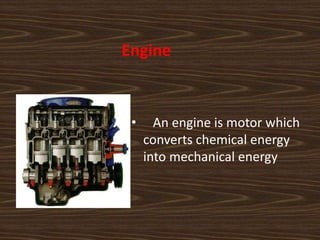
Engine
• An engine is motor which
converts chemical energy
into mechanical energy
History Four Stroke Engine
Four stroke engine was first demonstrate by
Nikolaus Otto in 1876,hence it is also known
as Otto cycle. It consist of 4 stroke ,one cycle
operation is completed in 4 stroke of the
piston, That is one cycle is completed in every
2 revolutions of the crankshaft. Each stroke
consist of 180°,of crankshaft rotation and
hence a cycle consist of 720°,of crankshaft
rotation.
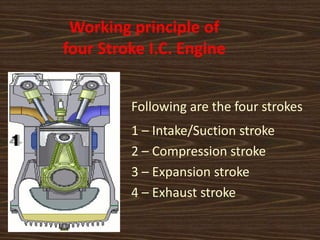
Working principle of
four Stroke I.C. Engine
Following are the four strokes
1 – Intake/Suction stroke
2 – Compression stroke
3 – Expansion stroke
4 – Exhaust stroke
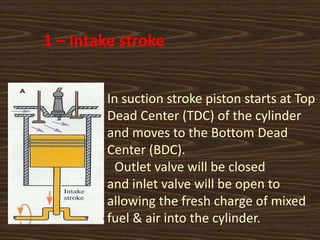
1 – Intake stroke
In suction stroke piston starts at Top
Dead Center (TDC) of the cylinder
and moves to the Bottom Dead
Center (BDC).
Outlet valve will be closed
and inlet valve will be open to
allowing the fresh charge of mixed
fuel & air into the cylinder.
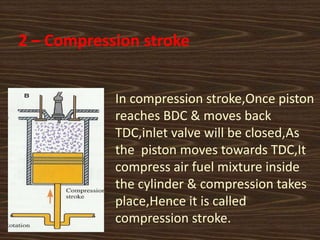
2 – Compression stroke
In compression stroke,Once piston
reaches BDC & moves back
TDC,inlet valve will be closed,As
the piston moves towards TDC,It
compress air fuel mixture inside
the cylinder & compression takes
place,Hence it is called
compression stroke.
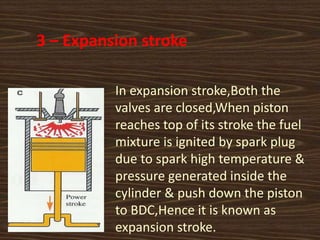
3 – Expansion stroke
In expansion stroke,Both the
valves are closed,When piston
reaches top of its stroke the fuel
mixture is ignited by spark plug
due to spark high temperature &
pressure generated inside the
cylinder & push down the piston
to BDC,Hence it is known as
expansion stroke.
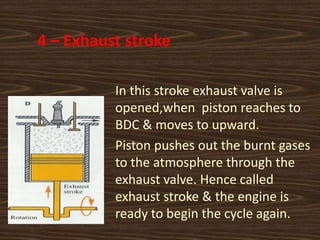
4 – Exhaust stroke
In this stroke exhaust valve is
opened,when piston reaches to
BDC & moves to upward.
Piston pushes out the burnt gases
to the atmosphere through the
exhaust valve. Hence called
exhaust stroke & the engine is
ready to begin the cycle again.
Various Parts of Engine
• Crankshaft
• Crankcase
• Crank Pin
• Camshaft
• Spark plug
• Fuel pump
• Cylinder Block
• Cylinder Head
• Inlet valve &
Exhaust valve
• Piston
• Piston Rings
• Connecting Rod
• Gudgeon Pin
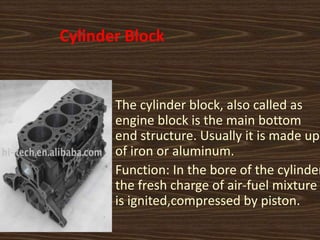
Cylinder Block
The cylinder block, also called as
engine block is the main bottom
end structure. Usually it is made up
of iron or aluminum.
Function: In the bore of the cylinder
the fresh charge of air-fuel mixture
is ignited,compressed by piston.
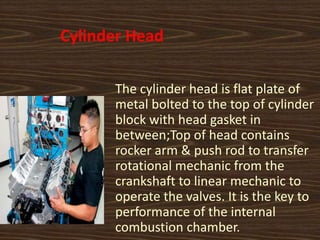
Cylinder Head
The cylinder head is flat plate of
metal bolted to the top of cylinder
block with head gasket in
between;Top of head contains
rocker arm & push rod to transfer
rotational mechanic from the
crankshaft to linear mechanic to
operate the valves. It is the key to
performance of the internal
combustion chamber.
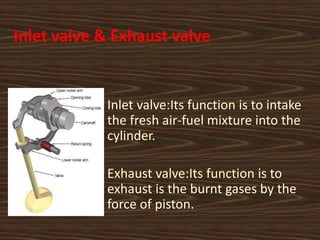
Inlet valve & Exhaust valve
Inlet valve:Its function is to intake
the fresh air-fuel mixture into the
cylinder.
Exhaust valve:Its function is to
exhaust is the burnt gases by the
force of piston.
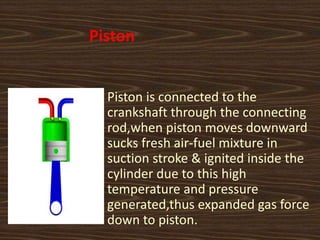
Piston
Piston is connected to the
crankshaft through the connecting
rod,when piston moves downward
sucks fresh air-fuel mixture in
suction stroke & ignited inside the
cylinder due to this high
temperature and pressure
generated,thus expanded gas force
down to piston.
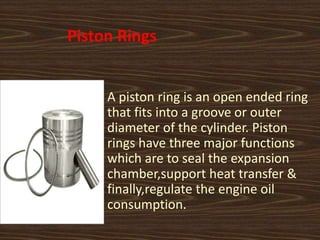
Piston Rings
A piston ring is an open ended ring
that fits into a groove or outer
diameter of the cylinder. Piston
rings have three major functions
which are to seal the expansion
chamber,support heat transfer &
finally,regulate the engine oil
consumption.
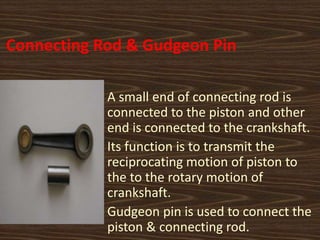
Connecting Rod & Gudgeon Pin
A small end of connecting rod is
connected to the piston and other
end is connected to the crankshaft.
Its function is to transmit the
reciprocating motion of piston to
the to the rotary motion of
crankshaft.
Gudgeon pin is used to connect the
piston & connecting rod.
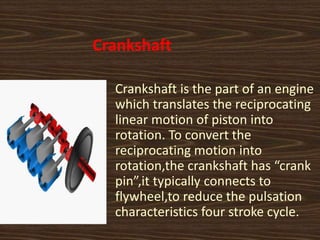
Crankshaft
Crankshaft is the part of an engine
which translates the reciprocating
linear motion of piston into
rotation. To convert the
reciprocating motion into
rotation,the crankshaft has “crank
pin”,it typically connects to
flywheel,to reduce the pulsation
characteristics four stroke cycle.
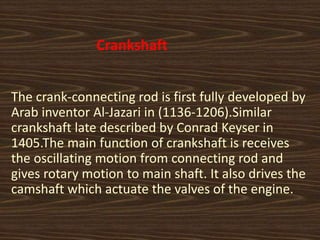
Crankshaft
The crank-connecting rod is first fully developed by
Arab inventor Al-Jazari in (1136-1206).Similar
crankshaft late described by Conrad Keyser in
1405.The main function of crankshaft is receives
the oscillating motion from connecting rod and
gives rotary motion to main shaft. It also drives the
camshaft which actuate the valves of the engine.
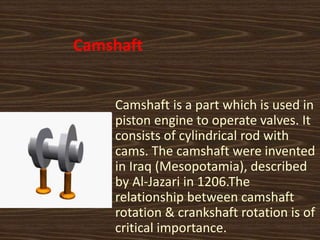
Camshaft
Camshaft is a part which is used in
piston engine to operate valves. It
consists of cylindrical rod with
cams. The camshaft were invented
in Iraq (Mesopotamia), described
by Al-Jazari in 1206.The
relationship between camshaft
rotation & crankshaft rotation is of
critical importance.
Camshaft
Since valves controls the flow of air-fuel mixture
intake & exhaust burnt gases. Valves must be
opened & closed at appropriate time during the
stroke of piston,For this reason ,the camshaft is
connected to the crankshaft either directly,via a
gear mechanism, or indirectly via belt/chain called a
timing belt or timing chain, the camshaft rotates at
the same rate of crankshaft.
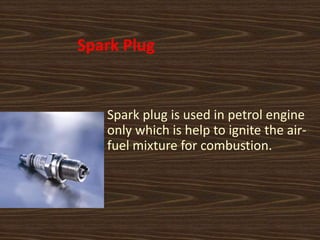
Spark Plug
Spark plug is used in petrol engine
only which is help to ignite the air-
fuel mixture for combustion.
Bibliography
• Google
• Wikipedia
• Element of Mechanical Engineering by
H.G. Katariya
THANK YOU

(Ic engine )

  • 1.
    By rajesh goswami TOPICNAME-I.C. Engine-Petrol Four Stroke Branch - Civil
  • 2.
    Outline of Topic Whatis engine? History of Four stoke Engine Working principle of four Stroke I.C. Engine Various Parts of Engine
  • 3.
    Engine • An engineis motor which converts chemical energy into mechanical energy
  • 4.
    History Four StrokeEngine Four stroke engine was first demonstrate by Nikolaus Otto in 1876,hence it is also known as Otto cycle. It consist of 4 stroke ,one cycle operation is completed in 4 stroke of the piston, That is one cycle is completed in every 2 revolutions of the crankshaft. Each stroke consist of 180°,of crankshaft rotation and hence a cycle consist of 720°,of crankshaft rotation.
  • 5.
    Working principle of fourStroke I.C. Engine Following are the four strokes 1 – Intake/Suction stroke 2 – Compression stroke 3 – Expansion stroke 4 – Exhaust stroke
  • 6.
    1 – Intakestroke In suction stroke piston starts at Top Dead Center (TDC) of the cylinder and moves to the Bottom Dead Center (BDC). Outlet valve will be closed and inlet valve will be open to allowing the fresh charge of mixed fuel & air into the cylinder.
  • 7.
    2 – Compressionstroke In compression stroke,Once piston reaches BDC & moves back TDC,inlet valve will be closed,As the piston moves towards TDC,It compress air fuel mixture inside the cylinder & compression takes place,Hence it is called compression stroke.
  • 8.
    3 – Expansionstroke In expansion stroke,Both the valves are closed,When piston reaches top of its stroke the fuel mixture is ignited by spark plug due to spark high temperature & pressure generated inside the cylinder & push down the piston to BDC,Hence it is known as expansion stroke.
  • 9.
    4 – Exhauststroke In this stroke exhaust valve is opened,when piston reaches to BDC & moves to upward. Piston pushes out the burnt gases to the atmosphere through the exhaust valve. Hence called exhaust stroke & the engine is ready to begin the cycle again.
  • 10.
    Various Parts ofEngine • Crankshaft • Crankcase • Crank Pin • Camshaft • Spark plug • Fuel pump • Cylinder Block • Cylinder Head • Inlet valve & Exhaust valve • Piston • Piston Rings • Connecting Rod • Gudgeon Pin
  • 11.
    Cylinder Block The cylinderblock, also called as engine block is the main bottom end structure. Usually it is made up of iron or aluminum. Function: In the bore of the cylinder the fresh charge of air-fuel mixture is ignited,compressed by piston.
  • 12.
    Cylinder Head The cylinderhead is flat plate of metal bolted to the top of cylinder block with head gasket in between;Top of head contains rocker arm & push rod to transfer rotational mechanic from the crankshaft to linear mechanic to operate the valves. It is the key to performance of the internal combustion chamber.
  • 13.
    Inlet valve &Exhaust valve Inlet valve:Its function is to intake the fresh air-fuel mixture into the cylinder. Exhaust valve:Its function is to exhaust is the burnt gases by the force of piston.
  • 14.
    Piston Piston is connectedto the crankshaft through the connecting rod,when piston moves downward sucks fresh air-fuel mixture in suction stroke & ignited inside the cylinder due to this high temperature and pressure generated,thus expanded gas force down to piston.
  • 15.
    Piston Rings A pistonring is an open ended ring that fits into a groove or outer diameter of the cylinder. Piston rings have three major functions which are to seal the expansion chamber,support heat transfer & finally,regulate the engine oil consumption.
  • 16.
    Connecting Rod &Gudgeon Pin A small end of connecting rod is connected to the piston and other end is connected to the crankshaft. Its function is to transmit the reciprocating motion of piston to the to the rotary motion of crankshaft. Gudgeon pin is used to connect the piston & connecting rod.
  • 17.
    Crankshaft Crankshaft is thepart of an engine which translates the reciprocating linear motion of piston into rotation. To convert the reciprocating motion into rotation,the crankshaft has “crank pin”,it typically connects to flywheel,to reduce the pulsation characteristics four stroke cycle.
  • 18.
    Crankshaft The crank-connecting rodis first fully developed by Arab inventor Al-Jazari in (1136-1206).Similar crankshaft late described by Conrad Keyser in 1405.The main function of crankshaft is receives the oscillating motion from connecting rod and gives rotary motion to main shaft. It also drives the camshaft which actuate the valves of the engine.
  • 19.
    Camshaft Camshaft is apart which is used in piston engine to operate valves. It consists of cylindrical rod with cams. The camshaft were invented in Iraq (Mesopotamia), described by Al-Jazari in 1206.The relationship between camshaft rotation & crankshaft rotation is of critical importance.
  • 20.
    Camshaft Since valves controlsthe flow of air-fuel mixture intake & exhaust burnt gases. Valves must be opened & closed at appropriate time during the stroke of piston,For this reason ,the camshaft is connected to the crankshaft either directly,via a gear mechanism, or indirectly via belt/chain called a timing belt or timing chain, the camshaft rotates at the same rate of crankshaft.
  • 21.
    Spark Plug Spark plugis used in petrol engine only which is help to ignite the air- fuel mixture for combustion.
  • 22.
    Bibliography • Google • Wikipedia •Element of Mechanical Engineering by H.G. Katariya
  • 23.