



Spark and GraphX in the Netflix
Recommender System
Ehtsham Elahi and Yves Raimond
Algorithms Engineering
Netflix
MLconf Seattle 2015
Machine Learning @ Netflix
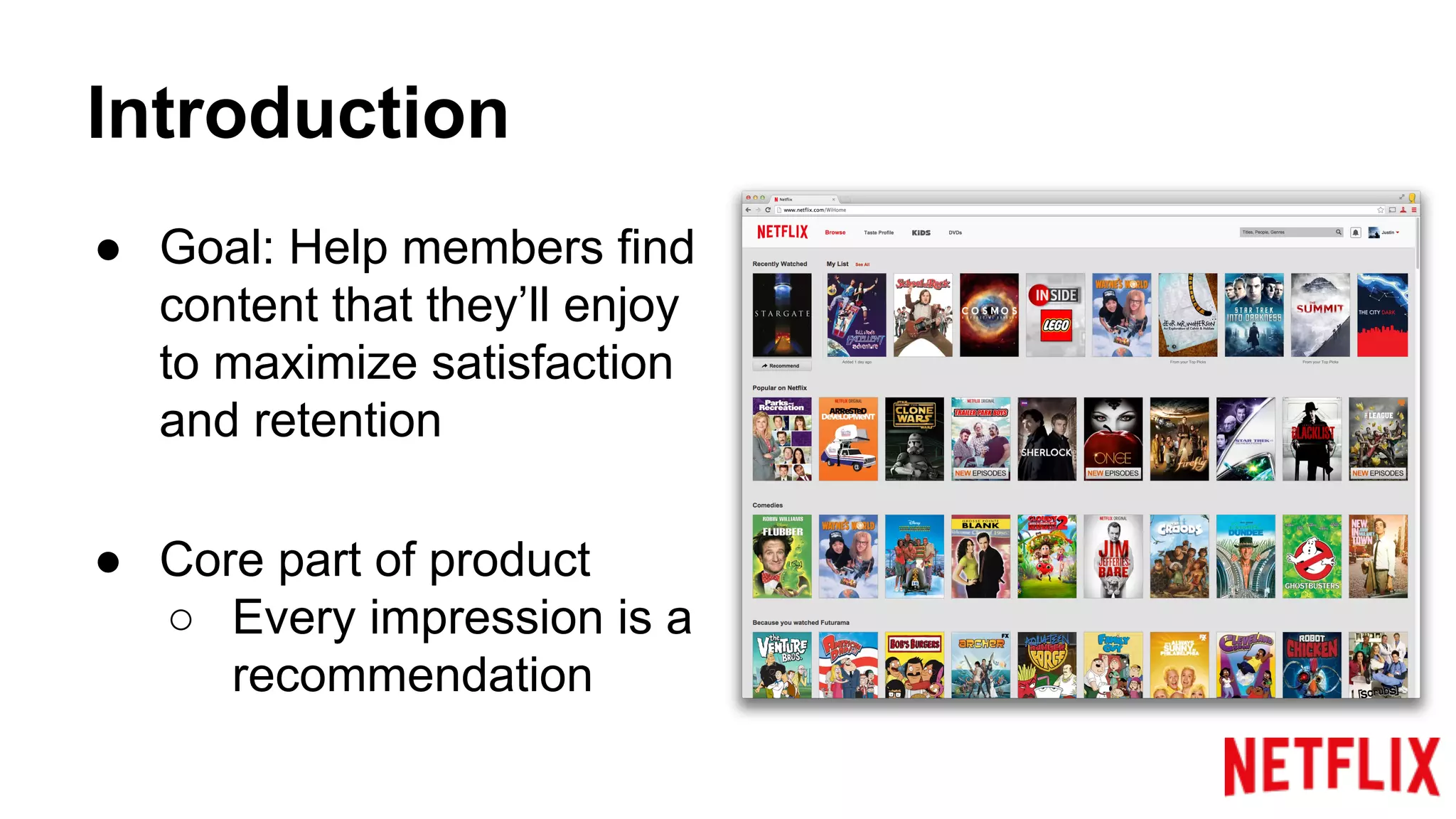
Introduction
● Goal: Help members find
content that they’ll enjoy
to maximize satisfaction
and retention
● Core part of product
○ Every impression is a
recommendation
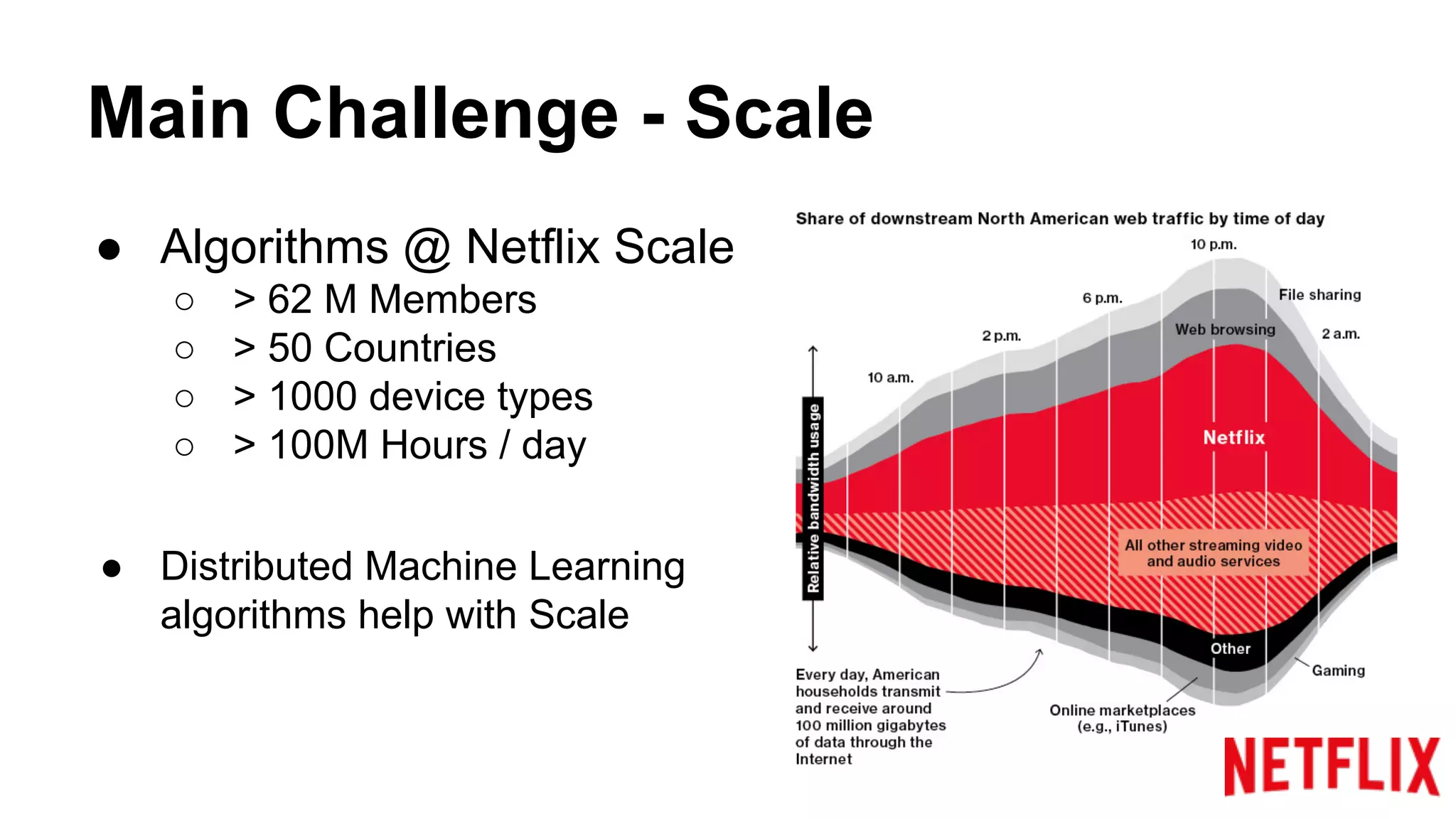
Main Challenge - Scale
● Algorithms @ Netflix Scale
○ > 62 M Members
○ > 50 Countries
○ > 1000 device types
○ > 100M Hours / day
● Distributed Machine Learning
algorithms help with Scale
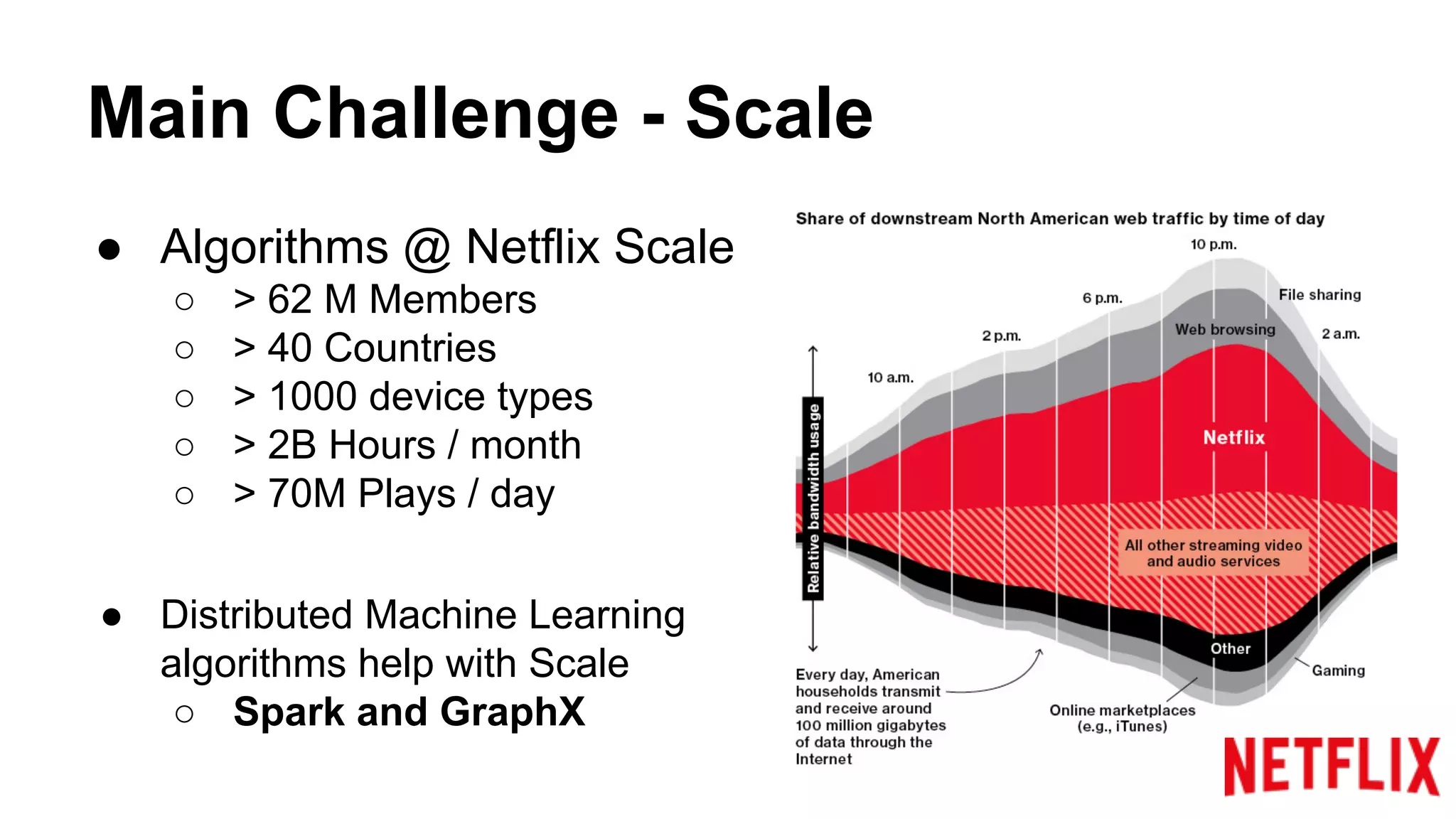
Main Challenge - Scale
● Algorithms @ Netflix Scale
○ > 62 M Members
○ > 50 Countries
○ > 1000 device types
○ > 100M Hours / day
● Distributed Machine Learning
algorithms help with Scale
○ Spark And GraphX
Spark and GraphX
Spark And GraphX
● Spark- Distributed in-memory computational engine
using Resilient Distributed Datasets (RDDs)
● GraphX - extends RDDs to Multigraphs and provides
graph analytics
● Convenient and fast, all the way from prototyping
(iSpark, Zeppelin) to Production
Two Machine Learning Problems
● Generate ranking of items with respect to a given item
from an interaction graph
○ Graph Diffusion algorithms (e.g. Topic Sensitive Pagerank)
● Find Clusters of related items using co-occurrence data
○ Probabilistic Graphical Models (Latent Dirichlet Allocation)
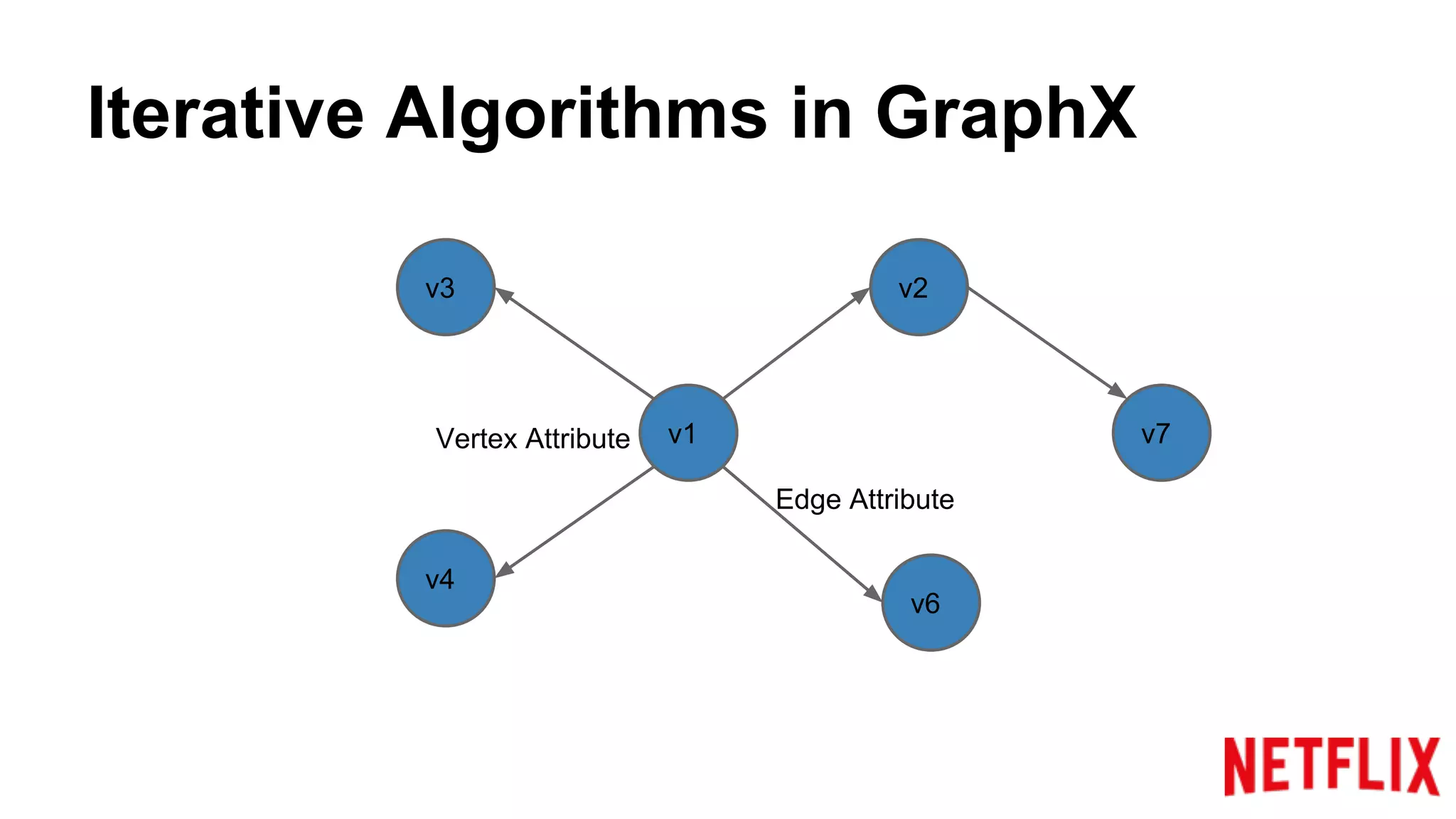
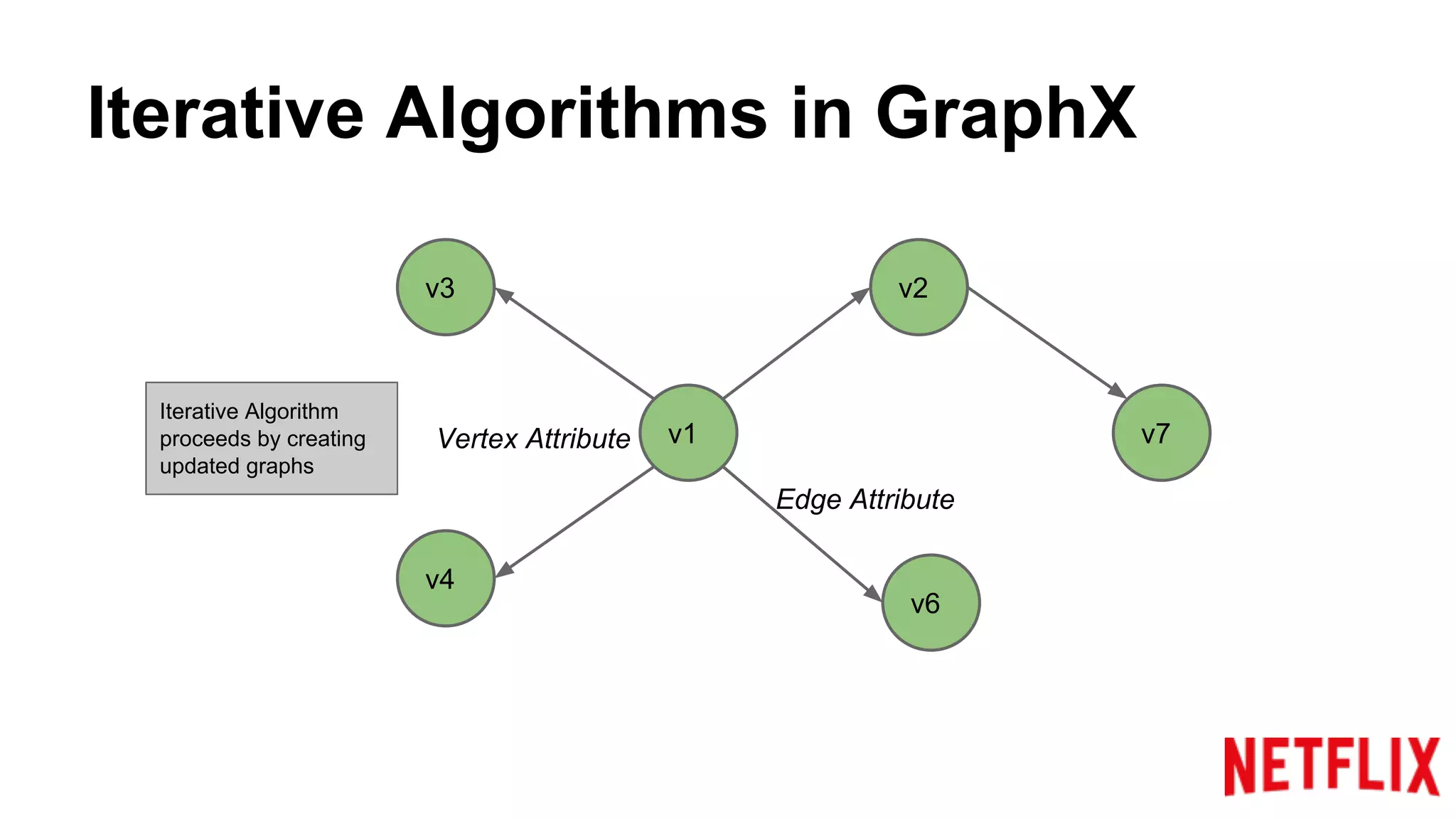
Iterative Algorithms in GraphX
v1
v2v3
v4
v6
v7Vertex Attribute
Edge Attribute
Iterative Algorithms in GraphX
v1
v2v3
v4
v6
v7Vertex Attribute
Edge Attribute
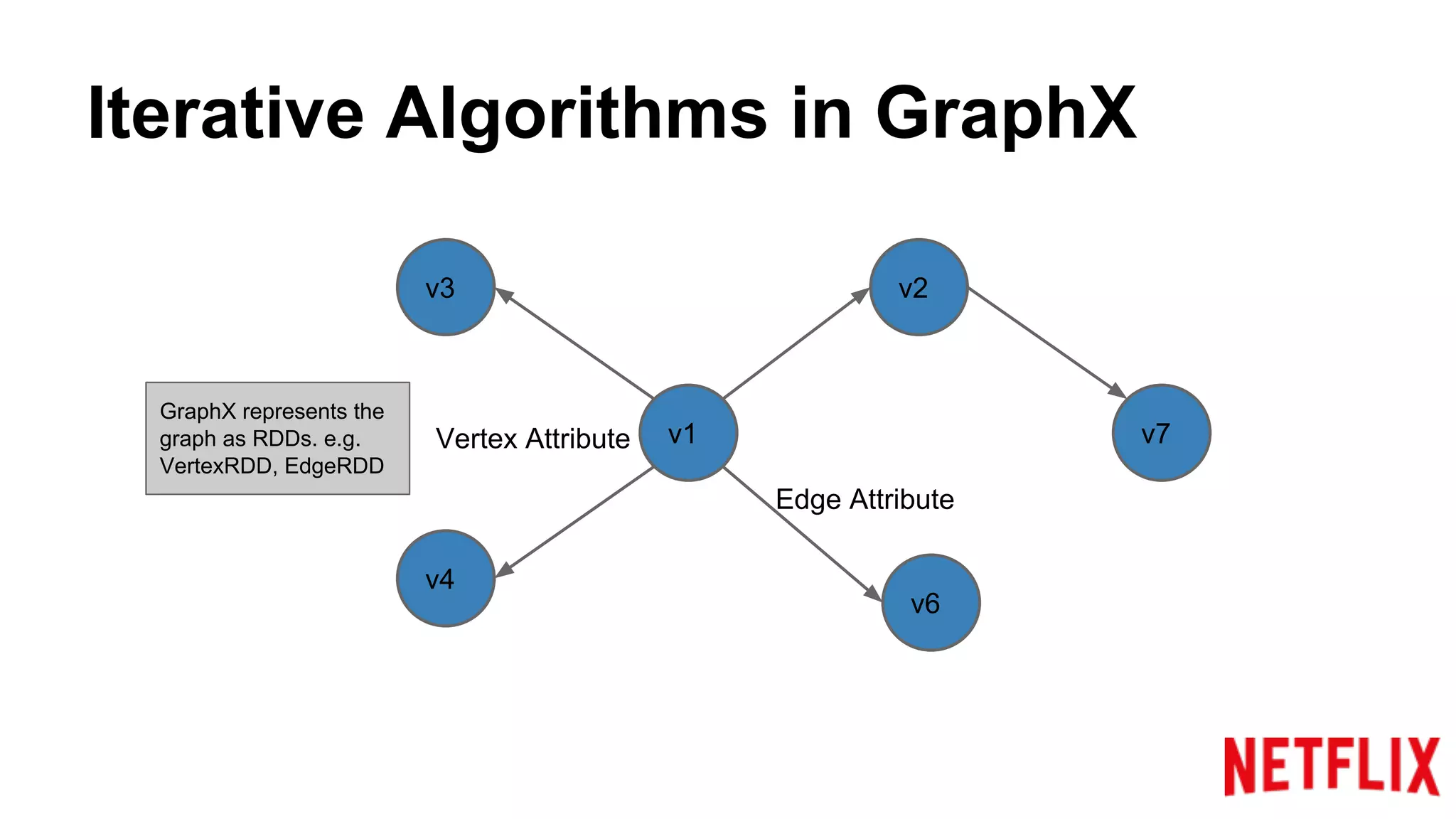
GraphX represents the
graph as RDDs. e.g.
VertexRDD, EdgeRDD
Iterative Algorithms in GraphX
v1
v2v3
v4
v6
v7Vertex Attribute
Edge Attribute
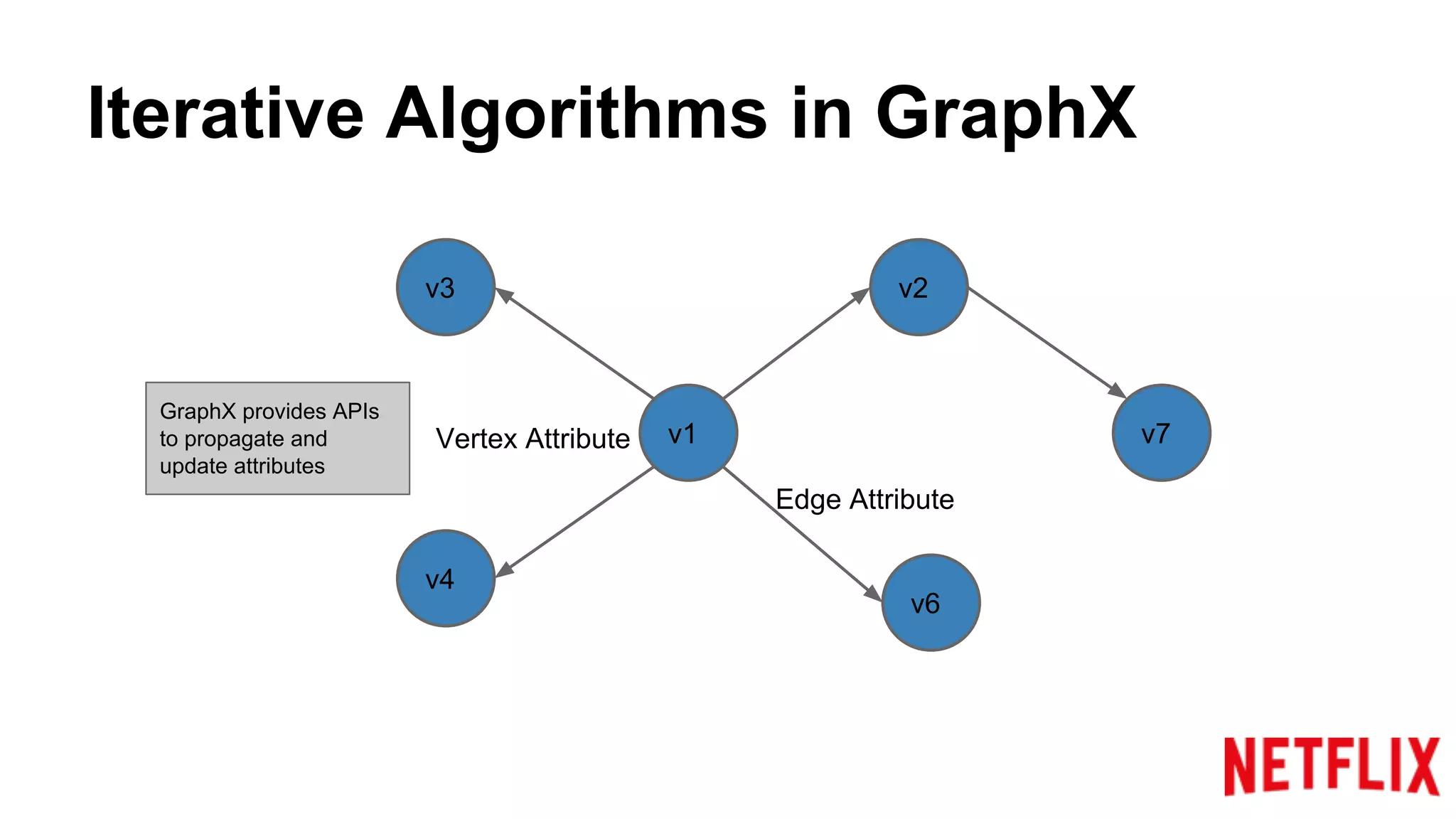
GraphX provides APIs
to propagate and
update attributes
Iterative Algorithms in GraphX
v1
v2v3
v4
v6
v7Vertex Attribute
Edge Attribute
Iterative Algorithm
proceeds by creating
updated graphs
Graph Diffusion algorithms
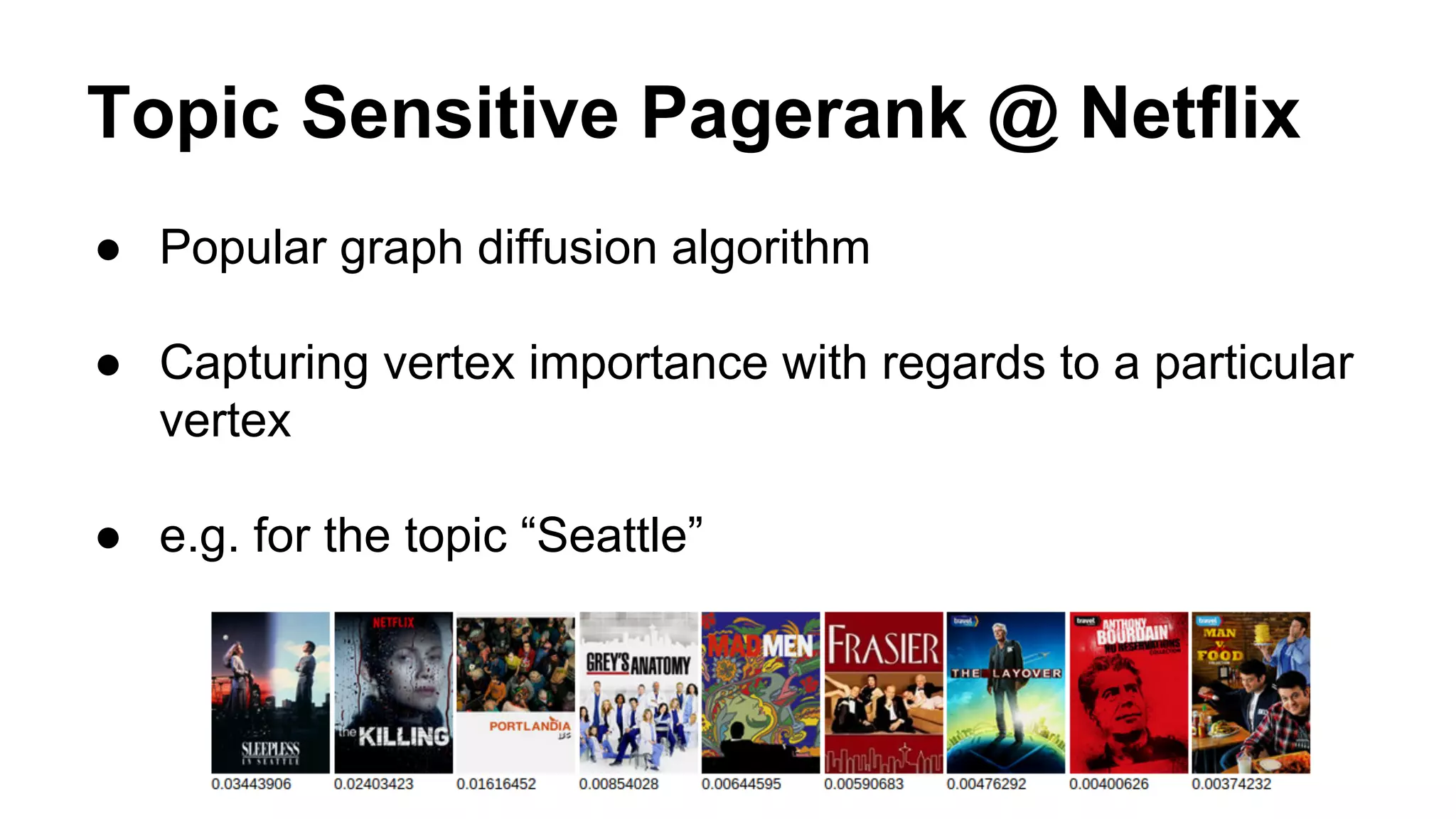
● Popular graph diffusion algorithm
● Capturing vertex importance with regards to a particular
vertex
● e.g. for the topic “Seattle”
Topic Sensitive Pagerank @ Netflix
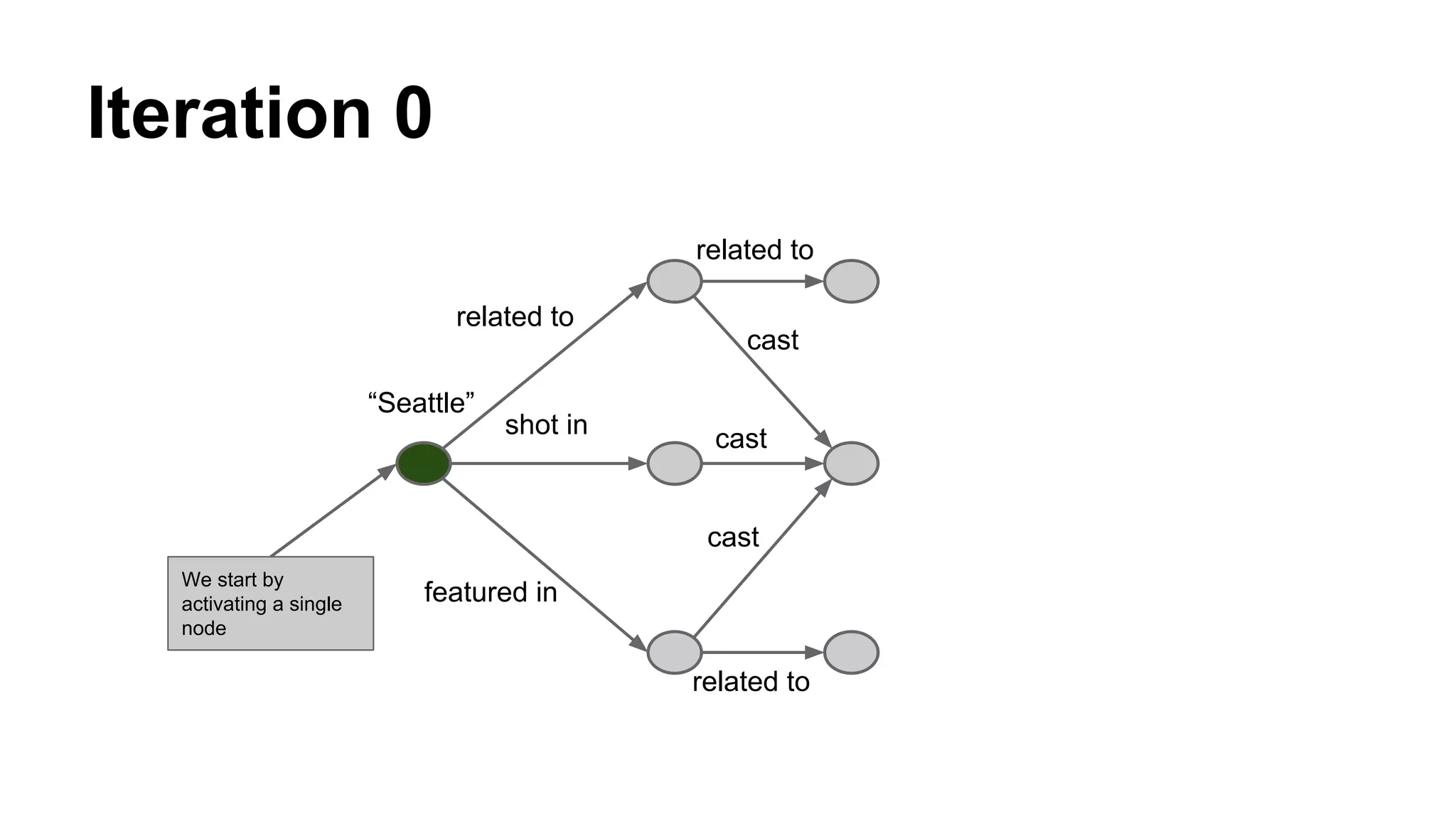
Iteration 0
We start by
activating a single
node
“Seattle”
related to
shot in
featured in
related to
cast
cast
cast
related to
Iteration 1
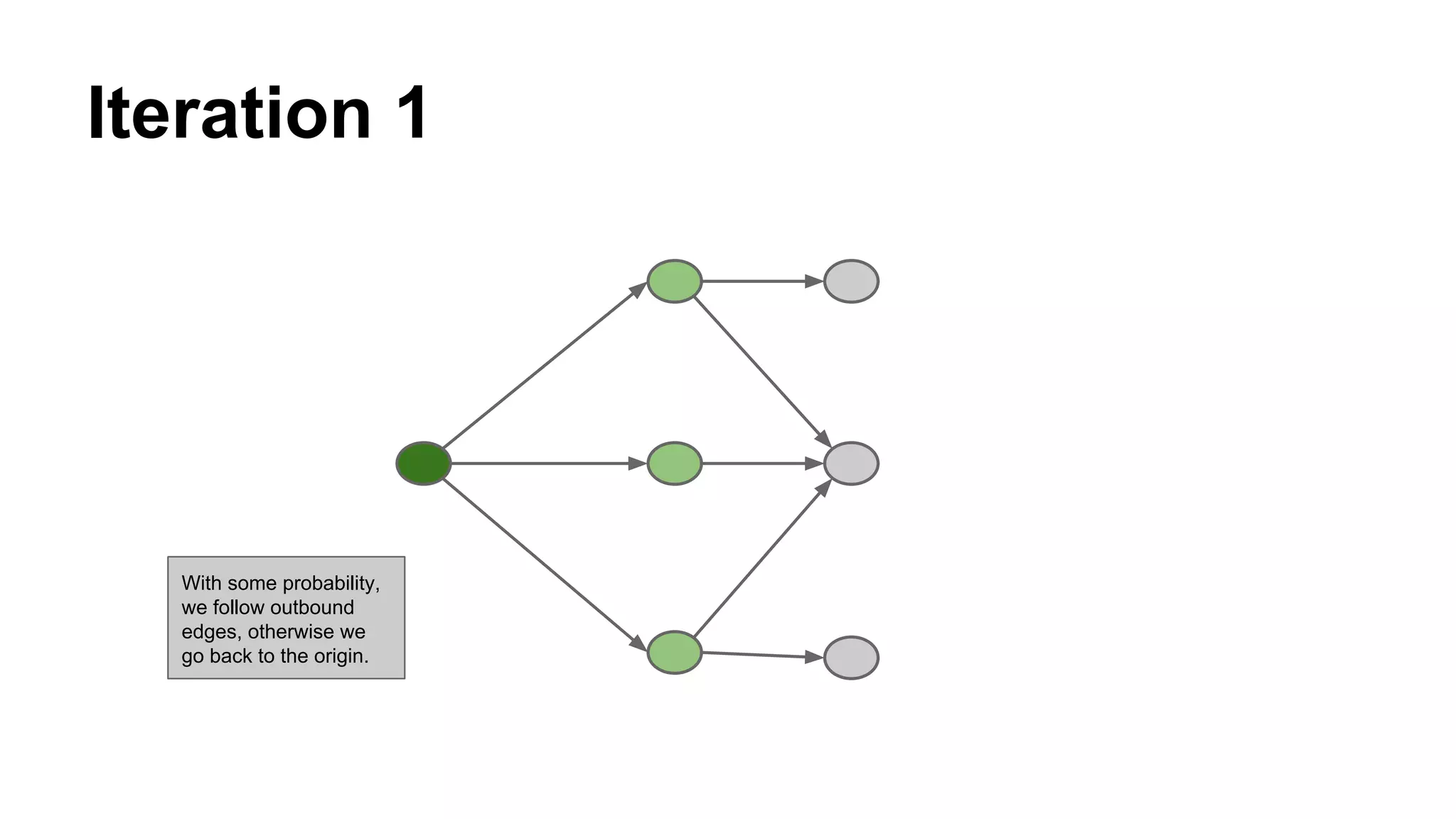
With some probability,
we follow outbound
edges, otherwise we
go back to the origin.
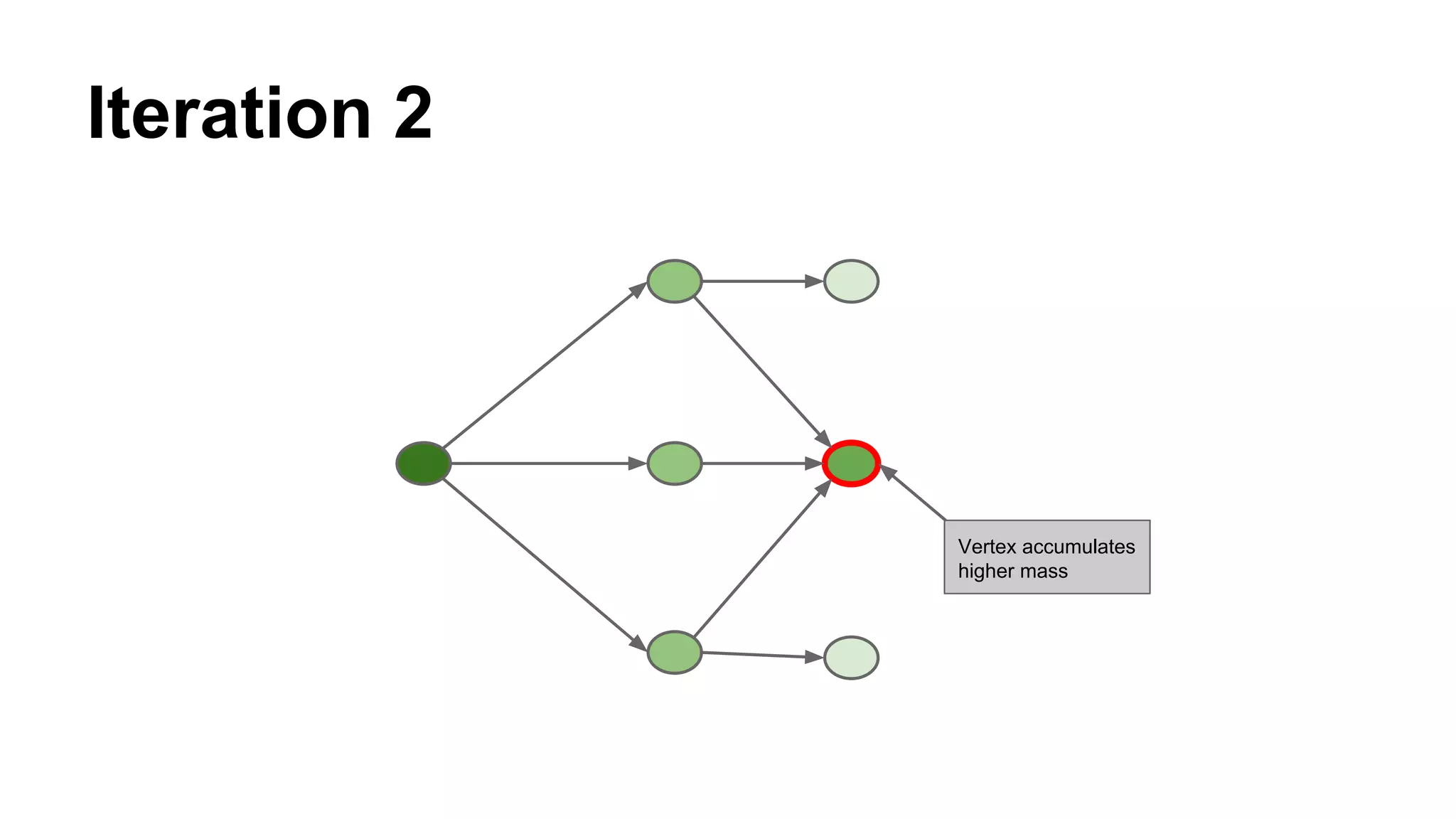
Iteration 2
Vertex accumulates
higher mass
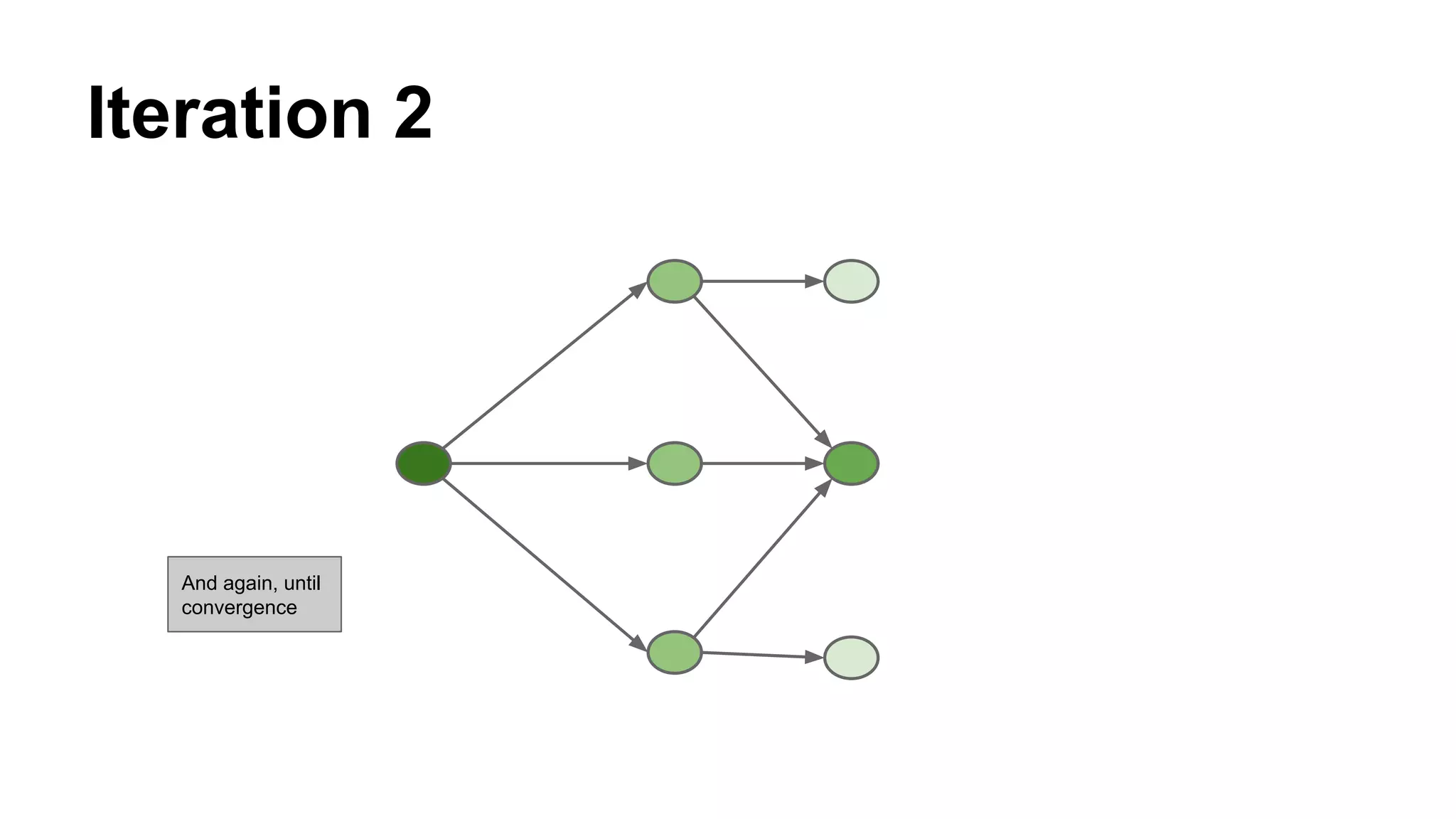
Iteration 2
And again, until
convergence
GraphX implementation
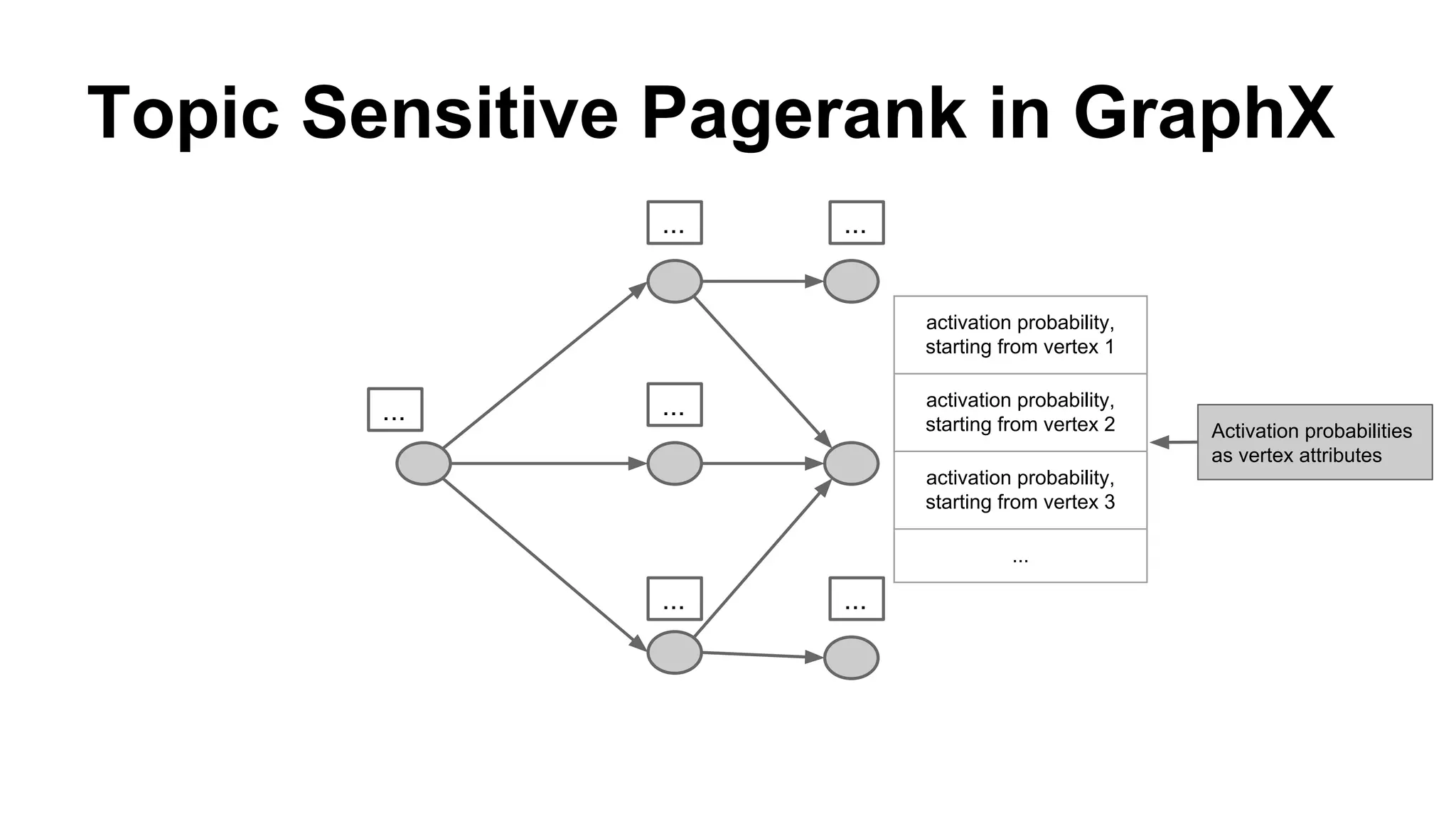
● Running one propagation for each possible starting
node would be slow
● Keep a vector of activation probabilities at each vertex
● Use GraphX to run all propagations in parallel
Topic Sensitive Pagerank in GraphX
activation probability,
starting from vertex 1
activation probability,
starting from vertex 2
activation probability,
starting from vertex 3
...
Activation probabilities
as vertex attributes
...
...
... ...
...
...
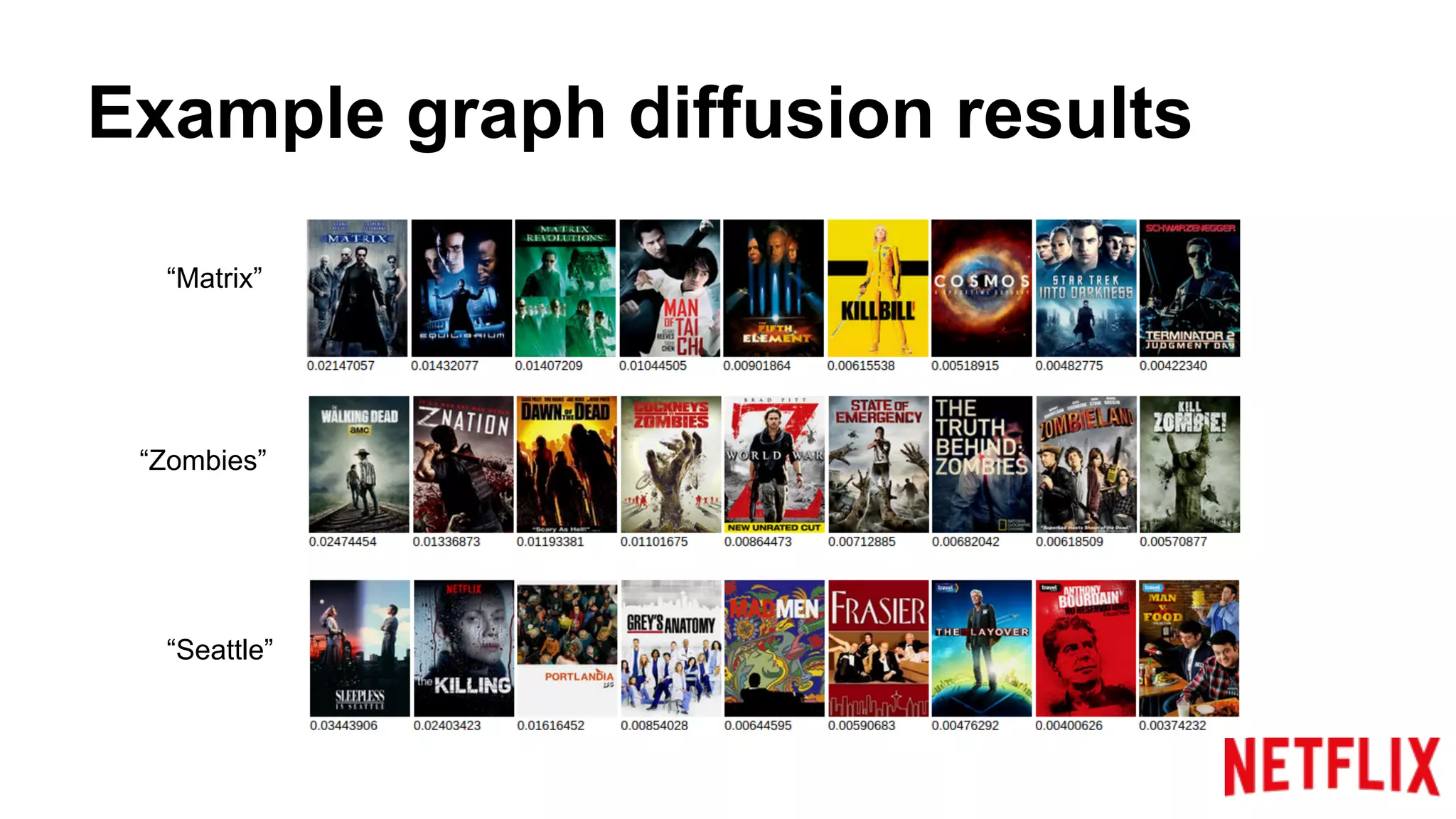
Example graph diffusion results
“Matrix”
“Zombies”
“Seattle”
Distributed Clustering algorithms
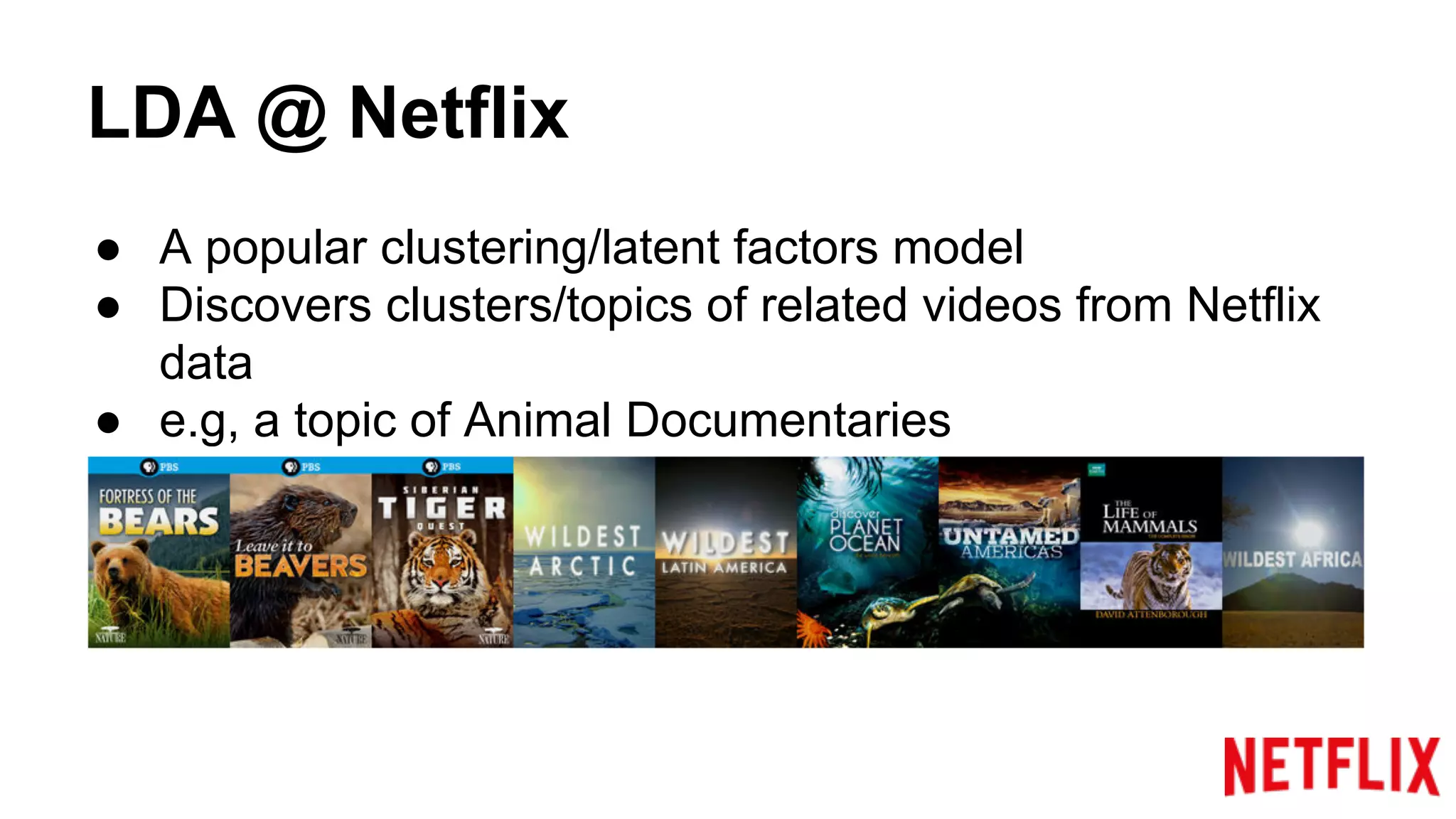
LDA @ Netflix
● A popular clustering/latent factors model
● Discovers clusters/topics of related videos from Netflix
data
● e.g, a topic of Animal Documentaries
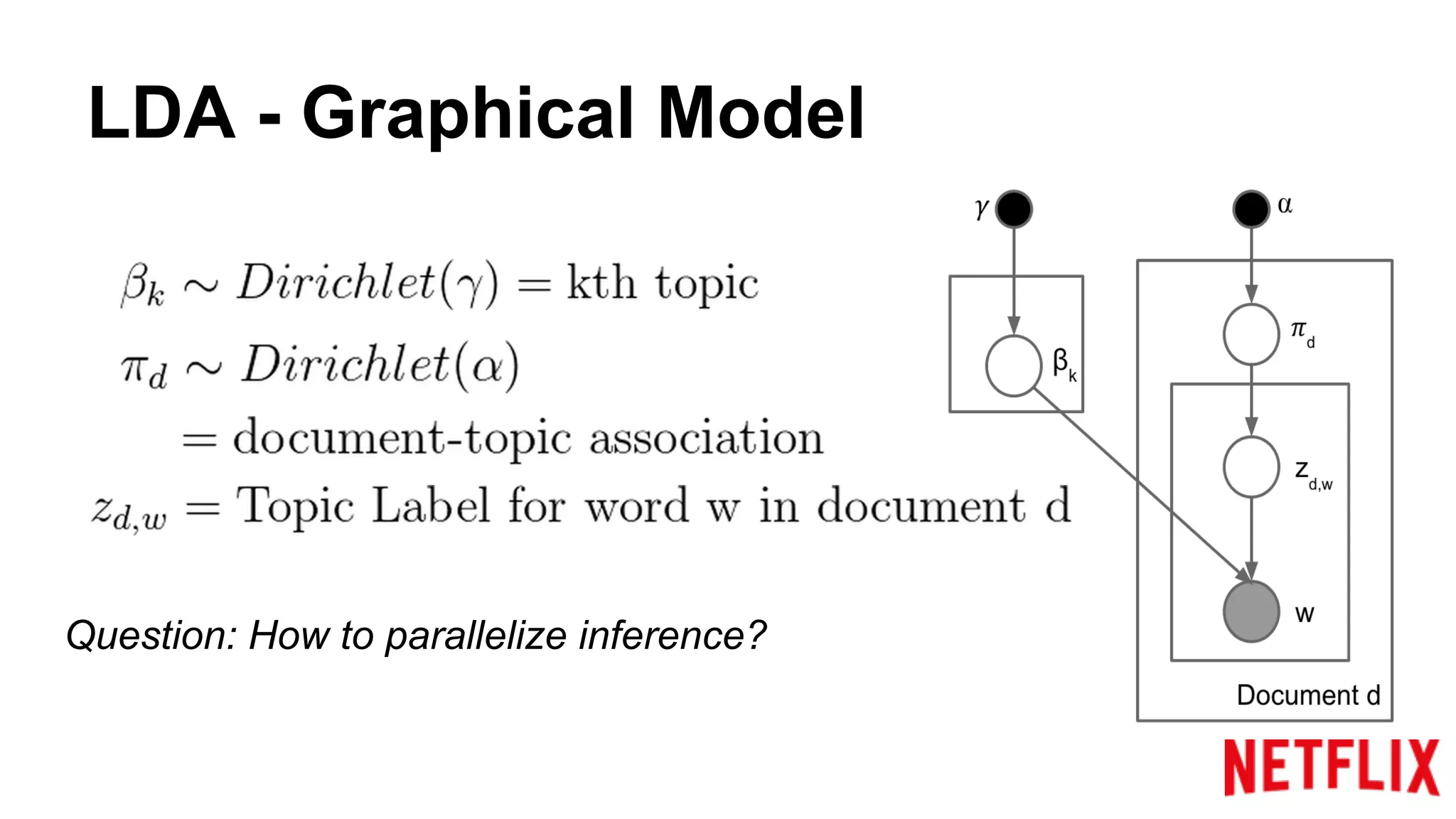
LDA - Graphical Model
Question: How to parallelize inference?
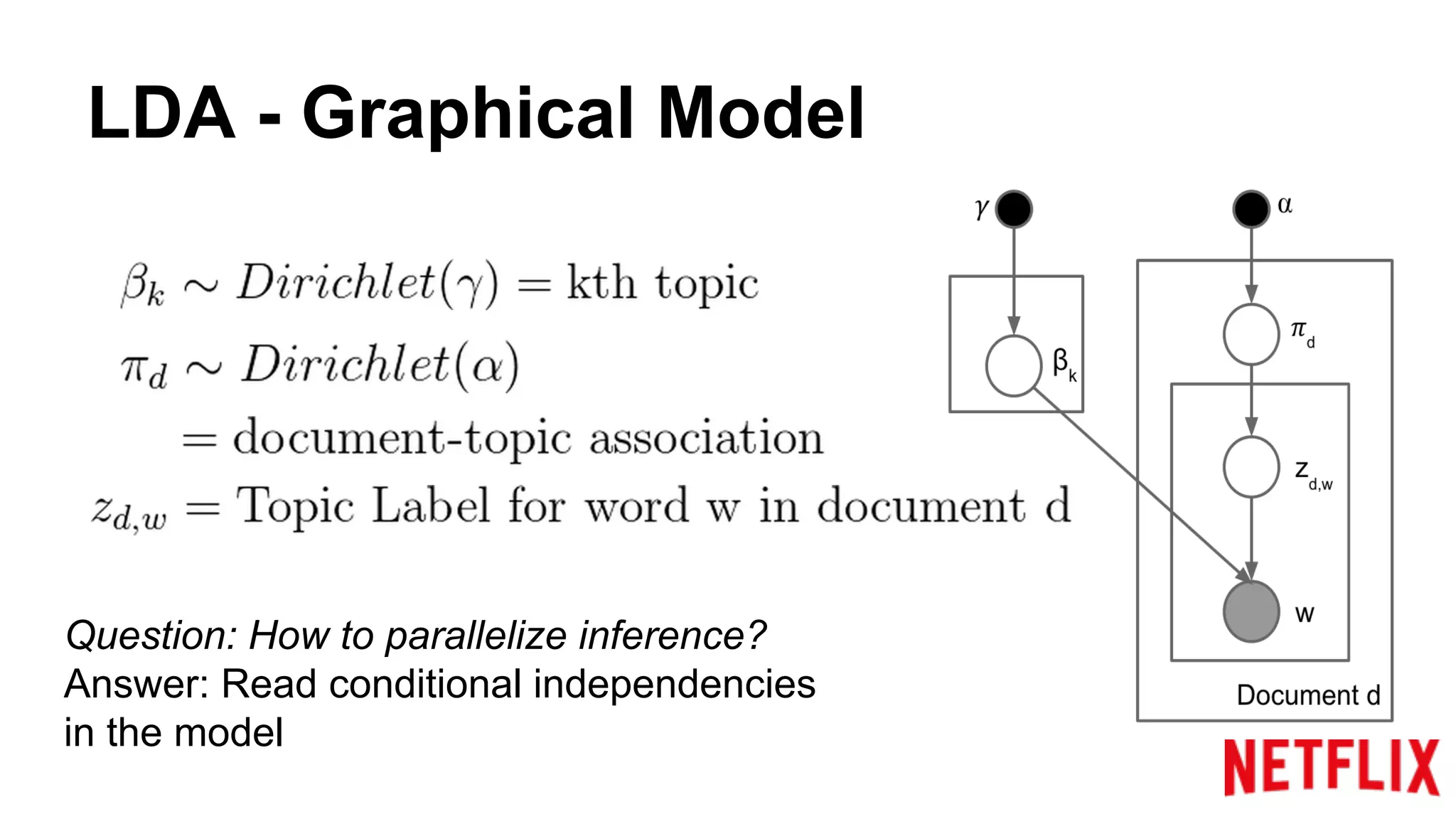
LDA - Graphical Model
Question: How to parallelize inference?
Answer: Read conditional independencies
in the model
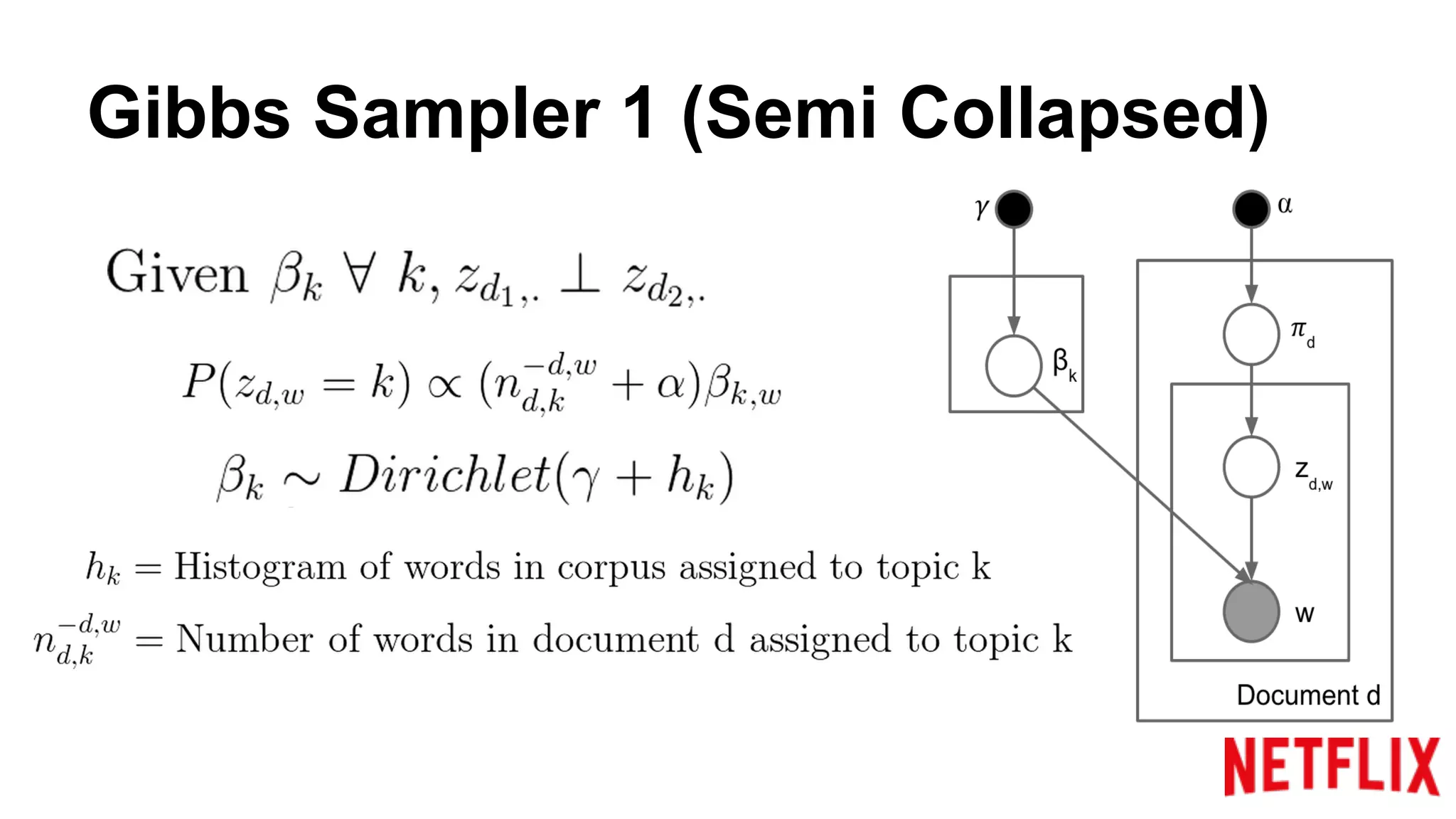
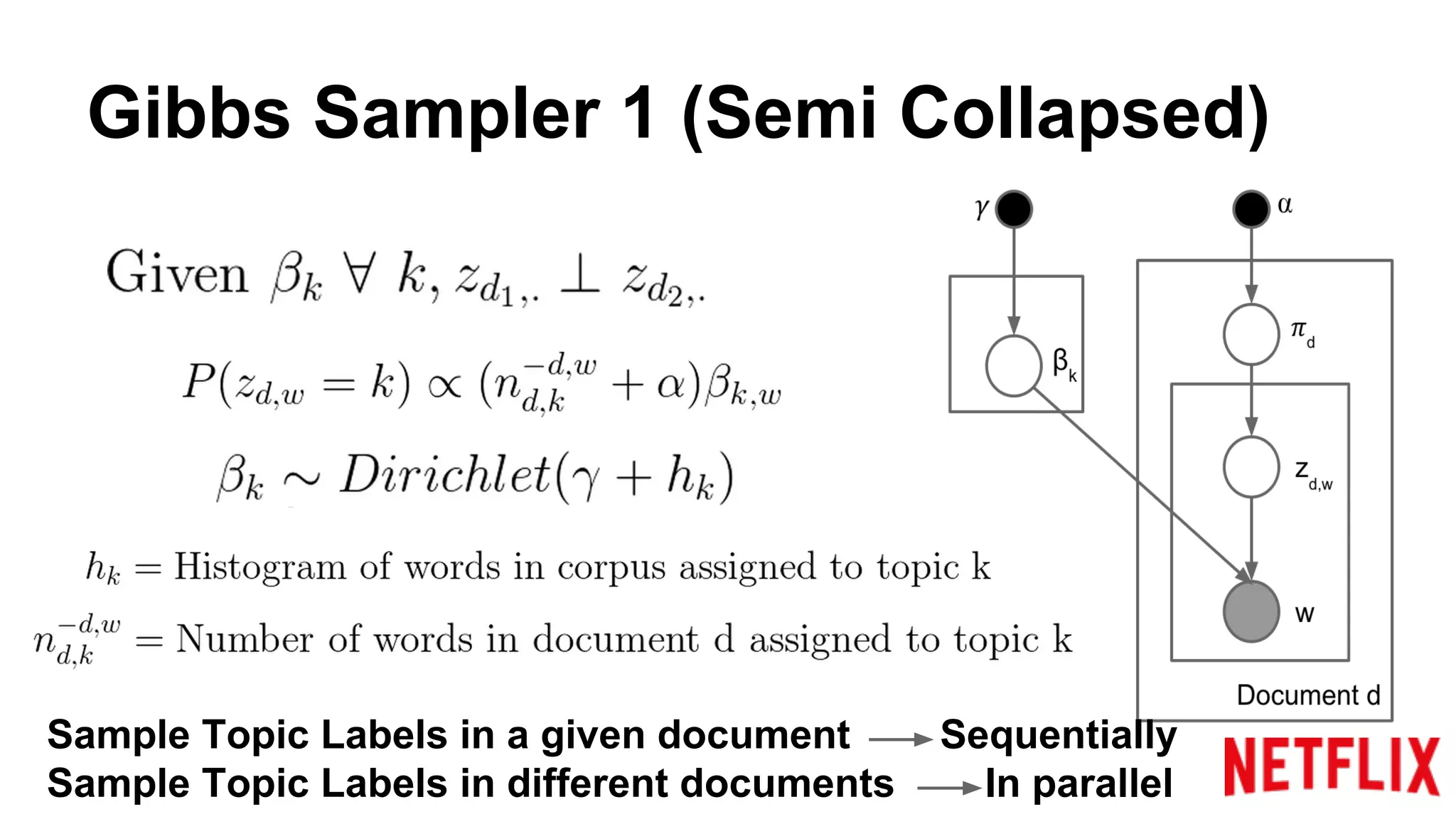
Gibbs Sampler 1 (Semi Collapsed)
Sample Topic Labels in a given document Sequentially
Sample Topic Labels in different documents In parallel
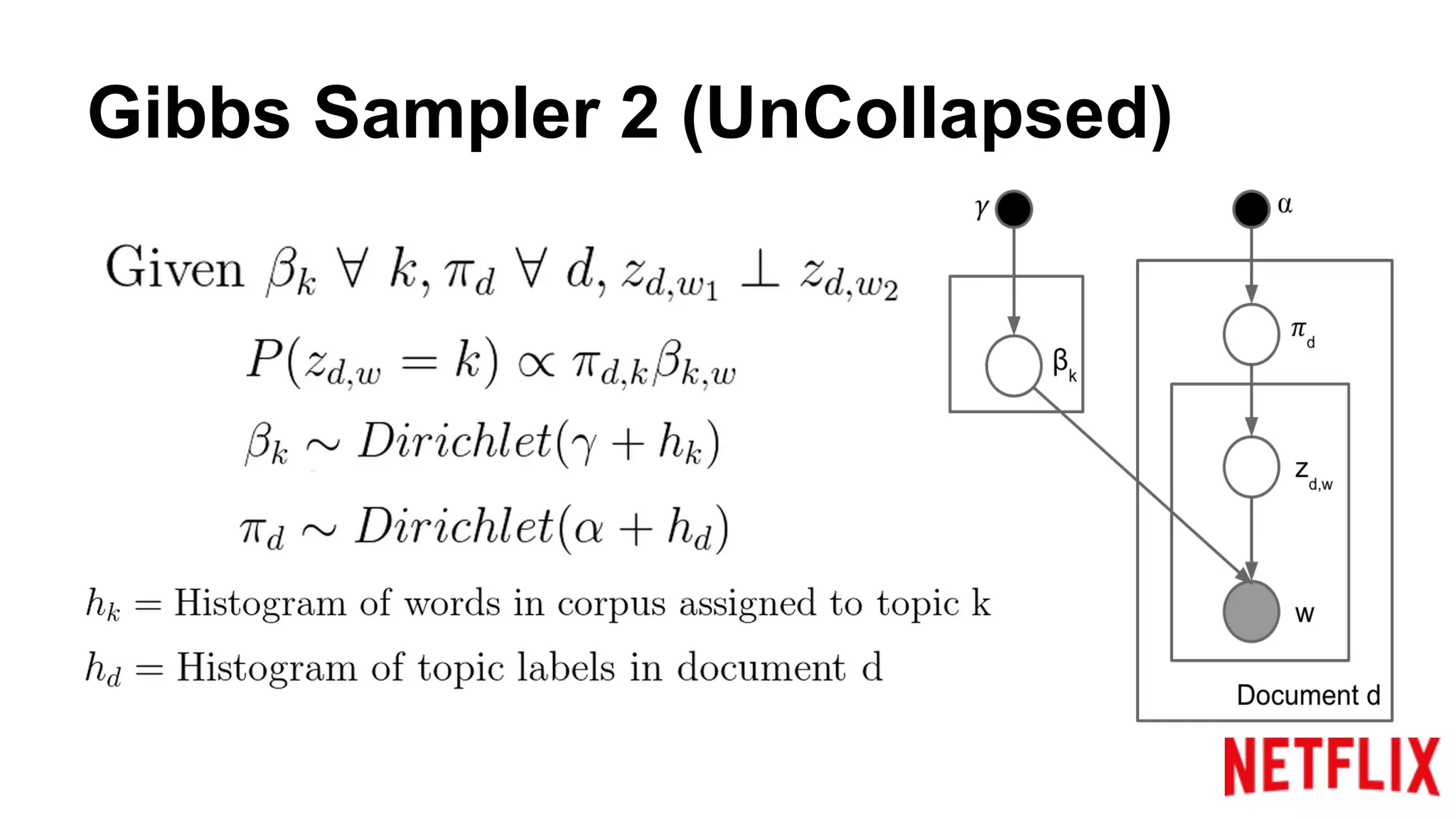
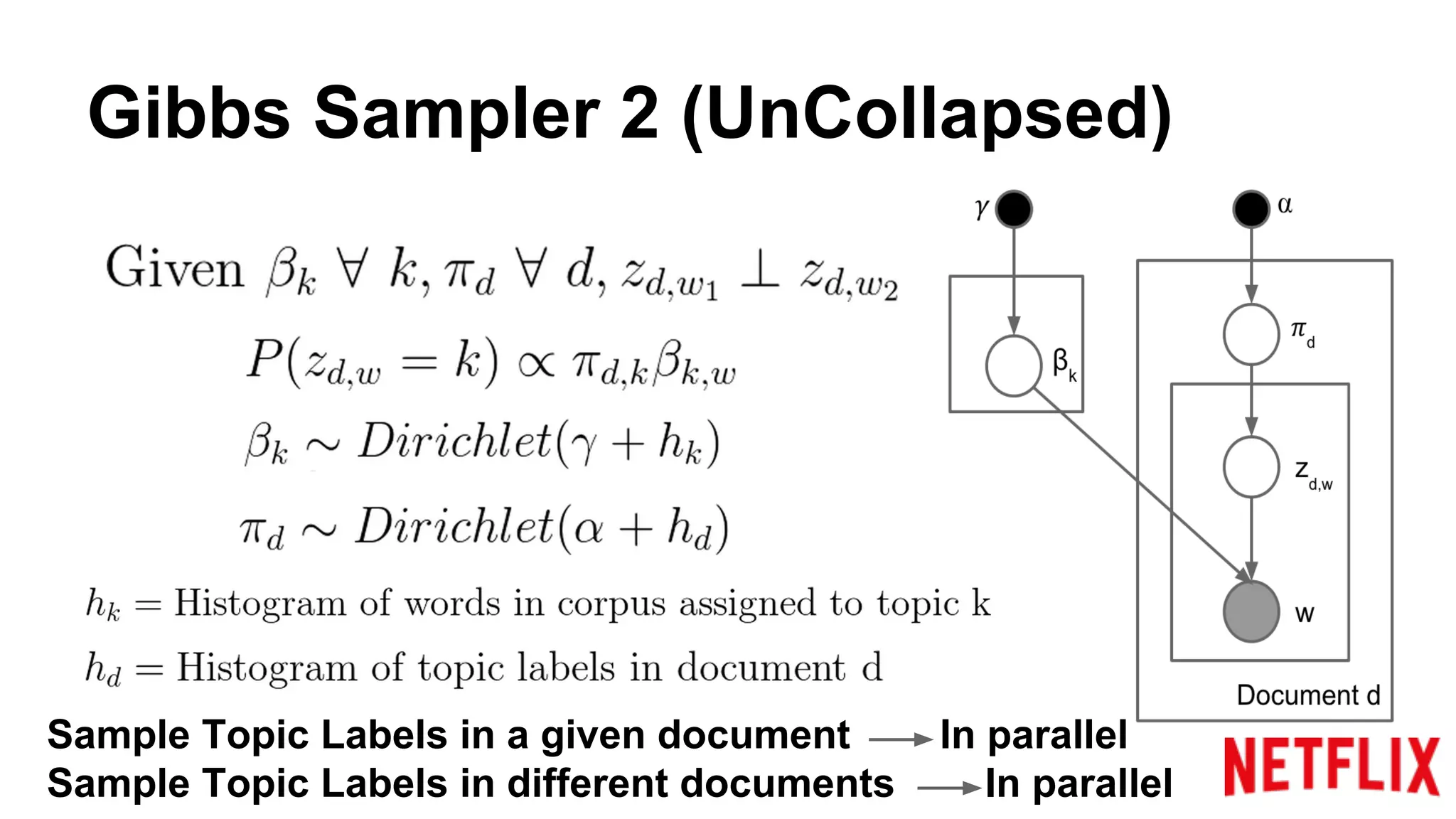
Gibbs Sampler 2 (UnCollapsed)
Sample Topic Labels in a given document In parallel
Sample Topic Labels in different documents In parallel
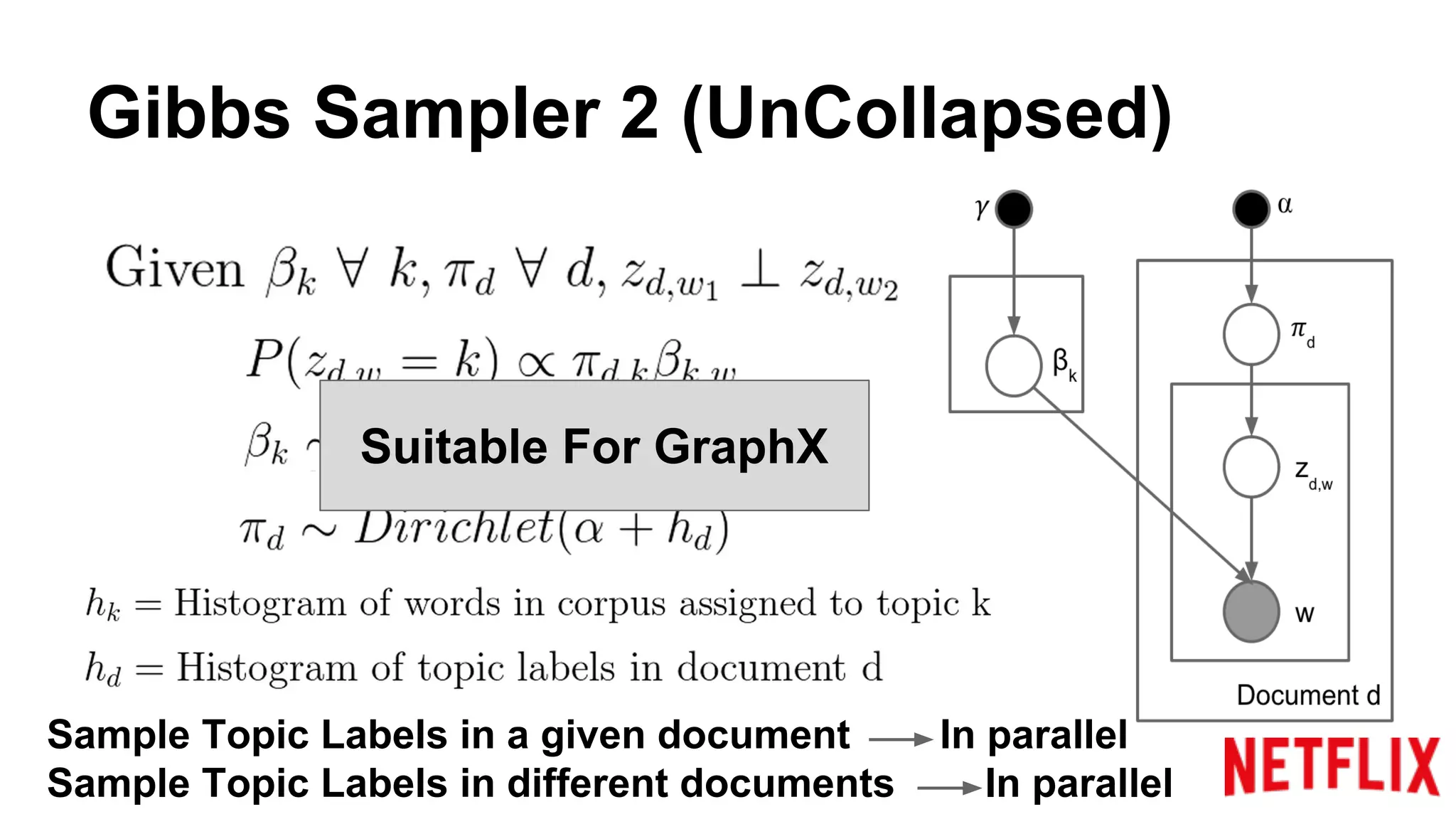
Gibbs Sampler 2 (UnCollapsed)
Suitable For GraphX
Sample Topic Labels in a given document In parallel
Sample Topic Labels in different documents In parallel
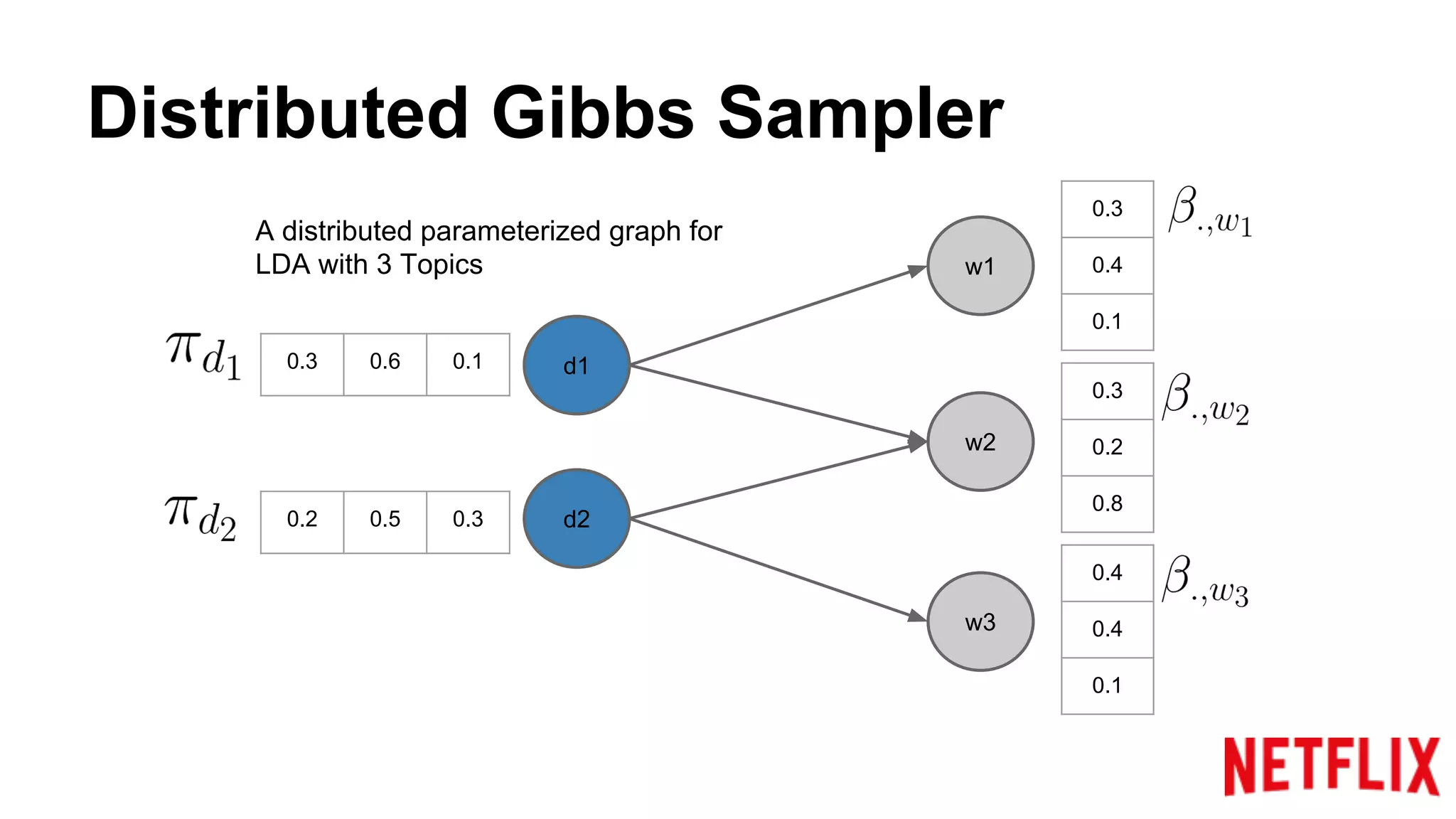
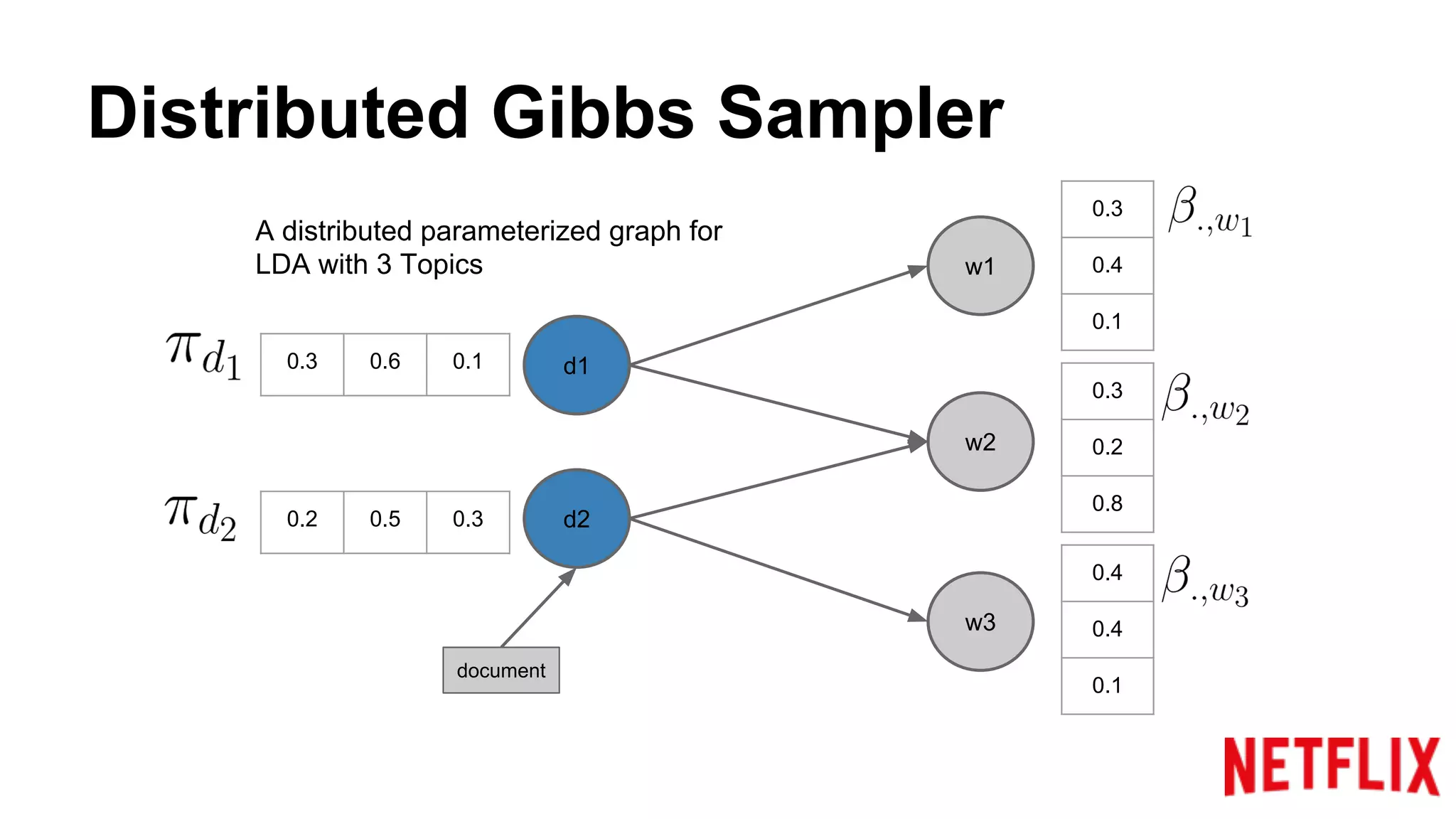
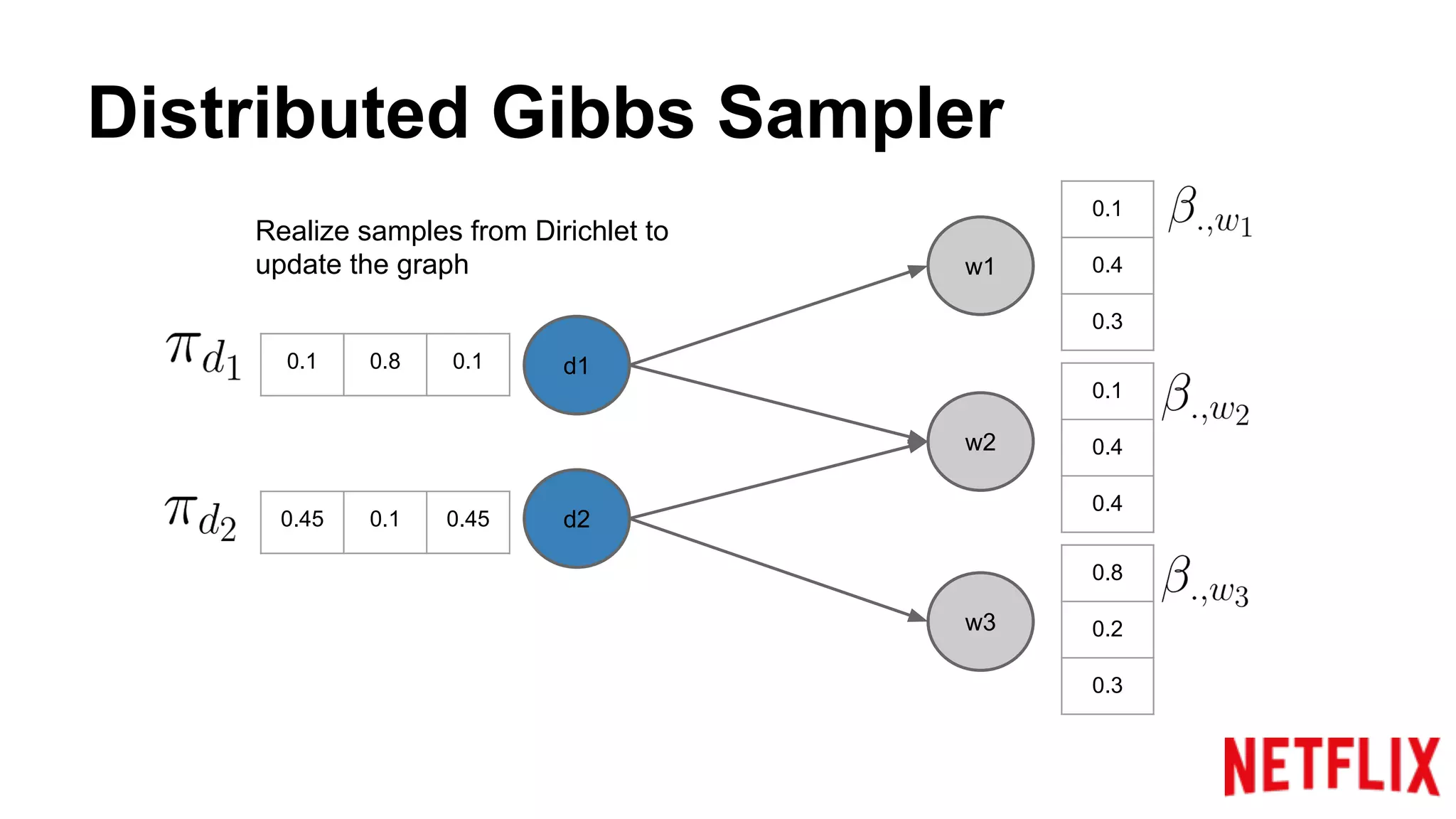
Distributed Gibbs Sampler
w1
w2
w3
d1
d2
0.3
0.4
0.1
0.3
0.2
0.8
0.4
0.4
0.1
0.3 0.6 0.1
0.2 0.5 0.3
A distributed parameterized graph for
LDA with 3 Topics
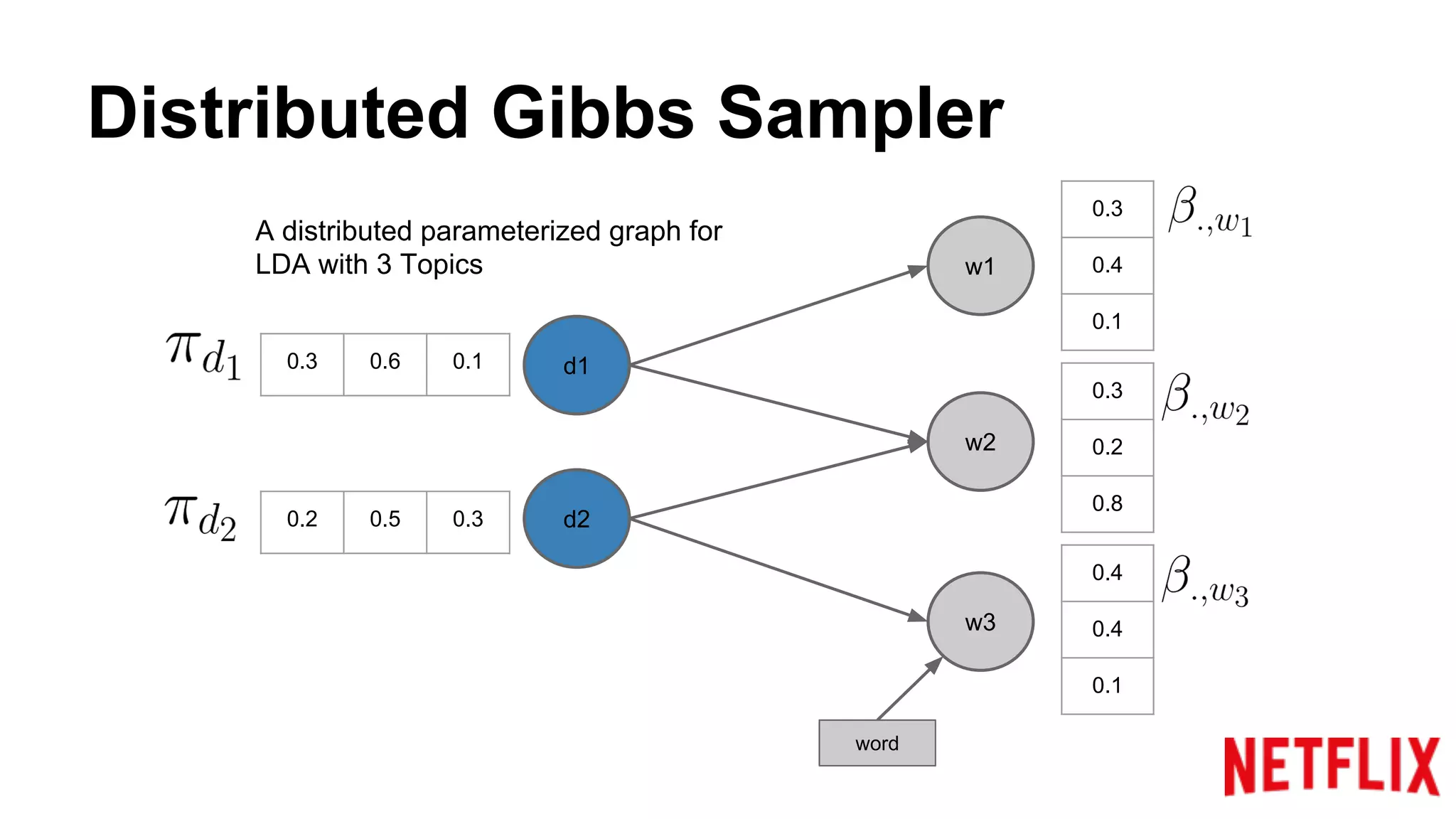
Distributed Gibbs Sampler
w1
w2
w3
d1
d2
0.3
0.4
0.1
0.3
0.2
0.8
0.4
0.4
0.1
0.3 0.6 0.1
0.2 0.5 0.3
A distributed parameterized graph for
LDA with 3 Topics
document
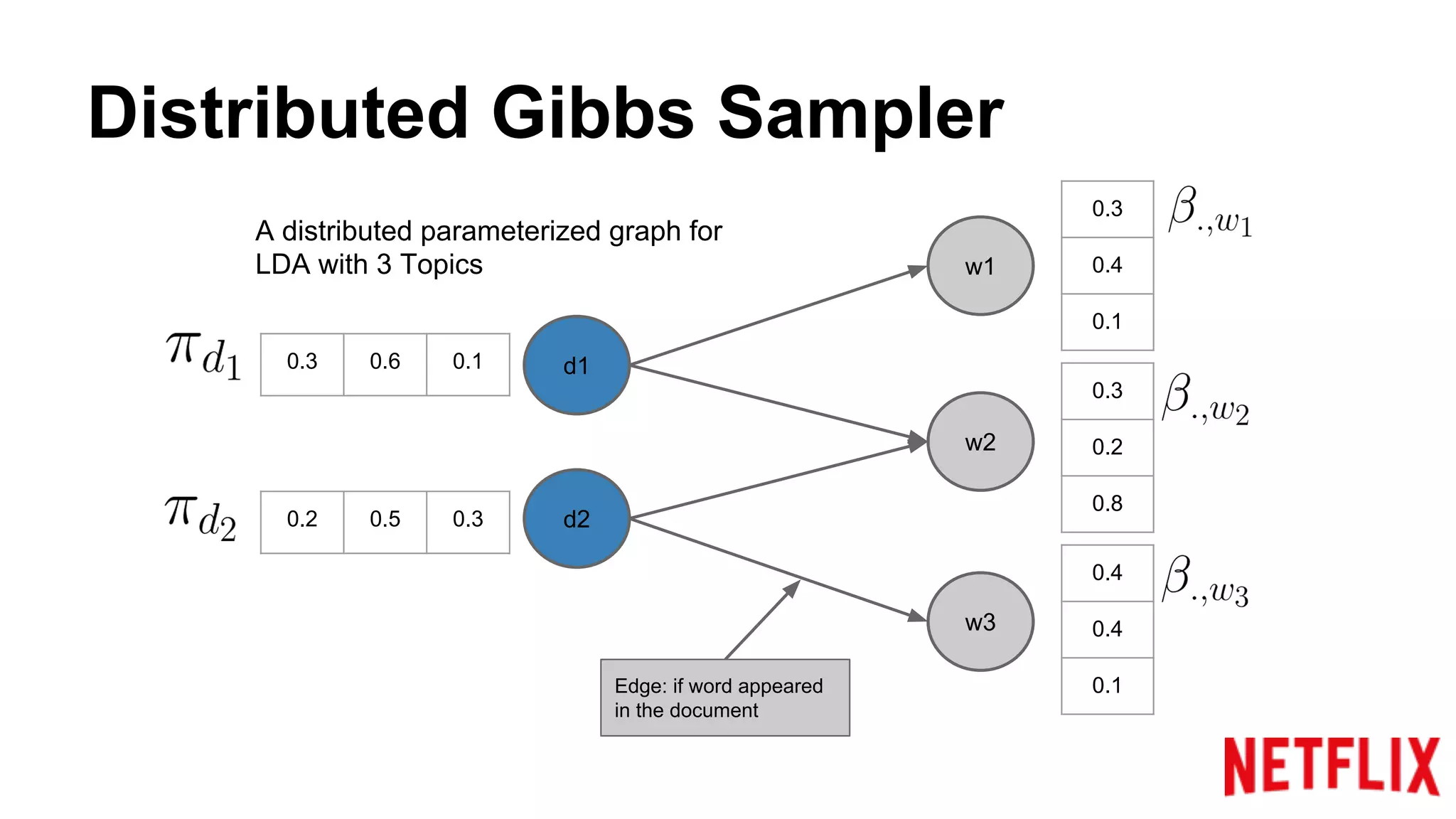
Distributed Gibbs Sampler
w1
w2
w3
d1
d2
0.3
0.4
0.1
0.3
0.2
0.8
0.4
0.4
0.1
0.3 0.6 0.1
0.2 0.5 0.3
A distributed parameterized graph for
LDA with 3 Topics
word
Distributed Gibbs Sampler
w1
w2
w3
d1
d2
0.3
0.4
0.1
0.3
0.2
0.8
0.4
0.4
0.1
0.3 0.6 0.1
0.2 0.5 0.3
A distributed parameterized graph for
LDA with 3 Topics
Edge: if word appeared
in the document
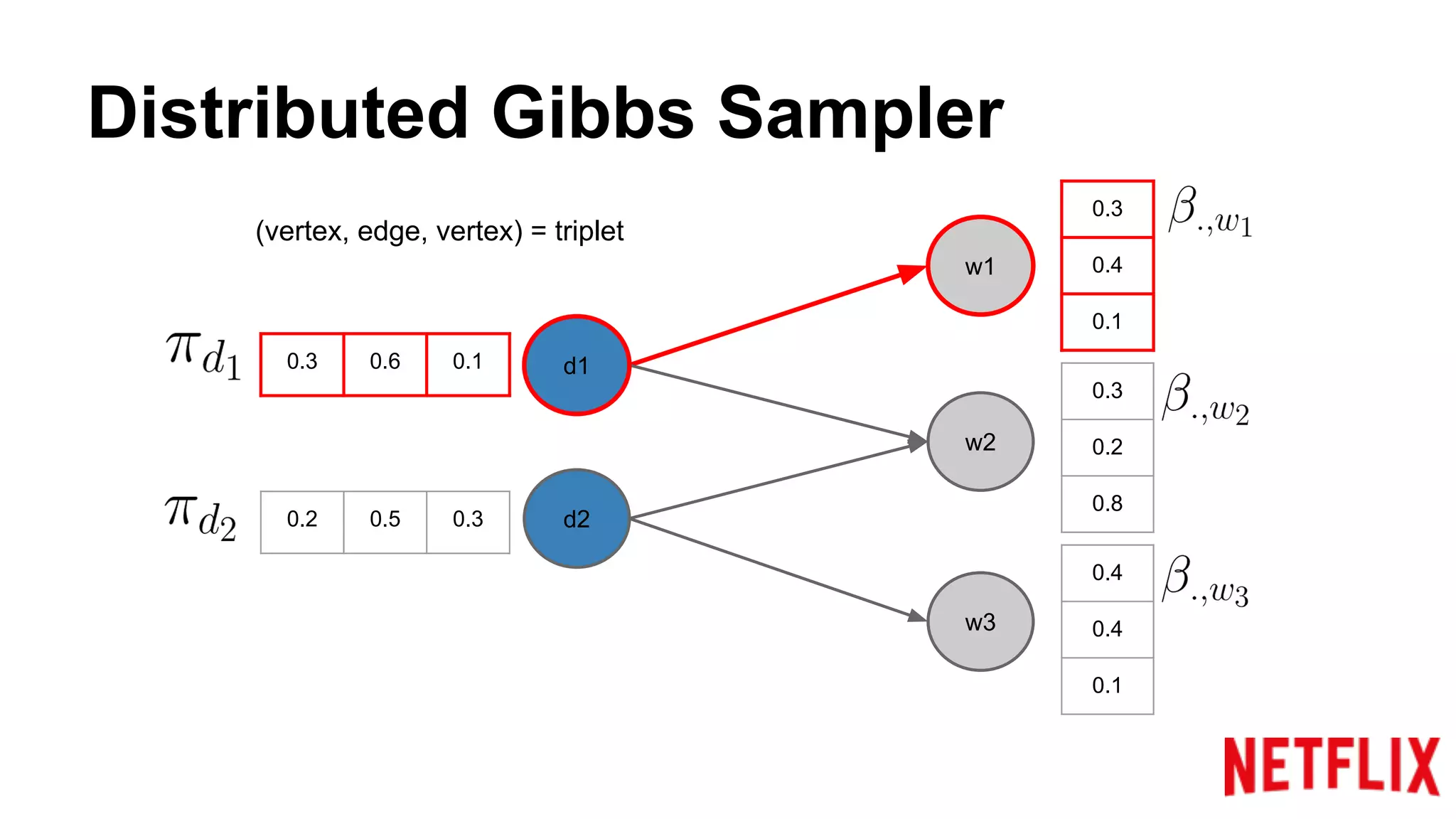
Distributed Gibbs Sampler
w1
w2
w3
d1
d2
0.3
0.4
0.1
0.3
0.2
0.8
0.4
0.4
0.1
0.3 0.6 0.1
0.2 0.5 0.3
(vertex, edge, vertex) = triplet
Distributed Gibbs Sampler
w1
w2
w3
d1
d2
0.3
0.4
0.1
0.3
0.2
0.8
0.4
0.4
0.1
0.3 0.6 0.1
0.2 0.5 0.3
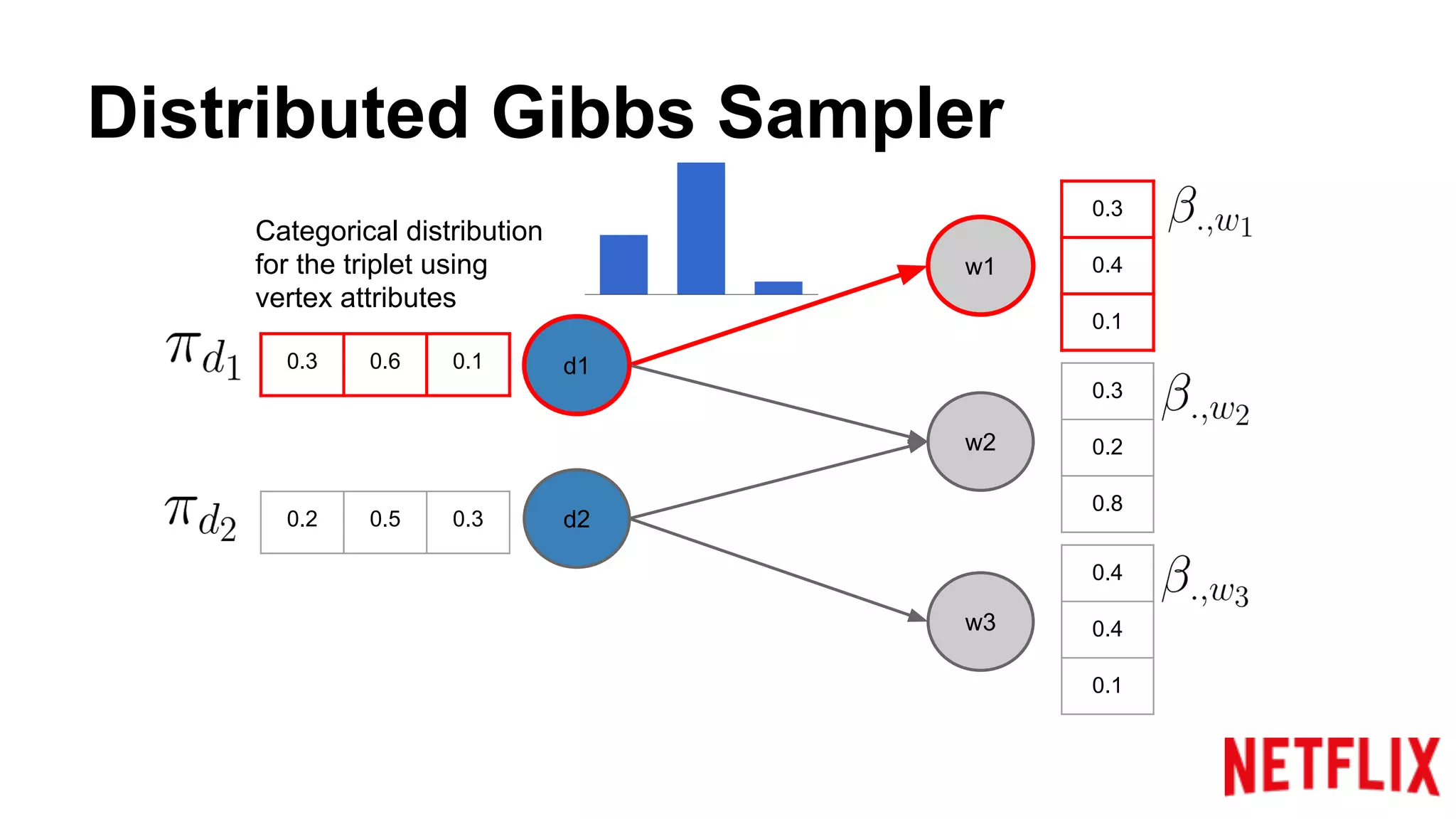
Categorical distribution
for the triplet using
vertex attributes
Distributed Gibbs Sampler
w1
w2
w3
d1
d2
0.3
0.4
0.1
0.3
0.2
0.8
0.4
0.4
0.1
0.3 0.6 0.1
0.2 0.5 0.3
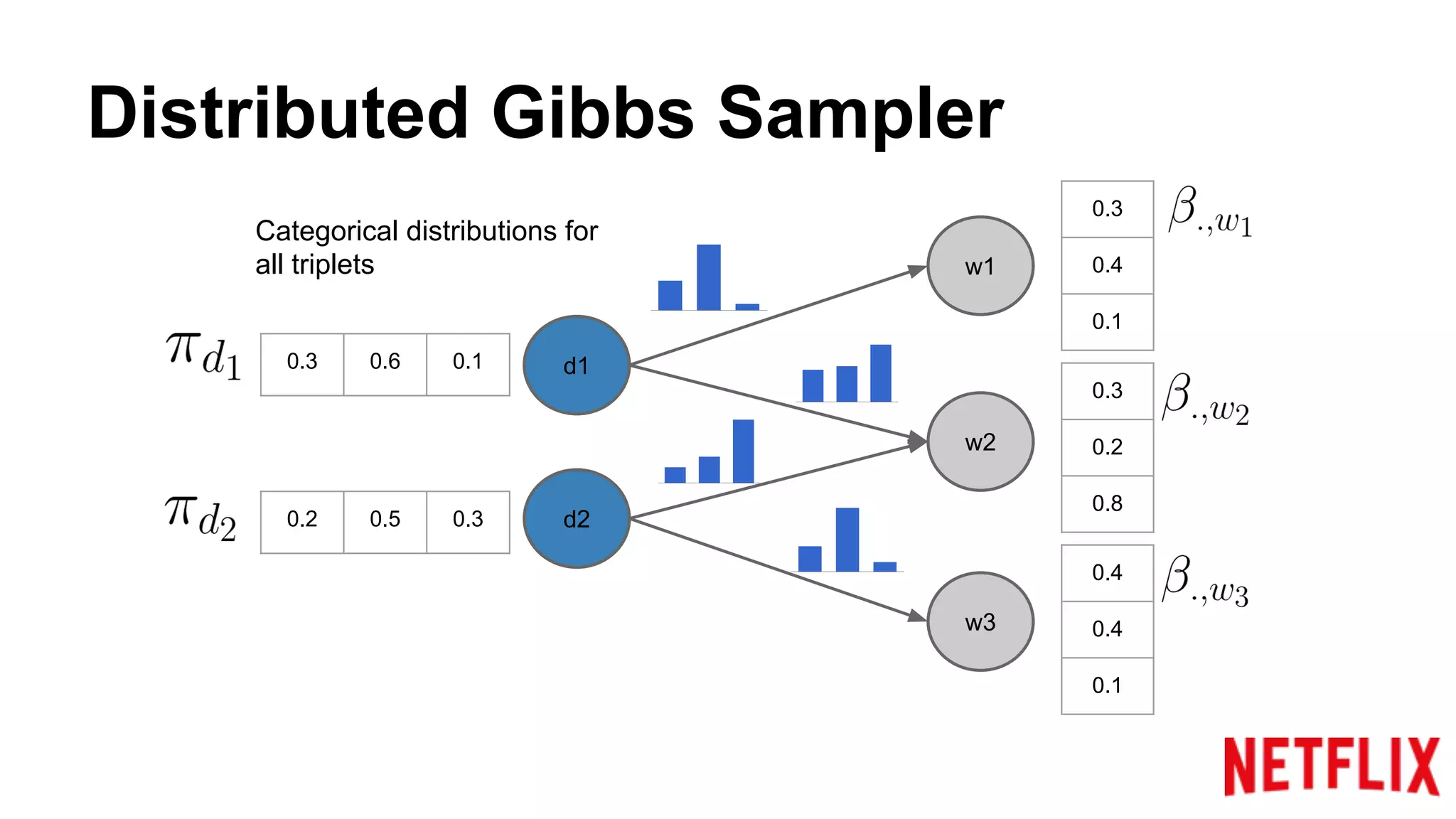
Categorical distributions for
all triplets
Distributed Gibbs Sampler
w1
w2
w3
d1
d2
0.3
0.4
0.1
0.3
0.2
0.8
0.4
0.4
0.1
0.3 0.6 0.1
0.2 0.5 0.3
1
1
2
0
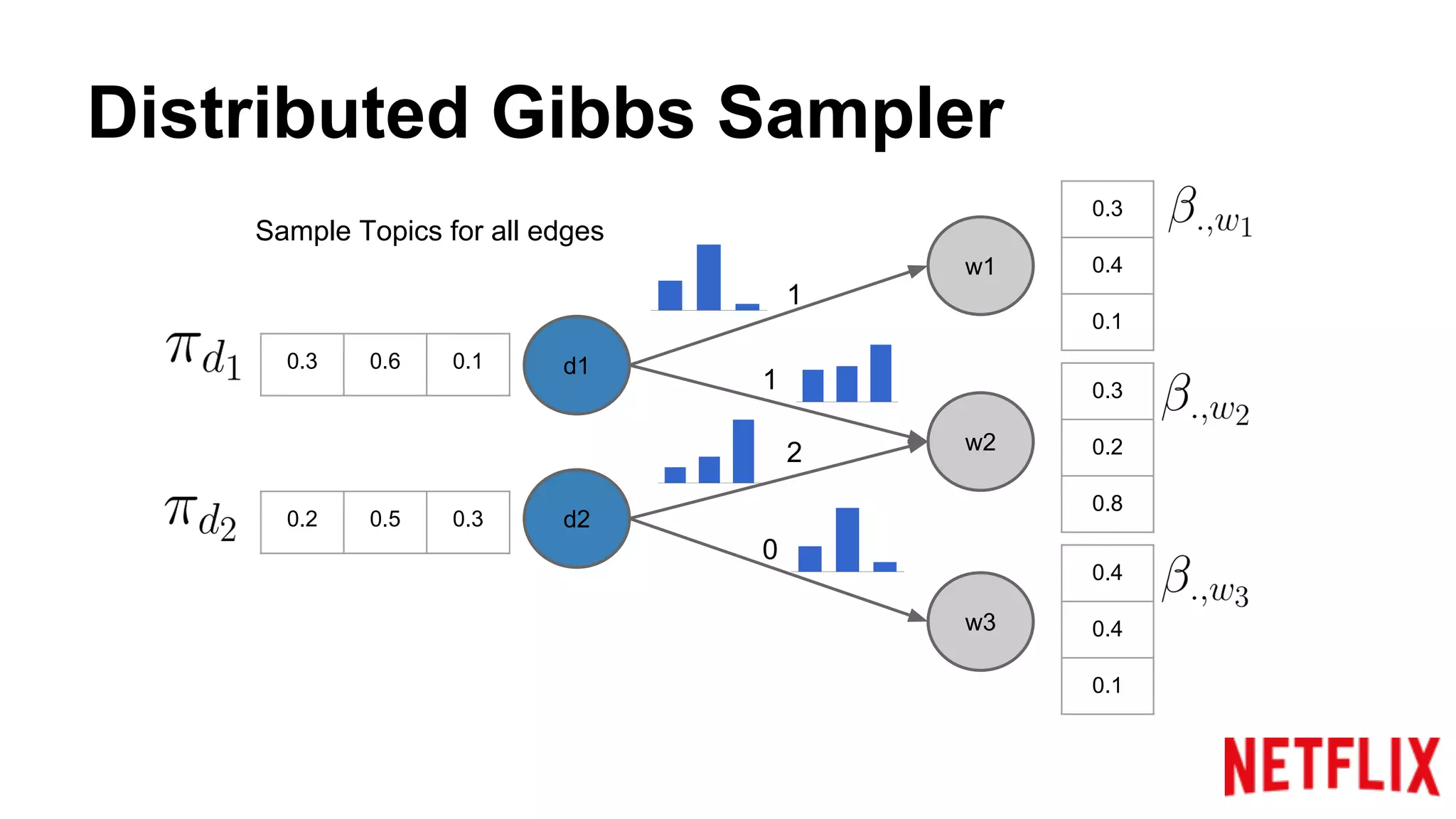
Sample Topics for all edges
Distributed Gibbs Sampler
w1
w2
w3
d1
d2
0
1
0
0
1
1
1
0
0
0 2 0
1 0 1
1
1
2
0
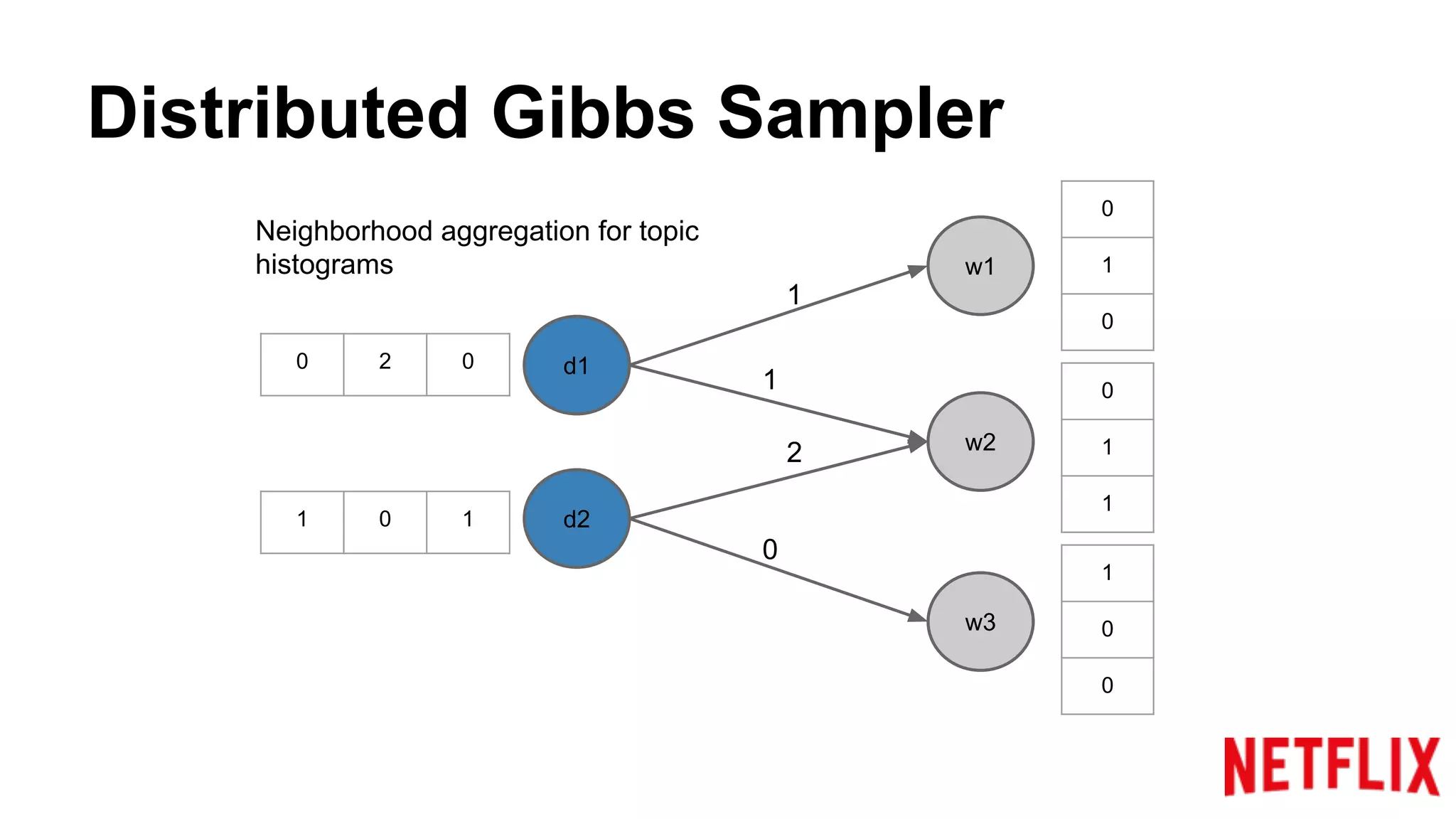
Neighborhood aggregation for topic
histograms
Distributed Gibbs Sampler
w1
w2
w3
d1
d2
0.1
0.4
0.3
0.1
0.4
0.4
0.8
0.2
0.3
0.1 0.8 0.1
0.45 0.1 0.45
Realize samples from Dirichlet to
update the graph
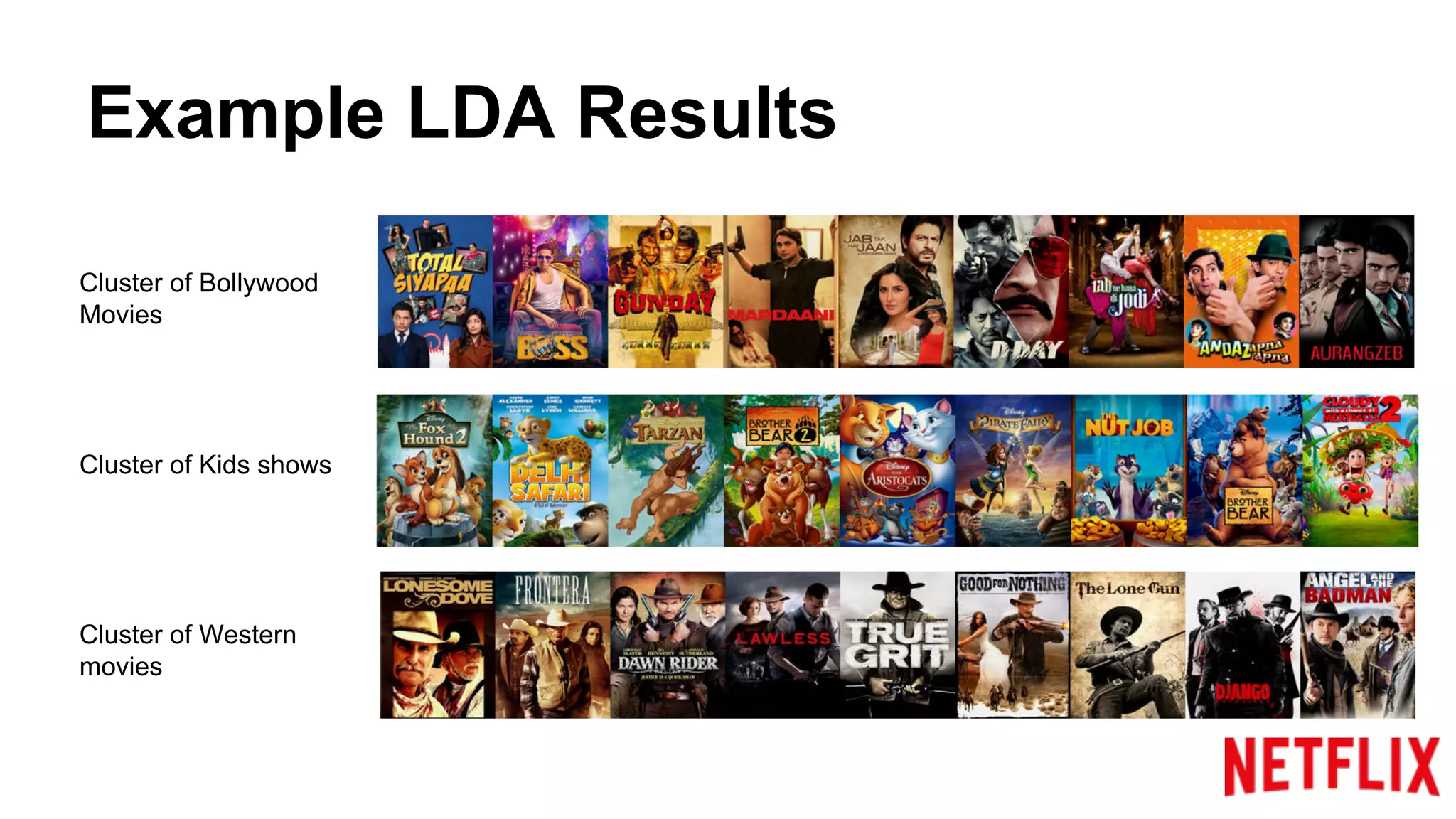
Example LDA Results
Cluster of Bollywood
Movies
Cluster of Kids shows
Cluster of Western
movies
GraphX performance comparison
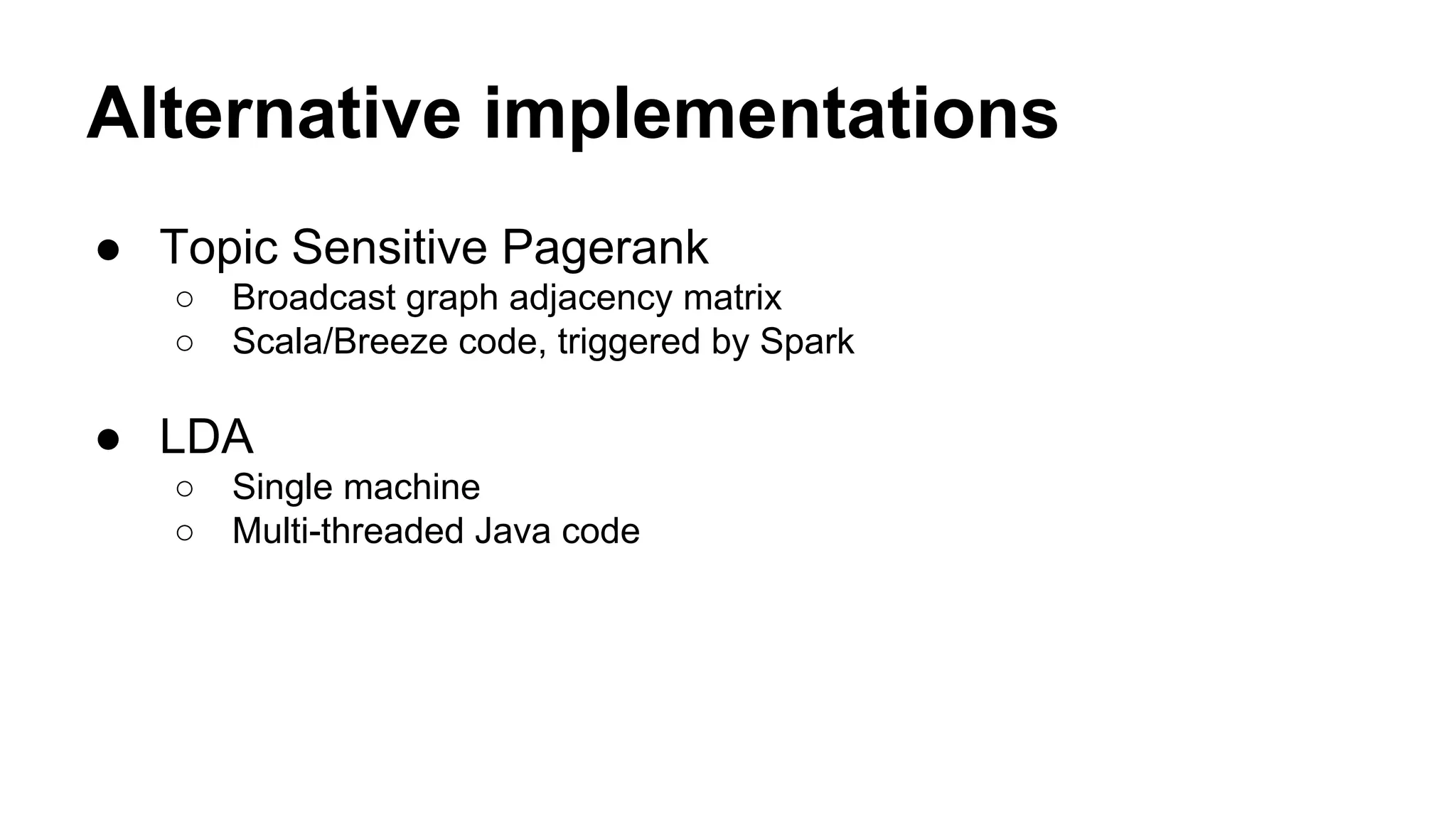
Algorithm Implementations
● Topic Sensitive Pagerank
○ Broadcast graph adjacency matrix
○ Scala/Breeze code, triggered by Spark
● LDA
○ Single machine
○ Multi-threaded Java code
● All implementations are Netflix Internal Code
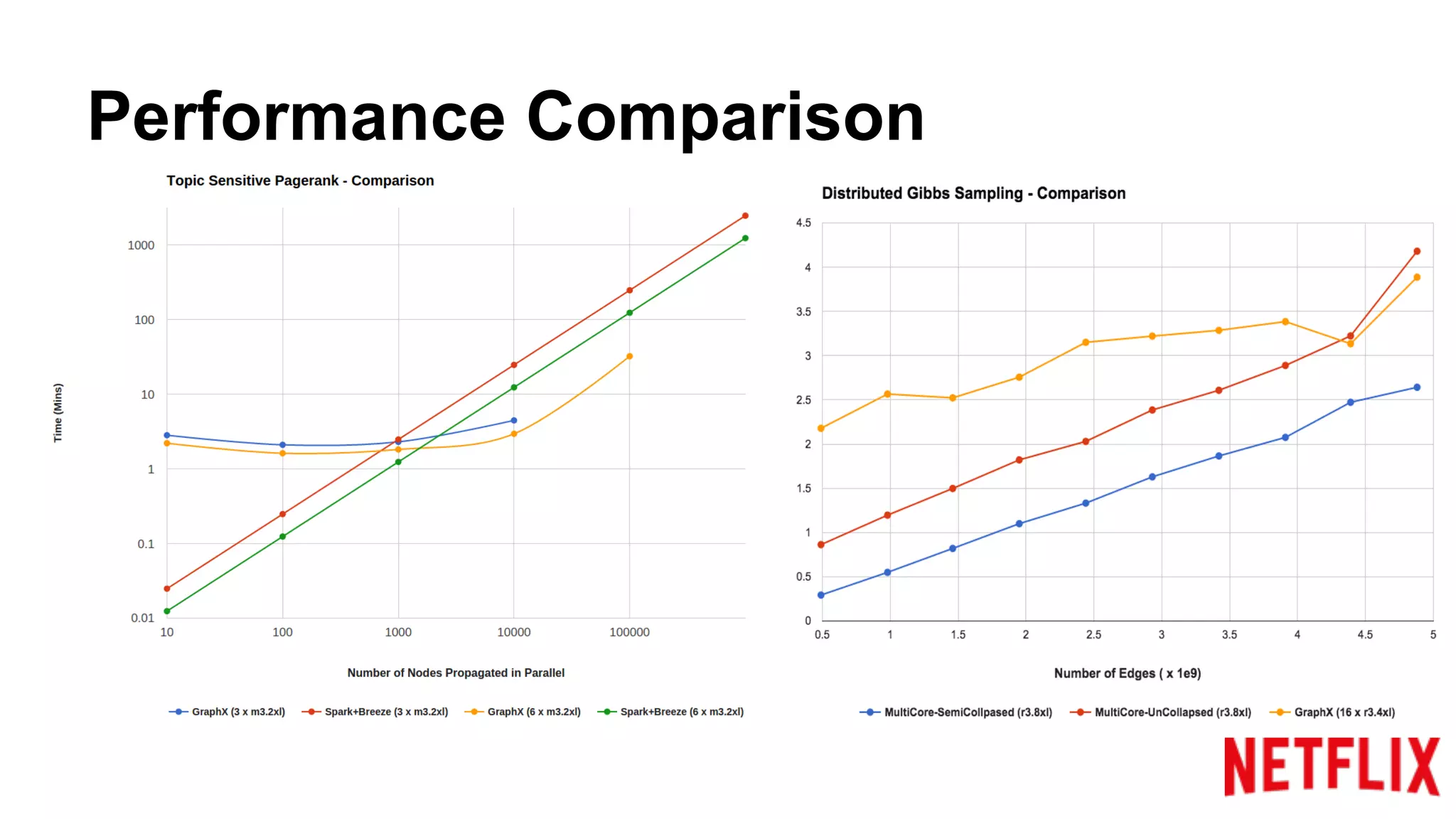
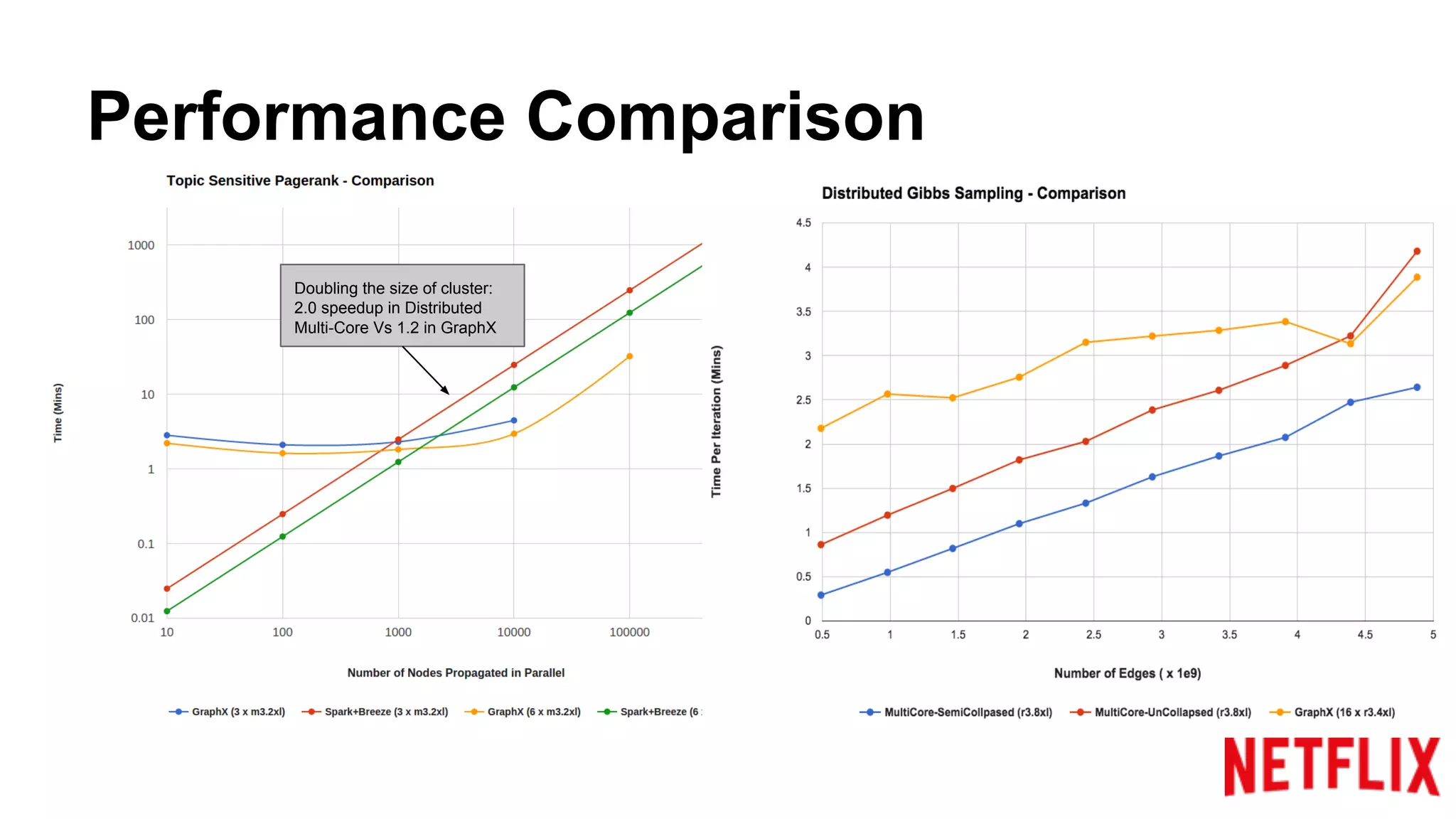
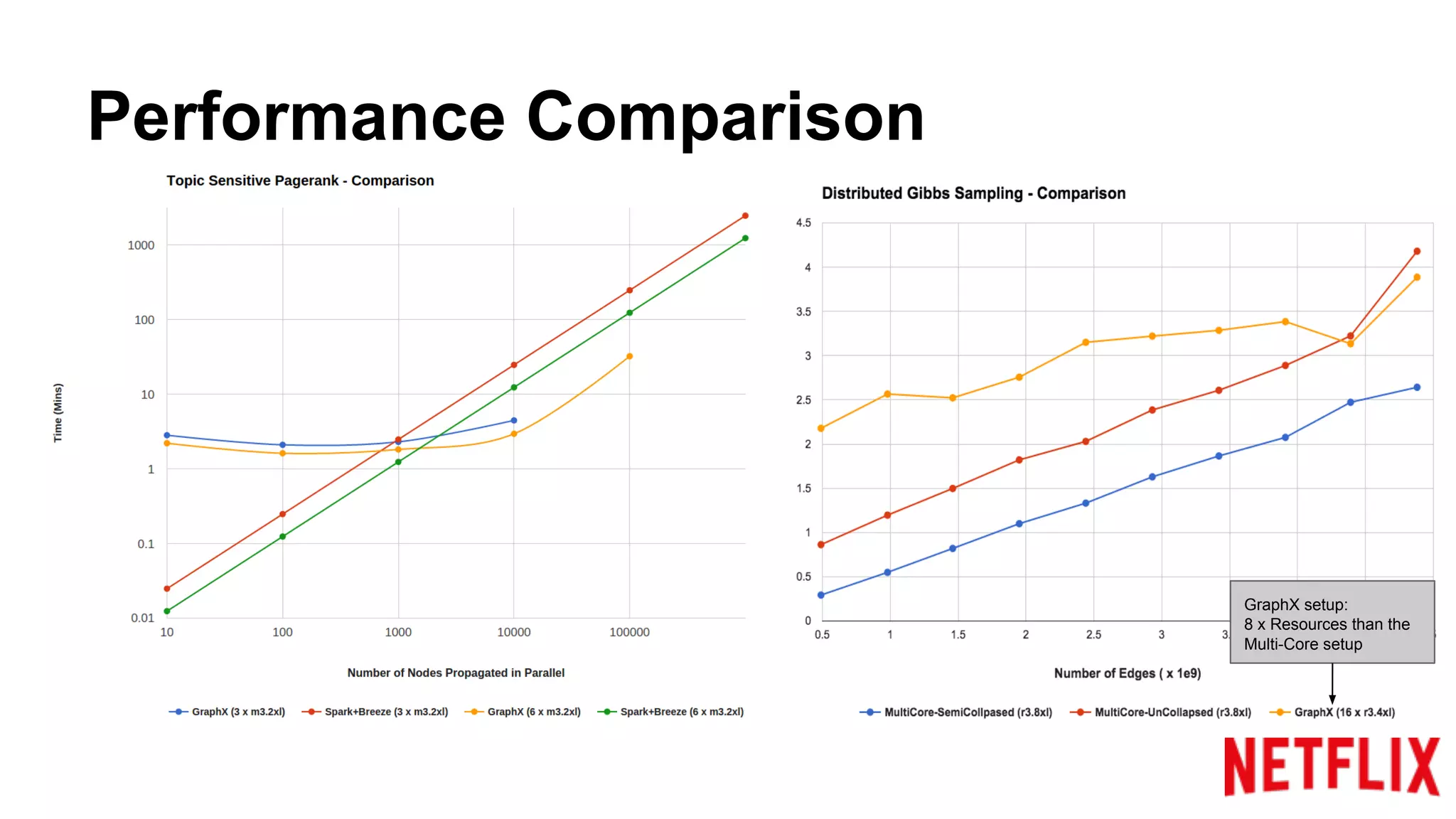
Performance Comparison
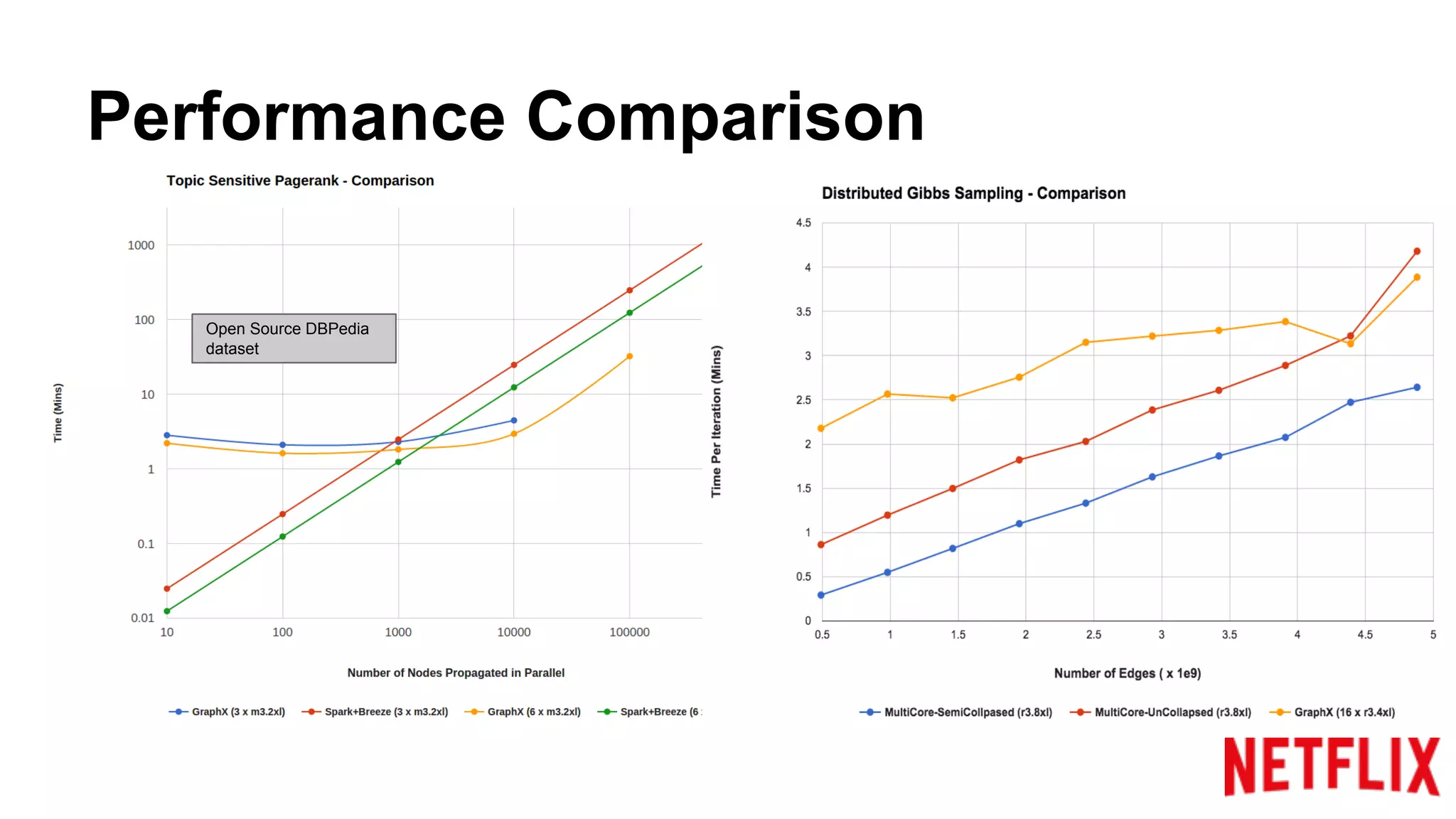
Open Source DBPedia
dataset
Performance Comparison
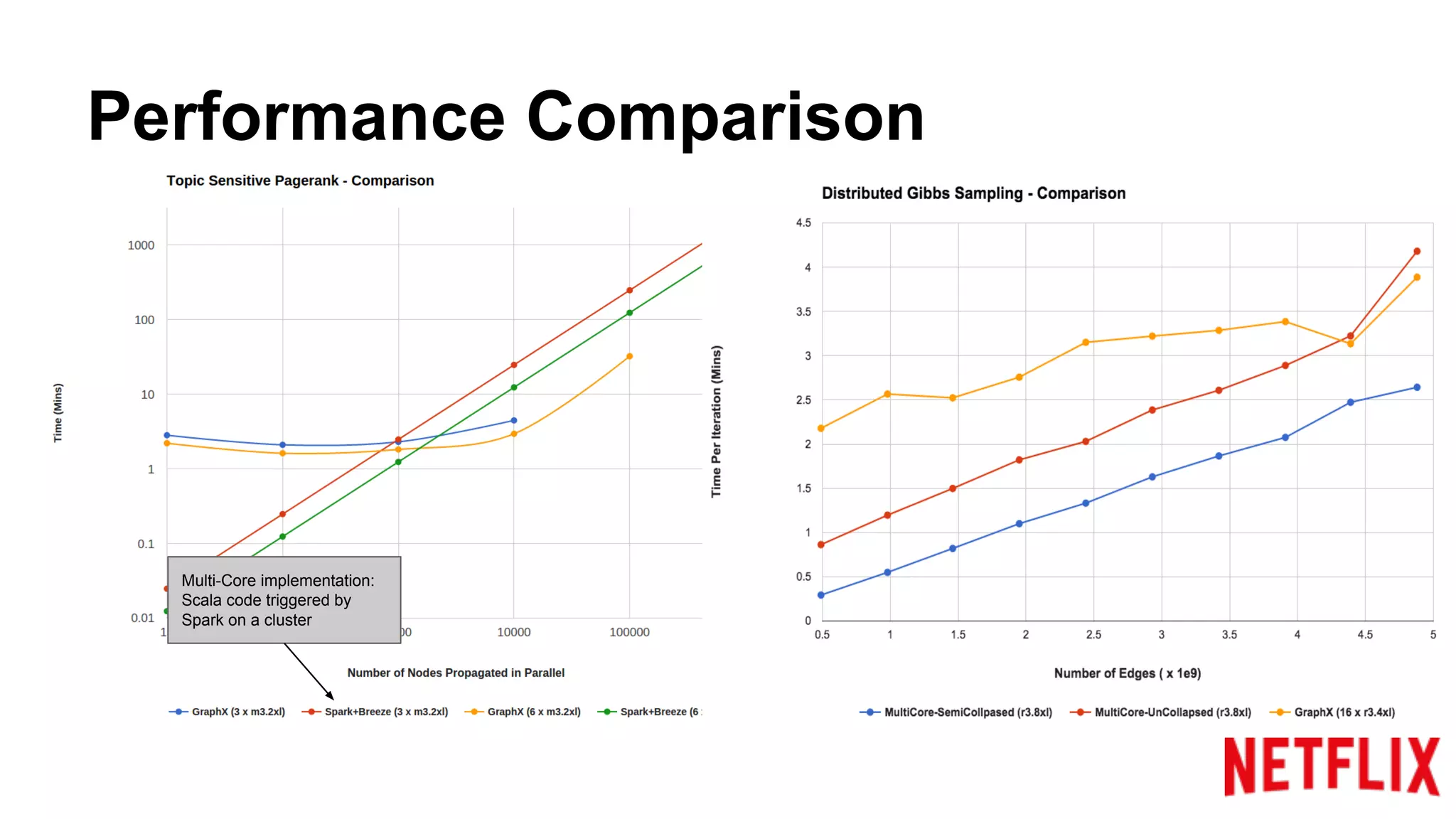
Alternative Implementation:
Scala code triggered by
Spark on a cluster
Performance Comparison
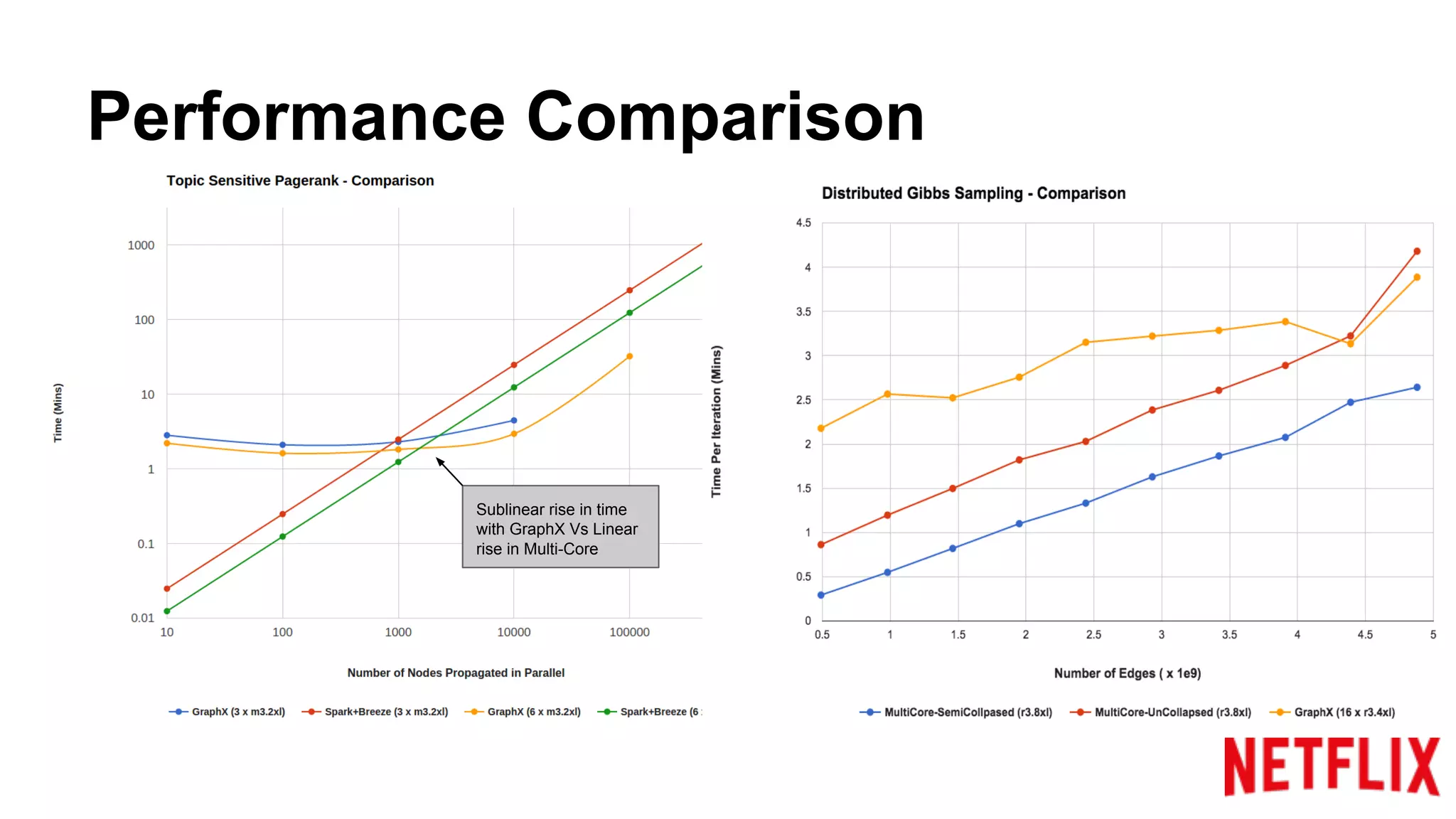
Sublinear rise in time
with GraphX Vs Linear
rise in the Alternative
Performance Comparison
Doubling the size of cluster:
2.0 speedup in the Alternative
Impl Vs 1.2 in GraphX
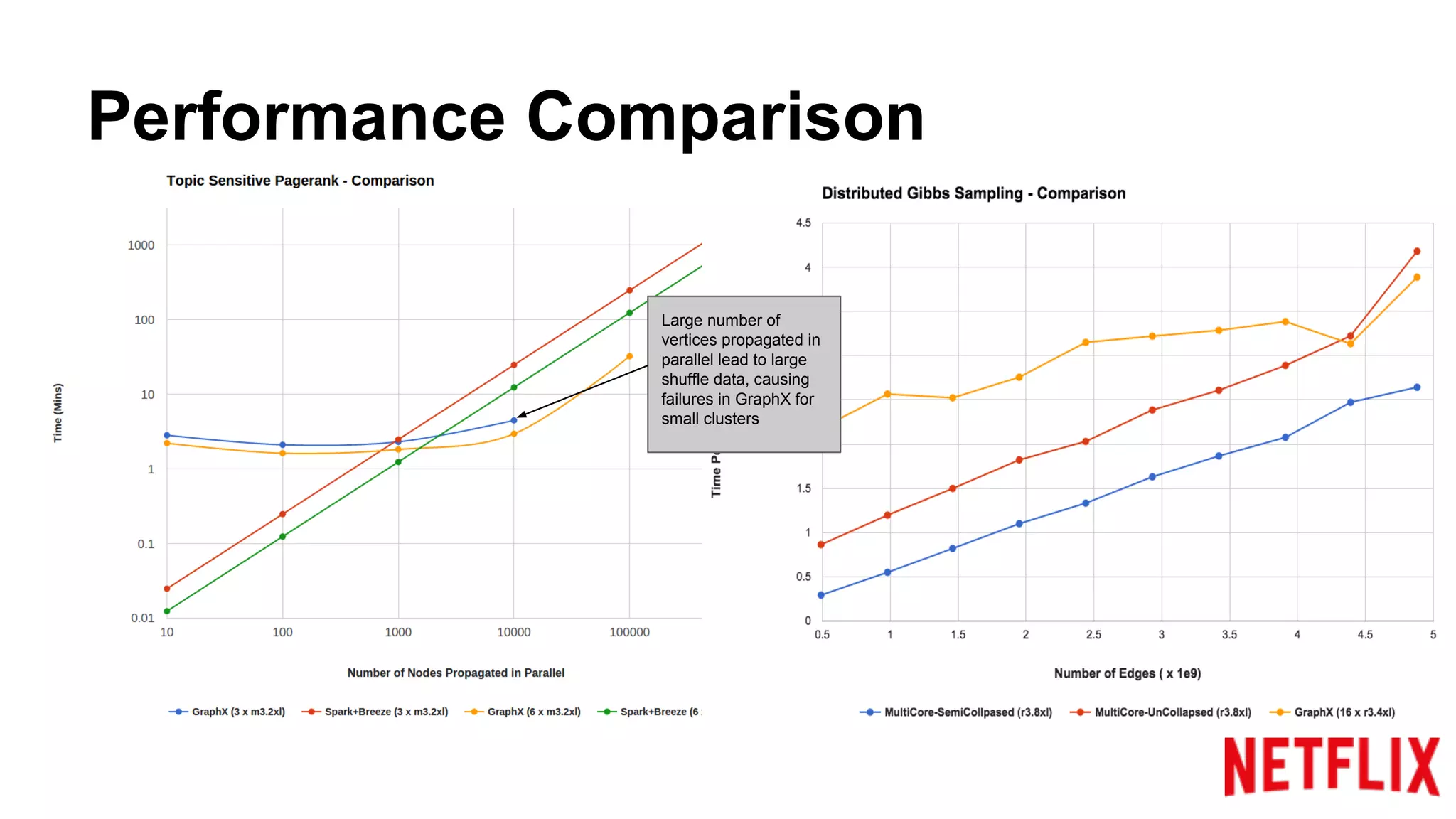
Performance Comparison
Large number of
vertices propagated in
parallel lead to large
shuffle data, causing
failures in GraphX for
small clusters
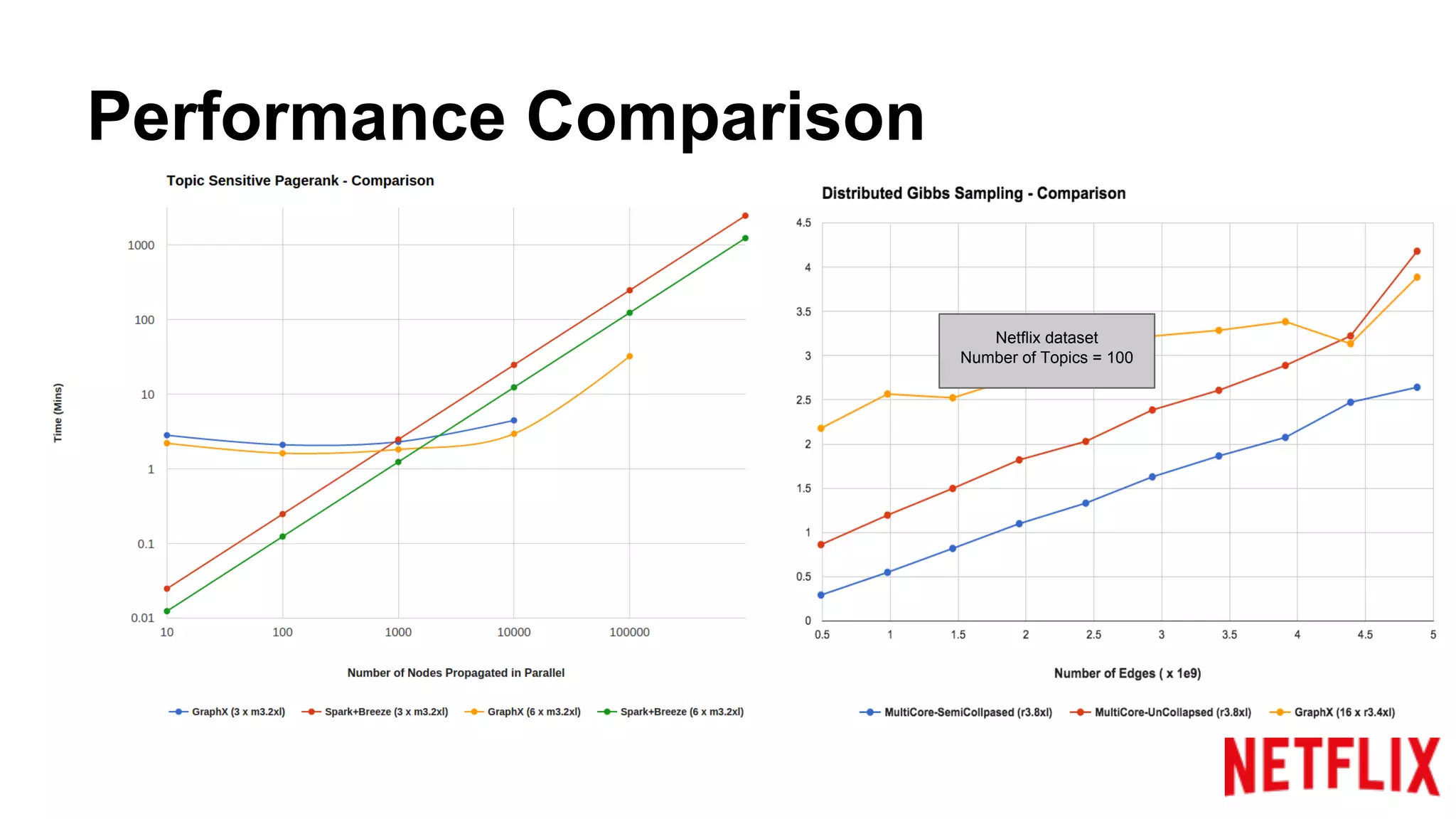
Performance Comparison
Netflix dataset
Number of Topics = 100
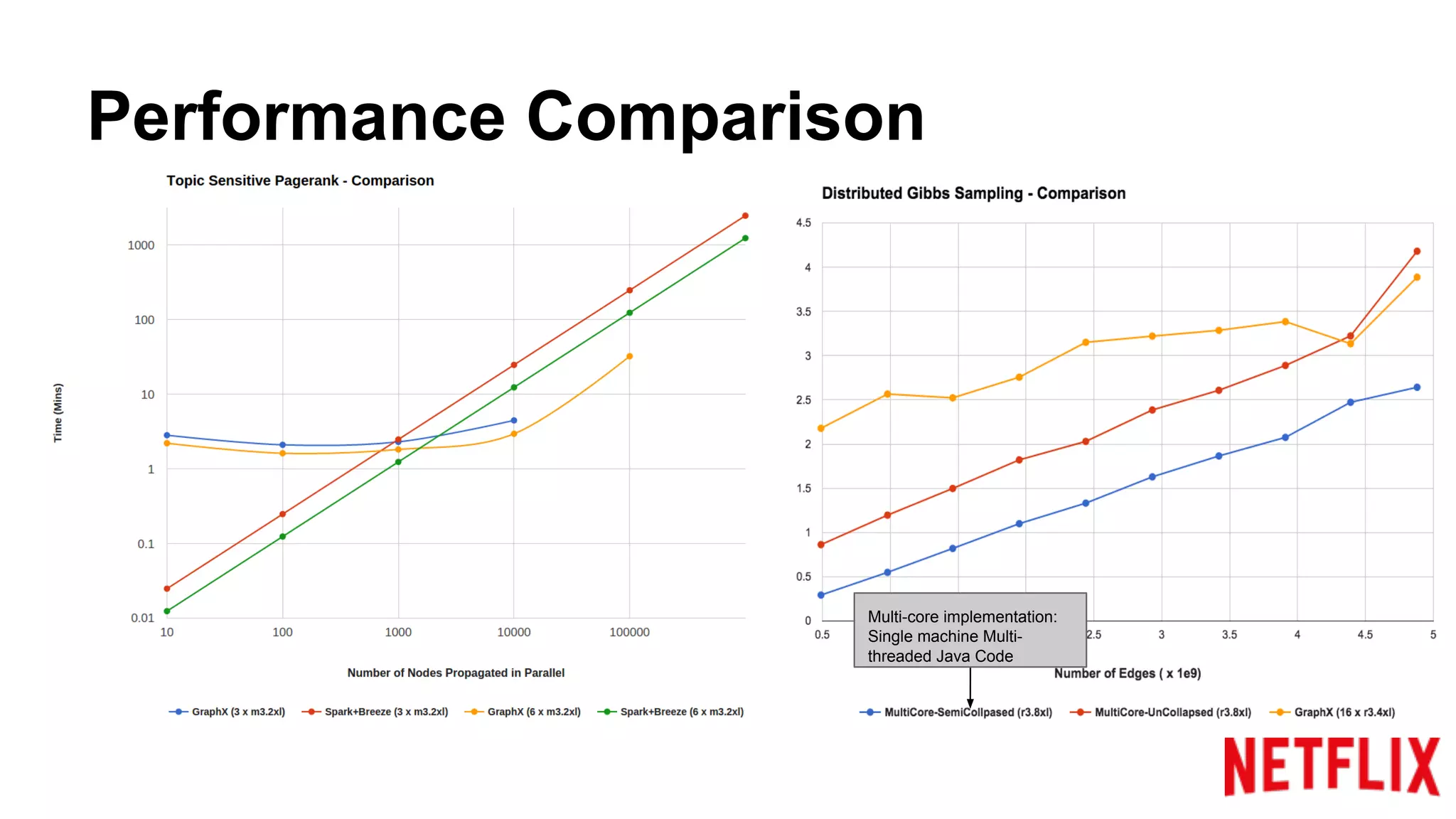
Performance Comparison
Multi-core implementation:
Single machine Multi-
threaded Java Code
Performance Comparison
GraphX setup:
8 x Resources than the
Multi-Core setup
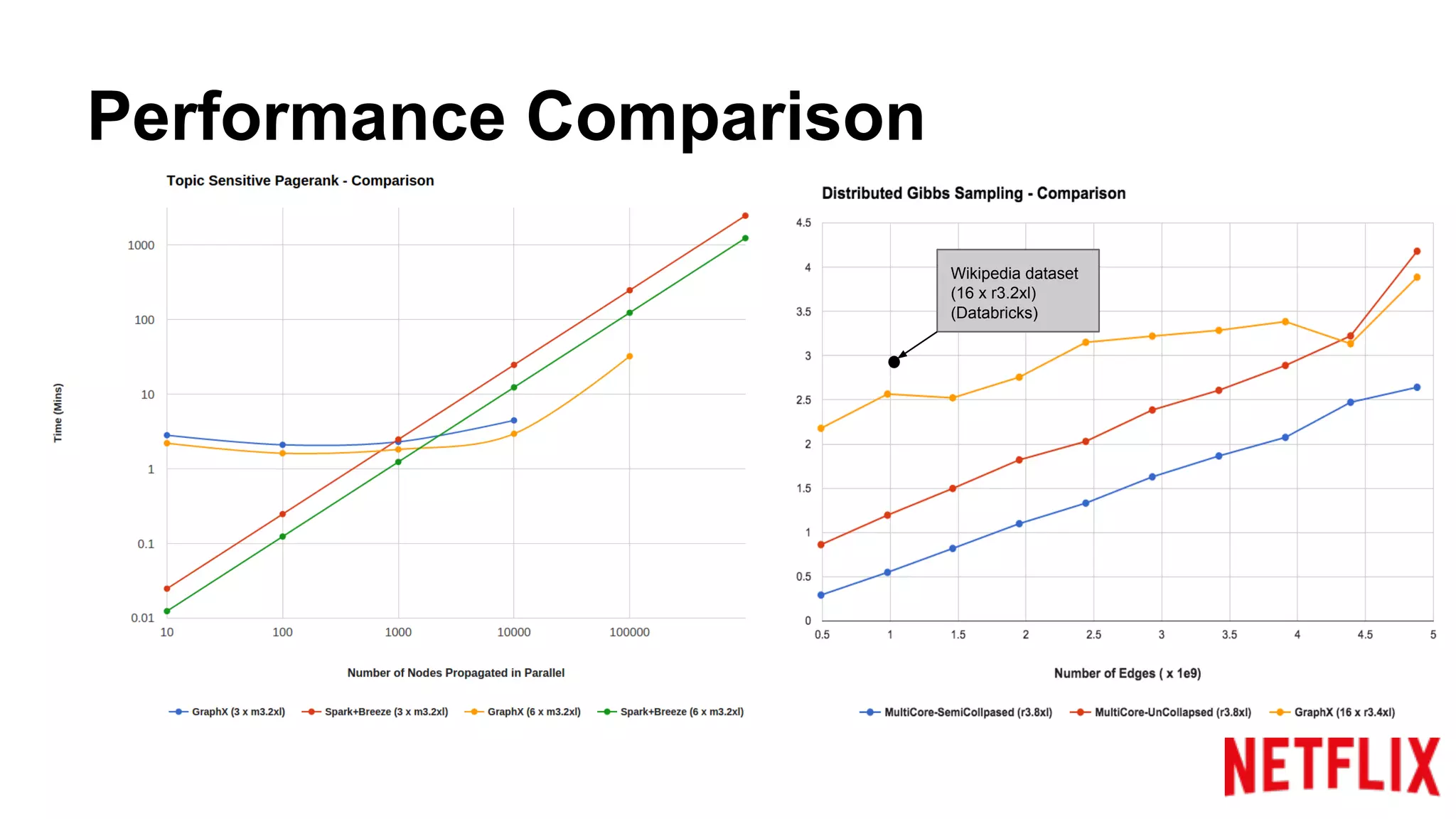
Performance Comparison
Wikipedia dataset
(16 x r3.2xl)
(Databricks)
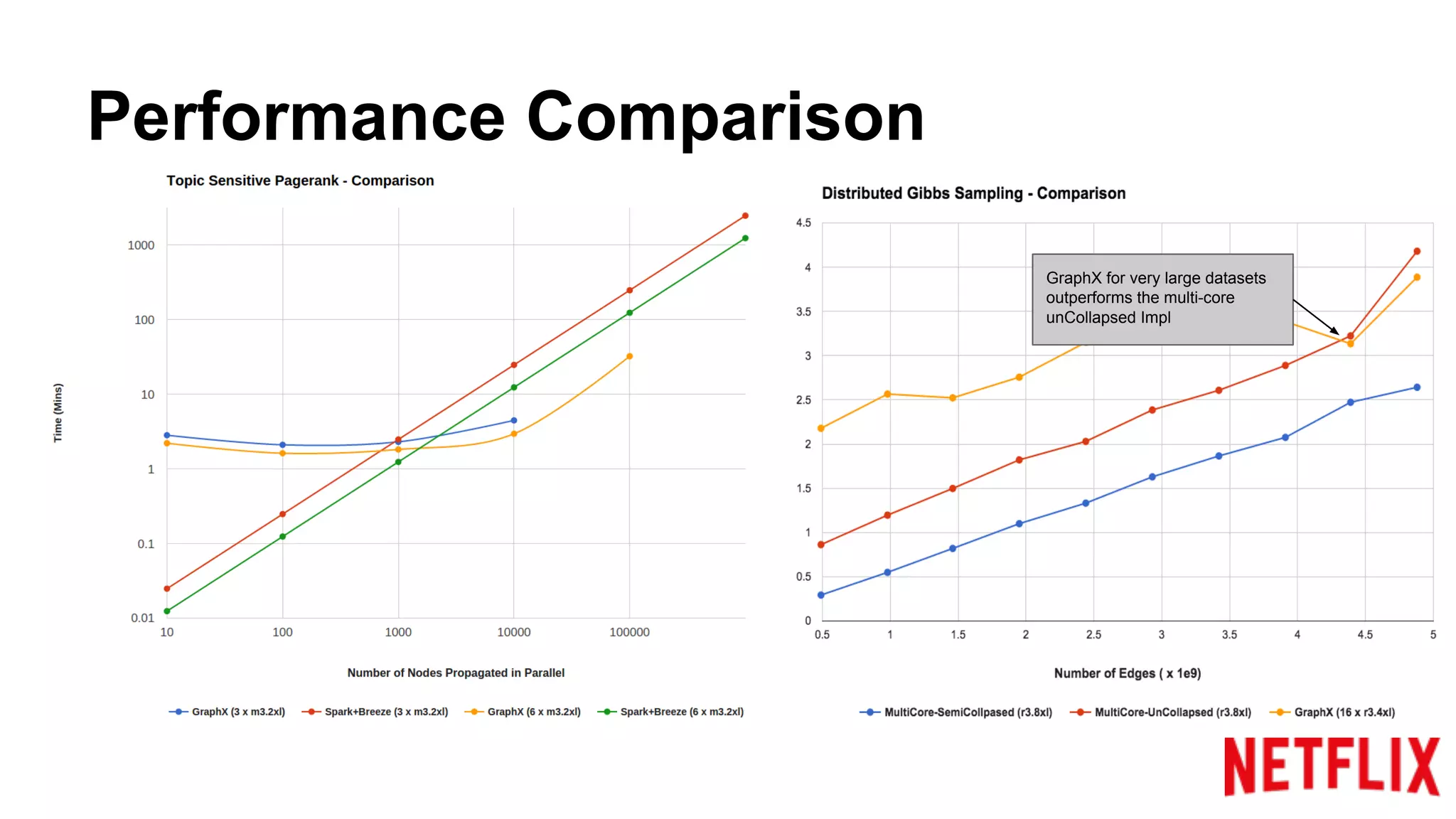
Performance Comparison
GraphX for very large datasets
outperforms the multi-core
unCollapsed Impl
Lessons Learned
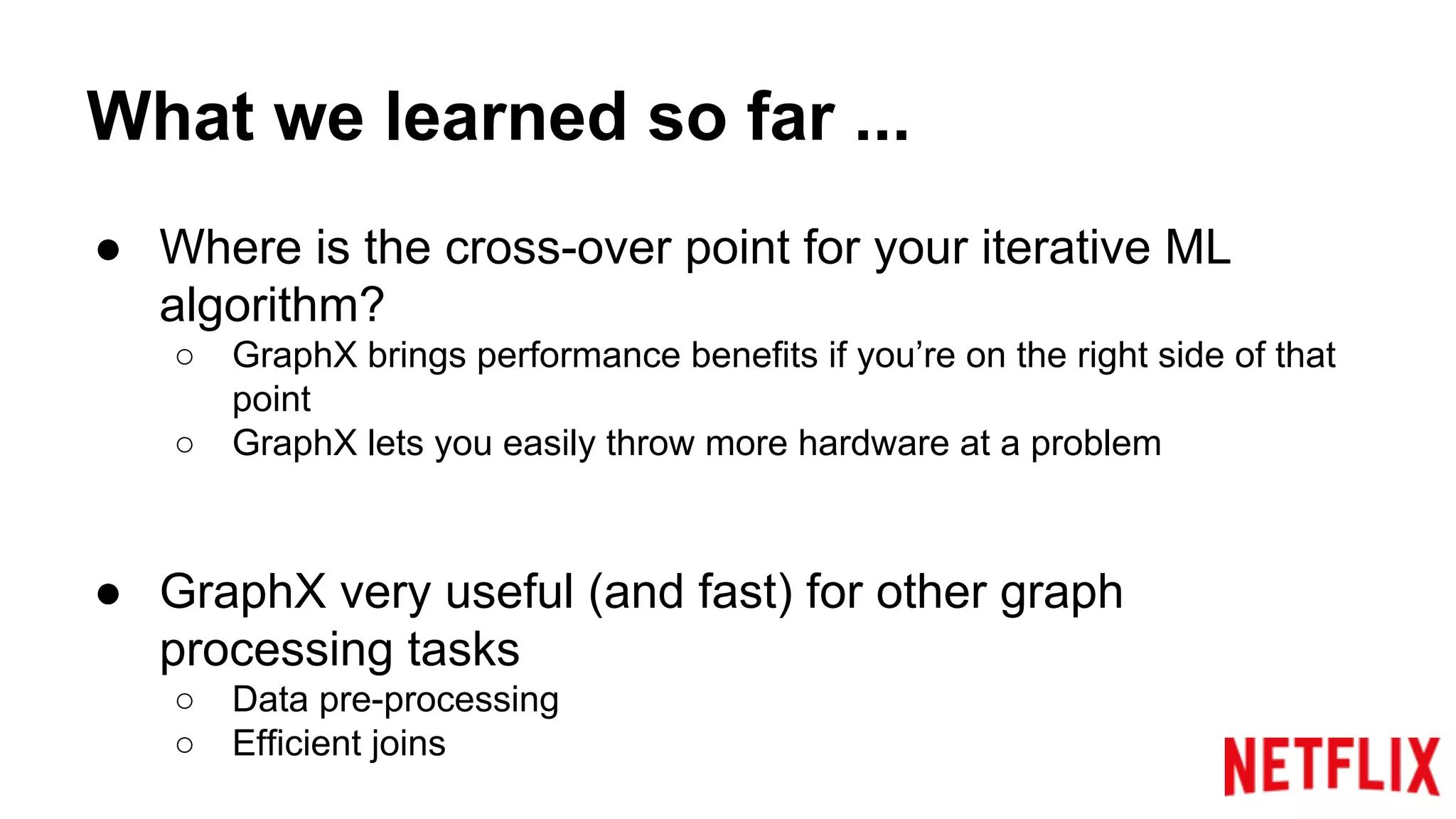
What we learned so far ...
● Where is the cross-over point for your iterative ML
algorithm?
○ GraphX brings performance benefits if you’re on the right side of that
point
○ GraphX lets you easily throw more hardware at a problem
● GraphX very useful (and fast) for other graph
processing tasks
○ Data pre-processing
○ Efficient joins
What we learned so far ...
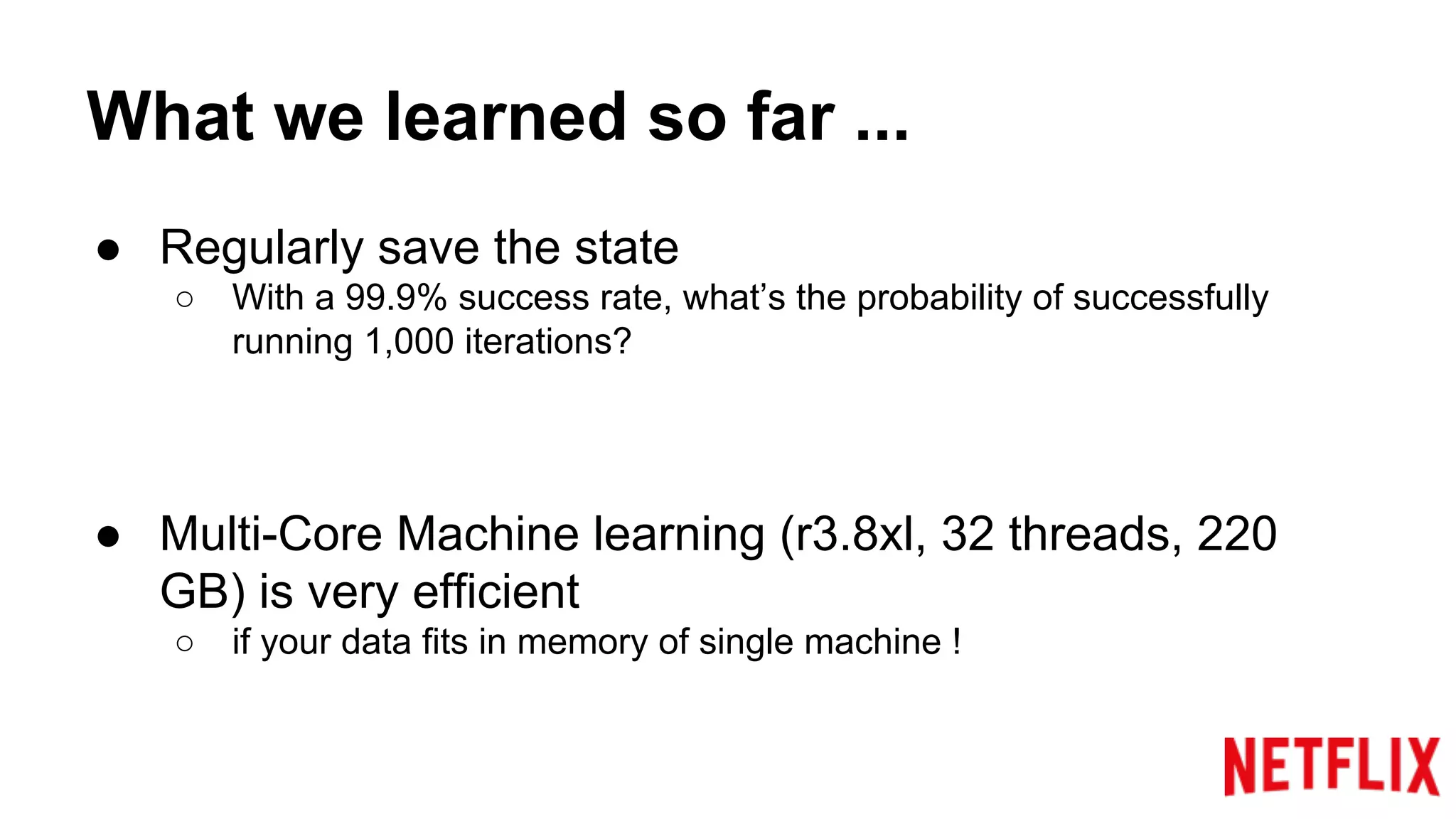
● Regularly save the state
○ With a 99.9% success rate, what’s the probability of successfully
running 1,000 iterations?
● Multi-Core Machine learning (r3.8xl, 32 threads, 220
GB) is very efficient
○ if your data fits in memory of single machine !
What we learned so far ...
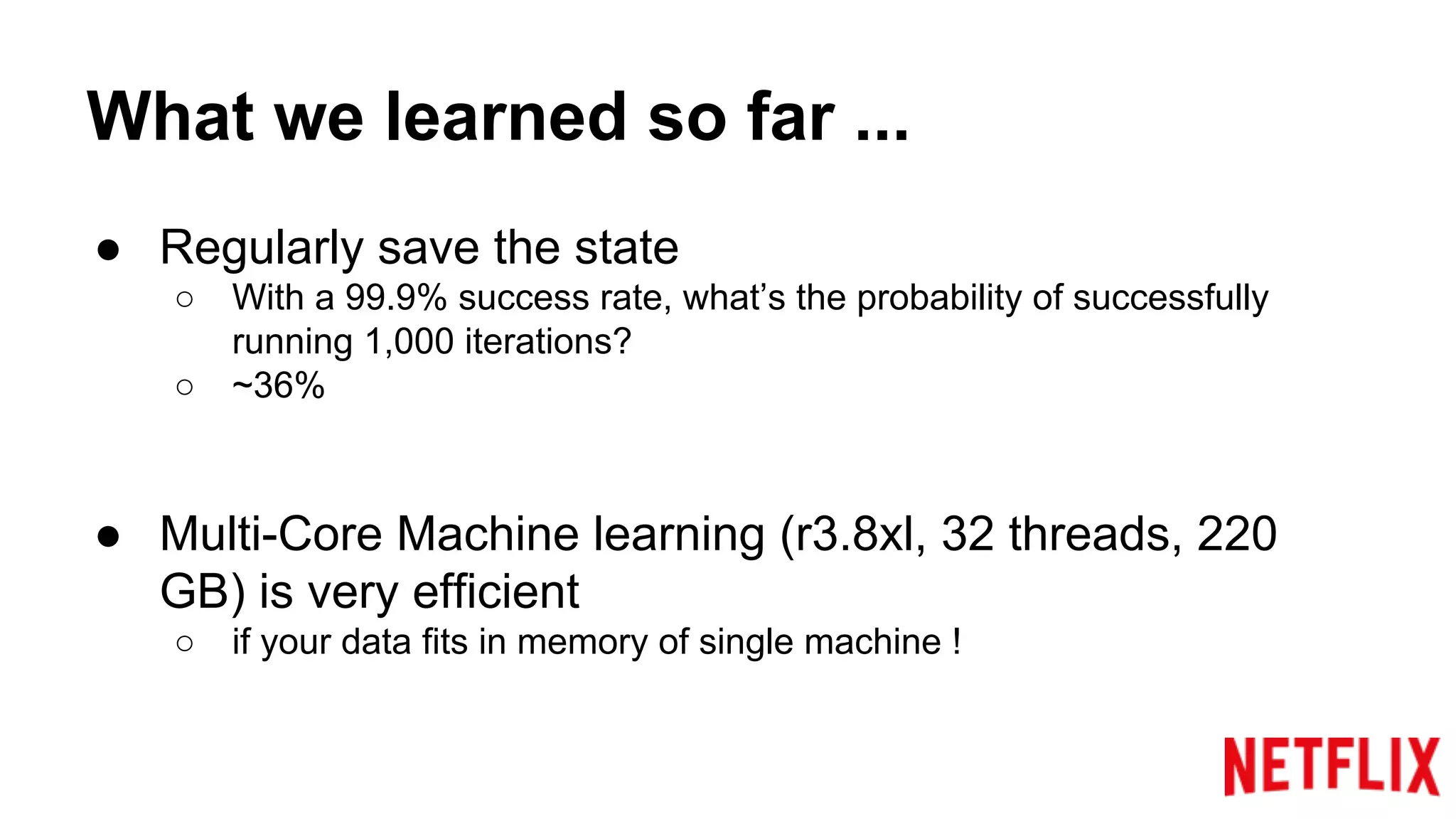
● Regularly save the state
○ With a 99.9% success rate, what’s the probability of successfully
running 1,000 iterations?
○ ~36%
● Multi-Core Machine learning (r3.8xl, 32 threads, 220
GB) is very efficient
○ if your data fits in memory of single machine !
We’re hiring!
(come talk to us)
https://jobs.netflix.com/
Appendix
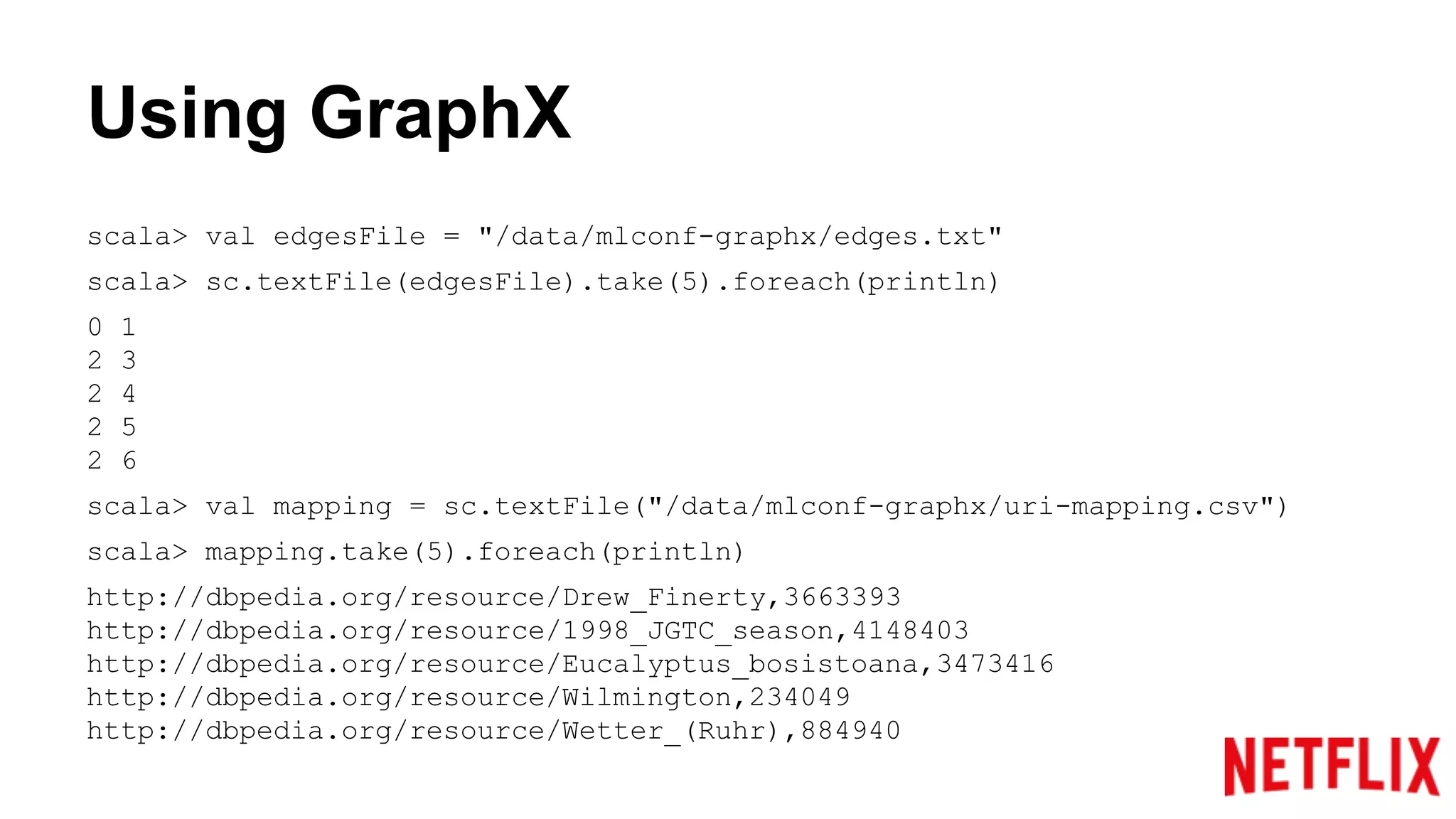
Using GraphX
scala> val edgesFile = "/data/mlconf-graphx/edges.txt"
scala> sc.textFile(edgesFile).take(5).foreach(println)
0 1
2 3
2 4
2 5
2 6
scala> val mapping = sc.textFile("/data/mlconf-graphx/uri-mapping.csv")
scala> mapping.take(5).foreach(println)
http://dbpedia.org/resource/Drew_Finerty,3663393
http://dbpedia.org/resource/1998_JGTC_season,4148403
http://dbpedia.org/resource/Eucalyptus_bosistoana,3473416
http://dbpedia.org/resource/Wilmington,234049
http://dbpedia.org/resource/Wetter_(Ruhr),884940
Creating a GraphX graph
scala> val graph = GraphLoader.edgeListFile(sc, edgesFile, false, 100)
graph: org.apache.spark.graphx.Graph[Int,Int] = org.apache.spark.graphx.
impl.GraphImpl@547a8dc1
scala> graph.edges.count
res3: Long = 16090021
scala> graph.vertices.count
res4: Long = 4548083
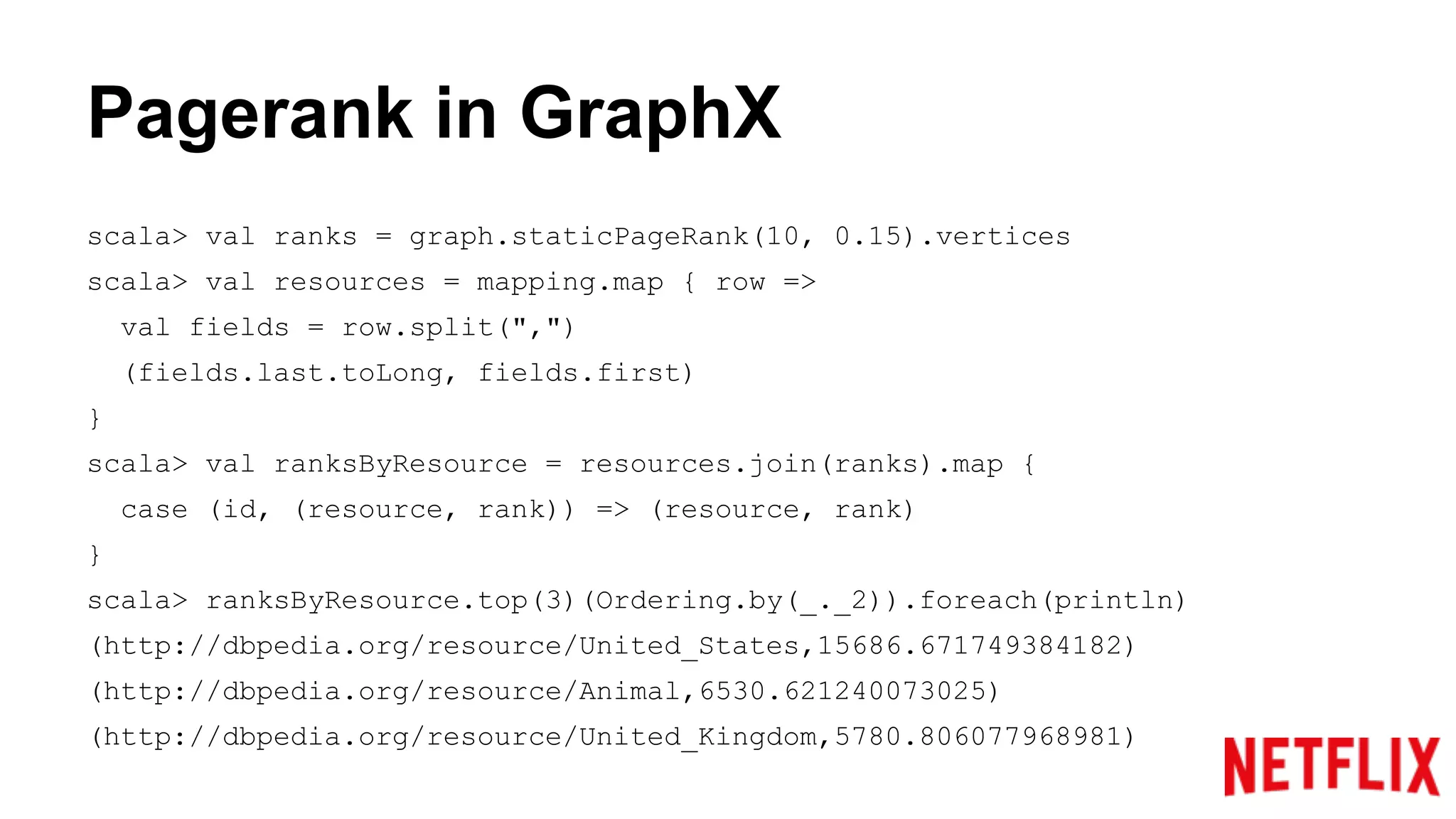
Pagerank in GraphX
scala> val ranks = graph.staticPageRank(10, 0.15).vertices
scala> val resources = mapping.map { row =>
val fields = row.split(",")
(fields.last.toLong, fields.first)
}
scala> val ranksByResource = resources.join(ranks).map {
case (id, (resource, rank)) => (resource, rank)
}
scala> ranksByResource.top(3)(Ordering.by(_._2)).foreach(println)
(http://dbpedia.org/resource/United_States,15686.671749384182)
(http://dbpedia.org/resource/Animal,6530.621240073025)
(http://dbpedia.org/resource/United_Kingdom,5780.806077968981)
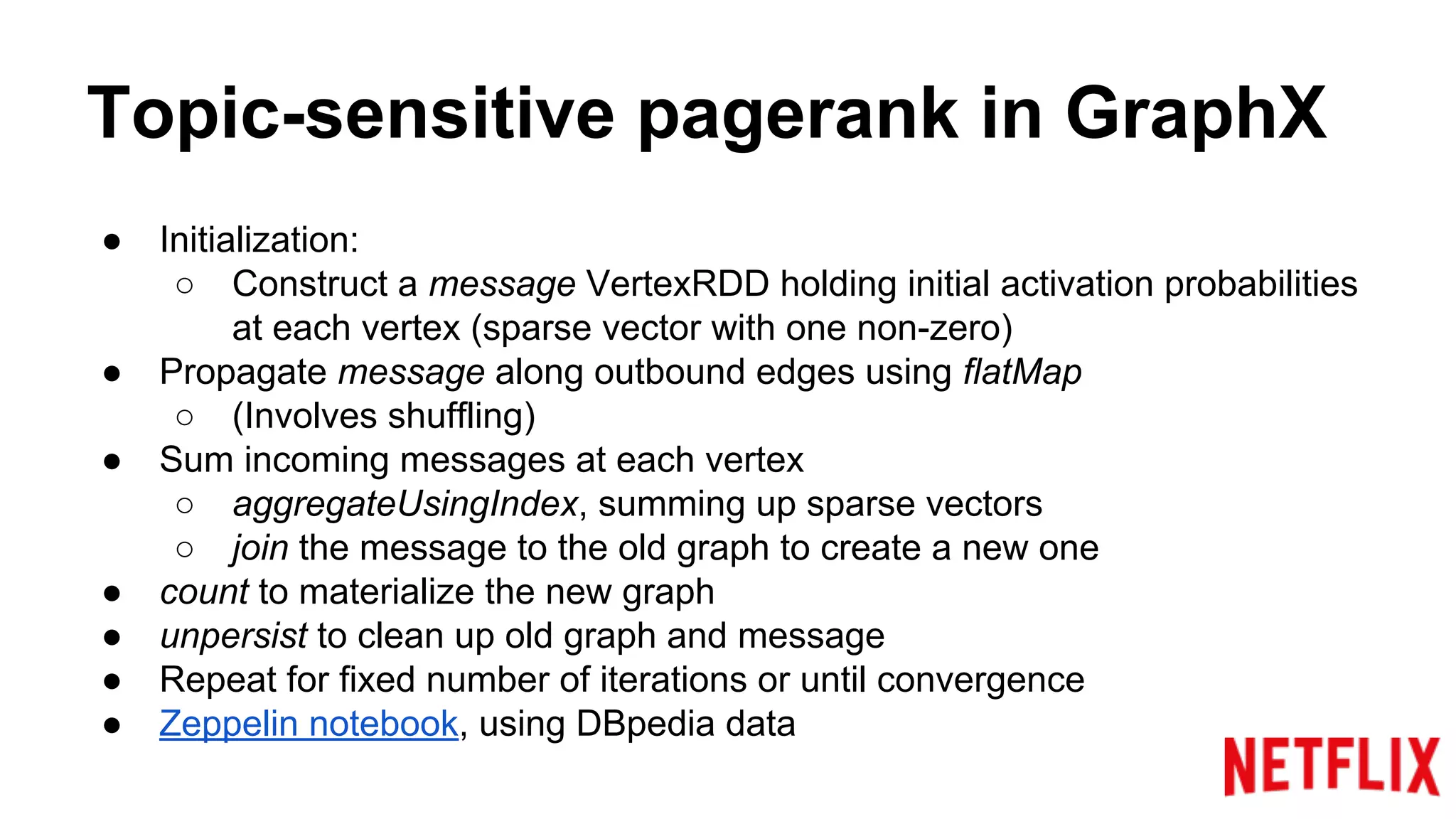
Topic-sensitive pagerank in GraphX
● Initialization:
○ Construct a message VertexRDD holding initial activation probabilities
at each vertex (sparse vector with one non-zero)
● Propagate message along outbound edges using flatMap
○ (Involves shuffling)
● Sum incoming messages at each vertex
○ aggregateUsingIndex, summing up sparse vectors
○ join the message to the old graph to create a new one
● count to materialize the new graph
● unpersist to clean up old graph and message
● Repeat for fixed number of iterations or until convergence
● Zeppelin notebook, using DBpedia data
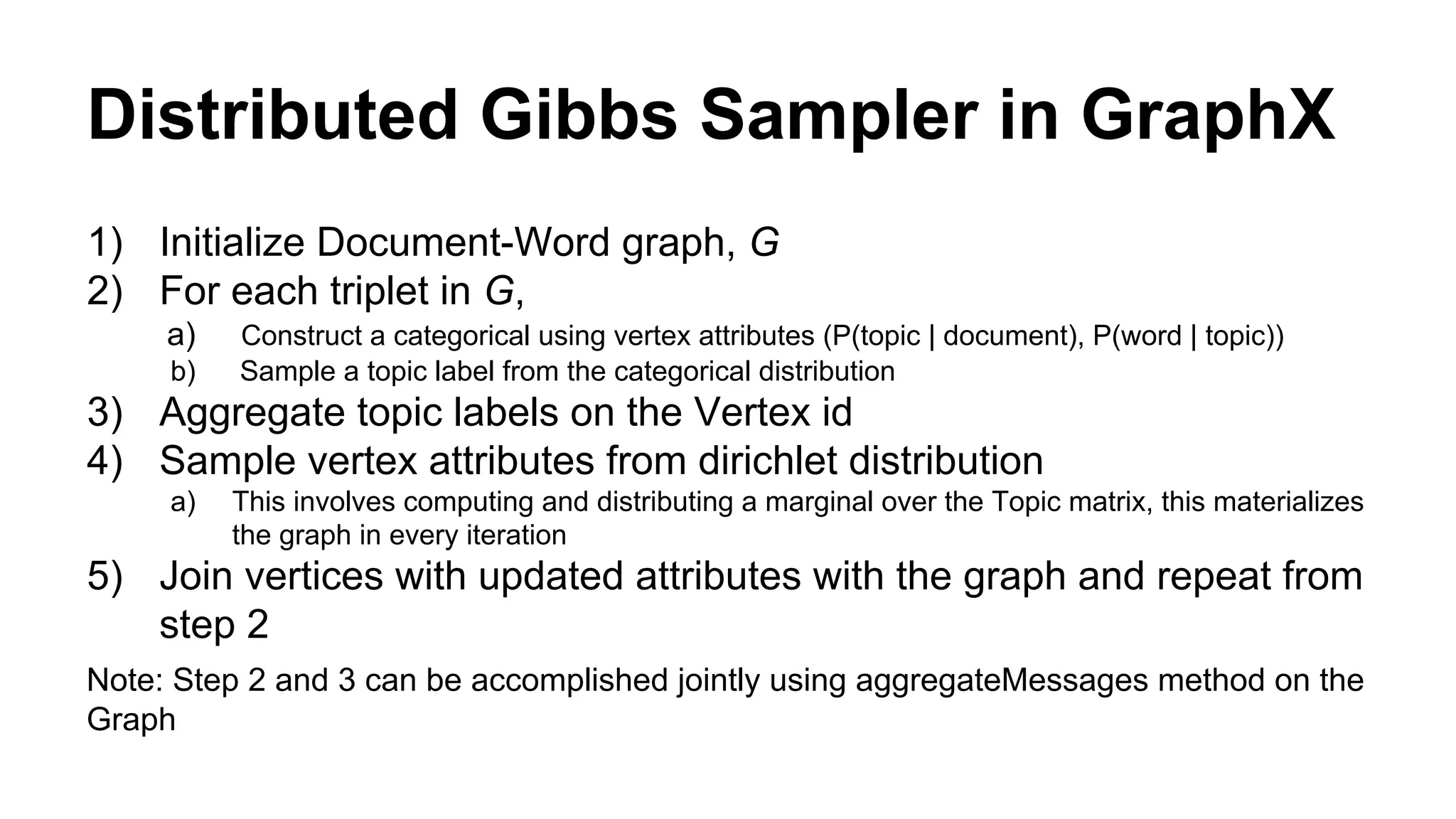
Distributed Gibbs Sampler in GraphX
1) Initialize Document-Word graph, G
2) For each triplet in G,
a) Construct a categorical using vertex attributes (P(topic | document), P(word | topic))
b) Sample a topic label from the categorical distribution
3) Aggregate topic labels on the Vertex id
4) Sample vertex attributes from dirichlet distribution
a) This involves computing and distributing a marginal over the Topic matrix, this materializes
the graph in every iteration
5) Join vertices with updated attributes with the graph and repeat from
step 2
Note: Step 2 and 3 can be accomplished jointly using aggregateMessages method on the
Graph
References
● Topic Sensitive Pagerank [Haveliwala, 2002]
● Latent Dirichlet Allocation [Blei, 2003]

Ehtsham Elahi, Senior Research Engineer, Personalization Science and Engineering Group at Netflix at MLconf SEA - 5/01/15