
Scalable Machine Learning:
Single Machine to Distributed
Yucheng Low
Chief Architect
What is ML scalability?
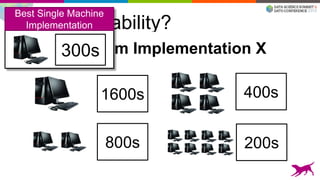
Is this scalability?
1600s
Algorithm Implementation X
800s
400s
200s
300s
Best Single Machine
Implementation
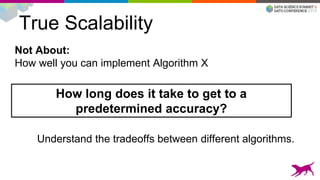
True Scalability
How long does it take to get to a
predetermined accuracy?
Not About:
How well you can implement Algorithm X
Understand the tradeoffs between different algorithms.
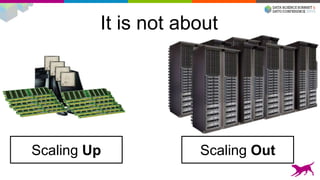
It is not about
Scaling Up Scaling Out
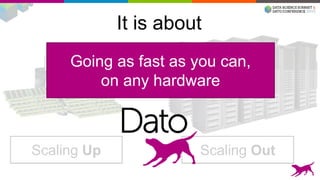
It is about
Scaling Up Scaling Out
Going as fast as you can,
on any hardware
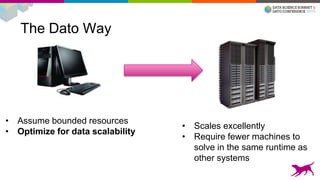
• Assume bounded resources
• Optimize for data scalability
The Dato Way
• Scales excellently
• Require fewer machines to
solve in the same runtime as
other systems
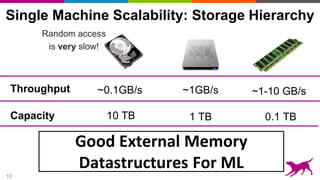
10
~1GB/s
1 TB
~0.1GB/s
10 TB
~1-10 GB/s
0.1 TB
Single Machine Scalability: Storage Hierarchy
Capacity
Throughput
Random access
is very slow!
Good External Memory
Datastructures For ML
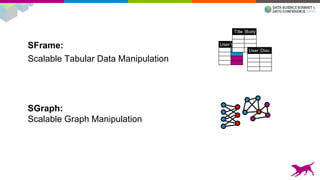
SFrame:
Scalable Tabular Data Manipulation
User Com.
Title Body
User Disc.
SGraph:
Scalable Graph Manipulation
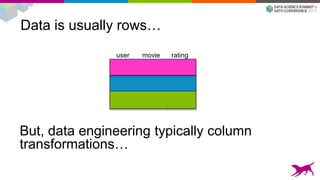
Data is usually rows…
user movie rating
But, data engineering typically column
transformations…
13
Feature engineering is columnar
Normalizes the feature x:
sf[ā€˜rating’] = sf[ā€˜rating’] / sf[ā€˜rating’].sum()
Create a new feature:
sf[ā€˜rating-squared’] =
sf[ā€˜rating’].apply(lambda rating: rating*rating)
Create a new dataset with 2 of the features:
sf2 = sf[[ā€˜rating’,’ rating-squared’]]
ratinguser movie
rating
squared
SFrame
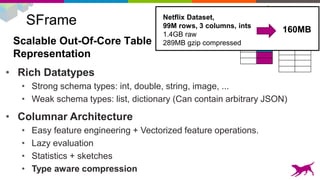
• Rich Datatypes
• Strong schema types: int, double, string, image, ...
• Weak schema types: list, dictionary (Can contain arbitrary JSON)
• Columnar Architecture
• Easy feature engineering + Vectorized feature operations.
• Lazy evaluation
• Statistics + sketches
• Type aware compression
User Com.
Title Body
User Disc.Scalable Out-Of-Core Table
Representation
Netflix Dataset,
99M rows, 3 columns, ints
1.4GB raw
289MB gzip compressed
160MB
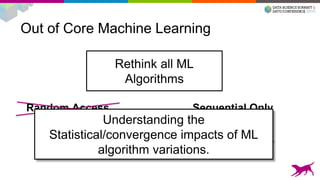
Out of Core Machine Learning
Rethink all ML
Algorithms
Random Access Sequential Only
Sampling? Sort/Shuffle
Understanding the
Statistical/convergence impacts of ML
algorithm variations.
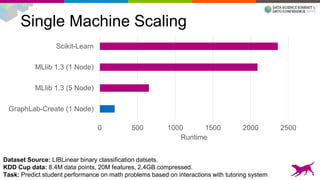
Single Machine Scaling
0 500 1000 1500 2000 2500
GraphLab-Create (1 Node)
MLlib 1.3 (5 Node)
MLlib 1.3 (1 Node)
Scikit-Learn
Runtime
Dataset Source: LIBLinear binary classification datsets.
KDD Cup data: 8.4M data points, 20M features, 2.4GB compressed.
Task: Predict student performance on math problems based on interactions with tutoring system
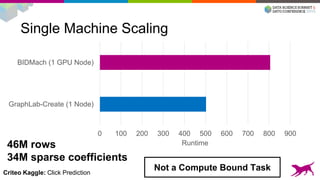
Single Machine Scaling
0 100 200 300 400 500 600 700 800 900
GraphLab-Create (1 Node)
BIDMach (1 GPU Node)
Runtime
Criteo Kaggle: Click Prediction
46M rows
34M sparse coefficients
Not a Compute Bound Task
Social Media
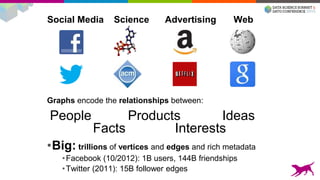
Graphs encode the relationships between:
•Big: trillions of vertices and edges and rich metadata
•Facebook (10/2012): 1B users, 144B friendships
•Twitter (2011): 15B follower edges
AdvertisingScience Web
People
Facts
Products
Interests
Ideas
SGraph
1. Immutable disk-backed graph representation.
(Append only)
2. Vertex / Edge Attributes.
3. Optimized for bulk access, not fine-grained queries.
Get neighborhood of [5 Million Vertices]
Get neighborhood of 1 vertex
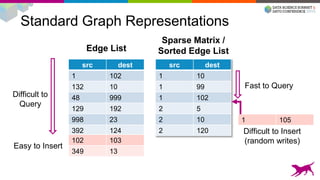
Standard Graph Representations
src dest
1 102
132 10
48 999
129 192
998 23
392 124
Edge List
Easy to Insert
src dest
1 10
1 99
1 102
2 5
2 10
2 120
Sparse Matrix /
Sorted Edge List
Difficult to Insert
(random writes)102 103
349 13
Difficult to
Query
Fast to Query
1 105
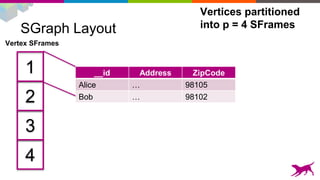
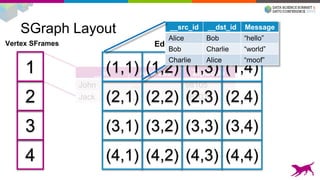
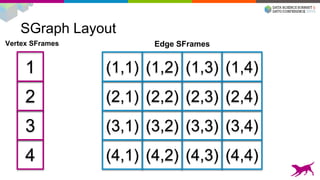
SGraph Layout
1
2
3
4
Vertex SFrames
__id Address ZipCode
Alice … 98105
Bob … 98102
Vertices partitioned
into p = 4 SFrames
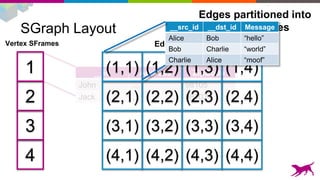
Edges partitioned into
p^2 = 16 SFrames
__id Address ZipCode
John … 98105
Jack … 98102
SGraph Layout
1
3
4
Vertex SFrames
(1,2)
(2,2)
(3,2)
(4,2)
(1,1)
(2,1)
(3,1)
(4,1)
(1,4)
(2,4)
(3,4)
(4,4)
(1,3)
(2,3)
(3,3)
(4,3)
Edge SFrames
__src_id __dst_id Message
Alice Bob ā€œhelloā€
Bob Charlie ā€œworldā€
Charlie Alice ā€œmoofā€
2
__id Address ZipCode
John … 98105
Jack … 98102
3
SGraph Layout
1
2
4
Vertex SFrames
(1,2)
(2,2)
(3,2)
(4,2)
(1,1)
(2,1)
(3,1)
(4,1)
(1,4)
(2,4)
(3,4)
(4,4)
(1,3)
(2,3)
(3,3)
(4,3)
Edge SFrames
__src_id __dst_id Message
Alice Bob ā€œhelloā€
Bob Charlie ā€œworldā€
Charlie Alice ā€œmoofā€
3
SGraph Layout
1
2
4
Vertex SFrames
(1,2)
(2,2)
(3,2)
(4,2)
(1,1)
(2,1)
(3,1)
(4,1)
(1,4)
(2,4)
(3,4)
(4,4)
(1,3)
(2,3)
(3,3)
(4,3)
Edge SFrames
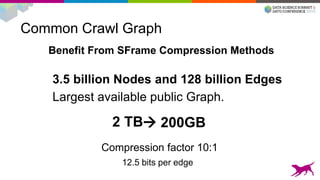
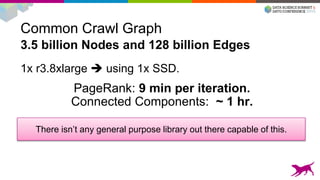
Common Crawl Graph
3.5 billion Nodes and 128 billion Edges
Largest available public Graph.
 200GB
Compression factor 10:1
12.5 bits per edge
2 TB
Benefit From SFrame Compression Methods
Common Crawl Graph
3.5 billion Nodes and 128 billion Edges
Largest available public Graph.
 200GB
Compression factor 10:1
12.5 bits per edge
2 TB
Common Crawl Graph
1x r3.8xlarge  using 1x SSD.
3.5 billion Nodes and 128 billion Edges
PageRank: 9 min per iteration.
Connected Components: ~ 1 hr.
There isn’t any general purpose library out there capable of this.
SFrame & SGraph
BSD License
(August)
Distributed
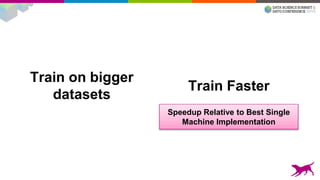
Train on bigger
datasets
Train Faster
Speedup Relative to Best Single
Machine Implementation
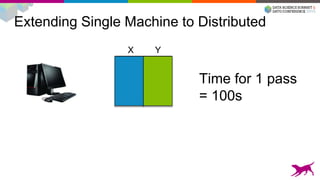
X Y
Time for 1 pass
= 100s
Extending Single Machine to Distributed
X Y
Time for 1 pass
= 50s
X Y
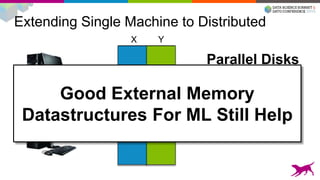
Parallel Disks
Good External Memory
Datastructures For ML Still Help
Distributed Optimization
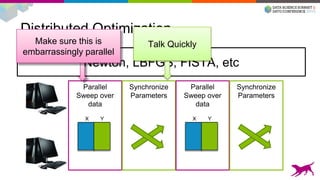
Newton, LBFGS, FISTA, etc
Parallel
Sweep over
data
X Y
Synchronize
Parameters
Parallel
Sweep over
data
X Y
Synchronize
Parameters
Make sure this is
embarrassingly parallel
Talk Quickly
Distributed Optimization
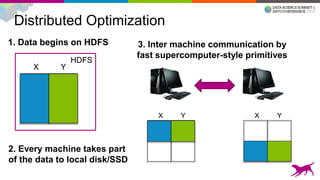
HDFS
X Y
1. Data begins on HDFS
X YX Y
2. Every machine takes part
of the data to local disk/SSD
3. Inter machine communication by
fast supercomputer-style primitives
Criteo Terabyte Click Logs
Click Prediction Task:
Whether visitor clicked on a link or not.
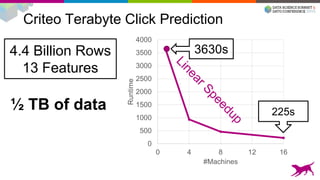
Criteo Terabyte Click Prediction
4.4 Billion Rows
13 Features
½ TB of data
0
500
1000
1500
2000
2500
3000
3500
4000
0 4 8 12 16
Runtime
#Machines
225s
3630s
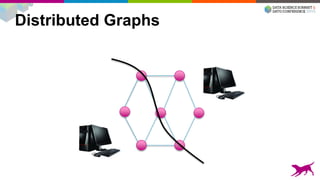
Distributed Graphs
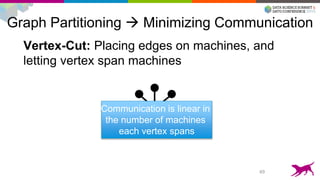
Graph Partitioning  Minimizing Communication
YYYCommunication is linear in
the number of machines
each vertex spans
49
Vertex-Cut: Placing edges on machines, and
letting vertex span machines
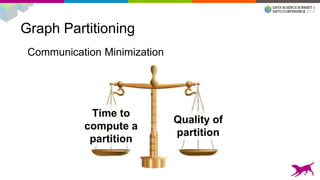
Graph Partitioning
Communication Minimization
Time to
compute a
partition
Quality of
partition
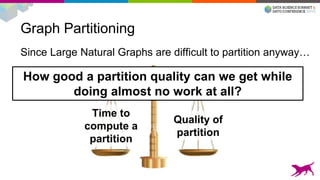
Graph Partitioning
Since Large Natural Graphs are difficult to partition anyway…
Time to
compute a
partition
Quality of
partition
How good a partition quality can we get while
doing almost no work at all?
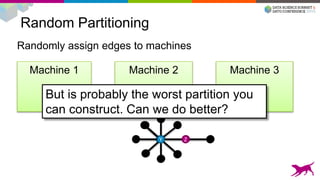
Machine 2Machine 1 Machine 3
Randomly assign edges to machines
YYYY ZYYYY ZY Z
Random Partitioning
But is probably the worst partition you
can construct. Can we do better?
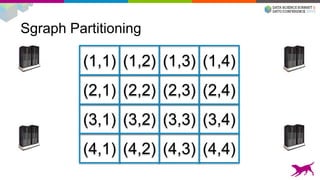
Sgraph Partitioning
(1,2)
(2,2)
(1,1)
(2,1)
(3,2)
(4,2)
(3,1)
(4,1)
(1,4)
(2,4)
(1,3)
(2,3)
(3,4)
(4,4)
(3,3)
(4,3)
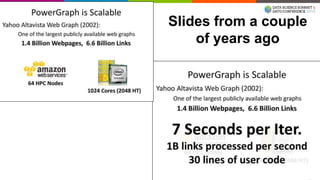
Slides from a couple
of years ago
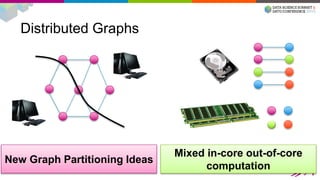
Distributed Graphs
New Graph Partitioning Ideas
Mixed in-core out-of-core
computation
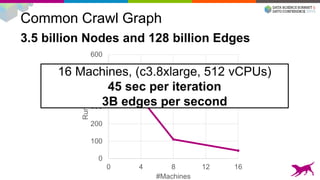
Common Crawl Graph
0
100
200
300
400
500
600
0 4 8 12 16
Runtime
#Machines
16 Machines, (c3.8xlarge, 512 vCPUs)
45 sec per iteration
3B edges per second
3.5 billion Nodes and 128 billion Edges
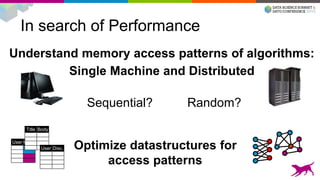
In search of Performance
Understand memory access patterns of algorithms:
Single Machine and Distributed
Sequential? Random?
User Com.
Title Body
User Disc. Optimize datastructures for
access patterns
It is not merely about speed, or scaling
Doing more with what you already have
Excess Slides
Our Tools Are Easy To Use
import graphlab as gl
train_data = gl.SFrame.read_csv(traindata_path)
train_data['1grams'] = gl.text_analytics.count_ngrams(train_data[ā€˜text’],1)
train_data['2grams'] = gl.text_analytics.count_ngrams(train_data[ā€˜text’],2)
cls = gl.classifier.create(train_data, target='sentiment’)
5 line sentiment analysis
But
You have preexisting code in Numpy, Scipy, Scikit-learn
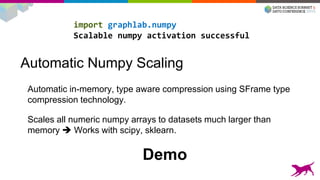
Automatic Numpy Scaling
Automatic in-memory, type aware compression using SFrame type
compression technology.
import graphlab.numpy
Scalable numpy activation successful
Scales all numeric numpy arrays to datasets much larger than
memory  Works with scipy, sklearn.
Demo
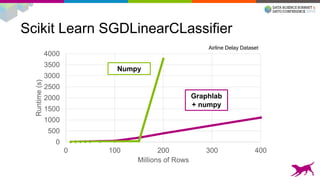
Scikit Learn SGDLinearCLassifier
0
500
1000
1500
2000
2500
3000
3500
4000
0 100 200 300 400
Runtime(s)
Millions of Rows
Airline Delay Dataset
Numpy
Graphlab
+ numpy
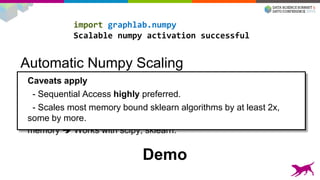
Automatic Numpy Scaling
Automatic in-memory, type aware compression using SFrame type
compression technology.
import graphlab.numpy
Scalable numpy activation successful
Scales all numeric numpy arrays to datasets much larger than
memory  Works with scipy, sklearn.
Demo
Caveats apply
- Sequential Access highly preferred.
- Scales most memory bound sklearn algorithms by at least 2x,
some by more.
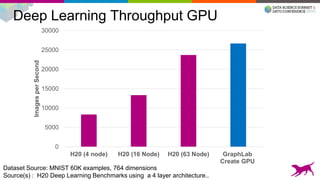
0
5000
10000
15000
20000
25000
30000
H20 (4 node) H20 (16 Node) H20 (63 Node) GraphLab
Create GPU
ImagesperSecond
Deep Learning Throughput GPU
Dataset Source: MNIST 60K examples, 764 dimensions
Source(s) : H20 Deep Learning Benchmarks using a 4 layer architecture..

Making Machine Learning Scale: Single Machine and Distributed

  • 1.
    Scalable Machine Learning: SingleMachine to Distributed Yucheng Low Chief Architect
  • 2.
    What is MLscalability?
  • 3.
    Is this scalability? 1600s AlgorithmImplementation X 800s 400s 200s 300s Best Single Machine Implementation
  • 4.
    True Scalability How longdoes it take to get to a predetermined accuracy? Not About: How well you can implement Algorithm X Understand the tradeoffs between different algorithms.
  • 5.
    It is notabout Scaling Up Scaling Out
  • 6.
    It is about ScalingUp Scaling Out Going as fast as you can, on any hardware
  • 7.
    • Assume boundedresources • Optimize for data scalability The Dato Way • Scales excellently • Require fewer machines to solve in the same runtime as other systems
  • 8.
    10 ~1GB/s 1 TB ~0.1GB/s 10 TB ~1-10GB/s 0.1 TB Single Machine Scalability: Storage Hierarchy Capacity Throughput Random access is very slow! Good External Memory Datastructures For ML
  • 9.
    SFrame: Scalable Tabular DataManipulation User Com. Title Body User Disc. SGraph: Scalable Graph Manipulation
  • 10.
    Data is usuallyrows… user movie rating But, data engineering typically column transformations…
  • 11.
    13 Feature engineering iscolumnar Normalizes the feature x: sf[ā€˜rating’] = sf[ā€˜rating’] / sf[ā€˜rating’].sum() Create a new feature: sf[ā€˜rating-squared’] = sf[ā€˜rating’].apply(lambda rating: rating*rating) Create a new dataset with 2 of the features: sf2 = sf[[ā€˜rating’,’ rating-squared’]] ratinguser movie rating squared
  • 12.
    SFrame • Rich Datatypes •Strong schema types: int, double, string, image, ... • Weak schema types: list, dictionary (Can contain arbitrary JSON) • Columnar Architecture • Easy feature engineering + Vectorized feature operations. • Lazy evaluation • Statistics + sketches • Type aware compression User Com. Title Body User Disc.Scalable Out-Of-Core Table Representation Netflix Dataset, 99M rows, 3 columns, ints 1.4GB raw 289MB gzip compressed 160MB
  • 13.
    Out of CoreMachine Learning Rethink all ML Algorithms Random Access Sequential Only Sampling? Sort/Shuffle Understanding the Statistical/convergence impacts of ML algorithm variations.
  • 14.
    Single Machine Scaling 0500 1000 1500 2000 2500 GraphLab-Create (1 Node) MLlib 1.3 (5 Node) MLlib 1.3 (1 Node) Scikit-Learn Runtime Dataset Source: LIBLinear binary classification datsets. KDD Cup data: 8.4M data points, 20M features, 2.4GB compressed. Task: Predict student performance on math problems based on interactions with tutoring system
  • 15.
    Single Machine Scaling 0100 200 300 400 500 600 700 800 900 GraphLab-Create (1 Node) BIDMach (1 GPU Node) Runtime Criteo Kaggle: Click Prediction 46M rows 34M sparse coefficients Not a Compute Bound Task
  • 16.
    Social Media Graphs encodethe relationships between: •Big: trillions of vertices and edges and rich metadata •Facebook (10/2012): 1B users, 144B friendships •Twitter (2011): 15B follower edges AdvertisingScience Web People Facts Products Interests Ideas
  • 17.
    SGraph 1. Immutable disk-backedgraph representation. (Append only) 2. Vertex / Edge Attributes. 3. Optimized for bulk access, not fine-grained queries. Get neighborhood of [5 Million Vertices] Get neighborhood of 1 vertex
  • 18.
    Standard Graph Representations srcdest 1 102 132 10 48 999 129 192 998 23 392 124 Edge List Easy to Insert src dest 1 10 1 99 1 102 2 5 2 10 2 120 Sparse Matrix / Sorted Edge List Difficult to Insert (random writes)102 103 349 13 Difficult to Query Fast to Query 1 105
  • 19.
    SGraph Layout 1 2 3 4 Vertex SFrames __idAddress ZipCode Alice … 98105 Bob … 98102 Vertices partitioned into p = 4 SFrames
  • 20.
    Edges partitioned into p^2= 16 SFrames __id Address ZipCode John … 98105 Jack … 98102 SGraph Layout 1 3 4 Vertex SFrames (1,2) (2,2) (3,2) (4,2) (1,1) (2,1) (3,1) (4,1) (1,4) (2,4) (3,4) (4,4) (1,3) (2,3) (3,3) (4,3) Edge SFrames __src_id __dst_id Message Alice Bob ā€œhelloā€ Bob Charlie ā€œworldā€ Charlie Alice ā€œmoofā€ 2
  • 21.
    __id Address ZipCode John… 98105 Jack … 98102 3 SGraph Layout 1 2 4 Vertex SFrames (1,2) (2,2) (3,2) (4,2) (1,1) (2,1) (3,1) (4,1) (1,4) (2,4) (3,4) (4,4) (1,3) (2,3) (3,3) (4,3) Edge SFrames __src_id __dst_id Message Alice Bob ā€œhelloā€ Bob Charlie ā€œworldā€ Charlie Alice ā€œmoofā€
  • 22.
  • 23.
    Common Crawl Graph 3.5billion Nodes and 128 billion Edges Largest available public Graph.  200GB Compression factor 10:1 12.5 bits per edge 2 TB Benefit From SFrame Compression Methods
  • 24.
    Common Crawl Graph 3.5billion Nodes and 128 billion Edges Largest available public Graph.  200GB Compression factor 10:1 12.5 bits per edge 2 TB
  • 25.
    Common Crawl Graph 1xr3.8xlarge  using 1x SSD. 3.5 billion Nodes and 128 billion Edges PageRank: 9 min per iteration. Connected Components: ~ 1 hr. There isn’t any general purpose library out there capable of this.
  • 26.
    SFrame & SGraph BSDLicense (August)
  • 27.
  • 28.
    Train on bigger datasets TrainFaster Speedup Relative to Best Single Machine Implementation
  • 29.
    X Y Time for1 pass = 100s Extending Single Machine to Distributed
  • 30.
    Extending Single Machineto Distributed X Y Time for 1 pass = 50s X Y Parallel Disks Good External Memory Datastructures For ML Still Help
  • 31.
    Distributed Optimization Newton, LBFGS,FISTA, etc Parallel Sweep over data X Y Synchronize Parameters Parallel Sweep over data X Y Synchronize Parameters Make sure this is embarrassingly parallel Talk Quickly
  • 32.
    Distributed Optimization HDFS X Y 1.Data begins on HDFS X YX Y 2. Every machine takes part of the data to local disk/SSD 3. Inter machine communication by fast supercomputer-style primitives
  • 33.
    Criteo Terabyte ClickLogs Click Prediction Task: Whether visitor clicked on a link or not.
  • 34.
    Criteo Terabyte ClickPrediction 4.4 Billion Rows 13 Features ½ TB of data 0 500 1000 1500 2000 2500 3000 3500 4000 0 4 8 12 16 Runtime #Machines 225s 3630s
  • 35.
  • 36.
    Graph Partitioning Minimizing Communication YYYCommunication is linear in the number of machines each vertex spans 49 Vertex-Cut: Placing edges on machines, and letting vertex span machines
  • 37.
    Graph Partitioning Communication Minimization Timeto compute a partition Quality of partition
  • 38.
    Graph Partitioning Since LargeNatural Graphs are difficult to partition anyway… Time to compute a partition Quality of partition How good a partition quality can we get while doing almost no work at all?
  • 39.
    Machine 2Machine 1Machine 3 Randomly assign edges to machines YYYY ZYYYY ZY Z Random Partitioning But is probably the worst partition you can construct. Can we do better?
  • 40.
  • 41.
    Slides from acouple of years ago
  • 42.
    Distributed Graphs New GraphPartitioning Ideas Mixed in-core out-of-core computation
  • 43.
    Common Crawl Graph 0 100 200 300 400 500 600 04 8 12 16 Runtime #Machines 16 Machines, (c3.8xlarge, 512 vCPUs) 45 sec per iteration 3B edges per second 3.5 billion Nodes and 128 billion Edges
  • 44.
    In search ofPerformance Understand memory access patterns of algorithms: Single Machine and Distributed Sequential? Random? User Com. Title Body User Disc. Optimize datastructures for access patterns
  • 45.
    It is notmerely about speed, or scaling Doing more with what you already have
  • 47.
  • 48.
    Our Tools AreEasy To Use import graphlab as gl train_data = gl.SFrame.read_csv(traindata_path) train_data['1grams'] = gl.text_analytics.count_ngrams(train_data[ā€˜text’],1) train_data['2grams'] = gl.text_analytics.count_ngrams(train_data[ā€˜text’],2) cls = gl.classifier.create(train_data, target='sentiment’) 5 line sentiment analysis But You have preexisting code in Numpy, Scipy, Scikit-learn
  • 49.
    Automatic Numpy Scaling Automaticin-memory, type aware compression using SFrame type compression technology. import graphlab.numpy Scalable numpy activation successful Scales all numeric numpy arrays to datasets much larger than memory  Works with scipy, sklearn. Demo
  • 50.
    Scikit Learn SGDLinearCLassifier 0 500 1000 1500 2000 2500 3000 3500 4000 0100 200 300 400 Runtime(s) Millions of Rows Airline Delay Dataset Numpy Graphlab + numpy
  • 51.
    Automatic Numpy Scaling Automaticin-memory, type aware compression using SFrame type compression technology. import graphlab.numpy Scalable numpy activation successful Scales all numeric numpy arrays to datasets much larger than memory  Works with scipy, sklearn. Demo Caveats apply - Sequential Access highly preferred. - Scales most memory bound sklearn algorithms by at least 2x, some by more.
  • 52.
    0 5000 10000 15000 20000 25000 30000 H20 (4 node)H20 (16 Node) H20 (63 Node) GraphLab Create GPU ImagesperSecond Deep Learning Throughput GPU Dataset Source: MNIST 60K examples, 764 dimensions Source(s) : H20 Deep Learning Benchmarks using a 4 layer architecture..