A Multi-Armed Bandit Framework
for Recommendations
at Netflix
Jaya Kawale & Fernando Amat
PRS Workshop, June 2018
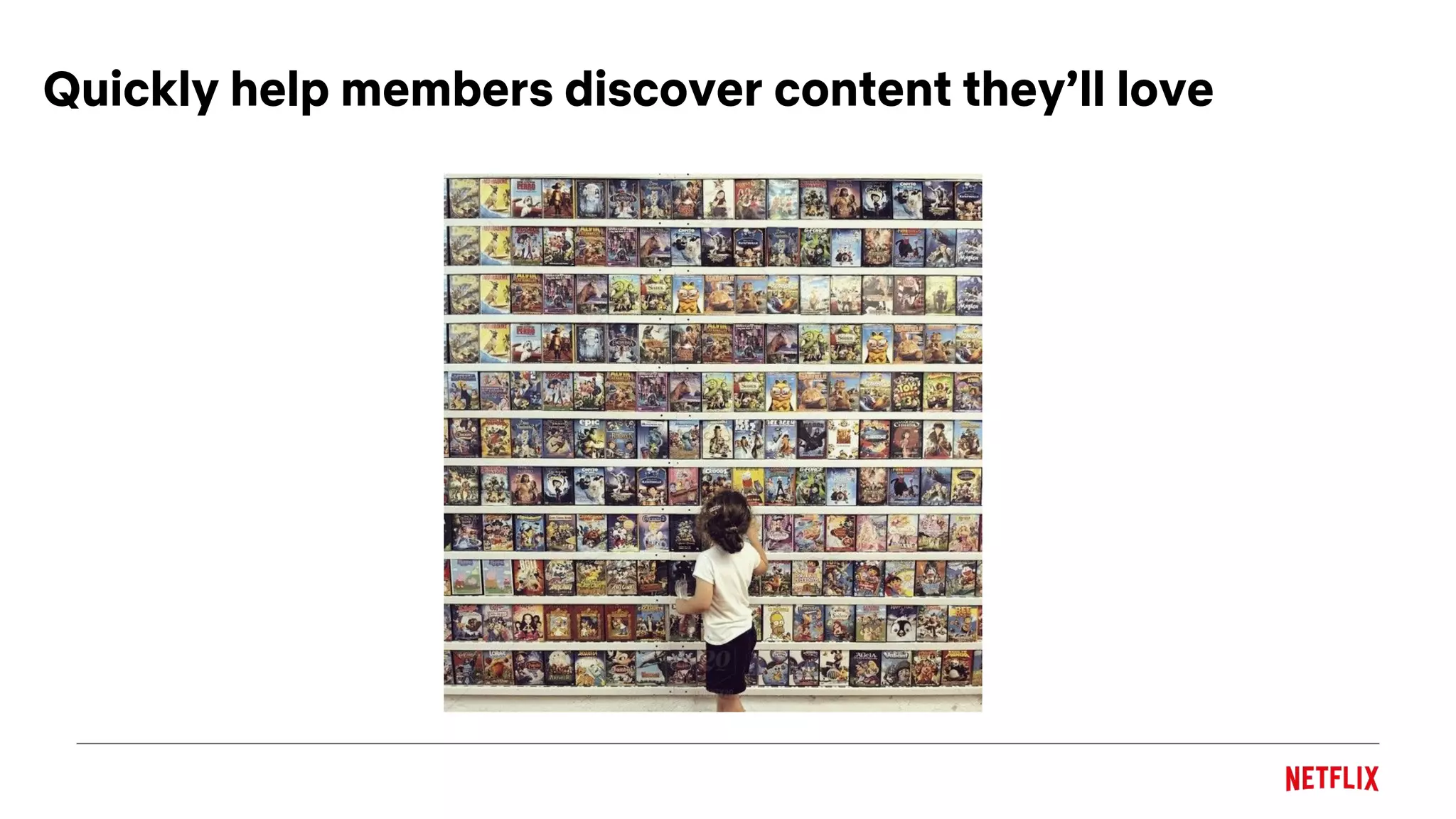
Quickly help members discover content they’ll love
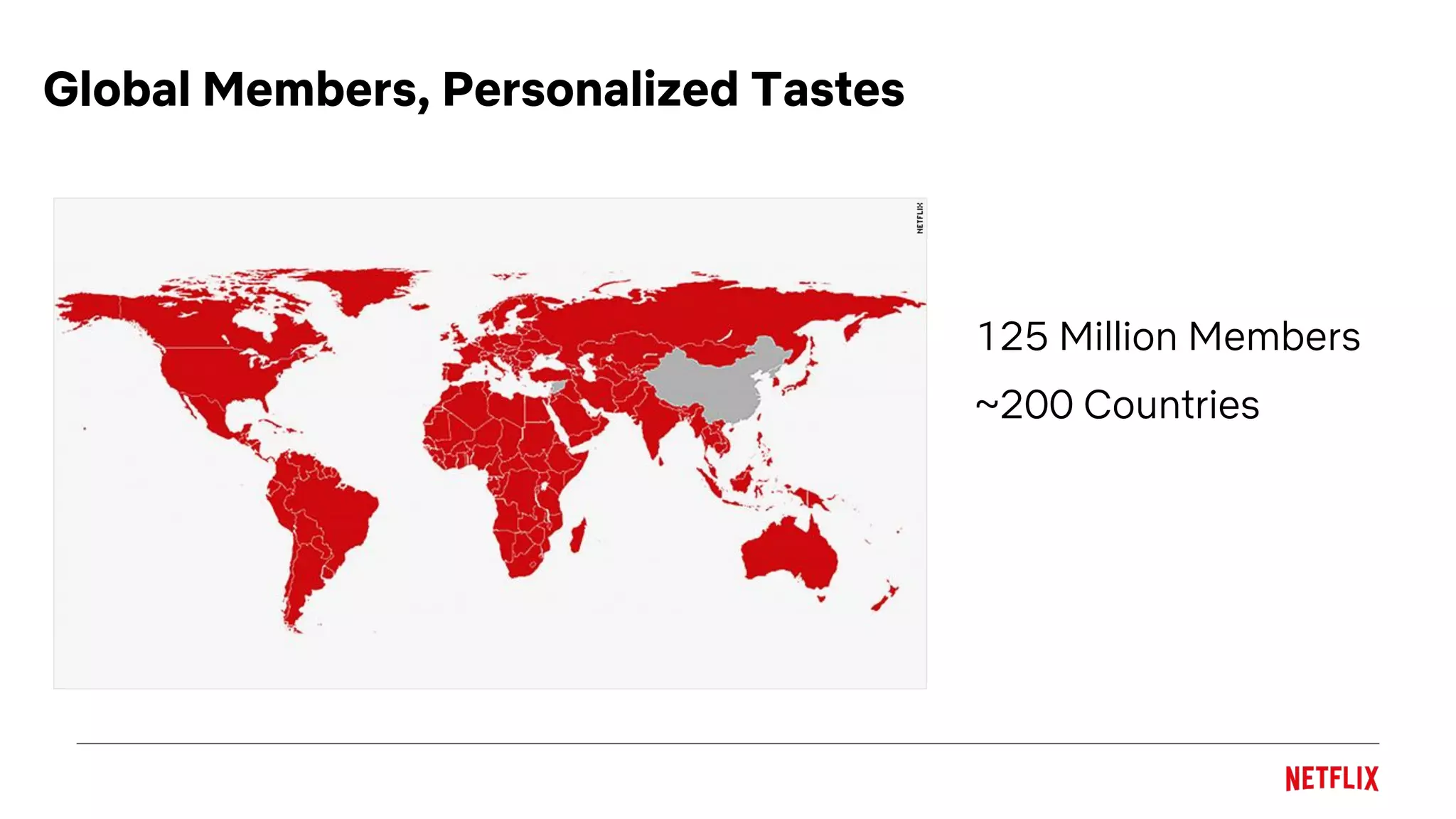
Global Members, Personalized Tastes
125 Million Members
~200 Countries
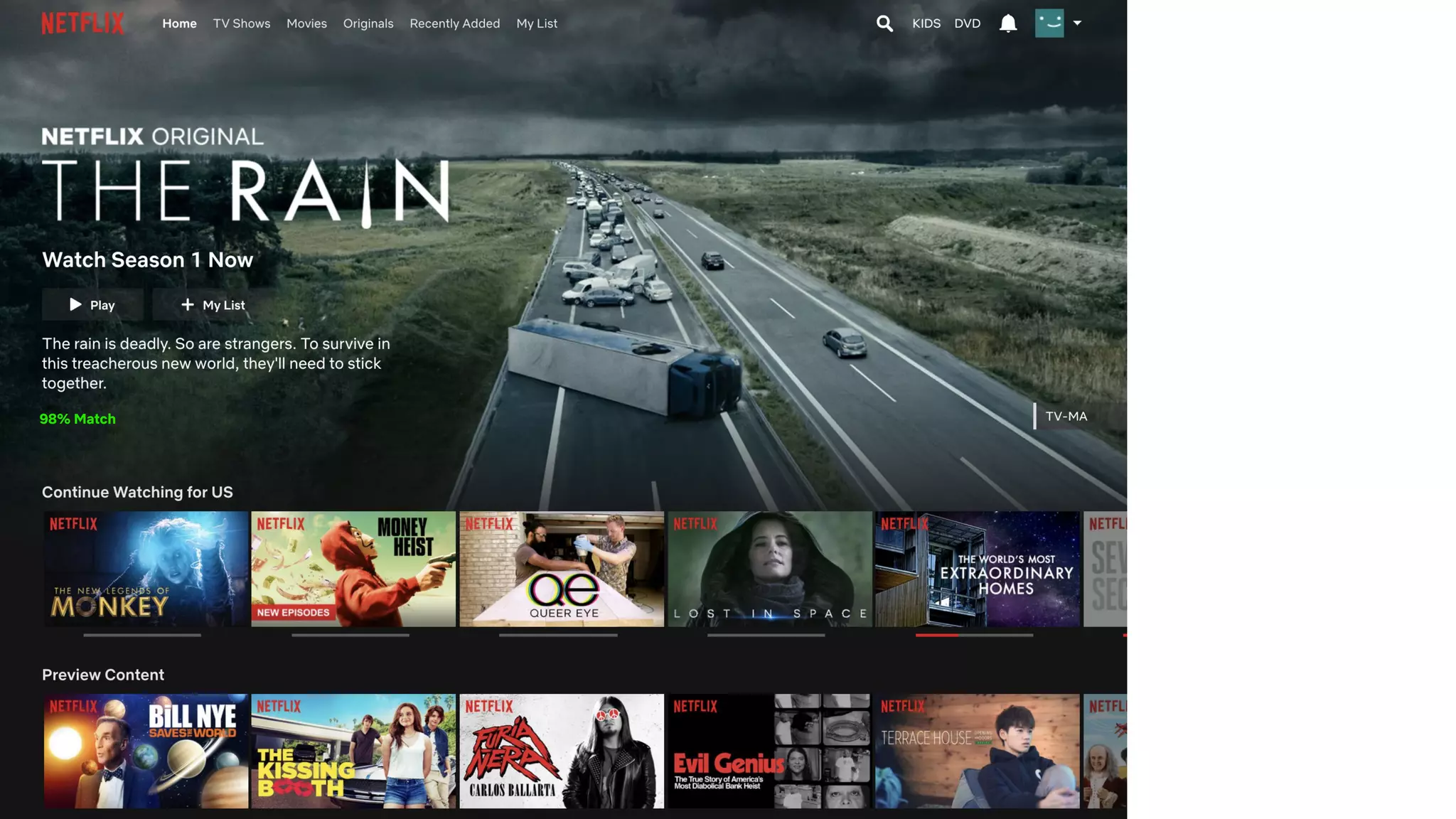
98% Match
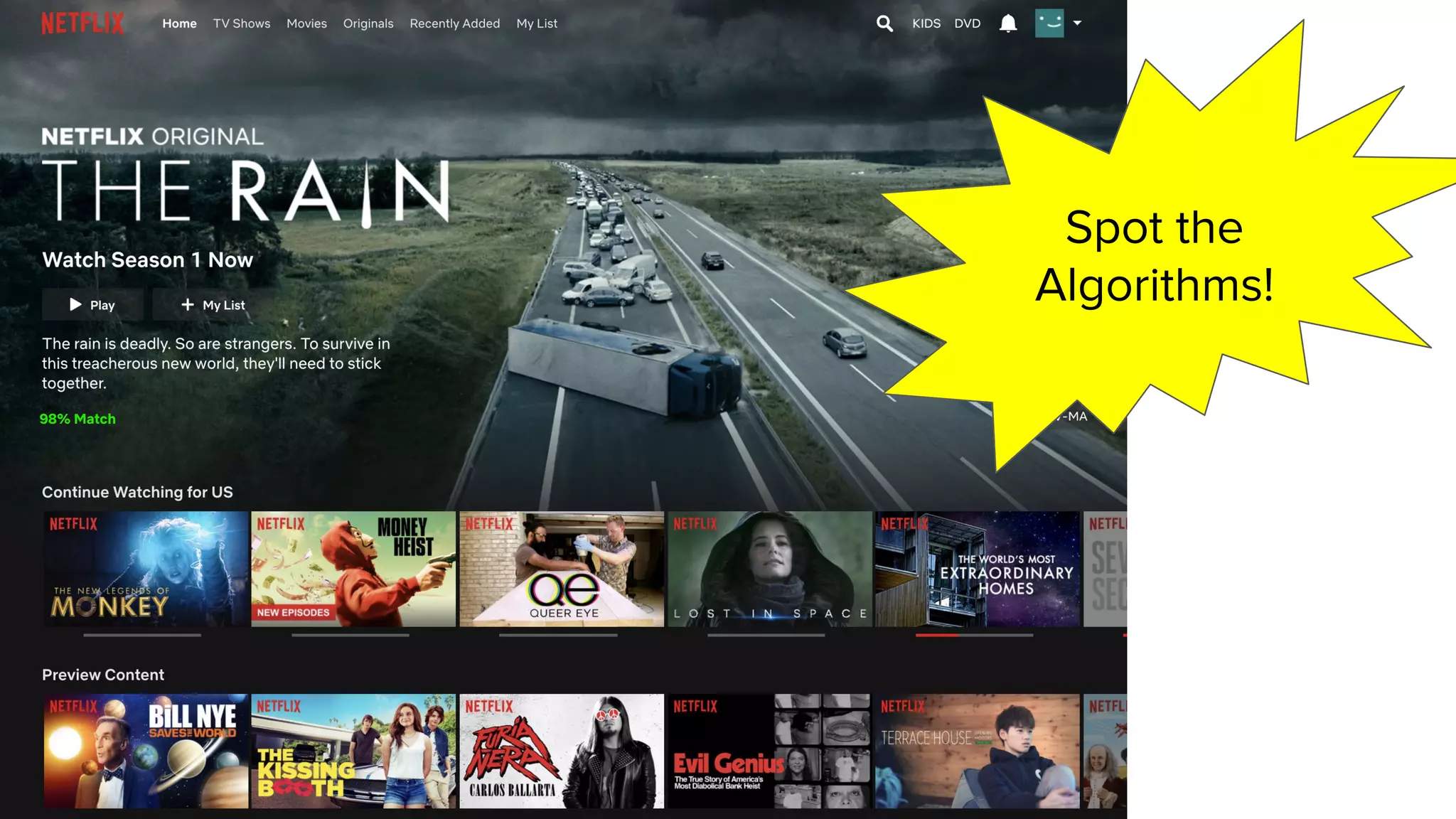
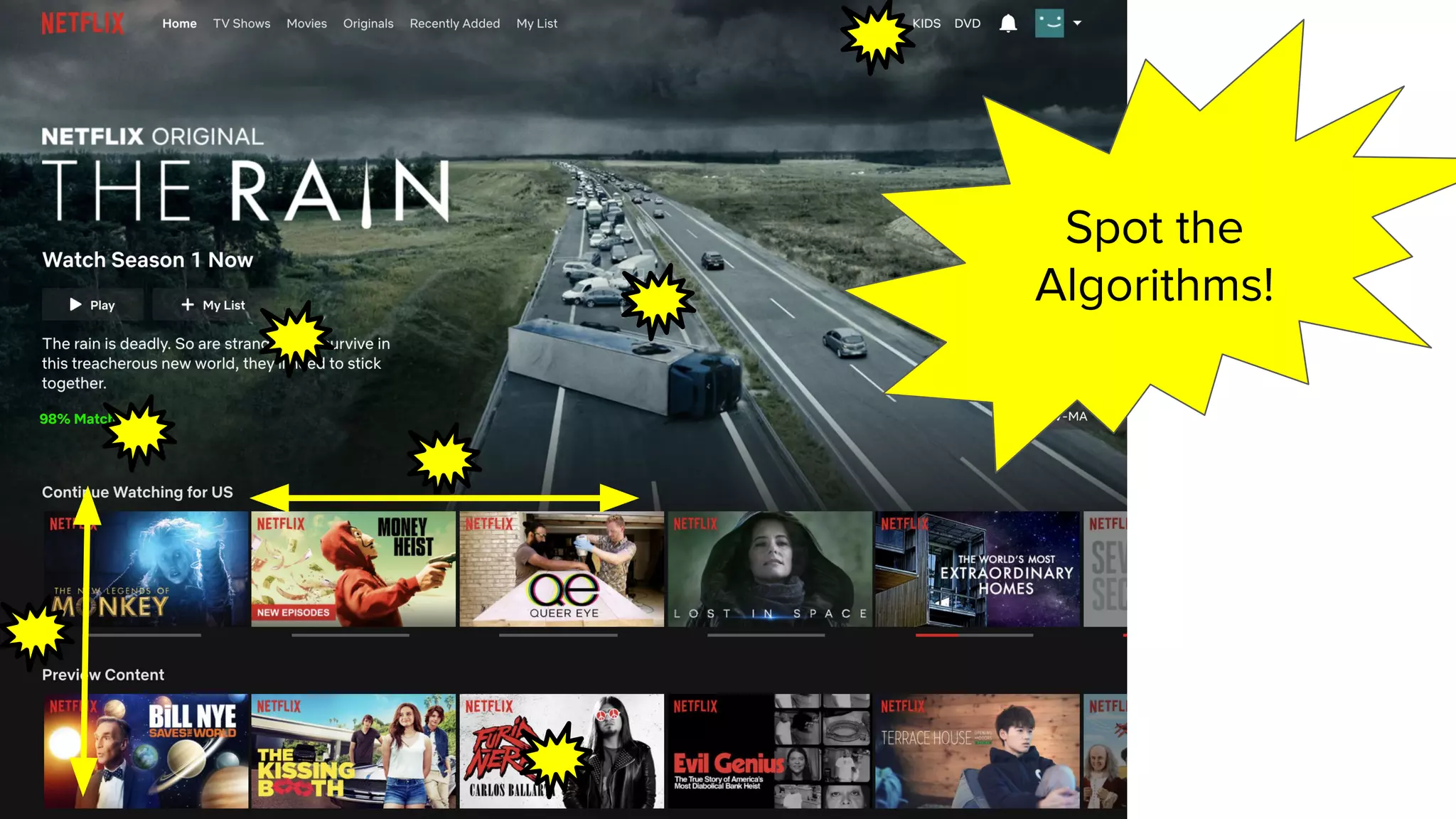
Spot the
Algorithms!
98% Match
Spot the
Algorithms!
98% Match
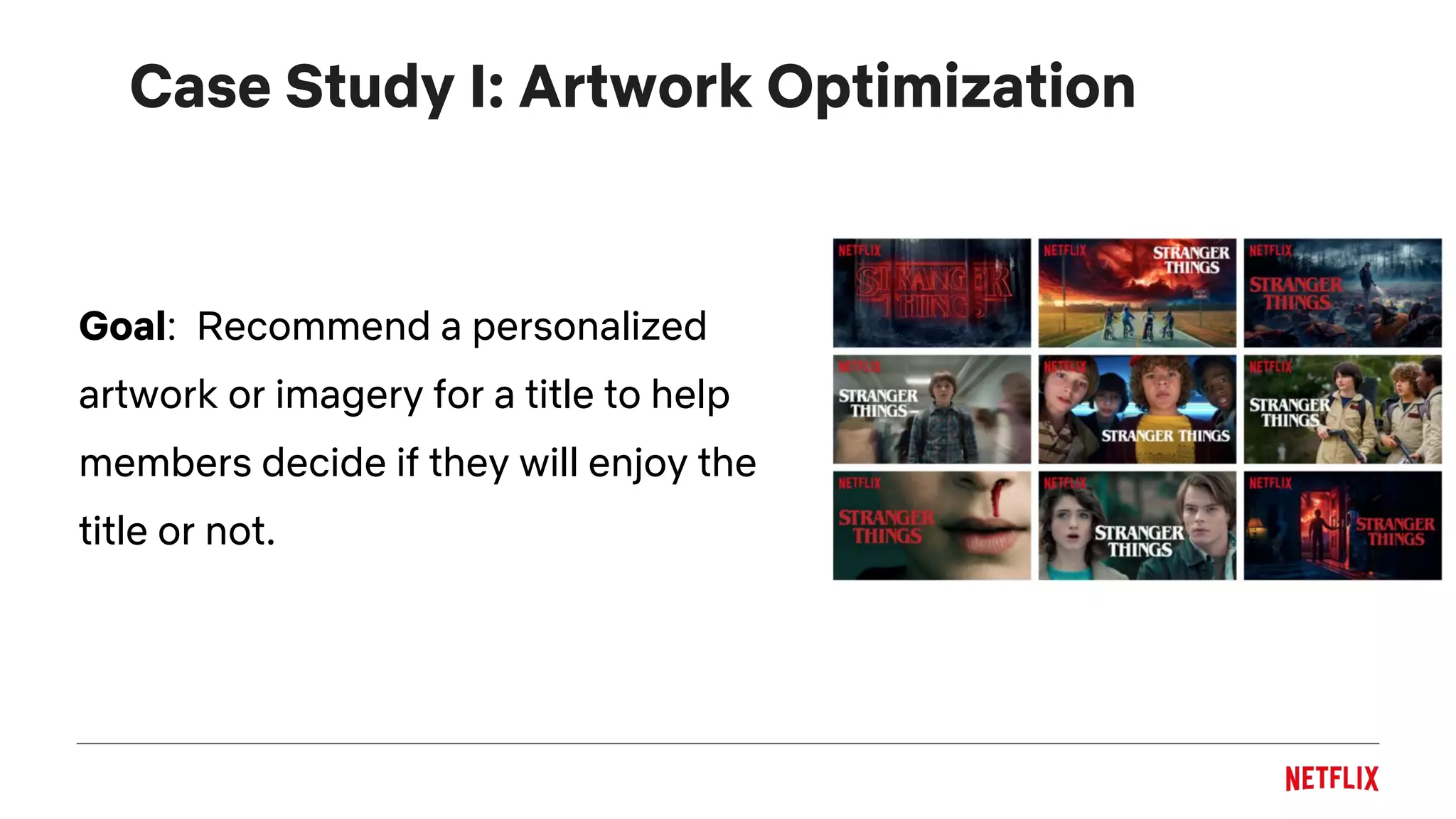
Case Study I: Artwork Optimization
Goal: Recommend a personalized
artwork or imagery for a title to help
members decide if they will enjoy the
title or not.
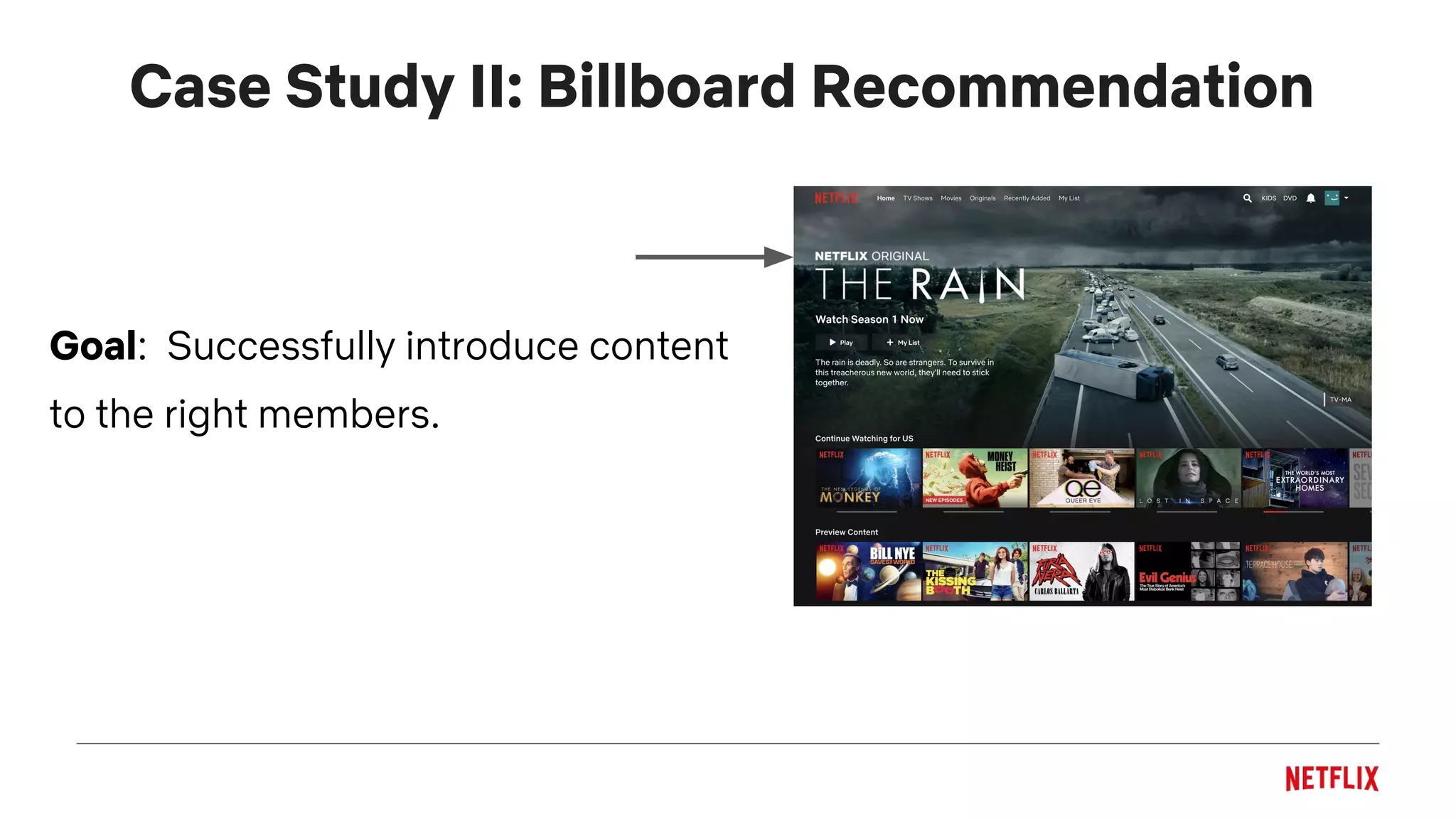
Case Study II: Billboard Recommendation
Goal: Successfully introduce content
to the right members.
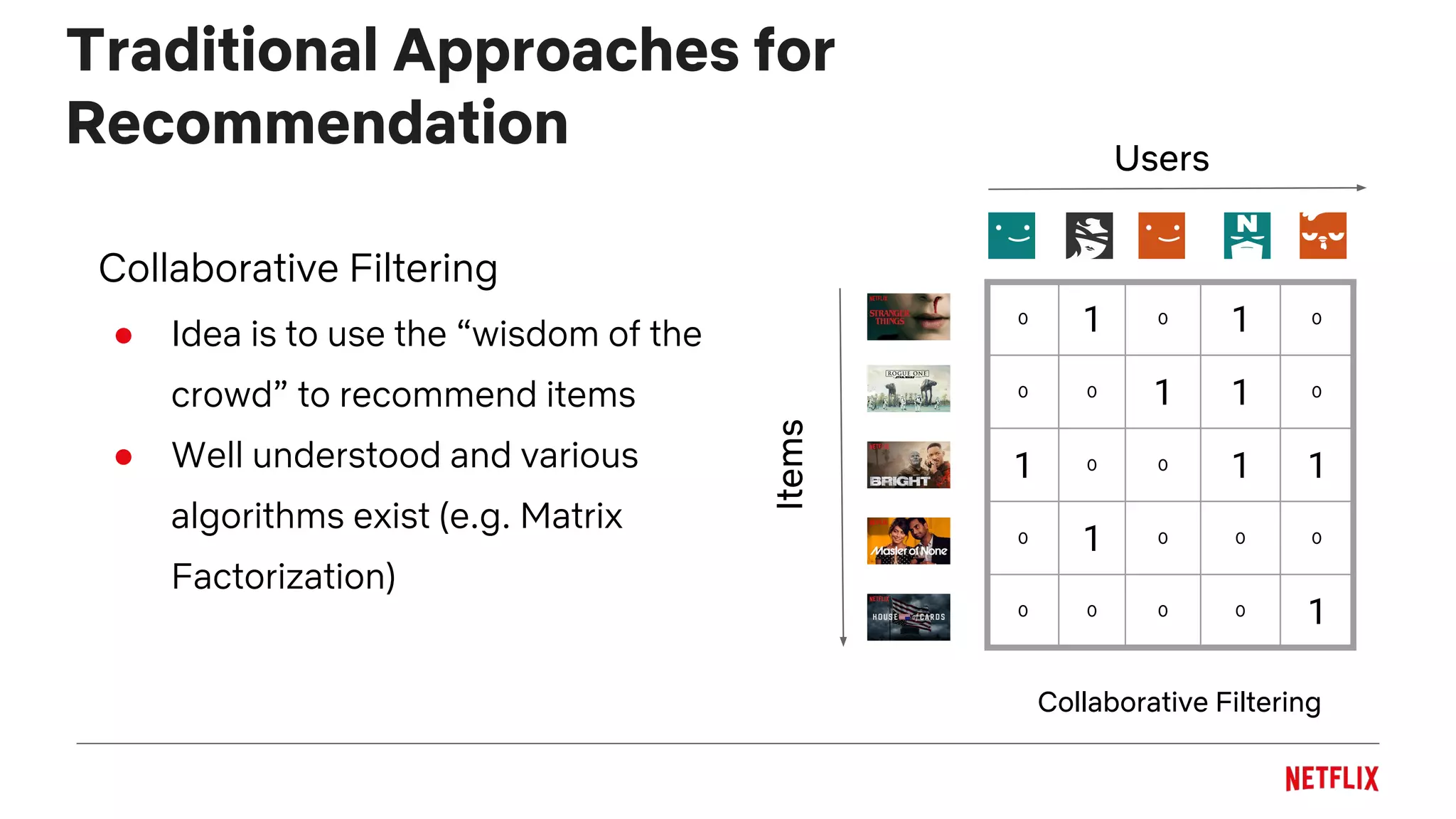
Traditional Approaches for
Recommendation
Collaborative Filtering
● Idea is to use the “wisdom of the
crowd” to recommend items
● Well understood and various
algorithms exist (e.g. Matrix
Factorization)
Collaborative Filtering
0 1 0 1 0
0 0 1 1 0
1 0 0 1 1
0 1 0 0 0
0 0 0 0 1
Users
Items
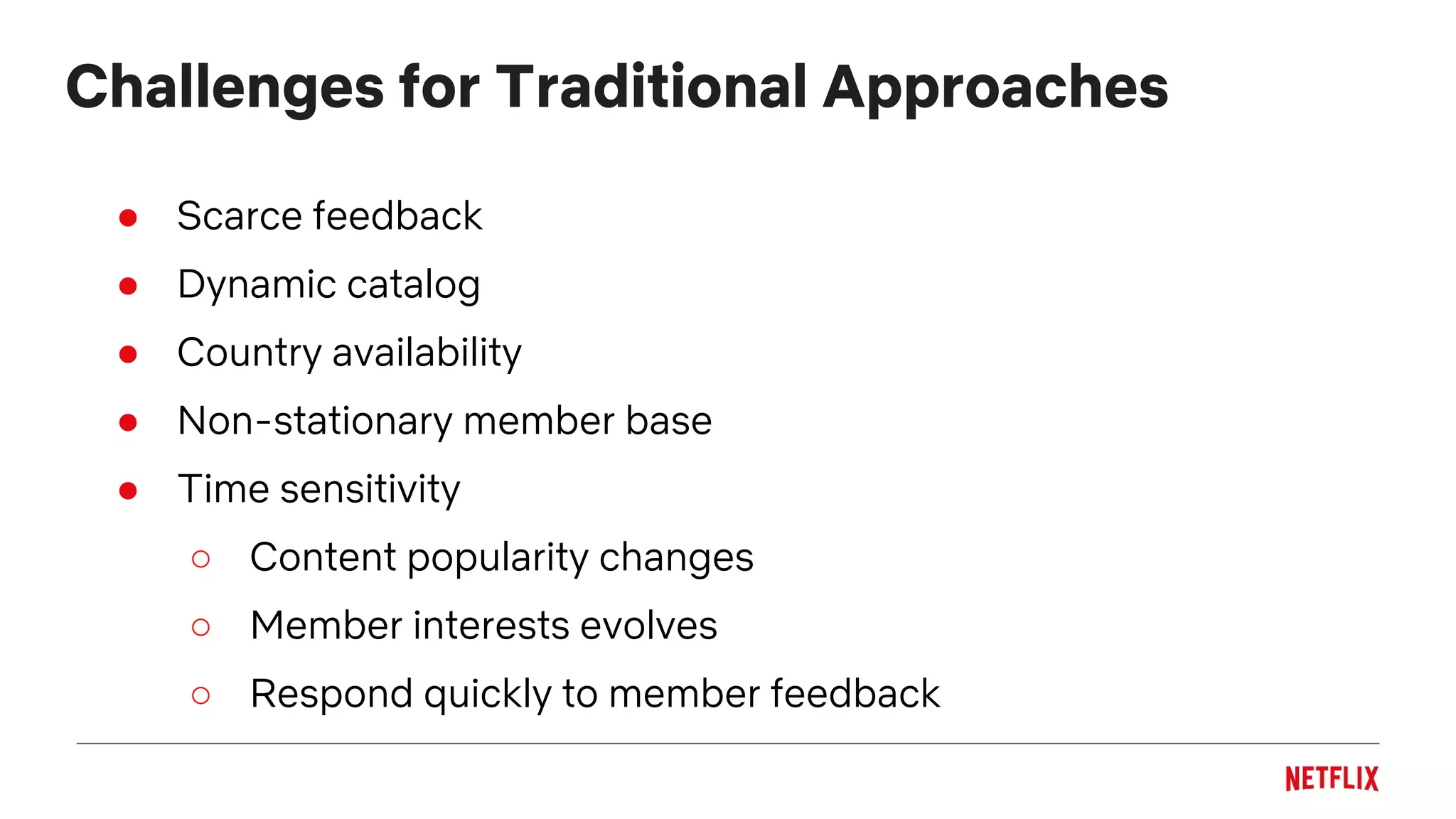
Challenges for Traditional Approaches
● Scarce feedback
● Dynamic catalog
● Country availability
● Non-stationary member base
● Time sensitivity
○ Content popularity changes
○ Member interests evolves
○ Respond quickly to member feedback
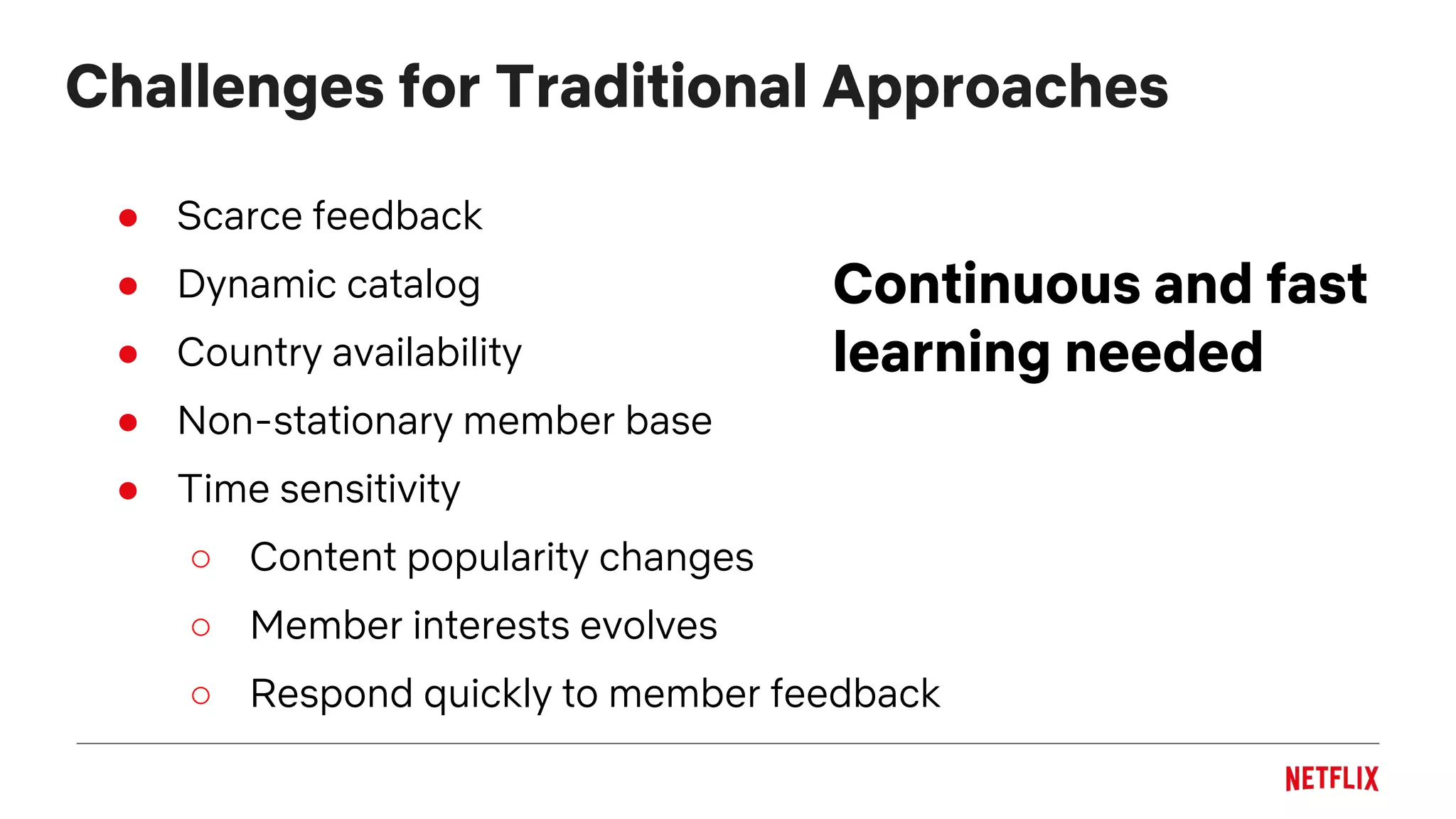
Challenges for Traditional Approaches
Continuous and fast
learning needed
● Scarce feedback
● Dynamic catalog
● Country availability
● Non-stationary member base
● Time sensitivity
○ Content popularity changes
○ Member interests evolves
○ Respond quickly to member feedback
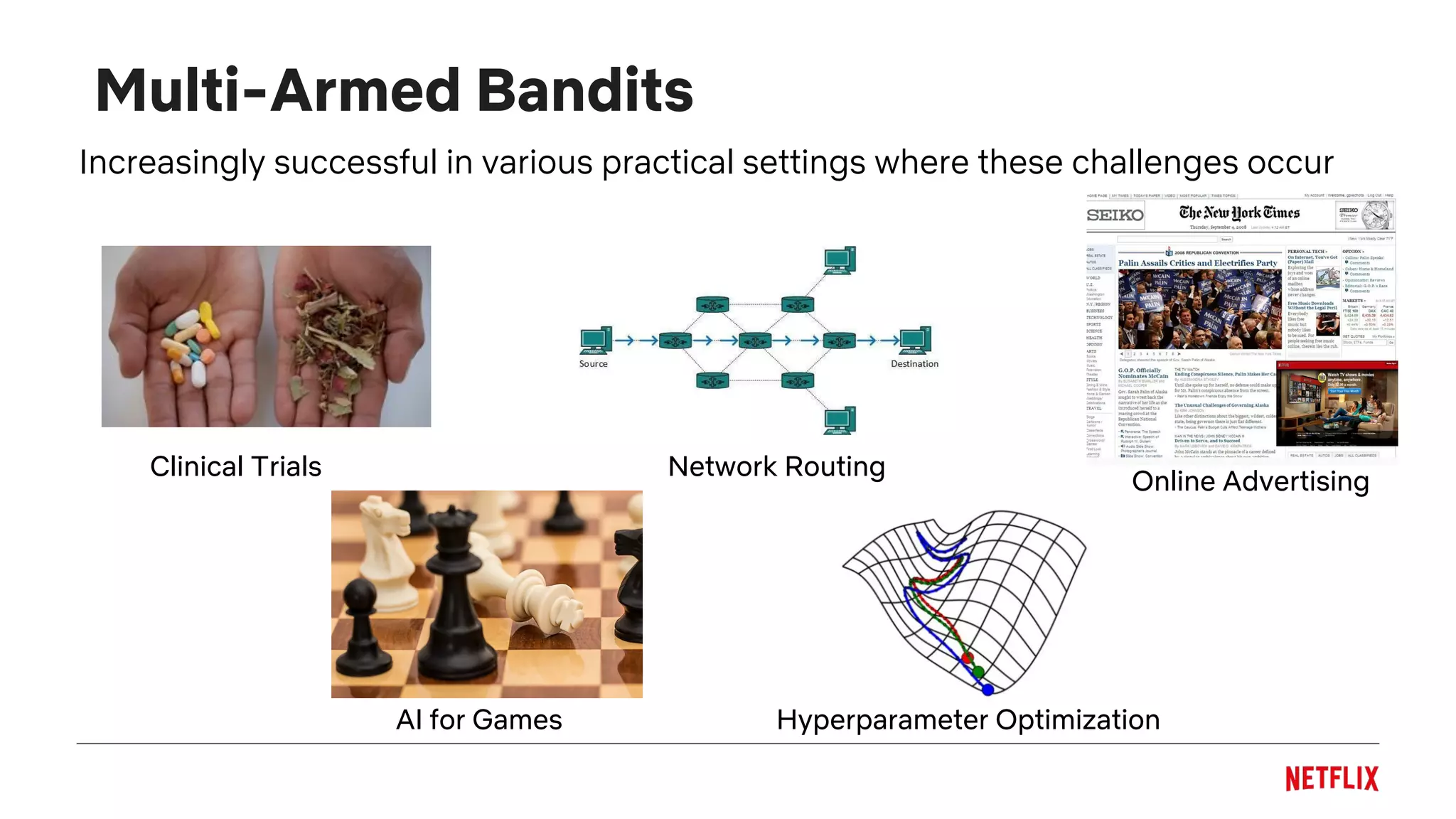
Multi-Armed Bandits
Increasingly successful in various practical settings where these challenges occur
Clinical Trials Network Routing
Online Advertising
AI for Games Hyperparameter Optimization
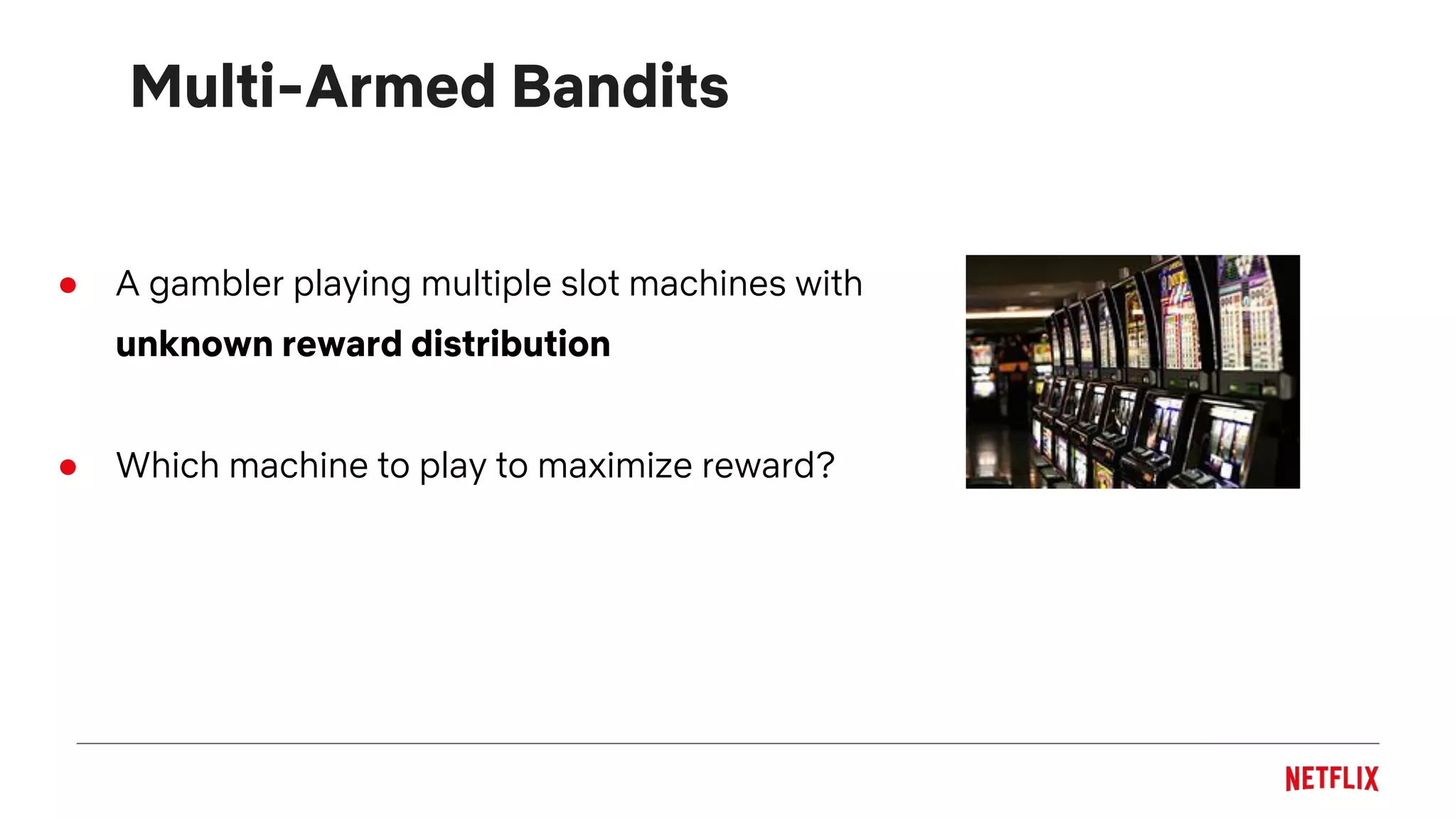
Multi-Armed Bandits
● A gambler playing multiple slot machines with
unknown reward distribution
● Which machine to play to maximize reward?
Multi-Armed Bandit For Recommendation
Exploration-Exploitation tradeoff :
Recommend the optimal title given the evidence i.e. exploit
OR
Recommend other titles to gather feedback i.e. explore.
Numerous Variants
● Different Strategies: ε-Greedy, Thompson Sampling (TS), Upper Confidence
Bound (UCB), etc.
● Different Environments:
○ Stochastic and stationary: Reward is generated i.i.d. from a distribution
specific to the action. No payoff drift.
○ Adversarial: No assumptions on how rewards are generated.
● Different objectives: Cumulative regret, tracking the best expert
● Continuous or discrete set of actions, finite vs infinite
● Extensions: Varying set of arms, Contextual Bandits, etc.
Case Study I: Artwork
Personalization
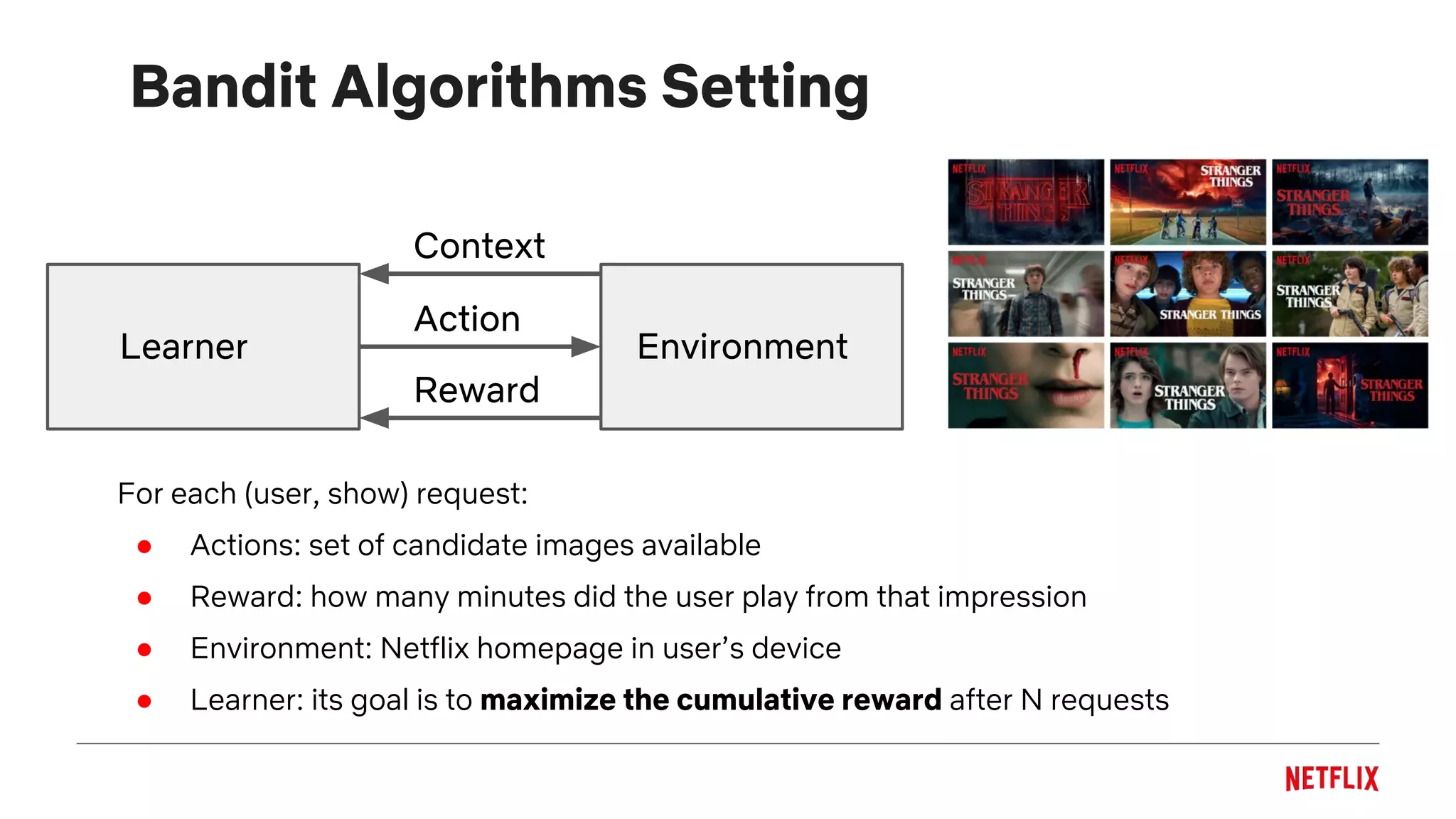
Bandit Algorithms Setting
For each (user, show) request:
● Actions: set of candidate images available
● Reward: how many minutes did the user play from that impression
● Environment: Netflix homepage in user’s device
● Learner: its goal is to maximize the cumulative reward after N requests
Learner Environment
Action
Reward
Context
Specific challenges
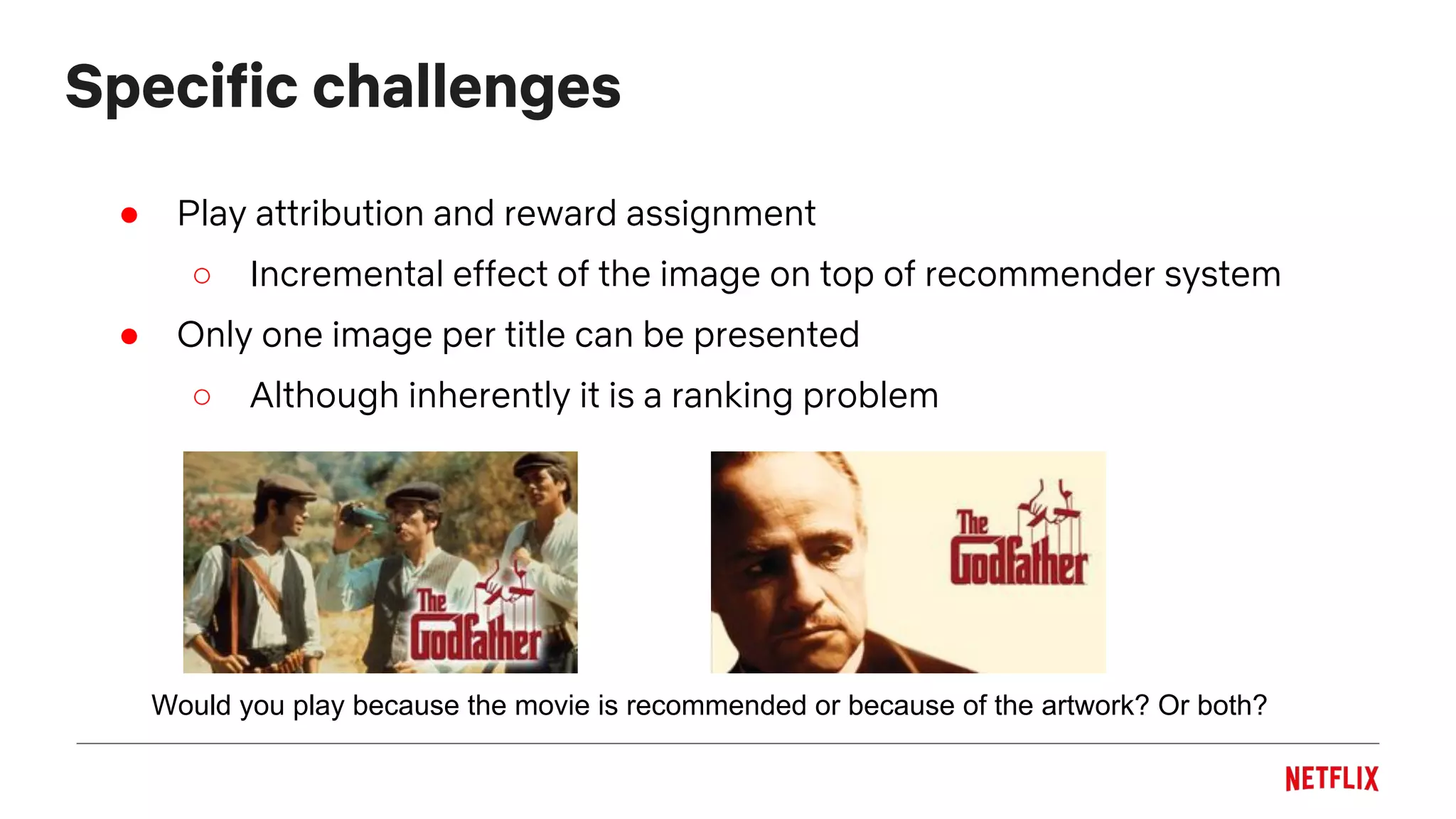
● Play attribution and reward assignment
○ Incremental effect of the image on top of recommender system
● Only one image per title can be presented
○ Although inherently it is a ranking problem
Would you play because the movie is recommended or because of the artwork? Or both?
Specific challenges
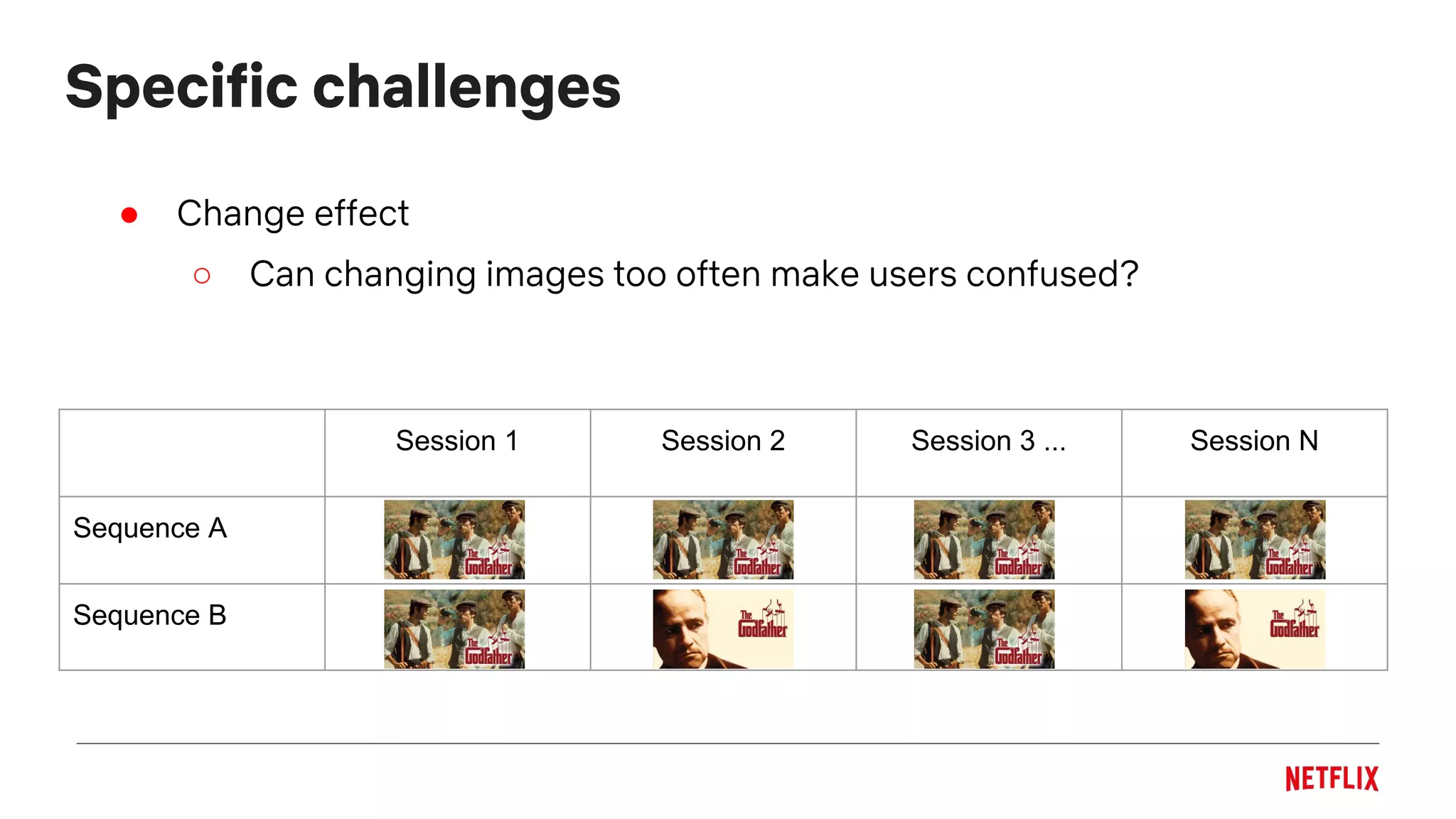
● Change effect
○ Can changing images too often make users confused?
Session 1 Session 2 Session 3 ... Session N
Sequence A
Sequence B
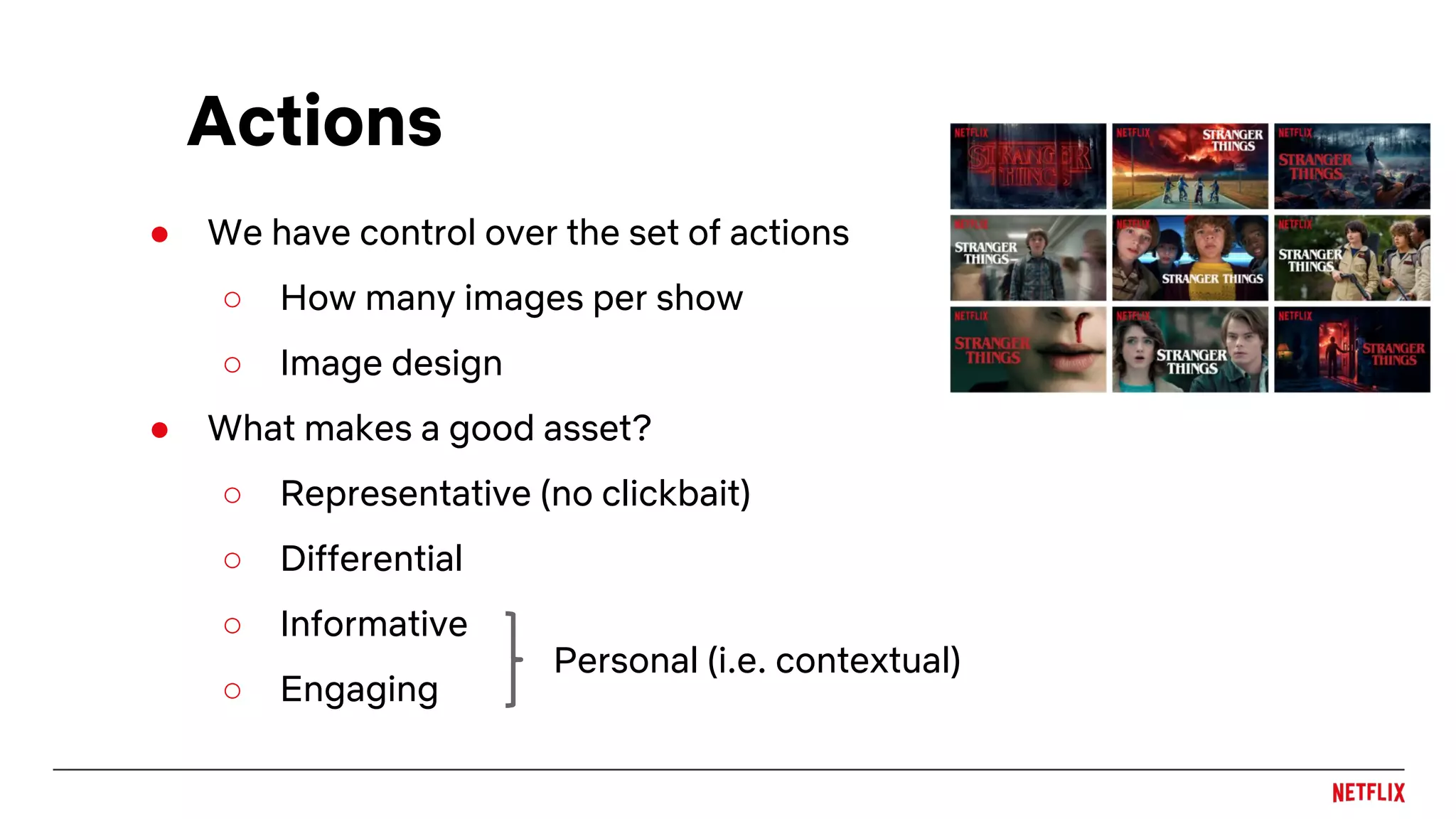
● We have control over the set of actions
○ How many images per show
○ Image design
● What makes a good asset?
○ Representative (no clickbait)
○ Differential
○ Informative
○ Engaging
Actions
Personal (i.e. contextual)
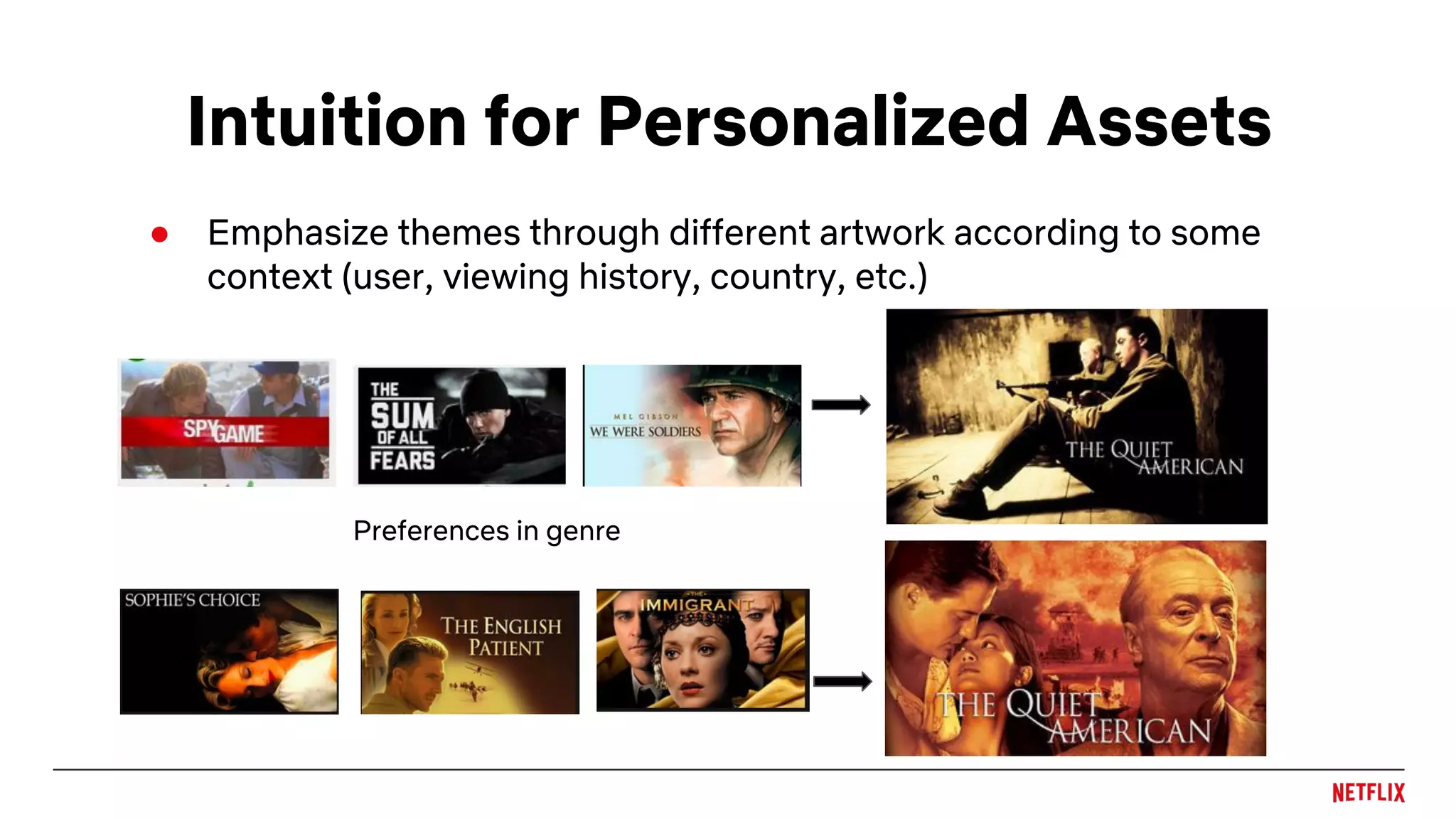
Intuition for Personalized Assets
● Emphasize themes through different artwork according to some
context (user, viewing history, country, etc.)
Preferences in genre
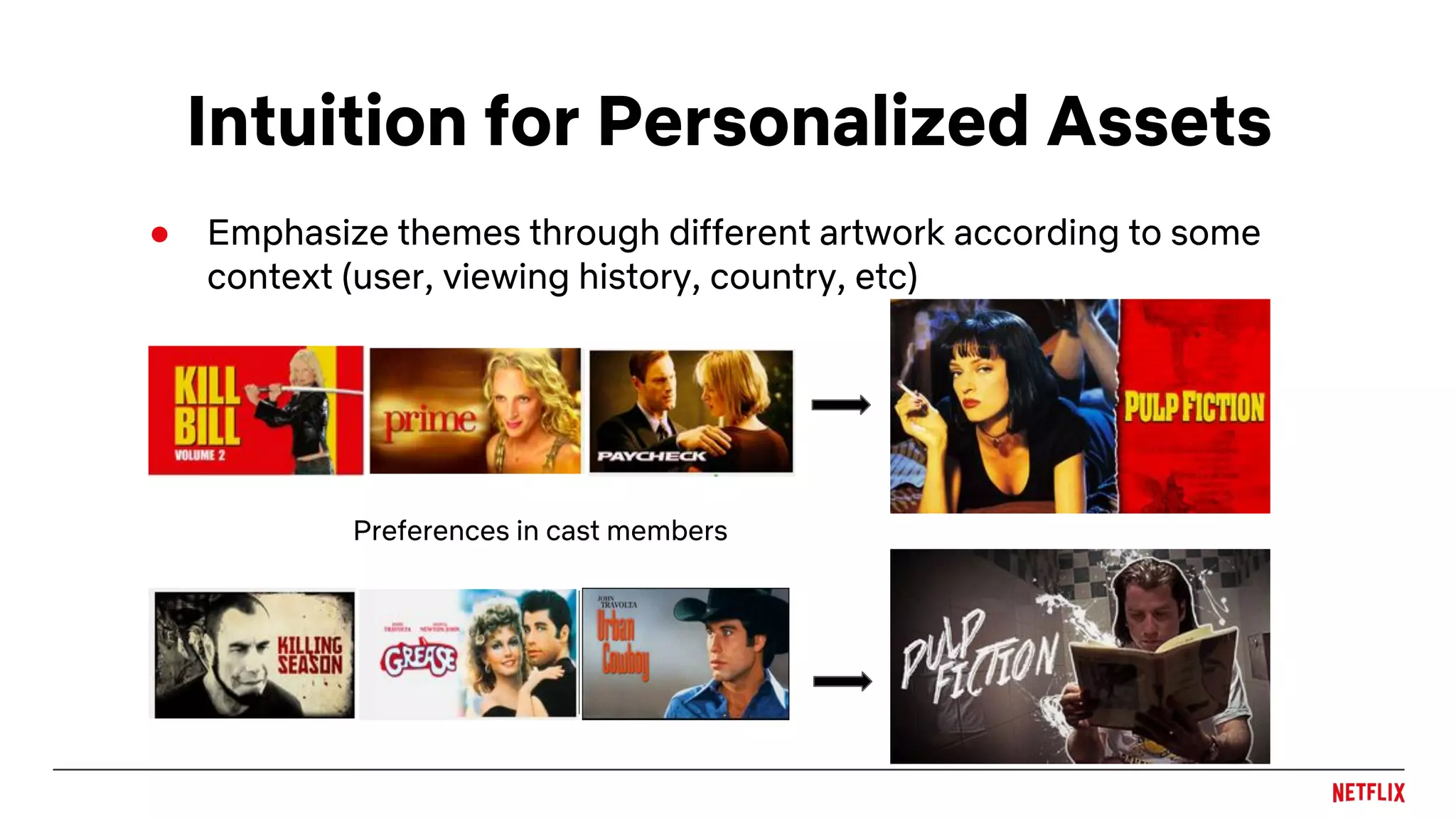
Intuition for Personalized Assets
● Emphasize themes through different artwork according to some
context (user, viewing history, country, etc)
Preferences in cast members
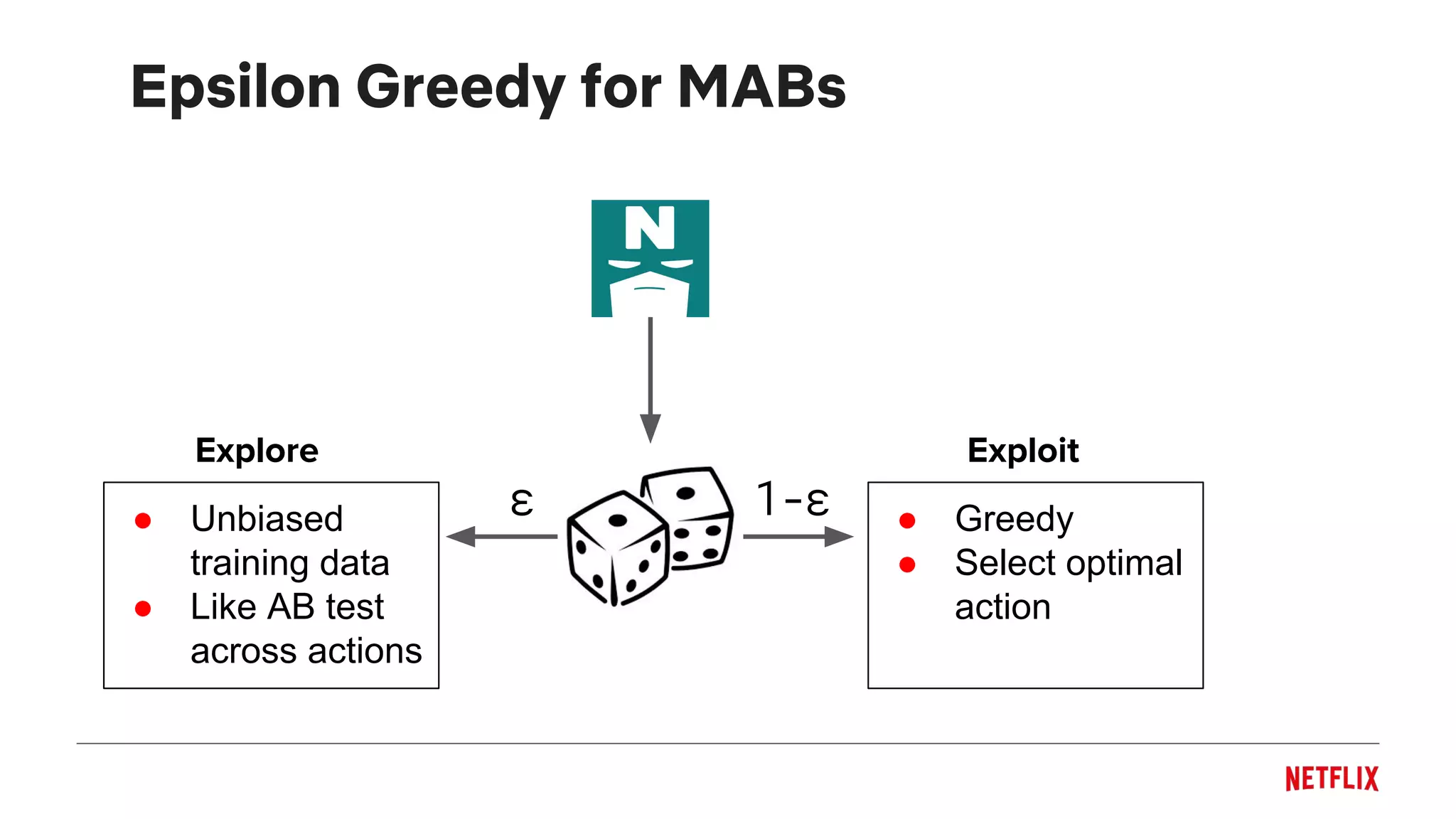
Epsilon Greedy for MABs
● Unbiased
training data
● Like AB test
across actions
● Greedy
● Select optimal
action
Explore
ε 1-ε
Exploit
● Learn a binary classifier per image to predict probability of play
● Pick the winner (arg max)
Member
(context)
Features
Image Pool
Model 1
Winner
arg
max
Model 2
Model 3
Model 4
Greedy Exploit Policy
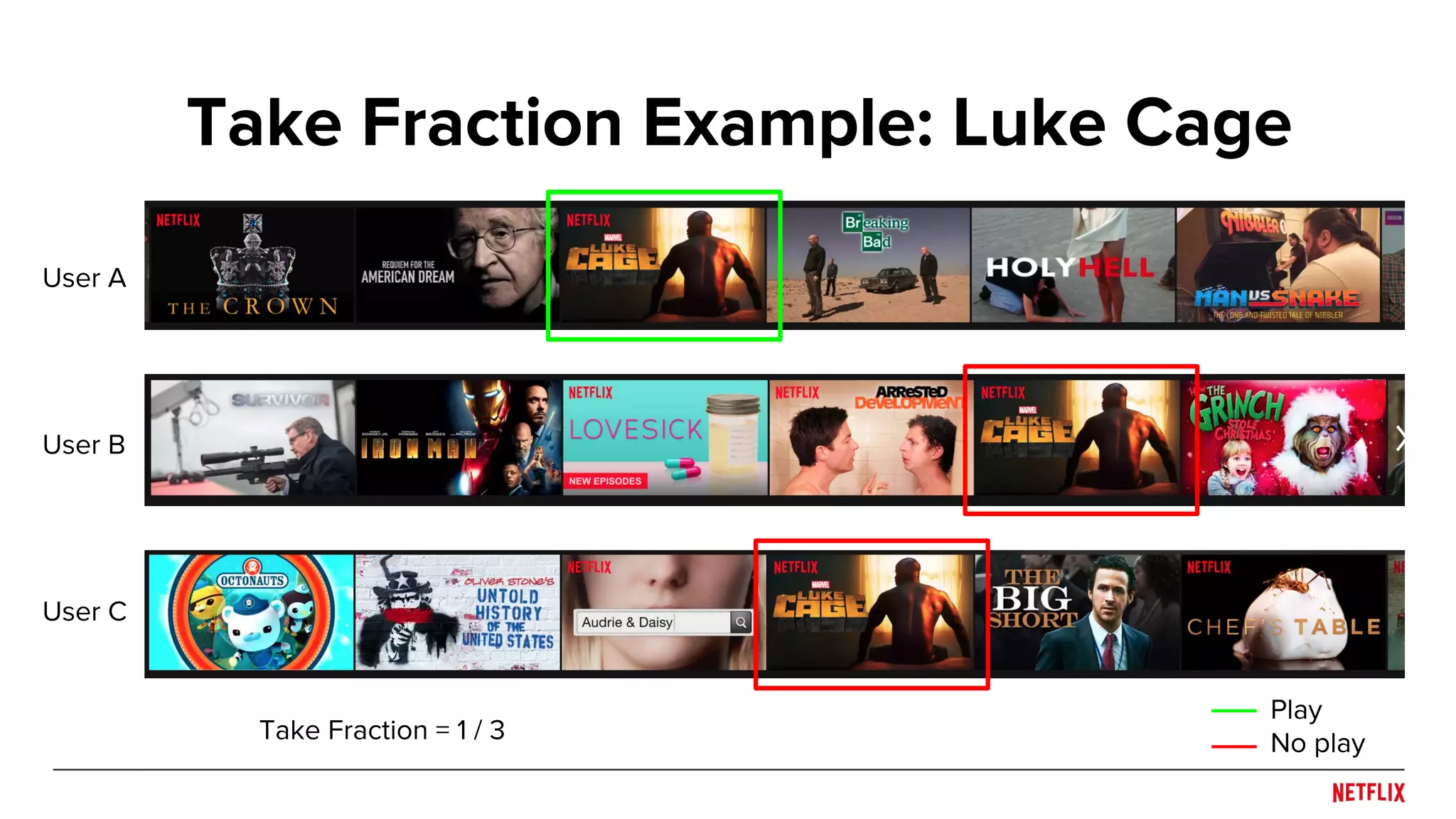
Take Fraction Example: Luke Cage
Take Fraction = 1 / 3
Play
No play
User A
User B
User C
● Unbiased offline evaluation from explore data
Offline metric: Replay [Li et al, 2010]
Offline Take Fraction = 2 / 3
User 1 User 2 User 3 User 4 User 5 User 6
Random Assignment
Play?
Model Assignment
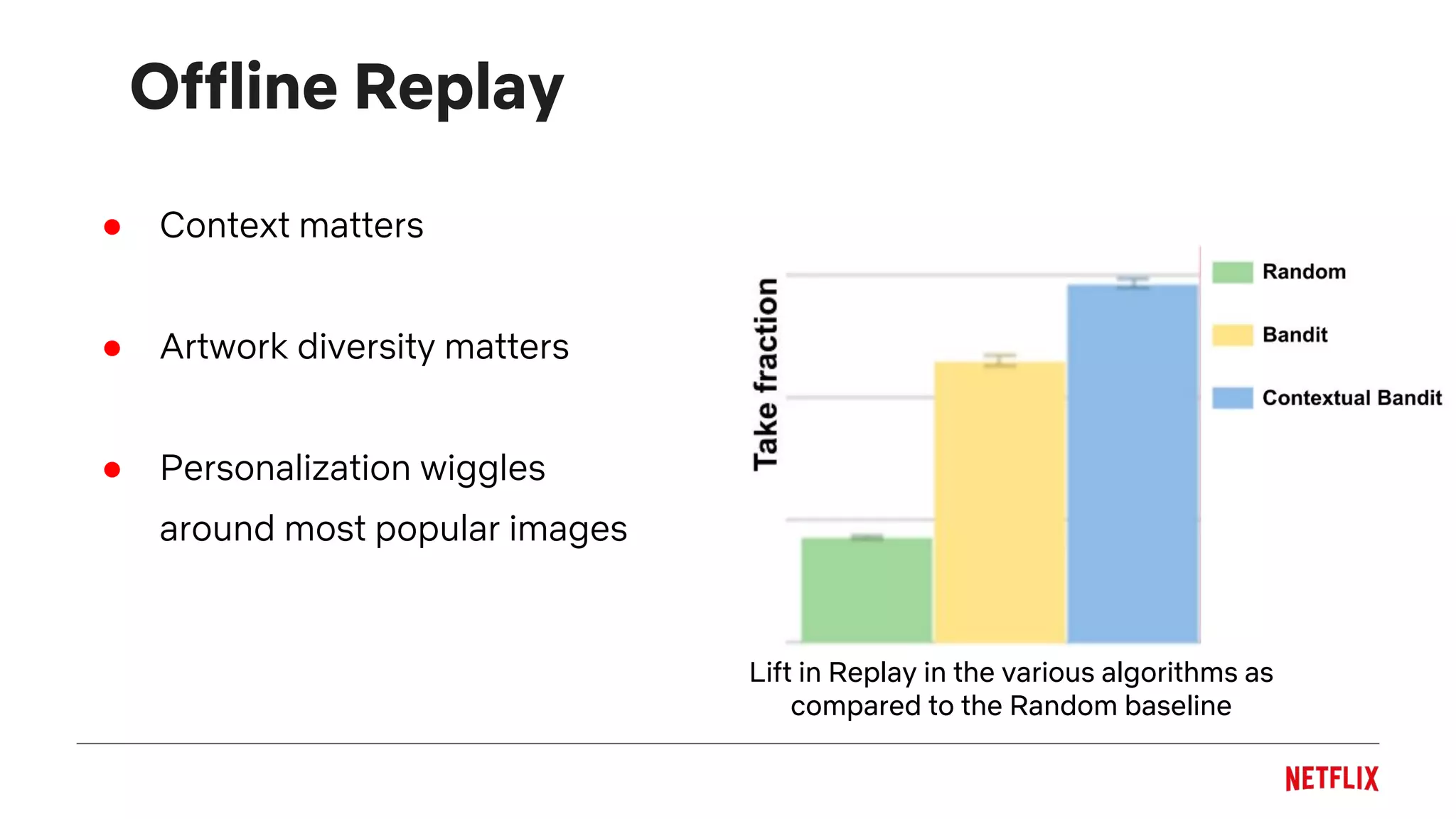
Offline Replay
● Context matters
● Artwork diversity matters
● Personalization wiggles
around most popular images
Lift in Replay in the various algorithms as
compared to the Random baseline
Online results
● Rollout to our >125M member base
● Most beneficial for less known titles
● Compression from title -level offline metrics due to cannibalization
between titles
Case Study II:
Billboard
Recommendation
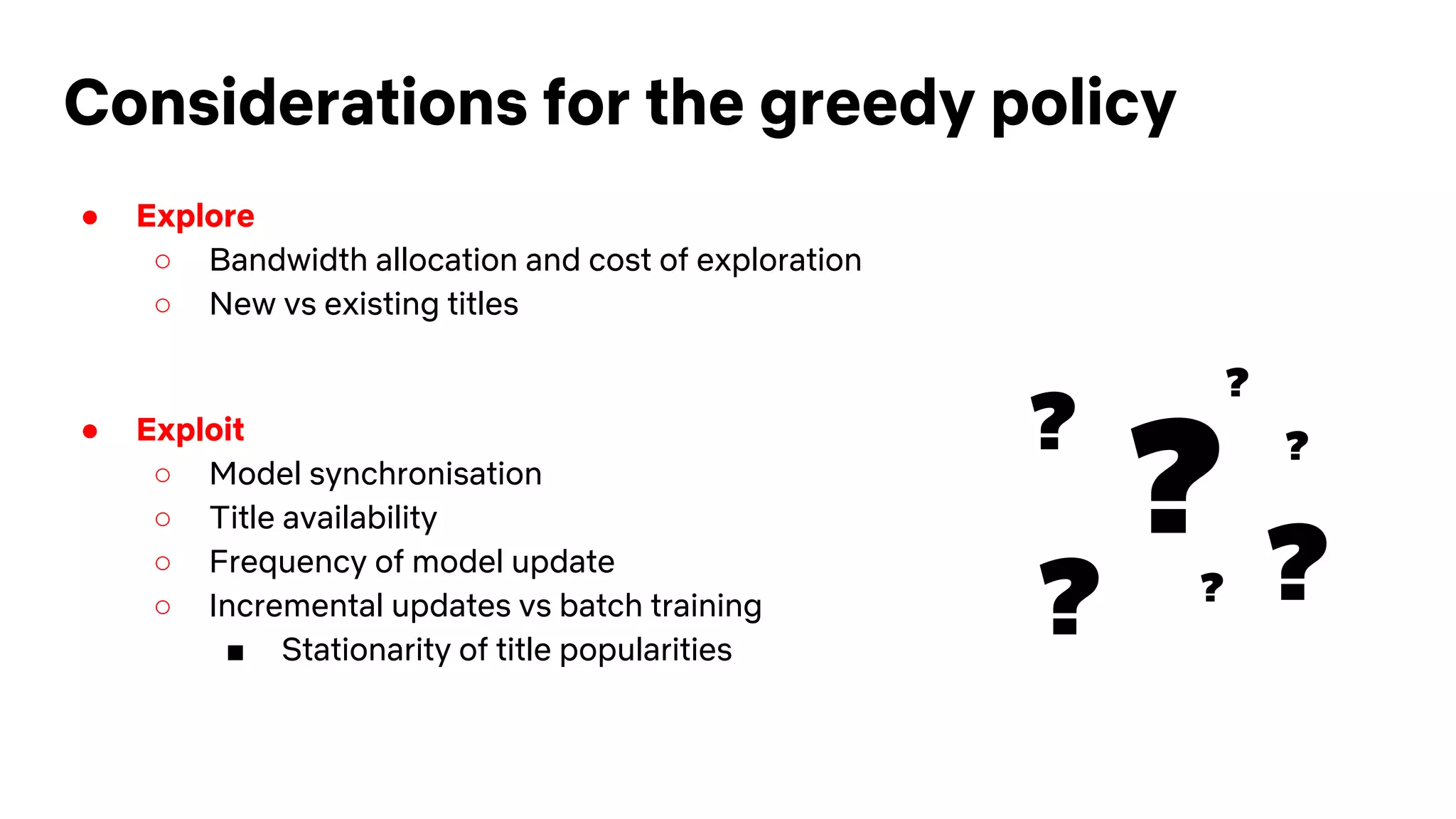
Considerations for the greedy policy
● Explore
○ Bandwidth allocation and cost of exploration
○ New vs existing titles
● Exploit
○ Model synchronisation
○ Title availability
○ Frequency of model update
○ Incremental updates vs batch training
■ Stationarity of title popularities
?
?
?
? ??
?
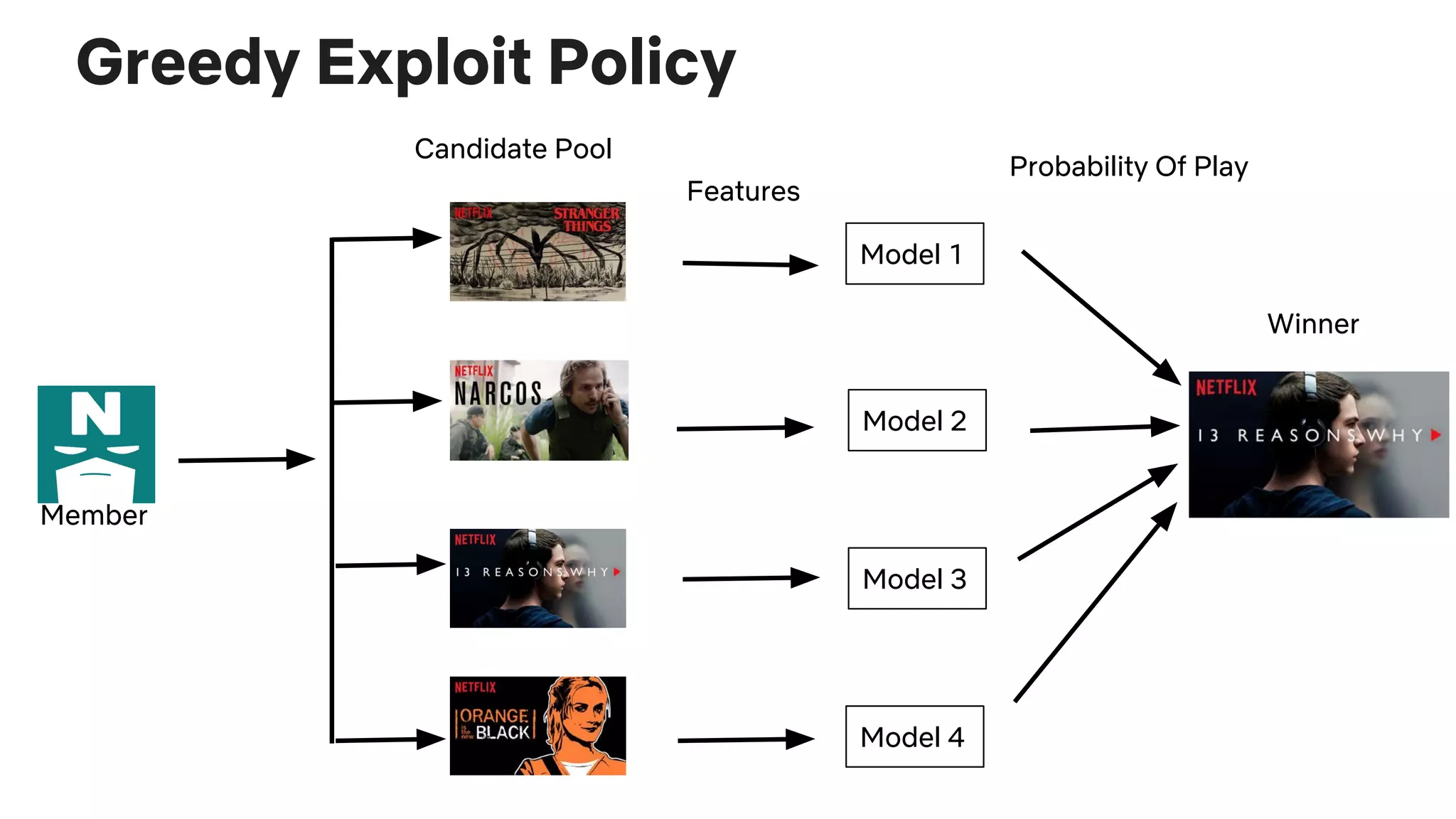
Greedy Exploit Policy
Member
Features
Candidate Pool
Model 1
Winner
Probability Of Play
Model 2
Model 3
Model 4
Would the member have played the title
anyway?
Netflix Promotions
Netflix homepage is an expensive real-estate (opportunity cost):
- so many titles to promote
- so few opportunities to win a “moment of truth”
D1 D2 D3 D4 D5
Promote?▶ ▶ ▶ ▶
Probability of
Play
Days
Netflix Promotions
Netflix homepage is an expensive real-estate (opportunity cost):
- so many titles to promote
- so few opportunities to win a “moment of truth”
Traditional (correlational) ML systems:
- take action if probability of positive reward is high, irrespective of reward
base rate
- don’t model incremental effect of taking action
D1 D2 D3 D4 D5
Promote?▶ ▶ ▶ ▶
Probability of
Play
Days
Incrementality from Advertising
● Goal: Measure ad effectiveness.
● Incrementality: The difference
in the outcome because the ad
was shown; the causal effect of
the ad.
$1.1M
$1.0M
$100k
Other
Advertisers’
Ads
Control Treatment
Revenue
Random Assignment*
*Johnson, Garrett A. and Lewis, Randall A. and Nubbemeyer, Elmar I, Ghost Ads: Improving the Economics of Measuring Online Ad Effectiveness (January 12, 2017).
Simon Business School Working Paper No. FR 15-21. Available at SSRN: https://ssrn.com/abstract=2620078
Incrementality Based Policy
● Goal: Select title for promotion that benefits most from being
shown in billboard
○ Member can play title from other sections on the homepage or search
○ Popular titles likely to appear on homepage anyway: Trending Now
○ Better utilize most expensive real-estate on the homepage!
● Define policy to be incremental with respect to probability of play
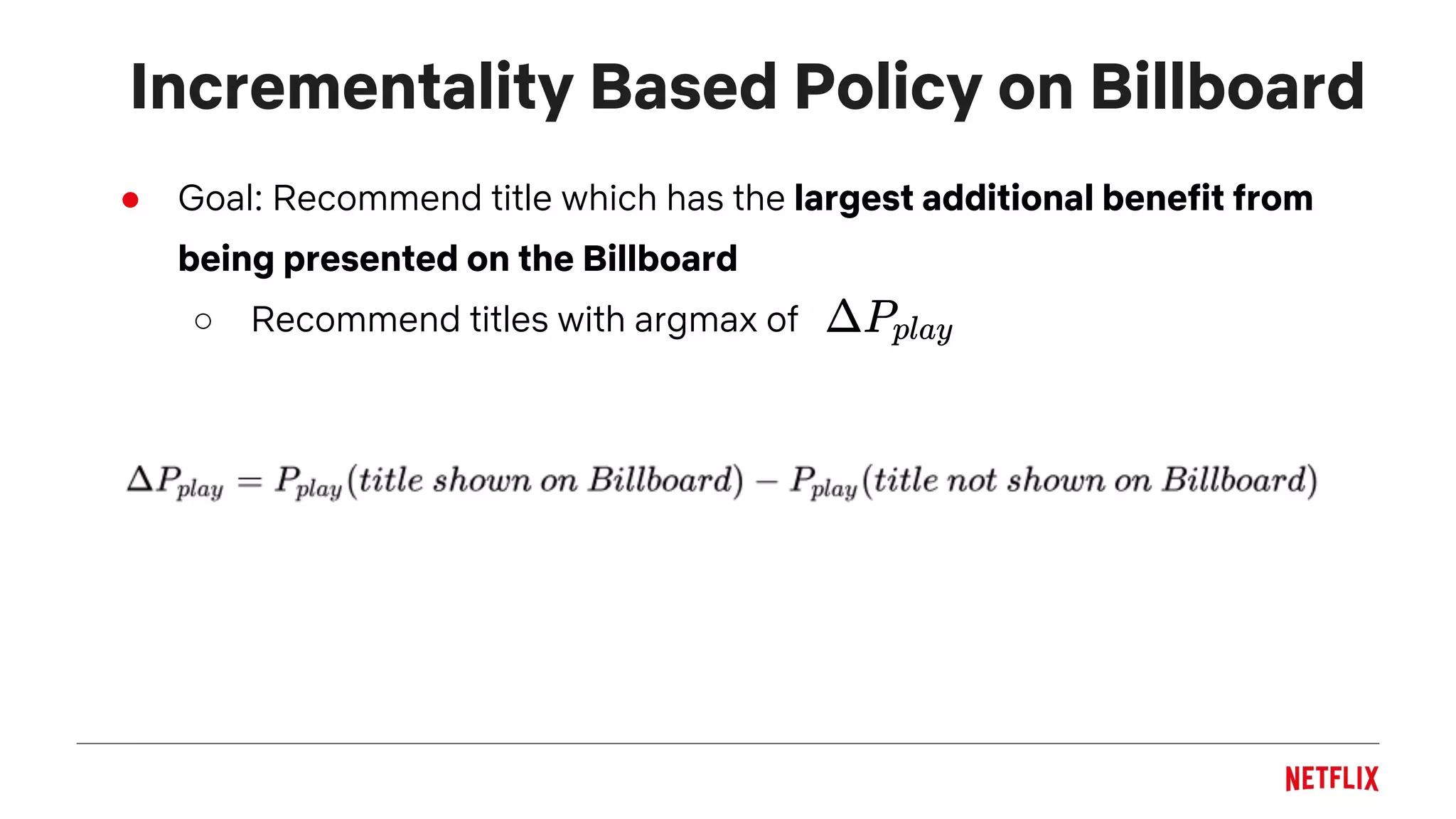
Incrementality Based Policy on Billboard
● Goal: Recommend title which has the largest additional benefit from
being presented on the Billboard
○ Recommend titles with argmax of
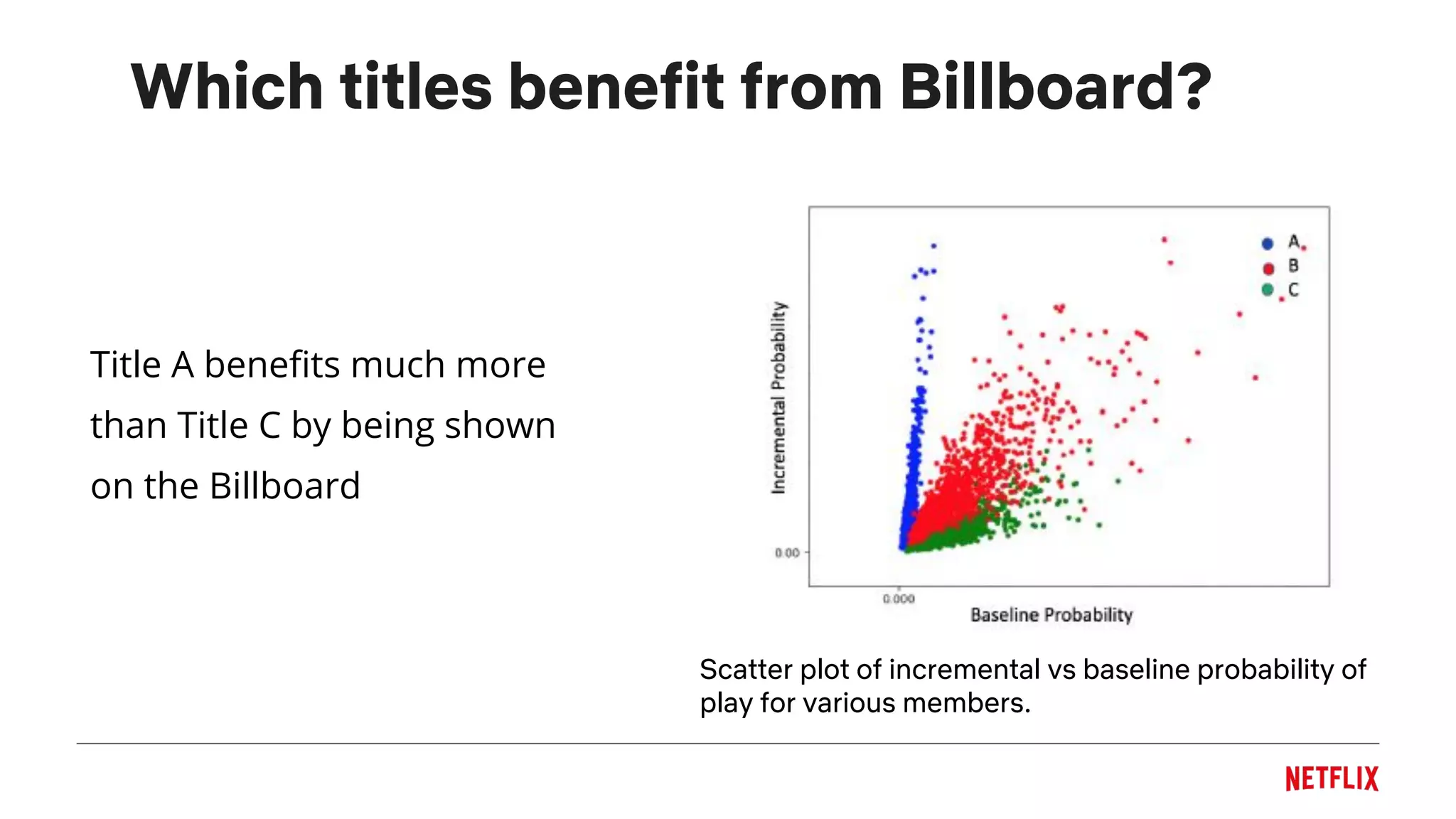
Which titles benefit from Billboard?
Title A benefits much more
than Title C by being shown
on the Billboard
Scatter plot of incremental vs baseline probability of
play for various members.
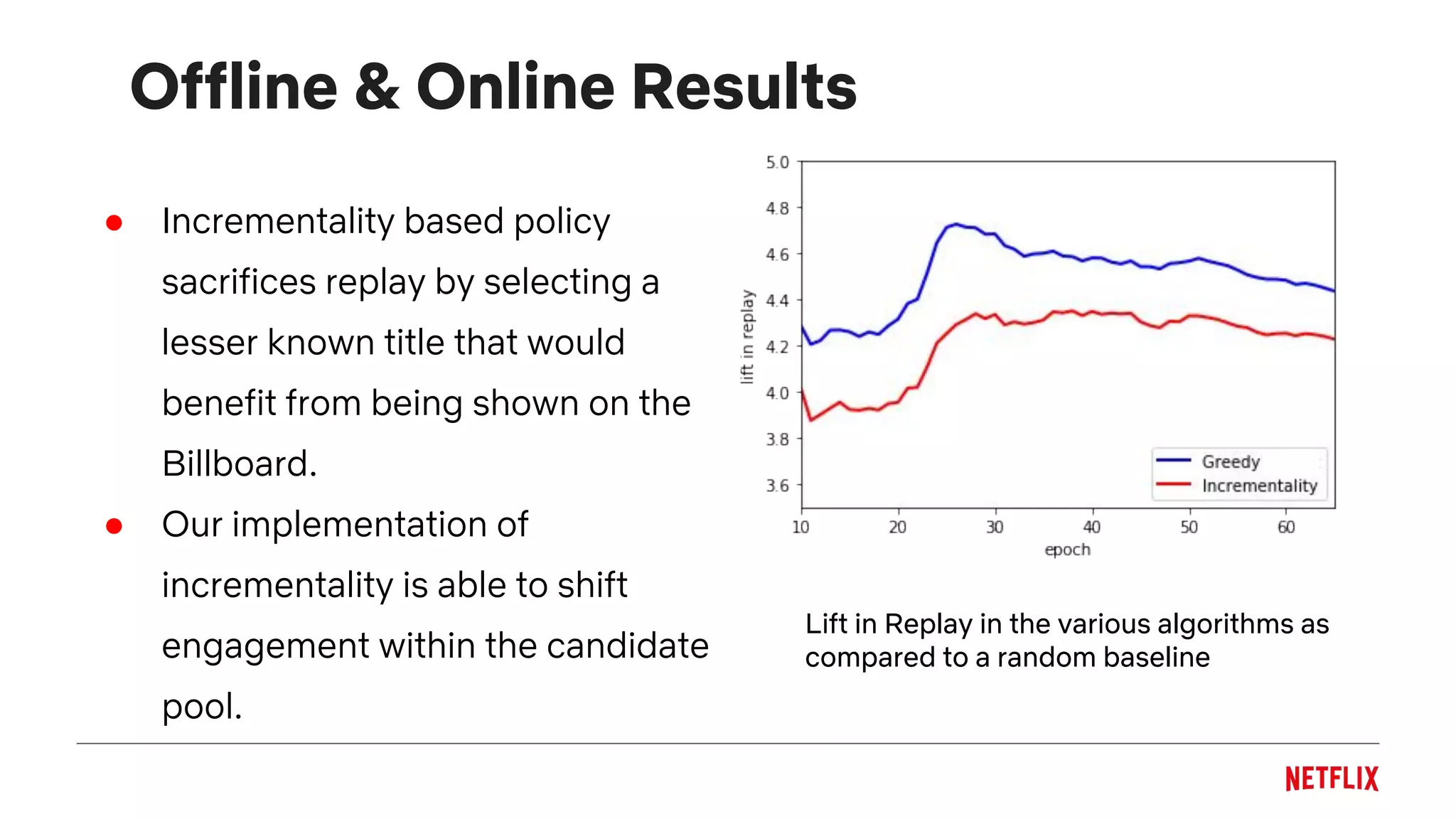
Offline & Online Results
● Incrementality based policy
sacrifices replay by selecting a
lesser known title that would
benefit from being shown on the
Billboard.
● Our implementation of
incrementality is able to shift
engagement within the candidate
pool.
Lift in Replay in the various algorithms as
compared to a random baseline
Research
Directions
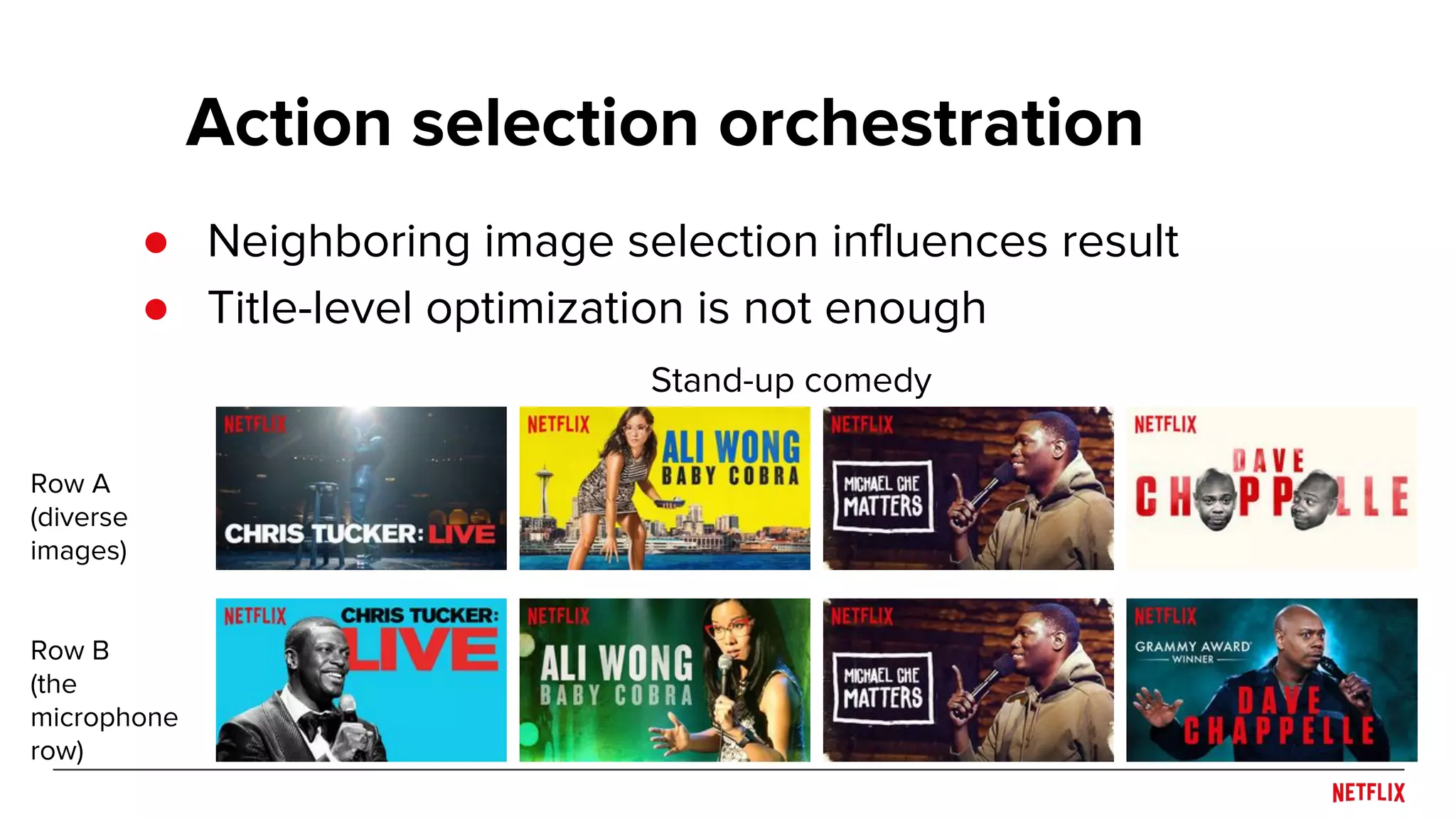
Action selection orchestration
● Neighboring image selection influences result
● Title-level optimization is not enough
Row A
(diverse
images)
Row B
(the
microphone
row)
Stand-up comedy
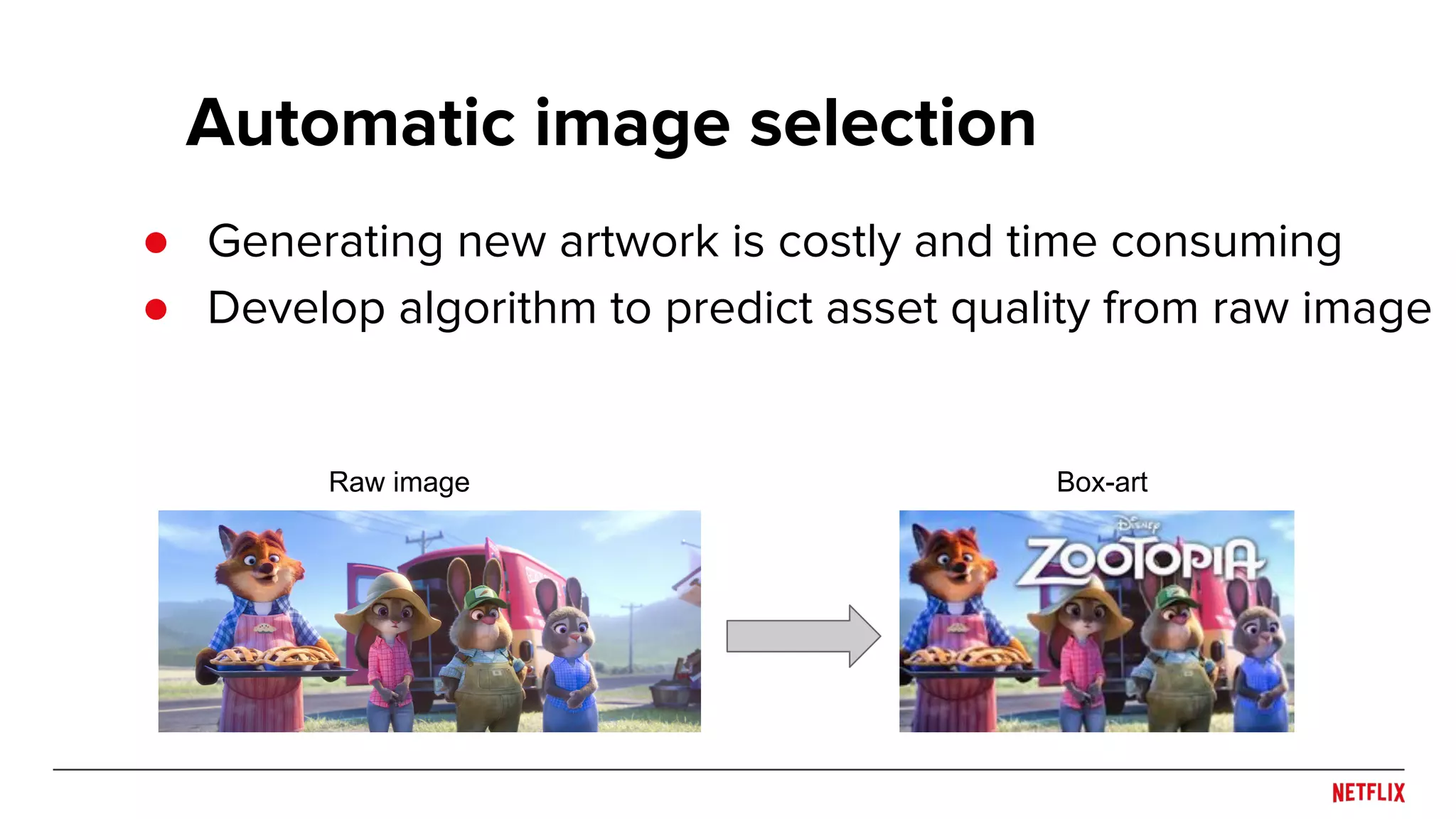
Automatic image selection
● Generating new artwork is costly and time consuming
● Develop algorithm to predict asset quality from raw image
Raw image Box-art
Long-term Reward: Road to RL
● Maximize long term reward: reinforcement learning
○ User long term joy rather than play clicks or duration.
Thank you.
Jaya Kawale (jkawale@netflix.com)
Fernando Amat (famat@netflix.com)

A Multi-Armed Bandit Framework For Recommendations at Netflix

  • 1.
    A Multi-Armed BanditFramework for Recommendations at Netflix Jaya Kawale & Fernando Amat PRS Workshop, June 2018
  • 3.
    Quickly help membersdiscover content they’ll love
  • 4.
    Global Members, PersonalizedTastes 125 Million Members ~200 Countries
  • 5.
  • 6.
  • 7.
  • 8.
    Case Study I:Artwork Optimization Goal: Recommend a personalized artwork or imagery for a title to help members decide if they will enjoy the title or not.
  • 9.
    Case Study II:Billboard Recommendation Goal: Successfully introduce content to the right members.
  • 10.
    Traditional Approaches for Recommendation CollaborativeFiltering ● Idea is to use the “wisdom of the crowd” to recommend items ● Well understood and various algorithms exist (e.g. Matrix Factorization) Collaborative Filtering 0 1 0 1 0 0 0 1 1 0 1 0 0 1 1 0 1 0 0 0 0 0 0 0 1 Users Items
  • 11.
    Challenges for TraditionalApproaches ● Scarce feedback ● Dynamic catalog ● Country availability ● Non-stationary member base ● Time sensitivity ○ Content popularity changes ○ Member interests evolves ○ Respond quickly to member feedback
  • 12.
    Challenges for TraditionalApproaches Continuous and fast learning needed ● Scarce feedback ● Dynamic catalog ● Country availability ● Non-stationary member base ● Time sensitivity ○ Content popularity changes ○ Member interests evolves ○ Respond quickly to member feedback
  • 13.
    Multi-Armed Bandits Increasingly successfulin various practical settings where these challenges occur Clinical Trials Network Routing Online Advertising AI for Games Hyperparameter Optimization
  • 14.
    Multi-Armed Bandits ● Agambler playing multiple slot machines with unknown reward distribution ● Which machine to play to maximize reward?
  • 15.
    Multi-Armed Bandit ForRecommendation Exploration-Exploitation tradeoff : Recommend the optimal title given the evidence i.e. exploit OR Recommend other titles to gather feedback i.e. explore.
  • 16.
    Numerous Variants ● DifferentStrategies: ε-Greedy, Thompson Sampling (TS), Upper Confidence Bound (UCB), etc. ● Different Environments: ○ Stochastic and stationary: Reward is generated i.i.d. from a distribution specific to the action. No payoff drift. ○ Adversarial: No assumptions on how rewards are generated. ● Different objectives: Cumulative regret, tracking the best expert ● Continuous or discrete set of actions, finite vs infinite ● Extensions: Varying set of arms, Contextual Bandits, etc.
  • 17.
    Case Study I:Artwork Personalization
  • 18.
    Bandit Algorithms Setting Foreach (user, show) request: ● Actions: set of candidate images available ● Reward: how many minutes did the user play from that impression ● Environment: Netflix homepage in user’s device ● Learner: its goal is to maximize the cumulative reward after N requests Learner Environment Action Reward Context
  • 19.
    Specific challenges ● Playattribution and reward assignment ○ Incremental effect of the image on top of recommender system ● Only one image per title can be presented ○ Although inherently it is a ranking problem Would you play because the movie is recommended or because of the artwork? Or both?
  • 20.
    Specific challenges ● Changeeffect ○ Can changing images too often make users confused? Session 1 Session 2 Session 3 ... Session N Sequence A Sequence B
  • 21.
    ● We havecontrol over the set of actions ○ How many images per show ○ Image design ● What makes a good asset? ○ Representative (no clickbait) ○ Differential ○ Informative ○ Engaging Actions Personal (i.e. contextual)
  • 22.
    Intuition for PersonalizedAssets ● Emphasize themes through different artwork according to some context (user, viewing history, country, etc.) Preferences in genre
  • 23.
    Intuition for PersonalizedAssets ● Emphasize themes through different artwork according to some context (user, viewing history, country, etc) Preferences in cast members
  • 24.
    Epsilon Greedy forMABs ● Unbiased training data ● Like AB test across actions ● Greedy ● Select optimal action Explore ε 1-ε Exploit
  • 25.
    ● Learn abinary classifier per image to predict probability of play ● Pick the winner (arg max) Member (context) Features Image Pool Model 1 Winner arg max Model 2 Model 3 Model 4 Greedy Exploit Policy
  • 26.
    Take Fraction Example:Luke Cage Take Fraction = 1 / 3 Play No play User A User B User C
  • 27.
    ● Unbiased offlineevaluation from explore data Offline metric: Replay [Li et al, 2010] Offline Take Fraction = 2 / 3 User 1 User 2 User 3 User 4 User 5 User 6 Random Assignment Play? Model Assignment
  • 28.
    Offline Replay ● Contextmatters ● Artwork diversity matters ● Personalization wiggles around most popular images Lift in Replay in the various algorithms as compared to the Random baseline
  • 29.
    Online results ● Rolloutto our >125M member base ● Most beneficial for less known titles ● Compression from title -level offline metrics due to cannibalization between titles
  • 30.
  • 31.
    Considerations for thegreedy policy ● Explore ○ Bandwidth allocation and cost of exploration ○ New vs existing titles ● Exploit ○ Model synchronisation ○ Title availability ○ Frequency of model update ○ Incremental updates vs batch training ■ Stationarity of title popularities ? ? ? ? ?? ?
  • 32.
    Greedy Exploit Policy Member Features CandidatePool Model 1 Winner Probability Of Play Model 2 Model 3 Model 4
  • 33.
    Would the memberhave played the title anyway?
  • 34.
    Netflix Promotions Netflix homepageis an expensive real-estate (opportunity cost): - so many titles to promote - so few opportunities to win a “moment of truth” D1 D2 D3 D4 D5 Promote?▶ ▶ ▶ ▶ Probability of Play Days
  • 35.
    Netflix Promotions Netflix homepageis an expensive real-estate (opportunity cost): - so many titles to promote - so few opportunities to win a “moment of truth” Traditional (correlational) ML systems: - take action if probability of positive reward is high, irrespective of reward base rate - don’t model incremental effect of taking action D1 D2 D3 D4 D5 Promote?▶ ▶ ▶ ▶ Probability of Play Days
  • 36.
    Incrementality from Advertising ●Goal: Measure ad effectiveness. ● Incrementality: The difference in the outcome because the ad was shown; the causal effect of the ad. $1.1M $1.0M $100k Other Advertisers’ Ads Control Treatment Revenue Random Assignment* *Johnson, Garrett A. and Lewis, Randall A. and Nubbemeyer, Elmar I, Ghost Ads: Improving the Economics of Measuring Online Ad Effectiveness (January 12, 2017). Simon Business School Working Paper No. FR 15-21. Available at SSRN: https://ssrn.com/abstract=2620078
  • 37.
    Incrementality Based Policy ●Goal: Select title for promotion that benefits most from being shown in billboard ○ Member can play title from other sections on the homepage or search ○ Popular titles likely to appear on homepage anyway: Trending Now ○ Better utilize most expensive real-estate on the homepage! ● Define policy to be incremental with respect to probability of play
  • 38.
    Incrementality Based Policyon Billboard ● Goal: Recommend title which has the largest additional benefit from being presented on the Billboard ○ Recommend titles with argmax of
  • 39.
    Which titles benefitfrom Billboard? Title A benefits much more than Title C by being shown on the Billboard Scatter plot of incremental vs baseline probability of play for various members.
  • 40.
    Offline & OnlineResults ● Incrementality based policy sacrifices replay by selecting a lesser known title that would benefit from being shown on the Billboard. ● Our implementation of incrementality is able to shift engagement within the candidate pool. Lift in Replay in the various algorithms as compared to a random baseline
  • 41.
  • 42.
    Action selection orchestration ●Neighboring image selection influences result ● Title-level optimization is not enough Row A (diverse images) Row B (the microphone row) Stand-up comedy
  • 43.
    Automatic image selection ●Generating new artwork is costly and time consuming ● Develop algorithm to predict asset quality from raw image Raw image Box-art
  • 44.
    Long-term Reward: Roadto RL ● Maximize long term reward: reinforcement learning ○ User long term joy rather than play clicks or duration.
  • 45.
    Thank you. Jaya Kawale(jkawale@netflix.com) Fernando Amat (famat@netflix.com)