

QUANTUM COMPUTING:
A TREASURE HUNT
NOT A GOLD MINE
Igor L. Markov
U. Michigan
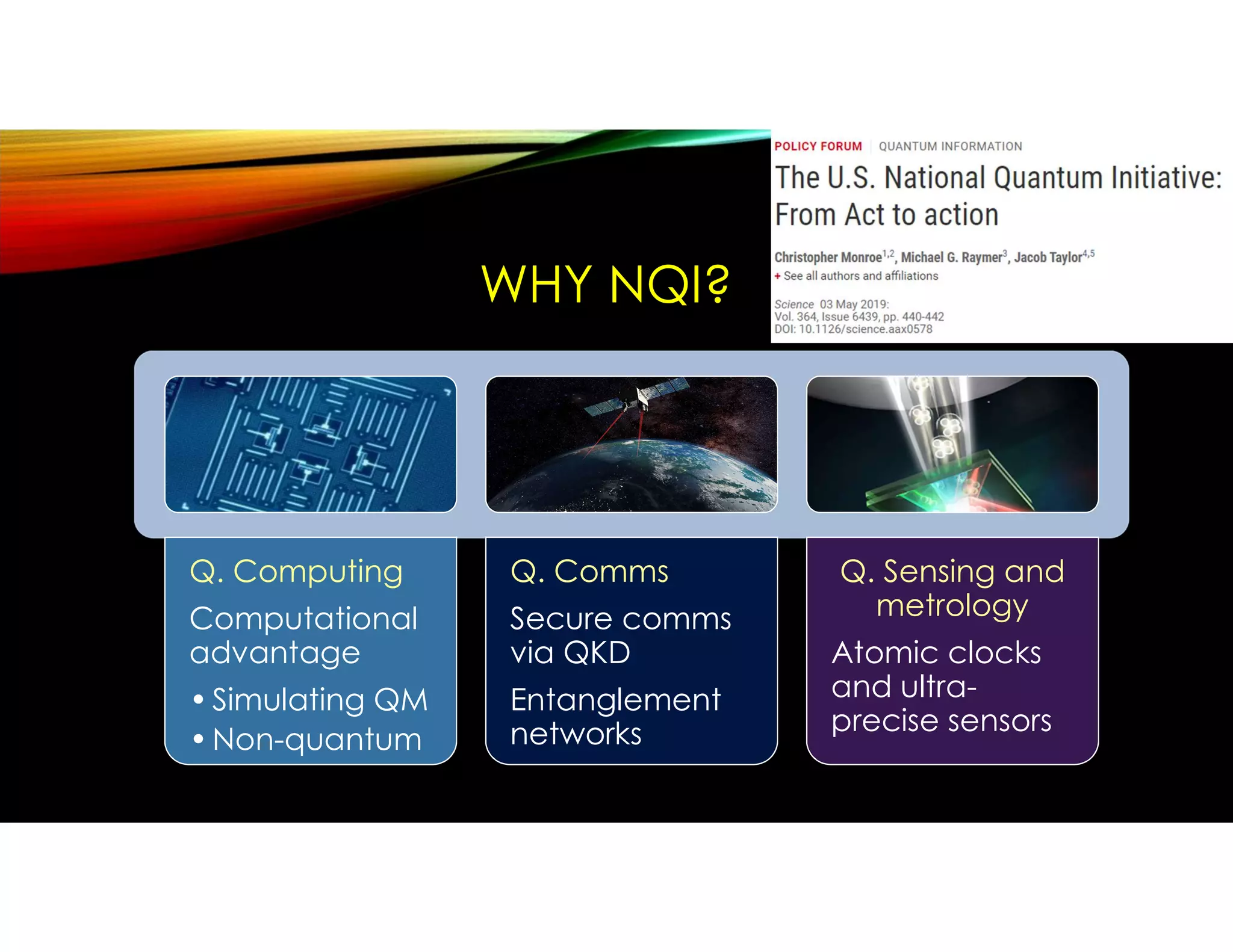
WHY NQI?
Q. Computing
Computational
advantage
•Simulating QM
•Non-quantum
Q. Comms
Secure comms
via QKD
Entanglement
networks
Q. Sensing and
metrology
Atomic clocks
and ultra-
precise sensors
ERROR-FREE QUANTUM ALGORITHMS
• No new decision powers (proof by simulation)
• No NP-complete problems solved exactly in poly time
• No asymptotic speed-up for sorting, etc
• Hence, no universal speed-up
• No speedup from single gates expected
• Main promise is in accelerators
• Surprisingly few good applications
• Surprisingly difficult to build hardware
NOISE AND ERROR CORRECTION
• Entangled states globalize noise & errors:
local faults have global effects
• No error masking by gates
• Errors accumulate multiplicatively:
• 500 gates with 0.995 fidelity
 0.995500 ~ 0.082 circuit fidelity
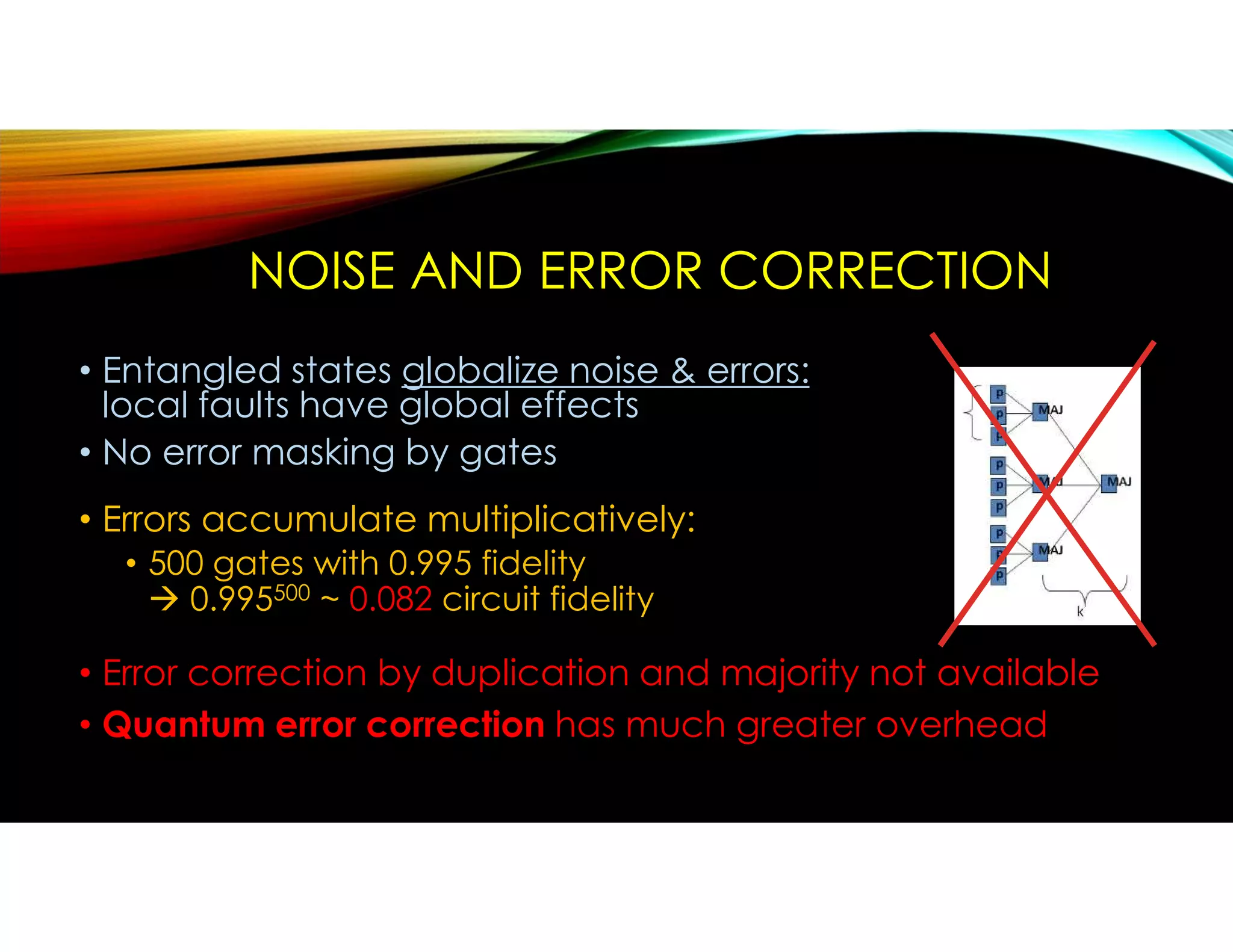
• Error correction by duplication and majority not available
• Quantum error correction has much greater overhead
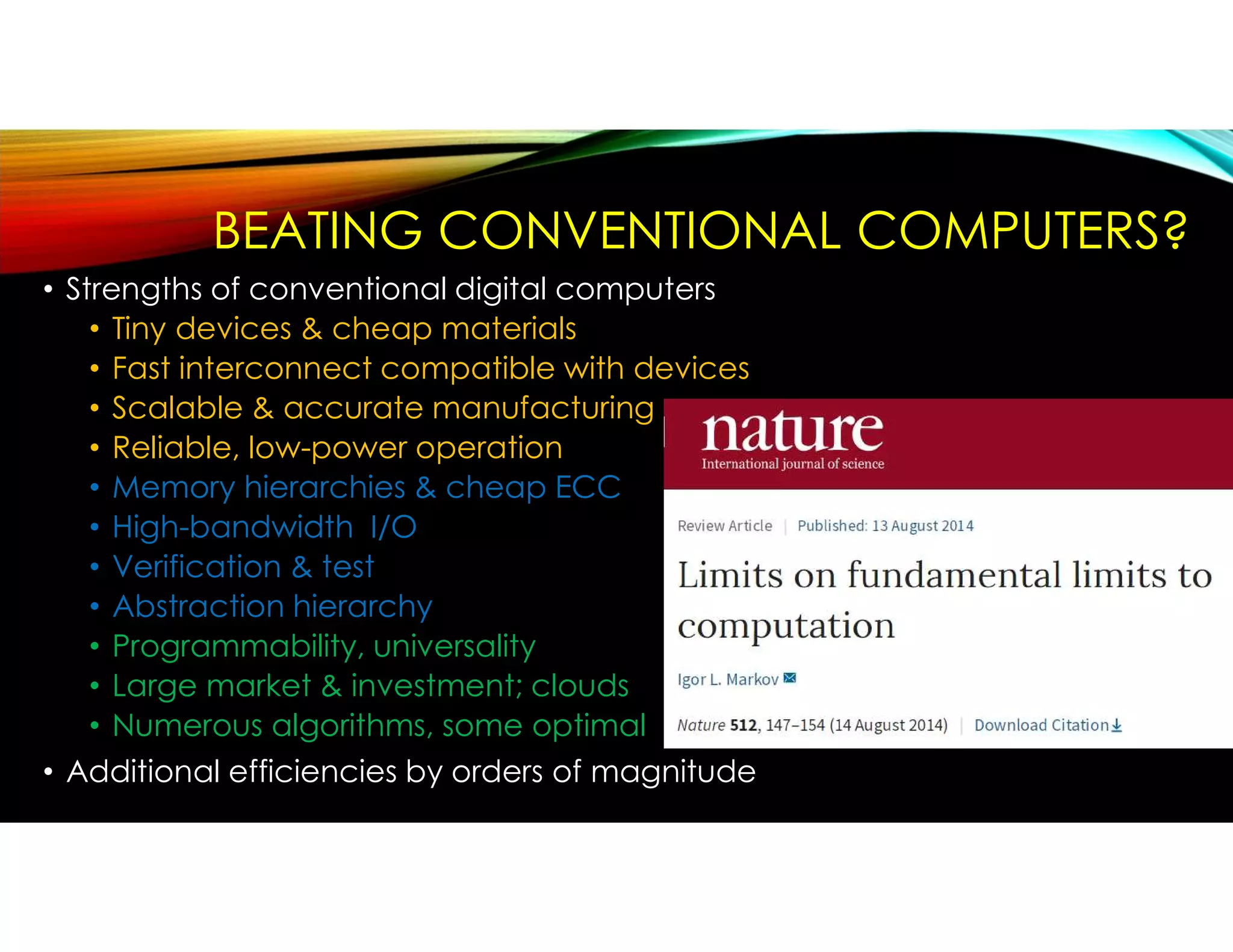
BEATING CONVENTIONAL COMPUTERS?
• Strengths of conventional digital computers
• Tiny devices & cheap materials
• Fast interconnect compatible with devices
• Scalable & accurate manufacturing
• Reliable, low-power operation
• Memory hierarchies & cheap ECC
• High-bandwidth I/O
• Verification & test
• Abstraction hierarchy
• Programmability, universality
• Large market & investment; clouds
• Numerous algorithms, some optimal
• Additional efficiencies by orders of magnitude
QC: GOLD RUSH OR A TREASURE HUNT?
VERIFY CORRECTNESS
DEMONSTRATE AN END-TO-END ADVANTAGE
OVER HIGHLY OPTIMIZED CLASSICAL SYSTEMS
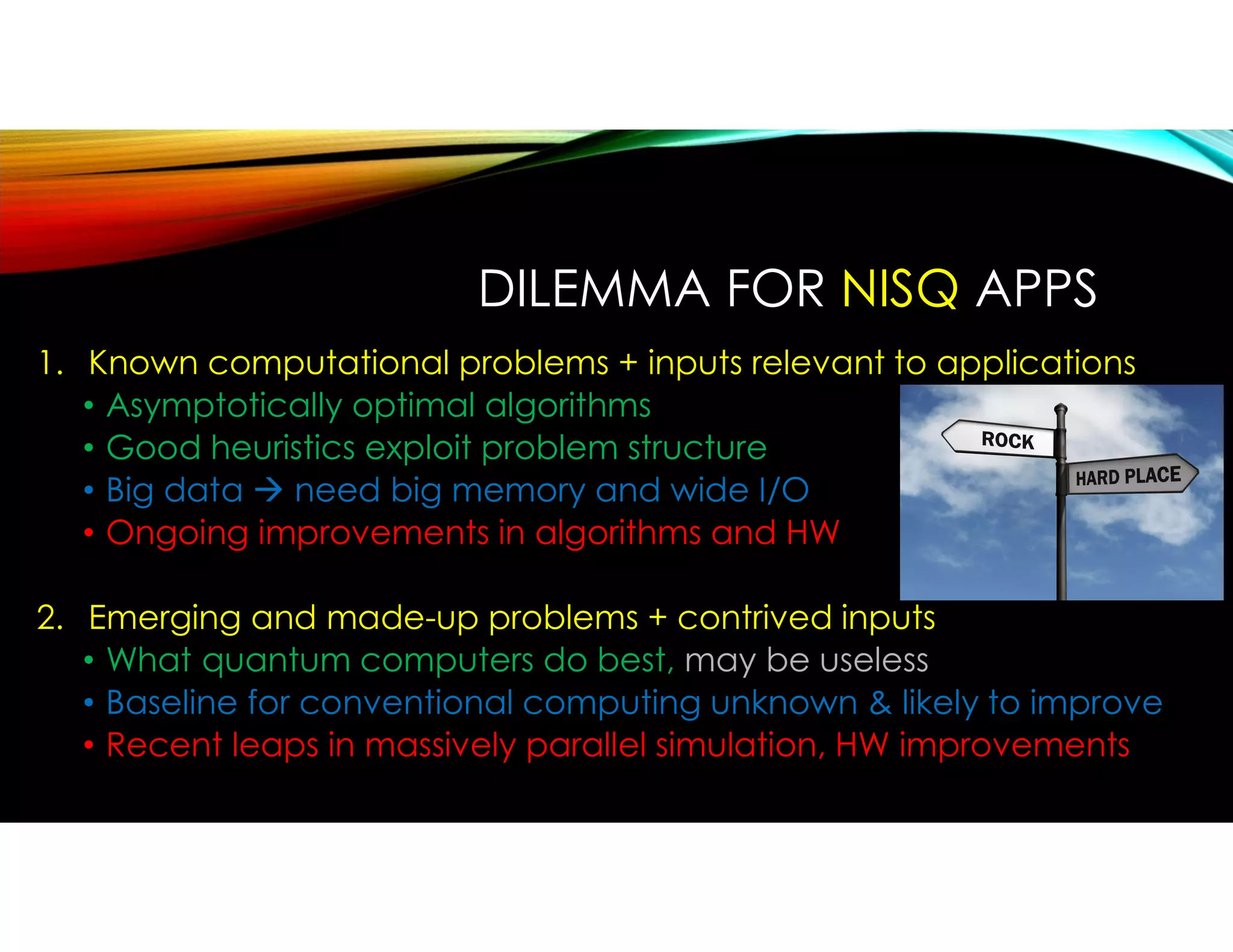
DILEMMA FOR NISQ APPS
1. Known computational problems + inputs relevant to applications
• Asymptotically optimal algorithms
• Good heuristics exploit problem structure
• Big data  need big memory and wide I/O
• Ongoing improvements in algorithms and HW
2. Emerging and made-up problems + contrived inputs
• What quantum computers do best, may be useless
• Baseline for conventional computing unknown & likely to improve
• Recent leaps in massively parallel simulation, HW improvements
• Input: description of a quantum circuit
• Defines the probability distribution
of measurement outcomes
• Output: samples from the distribution
• Some error allowed (approximation)
• Hardness results for certain circuits
(under mild assumptions)
• Worst-case and average-case results
• Exact sampling on classical computer
• Approximate sampling
• “Imminent availability” on QCs
CIRCUIT SAMPLING PROBLEMS
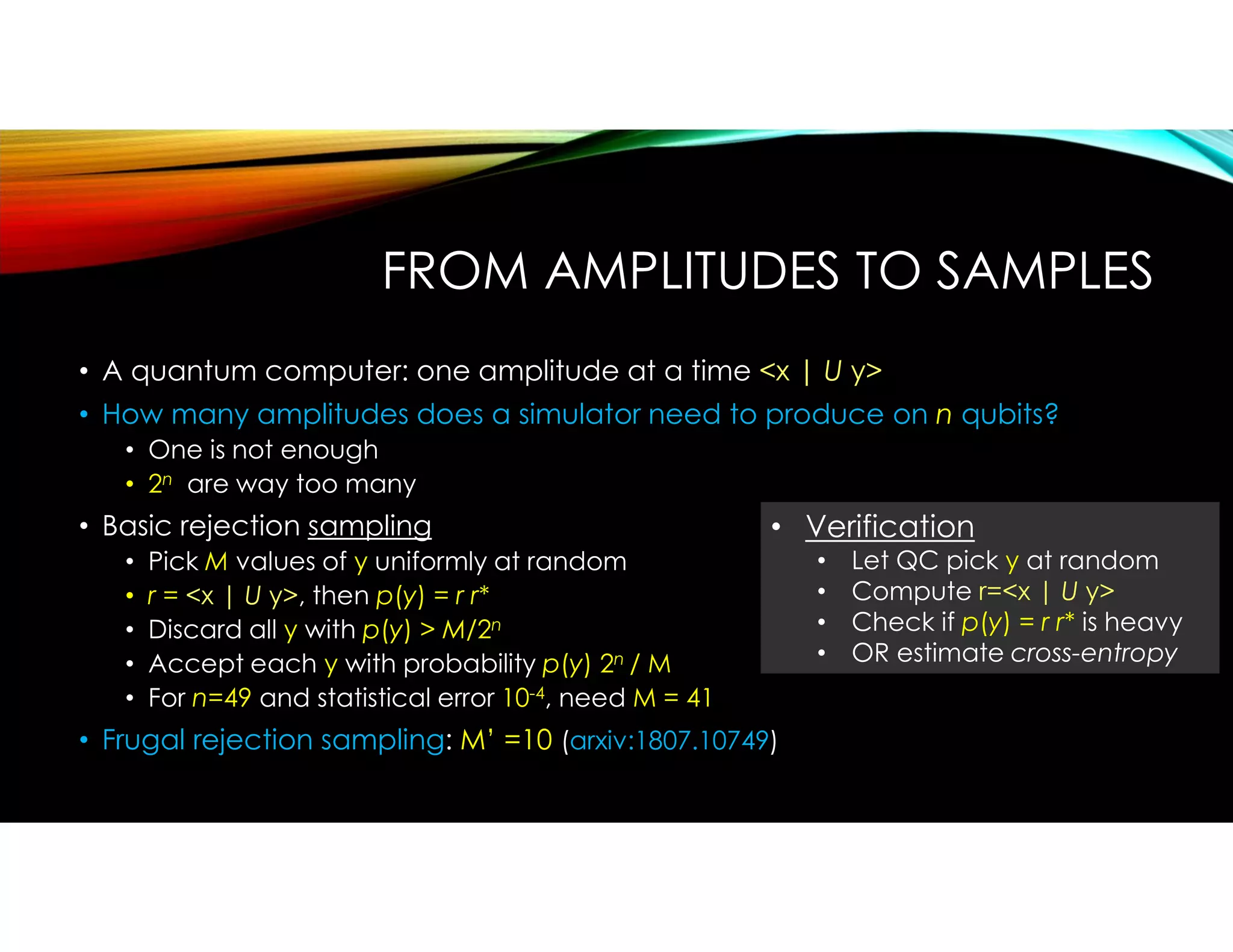
FROM AMPLITUDES TO SAMPLES
• A quantum computer: one amplitude at a time <x | U y>
• How many amplitudes does a simulator need to produce on n qubits?
• One is not enough
• 2n are way too many
• Basic rejection sampling
• Pick M values of y uniformly at random
• r = <x | U y>, then p(y) = r r*
• Discard all y with p(y) > M/2n
• Accept each y with probability p(y) 2n / M
• For n=49 and statistical error 10-4, need M = 41
• Frugal rejection sampling: M’ =10 (arxiv:1807.10749)
• Verification
• Let QC pick y at random
• Compute r=<x | U y>
• Check if p(y) = r r* is heavy
• OR estimate cross-entropy
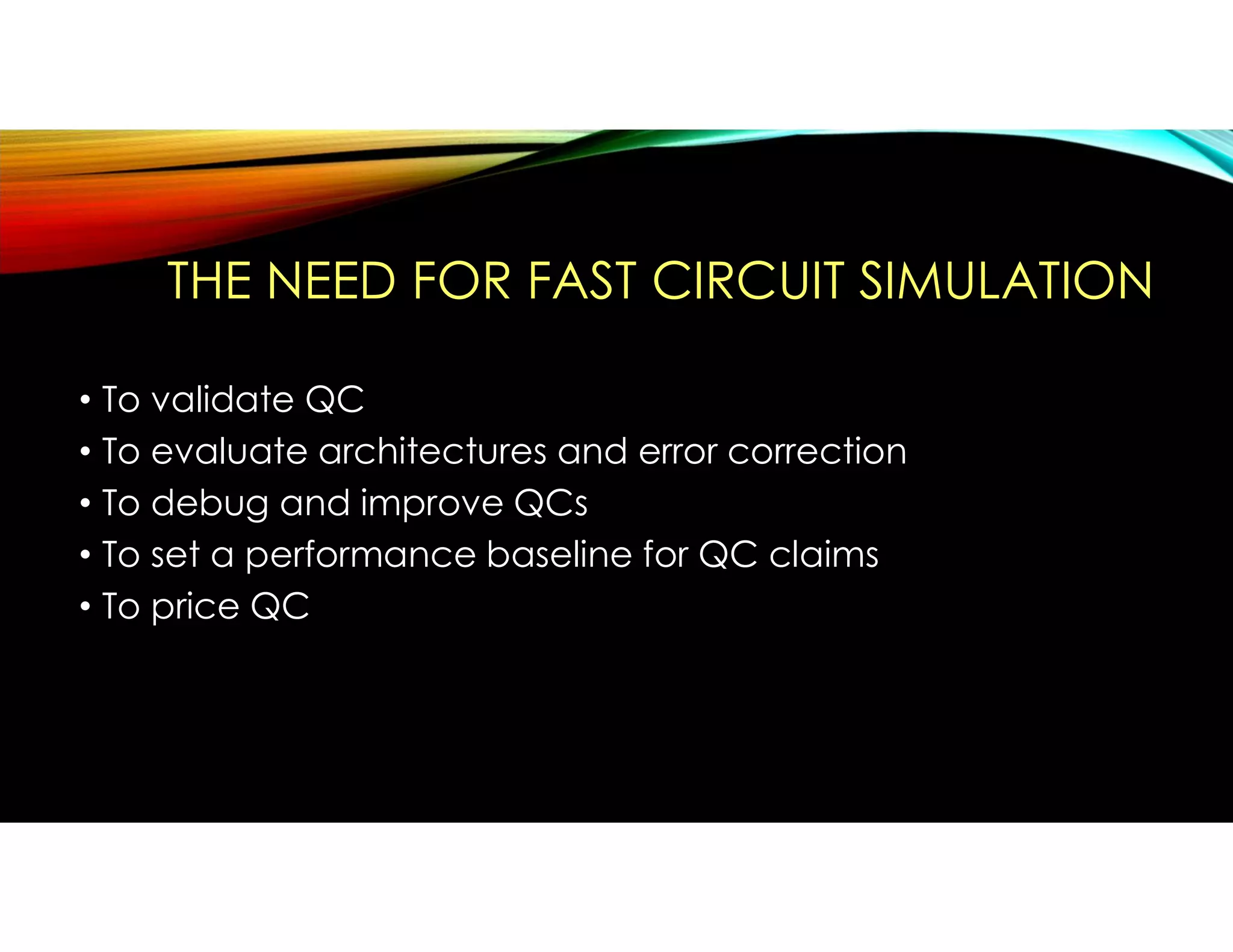
THE NEED FOR FAST CIRCUIT SIMULATION
• To validate QC
• To evaluate architectures and error correction
• To debug and improve QCs
• To set a performance baseline for QC claims
• To price QC
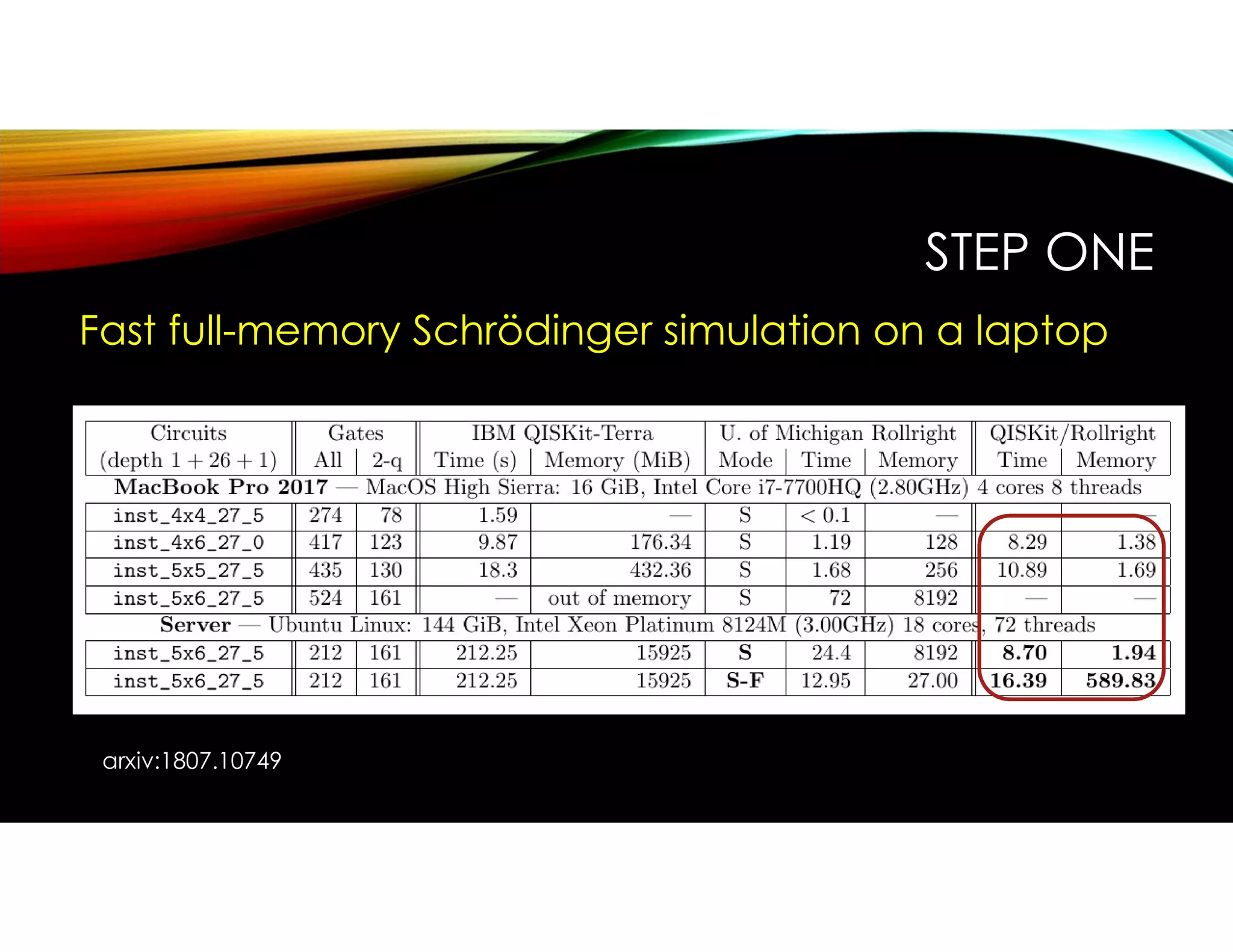
STEP ONE
Fast full-memory Schrödinger simulation on a laptop
arxiv:1807.10749
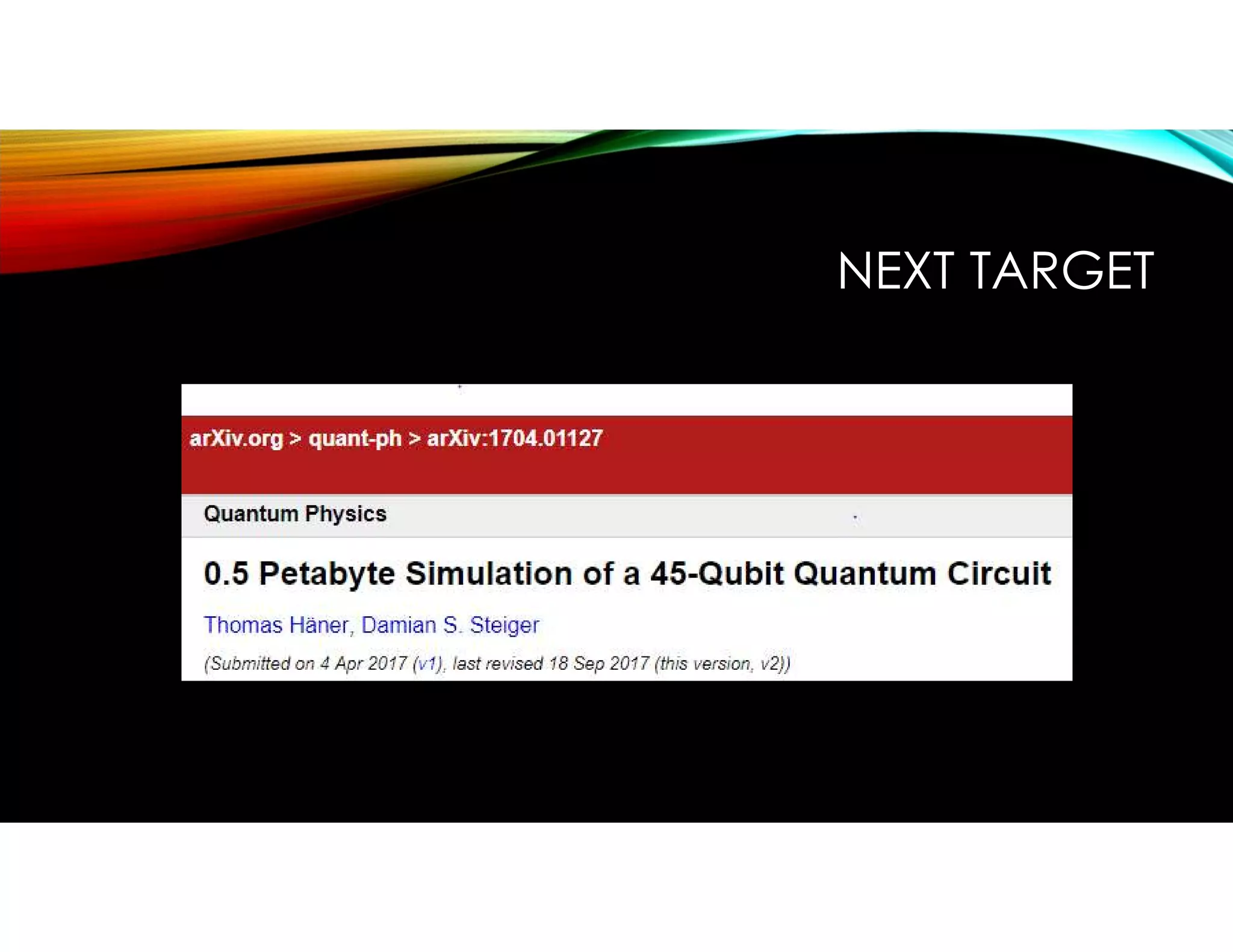
NEXT TARGET
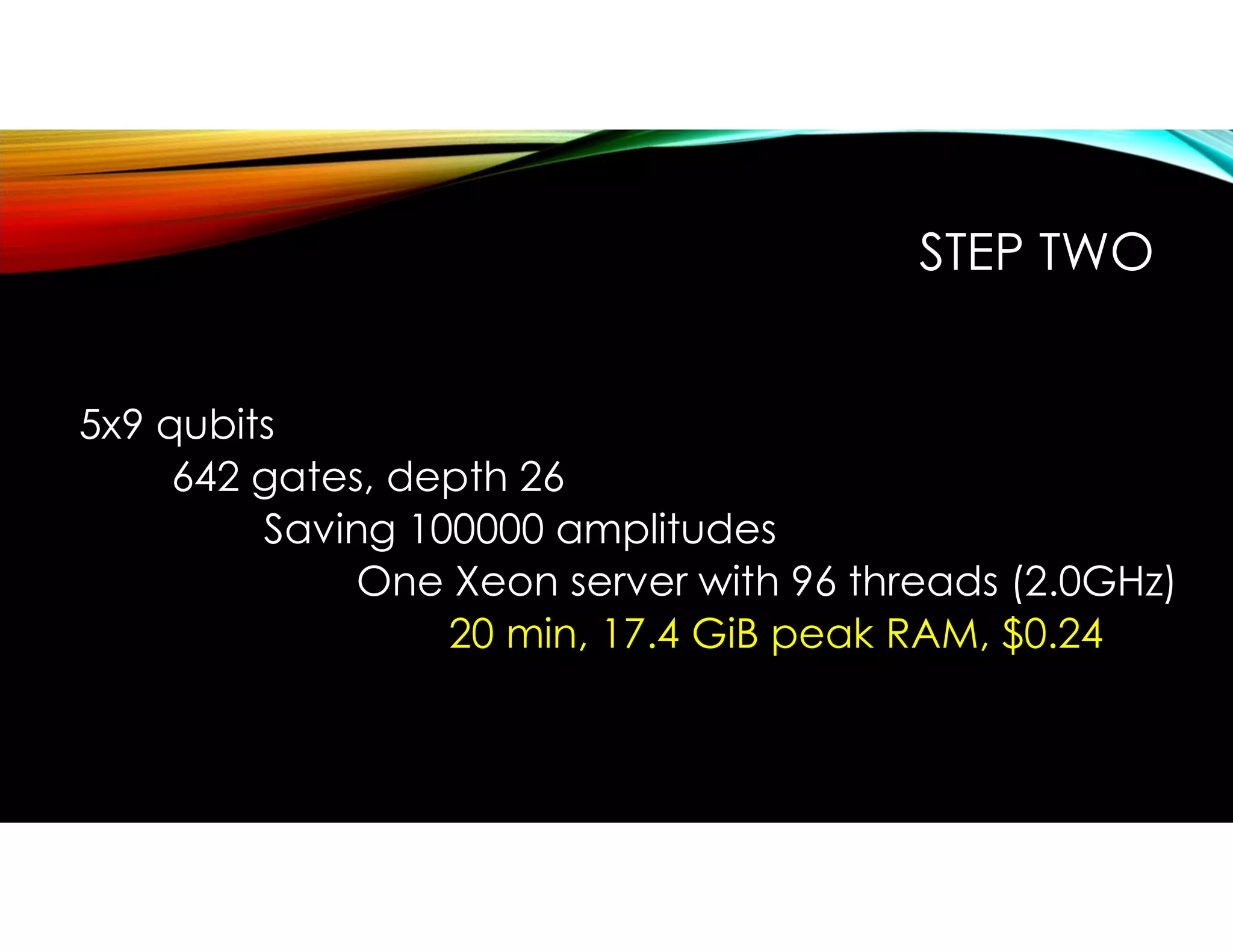
5x9 qubits
642 gates, depth 26
Saving 100000 amplitudes
One Xeon server with 96 threads (2.0GHz)
20 min, 17.4 GiB peak RAM, $0.24
STEP TWO
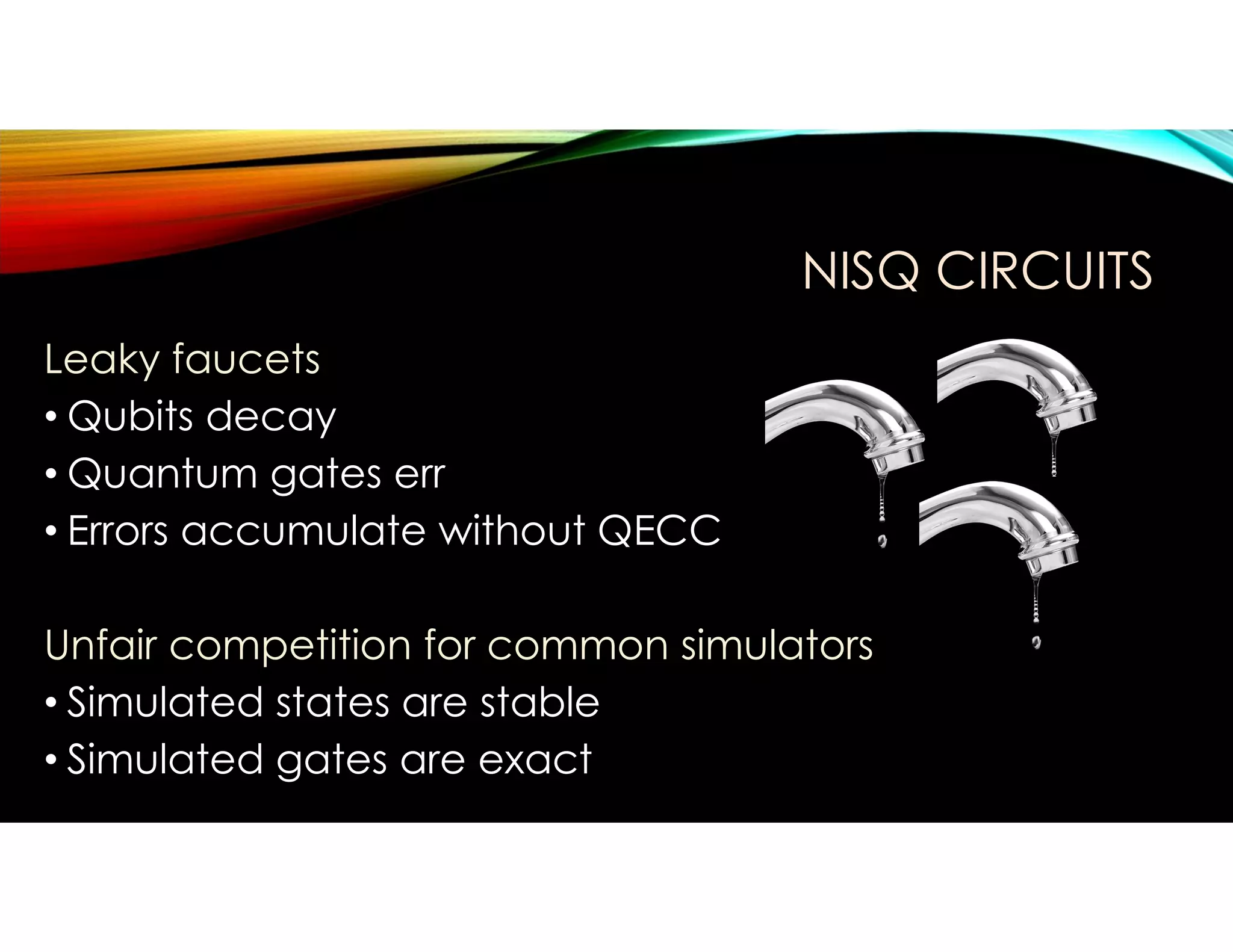
NISQ CIRCUITS
Leaky faucets
• Qubits decay
• Quantum gates err
• Errors accumulate without QECC
Unfair competition for common simulators
• Simulated states are stable
• Simulated gates are exact
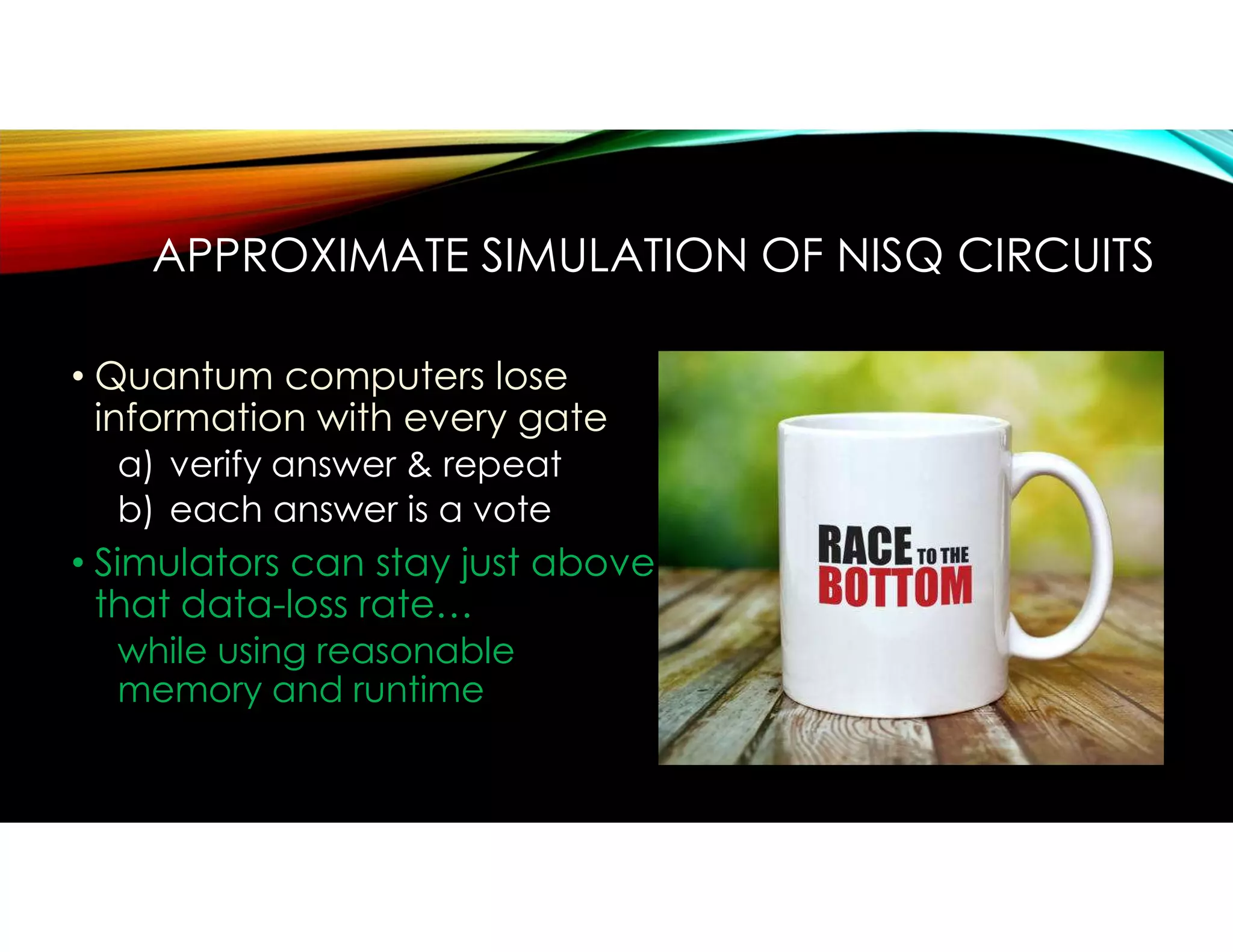
APPROXIMATE SIMULATION OF NISQ CIRCUITS
• Quantum computers lose
information with every gate
a) verify answer & repeat
b) each answer is a vote
• Simulators can stay just above
that data-loss rate…
while using reasonable
memory and runtime
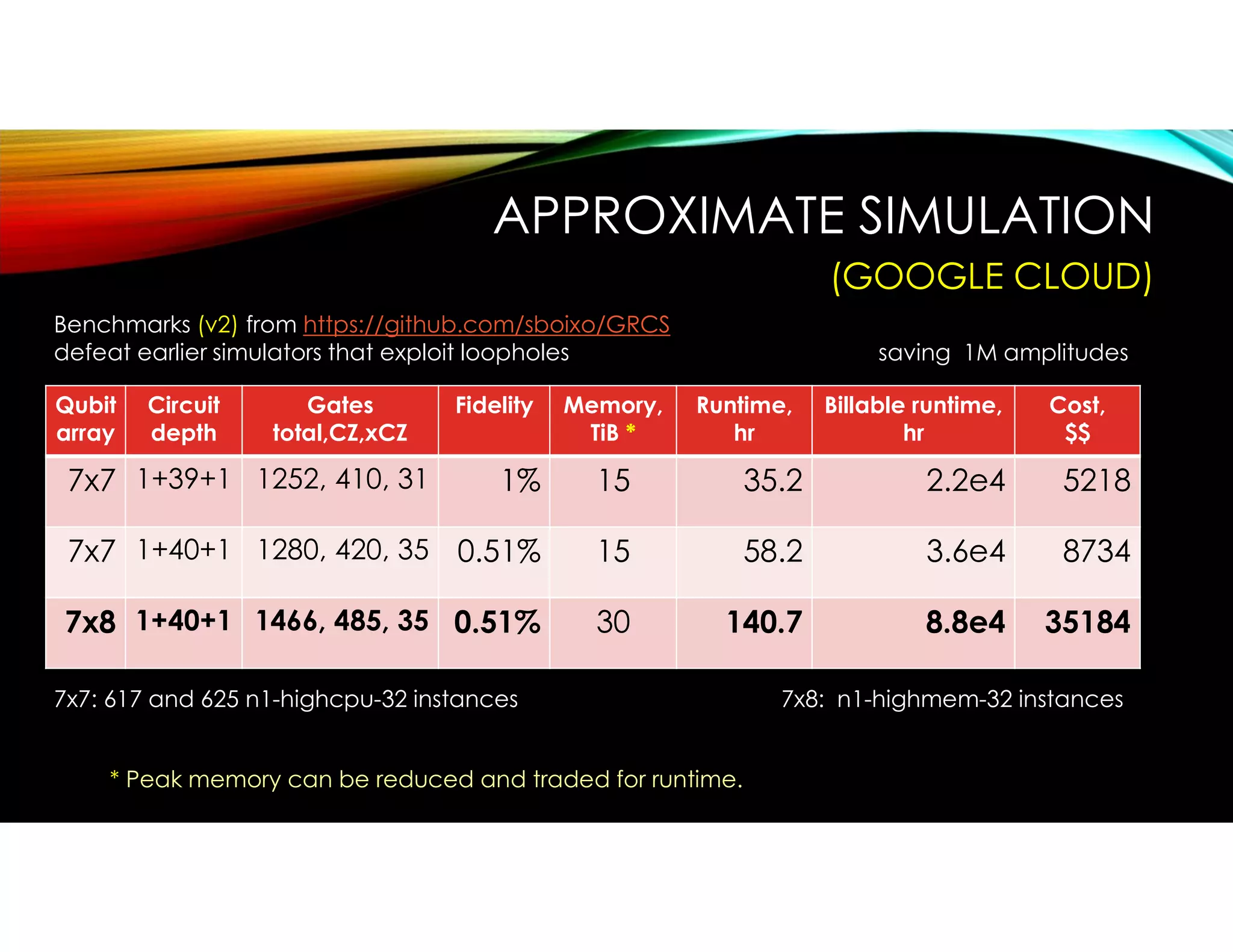
Qubit
array
Circuit
depth
Gates
total,CZ,xCZ
Fidelity Memory,
TiB *
Runtime,
hr
Billable runtime,
hr
Cost,
$$
7x7 1+39+1 1252, 410, 31 1% 15 35.2 2.2e4 5218
7x7 1+40+1 1280, 420, 35 0.51% 15 58.2 3.6e4 8734
7x8 1+40+1 1466, 485, 35 0.51% 30 140.7 8.8e4 35184
* Peak memory can be reduced and traded for runtime.
APPROXIMATE SIMULATION
(GOOGLE CLOUD)
Benchmarks (v2) from https://github.com/sboixo/GRCS
defeat earlier simulators that exploit loopholes
7x7: 617 and 625 n1-highcpu-32 instances 7x8: n1-highmem-32 instances
saving 1M amplitudes
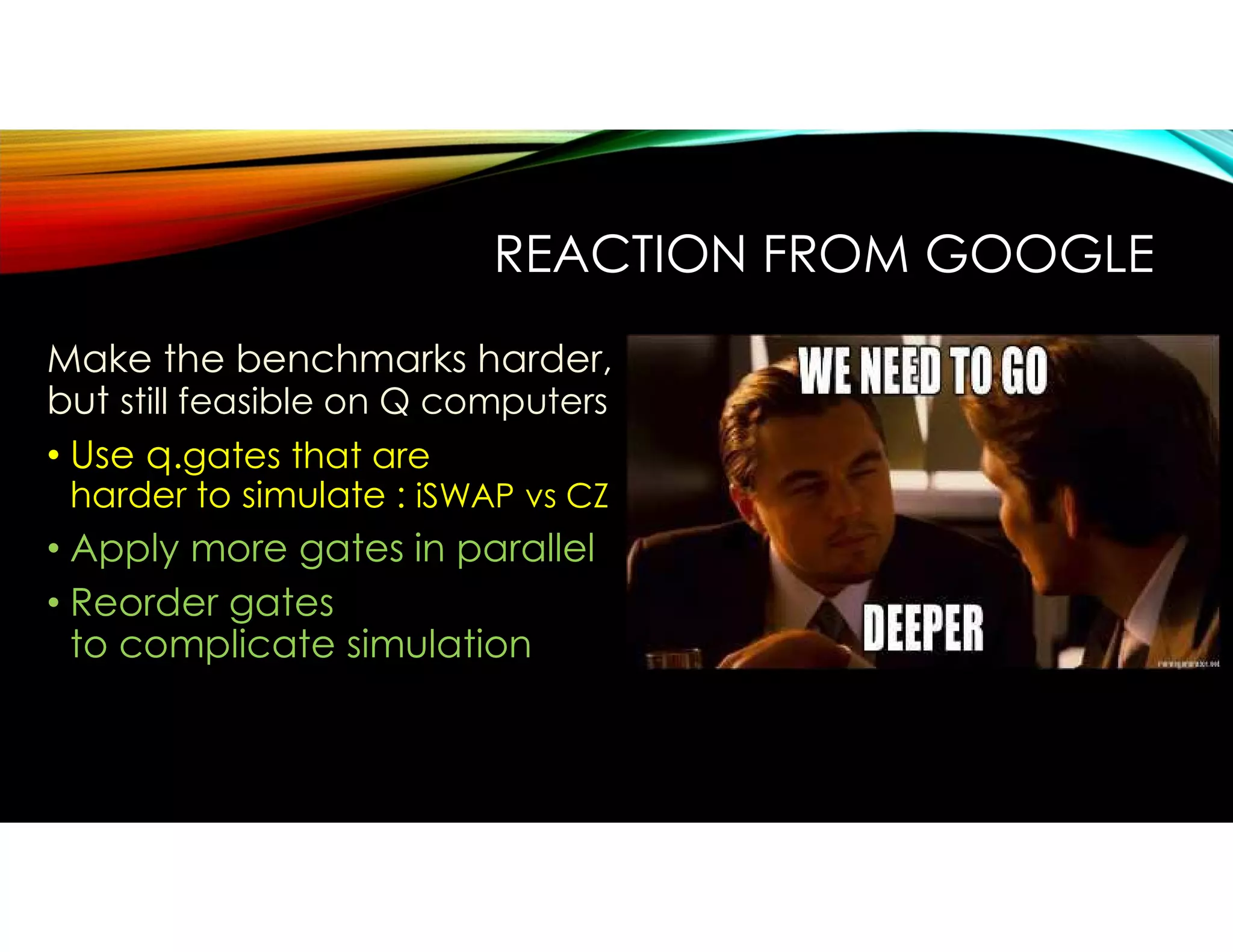
REACTION FROM GOOGLE
Make the benchmarks harder,
but still feasible on Q computers
• Use q.gates that are
harder to simulate : iSWAP vs CZ
• Apply more gates in parallel
• Reorder gates
to complicate simulation
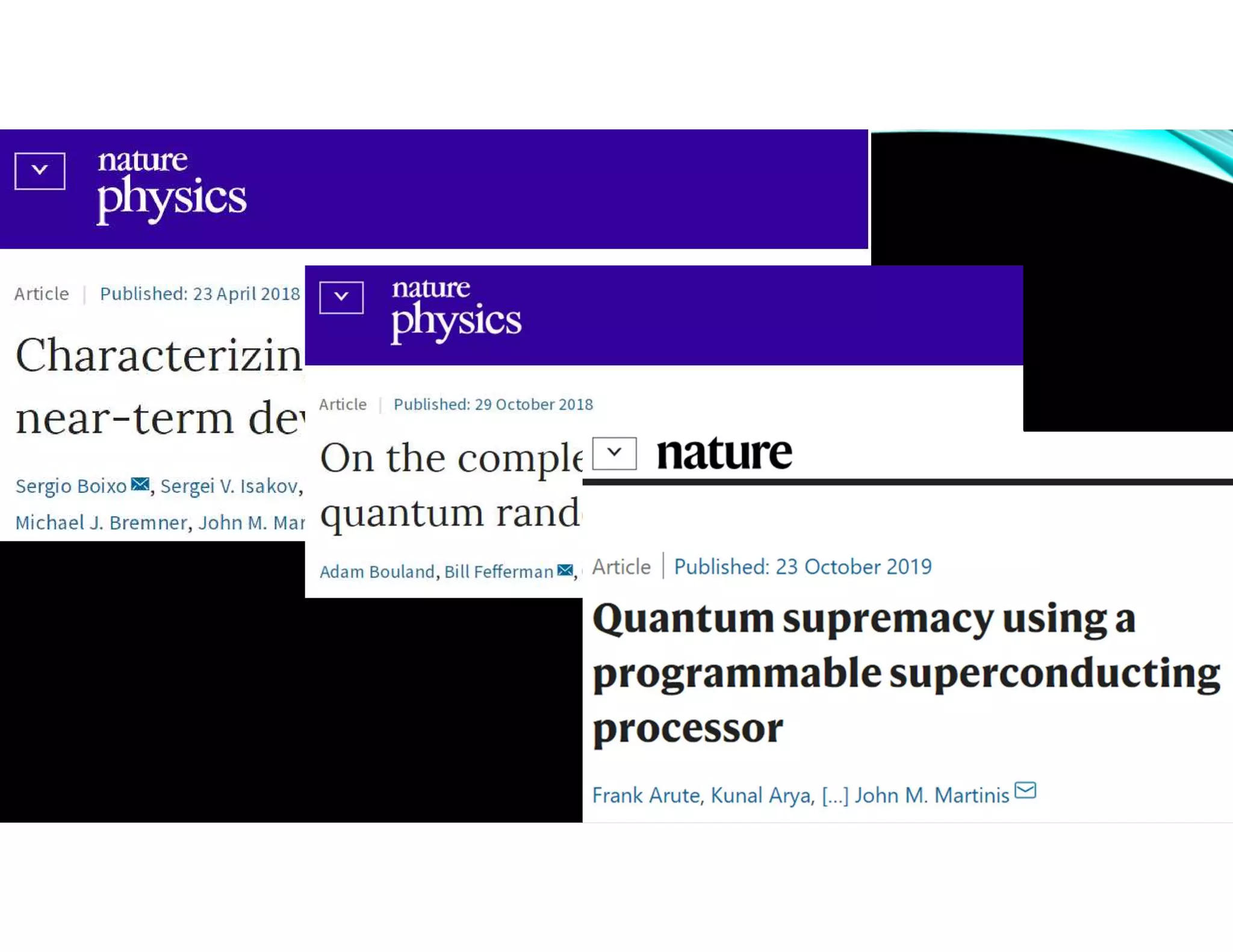
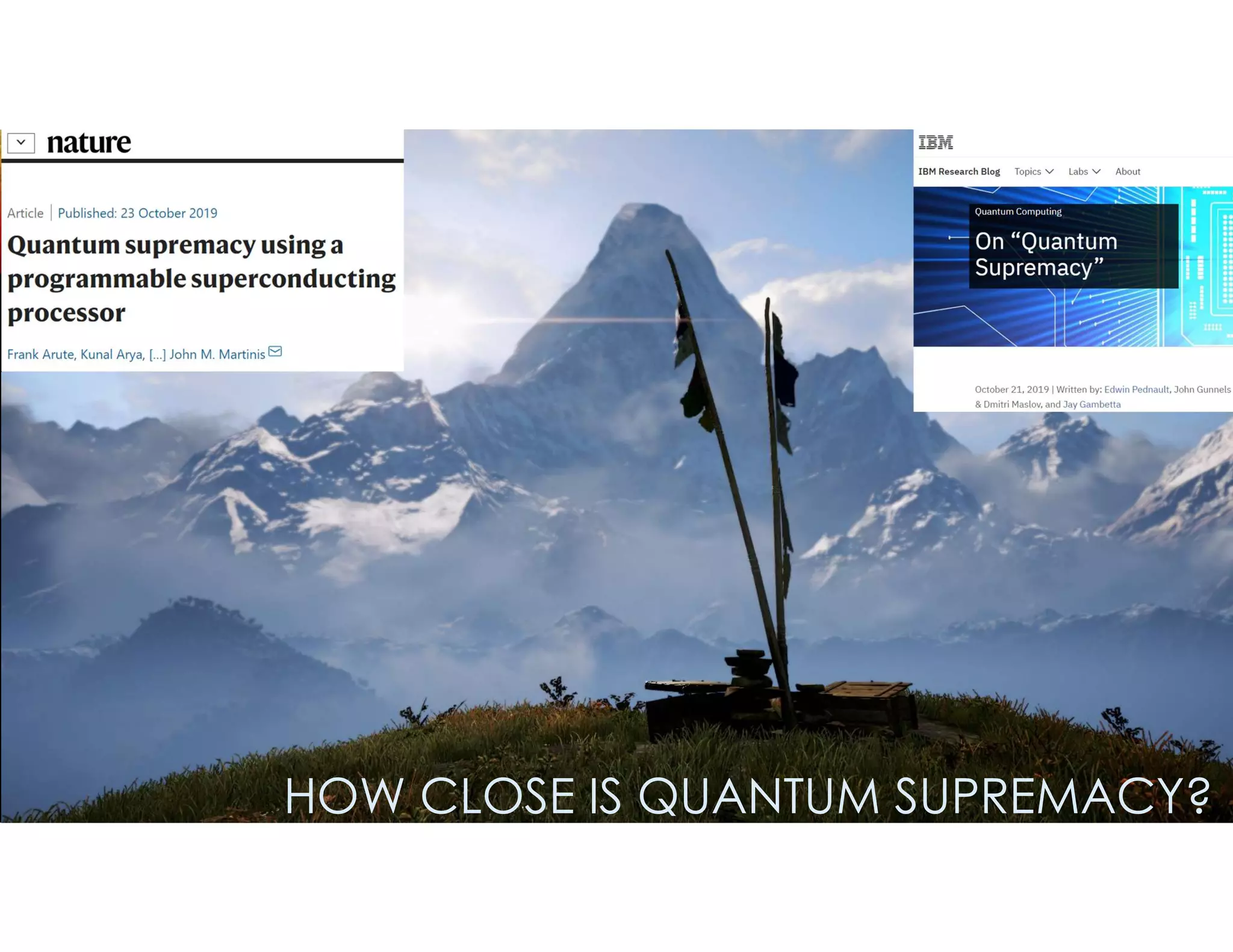
HOW CLOSE IS QUANTUM SUPREMACY?
QC AND ML?
• Need to reliably show “strong” quantum supremacy
• Processing large amounts of data on a QC
• “Large” – more than a few hundred floats
• Quantum algorithms with scalable advantage
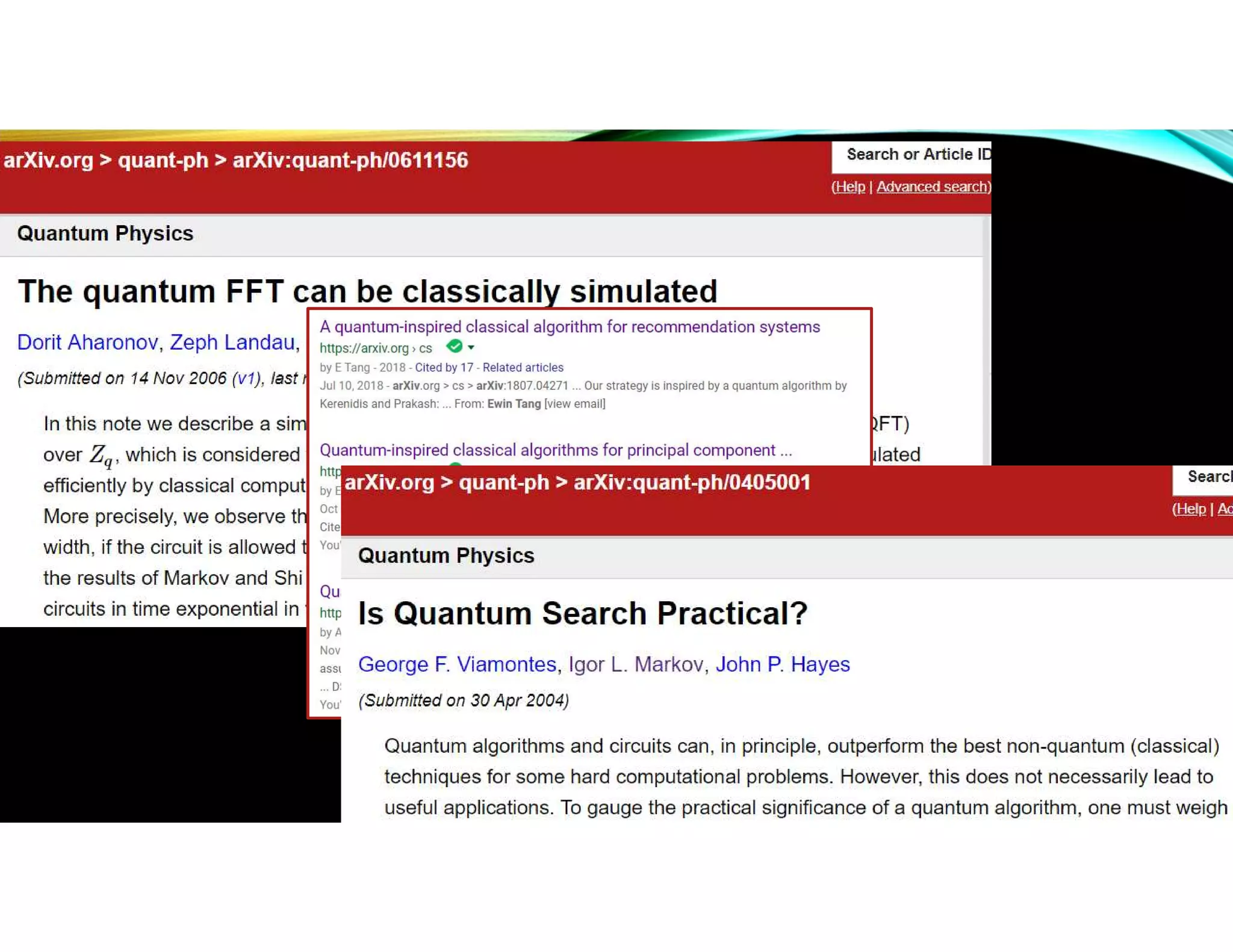
• Many of the candidates have been “dequantized”
• Simulation of QCs:
• Helps in design
• Indispensable in verification
• Also a performance competitor
QC: A TREASURE HUNT NOT A GOLD RUSH

Igor Markov - Quantum Computing: a Treasure Hunt, not a Gold Rush

  • 1.
    QUANTUM COMPUTING: A TREASUREHUNT NOT A GOLD MINE Igor L. Markov U. Michigan
  • 2.
    WHY NQI? Q. Computing Computational advantage •SimulatingQM •Non-quantum Q. Comms Secure comms via QKD Entanglement networks Q. Sensing and metrology Atomic clocks and ultra- precise sensors
  • 3.
    ERROR-FREE QUANTUM ALGORITHMS •No new decision powers (proof by simulation) • No NP-complete problems solved exactly in poly time • No asymptotic speed-up for sorting, etc • Hence, no universal speed-up • No speedup from single gates expected • Main promise is in accelerators • Surprisingly few good applications • Surprisingly difficult to build hardware
  • 4.
    NOISE AND ERRORCORRECTION • Entangled states globalize noise & errors: local faults have global effects • No error masking by gates • Errors accumulate multiplicatively: • 500 gates with 0.995 fidelity  0.995500 ~ 0.082 circuit fidelity • Error correction by duplication and majority not available • Quantum error correction has much greater overhead
  • 5.
  • 6.
    BEATING CONVENTIONAL COMPUTERS? •Strengths of conventional digital computers • Tiny devices & cheap materials • Fast interconnect compatible with devices • Scalable & accurate manufacturing • Reliable, low-power operation • Memory hierarchies & cheap ECC • High-bandwidth I/O • Verification & test • Abstraction hierarchy • Programmability, universality • Large market & investment; clouds • Numerous algorithms, some optimal • Additional efficiencies by orders of magnitude
  • 7.
    QC: GOLD RUSHOR A TREASURE HUNT?
  • 8.
    VERIFY CORRECTNESS DEMONSTRATE ANEND-TO-END ADVANTAGE OVER HIGHLY OPTIMIZED CLASSICAL SYSTEMS
  • 9.
    DILEMMA FOR NISQAPPS 1. Known computational problems + inputs relevant to applications • Asymptotically optimal algorithms • Good heuristics exploit problem structure • Big data  need big memory and wide I/O • Ongoing improvements in algorithms and HW 2. Emerging and made-up problems + contrived inputs • What quantum computers do best, may be useless • Baseline for conventional computing unknown & likely to improve • Recent leaps in massively parallel simulation, HW improvements
  • 12.
    • Input: descriptionof a quantum circuit • Defines the probability distribution of measurement outcomes • Output: samples from the distribution • Some error allowed (approximation) • Hardness results for certain circuits (under mild assumptions) • Worst-case and average-case results • Exact sampling on classical computer • Approximate sampling • “Imminent availability” on QCs CIRCUIT SAMPLING PROBLEMS
  • 13.
    FROM AMPLITUDES TOSAMPLES • A quantum computer: one amplitude at a time <x | U y> • How many amplitudes does a simulator need to produce on n qubits? • One is not enough • 2n are way too many • Basic rejection sampling • Pick M values of y uniformly at random • r = <x | U y>, then p(y) = r r* • Discard all y with p(y) > M/2n • Accept each y with probability p(y) 2n / M • For n=49 and statistical error 10-4, need M = 41 • Frugal rejection sampling: M’ =10 (arxiv:1807.10749) • Verification • Let QC pick y at random • Compute r=<x | U y> • Check if p(y) = r r* is heavy • OR estimate cross-entropy
  • 14.
    THE NEED FORFAST CIRCUIT SIMULATION • To validate QC • To evaluate architectures and error correction • To debug and improve QCs • To set a performance baseline for QC claims • To price QC
  • 15.
    STEP ONE Fast full-memorySchrödinger simulation on a laptop arxiv:1807.10749
  • 16.
  • 18.
    5x9 qubits 642 gates,depth 26 Saving 100000 amplitudes One Xeon server with 96 threads (2.0GHz) 20 min, 17.4 GiB peak RAM, $0.24 STEP TWO
  • 19.
    NISQ CIRCUITS Leaky faucets •Qubits decay • Quantum gates err • Errors accumulate without QECC Unfair competition for common simulators • Simulated states are stable • Simulated gates are exact
  • 20.
    APPROXIMATE SIMULATION OFNISQ CIRCUITS • Quantum computers lose information with every gate a) verify answer & repeat b) each answer is a vote • Simulators can stay just above that data-loss rate… while using reasonable memory and runtime
  • 21.
    Qubit array Circuit depth Gates total,CZ,xCZ Fidelity Memory, TiB * Runtime, hr Billableruntime, hr Cost, $$ 7x7 1+39+1 1252, 410, 31 1% 15 35.2 2.2e4 5218 7x7 1+40+1 1280, 420, 35 0.51% 15 58.2 3.6e4 8734 7x8 1+40+1 1466, 485, 35 0.51% 30 140.7 8.8e4 35184 * Peak memory can be reduced and traded for runtime. APPROXIMATE SIMULATION (GOOGLE CLOUD) Benchmarks (v2) from https://github.com/sboixo/GRCS defeat earlier simulators that exploit loopholes 7x7: 617 and 625 n1-highcpu-32 instances 7x8: n1-highmem-32 instances saving 1M amplitudes
  • 22.
    REACTION FROM GOOGLE Makethe benchmarks harder, but still feasible on Q computers • Use q.gates that are harder to simulate : iSWAP vs CZ • Apply more gates in parallel • Reorder gates to complicate simulation
  • 23.
    HOW CLOSE ISQUANTUM SUPREMACY?
  • 24.
    QC AND ML? •Need to reliably show “strong” quantum supremacy • Processing large amounts of data on a QC • “Large” – more than a few hundred floats • Quantum algorithms with scalable advantage • Many of the candidates have been “dequantized” • Simulation of QCs: • Helps in design • Indispensable in verification • Also a performance competitor
  • 25.
    QC: A TREASUREHUNT NOT A GOLD RUSH