Calibrated
Recommendations
Harald Steck,
presented by Justin Basilico
at RecSys 2018
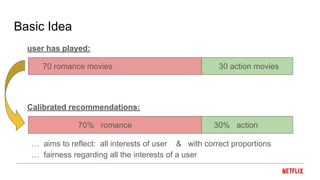
Basic Idea
user has played:
70 romance movies 30 action movies
Calibrated recommendations:
70% romance 30% action
… aims to reflect: all interests of user & with correct proportions
… fairness regarding all the interests of a user
Accuracy vs. Calibration
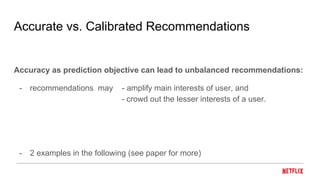
Accurate vs. Calibrated Recommendations
Accuracy as prediction objective can lead to unbalanced recommendations:
- recommendations may - amplify main interests of user, and
- crowd out the lesser interests of a user.
- 2 examples in the following (see paper for more)
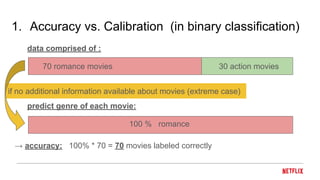
1. Accuracy vs. Calibration (in binary classification)
data comprised of :
70 romance movies 30 action movies
predict genre of each movie:
100 % romance
→ accuracy: 100% * 70 = 70 movies labeled correctly
if no additional information available about movies (extreme case)
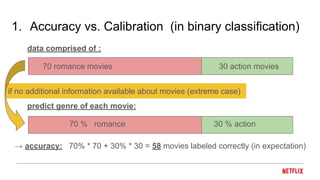
1. Accuracy vs. Calibration (in binary classification)
data comprised of :
70 romance movies 30 action movies
→ accuracy: 70% * 70 + 30% * 30 = 58 movies labeled correctly (in expectation)
if no additional information available about movies (extreme case)
predict genre of each movie:
70 % romance 30 % action
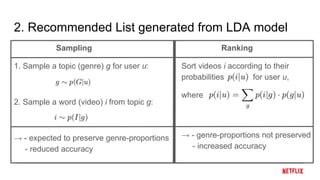
2. Recommended List generated from LDA model
Sampling
1. Sample a topic (genre) g for user u:
2. Sample a word (video) i from topic g:
→ - expected to preserve genre-proportions
- reduced accuracy
Ranking
Sort videos i according to their
probabilities for user u,
where
→ - genre-proportions not preserved
- increased accuracy
Calibration Metric
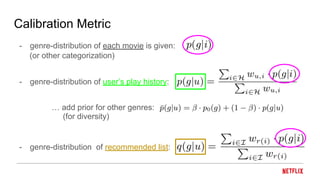
Calibration Metric
- genre-distribution of each movie is given:
- genre-distribution of user’s play history:
… add prior for other genres:
- genre-distribution of recommended list:
(for diversity)
(or other categorization)
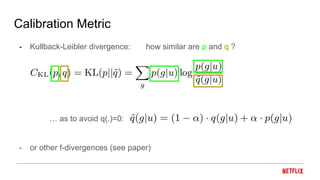
Calibration Metric
- Kullback-Leibler divergence: how similar are p and q ?
… as to avoid q(.)=0:
- or other f-divergences (see paper)
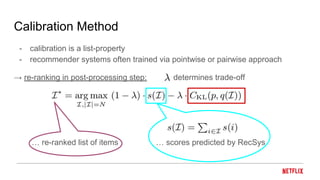
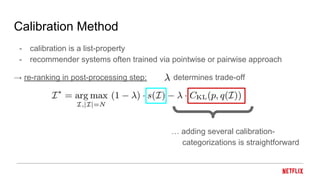
Calibration Method
- calibration is a list-property
- recommender systems often trained via pointwise or pairwise approach
→ re-ranking in post-processing step: determines trade-off
… re-ranked list of items … scores predicted by RecSys
Calibration Method
Calibration Method
- calibration is a list-property
- recommender systems often trained via pointwise or pairwise approach
→ re-ranking in post-processing step: determines trade-off
… adding several calibration-
categorizations is straightforward
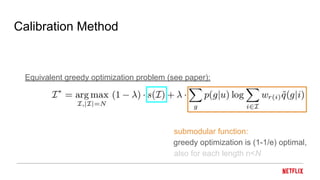
Calibration Method
Equivalent greedy optimization problem (see paper):
submodular function:
greedy optimization is (1-1/e) optimal,
also for each length n<N
Related Concepts
Related Concepts
Fairness: - typically refers to persons or groups within a population
- several fairness criteria besides calibration exist:
- equal(ized) odds, equal opportunity, statistical parity
Diversity: - minimal similarity or redundancy among items [majority of literature]
- proportionality in search results [Dang, Croft 2012]
- new metric to capture three properties [Vargas et al. 2014]
- focus on submodularity [Teo et al. 2016]
Experiments (on MovieLens 20 million data)
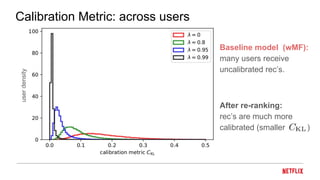
Calibration Metric: across users
Baseline model (wMF):
many users receive
uncalibrated rec’s.
After re-ranking:
rec’s are much more
calibrated (smaller )
userdensity
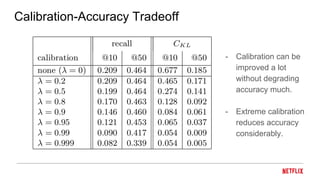
Calibration-Accuracy Tradeoff
- Calibration can be
improved a lot
without degrading
accuracy much.
- Extreme calibration
reduces accuracy
considerably.
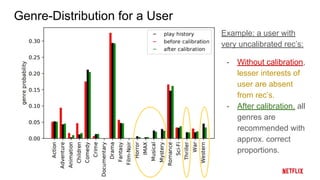
Genre-Distribution for a User
Example: a user with
very uncalibrated rec’s:
- Without calibration,
lesser interests of
user are absent
from rec’s.
- After calibration, all
genres are
recommended with
approx. correct
proportions.
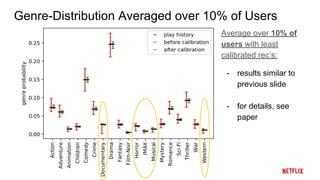
Genre-Distribution Averaged over 10% of Users
Average over 10% of
users with least
calibrated rec’s:
- results similar to
previous slide
- for details, see
paper
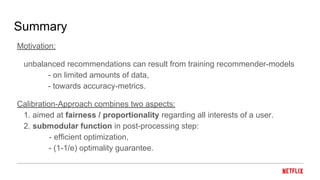
Summary
Summary
Motivation:
unbalanced recommendations can result from training recommender-models
- on limited amounts of data,
- towards accuracy-metrics.
Calibration-Approach combines two aspects:
1. aimed at fairness / proportionality regarding all interests of a user.
2. submodular function in post-processing step:
- efficient optimization,
- (1-1/e) optimality guarantee.
Thank you.

Calibrated Recommendations

  • 1.
  • 2.
    Basic Idea user hasplayed: 70 romance movies 30 action movies Calibrated recommendations: 70% romance 30% action … aims to reflect: all interests of user & with correct proportions … fairness regarding all the interests of a user
  • 3.
  • 4.
    Accurate vs. CalibratedRecommendations Accuracy as prediction objective can lead to unbalanced recommendations: - recommendations may - amplify main interests of user, and - crowd out the lesser interests of a user. - 2 examples in the following (see paper for more)
  • 5.
    1. Accuracy vs.Calibration (in binary classification) data comprised of : 70 romance movies 30 action movies predict genre of each movie: 100 % romance → accuracy: 100% * 70 = 70 movies labeled correctly if no additional information available about movies (extreme case)
  • 6.
    1. Accuracy vs.Calibration (in binary classification) data comprised of : 70 romance movies 30 action movies → accuracy: 70% * 70 + 30% * 30 = 58 movies labeled correctly (in expectation) if no additional information available about movies (extreme case) predict genre of each movie: 70 % romance 30 % action
  • 7.
    2. Recommended Listgenerated from LDA model Sampling 1. Sample a topic (genre) g for user u: 2. Sample a word (video) i from topic g: → - expected to preserve genre-proportions - reduced accuracy Ranking Sort videos i according to their probabilities for user u, where → - genre-proportions not preserved - increased accuracy
  • 8.
  • 9.
    Calibration Metric - genre-distributionof each movie is given: - genre-distribution of user’s play history: … add prior for other genres: - genre-distribution of recommended list: (for diversity) (or other categorization)
  • 10.
    Calibration Metric - Kullback-Leiblerdivergence: how similar are p and q ? … as to avoid q(.)=0: - or other f-divergences (see paper)
  • 11.
  • 12.
    - calibration isa list-property - recommender systems often trained via pointwise or pairwise approach → re-ranking in post-processing step: determines trade-off … re-ranked list of items … scores predicted by RecSys Calibration Method
  • 13.
    Calibration Method - calibrationis a list-property - recommender systems often trained via pointwise or pairwise approach → re-ranking in post-processing step: determines trade-off … adding several calibration- categorizations is straightforward
  • 14.
    Calibration Method Equivalent greedyoptimization problem (see paper): submodular function: greedy optimization is (1-1/e) optimal, also for each length n<N
  • 15.
  • 16.
    Related Concepts Fairness: -typically refers to persons or groups within a population - several fairness criteria besides calibration exist: - equal(ized) odds, equal opportunity, statistical parity Diversity: - minimal similarity or redundancy among items [majority of literature] - proportionality in search results [Dang, Croft 2012] - new metric to capture three properties [Vargas et al. 2014] - focus on submodularity [Teo et al. 2016]
  • 17.
    Experiments (on MovieLens20 million data)
  • 18.
    Calibration Metric: acrossusers Baseline model (wMF): many users receive uncalibrated rec’s. After re-ranking: rec’s are much more calibrated (smaller ) userdensity
  • 19.
    Calibration-Accuracy Tradeoff - Calibrationcan be improved a lot without degrading accuracy much. - Extreme calibration reduces accuracy considerably.
  • 20.
    Genre-Distribution for aUser Example: a user with very uncalibrated rec’s: - Without calibration, lesser interests of user are absent from rec’s. - After calibration, all genres are recommended with approx. correct proportions.
  • 21.
    Genre-Distribution Averaged over10% of Users Average over 10% of users with least calibrated rec’s: - results similar to previous slide - for details, see paper
  • 22.
  • 23.
    Summary Motivation: unbalanced recommendations canresult from training recommender-models - on limited amounts of data, - towards accuracy-metrics. Calibration-Approach combines two aspects: 1. aimed at fairness / proportionality regarding all interests of a user. 2. submodular function in post-processing step: - efficient optimization, - (1-1/e) optimality guarantee.
  • 24.