Effective listening skills
“Fully concentrating on what is being said and not just passively hearing the
message”
“It is the province of knowledge to speak. And
It is the privilege of wisdom to listen..”
-Oliver W. Holmes
Effective listening skills
“Fully concentrating on what is being said and not just passively hearing the
message”
• It is the counsellor’s responsibility to give their client their full, undivided
attention throughout the duration of a one to one counselling session.
Effective listening skills are achieved by fully concentrating on what is being
said and not just passively hearing the message.
• Listening makes the client feel worthy appreciated and respected. When a
counsellor pays particular attention to what the client is saying, they are
encouraging the client to continue talking as well as ensuring
communication remains open and positive.
• Listening helps to ensure that communication remains open and positive.
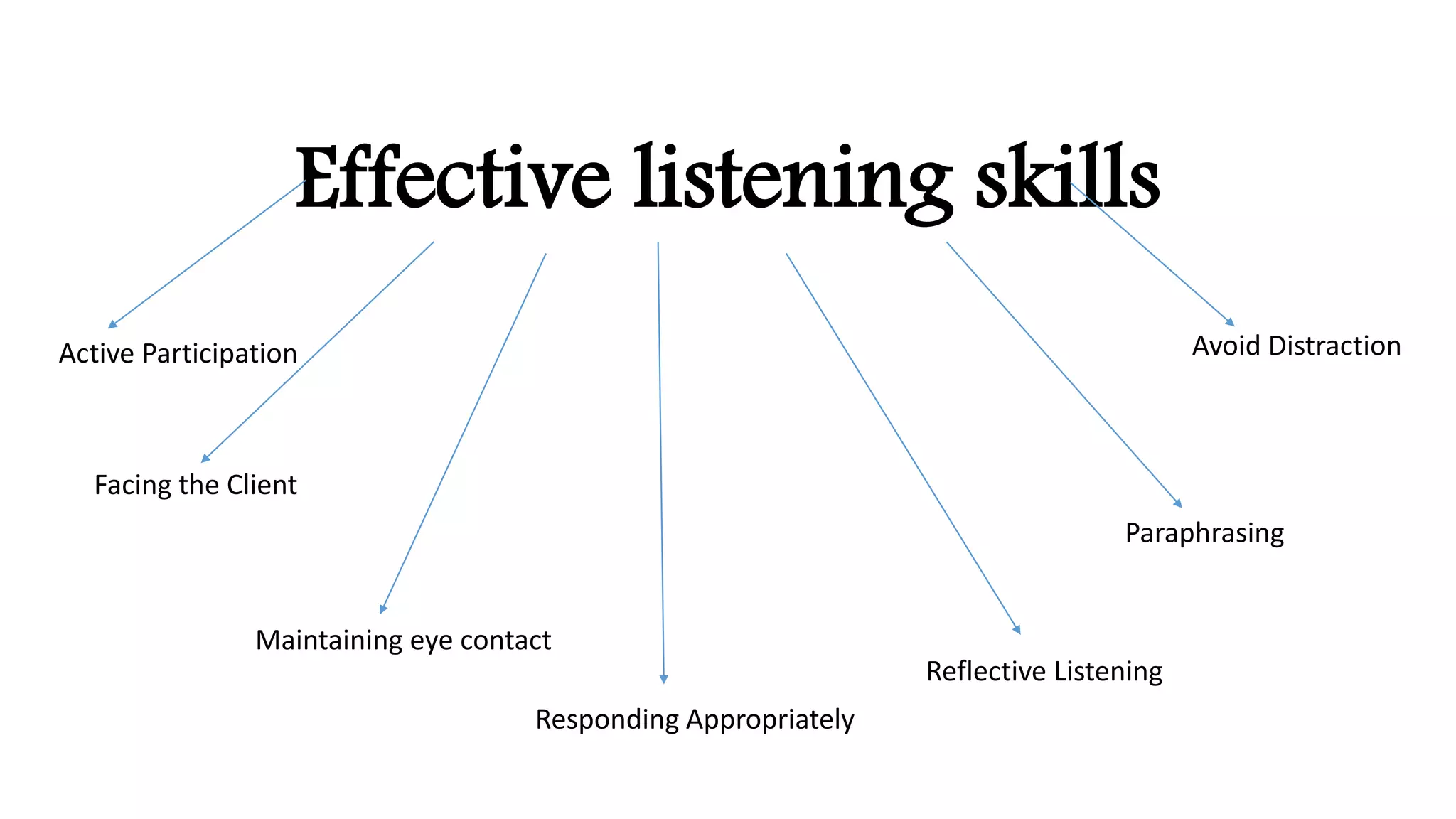
Effective listening skills
Active Participation
Facing the Client
Maintaining eye contact
Responding Appropriately
Reflective Listening
Paraphrasing
Avoid Distraction
Effective listening skills
“ Fully concentrating on what is being said and not just passively hearing the
message”
• Active Participation: To actively participate in a conversation requires more
than just listening to a client talk. It Involves taking an interest in the client,
making sure they are comfortable about disclosing personal information and
providing support for understanding.
• Facing the client: Sitting straight or leaning forward to show attentiveness.
“The posture”
• Maintaining eye contact: Having an eye “connection” This shows that the
therapist is taking interest in what the client is saying, thus creating a
comfortable atmosphere.
Effective listening skills
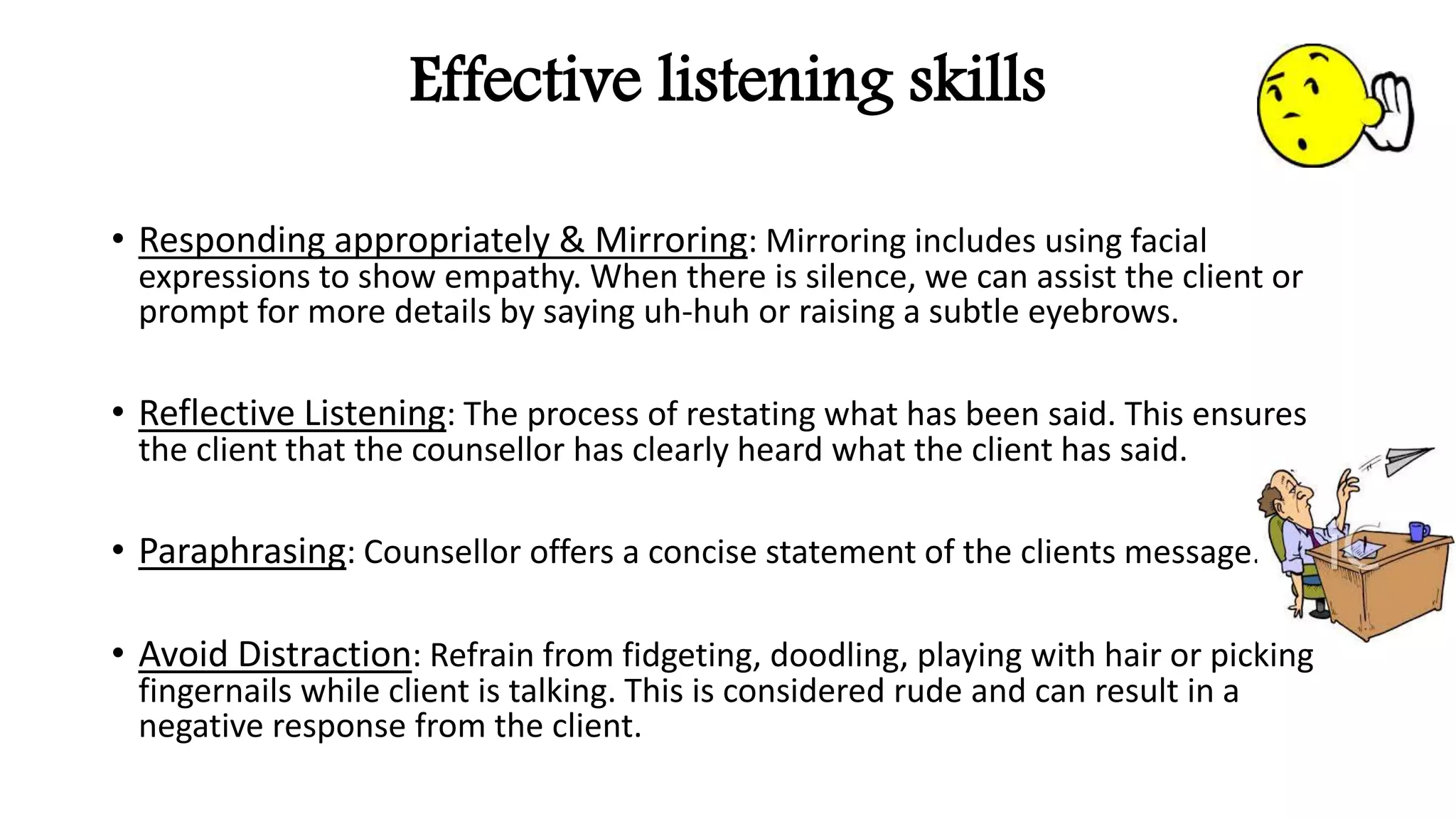
• Responding appropriately & Mirroring: Mirroring includes using facial
expressions to show empathy. When there is silence, we can assist the client or
prompt for more details by saying uh-huh or raising a subtle eyebrows.
• Reflective Listening: The process of restating what has been said. This ensures
the client that the counsellor has clearly heard what the client has said.
• Paraphrasing: Counsellor offers a concise statement of the clients message.
• Avoid Distraction: Refrain from fidgeting, doodling, playing with hair or picking
fingernails while client is talking. This is considered rude and can result in a
negative response from the client.
A “neutral” counsellor..
• It is very important that when therapists attempt to help clients resolve
issues they are dealing with, to remain neutral otherwise the therapist may
confuse himself/herself over the role they serve.
• Cultural diversity is also a major issue when working with clients from
different culture. E.g. Maintaining Eye contact may be regarded as rude in
certain countries. Also, ignorance of common cultural phenomena can
cause the counsellor to badly diagnose a client.
• Therapist must set aside their personal views such as arranged marriages,
abortion and other cultural traditional views of male and female roles.
Therapists need to ensure that their values, beliefs and experiences do not
influence their interaction with their clients.
Therapists need to ensure their values, beliefs and
experiences do not influence their interaction with
their clients.
• A client comes in and says “gays are an abomination before the Lord, and I hate
them”. It is not your job, nor your right to challenge their thinking and to disagree
with them politically or from your religious convictions. It is your responsibility to
attend to them enough to try and understand what about this issue is causing
them pain, anger, grief or conflict.
• Counsellor must adopt an “unconditional positive regard” attitude
toward the client inspite of any judgements which may have been
made.
• “Countertransference” is unethical. It refers to the projecting of a
counsellor’s experiences, values and repressed emotions that are
awakened by identification with the client’s experiences, feelings and
situation that affect the dynamics of a counselling relationship.
• The counsellor needs to be open minded and caring about the client’s
socio-economic details, religion and gender as well as age as clients
may be sensitive about these specific issues.
• The skill of being a good therapist requires that the therapist learn to
compartmentalize themselves. The job is to be able to put your
problems aside and focus on the client.
• Projective identification can also occur. It allows the client to give you
an experiential message about what it feels like to be them. You can
feel anger or rage but therapist needs to realize that those feelings
aren’t theirs.

Effective listening skills

  • 1.
    Effective listening skills “Fullyconcentrating on what is being said and not just passively hearing the message” “It is the province of knowledge to speak. And It is the privilege of wisdom to listen..” -Oliver W. Holmes
  • 2.
    Effective listening skills “Fullyconcentrating on what is being said and not just passively hearing the message” • It is the counsellor’s responsibility to give their client their full, undivided attention throughout the duration of a one to one counselling session. Effective listening skills are achieved by fully concentrating on what is being said and not just passively hearing the message. • Listening makes the client feel worthy appreciated and respected. When a counsellor pays particular attention to what the client is saying, they are encouraging the client to continue talking as well as ensuring communication remains open and positive. • Listening helps to ensure that communication remains open and positive.
  • 3.
    Effective listening skills ActiveParticipation Facing the Client Maintaining eye contact Responding Appropriately Reflective Listening Paraphrasing Avoid Distraction
  • 4.
  • 5.
    Effective listening skills “Fully concentrating on what is being said and not just passively hearing the message” • Active Participation: To actively participate in a conversation requires more than just listening to a client talk. It Involves taking an interest in the client, making sure they are comfortable about disclosing personal information and providing support for understanding. • Facing the client: Sitting straight or leaning forward to show attentiveness. “The posture” • Maintaining eye contact: Having an eye “connection” This shows that the therapist is taking interest in what the client is saying, thus creating a comfortable atmosphere.
  • 6.
    Effective listening skills •Responding appropriately & Mirroring: Mirroring includes using facial expressions to show empathy. When there is silence, we can assist the client or prompt for more details by saying uh-huh or raising a subtle eyebrows. • Reflective Listening: The process of restating what has been said. This ensures the client that the counsellor has clearly heard what the client has said. • Paraphrasing: Counsellor offers a concise statement of the clients message. • Avoid Distraction: Refrain from fidgeting, doodling, playing with hair or picking fingernails while client is talking. This is considered rude and can result in a negative response from the client.
  • 7.
    A “neutral” counsellor.. •It is very important that when therapists attempt to help clients resolve issues they are dealing with, to remain neutral otherwise the therapist may confuse himself/herself over the role they serve. • Cultural diversity is also a major issue when working with clients from different culture. E.g. Maintaining Eye contact may be regarded as rude in certain countries. Also, ignorance of common cultural phenomena can cause the counsellor to badly diagnose a client. • Therapist must set aside their personal views such as arranged marriages, abortion and other cultural traditional views of male and female roles. Therapists need to ensure that their values, beliefs and experiences do not influence their interaction with their clients.
  • 8.
    Therapists need toensure their values, beliefs and experiences do not influence their interaction with their clients. • A client comes in and says “gays are an abomination before the Lord, and I hate them”. It is not your job, nor your right to challenge their thinking and to disagree with them politically or from your religious convictions. It is your responsibility to attend to them enough to try and understand what about this issue is causing them pain, anger, grief or conflict.
  • 9.
    • Counsellor mustadopt an “unconditional positive regard” attitude toward the client inspite of any judgements which may have been made. • “Countertransference” is unethical. It refers to the projecting of a counsellor’s experiences, values and repressed emotions that are awakened by identification with the client’s experiences, feelings and situation that affect the dynamics of a counselling relationship.
  • 10.
    • The counsellorneeds to be open minded and caring about the client’s socio-economic details, religion and gender as well as age as clients may be sensitive about these specific issues. • The skill of being a good therapist requires that the therapist learn to compartmentalize themselves. The job is to be able to put your problems aside and focus on the client. • Projective identification can also occur. It allows the client to give you an experiential message about what it feels like to be them. You can feel anger or rage but therapist needs to realize that those feelings aren’t theirs.