Listening Skills


                            LISTENING VS. HEARING
                         TRAINING IN LISTENING SKILLS


SHL1013 Professional English                            5 October 2012
Listen ≠ Decode

 To listen is to understand meaning
  only, without the need to translate.
 To decode is to translate to understand
  meaning and importance.
 Listening and decoding are active
  processes of eliciting information
 Is hearing the same as listening?

SHL1013 Professional English                     5 October 2012
Hearing or Listening?

 To decode is to translate or to
  understand meaning and importance.
 Hearing is a passive process of
  absorbing information.
 Listening is an active process of
  eliciting information by decoding
  (translating) the code.

SHL1013 Professional English              5 October 2012
Hearing or Listening?

 Is hearing the same as listening?
    The  ears hear; the brain listens / decodes.
    Hearing is automatic; listening / decoding
     is conscious and deliberate
    Hearing may or may not create meaning.
     listening / decoding can creates meaning.


SHL1013 Professional English               5 October 2012
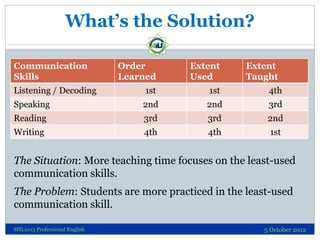
What’s the Solution?

Communication                  Order      Extent   Extent
Skills                         Learned    Used     Taught
Listening / Decoding                1st      1st       4th
Speaking                           2nd       2nd       3rd
Reading                            3rd       3rd       2nd
Writing                            4th       4th       1st


The Situation: More teaching time focuses on the least-used
communication skills.
The Problem: Students are more practiced in the least-used
communication skill.

SHL1013 Professional English                          5 October 2012
Points of Miscommunication

 Talking when we should be listening
 Thinking about what we are going to
  say rather than listening to a speaker
 Hearing what we expect to hear rather
  than what is actually said
 Not paying attention: preoccupation
 Not open-minded: prejudice, self-
  centeredness, stereotype
SHL1013 Professional English       5 October 2012
Quiz Tip

 Listening /decoding can be used to
   elicit meaning from words.
    How  can decoding elicit meaning from
     actions?
    How can decoding elicit meaning
     regarding a receiver’s attitudes?
    How can decoding elicit meaning
     regarding a receiver’s emotions?
SHL1013 Professional English              5 October 2012
Quiz Tip

 Decoding can be used in interpersonal
   communications.
    How  can decoding be used in intrapersonal
     communication?
    How can decoding be difficult when used
     in public communication?
    What are the barriers to effective decoding
     in mass communication?
SHL1013 Professional English              5 October 2012
Quiz Tip

 Decoding can be used in oral exchange.
    How  can decoding be used in textual
     exchange?
    How can decoding be used in non-verbal
     exchange?
    How is decoding used in visual
     communication?
    How is decoding used in tactile exchange?
    How is decoding used in kinetic exchange?

SHL1013 Professional English              5 October 2012
Quiz Tip

                               TRUE OR FALSE? WHY?
 Decoding is the receiver’s problem, not the
    sender’s.
   Listening and hearing are the same.
   Good readers are better listeners compared to good
    speakers.
   Smarter people are better listeners.
   A receiver can stop listening because of the
    message.
   Decoding is a minor part of the communication
    process.
SHL1013 Professional English                         5 October 2012
Quiz Tip

                               TRUE OR FALSE? WHY?
 The sender might have a problem if the
  receiver cannot decode the message
  correctly.
 Compared to speaking, reading requires
  more translation activity.
 People who decode can get more meaning
  than people who listen.
 A skill that is often used but not taught in
  school can be learned more easily.
SHL1013 Professional English                         5 October 2012
Stages of the Listening Process

 Hearing
 Focusing on the message
 Comprehending and interpreting
 Analyzing and Evaluating
 Responding
 Remembering

SHL1013 Professional English       5 October 2012
Barriers to Active Listening

 Environmental barriers
 Physiological barriers
 Psychological barriers
 Selective Listening
 Negative Listening Attitudes
 Personal Reactions
 Poor Motivation

SHL1013 Professional English     5 October 2012
Effective Communication

 Understand the complexities of
  decoding
 Make it easier for your target receiver
  to listen and decode your message
 Adjust to needs of each receiver
 Focus on ideas or key points
 Organize material for easier learning
SHL1013 Professional English         5 October 2012
To Be an Effective Decoder

      FOR CORPORATE EMPLOYEES, WORKERS, MANAGERS

 Want to listen
 Delay judgment
 Admit your biases
 Don’t tune out “dry” subjects
 Accept responsibility for understanding
 Encourage others to talk
SHL1013 Professional English               5 October 2012
To Be an Effective Decoder

                               FOR UNIVERSITY STUDENTS
 Establish eye contact with the speaker
 Take notes effectively
 Be a physically involved listener
 Avoid negative mannerisms
 Exercise your listening muscles
 Follow the Golden Rule: Do unto others as
   you want others to do unto you.
SHL1013 Professional English                             5 October 2012

Decoding Skills - Listening

  • 1.
    Listening Skills LISTENING VS. HEARING TRAINING IN LISTENING SKILLS SHL1013 Professional English 5 October 2012
  • 2.
    Listen ≠ Decode To listen is to understand meaning only, without the need to translate.  To decode is to translate to understand meaning and importance.  Listening and decoding are active processes of eliciting information  Is hearing the same as listening? SHL1013 Professional English 5 October 2012
  • 3.
    Hearing or Listening? To decode is to translate or to understand meaning and importance.  Hearing is a passive process of absorbing information.  Listening is an active process of eliciting information by decoding (translating) the code. SHL1013 Professional English 5 October 2012
  • 4.
    Hearing or Listening? Is hearing the same as listening?  The ears hear; the brain listens / decodes.  Hearing is automatic; listening / decoding is conscious and deliberate  Hearing may or may not create meaning. listening / decoding can creates meaning. SHL1013 Professional English 5 October 2012
  • 5.
    What’s the Solution? Communication Order Extent Extent Skills Learned Used Taught Listening / Decoding 1st 1st 4th Speaking 2nd 2nd 3rd Reading 3rd 3rd 2nd Writing 4th 4th 1st The Situation: More teaching time focuses on the least-used communication skills. The Problem: Students are more practiced in the least-used communication skill. SHL1013 Professional English 5 October 2012
  • 6.
    Points of Miscommunication Talking when we should be listening  Thinking about what we are going to say rather than listening to a speaker  Hearing what we expect to hear rather than what is actually said  Not paying attention: preoccupation  Not open-minded: prejudice, self- centeredness, stereotype SHL1013 Professional English 5 October 2012
  • 7.
    Quiz Tip  Listening/decoding can be used to elicit meaning from words.  How can decoding elicit meaning from actions?  How can decoding elicit meaning regarding a receiver’s attitudes?  How can decoding elicit meaning regarding a receiver’s emotions? SHL1013 Professional English 5 October 2012
  • 8.
    Quiz Tip  Decodingcan be used in interpersonal communications.  How can decoding be used in intrapersonal communication?  How can decoding be difficult when used in public communication?  What are the barriers to effective decoding in mass communication? SHL1013 Professional English 5 October 2012
  • 9.
    Quiz Tip  Decodingcan be used in oral exchange.  How can decoding be used in textual exchange?  How can decoding be used in non-verbal exchange?  How is decoding used in visual communication?  How is decoding used in tactile exchange?  How is decoding used in kinetic exchange? SHL1013 Professional English 5 October 2012
  • 10.
    Quiz Tip TRUE OR FALSE? WHY?  Decoding is the receiver’s problem, not the sender’s.  Listening and hearing are the same.  Good readers are better listeners compared to good speakers.  Smarter people are better listeners.  A receiver can stop listening because of the message.  Decoding is a minor part of the communication process. SHL1013 Professional English 5 October 2012
  • 11.
    Quiz Tip TRUE OR FALSE? WHY?  The sender might have a problem if the receiver cannot decode the message correctly.  Compared to speaking, reading requires more translation activity.  People who decode can get more meaning than people who listen.  A skill that is often used but not taught in school can be learned more easily. SHL1013 Professional English 5 October 2012
  • 12.
    Stages of theListening Process  Hearing  Focusing on the message  Comprehending and interpreting  Analyzing and Evaluating  Responding  Remembering SHL1013 Professional English 5 October 2012
  • 13.
    Barriers to ActiveListening  Environmental barriers  Physiological barriers  Psychological barriers  Selective Listening  Negative Listening Attitudes  Personal Reactions  Poor Motivation SHL1013 Professional English 5 October 2012
  • 14.
    Effective Communication  Understandthe complexities of decoding  Make it easier for your target receiver to listen and decode your message  Adjust to needs of each receiver  Focus on ideas or key points  Organize material for easier learning SHL1013 Professional English 5 October 2012
  • 15.
    To Be anEffective Decoder FOR CORPORATE EMPLOYEES, WORKERS, MANAGERS  Want to listen  Delay judgment  Admit your biases  Don’t tune out “dry” subjects  Accept responsibility for understanding  Encourage others to talk SHL1013 Professional English 5 October 2012
  • 16.
    To Be anEffective Decoder FOR UNIVERSITY STUDENTS  Establish eye contact with the speaker  Take notes effectively  Be a physically involved listener  Avoid negative mannerisms  Exercise your listening muscles  Follow the Golden Rule: Do unto others as you want others to do unto you. SHL1013 Professional English 5 October 2012