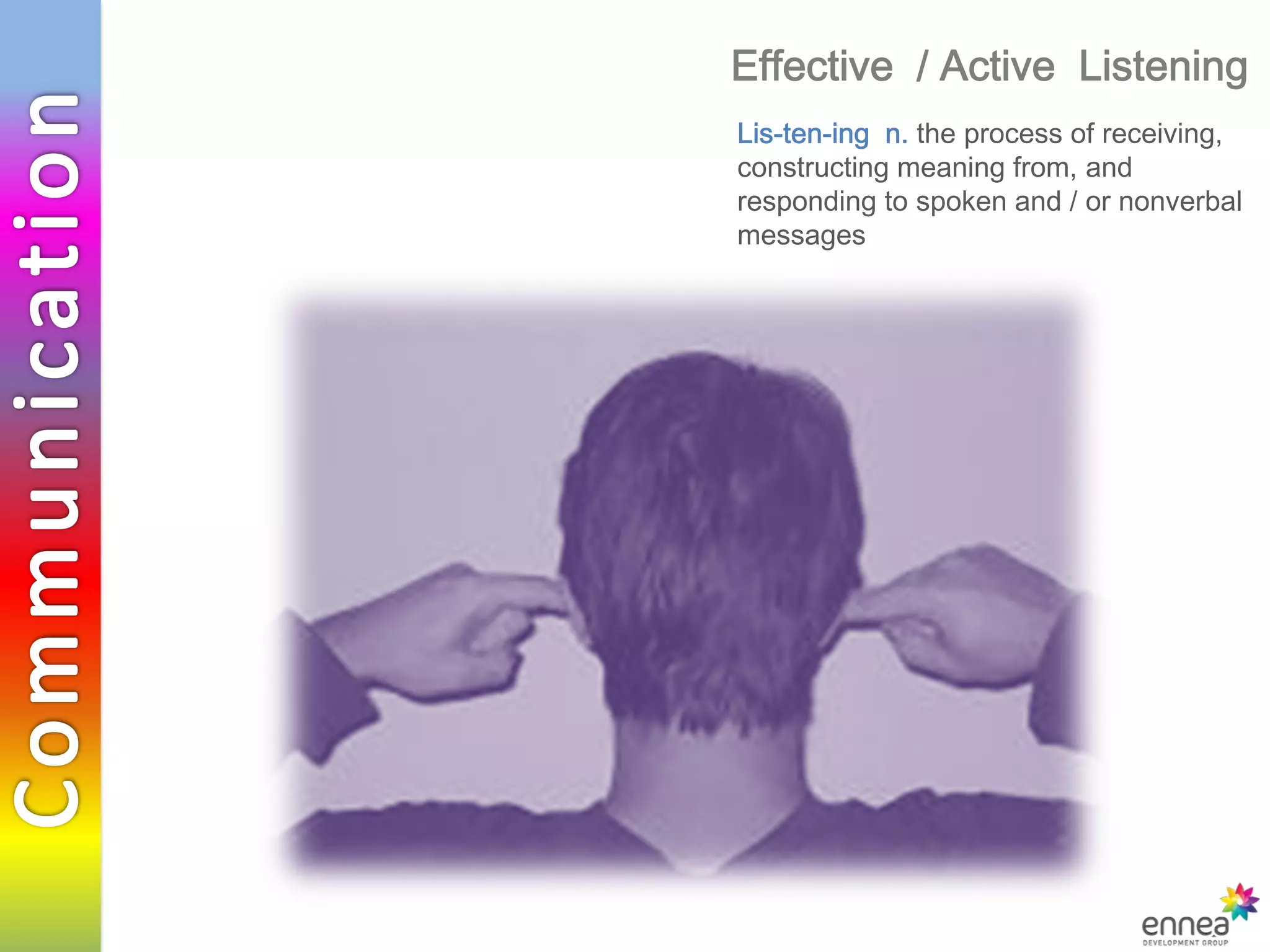
Effective / Active Listening
             Lis-ten-ing n. the process of receiving,
             constructing meaning from, and
             responding to spoken and / or nonverbal
             messages


© EDG 2010
Overview


                   I like to listen.

             I have learned a great deal

              from listening carefully.                        Definitions    •

                                                 Barriers and Bad habits      •
             Most people never listen.
                                                              4 Key Steps     •

                                           Tips for Active listening Skills   •
                 Ernest Hemingway
                                           Methods to test understanding      •

                                                                Summary       •


© EDG 2010
Communication – Why we need to be better Listeners

       •     We listen at 125 - 250 wpm, think at 1000-3000 wpm
       •     75% of the time we are distracted, preoccupied or forgetful
       •     20% of the time, we remember what we hear
       •     More than 35% of businesses think listening is a top skill for success
       •     Less than 2% of people have had formal education with listening

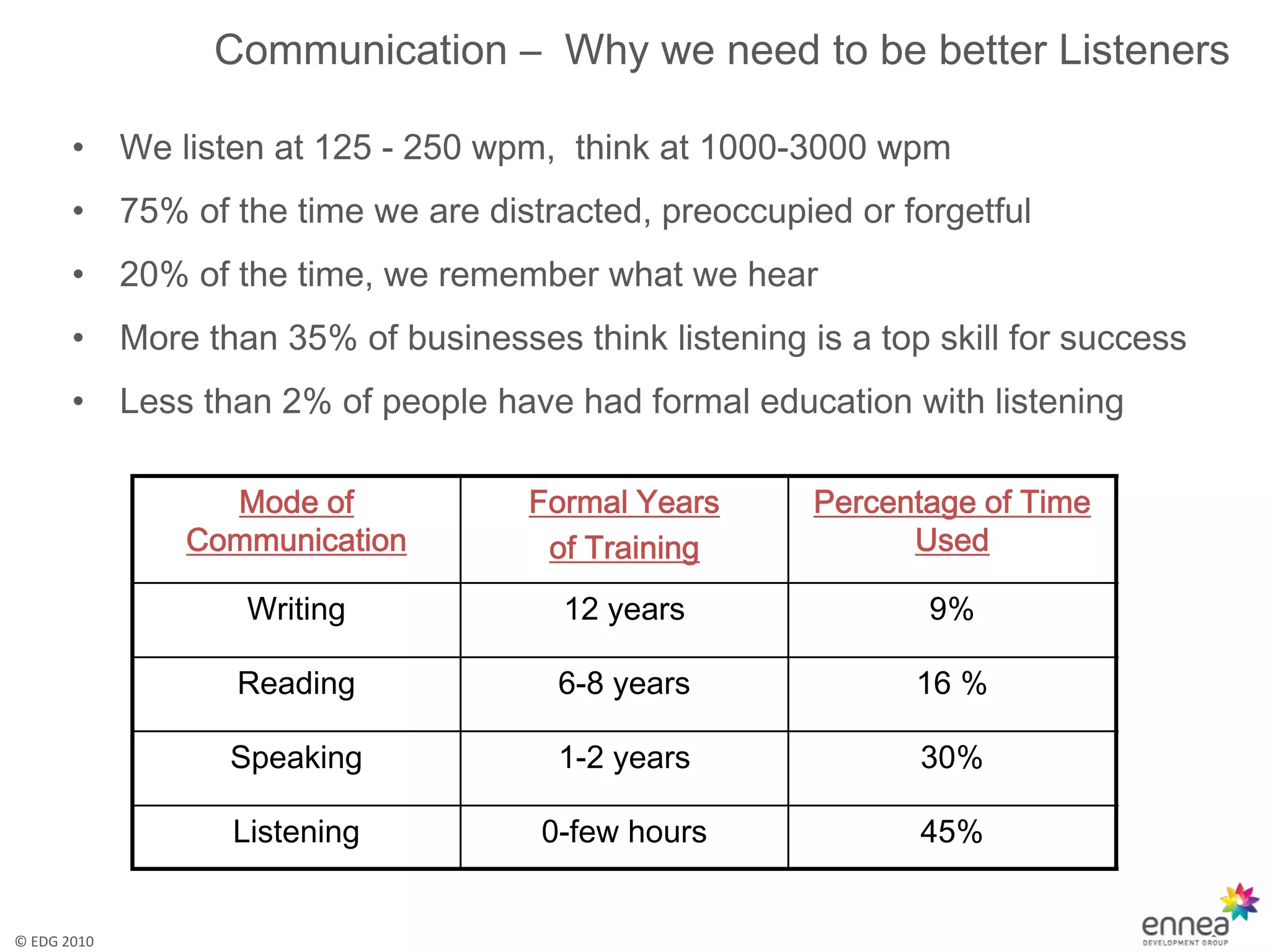
                   Mode of             Formal Years       Percentage of Time
                 Communication          of Training             Used

                     Writing              12 years                9%

                    Reading              6-8 years               16 %

                    Speaking             1-2 years               30%

                    Listening           0-few hours              45%


© EDG 2010
Definitions

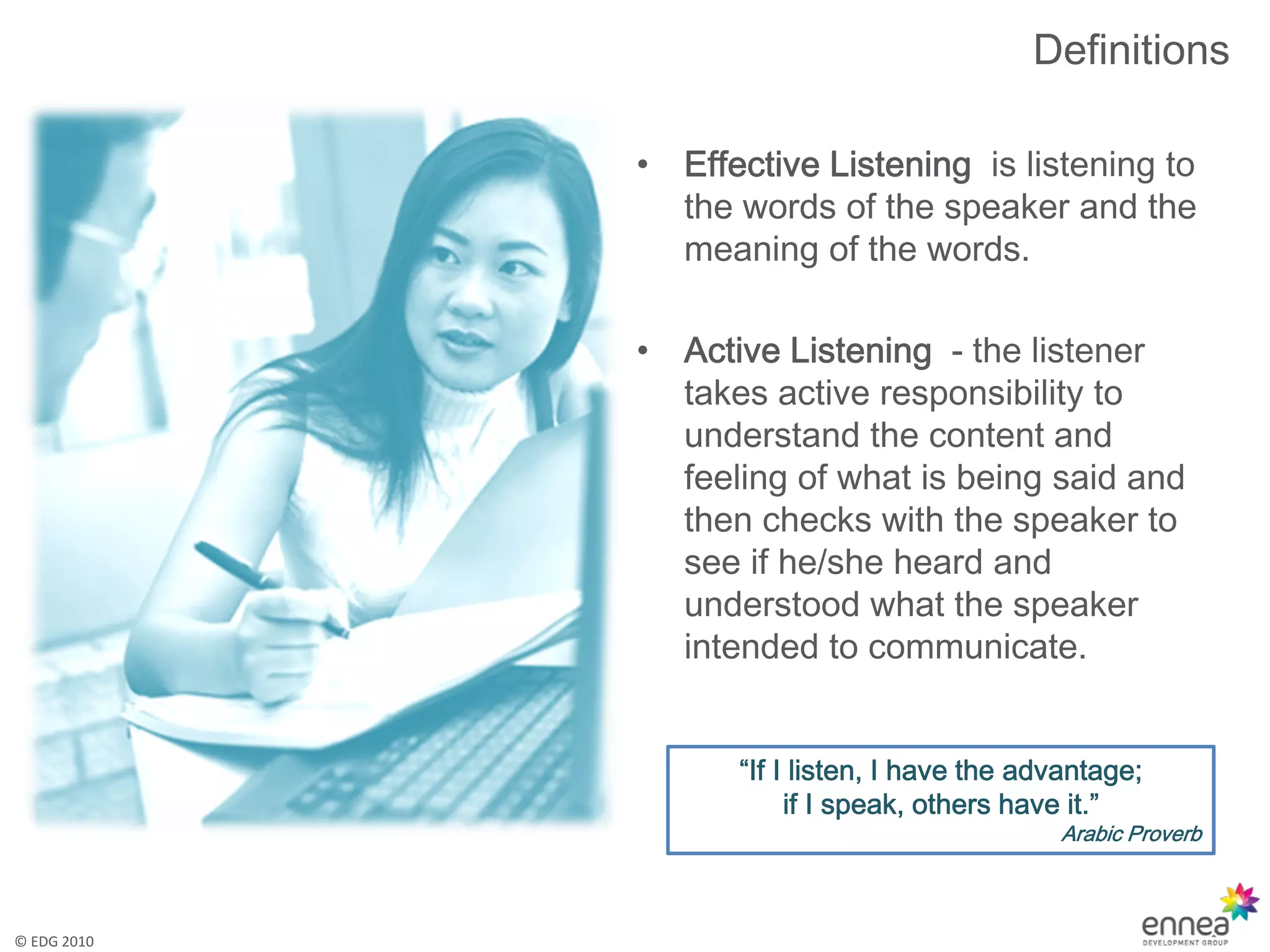
             •   Effective Listening is listening to
                 the words of the speaker and the
                 meaning of the words.

             •   Active Listening - the listener
                 takes active responsibility to
                 understand the content and
                 feeling of what is being said and
                 then checks with the speaker to
                 see if he/she heard and
                 understood what the speaker
                 intended to communicate.


                    “If I listen, I have the advantage;
                         if I speak, others have it.”
                                               Arabic Proverb


© EDG 2010
Barriers and bad habits to Effective/Active Listening


             •   Physical Barriers


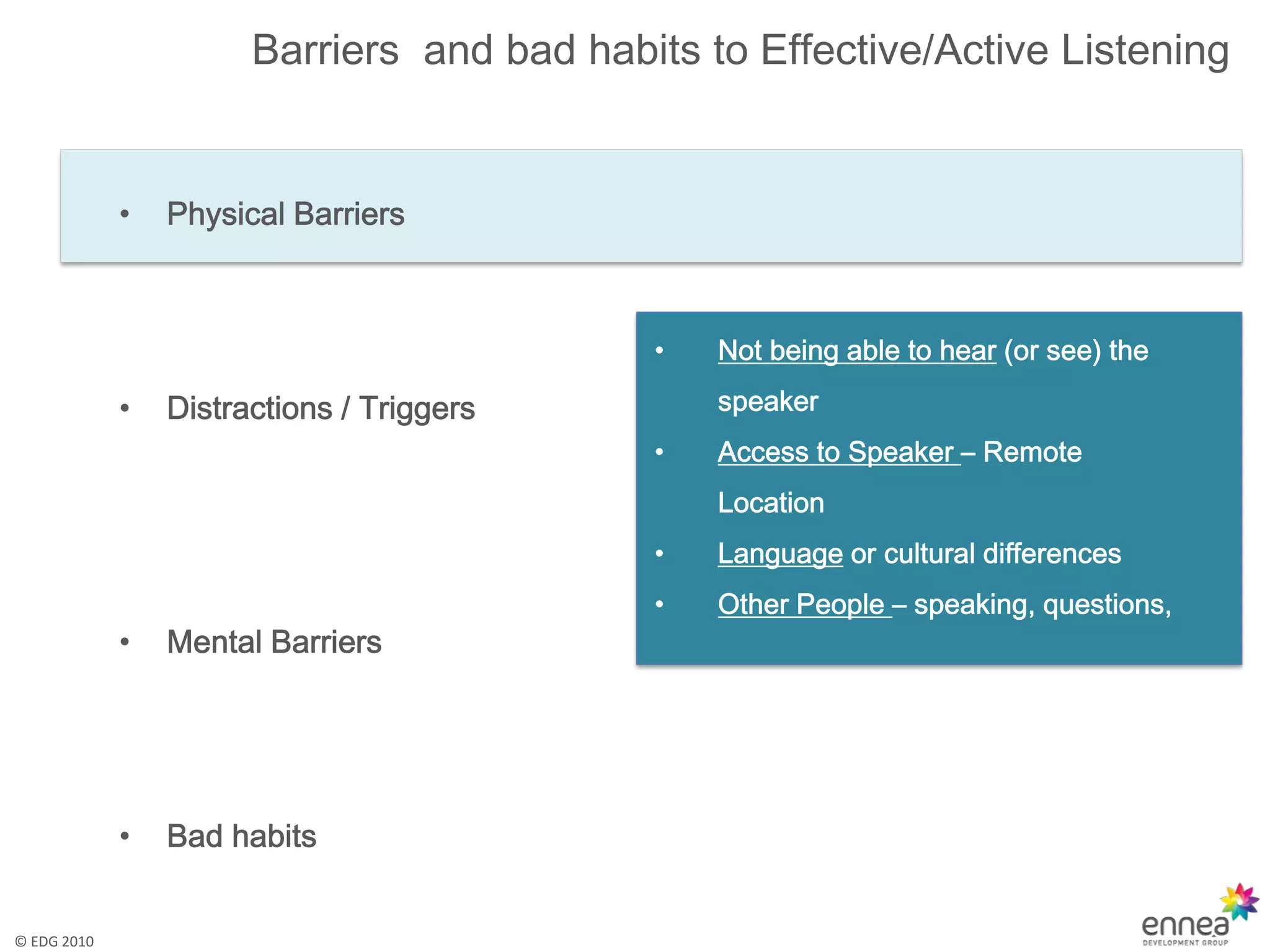
                                            •   Not being able to hear (or see) the

             •   Distractions / Triggers        speaker
                                            •   Access to Speaker – Remote
                                                Location
                                            •   Language or cultural differences
                                            •   Other People – speaking, questions,
             •   Mental Barriers


             •   Bad habits


© EDG 2010
Barriers and bad habits to Effective/Active Listening


             •   Physical Barriers


             •   Distractions / Triggers


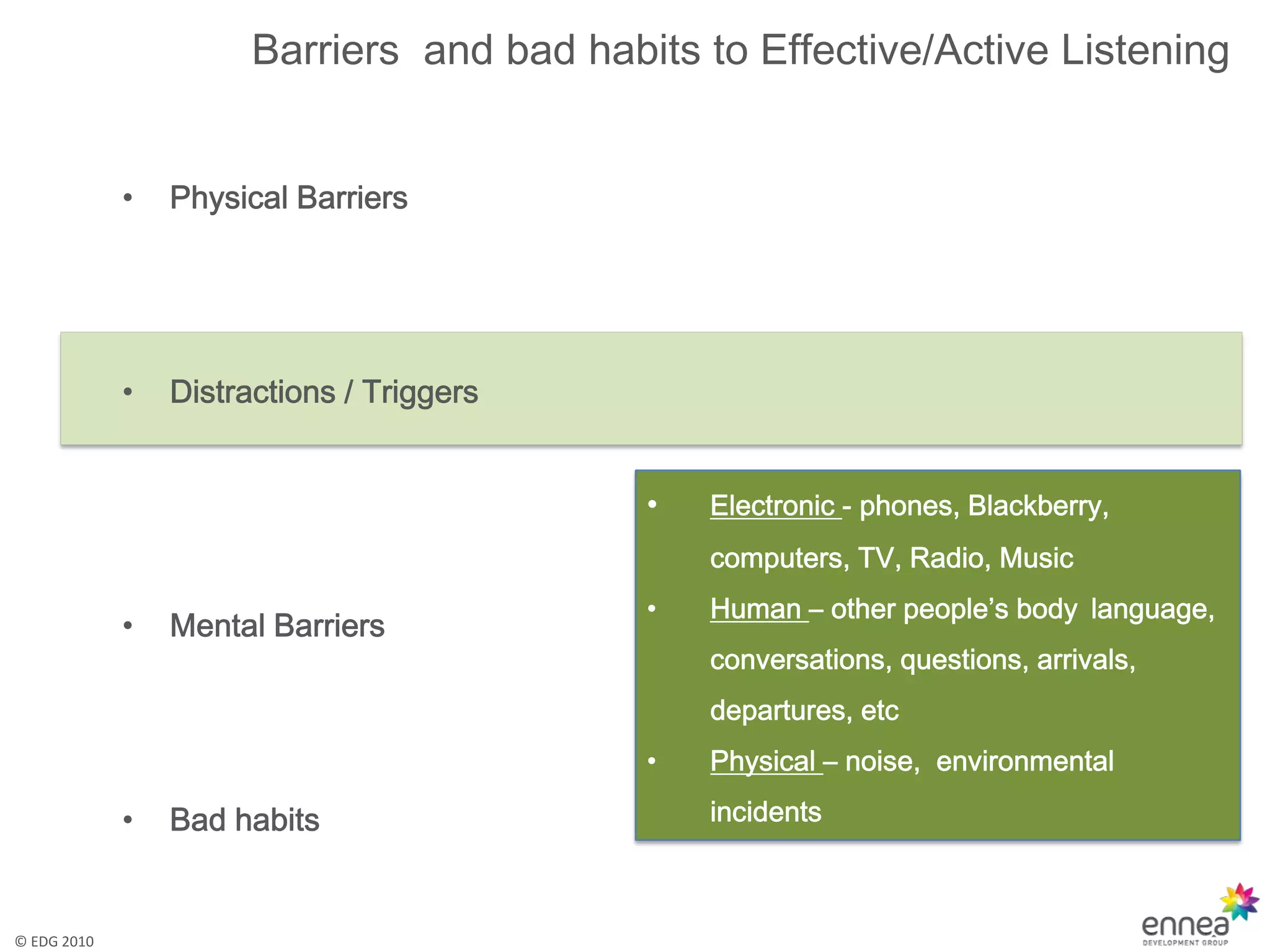
                                            •   Electronic - phones, Blackberry,
                                                computers, TV, Radio, Music
                                            •   Human – other people’s body language,
             •   Mental Barriers
                                                conversations, questions, arrivals,
                                                departures, etc
                                            •   Physical – noise, environmental

             •   Bad habits                     incidents


© EDG 2010
Barriers and bad habits to Effective/Active Listening

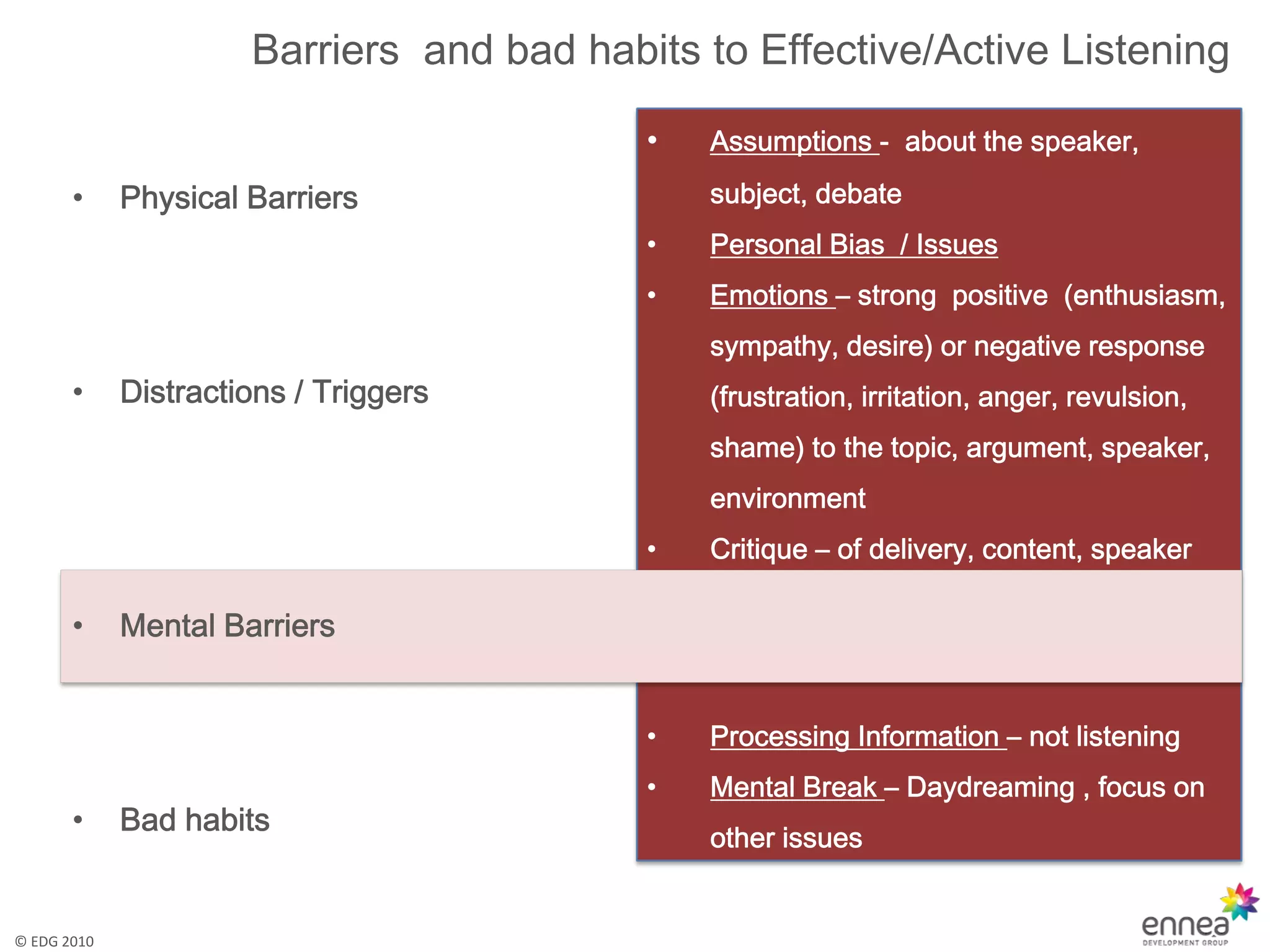
                                           •   Assumptions - about the speaker,

       •     Physical Barriers                 subject, debate
                                           •   Personal Bias / Issues
                                           •   Emotions – strong positive (enthusiasm,
                                               sympathy, desire) or negative response
       •     Distractions / Triggers           (frustration, irritation, anger, revulsion,
                                               shame) to the topic, argument, speaker,
                                               environment
                                           •   Critique – of delivery, content, speaker

       •     Mental Barriers


                                           •   Processing Information – not listening
                                           •   Mental Break – Daydreaming , focus on
       •     Bad habits
                                               other issues


© EDG 2010
Barriers and bad habits to Effective/Active Listening


       •     Physical Barriers
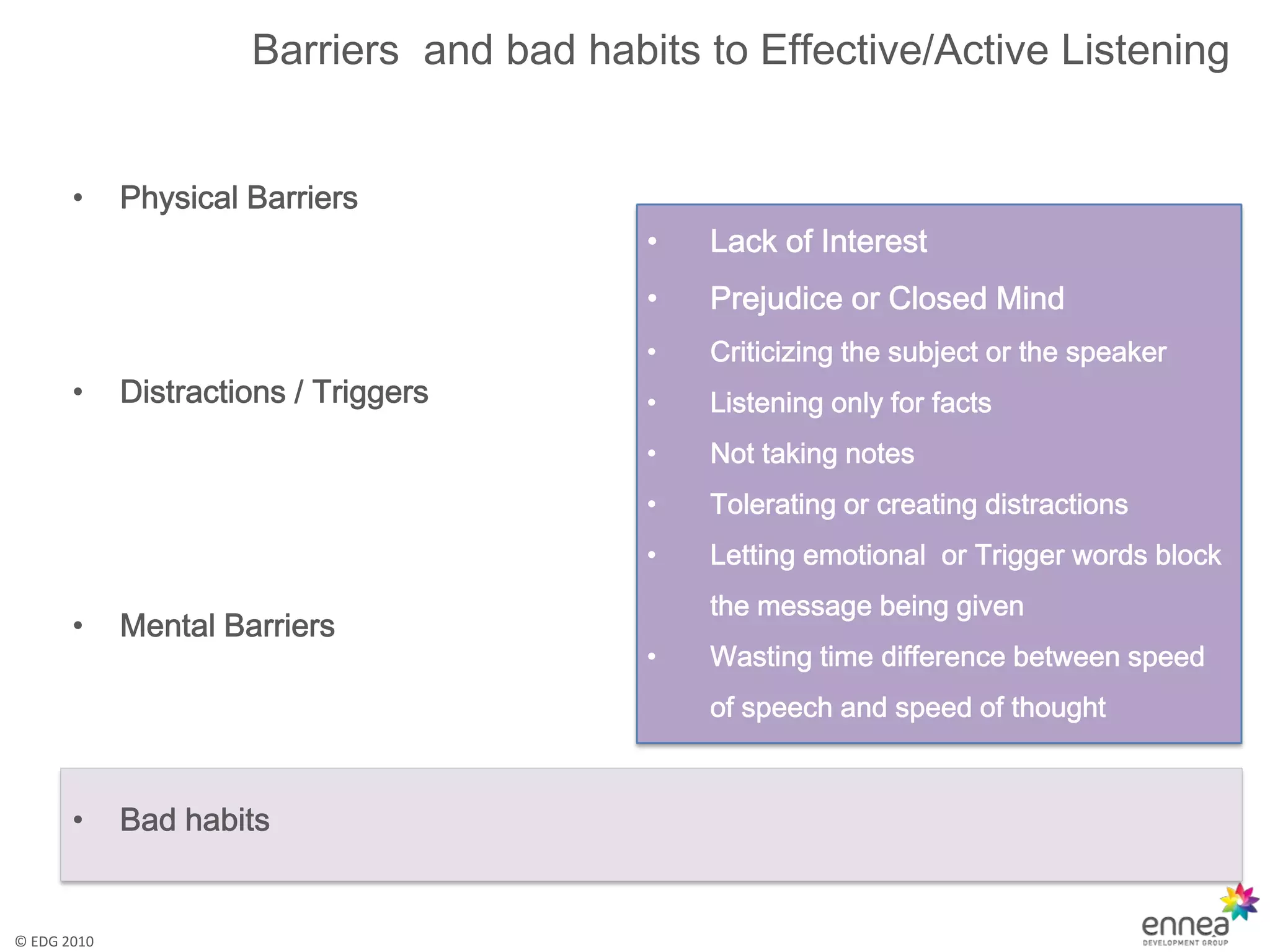
                                           •   Lack of Interest
                                           •   Prejudice or Closed Mind
                                           •   Criticizing the subject or the speaker
       •     Distractions / Triggers       •   Listening only for facts
                                           •   Not taking notes
                                           •   Tolerating or creating distractions
                                           •   Letting emotional or Trigger words block
                                               the message being given
       •     Mental Barriers
                                           •   Wasting time difference between speed
                                               of speech and speed of thought


       •     Bad habits


© EDG 2010
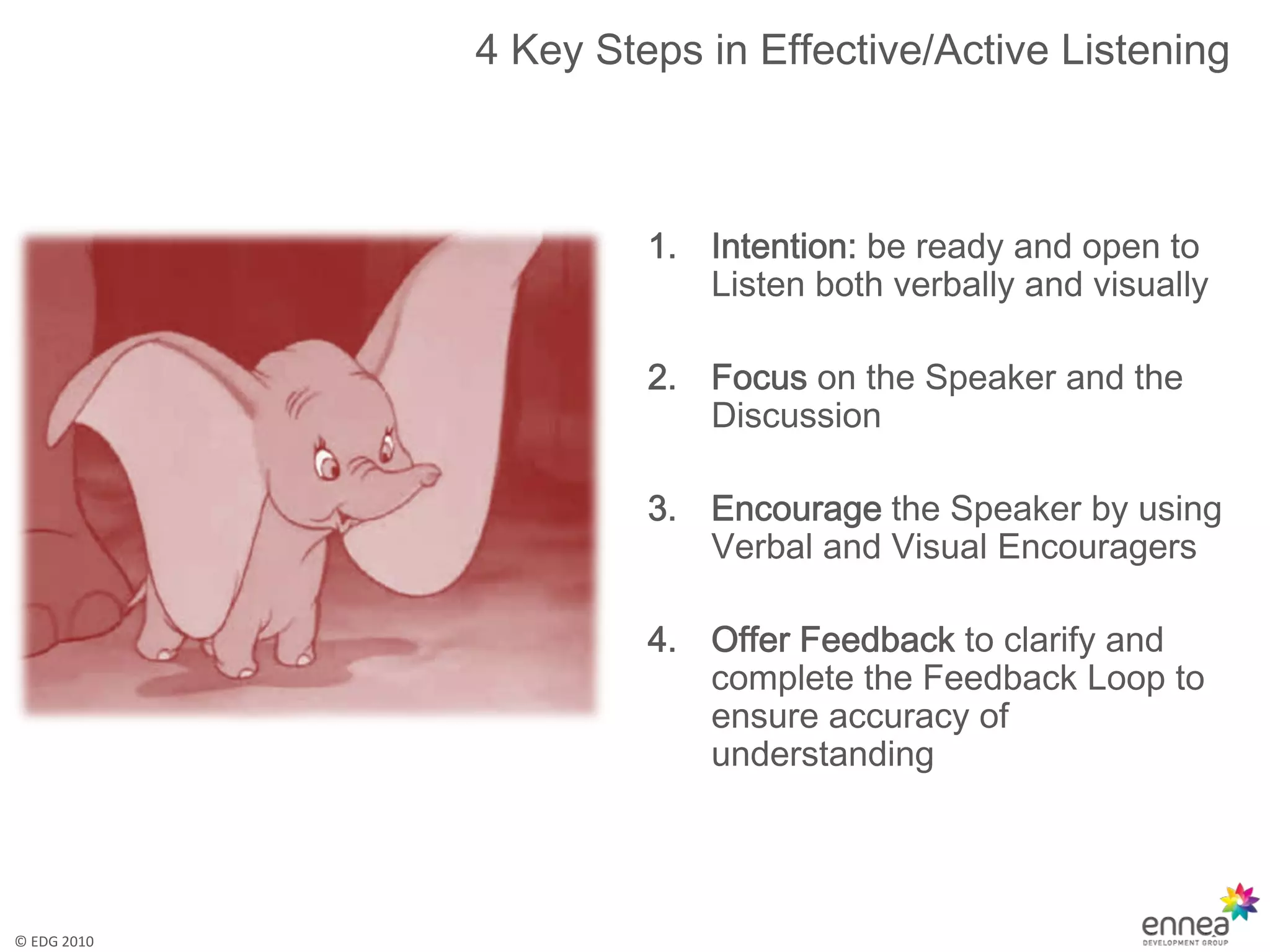
4 Key Steps in Effective/Active Listening


                      1. Intention: be ready and open to
                         Listen both verbally and visually

                      2. Focus on the Speaker and the
                         Discussion

                      3. Encourage the Speaker by using
                         Verbal and Visual Encouragers

                      4. Offer Feedback to clarify and
                         complete the Feedback Loop to
                         ensure accuracy of
                         understanding


© EDG 2010
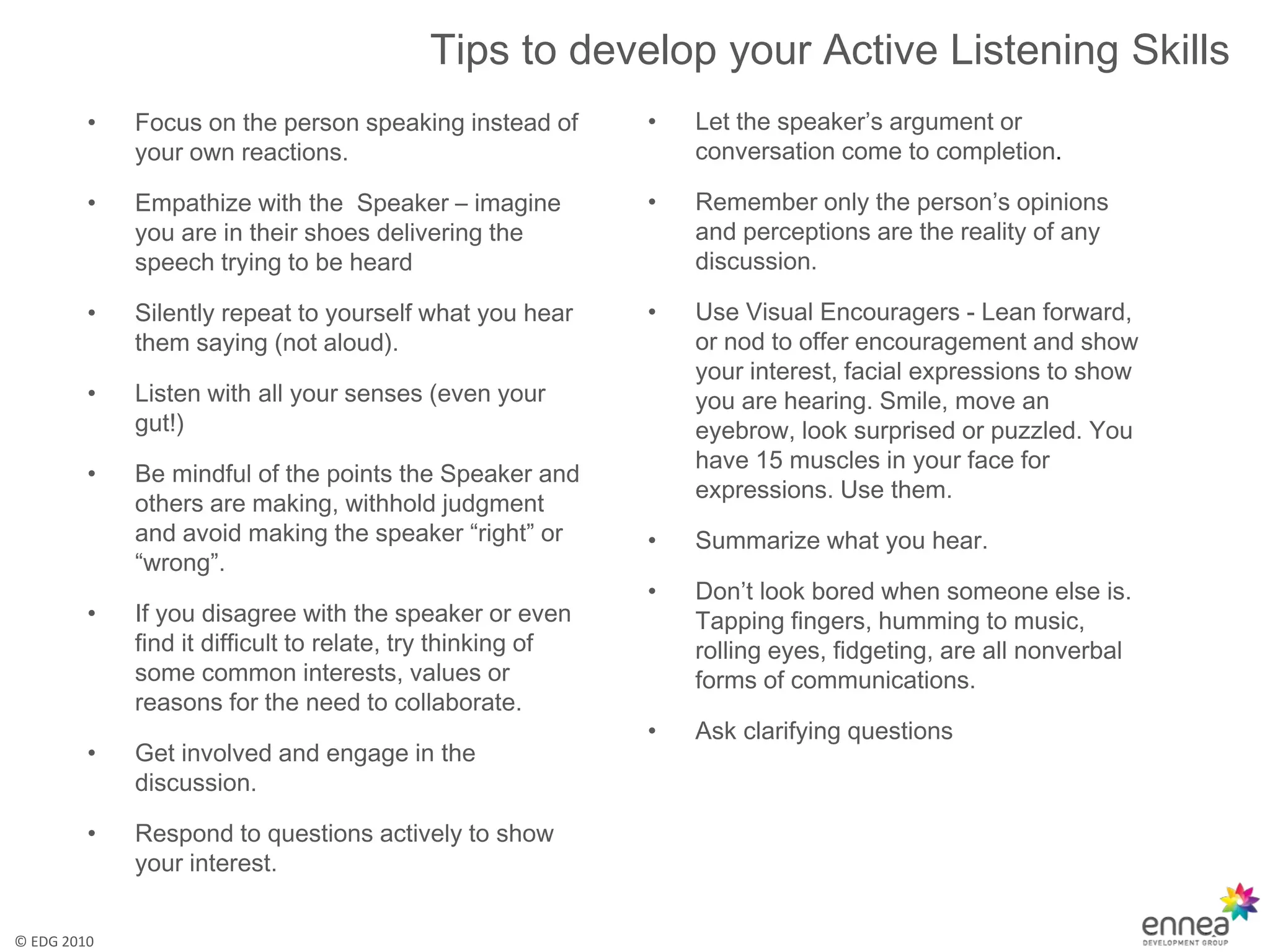
Tips to develop your Active Listening Skills
         •   Focus on the person speaking instead of        •   Let the speaker’s argument or
             your own reactions.                                conversation come to completion.

         •   Empathize with the Speaker – imagine           •   Remember only the person’s opinions
             you are in their shoes delivering the              and perceptions are the reality of any
             speech trying to be heard                          discussion.

         •   Silently repeat to yourself what you hear      •   Use Visual Encouragers - Lean forward,
             them saying (not aloud).                           or nod to offer encouragement and show
                                                                your interest, facial expressions to show
         •   Listen with all your senses (even your             you are hearing. Smile, move an
             gut!)                                              eyebrow, look surprised or puzzled. You
                                                                have 15 muscles in your face for
         •   Be mindful of the points the Speaker and
                                                                expressions. Use them.
             others are making, withhold judgment
             and avoid making the speaker “right” or        •   Summarize what you hear.
             “wrong”.
                                                            •   Don’t look bored when someone else is.
         •   If you disagree with the speaker or even           Tapping fingers, humming to music,
             find it difficult to relate, try thinking of       rolling eyes, fidgeting, are all nonverbal
             some common interests, values or                   forms of communications.
             reasons for the need to collaborate.
                                                            •   Ask clarifying questions
         •   Get involved and engage in the
             discussion.

         •   Respond to questions actively to show
             your interest.


© EDG 2010
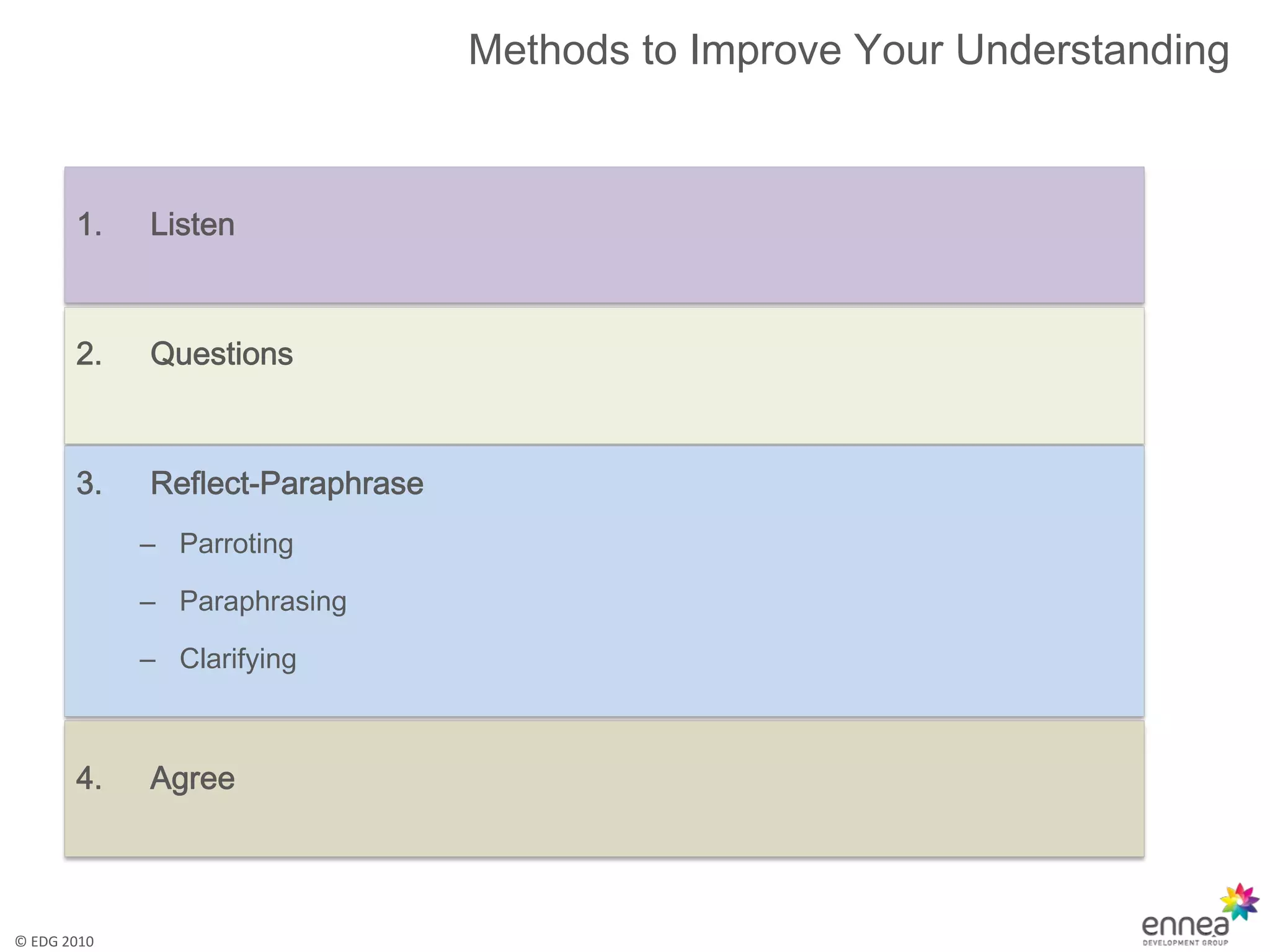
Methods to Improve Your Understanding


       1.    Listen


       2.    Questions


       3.    Reflect-Paraphrase
             – Parroting

             – Paraphrasing

             – Clarifying


       4.    Agree


© EDG 2010
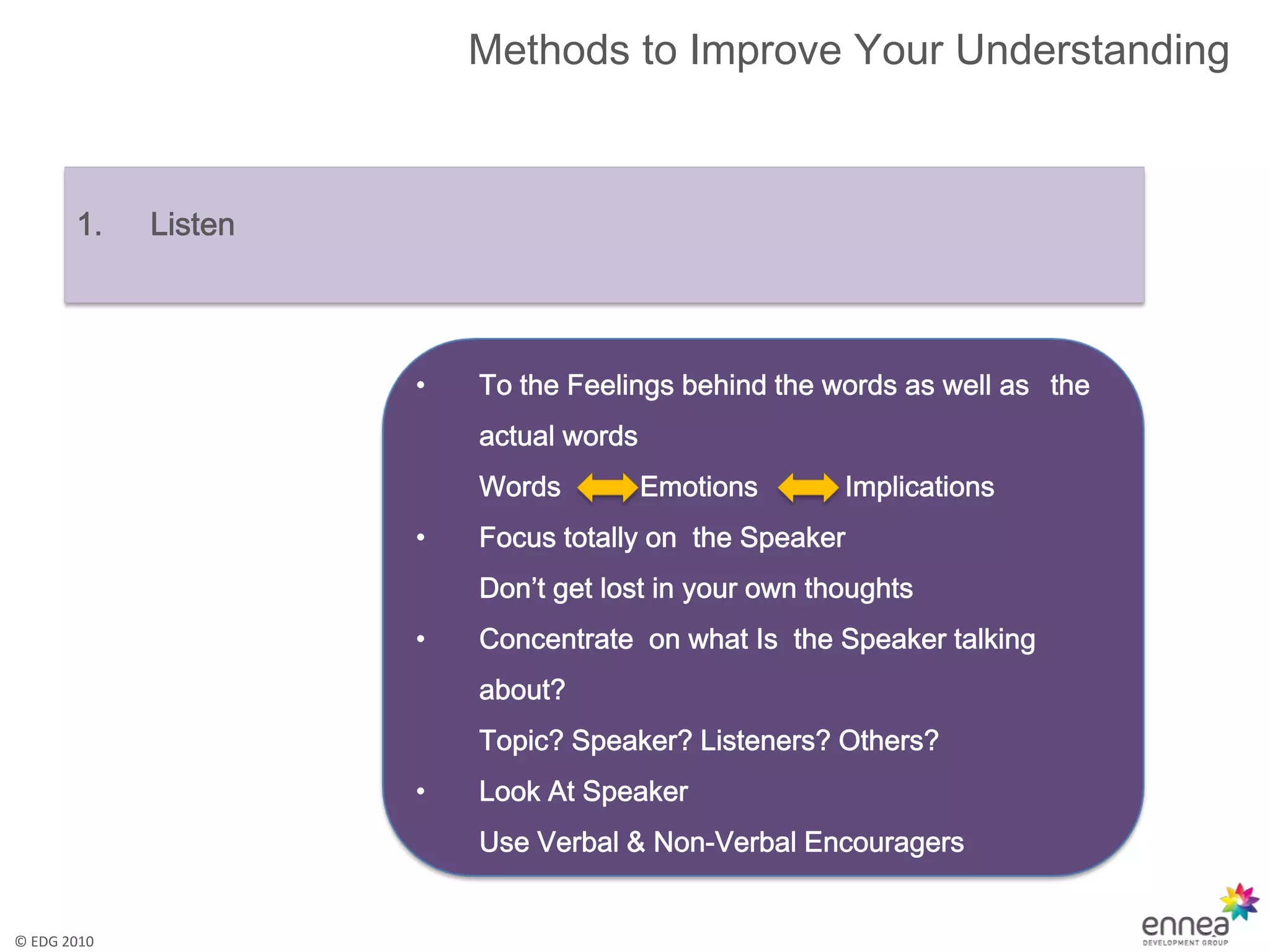
Methods to Improve Your Understanding


       1.    Listen


                      •   To the Feelings behind the words as well as the
                          actual words
                          Words          Emotions      Implications
                      •   Focus totally on the Speaker
                          Don’t get lost in your own thoughts
                      •   Concentrate on what Is the Speaker talking
                          about?
                          Topic? Speaker? Listeners? Others?
                      •   Look At Speaker
                          Use Verbal & Non-Verbal Encouragers


© EDG 2010
Methods to Improve Your Understanding


       2.    Questions


                         •   3 Reasons to Ask Questions
                                 Demonstrates you are listening
                                 Garner more information
                                 Clarification
                         •   Ask Open-ended Questions (5 W’s or H)
                                 How did you feel / What did that mean   to
                                 you/ What do you see… ? (sensory )
                                 Where will you…?
                                 What will happen…?


© EDG 2010
Methods to Improve Your Understanding

       3.    Reflect-Paraphrase
             – Parroting

             – Paraphrasing

             – Clarifying

                              •   Reflect what has been said (by restating in your
                                  own words)
                              •   Acknowledge and Reflect Feelings displayed
                              •   Reframe the sentiment or ideas or feelings
                                  Capture the essence of the communication
                                  Remove negative framing / positioning
                                  Move toward problem solving or positive outlook


© EDG 2010
Methods to Improve Your Understanding


       4.    Agree


                     •   Requires Closed (Yes/No) Questions
                     •   Get Speaker’s Consent and then agreement to
                         your Understanding or Reframing of their
                         position
                     •   Ask Speaker to acknowledge that they have
                         been heard by you
                     •   Get Agreement on Understanding


© EDG 2010
Summary


       Wisdom is the reward
      you get for a lifetime of                       Definitions     •
       listening when you'd              Barriers and Bad habits      •

      have preferred to talk.                         4 Key Steps     •

                                   Tips for Active listening Skills   •
             ~Doug Larson
                                  Methods to test understanding       •

                                                        Summary       •


© EDG 2010

ACTIVE LISTENING

  • 1.
    Effective / ActiveListening Lis-ten-ing n. the process of receiving, constructing meaning from, and responding to spoken and / or nonverbal messages © EDG 2010
  • 2.
    Overview I like to listen. I have learned a great deal from listening carefully. Definitions • Barriers and Bad habits • Most people never listen. 4 Key Steps • Tips for Active listening Skills • Ernest Hemingway Methods to test understanding • Summary • © EDG 2010
  • 3.
    Communication – Whywe need to be better Listeners • We listen at 125 - 250 wpm, think at 1000-3000 wpm • 75% of the time we are distracted, preoccupied or forgetful • 20% of the time, we remember what we hear • More than 35% of businesses think listening is a top skill for success • Less than 2% of people have had formal education with listening Mode of Formal Years Percentage of Time Communication of Training Used Writing 12 years 9% Reading 6-8 years 16 % Speaking 1-2 years 30% Listening 0-few hours 45% © EDG 2010
  • 4.
    Definitions • Effective Listening is listening to the words of the speaker and the meaning of the words. • Active Listening - the listener takes active responsibility to understand the content and feeling of what is being said and then checks with the speaker to see if he/she heard and understood what the speaker intended to communicate. “If I listen, I have the advantage; if I speak, others have it.” Arabic Proverb © EDG 2010
  • 5.
    Barriers and badhabits to Effective/Active Listening • Physical Barriers • Not being able to hear (or see) the • Distractions / Triggers speaker • Access to Speaker – Remote Location • Language or cultural differences • Other People – speaking, questions, • Mental Barriers • Bad habits © EDG 2010
  • 6.
    Barriers and badhabits to Effective/Active Listening • Physical Barriers • Distractions / Triggers • Electronic - phones, Blackberry, computers, TV, Radio, Music • Human – other people’s body language, • Mental Barriers conversations, questions, arrivals, departures, etc • Physical – noise, environmental • Bad habits incidents © EDG 2010
  • 7.
    Barriers and badhabits to Effective/Active Listening • Assumptions - about the speaker, • Physical Barriers subject, debate • Personal Bias / Issues • Emotions – strong positive (enthusiasm, sympathy, desire) or negative response • Distractions / Triggers (frustration, irritation, anger, revulsion, shame) to the topic, argument, speaker, environment • Critique – of delivery, content, speaker • Mental Barriers • Processing Information – not listening • Mental Break – Daydreaming , focus on • Bad habits other issues © EDG 2010
  • 8.
    Barriers and badhabits to Effective/Active Listening • Physical Barriers • Lack of Interest • Prejudice or Closed Mind • Criticizing the subject or the speaker • Distractions / Triggers • Listening only for facts • Not taking notes • Tolerating or creating distractions • Letting emotional or Trigger words block the message being given • Mental Barriers • Wasting time difference between speed of speech and speed of thought • Bad habits © EDG 2010
  • 9.
    4 Key Stepsin Effective/Active Listening 1. Intention: be ready and open to Listen both verbally and visually 2. Focus on the Speaker and the Discussion 3. Encourage the Speaker by using Verbal and Visual Encouragers 4. Offer Feedback to clarify and complete the Feedback Loop to ensure accuracy of understanding © EDG 2010
  • 10.
    Tips to developyour Active Listening Skills • Focus on the person speaking instead of • Let the speaker’s argument or your own reactions. conversation come to completion. • Empathize with the Speaker – imagine • Remember only the person’s opinions you are in their shoes delivering the and perceptions are the reality of any speech trying to be heard discussion. • Silently repeat to yourself what you hear • Use Visual Encouragers - Lean forward, them saying (not aloud). or nod to offer encouragement and show your interest, facial expressions to show • Listen with all your senses (even your you are hearing. Smile, move an gut!) eyebrow, look surprised or puzzled. You have 15 muscles in your face for • Be mindful of the points the Speaker and expressions. Use them. others are making, withhold judgment and avoid making the speaker “right” or • Summarize what you hear. “wrong”. • Don’t look bored when someone else is. • If you disagree with the speaker or even Tapping fingers, humming to music, find it difficult to relate, try thinking of rolling eyes, fidgeting, are all nonverbal some common interests, values or forms of communications. reasons for the need to collaborate. • Ask clarifying questions • Get involved and engage in the discussion. • Respond to questions actively to show your interest. © EDG 2010
  • 11.
    Methods to ImproveYour Understanding 1. Listen 2. Questions 3. Reflect-Paraphrase – Parroting – Paraphrasing – Clarifying 4. Agree © EDG 2010
  • 12.
    Methods to ImproveYour Understanding 1. Listen • To the Feelings behind the words as well as the actual words Words Emotions Implications • Focus totally on the Speaker Don’t get lost in your own thoughts • Concentrate on what Is the Speaker talking about? Topic? Speaker? Listeners? Others? • Look At Speaker Use Verbal & Non-Verbal Encouragers © EDG 2010
  • 13.
    Methods to ImproveYour Understanding 2. Questions • 3 Reasons to Ask Questions Demonstrates you are listening Garner more information Clarification • Ask Open-ended Questions (5 W’s or H) How did you feel / What did that mean to you/ What do you see… ? (sensory ) Where will you…? What will happen…? © EDG 2010
  • 14.
    Methods to ImproveYour Understanding 3. Reflect-Paraphrase – Parroting – Paraphrasing – Clarifying • Reflect what has been said (by restating in your own words) • Acknowledge and Reflect Feelings displayed • Reframe the sentiment or ideas or feelings Capture the essence of the communication Remove negative framing / positioning Move toward problem solving or positive outlook © EDG 2010
  • 15.
    Methods to ImproveYour Understanding 4. Agree • Requires Closed (Yes/No) Questions • Get Speaker’s Consent and then agreement to your Understanding or Reframing of their position • Ask Speaker to acknowledge that they have been heard by you • Get Agreement on Understanding © EDG 2010
  • 16.
    Summary Wisdom is the reward you get for a lifetime of Definitions • listening when you'd Barriers and Bad habits • have preferred to talk. 4 Key Steps • Tips for Active listening Skills • ~Doug Larson Methods to test understanding • Summary • © EDG 2010