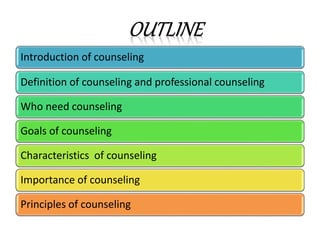
Introduction of counseling
Definition of counseling and professional counseling
Who need counseling
Goals of counseling
Characteristics of counseling
Importance of counseling
Principles of counseling
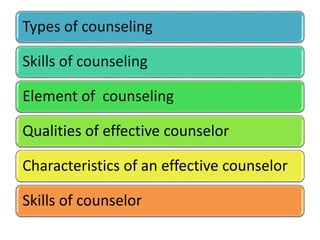
Types of counseling
Skills of counseling
Element of counseling
Qualities of effective counselor
Characteristics of an effective counselor
Skills of counselor
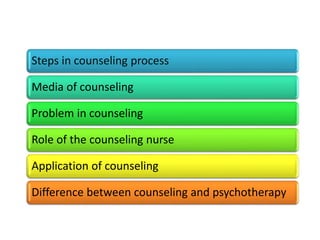
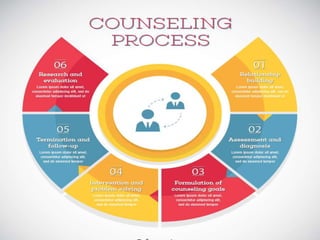
Steps in counseling process
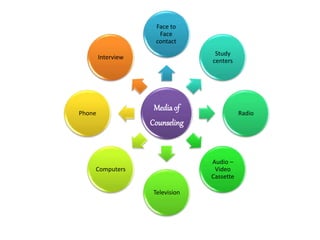
Media of counseling
Problem in counseling
Role of the counseling nurse
Application of counseling
Difference between counseling and psychotherapy
Introduction of counseling
• Counseling is as old as society. In every-day life
we find counseling goes on at many levels in a
family set-up, parents counsel their children, in
society doctors counsel patients, lawyers counsel
clients and teachers counsel students.
• Counseling is a process of assistance extended by
an expert in an individual situation to needy
person. Counseling involves two individuals one
seeking help and other a professionally trained
person helped solved problems to orient and
direct him to words a goals.
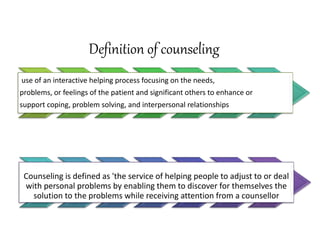
Definition of counseling
use of an interactive helping process focusing on the needs,
problems, or feelings of the patient and significant others to enhance or
support coping, problem solving, and interpersonal relationships
Counseling is defined as 'the service of helping people to adjust to or deal
with personal problems by enabling them to discover for themselves the
solution to the problems while receiving attention from a counsellor
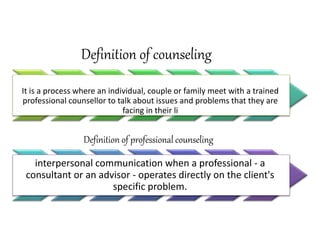
Definition of counseling
It is a process where an individual, couple or family meet with a trained
professional counsellor to talk about issues and problems that they are
facing in their li
Definition of professional counseling
interpersonal communication when a professional - a
consultant or an advisor - operates directly on the client's
specific problem.
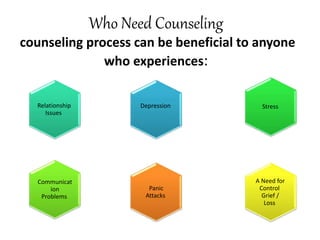
Who Need Counseling
counseling process can be beneficial to anyone
who experiences:
Depression
Relationship
Issues
Stress
Communicat
ion
Problems
A Need for
Control
Grief /
Loss
Panic
Attacks
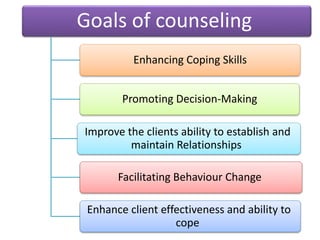
Goals of counseling
Enhancing Coping Skills
Promoting Decision-Making
Improve the clients ability to establish and
maintain Relationships
Facilitating Behaviour Change
Enhance client effectiveness and ability to
cope
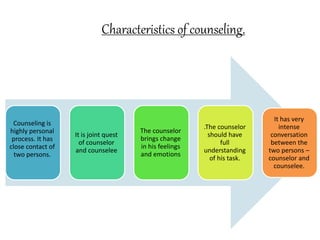
Characteristics of counseling.
Counseling is
highly personal
process. It has
close contact of
two persons.
It is joint quest
of counselor
and counselee
The counselor
brings change
in his feelings
and emotions
.The counselor
should have
full
understanding
of his task.
It has very
intense
conversation
between the
two persons –
counselor and
counselee.
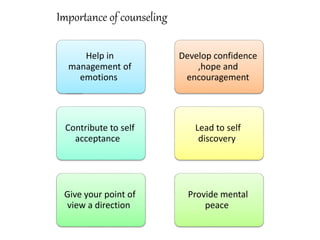
Help in
management of
emotions
Contribute to self
acceptance
Give your point of
view a direction
Provide mental
peace
Lead to self
discovery
Develop confidence
,hope and
encouragement
Importance of counseling
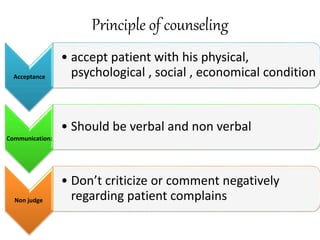
Principle of counseling
Acceptance
• accept patient with his physical,
psychological , social , economical condition
Communication:
• Should be verbal and non verbal
Non judge
• Don’t criticize or comment negatively
regarding patient complains
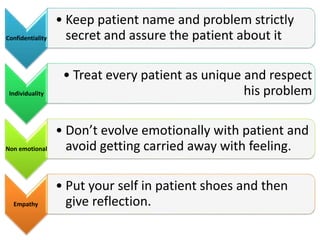
Confidentiality
• Keep patient name and problem strictly
secret and assure the patient about it
Individuality
• Treat every patient as unique and respect
his problem
Non emotional
• Don’t evolve emotionally with patient and
avoid getting carried away with feeling.
Empathy
• Put your self in patient shoes and then
give reflection.
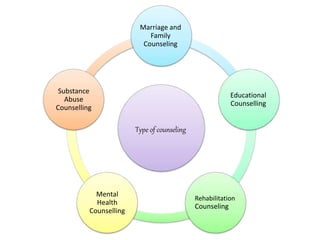
Type of counseling
Marriage and
Family
Counseling
Educational
Counselling
Rehabilitation
Counseling
Mental
Health
Counselling
Substance
Abuse
Counselling
Marriage and Family Counseling
• People often face a lot of problems in their
marriage and family life. Sometimes, these
troubled people find it hard to cope up with
their life. This results in constant fights with
their partners or family members. Marriage
and family counseling helps people with these
problems. They take them into confidence and
prescribe solutions that will help them
overcome their problems.
Educational Counseling
• A student who is fresh out of school or college is
often clueless as to which career to choose. This
is completely normal for kids of that age to feel
like that. Furthermore, sometimes even working
individuals feel like that in the midst of their
careers. This is nothing to worry about.
Educational counseling helps these people in
choosing their career path. They conduct
seminars and orientations or private sessions
where they discuss the interest of their client and
offer solutions accordingly.
Rehabilitation Counseling
• This type of counseling refers to a practice
where the counselor helps people with their
emotional and physical disabilities.
Furthermore, these counselors teach these
people ways to live independently and
maintain gainful employment. It evaluates the
strength and limitations of their patients. In
short, they help people in guiding them and
assisting them to lead independent lives.
Substance Abuse Counseling
• Substance abuse counseling is a form of
counseling which helps people in treating them
and supporting them from breaking free from
their drug and alcohol addiction. It helps people
discuss the cause of this addiction and reach to
the root of it. The counsellor thereby suggests
coping strategies which make a positive impact
on their lives. Moreover, they also provide them
with practicing skills and behaviors which helps in
their recovery.
Mental Health Counseling
• Mental illnesses have become very common
these days. Awareness has helped people identify
the symptoms of it and visit mental health
counsellors. Mental health counseling helps
people deal with issues that impact their mental
health and well-being. Some of the mental
illnesses are depression, PTSD, ADHD, Bipolar
disorder, and more. This counseling focuses on
these issues and helps in resolving them for a
healthier life.
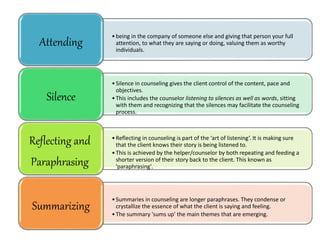
•being in the company of someone else and giving that person your full
attention, to what they are saying or doing, valuing them as worthy
individuals.
Attending
•Silence in counseling gives the client control of the content, pace and
objectives.
•This includes the counselor listening to silences as well as words, sitting
with them and recognizing that the silences may facilitate the counseling
process.
Silence
•Reflecting in counseling is part of the ‘art of listening’. It is making sure
that the client knows their story is being listened to.
•This is achieved by the helper/counselor by both repeating and feeding a
shorter version of their story back to the client. This known as
'paraphrasing'.
Reflecting and
Paraphrasing
•Summaries in counseling are longer paraphrases. They condense or
crystallize the essence of what the client is saying and feeling.
•The summary 'sums up' the main themes that are emerging.
Summarizing
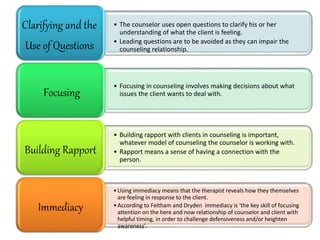
• The counselor uses open questions to clarify his or her
understanding of what the client is feeling.
• Leading questions are to be avoided as they can impair the
counseling relationship.
Clarifying and the
Use of Questions
• Focusing in counseling involves making decisions about what
issues the client wants to deal with.
Focusing
• Building rapport with clients in counseling is important,
whatever model of counseling the counselor is working with.
• Rapport means a sense of having a connection with the
person.
Building Rapport
•Using immediacy means that the therapist reveals how they themselves
are feeling in response to the client.
•According to Feltham and Dryden immediacy is ‘the key skill of focusing
attention on the here and now relationship of counselor and client with
helpful timing, in order to challenge defensiveness and/or heighten
awareness’.
Immediacy
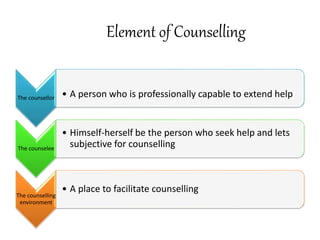
Element of Counselling
The counsellor • A person who is professionally capable to extend help
The counselee
• Himself-herself be the person who seek help and lets
subjective for counselling
The counselling
environment
• A place to facilitate counselling
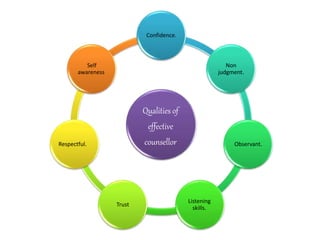
Qualities of
effective
counsellor
Confidence.
Non
judgment.
Observant.
Listening
skills.
Trust
Respectful.
Self
awareness
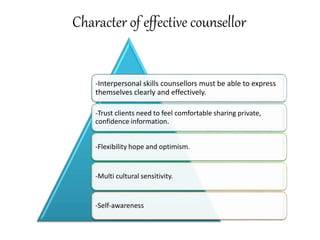
Character of effective counsellor
-Interpersonal skills counsellors must be able to express
themselves clearly and effectively.
-Trust clients need to feel comfortable sharing private,
confidence information.
-Flexibility hope and optimism.
-Multi cultural sensitivity.
-Self-awareness
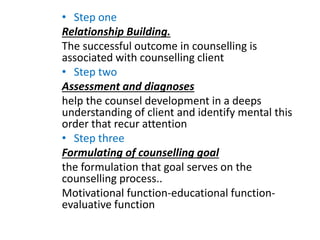
• Step one
Relationship Building.
The successful outcome in counselling is
associated with counselling client
• Step two
Assessment and diagnoses
help the counsel development in a deeps
understanding of client and identify mental this
order that recur attention
• Step three
Formulating of counselling goal
the formulation that goal serves on the
counselling process..
Motivational function-educational function-
evaluative function
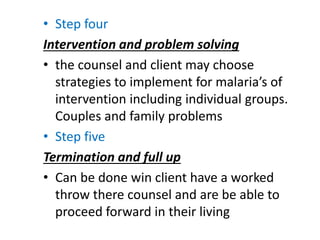
• Step four
Intervention and problem solving
• the counsel and client may choose
strategies to implement for malaria’s of
intervention including individual groups.
Couples and family problems
• Step five
Termination and full up
• Can be done win client have a worked
throw there counsel and are be able to
proceed forward in their living
Mediaof
Counseling
Face to
Face
contact
Study
centers
Radio
Audio –
Video
Cassette
Television
Computers
Phone
Interview
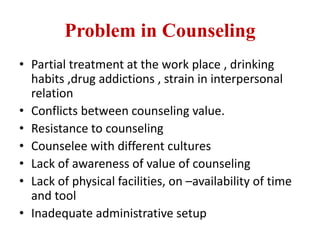
Problem in Counseling
• Partial treatment at the work place , drinking
habits ,drug addictions , strain in interpersonal
relation
• Conflicts between counseling value.
• Resistance to counseling
• Counselee with different cultures
• Lack of awareness of value of counseling
• Lack of physical facilities, on –availability of time
and tool
• Inadequate administrative setup
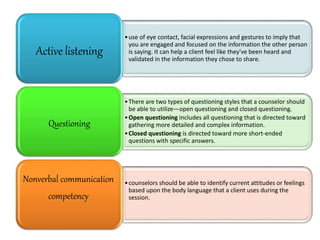
•use of eye contact, facial expressions and gestures to imply that
you are engaged and focused on the information the other person
is saying. It can help a client feel like they've been heard and
validated in the information they chose to share.
Active listening
•There are two types of questioning styles that a counselor should
be able to utilize—open questioning and closed questioning.
•Open questioning includes all questioning that is directed toward
gathering more detailed and complex information.
•Closed questioning is directed toward more short-ended
questions with specific answers.
Questioning
•counselors should be able to identify current attitudes or feelings
based upon the body language that a client uses during the
session.
Nonverbal communication
competency
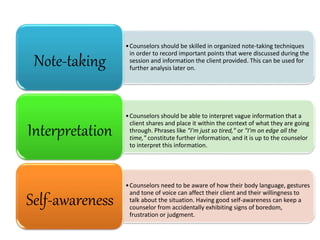
•Counselors should be skilled in organized note-taking techniques
in order to record important points that were discussed during the
session and information the client provided. This can be used for
further analysis later on.
Note-taking
•Counselors should be able to interpret vague information that a
client shares and place it within the context of what they are going
through. Phrases like "I'm just so tired," or "I'm on edge all the
time," constitute further information, and it is up to the counselor
to interpret this information.
Interpretation
•Counselors need to be aware of how their body language, gestures
and tone of voice can affect their client and their willingness to
talk about the situation. Having good self-awareness can keep a
counselor from accidentally exhibiting signs of boredom,
frustration or judgment.
Self-awareness
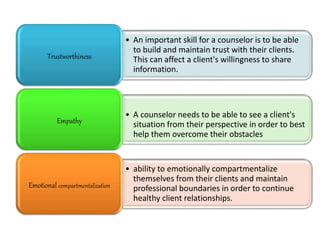
• An important skill for a counselor is to be able
to build and maintain trust with their clients.
This can affect a client's willingness to share
information.
Trustworthiness
• A counselor needs to be able to see a client's
situation from their perspective in order to best
help them overcome their obstacles
Empathy
• ability to emotionally compartmentalize
themselves from their clients and maintain
professional boundaries in order to continue
healthy client relationships.
Emotional compartmentalization
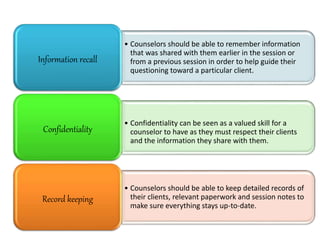
• Counselors should be able to remember information
that was shared with them earlier in the session or
from a previous session in order to help guide their
questioning toward a particular client.
Information recall
• Confidentiality can be seen as a valued skill for a
counselor to have as they must respect their clients
and the information they share with them.
Confidentiality
• Counselors should be able to keep detailed records of
their clients, relevant paperwork and session notes to
make sure everything stays up-to-date.
Record keeping
The Role of the counseling nurse
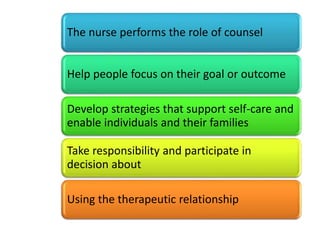
The nurse performs the role of counsel
Help people focus on their goal or outcome
Develop strategies that support self-care and
enable individuals and their families
Take responsibility and participate in
decision about
Using the therapeutic relationship
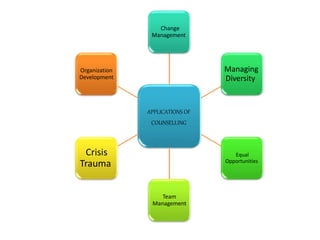
APPLICATIONS OF
COUNSELLING
Change
Management
Managing
Diversity
Equal
Opportunities
Team
Management
Crisis
Trauma
Organization
Development
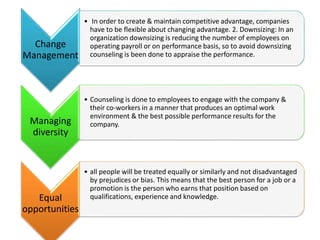
Change
Management
• In order to create & maintain competitive advantage, companies
have to be flexible about changing advantage. 2. Downsizing: In an
organization downsizing is reducing the number of employees on
operating payroll or on performance basis, so to avoid downsizing
counseling is been done to appraise the performance.
Managing
diversity
• Counseling is done to employees to engage with the company &
their co-workers in a manner that produces an optimal work
environment & the best possible performance results for the
company.
Equal
opportunities
• all people will be treated equally or similarly and not disadvantaged
by prejudices or bias. This means that the best person for a job or a
promotion is the person who earns that position based on
qualifications, experience and knowledge.
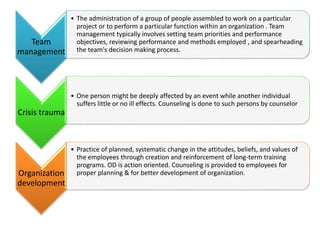
Team
management
• The administration of a group of people assembled to work on a particular
project or to perform a particular function within an organization . Team
management typically involves setting team priorities and performance
objectives, reviewing performance and methods employed , and spearheading
the team's decision making process.
Crisis trauma
• One person might be deeply affected by an event while another individual
suffers little or no ill effects. Counseling is done to such persons by counselor
Organization
development
• Practice of planned, systematic change in the attitudes, beliefs, and values of
the employees through creation and reinforcement of long-term training
programs. OD is action oriented. Counseling is provided to employees for
proper planning & for better development of organization.
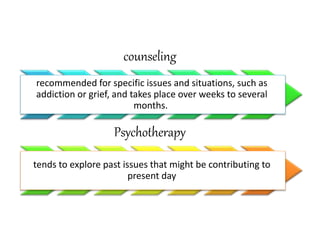
counseling
recommended for specific issues and situations, such as
addiction or grief, and takes place over weeks to several
months.
Psychotherapy
tends to explore past issues that might be contributing to
present day
07 counsling group 6.pptx

07 counsling group 6.pptx

  • 3.
    Introduction of counseling Definitionof counseling and professional counseling Who need counseling Goals of counseling Characteristics of counseling Importance of counseling Principles of counseling
  • 4.
    Types of counseling Skillsof counseling Element of counseling Qualities of effective counselor Characteristics of an effective counselor Skills of counselor
  • 5.
    Steps in counselingprocess Media of counseling Problem in counseling Role of the counseling nurse Application of counseling Difference between counseling and psychotherapy
  • 6.
    Introduction of counseling •Counseling is as old as society. In every-day life we find counseling goes on at many levels in a family set-up, parents counsel their children, in society doctors counsel patients, lawyers counsel clients and teachers counsel students. • Counseling is a process of assistance extended by an expert in an individual situation to needy person. Counseling involves two individuals one seeking help and other a professionally trained person helped solved problems to orient and direct him to words a goals.
  • 7.
    Definition of counseling useof an interactive helping process focusing on the needs, problems, or feelings of the patient and significant others to enhance or support coping, problem solving, and interpersonal relationships Counseling is defined as 'the service of helping people to adjust to or deal with personal problems by enabling them to discover for themselves the solution to the problems while receiving attention from a counsellor
  • 8.
    Definition of counseling Itis a process where an individual, couple or family meet with a trained professional counsellor to talk about issues and problems that they are facing in their li Definition of professional counseling interpersonal communication when a professional - a consultant or an advisor - operates directly on the client's specific problem.
  • 9.
    Who Need Counseling counselingprocess can be beneficial to anyone who experiences: Depression Relationship Issues Stress Communicat ion Problems A Need for Control Grief / Loss Panic Attacks
  • 10.
    Goals of counseling EnhancingCoping Skills Promoting Decision-Making Improve the clients ability to establish and maintain Relationships Facilitating Behaviour Change Enhance client effectiveness and ability to cope
  • 11.
    Characteristics of counseling. Counselingis highly personal process. It has close contact of two persons. It is joint quest of counselor and counselee The counselor brings change in his feelings and emotions .The counselor should have full understanding of his task. It has very intense conversation between the two persons – counselor and counselee.
  • 12.
    Help in management of emotions Contributeto self acceptance Give your point of view a direction Provide mental peace Lead to self discovery Develop confidence ,hope and encouragement Importance of counseling
  • 13.
    Principle of counseling Acceptance •accept patient with his physical, psychological , social , economical condition Communication: • Should be verbal and non verbal Non judge • Don’t criticize or comment negatively regarding patient complains
  • 14.
    Confidentiality • Keep patientname and problem strictly secret and assure the patient about it Individuality • Treat every patient as unique and respect his problem Non emotional • Don’t evolve emotionally with patient and avoid getting carried away with feeling. Empathy • Put your self in patient shoes and then give reflection.
  • 15.
    Type of counseling Marriageand Family Counseling Educational Counselling Rehabilitation Counseling Mental Health Counselling Substance Abuse Counselling
  • 16.
    Marriage and FamilyCounseling • People often face a lot of problems in their marriage and family life. Sometimes, these troubled people find it hard to cope up with their life. This results in constant fights with their partners or family members. Marriage and family counseling helps people with these problems. They take them into confidence and prescribe solutions that will help them overcome their problems.
  • 17.
    Educational Counseling • Astudent who is fresh out of school or college is often clueless as to which career to choose. This is completely normal for kids of that age to feel like that. Furthermore, sometimes even working individuals feel like that in the midst of their careers. This is nothing to worry about. Educational counseling helps these people in choosing their career path. They conduct seminars and orientations or private sessions where they discuss the interest of their client and offer solutions accordingly.
  • 18.
    Rehabilitation Counseling • Thistype of counseling refers to a practice where the counselor helps people with their emotional and physical disabilities. Furthermore, these counselors teach these people ways to live independently and maintain gainful employment. It evaluates the strength and limitations of their patients. In short, they help people in guiding them and assisting them to lead independent lives.
  • 19.
    Substance Abuse Counseling •Substance abuse counseling is a form of counseling which helps people in treating them and supporting them from breaking free from their drug and alcohol addiction. It helps people discuss the cause of this addiction and reach to the root of it. The counsellor thereby suggests coping strategies which make a positive impact on their lives. Moreover, they also provide them with practicing skills and behaviors which helps in their recovery.
  • 20.
    Mental Health Counseling •Mental illnesses have become very common these days. Awareness has helped people identify the symptoms of it and visit mental health counsellors. Mental health counseling helps people deal with issues that impact their mental health and well-being. Some of the mental illnesses are depression, PTSD, ADHD, Bipolar disorder, and more. This counseling focuses on these issues and helps in resolving them for a healthier life.
  • 22.
    •being in thecompany of someone else and giving that person your full attention, to what they are saying or doing, valuing them as worthy individuals. Attending •Silence in counseling gives the client control of the content, pace and objectives. •This includes the counselor listening to silences as well as words, sitting with them and recognizing that the silences may facilitate the counseling process. Silence •Reflecting in counseling is part of the ‘art of listening’. It is making sure that the client knows their story is being listened to. •This is achieved by the helper/counselor by both repeating and feeding a shorter version of their story back to the client. This known as 'paraphrasing'. Reflecting and Paraphrasing •Summaries in counseling are longer paraphrases. They condense or crystallize the essence of what the client is saying and feeling. •The summary 'sums up' the main themes that are emerging. Summarizing
  • 23.
    • The counseloruses open questions to clarify his or her understanding of what the client is feeling. • Leading questions are to be avoided as they can impair the counseling relationship. Clarifying and the Use of Questions • Focusing in counseling involves making decisions about what issues the client wants to deal with. Focusing • Building rapport with clients in counseling is important, whatever model of counseling the counselor is working with. • Rapport means a sense of having a connection with the person. Building Rapport •Using immediacy means that the therapist reveals how they themselves are feeling in response to the client. •According to Feltham and Dryden immediacy is ‘the key skill of focusing attention on the here and now relationship of counselor and client with helpful timing, in order to challenge defensiveness and/or heighten awareness’. Immediacy
  • 24.
    Element of Counselling Thecounsellor • A person who is professionally capable to extend help The counselee • Himself-herself be the person who seek help and lets subjective for counselling The counselling environment • A place to facilitate counselling
  • 25.
  • 26.
    Character of effectivecounsellor -Interpersonal skills counsellors must be able to express themselves clearly and effectively. -Trust clients need to feel comfortable sharing private, confidence information. -Flexibility hope and optimism. -Multi cultural sensitivity. -Self-awareness
  • 28.
    • Step one RelationshipBuilding. The successful outcome in counselling is associated with counselling client • Step two Assessment and diagnoses help the counsel development in a deeps understanding of client and identify mental this order that recur attention • Step three Formulating of counselling goal the formulation that goal serves on the counselling process.. Motivational function-educational function- evaluative function
  • 29.
    • Step four Interventionand problem solving • the counsel and client may choose strategies to implement for malaria’s of intervention including individual groups. Couples and family problems • Step five Termination and full up • Can be done win client have a worked throw there counsel and are be able to proceed forward in their living
  • 31.
  • 32.
    Problem in Counseling •Partial treatment at the work place , drinking habits ,drug addictions , strain in interpersonal relation • Conflicts between counseling value. • Resistance to counseling • Counselee with different cultures • Lack of awareness of value of counseling • Lack of physical facilities, on –availability of time and tool • Inadequate administrative setup
  • 34.
    •use of eyecontact, facial expressions and gestures to imply that you are engaged and focused on the information the other person is saying. It can help a client feel like they've been heard and validated in the information they chose to share. Active listening •There are two types of questioning styles that a counselor should be able to utilize—open questioning and closed questioning. •Open questioning includes all questioning that is directed toward gathering more detailed and complex information. •Closed questioning is directed toward more short-ended questions with specific answers. Questioning •counselors should be able to identify current attitudes or feelings based upon the body language that a client uses during the session. Nonverbal communication competency
  • 35.
    •Counselors should beskilled in organized note-taking techniques in order to record important points that were discussed during the session and information the client provided. This can be used for further analysis later on. Note-taking •Counselors should be able to interpret vague information that a client shares and place it within the context of what they are going through. Phrases like "I'm just so tired," or "I'm on edge all the time," constitute further information, and it is up to the counselor to interpret this information. Interpretation •Counselors need to be aware of how their body language, gestures and tone of voice can affect their client and their willingness to talk about the situation. Having good self-awareness can keep a counselor from accidentally exhibiting signs of boredom, frustration or judgment. Self-awareness
  • 36.
    • An importantskill for a counselor is to be able to build and maintain trust with their clients. This can affect a client's willingness to share information. Trustworthiness • A counselor needs to be able to see a client's situation from their perspective in order to best help them overcome their obstacles Empathy • ability to emotionally compartmentalize themselves from their clients and maintain professional boundaries in order to continue healthy client relationships. Emotional compartmentalization
  • 37.
    • Counselors shouldbe able to remember information that was shared with them earlier in the session or from a previous session in order to help guide their questioning toward a particular client. Information recall • Confidentiality can be seen as a valued skill for a counselor to have as they must respect their clients and the information they share with them. Confidentiality • Counselors should be able to keep detailed records of their clients, relevant paperwork and session notes to make sure everything stays up-to-date. Record keeping
  • 38.
    The Role ofthe counseling nurse
  • 39.
    The nurse performsthe role of counsel Help people focus on their goal or outcome Develop strategies that support self-care and enable individuals and their families Take responsibility and participate in decision about Using the therapeutic relationship
  • 40.
  • 41.
    Change Management • In orderto create & maintain competitive advantage, companies have to be flexible about changing advantage. 2. Downsizing: In an organization downsizing is reducing the number of employees on operating payroll or on performance basis, so to avoid downsizing counseling is been done to appraise the performance. Managing diversity • Counseling is done to employees to engage with the company & their co-workers in a manner that produces an optimal work environment & the best possible performance results for the company. Equal opportunities • all people will be treated equally or similarly and not disadvantaged by prejudices or bias. This means that the best person for a job or a promotion is the person who earns that position based on qualifications, experience and knowledge.
  • 42.
    Team management • The administrationof a group of people assembled to work on a particular project or to perform a particular function within an organization . Team management typically involves setting team priorities and performance objectives, reviewing performance and methods employed , and spearheading the team's decision making process. Crisis trauma • One person might be deeply affected by an event while another individual suffers little or no ill effects. Counseling is done to such persons by counselor Organization development • Practice of planned, systematic change in the attitudes, beliefs, and values of the employees through creation and reinforcement of long-term training programs. OD is action oriented. Counseling is provided to employees for proper planning & for better development of organization.
  • 44.
    counseling recommended for specificissues and situations, such as addiction or grief, and takes place over weeks to several months. Psychotherapy tends to explore past issues that might be contributing to present day