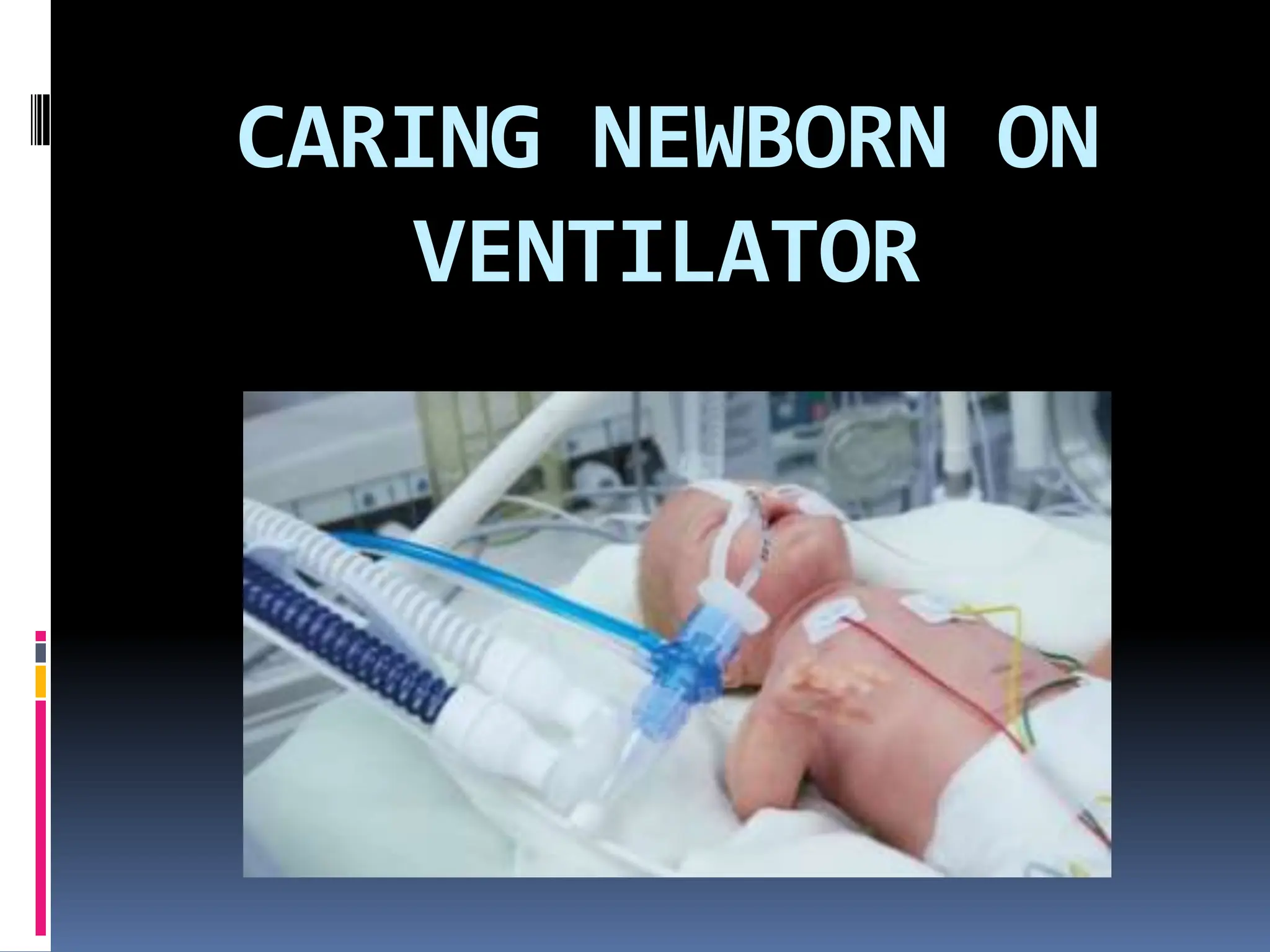
CARING NEWBORN ON
VENTILATOR
Mechanical ventilation
ď‚§ Mechanical ventilation or assisted
ventilation is the medical term for using a
machine called a ventilator to fully or
partially provide artificial ventilation.
ď‚§ Mechanical ventilation helps move air into
and out of the lungs, with the main goal of
helping the delivery of oxygen and removal
of carbon dioxide.
GOALS OF MECHANICAL VENTILATION
1. Minimize the risk of lung injury.
2. Reduce patient work of breathing.
3. Provide adequate oxygenation and
ventilation with the most minimal
intervention possible.
Indications
1. Respiratory distress syndrome (RDS)
2. Persistent bradycardia.
3. Failure to establish spontaneous
respiration in spite of mask.
4. Extremely premature baby
GENERAL PRINCIPLES
1. Achieve and maintain adequate
pulmonary gas exchange.
2. Reduce newborn work of breathing.
3. Minimize the risk of lung injury.
4. Optimize newborn comfort.
5. Appropriate oxygenation
Positioning
ď‚§ Change position: Supine, right or left
lateral every 2 – 4 hourly
ď‚§ Encourages postural drainage when
indicated
ď‚§ Passive physiotherapy.
ď‚§ Augment with nebulization
Promote Respiratory
Function
ď‚§ Auscultate lungs frequently to assess
for abnormal sounds.
ď‚§ Suction as needed.
ď‚§ Secure ETT properly.
ď‚§ Monitor ABG value and pulse
oximetry.
Prevention of Nosocomial
Infection
Surveillance of flora
ď‚§ Routine :Weekly swabs from various sites of
NICU
ď‚§ Endotracheal tube tips
ď‚§ Strict aseptic procedures
ď‚§ Carbolysation / disinfection of all equipments
/ items entering NICU
Provision of in-utero like
environment
ď‚§ Gentle handling
ď‚§ Reduce ambient noise levels
ď‚§ Control NICU environment - Optimum
Lighting
ď‚§ Thermal Comfort : Thermoneutral
environment (22-26 degree celcius)
Minimizing Oxygen demand
ď‚§ Treat fever and pain as they increase oxygen
consumption
ď‚§ Preventing hypothermia
ď‚§ Excessive crying and excessive movements of
limbs increase BMR and hence oxygen
demand.
ď‚§ Schedule care activities at one time
ď‚§ Approach softly and gently
Humidification
ď‚§ Inadequate humidification of the
inspired air may result in increased
volume and viscosity of secretions
and this increases risk of airway
obstruction.
Skin care
ď‚§ Skin hygiene should be maintained
properly.
ď‚§ Sponge bath with tepid water.
ď‚§ Mild moisturizers can be used.
Eye Care
ď‚§ Ventilated baby is often sedated and
increase the risk of corneal ulceration
or infection.
ď‚§ Eyes should be cleaned with sterile
wet swabs from inner canthus to
outer canthus.
Biochemical Monitoring
ď‚§ Blood investigations: LFT, RFT,
electrolytes.
ď‚§ ABG analysis
ď‚§ Blood culture: indicated before
changing antibiotics.
Suctioning
ď‚§ Strictly a sterile procedure
ď‚§ Suction catheter size 6, 8 and 10 fr
 Duration is short – entire procedure not
more than 10 – 20 sec
ď‚§ Suction pressure- 60- 80 mm hg for
neonates and infants
SUCTIONING
Articles Required
A big tray containing:
ď‚§ Sterile suction catheter (6-8 fr)
ď‚§ Normal saline / sterile water
ď‚§ Sterile gloves
ď‚§ Face mask
ď‚§ Stethoscope
A sterile tray containing:
ď‚§ Sterile bowl
ď‚§ Gauze pieces
ventilator, child on ventilator, newborn

ventilator, child on ventilator, newborn

  • 1.
  • 2.
    Mechanical ventilation ď‚§ Mechanicalventilation or assisted ventilation is the medical term for using a machine called a ventilator to fully or partially provide artificial ventilation. ď‚§ Mechanical ventilation helps move air into and out of the lungs, with the main goal of helping the delivery of oxygen and removal of carbon dioxide.
  • 3.
    GOALS OF MECHANICALVENTILATION 1. Minimize the risk of lung injury. 2. Reduce patient work of breathing. 3. Provide adequate oxygenation and ventilation with the most minimal intervention possible.
  • 4.
    Indications 1. Respiratory distresssyndrome (RDS) 2. Persistent bradycardia. 3. Failure to establish spontaneous respiration in spite of mask. 4. Extremely premature baby
  • 5.
    GENERAL PRINCIPLES 1. Achieveand maintain adequate pulmonary gas exchange. 2. Reduce newborn work of breathing. 3. Minimize the risk of lung injury. 4. Optimize newborn comfort. 5. Appropriate oxygenation
  • 6.
    Positioning  Change position:Supine, right or left lateral every 2 – 4 hourly  Encourages postural drainage when indicated  Passive physiotherapy.  Augment with nebulization
  • 7.
    Promote Respiratory Function ď‚§ Auscultatelungs frequently to assess for abnormal sounds. ď‚§ Suction as needed. ď‚§ Secure ETT properly. ď‚§ Monitor ABG value and pulse oximetry.
  • 8.
    Prevention of Nosocomial Infection Surveillanceof flora ď‚§ Routine :Weekly swabs from various sites of NICU ď‚§ Endotracheal tube tips ď‚§ Strict aseptic procedures ď‚§ Carbolysation / disinfection of all equipments / items entering NICU
  • 9.
    Provision of in-uterolike environment ď‚§ Gentle handling ď‚§ Reduce ambient noise levels ď‚§ Control NICU environment - Optimum Lighting ď‚§ Thermal Comfort : Thermoneutral environment (22-26 degree celcius)
  • 10.
    Minimizing Oxygen demand ď‚§Treat fever and pain as they increase oxygen consumption ď‚§ Preventing hypothermia ď‚§ Excessive crying and excessive movements of limbs increase BMR and hence oxygen demand. ď‚§ Schedule care activities at one time ď‚§ Approach softly and gently
  • 11.
    Humidification ď‚§ Inadequate humidificationof the inspired air may result in increased volume and viscosity of secretions and this increases risk of airway obstruction.
  • 12.
    Skin care ď‚§ Skinhygiene should be maintained properly. ď‚§ Sponge bath with tepid water. ď‚§ Mild moisturizers can be used.
  • 13.
    Eye Care ď‚§ Ventilatedbaby is often sedated and increase the risk of corneal ulceration or infection. ď‚§ Eyes should be cleaned with sterile wet swabs from inner canthus to outer canthus.
  • 14.
    Biochemical Monitoring ď‚§ Bloodinvestigations: LFT, RFT, electrolytes. ď‚§ ABG analysis ď‚§ Blood culture: indicated before changing antibiotics.
  • 15.
    Suctioning  Strictly asterile procedure  Suction catheter size 6, 8 and 10 fr  Duration is short – entire procedure not more than 10 – 20 sec  Suction pressure- 60- 80 mm hg for neonates and infants
  • 16.
  • 21.
    Articles Required A bigtray containing: ď‚§ Sterile suction catheter (6-8 fr) ď‚§ Normal saline / sterile water ď‚§ Sterile gloves ď‚§ Face mask ď‚§ Stethoscope A sterile tray containing: ď‚§ Sterile bowl ď‚§ Gauze pieces