L - Listening
S - Speaking
R - Reading
W - Writing
 The First and the Foremost communication skill
that we learn in our lives is LISTENING.
 It’s a Mother of all other skills.
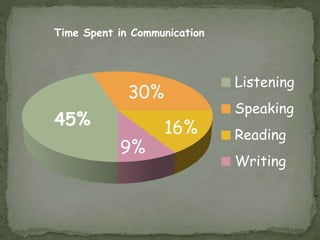
 We/Students spend more time on listening
45%
30%
16%
9%
Time Spent in Communication
Listening
Speaking
Reading
Writing
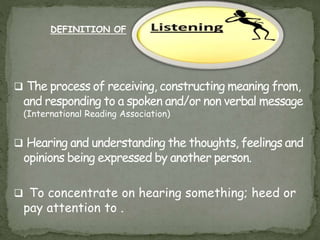
 The process of receiving, constructing meaning from,
and responding to a spoken and/or non verbal message
(International Reading Association)
 Hearing and understanding the thoughts, feelings and
opinions being expressed by another person.
 To concentrate on hearing something; heed or
pay attention to .
DEFINITION OF
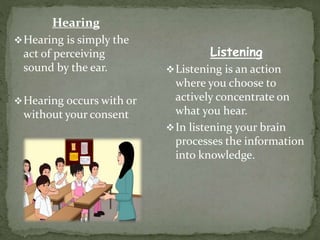
Hearing
Hearing is simply the
act of perceiving
sound by the ear.
Hearing occurs with or
without your consent
Listening
Listening is an action
where you choose to
actively concentrate on
what you hear.
In listening your brain
processes the information
into knowledge.
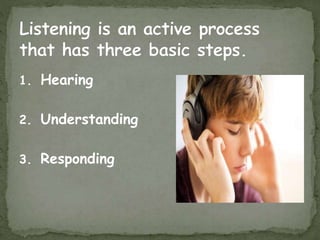
1. Hearing
2. Understanding
3. Responding
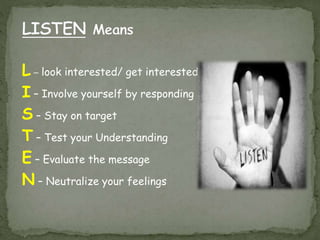
L – look interested/ get interested
I – Involve yourself by responding
S – Stay on target
T – Test your Understanding
E – Evaluate the message
N – Neutralize your feelings
Listening is a conscious activity
based on three basic skills:
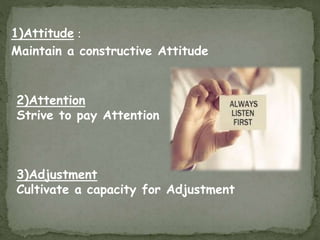
1) Attitude
2) Attention
3) Adjustment
1)Attitude :
Maintain a constructive Attitude
2)Attention
Strive to pay Attention
3)Adjustment
Cultivate a capacity for Adjustment
Types of Listening
1) Appreciative listening
2) Empathic listening
3) Comprehensive/Active listening
4) Critical /Analytical listening
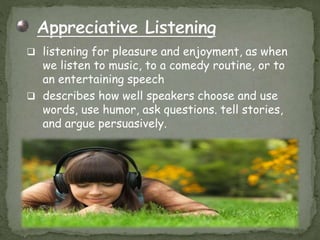
 listening for pleasure and enjoyment, as when
we listen to music, to a comedy routine, or to
an entertaining speech
 describes how well speakers choose and use
words, use humor, ask questions. tell stories,
and argue persuasively.
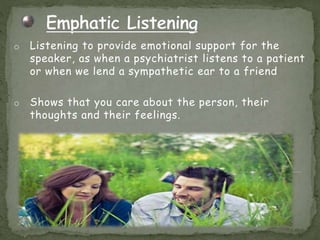
o Listening to provide emotional support for the
speaker, as when a psychiatrist listens to a patient
or when we lend a sympathetic ear to a friend
o Shows that you care about the person, their
thoughts and their feelings.
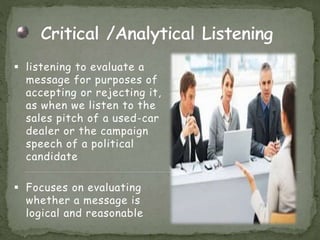
 listening to evaluate a
message for purposes of
accepting or rejecting it,
as when we listen to the
sales pitch of a used-car
dealer or the campaign
speech of a political
candidate
 Focuses on evaluating
whether a message is
logical and reasonable
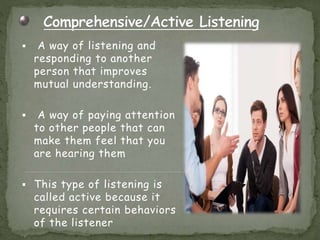
 A way of listening and
responding to another
person that improves
mutual understanding.
 A way of paying attention
to other people that can
make them feel that you
are hearing them
 This type of listening is
called active because it
requires certain behaviors
of the listener
 Our brain works four times faster than
that someone can speak. You have to
actively focus on listening so that your
mind doesn’t wander.
 It enriches you and those around you,
and guides other areas of your life.
 It can build trust and respect between
people, and prevent misunderstandings
that can lead to conflict, frustration or
hurt feelings.
 While listening to other people’s point
of view, you may just learn something
new and fascinating!
.
Listening
70%
Speaking
30%
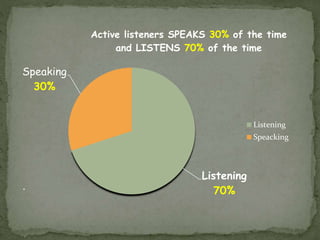
Active listeners SPEAKS 30% of the time
and LISTENS 70% of the time
Listening
Speacking
When people are preoccupied with current life
stresses or difficult situations, it is hard for
them to listen.
Anxiety can make it hard to listen.
Being angry at the person who is talking also
makes it hard to listen.
Having an idea in mind of what a person
“should do” makes it hard to listen to that
person's point of view.
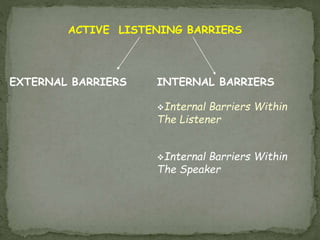
ACTIVE LISTENING BARRIERS
EXTERNAL BARRIERS INTERNAL BARRIERS
Internal Barriers Within
The Listener
Internal Barriers Within
The Speaker
External Barriers
noises
clutter
other interruptions
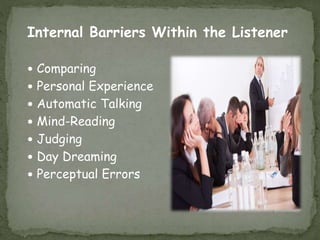
Internal Barriers Within the Listener
 Comparing
 Personal Experience
 Automatic Talking
 Mind-Reading
 Judging
 Day Dreaming
 Perceptual Errors
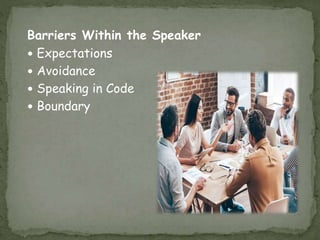
Barriers Within the Speaker
 Expectations
 Avoidance
 Speaking in Code
 Boundary
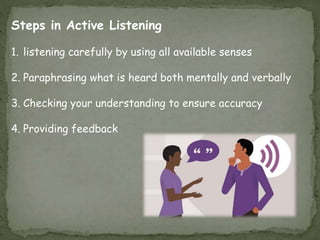
Steps in Active Listening
1. listening carefully by using all available senses
2. Paraphrasing what is heard both mentally and verbally
3. Checking your understanding to ensure accuracy
4. Providing feedback
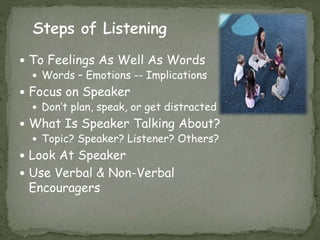
 To Feelings As Well As Words
 Words – Emotions -- Implications
 Focus on Speaker
 Don’t plan, speak, or get distracted
 What Is Speaker Talking About?
 Topic? Speaker? Listener? Others?
 Look At Speaker
 Use Verbal & Non-Verbal
Encouragers
Opening door to good conversation shows an
interest…. But it must be done sincerely,
without judgment.
1) Verbal&non-verbal encourages
2) Non-verbal behavior
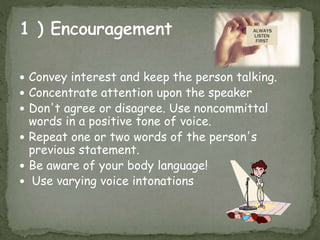
 Convey interest and keep the person talking.
 Concentrate attention upon the speaker
 Don't agree or disagree. Use noncommittal
words in a positive tone of voice.
 Repeat one or two words of the person's
previous statement.
 Be aware of your body language!
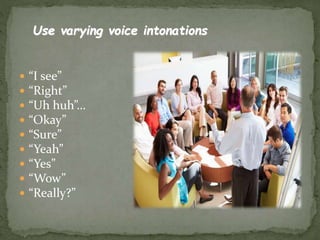
 Use varying voice intonations
 “I see”
 “Right”
 “Uh huh”…
 “Okay”
 “Sure”
 “Yeah”
 “Yes”
 “Wow”
 “Really?”
Use varying voice intonations
Non-Verbal Active Listening Techniques:
 Maintaining appropriate eye contact with the
Speaker.
 Occasionally nodding affirmatively to display
understanding and interest.
 Using expectant pauses to indicate to the
interviewee that more is expected
 touch
 sound
 smell
 timing and speed of delivery of speech
 proximity
 posture
 dress
 eye contact
 gestures
 facial expressions
 use of silence
Communication through Eyes
 3 Purposes
 Demonstrates you are listening
 Gather information
 Clarification
When you asked some questions:
 Show interest
 Encourage more explanation
 Keep the person talking
 Ask questions but not too many
 Avoid asking multiple questions at once.
 Generally, it’s best to start with open
questions
 Best questions are short, clear, objective.
 Ask questions in logical order.
 Allow for quiet, thinking time.
 Limit why-questions.
 Take notes.
Are You a Good Listener?
1. Do you frequently think of other things when others are
talking to you?
2. Do you doodle, shuffle papers, look at the clock or out the
window, read the newspaper,or watch TV?
3. Do you silently argue with the talker?
4. Do you only selectively hear ideas that fit your beliefs?
5. Do you feel most people have little to talk about that is
interesting or important?
6. Do you listen passively without any facial expressions?
7. Do you frequently interrupt others as they are speaking?
8. Do you complete sentences or ideas for people when they
pause to think?
9. Do you silently criticize characteristics of the speaker:
voice, looks, manner of speaking?
10. Do you have to ask people to repeat what they said because
you have forgotten?
Be there
Listen carefully to the person
Accept the person and his/her feelings
Stay with the other person's point of view
without becoming that person
Trust the person enough to keep out of it
 Listening is a critical communication skill for
managers and consultants, as well as for all of us in
our personal lives.
 You can't negotiate effectively until you understand
what the other person wants.
 Active listening, is crucial to achieving your ultimate
communication objectives.
 Active listening is a skill that, like other
communication skills, must be developed .
 By practicing you can develop these skills.
Listening skill

Listening skill

  • 2.
    L - Listening S- Speaking R - Reading W - Writing  The First and the Foremost communication skill that we learn in our lives is LISTENING.  It’s a Mother of all other skills.  We/Students spend more time on listening
  • 3.
    45% 30% 16% 9% Time Spent inCommunication Listening Speaking Reading Writing
  • 4.
     The processof receiving, constructing meaning from, and responding to a spoken and/or non verbal message (International Reading Association)  Hearing and understanding the thoughts, feelings and opinions being expressed by another person.  To concentrate on hearing something; heed or pay attention to . DEFINITION OF
  • 5.
    Hearing Hearing is simplythe act of perceiving sound by the ear. Hearing occurs with or without your consent Listening Listening is an action where you choose to actively concentrate on what you hear. In listening your brain processes the information into knowledge.
  • 6.
  • 7.
    L – lookinterested/ get interested I – Involve yourself by responding S – Stay on target T – Test your Understanding E – Evaluate the message N – Neutralize your feelings
  • 8.
    Listening is aconscious activity based on three basic skills: 1) Attitude 2) Attention 3) Adjustment
  • 9.
    1)Attitude : Maintain aconstructive Attitude 2)Attention Strive to pay Attention 3)Adjustment Cultivate a capacity for Adjustment
  • 10.
    Types of Listening 1)Appreciative listening 2) Empathic listening 3) Comprehensive/Active listening 4) Critical /Analytical listening
  • 11.
     listening forpleasure and enjoyment, as when we listen to music, to a comedy routine, or to an entertaining speech  describes how well speakers choose and use words, use humor, ask questions. tell stories, and argue persuasively.
  • 12.
    o Listening toprovide emotional support for the speaker, as when a psychiatrist listens to a patient or when we lend a sympathetic ear to a friend o Shows that you care about the person, their thoughts and their feelings.
  • 13.
     listening toevaluate a message for purposes of accepting or rejecting it, as when we listen to the sales pitch of a used-car dealer or the campaign speech of a political candidate  Focuses on evaluating whether a message is logical and reasonable
  • 14.
     A wayof listening and responding to another person that improves mutual understanding.  A way of paying attention to other people that can make them feel that you are hearing them  This type of listening is called active because it requires certain behaviors of the listener
  • 15.
     Our brainworks four times faster than that someone can speak. You have to actively focus on listening so that your mind doesn’t wander.  It enriches you and those around you, and guides other areas of your life.  It can build trust and respect between people, and prevent misunderstandings that can lead to conflict, frustration or hurt feelings.  While listening to other people’s point of view, you may just learn something new and fascinating!
  • 16.
    . Listening 70% Speaking 30% Active listeners SPEAKS30% of the time and LISTENS 70% of the time Listening Speacking
  • 17.
    When people arepreoccupied with current life stresses or difficult situations, it is hard for them to listen. Anxiety can make it hard to listen. Being angry at the person who is talking also makes it hard to listen. Having an idea in mind of what a person “should do” makes it hard to listen to that person's point of view.
  • 18.
    ACTIVE LISTENING BARRIERS EXTERNALBARRIERS INTERNAL BARRIERS Internal Barriers Within The Listener Internal Barriers Within The Speaker
  • 19.
  • 20.
    Internal Barriers Withinthe Listener  Comparing  Personal Experience  Automatic Talking  Mind-Reading  Judging  Day Dreaming  Perceptual Errors
  • 21.
    Barriers Within theSpeaker  Expectations  Avoidance  Speaking in Code  Boundary
  • 22.
    Steps in ActiveListening 1. listening carefully by using all available senses 2. Paraphrasing what is heard both mentally and verbally 3. Checking your understanding to ensure accuracy 4. Providing feedback
  • 23.
     To FeelingsAs Well As Words  Words – Emotions -- Implications  Focus on Speaker  Don’t plan, speak, or get distracted  What Is Speaker Talking About?  Topic? Speaker? Listener? Others?  Look At Speaker  Use Verbal & Non-Verbal Encouragers
  • 24.
    Opening door togood conversation shows an interest…. But it must be done sincerely, without judgment. 1) Verbal&non-verbal encourages 2) Non-verbal behavior
  • 25.
     Convey interestand keep the person talking.  Concentrate attention upon the speaker  Don't agree or disagree. Use noncommittal words in a positive tone of voice.  Repeat one or two words of the person's previous statement.  Be aware of your body language!  Use varying voice intonations
  • 26.
     “I see” “Right”  “Uh huh”…  “Okay”  “Sure”  “Yeah”  “Yes”  “Wow”  “Really?” Use varying voice intonations
  • 27.
    Non-Verbal Active ListeningTechniques:  Maintaining appropriate eye contact with the Speaker.  Occasionally nodding affirmatively to display understanding and interest.  Using expectant pauses to indicate to the interviewee that more is expected
  • 28.
     touch  sound smell  timing and speed of delivery of speech  proximity  posture  dress  eye contact  gestures  facial expressions  use of silence
  • 29.
  • 30.
     3 Purposes Demonstrates you are listening  Gather information  Clarification When you asked some questions:  Show interest  Encourage more explanation  Keep the person talking  Ask questions but not too many
  • 31.
     Avoid askingmultiple questions at once.  Generally, it’s best to start with open questions  Best questions are short, clear, objective.  Ask questions in logical order.  Allow for quiet, thinking time.  Limit why-questions.  Take notes.
  • 32.
    Are You aGood Listener? 1. Do you frequently think of other things when others are talking to you? 2. Do you doodle, shuffle papers, look at the clock or out the window, read the newspaper,or watch TV? 3. Do you silently argue with the talker? 4. Do you only selectively hear ideas that fit your beliefs? 5. Do you feel most people have little to talk about that is interesting or important? 6. Do you listen passively without any facial expressions? 7. Do you frequently interrupt others as they are speaking? 8. Do you complete sentences or ideas for people when they pause to think? 9. Do you silently criticize characteristics of the speaker: voice, looks, manner of speaking? 10. Do you have to ask people to repeat what they said because you have forgotten?
  • 33.
    Be there Listen carefullyto the person Accept the person and his/her feelings Stay with the other person's point of view without becoming that person Trust the person enough to keep out of it
  • 34.
     Listening isa critical communication skill for managers and consultants, as well as for all of us in our personal lives.  You can't negotiate effectively until you understand what the other person wants.  Active listening, is crucial to achieving your ultimate communication objectives.  Active listening is a skill that, like other communication skills, must be developed .  By practicing you can develop these skills.