1
COMMUNICATION
SKILL
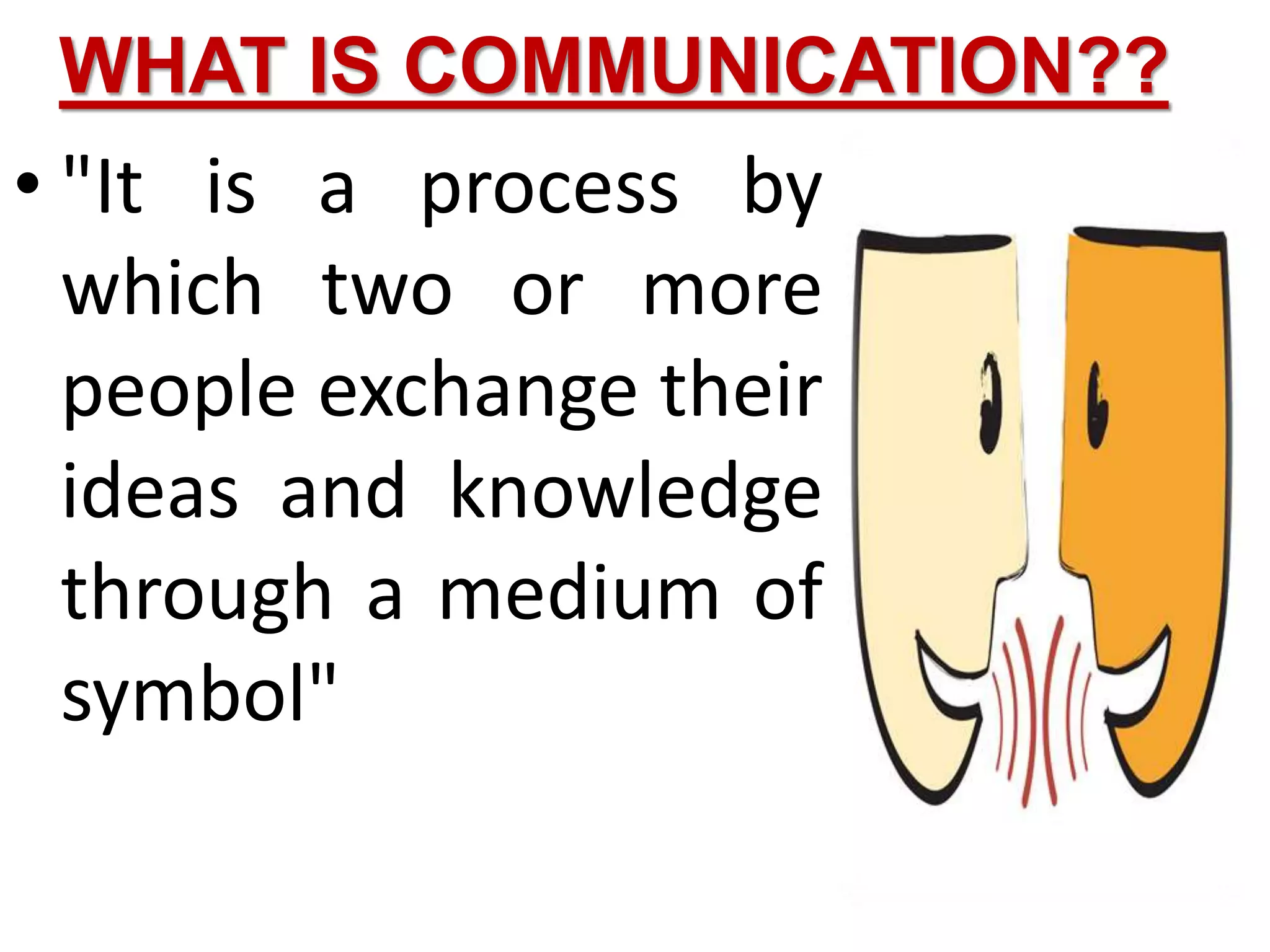
WHAT IS COMMUNICATION??
• "It is a process by
which two or more
people exchange their
ideas and knowledge
through a medium of
symbol"
COMPONENTS
• Genuineness
• Sincerity
• Respecting the client
• Shows love and affection
• Concern
• Active listening
• Empathy
• Concreteness- speaking in a realistic way
• Self-discipline
• Good communication skills in order to establish rapport
with the client
CHARACTERISTICS
• To provide safe and therapeutic environment.
• Ability to form intimate, interdependent ,
interpersonal relationships with client and his
family.
• Achieves realistic goals.
• Improves functioning capacity.
• Increased ability to satisfy and fulfill the needs
of the client.
Cont…
• Ability to give and receive love.
• Time is limited.
• Clarifies client's conflicts and anxiety.
• Allows time for the client to complete the
rituals.
• Respect the cultural values of the client.
• Encourages socialization and family
relatedness.
Principles Of Communication
• Treat the client as an individual.
• Accept the client as he is.
• Aware total needs of the client.
• Emotional involvement is essential.
• Objectivity has to be maintained.
• Consistency in behavior.
• Set appropriate limits and goals.
Cont…
• Encourage the client's feelings.
• Honest and open communication is needed.
• Engage in active listening.
• Evaluate client's weakness and potentialities.
• Realistic approach.
• Establish trust and rapport.
• Win the confidence of client.
• Provide sufficient time to the client
PROCESS OF COMMUNICATION
SENDER/ ENCODER
• The sender also
known as the
encoder, decides
on the message to
be sent, the best
and the most
effective way to be
sent.
MEDIUM
• The medium is the
immediate form which a
message takes.
For e. g. A message may be
transmitted in the form of
a letter or email or face to
face in the form of a
speech.
C
H
A
N
N
E
L
• The channel is
that which is
responsible for
the delivery of
the chosen
message form.
For e.g. post
office, internet ,
radio.
RECEIVER
• The receiver or the decoder is
responsible for
extracting/decoding meaning from
the message.
FEEDBACK
• Feedback is important as it
determines whether or not the
decoder grasped the intended
meaning and whether
communication was successful.
CONTEXT
• Communication does not take place
in a vacuum.
• The context of any communication
act as the environment surrounding
it. This includes among other things,
place, time , event and attitudes of
sender and receiver.
METHOD OF COMMUNICATION
• On the basis of relationship-
Formal and Informal
• On the basis of direction-
Downward
Upward
Horizontal
• On the basis of expression-
Verbal
Non-verbal
Formal communication
Formal
communication is
straightforward,
official and always
precise and has a
stringent and rigid
tone to it.
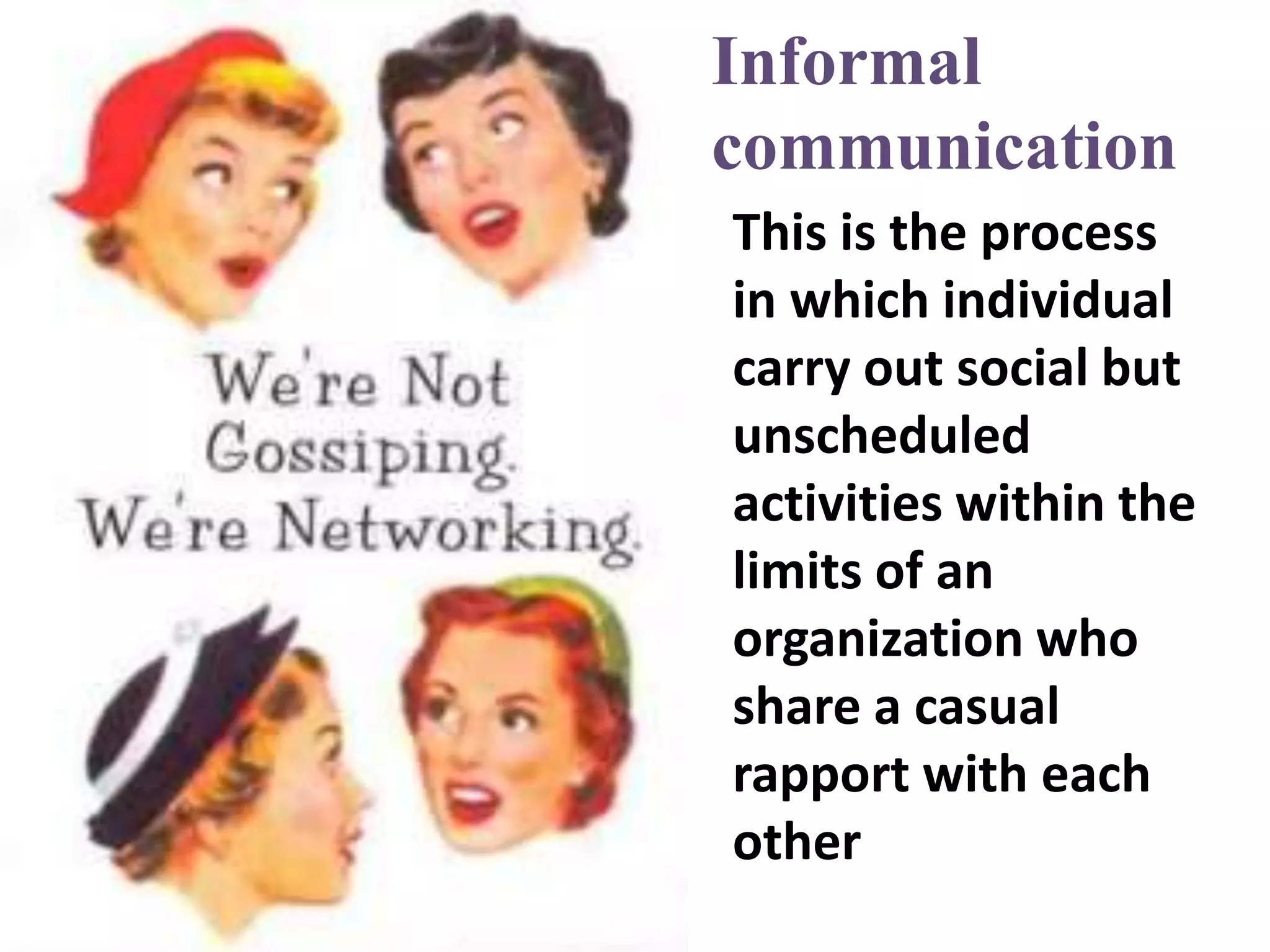
Informal
communication
This is the process
in which individual
carry out social but
unscheduled
activities within the
limits of an
organization who
share a casual
rapport with each
other
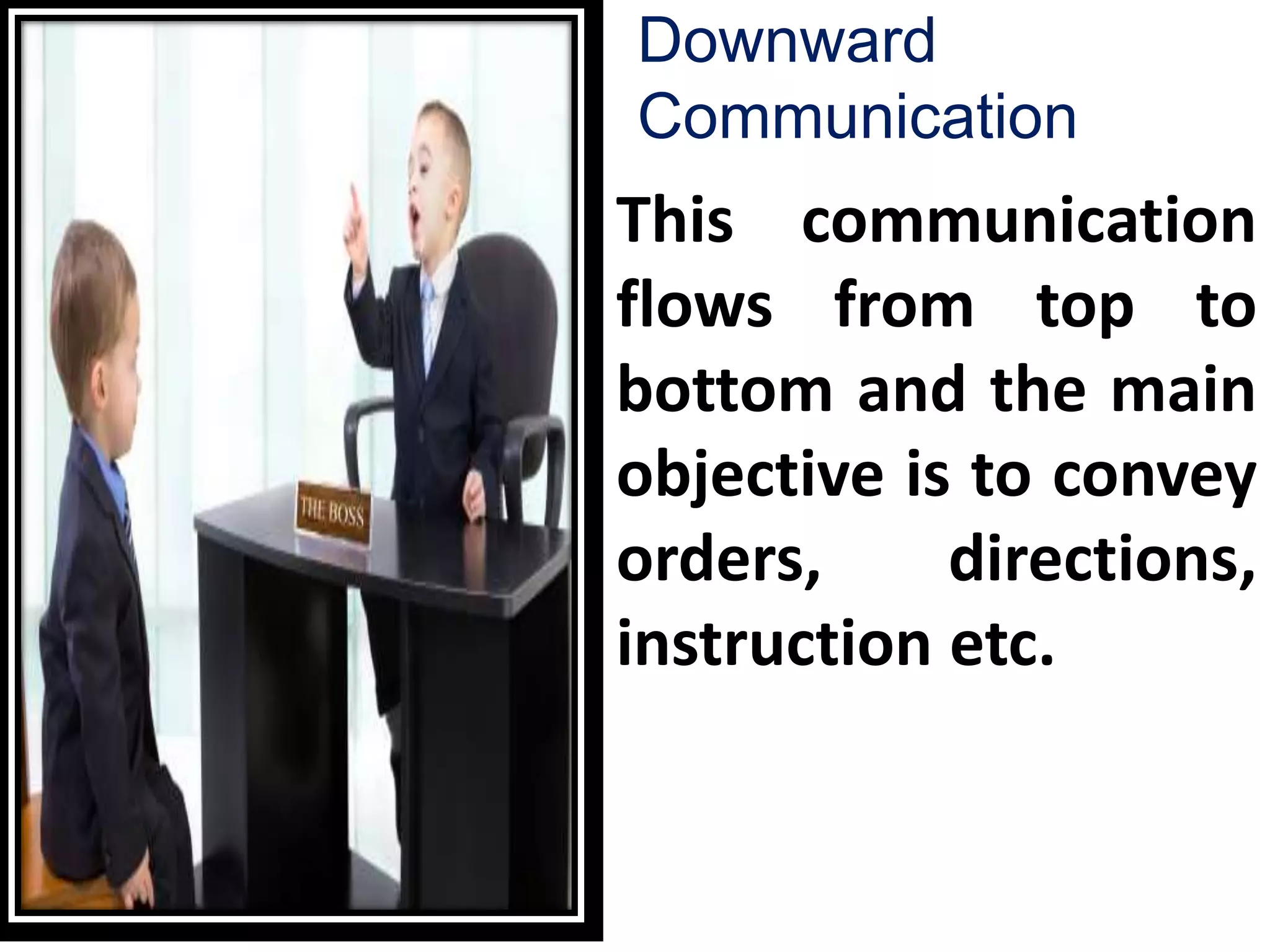
Downward
Communication
This communication
flows from top to
bottom and the main
objective is to convey
orders, directions,
instruction etc.
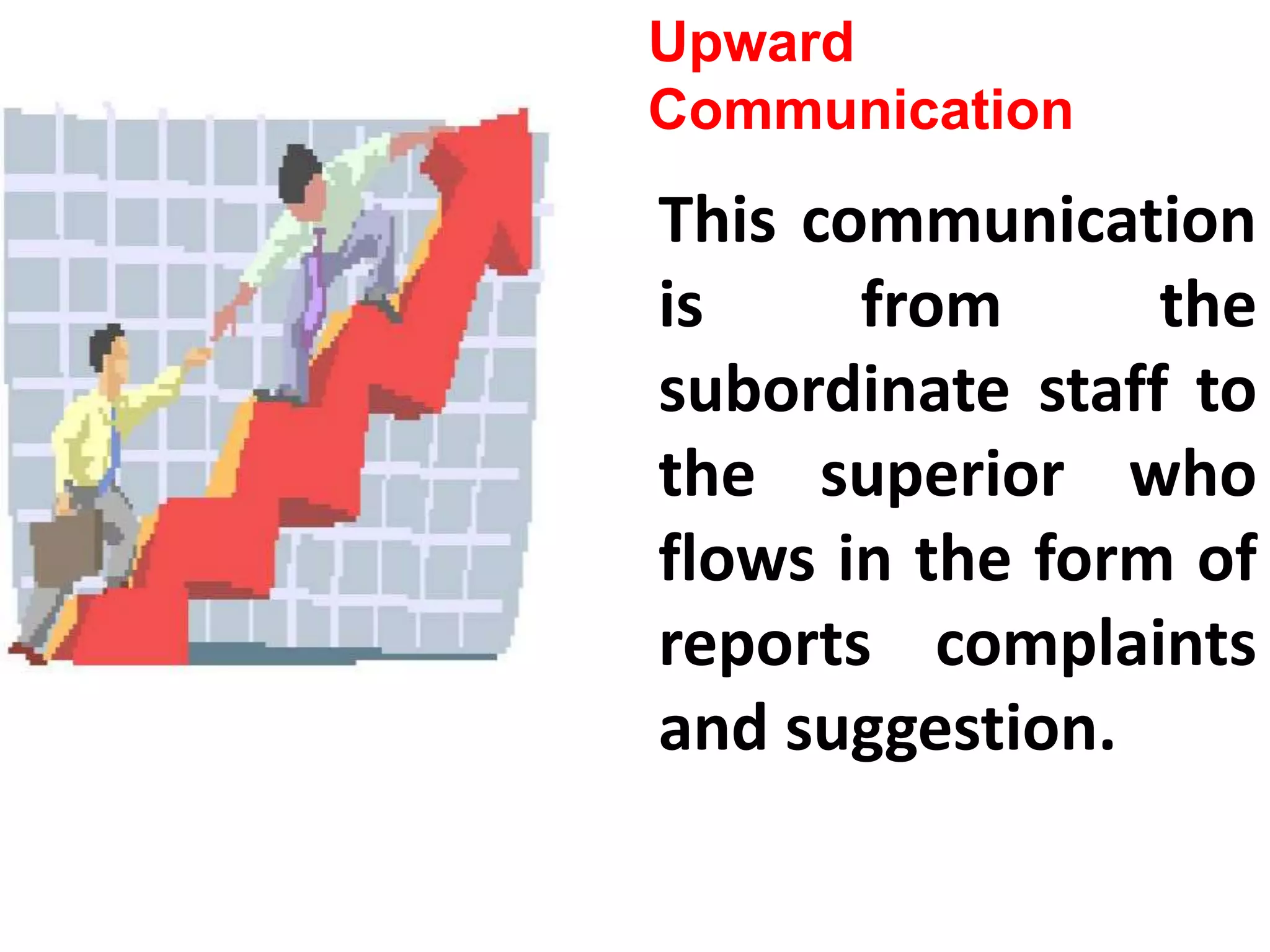
Upward
Communication
This communication
is from the
subordinate staff to
the superior who
flows in the form of
reports complaints
and suggestion.
Horizontal
Communication
This is the
exchange of
information
between individual
of the same status
or designation.
Verbal
Communication
Verbal
communication is the
use of words in
delivering your
intended message.
•It is an accurate and
effective medium of
communication.
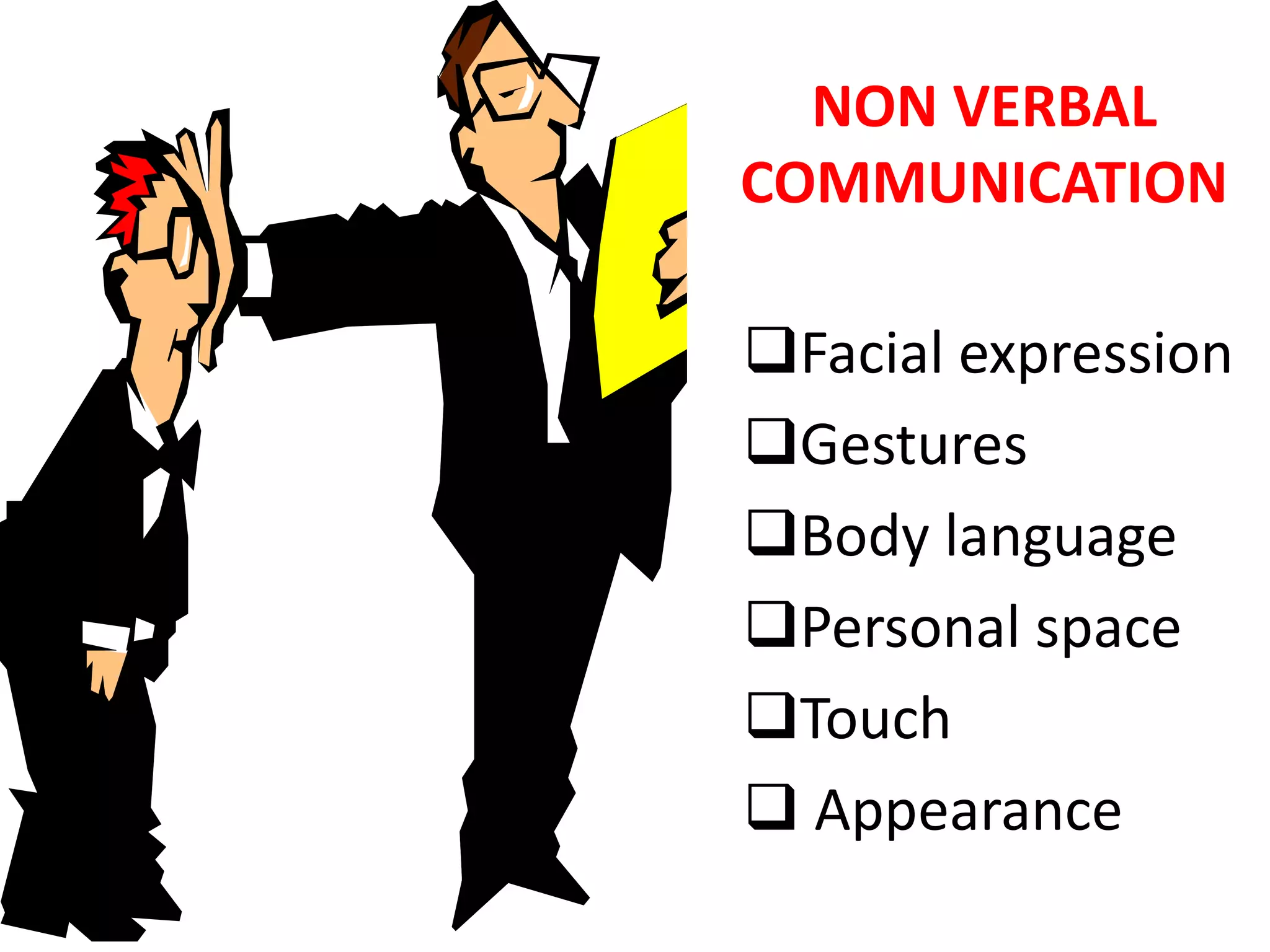
NON VERBAL
COMMUNICATION
Facial expression
Gestures
Body language
Personal space
Touch
 Appearance
Intimate <16”-18”
Personal 18” to 4 feet
Social--4 ft to 12 ft
Public > 12 ft.
CONVERSATIONAL DISTANCES
Communication Technique
• Using Silence
• Accepting
• Giving Recognition
• Offering Self
• Giving Broad Opening
• Offering General Leads
• Placing The Event In Time Or Sequence
• Making Observations
• Encouraging Description Of Perception
• Encouraging comparison
• Restating
• Reflecting
• Focusing
• Exploring
• Seeking clarification and validation
• Presenting reality
• Voicing doubt
• Verbalizing
• Attempting to translate words into feeling
• Formulating a plan of action
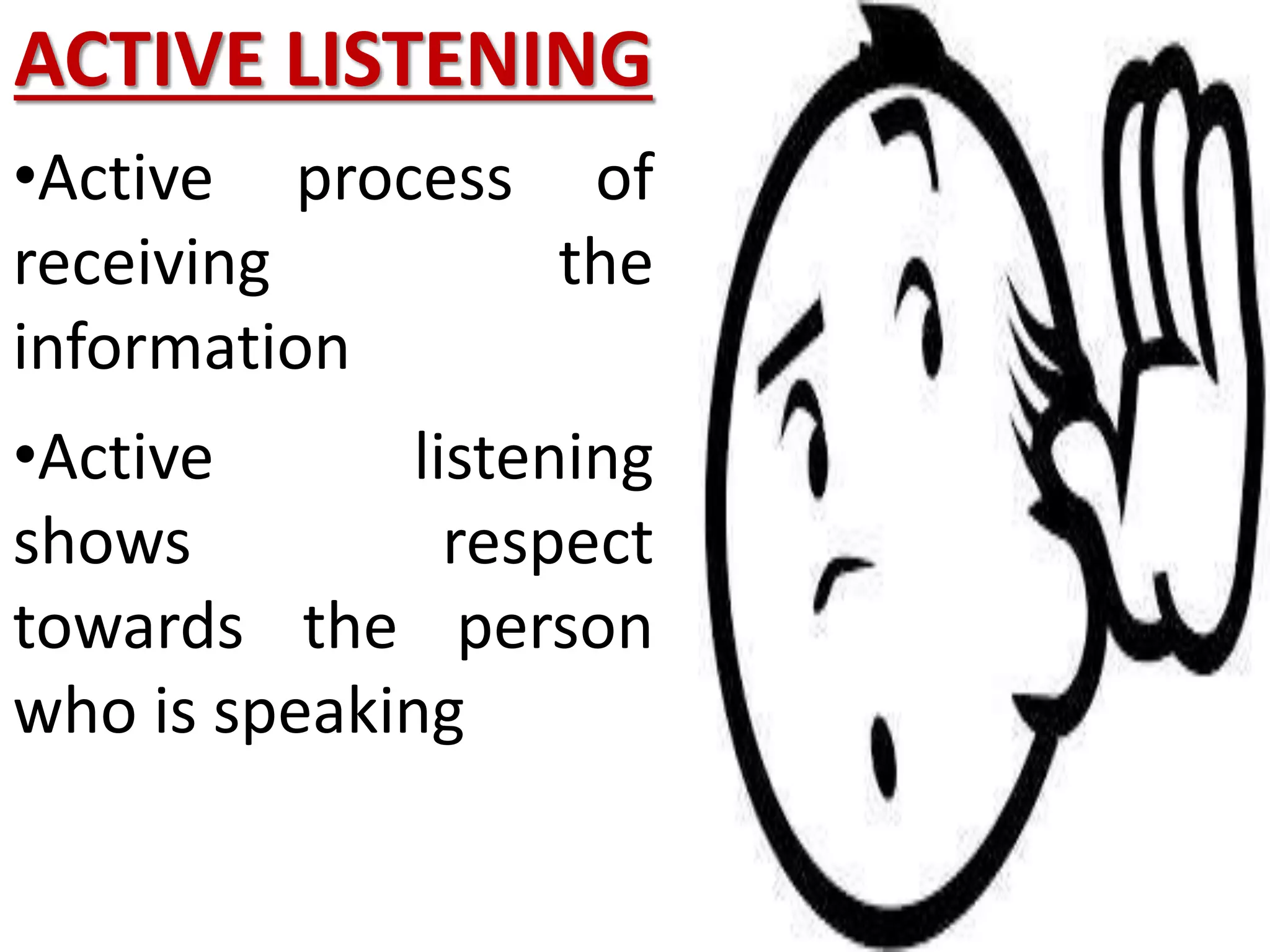
ACTIVE LISTENING
•Active process of
receiving the
information
•Active listening
shows respect
towards the person
who is speaking
RATIONALE
•Allows the client to talk more
without any inhibitions or
bias. It maintains trust or
confidentiality.
SILENCE
Absence of verbal
communication, which
provides time for the
client to put thoughts or
feelings into words,
regain composure, or
continue talking.
RATIONALE
31
Silence demonstrates the nurse's
patience and willingness to wait for a
response, when the client is unable to
respond quickly. Silence may be
therapeutic during the times of profound
distress or grief.
What are you thinking about?
What would you like to discuss?
RATIONALE
33
•Broad openings make explicit that the client
has the lead in the interaction.
• It emphasis the client role in interaction.
•For the client who is hesitant about talking,
broad openings may stimulate him or her to
take the initiative
I noticed that you dressed and put
make-up on today.
You’ve really been participating in
groups today.
Shyama, I see you made your bed.
35
Rationale
Greeting the client by name,
indicating awareness of change,
or noting efforts the client has
made all show that the nurse
recognizes the client as a person,
as an individual.
I would like to spend time with you.
I’ll stay here and sit awhile.
You seem upset, would you like to
talk?
RATIONALE
• The nurse can offer his or her presence,
interest and desire to understand. It is
important that this offer is unconditional,
that is, the client does not have to
respond verbally to get the nurse’s
attention. It increases the feeling of self-
worth.
•Yes I see.
•Go on
•Nodding of head
•Leaning forward
RATIONALE
39
•General leads indicate that the nurse is
listening and following what the client is
saying without taking away the initiative
for the interaction.
•They also encourage the client to
continue if he or she is hesitant or
uncomfortable about the topic.
•When did you do this?
•What led up to………?
•How old were you when this
occurred?
Rationale
• Putting events in proper sequence helps both the
nurse and client to see them in perspective.
• The client may be able to see that perhaps some
things are not related.
• The nurse may gain information about recurrent
patterns or themes in the client’s behavior or
relationships.
You appear
anxious.
I notice you are
biting your lips.
You seem restless.
RATIONALE
•Sometimes clients cannot
verbalize or make themselves
understood or the client may
not be ready to talk.
•This encourage the client to
recognize specific behavior.
ENCOURAGING DESCRIPTION OF
PERCEPTIONS
“ Tell me what is happening now?”
“Are you hearing the voices again”
RATIONALE
45
To understand the client, the nurse must
see things from his or her perspective.
Encouraging the client to describe ideas
fully may relieve the tension the client is
feeling. This is often used with client
experiencing hallucination.
P: My children are going through a financial
problem because I am sick
N: Your children are going through a financial
problem because you are Sick.
Client: “I can’t sleep. I stay awake all night.”
Nurse: “You have difficulty sleeping.”
Client: “I’m really upset.”
Nurse: “You’re really upset.”
RATIONALE
• This restatement lets the client know
that he or she communicated the
idea effectively.
• This encourages the client to
continue. Or if the client has been
misunderstood, he or she can clarify
his or her thoughts.
Client: “Do you think I should
divorce my wife?
Nurse: “Do you think you should?”.
RATIONALE
• Reflection encourages the client to
recognize and accept his or her own
feelings.
• The nurse indicates that the client’s point
of view has value, and that the client has
the right to have opinions, make
decisions, and think independently
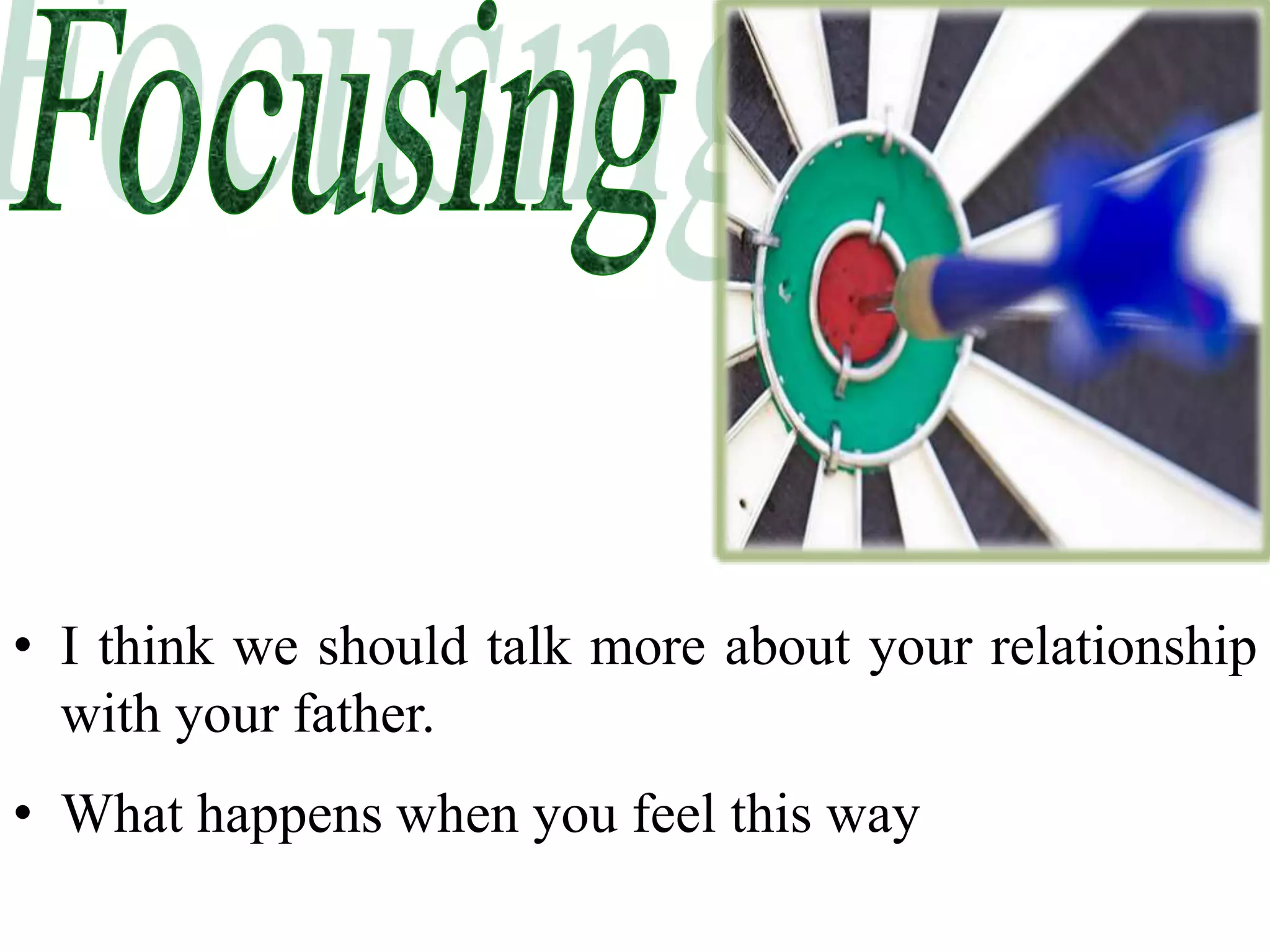
• I think we should talk more about your relationship
with your father.
• What happens when you feel this way
RATIONALE
• The nurse encourages the client to
concentrate his or her energies on a
single point, which may prevent a
multitude of factors or problems from
overwhelming the client.
• It is also a useful technique when a client
jumps from one topic to another
Tell me more about that?
Give me an example of one time
you thought everyone hated
you?
RATIONALE
• When clients deal with topics superficially,
exploring can help them examine the issue
more fully.
• Any problem or concern can be better
understood if explored in depth.
• If the client expresses an unwillingness to
explore a subject, however, the nurse must
respect his or her wishes.
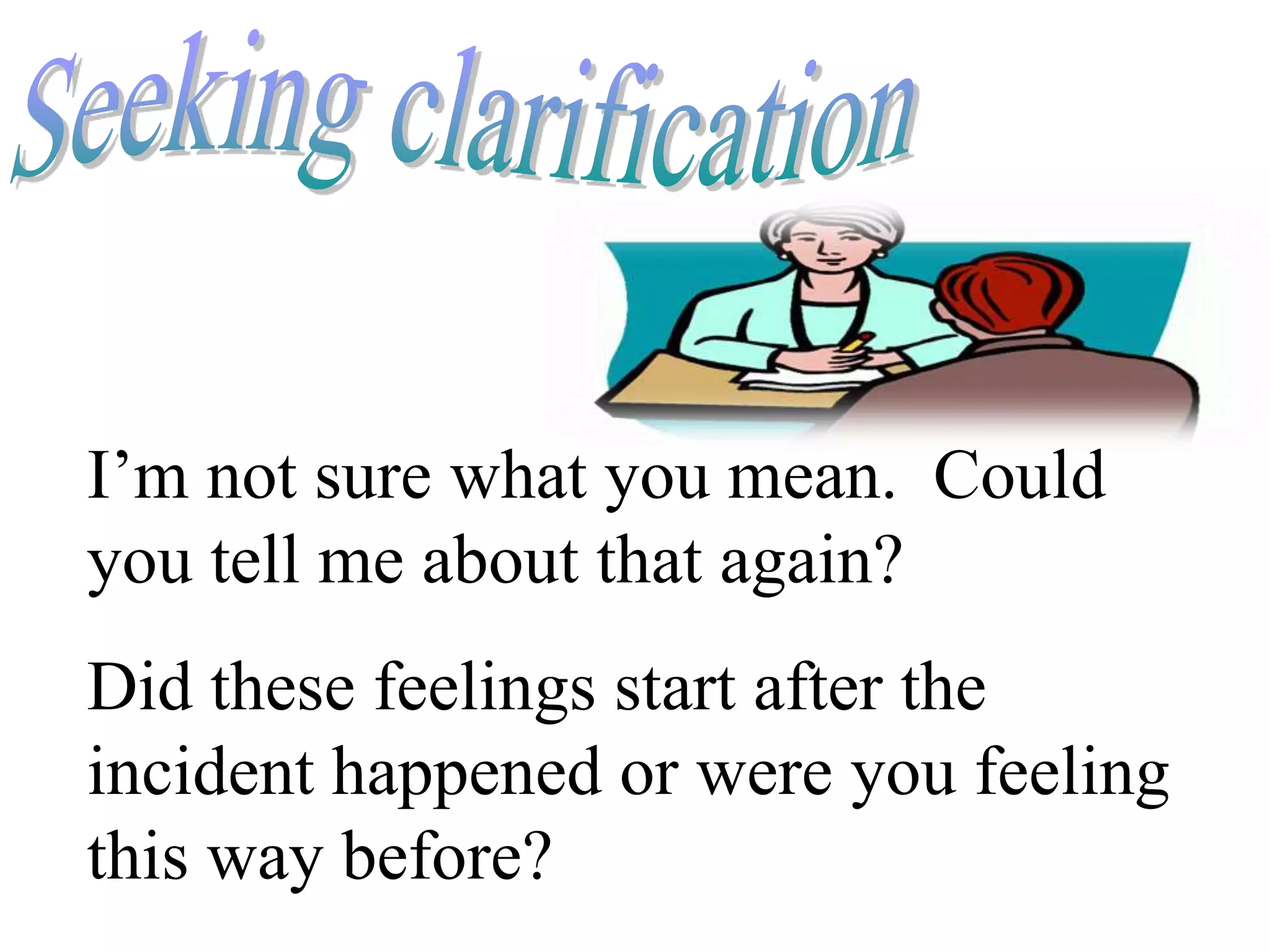
I’m not sure what you mean. Could
you tell me about that again?
Did these feelings start after the
incident happened or were you feeling
this way before?
Rationale
• Doing so can help the nurse to avoid
making assumptions that
understanding has occurred when it
has not.
• It helps the client to articulate
thoughts, feelings, and ideas more
clearly
PRESENTING REALITY
“I understand that the voices seem
real to you, but I do not hear any
voices.”
“There is no one in the room but
you and me.”
RATIONALE
•The nurse does this by calmly ,not by
way of arguing with the client or
belittling his or her experience.
•The intent is to indicate an alternative
line of thought for the client to
consider, not to “convince” the client
that he or she is wrong.
ATTEMTING TO TRANSLATE
WORDS INTO FEELING
• Client: “I’m dead.”
• Nurse: “Are you suggesting that you feel
lifeless?”
• Client: “I’m way out in the ocean.”
• Nurse: “You seem to feel lonely or deserted.”
RATIONALE
• Often what the client says, when taken
literally, seems meaningless or far
removed from reality.
• To understand, the nurse must
concentrate on what the client might be
feeling to express himself or herself this
way.
During the past hour we
have discussed…………
So far we have talked
about…………
SUMMARIZING
RATIONALE
61
•Summarization seeks to bring out
the important points of the
discussion
•It allows both client and nurse to
depart with the same ideas and
provides a sense of closure at the
completion of each discussion
BOUNDARY VIOLATION
• It occurs when the person goes outside
the boundaries of relationship and
establishes a personal, social relationship
with the client. Whenever the person
does anything unusual or different to the
client, a boundary violation results.
BARRIERS OF
COMMUNICATION
• Noise
• Inappropriate
medium
• Emotions
• Language
differences
• Poor listening skills
• Distractions
CONCLUSION
Therapeutic communication in
Nursing reinforces the nurse client
relationship. It makes the nurse more
human. Modern health care system
are seeking to adopt more client-
oriented approach to the delivery of
health care
Communication final   copy

Communication final copy

  • 1.
  • 2.
    WHAT IS COMMUNICATION?? •"It is a process by which two or more people exchange their ideas and knowledge through a medium of symbol"
  • 3.
    COMPONENTS • Genuineness • Sincerity •Respecting the client • Shows love and affection • Concern • Active listening • Empathy • Concreteness- speaking in a realistic way • Self-discipline • Good communication skills in order to establish rapport with the client
  • 4.
    CHARACTERISTICS • To providesafe and therapeutic environment. • Ability to form intimate, interdependent , interpersonal relationships with client and his family. • Achieves realistic goals. • Improves functioning capacity. • Increased ability to satisfy and fulfill the needs of the client.
  • 5.
    Cont… • Ability togive and receive love. • Time is limited. • Clarifies client's conflicts and anxiety. • Allows time for the client to complete the rituals. • Respect the cultural values of the client. • Encourages socialization and family relatedness.
  • 6.
    Principles Of Communication •Treat the client as an individual. • Accept the client as he is. • Aware total needs of the client. • Emotional involvement is essential. • Objectivity has to be maintained. • Consistency in behavior. • Set appropriate limits and goals.
  • 7.
    Cont… • Encourage theclient's feelings. • Honest and open communication is needed. • Engage in active listening. • Evaluate client's weakness and potentialities. • Realistic approach. • Establish trust and rapport. • Win the confidence of client. • Provide sufficient time to the client
  • 8.
  • 10.
    SENDER/ ENCODER • Thesender also known as the encoder, decides on the message to be sent, the best and the most effective way to be sent.
  • 11.
    MEDIUM • The mediumis the immediate form which a message takes. For e. g. A message may be transmitted in the form of a letter or email or face to face in the form of a speech.
  • 12.
    C H A N N E L • The channelis that which is responsible for the delivery of the chosen message form. For e.g. post office, internet , radio.
  • 13.
    RECEIVER • The receiveror the decoder is responsible for extracting/decoding meaning from the message.
  • 14.
    FEEDBACK • Feedback isimportant as it determines whether or not the decoder grasped the intended meaning and whether communication was successful.
  • 15.
    CONTEXT • Communication doesnot take place in a vacuum. • The context of any communication act as the environment surrounding it. This includes among other things, place, time , event and attitudes of sender and receiver.
  • 16.
    METHOD OF COMMUNICATION •On the basis of relationship- Formal and Informal • On the basis of direction- Downward Upward Horizontal • On the basis of expression- Verbal Non-verbal
  • 17.
    Formal communication Formal communication is straightforward, officialand always precise and has a stringent and rigid tone to it.
  • 18.
    Informal communication This is theprocess in which individual carry out social but unscheduled activities within the limits of an organization who share a casual rapport with each other
  • 19.
    Downward Communication This communication flows fromtop to bottom and the main objective is to convey orders, directions, instruction etc.
  • 20.
    Upward Communication This communication is fromthe subordinate staff to the superior who flows in the form of reports complaints and suggestion.
  • 21.
    Horizontal Communication This is the exchangeof information between individual of the same status or designation.
  • 22.
    Verbal Communication Verbal communication is the useof words in delivering your intended message. •It is an accurate and effective medium of communication.
  • 23.
    NON VERBAL COMMUNICATION Facial expression Gestures Bodylanguage Personal space Touch  Appearance
  • 24.
    Intimate <16”-18” Personal 18”to 4 feet Social--4 ft to 12 ft Public > 12 ft. CONVERSATIONAL DISTANCES
  • 25.
  • 26.
    • Using Silence •Accepting • Giving Recognition • Offering Self • Giving Broad Opening • Offering General Leads • Placing The Event In Time Or Sequence • Making Observations • Encouraging Description Of Perception
  • 27.
    • Encouraging comparison •Restating • Reflecting • Focusing • Exploring • Seeking clarification and validation • Presenting reality • Voicing doubt • Verbalizing • Attempting to translate words into feeling • Formulating a plan of action
  • 28.
    ACTIVE LISTENING •Active processof receiving the information •Active listening shows respect towards the person who is speaking
  • 29.
    RATIONALE •Allows the clientto talk more without any inhibitions or bias. It maintains trust or confidentiality.
  • 30.
    SILENCE Absence of verbal communication,which provides time for the client to put thoughts or feelings into words, regain composure, or continue talking.
  • 31.
    RATIONALE 31 Silence demonstrates thenurse's patience and willingness to wait for a response, when the client is unable to respond quickly. Silence may be therapeutic during the times of profound distress or grief.
  • 32.
    What are youthinking about? What would you like to discuss?
  • 33.
    RATIONALE 33 •Broad openings makeexplicit that the client has the lead in the interaction. • It emphasis the client role in interaction. •For the client who is hesitant about talking, broad openings may stimulate him or her to take the initiative
  • 34.
    I noticed thatyou dressed and put make-up on today. You’ve really been participating in groups today. Shyama, I see you made your bed.
  • 35.
    35 Rationale Greeting the clientby name, indicating awareness of change, or noting efforts the client has made all show that the nurse recognizes the client as a person, as an individual.
  • 36.
    I would liketo spend time with you. I’ll stay here and sit awhile. You seem upset, would you like to talk?
  • 37.
    RATIONALE • The nursecan offer his or her presence, interest and desire to understand. It is important that this offer is unconditional, that is, the client does not have to respond verbally to get the nurse’s attention. It increases the feeling of self- worth.
  • 38.
    •Yes I see. •Goon •Nodding of head •Leaning forward
  • 39.
    RATIONALE 39 •General leads indicatethat the nurse is listening and following what the client is saying without taking away the initiative for the interaction. •They also encourage the client to continue if he or she is hesitant or uncomfortable about the topic.
  • 40.
    •When did youdo this? •What led up to………? •How old were you when this occurred?
  • 41.
    Rationale • Putting eventsin proper sequence helps both the nurse and client to see them in perspective. • The client may be able to see that perhaps some things are not related. • The nurse may gain information about recurrent patterns or themes in the client’s behavior or relationships.
  • 42.
    You appear anxious. I noticeyou are biting your lips. You seem restless.
  • 43.
    RATIONALE •Sometimes clients cannot verbalizeor make themselves understood or the client may not be ready to talk. •This encourage the client to recognize specific behavior.
  • 44.
    ENCOURAGING DESCRIPTION OF PERCEPTIONS “Tell me what is happening now?” “Are you hearing the voices again”
  • 45.
    RATIONALE 45 To understand theclient, the nurse must see things from his or her perspective. Encouraging the client to describe ideas fully may relieve the tension the client is feeling. This is often used with client experiencing hallucination.
  • 46.
    P: My childrenare going through a financial problem because I am sick N: Your children are going through a financial problem because you are Sick. Client: “I can’t sleep. I stay awake all night.” Nurse: “You have difficulty sleeping.” Client: “I’m really upset.” Nurse: “You’re really upset.”
  • 47.
    RATIONALE • This restatementlets the client know that he or she communicated the idea effectively. • This encourages the client to continue. Or if the client has been misunderstood, he or she can clarify his or her thoughts.
  • 48.
    Client: “Do youthink I should divorce my wife? Nurse: “Do you think you should?”.
  • 49.
    RATIONALE • Reflection encouragesthe client to recognize and accept his or her own feelings. • The nurse indicates that the client’s point of view has value, and that the client has the right to have opinions, make decisions, and think independently
  • 50.
    • I thinkwe should talk more about your relationship with your father. • What happens when you feel this way
  • 51.
    RATIONALE • The nurseencourages the client to concentrate his or her energies on a single point, which may prevent a multitude of factors or problems from overwhelming the client. • It is also a useful technique when a client jumps from one topic to another
  • 52.
    Tell me moreabout that? Give me an example of one time you thought everyone hated you?
  • 53.
    RATIONALE • When clientsdeal with topics superficially, exploring can help them examine the issue more fully. • Any problem or concern can be better understood if explored in depth. • If the client expresses an unwillingness to explore a subject, however, the nurse must respect his or her wishes.
  • 54.
    I’m not surewhat you mean. Could you tell me about that again? Did these feelings start after the incident happened or were you feeling this way before?
  • 55.
    Rationale • Doing socan help the nurse to avoid making assumptions that understanding has occurred when it has not. • It helps the client to articulate thoughts, feelings, and ideas more clearly
  • 56.
    PRESENTING REALITY “I understandthat the voices seem real to you, but I do not hear any voices.” “There is no one in the room but you and me.”
  • 57.
    RATIONALE •The nurse doesthis by calmly ,not by way of arguing with the client or belittling his or her experience. •The intent is to indicate an alternative line of thought for the client to consider, not to “convince” the client that he or she is wrong.
  • 58.
    ATTEMTING TO TRANSLATE WORDSINTO FEELING • Client: “I’m dead.” • Nurse: “Are you suggesting that you feel lifeless?” • Client: “I’m way out in the ocean.” • Nurse: “You seem to feel lonely or deserted.”
  • 59.
    RATIONALE • Often whatthe client says, when taken literally, seems meaningless or far removed from reality. • To understand, the nurse must concentrate on what the client might be feeling to express himself or herself this way.
  • 60.
    During the pasthour we have discussed………… So far we have talked about………… SUMMARIZING
  • 61.
    RATIONALE 61 •Summarization seeks tobring out the important points of the discussion •It allows both client and nurse to depart with the same ideas and provides a sense of closure at the completion of each discussion
  • 62.
    BOUNDARY VIOLATION • Itoccurs when the person goes outside the boundaries of relationship and establishes a personal, social relationship with the client. Whenever the person does anything unusual or different to the client, a boundary violation results.
  • 63.
  • 64.
    • Noise • Inappropriate medium •Emotions • Language differences • Poor listening skills • Distractions
  • 65.
  • 66.
    Therapeutic communication in Nursingreinforces the nurse client relationship. It makes the nurse more human. Modern health care system are seeking to adopt more client- oriented approach to the delivery of health care