PERSONALIZED MEDICINES
Presented by
MISS.JYOTIDIPAKMHOPREKAR
M Pharmacy(FirstYear,SemI)
RollNo. 06
DEPARTMENTOFPHARMACEUTICS
SHREESANTKRUPACOLLEGEOFPHARMACYGHOGAON.
CONTENTS:
 Personalized medicines.
1. Dosage forms for personalized medicines.
2. Categories of patients for personalized medicines.
 Customized drug delivery systems.
 Bioelectronics Medicines
 3D printing of pharmaceuticals
 Telepharmacy
PERSONALIZED MEDICINE:
DEFINITION:
Personalized medicine is defined as of medical treatment to the
individual characteristics of each patient that not only improves our
ability to diagnose and treat disease but offers the potential to
detect disease at an earlier stage and to treat it effectively.
 Personalized medicines also referred as precision medicine holds
great promise to improve health care.
 According to the “National cancer institute” personalized
medicine integrates information about persons genes, proteins,
diagnosis and treat diseases.
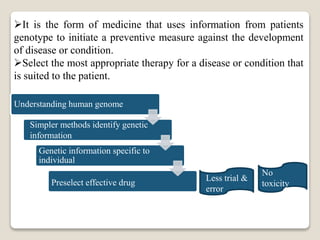
Understanding human genome
Genetic information specific to
individual
Preselect effective drug
Simpler methods identify genetic
information
Less trial &
error
No
toxicity
It is the form of medicine that uses information from patients
genotype to initiate a preventive measure against the development
of disease or condition.
Select the most appropriate therapy for a disease or condition that
is suited to the patient.
DOSAGE FORMS FOR PERSONALIZED MEDICINES:
Transdermal system
Liquid oral form
Solid dosage form
Semisolid dosage form
Topical dosage forms
Combination dose system
Thin film technologies
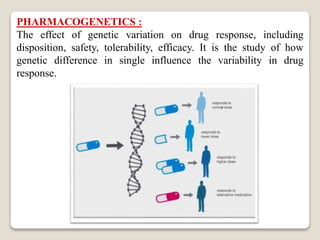
PHARMACOGENETICS :
The effect of genetic variation on drug response, including
disposition, safety, tolerability, efficacy. It is the study of how
genetic difference in single influence the variability in drug
response.
GOALS OF PHARMACOGENETICS :
Maximize drug efficacy
Minimize drug toxicity
Predict patients who will respond to intervention.
Aid in new drug development.
BENEFITS OF PHARMACOGENETICS:
More powerful medicines
Safer drugs the first time
More accurate methods to determine the dosages
Better vaccines.
CURRENT USE OF PHARMACOGENETICS:
Personalized medicine
Determine drug response in treatment of cardiac, respiratory and
psychiatric diseases
Develop drug target in treatment of cancer
Classify patient as slow and fast metabolizes of drugs.
Gene therapy
Drug response
Drug targets
Drug metabolism
CATEGORISE OF PATIENTS FOR PERSONALISED
MEDICINES :
Age related
Disease related
Genetically determined susceptibility
Individual physiological status
Specialized dosage form
Drug targeting
CUSTOMIZED DRUG DELIVERY SYSTEM:
INTRODUCTION :
Customized drug delivery also termed as personalized medicines,
is a medical procedure that separates patient into different groups-
with medical decisions, practices, interventions and/or products to
the individual patient based on their predicted response or risk of
disease.
The person:
•Their DNA
•Exposure of environmental factors
•Types and amount of stress they experiences
•What they eat
ADVANTAGES OF CUSTOMIZED MEDICINES :
Better matching patients to drug instead of “trial and error”.
Eliminate life threatening adverse reactions.
Reduce cost of clinical trials by quickly identifying total failures
and favorable response for particular backgrounds.
Improved efficacy of drugs.
Dosage can be controlled for the patients who need lower doses
or with the needs of each individual patient.
Any allergic creating ingredients can be skipped and a
customized medicine can be produced for a particular individual.
TOOLS TO CUSTOMIZED DRUG DELIVERY SYSTEM :
Bioelectronic medicines
3D printings of pharmaceuticals
Telepharmacy
BIOELECTRONICMEDICINE
BIOELECTRONIC MEDICINES:
DEFINITION:
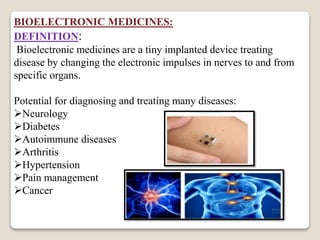
Bioelectronic medicines are a tiny implanted device treating
disease by changing the electronic impulses in nerves to and from
specific organs.
Potential for diagnosing and treating many diseases:
Neurology
Diabetes
Autoimmune diseases
Arthritis
Hypertension
Pain management
Cancer
New era of medicines
New way to understand the language of nervous system to
perform advanced diagnosis.
A tiny device that is attached to nerve that would adjust the
electrical signals between the brain and the organs of our body.
Bioelectronic medicines is a new approach to treat and diagnose
disease and injury.
Bioelectronic medicines uses device technology to read and
modulate the electrical activity within the body’s nervous system,
opening new doors to real time diagnostics and treatment options
for patients.
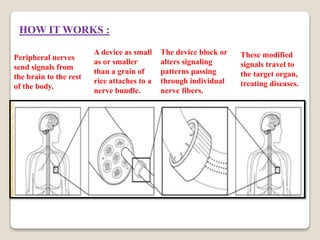
HOW IT WORKS :
Peripheral nerves
send signals from
the brain to the rest
of the body.
A device as small
as or smaller
than a grain of
rice attaches to a
nerve bundle.
The device block or
alters signaling
patterns passing
through individual
nerve fibers.
These modified
signals travel to
the target organ,
treating diseases.
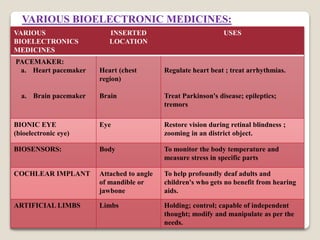
VARIOUS
BIOELECTRONICS
MEDICINES
INSERTED
LOCATION
USES
PACEMAKER:
a. Heart pacemaker
a. Brain pacemaker
Heart (chest
region)
Brain
Regulate heart beat ; treat arrhythmias.
Treat Parkinson's disease; epileptics;
tremors
BIONIC EYE
(bioelectronic eye)
Eye Restore vision during retinal blindness ;
zooming in an district object.
BIOSENSORS: Body To monitor the body temperature and
measure stress in specific parts
COCHLEAR IMPLANT Attached to angle
of mandible or
jawbone
To help profoundly deaf adults and
children's who gets no benefit from hearing
aids.
ARTIFICIAL LIMBS Limbs Holding; control; capable of independent
thought; modify and manipulate as per the
needs.
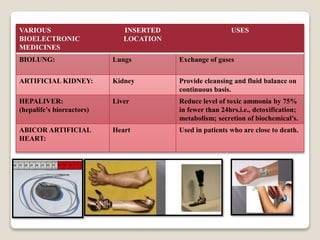
VARIOUS BIOELECTRONIC MEDICINES:
VARIOUS
BIOELECTRONIC
MEDICINES
INSERTED
LOCATION
USES
BIOLUNG: Lungs Exchange of gases
ARTIFICIAL KIDNEY: Kidney Provide cleansing and fluid balance on
continuous basis.
HEPALIVER:
(hepalife’s bioreactors)
Liver Reduce level of toxic ammonia by 75%
in fewer than 24hrs.i.e., detoxification;
metabolism; secretion of biochemical's.
ABICOR ARTIFICIAL
HEART:
Heart Used in patients who are close to death.
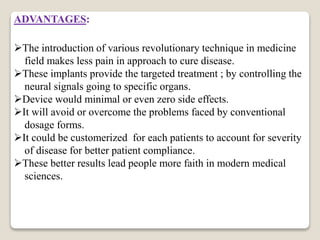
ADVANTAGES:
The introduction of various revolutionary technique in medicine
field makes less pain in approach to cure disease.
These implants provide the targeted treatment ; by controlling the
neural signals going to specific organs.
Device would minimal or even zero side effects.
It will avoid or overcome the problems faced by conventional
dosage forms.
It could be customerized for each patients to account for severity
of disease for better patient compliance.
These better results lead people more faith in modern medical
sciences.
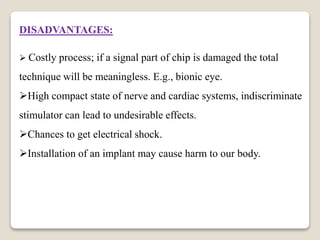
DISADVANTAGES:
 Costly process; if a signal part of chip is damaged the total
technique will be meaningless. E.g., bionic eye.
High compact state of nerve and cardiac systems, indiscriminate
stimulator can lead to undesirable effects.
Chances to get electrical shock.
Installation of an implant may cause harm to our body.
3D PRINTING PHARMACEUTICALS
3D PRINTINGS OF PHARMACEUTICALS:
INTRODUCTION :
DEFINITION:
3D Printing technology relies on computer aided designs to
achieve at most flexibility, time saving and exceptional
manufacturing capability of pharmaceutical medicines.
A single tablet containing multiple drug which means no need to
take so many pills in a day a desired size and shape of tablet.
3D printings is layer by layer production of 3D objects from
digital design.
3D printing a type of additive manufacturing has the potential to
be the “next great step’’ in pharmaceutical manufacturing, enabling
fabrication of specialty drugs and medical devices.
3D printings can be used for personalized or unique dosage
forms, more complex drug release profiles, and printing living
tissue.
3D printing builds an object layer by layer, it can be used to print
drug tablets with a personalizes dosage, possibly combining
multiples drugs into a single dose.
3D printing process could minimize the cost.
It can be used for customized drug delivery system.
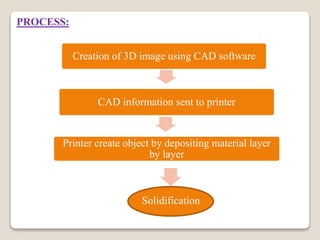
PROCESS:
Creation of 3D image using CAD software
CAD information sent to printer
Printer create object by depositing material layer
by layer
Solidification
ADVANTAGES OF 3D PRINTING:
High production rates due to its fast operating systems.
Reduction of material wastage which can save in the cost of
production.
Ability to achieve high drug loading with much desired precision
and accuracy especially for potent drugs that are applied in
small doses.
Treatment regimens must be customized to improve patient’s
adherence to treatment.
CURRENT 3D PRINTING TECHNOLOGIES IN
PHARMACEUTICAL DRUG DELIVERY:
1) Inkjet printing
2) Zip dose
3) Thermal inkjet printing
4) Fused deposition modeling
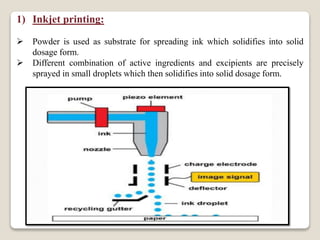
1) Inkjet printing:
 Powder is used as substrate for spreading ink which solidifies into solid
dosage form.
 Different combination of active ingredients and excipients are precisely
sprayed in small droplets which then solidifies into solid dosage form.
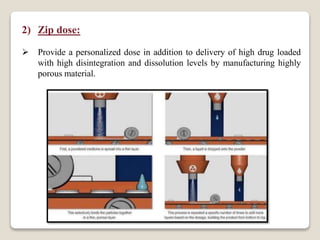
2) Zip dose:
 Provide a personalized dose in addition to delivery of high drug loaded
with high disintegration and dissolution levels by manufacturing highly
porous material.
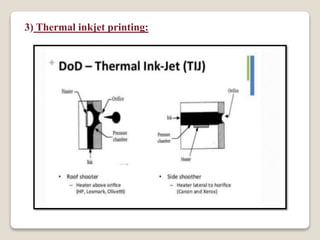
3) Thermal inkjet printing:
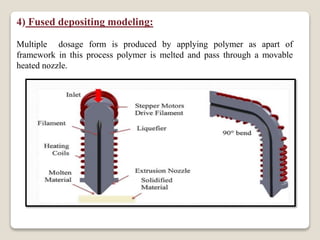
4) Fused depositing modeling:
Multiple dosage form is produced by applying polymer as apart of
framework in this process polymer is melted and pass through a movable
heated nozzle.
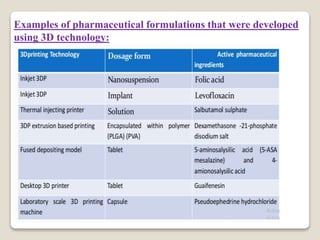
Examples of pharmaceutical formulations that were developed
using 3D technology:
APPLICATIONS OF 3D PRINTING PHARMACEUTICALS:
Tissue and organ fabrication
Creating prosthetics, implants, and anatomical models.
Pharmaceutical research concerning drug discovery, delivery and dosage
forms.
Flexibility in product development.
Useful for designing for complex drug profiles.
TELEPHARMACY
TELEPHARMACY:
DEFINITION:
Telepharmacy means a central pharmacy, either retail or associated with a
hospital , with one or more remote sites in which all sites are connected via
computer , audio, and video link.
Telepharmacy is the delivery of pharmaceutical care via telecommunication to
patients have in locations where they may not have direct contact with a
pharmacist
Purpose and scope:
In order to maintain or make pharmacy services available in areas that have lost
their pharmacy or are in failure of losing their pharmacy , rules are necessary to
permit telepharmacy.
OPERATIONS:
The remote site is considered to be under the personal charge of pharmacist at
the central pharmacy.
A remote site shall be connected to its central pharmacy via computer link,
video link , and audio link.
A remote site should use its central pharmacy’s processing unit.
A pharmacist at the central pharmacy must approve each prescription before it
leaves the remote site.
Counseling must be done by a pharmacist via video and audio link. The
pharmacist must counsel the patient or the patients agent on all new prescriptions
and refills.
A pharmacist must complete monthly inspection of the remote site. Inspection
reports must be included in the policies and procedure for the site. The inspection
reports must be maintained until the next Board Of Pharmacy Inspection.
CATEGORIES OF TELEPHARMACY SERVICES
Mail order
Patient counseling by telephone
Medication therapy management
Collaborative drug management
Central processing and remote order entry
Remote supervision of technician dispensing
Automated dispensing system
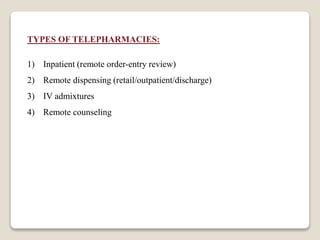
TYPES OF TELEPHARMACIES:
1) Inpatient (remote order-entry review)
2) Remote dispensing (retail/outpatient/discharge)
3) IV admixtures
4) Remote counseling
1) Inpatient (remote order-entry review):
Definition:
Inpatient telepharmacy refers to a pharmacist at a remote location
performing remote order-entry services for an inpatient pharmacy at a
hospital. The remote pharmacist reviews medication orders before the
hospital staff administers the drugs to the patient.
uses:
Hospitals and health systems benefit from inpatient telepharmacy as it
allows for real time medication order review and verification. With inpatient
telepharmacy, remote pharmacists are able to provide 24/7 coverage hours to
help supplement and strengthen the inpatient pharmacy.
2) Remote dispensing (retail/outpatient/discharge):
Definition:
A remote dispensing site, or retail community telepharmacy, is a licensed brick
and mortar pharmacy staffed by a certified pharmacy technician. A pharmacist
supervises the technician, reviews prescriptions and performs his or her duties
from a remote location via technology.
Uses:
It is used in retail community pharmacy and outpatient/discharge pharmacy
settings, telepharmacy gives patients convenient access to a pharmacist and
prescription medication.
3) IV admixtures:
Definition:
The joint commission on accreditation of healthcare organizations (JCAHO)
defines IV mixtures as, ‘the preparation of pharmaceutical product which
requires the measured addition of a medication to a 50ml or greater bag or
bottle of intravenous fluid.’
Uses:
Hospital pharmacies can save time and money by implementing telepharmacy
in the IV admixture clean room. They save the time needed to suit up and enter
the clean room to review the solutions. Freeing up pharmacists time allows
them to focus on clinical activities.
4) Remote counseling:
Definition:
Remote patient counseling equates to pharmacists providing patient counseling
and interactive video session, or by some means through telecommunications.
Uses:
Remote patient counseling allows pharmacists to consult and provide a variety
of pharmacy care services to patients via secure, live video calls. Beyond being
beneficial to retail independents, community, clinical and hospital based
pharmacies, remote counseling also provides opportunities for specialty
counseling, discharge counseling and various clinical interactions with
pharmacists.
Advantages:
Improve efficiency ( reduce work load)
Improve accuracy (reduce errors)
Improve documentations
Enhance security (authorized access only)
Reduce job stress and staff turnover
Improve timeliness for medication delivery
Disadvantages:
Complexity and function variation
Requires additional staff training and technical help
Downtime system failure and inflexibility
Cost and space issues
Personalised medicines 1 (1)