FEEDBACK REGULATED DRUG
DELIVERY SYSTEM
Rate Controlled Drug Delivery System
SUBMITTED TO:
Dr. ANUPAMA DIWAN
SUBMITTED BY:
SURBHI MADAN
(M. PHARM 1ST SEM)
Introduction
 The release of drug from delivery system is
activated by a triggering agent, such as a
biochemical substance, in the body and also
regulated by its concentration via some
feedback mechanism.
 Rate of drug release is controlled by the
concentration of triggering agent detected by a
sensor in the feedback regulated mechanisms.
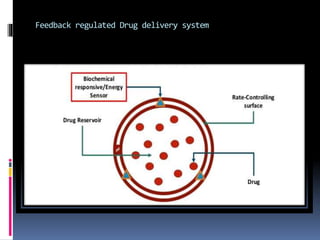
Feedback regulated Drug delivery system
 Feedback regulated drug delivery concept
was applied to:
1. Bio-erosion-regulated DDS
2. Bio-responsive DDS
3. Self-regulated DDS
1. Bio-erosion-regulated DDS
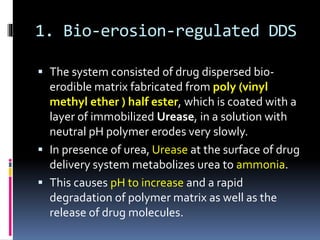
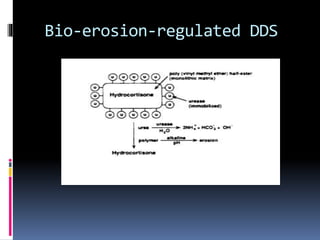
 The system consisted of drug dispersed bio-
erodible matrix fabricated from poly (vinyl
methyl ether ) half ester, which is coated with a
layer of immobilized Urease, in a solution with
neutral pH polymer erodes very slowly.
 In presence of urea, Urease at the surface of drug
delivery system metabolizes urea to ammonia.
 This causes pH to increase and a rapid
degradation of polymer matrix as well as the
release of drug molecules.
Bio-erosion-regulated DDS
2 Bio-responsive DDS
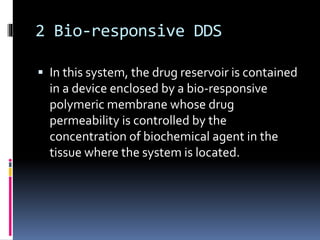
 In this system, the drug reservoir is contained
in a device enclosed by a bio-responsive
polymeric membrane whose drug
permeability is controlled by the
concentration of biochemical agent in the
tissue where the system is located.
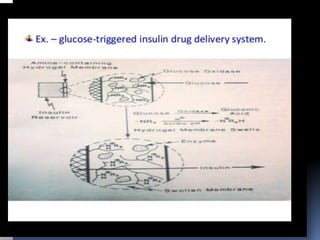
For Instance : Glucose triggered
Insulin delivery system
 The insulin reservoir is encapsulated within a
hydrogel membrane having pendant -NR2 groups.
 In alkaline solution, -NR2 groups are neutral and
membrane is un-swollen and impermeable to
insulin.
 As Glucose, a triggering agent penetrates into the
membrane to form gluconic acid.
 The - NR2 groups are protonated to form NR2 H+ and
the hydrogen membrane then become swollen and
permeable to insulin molecules.The amount of
insulin delivered is thus bio-responsive to the
concentration of glucose penetration the insulin
delivery system.
3. Self-regulated DDS
 This type of FR-DDS depends on a reversible
and competitive binding mechanism to
activate and to regulate the release of drug .
 In this system the drug reservoir is a drug
complex encapsulated in a impermeable
polymeric membrane.
 The release of drug from the delivery system
is activated by the membrane permeation of
a biochemical agent from the tissue in which
the system is located.
Example:
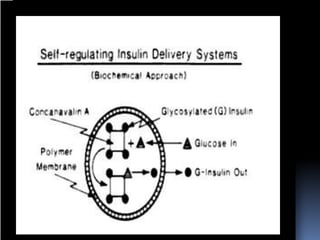
 Reversible binding of sugar molecule by lectin in the design of self
regulating DDS.
 It first involved preparation of Biologically Active insulin derivative in
which insulin I coupled with the sugar(maltose) and this into an insulin-
sugar-lectin Complex.
 The complex is then encapsulated within a semi-permeable membrane .
As blood glucose diffuses in the device and competitively binds at the
sugar binding sites in lectin molecules, this activated the release of
bound insulin-sugar derivatives.
 The released insulin-sugar derivatives then diffuses out of the device
and the amount of insulin sugar derivative depend on the glucose
concentration thus a self regulating drug delivery is achieved.
Drawbacks:
 Release of insulin is non linear in response to the changes in glucose
level.
 A glucose level of 500 mg per dl triggers the release of insulin at only
twice the rate of 50 mg per dl
Feedback Regulated Drug Delivery Vehicles:
Carbon Dioxide Responsive Cationic Hydrogels for
Antidote Release.
 An area that requires particular attention
from feedback regulated drug delivery
involves release of antidotes in response to
opioid overdose.
 feedback regulated approaches have been
used effectively in insulin release in response
to changing glucose levels for diabetic
treatments.
 However ,relatively limited work has been
done in the area of opioid overdose.
 An opioid typically works by binding to µ-receptors found in the
central nervous system and the gastrointestinal tract.
 The receptors in these organ systems mediate both the
benefits and side effects of opioids.
 Specifically, morphine is an extremely potent drug and this
opiate analgesic relieves pain when delivered in appropriate
amounts.
 However, an overdose of morphine causes hypoventilation,
resulting in increased blood CO2 levels, lowered concentration
of O2, and ultimately acidosis induced death.
 This imbalance of CO2 at high morphine concentrations has
been attributed to the suppression of the activity of carbonic
anhydrase (CA), a metalloenzyme that catalyzes the reversible
hydration of CO2 to HCO3 - and H+, thus, balancing the blood
CO2 levels.
 Naloxone is often used as an antidote to mitigate the risk of morphine
overdose.
 Besides the regular polyurethane materials,
many environmental sensitive polyurethanes
were also developed as drug controlled release
carriers, such as temperature sensitive
polyurethane , pH sensitive polyurethane and
pressure sensitive polyurethane , and so on.
 Apart from the controlled release of a specific
drug from a polyurethane matrix, simultaneous
drug release at different rates from
biodegradable polyurethane foams were also
reported
REFERENCE
 CHIENY.W. ,“NOVEL DRUG DELIVERY
SYSTEM”, PAGE NO. 1-132
 ROBINSON, “FUNDAMENTALS OF
CONTROLLED DRUG DELIVERY
SYSTEM”,PAGE NO. 482-508
Feedback regulated drug delivery system

Feedback regulated drug delivery system

  • 1.
    FEEDBACK REGULATED DRUG DELIVERYSYSTEM Rate Controlled Drug Delivery System SUBMITTED TO: Dr. ANUPAMA DIWAN SUBMITTED BY: SURBHI MADAN (M. PHARM 1ST SEM)
  • 2.
    Introduction  The releaseof drug from delivery system is activated by a triggering agent, such as a biochemical substance, in the body and also regulated by its concentration via some feedback mechanism.  Rate of drug release is controlled by the concentration of triggering agent detected by a sensor in the feedback regulated mechanisms.
  • 3.
    Feedback regulated Drugdelivery system
  • 4.
     Feedback regulateddrug delivery concept was applied to: 1. Bio-erosion-regulated DDS 2. Bio-responsive DDS 3. Self-regulated DDS
  • 5.
    1. Bio-erosion-regulated DDS The system consisted of drug dispersed bio- erodible matrix fabricated from poly (vinyl methyl ether ) half ester, which is coated with a layer of immobilized Urease, in a solution with neutral pH polymer erodes very slowly.  In presence of urea, Urease at the surface of drug delivery system metabolizes urea to ammonia.  This causes pH to increase and a rapid degradation of polymer matrix as well as the release of drug molecules.
  • 6.
  • 7.
    2 Bio-responsive DDS In this system, the drug reservoir is contained in a device enclosed by a bio-responsive polymeric membrane whose drug permeability is controlled by the concentration of biochemical agent in the tissue where the system is located.
  • 9.
    For Instance :Glucose triggered Insulin delivery system  The insulin reservoir is encapsulated within a hydrogel membrane having pendant -NR2 groups.  In alkaline solution, -NR2 groups are neutral and membrane is un-swollen and impermeable to insulin.  As Glucose, a triggering agent penetrates into the membrane to form gluconic acid.  The - NR2 groups are protonated to form NR2 H+ and the hydrogen membrane then become swollen and permeable to insulin molecules.The amount of insulin delivered is thus bio-responsive to the concentration of glucose penetration the insulin delivery system.
  • 10.
    3. Self-regulated DDS This type of FR-DDS depends on a reversible and competitive binding mechanism to activate and to regulate the release of drug .  In this system the drug reservoir is a drug complex encapsulated in a impermeable polymeric membrane.  The release of drug from the delivery system is activated by the membrane permeation of a biochemical agent from the tissue in which the system is located.
  • 12.
    Example:  Reversible bindingof sugar molecule by lectin in the design of self regulating DDS.  It first involved preparation of Biologically Active insulin derivative in which insulin I coupled with the sugar(maltose) and this into an insulin- sugar-lectin Complex.  The complex is then encapsulated within a semi-permeable membrane . As blood glucose diffuses in the device and competitively binds at the sugar binding sites in lectin molecules, this activated the release of bound insulin-sugar derivatives.  The released insulin-sugar derivatives then diffuses out of the device and the amount of insulin sugar derivative depend on the glucose concentration thus a self regulating drug delivery is achieved. Drawbacks:  Release of insulin is non linear in response to the changes in glucose level.  A glucose level of 500 mg per dl triggers the release of insulin at only twice the rate of 50 mg per dl
  • 13.
    Feedback Regulated DrugDelivery Vehicles: Carbon Dioxide Responsive Cationic Hydrogels for Antidote Release.  An area that requires particular attention from feedback regulated drug delivery involves release of antidotes in response to opioid overdose.  feedback regulated approaches have been used effectively in insulin release in response to changing glucose levels for diabetic treatments.  However ,relatively limited work has been done in the area of opioid overdose.
  • 14.
     An opioidtypically works by binding to µ-receptors found in the central nervous system and the gastrointestinal tract.  The receptors in these organ systems mediate both the benefits and side effects of opioids.  Specifically, morphine is an extremely potent drug and this opiate analgesic relieves pain when delivered in appropriate amounts.  However, an overdose of morphine causes hypoventilation, resulting in increased blood CO2 levels, lowered concentration of O2, and ultimately acidosis induced death.  This imbalance of CO2 at high morphine concentrations has been attributed to the suppression of the activity of carbonic anhydrase (CA), a metalloenzyme that catalyzes the reversible hydration of CO2 to HCO3 - and H+, thus, balancing the blood CO2 levels.  Naloxone is often used as an antidote to mitigate the risk of morphine overdose.
  • 15.
     Besides theregular polyurethane materials, many environmental sensitive polyurethanes were also developed as drug controlled release carriers, such as temperature sensitive polyurethane , pH sensitive polyurethane and pressure sensitive polyurethane , and so on.  Apart from the controlled release of a specific drug from a polyurethane matrix, simultaneous drug release at different rates from biodegradable polyurethane foams were also reported
  • 16.
    REFERENCE  CHIENY.W. ,“NOVELDRUG DELIVERY SYSTEM”, PAGE NO. 1-132  ROBINSON, “FUNDAMENTALS OF CONTROLLED DRUG DELIVERY SYSTEM”,PAGE NO. 482-508