02-05-2022 © R R INSTITUTIONS , BANGALORE 1
SUBJECT-DRUG DELIVERY SYSTEMS
SUMMITTED BY: SUBMITTED TO:
Becare Dkhar Prof. Dr.A.Geethalakshmi
1st sem m.pharm HOD
Department of Pharmaceutics
Seminar on rate controlled drug delivery
(Principle, Fundamental,Types)
02-05-2022 © R R INSTITUTIONS , BANGALORE
2
CONTENT
1. INTRODUCTION
2. PRINCIPLES
3. FUNDAMENTAL
4. TYPES
INTRODUCTION
• For many decades treatments of an acute disease or a chronic illness
has been mostly accomplished by delivery of drug to patients using
various pharmaceutical dosage form, including tablets, capsules, pills,
suppositories, creams, ointments, liquids, aerosols, and injectables, as
drug carrier
• Even today these conventional drug delivery system are the primary
pharmaceutical product commonly seen in the prescription and over
the counter drug market place
02-05-2022 © R R INSTITUTIONS , BANGALORE 3
• SUSTAINED RELEASED
It has been constantly used to describe a pharmaceutical dosage form
formulated to retard the release of a therapeutic agent such that its appearance
in the systemic circulation is delayed or prolonged and its plasma profile is
sustained in duration. The onset of its pharmacologic action is often delayed,
and the duration of its therapeutic effect is sustained.
CONTROLLED RELEASE
It also implies a predictability and reproductibility in the drug release
kinetics, which means that the release of drug ingredient(s) from a controlled-
release drug delivery system proceeds at a rate profile that is not only
predictable kinetically, but also reproducible from one unit to another
02-05-2022 © R R INSTITUTIONS , BANGALORE 4
Principles
When a drug is delivered as a conventional dosage form such as tablet,
capsule etc., the dosing interval is much shorter than the half life of the drug
resulting in number of limitations which are as follows:
Poor patient compliance
A typical peak- valley plasma concentration time profile is obtained which
makes the attainment of steady state condition difficult.
The unavoidable fluctuations in the drug concentration may lead to under-
medication/over-medication as the steady state value fall/rise beyond the
therapeutic range.
The fluctuating drug levels may lead to precipitation of adverse effects
especially of a drug with small therapeutics index whenever over-
medication occurs.
02-05-2022 © R R INSTITUTIONS , BANGALORE 5
02-05-2022 © R R INSTITUTIONS , BANGALORE 6
There are two ways to over come such situation:
1. Development of new better and safer drugs with long half-life and large therapeutic
indices.
2. Effective and safer use of existing drugs through concepts and techniques of
controlled and targeted delivery systems-that resulted in the development of DDS
capable of controlling the rate of drug delivery, sustaining the duration of
therapeutic action and/or targeting the delivery of drug to a particular tissue. Thus ,
a RCDDS was assigned to improved the therapeutics efficacy and safety of a drug
by precise temporal and spatial placement in the body, thus reducing both the size
and the number of dose required
spatial refers to targeting a drug to a specific organ/tissue.
temporal refers to controlling the rate /specific time of DD to the target tissue. It is
benificial for drugs that are rapidly metabolished or have short elimination half-life
02-05-2022 © R R INSTITUTIONS , BANGALORE 7
Fundamentals of RCDDS
• For the mechanistic analysis of rate controlled drug release from various
systems, the following assumption must be established:
1. Dissolution of drug crystals into their surrounding medium is the first step
of the drug release process
2. A pseudo-steady state exists in the process of controlled drug release
3. The diffusion coefficient of a drug molecule in a given medium is
invariable with time and distance
• The interfacial partitioning of a drug molecule from polymer toward
solution is related to its solubilities in polymer(Cp) and in solution (Cs)as
defined by
K=Cs/Cp
where K is defined as the distribution (or partition) coefficient
02-05-2022 © R R INSTITUTIONS , BANGALORE 8
1.POLYMER SOLUBILITY
The drug particles are not released until the drug molecules on the outermost surface
layer of a drug particles dissociate from their crystal lattice, dissolve or partition into
the surrounding polymer, diffuse through it and finally partition into the elution
medium surrounding the drug deliver device.
 the importance of polymer solubility in determining the rate of drug release
from:
membrane permeation
Q/t=(CpKDdDm)/(KDdhm+Dmhd)
polymer matrix diffusion
Q/t=[2A-Cp)CpDpt]1/2
Hybrid type
Q/t=ACpDp/{[DpKm(1/Pm+1/Pd)2 + 4ACpDpt1/2}
In all these equations, there exist a linear relationship between rate of drug release
Q/T and magnitude of polymer solubility i.e. Cp.
02-05-2022 © R R INSTITUTIONS , BANGALORE 9
2.SOLUTION SOLUBILITY
To maintain the drug release in controlled manner, it is important to
maintain a sink condition which can be accomplished by either
maintaining the drug conc. In the bulk solution very closed to zero or
by making solution solubility much greater than the bulk solution
concentration. (Cs>>Cb)
The solubilisation of poorly soluble drugs in aqueous solution can be
effectively accomplished by using multiple co-solvent systems.
E.g.;steroids, metronidazole.etc.
The equation suggest that Q/t ( rate of release)= KDdCs/hd
02-05-2022 © R R INSTITUTIONS , BANGALORE 10
3.PARTITION COEFFICIENT
• Partition coefficient is defined as the ration of drugs solubility in the elution
solution Cs over its solubity in the polymers composition Cp of the system.
• The magnitude of Q/t is a linear function of K.
• When the magnitude of K is small, Q/t increases linearly with increase in
partition coefficient. This region is called PARTITION-CONTROLLED
PROCESS.
• When K is increased beyond critical point (k=0.5), the matrix controlled
mechanism became pre-dominant
• Between these ,there exist a transition phase, where Q/t is proportional to
1/K
02-05-2022 © R R INSTITUTIONS , BANGALORE 11
4.POLYMER DIFFUSIVITY (Dp)
• The diffusion of small molecules in a polymer structure is an energy-
activated process in which the diffusant molecules move to a
successive series of equilibrium positions when a sufficient amount of
energy, called the energy of activation for diffusion Ed, has been
acquired by the diffusant and its surrounding polymer matrix
 the magnitude of polymer diffusitivity Dp is also dependent upon
the type of functional group and their stereo-chemical positions in the
diffusant molecule.
02-05-2022 © R R INSTITUTIONS , BANGALORE 12
02-05-2022 © R R INSTITUTIONS , BANGALORE 13
1. Effect of cross-linking: the diffusitivity is reduces as the cross-linking is
increased. The reduction in polymers diffusivity was found to be a linear
function of the reciprocal of the extent of cross linkage.
2. Effect of crystallinity: the crystallinity causes reduction in gross polymer
diffusivity.
3. Effect of fillers: the reduction in diffusivity is a function of filler content in
the polymer
5. SOLUTION DIFFUSIVITY (Ds)
The diffusion of solute molecules in a solution medium may be
considered to result from the random motion of molecules.
When the solution diffusivities of various chemical classes are
compared on the basis of molecular volume, the alkanes are the most
rapidly diffusing chemicals, with the relative rates of diffusion:
alkanes > alcohols > amides > acids > amino acid > dicarboxylic
acid. There fore , the solution diffusivity may also be defined by the
relationship: Ds=Doe- Ea/RT
Ds can also be equated as Ds is proportional to 1/𝜇 and 1/C, where 𝜇
is viscosity and C is concentration.
02-05-2022 © R R INSTITUTIONS , BANGALORE 14
6. THICKNESS OF POLYMER
DIFFUSIONAL PATH (hp)
• The release of drug release can also be governed by the thickness of
polymer diffusional path which states that the thickness show a linear
relationship with Cp and Dp.
• The thickness of polymer membrane can also be calculated through
lag time(t1) for membrane permeation.
given by, Dp=hp2/6t, where Dp is constant and hence hp is
proportional to t1
02-05-2022 © R R INSTITUTIONS , BANGALORE 15
7.SURFACE AREA
• The in-vivo and in-vitro rates of drug release are observed to be
dependent upon the SA of drug delivery sites.
02-05-2022 © R R INSTITUTIONS , BANGALORE 16
8. THICKNESS OF HYDRODYNAMIC
DIFFUSION LAYER (hD)
• The rate-limiting role of the hydrodynamic diffusion layer hd in
determining drug release profiles can be visualized by considering that
as a device is immersed in a stationary position in a solution, a
stagnant layer is established on the immediate surface of the device.
The effective thickness of this stagnant layer is dependent on the
solution diffusivity Ds and varies with the square root of time
(hd)nr=(IIDs)1/2t1/2
02-05-2022 © R R INSTITUTIONS , BANGALORE 17
TYPES OF CDDS
1. Rate pre-programmed DDS
2. Activated modulated DDS
3. Feedback regulated DDS
4. Site –targeting DDS
02-05-2022 © R R INSTITUTIONS , BANGALORE 18
RATE PRE-PROGRAMMED DDS
• In this group of controlled-release drug delivery systems, the release
of drug molecules from the delivery system design, which controls the
molecular diffusion of drug molecules in and/or across the barrier
medium within or surrounding the delivery system. Fick’s laws of
diffusion are often followed .These system can be
further classified as follows
a) Polymer membrane permeation CDDS
b) Polymer matrix diffusion CDDS
c) Micro reservior partition CDDS
02-05-2022 © R R INSTITUTIONS , BANGALORE 19
ACTIVATED-MODULATED DRUG
DELIVERY SYSTEM
• In this group of controlled-release drug delivery systems the release of
drug molecules from the delivery systems is activated by some
physical, chemical, or biochemical processes and/or facilitated by the
energy supplied externally. The rate of drug release is then controlled
by regulating the process applied or energy input.
02-05-2022 © R R INSTITUTIONS , BANGALORE 20
It can be classified into the following categories
1. Physical means
a) Osmotic pressure-activated DDS
b) Hydrodynamic pressure activated DDS
c) Vapour pressure activated DDS
d) Mechanical activated DDS
e) Magnetically activated DDS
f) Sonophoresis activated DDS
g) Iontophoresis activated DDS
h) Hydration activated DDS
02-05-2022 © R R INSTITUTIONS , BANGALORE 21
2. Chemical means
a) pH-activated DDS
b) Ion-activated DDS
c) Hydrolysis-activated DDS
3. Biochemical means
a) Enzyme activated DDS
b) Biochemical-activated DDS
02-05-2022 © R R INSTITUTIONS , BANGALORE 22
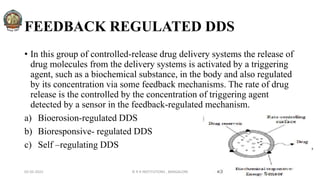
FEEDBACK REGULATED DDS
• In this group of controlled-release drug delivery systems the release of
drug molecules from the delivery systems is activated by a triggering
agent, such as a biochemical substance, in the body and also regulated
by its concentration via some feedback mechanisms. The rate of drug
release is the controlled by the concentration of triggering agent
detected by a sensor in the feedback-regulated mechanism.
a) Bioerosion-regulated DDS
b) Bioresponsive- regulated DDS
c) Self –regulating DDS
02-05-2022 © R R INSTITUTIONS , BANGALORE 23
SITE-TARGETTING DDS
• Targetted DDS refers to the system that place the drug at or near the
receptor site or site of action
• It can be classified as:
1. 1st order targeting: delivers the drug to capillary bed/active site
2. 2nd order targeting: delivers the drug to special cell type such as
tumour cells and are not to the normal cells
3. 3rd order targeting: delivers the drug
intracellularly.
02-05-2022 © R R INSTITUTIONS , BANGALORE 24
REFERENCES
• Y W.Chien, Novel drug delivery systems, 2nd edition, revised and
expanded, Marcel Dekker , Inc., Newyork, 1992;43-111
• Jaiswal S.B, Brahmankar DM; Biopharmaceutics and
pharmacokinetics- A treatise; 4th edition; 2016;400-422
02-05-2022 © R R INSTITUTIONS , BANGALORE 25
02-05-2022 © R R INSTITUTIONS , BANGALORE 26

rCDDS (FUNDAMENTAL AND TYPES).pptx

  • 1.
    02-05-2022 © RR INSTITUTIONS , BANGALORE 1 SUBJECT-DRUG DELIVERY SYSTEMS SUMMITTED BY: SUBMITTED TO: Becare Dkhar Prof. Dr.A.Geethalakshmi 1st sem m.pharm HOD Department of Pharmaceutics Seminar on rate controlled drug delivery (Principle, Fundamental,Types)
  • 2.
    02-05-2022 © RR INSTITUTIONS , BANGALORE 2 CONTENT 1. INTRODUCTION 2. PRINCIPLES 3. FUNDAMENTAL 4. TYPES
  • 3.
    INTRODUCTION • For manydecades treatments of an acute disease or a chronic illness has been mostly accomplished by delivery of drug to patients using various pharmaceutical dosage form, including tablets, capsules, pills, suppositories, creams, ointments, liquids, aerosols, and injectables, as drug carrier • Even today these conventional drug delivery system are the primary pharmaceutical product commonly seen in the prescription and over the counter drug market place 02-05-2022 © R R INSTITUTIONS , BANGALORE 3
  • 4.
    • SUSTAINED RELEASED Ithas been constantly used to describe a pharmaceutical dosage form formulated to retard the release of a therapeutic agent such that its appearance in the systemic circulation is delayed or prolonged and its plasma profile is sustained in duration. The onset of its pharmacologic action is often delayed, and the duration of its therapeutic effect is sustained. CONTROLLED RELEASE It also implies a predictability and reproductibility in the drug release kinetics, which means that the release of drug ingredient(s) from a controlled- release drug delivery system proceeds at a rate profile that is not only predictable kinetically, but also reproducible from one unit to another 02-05-2022 © R R INSTITUTIONS , BANGALORE 4
  • 5.
    Principles When a drugis delivered as a conventional dosage form such as tablet, capsule etc., the dosing interval is much shorter than the half life of the drug resulting in number of limitations which are as follows: Poor patient compliance A typical peak- valley plasma concentration time profile is obtained which makes the attainment of steady state condition difficult. The unavoidable fluctuations in the drug concentration may lead to under- medication/over-medication as the steady state value fall/rise beyond the therapeutic range. The fluctuating drug levels may lead to precipitation of adverse effects especially of a drug with small therapeutics index whenever over- medication occurs. 02-05-2022 © R R INSTITUTIONS , BANGALORE 5
  • 6.
    02-05-2022 © RR INSTITUTIONS , BANGALORE 6 There are two ways to over come such situation: 1. Development of new better and safer drugs with long half-life and large therapeutic indices. 2. Effective and safer use of existing drugs through concepts and techniques of controlled and targeted delivery systems-that resulted in the development of DDS capable of controlling the rate of drug delivery, sustaining the duration of therapeutic action and/or targeting the delivery of drug to a particular tissue. Thus , a RCDDS was assigned to improved the therapeutics efficacy and safety of a drug by precise temporal and spatial placement in the body, thus reducing both the size and the number of dose required spatial refers to targeting a drug to a specific organ/tissue. temporal refers to controlling the rate /specific time of DD to the target tissue. It is benificial for drugs that are rapidly metabolished or have short elimination half-life
  • 7.
    02-05-2022 © RR INSTITUTIONS , BANGALORE 7
  • 8.
    Fundamentals of RCDDS •For the mechanistic analysis of rate controlled drug release from various systems, the following assumption must be established: 1. Dissolution of drug crystals into their surrounding medium is the first step of the drug release process 2. A pseudo-steady state exists in the process of controlled drug release 3. The diffusion coefficient of a drug molecule in a given medium is invariable with time and distance • The interfacial partitioning of a drug molecule from polymer toward solution is related to its solubilities in polymer(Cp) and in solution (Cs)as defined by K=Cs/Cp where K is defined as the distribution (or partition) coefficient 02-05-2022 © R R INSTITUTIONS , BANGALORE 8
  • 9.
    1.POLYMER SOLUBILITY The drugparticles are not released until the drug molecules on the outermost surface layer of a drug particles dissociate from their crystal lattice, dissolve or partition into the surrounding polymer, diffuse through it and finally partition into the elution medium surrounding the drug deliver device.  the importance of polymer solubility in determining the rate of drug release from: membrane permeation Q/t=(CpKDdDm)/(KDdhm+Dmhd) polymer matrix diffusion Q/t=[2A-Cp)CpDpt]1/2 Hybrid type Q/t=ACpDp/{[DpKm(1/Pm+1/Pd)2 + 4ACpDpt1/2} In all these equations, there exist a linear relationship between rate of drug release Q/T and magnitude of polymer solubility i.e. Cp. 02-05-2022 © R R INSTITUTIONS , BANGALORE 9
  • 10.
    2.SOLUTION SOLUBILITY To maintainthe drug release in controlled manner, it is important to maintain a sink condition which can be accomplished by either maintaining the drug conc. In the bulk solution very closed to zero or by making solution solubility much greater than the bulk solution concentration. (Cs>>Cb) The solubilisation of poorly soluble drugs in aqueous solution can be effectively accomplished by using multiple co-solvent systems. E.g.;steroids, metronidazole.etc. The equation suggest that Q/t ( rate of release)= KDdCs/hd 02-05-2022 © R R INSTITUTIONS , BANGALORE 10
  • 11.
    3.PARTITION COEFFICIENT • Partitioncoefficient is defined as the ration of drugs solubility in the elution solution Cs over its solubity in the polymers composition Cp of the system. • The magnitude of Q/t is a linear function of K. • When the magnitude of K is small, Q/t increases linearly with increase in partition coefficient. This region is called PARTITION-CONTROLLED PROCESS. • When K is increased beyond critical point (k=0.5), the matrix controlled mechanism became pre-dominant • Between these ,there exist a transition phase, where Q/t is proportional to 1/K 02-05-2022 © R R INSTITUTIONS , BANGALORE 11
  • 12.
    4.POLYMER DIFFUSIVITY (Dp) •The diffusion of small molecules in a polymer structure is an energy- activated process in which the diffusant molecules move to a successive series of equilibrium positions when a sufficient amount of energy, called the energy of activation for diffusion Ed, has been acquired by the diffusant and its surrounding polymer matrix  the magnitude of polymer diffusitivity Dp is also dependent upon the type of functional group and their stereo-chemical positions in the diffusant molecule. 02-05-2022 © R R INSTITUTIONS , BANGALORE 12
  • 13.
    02-05-2022 © RR INSTITUTIONS , BANGALORE 13 1. Effect of cross-linking: the diffusitivity is reduces as the cross-linking is increased. The reduction in polymers diffusivity was found to be a linear function of the reciprocal of the extent of cross linkage. 2. Effect of crystallinity: the crystallinity causes reduction in gross polymer diffusivity. 3. Effect of fillers: the reduction in diffusivity is a function of filler content in the polymer
  • 14.
    5. SOLUTION DIFFUSIVITY(Ds) The diffusion of solute molecules in a solution medium may be considered to result from the random motion of molecules. When the solution diffusivities of various chemical classes are compared on the basis of molecular volume, the alkanes are the most rapidly diffusing chemicals, with the relative rates of diffusion: alkanes > alcohols > amides > acids > amino acid > dicarboxylic acid. There fore , the solution diffusivity may also be defined by the relationship: Ds=Doe- Ea/RT Ds can also be equated as Ds is proportional to 1/𝜇 and 1/C, where 𝜇 is viscosity and C is concentration. 02-05-2022 © R R INSTITUTIONS , BANGALORE 14
  • 15.
    6. THICKNESS OFPOLYMER DIFFUSIONAL PATH (hp) • The release of drug release can also be governed by the thickness of polymer diffusional path which states that the thickness show a linear relationship with Cp and Dp. • The thickness of polymer membrane can also be calculated through lag time(t1) for membrane permeation. given by, Dp=hp2/6t, where Dp is constant and hence hp is proportional to t1 02-05-2022 © R R INSTITUTIONS , BANGALORE 15
  • 16.
    7.SURFACE AREA • Thein-vivo and in-vitro rates of drug release are observed to be dependent upon the SA of drug delivery sites. 02-05-2022 © R R INSTITUTIONS , BANGALORE 16
  • 17.
    8. THICKNESS OFHYDRODYNAMIC DIFFUSION LAYER (hD) • The rate-limiting role of the hydrodynamic diffusion layer hd in determining drug release profiles can be visualized by considering that as a device is immersed in a stationary position in a solution, a stagnant layer is established on the immediate surface of the device. The effective thickness of this stagnant layer is dependent on the solution diffusivity Ds and varies with the square root of time (hd)nr=(IIDs)1/2t1/2 02-05-2022 © R R INSTITUTIONS , BANGALORE 17
  • 18.
    TYPES OF CDDS 1.Rate pre-programmed DDS 2. Activated modulated DDS 3. Feedback regulated DDS 4. Site –targeting DDS 02-05-2022 © R R INSTITUTIONS , BANGALORE 18
  • 19.
    RATE PRE-PROGRAMMED DDS •In this group of controlled-release drug delivery systems, the release of drug molecules from the delivery system design, which controls the molecular diffusion of drug molecules in and/or across the barrier medium within or surrounding the delivery system. Fick’s laws of diffusion are often followed .These system can be further classified as follows a) Polymer membrane permeation CDDS b) Polymer matrix diffusion CDDS c) Micro reservior partition CDDS 02-05-2022 © R R INSTITUTIONS , BANGALORE 19
  • 20.
    ACTIVATED-MODULATED DRUG DELIVERY SYSTEM •In this group of controlled-release drug delivery systems the release of drug molecules from the delivery systems is activated by some physical, chemical, or biochemical processes and/or facilitated by the energy supplied externally. The rate of drug release is then controlled by regulating the process applied or energy input. 02-05-2022 © R R INSTITUTIONS , BANGALORE 20
  • 21.
    It can beclassified into the following categories 1. Physical means a) Osmotic pressure-activated DDS b) Hydrodynamic pressure activated DDS c) Vapour pressure activated DDS d) Mechanical activated DDS e) Magnetically activated DDS f) Sonophoresis activated DDS g) Iontophoresis activated DDS h) Hydration activated DDS 02-05-2022 © R R INSTITUTIONS , BANGALORE 21
  • 22.
    2. Chemical means a)pH-activated DDS b) Ion-activated DDS c) Hydrolysis-activated DDS 3. Biochemical means a) Enzyme activated DDS b) Biochemical-activated DDS 02-05-2022 © R R INSTITUTIONS , BANGALORE 22
  • 23.
    FEEDBACK REGULATED DDS •In this group of controlled-release drug delivery systems the release of drug molecules from the delivery systems is activated by a triggering agent, such as a biochemical substance, in the body and also regulated by its concentration via some feedback mechanisms. The rate of drug release is the controlled by the concentration of triggering agent detected by a sensor in the feedback-regulated mechanism. a) Bioerosion-regulated DDS b) Bioresponsive- regulated DDS c) Self –regulating DDS 02-05-2022 © R R INSTITUTIONS , BANGALORE 23
  • 24.
    SITE-TARGETTING DDS • TargettedDDS refers to the system that place the drug at or near the receptor site or site of action • It can be classified as: 1. 1st order targeting: delivers the drug to capillary bed/active site 2. 2nd order targeting: delivers the drug to special cell type such as tumour cells and are not to the normal cells 3. 3rd order targeting: delivers the drug intracellularly. 02-05-2022 © R R INSTITUTIONS , BANGALORE 24
  • 25.
    REFERENCES • Y W.Chien,Novel drug delivery systems, 2nd edition, revised and expanded, Marcel Dekker , Inc., Newyork, 1992;43-111 • Jaiswal S.B, Brahmankar DM; Biopharmaceutics and pharmacokinetics- A treatise; 4th edition; 2016;400-422 02-05-2022 © R R INSTITUTIONS , BANGALORE 25
  • 26.
    02-05-2022 © RR INSTITUTIONS , BANGALORE 26