

11
Department of Pharmacy (Pharmaceutics) | Sagar savale
04/21/16 Sagar KiShor Savale
CONTENTS.
Definition.
Inherent properties of powder solids.
Solid air interface.
Angle of repose and flow rates.
Mass volume relationship.
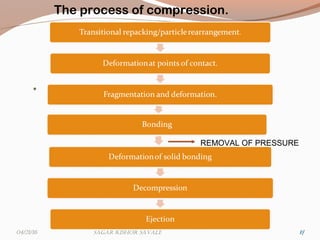
Process of compression.
2204/21/16 Sagar KiShor Savale
Die wall lubricant.
Force and volume relationship.
Heckel plot and kawatika equation.
Compaction profile.
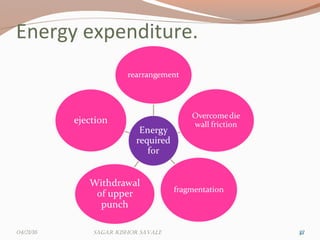
Energy expenditure.
Measurement of energy.
 transmission of force.
 force displacement curve.
Strength of tablet and its estimation.
References.
3304/21/16 Sagar KiShor Savale
WHAT IS COMPRESSION ?
Compression means reduction of bulk volume of
material as a result of the removal of gaseous
phase (air) by applied pressure
WHAT IS CONSOLIDATION?
Consolidation is an increase in mechanical
strength of material resulting from particle -
particle interactions.
4404/21/16 Sagar KiShor Savale
WHAT IS COMPACTION ?
The compression and consolidation of a two
phase (solid + gas) system due to an applied
force, resulting in the formation of a compact
but porous mass of definite geometry.
Compaction =compression + consolidation
of two phases (solid-gas) on
application of force.
5504/21/16 Sagar KiShor Savale
Inherent properties of
powder solids
Solid –air interfaces.
Angle of repose.
Fixed funnel and free standing cone method.
Tilting box method.
Revolving cylinder method.
Mass –volume relationships.
Methods to mesure volume of powder.
 Helium pycnometer
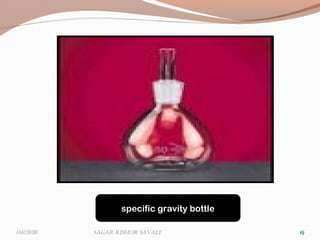
 Liquid displacement method (specific gravity
bottle method
604/21/16 Sagar KiShor Savale
7
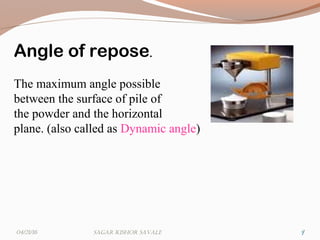
Angle of repose.
The maximum angle possible
between the surface of pile of
the powder and the horizontal
plane. (also called as Dynamic angle)
704/21/16 Sagar KiShor Savale
8
METHODS TO MEASURE
ANGLE OF REPOSE.
a.Fixed funnel and free standing cone method.
b.Tilting box method.
c.Revolving cylinder method
04/21/16 Sagar KiShor Savale
9
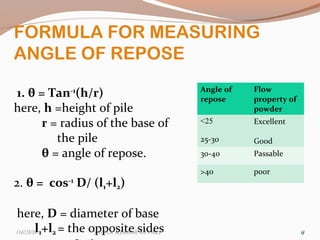
FORMULA FOR MEASURING
ANGLE OF REPOSE
1. θ = Tan-1
(h/r)
here, h =height of pile
r = radius of the base of
the pile
θ = angle of repose.
2. θ = cos-1
D/ (l1+l2)
here, D = diameter of base
l1+l2 = the opposite sides
Angle of
repose
Flow
property of
powder
<25
25-30
Excellent
Good
30-40 Passable
>40 poor
904/21/16 Sagar KiShor Savale
10
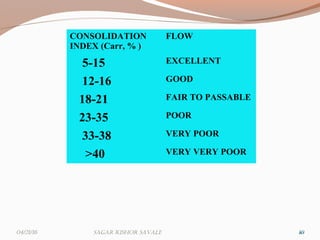
CONSOLIDATION
INDEX (Carr, % )
FLOW
5-15 EXCELLENT
12-16 GOOD
18-21 FAIR TO PASSABLE
23-35 POOR
33-38 VERY POOR
>40 VERY VERY POOR
1004/21/16 Sagar KiShor Savale
11
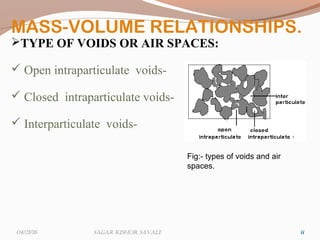
MASS-VOLUME RELATIONSHIPS.
TYPE OF VOIDS OR AIR SPACES:
 Open intraparticulate voids-
 Closed intraparticulate voids-
 Interparticulate voids-
11
Fig:- types of voids and air
spaces.
04/21/16 Sagar KiShor Savale
METHODS TO MEASURE
VOLUME OF POWDER.
 Helium pycnometer
 Liquid displacement method (specific gravity bottle
method)
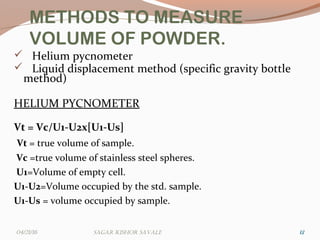
HELIUM PYCNOMETER
Vt = Vc/U1-U2x[U1-Us]
Vt = true volume of sample.
Vc =true volume of stainless steel spheres.
U1=Volume of empty cell.
U1-U2=Volume occupied by the std. sample.
U1-Us = volume occupied by sample.
121204/21/16 Sagar KiShor Savale
13
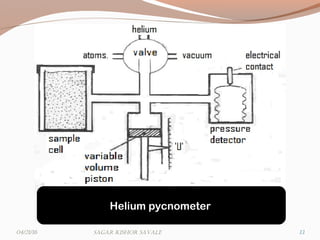
Helium pycnometer.
04/21/16 Sagar KiShor Savale
Liquid displacement method.
Solvent used are ---e.g., ethyl alcohol ,water,
mercury , etc.
Pycnometer or specific gravity bottle used.
True density= w3/(w4-w2) = (w2-w1)/(w4-w2)
w1 = wt. of Pycnometer
w2 = Wt. of Pycnometer +sample or glass
beads
w4 = Wt. ofPycnometerwith powder & filled with
solvent
w3=w2-w1=Wt. of sample
w4-w2=Volume of liquid displaced by the solid
141404/21/16 Sagar KiShor Savale
15
specific gravity bottle
1504/21/16 Sagar KiShor Savale
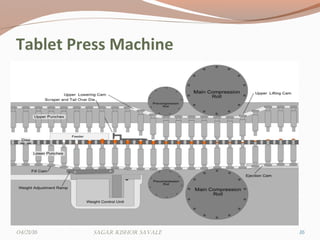
Tablet Press Machine
1604/21/16 Sagar KiShor Savale
.
17
The process of compression.
17
REMOVAL OF PRESSURE
04/21/16 Sagar KiShor Savale
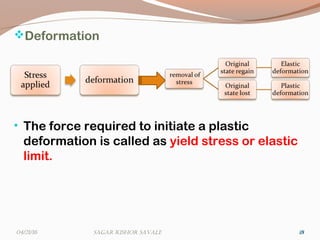
Deformation
• The force required to initiate a plastic
deformation is called as yield stress or elastic
limit.
181804/21/16 Sagar KiShor Savale
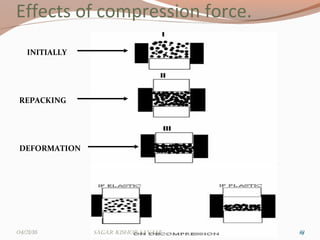
Effects of compression force.
19
INITIALLY
REPACKING
DEFORMATION
1904/21/16 Sagar KiShor Savale
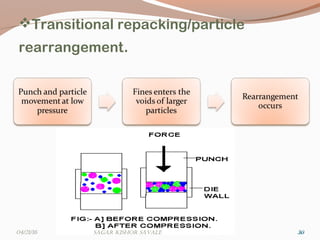
Transitional repacking/particle
rearrangement.
202004/21/16 Sagar KiShor Savale
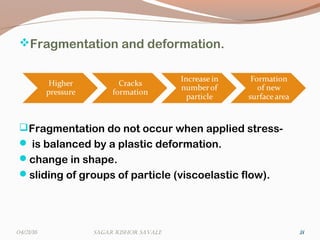
Fragmentation and deformation.
Fragmentation do not occur when applied stress-
 is balanced by a plastic deformation.
change in shape.
sliding of groups of particle (viscoelastic flow).
212104/21/16 Sagar KiShor Savale
22
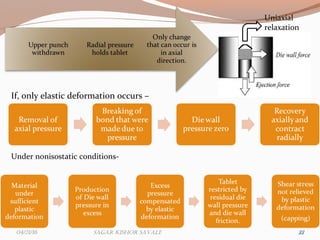
If, only elastic deformation occurs –
Under nonisostatic conditions-
Uniaxial
relaxation
2204/21/16 Sagar KiShor Savale
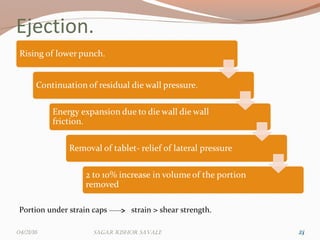
Ejection.
2323
Portion under strain caps strain > shear strength.
04/21/16 Sagar KiShor Savale
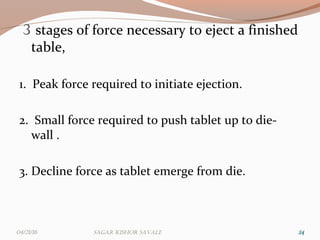
3 stages of force necessary to eject a finished
table,
1. Peak force required to initiate ejection.
2. Small force required to push tablet up to die-
wall .
3. Decline force as tablet emerge from die.
242404/21/16 Sagar KiShor Savale
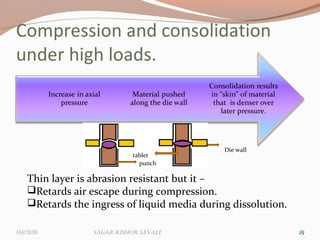
Compression and consolidation
under high loads.
2525
Thin layer is abrasion resistant but it –
Retards air escape during compression.
Retards the ingress of liquid media during dissolution.
punch
Die wall
tablet
04/21/16 Sagar KiShor Savale
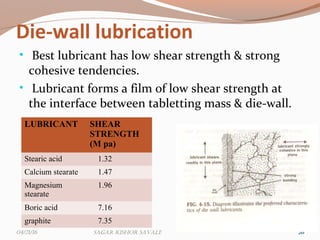
Die-wall lubrication
• Best lubricant has low shear strength & strong
cohesive tendencies.
• Lubricant forms a film of low shear strength at
the interface between tabletting mass & die-wall.
2626
LUBRICANT SHEAR
STRENGTH
(M pa)
Stearic acid 1.32
Calcium stearate 1.47
Magnesium
stearate
1.96
Boric acid 7.16
graphite 7.35
04/21/16 Sagar KiShor Savale
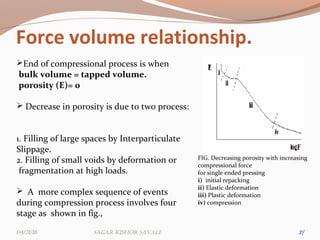
Force volume relationship.
2727
FIG. Decreasing porosity with increasing
compressional force
for single ended pressing
i) initial repacking
ii) Elastic deformation
iii) Plastic deformation
iv) compression
End of compressional process is when
bulk volume = tapped volume.
porosity (E)= 0
 Decrease in porosity is due to two process:
1. Filling of large spaces by Interparticulate
Slippage.
2. Filling of small voids by deformation or
fragmentation at high loads.
 A more complex sequence of events
during compression process involves four
stage as shown in fig.,
04/21/16 Sagar KiShor Savale
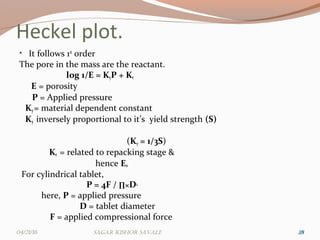
Heckel plot.
• It follows 1st
order
The pore in the mass are the reactant.
log 1/E = KyP + Kr
E = porosity
P = Applied pressure
Ky= material dependent constant
Ky inversely proportional to it’s yield strength (S)
(Ky = 1/3S)
Kr = related to repacking stage &
hence E0
For cylindrical tablet,
P = 4F / ∏×D2
here, P = applied pressure
D = tablet diameter
F = applied compressional force
282804/21/16 Sagar KiShor Savale
2929
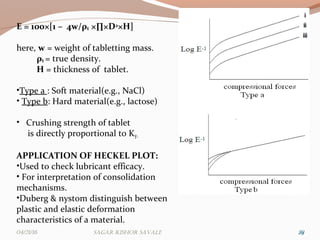
E = 100×[1 – 4w/ρt ×∏×D2×H]
here, w = weight of tabletting mass.
ρt = true density.
H = thickness of tablet.
•Type a : Soft material(e.g., NaCl)
• Type b: Hard material(e.g., lactose)
• Crushing strength of tablet
is directly proportional to Ky.
APPLICATION OF HECKEL PLOT:
•Used to check lubricant efficacy.
• For interpretation of consolidation
mechanisms.
•Duberg & nystom distinguish between
plastic and elastic deformation
characteristics of a material.
04/21/16 Sagar KiShor Savale
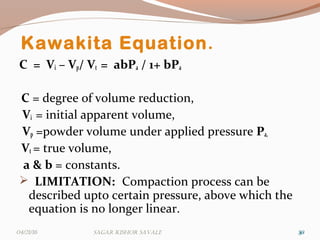
Kawakita Equation.
C = Vi – Vp/ Vt = abPa / 1+ bPa
C = degree of volume reduction,
Vi = initial apparent volume,
Vp =powder volume under applied pressure Pa,
Vt = true volume,
a & b = constants.
 LIMITATION: Compaction process can be
described upto certain pressure, above which the
equation is no longer linear.
303004/21/16 Sagar KiShor Savale
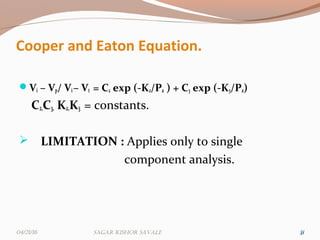
Cooper and Eaton Equation.
Vi – Vp/ Vi– Vt = C2 exp (-K2/Pa ) + C3 exp (-K3/Pa)
C2,C3, K2,K3 = constants.
 LIMITATION : Applies only to single
component analysis.
313104/21/16 Sagar KiShor Savale
Energy expenditure.
323204/21/16 Sagar KiShor Savale
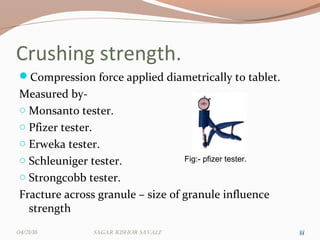
Crushing strength.
Compression force applied diametrically to tablet.
Measured by-
o Monsanto tester.
o Pfizer tester.
o Erweka tester.
o Schleuniger tester.
o Strongcobb tester.
Fracture across granule – size of granule influence
strength
3333
Fig:- pfizer tester.
04/21/16 Sagar KiShor Savale
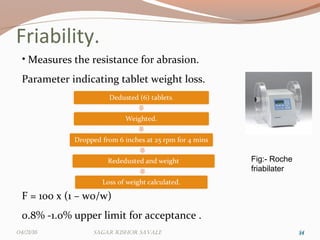
Friability.
3434
• Measures the resistance for abrasion.
Parameter indicating tablet weight loss.
F = 100 x (1 – wo/w)
0.8% -1.0% upper limit for acceptance .
Fig:- Roche
friabilater
04/21/16 Sagar KiShor Savale
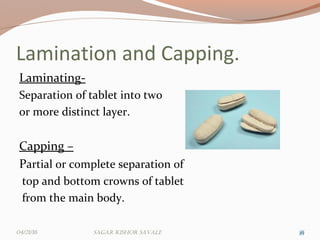
Lamination and Capping.
Laminating-
Separation of tablet into two
or more distinct layer.
Capping –
Partial or complete separation of
top and bottom crowns of tablet
from the main body.
353504/21/16 Sagar KiShor Savale
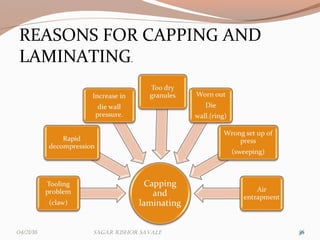
3636
REASONS FOR CAPPING AND
LAMINATING.
04/21/16 Sagar KiShor Savale
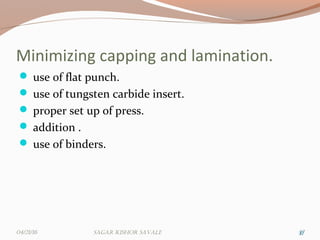
Minimizing capping and lamination.
 use of flat punch.
 use of tungsten carbide insert.
 proper set up of press.
 addition .
 use of binders.
373704/21/16 Sagar KiShor Savale
References:-
 Keith marshall 1987,Compression and consolidation of powderd solids,
Leon lachman, Herbert a.Liberman, & Joseph kanig ,The theory and
practice of industrial pharmacy, third edition varghese publication
house,bombay, pp.66,68,70-88.
 Eugene parrott , 2007,Compression,Herbert A.Liberman, Leon Lachman &
Joseph B.Schwartz ,Pharmaceutical dosage forms, tablets, volume
ii,pp.201-241.
 Stanforth J.N,Aulton’s pharmaceutics the design and manufacturing of
medicine,third edition,Churchill livingstone elsevier,pp.176,177.
 Subrahmanyam C.V. ,Micromeritics, Textbook Of Physical
Pharmaceutics, Second Edition,vallabh prakashan,delhi,Pp-180-234.
 Gilbert S. Banker , Christopher T. Rhodes, Modern
Pharmaceutics , Fourth Edition.Pp.408-409.
 encyclopedia of pharmaceutical Technology, Second Edition,volume-
3.Pp.303-305
383804/21/16 Sagar KiShor Savale
3904/21/16 Sagar KiShor Savale
4004/21/16 Sagar KiShor Savale
Thank YouThank You