EFFECT OF SYSTEM
PARAMETERS ON CONTROL
DRUG DELIVARY SYSTEM
3/17/2014
1
PREPARED BY
KOSARAJU SAI VIVEK
I M.PHARMACY,
DEPARTMENT OF PHARMACEUTICS
Jss college of pharmacy
3/17/2014
2
Sustained release, sustained action, controlled
release, extended action, timed release dosage forms
are the terms used to identify drug delivery systems
that are designed to achieve a prolonged therapeutic
effect by continuously releasing medication over an
extended period of time after the administration of
single dose.
The term “Controlled release” has become associated
with those systems from which therapeutic agents
may be automatically delivered at predefined rates
over a long period of time.
But, there are some confusion in terminology between
“Controlled release” & “Sustained release”
3/17/2014
3
Sustained Release :
 The term sustained release has been constantly used to describe a
pharmaceutical dosage form formulated to retard the release of a
therapeutic agent such that its appearance in the systemic
circulation is delayed &/or prolonged & its plasma profile is
sustained in duration.
Controlled Release :
 This term on the other hand, has a meaning that goes beyond the
scope of sustained drug action.
 It also implies a predictability & reproducibility in the drug release
kinetics, which means that the release of drug ingredient from a
controlled delivery system proceeds at a rate profile that is not only
predictable kinetically, but also reproducible from one unit to
another.
3/17/2014
4
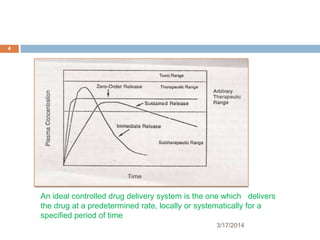
An ideal controlled drug delivery system is the one which delivers
the drug at a predetermined rate, locally or systematically for a
specified period of time
3/17/2014
5
Advantages :
1. Less fluctuation in drug blood levels.
2. Frequency reduction in dosing.
3. Improved patient convenience & compliance.
4. Increased safety margin of the high potency
drugs.
5. Reduction in total health care cost.
3/17/2014
6
Disadvantages :
1. Decreased systemic availability in
comparison to immediate release
conventional dosage forms.
2. Poor in vivo – in vitro correlation.
3. Possibility of dose dumping.
4. Retrieval of drug is difficult.
5. Higher cost of formulation.
Effects of system parameters
3/17/2014
7
Polymer solubility
Solution solubility
Partition coefficient
Polymer diffusivity
Solution diffusivity
Thickness of polymer diffusional path
Thickness of hydrodynamic diffusion layer
Drug loading dose
Surface area
Polymer diffusivity (Dp)
3/17/2014
8
The diffusion of small molecules in a polymer
structure is a energy activated process in
which the diffusant molecules move to a
successive series of equilibrium positions
when a sufficient amount of energy of
activation for diffusion Ed, has been acquired
by the diffusant & it‟s surrounding polymer
matrix.
3/17/20149
This energy- activated diffusion process is
frequently described by the following Arrhenius
relationship :
 Dp = D0 e-(Ed/RT)
The bulkier the functional group attached to polymer
chain lower the polymer diffusivity.
Magnitude of polymer diffusivity is dependant
upon type of functional group and type of stereo
chemical position in diffusant molecule.
temparature
Barrier
Difussivity
factor
Solution diffusivity (Ds)
3/17/2014
10
 The diffusion of solute molecules in solution
medium is a result of the random motion of
molecules.
 Under concentration gradient molecule diffuse
spontaneously from higher concentration to
lower concentration.
3/17/2014
11
When solution diffusivity are compared on bases of
molecular volume, alkanes are most rapidly diffusing
chemicals.
The relative rates of diffusion of various chemical
classes are as follows :
alkane > alcohol > amides > acids > amino acids
> dicarboxylic acid
Diffusivity of solute molecule in aqueous solution
usually decreases as its concentration increases.
Thickness of polymer diffusional path
(hp)
3/17/2014
12
Control release of drug species from both
polymer membrane & polymer matrix
controlled drug delivery system is governed
by,
1) The solute diffusion coefficient in the
membrane lipid.
2) The thickness of the membrane.
3/17/2014
13
 hp value for polymer membrane controlled reservoir
devices, which are fabricated from non
biodegradable and non swollen polymer, the value is
defined by polymer wall with constant thickness that
is invariable with time span.
 In polymer matrix controlled reservoir devices, which
are fabricated from non biodegradable polymers, the
thickness of diffusional path is defined as drug
depletion zone progressively in proportion to the
square root of time.
3/17/2014
14
The rate of growth in the hp value can be defined
mathematically by :
hp 2CpDp
t1/2 A – Cp/2
Where,
Cp = solubility of drug in the polymer phase
Dp = diffusivity of drug in the polymer matrix
A = loading dose of a drug
( (1/2
Thickness of hydrodynamic diffusion
layer (hd)
3/17/2014
15
The hydrodynamic diffusion layer has a rate
limiting role on controlled release dosage form.
Magnitude of drug release value decreases as
the thickness of hydrodynamic diffusion layer is
increased.
Polymer solubility
3/17/2014
16
 Drug particles are not released until they
dissociate from their crystal lattice
structure, dissolve or partition into surrounding
polymer.
 Solubility of drug in polymer membrane or matrix
plays important role in it‟s release from a
polymeric device.
 For a drug to release at an appropriate rate the
drug should have adequate polymer solubility.
 Rate of drug release is directly proportional to
magnitude of polymer solubility.
Solution solubility
3/17/2014
17
Aqueous solubility varies from one drug to
another.
Difference in aqueous solubility is depend on the
difference in their chemical structure, types &
physicochemical nature of functional groups & the
variations in their stereo chemical configurations.
By using a water – miscible cosolvent as a
solubilizer & addition of the cosolvent into the
elution solution to increase the solution solubility
of drugs.
3/17/2014
18
 Solubilization of poorly soluble drug in aqueous
solution can be accomplished by using multiple
co-solvent system.
 Drug release increases with increase in Solution
solubility of drug.
Partition coefficient
3/17/2014
19
 Partition co-efficient K of a drug for it‟s interfacial
partitioning from the surface of a drug delivery
device towards an elution medium as given :
K = Cs/Cp
Where,
Cs = conc. Of drug at the solution/polymer
interface
Cp = solubility of drug in the polymer phase.
3/17/2014
20
Ratio of drug solubility in the elution solution
Cs over its solubility in polymer composition
Cp of device.
Any variation in either Cs or Cp result in
increase or decrease in magnitude of „K‟
value.
Rate of drug release increase with increase
in partition coefficient.
Drug loading dose
3/17/2014
21
In preparation of the device varying loading
doses of drugs are incorporated, as required for
different length of treatment.
Variation in the loading doses results only in the
change in duration of action with constant drug
release profile.
Surface Area
3/17/2014
22
Both the in-vivo & in-vitro rates of drug release
dependant on the surface area of the drug
delivery device.
Greater the surface area greater will be the rate
of drug release.

Cdds parameters

  • 1.
    EFFECT OF SYSTEM PARAMETERSON CONTROL DRUG DELIVARY SYSTEM 3/17/2014 1 PREPARED BY KOSARAJU SAI VIVEK I M.PHARMACY, DEPARTMENT OF PHARMACEUTICS Jss college of pharmacy
  • 2.
    3/17/2014 2 Sustained release, sustainedaction, controlled release, extended action, timed release dosage forms are the terms used to identify drug delivery systems that are designed to achieve a prolonged therapeutic effect by continuously releasing medication over an extended period of time after the administration of single dose. The term “Controlled release” has become associated with those systems from which therapeutic agents may be automatically delivered at predefined rates over a long period of time. But, there are some confusion in terminology between “Controlled release” & “Sustained release”
  • 3.
    3/17/2014 3 Sustained Release : The term sustained release has been constantly used to describe a pharmaceutical dosage form formulated to retard the release of a therapeutic agent such that its appearance in the systemic circulation is delayed &/or prolonged & its plasma profile is sustained in duration. Controlled Release :  This term on the other hand, has a meaning that goes beyond the scope of sustained drug action.  It also implies a predictability & reproducibility in the drug release kinetics, which means that the release of drug ingredient from a controlled delivery system proceeds at a rate profile that is not only predictable kinetically, but also reproducible from one unit to another.
  • 4.
    3/17/2014 4 An ideal controlleddrug delivery system is the one which delivers the drug at a predetermined rate, locally or systematically for a specified period of time
  • 5.
    3/17/2014 5 Advantages : 1. Lessfluctuation in drug blood levels. 2. Frequency reduction in dosing. 3. Improved patient convenience & compliance. 4. Increased safety margin of the high potency drugs. 5. Reduction in total health care cost.
  • 6.
    3/17/2014 6 Disadvantages : 1. Decreasedsystemic availability in comparison to immediate release conventional dosage forms. 2. Poor in vivo – in vitro correlation. 3. Possibility of dose dumping. 4. Retrieval of drug is difficult. 5. Higher cost of formulation.
  • 7.
    Effects of systemparameters 3/17/2014 7 Polymer solubility Solution solubility Partition coefficient Polymer diffusivity Solution diffusivity Thickness of polymer diffusional path Thickness of hydrodynamic diffusion layer Drug loading dose Surface area
  • 8.
    Polymer diffusivity (Dp) 3/17/2014 8 Thediffusion of small molecules in a polymer structure is a energy activated process in which the diffusant molecules move to a successive series of equilibrium positions when a sufficient amount of energy of activation for diffusion Ed, has been acquired by the diffusant & it‟s surrounding polymer matrix.
  • 9.
    3/17/20149 This energy- activateddiffusion process is frequently described by the following Arrhenius relationship :  Dp = D0 e-(Ed/RT) The bulkier the functional group attached to polymer chain lower the polymer diffusivity. Magnitude of polymer diffusivity is dependant upon type of functional group and type of stereo chemical position in diffusant molecule. temparature Barrier Difussivity factor
  • 10.
    Solution diffusivity (Ds) 3/17/2014 10 The diffusion of solute molecules in solution medium is a result of the random motion of molecules.  Under concentration gradient molecule diffuse spontaneously from higher concentration to lower concentration.
  • 11.
    3/17/2014 11 When solution diffusivityare compared on bases of molecular volume, alkanes are most rapidly diffusing chemicals. The relative rates of diffusion of various chemical classes are as follows : alkane > alcohol > amides > acids > amino acids > dicarboxylic acid Diffusivity of solute molecule in aqueous solution usually decreases as its concentration increases.
  • 12.
    Thickness of polymerdiffusional path (hp) 3/17/2014 12 Control release of drug species from both polymer membrane & polymer matrix controlled drug delivery system is governed by, 1) The solute diffusion coefficient in the membrane lipid. 2) The thickness of the membrane.
  • 13.
    3/17/2014 13  hp valuefor polymer membrane controlled reservoir devices, which are fabricated from non biodegradable and non swollen polymer, the value is defined by polymer wall with constant thickness that is invariable with time span.  In polymer matrix controlled reservoir devices, which are fabricated from non biodegradable polymers, the thickness of diffusional path is defined as drug depletion zone progressively in proportion to the square root of time.
  • 14.
    3/17/2014 14 The rate ofgrowth in the hp value can be defined mathematically by : hp 2CpDp t1/2 A – Cp/2 Where, Cp = solubility of drug in the polymer phase Dp = diffusivity of drug in the polymer matrix A = loading dose of a drug ( (1/2
  • 15.
    Thickness of hydrodynamicdiffusion layer (hd) 3/17/2014 15 The hydrodynamic diffusion layer has a rate limiting role on controlled release dosage form. Magnitude of drug release value decreases as the thickness of hydrodynamic diffusion layer is increased.
  • 16.
    Polymer solubility 3/17/2014 16  Drugparticles are not released until they dissociate from their crystal lattice structure, dissolve or partition into surrounding polymer.  Solubility of drug in polymer membrane or matrix plays important role in it‟s release from a polymeric device.  For a drug to release at an appropriate rate the drug should have adequate polymer solubility.  Rate of drug release is directly proportional to magnitude of polymer solubility.
  • 17.
    Solution solubility 3/17/2014 17 Aqueous solubilityvaries from one drug to another. Difference in aqueous solubility is depend on the difference in their chemical structure, types & physicochemical nature of functional groups & the variations in their stereo chemical configurations. By using a water – miscible cosolvent as a solubilizer & addition of the cosolvent into the elution solution to increase the solution solubility of drugs.
  • 18.
    3/17/2014 18  Solubilization ofpoorly soluble drug in aqueous solution can be accomplished by using multiple co-solvent system.  Drug release increases with increase in Solution solubility of drug.
  • 19.
    Partition coefficient 3/17/2014 19  Partitionco-efficient K of a drug for it‟s interfacial partitioning from the surface of a drug delivery device towards an elution medium as given : K = Cs/Cp Where, Cs = conc. Of drug at the solution/polymer interface Cp = solubility of drug in the polymer phase.
  • 20.
    3/17/2014 20 Ratio of drugsolubility in the elution solution Cs over its solubility in polymer composition Cp of device. Any variation in either Cs or Cp result in increase or decrease in magnitude of „K‟ value. Rate of drug release increase with increase in partition coefficient.
  • 21.
    Drug loading dose 3/17/2014 21 Inpreparation of the device varying loading doses of drugs are incorporated, as required for different length of treatment. Variation in the loading doses results only in the change in duration of action with constant drug release profile.
  • 22.
    Surface Area 3/17/2014 22 Both thein-vivo & in-vitro rates of drug release dependant on the surface area of the drug delivery device. Greater the surface area greater will be the rate of drug release.