11-Dec-15 1
Vesicular Drug Delivery System
Advances and Applications
STES’s SINHGAD INSTITUTE OF PHARMACY NARHE, PUNE-4110 41.
Name of Guide :
Dr. C. R. Kokare
(HOD of Department of
Pharmaceutics)
Name of Student :
Mr. Vijaykumar R. Chavan
M. Pharm (Sem - III)
(Department of Pharmaceutics)
Content
11-Dec-15 2
 Introduction
 Classification of vesicular drug delivery system
 1 Lipoidal biocarrier
 2 Nonlipoidal biocarrier
 Case study
 Future aspect
 Key Referances
11-Dec-15 3
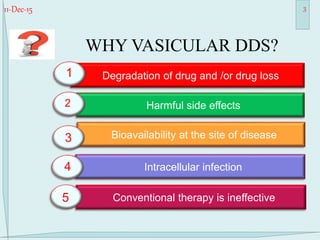
WHY VASICULAR DDS?
Degradation of drug and /or drug loss
Harmful side effects
Bioavailability at the site of disease
Intracellular infection
Conventional therapy is ineffective
1
2
3
4
5
11-Dec-15 4
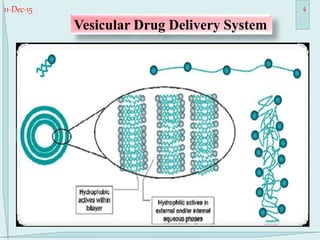
Vesicular Drug Delivery System
11-Dec-15 5
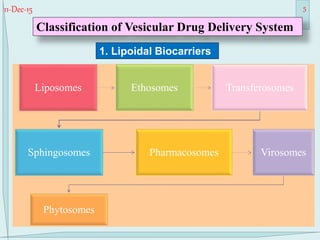
Liposomes Ethosomes Transferosomes
Sphingosomes Pharmacosomes Virosomes
Phytosomes
Classification of Vesicular Drug Delivery System
1. Lipoidal Biocarriers
11-Dec-15 6
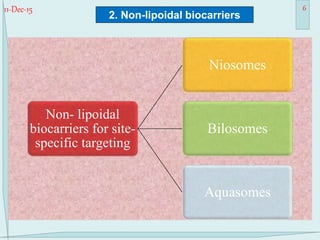
Non- lipoidal
biocarriers for site-
specific targeting
Niosomes
Bilosomes
Aquasomes
2. Non-lipoidal biocarriers
11-Dec-15 7
1.Lipoidal Biocarrier
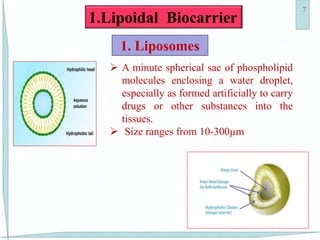
1. Liposomes
 A minute spherical sac of phospholipid
molecules enclosing a water droplet,
especially as formed artificially to carry
drugs or other substances into the
tissues.
 Size ranges from 10-300µm
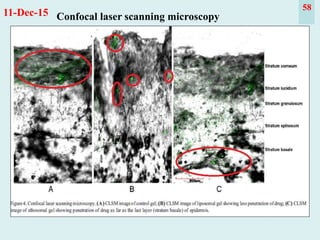
11-Dec-15 8
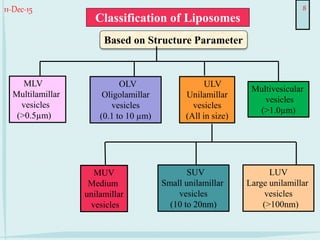
Based on Structure Parameter
MLV
Multilamillar
vesicles
(>0.5µm)
OLV
Oligolamillar
vesicles
(0.1 to 10 µm)
ULV
Unilamillar
vesicles
(All in size)
Multivesicular
vesicles
(>1.0µm)
MUV
Medium
unilamillar
vesicles
SUV
Small unilamillar
vesicles
(10 to 20nm)
LUV
Large unilamillar
vesicles
(>100nm)
Classification of Liposomes
11-Dec-15
9
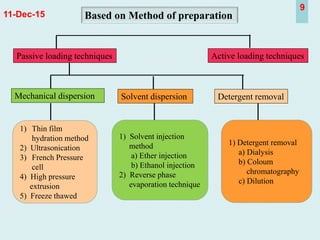
Passive loading techniques Active loading techniques
Mechanical dispersion Solvent dispersion Detergent removal
Based on Method of preparation
1) Thin film
hydration method
2) Ultrasonication
3) French Pressure
cell
4) High pressure
extrusion
5) Freeze thawed
1) Solvent injection
method
a) Ether injection
b) Ethanol injection
2) Reverse phase
evaporation technique
1) Detergent removal
a) Dialysis
b) Coloum
chromatography
c) Dilution
11-Dec-15 10
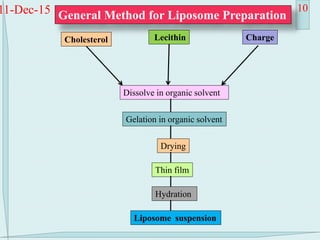
General Method for Liposome Preparation
Lecithin Charge
Dissolve in organic solvent
Gelation in organic solvent
Drying
Thin film
Hydration
Liposome suspension
Cholesterol
11-Dec-15 11
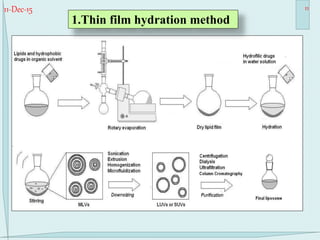
1.Thin film hydration method
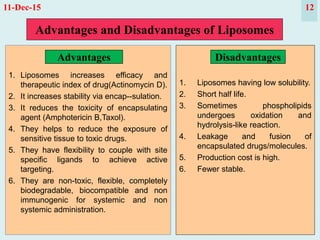
Advantages and Disadvantages of Liposomes
1. Liposomes increases efficacy and
therapeutic index of drug(Actinomycin D).
2. It increases stability via encap--sulation.
3. It reduces the toxicity of encapsulating
agent (Amphotericin B,Taxol).
4. They helps to reduce the exposure of
sensitive tissue to toxic drugs.
5. They have flexibility to couple with site
specific ligands to achieve active
targeting.
6. They are non-toxic, flexible, completely
biodegradable, biocompatible and non
immunogenic for systemic and non
systemic administration.
1. Liposomes having low solubility.
2. Short half life.
3. Sometimes phospholipids
undergoes oxidation and
hydrolysis-like reaction.
4. Leakage and fusion of
encapsulated drugs/molecules.
5. Production cost is high.
6. Fewer stable.
11-Dec-15 12
Advantages Disadvantages
11-Dec-15 13
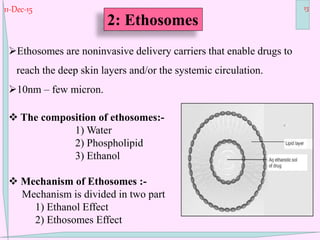
2: Ethosomes
Ethosomes are noninvasive delivery carriers that enable drugs to
reach the deep skin layers and/or the systemic circulation.
10nm – few micron.
 The composition of ethosomes:-
1) Water
2) Phospholipid
3) Ethanol
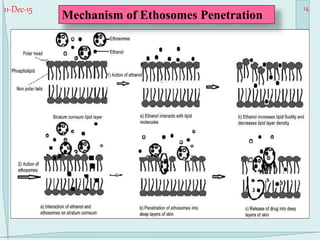
 Mechanism of Ethosomes :-
Mechanism is divided in two part
1) Ethanol Effect
2) Ethosomes Effect
11-Dec-15 14
Mechanism of Ethosomes Penetration
11-Dec-15 15
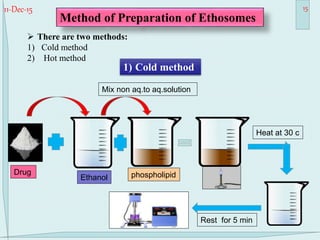
Method of Preparation of Ethosomes
 There are two methods:
1) Cold method
2) Hot method
Heat at 30 c
Mix non aq.to aq.solution
Rest for 5 min
Drug
Ethanol phospholipid
1) Cold method
11-Dec-15 16
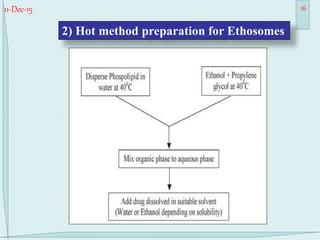
2) Hot method preparation for Ethosomes
11-Dec-15 17
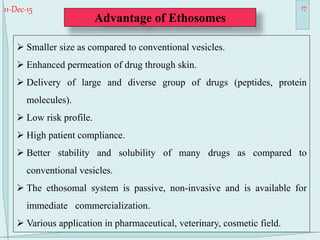
 Smaller size as compared to conventional vesicles.
 Enhanced permeation of drug through skin.
 Delivery of large and diverse group of drugs (peptides, protein
molecules).
 Low risk profile.
 High patient compliance.
 Better stability and solubility of many drugs as compared to
conventional vesicles.
 The ethosomal system is passive, non-invasive and is available for
immediate commercialization.
 Various application in pharmaceutical, veterinary, cosmetic field.
Advantage of Ethosomes
11-Dec-15 18
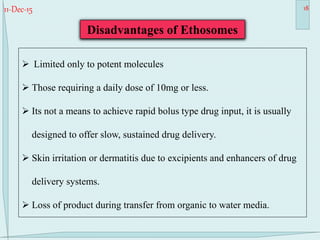
 Limited only to potent molecules
 Those requiring a daily dose of 10mg or less.
 Its not a means to achieve rapid bolus type drug input, it is usually
designed to offer slow, sustained drug delivery.
 Skin irritation or dermatitis due to excipients and enhancers of drug
delivery systems.
 Loss of product during transfer from organic to water media.
Disadvantages of Ethosomes
11-Dec-15 19
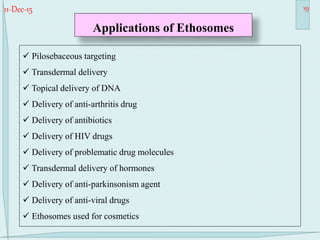
 Pilosebaceous targeting
 Transdermal delivery
 Topical delivery of DNA
 Delivery of anti-arthritis drug
 Delivery of antibiotics
 Delivery of HIV drugs
 Delivery of problematic drug molecules
 Transdermal delivery of hormones
 Delivery of anti-parkinsonism agent
 Delivery of anti-viral drugs
 Ethosomes used for cosmetics
Applications of Ethosomes
11-Dec-15 20
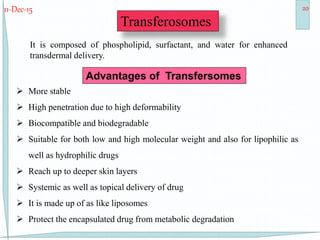
Transferosomes
It is composed of phospholipid, surfactant, and water for enhanced
transdermal delivery.
 More stable
 High penetration due to high deformability
 Biocompatible and biodegradable
 Suitable for both low and high molecular weight and also for lipophilic as
well as hydrophilic drugs
 Reach up to deeper skin layers
 Systemic as well as topical delivery of drug
 It is made up of as like liposomes
 Protect the encapsulated drug from metabolic degradation
Advantages of Transfersomes
11-Dec-15 21
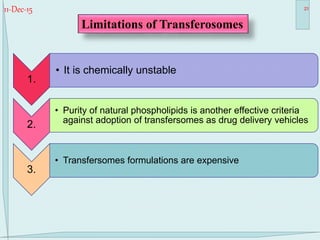
1.
• It is chemically unstable
2.
• Purity of natural phospholipids is another effective criteria
against adoption of transfersomes as drug delivery vehicles
3.
• Transfersomes formulations are expensive
Limitations of Transferosomes
11-Dec-15 22
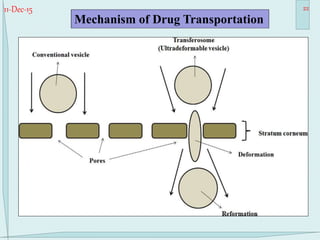
Mechanism of Drug Transportation
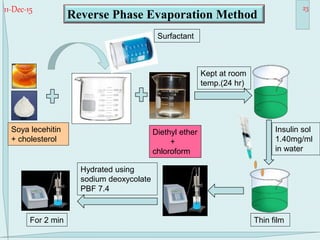
11-Dec-15 23
Hydrated using
sodium deoxycolate
PBF 7.4
For 2 min
Surfactant
Diethyl ether
+
chloroform
Kept at room
temp.(24 hr)
Thin film
Insulin sol
1.40mg/ml
in water
Soya lecehitin
+ cholesterol
Reverse Phase Evaporation Method
11-Dec-15 24
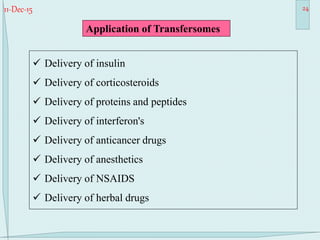
Application of Transfersomes
 Delivery of insulin
 Delivery of corticosteroids
 Delivery of proteins and peptides
 Delivery of interferon's
 Delivery of anticancer drugs
 Delivery of anesthetics
 Delivery of NSAIDS
 Delivery of herbal drugs
11-Dec-15 25
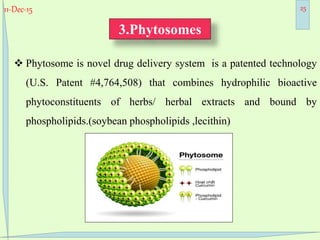
3.Phytosomes
 Phytosome is novel drug delivery system is a patented technology
(U.S. Patent #4,764,508) that combines hydrophilic bioactive
phytoconstituents of herbs/ herbal extracts and bound by
phospholipids.(soybean phospholipids ,lecithin)
11-Dec-15 26
Advantage of Phytosomes
Phosphatidylcholine used in preparation of phytosomes,
besides acting as a carrier also acts as a hepatoprotective.
Phytosomes show better stability profile due to formation of
chemical bonds between phosphatidylcholine molecule and
botanical extract.
Phytosome are widely used in cosmetics due to there more skin
penetration and have a high lipid profile.
By enhancing the solubility of bile to herbal constituent,
phytosomes facilitates the liver targeting.
11-Dec-15 27
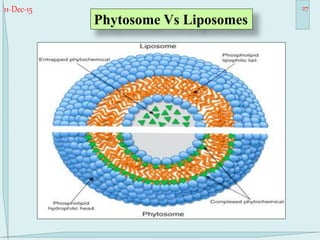
Phytosome Vs Liposomes
11-Dec-15 28
PHYTOSOMES LIPOSOMES
 In phytosomes active
chemical constituents molecules
are anchored through chemical
bonds to the polar head of the
phospholipids.
 In liposomes, the active
principle is dissolved in the
medium of the cavity or in the
layers of the membrane. No
chemical bonds are formed.
 In phytosomes, PC and the
individual plant compound form
a 1:1or 2:1 complex depending
on the substance.
 In liposoes, hundred and
thousands of phosphatidyl-
choline molecules surround the
water soluble molecule.
Difference between Phytosome and Liposomes
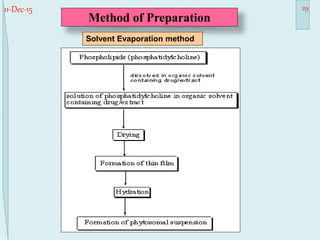
11-Dec-15 29
Method of Preparation
Solvent Evaporation method
11-Dec-15 30
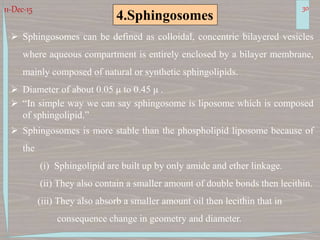
4.Sphingosomes
 Sphingosomes can be defined as colloidal, concentric bilayered vesicles
where aqueous compartment is entirely enclosed by a bilayer membrane,
mainly composed of natural or synthetic sphingolipids.
 Diameter of about 0.05 μ to 0.45 μ .
 “In simple way we can say sphingosome is liposome which is composed
of sphingolipid.”
 Sphingosomes is more stable than the phospholipid liposome because of
the
(i) Sphingolipid are built up by only amide and ether linkage.
(ii) They also contain a smaller amount of double bonds then lecithin.
(iii) They also absorb a smaller amount oil then lecithin that in
consequence change in geometry and diameter.
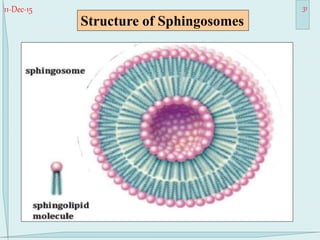
11-Dec-15 31
Structure of Sphingosomes
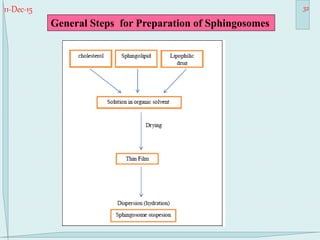
11-Dec-15 32
General Steps for Preparation of Sphingosomes
11-Dec-15 33
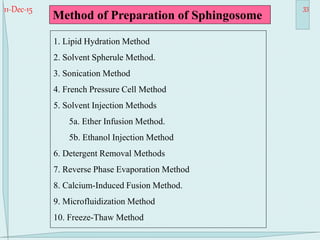
Method of Preparation of Sphingosome
1. Lipid Hydration Method
2. Solvent Spherule Method.
3. Sonication Method
4. French Pressure Cell Method
5. Solvent Injection Methods
5a. Ether Infusion Method.
5b. Ethanol Injection Method
6. Detergent Removal Methods
7. Reverse Phase Evaporation Method
8. Calcium-Induced Fusion Method.
9. Microfluidization Method
10. Freeze-Thaw Method
11-Dec-15 34
 Sphingosomes have better drug retention characteristics.
 They can be administered by subcutaneous, intravenous, intra-arterial,
intramuscular, oral, and transdermal routes of drug administration and so forth.
 They provide selective passive targeting to tumor tissue.
 Sphingosomes increase efficacy and therapeutic index of the encapsulated drug.
 Stability is increased via encapsulation.
Design of sphingosomes is so flexible to allow coupling with site specific
ligands to achieve active targeting.
(i) sphingolipids are expensive, sphingosomes are not economic.
(ii) Sphingosomes have poor entrapment efficiency.
Advantages of Sphingosomes
Disadvantages of Sphingosomes
11-Dec-15 35
5.Virosomes
Virosomes are spherical, unilamillar phospholipid bilayer
vesicles incorporating virus derived proteins to allow the
virosomes to fuse with the target cell.
They are lipid based , synthetic vesicles consisting of viral
surface glycoproteins.
 They have a typical mean diameter in range 120-180 nm.
11-Dec-15 36
 It is an influenza virus.
 The envelop made up of influenza
lipids constitute the membrane and
proteins called haemagglutinin (HA)
and neuraminidase (NA) are
intercalated on it.
 The nucleocapsid and the genetic
material of the source virus is
present inside the envelop.
Virosomes (conti…)
11-Dec-15 37
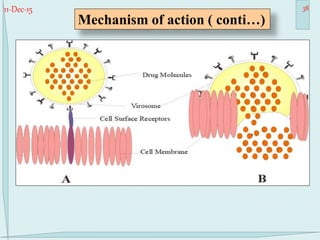
Virosomes act both as carrier and as adjuvant with multifunctions
during the induction of an immune response.
The carrier function comprises the positive effects of embedding the
antigen into a higher structure, the virosome particle.
The adjuvant function relates to the immune stimulating properties
of the virosomes and their components on the immune system.
It also suceeds in stimulating specific immunity without causing
non-specific inflammation.
Mechanism of Action
11-Dec-15 38
Mechanism of action ( conti…)
11-Dec-15 39
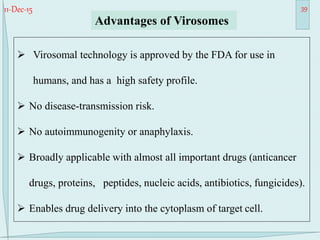
 Virosomal technology is approved by the FDA for use in
humans, and has a high safety profile.
 No disease-transmission risk.
 No autoimmunogenity or anaphylaxis.
 Broadly applicable with almost all important drugs (anticancer
drugs, proteins, peptides, nucleic acids, antibiotics, fungicides).
 Enables drug delivery into the cytoplasm of target cell.
Advantages of Virosomes
11-Dec-15 40
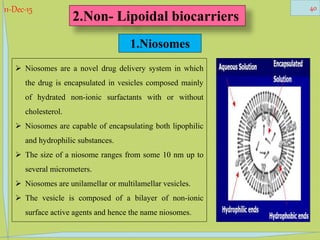
2.Non- Lipoidal biocarriers
1.Niosomes
 Niosomes are a novel drug delivery system in which
the drug is encapsulated in vesicles composed mainly
of hydrated non-ionic surfactants with or without
cholesterol.
 Niosomes are capable of encapsulating both lipophilic
and hydrophilic substances.
 The size of a niosome ranges from some 10 nm up to
several micrometers.
 Niosomes are unilamellar or multilamellar vesicles.
 The vesicle is composed of a bilayer of non-ionic
surface active agents and hence the name niosomes.
11-Dec-15 41
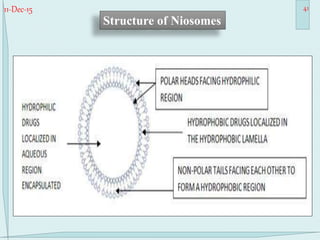
Structure of Niosomes
11-Dec-15 42
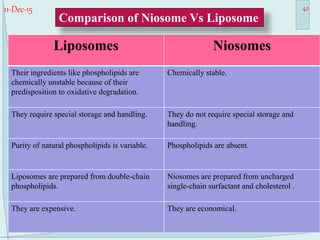
Liposomes Niosomes
Their ingredients like phospholipids are
chemically unstable because of their
predisposition to oxidative degradation.
Chemically stable.
They require special storage and handling. They do not require special storage and
handling.
Purity of natural phospholipids is variable. Phospholipids are absent.
Liposomes are prepared from double-chain
phospholipids.
Niosomes are prepared from uncharged
single-chain surfactant and cholesterol .
They are expensive. They are economical.
Comparison of Niosome Vs Liposome
11-Dec-15 43
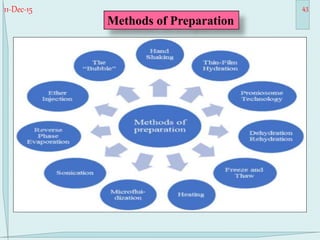
Methods of Preparation
11-Dec-15 44
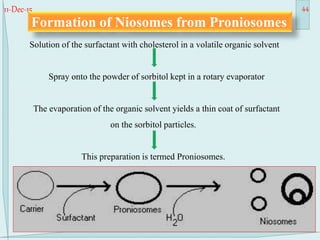
Solution of the surfactant with cholesterol in a volatile organic solvent
Spray onto the powder of sorbitol kept in a rotary evaporator
The evaporation of the organic solvent yields a thin coat of surfactant
on the sorbitol particles.
This preparation is termed Proniosomes.
Formation of Niosomes from Proniosomes
11-Dec-15 45
 Novel technique of Niosome preparation without the use of organic solvent (Green
Method).
 In this technique, surfactant, additives, and PBS (pH 7.4) were transferred into a
glass reactor with three necks.
 The reactor is positioned in a water bath to control the temperature.
 The thermometer is positioned in the first neck, nitrogen supplied through second
neck, and water cooled reflux in the third neck.
 Niosome components are dispersed at 70 °C and is mixed for 15sec with high shear
homogenizer and immediately followed by the bubbling of nitrogen gas at 70 °C .
The “Bubble” Method
11-Dec-15 46
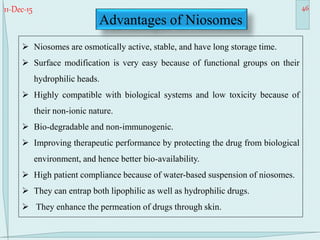
Advantages of Niosomes
 Niosomes are osmotically active, stable, and have long storage time.
 Surface modification is very easy because of functional groups on their
hydrophilic heads.
 Highly compatible with biological systems and low toxicity because of
their non-ionic nature.
 Bio-degradable and non-immunogenic.
 Improving therapeutic performance by protecting the drug from biological
environment, and hence better bio-availability.
 High patient compliance because of water-based suspension of niosomes.
 They can entrap both lipophilic as well as hydrophilic drugs.
 They enhance the permeation of drugs through skin.
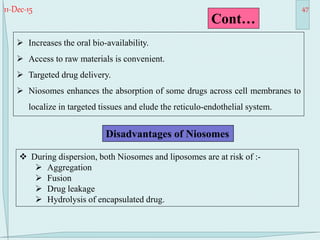
11-Dec-15 47
 Increases the oral bio-availability.
 Access to raw materials is convenient.
 Targeted drug delivery.
 Niosomes enhances the absorption of some drugs across cell membranes to
localize in targeted tissues and elude the reticulo-endothelial system.
Cont…
Disadvantages of Niosomes
 During dispersion, both Niosomes and liposomes are at risk of :-
 Aggregation
 Fusion
 Drug leakage
 Hydrolysis of encapsulated drug.
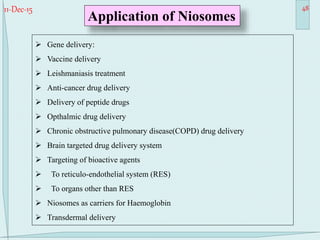
11-Dec-15 48
 Gene delivery:
 Vaccine delivery
 Leishmaniasis treatment
 Anti-cancer drug delivery
 Delivery of peptide drugs
 Opthalmic drug delivery
 Chronic obstructive pulmonary disease(COPD) drug delivery
 Brain targeted drug delivery system
 Targeting of bioactive agents
 To reticulo-endothelial system (RES)
 To organs other than RES
 Niosomes as carriers for Haemoglobin
 Transdermal delivery
Application of Niosomes
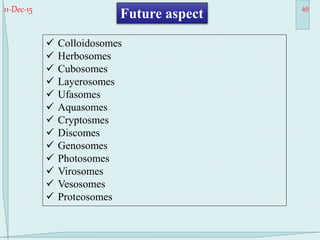
11-Dec-15 49
Future aspect
 Colloidosomes
 Herbosomes
 Cubosomes
 Layerosomes
 Ufasomes
 Aquasomes
 Cryptosmes
 Discomes
 Genosomes
 Photosomes
 Virosomes
 Vesosomes
 Proteosomes
11-Dec-15 50
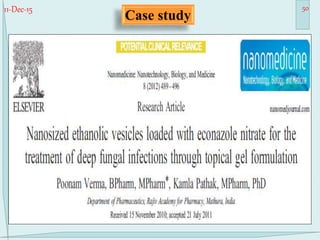
Case study
11-Dec-15 51
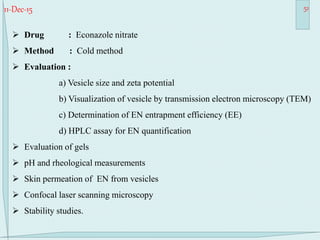
 Drug : Econazole nitrate
 Method : Cold method
 Evaluation :
a) Vesicle size and zeta potential
b) Visualization of vesicle by transmission electron microscopy (TEM)
c) Determination of EN entrapment efficiency (EE)
d) HPLC assay for EN quantification
 Evaluation of gels
 pH and rheological measurements
 Skin permeation of EN from vesicles
 Confocal laser scanning microscopy
 Stability studies.
11-Dec-15 52
Material and method
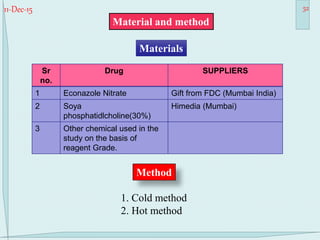
Materials
Sr
no.
Drug SUPPLIERS
1 Econazole Nitrate Gift from FDC (Mumbai India)
2 Soya
phosphatidlcholine(30%)
Himedia (Mumbai)
3 Other chemical used in the
study on the basis of
reagent Grade.
Method
1. Cold method
2. Hot method
11-Dec-15 53
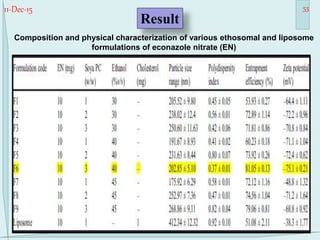
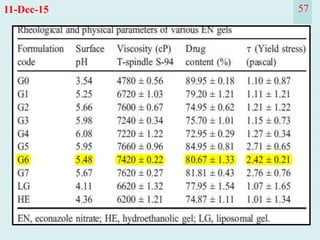
Composition and physical characterization of various ethosomal and liposome
formulations of econazole nitrate (EN)
Result
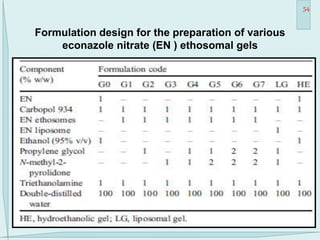
Formulation design for the preparation of various
econazole nitrate (EN ) ethosomal gels
54
11-Dec-15 57
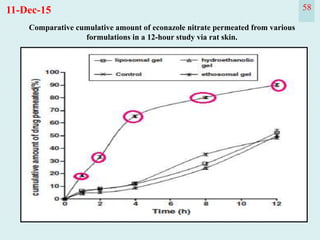
58
Comparative cumulative amount of econazole nitrate permeated from various
formulations in a 12-hour study via rat skin.
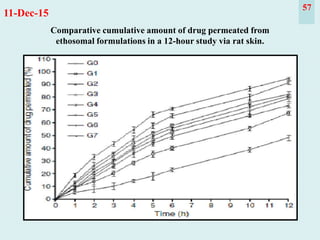
11-Dec-15
Comparative cumulative amount of drug permeated from
ethosomal formulations in a 12-hour study via rat skin.
57
11-Dec-15
58
Confocal laser scanning microscopy11-Dec-15
11-Dec-15 59
Key Reference
 Sunil Kamboj et al,“Vesicular drug delivery systems: A novel approach for drug
targeting”,International Journal of Drug Delivery,5 (2013): 121-130
 Namdeo G. Shinde et al, “Recent Advances in Vesicular Drug Delivery System”
Research Journal of Pharmaceutical Dosage Forms and Technology. 6(2): April-
June, 2014, 110-120.
 Seema M. Jadhav et al, “Novel vesicular system: an overview”, Journal of Applied
Pharmaceutical Science; 02(2012): 193-202.
 Nishith Patel, “Liposome Drug delivery system: a Critic Review” ,JPSBR:
2 (2012):169-175.
 Abolfazl Akbarzadeh, NANO REVIEW, “Liposome: classification, preparation,
and Applications” ,Nanoscale Research Letters ,8(2013):102.
 E. Touitou ,et al , “Ethosomes - novel vesicular carriers for enhanced delivery:
characterization and skin penetration properties” , Journal of Controlled Release;
65(2000):403–418.
11-Dec-15 60
 Marwa h. Abdallah et al, “Transfersomes as a transdermal drug delivery system
for enhancement the antifungal activity of nystatin” ,International Journal of
Pharmacy and Pharmaceutical Sciences;5(2013): 108-119.
 Sahil M. Gavali et al,“clinical transfersome: A new technique for transdermal
drug delivery” ,International journal of research in pharmacy and chemistry ;
1(3) (2011):212-230.
 Nilesh Jain et al., “Phytosome: A Novel Drug Delivery System for Herbal
Medicine”, International Journal of Pharmaceutical Sciences and Drug Research
2(4),(2010); 224-228.
 Abhijeet Sunder Kunwarpuriya et al, “Sphingosome: a novel vesicular drug
delivery sysytem”, European journal of pharmaceutical And medical research ,
2(3),(2015) ;509-525.
 Bhamare Gaurav Et Al, Review Article “ Virosome – Drug And Vaccine
Delivery System ,” World Journal Of Pharmacy And Pharmaceutical Sciences
Volume 3, Issue 10, 437-447.
Key Reference
11-Dec-15 61
 S. S. Patel et al, “Review Article Need, Development and Application of
Virosomal System in Medicine” International Journal of Pharmaceutical
Sciences and Nanotechnology Volume 3 · Issue 3 · October - December 2010
 Nilesh Jain et al., “Phytosome: A Novel Drug Delivery System for Herbal
Medicine”, International Journal of Pharmaceutical Sciences and Drug Research
2(4),(2010); 224-228.
 Abhijeet Sunder Kunwarpuriya et al, “Sphingosome: a novel vesicular drug
delivery sysytem”, European journal of pharmaceutical And medical research ,
2(3),(2015) ;509-525.
 Harshal Ashok Pawar et la, “Phytosome as a Novel Biomedicine: A
Microencapsulated Drug Delivery System” Bioanalysis & Biomedicine 7(1):
2015,
Key Reference
Vesicular drug delivery system

Vesicular drug delivery system

  • 1.
    11-Dec-15 1 Vesicular DrugDelivery System Advances and Applications STES’s SINHGAD INSTITUTE OF PHARMACY NARHE, PUNE-4110 41. Name of Guide : Dr. C. R. Kokare (HOD of Department of Pharmaceutics) Name of Student : Mr. Vijaykumar R. Chavan M. Pharm (Sem - III) (Department of Pharmaceutics)
  • 2.
    Content 11-Dec-15 2  Introduction Classification of vesicular drug delivery system  1 Lipoidal biocarrier  2 Nonlipoidal biocarrier  Case study  Future aspect  Key Referances
  • 3.
    11-Dec-15 3 WHY VASICULARDDS? Degradation of drug and /or drug loss Harmful side effects Bioavailability at the site of disease Intracellular infection Conventional therapy is ineffective 1 2 3 4 5
  • 4.
  • 5.
    11-Dec-15 5 Liposomes EthosomesTransferosomes Sphingosomes Pharmacosomes Virosomes Phytosomes Classification of Vesicular Drug Delivery System 1. Lipoidal Biocarriers
  • 6.
    11-Dec-15 6 Non- lipoidal biocarriersfor site- specific targeting Niosomes Bilosomes Aquasomes 2. Non-lipoidal biocarriers
  • 7.
    11-Dec-15 7 1.Lipoidal Biocarrier 1.Liposomes  A minute spherical sac of phospholipid molecules enclosing a water droplet, especially as formed artificially to carry drugs or other substances into the tissues.  Size ranges from 10-300µm
  • 8.
    11-Dec-15 8 Based onStructure Parameter MLV Multilamillar vesicles (>0.5µm) OLV Oligolamillar vesicles (0.1 to 10 µm) ULV Unilamillar vesicles (All in size) Multivesicular vesicles (>1.0µm) MUV Medium unilamillar vesicles SUV Small unilamillar vesicles (10 to 20nm) LUV Large unilamillar vesicles (>100nm) Classification of Liposomes
  • 9.
    11-Dec-15 9 Passive loading techniquesActive loading techniques Mechanical dispersion Solvent dispersion Detergent removal Based on Method of preparation 1) Thin film hydration method 2) Ultrasonication 3) French Pressure cell 4) High pressure extrusion 5) Freeze thawed 1) Solvent injection method a) Ether injection b) Ethanol injection 2) Reverse phase evaporation technique 1) Detergent removal a) Dialysis b) Coloum chromatography c) Dilution
  • 10.
    11-Dec-15 10 General Methodfor Liposome Preparation Lecithin Charge Dissolve in organic solvent Gelation in organic solvent Drying Thin film Hydration Liposome suspension Cholesterol
  • 11.
    11-Dec-15 11 1.Thin filmhydration method
  • 12.
    Advantages and Disadvantagesof Liposomes 1. Liposomes increases efficacy and therapeutic index of drug(Actinomycin D). 2. It increases stability via encap--sulation. 3. It reduces the toxicity of encapsulating agent (Amphotericin B,Taxol). 4. They helps to reduce the exposure of sensitive tissue to toxic drugs. 5. They have flexibility to couple with site specific ligands to achieve active targeting. 6. They are non-toxic, flexible, completely biodegradable, biocompatible and non immunogenic for systemic and non systemic administration. 1. Liposomes having low solubility. 2. Short half life. 3. Sometimes phospholipids undergoes oxidation and hydrolysis-like reaction. 4. Leakage and fusion of encapsulated drugs/molecules. 5. Production cost is high. 6. Fewer stable. 11-Dec-15 12 Advantages Disadvantages
  • 13.
    11-Dec-15 13 2: Ethosomes Ethosomesare noninvasive delivery carriers that enable drugs to reach the deep skin layers and/or the systemic circulation. 10nm – few micron.  The composition of ethosomes:- 1) Water 2) Phospholipid 3) Ethanol  Mechanism of Ethosomes :- Mechanism is divided in two part 1) Ethanol Effect 2) Ethosomes Effect
  • 14.
    11-Dec-15 14 Mechanism ofEthosomes Penetration
  • 15.
    11-Dec-15 15 Method ofPreparation of Ethosomes  There are two methods: 1) Cold method 2) Hot method Heat at 30 c Mix non aq.to aq.solution Rest for 5 min Drug Ethanol phospholipid 1) Cold method
  • 16.
    11-Dec-15 16 2) Hotmethod preparation for Ethosomes
  • 17.
    11-Dec-15 17  Smallersize as compared to conventional vesicles.  Enhanced permeation of drug through skin.  Delivery of large and diverse group of drugs (peptides, protein molecules).  Low risk profile.  High patient compliance.  Better stability and solubility of many drugs as compared to conventional vesicles.  The ethosomal system is passive, non-invasive and is available for immediate commercialization.  Various application in pharmaceutical, veterinary, cosmetic field. Advantage of Ethosomes
  • 18.
    11-Dec-15 18  Limitedonly to potent molecules  Those requiring a daily dose of 10mg or less.  Its not a means to achieve rapid bolus type drug input, it is usually designed to offer slow, sustained drug delivery.  Skin irritation or dermatitis due to excipients and enhancers of drug delivery systems.  Loss of product during transfer from organic to water media. Disadvantages of Ethosomes
  • 19.
    11-Dec-15 19  Pilosebaceoustargeting  Transdermal delivery  Topical delivery of DNA  Delivery of anti-arthritis drug  Delivery of antibiotics  Delivery of HIV drugs  Delivery of problematic drug molecules  Transdermal delivery of hormones  Delivery of anti-parkinsonism agent  Delivery of anti-viral drugs  Ethosomes used for cosmetics Applications of Ethosomes
  • 20.
    11-Dec-15 20 Transferosomes It iscomposed of phospholipid, surfactant, and water for enhanced transdermal delivery.  More stable  High penetration due to high deformability  Biocompatible and biodegradable  Suitable for both low and high molecular weight and also for lipophilic as well as hydrophilic drugs  Reach up to deeper skin layers  Systemic as well as topical delivery of drug  It is made up of as like liposomes  Protect the encapsulated drug from metabolic degradation Advantages of Transfersomes
  • 21.
    11-Dec-15 21 1. • Itis chemically unstable 2. • Purity of natural phospholipids is another effective criteria against adoption of transfersomes as drug delivery vehicles 3. • Transfersomes formulations are expensive Limitations of Transferosomes
  • 22.
    11-Dec-15 22 Mechanism ofDrug Transportation
  • 23.
    11-Dec-15 23 Hydrated using sodiumdeoxycolate PBF 7.4 For 2 min Surfactant Diethyl ether + chloroform Kept at room temp.(24 hr) Thin film Insulin sol 1.40mg/ml in water Soya lecehitin + cholesterol Reverse Phase Evaporation Method
  • 24.
    11-Dec-15 24 Application ofTransfersomes  Delivery of insulin  Delivery of corticosteroids  Delivery of proteins and peptides  Delivery of interferon's  Delivery of anticancer drugs  Delivery of anesthetics  Delivery of NSAIDS  Delivery of herbal drugs
  • 25.
    11-Dec-15 25 3.Phytosomes  Phytosomeis novel drug delivery system is a patented technology (U.S. Patent #4,764,508) that combines hydrophilic bioactive phytoconstituents of herbs/ herbal extracts and bound by phospholipids.(soybean phospholipids ,lecithin)
  • 26.
    11-Dec-15 26 Advantage ofPhytosomes Phosphatidylcholine used in preparation of phytosomes, besides acting as a carrier also acts as a hepatoprotective. Phytosomes show better stability profile due to formation of chemical bonds between phosphatidylcholine molecule and botanical extract. Phytosome are widely used in cosmetics due to there more skin penetration and have a high lipid profile. By enhancing the solubility of bile to herbal constituent, phytosomes facilitates the liver targeting.
  • 27.
  • 28.
    11-Dec-15 28 PHYTOSOMES LIPOSOMES In phytosomes active chemical constituents molecules are anchored through chemical bonds to the polar head of the phospholipids.  In liposomes, the active principle is dissolved in the medium of the cavity or in the layers of the membrane. No chemical bonds are formed.  In phytosomes, PC and the individual plant compound form a 1:1or 2:1 complex depending on the substance.  In liposoes, hundred and thousands of phosphatidyl- choline molecules surround the water soluble molecule. Difference between Phytosome and Liposomes
  • 29.
    11-Dec-15 29 Method ofPreparation Solvent Evaporation method
  • 30.
    11-Dec-15 30 4.Sphingosomes  Sphingosomescan be defined as colloidal, concentric bilayered vesicles where aqueous compartment is entirely enclosed by a bilayer membrane, mainly composed of natural or synthetic sphingolipids.  Diameter of about 0.05 μ to 0.45 μ .  “In simple way we can say sphingosome is liposome which is composed of sphingolipid.”  Sphingosomes is more stable than the phospholipid liposome because of the (i) Sphingolipid are built up by only amide and ether linkage. (ii) They also contain a smaller amount of double bonds then lecithin. (iii) They also absorb a smaller amount oil then lecithin that in consequence change in geometry and diameter.
  • 31.
  • 32.
    11-Dec-15 32 General Stepsfor Preparation of Sphingosomes
  • 33.
    11-Dec-15 33 Method ofPreparation of Sphingosome 1. Lipid Hydration Method 2. Solvent Spherule Method. 3. Sonication Method 4. French Pressure Cell Method 5. Solvent Injection Methods 5a. Ether Infusion Method. 5b. Ethanol Injection Method 6. Detergent Removal Methods 7. Reverse Phase Evaporation Method 8. Calcium-Induced Fusion Method. 9. Microfluidization Method 10. Freeze-Thaw Method
  • 34.
    11-Dec-15 34  Sphingosomeshave better drug retention characteristics.  They can be administered by subcutaneous, intravenous, intra-arterial, intramuscular, oral, and transdermal routes of drug administration and so forth.  They provide selective passive targeting to tumor tissue.  Sphingosomes increase efficacy and therapeutic index of the encapsulated drug.  Stability is increased via encapsulation. Design of sphingosomes is so flexible to allow coupling with site specific ligands to achieve active targeting. (i) sphingolipids are expensive, sphingosomes are not economic. (ii) Sphingosomes have poor entrapment efficiency. Advantages of Sphingosomes Disadvantages of Sphingosomes
  • 35.
    11-Dec-15 35 5.Virosomes Virosomes arespherical, unilamillar phospholipid bilayer vesicles incorporating virus derived proteins to allow the virosomes to fuse with the target cell. They are lipid based , synthetic vesicles consisting of viral surface glycoproteins.  They have a typical mean diameter in range 120-180 nm.
  • 36.
    11-Dec-15 36  Itis an influenza virus.  The envelop made up of influenza lipids constitute the membrane and proteins called haemagglutinin (HA) and neuraminidase (NA) are intercalated on it.  The nucleocapsid and the genetic material of the source virus is present inside the envelop. Virosomes (conti…)
  • 37.
    11-Dec-15 37 Virosomes actboth as carrier and as adjuvant with multifunctions during the induction of an immune response. The carrier function comprises the positive effects of embedding the antigen into a higher structure, the virosome particle. The adjuvant function relates to the immune stimulating properties of the virosomes and their components on the immune system. It also suceeds in stimulating specific immunity without causing non-specific inflammation. Mechanism of Action
  • 38.
    11-Dec-15 38 Mechanism ofaction ( conti…)
  • 39.
    11-Dec-15 39  Virosomaltechnology is approved by the FDA for use in humans, and has a high safety profile.  No disease-transmission risk.  No autoimmunogenity or anaphylaxis.  Broadly applicable with almost all important drugs (anticancer drugs, proteins, peptides, nucleic acids, antibiotics, fungicides).  Enables drug delivery into the cytoplasm of target cell. Advantages of Virosomes
  • 40.
    11-Dec-15 40 2.Non- Lipoidalbiocarriers 1.Niosomes  Niosomes are a novel drug delivery system in which the drug is encapsulated in vesicles composed mainly of hydrated non-ionic surfactants with or without cholesterol.  Niosomes are capable of encapsulating both lipophilic and hydrophilic substances.  The size of a niosome ranges from some 10 nm up to several micrometers.  Niosomes are unilamellar or multilamellar vesicles.  The vesicle is composed of a bilayer of non-ionic surface active agents and hence the name niosomes.
  • 41.
  • 42.
    11-Dec-15 42 Liposomes Niosomes Theiringredients like phospholipids are chemically unstable because of their predisposition to oxidative degradation. Chemically stable. They require special storage and handling. They do not require special storage and handling. Purity of natural phospholipids is variable. Phospholipids are absent. Liposomes are prepared from double-chain phospholipids. Niosomes are prepared from uncharged single-chain surfactant and cholesterol . They are expensive. They are economical. Comparison of Niosome Vs Liposome
  • 43.
  • 44.
    11-Dec-15 44 Solution ofthe surfactant with cholesterol in a volatile organic solvent Spray onto the powder of sorbitol kept in a rotary evaporator The evaporation of the organic solvent yields a thin coat of surfactant on the sorbitol particles. This preparation is termed Proniosomes. Formation of Niosomes from Proniosomes
  • 45.
    11-Dec-15 45  Noveltechnique of Niosome preparation without the use of organic solvent (Green Method).  In this technique, surfactant, additives, and PBS (pH 7.4) were transferred into a glass reactor with three necks.  The reactor is positioned in a water bath to control the temperature.  The thermometer is positioned in the first neck, nitrogen supplied through second neck, and water cooled reflux in the third neck.  Niosome components are dispersed at 70 °C and is mixed for 15sec with high shear homogenizer and immediately followed by the bubbling of nitrogen gas at 70 °C . The “Bubble” Method
  • 46.
    11-Dec-15 46 Advantages ofNiosomes  Niosomes are osmotically active, stable, and have long storage time.  Surface modification is very easy because of functional groups on their hydrophilic heads.  Highly compatible with biological systems and low toxicity because of their non-ionic nature.  Bio-degradable and non-immunogenic.  Improving therapeutic performance by protecting the drug from biological environment, and hence better bio-availability.  High patient compliance because of water-based suspension of niosomes.  They can entrap both lipophilic as well as hydrophilic drugs.  They enhance the permeation of drugs through skin.
  • 47.
    11-Dec-15 47  Increasesthe oral bio-availability.  Access to raw materials is convenient.  Targeted drug delivery.  Niosomes enhances the absorption of some drugs across cell membranes to localize in targeted tissues and elude the reticulo-endothelial system. Cont… Disadvantages of Niosomes  During dispersion, both Niosomes and liposomes are at risk of :-  Aggregation  Fusion  Drug leakage  Hydrolysis of encapsulated drug.
  • 48.
    11-Dec-15 48  Genedelivery:  Vaccine delivery  Leishmaniasis treatment  Anti-cancer drug delivery  Delivery of peptide drugs  Opthalmic drug delivery  Chronic obstructive pulmonary disease(COPD) drug delivery  Brain targeted drug delivery system  Targeting of bioactive agents  To reticulo-endothelial system (RES)  To organs other than RES  Niosomes as carriers for Haemoglobin  Transdermal delivery Application of Niosomes
  • 49.
    11-Dec-15 49 Future aspect Colloidosomes  Herbosomes  Cubosomes  Layerosomes  Ufasomes  Aquasomes  Cryptosmes  Discomes  Genosomes  Photosomes  Virosomes  Vesosomes  Proteosomes
  • 50.
  • 51.
    11-Dec-15 51  Drug: Econazole nitrate  Method : Cold method  Evaluation : a) Vesicle size and zeta potential b) Visualization of vesicle by transmission electron microscopy (TEM) c) Determination of EN entrapment efficiency (EE) d) HPLC assay for EN quantification  Evaluation of gels  pH and rheological measurements  Skin permeation of EN from vesicles  Confocal laser scanning microscopy  Stability studies.
  • 52.
    11-Dec-15 52 Material andmethod Materials Sr no. Drug SUPPLIERS 1 Econazole Nitrate Gift from FDC (Mumbai India) 2 Soya phosphatidlcholine(30%) Himedia (Mumbai) 3 Other chemical used in the study on the basis of reagent Grade. Method 1. Cold method 2. Hot method
  • 53.
    11-Dec-15 53 Composition andphysical characterization of various ethosomal and liposome formulations of econazole nitrate (EN) Result
  • 54.
    Formulation design forthe preparation of various econazole nitrate (EN ) ethosomal gels 54
  • 55.
  • 56.
    58 Comparative cumulative amountof econazole nitrate permeated from various formulations in a 12-hour study via rat skin. 11-Dec-15
  • 57.
    Comparative cumulative amountof drug permeated from ethosomal formulations in a 12-hour study via rat skin. 57 11-Dec-15
  • 58.
    58 Confocal laser scanningmicroscopy11-Dec-15
  • 59.
    11-Dec-15 59 Key Reference Sunil Kamboj et al,“Vesicular drug delivery systems: A novel approach for drug targeting”,International Journal of Drug Delivery,5 (2013): 121-130  Namdeo G. Shinde et al, “Recent Advances in Vesicular Drug Delivery System” Research Journal of Pharmaceutical Dosage Forms and Technology. 6(2): April- June, 2014, 110-120.  Seema M. Jadhav et al, “Novel vesicular system: an overview”, Journal of Applied Pharmaceutical Science; 02(2012): 193-202.  Nishith Patel, “Liposome Drug delivery system: a Critic Review” ,JPSBR: 2 (2012):169-175.  Abolfazl Akbarzadeh, NANO REVIEW, “Liposome: classification, preparation, and Applications” ,Nanoscale Research Letters ,8(2013):102.  E. Touitou ,et al , “Ethosomes - novel vesicular carriers for enhanced delivery: characterization and skin penetration properties” , Journal of Controlled Release; 65(2000):403–418.
  • 60.
    11-Dec-15 60  Marwah. Abdallah et al, “Transfersomes as a transdermal drug delivery system for enhancement the antifungal activity of nystatin” ,International Journal of Pharmacy and Pharmaceutical Sciences;5(2013): 108-119.  Sahil M. Gavali et al,“clinical transfersome: A new technique for transdermal drug delivery” ,International journal of research in pharmacy and chemistry ; 1(3) (2011):212-230.  Nilesh Jain et al., “Phytosome: A Novel Drug Delivery System for Herbal Medicine”, International Journal of Pharmaceutical Sciences and Drug Research 2(4),(2010); 224-228.  Abhijeet Sunder Kunwarpuriya et al, “Sphingosome: a novel vesicular drug delivery sysytem”, European journal of pharmaceutical And medical research , 2(3),(2015) ;509-525.  Bhamare Gaurav Et Al, Review Article “ Virosome – Drug And Vaccine Delivery System ,” World Journal Of Pharmacy And Pharmaceutical Sciences Volume 3, Issue 10, 437-447. Key Reference
  • 61.
    11-Dec-15 61  S.S. Patel et al, “Review Article Need, Development and Application of Virosomal System in Medicine” International Journal of Pharmaceutical Sciences and Nanotechnology Volume 3 · Issue 3 · October - December 2010  Nilesh Jain et al., “Phytosome: A Novel Drug Delivery System for Herbal Medicine”, International Journal of Pharmaceutical Sciences and Drug Research 2(4),(2010); 224-228.  Abhijeet Sunder Kunwarpuriya et al, “Sphingosome: a novel vesicular drug delivery sysytem”, European journal of pharmaceutical And medical research , 2(3),(2015) ;509-525.  Harshal Ashok Pawar et la, “Phytosome as a Novel Biomedicine: A Microencapsulated Drug Delivery System” Bioanalysis & Biomedicine 7(1): 2015, Key Reference