A SEMINAR ON
TRANSDERMAL DRUG
DELIVERY SYSTEM
PRESENTED BY:
SHIRODE RAHUL A.
M. Pharm.2nd sem.(2014-2015)
(Department of Pharmaceutics)
R. C. Patel Institute of Pharmaceutical
Education and Research, Shirpur 1
CONTENTS
 Introduction
 Advantages-Disadvantages
 Comparison between IV, Oral and TDDS
 Anatomy and Physiology of Skin
 Permeation of Drug Molecule through Skin
 Percutaneous Absorption
 Classification of TDDS
 Basic components of TDDS
 Factors affecting Transdermal Permeation
 Evaluation of TDDS
 Application
 Marketed Product
 Conclusion
 References.
2
INTRODUCTION
 TDDS are topically administered medicaments in the
form of patches that deliver drugs for systemic effects
at predetermined and controlled rate.
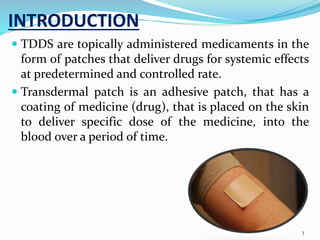
 Transdermal patch is an adhesive patch, that has a
coating of medicine (drug), that is placed on the skin
to deliver specific dose of the medicine, into the
blood over a period of time.
3
ADVANTAGES
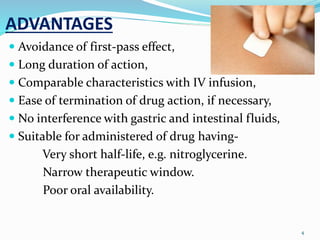
 Avoidance of first-pass effect,
 Long duration of action,
 Comparable characteristics with IV infusion,
 Ease of termination of drug action, if necessary,
 No interference with gastric and intestinal fluids,
 Suitable for administered of drug having-
Very short half-life, e.g. nitroglycerine.
Narrow therapeutic window.
Poor oral availability.
4
DISADVANTAGES
 Poor diffusion of large molecules,
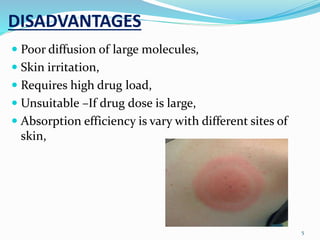
 Skin irritation,
 Requires high drug load,
 Unsuitable –If drug dose is large,
 Absorption efficiency is vary with different sites of
skin,
5
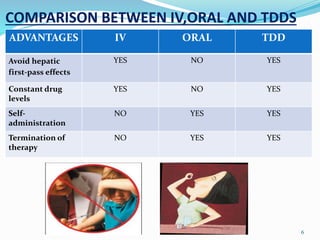
COMPARISON BETWEEN IV,ORAL AND TDDS
ADVANTAGES IV ORAL TDD
Avoid hepatic
first-pass effects
YES NO YES
Constant drug
levels
YES NO YES
Self-
administration
NO YES YES
Termination of
therapy
NO YES YES
6
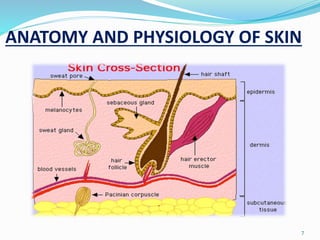
ANATOMY AND PHYSIOLOGY OF SKIN
7
 Skin is the part of Integrated system i.e. it helps to
maintain body temp and protect It from
surrounding environment.
 It covers an area of about 2m2 and 4.5-5 kg i.e. about
16% of total body weight in adults.

 Thickness is in range of 0.5mm (on eyelids ) to
4.0mm ( on heels ).
8
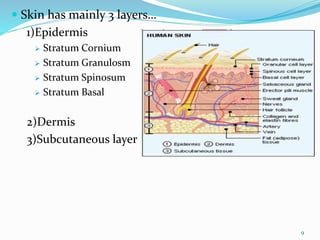
 Skin has mainly 3 layers…
1)Epidermis
 Stratum Cornium
 Stratum Granulosm
 Stratum Spinosum
 Stratum Basal
2)Dermis
3)Subcutaneous layer
9
EPIDERMIS
 Stratum Cornium- consists of 25 to 30 layers of
flattened dead keratinocytes. Which makes it water
repellent.
 Stratum Granulosm- consists of 3 to 5 layers and
under goes Apoptosis. It contains granules known as
Keratohyalin. These granules release Lipid rich
secretion, which acts as the water repellent.
 Stratum Spinosum- contains 8 to 10 layers of cells
and it is closely arranged.
 Stratum Basal- consists of single layer of cubical or
columnar keratinocytes.
10
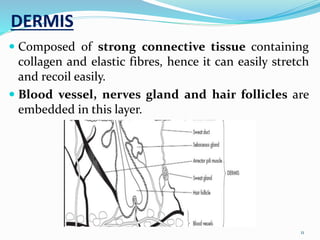
DERMIS
 Composed of strong connective tissue containing
collagen and elastic fibres, hence it can easily stretch
and recoil easily.
 Blood vessel, nerves gland and hair follicles are
embedded in this layer.
11
SUBCUTANEOUS LAYER
 It is also called as Hypodermis.
 It is made up of loose connective tissue, including
Adipose tissue.
 This helps to insulate the body by monitoring heat
gain and heat loss.
 The dermis is the layer of tissue that is Deeper and
Thicker than epidermis.
12
PERMEATION OF DRUG MOLECULE THROUGH SKIN
 It express by Fick’s first law of Diffusion-Drug
molecule diffuse from a region of higher conc. to one
of lower conc. until equilibrium is attained.
 The process of Diffusion of molecule is driven by
gradient between high concentration to low
concentration.
13
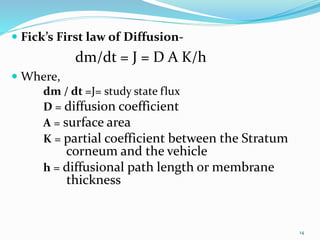
 Fick’s First law of Diffusion-
dm/dt = J = D A K/h
 Where,
dm / dt =J= study state flux
D = diffusion coefficient
A = surface area
K = partial coefficient between the Stratum
corneum and the vehicle
h = diffusional path length or membrane
thickness
14
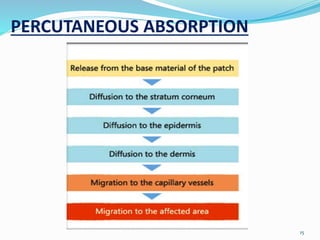
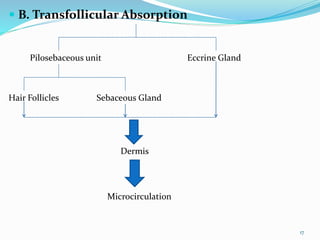
PERCUTANEOUS ABSORPTION
15
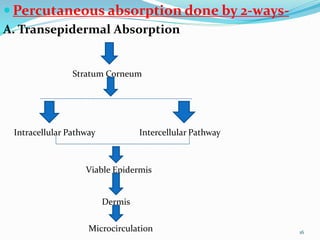
 Percutaneous absorption done by 2-ways-
A. Transepidermal Absorption
16
Stratum Corneum
Intracellular Pathway Intercellular Pathway
Viable Epidermis
Dermis
Microcirculation
 B. Transfollicular Absorption
17
Pilosebaceous unit Eccrine Gland
Hair Follicles Sebaceous Gland
Dermis
Microcirculation
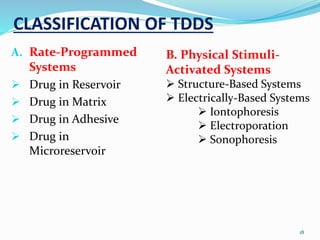
CLASSIFICATION OF TDDS
A. Rate-Programmed
Systems
 Drug in Reservoir
 Drug in Matrix
 Drug in Adhesive
 Drug in
Microreservoir
B. Physical Stimuli-
Activated Systems
 Structure-Based Systems
 Electrically-Based Systems
 Iontophoresis
 Electroporation
 Sonophoresis
18
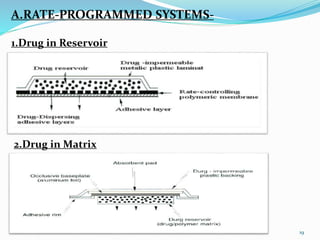
1.Drug in Reservoir
2.Drug in Matrix
A.RATE-PROGRAMMED SYSTEMS-
19
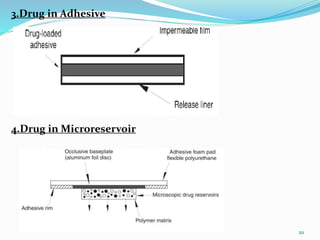
3.Drug in Adhesive
4.Drug in Microreservoir
20
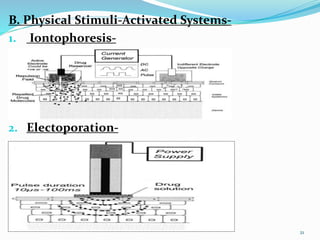
B. Physical Stimuli-Activated Systems-
1. Iontophoresis-
2. Electoporation-
21
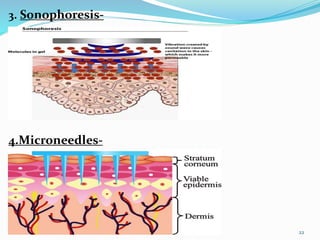
3. Sonophoresis-
4.Microneedles-
22
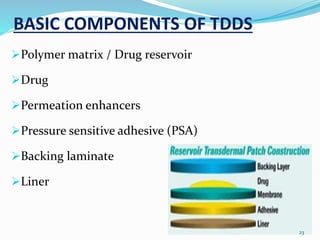
BASIC COMPONENTS OF TDDS
Polymer matrix / Drug reservoir
Drug
Permeation enhancers
Pressure sensitive adhesive (PSA)
Backing laminate
Liner
23
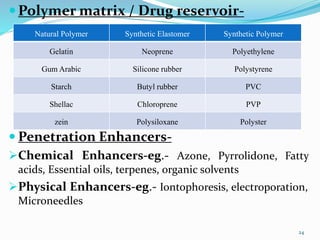
Polymer matrix / Drug reservoir-
 Penetration Enhancers-
Chemical Enhancers-eg.- Azone, Pyrrolidone, Fatty
acids, Essential oils, terpenes, organic solvents
Physical Enhancers-eg.- Iontophoresis, electroporation,
Microneedles
Natural Polymer Synthetic Elastomer Synthetic Polymer
Gelatin Neoprene Polyethylene
Gum Arabic Silicone rubber Polystyrene
Starch Butyl rubber PVC
Shellac Chloroprene PVP
zein Polysiloxane Polyster
24
Pressure Sensitive Adhesives (PSA)-
 A PSA is a material that helps in maintaining an intimate
contact between transdermal system and the skin surface.
 Some widely used pressure sensitive adhesives are-
 Eg- Polyisobutylenes, Polyacrylates, Silicones.
Backing Laminate:
Hold and protect the drug reservoir from exposure to
atmosphere.
Avoid loss of drug
Accept printing
High flexibility
Eg- vinyl, polyethylene and polyester films, aluminium foil,
foam pad, metallic plastic laminate.
25
Liner-
Protects the patch during storage. The liner is removed
prior to use. Drug – Drug solution in direct contact
with release liner.
26
FACTORS AFFECTING TRANSDERMAL
PERMEATION
 Physicochemical property of Drug molecule,
 Partition co-efficient,
 pH Condition,
 Drug Concentration,
 Molecular weight.
 Physicochemical property of Drug Delivery
System,
 Release characteristics,
 Use of permeation enhancer,
 Composition of Drug Delivery System.
27
 Pathophysiological condition of Skin,
 Reservoir effect of Horney Layer,
 Hydration of skin,
 Lipid Film,
 Skin Temperature,
 Pathological Injury to Skin,
 Regional variation.
28
Evaluation of TDDS
1. Evaluation of Adhesive
a. Peel Adhesion Properties- It is the force required to
remove coating from a test substrate.
b. Tack Properties- It is the ability of polymer to adhere to a
substrate with little contact pressure.
 Thumb tack test
 Rolling ball tack test
 Quick-Stick test
 Probe tack test
c. Shear Strength Properties- It is the measurement of the
cohesive strength of an adhesive polymer.
29
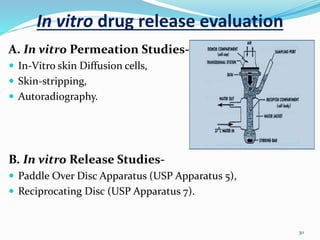
In vitro drug release evaluation
A. In vitro Permeation Studies-
 In-Vitro skin Diffusion cells,
 Skin-stripping,
 Autoradiography.
B. In vitro Release Studies-
 Paddle Over Disc Apparatus (USP Apparatus 5),
 Reciprocating Disc (USP Apparatus 7).
30
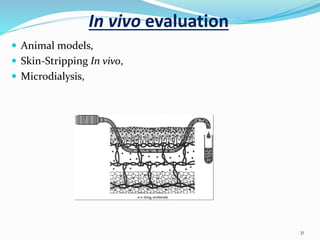
In vivo evaluation
 Animal models,
 Skin-Stripping In vivo,
 Microdialysis,
31
APPLICATIONS
 For treatment of Angina Pectoris,
 Smoking cessation(Nicotine Patch),
 Contraceptive,
 Antiemetic,
 Anti-inflammatory,
 Cosmetics.
32
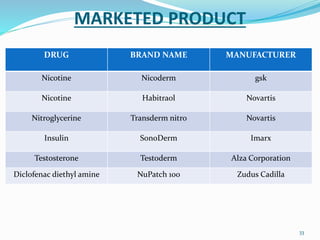
MARKETED PRODUCT
DRUG BRAND NAME MANUFACTURER
Nicotine Nicoderm gsk
Nicotine Habitraol Novartis
Nitroglycerine Transderm nitro Novartis
Insulin SonoDerm Imarx
Testosterone Testoderm Alza Corporation
Diclofenac diethyl amine NuPatch 100 Zudus Cadilla
33
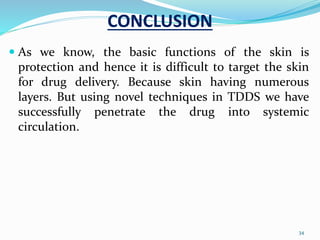
CONCLUSION
 As we know, the basic functions of the skin is
protection and hence it is difficult to target the skin
for drug delivery. Because skin having numerous
layers. But using novel techniques in TDDS we have
successfully penetrate the drug into systemic
circulation.
34
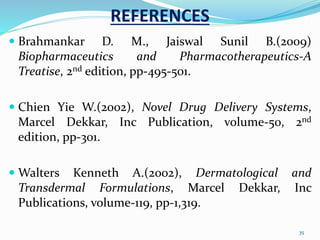
REFERENCES
 Brahmankar D. M., Jaiswal Sunil B.(2009)
Biopharmaceutics and Pharmacotherapeutics-A
Treatise, 2nd edition, pp-495-501.
 Chien Yie W.(2002), Novel Drug Delivery Systems,
Marcel Dekkar, Inc Publication, volume-50, 2nd
edition, pp-301.
 Walters Kenneth A.(2002), Dermatological and
Transdermal Formulations, Marcel Dekkar, Inc
Publications, volume-119, pp-1,319.
35
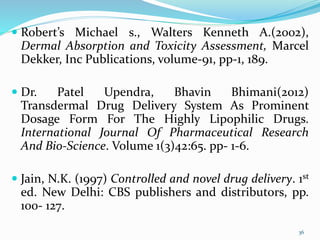
 Robert’s Michael s., Walters Kenneth A.(2002),
Dermal Absorption and Toxicity Assessment, Marcel
Dekker, Inc Publications, volume-91, pp-1, 189.
 Dr. Patel Upendra, Bhavin Bhimani(2012)
Transdermal Drug Delivery System As Prominent
Dosage Form For The Highly Lipophilic Drugs.
International Journal Of Pharmaceutical Research
And Bio-Science. Volume 1(3)42:65. pp- 1-6.
 Jain, N.K. (1997) Controlled and novel drug delivery. 1st
ed. New Delhi: CBS publishers and distributors, pp.
100- 127.
36
37

Transdermal drug delivery system

  • 1.
    A SEMINAR ON TRANSDERMALDRUG DELIVERY SYSTEM PRESENTED BY: SHIRODE RAHUL A. M. Pharm.2nd sem.(2014-2015) (Department of Pharmaceutics) R. C. Patel Institute of Pharmaceutical Education and Research, Shirpur 1
  • 2.
    CONTENTS  Introduction  Advantages-Disadvantages Comparison between IV, Oral and TDDS  Anatomy and Physiology of Skin  Permeation of Drug Molecule through Skin  Percutaneous Absorption  Classification of TDDS  Basic components of TDDS  Factors affecting Transdermal Permeation  Evaluation of TDDS  Application  Marketed Product  Conclusion  References. 2
  • 3.
    INTRODUCTION  TDDS aretopically administered medicaments in the form of patches that deliver drugs for systemic effects at predetermined and controlled rate.  Transdermal patch is an adhesive patch, that has a coating of medicine (drug), that is placed on the skin to deliver specific dose of the medicine, into the blood over a period of time. 3
  • 4.
    ADVANTAGES  Avoidance offirst-pass effect,  Long duration of action,  Comparable characteristics with IV infusion,  Ease of termination of drug action, if necessary,  No interference with gastric and intestinal fluids,  Suitable for administered of drug having- Very short half-life, e.g. nitroglycerine. Narrow therapeutic window. Poor oral availability. 4
  • 5.
    DISADVANTAGES  Poor diffusionof large molecules,  Skin irritation,  Requires high drug load,  Unsuitable –If drug dose is large,  Absorption efficiency is vary with different sites of skin, 5
  • 6.
    COMPARISON BETWEEN IV,ORALAND TDDS ADVANTAGES IV ORAL TDD Avoid hepatic first-pass effects YES NO YES Constant drug levels YES NO YES Self- administration NO YES YES Termination of therapy NO YES YES 6
  • 7.
  • 8.
     Skin isthe part of Integrated system i.e. it helps to maintain body temp and protect It from surrounding environment.  It covers an area of about 2m2 and 4.5-5 kg i.e. about 16% of total body weight in adults.  Thickness is in range of 0.5mm (on eyelids ) to 4.0mm ( on heels ). 8
  • 9.
     Skin hasmainly 3 layers… 1)Epidermis  Stratum Cornium  Stratum Granulosm  Stratum Spinosum  Stratum Basal 2)Dermis 3)Subcutaneous layer 9
  • 10.
    EPIDERMIS  Stratum Cornium-consists of 25 to 30 layers of flattened dead keratinocytes. Which makes it water repellent.  Stratum Granulosm- consists of 3 to 5 layers and under goes Apoptosis. It contains granules known as Keratohyalin. These granules release Lipid rich secretion, which acts as the water repellent.  Stratum Spinosum- contains 8 to 10 layers of cells and it is closely arranged.  Stratum Basal- consists of single layer of cubical or columnar keratinocytes. 10
  • 11.
    DERMIS  Composed ofstrong connective tissue containing collagen and elastic fibres, hence it can easily stretch and recoil easily.  Blood vessel, nerves gland and hair follicles are embedded in this layer. 11
  • 12.
    SUBCUTANEOUS LAYER  Itis also called as Hypodermis.  It is made up of loose connective tissue, including Adipose tissue.  This helps to insulate the body by monitoring heat gain and heat loss.  The dermis is the layer of tissue that is Deeper and Thicker than epidermis. 12
  • 13.
    PERMEATION OF DRUGMOLECULE THROUGH SKIN  It express by Fick’s first law of Diffusion-Drug molecule diffuse from a region of higher conc. to one of lower conc. until equilibrium is attained.  The process of Diffusion of molecule is driven by gradient between high concentration to low concentration. 13
  • 14.
     Fick’s Firstlaw of Diffusion- dm/dt = J = D A K/h  Where, dm / dt =J= study state flux D = diffusion coefficient A = surface area K = partial coefficient between the Stratum corneum and the vehicle h = diffusional path length or membrane thickness 14
  • 15.
  • 16.
     Percutaneous absorptiondone by 2-ways- A. Transepidermal Absorption 16 Stratum Corneum Intracellular Pathway Intercellular Pathway Viable Epidermis Dermis Microcirculation
  • 17.
     B. TransfollicularAbsorption 17 Pilosebaceous unit Eccrine Gland Hair Follicles Sebaceous Gland Dermis Microcirculation
  • 18.
    CLASSIFICATION OF TDDS A.Rate-Programmed Systems  Drug in Reservoir  Drug in Matrix  Drug in Adhesive  Drug in Microreservoir B. Physical Stimuli- Activated Systems  Structure-Based Systems  Electrically-Based Systems  Iontophoresis  Electroporation  Sonophoresis 18
  • 19.
    1.Drug in Reservoir 2.Drugin Matrix A.RATE-PROGRAMMED SYSTEMS- 19
  • 20.
    3.Drug in Adhesive 4.Drugin Microreservoir 20
  • 21.
    B. Physical Stimuli-ActivatedSystems- 1. Iontophoresis- 2. Electoporation- 21
  • 22.
  • 23.
    BASIC COMPONENTS OFTDDS Polymer matrix / Drug reservoir Drug Permeation enhancers Pressure sensitive adhesive (PSA) Backing laminate Liner 23
  • 24.
    Polymer matrix /Drug reservoir-  Penetration Enhancers- Chemical Enhancers-eg.- Azone, Pyrrolidone, Fatty acids, Essential oils, terpenes, organic solvents Physical Enhancers-eg.- Iontophoresis, electroporation, Microneedles Natural Polymer Synthetic Elastomer Synthetic Polymer Gelatin Neoprene Polyethylene Gum Arabic Silicone rubber Polystyrene Starch Butyl rubber PVC Shellac Chloroprene PVP zein Polysiloxane Polyster 24
  • 25.
    Pressure Sensitive Adhesives(PSA)-  A PSA is a material that helps in maintaining an intimate contact between transdermal system and the skin surface.  Some widely used pressure sensitive adhesives are-  Eg- Polyisobutylenes, Polyacrylates, Silicones. Backing Laminate: Hold and protect the drug reservoir from exposure to atmosphere. Avoid loss of drug Accept printing High flexibility Eg- vinyl, polyethylene and polyester films, aluminium foil, foam pad, metallic plastic laminate. 25
  • 26.
    Liner- Protects the patchduring storage. The liner is removed prior to use. Drug – Drug solution in direct contact with release liner. 26
  • 27.
    FACTORS AFFECTING TRANSDERMAL PERMEATION Physicochemical property of Drug molecule,  Partition co-efficient,  pH Condition,  Drug Concentration,  Molecular weight.  Physicochemical property of Drug Delivery System,  Release characteristics,  Use of permeation enhancer,  Composition of Drug Delivery System. 27
  • 28.
     Pathophysiological conditionof Skin,  Reservoir effect of Horney Layer,  Hydration of skin,  Lipid Film,  Skin Temperature,  Pathological Injury to Skin,  Regional variation. 28
  • 29.
    Evaluation of TDDS 1.Evaluation of Adhesive a. Peel Adhesion Properties- It is the force required to remove coating from a test substrate. b. Tack Properties- It is the ability of polymer to adhere to a substrate with little contact pressure.  Thumb tack test  Rolling ball tack test  Quick-Stick test  Probe tack test c. Shear Strength Properties- It is the measurement of the cohesive strength of an adhesive polymer. 29
  • 30.
    In vitro drugrelease evaluation A. In vitro Permeation Studies-  In-Vitro skin Diffusion cells,  Skin-stripping,  Autoradiography. B. In vitro Release Studies-  Paddle Over Disc Apparatus (USP Apparatus 5),  Reciprocating Disc (USP Apparatus 7). 30
  • 31.
    In vivo evaluation Animal models,  Skin-Stripping In vivo,  Microdialysis, 31
  • 32.
    APPLICATIONS  For treatmentof Angina Pectoris,  Smoking cessation(Nicotine Patch),  Contraceptive,  Antiemetic,  Anti-inflammatory,  Cosmetics. 32
  • 33.
    MARKETED PRODUCT DRUG BRANDNAME MANUFACTURER Nicotine Nicoderm gsk Nicotine Habitraol Novartis Nitroglycerine Transderm nitro Novartis Insulin SonoDerm Imarx Testosterone Testoderm Alza Corporation Diclofenac diethyl amine NuPatch 100 Zudus Cadilla 33
  • 34.
    CONCLUSION  As weknow, the basic functions of the skin is protection and hence it is difficult to target the skin for drug delivery. Because skin having numerous layers. But using novel techniques in TDDS we have successfully penetrate the drug into systemic circulation. 34
  • 35.
    REFERENCES  Brahmankar D.M., Jaiswal Sunil B.(2009) Biopharmaceutics and Pharmacotherapeutics-A Treatise, 2nd edition, pp-495-501.  Chien Yie W.(2002), Novel Drug Delivery Systems, Marcel Dekkar, Inc Publication, volume-50, 2nd edition, pp-301.  Walters Kenneth A.(2002), Dermatological and Transdermal Formulations, Marcel Dekkar, Inc Publications, volume-119, pp-1,319. 35
  • 36.
     Robert’s Michaels., Walters Kenneth A.(2002), Dermal Absorption and Toxicity Assessment, Marcel Dekker, Inc Publications, volume-91, pp-1, 189.  Dr. Patel Upendra, Bhavin Bhimani(2012) Transdermal Drug Delivery System As Prominent Dosage Form For The Highly Lipophilic Drugs. International Journal Of Pharmaceutical Research And Bio-Science. Volume 1(3)42:65. pp- 1-6.  Jain, N.K. (1997) Controlled and novel drug delivery. 1st ed. New Delhi: CBS publishers and distributors, pp. 100- 127. 36
  • 37.