Rate controlled
drug delivery
system
Prepared by:
PANKAJ
Department of pharmaceutics
27/MPH/18
CONTENTS:
Introduction
Classification of rate controlled DD Systems
Rate programmed Drug Delivery System
Activation Modulated Drug Delivery System
Feedback regulated Drug Delivery System
Effect of System Parameters on Controlled
Drug Delivery System
References
INTRODUCTION
• Sustained release, sustained action, controlled release,
extended action, timed release dosage forms are the terms
used to identify drug delivery systems that are designed to
achieve a prolonged therapeutic effect by continuously
releasing medication over an extended period of time after the
administration of single dose.
• The term “Controlled release” has become associated with
those systems from which therapeutic agents may be
automatically delivered at predefined rates over a long period
of time.
CONTD…
But, there are some confusion in terminology between
“Controlled release” & “Sustained release”
Sustained Release
The term sustained release has been constantly used to describe a
pharmaceutical dosage form formulated to retard the release of a
therapeutic agent such that its appearance in the systemic
circulation is delayed &/or prolonged & its plasma profile is
sustained in duration.
Controlled Release
It implies a predictability & reproducibility in the drug release
kinetics, which means that the release of drug ingredient from a
controlled delivery system proceeds at a rate profile that is not
only predictable kinetically, but also reproducible from one unit to
another.
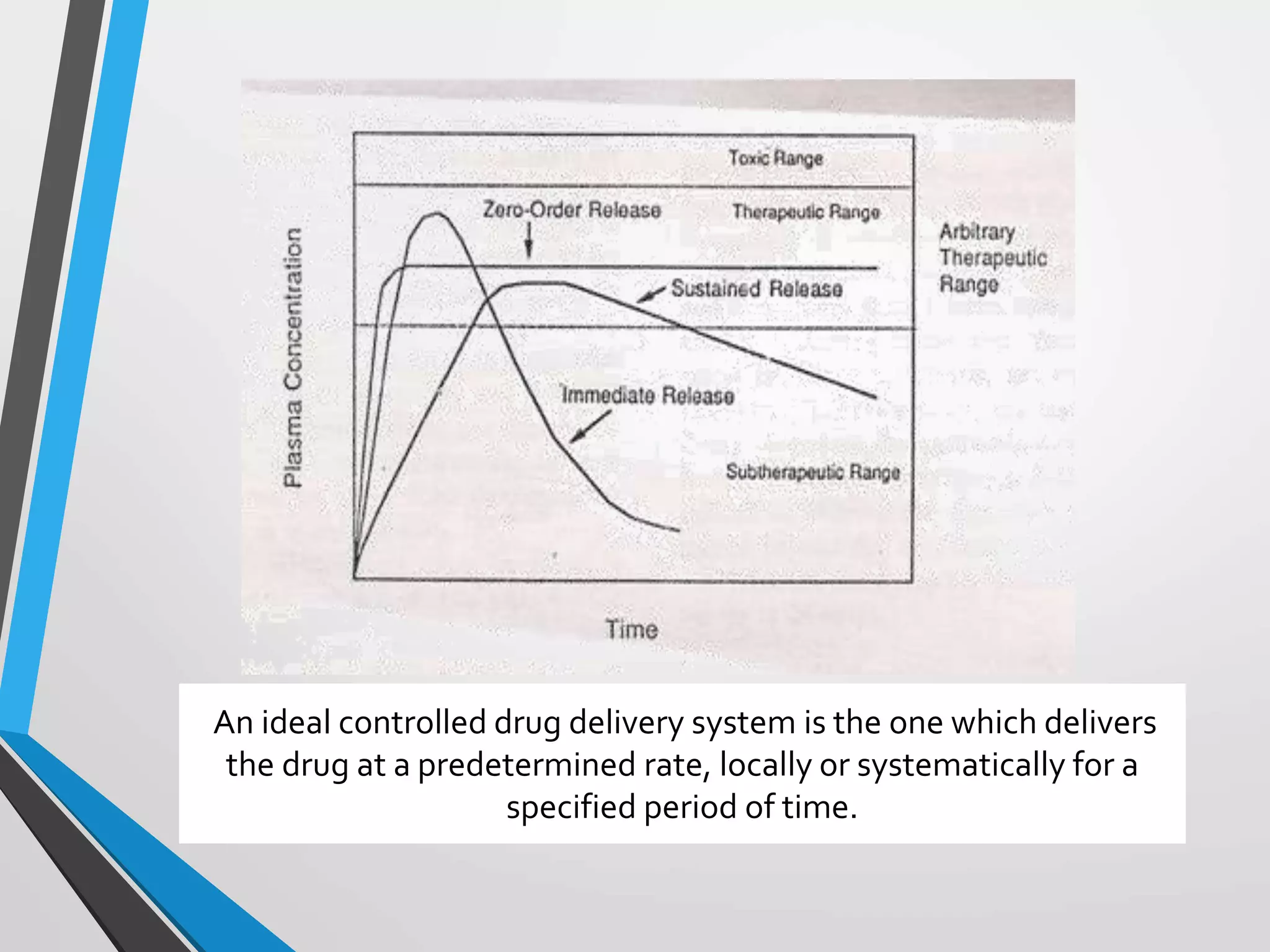
An ideal controlled drug delivery system is the one which delivers
the drug at a predetermined rate, locally or systematically for a
specified period of time.
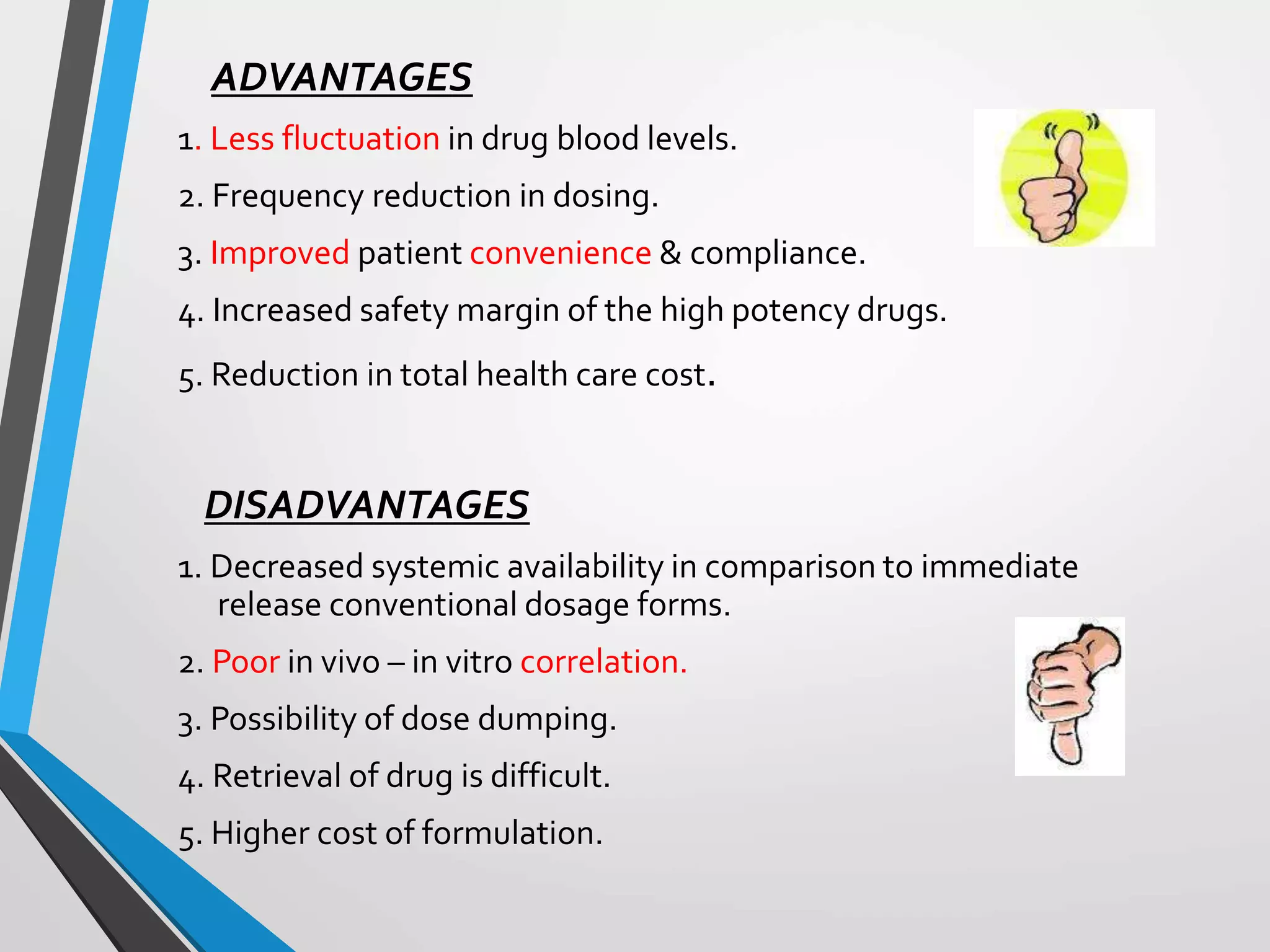
ADVANTAGES
1. Less fluctuation in drug blood levels.
2. Frequency reduction in dosing.
3. Improved patient convenience & compliance.
4. Increased safety margin of the high potency drugs.
5. Reduction in total health care cost.
DISADVANTAGES
1. Decreased systemic availability in comparison to immediate
release conventional dosage forms.
2. Poor in vivo – in vitro correlation.
3. Possibility of dose dumping.
4. Retrieval of drug is difficult.
5. Higher cost of formulation.
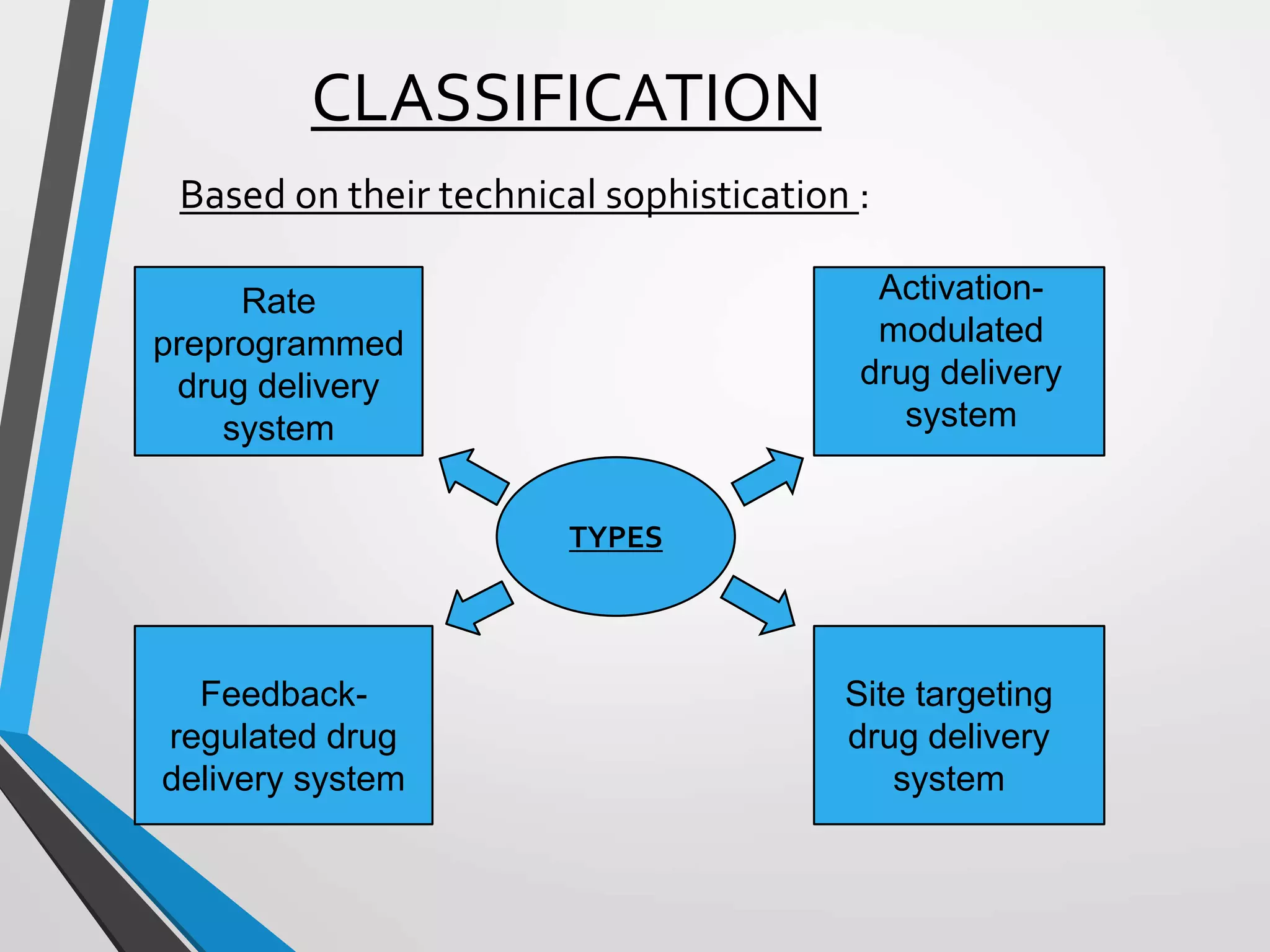
CLASSIFICATION
Based on their technical sophistication :
Rate
preprogrammed
drug delivery
system
Activation-
modulated
drug delivery
system
Feedback-
regulated drug
delivery system
Site targeting
drug delivery
system
TYPES
#1. Rate preprogrammed DDS
In this group , the release of drug molecule from the
system has been preprogrammed at specific rate
profile.
Classification
a. Polymer membrane permeation-controlled drug
delivery system.
b. Polymer matrix diffusion-controlled drug delivery
system.
c. Microreservior partition-controlled drug delivery
system.
a. Polymer membrane permeation-controlled drug
delivery system.
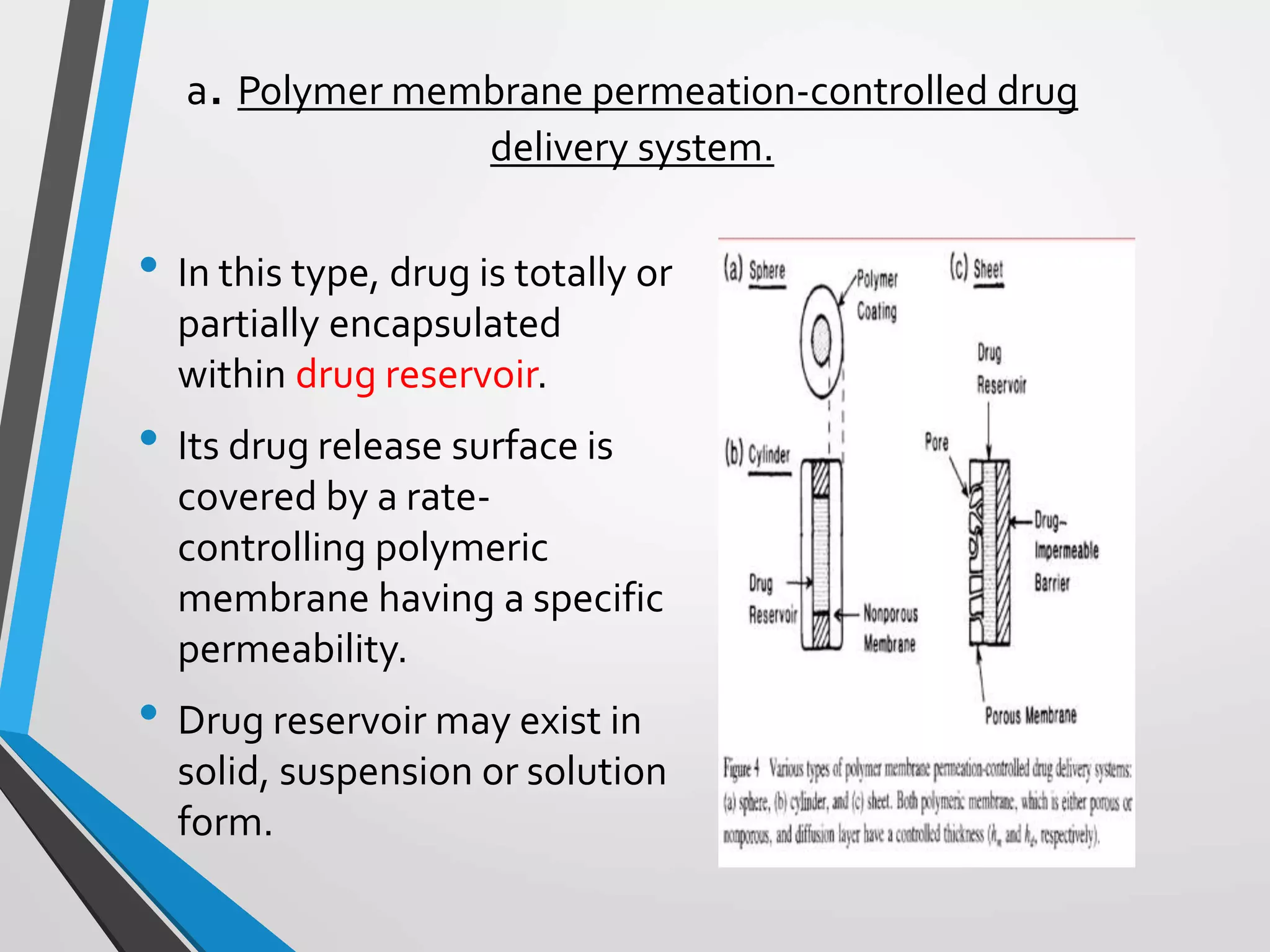
• In this type, drug is totally or
partially encapsulated
within drug reservoir.
• Its drug release surface is
covered by a rate-
controlling polymeric
membrane having a specific
permeability.
• Drug reservoir may exist in
solid, suspension or solution
form.
CONTD..
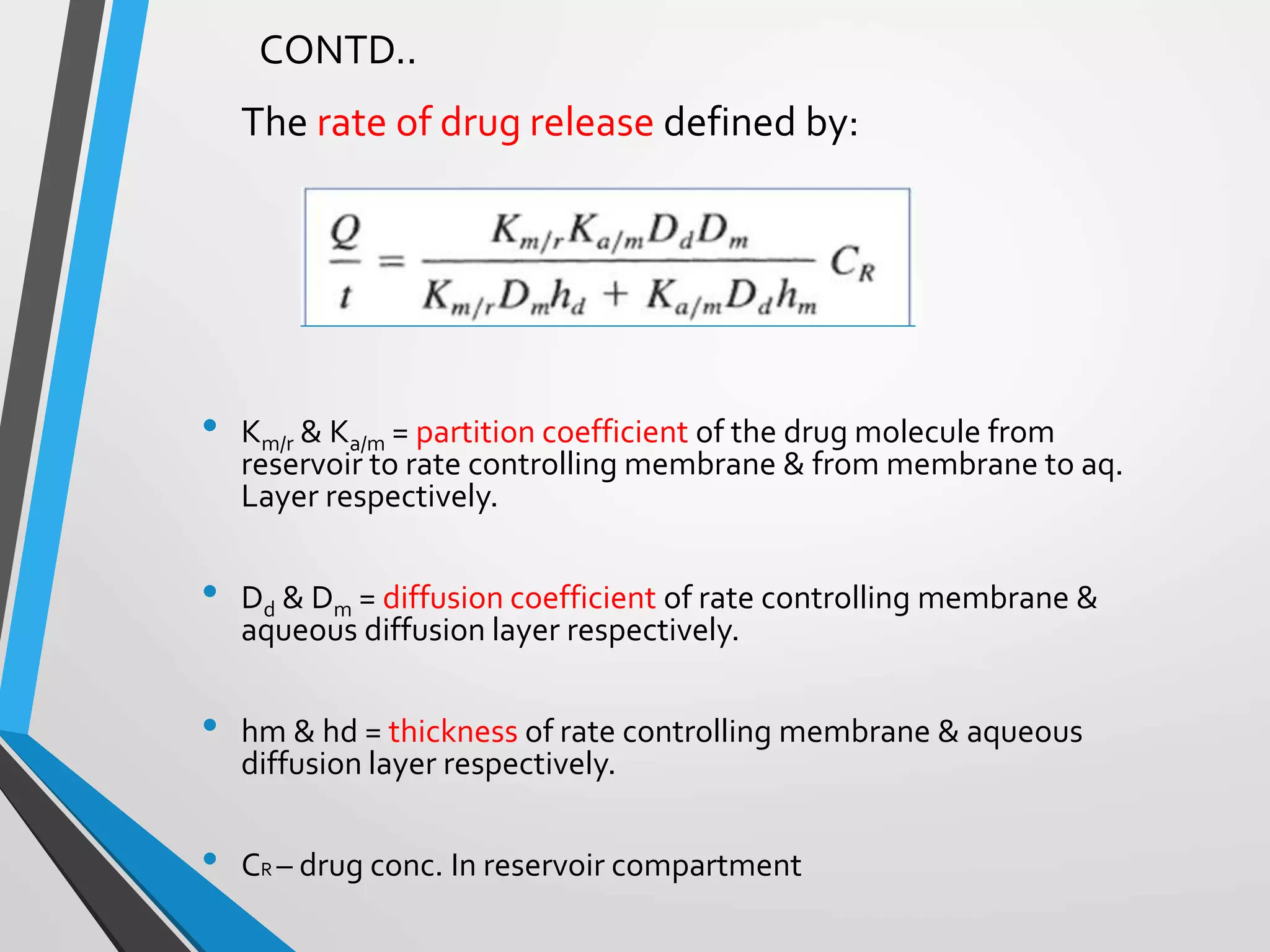
The rate of drug release defined by:
• Km/r & Ka/m = partition coefficient of the drug molecule from
reservoir to rate controlling membrane & from membrane to aq.
Layer respectively.
• Dd & Dm = diffusion coefficient of rate controlling membrane &
aqueous diffusion layer respectively.
• hm & hd = thickness of rate controlling membrane & aqueous
diffusion layer respectively.
• CR – drug conc. In reservoir compartment
CONTD…
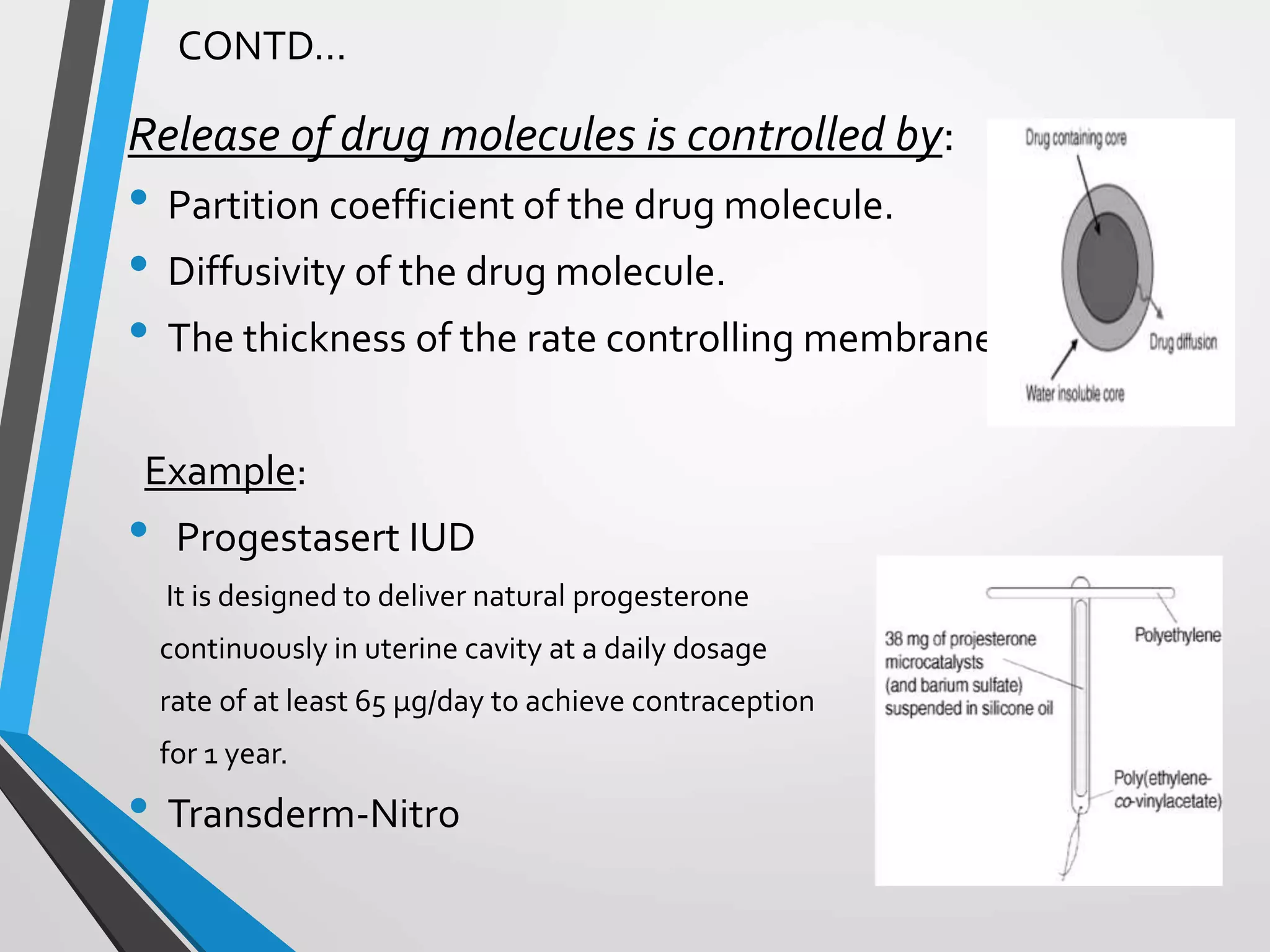
Release of drug molecules is controlled by:
• Partition coefficient of the drug molecule.
• Diffusivity of the drug molecule.
• The thickness of the rate controlling membrane.
Example:
• Progestasert IUD
It is designed to deliver natural progesterone
continuously in uterine cavity at a daily dosage
rate of at least 65 μg/day to achieve contraception
for 1 year.
• Transderm-Nitro
b. Polymer matrix diffusion-controlled drug delivery
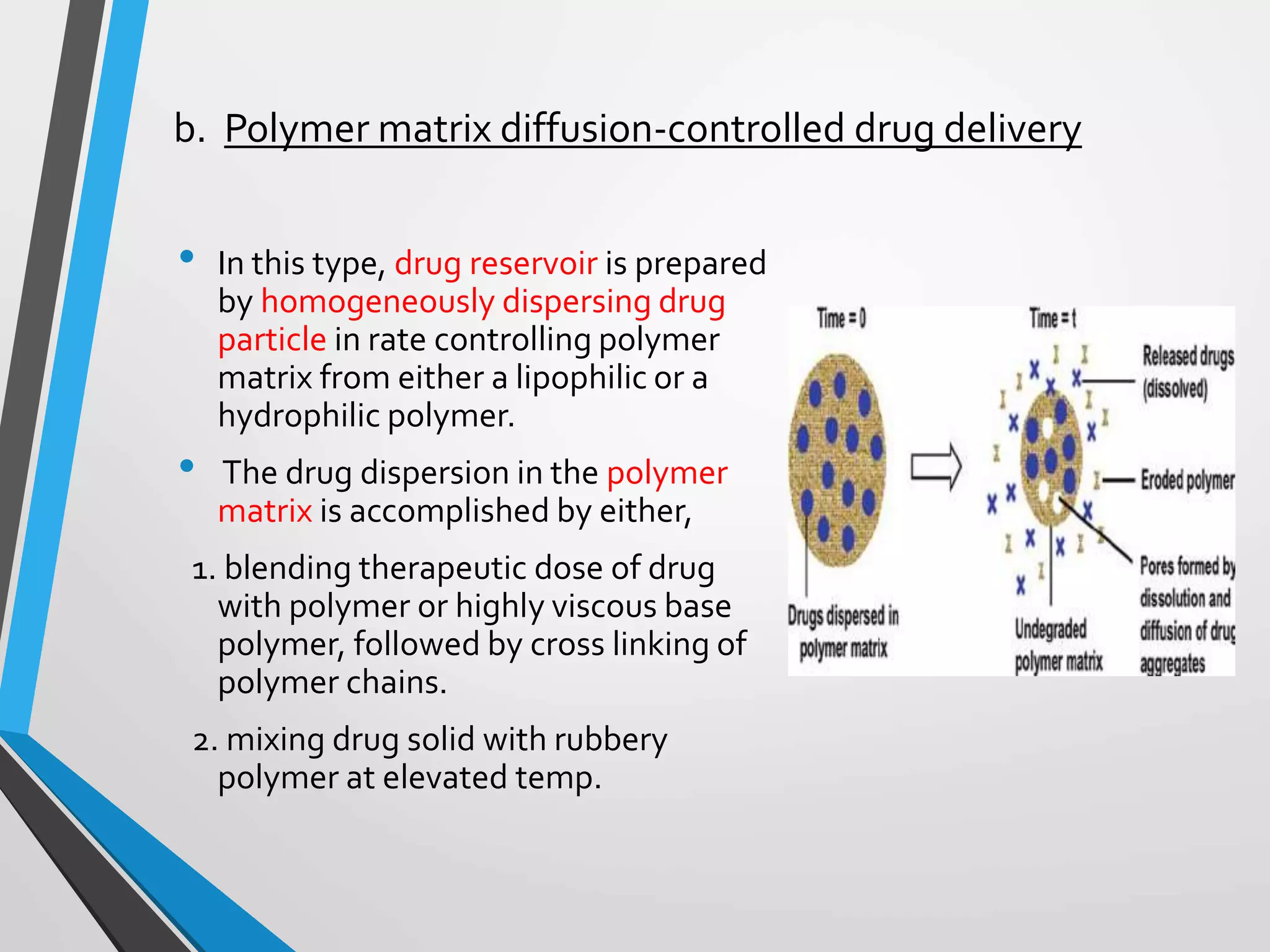
• In this type, drug reservoir is prepared
by homogeneously dispersing drug
particle in rate controlling polymer
matrix from either a lipophilic or a
hydrophilic polymer.
• The drug dispersion in the polymer
matrix is accomplished by either,
1. blending therapeutic dose of drug
with polymer or highly viscous base
polymer, followed by cross linking of
polymer chains.
2. mixing drug solid with rubbery
polymer at elevated temp.
CONTD…
• The resultant drug-polymer dispersion
is then molded or extruded to form a
drug delivery device of various shapes
and sizes designed for specific
application.
• It can also be fabricated by dissolving
the drug and the polymer in a
common solvent, followed by solvent
evaporation at an elevated
temperature and/or under a vacuum.
• Release of drug molecule is controlled
by
Loading dose
Polymer solubility of drug
Drug diffusivity in polymer matrix.
CONTD...
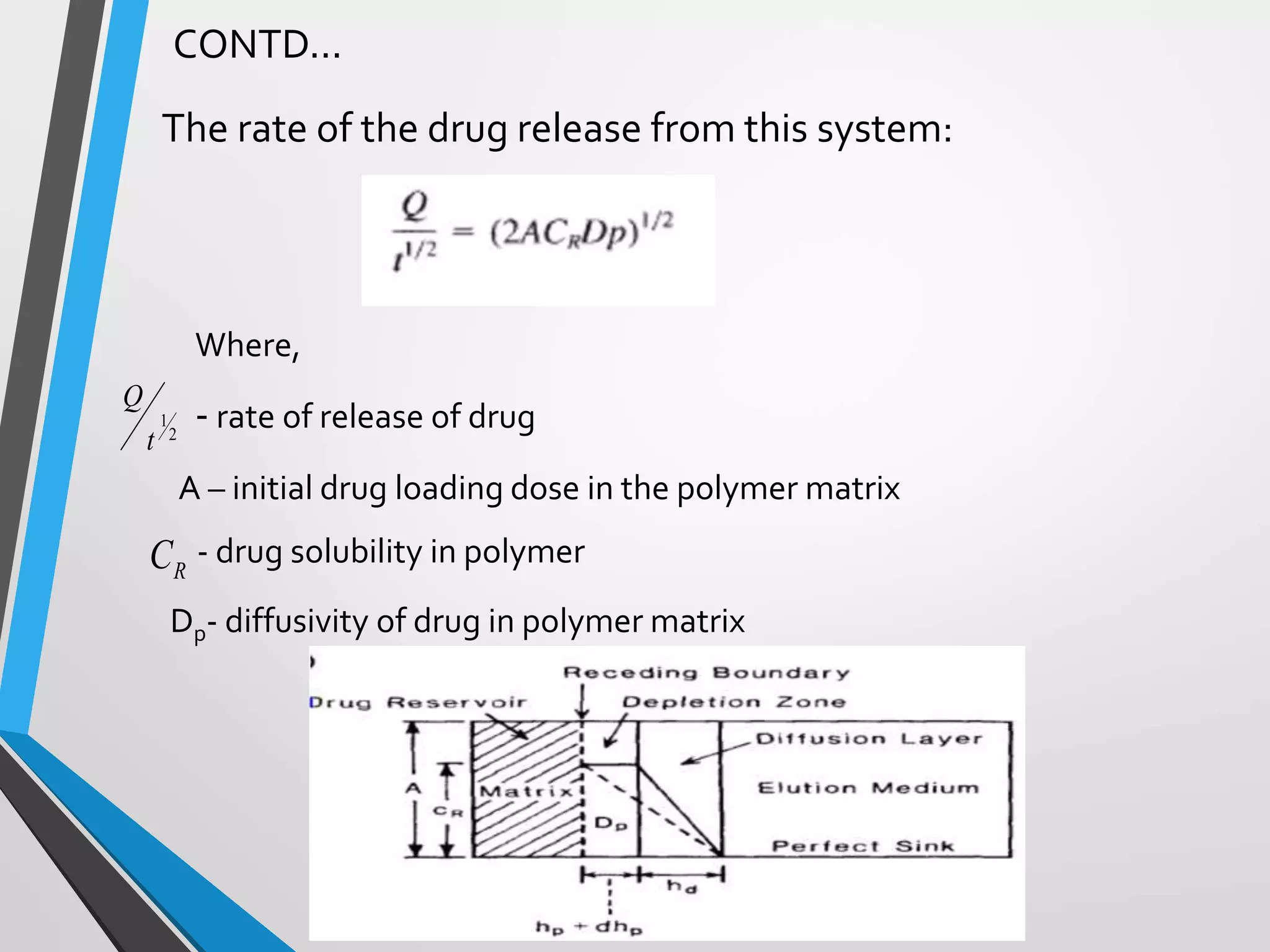
The rate of the drug release from this system:
Where,
- rate of release of drug
A – initial drug loading dose in the polymer matrix
- drug solubility in polymer
Dp- diffusivity of drug in polymer matrix
2
1
t
Q
RC
c. MICRORESERVIOR PARTITION-CONTROLLED
DRUG DELIVERY SYSTEM
• In this type, drug reservoir is fabricated by micro
dispersion of an aqueous Suspension of drug in
biocompatible polymer to form homogeneous
dispersion.
• Depending upon the physicochemical properties of
drugs & desired rate of drug release, the device can be
further coated with a layer of biocompatible polymer
to modify the mechanism & the rate of drug release
CONTD..
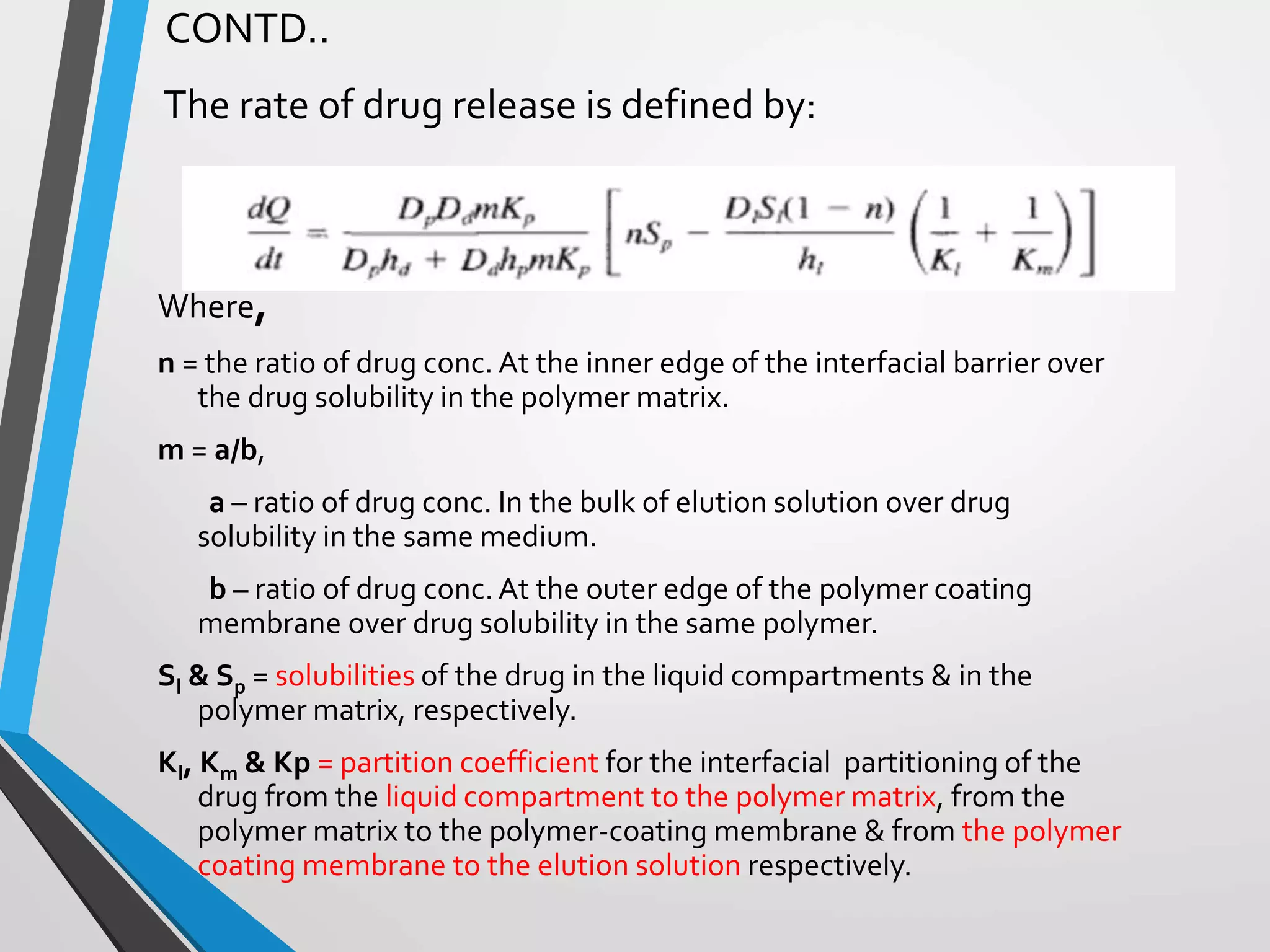
The rate of drug release is defined by:
Where,
n = the ratio of drug conc. At the inner edge of the interfacial barrier over
the drug solubility in the polymer matrix.
m = a/b,
a – ratio of drug conc. In the bulk of elution solution over drug
solubility in the same medium.
b – ratio of drug conc. At the outer edge of the polymer coating
membrane over drug solubility in the same polymer.
Sl & Sp = solubilities of the drug in the liquid compartments & in the
polymer matrix, respectively.
Kl, Km & Kp = partition coefficient for the interfacial partitioning of the
drug from the liquid compartment to the polymer matrix, from the
polymer matrix to the polymer-coating membrane & from the polymer
coating membrane to the elution solution respectively.
CONTD…
Release of drug molecule is controlled by,
• Partition coefficient
• Diffusivity of drug
• Solubility of drug
Example:
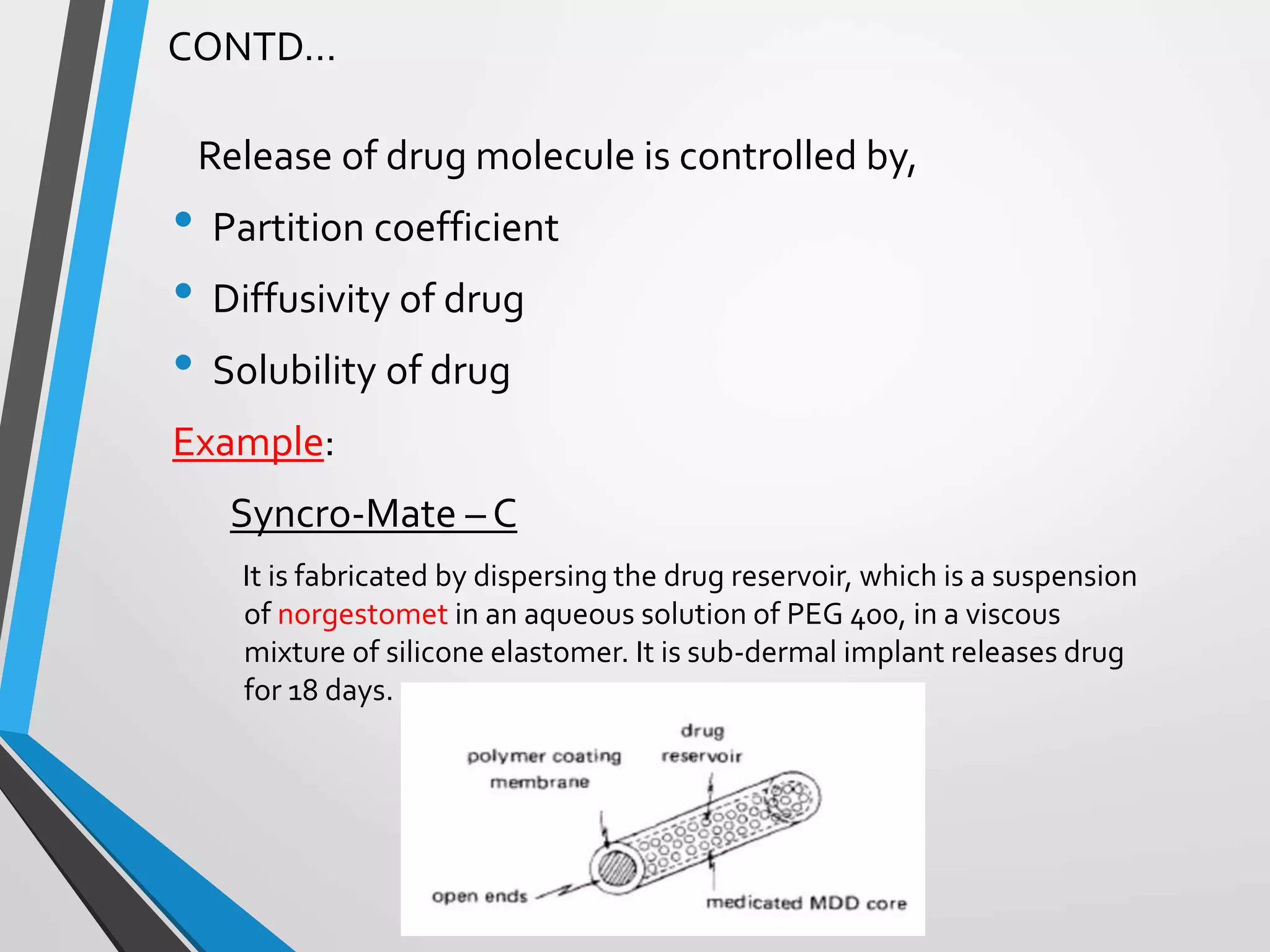
Syncro-Mate – C
It is fabricated by dispersing the drug reservoir, which is a suspension
of norgestomet in an aqueous solution of PEG 400, in a viscous
mixture of silicone elastomer. It is sub-dermal implant releases drug
for 18 days.
#2. Activation modulated drug
delivery systems
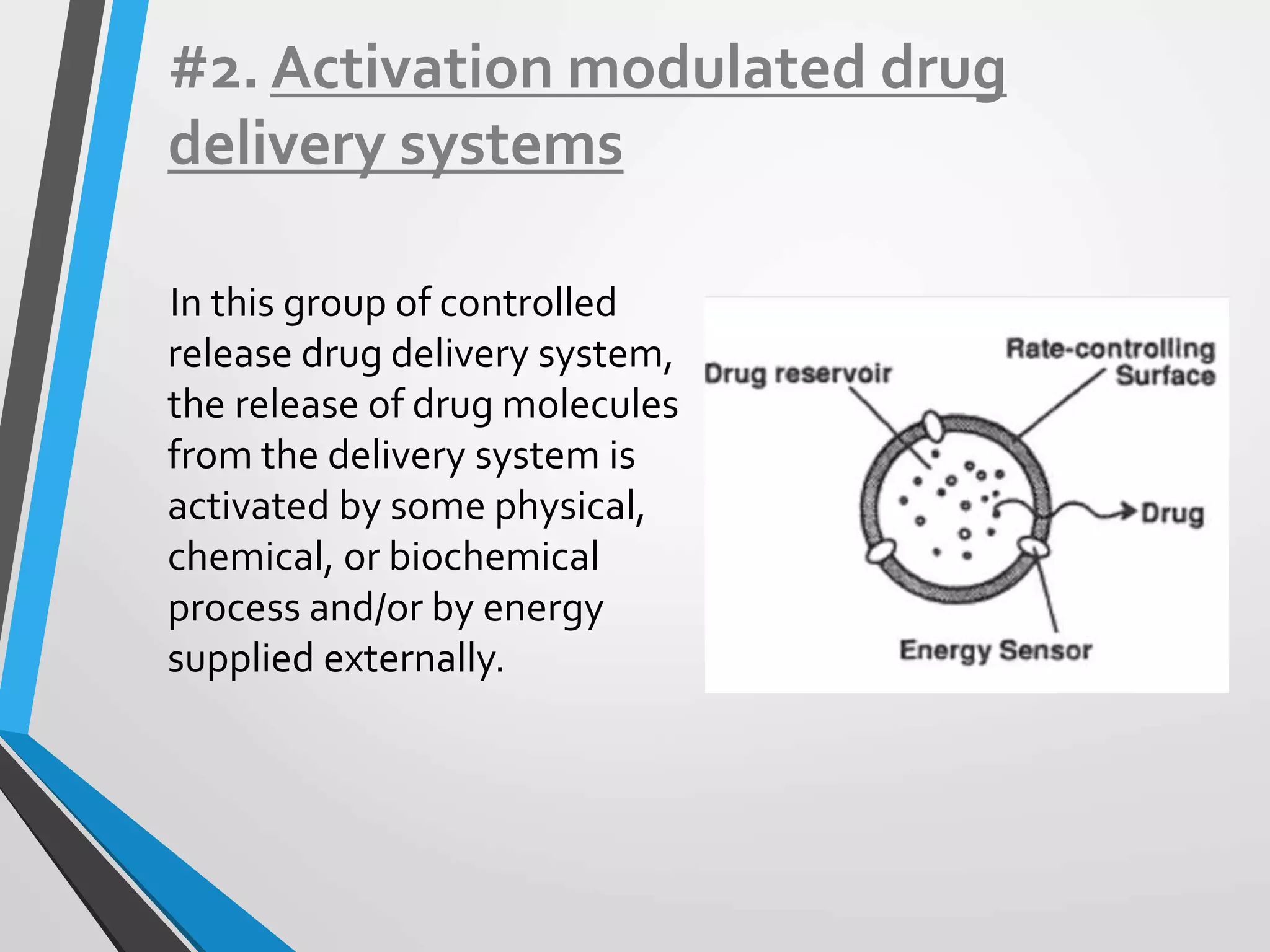
In this group of controlled
release drug delivery system,
the release of drug molecules
from the delivery system is
activated by some physical,
chemical, or biochemical
process and/or by energy
supplied externally.
CONTD…
Based on nature of the process or type of energy used
they can be classified into:
1. Physical means
a. Osmotic pressure-activated DDS
b. Hydrodynamic pressure-activated DDS
c.Vapour pressure-activated DDS
d.Magnetically activated DDS
e. Iontophoresis activated DDS
f. Hydration-activated DDS
2. Chemical means
a. pH- activated DDS
b. Ion- activated DDS
c. Hydrolysis- activated DDS
CONTD…
3. Biochemical means
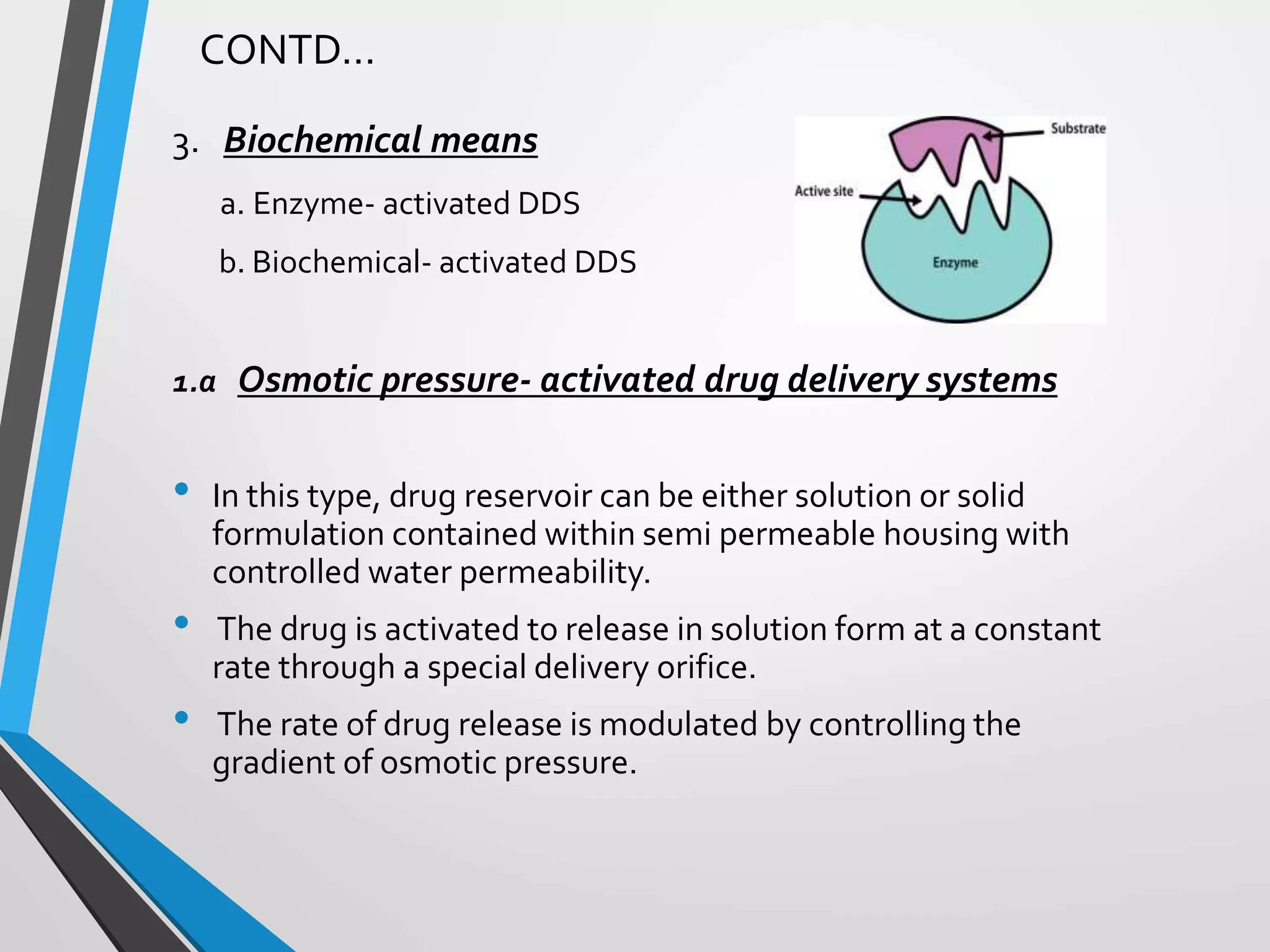
a. Enzyme- activated DDS
b. Biochemical- activated DDS
1.a Osmotic pressure- activated drug delivery systems
• In this type, drug reservoir can be either solution or solid
formulation contained within semi permeable housing with
controlled water permeability.
• The drug is activated to release in solution form at a constant
rate through a special delivery orifice.
• The rate of drug release is modulated by controlling the
gradient of osmotic pressure.
CONTD…
For the drug delivery system containing a solution formulation,
the intrinsic rate of drug release is defined by,
Rate controlling factors :
• Water permeability of the semi permeable membrane.
• Effective surface area of the semi permeable membrane.
• Osmotic pressure difference across the semi permeable
membrane.
CONTD…
Example:
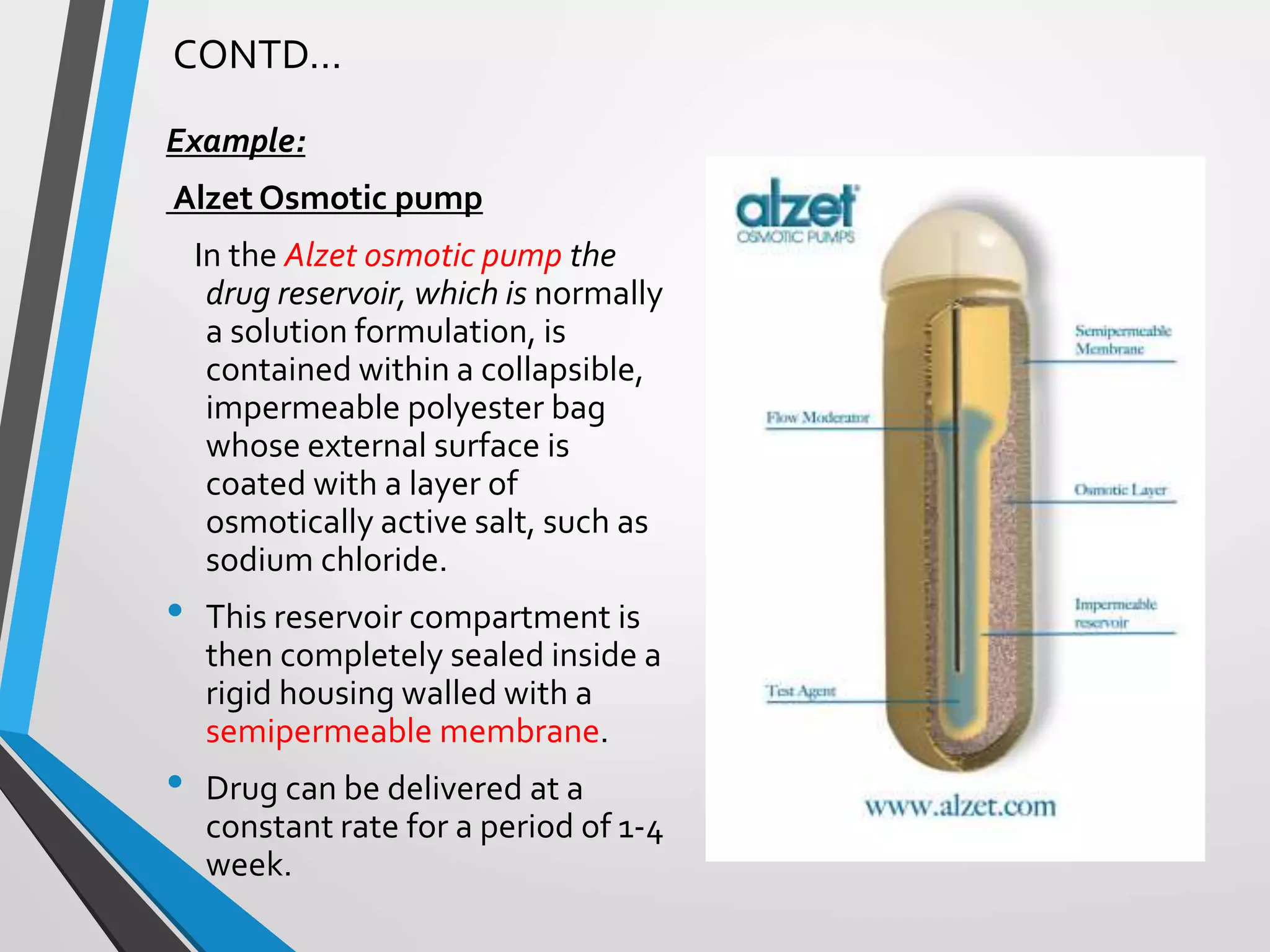
Alzet Osmotic pump
In the Alzet osmotic pump the
drug reservoir, which is normally
a solution formulation, is
contained within a collapsible,
impermeable polyester bag
whose external surface is
coated with a layer of
osmotically active salt, such as
sodium chloride.
• This reservoir compartment is
then completely sealed inside a
rigid housing walled with a
semipermeable membrane.
• Drug can be delivered at a
constant rate for a period of 1-4
week.
1.b Hydrodynamic pressure-activated DDS
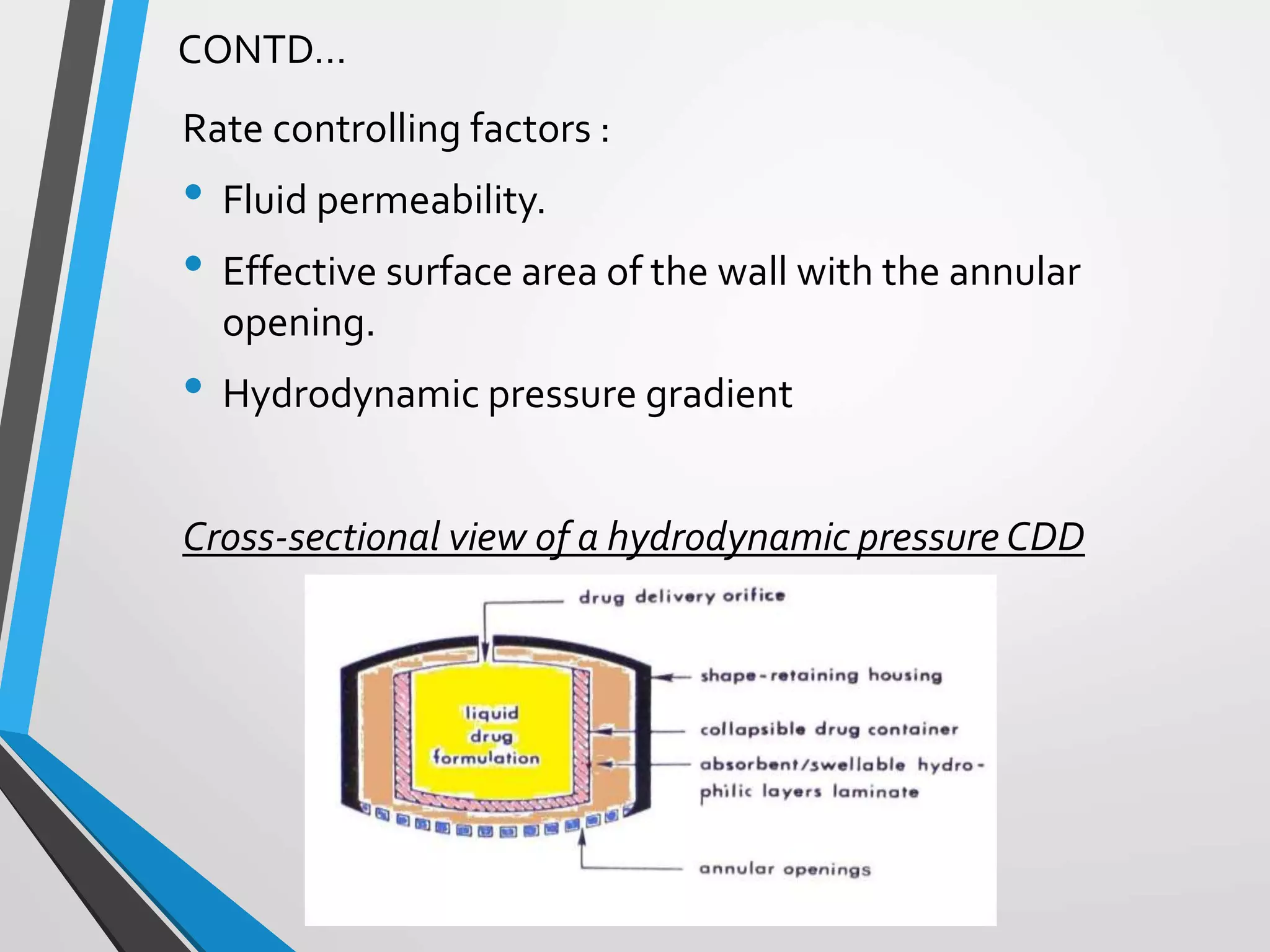
A hydrodynamic pressure-activated drug delivery system can be
fabricated by enclosing a collapsible, impermeable container,
which contains a liquid drug formulation to form a drug reservoir
compartment, inside a rigid shape-retaining housing.
Rate of drug release is defined by,
Where,
Pf = fluid permeability
Am = effective Surface area
hm = thickness of wall with anular opening
(qs - qe) = differential hydrodynamic pressure
between the drug delivery system & the environment.
CONTD…
Rate controlling factors :
• Fluid permeability.
• Effective surface area of the wall with the annular
opening.
• Hydrodynamic pressure gradient
Cross-sectional view of a hydrodynamic pressure CDD
1.c Vapour pressure- activated drug delivery systems
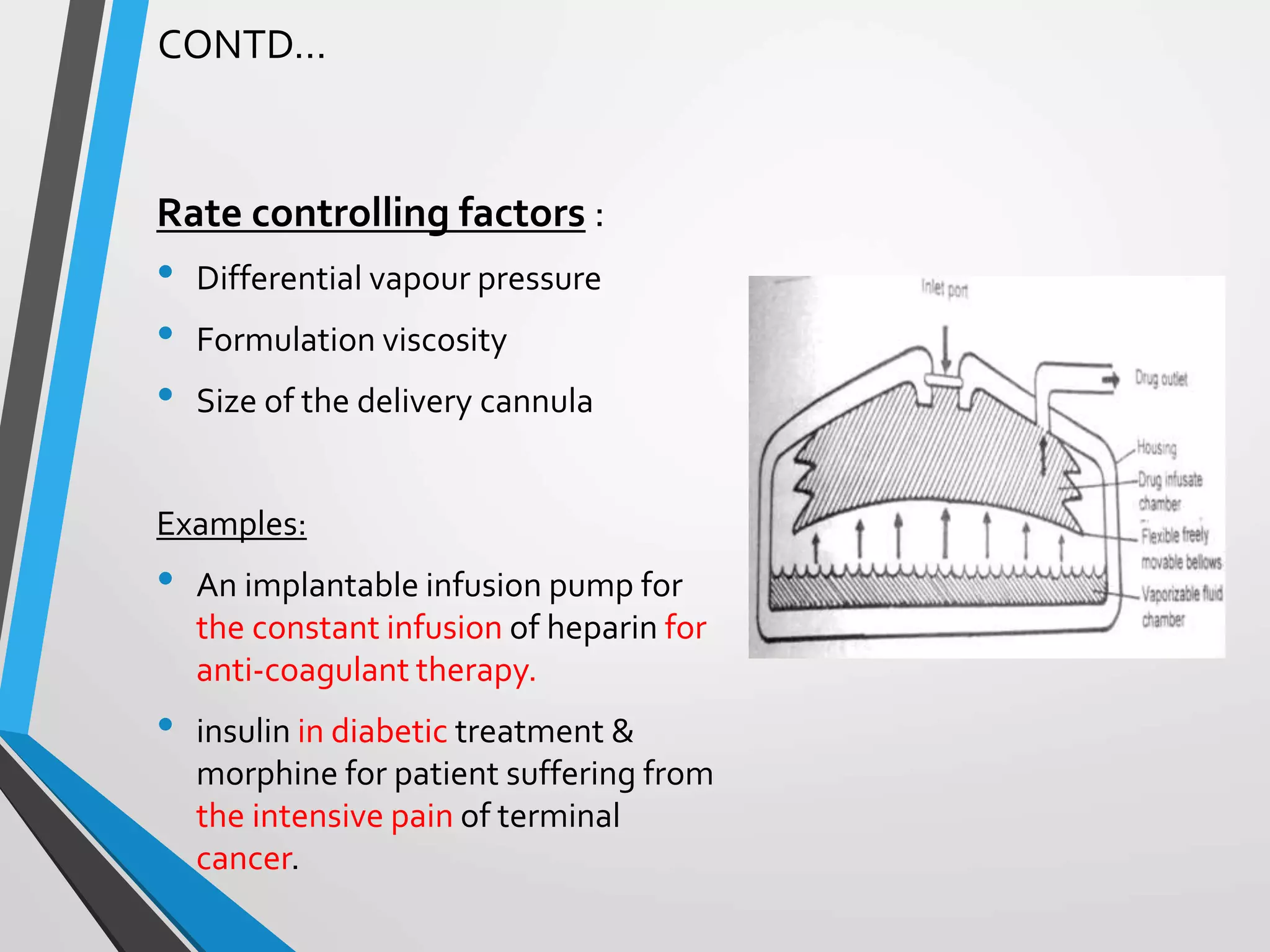
In this type of drug delivery system the drug reservoir, which also
exists as a solution formulation, is contained inside the infusion
compartment. It is physically separated from the pumping
compartment by a freely movable partition .
The rate of drug release is defined by,
Where-
Q/t - rate of drug release
d – inner diameter of cannula
l – length of cannula
(Ps -Pe)- the difference between the vapor pressure in the vapor
chamber & pressure at the implantation site.
µ - viscosity of the drug solution
CONTD…
Rate controlling factors :
• Differential vapour pressure
• Formulation viscosity
• Size of the delivery cannula
Examples:
• An implantable infusion pump for
the constant infusion of heparin for
anti-coagulant therapy.
• insulin in diabetic treatment &
morphine for patient suffering from
the intensive pain of terminal
cancer.
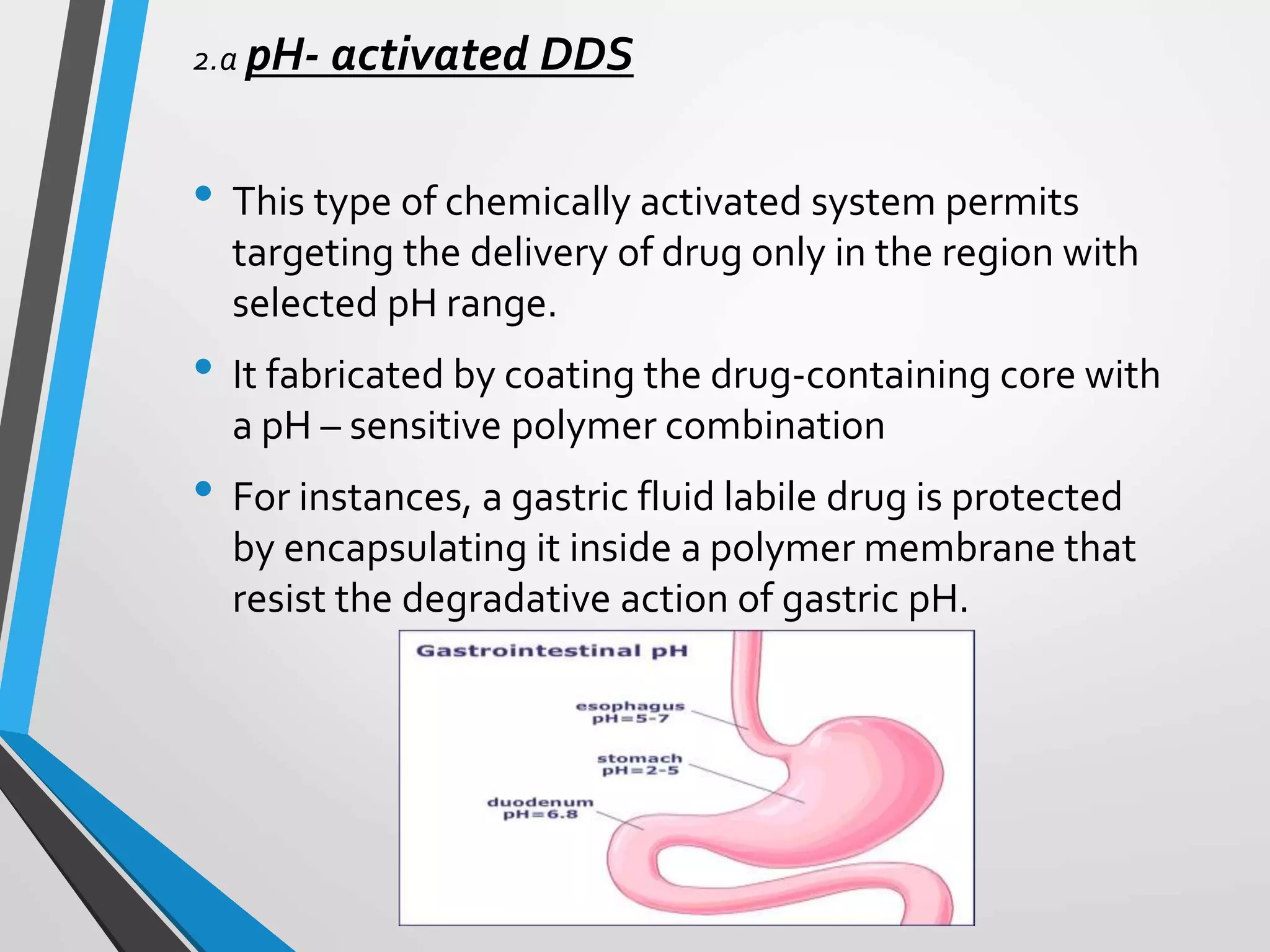
2.a pH- activated DDS
• This type of chemically activated system permits
targeting the delivery of drug only in the region with
selected pH range.
• It fabricated by coating the drug-containing core with
a pH – sensitive polymer combination
• For instances, a gastric fluid labile drug is protected
by encapsulating it inside a polymer membrane that
resist the degradative action of gastric pH.
CONTD…
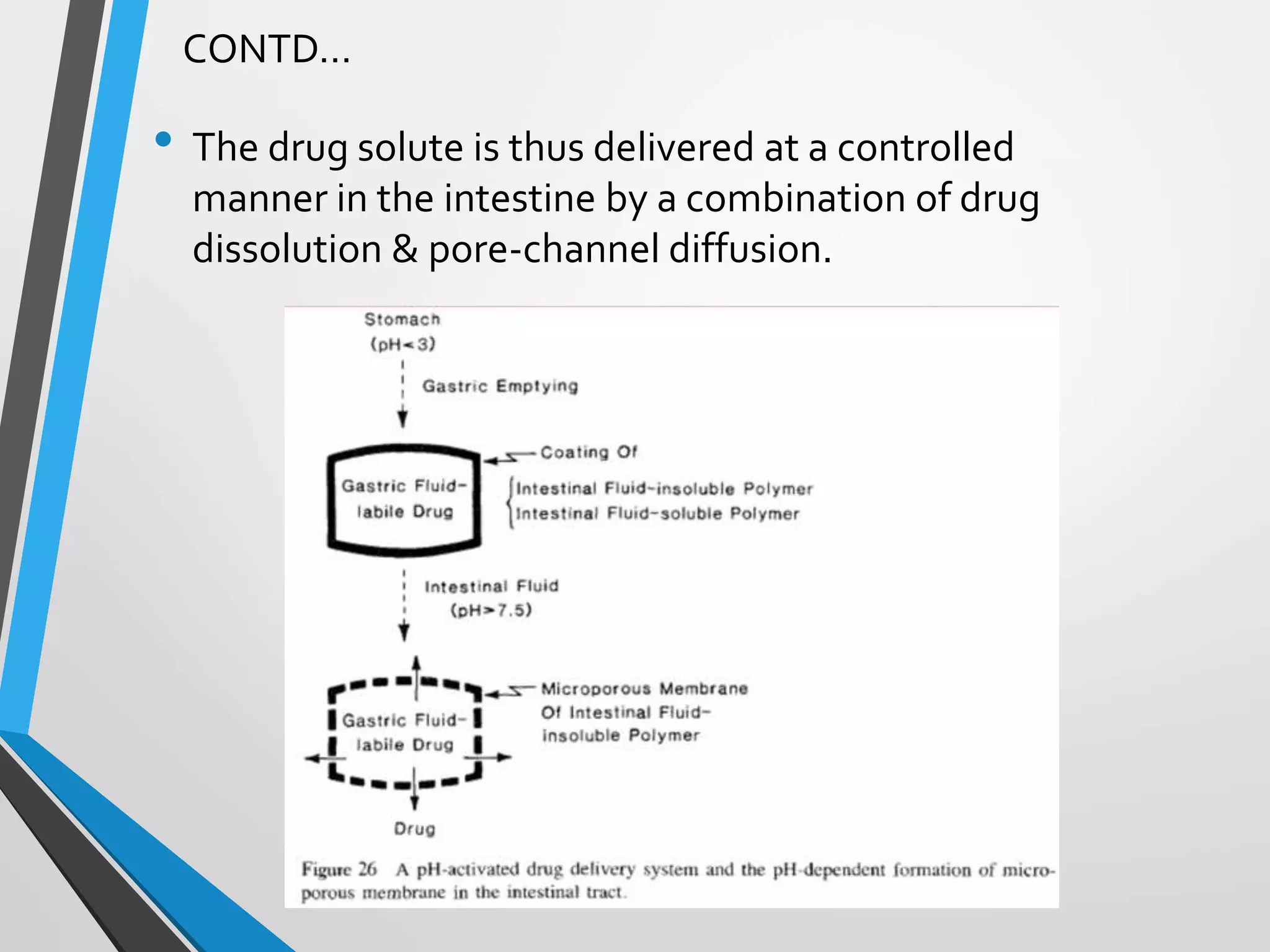
• In the stomach, coating membrane resists the
action of gastric fluid (pH<3) & the drug molecule
thus protected from acid degradation.
• After gastric emptying the DDS travels to the small
intestine & intestinal fluid (pH>7.5) activates the erosion
of the intestinal fluid soluble polymer from the coating
membrane.
• This leaves a micro porous membrane constructed from
the intestinal fluid insoluble polymer, which controls the
release of drug from the core tablet.
CONTD…
• The drug solute is thus delivered at a controlled
manner in the intestine by a combination of drug
dissolution & pore-channel diffusion.
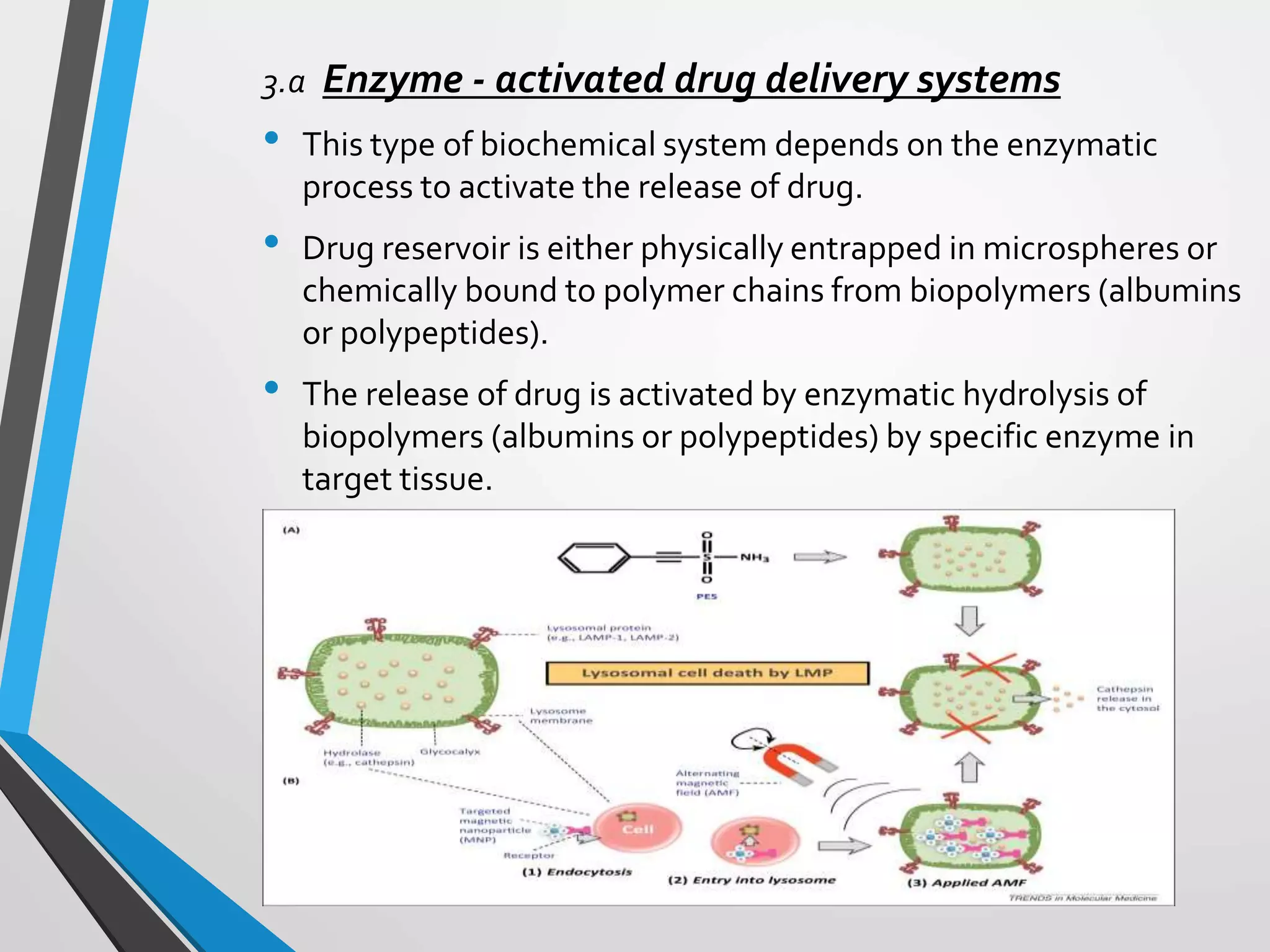
3.a Enzyme - activated drug delivery systems
• This type of biochemical system depends on the enzymatic
process to activate the release of drug.
• Drug reservoir is either physically entrapped in microspheres or
chemically bound to polymer chains from biopolymers (albumins
or polypeptides).
• The release of drug is activated by enzymatic hydrolysis of
biopolymers (albumins or polypeptides) by specific enzyme in
target tissue.
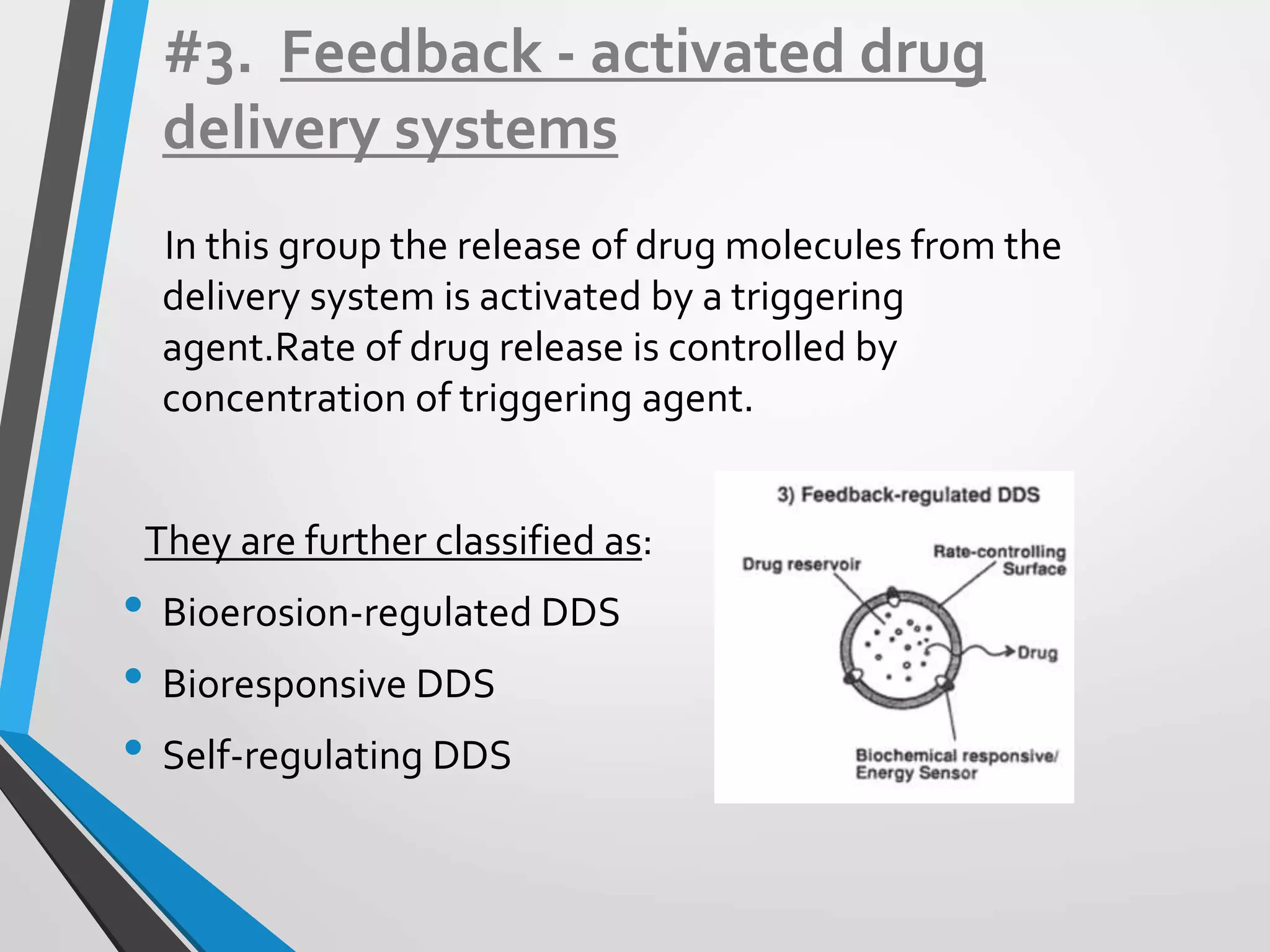
#3. Feedback - activated drug
delivery systems
In this group the release of drug molecules from the
delivery system is activated by a triggering
agent.Rate of drug release is controlled by
concentration of triggering agent.
They are further classified as:
• Bioerosion-regulated DDS
• Bioresponsive DDS
• Self-regulating DDS
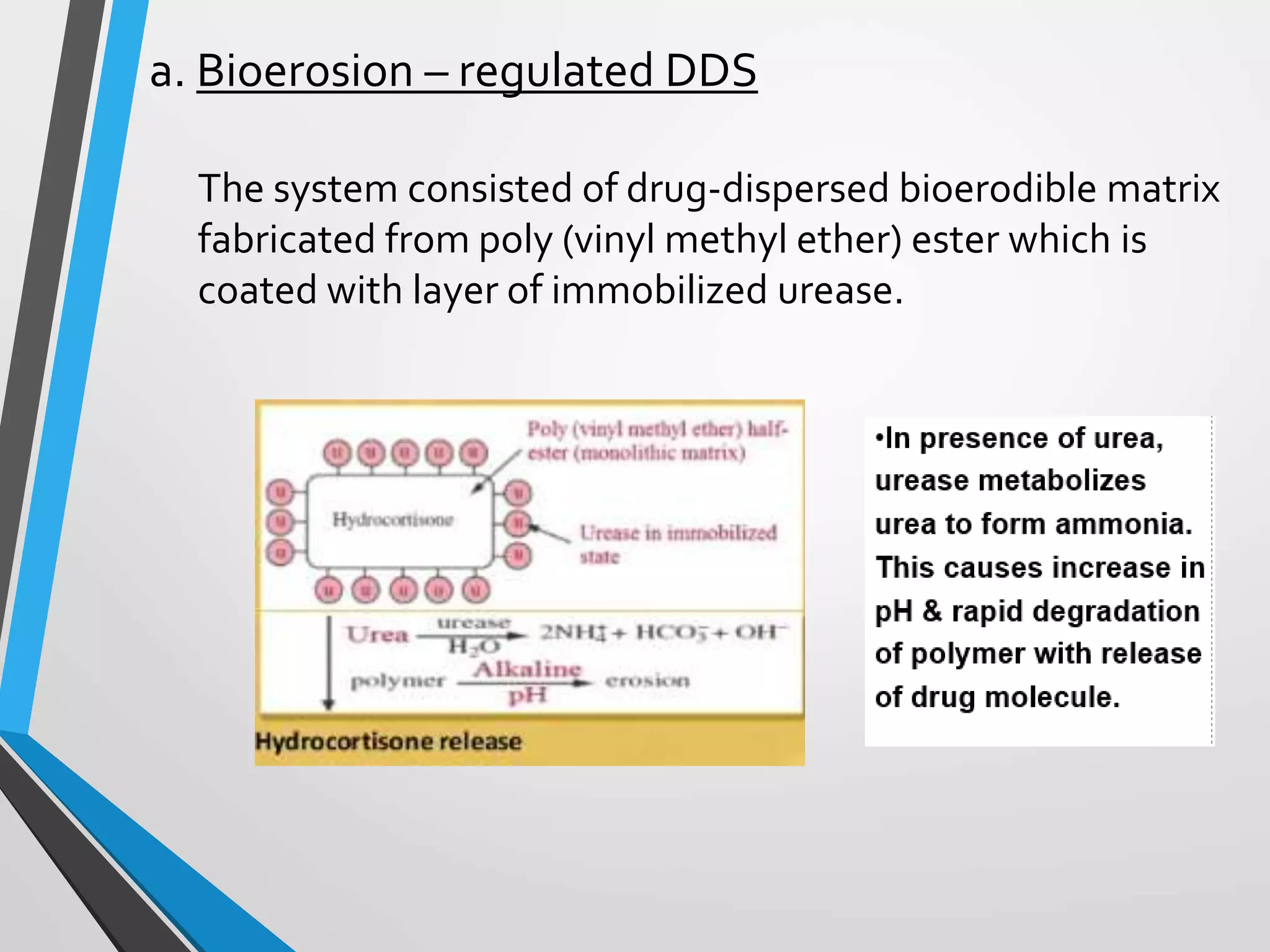
a. Bioerosion – regulated DDS
The system consisted of drug-dispersed bioerodible matrix
fabricated from poly (vinyl methyl ether) ester which is
coated with layer of immobilized urease.
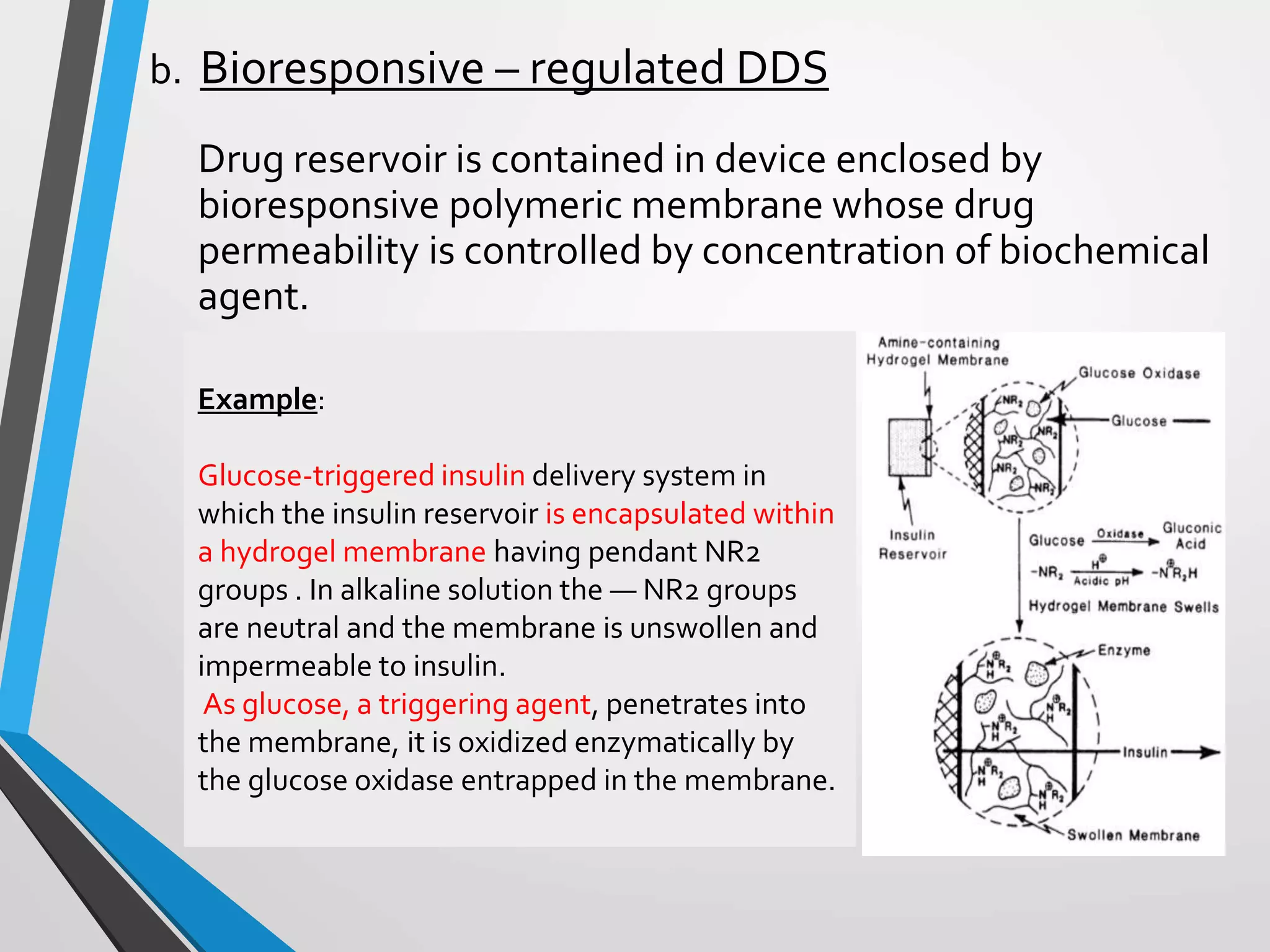
b. Bioresponsive – regulated DDS
Drug reservoir is contained in device enclosed by
bioresponsive polymeric membrane whose drug
permeability is controlled by concentration of biochemical
agent.
Example:
Glucose-triggered insulin delivery system in
which the insulin reservoir is encapsulated within
a hydrogel membrane having pendant NR2
groups . In alkaline solution the — NR2 groups
are neutral and the membrane is unswollen and
impermeable to insulin.
As glucose, a triggering agent, penetrates into
the membrane, it is oxidized enzymatically by
the glucose oxidase entrapped in the membrane.
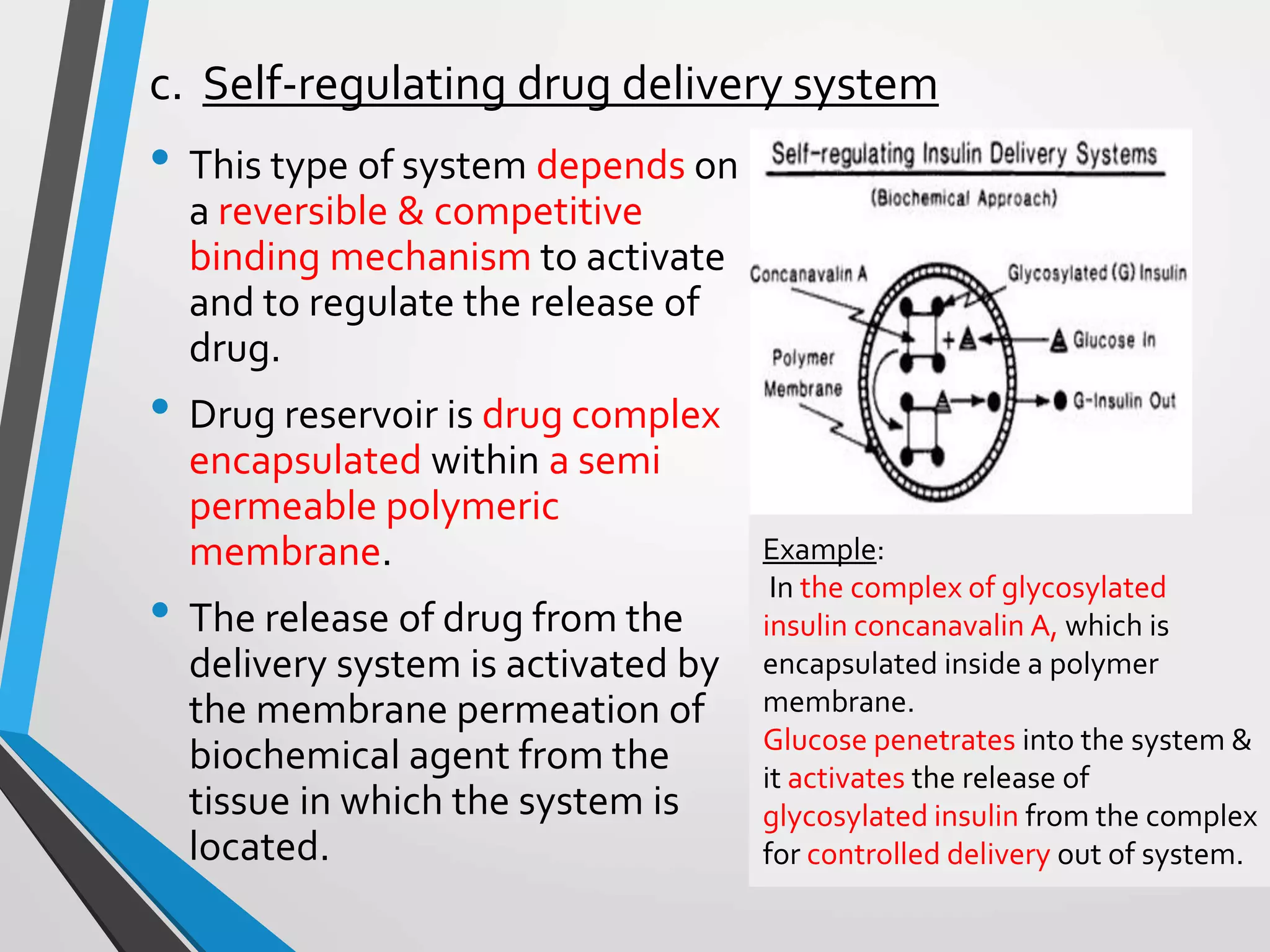
c. Self-regulating drug delivery system
• This type of system depends on
a reversible & competitive
binding mechanism to activate
and to regulate the release of
drug.
• Drug reservoir is drug complex
encapsulated within a semi
permeable polymeric
membrane.
• The release of drug from the
delivery system is activated by
the membrane permeation of
biochemical agent from the
tissue in which the system is
located.
Example:
In the complex of glycosylated
insulin concanavalin A, which is
encapsulated inside a polymer
membrane.
Glucose penetrates into the system &
it activates the release of
glycosylated insulin from the complex
for controlled delivery out of system.
SYSTEM PARAMETER’STHAT EFFECT
CONTROLLED RELEASE DOSAGE FORM
• Polymer solubility
• Solution solubility
• Partition coefficient
• Polymer diffusivity
• Solution diffusivity
• Thickness of polymer diffusional path
• Thickness of hydrodynamic diffusion layer Drug loading
dose
• Surface area
References:
1. Novel drug delivery system- Chien. Pg no. 1-132
2. Biopharmaceutics & pharmacokinetics- Brahmankar. Pg
no. 335 - 370
3. Fundamentals of controlled release drug delivery-
Robinson. Pg no. 482 – 508
Rate controlled drug delivery system

Rate controlled drug delivery system

  • 1.
    Rate controlled drug delivery system Preparedby: PANKAJ Department of pharmaceutics 27/MPH/18
  • 2.
    CONTENTS: Introduction Classification of ratecontrolled DD Systems Rate programmed Drug Delivery System Activation Modulated Drug Delivery System Feedback regulated Drug Delivery System Effect of System Parameters on Controlled Drug Delivery System References
  • 3.
    INTRODUCTION • Sustained release,sustained action, controlled release, extended action, timed release dosage forms are the terms used to identify drug delivery systems that are designed to achieve a prolonged therapeutic effect by continuously releasing medication over an extended period of time after the administration of single dose. • The term “Controlled release” has become associated with those systems from which therapeutic agents may be automatically delivered at predefined rates over a long period of time.
  • 4.
    CONTD… But, there aresome confusion in terminology between “Controlled release” & “Sustained release” Sustained Release The term sustained release has been constantly used to describe a pharmaceutical dosage form formulated to retard the release of a therapeutic agent such that its appearance in the systemic circulation is delayed &/or prolonged & its plasma profile is sustained in duration. Controlled Release It implies a predictability & reproducibility in the drug release kinetics, which means that the release of drug ingredient from a controlled delivery system proceeds at a rate profile that is not only predictable kinetically, but also reproducible from one unit to another.
  • 5.
    An ideal controlleddrug delivery system is the one which delivers the drug at a predetermined rate, locally or systematically for a specified period of time.
  • 6.
    ADVANTAGES 1. Less fluctuationin drug blood levels. 2. Frequency reduction in dosing. 3. Improved patient convenience & compliance. 4. Increased safety margin of the high potency drugs. 5. Reduction in total health care cost. DISADVANTAGES 1. Decreased systemic availability in comparison to immediate release conventional dosage forms. 2. Poor in vivo – in vitro correlation. 3. Possibility of dose dumping. 4. Retrieval of drug is difficult. 5. Higher cost of formulation.
  • 7.
    CLASSIFICATION Based on theirtechnical sophistication : Rate preprogrammed drug delivery system Activation- modulated drug delivery system Feedback- regulated drug delivery system Site targeting drug delivery system TYPES
  • 8.
    #1. Rate preprogrammedDDS In this group , the release of drug molecule from the system has been preprogrammed at specific rate profile. Classification a. Polymer membrane permeation-controlled drug delivery system. b. Polymer matrix diffusion-controlled drug delivery system. c. Microreservior partition-controlled drug delivery system.
  • 9.
    a. Polymer membranepermeation-controlled drug delivery system. • In this type, drug is totally or partially encapsulated within drug reservoir. • Its drug release surface is covered by a rate- controlling polymeric membrane having a specific permeability. • Drug reservoir may exist in solid, suspension or solution form.
  • 10.
    CONTD.. The rate ofdrug release defined by: • Km/r & Ka/m = partition coefficient of the drug molecule from reservoir to rate controlling membrane & from membrane to aq. Layer respectively. • Dd & Dm = diffusion coefficient of rate controlling membrane & aqueous diffusion layer respectively. • hm & hd = thickness of rate controlling membrane & aqueous diffusion layer respectively. • CR – drug conc. In reservoir compartment
  • 11.
    CONTD… Release of drugmolecules is controlled by: • Partition coefficient of the drug molecule. • Diffusivity of the drug molecule. • The thickness of the rate controlling membrane. Example: • Progestasert IUD It is designed to deliver natural progesterone continuously in uterine cavity at a daily dosage rate of at least 65 μg/day to achieve contraception for 1 year. • Transderm-Nitro
  • 12.
    b. Polymer matrixdiffusion-controlled drug delivery • In this type, drug reservoir is prepared by homogeneously dispersing drug particle in rate controlling polymer matrix from either a lipophilic or a hydrophilic polymer. • The drug dispersion in the polymer matrix is accomplished by either, 1. blending therapeutic dose of drug with polymer or highly viscous base polymer, followed by cross linking of polymer chains. 2. mixing drug solid with rubbery polymer at elevated temp.
  • 13.
    CONTD… • The resultantdrug-polymer dispersion is then molded or extruded to form a drug delivery device of various shapes and sizes designed for specific application. • It can also be fabricated by dissolving the drug and the polymer in a common solvent, followed by solvent evaporation at an elevated temperature and/or under a vacuum. • Release of drug molecule is controlled by Loading dose Polymer solubility of drug Drug diffusivity in polymer matrix.
  • 14.
    CONTD... The rate ofthe drug release from this system: Where, - rate of release of drug A – initial drug loading dose in the polymer matrix - drug solubility in polymer Dp- diffusivity of drug in polymer matrix 2 1 t Q RC
  • 15.
    c. MICRORESERVIOR PARTITION-CONTROLLED DRUGDELIVERY SYSTEM • In this type, drug reservoir is fabricated by micro dispersion of an aqueous Suspension of drug in biocompatible polymer to form homogeneous dispersion. • Depending upon the physicochemical properties of drugs & desired rate of drug release, the device can be further coated with a layer of biocompatible polymer to modify the mechanism & the rate of drug release
  • 16.
    CONTD.. The rate ofdrug release is defined by: Where, n = the ratio of drug conc. At the inner edge of the interfacial barrier over the drug solubility in the polymer matrix. m = a/b, a – ratio of drug conc. In the bulk of elution solution over drug solubility in the same medium. b – ratio of drug conc. At the outer edge of the polymer coating membrane over drug solubility in the same polymer. Sl & Sp = solubilities of the drug in the liquid compartments & in the polymer matrix, respectively. Kl, Km & Kp = partition coefficient for the interfacial partitioning of the drug from the liquid compartment to the polymer matrix, from the polymer matrix to the polymer-coating membrane & from the polymer coating membrane to the elution solution respectively.
  • 17.
    CONTD… Release of drugmolecule is controlled by, • Partition coefficient • Diffusivity of drug • Solubility of drug Example: Syncro-Mate – C It is fabricated by dispersing the drug reservoir, which is a suspension of norgestomet in an aqueous solution of PEG 400, in a viscous mixture of silicone elastomer. It is sub-dermal implant releases drug for 18 days.
  • 18.
    #2. Activation modulateddrug delivery systems In this group of controlled release drug delivery system, the release of drug molecules from the delivery system is activated by some physical, chemical, or biochemical process and/or by energy supplied externally.
  • 19.
    CONTD… Based on natureof the process or type of energy used they can be classified into: 1. Physical means a. Osmotic pressure-activated DDS b. Hydrodynamic pressure-activated DDS c.Vapour pressure-activated DDS d.Magnetically activated DDS e. Iontophoresis activated DDS f. Hydration-activated DDS 2. Chemical means a. pH- activated DDS b. Ion- activated DDS c. Hydrolysis- activated DDS
  • 20.
    CONTD… 3. Biochemical means a.Enzyme- activated DDS b. Biochemical- activated DDS 1.a Osmotic pressure- activated drug delivery systems • In this type, drug reservoir can be either solution or solid formulation contained within semi permeable housing with controlled water permeability. • The drug is activated to release in solution form at a constant rate through a special delivery orifice. • The rate of drug release is modulated by controlling the gradient of osmotic pressure.
  • 21.
    CONTD… For the drugdelivery system containing a solution formulation, the intrinsic rate of drug release is defined by, Rate controlling factors : • Water permeability of the semi permeable membrane. • Effective surface area of the semi permeable membrane. • Osmotic pressure difference across the semi permeable membrane.
  • 22.
    CONTD… Example: Alzet Osmotic pump Inthe Alzet osmotic pump the drug reservoir, which is normally a solution formulation, is contained within a collapsible, impermeable polyester bag whose external surface is coated with a layer of osmotically active salt, such as sodium chloride. • This reservoir compartment is then completely sealed inside a rigid housing walled with a semipermeable membrane. • Drug can be delivered at a constant rate for a period of 1-4 week.
  • 23.
    1.b Hydrodynamic pressure-activatedDDS A hydrodynamic pressure-activated drug delivery system can be fabricated by enclosing a collapsible, impermeable container, which contains a liquid drug formulation to form a drug reservoir compartment, inside a rigid shape-retaining housing. Rate of drug release is defined by, Where, Pf = fluid permeability Am = effective Surface area hm = thickness of wall with anular opening (qs - qe) = differential hydrodynamic pressure between the drug delivery system & the environment.
  • 24.
    CONTD… Rate controlling factors: • Fluid permeability. • Effective surface area of the wall with the annular opening. • Hydrodynamic pressure gradient Cross-sectional view of a hydrodynamic pressure CDD
  • 25.
    1.c Vapour pressure-activated drug delivery systems In this type of drug delivery system the drug reservoir, which also exists as a solution formulation, is contained inside the infusion compartment. It is physically separated from the pumping compartment by a freely movable partition . The rate of drug release is defined by, Where- Q/t - rate of drug release d – inner diameter of cannula l – length of cannula (Ps -Pe)- the difference between the vapor pressure in the vapor chamber & pressure at the implantation site. µ - viscosity of the drug solution
  • 26.
    CONTD… Rate controlling factors: • Differential vapour pressure • Formulation viscosity • Size of the delivery cannula Examples: • An implantable infusion pump for the constant infusion of heparin for anti-coagulant therapy. • insulin in diabetic treatment & morphine for patient suffering from the intensive pain of terminal cancer.
  • 27.
    2.a pH- activatedDDS • This type of chemically activated system permits targeting the delivery of drug only in the region with selected pH range. • It fabricated by coating the drug-containing core with a pH – sensitive polymer combination • For instances, a gastric fluid labile drug is protected by encapsulating it inside a polymer membrane that resist the degradative action of gastric pH.
  • 28.
    CONTD… • In thestomach, coating membrane resists the action of gastric fluid (pH<3) & the drug molecule thus protected from acid degradation. • After gastric emptying the DDS travels to the small intestine & intestinal fluid (pH>7.5) activates the erosion of the intestinal fluid soluble polymer from the coating membrane. • This leaves a micro porous membrane constructed from the intestinal fluid insoluble polymer, which controls the release of drug from the core tablet.
  • 29.
    CONTD… • The drugsolute is thus delivered at a controlled manner in the intestine by a combination of drug dissolution & pore-channel diffusion.
  • 30.
    3.a Enzyme -activated drug delivery systems • This type of biochemical system depends on the enzymatic process to activate the release of drug. • Drug reservoir is either physically entrapped in microspheres or chemically bound to polymer chains from biopolymers (albumins or polypeptides). • The release of drug is activated by enzymatic hydrolysis of biopolymers (albumins or polypeptides) by specific enzyme in target tissue.
  • 31.
    #3. Feedback -activated drug delivery systems In this group the release of drug molecules from the delivery system is activated by a triggering agent.Rate of drug release is controlled by concentration of triggering agent. They are further classified as: • Bioerosion-regulated DDS • Bioresponsive DDS • Self-regulating DDS
  • 32.
    a. Bioerosion –regulated DDS The system consisted of drug-dispersed bioerodible matrix fabricated from poly (vinyl methyl ether) ester which is coated with layer of immobilized urease.
  • 33.
    b. Bioresponsive –regulated DDS Drug reservoir is contained in device enclosed by bioresponsive polymeric membrane whose drug permeability is controlled by concentration of biochemical agent. Example: Glucose-triggered insulin delivery system in which the insulin reservoir is encapsulated within a hydrogel membrane having pendant NR2 groups . In alkaline solution the — NR2 groups are neutral and the membrane is unswollen and impermeable to insulin. As glucose, a triggering agent, penetrates into the membrane, it is oxidized enzymatically by the glucose oxidase entrapped in the membrane.
  • 34.
    c. Self-regulating drugdelivery system • This type of system depends on a reversible & competitive binding mechanism to activate and to regulate the release of drug. • Drug reservoir is drug complex encapsulated within a semi permeable polymeric membrane. • The release of drug from the delivery system is activated by the membrane permeation of biochemical agent from the tissue in which the system is located. Example: In the complex of glycosylated insulin concanavalin A, which is encapsulated inside a polymer membrane. Glucose penetrates into the system & it activates the release of glycosylated insulin from the complex for controlled delivery out of system.
  • 35.
    SYSTEM PARAMETER’STHAT EFFECT CONTROLLEDRELEASE DOSAGE FORM • Polymer solubility • Solution solubility • Partition coefficient • Polymer diffusivity • Solution diffusivity • Thickness of polymer diffusional path • Thickness of hydrodynamic diffusion layer Drug loading dose • Surface area
  • 36.
    References: 1. Novel drugdelivery system- Chien. Pg no. 1-132 2. Biopharmaceutics & pharmacokinetics- Brahmankar. Pg no. 335 - 370 3. Fundamentals of controlled release drug delivery- Robinson. Pg no. 482 – 508

Editor's Notes

  • #16 Pankaj
  • #36 Polymer solublity-rate of drug release is directly prop. To magnitude of polymer solublity Solution solublity-Solubilization of poorly soluble drug in aqueous solution can be accomplished by using multiple co-solvent system. Drug release increases with increase in Solution solubility of drug Partition coefficient-Rate of drug release increase with increase in partition coefficient. Polymer diffusivity-The bulkier the functional group attached to polymer chain lower the polymer diffusivity. Solution diffusivity-The diffusivity of the solute molecules in the aqueous solution whose molar volume is equal to or greater than the molar volume of water molecules is inversely proportional to the cube root of their volume. Surface area-Greater the surface area greater will be the rate of drug release.