Controlled Release Oral 
Drug Delivery System 
Bhupendra Kumar Yadav M.Pharm 
University Institute of Pharmacy 
Pt.Ravishankar Shukla University Raipur-492010, Chhattishgarh, India 
E-mail: byadav48@gmail.com
2 
Contents 
 Overview of Digestive system 
 Introduction 
 Advantages 
 Disadvantages 
 Mechanisms 
1.Dissolution 
2.Diffusion 
3.Combination of Dissolution & Diffusion 
4.Osmotic pressure controlled system 
 References
3 
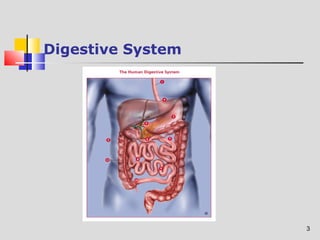
Digestive System
4 
Concept 
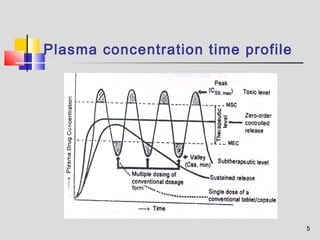
 Controlled drug delivery is one which 
delivers the drug at a predetermined rate, 
for locally or systemically, for a specified 
period of time. 
 Continuous oral delivery of drugs at 
predictable & reproducible kinetics for 
predetermined period throughout the 
course of GIT.
5 
Plasma concentration time profile
6 
Challenges in Oral 
Drug Delivery 
 Development of drug delivery system 
Delivering a drug at therapeutically effective rate to 
desirable site. 
 Modulation of GI transit time 
Transportation of drug to target site. 
 Minimization of first pass elimination
7 
Advantages 
 Total dose is low. 
 Reduced GI side effects. 
 Reduced dosing frequency. 
 Better patient acceptance and compliance. 
 Less fluctuation at plasma drug levels. 
 More uniform drug effect 
 Improved efficacy/safety ratio.
8 
Disadvantages 
 Dose dumping. 
 Reduced potential for accurate dose adjustment. 
 Need of additional patient education. 
 Stability problem.
9 
Mechanism aspects of Oral drug 
delivery formulation 
1.Dissolution : 1.Matrix 
2.Encapsulation 
2.Diffusion : 1.Matrix 
2.Reservoir 
3.Combination of both dissolution & diffusion. 
4.Osmotic pressure controlled system
10 
Dissolution Definition: 
 Solid substances solubilizes in a given 
solvent. 
 Mass transfer from solid to liquid. 
 Rate determining step: Diffusion from solid 
to liquid. 
 Several theories to explain dissolution – 
Diffusion layer theory (imp) 
Surface renewal theory 
Limited solvation theory.
11 
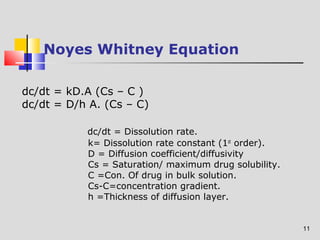
Noyes Whitney Equation 
dc/dt = kD.A (Cs – C ) 
dc/dt = D/h A. (Cs – C) 
dc/dt = Dissolution rate. 
k= Dissolution rate constant (1st order). 
D = Diffusion coefficient/diffusivity 
Cs = Saturation/ maximum drug solubility. 
C =Con. Of drug in bulk solution. 
Cs-C=concentration gradient. 
h =Thickness of diffusion layer.
12 
Matrix Type 
 Also called as Monolith dissolution 
controlled system. 
 Controlled dissolution by: 
1.Altering porosity of tablet. 
2.Decreasing its wettebility. 
3.Dissolving at slower rate. 
 First order drug release. 
 Drug release determined by 
dissolution rate of polymer. 
 Examples: Dimetane extencaps, 
Dimetapp extentabs. 
Soluble drug 
Slowly 
dissolving 
matrix
13 
Encapsulation 
 Called as Coating dissolution 
controlled system. 
 Dissolution rate of coat depends 
upon stability & thickness of 
coating. 
 Masks 
colour,odour,taste,minimising GI 
irritation. 
 One of the microencapsulation 
method is used. 
 Examples: Ornade spansules, 
Chlortrimeton Repetabs 
Soluble drug 
Slowly 
dissolving 
or erodible 
coat
14 
Diffusion 
 Major process for absorption. 
 No energy required. 
 Drug molecules diffuse from a region of higher concentration to 
lower concentration until equilibrium is attainded. 
 Directly proportional to the concentration gradient across the 
membrane.
15 
Matrix Diffusion Types 
 Rigid Matrix Diffusion 
Materials used are insoluble plastics such as PVP & fatty 
acids. 
 Swellable Matrix Diffusion 
1. Also called as Glassy hydrogels.Popular for sustaining 
the release of highly water soluble drugs. 
2. Materials used are hydrophilic gums. 
Examples : Natural- Guar gum,Tragacanth. 
Semisynthetic -HPMC,CMC,Xanthum 
gum. 
Synthetic -Polyacrilamides. 
Examples: Glucotrol XL, Procardia XL
16 
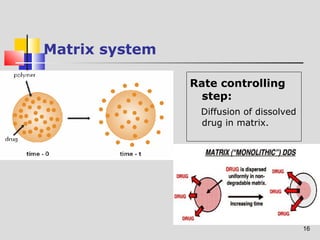
Matrix system 
Rate controlling 
step: 
Diffusion of dissolved 
drug in matrix.
17 
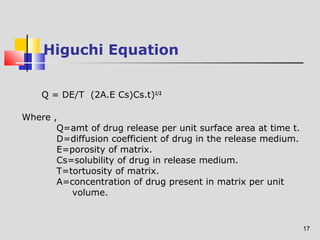
Higuchi Equation 
Q = DE/T (2A.E Cs)Cs.t)1/2 
Where , 
Q=amt of drug release per unit surface area at time t. 
D=diffusion coefficient of drug in the release medium. 
E=porosity of matrix. 
Cs=solubility of drug in release medium. 
T=tortuosity of matrix. 
A=concentration of drug present in matrix per unit 
volume.
18 
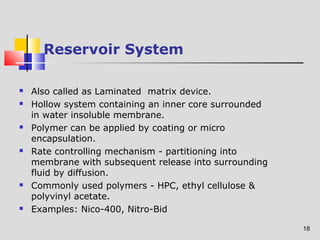
Reservoir System 
 Also called as Laminated matrix device. 
 Hollow system containing an inner core surrounded 
in water insoluble membrane. 
 Polymer can be applied by coating or micro 
encapsulation. 
 Rate controlling mechanism - partitioning into 
membrane with subsequent release into surrounding 
fluid by diffusion. 
 Commonly used polymers - HPC, ethyl cellulose & 
polyvinyl acetate. 
 Examples: Nico-400, Nitro-Bid
19 
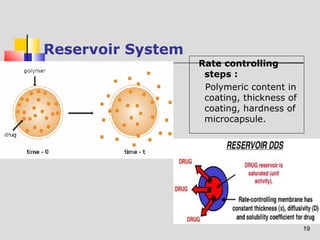
Reservoir System 
Rate controlling 
steps : 
Polymeric content in 
coating, thickness of 
coating, hardness of 
microcapsule.
Entry of 
dissolution 
fluid 
Drug 
diffusion 
20 
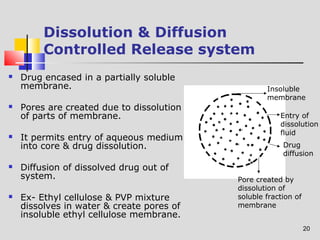
Dissolution & Diffusion 
Controlled Release system 
 Drug encased in a partially soluble 
membrane. 
 Pores are created due to dissolution 
of parts of membrane. 
 It permits entry of aqueous medium 
into core & drug dissolution. 
 Diffusion of dissolved drug out of 
system. 
 Ex- Ethyl cellulose & PVP mixture 
dissolves in water & create pores of 
insoluble ethyl cellulose membrane. 
Insoluble 
membrane 
Pore created by 
dissolution of 
soluble fraction of 
membrane
21 
Osmotic Pressure Controlled 
Drug Delivery System 
 Definition 
 Procedure 
 Diagram 
 Modifications
22 
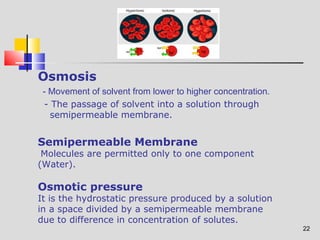
Osmosis 
- Movement of solvent from lower to higher concentration. 
- The passage of solvent into a solution through 
semipermeable membrane. 
Semipermeable Membrane 
Molecules are permitted only to one component 
(Water). 
Osmotic pressure 
It is the hydrostatic pressure produced by a solution 
in a space divided by a semipermeable membrane 
due to difference in concentration of solutes.
23 
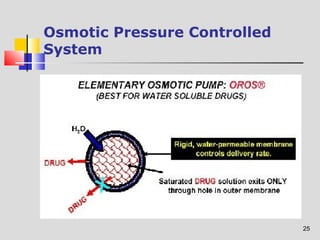
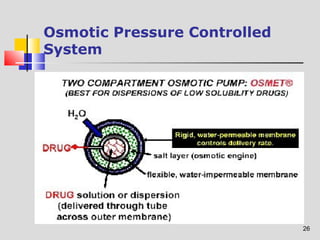
Osmotic Pressure Controlled 
System 
 Provides zero order release 
 Drug may be osmotically active, or combined with an 
osmotically active salt (e.g., NaCl). 
 Semipermeable membrane usually made from cellulose 
acetate. 
 More suitable for hydrophilic drug. 
 Examples: Glucotrol XL, Procardia XL,
24 
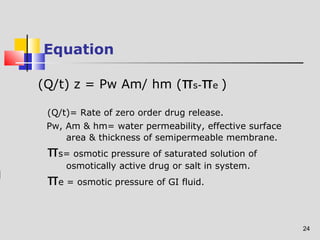
Equation 
(Q/t) z = Pw Am/ hm (πs-πe ) 
(Q/t)= Rate of zero order drug release. 
Pw, Am & hm= water permeability, effective surface 
area & thickness of semipermeable membrane. 
πs= osmotic pressure of saturated solution of 
osmotically active drug or salt in system. 
πe = osmotic pressure of GI fluid.
25 
Osmotic Pressure Controlled 
System
26 
Osmotic Pressure Controlled 
System
Modifications 
- Immediate release system. 
- Osmotically active compartment system
28 
Immediate Release System 
 Activation of system is done. 
 Dividing a dose into two parts. 
 One third immediate release. 
 Two third controlled release. 
 Encapsulated into semipermeable 
membrane. 
e.g. : Phenyl propanolamine.
29 
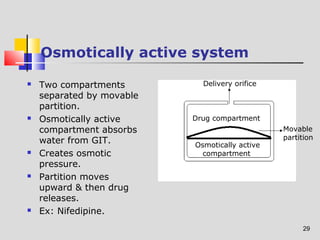
Osmotically active system 
 Two compartments 
separated by movable 
partition. 
 Osmotically active 
compartment absorbs 
water from GIT. 
 Creates osmotic 
pressure. 
 Partition moves 
upward & then drug 
releases. 
 Ex: Nifedipine. 
Movable 
partition 
Delivery orifice 
Drug compartment 
Osmotically active 
compartment
30 
Some Popular Brand names used 
for OCDDS 
 Spansule capsule ( SK & F ) 
 Sequal capsule (Lederle ) 
 Extentab tablets ( Robins ) 
 Timespan tablet ( Roche ) 
 Dospan tablet ( Merrell Dow ) 
 Chronotab tablet ( Schering ) 
 Plateau capsule ( Marion ) 
 Tempule capsule ( Armour )
31 
Some Examples of OCDDS 
 Propranolol (Inderal LA) 
 Methyiphenidate HCl (RitalinSR) 
 Iron (Slow-Fe) 
 GITS-Prazosin (Minipress) 
 Morphine sulfate (Roxanol SR) 
 Decongestant & antihistamine (Resaid SR, Novafed SR 
Dristan) 
 Pseudoephedrine HCI (Sudafed SA) 
 Potassium (Micro-K, Slow-K, Klotrix) 
 Antitussive combinations (Rescap, Ornade Spansules) 
 Chlorpheniramine maleate (ChlorTrimeton) 
 Decongestant, antihistamine and anticholinergic (Dallergy, 
Supres)
32 
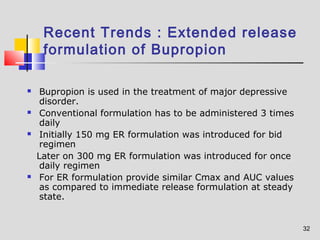
Recent Trends : Extended release 
formulation of Bupropion 
 Bupropion is used in the treatment of major depressive 
disorder. 
 Conventional formulation has to be administered 3 times 
daily 
 Initially 150 mg ER formulation was introduced for bid 
regimen 
Later on 300 mg ER formulation was introduced for once 
daily regimen 
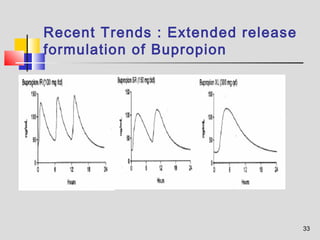
 For ER formulation provide similar Cmax and AUC values 
as compared to immediate release formulation at steady 
state.
33 
Recent Trends : Extended release 
formulation of Bupropion
34 
Recent Trends: OROS Technology 
(ALZA corporation) 
 Single layer tablet: Drug 
core (water soluble drug 
with or without excipients) 
 Semipermeable membrane 
with a drilled orifice 
 Water imbibition by the core 
because of osmotic action 
results in drug dissolution, 
which is released at a 
controlled rate through the 
orifice 
ELEMENTARY OSMOTIC PUMP 
 Not suitable for water insoluble drugs. 
 Examples: Sudafed 24 
hours (Pseudoephedrine); Volmax (Salbutamol)
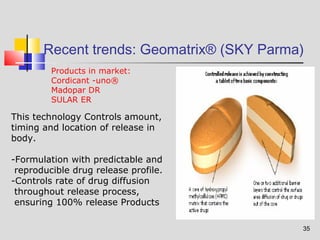
Recent trends: Geomatrix® (SKY Parma) 
35 
Products in market: 
Cordicant -uno® 
Madopar DR 
SULAR ER 
This technology Controls amount, 
timing and location of release in 
body. 
-Formulation with predictable and 
reproducible drug release profile. 
-Controls rate of drug diffusion 
throughout release process, 
ensuring 100% release Products
36 
References 
 Novel drug delivery system , volume 50, 
Y.W.Chien 
 The theory & practice of industrial pharmacy, 
Leon Lachman , Herbert A.Lieberman, 
Joseph L.Kanig,3 rd edition. 
 The Eastern pharmacist, november 1993. 
Sustained release drugs, V R.Gudsoorkar & D.Rambhau 
page 27-32 
 Biopharmaceuitics & pharmacokinetics, 
D M.Brahmankar & Sunil B. Jaiswal. 
www.google.com
37 
Thank you for paying 
attention… 
If this presentation was 
useful to u, then please 
click like button