COMPACTION PROFILES
 Siddu K M
 M Pharm 1st year
 Department of Pharmaceutics
 Al-Ameen college of Pharmacy
Definition
› Compaction profiles are hysteresis curves that establish
the relationship between axial pressure and radial
pressure.
› In the compaction cycle, two forces are considered
1. Axial force: This vertical component is applied by the upper
punch during compression.
2. Radial pressure: This is the horizontal component observed in
the die wall, when the powder mass attempt to expand in the
die.
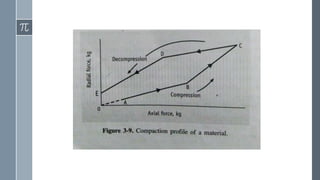
› Compression Phase:
 OA - Represents repacking of granules or powders.
 AB - Represents elastic deformation which continues up to B
(elastic limit)
 BC - Represents plastic deformation and brittle fracture. Point C
indicates the maximum compression force.
› Decompression phase:
 CD - Represents elastic recovery on the removal of applied
force.
 DE - Represents recovery from plastic deformation
 E - Represents residual force, which holds the compact in the
sides of the die.
 Ejection force must be greater than residual force.
How they are measured?
› It is analysed by compaction simulators, these are
attached to punching machines which collect or measure
the data from forces on punches, displacement of
punches, die wall friction, ejection force and temperature
change.
› Types of compaction profiles
» Force-time profile
» Force-displacement profile
» Die wall force profile
 Force-Time profile
Compression force-time profiles are used to characterise
the compression behaviour of the active ingredients,
excipients and formulations with respect to their plastic
and elastic deformation.
a) Compression phase
b) Dwell phase
c) Decompression/relaxation phase
(a). Compression phase [horizontal and vertical punch movement]
(b). Dwell time [plane punch head area is under compression roller]
(c). Decompression phase [both punches move away from upper & lower
surfaces]
a. Compression phase:
Compression is the process in which maximum force is applied on
powdered bed in order to reduce its volume.
b. Dwell phase:
When compression force reaches a maximum value, this maximum
force is maintained for prolonged period before decompression.
The time period b/w the compression phase and decompression
phase is known as dwell time.
c. Decompression phase:
Removal of applied force on powder bed i.e, both punches moving
away from upper and lower surfaces.
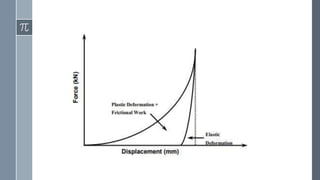
 Force-Displacement profile
• Assessment of the compaction behaviour of materials is
done by force-displacement profile.
• Force-displacement profile can be used to determine the
behaviour of plastic and elastic materials.
• Stress relaxation is observed to be minimal in case of
plastic deformation; where as materials that undergoes
elastic deformation tend to relax to a greater extent
during and/or after compression.
• At a given fmax the displacement area of plastic
deformation is more when compared to the displacement
area of elastic deformation.
 Die wall force profile
• During tableting, friction arises b/w the material and the
die wall which is called Die wall force friction.
• The die wall force reaches maximum just after the
maximum upper and lower force, and a constant residual
value after upper and lower forces become zero.
• The high die wall force during ejection is a sign of
adhesion of powders to the die.
Applications
These can be used to monitor compaction cycle.
Compaction profiles give a good assessment of the
elastic component of the powder.
Provides information regarding the radial transmission of
applied force to the die wall.
Helps in calculating possible ejection force and lubricant
requirements.
Compaction profiles

Compaction profiles

  • 1.
    COMPACTION PROFILES  SidduK M  M Pharm 1st year  Department of Pharmaceutics  Al-Ameen college of Pharmacy
  • 2.
    Definition › Compaction profilesare hysteresis curves that establish the relationship between axial pressure and radial pressure. › In the compaction cycle, two forces are considered 1. Axial force: This vertical component is applied by the upper punch during compression. 2. Radial pressure: This is the horizontal component observed in the die wall, when the powder mass attempt to expand in the die.
  • 4.
    › Compression Phase: OA - Represents repacking of granules or powders.  AB - Represents elastic deformation which continues up to B (elastic limit)  BC - Represents plastic deformation and brittle fracture. Point C indicates the maximum compression force. › Decompression phase:  CD - Represents elastic recovery on the removal of applied force.  DE - Represents recovery from plastic deformation  E - Represents residual force, which holds the compact in the sides of the die.  Ejection force must be greater than residual force.
  • 5.
    How they aremeasured? › It is analysed by compaction simulators, these are attached to punching machines which collect or measure the data from forces on punches, displacement of punches, die wall friction, ejection force and temperature change. › Types of compaction profiles » Force-time profile » Force-displacement profile » Die wall force profile
  • 6.
     Force-Time profile Compressionforce-time profiles are used to characterise the compression behaviour of the active ingredients, excipients and formulations with respect to their plastic and elastic deformation. a) Compression phase b) Dwell phase c) Decompression/relaxation phase
  • 7.
    (a). Compression phase[horizontal and vertical punch movement] (b). Dwell time [plane punch head area is under compression roller] (c). Decompression phase [both punches move away from upper & lower surfaces]
  • 8.
    a. Compression phase: Compressionis the process in which maximum force is applied on powdered bed in order to reduce its volume. b. Dwell phase: When compression force reaches a maximum value, this maximum force is maintained for prolonged period before decompression. The time period b/w the compression phase and decompression phase is known as dwell time. c. Decompression phase: Removal of applied force on powder bed i.e, both punches moving away from upper and lower surfaces.
  • 9.
     Force-Displacement profile •Assessment of the compaction behaviour of materials is done by force-displacement profile. • Force-displacement profile can be used to determine the behaviour of plastic and elastic materials. • Stress relaxation is observed to be minimal in case of plastic deformation; where as materials that undergoes elastic deformation tend to relax to a greater extent during and/or after compression. • At a given fmax the displacement area of plastic deformation is more when compared to the displacement area of elastic deformation.
  • 11.
     Die wallforce profile • During tableting, friction arises b/w the material and the die wall which is called Die wall force friction. • The die wall force reaches maximum just after the maximum upper and lower force, and a constant residual value after upper and lower forces become zero. • The high die wall force during ejection is a sign of adhesion of powders to the die.
  • 12.
    Applications These can beused to monitor compaction cycle. Compaction profiles give a good assessment of the elastic component of the powder. Provides information regarding the radial transmission of applied force to the die wall. Helps in calculating possible ejection force and lubricant requirements.

Editor's Notes

  • #6 Compaction simulators are designed to mimic the exact cycle of any tableting process and to record all important parameter during the cycle. These are used in force and time, force displacement studies.