Damped Oscillations
™  Typically, when something is oscillating, there is an
opposing force (friction or drag) acting on the
oscillation and causing it to slow down and come to a
stop.
™  If you were to swing a ball attached to the end of a
string hanging on the ceiling, you would eventually see
that it comes to a stop. This is called damping!
Equations
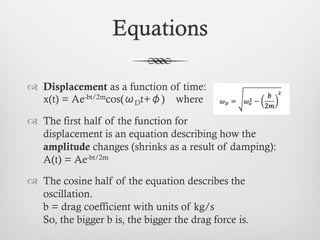
™  Displacement as a function of time:
x(t) = Ae-bt/2mcos(ωDt+φ) where
™  The first half of the function for
displacement is an equation describing how the
amplitude changes (shrinks as a result of damping):
A(t) = Ae-bt/2m
™  The cosine half of the equation describes the
oscillation.
b = drag coefficient with units of kg/s
So, the bigger b is, the bigger the drag force is.
Frequency
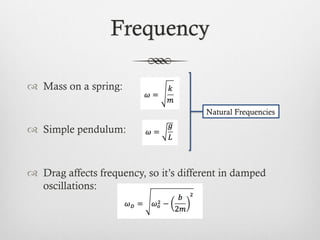
™  Mass on a spring:
™  Simple pendulum:
™  Drag affects frequency, so it’s different in damped
oscillations:
Natural Frequencies
Frequency of Damped
Oscillations
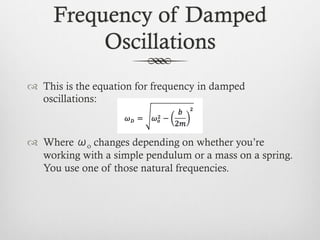
™  This is the equation for frequency in damped
oscillations:
™  Where ωo changes depending on whether you’re
working with a simple pendulum or a mass on a spring.
You use one of those natural frequencies.
Question
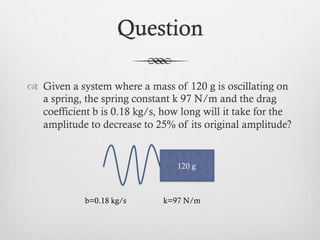
™  Given a system where a mass of 120 g is oscillating on
a spring, the spring constant k 97 N/m and the drag
coefficient b is 0.18 kg/s, how long will it take for the
amplitude to decrease to 25% of its original amplitude?
120 g
b=0.18 kg/s k=97 N/m
Solution
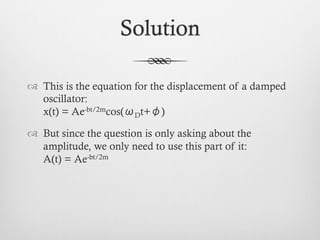
™  This is the equation for the displacement of a damped
oscillator:
x(t) = Ae-bt/2mcos(ωDt+φ)
™  But since the question is only asking about the
amplitude, we only need to use this part of it:
A(t) = Ae-bt/2m
Solution (cont’d)
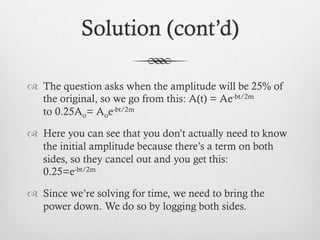
™  The question asks when the amplitude will be 25% of
the original, so we go from this: A(t) = Ae-bt/2m
to 0.25Ao= Aoe-bt/2m
™  Here you can see that you don’t actually need to know
the initial amplitude because there’s a term on both
sides, so they cancel out and you get this:
0.25=e-bt/2m
™  Since we’re solving for time, we need to bring the
power down. We do so by logging both sides.
Solution (cont’d)
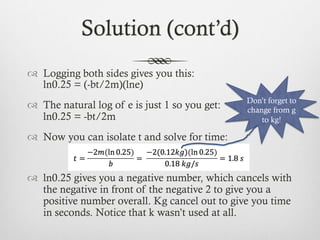
™  Logging both sides gives you this:
ln0.25 = (-bt/2m)(lne)
™  The natural log of e is just 1 so you get:
ln0.25 = -bt/2m
™  Now you can isolate t and solve for time:
™  ln0.25 gives you a negative number, which cancels with
the negative in front of the negative 2 to give you a
positive number overall. Kg cancel out to give you time
in seconds. Notice that k wasn’t used at all.
Don’t forget to
change from g
to kg!

Damped Oscillations

  • 2.
    Damped Oscillations ™  Typically,when something is oscillating, there is an opposing force (friction or drag) acting on the oscillation and causing it to slow down and come to a stop. ™  If you were to swing a ball attached to the end of a string hanging on the ceiling, you would eventually see that it comes to a stop. This is called damping!
  • 3.
    Equations ™  Displacement asa function of time: x(t) = Ae-bt/2mcos(ωDt+φ) where ™  The first half of the function for displacement is an equation describing how the amplitude changes (shrinks as a result of damping): A(t) = Ae-bt/2m ™  The cosine half of the equation describes the oscillation. b = drag coefficient with units of kg/s So, the bigger b is, the bigger the drag force is.
  • 4.
    Frequency ™  Mass ona spring: ™  Simple pendulum: ™  Drag affects frequency, so it’s different in damped oscillations: Natural Frequencies
  • 5.
    Frequency of Damped Oscillations ™ This is the equation for frequency in damped oscillations: ™  Where ωo changes depending on whether you’re working with a simple pendulum or a mass on a spring. You use one of those natural frequencies.
  • 6.
    Question ™  Given asystem where a mass of 120 g is oscillating on a spring, the spring constant k 97 N/m and the drag coefficient b is 0.18 kg/s, how long will it take for the amplitude to decrease to 25% of its original amplitude? 120 g b=0.18 kg/s k=97 N/m
  • 7.
    Solution ™  This isthe equation for the displacement of a damped oscillator: x(t) = Ae-bt/2mcos(ωDt+φ) ™  But since the question is only asking about the amplitude, we only need to use this part of it: A(t) = Ae-bt/2m
  • 8.
    Solution (cont’d) ™  Thequestion asks when the amplitude will be 25% of the original, so we go from this: A(t) = Ae-bt/2m to 0.25Ao= Aoe-bt/2m ™  Here you can see that you don’t actually need to know the initial amplitude because there’s a term on both sides, so they cancel out and you get this: 0.25=e-bt/2m ™  Since we’re solving for time, we need to bring the power down. We do so by logging both sides.
  • 9.
    Solution (cont’d) ™  Loggingboth sides gives you this: ln0.25 = (-bt/2m)(lne) ™  The natural log of e is just 1 so you get: ln0.25 = -bt/2m ™  Now you can isolate t and solve for time: ™  ln0.25 gives you a negative number, which cancels with the negative in front of the negative 2 to give you a positive number overall. Kg cancel out to give you time in seconds. Notice that k wasn’t used at all. Don’t forget to change from g to kg!