ENGAGE YOURSELF
IN EDUCATIONAL
TECHNOLOGY 2 2
CLARISSA D. DASIG
I’m Clarissa Dasig, im glad that I’ve learned so much on technology I just
remember a long ago I get scared and afraid when my Teacher in T.L.E required us to
use computer one by one. Because I grow up in province I didn’t have an idea about
technology I can’t imagine myself facing on computer everytime I tried to use it I feel
nervous and I don’t know what to do.
As time passing by I get to know it I just try to engage myself in technology even
I’d feeling nervous sometimes my cousin teach me the functions of those
software and after a long adjustment, finally I knew it I found it more useful
when I need to know something and I can now used it everytime without any
worries.
o 19 years old
o Panginay, Balagtas, Bulacan
o Currently taking the course of bachelor of Secondary Education major in
Filipino
o You can call me “Lea”
o Im a big fan of Kathryn Bernardo since first year high school.
OVERVIEW OF EDUCATIONAL TECHNOLOGY 2
EDCATIONAL TECHNOLOGY OBJECTIVES
to improve education in the use of technology in instruction by
providing knowledge and skills on technology.
to impart learning experiences in instructional technology supported
instructional planning.
to acquaint students on Information Technology IT-related learning
theories.
to learn to use and evaluate computer based educational
resources.
to engage learners on practical technology integration
issues including use of internet for learning.
 to cultivate higher level thinking and creativity among
students.
Eucational Technology 2
The Educational 2 aims:
To infuse technology in the students-
teacher training.
Helping to meet communication
technology.
Adapt to rapid and continuing
technological changes
EDUCATIONAL TECHNOLOGY 2
o Involve a deeper understanding of the
computer as well as hands-on application
of computer skills and focused on
intoducing,
reinforcing,supplementing,and extending
the knowledge and skills of the learners.
Undestanding Technology Learners
 Today learners appear smarter.
 The concern of the student is valid, wherein the teacher uses the
traditional educational program
 The new learners spend much time talking with friends by
means of social medias.
Bridging the generation Gap
• 21st Century learners require activities
that move beyond the traditional
teacher-centered transmission model of
education
• When discussing adult education in the
21st Century it may be better to consider
it as an age of the “relationship
revolution”, as opposed to the widely
held notion of the “information
revolution” (Schrage, 2001, p. 1).
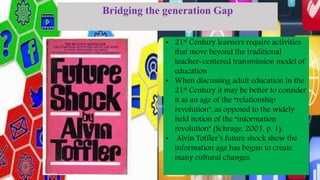
• Alvin Toffler’s future shock show the
information age has begun to create
many cultural changes.
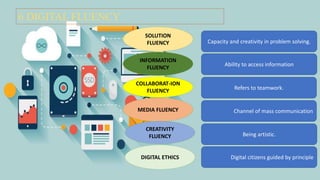
6 DIGITAL FLUENCY
SOLUTION
FLUENCY
INFORMATION
FLUENCY
COLLABORAT-ION
FLUENCY
MEDIA FLUENCY
CREATIVITY
FLUENCY
DIGITAL ETHICS
Capacity and creativity in problem solving.
Ability to access information
Digital citizens guided by principle
Being artistic.
Refers to teamwork.
Channel of mass communication
The role of
Online
The role of Technology in developing Higher Thinking Skills
Online instructors can use technology tools to create activities that help students develop
both lower-level and higher-level critical thinking skills.
Reflection activities. Reflection activities provide students with opportunities to track
their learning and demonstrate their progress throughout the semester.
Peer review activities. Peer review activities enable students to demonstrate
communication skills by giving feedback on each other’s work.
 Discussion forums. Discussion forums allow students to communicate with their peers,
answer questions that require them to demonstrate both lower-level and higher-level
critical thinking skills.
Small group activities. Small group activities allow students to
communicate, problem solve, hear different perspectives, and
collaborate to analyze and synthesize course content. By assigning small
group activities, instructors can engage students in multiple levels of
critical thinking.
 Digital Storytelling Activities. Telling digital stories allows students to
use multimedia.
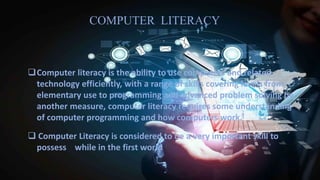
COMPUTER LITERACY
Computer literacy is the ability to use computers and related
technology efficiently, with a range of skills covering levels from
elementary use to programming and advanced problem solving by
another measure, computer literacy requires some understanding
of computer programming and how computers work.[
 Computer Literacy is considered to be a very important skill to
possess while in the first world
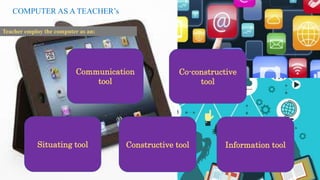
• TOOL
COMPUTER AS A TEACHER’s
Teacher employ the computer as an:
Information toolConstructive toolSituating tool
Communication
tool
Co-constructive
tool
THE IMPACT OF TECHNOLOGY TO
TEACHING LEARNING PROCESS
Educational technology covers two aspect in teaching learning process
i.e. technology as a things and technology as a social process
Students have other sources of information from computers than
textbooks.
Average students using technology to learn can get higher score compared
to those who are not using computers.
WHAT I LEARNED IN EDUCATIONAL TECHNOLOGY 2
Educational Technology 2 has a big part in human
lives it give us ideas onto something we wanted to
know and bring a different insight on how we can
improve our knowledge and skills using the technology
and I’ve learn that discovering the importance of
technology will help me to be more productive since I
will be a future educator.

Edtech dasig-clarissa

  • 1.
  • 2.
    CLARISSA D. DASIG I’mClarissa Dasig, im glad that I’ve learned so much on technology I just remember a long ago I get scared and afraid when my Teacher in T.L.E required us to use computer one by one. Because I grow up in province I didn’t have an idea about technology I can’t imagine myself facing on computer everytime I tried to use it I feel nervous and I don’t know what to do. As time passing by I get to know it I just try to engage myself in technology even I’d feeling nervous sometimes my cousin teach me the functions of those software and after a long adjustment, finally I knew it I found it more useful when I need to know something and I can now used it everytime without any worries.
  • 3.
    o 19 yearsold o Panginay, Balagtas, Bulacan o Currently taking the course of bachelor of Secondary Education major in Filipino o You can call me “Lea” o Im a big fan of Kathryn Bernardo since first year high school.
  • 4.
    OVERVIEW OF EDUCATIONALTECHNOLOGY 2 EDCATIONAL TECHNOLOGY OBJECTIVES to improve education in the use of technology in instruction by providing knowledge and skills on technology. to impart learning experiences in instructional technology supported instructional planning. to acquaint students on Information Technology IT-related learning theories.
  • 5.
    to learn touse and evaluate computer based educational resources. to engage learners on practical technology integration issues including use of internet for learning.  to cultivate higher level thinking and creativity among students.
  • 6.
    Eucational Technology 2 TheEducational 2 aims: To infuse technology in the students- teacher training. Helping to meet communication technology. Adapt to rapid and continuing technological changes
  • 7.
    EDUCATIONAL TECHNOLOGY 2 oInvolve a deeper understanding of the computer as well as hands-on application of computer skills and focused on intoducing, reinforcing,supplementing,and extending the knowledge and skills of the learners.
  • 8.
    Undestanding Technology Learners Today learners appear smarter.  The concern of the student is valid, wherein the teacher uses the traditional educational program  The new learners spend much time talking with friends by means of social medias.
  • 9.
    Bridging the generationGap • 21st Century learners require activities that move beyond the traditional teacher-centered transmission model of education • When discussing adult education in the 21st Century it may be better to consider it as an age of the “relationship revolution”, as opposed to the widely held notion of the “information revolution” (Schrage, 2001, p. 1). • Alvin Toffler’s future shock show the information age has begun to create many cultural changes.
  • 10.
    6 DIGITAL FLUENCY SOLUTION FLUENCY INFORMATION FLUENCY COLLABORAT-ION FLUENCY MEDIAFLUENCY CREATIVITY FLUENCY DIGITAL ETHICS Capacity and creativity in problem solving. Ability to access information Digital citizens guided by principle Being artistic. Refers to teamwork. Channel of mass communication
  • 11.
    The role of Online Therole of Technology in developing Higher Thinking Skills Online instructors can use technology tools to create activities that help students develop both lower-level and higher-level critical thinking skills. Reflection activities. Reflection activities provide students with opportunities to track their learning and demonstrate their progress throughout the semester. Peer review activities. Peer review activities enable students to demonstrate communication skills by giving feedback on each other’s work.  Discussion forums. Discussion forums allow students to communicate with their peers, answer questions that require them to demonstrate both lower-level and higher-level critical thinking skills.
  • 12.
    Small group activities.Small group activities allow students to communicate, problem solve, hear different perspectives, and collaborate to analyze and synthesize course content. By assigning small group activities, instructors can engage students in multiple levels of critical thinking.  Digital Storytelling Activities. Telling digital stories allows students to use multimedia.
  • 13.
    COMPUTER LITERACY Computer literacyis the ability to use computers and related technology efficiently, with a range of skills covering levels from elementary use to programming and advanced problem solving by another measure, computer literacy requires some understanding of computer programming and how computers work.[  Computer Literacy is considered to be a very important skill to possess while in the first world
  • 14.
    • TOOL COMPUTER ASA TEACHER’s Teacher employ the computer as an: Information toolConstructive toolSituating tool Communication tool Co-constructive tool
  • 15.
    THE IMPACT OFTECHNOLOGY TO TEACHING LEARNING PROCESS Educational technology covers two aspect in teaching learning process i.e. technology as a things and technology as a social process Students have other sources of information from computers than textbooks. Average students using technology to learn can get higher score compared to those who are not using computers.
  • 16.
    WHAT I LEARNEDIN EDUCATIONAL TECHNOLOGY 2 Educational Technology 2 has a big part in human lives it give us ideas onto something we wanted to know and bring a different insight on how we can improve our knowledge and skills using the technology and I’ve learn that discovering the importance of technology will help me to be more productive since I will be a future educator.