A Very Short
Introduction to
Educational Technology
Mike Sharples
Institute of Educational Technology, The Open University
Definitions
Pedagogy
“The theory and practice of teaching, learning and assessment”
Sharples, M., McAndrew, P., Weller, M., Ferguson, R., FitzGerald, E., Hirst, T., Mor, Y., Gaved, M. and
Whitelock, D. (2012). Innovating Pedagogy 2012: Open University Innovation Report 1. Milton Keynes:
The Open University.
Educational technology
Interactive technology to enable effective learning (may include fixed,
desktop, mobile and wearable devices and their software - and
combinations of these)
Technology Enhanced Learning
Learning supported by individual or multiple technologies. In Europe, now
used in preference to e-learning, or computer-assisted learning
Contents
A short history of educational technology
Theories of learning with technologies
Evaluation of learning with technologies
3
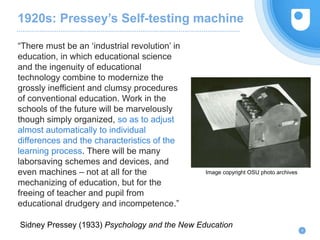
1920s: Pressey’s Self-testing machine
4
Image copyright OSU photo archives
“There must be an ‘industrial revolution’ in
education, in which educational science
and the ingenuity of educational
technology combine to modernize the
grossly inefficient and clumsy procedures
of conventional education. Work in the
schools of the future will be marvelously
though simply organized, so as to adjust
almost automatically to individual
differences and the characteristics of the
learning process. There will be many
laborsaving schemes and devices, and
even machines – not at all for the
mechanizing of education, but for the
freeing of teacher and pupil from
educational drudgery and incompetence.”
Sidney Pressey (1933) Psychology and the New Education
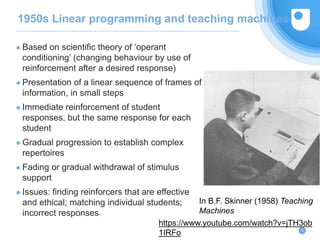
1950s Linear programming and teaching machines
● Based on scientific theory of ‘operant
conditioning’ (changing behaviour by use of
reinforcement after a desired response)
● Presentation of a linear sequence of frames of
information, in small steps
● Immediate reinforcement of student
responses, but the same response for each
student
● Gradual progression to establish complex
repertoires
● Fading or gradual withdrawal of stimulus
support
● Issues: finding reinforcers that are effective
and ethical; matching individual students;
incorrect responses
5
In B.F. Skinner (1958) Teaching
Machines
https://www.youtube.com/watch?v=jTH3ob
1IRFo
Emerging themes
● Educational technology
● Self-paced learning
● Interactive learning
● Learning design
● Formative assessment
● Motivation for learning
6
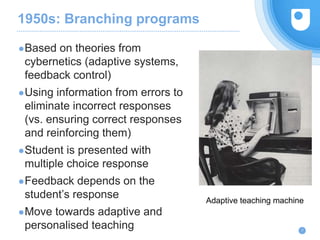
1950s: Branching programs
●Based on theories from
cybernetics (adaptive systems,
feedback control)
●Using information from errors to
eliminate incorrect responses
(vs. ensuring correct responses
and reinforcing them)
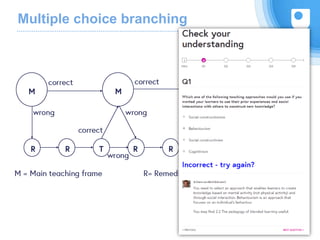
●Student is presented with
multiple choice response
●Feedback depends on the
student’s response
●Move towards adaptive and
personalised teaching 7
Adaptive teaching machine
Multiple choice branching
8
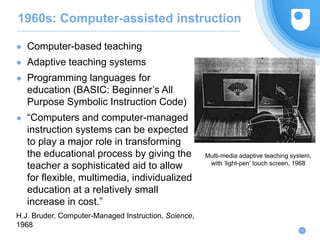
1960s: Computer-assisted instruction
● Computer-based teaching
● Adaptive teaching systems
● Programming languages for
education (BASIC: Beginner’s All
Purpose Symbolic Instruction Code)
● “Computers and computer-managed
instruction systems can be expected
to play a major role in transforming
the educational process by giving the
teacher a sophisticated aid to allow
for flexible, multimedia, individualized
education at a relatively small
increase in cost.”
H.J. Bruder, Computer-Managed Instruction, Science,
1968
9
Multi-media adaptive teaching system,
with ‘light-pen’ touch screen, 1968
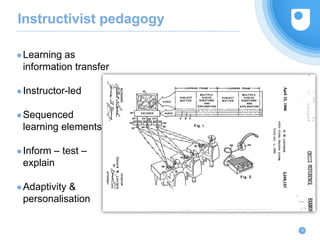
Instructivist pedagogy
●Learning as
information transfer
●Instructor-led
●Sequenced
learning elements
●Inform – test –
explain
●Adaptivity &
personalisation
10
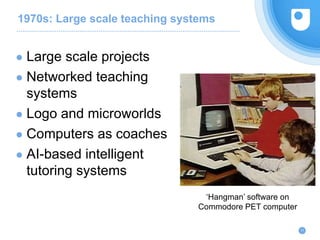
1970s: Large scale teaching systems
● Large scale projects
● Networked teaching
systems
● Logo and microworlds
● Computers as coaches
● AI-based intelligent
tutoring systems
11
‘Hangman’ software on
Commodore PET computer
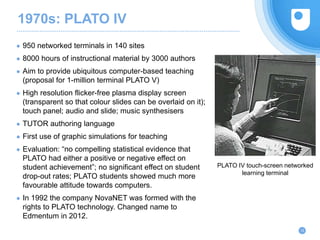
1970s: PLATO IV
● 950 networked terminals in 140 sites
● 8000 hours of instructional material by 3000 authors
● Aim to provide ubiquitous computer-based teaching
(proposal for 1-million terminal PLATO V)
● High resolution flicker-free plasma display screen
(transparent so that colour slides can be overlaid on it);
touch panel; audio and slide; music synthesisers
● TUTOR authoring language
● First use of graphic simulations for teaching
● Evaluation: “no compelling statistical evidence that
PLATO had either a positive or negative effect on
student achievement”; no significant effect on student
drop-out rates; PLATO students showed much more
favourable attitude towards computers.
● In 1992 the company NovaNET was formed with the
rights to PLATO technology. Changed name to
Edmentum in 2012.
12
PLATO IV touch-screen networked
learning terminal
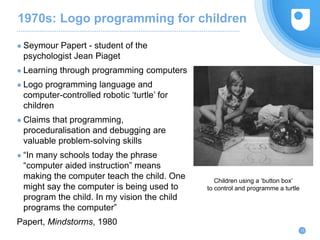
1970s: Logo programming for children
● Seymour Papert - student of the
psychologist Jean Piaget
● Learning through programming computers
● Logo programming language and
computer-controlled robotic ‘turtle’ for
children
● Claims that programming,
proceduralisation and debugging are
valuable problem-solving skills
● “In many schools today the phrase
“computer aided instruction” means
making the computer teach the child. One
might say the computer is being used to
program the child. In my vision the child
programs the computer”
Papert, Mindstorms, 1980
13
Children using a ‘button box’
to control and programme a turtle
1980s: Microcomputers in education
● Multimedia personal computers
● Videodisks
● Networked-based teaching and
computer-supported
collaborative learning
● Educational simulations
● Commercial teaching and
training packages
14
Children using educational software on
a BBC microcomputer
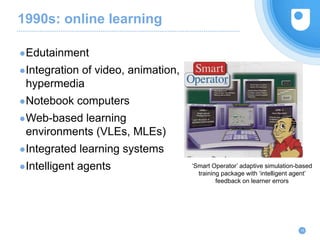
1990s: online learning
●Edutainment
●Integration of video, animation,
hypermedia
●Notebook computers
●Web-based learning
environments (VLEs, MLEs)
●Integrated learning systems
●Intelligent agents
15
‘Smart Operator’ adaptive simulation-based
training package with ‘intelligent agent’
feedback on learner errors
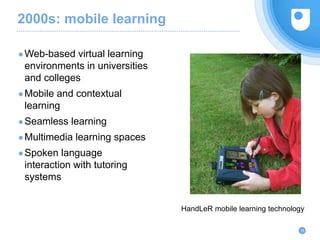
2000s: mobile learning
●Web-based virtual learning
environments in universities
and colleges
●Mobile and contextual
learning
●Seamless learning
●Multimedia learning spaces
●Spoken language
interaction with tutoring
systems
16
HandLeR mobile learning technology
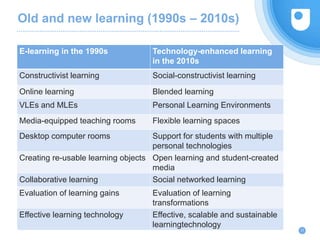
Old and new learning (1990s – 2010s)
17
E-learning in the 1990s Technology-enhanced learning
in the 2010s
Constructivist learning Social-constructivist learning
Online learning Blended learning
VLEs and MLEs Personal Learning Environments
Media-equipped teaching rooms Flexible learning spaces
Desktop computer rooms Support for students with multiple
personal technologies
Creating re-usable learning objects Open learning and student-created
media
Collaborative learning Social networked learning
Evaluation of learning gains Evaluation of learning
transformations
Effective learning technology Effective, scalable and sustainable
learningtechnology
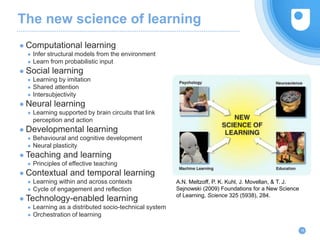
The new science of learning
● Computational learning
● Infer structural models from the environment
● Learn from probabilistic input
● Social learning
● Learning by imitation
● Shared attention
● Intersubjectivity
● Neural learning
● Learning supported by brain circuits that link
perception and action
● Developmental learning
● Behavioural and cognitive development
● Neural plasticity
● Teaching and learning
● Principles of effective teaching
● Contextual and temporal learning
● Learning within and across contexts
● Cycle of engagement and reflection
● Technology-enabled learning
● Learning as a distributed socio-technical system
● Orchestration of learning
18
A.N. Meltzoff, P. K. Kuhl, J. Movellan, & T. J.
Sejnowski (2009) Foundations for a New Science
of Learning, Science 325 (5938), 284.
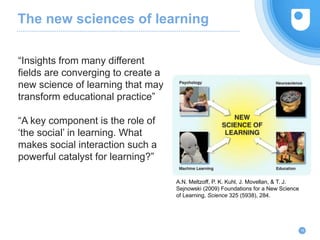
The new sciences of learning
“Insights from many different
fields are converging to create a
new science of learning that may
transform educational practice”
“A key component is the role of
‘the social’ in learning. What
makes social interaction such a
powerful catalyst for learning?”
19
A.N. Meltzoff, P. K. Kuhl, J. Movellan, & T. J.
Sejnowski (2009) Foundations for a New Science
of Learning, Science 325 (5938), 284.
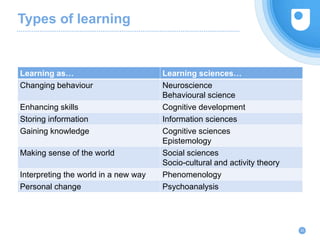
Types of learning
Learning as… Learning sciences…
Changing behaviour Neuroscience
Behavioural science
Enhancing skills Cognitive development
Storing information Information sciences
Gaining knowledge Cognitive sciences
Epistemology
Making sense of the world Social sciences
Socio-cultural and activity theory
Interpreting the world in a new way Phenomenology
Personal change Psychoanalysis
20
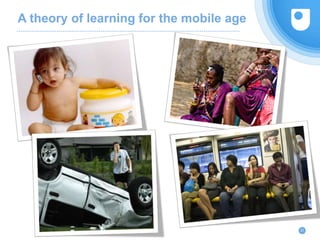
A theory of learning for the mobile age
21
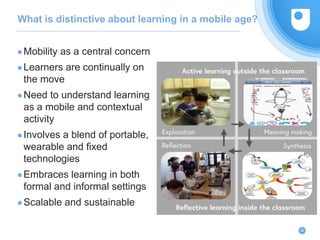
What is distinctive about learning in a mobile age?
22
●Mobility as a central concern
●Learners are continually on
the move
●Need to understand learning
as a mobile and contextual
activity
●Involves a blend of portable,
wearable and fixed
technologies
●Embraces learning in both
formal and informal settings
●Scalable and sustainable
Theories of learning with technology
John Dewey’s Instrumental inquiry
● Knowing is activity in the world, involving a combination of thoughts and
external artefacts as tools for inquiry
● Every reflective experience is an instrument for production of meaning
● Inquiry-led learning
Yrjö Engeström’s Expansive Activity Theory
● Learning is a cultural-historical activity mediated by tools, including
technology and language
● Activity systems contain the possibility for expansive transformation, as
contradictions are internalised and resolved
● Social-constructivist learning
Gordon Pask’s Conversation Theory
● Conversation is the fundamental process of learning
● Learning is a cybernetic process of “coming to know” through mutual
adjustment and negotiation
● Conversational learning 23
Dewey’s instrumental inquiry
●Education should be based upon the quality of experience
●For an experience to be educational, there must be continuity
and interaction
●Continuity: experience comes from and leads to other
experiences
●Interaction: when the experience meets the internal needs or
goals of a person
●Pragmatic instrumentalism: Knowing is activity in the world,
involving a combination of thoughts and external artefacts as
tools for inquiry
24
Dewey and social learning
“The principle that development of experience comes about
through interaction means that education is essentially a social
process. This quality is realized in the degree in which
individuals form a community group. … It is absurd to exclude
the teacher from membership in the group. As the most mature
member of the group he has a peculiar responsibility for the
conduct of the interactions and inter-communications which are
the very life of the group as a community.”
Dewey, “Experience and Education” (1938)
25
Dewey and reflective learning
Learning comes when a person strives to overcome a problem
or breakdown in everyday activity, or recognises part of the
continual flow of activity and conversation as worth
remembering
Every reflective experience is an instrument for the
production of meaning
A mis-educative experience is one that stops or distorts growth
for future experiences
A non-educative experience is when a person has not done any
reflection and so has not obtained lasting mental growth
26
Engeström’s expansive activity theory
● Learning is a cultural-historical activity mediated by tools,
including technology and language
● Activity is the focus of analysis
● Activity systems are multi-voiced, with many perspectives,
transitions and interests in continual interaction
● Activity systems are shaped over time
● Activity systems contain the possibility for expansive
transformation: they go though extended periods of qualitative
change, as the contradictions are internalised and resolved,
leading to the emergence of new structure, tools and activity.
Learning as cultural historical activity
27
Example
● Learning at university is an activity system shaped by the
history of higher education and mediated by tools, including
technology and academic language
● Teaching and learning activity is the focus of analysis
● Teaching and learning activity systems are multi-voiced: many
teaching methods, learning strategies, cultures
● Teaching and learning systems in universities are shaped
over time
● University systems contain the possibility for expansive
transformation. For example, students bringing their own
devices into lectures initially caused tensions and disruptions
- but also possibilities for radical transformation to a more
student-centred learning activity.
University as an activity system
28
Pask and learning as conversation
● A theory of how we come to
know
● Derived from cybernetics
● A conversation is the
minimum necessary
structure to enable learning
- Multiple conversations within one
mind
- One conversation across multiple
minds
● Can involve technology as a
conversational partner
29
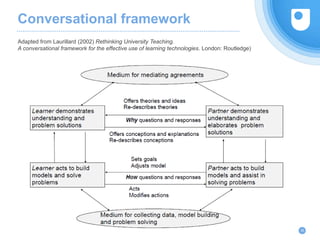
● Conversations about the how
and why of a topic
● Conversations about the how
of learning (for example
discussing study skills and
reflecting on experiences as a
learner)
● Conversations about purposes,
the why of learning, where the
emphasis is on encouraging
personal autonomy and
accepting responsibility for
one’s own learning
Conversational framework
Adapted from Laurillard (2002) Rethinking University Teaching.
A conversational framework for the effective use of learning technologies. London: Routledge)
30
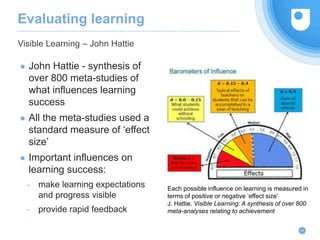
Evaluating learning
● John Hattie - synthesis of
over 800 meta-studies of
what influences learning
success
● All the meta-studies used a
standard measure of ‘effect
size’
● Important influences on
learning success:
- make learning expectations
and progress visible
- provide rapid feedback
Visible Learning – John Hattie
31
Each possible influence on learning is measured in
terms of positive or negative ‘effect size’
J. Hattie. Visible Learning: A synthesis of over 800
meta-analyses relating to achievement
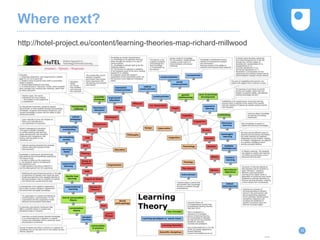
Where next?
http://hotel-project.eu/content/learning-theories-map-richard-millwood
32
Open University Innovating Pedagogy
● Annual report
● Explores new forms of
teaching, learning and
assessment for an
interactive world
● To guide teachers and
policy makers in productive
innovation
● www.open.ac.uk/innovating
Weak signals

Introduction to educational technology

  • 1.
    A Very Short Introductionto Educational Technology Mike Sharples Institute of Educational Technology, The Open University
  • 2.
    Definitions Pedagogy “The theory andpractice of teaching, learning and assessment” Sharples, M., McAndrew, P., Weller, M., Ferguson, R., FitzGerald, E., Hirst, T., Mor, Y., Gaved, M. and Whitelock, D. (2012). Innovating Pedagogy 2012: Open University Innovation Report 1. Milton Keynes: The Open University. Educational technology Interactive technology to enable effective learning (may include fixed, desktop, mobile and wearable devices and their software - and combinations of these) Technology Enhanced Learning Learning supported by individual or multiple technologies. In Europe, now used in preference to e-learning, or computer-assisted learning
  • 3.
    Contents A short historyof educational technology Theories of learning with technologies Evaluation of learning with technologies 3
  • 4.
    1920s: Pressey’s Self-testingmachine 4 Image copyright OSU photo archives “There must be an ‘industrial revolution’ in education, in which educational science and the ingenuity of educational technology combine to modernize the grossly inefficient and clumsy procedures of conventional education. Work in the schools of the future will be marvelously though simply organized, so as to adjust almost automatically to individual differences and the characteristics of the learning process. There will be many laborsaving schemes and devices, and even machines – not at all for the mechanizing of education, but for the freeing of teacher and pupil from educational drudgery and incompetence.” Sidney Pressey (1933) Psychology and the New Education
  • 5.
    1950s Linear programmingand teaching machines ● Based on scientific theory of ‘operant conditioning’ (changing behaviour by use of reinforcement after a desired response) ● Presentation of a linear sequence of frames of information, in small steps ● Immediate reinforcement of student responses, but the same response for each student ● Gradual progression to establish complex repertoires ● Fading or gradual withdrawal of stimulus support ● Issues: finding reinforcers that are effective and ethical; matching individual students; incorrect responses 5 In B.F. Skinner (1958) Teaching Machines https://www.youtube.com/watch?v=jTH3ob 1IRFo
  • 6.
    Emerging themes ● Educationaltechnology ● Self-paced learning ● Interactive learning ● Learning design ● Formative assessment ● Motivation for learning 6
  • 7.
    1950s: Branching programs ●Basedon theories from cybernetics (adaptive systems, feedback control) ●Using information from errors to eliminate incorrect responses (vs. ensuring correct responses and reinforcing them) ●Student is presented with multiple choice response ●Feedback depends on the student’s response ●Move towards adaptive and personalised teaching 7 Adaptive teaching machine
  • 8.
  • 9.
    1960s: Computer-assisted instruction ●Computer-based teaching ● Adaptive teaching systems ● Programming languages for education (BASIC: Beginner’s All Purpose Symbolic Instruction Code) ● “Computers and computer-managed instruction systems can be expected to play a major role in transforming the educational process by giving the teacher a sophisticated aid to allow for flexible, multimedia, individualized education at a relatively small increase in cost.” H.J. Bruder, Computer-Managed Instruction, Science, 1968 9 Multi-media adaptive teaching system, with ‘light-pen’ touch screen, 1968
  • 10.
    Instructivist pedagogy ●Learning as informationtransfer ●Instructor-led ●Sequenced learning elements ●Inform – test – explain ●Adaptivity & personalisation 10
  • 11.
    1970s: Large scaleteaching systems ● Large scale projects ● Networked teaching systems ● Logo and microworlds ● Computers as coaches ● AI-based intelligent tutoring systems 11 ‘Hangman’ software on Commodore PET computer
  • 12.
    1970s: PLATO IV ●950 networked terminals in 140 sites ● 8000 hours of instructional material by 3000 authors ● Aim to provide ubiquitous computer-based teaching (proposal for 1-million terminal PLATO V) ● High resolution flicker-free plasma display screen (transparent so that colour slides can be overlaid on it); touch panel; audio and slide; music synthesisers ● TUTOR authoring language ● First use of graphic simulations for teaching ● Evaluation: “no compelling statistical evidence that PLATO had either a positive or negative effect on student achievement”; no significant effect on student drop-out rates; PLATO students showed much more favourable attitude towards computers. ● In 1992 the company NovaNET was formed with the rights to PLATO technology. Changed name to Edmentum in 2012. 12 PLATO IV touch-screen networked learning terminal
  • 13.
    1970s: Logo programmingfor children ● Seymour Papert - student of the psychologist Jean Piaget ● Learning through programming computers ● Logo programming language and computer-controlled robotic ‘turtle’ for children ● Claims that programming, proceduralisation and debugging are valuable problem-solving skills ● “In many schools today the phrase “computer aided instruction” means making the computer teach the child. One might say the computer is being used to program the child. In my vision the child programs the computer” Papert, Mindstorms, 1980 13 Children using a ‘button box’ to control and programme a turtle
  • 14.
    1980s: Microcomputers ineducation ● Multimedia personal computers ● Videodisks ● Networked-based teaching and computer-supported collaborative learning ● Educational simulations ● Commercial teaching and training packages 14 Children using educational software on a BBC microcomputer
  • 15.
    1990s: online learning ●Edutainment ●Integrationof video, animation, hypermedia ●Notebook computers ●Web-based learning environments (VLEs, MLEs) ●Integrated learning systems ●Intelligent agents 15 ‘Smart Operator’ adaptive simulation-based training package with ‘intelligent agent’ feedback on learner errors
  • 16.
    2000s: mobile learning ●Web-basedvirtual learning environments in universities and colleges ●Mobile and contextual learning ●Seamless learning ●Multimedia learning spaces ●Spoken language interaction with tutoring systems 16 HandLeR mobile learning technology
  • 17.
    Old and newlearning (1990s – 2010s) 17 E-learning in the 1990s Technology-enhanced learning in the 2010s Constructivist learning Social-constructivist learning Online learning Blended learning VLEs and MLEs Personal Learning Environments Media-equipped teaching rooms Flexible learning spaces Desktop computer rooms Support for students with multiple personal technologies Creating re-usable learning objects Open learning and student-created media Collaborative learning Social networked learning Evaluation of learning gains Evaluation of learning transformations Effective learning technology Effective, scalable and sustainable learningtechnology
  • 18.
    The new scienceof learning ● Computational learning ● Infer structural models from the environment ● Learn from probabilistic input ● Social learning ● Learning by imitation ● Shared attention ● Intersubjectivity ● Neural learning ● Learning supported by brain circuits that link perception and action ● Developmental learning ● Behavioural and cognitive development ● Neural plasticity ● Teaching and learning ● Principles of effective teaching ● Contextual and temporal learning ● Learning within and across contexts ● Cycle of engagement and reflection ● Technology-enabled learning ● Learning as a distributed socio-technical system ● Orchestration of learning 18 A.N. Meltzoff, P. K. Kuhl, J. Movellan, & T. J. Sejnowski (2009) Foundations for a New Science of Learning, Science 325 (5938), 284.
  • 19.
    The new sciencesof learning “Insights from many different fields are converging to create a new science of learning that may transform educational practice” “A key component is the role of ‘the social’ in learning. What makes social interaction such a powerful catalyst for learning?” 19 A.N. Meltzoff, P. K. Kuhl, J. Movellan, & T. J. Sejnowski (2009) Foundations for a New Science of Learning, Science 325 (5938), 284.
  • 20.
    Types of learning Learningas… Learning sciences… Changing behaviour Neuroscience Behavioural science Enhancing skills Cognitive development Storing information Information sciences Gaining knowledge Cognitive sciences Epistemology Making sense of the world Social sciences Socio-cultural and activity theory Interpreting the world in a new way Phenomenology Personal change Psychoanalysis 20
  • 21.
    A theory oflearning for the mobile age 21
  • 22.
    What is distinctiveabout learning in a mobile age? 22 ●Mobility as a central concern ●Learners are continually on the move ●Need to understand learning as a mobile and contextual activity ●Involves a blend of portable, wearable and fixed technologies ●Embraces learning in both formal and informal settings ●Scalable and sustainable
  • 23.
    Theories of learningwith technology John Dewey’s Instrumental inquiry ● Knowing is activity in the world, involving a combination of thoughts and external artefacts as tools for inquiry ● Every reflective experience is an instrument for production of meaning ● Inquiry-led learning Yrjö Engeström’s Expansive Activity Theory ● Learning is a cultural-historical activity mediated by tools, including technology and language ● Activity systems contain the possibility for expansive transformation, as contradictions are internalised and resolved ● Social-constructivist learning Gordon Pask’s Conversation Theory ● Conversation is the fundamental process of learning ● Learning is a cybernetic process of “coming to know” through mutual adjustment and negotiation ● Conversational learning 23
  • 24.
    Dewey’s instrumental inquiry ●Educationshould be based upon the quality of experience ●For an experience to be educational, there must be continuity and interaction ●Continuity: experience comes from and leads to other experiences ●Interaction: when the experience meets the internal needs or goals of a person ●Pragmatic instrumentalism: Knowing is activity in the world, involving a combination of thoughts and external artefacts as tools for inquiry 24
  • 25.
    Dewey and sociallearning “The principle that development of experience comes about through interaction means that education is essentially a social process. This quality is realized in the degree in which individuals form a community group. … It is absurd to exclude the teacher from membership in the group. As the most mature member of the group he has a peculiar responsibility for the conduct of the interactions and inter-communications which are the very life of the group as a community.” Dewey, “Experience and Education” (1938) 25
  • 26.
    Dewey and reflectivelearning Learning comes when a person strives to overcome a problem or breakdown in everyday activity, or recognises part of the continual flow of activity and conversation as worth remembering Every reflective experience is an instrument for the production of meaning A mis-educative experience is one that stops or distorts growth for future experiences A non-educative experience is when a person has not done any reflection and so has not obtained lasting mental growth 26
  • 27.
    Engeström’s expansive activitytheory ● Learning is a cultural-historical activity mediated by tools, including technology and language ● Activity is the focus of analysis ● Activity systems are multi-voiced, with many perspectives, transitions and interests in continual interaction ● Activity systems are shaped over time ● Activity systems contain the possibility for expansive transformation: they go though extended periods of qualitative change, as the contradictions are internalised and resolved, leading to the emergence of new structure, tools and activity. Learning as cultural historical activity 27
  • 28.
    Example ● Learning atuniversity is an activity system shaped by the history of higher education and mediated by tools, including technology and academic language ● Teaching and learning activity is the focus of analysis ● Teaching and learning activity systems are multi-voiced: many teaching methods, learning strategies, cultures ● Teaching and learning systems in universities are shaped over time ● University systems contain the possibility for expansive transformation. For example, students bringing their own devices into lectures initially caused tensions and disruptions - but also possibilities for radical transformation to a more student-centred learning activity. University as an activity system 28
  • 29.
    Pask and learningas conversation ● A theory of how we come to know ● Derived from cybernetics ● A conversation is the minimum necessary structure to enable learning - Multiple conversations within one mind - One conversation across multiple minds ● Can involve technology as a conversational partner 29 ● Conversations about the how and why of a topic ● Conversations about the how of learning (for example discussing study skills and reflecting on experiences as a learner) ● Conversations about purposes, the why of learning, where the emphasis is on encouraging personal autonomy and accepting responsibility for one’s own learning
  • 30.
    Conversational framework Adapted fromLaurillard (2002) Rethinking University Teaching. A conversational framework for the effective use of learning technologies. London: Routledge) 30
  • 31.
    Evaluating learning ● JohnHattie - synthesis of over 800 meta-studies of what influences learning success ● All the meta-studies used a standard measure of ‘effect size’ ● Important influences on learning success: - make learning expectations and progress visible - provide rapid feedback Visible Learning – John Hattie 31 Each possible influence on learning is measured in terms of positive or negative ‘effect size’ J. Hattie. Visible Learning: A synthesis of over 800 meta-analyses relating to achievement
  • 32.
  • 33.
    Open University InnovatingPedagogy ● Annual report ● Explores new forms of teaching, learning and assessment for an interactive world ● To guide teachers and policy makers in productive innovation ● www.open.ac.uk/innovating Weak signals