MY PORTFOLIO IN
EDUCATIONAL
TECHNOLOGY
LANCIAN, JEIZEL
C.
BSED-III HET
THE STUDENT
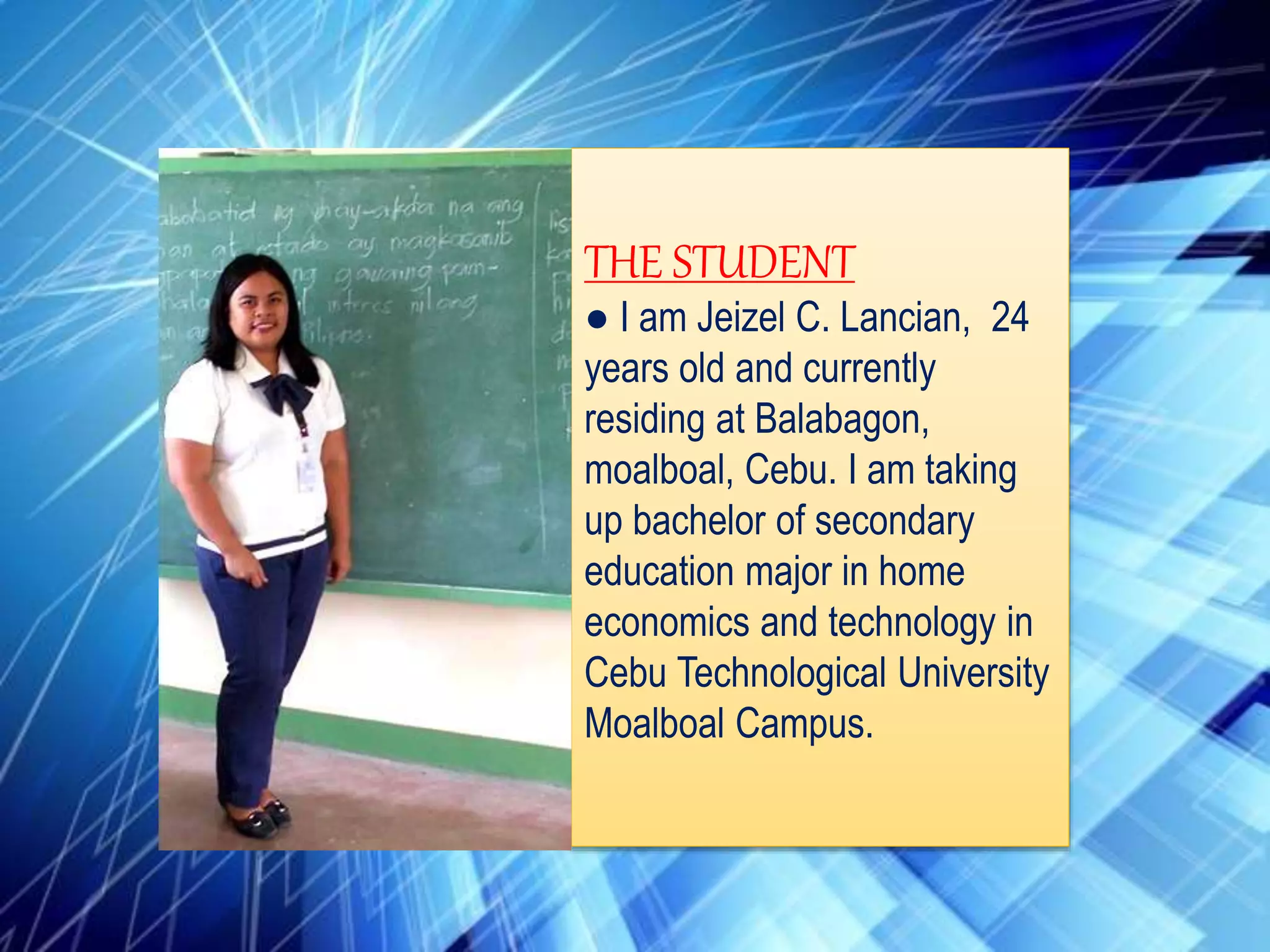
● I am Jeizel C. Lancian, 24
years old and currently
residing at Balabagon,
moalboal, Cebu. I am taking
up bachelor of secondary
education major in home
economics and technology in
Cebu Technological University
Moalboal Campus.
• THE STUDENT
• EXPLORING EDUCATIONAL
TECHNOLOGY 1
• EXPLORING EDUCATIONAL
TECHNOLOGY 2
• THE STUDENT AFTER EDUCATIONAL
TECHNOLOGY 1 AND 2
EXPLORING
EDUCATIONAL
TECHNOLOGY 1
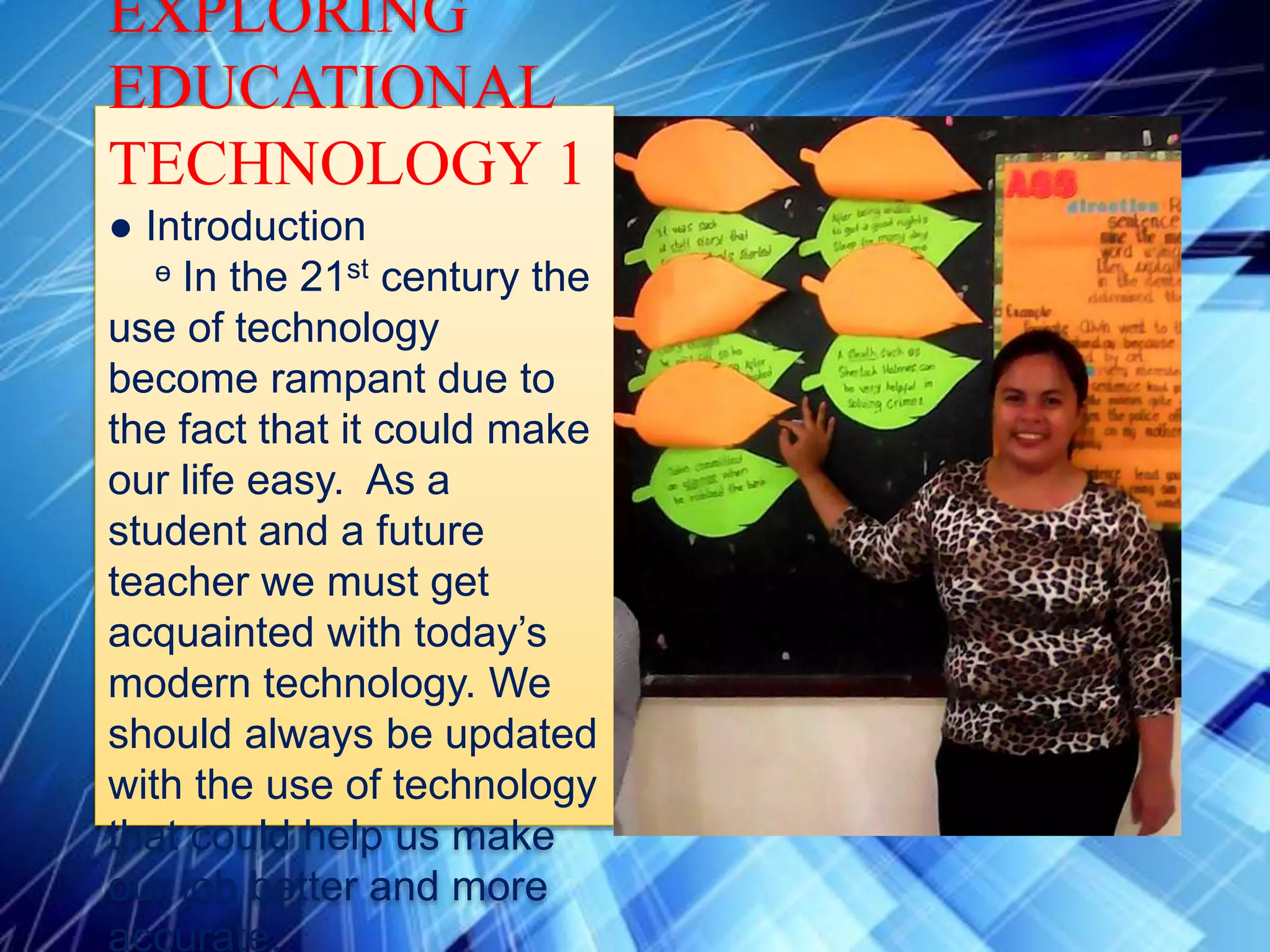
● Introduction
ᶱ In the 21st century the
use of technology
become rampant due to
the fact that it could make
our life easy. As a
student and a future
teacher we must get
acquainted with today’s
modern technology. We
should always be updated
with the use of technology
that could help us make
our job better and more
accurate.
● Educational technology is a “complex,
integrated process involving people, procedures,
ideas, devices and organization for analyzing
problems and devising, implementing, evaluating
and managing solutions to those problems
involved in all aspects of human learning” (
Association for Educational Communications and
Technology, 1977.)
● Educational technology is a profession like
teaching. It is made up of organized effort to
implement the theory, intellectual technique and
practical application of educational technology.
(David H. Jonassen, et al 1999)
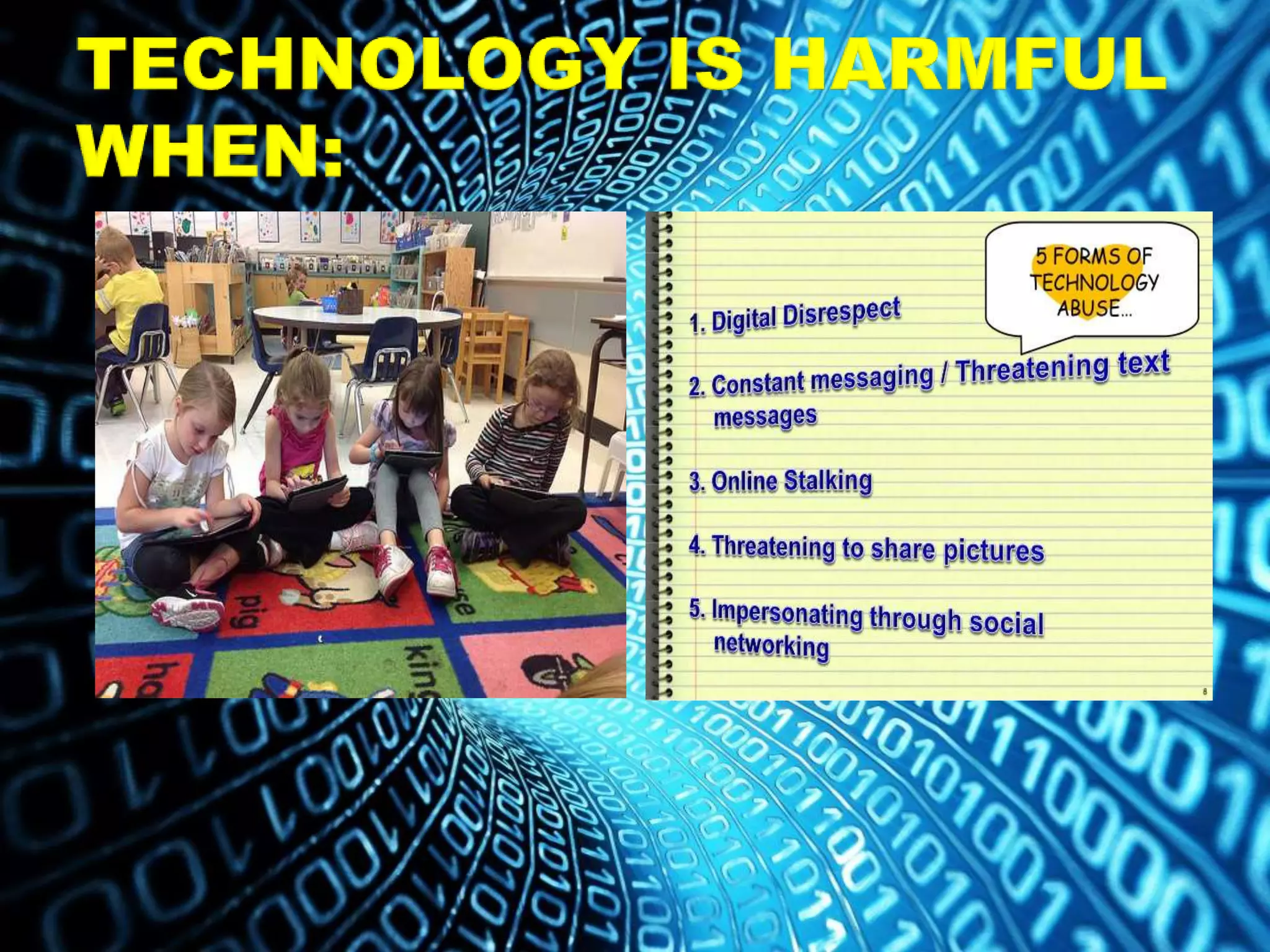
 Technology is a blessing for man. With
technology, there is a lot that we can do
which we could not do without it. However,
when not used properly, technology becomes
a detriment to learning and development.
●Technology is Bone:
• Factory machines
° Could help in making the job
faster and easier.
• In Farming
° Could help the farmers produce
more food without too much
work.
• At home
° Could help the family through
fast communication and work is
done easily.
●Technology is Bane:
• Factory machines
° Can cause pollution when
misuse.
• In Farming
° Farmers could be overly
dependent to technology and could
not think of other manual way of
farming.
• At home
° Can cause miscommunication
and addiction in technology; can
cause lack of physical contact.
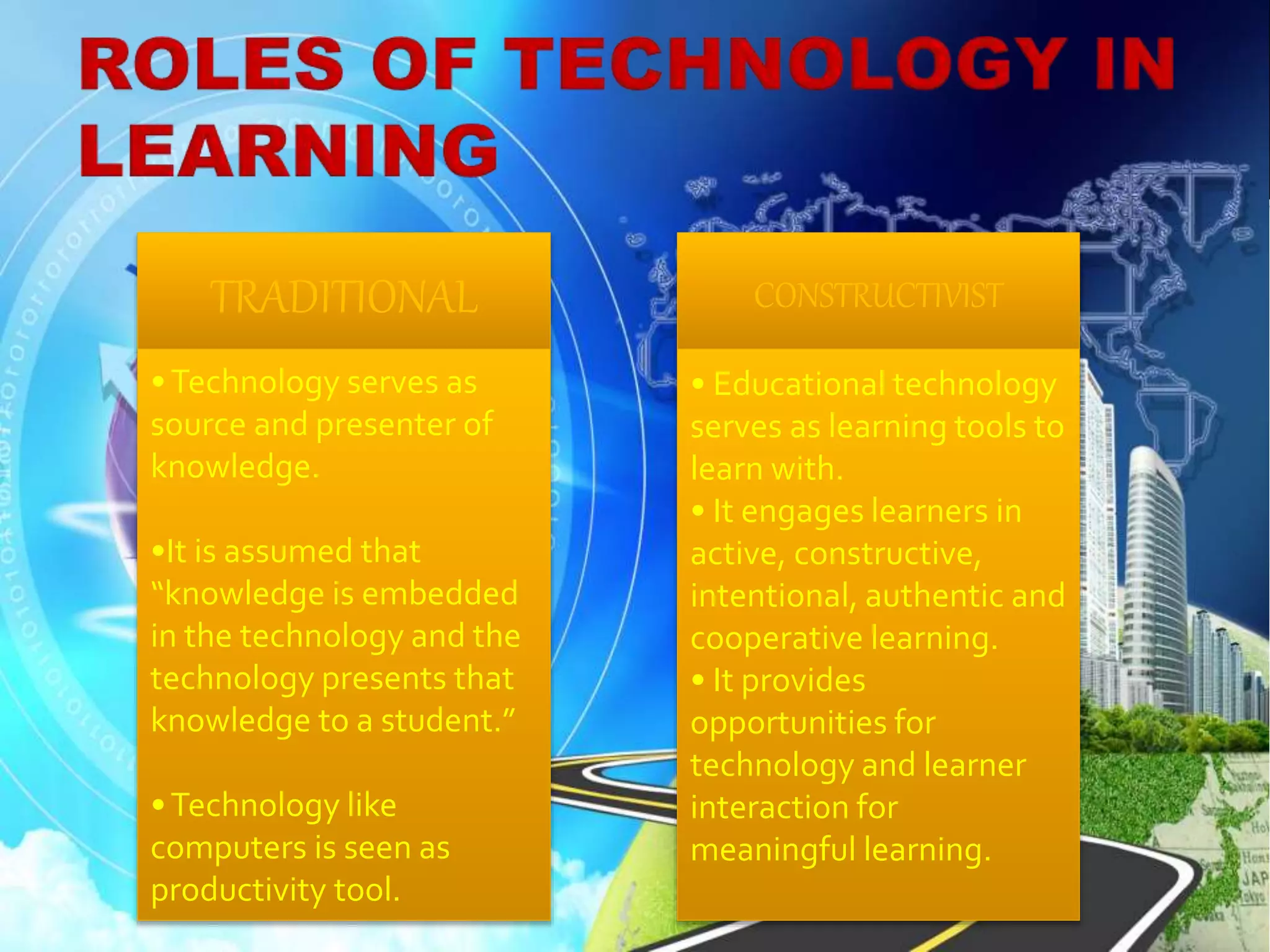
TRADITIONAL
•Technology serves as
source and presenter of
knowledge.
•It is assumed that
“knowledge is embedded
in the technology and the
technology presents that
knowledge to a student.”
•Technology like
computers is seen as
productivity tool.
CONSTRUCTIVIST
• Educational technology
serves as learning tools to
learn with.
• It engages learners in
active, constructive,
intentional, authentic and
cooperative learning.
• It provides
opportunities for
technology and learner
interaction for
meaningful learning.
 As tools to support knowledge construction
 As information vehicles for exploring
knowledge to support learning-by-
constructing
 As context to support learning-by-doing
 As a social medium to support learning by
conversing
 As intellectual partner to support learning-
by-reflecting
DO
RP
EO
ITI
APR
SME
F
CA
E
CA
M
 Setting of a specific goal that needs to be
achieved
 It serves as a guide for the teacher and
the learners on what to learn
R
I
N
• Readiness
• Interest
• Needs
3
things
to
conside
r in
makin
g an
objecti
ve
S • Specific
M • Measurable
A • Attainable
R • Realistic/Result Oriented
T • Time Bounded
5
Charac
teristic
s of an
Object
ive
C • Cognitive Domain
A • Affective Domain
P • Psychomotor Domain
3
LEARNING
DOMAINS
THAT
MUST BE
CONSIDER
ED IN
MAKING
AN
OBJECTIVE
 Selecting the appropriate methods of
teaching including the strategies and
technique that you will use.
 Will you use inductive or deductive approach?
Specific to general or general to specific?
 Selecting the appropriate experiences for the
students.
 Selecting the right learning activities for the
students.
 Selecting the appropriate materials,
equipment and even facilities you will use
in achieving your objective.
 Selecting the best instructional material to
achieved the best learning outcome.
 Assigning or delegating task to the person in
charge to help you meet your objective.
6. Implement The Instruction
(ITI)
• Application of all the things you planned and
prepared in order to meet your objective.
• Engaging with the students.
 Evaluating the outcome of the discussion for us to
know if our objective is achieved or not.
 It can be written evaluation or oral evaluation.
8. Refine the Process (RP)
• It is a process wherein if the students passed the
evaluation and you achieved your objective then you
can proceed to the new lesson and if the objective is
not met or achieved then you will again go back to the
process.
 Focused on:
• Introducing
• Reinforcing
• Supplementing
• Extending the
knowledge and
skills to
learners
•The use of students and
teachers
• On the application of educational technology to
instruction. EducationalTechnology 1 showed
the 4 phases of application of educational
technology in teaching-and-learning,
namely; (a) setting of learning
objectives (b) designing specific learning
experiences (c)evaluating the effectiveness of
the learning experiences vis-a-vis the learning
objectives, and (d) revision as needed of the
whole teaching-learning process, or elements of
it, for further improving future instructional
activities.
 To lend familiarization on how educational
technology can be utilized as media for the
avenues teaching-learning process in the
school.
 To impact skills in planning, designing, using
and evaluating the technology-enriched
teaching-learning process.
 To acquaint learners on the basic aspects
of community education, functions of the
school media center, and finally.
 To introduce the learner to what is
recognized as the third revolution in
education, the computer.
 Educational technology 2 is concerned with
“IntegratingTechnology intoTeaching and
Learning.” Specifically this is focused on
introducing, reinforcing, supplementing and
extending the knowledge and skills to learners so
that they can become exemplary users of
educational technology. Mainly directed to student
teachers, also professional teachers who may wish
to update their knowledge of educational
technology, it is our goal that this course can help
our target learners to weave technology in teaching
with software (computer programmed learning
materials) becoming a natural extension of their
learning tools.
 To provide education in the use of technology
in instruction by providing knowledge and
skills on technology integration-in-instruction
to learners.
 To impart learning experiences in
instructional technology-supported
instructional planning
 To acquaint students on information
technology or IT- related learning theories
with the computer as a tutor.
 To engage learners on practical technology
integration issues including managing IT
classrooms, use of the internet for learning,
cooperative learning through the use of
information technology, etc.
 To inculcate higher level thinking and
creativity among students while providing
them knowledge of IT-related learning
theories.
 After the importance of technology was
introduced to us in our Educational
Technology 1 and 2, I have learned that
technology is indeed useful to human society.
 The use of technology is very important but it
depends on how it is used.
 As a student I can say that technology is
indeed our way in building a better future,
and taking the subject will help us understand
how technology work.
Presentation1.pptx.lancian

Presentation1.pptx.lancian

  • 1.
  • 2.
    THE STUDENT ● Iam Jeizel C. Lancian, 24 years old and currently residing at Balabagon, moalboal, Cebu. I am taking up bachelor of secondary education major in home economics and technology in Cebu Technological University Moalboal Campus.
  • 3.
    • THE STUDENT •EXPLORING EDUCATIONAL TECHNOLOGY 1 • EXPLORING EDUCATIONAL TECHNOLOGY 2 • THE STUDENT AFTER EDUCATIONAL TECHNOLOGY 1 AND 2
  • 4.
    EXPLORING EDUCATIONAL TECHNOLOGY 1 ● Introduction ᶱIn the 21st century the use of technology become rampant due to the fact that it could make our life easy. As a student and a future teacher we must get acquainted with today’s modern technology. We should always be updated with the use of technology that could help us make our job better and more accurate.
  • 5.
    ● Educational technologyis a “complex, integrated process involving people, procedures, ideas, devices and organization for analyzing problems and devising, implementing, evaluating and managing solutions to those problems involved in all aspects of human learning” ( Association for Educational Communications and Technology, 1977.) ● Educational technology is a profession like teaching. It is made up of organized effort to implement the theory, intellectual technique and practical application of educational technology. (David H. Jonassen, et al 1999)
  • 8.
     Technology isa blessing for man. With technology, there is a lot that we can do which we could not do without it. However, when not used properly, technology becomes a detriment to learning and development.
  • 9.
    ●Technology is Bone: •Factory machines ° Could help in making the job faster and easier. • In Farming ° Could help the farmers produce more food without too much work. • At home ° Could help the family through fast communication and work is done easily. ●Technology is Bane: • Factory machines ° Can cause pollution when misuse. • In Farming ° Farmers could be overly dependent to technology and could not think of other manual way of farming. • At home ° Can cause miscommunication and addiction in technology; can cause lack of physical contact.
  • 10.
    TRADITIONAL •Technology serves as sourceand presenter of knowledge. •It is assumed that “knowledge is embedded in the technology and the technology presents that knowledge to a student.” •Technology like computers is seen as productivity tool. CONSTRUCTIVIST • Educational technology serves as learning tools to learn with. • It engages learners in active, constructive, intentional, authentic and cooperative learning. • It provides opportunities for technology and learner interaction for meaningful learning.
  • 11.
     As toolsto support knowledge construction  As information vehicles for exploring knowledge to support learning-by- constructing  As context to support learning-by-doing  As a social medium to support learning by conversing  As intellectual partner to support learning- by-reflecting
  • 12.
  • 13.
     Setting ofa specific goal that needs to be achieved  It serves as a guide for the teacher and the learners on what to learn
  • 14.
    R I N • Readiness • Interest •Needs 3 things to conside r in makin g an objecti ve S • Specific M • Measurable A • Attainable R • Realistic/Result Oriented T • Time Bounded 5 Charac teristic s of an Object ive C • Cognitive Domain A • Affective Domain P • Psychomotor Domain 3 LEARNING DOMAINS THAT MUST BE CONSIDER ED IN MAKING AN OBJECTIVE
  • 15.
     Selecting theappropriate methods of teaching including the strategies and technique that you will use.  Will you use inductive or deductive approach? Specific to general or general to specific?
  • 16.
     Selecting theappropriate experiences for the students.  Selecting the right learning activities for the students.
  • 17.
     Selecting theappropriate materials, equipment and even facilities you will use in achieving your objective.  Selecting the best instructional material to achieved the best learning outcome.
  • 18.
     Assigning ordelegating task to the person in charge to help you meet your objective. 6. Implement The Instruction (ITI) • Application of all the things you planned and prepared in order to meet your objective. • Engaging with the students.
  • 19.
     Evaluating theoutcome of the discussion for us to know if our objective is achieved or not.  It can be written evaluation or oral evaluation. 8. Refine the Process (RP) • It is a process wherein if the students passed the evaluation and you achieved your objective then you can proceed to the new lesson and if the objective is not met or achieved then you will again go back to the process.
  • 22.
     Focused on: •Introducing • Reinforcing • Supplementing • Extending the knowledge and skills to learners
  • 23.
    •The use ofstudents and teachers
  • 26.
    • On theapplication of educational technology to instruction. EducationalTechnology 1 showed the 4 phases of application of educational technology in teaching-and-learning, namely; (a) setting of learning objectives (b) designing specific learning experiences (c)evaluating the effectiveness of the learning experiences vis-a-vis the learning objectives, and (d) revision as needed of the whole teaching-learning process, or elements of it, for further improving future instructional activities.
  • 27.
     To lendfamiliarization on how educational technology can be utilized as media for the avenues teaching-learning process in the school.  To impact skills in planning, designing, using and evaluating the technology-enriched teaching-learning process.
  • 28.
     To acquaintlearners on the basic aspects of community education, functions of the school media center, and finally.  To introduce the learner to what is recognized as the third revolution in education, the computer.
  • 29.
     Educational technology2 is concerned with “IntegratingTechnology intoTeaching and Learning.” Specifically this is focused on introducing, reinforcing, supplementing and extending the knowledge and skills to learners so that they can become exemplary users of educational technology. Mainly directed to student teachers, also professional teachers who may wish to update their knowledge of educational technology, it is our goal that this course can help our target learners to weave technology in teaching with software (computer programmed learning materials) becoming a natural extension of their learning tools.
  • 30.
     To provideeducation in the use of technology in instruction by providing knowledge and skills on technology integration-in-instruction to learners.  To impart learning experiences in instructional technology-supported instructional planning  To acquaint students on information technology or IT- related learning theories with the computer as a tutor.
  • 31.
     To engagelearners on practical technology integration issues including managing IT classrooms, use of the internet for learning, cooperative learning through the use of information technology, etc.  To inculcate higher level thinking and creativity among students while providing them knowledge of IT-related learning theories.
  • 32.
     After theimportance of technology was introduced to us in our Educational Technology 1 and 2, I have learned that technology is indeed useful to human society.  The use of technology is very important but it depends on how it is used.  As a student I can say that technology is indeed our way in building a better future, and taking the subject will help us understand how technology work.