AN
D
WAY
TEACHING
Educational technology 2
I’m Alelie Joice S. Ramos, 19 years old. I Live in
Longos, Malolos Bulacan. I took my High School
years in Marcelo H. Del Pilar National High
School. I am taking up Bachelor of Secondary
Education major in Filipino in Bulacan State
University.
A n
O V E R V I E W
E d u c ta i o n a l
Technology II
Educational
Technology 2Concerned with “Integrating Technology into
Teaching and Learning.”
Focused on introducing, reinforcing, supplementing and
extending the knowledge and skills to learners.
Enhancing teaching-and-learning through
technology integration
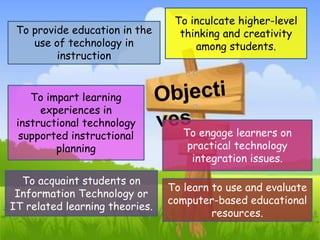
To provide education in the
use of technology in
instruction
To impart learning
experiences in
instructional technology
supported instructional
planning
To acquaint students on
Information Technology or
IT related learning theories.
To learn to use and evaluate
computer-based educational
resources.
To engage learners on
practical technology
integration issues.
To inculcate higher-level
thinking and creativity
among students.
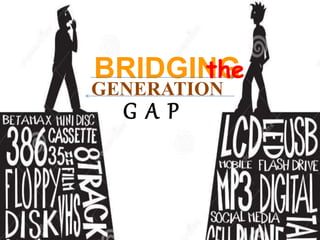
BRIDGINGthe
GENERATION
G A P
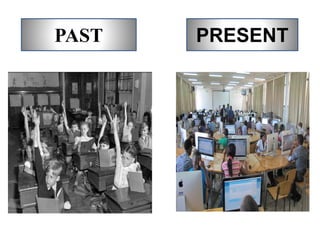
The older generation often feels there
is a generation gap between them and the
younger generation.
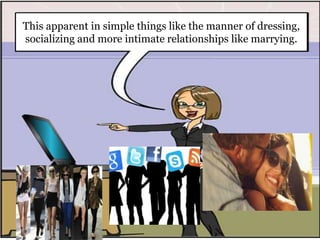
This apparent in simple things like the manner of dressing,
socializing and more intimate relationships like marrying.
In the field of education, a
huge generation gap also exists
and it will continue to widen
unless some changes are
adopted at the proper time.
The network of instantaneous communication is
global, overcoming borders between countries and
continents.
Much of what elders believe may not be applicable
anymore to the new generations, especially along matters
of traditional value systems.
PAST PRESENT
It shows how the information
age has begun to create many
cultural changes in the family,
societies, business, governments
such as what he calls the
throw-away society, modular
man, kinetic image, scientific
trajectory, fractured family,
surfeit of subcluts,
psychological dimension, etc.
6
As teachers adjust their teaching to effectively match
the new digital world of information and
communication technology, they must be clear on
what basic knowledge, skills and values need to be
developed by digital learners.
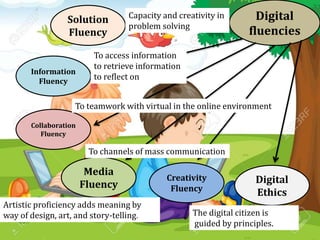
Digital
fluencies
Solution
Fluency
Information
Fluency
Collaboration
Fluency
Media
Fluency
Creativity
Fluency
Digital
Ethics
Capacity and creativity in
problem solving
To access information
to retrieve information
to reflect on
To teamwork with virtual in the online environment
To channels of mass communication
Artistic proficiency adds meaning by
way of design, art, and story-telling. The digital citizen is
guided by principles.
Th
e
ROLEof
Technology in
High Order
THINKING SKILL
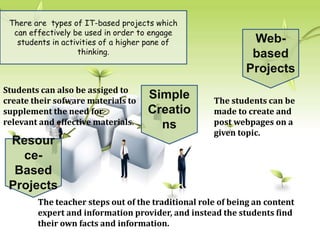
There are types of IT-based projects which
can effectively be used in order to engage
students in activities of a higher pane of
thinking.
Resour
ce-
Based
Projects
Web-
based
Projects
Simple
Creatio
ns
The teacher steps out of the traditional role of being an content
expert and information provider, and instead the students find
their own facts and information.
Students can also be assiged to
create their sofware materials to
supplement the need for
relevant and effective materials.
The students can be
made to create and
post webpages on a
given topic.
COMPUTERS
a
s
INFORMATIO
N
and Communication
TECHNOL
OGY
Through computer technology, educators saw he
amplification of learning along computer literacy.
Much like reading, the modern student
can now interact with computer
messages, even respond to questions or to
computer commands.
But the evolving pace of innovation in
today’s information Age is so dynamic that
within the first decade of the 21st century,
computer technology in education has
matured to transform into an educative
information and communication
technology in education.
The Computer
as the Teacher’s
Tool
I learned that the teachers should be open
to changes. And to become a 21st century
teacher, we must ready to embrace those
changes in order to meet the needs of our
students.
With the use of technology, we can easily
transfer knowledge in creative way.
What I learned in Educational Technology 2?

Ramos Alelie-

  • 1.
  • 2.
    I’m Alelie JoiceS. Ramos, 19 years old. I Live in Longos, Malolos Bulacan. I took my High School years in Marcelo H. Del Pilar National High School. I am taking up Bachelor of Secondary Education major in Filipino in Bulacan State University.
  • 3.
    A n O VE R V I E W E d u c ta i o n a l Technology II
  • 4.
    Educational Technology 2Concerned with“Integrating Technology into Teaching and Learning.” Focused on introducing, reinforcing, supplementing and extending the knowledge and skills to learners. Enhancing teaching-and-learning through technology integration
  • 5.
    To provide educationin the use of technology in instruction To impart learning experiences in instructional technology supported instructional planning To acquaint students on Information Technology or IT related learning theories. To learn to use and evaluate computer-based educational resources. To engage learners on practical technology integration issues. To inculcate higher-level thinking and creativity among students.
  • 6.
  • 7.
    The older generationoften feels there is a generation gap between them and the younger generation.
  • 8.
    This apparent insimple things like the manner of dressing, socializing and more intimate relationships like marrying.
  • 9.
    In the fieldof education, a huge generation gap also exists and it will continue to widen unless some changes are adopted at the proper time. The network of instantaneous communication is global, overcoming borders between countries and continents. Much of what elders believe may not be applicable anymore to the new generations, especially along matters of traditional value systems.
  • 10.
  • 11.
    It shows howthe information age has begun to create many cultural changes in the family, societies, business, governments such as what he calls the throw-away society, modular man, kinetic image, scientific trajectory, fractured family, surfeit of subcluts, psychological dimension, etc.
  • 13.
    6 As teachers adjusttheir teaching to effectively match the new digital world of information and communication technology, they must be clear on what basic knowledge, skills and values need to be developed by digital learners.
  • 14.
    Digital fluencies Solution Fluency Information Fluency Collaboration Fluency Media Fluency Creativity Fluency Digital Ethics Capacity and creativityin problem solving To access information to retrieve information to reflect on To teamwork with virtual in the online environment To channels of mass communication Artistic proficiency adds meaning by way of design, art, and story-telling. The digital citizen is guided by principles.
  • 15.
  • 16.
    There are typesof IT-based projects which can effectively be used in order to engage students in activities of a higher pane of thinking. Resour ce- Based Projects Web- based Projects Simple Creatio ns The teacher steps out of the traditional role of being an content expert and information provider, and instead the students find their own facts and information. Students can also be assiged to create their sofware materials to supplement the need for relevant and effective materials. The students can be made to create and post webpages on a given topic.
  • 17.
    COMPUTERS a s INFORMATIO N and Communication TECHNOL OGY Through computertechnology, educators saw he amplification of learning along computer literacy.
  • 18.
    Much like reading,the modern student can now interact with computer messages, even respond to questions or to computer commands. But the evolving pace of innovation in today’s information Age is so dynamic that within the first decade of the 21st century, computer technology in education has matured to transform into an educative information and communication technology in education.
  • 19.
    The Computer as theTeacher’s Tool
  • 23.
    I learned thatthe teachers should be open to changes. And to become a 21st century teacher, we must ready to embrace those changes in order to meet the needs of our students. With the use of technology, we can easily transfer knowledge in creative way. What I learned in Educational Technology 2?