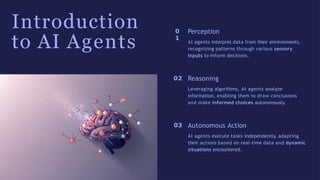
Perception
AI agents interpretdata from their environments,
recognizing patterns through various sensory
inputs to inform decisions.
0
1
Reasoning
Leveraging algorithms, AI agents analyze
information, enabling them to draw conclusions
and make informed choices autonomously.
02
Autonomous Action
AI agents execute tasks independently, adapting
their actions based on real-time data and dynamic
situations encountered.
03
Introduction
to AI Agents
4.
Automation in Workflows
AIagents streamline processes, enhancing efficiency and reducing
human error across various industries and applications.
0
1
Intelligent Virtual Assistants
These agents provide personalized support, improving customer
experience and engagement in sectors like retail and healthcare.
02
Scalable AI Systems
AI agents enable businesses to scale operations seamlessly, adapting to
increasing demands without compromising on quality or performance.
03
Importance of AI Agents
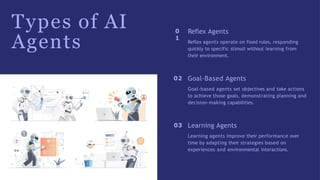
Reflex Agents
Reflex agentsoperate on fixed rules, responding
quickly to specific stimuli without learning from
their environment.
0
1
Goal-Based Agents
Goal-based agents set objectives and take actions
to achieve those goals, demonstrating planning and
decision-making capabilities.
02
Learning Agents
Learning agents improve their performance over
time by adapting their strategies based on
experiences and environmental interactions.
03
Types of AI
Agents
7.
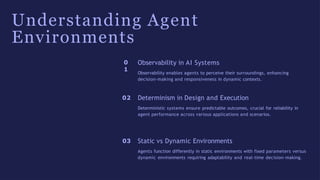
Observability in AISystems
Observability enables agents to perceive their surroundings, enhancing
decision-making and responsiveness in dynamic contexts.
0
1
Determinism in Design and Execution
Deterministic systems ensure predictable outcomes, crucial for reliability in
agent performance across various applications and scenarios.
02
Static vs Dynamic Environments
Agents function differently in static environments with fixed parameters versus
dynamic environments requiring adaptability and real-time decision-making.
03
Understanding Agent
Environments
8.
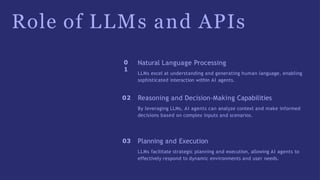
Natural Language Processing
LLMsexcel at understanding and generating human language, enabling
sophisticated interaction within AI agents.
0
1
Reasoning and Decision-Making Capabilities
By leveraging LLMs, AI agents can analyze context and make informed
decisions based on complex inputs and scenarios.
02
Planning and Execution
LLMs facilitate strategic planning and execution, allowing AI agents to
effectively respond to dynamic environments and user needs.
03
Role of LLMs and APIs
9.
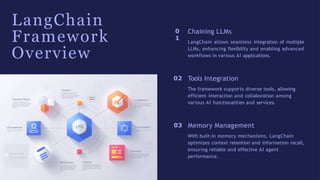
Chaining LLMs
LangChain allowsseamless integration of multiple
LLMs, enhancing flexibility and enabling advanced
workflows in various AI applications.
0
1
Tools Integration
The framework supports diverse tools, allowing
efficient interaction and collaboration among
various AI functionalities and services.
02
Memory Management
With built-in memory mechanisms, LangChain
optimizes context retention and information recall,
ensuring reliable and effective AI agent
performance.
03
LangChain
Framework
Overview
10.
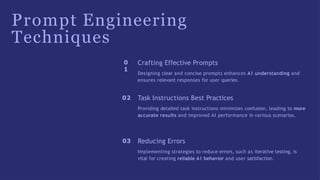
Crafting Effective Prompts
Designingclear and concise prompts enhances AI understanding and
ensures relevant responses for user queries.
0
1
Task Instructions Best Practices
Providing detailed task instructions minimizes confusion, leading to more
accurate results and improved AI performance in various scenarios.
02
Reducing Errors
Implementing strategies to reduce errors, such as iterative testing, is
vital for creating reliable AI behavior and user satisfaction.
03
Prompt Engineering
Techniques
11.
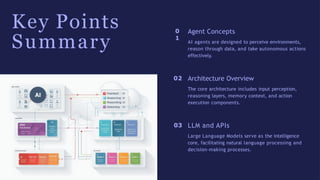
Agent Concepts
AI agentsare designed to perceive environments,
reason through data, and take autonomous actions
effectively.
0
1
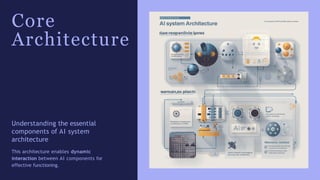
Architecture Overview
The core architecture includes input perception,
reasoning layers, memory context, and action
execution components.
02
LLM and APIs
Large Language Models serve as the intelligence
core, facilitating natural language processing and
decision-making processes.
03
Key Points
Summary


 Most read
 Most read
 Most read