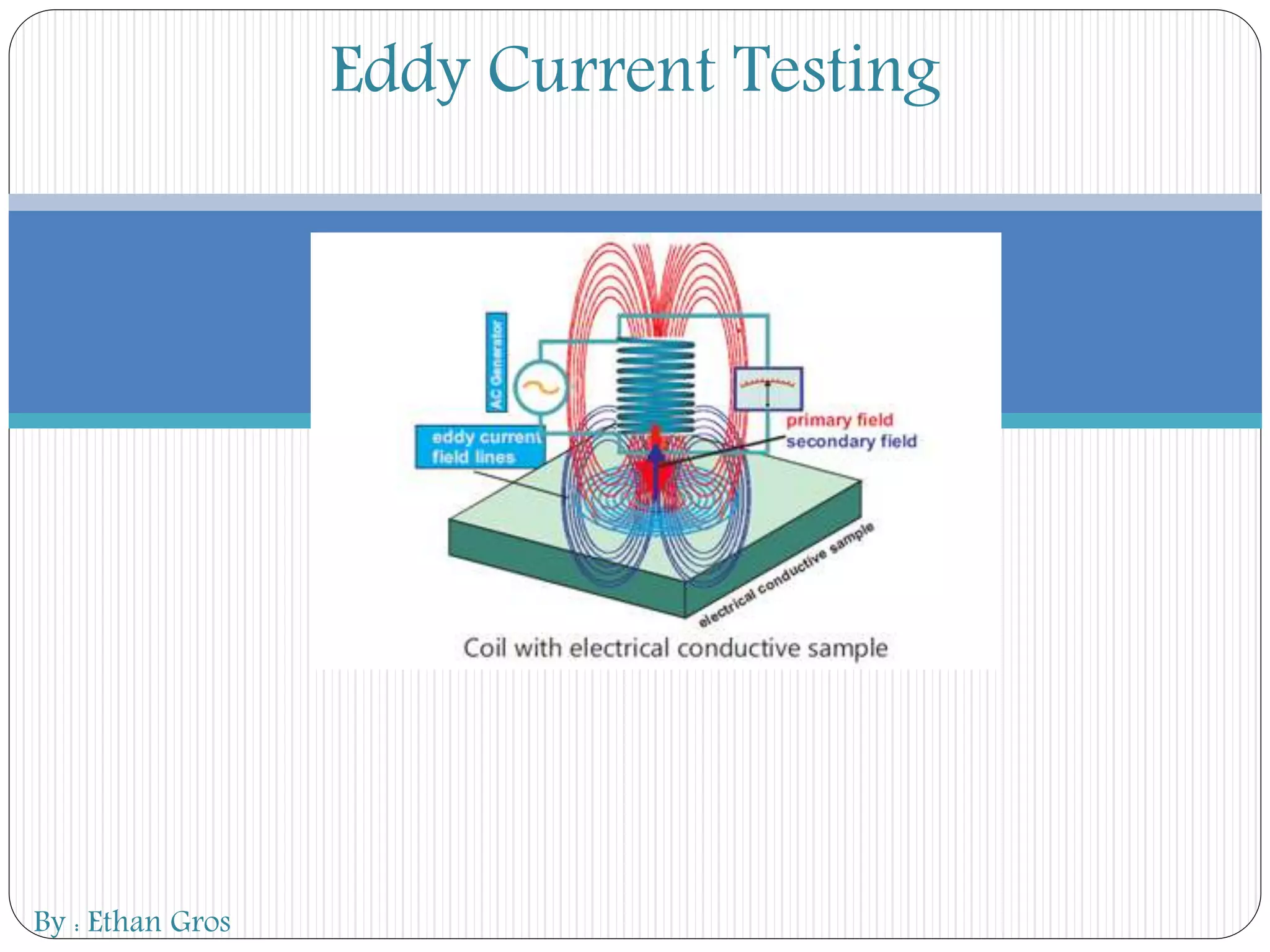
Eddy Current Testing
By : Ethan Gros
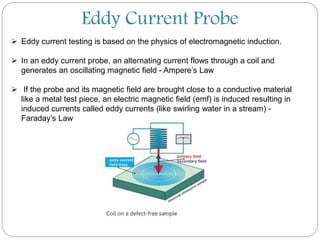
 Eddy current testing is based on the physics of electromagnetic induction.
 In an eddy current probe, an alternating current flows through a coil and
generates an oscillating magnetic field - Ampere’s Law
 If the probe and its magnetic field are brought close to a conductive material
like a metal test piece, an electric magnetic field (emf) is induced resulting in
induced currents called eddy currents (like swirling water in a stream) -
Faraday’s Law
Eddy Current Probe
Eddy Current Probe Cont.
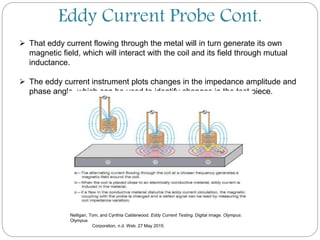
 That eddy current flowing through the metal will in turn generate its own
magnetic field, which will interact with the coil and its field through mutual
inductance.
 The eddy current instrument plots changes in the impedance amplitude and
phase angle, which can be used to identify changes in the test piece.
Nelligan, Tom, and Cynthia Calderwood. Eddy Current Testing. Digital image. Olympus.
Olympus
Corporation, n.d. Web. 27 May 2015.
ADVANTAGES
1) It is very fast method of testing
2) It does not required direct electonic contact
with part being inspected
3) It can be made automatic for high speed
inspection and can be used to inspect the
entire production output if desired
4) Permanent record of test result can be
available
LIMITATIONS
1) Only metallic material can be tested
2) Defects at or near the surface can be
measure
3) Proper size of coil should be used to
maintain the sensitivity of instruments
4) Instruments and display units are costly
MAGNETIC PARTICLE METHOD
•Magnetic particle testing is used for the testing of
materials which can be easily magnetized.
•This method is capable of detecting open to
surface and just below the surface flaws.
•In this method the test specimen is first
magnetized either by using a permanent or an
electromagnet or by passing electric current
through or around the specimen.
• It does not need very powerful pre-cleaning operation.
• Best method for the detection of fine,
shallow surface cracks in ferromagnetic material.
• Relatively simple NDT method.
•Generally inexpensive.
• Will work through thin coating.
•Only few limitations regarding the size/shape of test spe
• Highly portable NDT method.
•It is quicker.
ADVANTAGES
LIMITATIONS:
•Material must be ferromagnetic.
• Orientation and strength of magnetic field is
critical.
• Detects surface and near-to-surface
discontinuities
only.
• Large currents sometimes required.
• “Burning” of test parts a possibility.
• Parts must often be demagnetized, which may
be
difficult.
THANK YOU

EDDY CURRENT TESTING

  • 1.
  • 2.
     Eddy currenttesting is based on the physics of electromagnetic induction.  In an eddy current probe, an alternating current flows through a coil and generates an oscillating magnetic field - Ampere’s Law  If the probe and its magnetic field are brought close to a conductive material like a metal test piece, an electric magnetic field (emf) is induced resulting in induced currents called eddy currents (like swirling water in a stream) - Faraday’s Law Eddy Current Probe
  • 3.
    Eddy Current ProbeCont.  That eddy current flowing through the metal will in turn generate its own magnetic field, which will interact with the coil and its field through mutual inductance.  The eddy current instrument plots changes in the impedance amplitude and phase angle, which can be used to identify changes in the test piece. Nelligan, Tom, and Cynthia Calderwood. Eddy Current Testing. Digital image. Olympus. Olympus Corporation, n.d. Web. 27 May 2015.
  • 6.
    ADVANTAGES 1) It isvery fast method of testing 2) It does not required direct electonic contact with part being inspected 3) It can be made automatic for high speed inspection and can be used to inspect the entire production output if desired 4) Permanent record of test result can be available
  • 7.
    LIMITATIONS 1) Only metallicmaterial can be tested 2) Defects at or near the surface can be measure 3) Proper size of coil should be used to maintain the sensitivity of instruments 4) Instruments and display units are costly
  • 8.
    MAGNETIC PARTICLE METHOD •Magneticparticle testing is used for the testing of materials which can be easily magnetized. •This method is capable of detecting open to surface and just below the surface flaws. •In this method the test specimen is first magnetized either by using a permanent or an electromagnet or by passing electric current through or around the specimen.
  • 10.
    • It doesnot need very powerful pre-cleaning operation. • Best method for the detection of fine, shallow surface cracks in ferromagnetic material. • Relatively simple NDT method. •Generally inexpensive. • Will work through thin coating. •Only few limitations regarding the size/shape of test spe • Highly portable NDT method. •It is quicker. ADVANTAGES
  • 11.
    LIMITATIONS: •Material must beferromagnetic. • Orientation and strength of magnetic field is critical. • Detects surface and near-to-surface discontinuities only. • Large currents sometimes required. • “Burning” of test parts a possibility. • Parts must often be demagnetized, which may be difficult.
  • 12.