1
Non-destructive Testing
2
Non-Destructive Testing (NDT)
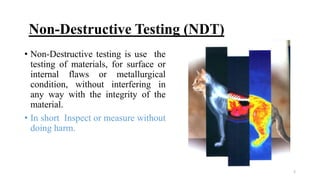
• Non-Destructive testing is use the
testing of materials, for surface or
internal flaws or metallurgical
condition, without interfering in
any way with the integrity of the
material.
• In short Inspect or measure without
doing harm.
3
Importance of NDT
1. NDT increases the safety and reliability of the product during
operation.
2. It decreases the cost of the product by reducing scrap and conserving
materials, labour and energy.
3. It enhances the reputation of the manufacturer as a producer of
quality goods.
4. NDT is also used widely for routine or periodic determination of
quality
Methods of NDT
1. Visual Testing (VT)
2. Dye Penetrant Testing (DPT)
3 Magnetic Particle Testing (MPT)
4. Ultrasonic Testing (UT)
5. Eddy Current Testing (ECT)
6. Radiography Testing (RT)
4
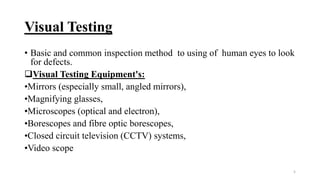
Visual Testing
• Basic and common inspection method to using of human eyes to look
for defects.
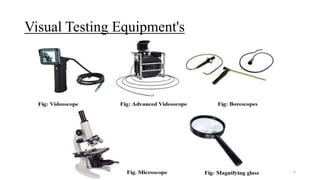
Visual Testing Equipment's:
•Mirrors (especially small, angled mirrors),
•Magnifying glasses,
•Microscopes (optical and electron),
•Borescopes and fibre optic borescopes,
•Closed circuit television (CCTV) systems,
•Video scope
5
Visual Testing Equipment's
6
Advantages
• Low cost
• It is quick method to verify
• limited equipment needed
Disadvantages
• Not the ultimate cleaning verification
• Accessibility
• Experience of inspector
• Time allocation
• Allergen Clean
7
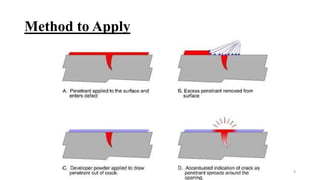
Dye Penetrant Testing
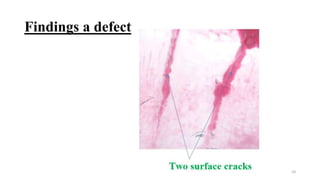
• Detect the surface cracks or defects.
• (DPT) is one of the most widely used non-destructive Testing (NDT)
methods.
• DPT can be used to inspect almost any material provided that its
surface is not extremely rough.
• Three liquids are used in this method.
• 1. Cleaner
• 2. Penetrant
• 3. Developer
8
Method to Apply
9
Findings a defect
10
Advantages of Dye Penetrant Testing
• Highly sensitivity to small surface discontinuities.
• Large areas and large volumes of parts/materials can be inspected
rapidly
• low cost
• Indications are produced directly on the surface
• Spray can make penetrant materials very portable.
• Penetrant materials and associated equipment's are relatively
inexpensive.
11
Limitations of Dye Penetrant Testing
• Only surface breaking defects can be detected.
• Pre cleaning is critical
• Surface finish and roughness can affect inspection sensitivity.
• Post cleaning of acceptable parts or materials is required.
• Chemical handling
• Proper disposal is required
12
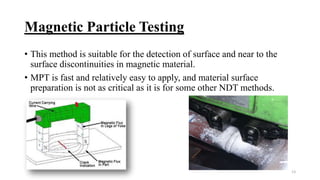
Magnetic Particle Testing
• This method is suitable for the detection of surface and near to the
surface discontinuities in magnetic material.
• MPT is fast and relatively easy to apply, and material surface
preparation is not as critical as it is for some other NDT methods.
13
Advantages Magnetic Particle Testing
• It does not need very stringent pre-cleaning
• It is the best method for the detection of surface and near to the
surface cracks in ferromagnetic materials.
• Fast and relatively simple NDT method.
• Generally inexpensive.
• Will work through thin coating.
• Highly portable NDT method.
• It is quicker.
14
Limitations of Magnetic Particle Testing
• Material must be ferromagnetic.
• Orientation and strength of magnetic field is critical.
• Detects surface and near-to-surface discontinuities only.
• Large currents sometimes require.
15
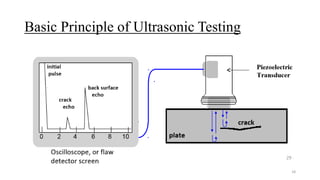
Ultrasonic Testing
• This technique is used for the detection of internal surface (particularly
distant surface) defects in sound conducting materials.
• high frequency sound waves are introduced into a material and they
are reflected back from surface and flaws.
• Reflected sound energy is displayed versus time, and inspector can
visualize a cross section of the specimen showing the depth of
features.
• Audible frequency range is 20-20,000 Hz it has higher frequency than
normal audible sound
16
What sort of materials can be tested?
• Metals
• Plastics
• Composites
• Ceramics.
 Application
• Detect cracks and defects
thickness, such as measuring the wall thickness of a pipe.
17
Basic Principle of Ultrasonic Testing
18
Advantages of Ultrasonic Testing
• Thickness and lengths up to 30 ft. can be tested.
• Position, size and type of defect can be determined.
• Instant test results.
• Portable.
• Capable of being fully automated.
• Access to only one side necessary
19
Limitations of Ultrasonic Testing
• Difficult to identify whether the work piece is defective or not while
the test is in progress.
• Skill & Knowledge is necessary
• Very thin sections can prove difficult.
20
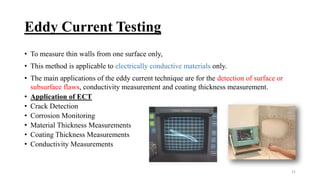
Eddy Current Testing
• To measure thin walls from one surface only,
• This method is applicable to electrically conductive materials only.
• The main applications of the eddy current technique are for the detection of surface or
subsurface flaws, conductivity measurement and coating thickness measurement.
• Application of ECT
• Crack Detection
• Corrosion Monitoring
• Material Thickness Measurements
• Coating Thickness Measurements
• Conductivity Measurements
21
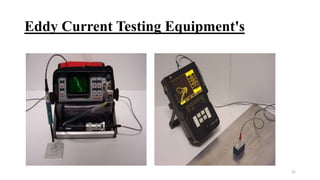
Eddy Current Testing Equipment's
22
Advantages of Eddy Current Testing
• Sensitive to small cracks and other defects
• Detect near surface defects
• Inspection gives immediate results
• Equipment is very portable
• Method can be used for much more than flaw detection
• Inspects complex shapes and sizes of conductive materials
23
Limitations of Eddy Current Testing
• Only conductive materials can be inspected.
• Surface must be accessible to the probe.
• Skill and training required is more extensive than other
techniques.
• Depth of penetration is limited.
24
X- Ray (Radiography Testing)
• Inspecting materials for hidden flaws by using the ability of short
wavelength electromagnetic radiation.
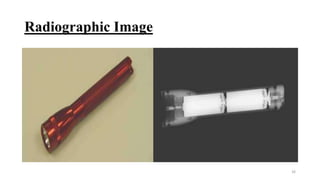
• Radiographic Testing Method is nothing but to take the shadow picture
of an object onto a film by the passage of X-ray or Gamma ray
through it.
• It is the same as the medical radiography (X-ray).
• Only difference in their wave length.
25
Radiographic Image
26
Advantages of Radiography Testing
• Information is presented pictorially.
• A permanent record is provided which may be viewed at a time and
place distant from the test.
• Useful for thin sections.
• Sensitivity declared on each film suitable for any material.
27
Limitations of Radiography Testing
• Possible health hazard.
• Need to direct the beam accurately for two-dimensional defects.
• Film processing and viewing facilities are necessary
• Not suitable for automation.
• Not suitable for surface defects.
28

Non destructive evaluation

  • 1.
  • 2.
    2 Non-Destructive Testing (NDT) •Non-Destructive testing is use the testing of materials, for surface or internal flaws or metallurgical condition, without interfering in any way with the integrity of the material. • In short Inspect or measure without doing harm.
  • 3.
    3 Importance of NDT 1.NDT increases the safety and reliability of the product during operation. 2. It decreases the cost of the product by reducing scrap and conserving materials, labour and energy. 3. It enhances the reputation of the manufacturer as a producer of quality goods. 4. NDT is also used widely for routine or periodic determination of quality
  • 4.
    Methods of NDT 1.Visual Testing (VT) 2. Dye Penetrant Testing (DPT) 3 Magnetic Particle Testing (MPT) 4. Ultrasonic Testing (UT) 5. Eddy Current Testing (ECT) 6. Radiography Testing (RT) 4
  • 5.
    Visual Testing • Basicand common inspection method to using of human eyes to look for defects. Visual Testing Equipment's: •Mirrors (especially small, angled mirrors), •Magnifying glasses, •Microscopes (optical and electron), •Borescopes and fibre optic borescopes, •Closed circuit television (CCTV) systems, •Video scope 5
  • 6.
  • 7.
    Advantages • Low cost •It is quick method to verify • limited equipment needed Disadvantages • Not the ultimate cleaning verification • Accessibility • Experience of inspector • Time allocation • Allergen Clean 7
  • 8.
    Dye Penetrant Testing •Detect the surface cracks or defects. • (DPT) is one of the most widely used non-destructive Testing (NDT) methods. • DPT can be used to inspect almost any material provided that its surface is not extremely rough. • Three liquids are used in this method. • 1. Cleaner • 2. Penetrant • 3. Developer 8
  • 9.
  • 10.
  • 11.
    Advantages of DyePenetrant Testing • Highly sensitivity to small surface discontinuities. • Large areas and large volumes of parts/materials can be inspected rapidly • low cost • Indications are produced directly on the surface • Spray can make penetrant materials very portable. • Penetrant materials and associated equipment's are relatively inexpensive. 11
  • 12.
    Limitations of DyePenetrant Testing • Only surface breaking defects can be detected. • Pre cleaning is critical • Surface finish and roughness can affect inspection sensitivity. • Post cleaning of acceptable parts or materials is required. • Chemical handling • Proper disposal is required 12
  • 13.
    Magnetic Particle Testing •This method is suitable for the detection of surface and near to the surface discontinuities in magnetic material. • MPT is fast and relatively easy to apply, and material surface preparation is not as critical as it is for some other NDT methods. 13
  • 14.
    Advantages Magnetic ParticleTesting • It does not need very stringent pre-cleaning • It is the best method for the detection of surface and near to the surface cracks in ferromagnetic materials. • Fast and relatively simple NDT method. • Generally inexpensive. • Will work through thin coating. • Highly portable NDT method. • It is quicker. 14
  • 15.
    Limitations of MagneticParticle Testing • Material must be ferromagnetic. • Orientation and strength of magnetic field is critical. • Detects surface and near-to-surface discontinuities only. • Large currents sometimes require. 15
  • 16.
    Ultrasonic Testing • Thistechnique is used for the detection of internal surface (particularly distant surface) defects in sound conducting materials. • high frequency sound waves are introduced into a material and they are reflected back from surface and flaws. • Reflected sound energy is displayed versus time, and inspector can visualize a cross section of the specimen showing the depth of features. • Audible frequency range is 20-20,000 Hz it has higher frequency than normal audible sound 16
  • 17.
    What sort ofmaterials can be tested? • Metals • Plastics • Composites • Ceramics.  Application • Detect cracks and defects thickness, such as measuring the wall thickness of a pipe. 17
  • 18.
    Basic Principle ofUltrasonic Testing 18
  • 19.
    Advantages of UltrasonicTesting • Thickness and lengths up to 30 ft. can be tested. • Position, size and type of defect can be determined. • Instant test results. • Portable. • Capable of being fully automated. • Access to only one side necessary 19
  • 20.
    Limitations of UltrasonicTesting • Difficult to identify whether the work piece is defective or not while the test is in progress. • Skill & Knowledge is necessary • Very thin sections can prove difficult. 20
  • 21.
    Eddy Current Testing •To measure thin walls from one surface only, • This method is applicable to electrically conductive materials only. • The main applications of the eddy current technique are for the detection of surface or subsurface flaws, conductivity measurement and coating thickness measurement. • Application of ECT • Crack Detection • Corrosion Monitoring • Material Thickness Measurements • Coating Thickness Measurements • Conductivity Measurements 21
  • 22.
    Eddy Current TestingEquipment's 22
  • 23.
    Advantages of EddyCurrent Testing • Sensitive to small cracks and other defects • Detect near surface defects • Inspection gives immediate results • Equipment is very portable • Method can be used for much more than flaw detection • Inspects complex shapes and sizes of conductive materials 23
  • 24.
    Limitations of EddyCurrent Testing • Only conductive materials can be inspected. • Surface must be accessible to the probe. • Skill and training required is more extensive than other techniques. • Depth of penetration is limited. 24
  • 25.
    X- Ray (RadiographyTesting) • Inspecting materials for hidden flaws by using the ability of short wavelength electromagnetic radiation. • Radiographic Testing Method is nothing but to take the shadow picture of an object onto a film by the passage of X-ray or Gamma ray through it. • It is the same as the medical radiography (X-ray). • Only difference in their wave length. 25
  • 26.
  • 27.
    Advantages of RadiographyTesting • Information is presented pictorially. • A permanent record is provided which may be viewed at a time and place distant from the test. • Useful for thin sections. • Sensitivity declared on each film suitable for any material. 27
  • 28.
    Limitations of RadiographyTesting • Possible health hazard. • Need to direct the beam accurately for two-dimensional defects. • Film processing and viewing facilities are necessary • Not suitable for automation. • Not suitable for surface defects. 28