Seminar on
Eddy current Testing
Department of Aeronautical Engineering
Improved Delivery Methods
Non Destructive Testing (2022-23)
Name of the Faculty
Mr.Somaiah
Assistant Professor
Department of Aeronautical Engineering
11-10-2022
STUDENT NAME:PRAGATHi B.S
USN:1NT20AE041
Abstract
11-10-2022 Department of Aeronautical Engineering 2
Non-destructive techniques are used in the metal industry and science
in order to evaluate the properties of a wide variety of materials
without causing damage. Some of the most common non-destructive
techniques are electromagnetic, ultrasonic and liquid penetrant testing.
One of the conventional electromagnetic methods utilized for the
inspection of conductive materials such as copper, aluminum or steel
is eddy current non-destructive testing .Electromagnetic methods such
as eddy current, magnetic particle or radiographic and ultrasonic
methods all introduce electromagnetic or sound waves into the
inspected material in order to extract its properties. Penetrant liquid
techniques can detect cracks in the test material by using either
fluorescent or non-fluorescent dyes.
Principle of eddy current testing
11-10-2022 Department of Aeronautical Engineering 3
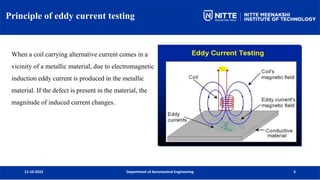
When a coil carrying alternative current comes in a
vicinity of a metallic material, due to electromagnetic
induction eddy current is produced in the metallic
material. If the defect is present in the material, the
magnitude of induced current changes.
11-10-2022 Department of Aeronautical Engineering 4
Eddy current testing
• eddy current testing permits crack detection in a large variety of conductive materials, either ferromagnetic or non-ferromagnetic,
whereas other non-destructive techniques such as the magnetic particle method are limited to ferromagnetic metals.
• Another advantage of the eddy current method over other techniques is that inspection can be implemented without any direct
physical contact between the sensor and the inspected piece.
• In addition, a wide variety of inspections and measurements may be performed with the eddy current methods that are beyond the
scope of other techniques. Measurements of non-conductive coating thickness and conductivity can be done.
• Conductivity is related to the composition and heat treatment of the test material. Therefore, the eddy current method can also be
used to distinguish between pure materials and alloy compositions and to determine the hardness of test pieces after heat treatments
11-10-2022 Department of Aeronautical Engineering 5
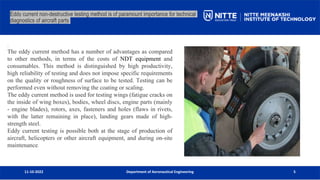
Eddy current non-destructive testing method is of paramount importance for technical
diagnostics of aircraft parts
.
The eddy current method has a number of advantages as compared
to other methods, in terms of the costs of NDT equipment and
consumables. This method is distinguished by high productivity,
high reliability of testing and does not impose specific requirements
on the quality or roughness of surface to be tested. Testing can be
performed even without removing the coating or scaling.
The eddy current method is used for testing wings (fatigue cracks on
the inside of wing boxes), bodies, wheel discs, engine parts (mainly
- engine blades), rotors, axes, fasteners and holes (flaws in rivets,
with the latter remaining in place), landing gears made of high-
strength steel.
Eddy current testing is possible both at the stage of production of
aircraft, helicopters or other aircraft equipment, and during on-site
maintenance.
Accident due eddy current testing failure
6
on April 28, 1988, the skin of an aging Aloha Airlines 737 peeled off at 24,000 feet. A crew member was lost in the
resulting explosive decompression, and the passenger cabin was opened to the frigid, oxygen-poor sky. Only sheer
luck, the intrinsic strength of the 737 airframe, and the skill of the pilots managed to get this aircraft back on the
ground safely.
So what happened? According to the NTSB, “the probable cause of this accident was the failure of the Aloha
Airlines maintenance program to detect the presence of significant disbonding and fatigue damage which ultimately
led to failure of the lap joint … and the separation of the fuselage upper lobe.” These were problems that could have
been detected using nondestructive eddy current testing. As a result of the Aloha Flight 243 near-disaster, detecting
such faults in this manner has become standard aircraft maintenance procedure.
But what is eddy current testing, and how can this nondestructive testing (NDT) process find potentially disastrous
flaws safely and reliably? That’s what this article is all about.
Applications
•
Eddy current testing has many uses in the maintenance hangar. On airframes, for instance, “it is primarily
deployed for detecting cracks and faults in riveted areas,” says Dr. Nakagawa. “Since these rivets literally hold
the airframe together, the integrity of these joints and their holes is paramount to the aircraft’s overall integrity.”
• Areas that take a lot of stress, such as undercarriages and engine casings, are also prime targets for eddy current
testing. “The amount of stress undercarriages experience during repeated takeoffs and landings makes them
vulnerable to cracks and other forms of fatigue,” says Jankowski. “Meanwhile, if the engines are kept running too
long after landing, materials in those areas can be inadvertently backtempered; making them brittle and more
prone to failure. The symptoms of these problems can all be detected using eddy current testing.”
7
conclusion
8
In conclusion, as eddy current and developers of solutions based on eddy current testing, we have found that eddy current
techniques can provide the industry with reliable quality control systems. Although there are excellent improvements due to the
effort of the many scientists during the last several years, we believe that more research in eddy current techniques, in terms of
sensors, equipment and signal processing, will lead to even more applications of these techniques.
Thank you.
Aeronautical Engineering

shashi.pptx

  • 1.
    Seminar on Eddy currentTesting Department of Aeronautical Engineering Improved Delivery Methods Non Destructive Testing (2022-23) Name of the Faculty Mr.Somaiah Assistant Professor Department of Aeronautical Engineering 11-10-2022 STUDENT NAME:PRAGATHi B.S USN:1NT20AE041
  • 2.
    Abstract 11-10-2022 Department ofAeronautical Engineering 2 Non-destructive techniques are used in the metal industry and science in order to evaluate the properties of a wide variety of materials without causing damage. Some of the most common non-destructive techniques are electromagnetic, ultrasonic and liquid penetrant testing. One of the conventional electromagnetic methods utilized for the inspection of conductive materials such as copper, aluminum or steel is eddy current non-destructive testing .Electromagnetic methods such as eddy current, magnetic particle or radiographic and ultrasonic methods all introduce electromagnetic or sound waves into the inspected material in order to extract its properties. Penetrant liquid techniques can detect cracks in the test material by using either fluorescent or non-fluorescent dyes.
  • 3.
    Principle of eddycurrent testing 11-10-2022 Department of Aeronautical Engineering 3 When a coil carrying alternative current comes in a vicinity of a metallic material, due to electromagnetic induction eddy current is produced in the metallic material. If the defect is present in the material, the magnitude of induced current changes.
  • 4.
    11-10-2022 Department ofAeronautical Engineering 4 Eddy current testing • eddy current testing permits crack detection in a large variety of conductive materials, either ferromagnetic or non-ferromagnetic, whereas other non-destructive techniques such as the magnetic particle method are limited to ferromagnetic metals. • Another advantage of the eddy current method over other techniques is that inspection can be implemented without any direct physical contact between the sensor and the inspected piece. • In addition, a wide variety of inspections and measurements may be performed with the eddy current methods that are beyond the scope of other techniques. Measurements of non-conductive coating thickness and conductivity can be done. • Conductivity is related to the composition and heat treatment of the test material. Therefore, the eddy current method can also be used to distinguish between pure materials and alloy compositions and to determine the hardness of test pieces after heat treatments
  • 5.
    11-10-2022 Department ofAeronautical Engineering 5 Eddy current non-destructive testing method is of paramount importance for technical diagnostics of aircraft parts . The eddy current method has a number of advantages as compared to other methods, in terms of the costs of NDT equipment and consumables. This method is distinguished by high productivity, high reliability of testing and does not impose specific requirements on the quality or roughness of surface to be tested. Testing can be performed even without removing the coating or scaling. The eddy current method is used for testing wings (fatigue cracks on the inside of wing boxes), bodies, wheel discs, engine parts (mainly - engine blades), rotors, axes, fasteners and holes (flaws in rivets, with the latter remaining in place), landing gears made of high- strength steel. Eddy current testing is possible both at the stage of production of aircraft, helicopters or other aircraft equipment, and during on-site maintenance.
  • 6.
    Accident due eddycurrent testing failure 6 on April 28, 1988, the skin of an aging Aloha Airlines 737 peeled off at 24,000 feet. A crew member was lost in the resulting explosive decompression, and the passenger cabin was opened to the frigid, oxygen-poor sky. Only sheer luck, the intrinsic strength of the 737 airframe, and the skill of the pilots managed to get this aircraft back on the ground safely. So what happened? According to the NTSB, “the probable cause of this accident was the failure of the Aloha Airlines maintenance program to detect the presence of significant disbonding and fatigue damage which ultimately led to failure of the lap joint … and the separation of the fuselage upper lobe.” These were problems that could have been detected using nondestructive eddy current testing. As a result of the Aloha Flight 243 near-disaster, detecting such faults in this manner has become standard aircraft maintenance procedure. But what is eddy current testing, and how can this nondestructive testing (NDT) process find potentially disastrous flaws safely and reliably? That’s what this article is all about.
  • 7.
    Applications • Eddy current testinghas many uses in the maintenance hangar. On airframes, for instance, “it is primarily deployed for detecting cracks and faults in riveted areas,” says Dr. Nakagawa. “Since these rivets literally hold the airframe together, the integrity of these joints and their holes is paramount to the aircraft’s overall integrity.” • Areas that take a lot of stress, such as undercarriages and engine casings, are also prime targets for eddy current testing. “The amount of stress undercarriages experience during repeated takeoffs and landings makes them vulnerable to cracks and other forms of fatigue,” says Jankowski. “Meanwhile, if the engines are kept running too long after landing, materials in those areas can be inadvertently backtempered; making them brittle and more prone to failure. The symptoms of these problems can all be detected using eddy current testing.” 7
  • 8.
    conclusion 8 In conclusion, aseddy current and developers of solutions based on eddy current testing, we have found that eddy current techniques can provide the industry with reliable quality control systems. Although there are excellent improvements due to the effort of the many scientists during the last several years, we believe that more research in eddy current techniques, in terms of sensors, equipment and signal processing, will lead to even more applications of these techniques.
  • 9.