

GEOTECHNICS & APPLIED GEOLGIY 
SUBJECT CODE: 2130606 
EARTHQUAKES 
B.E. 3RD SEM 
Branch:-Civil 
Div:-C 
1 
HJD Institute of Technical Education and Research, Kera-Kutch.
Presented By: 
ROLL NO.: NAME ENL. NO.: 
57 PRAJAPATI JITENDRA P. 130850106062 
31 JIVANI KULDEEP 130850106032 
52 PATEL SAVAN . 130850106057 
53 PATEL TEJAS. 130850106058 
21 GOSWAMI DENISH 130850106022 
58 PRAJAPATI PUNIT B. 130850106063
What are Earthquakes 
 Vibrations induced in the earth’s 
crust due to internal or external 
causes that virtually shake up the a 
part of the crust and all the 
structures along with living and non-living 
things.
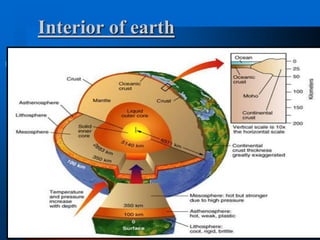
Interior of earth
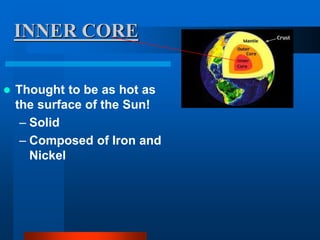
INNER CORE 
 Thought to be as hot as 
the surface of the Sun! 
– Solid 
– Composed of Iron and 
Nickel
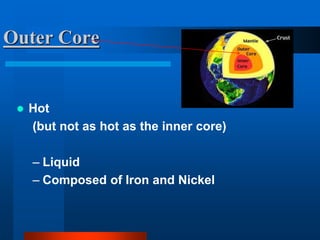
Outer Core 
 Hot 
(but not as hot as the inner core) 
– Liquid 
– Composed of Iron and Nickel
Mantle 
 Still hot! – 
(but not as hot as the core!) 
– Largest layer 
– Composed of various materials 
– Solid and liquid 
– Made up of ultra basic rocks.
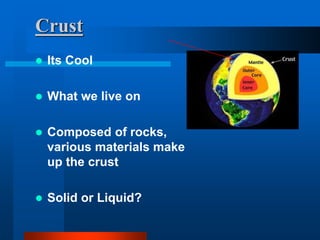
Crust 
 Its Cool 
 What we live on 
 Composed of rocks, 
various materials make 
up the crust 
 Solid or Liquid?
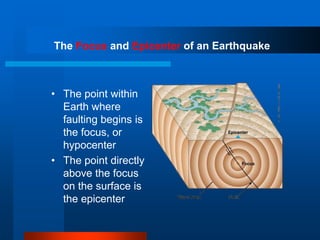
The Focus and Epicenter of an Earthquake 
• The point within 
Earth where 
faulting begins is 
the focus, or 
hypocenter 
• The point directly 
above the focus 
on the surface is 
the epicenter
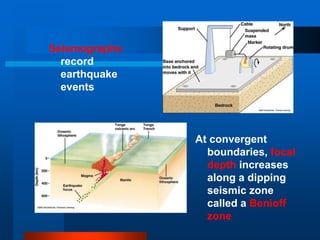
Seismographs 
record 
earthquake 
events 
At convergent 
boundaries, focal 
depth increases 
along a dipping 
seismic zone 
called a Benioff 
zone
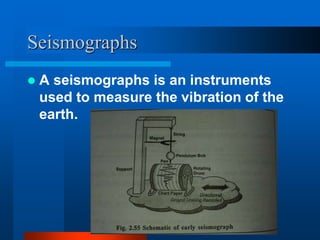
Seismographs 
 A seismographs is an instruments 
used to measure the vibration of the 
earth.
COMPONENSTS 
 The sensor :- consisting of the pendulum mass, 
string, magnet and support. 
 The recorder :- consisting of the drum, pen and 
chart paper. 
 The timer :- consisting of the motor that rotates 
the drum at constant speed.
What are Seismic Waves? 
 Response of material to the 
arrival of energy fronts 
released by rupture 
 Two types: 
– Body waves 
• P and S 
– Surface waves 
• R and L
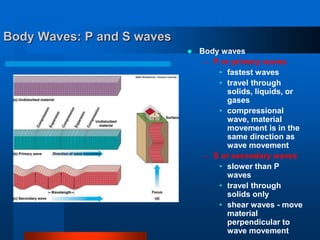
Body Waves: P and S waves 
 Body waves 
– P or primary waves 
• fastest waves 
• travel through 
solids, liquids, or 
gases 
• compressional 
wave, material 
movement is in the 
same direction as 
wave movement 
– S or secondary waves 
• slower than P 
waves 
• travel through 
solids only 
• shear waves - move 
material 
perpendicular to 
wave movement
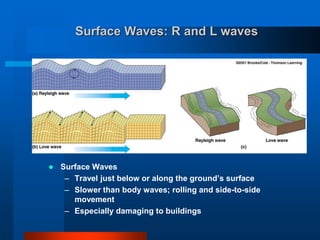
Surface Waves: R and L waves 
 Surface Waves 
– Travel just below or along the ground’s surface 
– Slower than body waves; rolling and side-to-side 
movement 
– Especially damaging to buildings
Causes of earthquakes 
 Two main causes of earthquakes 
– Tectonic earthquakes 
• Stressing 
• Straining ( Flexuring & fracturing) 
Elastic Rebound theory 
• Faulting 
– Reservoir induced earthquakes 
• These are caused due to 
– Sagging effect 
– Increased pore pressure 
– Man made cause like atomic explosion, 
blasting activity in mining, 
– Volcanic explosions
Effects of earthquakes 
 The earthquakes are classified into two 
– Primary effects 
– Secondary effects 
 Primary effects 
– It includes effects which are directly related to the cause of 
origin of an earthquake. Tectonic activity is often responsible 
for producing major changes in the geological structures of an 
area like; 
• Creation of slope 
• Fissures, streams 
• Origin of new springs and sand dike 
• Emergence or subsidence of coastlines.
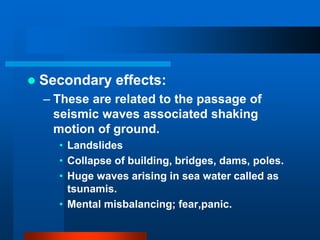
 Secondary effects: 
– These are related to the passage of 
seismic waves associated shaking 
motion of ground. 
• Landslides 
• Collapse of building, bridges, dams, poles. 
• Huge waves arising in sea water called as 
tsunamis. 
• Mental misbalancing; fear,panic.
Earthquakes
Earthquakes
Earthquakes

Earthquakes

  • 1.
    GEOTECHNICS & APPLIEDGEOLGIY SUBJECT CODE: 2130606 EARTHQUAKES B.E. 3RD SEM Branch:-Civil Div:-C 1 HJD Institute of Technical Education and Research, Kera-Kutch.
  • 2.
    Presented By: ROLLNO.: NAME ENL. NO.: 57 PRAJAPATI JITENDRA P. 130850106062 31 JIVANI KULDEEP 130850106032 52 PATEL SAVAN . 130850106057 53 PATEL TEJAS. 130850106058 21 GOSWAMI DENISH 130850106022 58 PRAJAPATI PUNIT B. 130850106063
  • 3.
    What are Earthquakes  Vibrations induced in the earth’s crust due to internal or external causes that virtually shake up the a part of the crust and all the structures along with living and non-living things.
  • 4.
  • 5.
    INNER CORE Thought to be as hot as the surface of the Sun! – Solid – Composed of Iron and Nickel
  • 6.
    Outer Core Hot (but not as hot as the inner core) – Liquid – Composed of Iron and Nickel
  • 7.
    Mantle  Stillhot! – (but not as hot as the core!) – Largest layer – Composed of various materials – Solid and liquid – Made up of ultra basic rocks.
  • 8.
    Crust  ItsCool  What we live on  Composed of rocks, various materials make up the crust  Solid or Liquid?
  • 9.
    The Focus andEpicenter of an Earthquake • The point within Earth where faulting begins is the focus, or hypocenter • The point directly above the focus on the surface is the epicenter
  • 10.
    Seismographs record earthquake events At convergent boundaries, focal depth increases along a dipping seismic zone called a Benioff zone
  • 11.
    Seismographs  Aseismographs is an instruments used to measure the vibration of the earth.
  • 12.
    COMPONENSTS  Thesensor :- consisting of the pendulum mass, string, magnet and support.  The recorder :- consisting of the drum, pen and chart paper.  The timer :- consisting of the motor that rotates the drum at constant speed.
  • 13.
    What are SeismicWaves?  Response of material to the arrival of energy fronts released by rupture  Two types: – Body waves • P and S – Surface waves • R and L
  • 14.
    Body Waves: Pand S waves  Body waves – P or primary waves • fastest waves • travel through solids, liquids, or gases • compressional wave, material movement is in the same direction as wave movement – S or secondary waves • slower than P waves • travel through solids only • shear waves - move material perpendicular to wave movement
  • 15.
    Surface Waves: Rand L waves  Surface Waves – Travel just below or along the ground’s surface – Slower than body waves; rolling and side-to-side movement – Especially damaging to buildings
  • 16.
    Causes of earthquakes  Two main causes of earthquakes – Tectonic earthquakes • Stressing • Straining ( Flexuring & fracturing) Elastic Rebound theory • Faulting – Reservoir induced earthquakes • These are caused due to – Sagging effect – Increased pore pressure – Man made cause like atomic explosion, blasting activity in mining, – Volcanic explosions
  • 17.
    Effects of earthquakes  The earthquakes are classified into two – Primary effects – Secondary effects  Primary effects – It includes effects which are directly related to the cause of origin of an earthquake. Tectonic activity is often responsible for producing major changes in the geological structures of an area like; • Creation of slope • Fissures, streams • Origin of new springs and sand dike • Emergence or subsidence of coastlines.
  • 18.
     Secondary effects: – These are related to the passage of seismic waves associated shaking motion of ground. • Landslides • Collapse of building, bridges, dams, poles. • Huge waves arising in sea water called as tsunamis. • Mental misbalancing; fear,panic.