Presentation
On
EARTHQUAKE
Master of science in Agriculture
SUBMITTED TO
Dr. K.k Sahu
Deptt. of soil science and
agricultural chemistry
IGKV Raipur
SUBMITTED BY
Dayashankar Baghel
M.sc.(Previous)
Deptt. of Agril.
Microbiology
Introduction
Earthquakes constitute one of the worst natural hazards which
often turn into disaster causing widespread destruction and
loss to human life. The effects of earthquake vary upon the
magnitude and intensity. Earthquakes occur every now and
then all round the world, except in some places where
earthquakes occur rarely. The devastation of cities and towns
is one of the effects of earthquake.
What is Earthquake
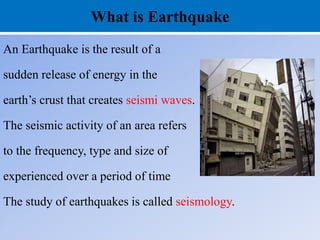
An Earthquake is the result of a
sudden release of energy in the
earth’s crust that creates seismi waves.
The seismic activity of an area refers
to the frequency, type and size of
experienced over a period of time
The study of earthquakes is called seismology.
Terms related to earthquake
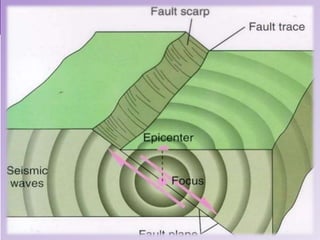
Focus(Hypocenter): Focus is the point on the fault where rupture occurs and the
location from which seismic waves are released.
Epicenter: Epicenter is the point on the earth’s surface that is directly above the
focus ,the point where an earthquake or underground explosion originates.
Fault Line: A Fault line is the surface trace of a fault, the line of intersection
between the earth’s surface.
Fault plane: Fault plane are the crackes or sudden slips of the land .
Fault Scrap: A Fault scrap is the topographic expression of faulting attributed to
the displacement of the land surface by movement along faults.
G
Causes of earthquake
• The primary cause of an earthquake is faults on the crust of
the earth. “A Fault is a break or fracture b/w two blocks of
rocks in response to stress.”
• This movement may occur rapidly, in the form of an
earthquake or may occur slowly, in the form of creep.
• Earth scientists use the angle of the fault with respect to the
surface (known as the dip) and the direction of slip along
the fault to classify faults.
J
Classification of faults
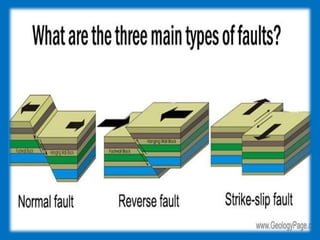
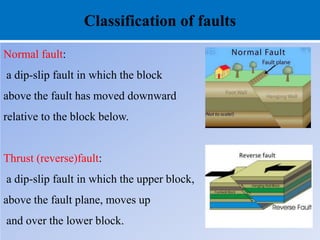
Normal fault:
a dip-slip fault in which the block
above the fault has moved downward
relative to the block below.
Thrust (reverse)fault:
a dip-slip fault in which the upper block,
above the fault plane, moves up
and over the lower block.
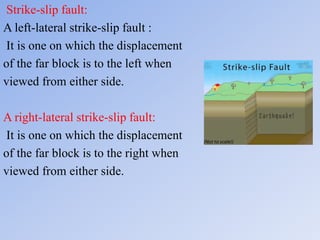
Strike-slip fault:
A left-lateral strike-slip fault :
It is one on which the displacement
of the far block is to the left when
viewed from either side.
A right-lateral strike-slip fault:
It is one on which the displacement
of the far block is to the right when
viewed from either side.
Major causes of earthquake
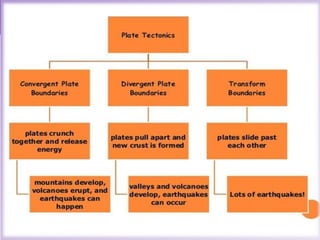
• tectonic earthquake is one that occurs when the earth's crust breaks
due to geological forces on rocks and adjoining plates that cause
physical and chemical changes.
• A volcanic earthquake is any earthquake that results from tectonic
forces which occur in conjunction with volcanic activity.
• Collapse Earthquakes are small earthquakes in the underground and in
mines that are caused by seismic waves produced from the explosion
of rock on the surface. The immediate cause of ground shaking is the
collapse of the roof of the mine or cavern. An often- observed
variation of this extraordinary event is called "mine burst".
• An explosion earthquake is an earthquake that is the result of the
detonation of a nuclear and/or chemical device.
S
Waves produced due to earthquake
SEISMIC WAVES
• Seismic waves originate from the focus of earthquake,
during an event of earthquake.
• Seismic waves are broadly classified into two categories.
1- Body Waves
2- Surface Waves
Body wave
• BODY WAVES
• Body waves are generated due to the release of energy at the
focus and move in all the directions travelling through the
body of the earth.
• There are two types of body waves.
• They are P and S waves.
P-Wave
P –WAVE
• The faster of these body waves is called the primary or P
wave.
• Its motion is the same as that of a sound wave in that, as it
spreads out, it alternately pushes (compresses) and pulls
(dilates) the rock.
• These P waves are able to travel through both solid rock,
such as granite mountains, and liquid material, such as
volcanic magma or the water of the oceans.
S- wave
S- WAVE
• The slower wave through the body of rock is called the
secondary or S wave.
• As an S wave propagates, it shears the rock sideways at
right angles to the direction of travel
• If a liquid is sheared sideways or twisted, it will not spring
back, hence S waves cannot propagate in the liquid parts of
the earth, such as oceans and lakes.
Surface wave
SURFACE WAVE
• The third general type of earthquake wave is called a surface
wave, reason being is that its motion is restricted to near the
ground surface. Such waves correspond to ripples of water that
travel across a lake.
• These waves are most Destructive. They cause displacement of
rocks and hence, the collapse of structure( e.g. Buildings,
Bridges etc.) occurs.
• Surface waves in earthquakes can be divided into two types.
Love wave
LOVE WAVE
• The first is called a Love wave.
• Its motion is essentially that of S waves that have no
vertical displacement; it moves the ground from side to side
in a horizontal plane but at right angles to the direction of
propagation.
• The horizontal shaking of Love waves is particularly
damaging to the foundations of structures.
Rayleigh wave
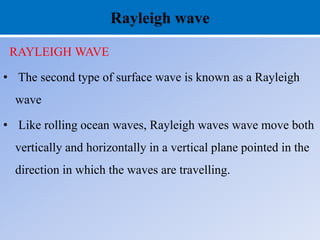
RAYLEIGH WAVE
• The second type of surface wave is known as a Rayleigh
wave
• Like rolling ocean waves, Rayleigh waves wave move both
vertically and horizontally in a vertical plane pointed in the
direction in which the waves are travelling.
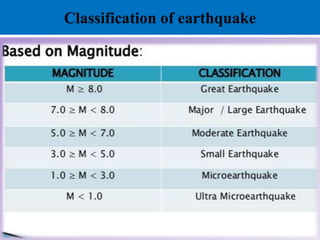
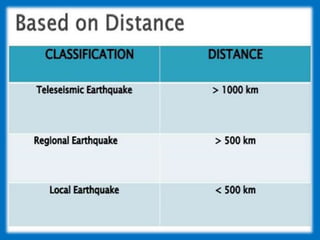
Classification of earthquake
H
H
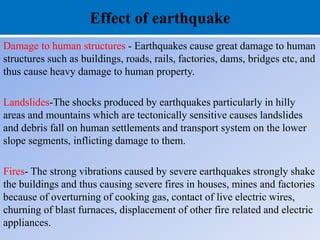
Effect of earthquake
Damage to human structures - Earthquakes cause great damage to human
structures such as buildings, roads, rails, factories, dams, bridges etc, and
thus cause heavy damage to human property.
Landslides-The shocks produced by earthquakes particularly in hilly
areas and mountains which are tectonically sensitive causes landslides
and debris fall on human settlements and transport system on the lower
slope segments, inflicting damage to them.
Fires- The strong vibrations caused by severe earthquakes strongly shake
the buildings and thus causing severe fires in houses, mines and factories
because of overturning of cooking gas, contact of live electric wires,
churning of blast furnaces, displacement of other fire related and electric
appliances.
Effect of earthquake cont..
• Flash Floods- Strong seismic waves cause damage to dams
thereby causing severe flash floods. Severe floods are also
caused because of blocking of water flow of rivers due to rock
blocks and debris produced by severe tremors in the hill slopes
facing the river valleys. Sometimes the blockage is so severe that
rivers change their main course.
• Deformation of Ground surface- severe tremors and resultant
vibrations caused by earthquakes result in the deformation of
ground surface because of rise and subsidence of ground surface
and faulting activity( formation of faults).
• Tsunamis- The seismic waves caused by earthquake(
measuring more than 7 on (scale) travelling through sea
water generate high sea waves and cause great loss of life
and property.
• Soil liquefaction -Soil liquefaction occurs when, because of
the shaking, water-saturated granular material (such as sand)
temporarily loses its strength and transforms from a solid to
a liquid. Soil liquefaction may cause rigid structures, like
buildings and bridges, to tilt or sink into the liquefied
deposits.
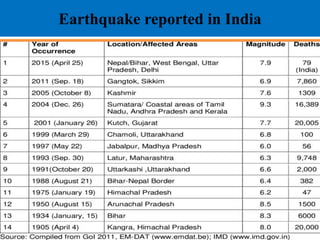
Earthquake reported in India
H
Strength of earthquake
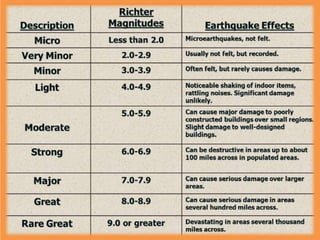
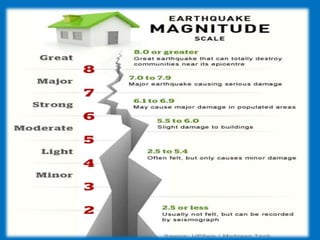
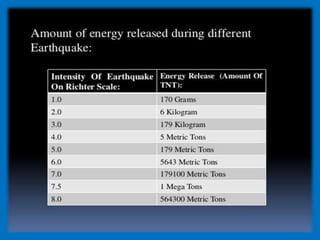
The intensity and strength of an earthquake is measured on Richter
scale, the scale invented by Charles Richter California ,USA in
1935.which categories earthquake on the basis of energy released.
Defintion: “the logarithm to base ten of the maximum seismic-
wave amplitude recorded on a standard seismograph at a distance
of 100 kilometers from the earthquake epicenter.” Scientists
measure the strength of earthquakes using machines known as
seismographs.
Seismology is the scientific study of earthquakes and the
propagation of elastic waves through the Earth.
J
H
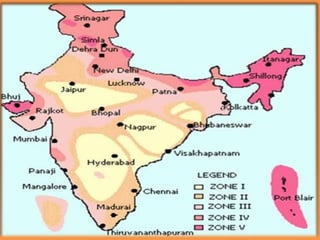
Types of zone
The earthquake zoning map of India divides India into 4
seismic zones Based on the observations of the affected area
due to Earthquake india divided into four types of zones:
Zone - II: This is said to be the least active seismic zone.
Zone - III: It is included in the moderate seismic zone.
Zone - IV: This is considered to be the high seismic zone.
Zone - V: It is the highest seismic zone.
J
How earthquake are measured
• The earthquake is measured according to the magnitude or
intensity of the shock.
• The magnitude scale is known as Richter Scale. The
magnitude relates to the energy released during the quake. It
is expressed in absolute numbers, Its range is 0-10. They are
recorded by an instrument called Seismograph.
• The intensity scale is called Mercalli Scale. It takes into
account the visible damage caused by the event. The range
of Intensity Scale is from 1-12.
Seismographs
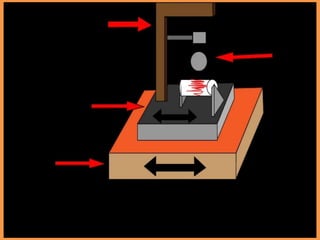
Earthquakes are measured by instruments called
seismographs. It has a base that sets firmly in the ground, and
a heavy weight that hangs free. When an earthquake causes the
ground to shake, the base of the seismograph shakes too, but
the heavy weight does not. The spring that it is hanging from
absorbs all the movement.
The recording is called a seismogram.
H
J
Earthquake monitoring
Remote Seismograph Positioning.
• Scientists consider seismic activity as it is registered on a
seismometer.
• A volcano will usually register some small earthquakes as the
magma pushes its way up through cracks and vents in rocks.
• As a volcano gets closer to erupting, the pressure builds up in the
earth under the volcano and the earthquake activity becomes
more and more frequent
H
Earthquake monitoring cont...
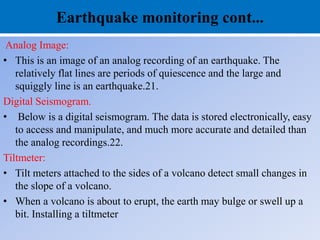
Analog Image:
• This is an image of an analog recording of an earthquake. The
relatively flat lines are periods of quiescence and the large and
squiggly line is an earthquake.21.
Digital Seismogram.
• Below is a digital seismogram. The data is stored electronically, easy
to access and manipulate, and much more accurate and detailed than
the analog recordings.22.
Tiltmeter:
• Tilt meters attached to the sides of a volcano detect small changes in
the slope of a volcano.
• When a volcano is about to erupt, the earth may bulge or swell up a
bit. Installing a tiltmeter
Earthquake monitoring cont...
Changes in Groundwater Levels.
• Hydro geological responses to large distant earthquakes
have important scientific implications with regard to our
earth’s intricate plumbing system.
• Improves our insights into the responsible mechanisms,
and may improve our frustratingly imprecise ability to
forecast the timing, magnitude, and impact of
earthquakes.24.
Observations of Strange Behaviors in Animals.
The cause of unusual animal behavior seconds before humans
feel an earthquake can be easily explain-ed.
Very few humans notice the smaller P wave that travels the
fastest from the earthquake source and arrives before the larger
S wave.
But many animals with more keen senses are able to feel the P
wave seconds before the S wave arrives. indeed it’s possible
that some animals could sense these signals and connect the
perception with an impending earthquake.
Earthquake prediction
Earthquake prediction is usually defined as the specification of the
time , location , and magnitude of a future earthquake within stated
limits. But some evidence of upcoming Earthquake are following:
• Unusual animal behavior
• Water level in wells
• Large scale of fluctuation of oil flow from oil wells
• Foreshocks or minor shocks before major earthquake
Temperature change
• Uplifting of earth surface
• Change in seismic wave velocity
Earthquake safety rules
If you are in house;
• Don’t use lift for getting down from building.
• Be prepared to move with your family.
If you are in shop ,school or office;
• Don’t run for an exit.
•Take cover under a disk/table.
•Move away from window glass.
•Do not go near electric point and cable. Keep away from weak portion of the building
and false ceiling.
If you are outside;
• Avoid high buildings , walls , power lines and other objects
that could fall and create block.
• Don’t run through streets.
• If possible , move on to an open area away from hazard
including trees.
If you are in vehicle;
• Stop in a safe open place.
• Remain inside vehicle.
• Close window , doors and vents.
After an earthquake
• . Keep calm, switch on the transistor radio and obey instructions.
• Keep away from beaches and low banks of river.
• A huge wave may sweep in Do not re enter badly damaged
buildings and do not go near damage structures.
• Turn off the water, gas and electricity.
• Do not smoke, light match or use a cigarette lighter Do not turn
on switches there may be gas leak or short circuit If there is any
fire, try to put it out or call fire brigade.
• Do not drink water from open containers without having
examined it.
• If you aware of people have been buried, tell the rescue
team.
• Do not rush and try not to worsen the situation. Avoid
places where there are loose electric wires and do not come
in contact with any metal object
• You will better and more capable of helping other.
• Do not walk around the streets to see what is happening.
Keep the streets clear so rescue vehicles can access the
roads easily.
Relief and Reconstruction
• Gujarat earthquake emergency reconstruction project (GEERP) was
started by GSDMA(Gujarat State Disaster Management Authority),
with financial help from world bank, Asian development bank, govt.
of India and other donor agencies.
• Several state governments came forward to participate in, the
reconstruction work in different villages.
• The UN system, multilateral and bilateral agencies, NGOs and the
corporate sector participated in the relief and reconstruction work.42
• Government of Gujarat provided assistance in the form of materials
and cash to about 218,000 families.
• NGOs supplemented the efforts by providing shelter to
about 7000 families.
• About 65 NGOs were active in kutch alone who adopted
211 villages and constructed 32,297 houses at the cost of
Rs. 185.80 crores.
• Abouttechnical support was made available to the owners
who were provided loan to reconstruct the houses.
Earthquake

Earthquake

  • 1.
    Presentation On EARTHQUAKE Master of sciencein Agriculture SUBMITTED TO Dr. K.k Sahu Deptt. of soil science and agricultural chemistry IGKV Raipur SUBMITTED BY Dayashankar Baghel M.sc.(Previous) Deptt. of Agril. Microbiology
  • 2.
    Introduction Earthquakes constitute oneof the worst natural hazards which often turn into disaster causing widespread destruction and loss to human life. The effects of earthquake vary upon the magnitude and intensity. Earthquakes occur every now and then all round the world, except in some places where earthquakes occur rarely. The devastation of cities and towns is one of the effects of earthquake.
  • 3.
    What is Earthquake AnEarthquake is the result of a sudden release of energy in the earth’s crust that creates seismi waves. The seismic activity of an area refers to the frequency, type and size of experienced over a period of time The study of earthquakes is called seismology.
  • 4.
    Terms related toearthquake Focus(Hypocenter): Focus is the point on the fault where rupture occurs and the location from which seismic waves are released. Epicenter: Epicenter is the point on the earth’s surface that is directly above the focus ,the point where an earthquake or underground explosion originates. Fault Line: A Fault line is the surface trace of a fault, the line of intersection between the earth’s surface. Fault plane: Fault plane are the crackes or sudden slips of the land . Fault Scrap: A Fault scrap is the topographic expression of faulting attributed to the displacement of the land surface by movement along faults.
  • 5.
  • 6.
    Causes of earthquake •The primary cause of an earthquake is faults on the crust of the earth. “A Fault is a break or fracture b/w two blocks of rocks in response to stress.” • This movement may occur rapidly, in the form of an earthquake or may occur slowly, in the form of creep. • Earth scientists use the angle of the fault with respect to the surface (known as the dip) and the direction of slip along the fault to classify faults.
  • 7.
  • 8.
    Classification of faults Normalfault: a dip-slip fault in which the block above the fault has moved downward relative to the block below. Thrust (reverse)fault: a dip-slip fault in which the upper block, above the fault plane, moves up and over the lower block.
  • 9.
    Strike-slip fault: A left-lateralstrike-slip fault : It is one on which the displacement of the far block is to the left when viewed from either side. A right-lateral strike-slip fault: It is one on which the displacement of the far block is to the right when viewed from either side.
  • 10.
    Major causes ofearthquake • tectonic earthquake is one that occurs when the earth's crust breaks due to geological forces on rocks and adjoining plates that cause physical and chemical changes. • A volcanic earthquake is any earthquake that results from tectonic forces which occur in conjunction with volcanic activity. • Collapse Earthquakes are small earthquakes in the underground and in mines that are caused by seismic waves produced from the explosion of rock on the surface. The immediate cause of ground shaking is the collapse of the roof of the mine or cavern. An often- observed variation of this extraordinary event is called "mine burst". • An explosion earthquake is an earthquake that is the result of the detonation of a nuclear and/or chemical device.
  • 11.
  • 12.
    Waves produced dueto earthquake SEISMIC WAVES • Seismic waves originate from the focus of earthquake, during an event of earthquake. • Seismic waves are broadly classified into two categories. 1- Body Waves 2- Surface Waves
  • 13.
    Body wave • BODYWAVES • Body waves are generated due to the release of energy at the focus and move in all the directions travelling through the body of the earth. • There are two types of body waves. • They are P and S waves.
  • 14.
    P-Wave P –WAVE • Thefaster of these body waves is called the primary or P wave. • Its motion is the same as that of a sound wave in that, as it spreads out, it alternately pushes (compresses) and pulls (dilates) the rock. • These P waves are able to travel through both solid rock, such as granite mountains, and liquid material, such as volcanic magma or the water of the oceans.
  • 15.
    S- wave S- WAVE •The slower wave through the body of rock is called the secondary or S wave. • As an S wave propagates, it shears the rock sideways at right angles to the direction of travel • If a liquid is sheared sideways or twisted, it will not spring back, hence S waves cannot propagate in the liquid parts of the earth, such as oceans and lakes.
  • 16.
    Surface wave SURFACE WAVE •The third general type of earthquake wave is called a surface wave, reason being is that its motion is restricted to near the ground surface. Such waves correspond to ripples of water that travel across a lake. • These waves are most Destructive. They cause displacement of rocks and hence, the collapse of structure( e.g. Buildings, Bridges etc.) occurs. • Surface waves in earthquakes can be divided into two types.
  • 17.
    Love wave LOVE WAVE •The first is called a Love wave. • Its motion is essentially that of S waves that have no vertical displacement; it moves the ground from side to side in a horizontal plane but at right angles to the direction of propagation. • The horizontal shaking of Love waves is particularly damaging to the foundations of structures.
  • 18.
    Rayleigh wave RAYLEIGH WAVE •The second type of surface wave is known as a Rayleigh wave • Like rolling ocean waves, Rayleigh waves wave move both vertically and horizontally in a vertical plane pointed in the direction in which the waves are travelling.
  • 19.
  • 20.
  • 21.
    Effect of earthquake Damageto human structures - Earthquakes cause great damage to human structures such as buildings, roads, rails, factories, dams, bridges etc, and thus cause heavy damage to human property. Landslides-The shocks produced by earthquakes particularly in hilly areas and mountains which are tectonically sensitive causes landslides and debris fall on human settlements and transport system on the lower slope segments, inflicting damage to them. Fires- The strong vibrations caused by severe earthquakes strongly shake the buildings and thus causing severe fires in houses, mines and factories because of overturning of cooking gas, contact of live electric wires, churning of blast furnaces, displacement of other fire related and electric appliances.
  • 22.
    Effect of earthquakecont.. • Flash Floods- Strong seismic waves cause damage to dams thereby causing severe flash floods. Severe floods are also caused because of blocking of water flow of rivers due to rock blocks and debris produced by severe tremors in the hill slopes facing the river valleys. Sometimes the blockage is so severe that rivers change their main course. • Deformation of Ground surface- severe tremors and resultant vibrations caused by earthquakes result in the deformation of ground surface because of rise and subsidence of ground surface and faulting activity( formation of faults).
  • 23.
    • Tsunamis- Theseismic waves caused by earthquake( measuring more than 7 on (scale) travelling through sea water generate high sea waves and cause great loss of life and property. • Soil liquefaction -Soil liquefaction occurs when, because of the shaking, water-saturated granular material (such as sand) temporarily loses its strength and transforms from a solid to a liquid. Soil liquefaction may cause rigid structures, like buildings and bridges, to tilt or sink into the liquefied deposits.
  • 24.
  • 25.
    Strength of earthquake Theintensity and strength of an earthquake is measured on Richter scale, the scale invented by Charles Richter California ,USA in 1935.which categories earthquake on the basis of energy released. Defintion: “the logarithm to base ten of the maximum seismic- wave amplitude recorded on a standard seismograph at a distance of 100 kilometers from the earthquake epicenter.” Scientists measure the strength of earthquakes using machines known as seismographs. Seismology is the scientific study of earthquakes and the propagation of elastic waves through the Earth.
  • 26.
  • 27.
  • 28.
    Types of zone Theearthquake zoning map of India divides India into 4 seismic zones Based on the observations of the affected area due to Earthquake india divided into four types of zones: Zone - II: This is said to be the least active seismic zone. Zone - III: It is included in the moderate seismic zone. Zone - IV: This is considered to be the high seismic zone. Zone - V: It is the highest seismic zone.
  • 29.
  • 30.
    How earthquake aremeasured • The earthquake is measured according to the magnitude or intensity of the shock. • The magnitude scale is known as Richter Scale. The magnitude relates to the energy released during the quake. It is expressed in absolute numbers, Its range is 0-10. They are recorded by an instrument called Seismograph. • The intensity scale is called Mercalli Scale. It takes into account the visible damage caused by the event. The range of Intensity Scale is from 1-12.
  • 31.
    Seismographs Earthquakes are measuredby instruments called seismographs. It has a base that sets firmly in the ground, and a heavy weight that hangs free. When an earthquake causes the ground to shake, the base of the seismograph shakes too, but the heavy weight does not. The spring that it is hanging from absorbs all the movement. The recording is called a seismogram.
  • 32.
  • 33.
  • 34.
    Earthquake monitoring Remote SeismographPositioning. • Scientists consider seismic activity as it is registered on a seismometer. • A volcano will usually register some small earthquakes as the magma pushes its way up through cracks and vents in rocks. • As a volcano gets closer to erupting, the pressure builds up in the earth under the volcano and the earthquake activity becomes more and more frequent
  • 35.
  • 36.
    Earthquake monitoring cont... AnalogImage: • This is an image of an analog recording of an earthquake. The relatively flat lines are periods of quiescence and the large and squiggly line is an earthquake.21. Digital Seismogram. • Below is a digital seismogram. The data is stored electronically, easy to access and manipulate, and much more accurate and detailed than the analog recordings.22. Tiltmeter: • Tilt meters attached to the sides of a volcano detect small changes in the slope of a volcano. • When a volcano is about to erupt, the earth may bulge or swell up a bit. Installing a tiltmeter
  • 37.
    Earthquake monitoring cont... Changesin Groundwater Levels. • Hydro geological responses to large distant earthquakes have important scientific implications with regard to our earth’s intricate plumbing system. • Improves our insights into the responsible mechanisms, and may improve our frustratingly imprecise ability to forecast the timing, magnitude, and impact of earthquakes.24.
  • 38.
    Observations of StrangeBehaviors in Animals. The cause of unusual animal behavior seconds before humans feel an earthquake can be easily explain-ed. Very few humans notice the smaller P wave that travels the fastest from the earthquake source and arrives before the larger S wave. But many animals with more keen senses are able to feel the P wave seconds before the S wave arrives. indeed it’s possible that some animals could sense these signals and connect the perception with an impending earthquake.
  • 39.
    Earthquake prediction Earthquake predictionis usually defined as the specification of the time , location , and magnitude of a future earthquake within stated limits. But some evidence of upcoming Earthquake are following: • Unusual animal behavior • Water level in wells • Large scale of fluctuation of oil flow from oil wells • Foreshocks or minor shocks before major earthquake Temperature change • Uplifting of earth surface • Change in seismic wave velocity
  • 40.
    Earthquake safety rules Ifyou are in house; • Don’t use lift for getting down from building. • Be prepared to move with your family. If you are in shop ,school or office; • Don’t run for an exit. •Take cover under a disk/table. •Move away from window glass. •Do not go near electric point and cable. Keep away from weak portion of the building and false ceiling.
  • 41.
    If you areoutside; • Avoid high buildings , walls , power lines and other objects that could fall and create block. • Don’t run through streets. • If possible , move on to an open area away from hazard including trees. If you are in vehicle; • Stop in a safe open place. • Remain inside vehicle. • Close window , doors and vents.
  • 42.
    After an earthquake •. Keep calm, switch on the transistor radio and obey instructions. • Keep away from beaches and low banks of river. • A huge wave may sweep in Do not re enter badly damaged buildings and do not go near damage structures. • Turn off the water, gas and electricity. • Do not smoke, light match or use a cigarette lighter Do not turn on switches there may be gas leak or short circuit If there is any fire, try to put it out or call fire brigade.
  • 43.
    • Do notdrink water from open containers without having examined it. • If you aware of people have been buried, tell the rescue team. • Do not rush and try not to worsen the situation. Avoid places where there are loose electric wires and do not come in contact with any metal object • You will better and more capable of helping other. • Do not walk around the streets to see what is happening. Keep the streets clear so rescue vehicles can access the roads easily.
  • 44.
    Relief and Reconstruction •Gujarat earthquake emergency reconstruction project (GEERP) was started by GSDMA(Gujarat State Disaster Management Authority), with financial help from world bank, Asian development bank, govt. of India and other donor agencies. • Several state governments came forward to participate in, the reconstruction work in different villages. • The UN system, multilateral and bilateral agencies, NGOs and the corporate sector participated in the relief and reconstruction work.42 • Government of Gujarat provided assistance in the form of materials and cash to about 218,000 families.
  • 45.
    • NGOs supplementedthe efforts by providing shelter to about 7000 families. • About 65 NGOs were active in kutch alone who adopted 211 villages and constructed 32,297 houses at the cost of Rs. 185.80 crores. • Abouttechnical support was made available to the owners who were provided loan to reconstruct the houses.