
PRESENTATION ON EARTHQUAKE


              SILVER OAK COLLEGE OF
            ENGINEERING & TECHNOLOGY

                              Prepared by :
Adviser :
                              Nirav R Dabhi      11CLD09
Dulari Mehta                  Simal B Gandhi     11CLD10
Khushbu Bhojak                Parth J Bhavsar    11CLD12
                              Ketul P Mandavia   11CLD14
•   An earthquake (also known as a quake, tremor or temblor) is the
    result of a sudden release of energy in the Earth's crust that
    creates seismic waves.
•   An earthquake is caused by a sudden rupture (break) of the earth
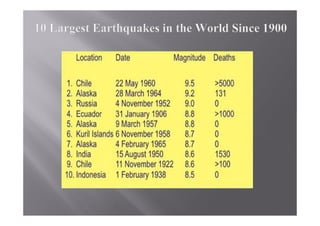
•   The most largest earthquake of 9.5 magnitude earthquake in
    Chile in 1960.
•   The most recent earthquake of 9.0 magnitude earthquake in
    Japan in 2011 (as of March 2011), and it was the largest Japanese
    earthquake since records began.
•   It struck at 7.58am on December 26, 41 miles off the coast of
    north-west Sumatra where 200,000 are now thought to have been
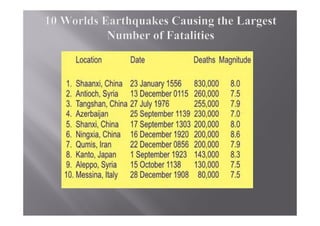
    killed in just 15 minutes.
•   Passing the Elastic Limit Causes Faulting

•   Applied stresses can cause rocks to bend and stretch
•   Eventually rocks will break away from one another
•   Area in which the rocks break and move is called a fault
•   Vibrations produced is called an earthquake
•   Earth’s crust movement causes the stresses applied
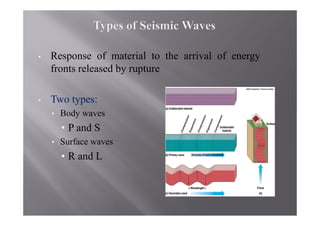
•   Response of material to the arrival of energy
    fronts released by rupture

•   Two types:
    •   Body waves
        • P and S
    •   Surface waves
        • R and L
•       Body waves

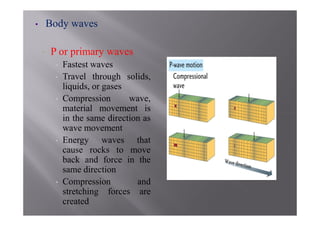
    •   P or primary waves
         •   Fastest waves
         •   Travel through solids,
             liquids, or gases
         •   Compression       wave,
             material movement is
             in the same direction as
             wave movement
         •   Energy waves that
             cause rocks to move
             back and force in the      •
             same direction             •
         •   Compression         and
             stretching forces are
             created
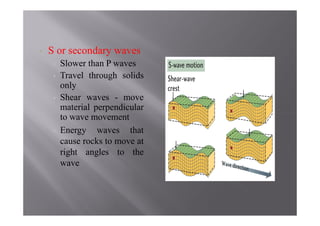
•   S or secondary waves
     •   Slower than P waves
     •   Travel through solids
         only
     •   Shear waves - move
         material perpendicular
         to wave movement
     •   Energy waves that
         cause rocks to move at
         right angles to the
         wave
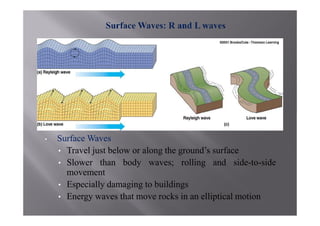
•   Surface Waves
    • Travel just below or along the ground’s surface
    • Slower than body waves; rolling and side-to-side
      movement
    • Especially damaging to buildings
    • Energy waves that move rocks in an elliptical motion
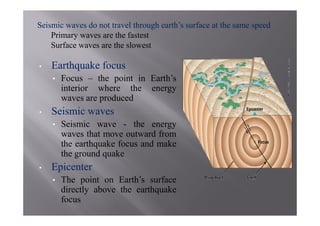
Seismic waves do not travel through earth’s surface at the same speed
    Primary waves are the fastest
    Surface waves are the slowest

•   Earthquake focus
    •   Focus – the point in Earth’s
        interior where the energy
        waves are produced
•   Seismic waves
    •   Seismic wave - the energy
        waves that move outward from
        the earthquake focus and make
        the ground quake
•   Epicenter
    •   The point on Earth’s surface
        directly above the earthquake
        focus
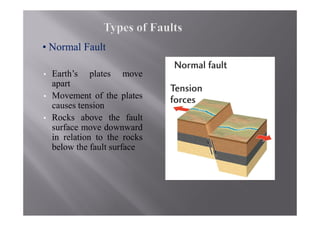
• Normal Fault

•   Earth’s plates move
    apart
•   Movement of the plates
    causes tension
•   Rocks above the fault
    surface move downward
    in relation to the rocks
    below the fault surface
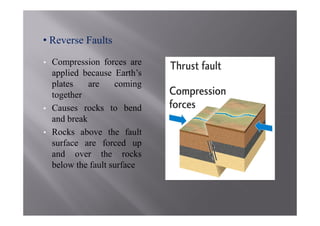
• Reverse Faults

•   Compression forces are
    applied because Earth’s
    plates    are    coming
    together
•   Causes rocks to bend
    and break
•   Rocks above the fault
    surface are forced up
    and over the rocks
    below the fault surface
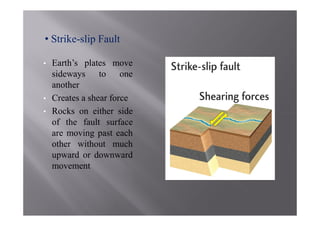
• Strike-slip Fault

•   Earth’s plates move
    sideways to one
    another
•   Creates a shear force
•   Rocks on either side
    of the fault surface
    are moving past each
    other without much
    upward or downward
    movement
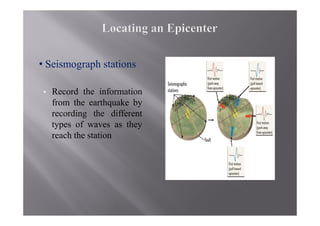
• Seismograph stations

 •   Record the information
     from the earthquake by
     recording the different
     types of waves as they
     reach the station
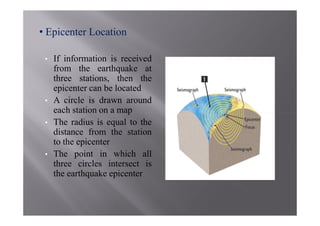
• Epicenter Location

 •   If information is received
     from the earthquake at
     three stations, then the
     epicenter can be located
 •   A circle is drawn around
     each station on a map
 •   The radius is equal to the
     distance from the station
     to the epicenter
 •   The point in which all
     three circles intersect is
     the earthquake epicenter
•   Seismology
    •   Seismologists - People who study earthquakes and seismic
        waves
    •   Use instruments called seismographs
        • Record seismic waves
        • A drum with a sheet of paper vibrates and a stationary
          pen marks the vibrations on the paper
        • The height of the lines are used to measure the energy
          released from the earthquake called the magnitude
•   Earthquake Magnitude
    •   Usually determines the strength of the break
    •   Doesn’t determine the duration or the size
    •   For each increase of 1 is 10 times stronger
    •   An earthquake of 4 is 10 times stronger than an earthquake
        of 3

•   Caused by the movement of the ocean floor
    •   Causes a disruption in the water
    •   Some are so wide that a large ship can travel over the wave
        without knowing
    •   Recent earthquake in the Indian Ocean created a tsunamis
        that was 100 feet high and moving at 500 mph
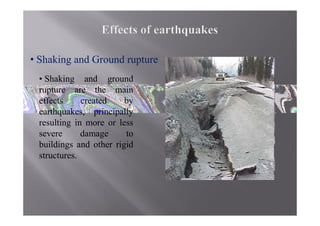
• Shaking and Ground rupture
 • Shaking and ground
 rupture are the main
 effects     created    by
 earthquakes, principally
 resulting in more or less
 severe      damage     to
 buildings and other rigid
 structures.
• The severity of the local effects depends on the complex
combination of the earthquake magnitude, the distance
from the epicenter, and the local geological and
geomorphologic conditions, which may amplify or reduce
wave propagation.

• The ground-shaking is measured by ground acceleration.
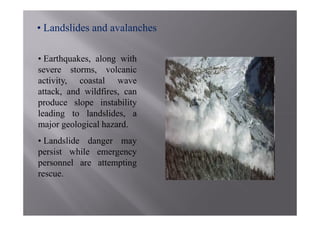
• Landslides and avalanches

• Earthquakes, along with
severe storms, volcanic
activity, coastal wave
attack, and wildfires, can
produce slope instability
leading to landslides, a
major geological hazard.
• Landslide danger may
persist while emergency
personnel are attempting
rescue.
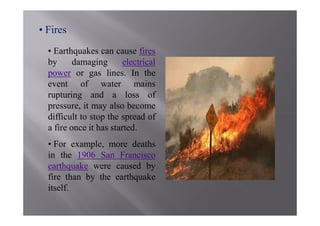
• Fires
  • Earthquakes can cause fires
  by      damaging       electrical
  power or gas lines. In the
  event of water mains
  rupturing and a loss of
  pressure, it may also become
  difficult to stop the spread of
  a fire once it has started.
  • For example, more deaths
  in the 1906 San Francisco
  earthquake were caused by
  fire than by the earthquake
  itself.
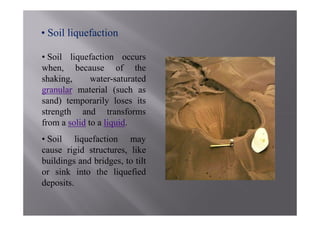
• Soil liquefaction

• Soil liquefaction occurs
when, because of the
shaking,      water-saturated
granular material (such as
sand) temporarily loses its
strength and transforms
from a solid to a liquid.
• Soil liquefaction may
cause rigid structures, like
buildings and bridges, to tilt
or sink into the liquefied
deposits.
• This can be a devastating effect of earthquakes. For
example, in the 1964 Alaska earthquake, soil liquefaction
caused many buildings to sink into the ground, eventually
collapsing upon themselves.
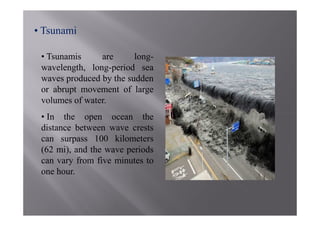
• Tsunami

 • Tsunamis     are      long-
 wavelength, long-period sea
 waves produced by the sudden
 or abrupt movement of large
 volumes of water.
 • In the open ocean the
 distance between wave crests
 can surpass 100 kilometers
 (62 mi), and the wave periods
 can vary from five minutes to
 one hour.
• Such tsunamis travel 600-800 kilometers per hour (373–497
miles per hour), depending on water depth.
• Large waves produced by an earthquake or a submarine
landslide can overrun nearby coastal areas in a matter of
minutes.
• Tsunamis can also travel thousands of kilometers across open
ocean and wreak destruction on far shores hours after the
earthquake that generated them.
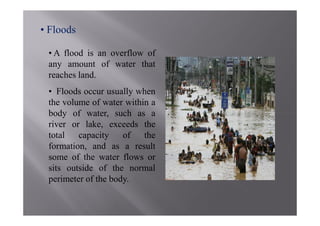
• Floods

 • A flood is an overflow of
 any amount of water that
 reaches land.
 • Floods occur usually when
 the volume of water within a
 body of water, such as a
 river or lake, exceeds the
 total   capacity    of   the
 formation, and as a result
 some of the water flows or
 sits outside of the normal
 perimeter of the body.
• However, floods may be secondary         effects   of
earthquakes, if dams are damaged.
• Earthquakes may cause landslips to dam rivers, which
collapse and cause floods.
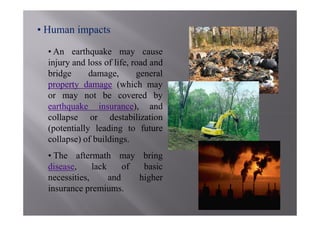
• Human impacts

  • An earthquake may cause
  injury and loss of life, road and
  bridge      damage,       general
  property damage (which may
  or may not be covered by
  earthquake insurance), and
  collapse or destabilization
  (potentially leading to future
  collapse) of buildings.
  • The aftermath may bring
  disease,     lack     of  basic
  necessities,      and    higher
  insurance premiums.
•   Seismic safe structures
    •   Structures that are resistant to the vibrations of Earth’s
        crust
    •   Structures are made with moorings
    •   Made of steel and are filled with alternating layers of
        rubber and steel
    •   These structures absorb the energy produced from the
        earthquake
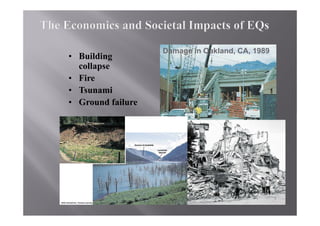
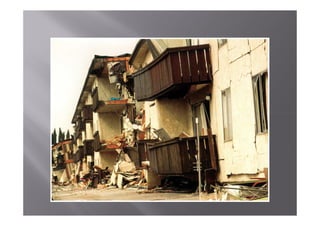
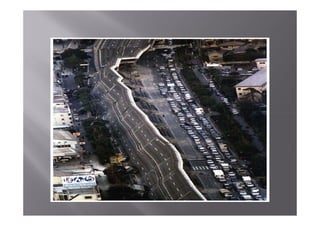
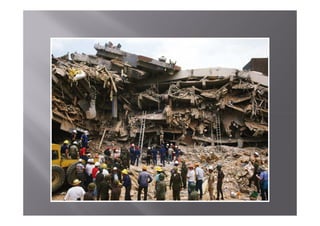
Damage in Oakland, CA, 1989
• Building
  collapse
• Fire
• Tsunami
• Ground failure
Earthquake
Earthquake
Earthquake
Earthquake
Earthquake

Earthquake

  • 1.
    PRESENTATION ON EARTHQUAKE SILVER OAK COLLEGE OF ENGINEERING & TECHNOLOGY Prepared by : Adviser : Nirav R Dabhi 11CLD09 Dulari Mehta Simal B Gandhi 11CLD10 Khushbu Bhojak Parth J Bhavsar 11CLD12 Ketul P Mandavia 11CLD14
  • 2.
    An earthquake (also known as a quake, tremor or temblor) is the result of a sudden release of energy in the Earth's crust that creates seismic waves. • An earthquake is caused by a sudden rupture (break) of the earth • The most largest earthquake of 9.5 magnitude earthquake in Chile in 1960. • The most recent earthquake of 9.0 magnitude earthquake in Japan in 2011 (as of March 2011), and it was the largest Japanese earthquake since records began. • It struck at 7.58am on December 26, 41 miles off the coast of north-west Sumatra where 200,000 are now thought to have been killed in just 15 minutes.
  • 3.
    Passing the Elastic Limit Causes Faulting • Applied stresses can cause rocks to bend and stretch • Eventually rocks will break away from one another • Area in which the rocks break and move is called a fault • Vibrations produced is called an earthquake • Earth’s crust movement causes the stresses applied
  • 4.
    Response of material to the arrival of energy fronts released by rupture • Two types: • Body waves • P and S • Surface waves • R and L
  • 5.
    Body waves • P or primary waves • Fastest waves • Travel through solids, liquids, or gases • Compression wave, material movement is in the same direction as wave movement • Energy waves that cause rocks to move back and force in the • same direction • • Compression and stretching forces are created
  • 6.
    S or secondary waves • Slower than P waves • Travel through solids only • Shear waves - move material perpendicular to wave movement • Energy waves that cause rocks to move at right angles to the wave
  • 7.
    Surface Waves • Travel just below or along the ground’s surface • Slower than body waves; rolling and side-to-side movement • Especially damaging to buildings • Energy waves that move rocks in an elliptical motion
  • 8.
    Seismic waves donot travel through earth’s surface at the same speed Primary waves are the fastest Surface waves are the slowest • Earthquake focus • Focus – the point in Earth’s interior where the energy waves are produced • Seismic waves • Seismic wave - the energy waves that move outward from the earthquake focus and make the ground quake • Epicenter • The point on Earth’s surface directly above the earthquake focus
  • 9.
    • Normal Fault • Earth’s plates move apart • Movement of the plates causes tension • Rocks above the fault surface move downward in relation to the rocks below the fault surface
  • 10.
    • Reverse Faults • Compression forces are applied because Earth’s plates are coming together • Causes rocks to bend and break • Rocks above the fault surface are forced up and over the rocks below the fault surface
  • 11.
    • Strike-slip Fault • Earth’s plates move sideways to one another • Creates a shear force • Rocks on either side of the fault surface are moving past each other without much upward or downward movement
  • 12.
    • Seismograph stations • Record the information from the earthquake by recording the different types of waves as they reach the station
  • 13.
    • Epicenter Location • If information is received from the earthquake at three stations, then the epicenter can be located • A circle is drawn around each station on a map • The radius is equal to the distance from the station to the epicenter • The point in which all three circles intersect is the earthquake epicenter
  • 14.
    Seismology • Seismologists - People who study earthquakes and seismic waves • Use instruments called seismographs • Record seismic waves • A drum with a sheet of paper vibrates and a stationary pen marks the vibrations on the paper • The height of the lines are used to measure the energy released from the earthquake called the magnitude
  • 15.
    Earthquake Magnitude • Usually determines the strength of the break • Doesn’t determine the duration or the size • For each increase of 1 is 10 times stronger • An earthquake of 4 is 10 times stronger than an earthquake of 3 • Caused by the movement of the ocean floor • Causes a disruption in the water • Some are so wide that a large ship can travel over the wave without knowing • Recent earthquake in the Indian Ocean created a tsunamis that was 100 feet high and moving at 500 mph
  • 16.
    • Shaking andGround rupture • Shaking and ground rupture are the main effects created by earthquakes, principally resulting in more or less severe damage to buildings and other rigid structures.
  • 17.
    • The severityof the local effects depends on the complex combination of the earthquake magnitude, the distance from the epicenter, and the local geological and geomorphologic conditions, which may amplify or reduce wave propagation. • The ground-shaking is measured by ground acceleration.
  • 18.
    • Landslides andavalanches • Earthquakes, along with severe storms, volcanic activity, coastal wave attack, and wildfires, can produce slope instability leading to landslides, a major geological hazard. • Landslide danger may persist while emergency personnel are attempting rescue.
  • 19.
    • Fires • Earthquakes can cause fires by damaging electrical power or gas lines. In the event of water mains rupturing and a loss of pressure, it may also become difficult to stop the spread of a fire once it has started. • For example, more deaths in the 1906 San Francisco earthquake were caused by fire than by the earthquake itself.
  • 20.
    • Soil liquefaction •Soil liquefaction occurs when, because of the shaking, water-saturated granular material (such as sand) temporarily loses its strength and transforms from a solid to a liquid. • Soil liquefaction may cause rigid structures, like buildings and bridges, to tilt or sink into the liquefied deposits.
  • 21.
    • This canbe a devastating effect of earthquakes. For example, in the 1964 Alaska earthquake, soil liquefaction caused many buildings to sink into the ground, eventually collapsing upon themselves.
  • 22.
    • Tsunami •Tsunamis are long- wavelength, long-period sea waves produced by the sudden or abrupt movement of large volumes of water. • In the open ocean the distance between wave crests can surpass 100 kilometers (62 mi), and the wave periods can vary from five minutes to one hour.
  • 23.
    • Such tsunamistravel 600-800 kilometers per hour (373–497 miles per hour), depending on water depth. • Large waves produced by an earthquake or a submarine landslide can overrun nearby coastal areas in a matter of minutes. • Tsunamis can also travel thousands of kilometers across open ocean and wreak destruction on far shores hours after the earthquake that generated them.
  • 24.
    • Floods •A flood is an overflow of any amount of water that reaches land. • Floods occur usually when the volume of water within a body of water, such as a river or lake, exceeds the total capacity of the formation, and as a result some of the water flows or sits outside of the normal perimeter of the body.
  • 25.
    • However, floodsmay be secondary effects of earthquakes, if dams are damaged. • Earthquakes may cause landslips to dam rivers, which collapse and cause floods.
  • 26.
    • Human impacts • An earthquake may cause injury and loss of life, road and bridge damage, general property damage (which may or may not be covered by earthquake insurance), and collapse or destabilization (potentially leading to future collapse) of buildings. • The aftermath may bring disease, lack of basic necessities, and higher insurance premiums.
  • 27.
    Seismic safe structures • Structures that are resistant to the vibrations of Earth’s crust • Structures are made with moorings • Made of steel and are filled with alternating layers of rubber and steel • These structures absorb the energy produced from the earthquake
  • 30.
    Damage in Oakland,CA, 1989 • Building collapse • Fire • Tsunami • Ground failure