Mineralogy
Kaustubh J. Sane
HJD Institute of Technical Education
& Research, Kera
• A mineral is a naturally occurring
homogeneous solid, inorganic form with a
definite chemical composition and ordered
atomic arrangement.
• There are over 2000 minerals identified.
• Physical properties of minerals
– Color
– Streak
– Luster
– Transparency
– Form
– Hardness
– Fracture
– Cleavage
– Density
• Color
– Depends on absorption of some and reflection of
other colored rays or vibrations which composed
ordinary white light.
• Streak
– It is a color of powder of mineral produced on
rubbing.
– It is determined by rubbing a mineral on unglazed
porcelain plate.
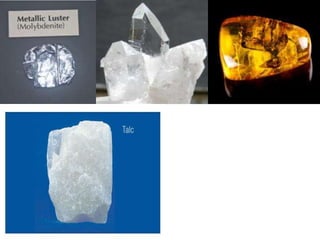
• Luster
– It is appearance given to a mineral by light reflected from
its surface.
– Metallic-
• Metallic minerals e.g. pyrite, galena
– Vitreous-
• Luster of broken glass reflection. E.g. quartz
– Resinous
• Light reflection like of resins. Eg. Opal, amber
– Pearly
• Sheen of a pearl, eg. Talc.
– Silky
• Luster of silk. Fibrous minerals like asbestoses and gypsum
– Adamantine
• Brilliant reflection like diamond
• Transparency
– A mineral is transparent when the outlines of the
objects seen through it appear sharp and distinct.
– When an object looks indistinct then it is called as
semitransparent.
– Minerals which are capable of transmitting light
but can't see through it are called translucent.
– Minerals which do not transmits the light are
called as opaque minerals.
• Forms
– Crystalline
• Mineral which show well developed crystals are termed
as crystallized
– Crystalline
• Crystal is developed but it is imperfectly formed grains
– Cryptocrystalline
• Mineral which show mere traces of crystalline
structure.
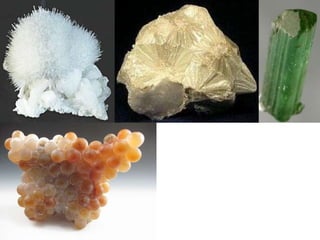
– Acicular – fine needle like structure; natrolite
– Bladed – shape of knife blade; kyanite
– Botryoidal- spheroidal forms resembling to bunch
of grapes. Botryoidal hematite
– Columnar- resembles to columns; hornblende
– Fibrous- fine thread like strands; asbestos
– Granular- grain shape like lump of sugar.
– Radiated- needle like crystal radiating from a
centre; pyrite concentration
• Hardness
– It is measured by scratching
a mineral surface.
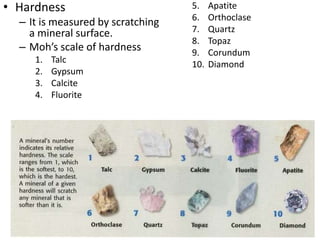
– Moh’s scale of hardness
1. Talc
2. Gypsum
3. Calcite
4. Fluorite
5. Apatite
6. Orthoclase
7. Quartz
8. Topaz
9. Corundum
10. Diamond
• Fracture
– Mineral when breaks from cleavage plane it forms
a fracture.
– These are not linear nor parallel
1. Even fracture
2. Uneven fracture
3. Splintery- observed in fibrous minerals look like
woodstick
4. Concoidal-minerals break in curved shaped. Shown by
natural glass
5. Hackly- surface elevations of minerals.
• Cleavage-
– The property of mineral to split under the
influence of force, more or less parallel to crystal
face.
– It may cleave in one, two, three or more
directions.
• Density-
Silicate group
• Silicates include large number of minerals.
• They constitute 95% of silicate minerals.
Which are considered common minerals of
earth’s crust.
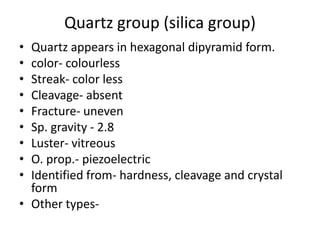
Quartz group (silica group)
• Quartz appears in hexagonal dipyramid form.
• color- colourless
• Streak- color less
• Cleavage- absent
• Fracture- uneven
• Sp. gravity - 2.8
• Luster- vitreous
• O. prop.- piezoelectric
• Identified from- hardness, cleavage and crystal
form
• Other types-
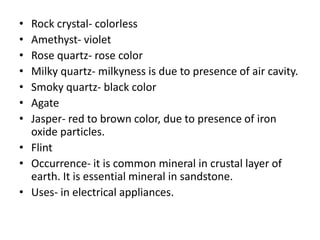
• Rock crystal- colorless
• Amethyst- violet
• Rose quartz- rose color
• Milky quartz- milkyness is due to presence of air cavity.
• Smoky quartz- black color
• Agate
• Jasper- red to brown color, due to presence of iron
oxide particles.
• Flint
• Occurrence- it is common mineral in crustal layer of
earth. It is essential mineral in sandstone.
• Uses- in electrical appliances.
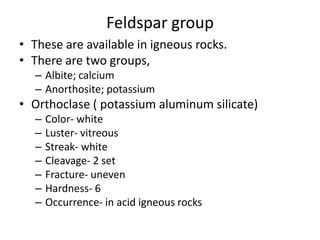
Feldspar group
• These are available in igneous rocks.
• There are two groups,
– Albite; calcium
– Anorthosite; potassium
• Orthoclase ( potassium aluminum silicate)
– Color- white
– Luster- vitreous
– Streak- white
– Cleavage- 2 set
– Fracture- uneven
– Hardness- 6
– Occurrence- in acid igneous rocks
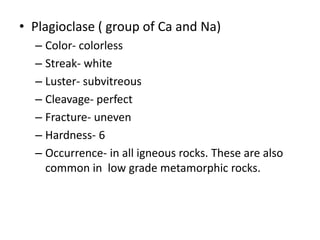
• Plagioclase ( group of Ca and Na)
– Color- colorless
– Streak- white
– Luster- subvitreous
– Cleavage- perfect
– Fracture- uneven
– Hardness- 6
– Occurrence- in all igneous rocks. These are also
common in low grade metamorphic rocks.
Pyroxene group
• Pyroxenes are silicates of iron, magnesium and
calcium. Hey crystallize in orthorhombic and
monoclinic system.
• Two groups
– Orthorhombic system-
• Astatine
• Hypersthenes
– Monoclinic system-
• Augite
• Diopside
• Hypersthenes-
– Color- brownish yellow
– Streak- colorless
– Hardness- 5-6
– Luster- sub metallic
– Fracture- uneven
– Occurrence- found in igneous rocks like gabbros
– Composition- iron magnesium silicate
• Diopside
– Color- white
– Luster- vitreous
– Hardness- 6
– Cleavage- parallel
– Fracture- uneven
– Occurrence- metamorphosed dolomite limestone.
Amphibole group
• It is double chain structure.
• They crystallize in monoclinic system
• Hornblende-
– Color- light green
– Luster- resinous
– Cleavage- 2 set
– Hardness- 5
– Fracture- uneven
Olivine-
•Color- green
•Luster- dull
•Streak- light green
•Cleavage- imperfect
•Hardness-7
•Form- granular
Mica group
• They are characterized by cleavage in one
direction.
• Muscovite-
– Color- colorless
– Luster- vitreous
– Streak- colorless
– Hardness- 3
– Cleavage- present
– Fracture- uneven
– Occurrence- in acid igneous rocks. Also in sandstone
and schist.

Mineralogy

  • 1.
    Mineralogy Kaustubh J. Sane HJDInstitute of Technical Education & Research, Kera
  • 2.
    • A mineralis a naturally occurring homogeneous solid, inorganic form with a definite chemical composition and ordered atomic arrangement. • There are over 2000 minerals identified.
  • 3.
    • Physical propertiesof minerals – Color – Streak – Luster – Transparency – Form – Hardness – Fracture – Cleavage – Density
  • 4.
    • Color – Dependson absorption of some and reflection of other colored rays or vibrations which composed ordinary white light. • Streak – It is a color of powder of mineral produced on rubbing. – It is determined by rubbing a mineral on unglazed porcelain plate.
  • 5.
    • Luster – Itis appearance given to a mineral by light reflected from its surface. – Metallic- • Metallic minerals e.g. pyrite, galena – Vitreous- • Luster of broken glass reflection. E.g. quartz – Resinous • Light reflection like of resins. Eg. Opal, amber – Pearly • Sheen of a pearl, eg. Talc. – Silky • Luster of silk. Fibrous minerals like asbestoses and gypsum – Adamantine • Brilliant reflection like diamond
  • 7.
    • Transparency – Amineral is transparent when the outlines of the objects seen through it appear sharp and distinct. – When an object looks indistinct then it is called as semitransparent. – Minerals which are capable of transmitting light but can't see through it are called translucent. – Minerals which do not transmits the light are called as opaque minerals.
  • 9.
    • Forms – Crystalline •Mineral which show well developed crystals are termed as crystallized – Crystalline • Crystal is developed but it is imperfectly formed grains – Cryptocrystalline • Mineral which show mere traces of crystalline structure.
  • 10.
    – Acicular –fine needle like structure; natrolite – Bladed – shape of knife blade; kyanite – Botryoidal- spheroidal forms resembling to bunch of grapes. Botryoidal hematite – Columnar- resembles to columns; hornblende – Fibrous- fine thread like strands; asbestos – Granular- grain shape like lump of sugar. – Radiated- needle like crystal radiating from a centre; pyrite concentration
  • 12.
    • Hardness – Itis measured by scratching a mineral surface. – Moh’s scale of hardness 1. Talc 2. Gypsum 3. Calcite 4. Fluorite 5. Apatite 6. Orthoclase 7. Quartz 8. Topaz 9. Corundum 10. Diamond
  • 13.
    • Fracture – Mineralwhen breaks from cleavage plane it forms a fracture. – These are not linear nor parallel 1. Even fracture 2. Uneven fracture 3. Splintery- observed in fibrous minerals look like woodstick 4. Concoidal-minerals break in curved shaped. Shown by natural glass 5. Hackly- surface elevations of minerals.
  • 14.
    • Cleavage- – Theproperty of mineral to split under the influence of force, more or less parallel to crystal face. – It may cleave in one, two, three or more directions. • Density-
  • 15.
    Silicate group • Silicatesinclude large number of minerals. • They constitute 95% of silicate minerals. Which are considered common minerals of earth’s crust.
  • 16.
    Quartz group (silicagroup) • Quartz appears in hexagonal dipyramid form. • color- colourless • Streak- color less • Cleavage- absent • Fracture- uneven • Sp. gravity - 2.8 • Luster- vitreous • O. prop.- piezoelectric • Identified from- hardness, cleavage and crystal form • Other types-
  • 17.
    • Rock crystal-colorless • Amethyst- violet • Rose quartz- rose color • Milky quartz- milkyness is due to presence of air cavity. • Smoky quartz- black color • Agate • Jasper- red to brown color, due to presence of iron oxide particles. • Flint • Occurrence- it is common mineral in crustal layer of earth. It is essential mineral in sandstone. • Uses- in electrical appliances.
  • 18.
    Feldspar group • Theseare available in igneous rocks. • There are two groups, – Albite; calcium – Anorthosite; potassium • Orthoclase ( potassium aluminum silicate) – Color- white – Luster- vitreous – Streak- white – Cleavage- 2 set – Fracture- uneven – Hardness- 6 – Occurrence- in acid igneous rocks
  • 19.
    • Plagioclase (group of Ca and Na) – Color- colorless – Streak- white – Luster- subvitreous – Cleavage- perfect – Fracture- uneven – Hardness- 6 – Occurrence- in all igneous rocks. These are also common in low grade metamorphic rocks.
  • 20.
    Pyroxene group • Pyroxenesare silicates of iron, magnesium and calcium. Hey crystallize in orthorhombic and monoclinic system. • Two groups – Orthorhombic system- • Astatine • Hypersthenes – Monoclinic system- • Augite • Diopside
  • 21.
    • Hypersthenes- – Color-brownish yellow – Streak- colorless – Hardness- 5-6 – Luster- sub metallic – Fracture- uneven – Occurrence- found in igneous rocks like gabbros – Composition- iron magnesium silicate
  • 22.
    • Diopside – Color-white – Luster- vitreous – Hardness- 6 – Cleavage- parallel – Fracture- uneven – Occurrence- metamorphosed dolomite limestone.
  • 23.
    Amphibole group • Itis double chain structure. • They crystallize in monoclinic system • Hornblende- – Color- light green – Luster- resinous – Cleavage- 2 set – Hardness- 5 – Fracture- uneven Olivine- •Color- green •Luster- dull •Streak- light green •Cleavage- imperfect •Hardness-7 •Form- granular
  • 24.
    Mica group • Theyare characterized by cleavage in one direction. • Muscovite- – Color- colorless – Luster- vitreous – Streak- colorless – Hardness- 3 – Cleavage- present – Fracture- uneven – Occurrence- in acid igneous rocks. Also in sandstone and schist.