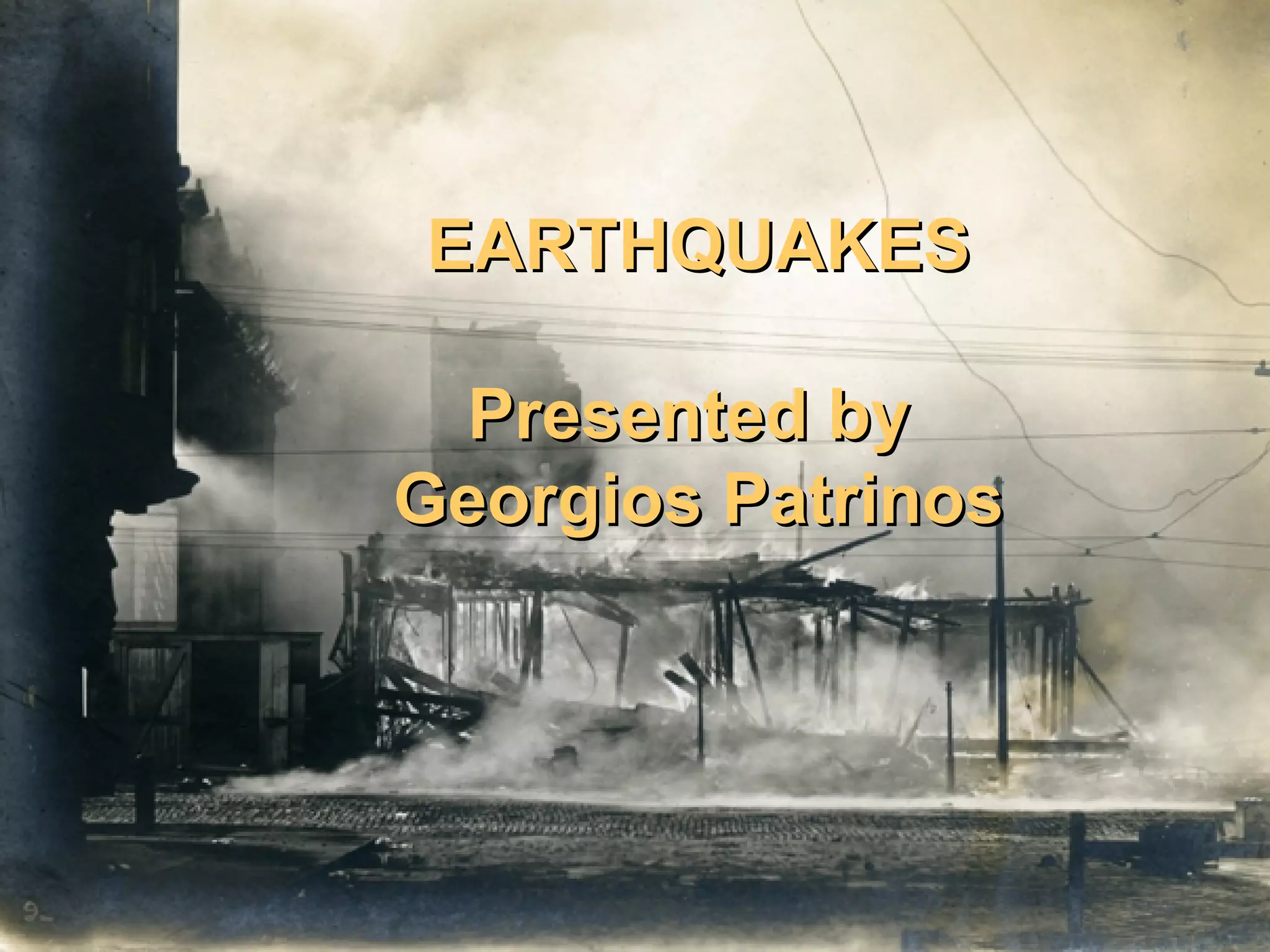
EARTHQUAKES Presented by  Georgios Patrinos
OUTLINE Introduction  Causes of earthquakes Description of initial earthquake development Analysis of seismic waves Magnitude of an earthquake Interview with people that survived the catastrophic effects of big earthquakes Recommendations Conclusions
INTRODUCTION No natural phenomenon creates more fear and insecurity than an earthquake   . Every day thousands of earthquakes occur   . Researchers (Charles Richter, Lord Rayleigh) have investigated the nature of earthquakes
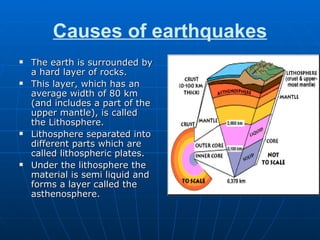
Causes of earthquakes The earth is surrounded by a hard layer of rocks. This layer, which has an average width of 80 km (and includes a part of the upper mantle), is called the Lithosphere.   Lithosphere separated into different parts which are called lithospheric plates. Under the lithosphere the material is semi liquid and forms a layer called the asthenosphere.
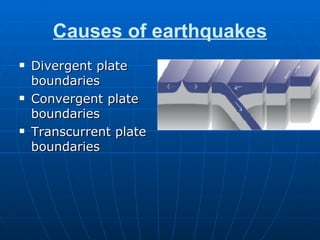
Causes of earthquakes Divergent plate boundaries  Convergent plate boundaries  Transcurrent plate boundaries
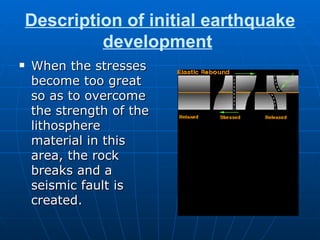
Description of initial earthquake development   When the stresses become too great so as to overcome the strength of the lithosphere material in this area, the rock breaks and a seismic fault is created.
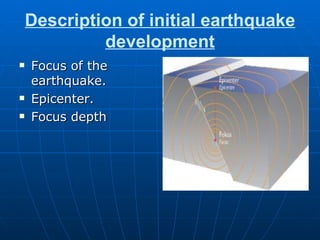
Description of initial earthquake development Focus of the earthquake.   Epicenter. Focus depth
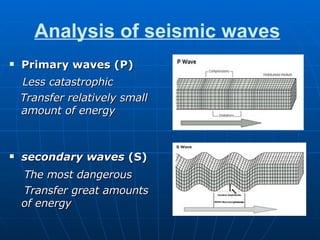
Analysis of seismic waves   Primary waves (P)   Less catastrophic  Transfer relatively small amount of energy   secondary waves  (S) The most dangerous   Transfer great amounts  of energy
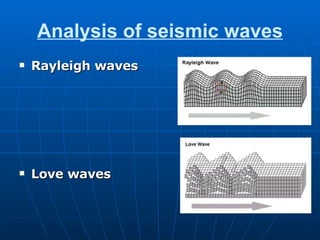
Analysis of seismic waves Rayleigh waves Love waves
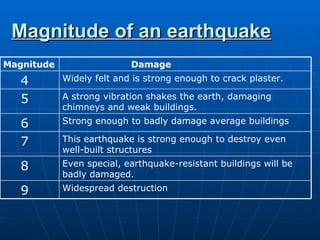
Magnitude of an earthquake   Widespread destruction   9 Even special, earthquake-resistant buildings will be badly damaged.   8 This earthquake is strong enough to destroy even well-built structures   7 Strong enough to badly damage average buildings   6 A strong vibration shakes the earth, damaging chimneys and weak buildings.   5 Widely felt and is strong enough to crack plaster.   4 Damage   Magnitude
 
Recommendations   In view of the above the following recommendations are outlined   : Improvements on antiseismic legislation and technology   . Study of the seismic activity and the terrain of the area are obligatory   Education and action plans to minimise the risk of an earthquake’s aftermath.   Evacuation plans , emergency exercises .
Bibliography Bolt, B.A. (1993)  Earthquakes  USA: W.H. Freeman and Company Bolt, B.A. (1993)  Earthquakes And Geological Discovery  USA: W.H. Freeman and Company Coburn, A. and R. Spence, (1992) Earthquake  Protection  UK: John Wiley & Sons Ltd
Further References 1. U.S. Geological Survey (1997)  Earthquake s.Retrieved August 20, 2006, from World Wide Web  http://pubs.usgs.gov/gip/earthq1/intro.html 2.  Glasscoe, M. (1998, 13th August)  Space technology is used to observe and measure tectonic motion of the Earth's surface.  Retrieved August 20, 2006, from World Wide Web   http:// scign.jpl.nasa.gov/learn/index.htm 3. Encyclopedia Britannica (2006)   Earthquake   .  Retrieved August 20, 2006, from World Wide Web  http://www.britannica.com/eb/article-9106195   4. U.S. Geological Survey Earthquake Hazards Program (2006).  Retrieved August 20, 2006, from World Wide Web  http:// earthquake.usgs.gov/eqcenter/dyfi.php   5. Wikipedia, The Free Encyclopedia (2006)  Earthquake .  Retrieved August 20, 2006, from World Wide Web  http:// en.wikipedia.org/wiki/Earthquake

Earthquakes Presentation Final

  • 1.
    EARTHQUAKES Presented by Georgios Patrinos
  • 2.
    OUTLINE Introduction Causes of earthquakes Description of initial earthquake development Analysis of seismic waves Magnitude of an earthquake Interview with people that survived the catastrophic effects of big earthquakes Recommendations Conclusions
  • 3.
    INTRODUCTION No naturalphenomenon creates more fear and insecurity than an earthquake . Every day thousands of earthquakes occur . Researchers (Charles Richter, Lord Rayleigh) have investigated the nature of earthquakes
  • 4.
    Causes of earthquakesThe earth is surrounded by a hard layer of rocks. This layer, which has an average width of 80 km (and includes a part of the upper mantle), is called the Lithosphere. Lithosphere separated into different parts which are called lithospheric plates. Under the lithosphere the material is semi liquid and forms a layer called the asthenosphere.
  • 5.
    Causes of earthquakesDivergent plate boundaries Convergent plate boundaries Transcurrent plate boundaries
  • 6.
    Description of initialearthquake development When the stresses become too great so as to overcome the strength of the lithosphere material in this area, the rock breaks and a seismic fault is created.
  • 7.
    Description of initialearthquake development Focus of the earthquake. Epicenter. Focus depth
  • 8.
    Analysis of seismicwaves Primary waves (P) Less catastrophic Transfer relatively small amount of energy secondary waves (S) The most dangerous Transfer great amounts of energy
  • 9.
    Analysis of seismicwaves Rayleigh waves Love waves
  • 10.
    Magnitude of anearthquake Widespread destruction 9 Even special, earthquake-resistant buildings will be badly damaged. 8 This earthquake is strong enough to destroy even well-built structures 7 Strong enough to badly damage average buildings 6 A strong vibration shakes the earth, damaging chimneys and weak buildings. 5 Widely felt and is strong enough to crack plaster. 4 Damage Magnitude
  • 11.
  • 12.
    Recommendations In view of the above the following recommendations are outlined : Improvements on antiseismic legislation and technology . Study of the seismic activity and the terrain of the area are obligatory Education and action plans to minimise the risk of an earthquake’s aftermath. Evacuation plans , emergency exercises .
  • 13.
    Bibliography Bolt, B.A.(1993) Earthquakes USA: W.H. Freeman and Company Bolt, B.A. (1993) Earthquakes And Geological Discovery USA: W.H. Freeman and Company Coburn, A. and R. Spence, (1992) Earthquake Protection UK: John Wiley & Sons Ltd
  • 14.
    Further References 1.U.S. Geological Survey (1997) Earthquake s.Retrieved August 20, 2006, from World Wide Web http://pubs.usgs.gov/gip/earthq1/intro.html 2. Glasscoe, M. (1998, 13th August) Space technology is used to observe and measure tectonic motion of the Earth's surface. Retrieved August 20, 2006, from World Wide Web http:// scign.jpl.nasa.gov/learn/index.htm 3. Encyclopedia Britannica (2006) Earthquake . Retrieved August 20, 2006, from World Wide Web http://www.britannica.com/eb/article-9106195 4. U.S. Geological Survey Earthquake Hazards Program (2006). Retrieved August 20, 2006, from World Wide Web http:// earthquake.usgs.gov/eqcenter/dyfi.php 5. Wikipedia, The Free Encyclopedia (2006) Earthquake . Retrieved August 20, 2006, from World Wide Web http:// en.wikipedia.org/wiki/Earthquake