Earthquakes
     Fernando Viscarret
          Pablo Pueyo
            Xavi Viñeta
          Pablo Visiers
Why they occurs:

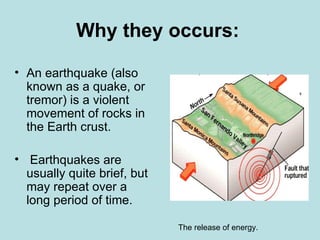
• An earthquake (also
  known as a quake, or
  tremor) is a violent
  movement of rocks in
  the Earth crust.

• Earthquakes are
  usually quite brief, but
  may repeat over a
  long period of time.

                             The release of energy.
What causes?
• Earthquakes are
  caused by tectonic
  movements in the
  Earth crust.
• The main cause are
  the tectonic plates.
• One rides over the
  other, causing
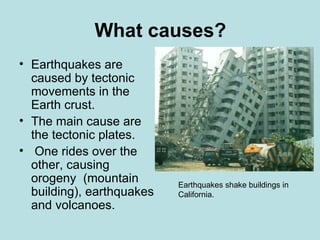
  orogeny (mountain        Earthquakes shake buildings in
  building), earthquakes   California.
  and volcanoes.
The earthquake fault types

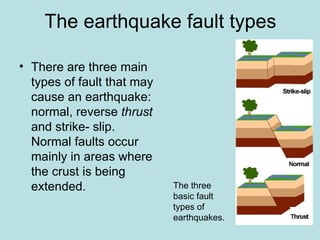
• There are three main
  types of fault that may
  cause an earthquake:
  normal, reverse thrust
  and strike- slip.
  Normal faults occur
  mainly in areas where
  the crust is being
  extended.                 The three
                            basic fault
                            types of
                            earthquakes.
The earthquake clusters
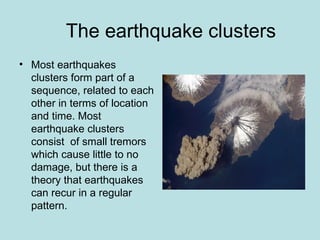
• Most earthquakes
  clusters form part of a
  sequence, related to each
  other in terms of location
  and time. Most
  earthquake clusters
  consist of small tremors
  which cause little to no
  damage, but there is a
  theory that earthquakes
  can recur in a regular
  pattern.
The effects and the precipitation of
          earthquakes.
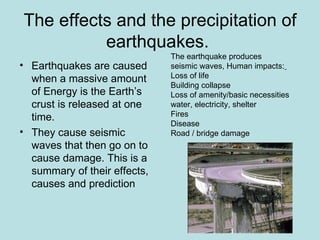
                              The earthquake produces
• Earthquakes are caused      seismic waves, Human impacts:
  when a massive amount       Loss of life
                              Building collapse
  of Energy is the Earth’s    Loss of amenity/basic necessities
  crust is released at one    water, electricity, shelter
  time.                       Fires
                              Disease
• They cause seismic          Road / bridge damage
  waves that then go on to
  cause damage. This is a
  summary of their effects,
  causes and prediction
Which are the cities that suffer the
         earthquakes
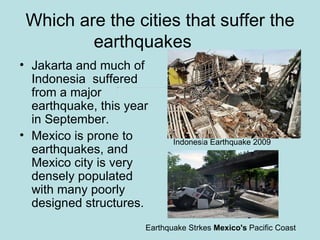
• Jakarta and much of
  Indonesia suffered
  from a major
  earthquake, this year
  in September.
• Mexico is prone to         Indonesia Earthquake 2009
  earthquakes, and
  Mexico city is very
  densely populated
  with many poorly
  designed structures.
                      Earthquake Strkes Mexico's Pacific Coast
The aftershocks

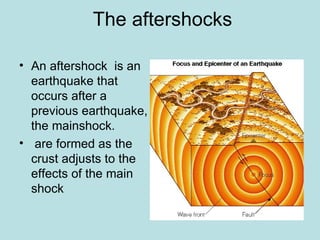
• An aftershock is an
  earthquake that
  occurs after a
  previous earthquake,
  the mainshock.
• are formed as the
  crust adjusts to the
  effects of the main
  shock
Earthquake swarms
• Are sequences of        • By the fact that no
  earthquakes striking      single earthquake in
  in a specific area        the sequence is
  within a short period     obviously the main
  of time.
                            shock, therefore none
• They are different
                            have notable higher
  from earthquakes
  because they              magnitudes than the
  followed by a series      other.
  of aftershocks.
Earthquake storms
• A series of earthquakes
  occur in a sort of
  earthquake storm,
• Are Similar to
  aftershocks but on
  adjacent segments of
  fault.
• These storms occur over
  the course of years, and
  with some of the later
  earthquakes as damaging
  as the early ones.
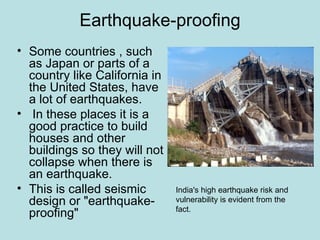
Earthquake-proofing
• Some countries , such
  as Japan or parts of a
  country like California in
  the United States, have
  a lot of earthquakes.
• In these places it is a
  good practice to build
  houses and other
  buildings so they will not
  collapse when there is
  an earthquake.
• This is called seismic       India's high earthquake risk and
  design or "earthquake-       vulnerability is evident from the
                               fact.
  proofing"
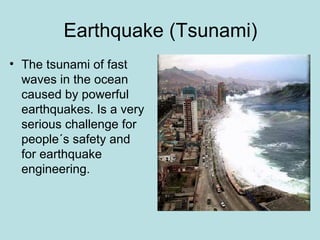
Earthquake (Tsunami)
• The tsunami of fast
  waves in the ocean
  caused by powerful
  earthquakes. Is a very
  serious challenge for
  people´s safety and
  for earthquake
  engineering.
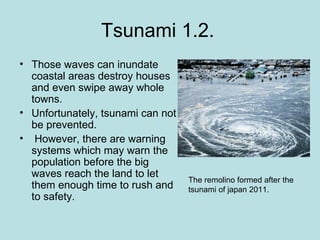
Tsunami 1.2.
• Those waves can inundate
  coastal areas destroy houses
  and even swipe away whole
  towns.
• Unfortunately, tsunami can not
  be prevented.
• However, there are warning
  systems which may warn the
  population before the big
  waves reach the land to let
                                   The remolino formed after the
  them enough time to rush and     tsunami of japan 2011.
  to safety.
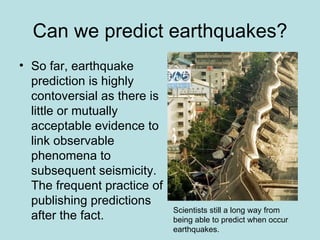
Can we predict earthquakes?
• So far, earthquake
  prediction is highly
  contoversial as there is
  little or mutually
  acceptable evidence to
  link observable
  phenomena to
  subsequent seismicity.
  The frequent practice of
  publishing predictions
                             Scientists still a long way from
  after the fact.            being able to predict when occur
                             earthquakes.
The tectonic plates
                                Tectonic plates are
• The tectonic plates is a      composed of oceanic
  scientific theory that        lithosphere and thicker
                                continental lithosphere,
  describe the large-scale      each topped by its own
  motions of earth´s            kind of crust. Along
  lithosphere. The theory       convergent boundaries,
                                subduction carries plates
  builds on the concepts of     into the mantle; the
  continental drift developed   material lost is roughly
                                balanced by the formation
  during the first decades of   of new (oceanic) crust
  the 20th century.             along divergent margins by
                                seafloor spreading.
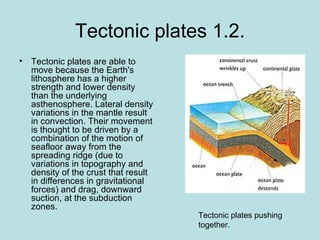
Tectonic plates 1.2.
• Tectonic plates are able to
  move because the Earth's
  lithosphere has a higher
  strength and lower density
  than the underlying
  asthenosphere. Lateral density
  variations in the mantle result
  in convection. Their movement
  is thought to be driven by a
  combination of the motion of
  seafloor away from the
  spreading ridge (due to
  variations in topography and
  density of the crust that result
  in differences in gravitational
  forces) and drag, downward
  suction, at the subduction
  zones.
                                     Tectonic plates pushing
                                     together.
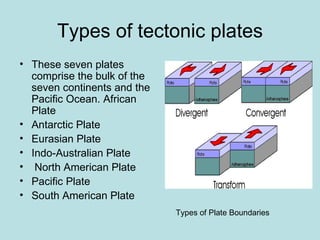
Types of tectonic plates
• These seven plates
  comprise the bulk of the
  seven continents and the
  Pacific Ocean. African
  Plate
• Antarctic Plate
• Eurasian Plate
• Indo-Australian Plate
• North American Plate
• Pacific Plate
• South American Plate
                             Types of Plate Boundaries

Earthquakes

  • 1.
    Earthquakes Fernando Viscarret Pablo Pueyo Xavi Viñeta Pablo Visiers
  • 2.
    Why they occurs: •An earthquake (also known as a quake, or tremor) is a violent movement of rocks in the Earth crust. • Earthquakes are usually quite brief, but may repeat over a long period of time. The release of energy.
  • 3.
    What causes? • Earthquakesare caused by tectonic movements in the Earth crust. • The main cause are the tectonic plates. • One rides over the other, causing orogeny (mountain Earthquakes shake buildings in building), earthquakes California. and volcanoes.
  • 4.
    The earthquake faulttypes • There are three main types of fault that may cause an earthquake: normal, reverse thrust and strike- slip. Normal faults occur mainly in areas where the crust is being extended. The three basic fault types of earthquakes.
  • 5.
    The earthquake clusters •Most earthquakes clusters form part of a sequence, related to each other in terms of location and time. Most earthquake clusters consist of small tremors which cause little to no damage, but there is a theory that earthquakes can recur in a regular pattern.
  • 6.
    The effects andthe precipitation of earthquakes. The earthquake produces • Earthquakes are caused seismic waves, Human impacts: when a massive amount Loss of life Building collapse of Energy is the Earth’s Loss of amenity/basic necessities crust is released at one water, electricity, shelter time. Fires Disease • They cause seismic Road / bridge damage waves that then go on to cause damage. This is a summary of their effects, causes and prediction
  • 7.
    Which are thecities that suffer the earthquakes • Jakarta and much of Indonesia suffered from a major earthquake, this year in September. • Mexico is prone to Indonesia Earthquake 2009 earthquakes, and Mexico city is very densely populated with many poorly designed structures. Earthquake Strkes Mexico's Pacific Coast
  • 8.
    The aftershocks • Anaftershock is an earthquake that occurs after a previous earthquake, the mainshock. • are formed as the crust adjusts to the effects of the main shock
  • 9.
    Earthquake swarms • Aresequences of • By the fact that no earthquakes striking single earthquake in in a specific area the sequence is within a short period obviously the main of time. shock, therefore none • They are different have notable higher from earthquakes because they magnitudes than the followed by a series other. of aftershocks.
  • 10.
    Earthquake storms • Aseries of earthquakes occur in a sort of earthquake storm, • Are Similar to aftershocks but on adjacent segments of fault. • These storms occur over the course of years, and with some of the later earthquakes as damaging as the early ones.
  • 11.
    Earthquake-proofing • Some countries, such as Japan or parts of a country like California in the United States, have a lot of earthquakes. • In these places it is a good practice to build houses and other buildings so they will not collapse when there is an earthquake. • This is called seismic India's high earthquake risk and design or "earthquake- vulnerability is evident from the fact. proofing"
  • 12.
    Earthquake (Tsunami) • Thetsunami of fast waves in the ocean caused by powerful earthquakes. Is a very serious challenge for people´s safety and for earthquake engineering.
  • 13.
    Tsunami 1.2. • Thosewaves can inundate coastal areas destroy houses and even swipe away whole towns. • Unfortunately, tsunami can not be prevented. • However, there are warning systems which may warn the population before the big waves reach the land to let The remolino formed after the them enough time to rush and tsunami of japan 2011. to safety.
  • 14.
    Can we predictearthquakes? • So far, earthquake prediction is highly contoversial as there is little or mutually acceptable evidence to link observable phenomena to subsequent seismicity. The frequent practice of publishing predictions Scientists still a long way from after the fact. being able to predict when occur earthquakes.
  • 15.
    The tectonic plates Tectonic plates are • The tectonic plates is a composed of oceanic scientific theory that lithosphere and thicker continental lithosphere, describe the large-scale each topped by its own motions of earth´s kind of crust. Along lithosphere. The theory convergent boundaries, subduction carries plates builds on the concepts of into the mantle; the continental drift developed material lost is roughly balanced by the formation during the first decades of of new (oceanic) crust the 20th century. along divergent margins by seafloor spreading.
  • 16.
    Tectonic plates 1.2. •Tectonic plates are able to move because the Earth's lithosphere has a higher strength and lower density than the underlying asthenosphere. Lateral density variations in the mantle result in convection. Their movement is thought to be driven by a combination of the motion of seafloor away from the spreading ridge (due to variations in topography and density of the crust that result in differences in gravitational forces) and drag, downward suction, at the subduction zones. Tectonic plates pushing together.
  • 17.
    Types of tectonicplates • These seven plates comprise the bulk of the seven continents and the Pacific Ocean. African Plate • Antarctic Plate • Eurasian Plate • Indo-Australian Plate • North American Plate • Pacific Plate • South American Plate Types of Plate Boundaries