What is anEarthquake?
An earthquake is a sudden release of
energy in the Earth's crust that creates
seismic waves.
What causes Earthquakes?
Most earthquakes occur due to the
movement of tectonic plates, which are large
pieces of the Earth's crust that fit together
like a jigsaw puzzle.
3.
FOCUS
• It isthe point on the Earth’s surface directly above the
focus.
• a point inside the earth where the earthquake started, also
called as HYPOCENTER.
EPICENTER
4.
Types of FOCUS
•It is produce when the hypocenter is located near the surface
from 0 – 70 km.
1. Deep Shallow Focus
2. Deep-Focus
• It is produced when the seismic wave intermediate between 70 –
700 km.
5.
Seismograph
• A seismographis an instrument used to record and measure
the motion of the ground during an earthquake.
Seismologist
• They can detect the existence of a fault by studying the
distance between rocks, either when they move apart or come
together,
• They also look for surface evidence such as surface rupture or
fault scarps and by tracking earthquake records by
SEISMOGRAPHIC network.
6.
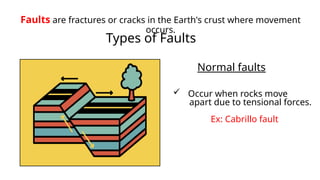
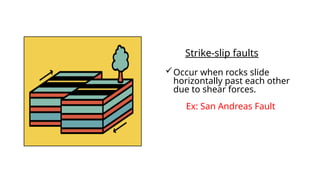
Faults are fracturesor cracks in the Earth's crust where movement
occurs.
Normal faults
Occur when rocks move
apart due to tensional forces.
Ex: Cabrillo fault
Types of Faults
7.
Reverse faults
Occur whenrocks are pushed
together due to
compressional forces.
Ex: SUMATRA Earthquake fault
2004
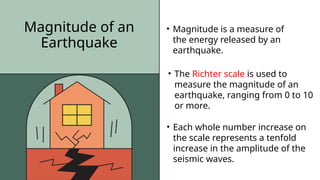
Magnitude of an
Earthquake
•Magnitude is a measure of
the energy released by an
earthquake.
• The Richter scale is used to
measure the magnitude of an
earthquake, ranging from 0 to 10
or more.
• Each whole number increase on
the scale represents a tenfold
increase in the amplitude of the
seismic waves.
10.
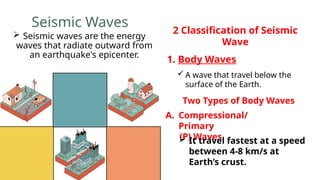
Seismic Waves
Seismicwaves are the energy
waves that radiate outward from
an earthquake's epicenter.
1. Body Waves
2 Classification of Seismic
Wave
A wave that travel below the
surface of the Earth.
Two Types of Body Waves
A. Compressional/
Primary
(P) Waves
It travel fastest at a speed
between 4-8 km/s at
Earth’s crust.
11.
2. Surface Waves
It can only travel along the surface. They arrive after the Body wave
and confined to the outer layer of the Earth.
B. Shear/Secondary (S) Waves
Usually travel at 2.5-4 km/s and can travel only through
solid materials unlike P-wave that can travel through all
states of matter.
12.
Two Types ofSurface
Waves
A. LOVE WAVE
Move transverse to the direction of the propagation but with no
vertical motion. It cause rock to move horizontally or side to
side at right angles to the direction of the travelling wave.
B. RAYLEIGH WAVE
Also called ground roll, cause rock particles to move upward,
backward, and downward in a path that contains the direction of
the wave travel. It cause the most damage.
13.
EFFECTS
OF
AN
EARTHQUAKE
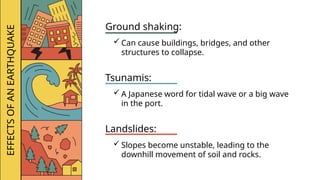
Ground shaking:
Cancause buildings, bridges, and other
structures to collapse.
Tsunamis:
A Japanese word for tidal wave or a big wave
in the port.
Landslides:
Slopes become unstable, leading to the
downhill movement of soil and rocks.
14.
EFFECTS
OF
AN
EARTHQUAKE
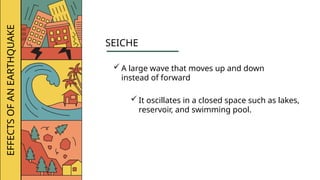
SEICHE
A largewave that moves up and down
instead of forward
It oscillates in a closed space such as lakes,
reservoir, and swimming pool.
15.
FOUR
TYPES
OF
EARTHQUAKE
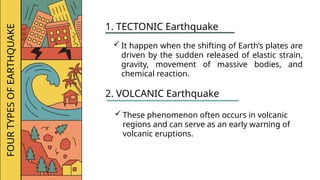
1. TECTONIC Earthquake
It happen when the shifting of Earth’s plates are
driven by the sudden released of elastic strain,
gravity, movement of massive bodies, and
chemical reaction.
2. VOLCANIC Earthquake
These phenomenon often occurs in volcanic
regions and can serve as an early warning of
volcanic eruptions.
16.
FOUR
TYPES
OF
EARTHQUAKE
It iscaused by either the injection or withdrawal
of magma in response to the changes in
pressure in the rock where the magma has
experienced stress.
3. COLLAPSE Earthquake
Are small earthquake located underground
and in mines that are caused by the
disintegration of the roof of the mine, cavern/
by massive landsliding.
An often observe variation of this
earthquake type is the “mine burst”.
17.
FOUR
TYPES
OF
EARTHQUAKE
4. EXPLOSION Earthquake
It is an earthquake that results from detonation
of chemicals or nuclear devices.
It occurs when enormous nuclear
energy is released during underground
nuclear explosion.
18.
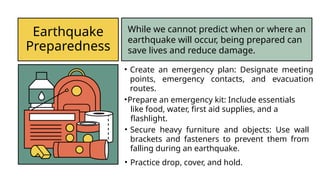
Earthquake
Preparedness
While we cannotpredict when or where an
earthquake will occur, being prepared can
save lives and reduce damage.
• Create an emergency plan: Designate meeting
points, emergency contacts, and evacuation
routes.
•Prepare an emergency kit: Include essentials
like food, water, first aid supplies, and a
flashlight.
• Secure heavy furniture and objects: Use wall
brackets and fasteners to prevent them from
falling during an earthquake.
• Practice drop, cover, and hold.





![谷歌留痕技术 [ 𝙩𝙤𝙥 𝟮𝟯𝟯. 𝙘 𝙤𝙢 ]](https://cdn.slidesharecdn.com/ss_thumbnails/top233-260130174328-3833018c-thumbnail.jpg?width=640&height=640&fit=bounds)