1
Presentation 
Engineering Geology & Geomorphology 
CEN-223 
Instructor 
Anisuzzaman Khan 
2
Group Name 
3
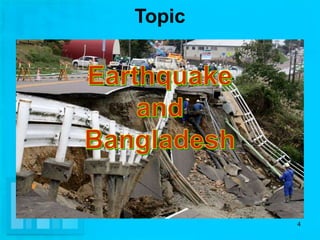
Topic 
4
Group Members 
Md. Saddam 
Husain 
ID# 12206023 
Md. Hasan 
Shahariar 
ID#12206013 
Md. Shakkik 
Zunaed 
ID#12206004 
Arun Chandra 
Acharjee 
ID#12206066 
Md. Oliullah 
Sheik 
ID#12206067 
Md. Shariful 
Haque Robin 
ID#12206049 
5
Contents 
Topic Topic 
What is Earthquake Major Earthquakes Zone in the World 
The Focus and Epicenter of an Earthquake Tsunami 
Types of Earthquake Earthquakes Zone in Bangladesh 
Elastic Rebound Theory Last 2 Years Earthquake Statistic in 
6 
Bangladesh & Places Near Bangladesh 
Seismic Waves Earthquake and Dhaka City 
Faults Earthquake Preventive Design 
How does earthquake occurs Effect of Earthquake 
The Seismograph Positive Effects of Earthquake 
The Richter Scale Basic Recommendations for Earthquake 
Protection
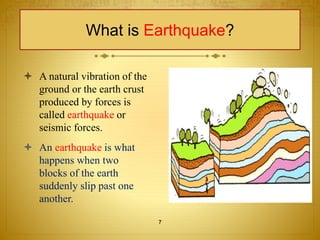
What is Earthquake? 
 A natural vibration of the 
ground or the earth crust 
produced by forces is 
called earthquake or 
seismic forces. 
 An earthquake is what 
happens when two 
blocks of the earth 
suddenly slip past one 
another. 
7
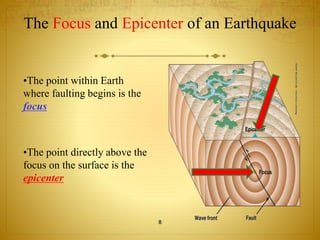
The Focus and Epicenter of an Earthquake 
•The point within Earth 
where faulting begins is the 
focus 
•The point directly above the 
focus on the surface is the 
epicenter 
8
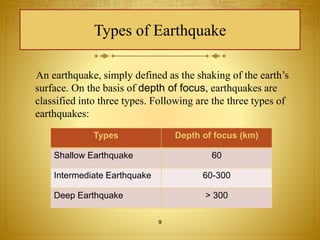
Types of Earthquake 
An earthquake, simply defined as the shaking of the earth’s 
surface. On the basis of depth of focus, earthquakes are 
classified into three types. Following are the three types of 
earthquakes: 
Types Depth of focus (km) 
Shallow Earthquake 60 
Intermediate Earthquake 60-300 
Deep Earthquake > 300 
9
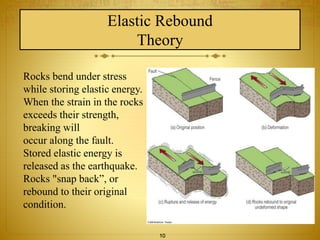
Elastic Rebound 
Theory 
Rocks bend under stress 
while storing elastic energy. 
When the strain in the rocks 
exceeds their strength, 
breaking will 
occur along the fault. 
Stored elastic energy is 
released as the earthquake. 
Rocks "snap back”, or 
rebound to their original 
condition. 
10
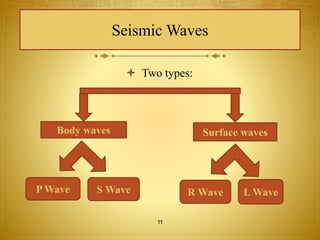
Seismic Waves 
 Two types: 
Body waves Surface waves 
P Wave S Wave R Wave L Wave 
11
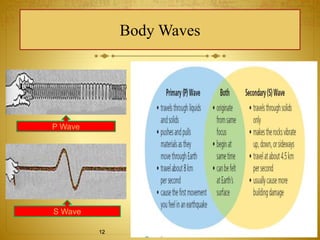
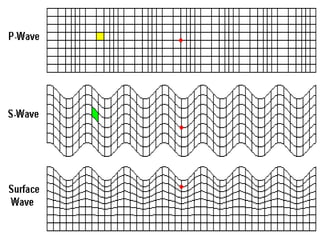
Body Waves 
12 
P Wave 
S Wave
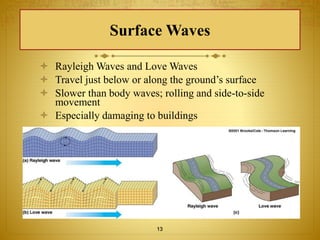
Surface Waves 
 Rayleigh Waves and Love Waves 
 Travel just below or along the ground’s surface 
 Slower than body waves; rolling and side-to-side 
movement 
 Especially damaging to buildings 
13
14
Faults 
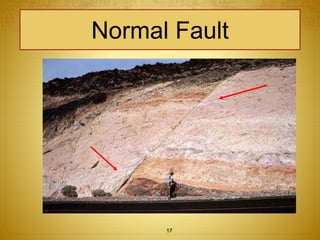
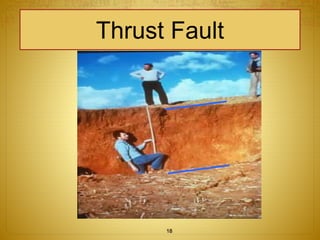
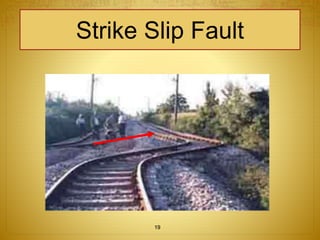
 A fault is a fracture in the Earth's crust 
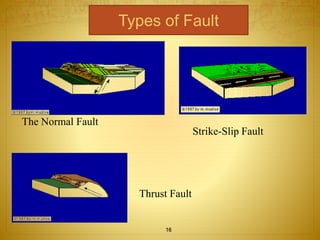
 3 main fault groups 
 Faults are classified depending on how they move. 
15
The Normal Fault 
Types of Fault 
Strike-Slip Fault 
Thrust Fault 
16
Normal Fault 
17
Thrust Fault 
18
Strike Slip Fault 
19
How does earthquake occurs? 
 Most earthquakes happen along the edge of the oceanic and 
continental plates. [Oceanic plates are under water, 
continental plates are above.] The earth's crust (the outer 
layer of the planet) is made up of a bunch of pieces, called 
plates. The plates get moved around by the liquid layers of 
magma underneath the Earth's crust. The plates are always 
bumping into each other, and pulling away from each other 
or past each other. Earthquakes usually happen when two 
plates are running into each other or sliding past each other. 
They can also happen along faults, too though. 
20
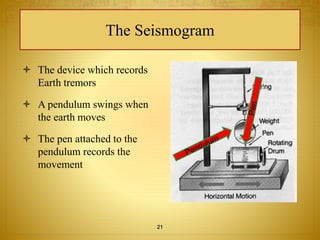
The Seismogram 
 The device which records 
Earth tremors 
 A pendulum swings when 
the earth moves 
 The pen attached to the 
pendulum records the 
movement 
21
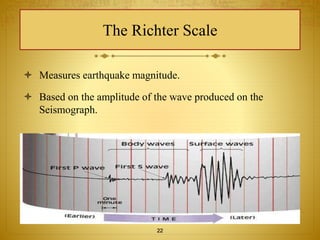
The Richter Scale 
 Measures earthquake magnitude. 
 Based on the amplitude of the wave produced on the 
Seismograph. 
22
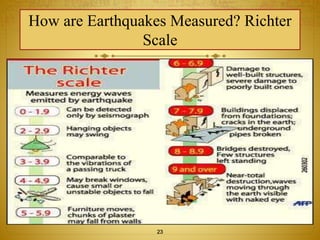
How are Earthquakes Measured? Richter 
Scale 
23
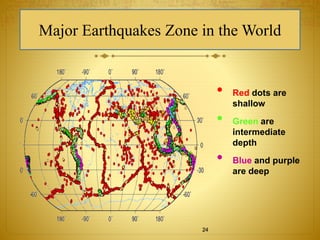
Major Earthquakes Zone in the World 
• Red dots are 
shallow 
• Green are 
intermediate 
depth 
• Blue and purple 
are deep 
24
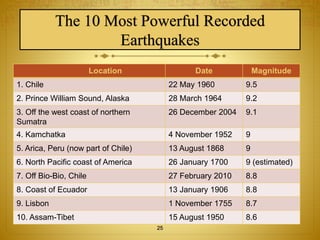
The 10 Most Powerful Recorded 
Earthquakes 
Location Date Magnitude 
1. Chile 22 May 1960 9.5 
2. Prince William Sound, Alaska 28 March 1964 9.2 
3. Off the west coast of northern 
Sumatra 
25 
26 December 2004 9.1 
4. Kamchatka 4 November 1952 9 
5. Arica, Peru (now part of Chile) 13 August 1868 9 
6. North Pacific coast of America 26 January 1700 9 (estimated) 
7. Off Bio-Bio, Chile 27 February 2010 8.8 
8. Coast of Ecuador 13 January 1906 8.8 
9. Lisbon 1 November 1755 8.7 
10. Assam-Tibet 15 August 1950 8.6
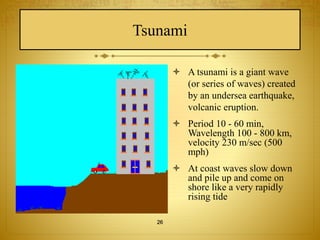
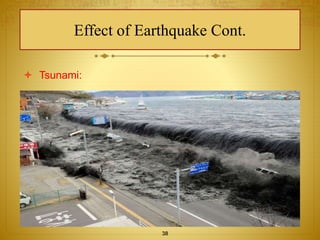
Tsunami 
 A tsunami is a giant wave 
(or series of waves) created 
by an undersea earthquake, 
volcanic eruption. 
 Period 10 - 60 min, 
Wavelength 100 - 800 km, 
velocity 230 m/sec (500 
mph) 
 At coast waves slow down 
and pile up and come on 
shore like a very rapidly 
rising tide 
26
Earthquakes in Bangladesh 
27
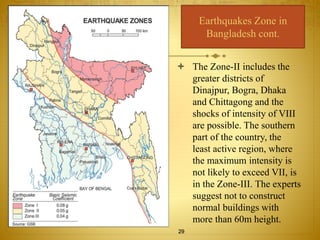
Earthquakes Zone in Bangladesh 
 In the north and northeast of Bangladesh, there are 
areas of high seismic activity and some of the major 
earthquakes originating in these areas. The whole of 
Bangladesh is divided into three seismic zones. The 
northern part of the country that includes the greater 
districts of Rangpur, Mymensingh, and Sylhet are in 
the Zone-I where earthquake shock of maximum 
intensity. 
28
 The Zone-II includes the 
greater districts of 
Dinajpur, Bogra, Dhaka 
and Chittagong and the 
shocks of intensity of VIII 
are possible. The southern 
part of the country, the 
least active region, where 
the maximum intensity is 
not likely to exceed VII, is 
in the Zone-III. The experts 
suggest not to construct 
normal buildings with 
more than 60m height. 
29 
Earthquakes Zone in 
Bangladesh cont.
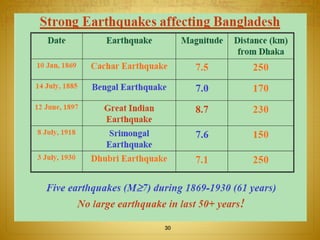
30
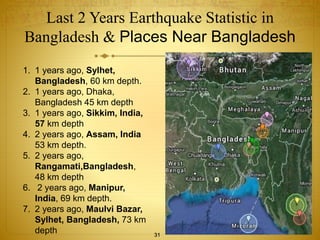
Last 2 Years Earthquake Statistic in 
Bangladesh & Places Near Bangladesh 
1. 1 years ago, Sylhet, 
Bangladesh, 60 km depth. 
2. 1 years ago, Dhaka, 
Bangladesh 45 km depth 
3. 1 years ago, Sikkim, India, 
57 km depth 
4. 2 years ago, Assam, India 
53 km depth. 
5. 2 years ago, 
Rangamati,Bangladesh, 
48 km depth 
6. 2 years ago, Manipur, 
India, 69 km depth. 
7. 2 years ago, Maulvi Bazar, 
Sylhet, Bangladesh, 73 km 
depth 
31
32
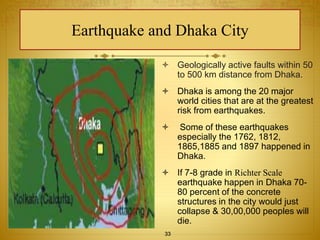
Earthquake and Dhaka City 
 Geologically active faults within 50 
to 500 km distance from Dhaka. 
 Dhaka is among the 20 major 
world cities that are at the greatest 
risk from earthquakes. 
 Some of these earthquakes 
especially the 1762, 1812, 
1865,1885 and 1897 happened in 
Dhaka. 
 If 7-8 grade in Richter Scale 
earthquake happen in Dhaka 70- 
80 percent of the concrete 
structures in the city would just 
collapse & 30,00,000 peoples will 
die. 
33
Effect of Earthquake 
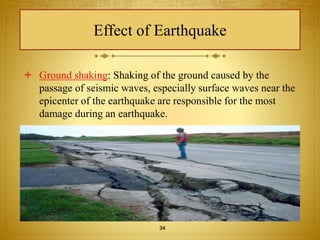
 Ground shaking: Shaking of the ground caused by the 
passage of seismic waves, especially surface waves near the 
epicenter of the earthquake are responsible for the most 
damage during an earthquake. 
34
Effect of Earthquake Cont. 
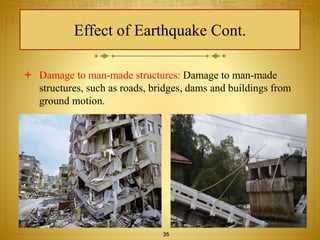
 Damage to man-made structures: Damage to man-made 
structures, such as roads, bridges, dams and buildings from 
ground motion. 
35
Effect of Earthquake Cont. 
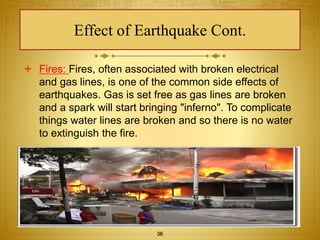
 Fires: Fires, often associated with broken electrical 
and gas lines, is one of the common side effects of 
earthquakes. Gas is set free as gas lines are broken 
and a spark will start bringing "inferno". To complicate 
things water lines are broken and so there is no water 
to extinguish the fire. 
36
Effect of Earthquake Cont. 
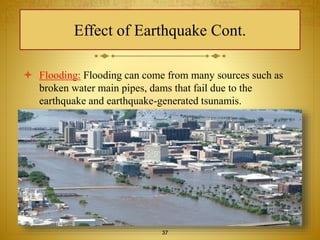
 Flooding: Flooding can come from many sources such as 
broken water main pipes, dams that fail due to the 
earthquake and earthquake-generated tsunamis. 
37
Effect of Earthquake Cont. 
 Tsunami: 
38
Positive Effects of Earthquake 
 Give knowledge insight in Geology 
 Push Minerals and Metals to the Surface 
 Make Fossil Fuels Easier to Access 
39
Earthquake Preventive Design 
 All structure should be designed according to BNBC – 2006 
code 
 33% extra reinforcement provision to reduce earthquake 
effect 
 Residential building (5/ 6 storied) may be constructed with 
L-type corner column and 2/3 T-type inner column tied 
with beam 
 To make it tight 8”x 12” column section with 5” to 8” brick 
wall thickness may be selected 
40
Earthquake Preventive Design Cont. 
 Furthermore, the following general principles may be 
followed: 
 (a) Ht. of each floor should be 10’ 
 (b) Foundation must be laid on hard soil 
 (c) Framed structure should be preferred rather than brick 
structure 
 (d) Where frame structure is not possible, brick wall should 
be reinforced vertically & horizontally 
41
Basic Recommendations for Earthquake 
Protection 
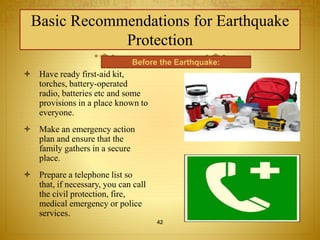
 Have ready first-aid kit, 
Before the Earthquake: 
torches, battery-operated 
radio, batteries etc and some 
provisions in a place known to 
everyone. 
 Make an emergency action 
plan and ensure that the 
family gathers in a secure 
place. 
 Prepare a telephone list so 
that, if necessary, you can call 
the civil protection, fire, 
medical emergency or police 
services. 
42
Basic Recommendations for Earthquake 
Protection 
During the earthquake: 
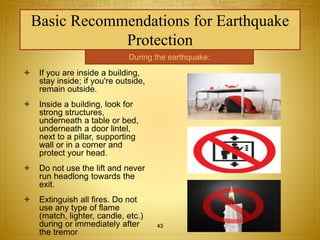
 If you are inside a building, 
stay inside; if you're outside, 
remain outside. 
 Inside a building, look for 
strong structures, 
underneath a table or bed, 
underneath a door lintel, 
next to a pillar, supporting 
wall or in a corner and 
protect your head. 
 Do not use the lift and never 
run headlong towards the 
exit. 
 Extinguish all fires. Do not 
use any type of flame 
(match, lighter, candle, etc.) 
during or immediately after 
the tremor 
43
Basic Recommendations for Earthquake 
Protection 
After the Earthquake: 
 keep calm and ensure that others do the same. Prevent any 
panic situations. 
 Check whether anyone is hurt; give them any necessary first 
aid. 
 Do not repair damage immediately, except if there is broken 
glass or bottles containing toxic or inflammable substances. 
 Keep away from damaged buildings. Move to open areas. 
44
45
46

Earthquake

  • 1.
  • 2.
    Presentation Engineering Geology& Geomorphology CEN-223 Instructor Anisuzzaman Khan 2
  • 3.
  • 4.
  • 5.
    Group Members Md.Saddam Husain ID# 12206023 Md. Hasan Shahariar ID#12206013 Md. Shakkik Zunaed ID#12206004 Arun Chandra Acharjee ID#12206066 Md. Oliullah Sheik ID#12206067 Md. Shariful Haque Robin ID#12206049 5
  • 6.
    Contents Topic Topic What is Earthquake Major Earthquakes Zone in the World The Focus and Epicenter of an Earthquake Tsunami Types of Earthquake Earthquakes Zone in Bangladesh Elastic Rebound Theory Last 2 Years Earthquake Statistic in 6 Bangladesh & Places Near Bangladesh Seismic Waves Earthquake and Dhaka City Faults Earthquake Preventive Design How does earthquake occurs Effect of Earthquake The Seismograph Positive Effects of Earthquake The Richter Scale Basic Recommendations for Earthquake Protection
  • 7.
    What is Earthquake?  A natural vibration of the ground or the earth crust produced by forces is called earthquake or seismic forces.  An earthquake is what happens when two blocks of the earth suddenly slip past one another. 7
  • 8.
    The Focus andEpicenter of an Earthquake •The point within Earth where faulting begins is the focus •The point directly above the focus on the surface is the epicenter 8
  • 9.
    Types of Earthquake An earthquake, simply defined as the shaking of the earth’s surface. On the basis of depth of focus, earthquakes are classified into three types. Following are the three types of earthquakes: Types Depth of focus (km) Shallow Earthquake 60 Intermediate Earthquake 60-300 Deep Earthquake > 300 9
  • 10.
    Elastic Rebound Theory Rocks bend under stress while storing elastic energy. When the strain in the rocks exceeds their strength, breaking will occur along the fault. Stored elastic energy is released as the earthquake. Rocks "snap back”, or rebound to their original condition. 10
  • 11.
    Seismic Waves Two types: Body waves Surface waves P Wave S Wave R Wave L Wave 11
  • 12.
    Body Waves 12 P Wave S Wave
  • 13.
    Surface Waves Rayleigh Waves and Love Waves  Travel just below or along the ground’s surface  Slower than body waves; rolling and side-to-side movement  Especially damaging to buildings 13
  • 14.
  • 15.
    Faults  Afault is a fracture in the Earth's crust  3 main fault groups  Faults are classified depending on how they move. 15
  • 16.
    The Normal Fault Types of Fault Strike-Slip Fault Thrust Fault 16
  • 17.
  • 18.
  • 19.
  • 20.
    How does earthquakeoccurs?  Most earthquakes happen along the edge of the oceanic and continental plates. [Oceanic plates are under water, continental plates are above.] The earth's crust (the outer layer of the planet) is made up of a bunch of pieces, called plates. The plates get moved around by the liquid layers of magma underneath the Earth's crust. The plates are always bumping into each other, and pulling away from each other or past each other. Earthquakes usually happen when two plates are running into each other or sliding past each other. They can also happen along faults, too though. 20
  • 21.
    The Seismogram The device which records Earth tremors  A pendulum swings when the earth moves  The pen attached to the pendulum records the movement 21
  • 22.
    The Richter Scale  Measures earthquake magnitude.  Based on the amplitude of the wave produced on the Seismograph. 22
  • 23.
    How are EarthquakesMeasured? Richter Scale 23
  • 24.
    Major Earthquakes Zonein the World • Red dots are shallow • Green are intermediate depth • Blue and purple are deep 24
  • 25.
    The 10 MostPowerful Recorded Earthquakes Location Date Magnitude 1. Chile 22 May 1960 9.5 2. Prince William Sound, Alaska 28 March 1964 9.2 3. Off the west coast of northern Sumatra 25 26 December 2004 9.1 4. Kamchatka 4 November 1952 9 5. Arica, Peru (now part of Chile) 13 August 1868 9 6. North Pacific coast of America 26 January 1700 9 (estimated) 7. Off Bio-Bio, Chile 27 February 2010 8.8 8. Coast of Ecuador 13 January 1906 8.8 9. Lisbon 1 November 1755 8.7 10. Assam-Tibet 15 August 1950 8.6
  • 26.
    Tsunami  Atsunami is a giant wave (or series of waves) created by an undersea earthquake, volcanic eruption.  Period 10 - 60 min, Wavelength 100 - 800 km, velocity 230 m/sec (500 mph)  At coast waves slow down and pile up and come on shore like a very rapidly rising tide 26
  • 27.
  • 28.
    Earthquakes Zone inBangladesh  In the north and northeast of Bangladesh, there are areas of high seismic activity and some of the major earthquakes originating in these areas. The whole of Bangladesh is divided into three seismic zones. The northern part of the country that includes the greater districts of Rangpur, Mymensingh, and Sylhet are in the Zone-I where earthquake shock of maximum intensity. 28
  • 29.
     The Zone-IIincludes the greater districts of Dinajpur, Bogra, Dhaka and Chittagong and the shocks of intensity of VIII are possible. The southern part of the country, the least active region, where the maximum intensity is not likely to exceed VII, is in the Zone-III. The experts suggest not to construct normal buildings with more than 60m height. 29 Earthquakes Zone in Bangladesh cont.
  • 30.
  • 31.
    Last 2 YearsEarthquake Statistic in Bangladesh & Places Near Bangladesh 1. 1 years ago, Sylhet, Bangladesh, 60 km depth. 2. 1 years ago, Dhaka, Bangladesh 45 km depth 3. 1 years ago, Sikkim, India, 57 km depth 4. 2 years ago, Assam, India 53 km depth. 5. 2 years ago, Rangamati,Bangladesh, 48 km depth 6. 2 years ago, Manipur, India, 69 km depth. 7. 2 years ago, Maulvi Bazar, Sylhet, Bangladesh, 73 km depth 31
  • 32.
  • 33.
    Earthquake and DhakaCity  Geologically active faults within 50 to 500 km distance from Dhaka.  Dhaka is among the 20 major world cities that are at the greatest risk from earthquakes.  Some of these earthquakes especially the 1762, 1812, 1865,1885 and 1897 happened in Dhaka.  If 7-8 grade in Richter Scale earthquake happen in Dhaka 70- 80 percent of the concrete structures in the city would just collapse & 30,00,000 peoples will die. 33
  • 34.
    Effect of Earthquake  Ground shaking: Shaking of the ground caused by the passage of seismic waves, especially surface waves near the epicenter of the earthquake are responsible for the most damage during an earthquake. 34
  • 35.
    Effect of EarthquakeCont.  Damage to man-made structures: Damage to man-made structures, such as roads, bridges, dams and buildings from ground motion. 35
  • 36.
    Effect of EarthquakeCont.  Fires: Fires, often associated with broken electrical and gas lines, is one of the common side effects of earthquakes. Gas is set free as gas lines are broken and a spark will start bringing "inferno". To complicate things water lines are broken and so there is no water to extinguish the fire. 36
  • 37.
    Effect of EarthquakeCont.  Flooding: Flooding can come from many sources such as broken water main pipes, dams that fail due to the earthquake and earthquake-generated tsunamis. 37
  • 38.
    Effect of EarthquakeCont.  Tsunami: 38
  • 39.
    Positive Effects ofEarthquake  Give knowledge insight in Geology  Push Minerals and Metals to the Surface  Make Fossil Fuels Easier to Access 39
  • 40.
    Earthquake Preventive Design  All structure should be designed according to BNBC – 2006 code  33% extra reinforcement provision to reduce earthquake effect  Residential building (5/ 6 storied) may be constructed with L-type corner column and 2/3 T-type inner column tied with beam  To make it tight 8”x 12” column section with 5” to 8” brick wall thickness may be selected 40
  • 41.
    Earthquake Preventive DesignCont.  Furthermore, the following general principles may be followed:  (a) Ht. of each floor should be 10’  (b) Foundation must be laid on hard soil  (c) Framed structure should be preferred rather than brick structure  (d) Where frame structure is not possible, brick wall should be reinforced vertically & horizontally 41
  • 42.
    Basic Recommendations forEarthquake Protection  Have ready first-aid kit, Before the Earthquake: torches, battery-operated radio, batteries etc and some provisions in a place known to everyone.  Make an emergency action plan and ensure that the family gathers in a secure place.  Prepare a telephone list so that, if necessary, you can call the civil protection, fire, medical emergency or police services. 42
  • 43.
    Basic Recommendations forEarthquake Protection During the earthquake:  If you are inside a building, stay inside; if you're outside, remain outside.  Inside a building, look for strong structures, underneath a table or bed, underneath a door lintel, next to a pillar, supporting wall or in a corner and protect your head.  Do not use the lift and never run headlong towards the exit.  Extinguish all fires. Do not use any type of flame (match, lighter, candle, etc.) during or immediately after the tremor 43
  • 44.
    Basic Recommendations forEarthquake Protection After the Earthquake:  keep calm and ensure that others do the same. Prevent any panic situations.  Check whether anyone is hurt; give them any necessary first aid.  Do not repair damage immediately, except if there is broken glass or bottles containing toxic or inflammable substances.  Keep away from damaged buildings. Move to open areas. 44
  • 45.
  • 46.