GEOLOGICAL AGENTS & THEIR
ACTION
Kaustubh J. Sane
HJD Institute of Technical
Education and Research, Kera
Geological agents
GEOLOGICAL
AGENTS
WIND
RIVER SEA
GROUNDWATER GLACIERS
WORK OF WIND
• The wind acts in three different ways viz.
Erosion, Transportation, Deposition.
• Erosive work of wind:
– Three types
• Deflation
• Abrasion
• Attrition
Deflation
• The removal of sand particles and dust by strong wind
is called deflation.
• This is observed mainly in desert regions.
• In some deserts deflation may remove the sand from a
particular location and create a depressions.
• These depressions some times reaches the ground
water table. These deeper water filled depressions are
called as OASES.
• Wind deflation also produces another feature like
HAMMADA. It is bare rock surface which is called as
desert pavement.
Wind Abrasion
• Wind when consist of sand and dust particles
it becomes powerful agent.
• These type of erosion evolves rubbing,
grinding, polishing and abrading of rock
surface by wind is called wind abrasion.
• These type of process itself is responsible for
formation of various landforms viz. Yardangs,
pedestal rocks, ventifacts.
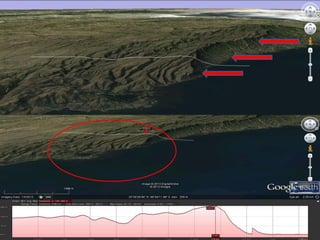
• Yardangs:
• These are elongated, low- lying ridges forming
overhangs above depression.
• These are formed in areas where rocks of
alternate hard and soft characters are lying
above one another with gentle slope.
• Pedestal rocks:
• These are also called as mashroom rocks.
• These are flat topped rock masses with
narrow bottom.
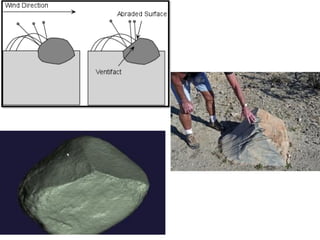
• Ventifacts:
• These are small size rock fragments having
one, two three or more polished surfaces.
• The polishing of surface is carried out by
prolonged action of wind.
• As soon as polishing of one surface is achieved
the rock is overturned by strong wind and
again second face gets under action of wind.
• These wind polished and facetted fragments
are called ventifacts.
Transportation
Most Effective in Moving Loose Material
• Suspension (Silt)
– Light silt grade particles are lifted up in to upper
layer and moves along with it.
• Saltation (Sand)
• Rolling
Depositional features
• Dunes:
– It is a broadly conical heap of sand characterized
with two slope either side of a medial ridge or
crest.
Verhar (Pakistan)
Loess
• Term is used for wind blown deposits of silt
and clay.
• Loess is an aeolian sediment formed by the
accumulation of wind-blown silt, typically in
the 20–50 micro-metre size range.
• It is usually homogeneous and highly porous
and is traversed by vertical capillaries.
Engineering consideration
• Dunes and loess offer complicated problem in construction.
• As dunes & loess are migrating they are moving structures.
• Methods applied in such conditions are;
– Establishing frontal belts of vegetation that can resist the
advancing of sand dunes.
– Construction of wind breakers around the area. These walls
check the velocities of approaching wind.
– Treating the sands locally with crude oil.
– In loess soil engineering problems is to deal with hydro
consolidation characteristics of soil.
– As loess soil gets settle down quickly in moisture, which is
dangerous foundation soil.

Weathering agents

  • 1.
    GEOLOGICAL AGENTS &THEIR ACTION Kaustubh J. Sane HJD Institute of Technical Education and Research, Kera
  • 2.
  • 3.
    WORK OF WIND •The wind acts in three different ways viz. Erosion, Transportation, Deposition. • Erosive work of wind: – Three types • Deflation • Abrasion • Attrition
  • 4.
    Deflation • The removalof sand particles and dust by strong wind is called deflation. • This is observed mainly in desert regions. • In some deserts deflation may remove the sand from a particular location and create a depressions. • These depressions some times reaches the ground water table. These deeper water filled depressions are called as OASES. • Wind deflation also produces another feature like HAMMADA. It is bare rock surface which is called as desert pavement.
  • 6.
    Wind Abrasion • Windwhen consist of sand and dust particles it becomes powerful agent. • These type of erosion evolves rubbing, grinding, polishing and abrading of rock surface by wind is called wind abrasion. • These type of process itself is responsible for formation of various landforms viz. Yardangs, pedestal rocks, ventifacts.
  • 7.
    • Yardangs: • Theseare elongated, low- lying ridges forming overhangs above depression. • These are formed in areas where rocks of alternate hard and soft characters are lying above one another with gentle slope. • Pedestal rocks: • These are also called as mashroom rocks. • These are flat topped rock masses with narrow bottom.
  • 9.
    • Ventifacts: • Theseare small size rock fragments having one, two three or more polished surfaces. • The polishing of surface is carried out by prolonged action of wind. • As soon as polishing of one surface is achieved the rock is overturned by strong wind and again second face gets under action of wind. • These wind polished and facetted fragments are called ventifacts.
  • 11.
    Transportation Most Effective inMoving Loose Material • Suspension (Silt) – Light silt grade particles are lifted up in to upper layer and moves along with it. • Saltation (Sand) • Rolling
  • 12.
    Depositional features • Dunes: –It is a broadly conical heap of sand characterized with two slope either side of a medial ridge or crest.
  • 14.
  • 16.
    Loess • Term isused for wind blown deposits of silt and clay. • Loess is an aeolian sediment formed by the accumulation of wind-blown silt, typically in the 20–50 micro-metre size range. • It is usually homogeneous and highly porous and is traversed by vertical capillaries.
  • 19.
    Engineering consideration • Dunesand loess offer complicated problem in construction. • As dunes & loess are migrating they are moving structures. • Methods applied in such conditions are; – Establishing frontal belts of vegetation that can resist the advancing of sand dunes. – Construction of wind breakers around the area. These walls check the velocities of approaching wind. – Treating the sands locally with crude oil. – In loess soil engineering problems is to deal with hydro consolidation characteristics of soil. – As loess soil gets settle down quickly in moisture, which is dangerous foundation soil.