IOSR Journal of Electrical and Electronics Engineering (IOSR-JEEE)
e-ISSN: 2278-1676,p-ISSN: 2320-3331, Volume 7, Issue 4 (Sep. - Oct. 2013), PP 25-32
www.iosrjournals.org
www.iosrjournals.org 25 | Page
SIMULINK Based Model for Determination of Different Design
Parameters of a Three Phase Delta Connected Squirrel Cage
Induction Motor
Bhaskar Lodh
(Department of Electrical Engineering, Bengal Institute of Technology & Management, West Bengal, India)
Abstract: Electrical Machine Design is a renown discipline of electrical engineering, which can be termed as
the physical implementation of theoretical knowledge .A machine is designed considering different aspects like-
quality and availability of materials, availability of suitable mechanism and skilled labor, cost, durability etc. In
this paper, a computer based model (using SIMULINK) is furnished for obtaining the suitable dimensions of a
three phase squirrel cage induction motor. The main objective of the work is to determine the dimensions of
various parts and components of the motor, specify suitable materials for design and obtain the output
parameters. Now-a-days, induction motors have become the workhorse of the industrial sector due to their easy
means of construction and maintenance. Therefore, the performance of the machine needs to be specified using
computer aided programs. In this paper, the input parameters of the induction motor is so chosen that it will
offer a very competitive pricing and good efficiency.
Keywords: Electrical Machine Design, End ring, Squirrel cage Motor, SIMULINK
I. INTRODUCTION
In practical design of an induction motor, the designer has to follow a number of constraints. Also, the
number of input variables is also high. Therefore, manual calculation becomes very much tedious. In order to
overcome this, one needs to build a computer aided program or simulation model for determining the parameters
of the specific motor. In this paper, a SIMULINK based model is constructed for an induction motor, which will
provide high efficiency. Also, the manufacturing cost of the machine will be less and therefore the motor will
offer a very competitive pricing. Different parameters of the motor like- rating of the motor (KW/KVA), supply
voltage, frequency, type of connection (star/delta), desirable efficiency and power factor, magnetic flux density
etc. are specified. Depending on these specified values, the SIMULINK models will generate and display the
values of different dimensions of the induction motor. It is desirable to describe clearly the objective of the
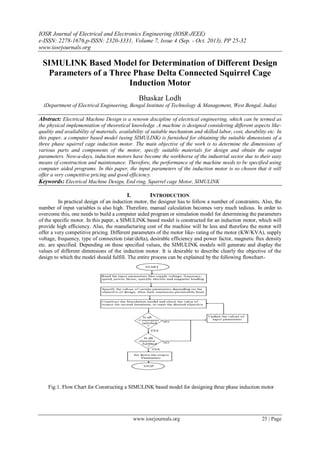
design to which the model should fulfill. The entire process can be explained by the following flowchart-
Fig.1. Flow Chart for Constructing a SIMULINK based model for designing three phase induction motor
SIMULINK Based Model for Determination of Different Design Parameters of a Three Phase delta
www.iosrjournals.org 26 | Page
II. INTRODUCTION TO MATLAB-SIMULINK
In this paper, the software used for constructing the simulation model is MATLAB. It is a very
powerful tool for design engineers. It was first introduced in 1970 by a numerical analyst Cleve Moler, who
wrote the first version of MATLAB. Since then, it has become successful computational and profit-making
software. SIMULINK is a commercial tool furnished by MathWorks Inc. that comes with MATLAB. It is used
for modeling and analyzing different types of static and dynamic systems. In this paper, the required simulation
model is obtained with the help of different building blocks available in SIMULINK environment.
III. DESIGN OF MAIN DIMENSIONS
In this section, diameter (D) and Core length (L) of the stator is determined. The output equation of ac
machines is taken as Q (KVA) =C0D²Ln. Where, C0 is the output coefficient as determined from the SIMULINK
diagram shown. In this paper, the power output, power factor, efficiency and speed is specified. For an electrical
machine manufacturing company, it’s necessary to design an electrical machine that will offer a very
competitive pricing. Therefore, it’s customary to take higher values of specific electric and magnetic loading
(i.e. the values of ac and Bav). Here, ampere conductor per meter of the armature periphery (ac) is taken as
21000 A/m and average value of flux density in the air gap (Bav) is taken as 0.44 Wb/m². In order to have a
small magnetizing current, flux density should be very low. Otherwise the machine will have a poor power
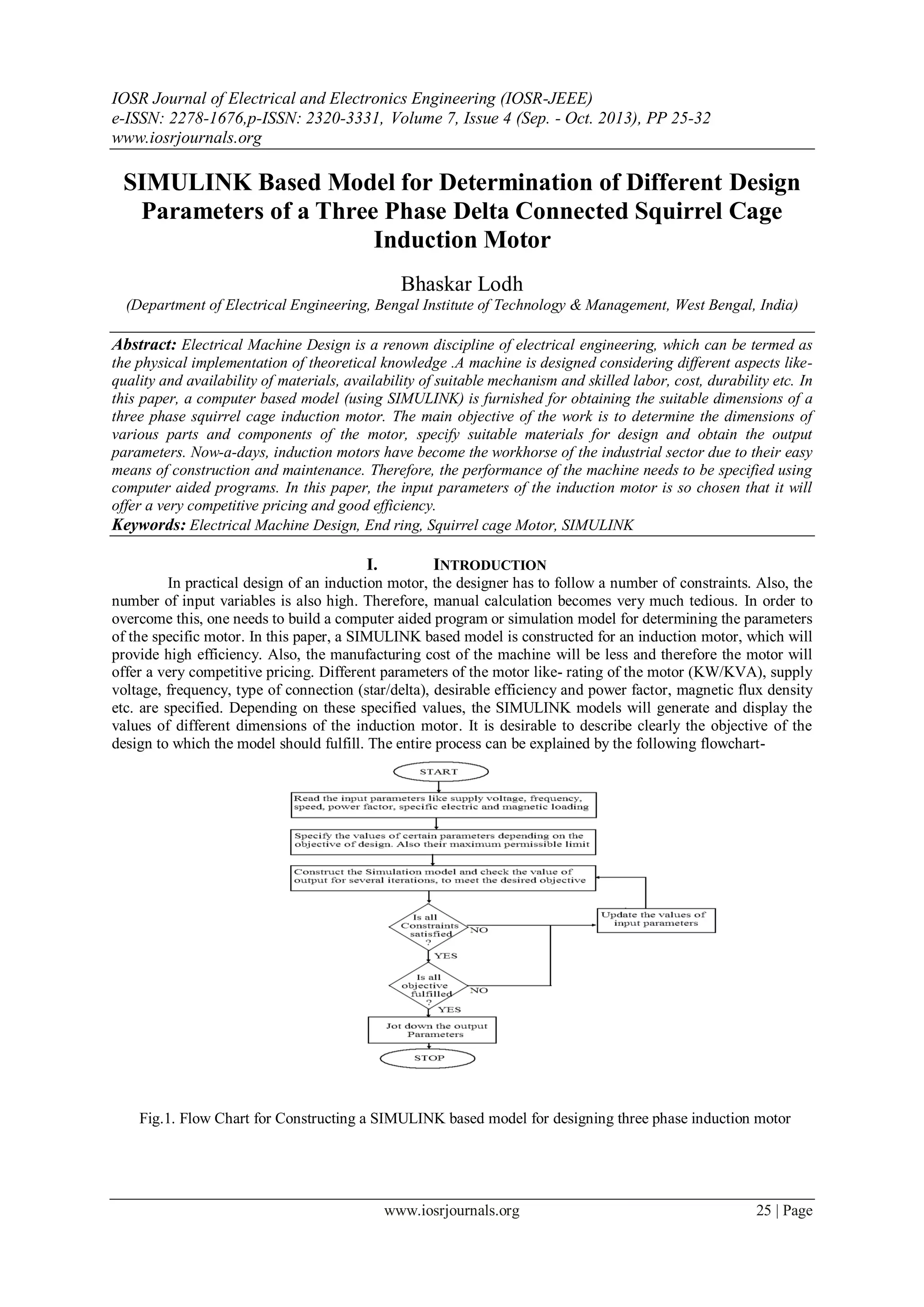
factor and consequently the efficiency of the motor will be less. The corresponding SIMULINK diagram is as
follows-
Fig. 2 SIMULINK model for determination of main frame parameters of an Induction motor
In a typical 50 Hz motor, the value of Bav ranges between 0.3 wb/m² to 0.6 wb/m² and ac ranges
between 5000 to 45000 A/m depending upon the type and application of the machine. In this paper, the taken
value of Bav indicates that the machine will be capable of providing a good overload facility and can be applied
in cranes, rolling mills etc. The ratio of Core length to pole pitch (pole pitch is abbreviated as “TAU” in
SIMULINK model) i.e.
𝐿
𝜏
differs in different machines according to their design specification.
In this paper the value of
𝐿
𝜏
is taken as 1.5 which is a suitable value taken for minimum cost and good
efficiency. In order to attain a good power factor and good overall design of the motor, the value should lie
between 1.0 to 1.25. The peripheral velocity of the motor is expressed in terms of r.p.s. For a normal
construction, the peripheral velocity should not exceed the value 30 r.p.s.
SIMULINK Based Model for Determination of Different Design Parameters of a Three Phase delta
www.iosrjournals.org 27 | Page
IV. DESIGN OF STATOR
The stator is the stationary part of the motor, which consists of the outer cylindrical frame of the motor
or yoke, which is made either of welded sheet steel, cast iron or cast aluminum alloy. Stator is made of a steel
frame which encloses a hollow, cylindrical core fabricated of thin laminations of silicon steel to lessen
hysteresis and eddy current losses. A number of evenly spaced slots are provided on the inner edge of the
laminations. It forms a balanced star or delta connected circuit. For a typical 3 phase 50 Hz motor, rotor is
separated from the stator by a small air-gap which ranges from 0.4 mm to 4 mm, depending on the power of the
motor. In this paper, the machine is designed for delta connection with a star-delta starter. The stator will be
designed with a single layer mush winding where the coil span should not be an even integer. When 3-phase
supply is given to the stator winding, a rotating magnetic field is produced which induces currents in the rotor
by electromagnetic induction. No. of stator winding turns per phase is calculated as 𝑇𝑠 =
𝐸 𝑠
4.44𝐾 𝑤𝑠 𝜑 𝑚
, where
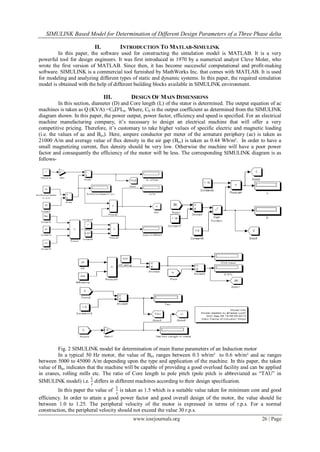
𝐸𝑠 =Applied ac voltage, 𝐾 𝑤𝑠 = Stator winding factor and 𝜑 𝑚 =Maximum flux per pole as calculated from the
SIMULINK diagram.
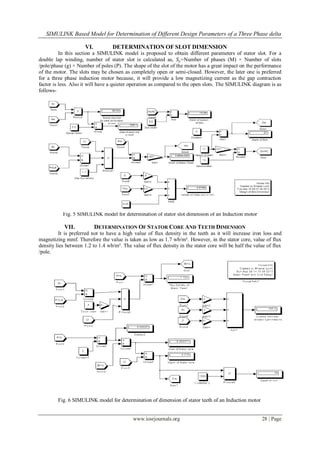
Fig. 3 SIMULINK model for determination of stator parameters of an Induction motor
V. DETERMINATION OF CONDUCTOR SIZE
In this section a SIMULINK model is proposed to obtain the current density (𝜕𝑠) and area of stator
conductor (𝑎 𝑠). For a typical 50 Hz induction motor value of current density in the stator winding normally lies
between 3 to 5 A / mm². The corresponding SIMULINK diagram is shown below-
Fig. 4 SIMULINK model for determination of stator conductor size of an Induction motor
SIMULINK Based Model for Determination of Different Design Parameters of a Three Phase delta
www.iosrjournals.org 28 | Page
VI. DETERMINATION OF SLOT DIMENSION
In this section a SIMULINK model is proposed to obtain different parameters of stator slot. For a
double lap winding, number of stator slot is calculated as, 𝑆𝑠=Number of phases (M) × Number of slots
/pole/phase (g) × Number of poles (P). The shape of the slot of the motor has a great impact on the performance
of the motor. The slots may be chosen as completely open or semi-closed. However, the later one is preferred
for a three phase induction motor because, it will provide a low magnetizing current as the gap contraction
factor is less. Also it will have a quieter operation as compared to the open slots. The SIMULINK diagram is as
follows-
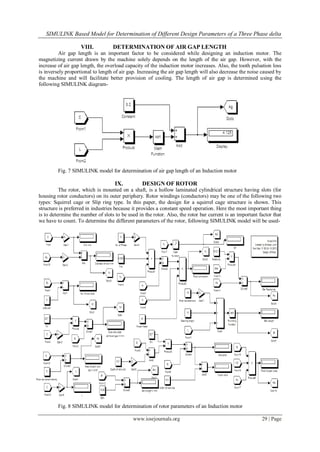
Fig. 5 SIMULINK model for determination of stator slot dimension of an Induction motor
VII. DETERMINATION OF STATOR CORE AND TEETH DIMENSION
It is preferred not to have a high value of flux density in the teeth as it will increase iron loss and
magnetizing mmf. Therefore the value is taken as low as 1.7 wb/m². However, in the stator core, value of flux
density lies between 1.2 to 1.4 wb/m². The value of flux density in the stator core will be half the value of flux
/pole.
Fig. 6 SIMULINK model for determination of dimension of stator teeth of an Induction motor
SIMULINK Based Model for Determination of Different Design Parameters of a Three Phase delta
www.iosrjournals.org 29 | Page
VIII. DETERMINATION OF AIR GAP LENGTH
Air gap length is an important factor to be considered while designing an induction motor. The
magnetizing current drawn by the machine solely depends on the length of the air gap. However, with the
increase of air gap length, the overload capacity of the induction motor increases. Also, the tooth pulsation loss
is inversely proportional to length of air gap. Increasing the air gap length will also decrease the noise caused by
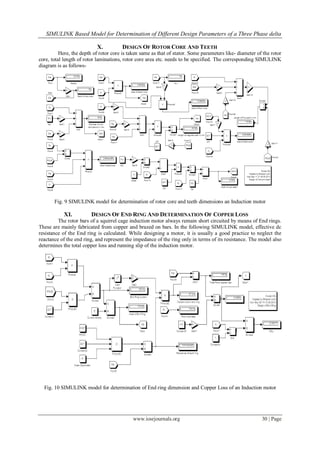
the machine and will facilitate better provision of cooling. The length of air gap is determined using the
following SIMULINK diagram-
Fig. 7 SIMULINK model for determination of air gap length of an Induction motor
IX. DESIGN OF ROTOR
The rotor, which is mounted on a shaft, is a hollow laminated cylindrical structure having slots (for
housing rotor conductors) on its outer periphery. Rotor windings (conductors) may be one of the following two
types: Squirrel cage or Slip ring type. In this paper, the design for a squirrel cage structure is shown. This
structure is preferred in industries because it provides a constant speed operation. Here the most important thing
is to determine the number of slots to be used in the rotor. Also, the rotor bar current is an important factor that
we have to count. To determine the different parameters of the rotor, following SIMULINK model will be used-
Fig. 8 SIMULINK model for determination of rotor parameters of an Induction motor
SIMULINK Based Model for Determination of Different Design Parameters of a Three Phase delta
www.iosrjournals.org 30 | Page
X. DESIGN OF ROTOR CORE AND TEETH
Here, the depth of rotor core is taken same as that of stator. Some parameters like- diameter of the rotor
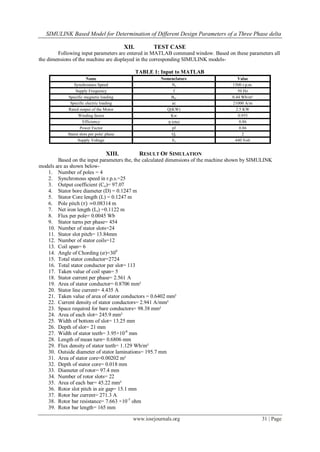
core, total length of rotor laminations, rotor core area etc. needs to be specified. The corresponding SIMULINK
diagram is as follows-
Fig. 9 SIMULINK model for determination of rotor core and teeth dimensions an Induction motor
XI. DESIGN OF END RING AND DETERMINATION OF COPPER LOSS
The rotor bars of a squirrel cage induction motor always remain short circuited by means of End rings.
These are mainly fabricated from copper and brazed on bars. In the following SIMULINK model, effective dc
resistance of the End ring is calculated. While designing a motor, it is usually a good practice to neglect the
reactance of the end ring, and represent the impedance of the ring only in terms of its resistance. The model also
determines the total copper loss and running slip of the induction motor.
Fig. 10 SIMULINK model for determination of End ring dimension and Copper Loss of an Induction motor
SIMULINK Based Model for Determination of Different Design Parameters of a Three Phase delta
www.iosrjournals.org 31 | Page
XII. TEST CASE
Following input parameters are entered in MATLAB command window. Based on these parameters all
the dimensions of the machine are displayed in the corresponding SIMULINK models-
TABLE 1: Input to MATLAB
Name Nomenclature Value
Synchronous Speed Ns 1500 r.p.m.
Supply Frequency f 50 Hz
Specific magnetic loading Bav 0.44 Wb/m²
Specific electric loading ac 21000 A/m
Rated output of the Motor Q(KW) 2.5 KW
Winding factor Kw 0.955
Efficiency 𝜂 (eta) 0.86
Power Factor pf 0.86
Stator slots per pole/ phase Qs 2
Supply Voltage Es 440 Volt
XIII. RESULT OF SIMULATION
Based on the input parameters the, the calculated dimensions of the machine shown by SIMULINK
models are as shown below-
1. Number of poles = 4
2. Synchronous speed in r.p.s.=25
3. Output coefficient (Co)= 97.07
4. Stator bore diameter (D) = 0.1247 m
5. Stator Core length (L) = 0.1247 m
6. Pole pitch (𝜏) =0.08314 m
7. Net iron length (Li) =0.1122 m
8. Flux per pole= 0.0045 Wb
9. Stator turns per phase= 454
10. Number of stator slots=24
11. Stator slot pitch= 13.84mm
12. Number of stator coils=12
13. Coil span= 6
14. Angle of Chording (𝛼)=300
15. Total stator conductor=2724
16. Total stator conductor per slot= 113
17. Taken value of coil span= 5
18. Stator current per phase= 2.561 A
19. Area of stator conductor= 0.8706 mm²
20. Stator line current= 4.435 A
21. Taken value of area of stator conductors = 0.6402 mm²
22. Current density of stator conductors= 2.941 A/mm²
23. Space required for bare conductors= 98.38 mm²
24. Area of each slot= 245.9 mm²
25. Width of bottom of slot= 13.25 mm
26. Depth of slot= 21 mm
27. Width of stator teeth= 3.95×10⁻⁶
mm
28. Length of mean turn= 0.6806 mm
29. Flux density of stator teeth= 1.129 Wb/m²
30. Outside diameter of stator laminations= 195.7 mm
31. Area of stator core=0.00202 m²
32. Depth of stator core= 0.018 mm
33. Diameter of rotor= 97.4 mm
34. Number of rotor slots= 22
35. Area of each bar= 45.22 mm²
36. Rotor slot pitch in air gap= 15.1 mm
37. Rotor bar current= 271.3 A
38. Rotor bar resistance= 7.663 ×10⁻⁵
ohm
39. Rotor bar length= 165 mm
SIMULINK Based Model for Determination of Different Design Parameters of a Three Phase delta
www.iosrjournals.org 32 | Page
40. Rotor slot pitch= 11.26 mm
41. Rotor tooth width= 4.467 mm
42. Rotor copper loss= 124.12 W
43. End ring current=474.8 A
44. Area of end ring= 79.13 mm²
45. Resistance of each ring = 6.322 ×10⁻⁵
ohm
46. Copper loss in end ring= 28.5 W
47. Depth of rotor core= 18 mm
48. Diameter of rotor laminations = 42.8 mm
49. Width of rotor teeth = 5.342 mm
50. Slip of the motor= 0.05753 ( ≅ 5.8 %)
XIV. CONCLUSION
Different dimensions of the three phase induction motor are obtained from the SIMULINK diagrams.
The “slip” of the motor came out as 5.8% which is an acceptable value. In this paper, an attempt has been made
to develop a model for analysis of three phase induction motor. The developed models has been tested with the
above mentioned test specifications. Here, all possible testing were carried out on and errors are minimized for
successful operation of the software. Different examples are considered to study the performance of the
developed SIMULINK model. Test results are obtained and compared with actual result.
References
[1] I.J. Nagrath, D.P. Kothari, Electrical Machines (New Delhi, Tata McGraw-Hill Publishing company Limited, 2003)
[2] The MathWorks, Inc , Simulink- Dynamic System Simulation for Matlab (Natick, M A, USA, The MathWorks, Inc, 2000)
[3] A.K. Sawhney, A Course in Electrical Machine Design (Delhi, Dhanpat Rai & Co,2003)
[4] K.M. Vishnu Murthy, Computer-Aided Design of Electrical machines (Hyderabad, B.S. Publications, 2008)
[5] A.K. Tyagi, MATLAB and Simulink for Engineers (New Delhi, Oxford University Press, 2012)

SIMULINK Based Model for Determination of Different Design Parameters of a Three Phase Delta Connected Squirrel Cage Induction Motor

  • 1.
    IOSR Journal ofElectrical and Electronics Engineering (IOSR-JEEE) e-ISSN: 2278-1676,p-ISSN: 2320-3331, Volume 7, Issue 4 (Sep. - Oct. 2013), PP 25-32 www.iosrjournals.org www.iosrjournals.org 25 | Page SIMULINK Based Model for Determination of Different Design Parameters of a Three Phase Delta Connected Squirrel Cage Induction Motor Bhaskar Lodh (Department of Electrical Engineering, Bengal Institute of Technology & Management, West Bengal, India) Abstract: Electrical Machine Design is a renown discipline of electrical engineering, which can be termed as the physical implementation of theoretical knowledge .A machine is designed considering different aspects like- quality and availability of materials, availability of suitable mechanism and skilled labor, cost, durability etc. In this paper, a computer based model (using SIMULINK) is furnished for obtaining the suitable dimensions of a three phase squirrel cage induction motor. The main objective of the work is to determine the dimensions of various parts and components of the motor, specify suitable materials for design and obtain the output parameters. Now-a-days, induction motors have become the workhorse of the industrial sector due to their easy means of construction and maintenance. Therefore, the performance of the machine needs to be specified using computer aided programs. In this paper, the input parameters of the induction motor is so chosen that it will offer a very competitive pricing and good efficiency. Keywords: Electrical Machine Design, End ring, Squirrel cage Motor, SIMULINK I. INTRODUCTION In practical design of an induction motor, the designer has to follow a number of constraints. Also, the number of input variables is also high. Therefore, manual calculation becomes very much tedious. In order to overcome this, one needs to build a computer aided program or simulation model for determining the parameters of the specific motor. In this paper, a SIMULINK based model is constructed for an induction motor, which will provide high efficiency. Also, the manufacturing cost of the machine will be less and therefore the motor will offer a very competitive pricing. Different parameters of the motor like- rating of the motor (KW/KVA), supply voltage, frequency, type of connection (star/delta), desirable efficiency and power factor, magnetic flux density etc. are specified. Depending on these specified values, the SIMULINK models will generate and display the values of different dimensions of the induction motor. It is desirable to describe clearly the objective of the design to which the model should fulfill. The entire process can be explained by the following flowchart- Fig.1. Flow Chart for Constructing a SIMULINK based model for designing three phase induction motor
  • 2.
    SIMULINK Based Modelfor Determination of Different Design Parameters of a Three Phase delta www.iosrjournals.org 26 | Page II. INTRODUCTION TO MATLAB-SIMULINK In this paper, the software used for constructing the simulation model is MATLAB. It is a very powerful tool for design engineers. It was first introduced in 1970 by a numerical analyst Cleve Moler, who wrote the first version of MATLAB. Since then, it has become successful computational and profit-making software. SIMULINK is a commercial tool furnished by MathWorks Inc. that comes with MATLAB. It is used for modeling and analyzing different types of static and dynamic systems. In this paper, the required simulation model is obtained with the help of different building blocks available in SIMULINK environment. III. DESIGN OF MAIN DIMENSIONS In this section, diameter (D) and Core length (L) of the stator is determined. The output equation of ac machines is taken as Q (KVA) =C0D²Ln. Where, C0 is the output coefficient as determined from the SIMULINK diagram shown. In this paper, the power output, power factor, efficiency and speed is specified. For an electrical machine manufacturing company, it’s necessary to design an electrical machine that will offer a very competitive pricing. Therefore, it’s customary to take higher values of specific electric and magnetic loading (i.e. the values of ac and Bav). Here, ampere conductor per meter of the armature periphery (ac) is taken as 21000 A/m and average value of flux density in the air gap (Bav) is taken as 0.44 Wb/m². In order to have a small magnetizing current, flux density should be very low. Otherwise the machine will have a poor power factor and consequently the efficiency of the motor will be less. The corresponding SIMULINK diagram is as follows- Fig. 2 SIMULINK model for determination of main frame parameters of an Induction motor In a typical 50 Hz motor, the value of Bav ranges between 0.3 wb/m² to 0.6 wb/m² and ac ranges between 5000 to 45000 A/m depending upon the type and application of the machine. In this paper, the taken value of Bav indicates that the machine will be capable of providing a good overload facility and can be applied in cranes, rolling mills etc. The ratio of Core length to pole pitch (pole pitch is abbreviated as “TAU” in SIMULINK model) i.e. 𝐿 𝜏 differs in different machines according to their design specification. In this paper the value of 𝐿 𝜏 is taken as 1.5 which is a suitable value taken for minimum cost and good efficiency. In order to attain a good power factor and good overall design of the motor, the value should lie between 1.0 to 1.25. The peripheral velocity of the motor is expressed in terms of r.p.s. For a normal construction, the peripheral velocity should not exceed the value 30 r.p.s.
  • 3.
    SIMULINK Based Modelfor Determination of Different Design Parameters of a Three Phase delta www.iosrjournals.org 27 | Page IV. DESIGN OF STATOR The stator is the stationary part of the motor, which consists of the outer cylindrical frame of the motor or yoke, which is made either of welded sheet steel, cast iron or cast aluminum alloy. Stator is made of a steel frame which encloses a hollow, cylindrical core fabricated of thin laminations of silicon steel to lessen hysteresis and eddy current losses. A number of evenly spaced slots are provided on the inner edge of the laminations. It forms a balanced star or delta connected circuit. For a typical 3 phase 50 Hz motor, rotor is separated from the stator by a small air-gap which ranges from 0.4 mm to 4 mm, depending on the power of the motor. In this paper, the machine is designed for delta connection with a star-delta starter. The stator will be designed with a single layer mush winding where the coil span should not be an even integer. When 3-phase supply is given to the stator winding, a rotating magnetic field is produced which induces currents in the rotor by electromagnetic induction. No. of stator winding turns per phase is calculated as 𝑇𝑠 = 𝐸 𝑠 4.44𝐾 𝑤𝑠 𝜑 𝑚 , where 𝐸𝑠 =Applied ac voltage, 𝐾 𝑤𝑠 = Stator winding factor and 𝜑 𝑚 =Maximum flux per pole as calculated from the SIMULINK diagram. Fig. 3 SIMULINK model for determination of stator parameters of an Induction motor V. DETERMINATION OF CONDUCTOR SIZE In this section a SIMULINK model is proposed to obtain the current density (𝜕𝑠) and area of stator conductor (𝑎 𝑠). For a typical 50 Hz induction motor value of current density in the stator winding normally lies between 3 to 5 A / mm². The corresponding SIMULINK diagram is shown below- Fig. 4 SIMULINK model for determination of stator conductor size of an Induction motor
  • 4.
    SIMULINK Based Modelfor Determination of Different Design Parameters of a Three Phase delta www.iosrjournals.org 28 | Page VI. DETERMINATION OF SLOT DIMENSION In this section a SIMULINK model is proposed to obtain different parameters of stator slot. For a double lap winding, number of stator slot is calculated as, 𝑆𝑠=Number of phases (M) × Number of slots /pole/phase (g) × Number of poles (P). The shape of the slot of the motor has a great impact on the performance of the motor. The slots may be chosen as completely open or semi-closed. However, the later one is preferred for a three phase induction motor because, it will provide a low magnetizing current as the gap contraction factor is less. Also it will have a quieter operation as compared to the open slots. The SIMULINK diagram is as follows- Fig. 5 SIMULINK model for determination of stator slot dimension of an Induction motor VII. DETERMINATION OF STATOR CORE AND TEETH DIMENSION It is preferred not to have a high value of flux density in the teeth as it will increase iron loss and magnetizing mmf. Therefore the value is taken as low as 1.7 wb/m². However, in the stator core, value of flux density lies between 1.2 to 1.4 wb/m². The value of flux density in the stator core will be half the value of flux /pole. Fig. 6 SIMULINK model for determination of dimension of stator teeth of an Induction motor
  • 5.
    SIMULINK Based Modelfor Determination of Different Design Parameters of a Three Phase delta www.iosrjournals.org 29 | Page VIII. DETERMINATION OF AIR GAP LENGTH Air gap length is an important factor to be considered while designing an induction motor. The magnetizing current drawn by the machine solely depends on the length of the air gap. However, with the increase of air gap length, the overload capacity of the induction motor increases. Also, the tooth pulsation loss is inversely proportional to length of air gap. Increasing the air gap length will also decrease the noise caused by the machine and will facilitate better provision of cooling. The length of air gap is determined using the following SIMULINK diagram- Fig. 7 SIMULINK model for determination of air gap length of an Induction motor IX. DESIGN OF ROTOR The rotor, which is mounted on a shaft, is a hollow laminated cylindrical structure having slots (for housing rotor conductors) on its outer periphery. Rotor windings (conductors) may be one of the following two types: Squirrel cage or Slip ring type. In this paper, the design for a squirrel cage structure is shown. This structure is preferred in industries because it provides a constant speed operation. Here the most important thing is to determine the number of slots to be used in the rotor. Also, the rotor bar current is an important factor that we have to count. To determine the different parameters of the rotor, following SIMULINK model will be used- Fig. 8 SIMULINK model for determination of rotor parameters of an Induction motor
  • 6.
    SIMULINK Based Modelfor Determination of Different Design Parameters of a Three Phase delta www.iosrjournals.org 30 | Page X. DESIGN OF ROTOR CORE AND TEETH Here, the depth of rotor core is taken same as that of stator. Some parameters like- diameter of the rotor core, total length of rotor laminations, rotor core area etc. needs to be specified. The corresponding SIMULINK diagram is as follows- Fig. 9 SIMULINK model for determination of rotor core and teeth dimensions an Induction motor XI. DESIGN OF END RING AND DETERMINATION OF COPPER LOSS The rotor bars of a squirrel cage induction motor always remain short circuited by means of End rings. These are mainly fabricated from copper and brazed on bars. In the following SIMULINK model, effective dc resistance of the End ring is calculated. While designing a motor, it is usually a good practice to neglect the reactance of the end ring, and represent the impedance of the ring only in terms of its resistance. The model also determines the total copper loss and running slip of the induction motor. Fig. 10 SIMULINK model for determination of End ring dimension and Copper Loss of an Induction motor
  • 7.
    SIMULINK Based Modelfor Determination of Different Design Parameters of a Three Phase delta www.iosrjournals.org 31 | Page XII. TEST CASE Following input parameters are entered in MATLAB command window. Based on these parameters all the dimensions of the machine are displayed in the corresponding SIMULINK models- TABLE 1: Input to MATLAB Name Nomenclature Value Synchronous Speed Ns 1500 r.p.m. Supply Frequency f 50 Hz Specific magnetic loading Bav 0.44 Wb/m² Specific electric loading ac 21000 A/m Rated output of the Motor Q(KW) 2.5 KW Winding factor Kw 0.955 Efficiency 𝜂 (eta) 0.86 Power Factor pf 0.86 Stator slots per pole/ phase Qs 2 Supply Voltage Es 440 Volt XIII. RESULT OF SIMULATION Based on the input parameters the, the calculated dimensions of the machine shown by SIMULINK models are as shown below- 1. Number of poles = 4 2. Synchronous speed in r.p.s.=25 3. Output coefficient (Co)= 97.07 4. Stator bore diameter (D) = 0.1247 m 5. Stator Core length (L) = 0.1247 m 6. Pole pitch (𝜏) =0.08314 m 7. Net iron length (Li) =0.1122 m 8. Flux per pole= 0.0045 Wb 9. Stator turns per phase= 454 10. Number of stator slots=24 11. Stator slot pitch= 13.84mm 12. Number of stator coils=12 13. Coil span= 6 14. Angle of Chording (𝛼)=300 15. Total stator conductor=2724 16. Total stator conductor per slot= 113 17. Taken value of coil span= 5 18. Stator current per phase= 2.561 A 19. Area of stator conductor= 0.8706 mm² 20. Stator line current= 4.435 A 21. Taken value of area of stator conductors = 0.6402 mm² 22. Current density of stator conductors= 2.941 A/mm² 23. Space required for bare conductors= 98.38 mm² 24. Area of each slot= 245.9 mm² 25. Width of bottom of slot= 13.25 mm 26. Depth of slot= 21 mm 27. Width of stator teeth= 3.95×10⁻⁶ mm 28. Length of mean turn= 0.6806 mm 29. Flux density of stator teeth= 1.129 Wb/m² 30. Outside diameter of stator laminations= 195.7 mm 31. Area of stator core=0.00202 m² 32. Depth of stator core= 0.018 mm 33. Diameter of rotor= 97.4 mm 34. Number of rotor slots= 22 35. Area of each bar= 45.22 mm² 36. Rotor slot pitch in air gap= 15.1 mm 37. Rotor bar current= 271.3 A 38. Rotor bar resistance= 7.663 ×10⁻⁵ ohm 39. Rotor bar length= 165 mm
  • 8.
    SIMULINK Based Modelfor Determination of Different Design Parameters of a Three Phase delta www.iosrjournals.org 32 | Page 40. Rotor slot pitch= 11.26 mm 41. Rotor tooth width= 4.467 mm 42. Rotor copper loss= 124.12 W 43. End ring current=474.8 A 44. Area of end ring= 79.13 mm² 45. Resistance of each ring = 6.322 ×10⁻⁵ ohm 46. Copper loss in end ring= 28.5 W 47. Depth of rotor core= 18 mm 48. Diameter of rotor laminations = 42.8 mm 49. Width of rotor teeth = 5.342 mm 50. Slip of the motor= 0.05753 ( ≅ 5.8 %) XIV. CONCLUSION Different dimensions of the three phase induction motor are obtained from the SIMULINK diagrams. The “slip” of the motor came out as 5.8% which is an acceptable value. In this paper, an attempt has been made to develop a model for analysis of three phase induction motor. The developed models has been tested with the above mentioned test specifications. Here, all possible testing were carried out on and errors are minimized for successful operation of the software. Different examples are considered to study the performance of the developed SIMULINK model. Test results are obtained and compared with actual result. References [1] I.J. Nagrath, D.P. Kothari, Electrical Machines (New Delhi, Tata McGraw-Hill Publishing company Limited, 2003) [2] The MathWorks, Inc , Simulink- Dynamic System Simulation for Matlab (Natick, M A, USA, The MathWorks, Inc, 2000) [3] A.K. Sawhney, A Course in Electrical Machine Design (Delhi, Dhanpat Rai & Co,2003) [4] K.M. Vishnu Murthy, Computer-Aided Design of Electrical machines (Hyderabad, B.S. Publications, 2008) [5] A.K. Tyagi, MATLAB and Simulink for Engineers (New Delhi, Oxford University Press, 2012)