INTERNATIONAL JOURNAL OF MECHANICAL ENGINEERING 
International Journal of Mechanical Engineering and Technology (IJMET), ISSN 0976 – 6340(Print), 
ISSN 0976 – 6359(Online), Volume 5, Issue 8, August (2014), pp. 60-72 © IAEME 
AND TECHNOLOGY (IJMET) 
ISSN 0976 – 6340 (Print) 
ISSN 0976 – 6359 (Online) 
Volume 5, Issue 8, August (2014), pp. 60-72 
© IAEME: www.iaeme.com/IJMET.asp 
Journal Impact Factor (2014): 7.5377 (Calculated by GISI) 
www.jifactor.com 
60 
 
IJMET 
© I A E M E 
MODELLING AND OPTIMIZATION OF ELECTROMAGNETIC TYPE 
ACTIVE CONTROL ENGINE-MOUNT SYSTEM 
Prabhat Kumar Sinha, Dan Bahadur Patel*, Mohd Tariq, SaurabhaKumar 
Mechanical Engineering Department, Shepherd School of Engineering and Technology, 
Sam Higginbottom Institute of Agriculture, Technology and Sciences Allahabad U.P. 211007 India 
ABSTRACT 
This paper presents a low-cost prototype active control engine mount (ACM) designed for 
commercial passenger vehicles, requiring a good engine vibration isolation performance. To 
construct such an ACM system, all feedback sensors normally required for full ACM systems are 
replaced by the model based feed forward algorithm, consisting of a vibration estimation algorithm, a 
current shaping controller and an enhanced ACM model. The current shaping control compensates 
for degradation of control performance due to elimination of feedback control sensors. The proposed 
current shaping control improves the actuator control performance, and the vibration estimation 
algorithm provides the anti-vibration signals for vibration isolation 
The dynamic loads that are generated due to the shaking forces within the engine and the road 
loads that are transmitted to the engine through the tire patch are discussed. The geometrical shape of 
the engine mount is also considered in this work. All models discussed herein deal with solving the 
optimization problem for the engine mount system such that the transmitted forces to and from the 
engine are minimized in which the mount parameters are used as design variables. While work has 
been done in the past in the area of engine mount design, this dissertation tries to fill in the gap when 
it comes to designing a comprehensive mounting system that takes into account modeling of the 
mount characteristics, the excitation load present in the system, and a determination of the final 
geometrical shape of the engine mount. 
Keyword: Vibrations, Sensor, Actuator. 
INTRODUCTION 
In recent years, various types of ACMs have been developed by many researchers. Y.W. Lee 
[2] proposed an ACM that used a pneumatic actuator as an active system. The ACMs activated by 
piezo-electric actuators were developed by M. Hideki and T. Mikasa [3]. The electromagnetic type
International Journal of Mechanical Engineering and Technology (IJMET), ISSN 0976 – 6340(Print), 
ISSN 0976 – 6359(Online), Volume 5, Issue 8, August (2014), pp. 60-72 © IAEME 
ACMs were evolved to utilize their high specific force per unit volume. Recently, Japanese 
automotive companies such as Toyota, Nissan, and Honda introduced ACMs to the automotive 
market. They provided the good vehicle tested mount results and highlighted improvements in 
isolation of force induced by engine roll motion over the low frequency region of interest. 
61 
 
This research mainly focuses on development of an ACM designed for low-cost and, yet 
satisfactory vibration isolation performance. A full loaded ACM system normally requires two 
sensors: one for measurement of engine vibration or transmitted force through ACM, and the other 
for position feedback of actuator itself. Without such sensors, the performance of ACM will degrade, 
compared with the full loaded ACM. In this paper, a model based feed forward algorithm, which 
consists of a vibration estimation algorithm, a current shaping controller and an improved ACM 
model, is adopted, in order to compensate for the performance degradation due to absence of the 
feedback sensors. The engine vibration estimator indirectly monitors the engine vibrations using the 
signals taken from the existing sensors such as CAM and CAS [12–14]. The current shaping 
controller compensates for the undesired harmonic distortion in the actuator output due to lack of its 
position feedback. The improved ACM model is developed to accurately describe the active as well 
as passive characteristics of ACM. 
2. STRUCTURE OF ACM 
To isolate the engine-induced vibration, many researchers have developed various kinds of 
ACMs [6–11], but their basic structures are similar to each other, as illustrated in Fig. 1. These were 
achieved by different methods from the full loaded ACM system. Undesired harmonics due to the 
free vibration of actuating system was reduced to some extent by the filter orifice, but it increased the 
dynamic stiffness of the ACM system in the high frequency region, and then amplified the vibration 
transfer via the ACM. The low-cost ACMs provided good vibration isolation performance in vehicle 
tests, but there still remain problems in engine vibration estimation technique, controller of the ACM 
system and proper mathematical model for design and control. 
In this paper, three major contributions are made. First, a refined ACM model, which 
accounts for the actuator model and base motion, is proposed to get the required force information 
for control and design of ACM actuator. Second, a current shaping algorithm based on the ACM 
model is suggested in order to compensate for the performance degradation due to absence of 
feedback sensors without any side effects. Third, an engine vibration estimation algorithm, which 
uses such existing sensors as CAM and CAS, is extended to construct the gain map easily by 
applying an in-situ engine vibration estimation method using back EMF (electromotive force) of the 
actuator coil and engine-mounting system model. The prototype low- cost ACM construction is 
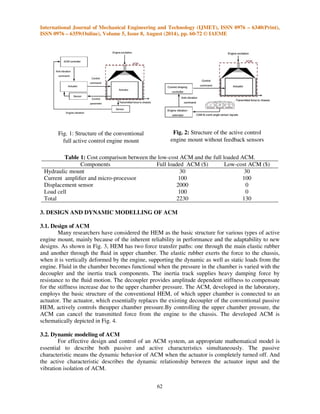
depicted in Fig. 2, which consists of three components: an ACM device, a current shaping controller 
and an engine vibration estimator. As a result, main difference between the low-cost ACM and full 
loaded ACM is absence of two feedback sensors, a displacement sensor for actuator control and a 
load cell for reference signal. To help understanding, cost comparison between the two is described 
in Table 1.
International Journal of Mechanical Engineering and Technology (IJMET), ISSN 0976 – 6340(Print), 
ISSN 0976 – 6359(Online), Volume 5, Issue 8, August (2014), pp. 60-72 © IAEME 
Fig. 1: Structure of the conventional 
full active control engine mount 
Fig. 2: Structure of the active control 
engine mount without feedback sensors 
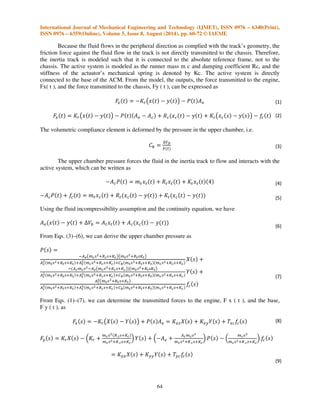
Table 1: Cost comparison between the low-cost ACM and the full loaded ACM. 
Components Full loaded ACM ($) Low-cost ACM ($) 
Hydraulic mount 30 30 
Current amplifier and micro-processor 100 100 
Displacement sensor 2000 0 
Load cell 100 0 
Total 2230 130 
3. DESIGN AND DYNAMIC MODELLING OF ACM 
62 
3.1. Design of ACM 
Many researchers have considered the HEM as the basic structure for various types of active 
engine mount, mainly because of the inherent reliability in performance and the adaptability to new 
designs. As shown in Fig. 3, HEM has two force transfer paths: one through the main elastic rubber 
and another through the fluid in upper chamber. The elastic rubber exerts the force to the chassis, 
when it is vertically deformed by the engine, supporting the dynamic as well as static loads from the 
engine. Fluid in the chamber becomes functional when the pressure in the chamber is varied with the 
decoupler and the inertia track components. The inertia track supplies heavy damping force by 
resistance to the fluid motion. The decoupler provides amplitude dependent stiffness to compensate 
for the stiffness increase due to the upper chamber pressure. The ACM, developed in the laboratory, 
employs the basic structure of the conventional HEM, of which upper chamber is connected to an 
actuator. The actuator, which essentially replaces the existing decoupler of the conventional passive 
HEM, actively controls theupper chamber pressure.By controlling the upper chamber pressure, the 
ACM can cancel the transmitted force from the engine to the chassis. The developed ACM is 
schematically depicted in Fig. 4. 
3.2. Dynamic modeling of ACM 
For effective design and control of an ACM system, an appropriate mathematical model is 
essential to describe both passive and active characteristics simultaneously. The passive 
characteristic means the dynamic behavior of ACM when the actuator is completely turned off. And 
the active characteristic describes the dynamic relationship between the actuator input and the 
vibration isolation of ACM.
International Journal of Mechanical Engineering and Technology (IJMET), ISSN 0976 – 6340(Print), 
ISSN 0976 – 6359(Online), Volume 5, Issue 8, August (2014), pp. 60-72 © IAEME 
Fig. 3: Conventional hydraulic engine mount Fig. 4: The developed active control engine mount 
The conventional HEM model, which has been proposed and optimized in the past by many 
researchers [26–33], was incorporated into the ACM model to describe the active as well as passive 
characteristics, accounting for dynamics of the active actuator. Lee and Lee [10] suggested a two-input 
single-output system as an ACM model, treating the engine vibration and the actuator runner 
displacement as the two independent inputs and the resulting transmitted force to the chassis as the 
output. The passive and active transfer functions, defined from the two-input single-output 
relationship, were extensively used for design and control of the ACM [10]. Sakamoto and Sakai 
[15] proposed a modified ACM model that reflects the actuator dynamics to explain the passive 
characteristics more precisely 
In Fig. 5, Kr and Cb represent the stiffness and volumetric compliance of rubber, 
respectively; Ac and At denote the cross-sectional areas of the actuator runner and the inertia track, 
respectively; Ae is the equivalent cross-sectional area of the upper fluid chamber. The fluid flow in 
the inertia track is modeled as the equivalent mass m t and damping coefficient Rt, and the 
volumetric compliance of the lower chamber is designated as Kt. 
63 
Fig. 6: Conventional dynamic model for 
active control engine mount 
Fig. 5: New dynamic modelfor 
active control engine mount
International Journal of Mechanical Engineering and Technology (IJMET), ISSN 0976 – 6340(Print), 
ISSN 0976 – 6359(Online), Volume 5, Issue 8, August (2014), pp. 60-72 © IAEME 
'$%'()%(*%(,$+'()+(*+$%'()%(*%-  
'$%'()%(*%(,$+'()+(*+$%'()%(*% .  
'$%'()%(*%(,$+'()+(*+$%'()%(*%  
64 
 
Because the fluid flows in the peripheral direction as complied with the track’s geometry, the 
friction force against the fluid flow in the track is not directly transmitted to the chassis. Therefore, 
the inertia track is modeled such that it is connected to the absolute reference frame, not to the 
chassis. The active system is modeled as the runner mass m c and damping coefficient Rc, and the 
stiffness of the actuator’s mechanical spring is denoted by Kc. The active system is directly 
connected to the base of the ACM. From the model, the outputs, the force transmitted to the engine, 
Fx( t ), and the force transmitted to the chassis, Fy ( t ), can be expressed as
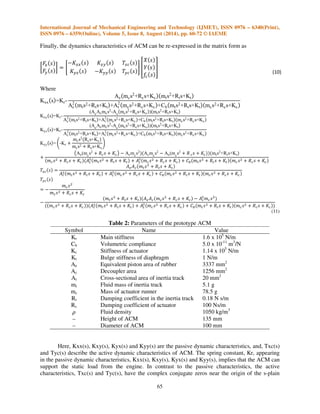
The volumetric compliance element is deformed by the pressure in the upper chamber, i.e. 
   
 
The upper chamber pressure forces the fluid in the inertia track to flow and interacts with the 
active system, which can be written as
Using the fluid incompressibility assumption and the continuity equation, we have
From Eqs. (3)–(6), we can derive the upper chamber pressure as 
  
!#
$%'()%(*%
$+'()+*+
 
% 
'$+'()+(*+(+ 
!%$%'!#
$%'()%(*%

$+'()+*+
 
% 
'$+'()+(*+(+ 
% 
'
$+'()+(*+
 
% 
'$+'()+(*+(+ 
From Eqs. (1)–(7), we can determine the transmitted forces to the engine, F x ( t ), and the base, 
F y ( t ), as 
  	
-  .
    -  /.  0 
/  	-  1	  $%')%(*% 
$%'()%(*% 
2 .  1  %$%' 
$%'()%(*% 
2   1 $%' 
$%'()%(*% 
2  
 /-  //.  0/
International Journal of Mechanical Engineering and Technology (IJMET), ISSN 0976 – 6340(Print), 
ISSN 0976 – 6359(Online), Volume 5, Issue 8, August (2014), pp. 60-72 © IAEME 
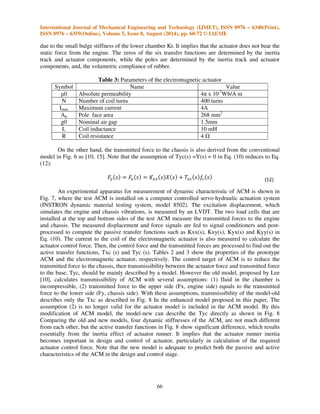
Finally, the dynamics characteristics of ACM can be re-expressed in the matrix form as 
65 
3 
 
 / 0 
/ // 0/6 7 
 
/4  5 
- 
. 
 
8 
Where 
Kxxs=Kr- 
Aemcs2+Rcs+Kcmts2+Rts+Kt 
2mts2+Rts+Kt+At 
Ac 
2mcs2+Rcs+Kc+Cbmts2+Rts+Ktmcs2+Rcs+Kc 
Kxys=Kr- 
(AeAcmcs2-Aemcs2+Rcs+Kc)mts2+Rts+Kt 
2mts2+Rts+Kt+At 
Ac 
2mcs2+Rcs+Kc+Cbmts2+Rts+Ktmcs2+Rcs+Kc 
Kyxs=Kr- 
(AeAcmcs2-Aemcs2+Rcs+Kc)mts2+Rts+Kt 
2mts2+Rts+Kt+At 
Ac 
2mcs2+Rcs+Kc+Cbmts2+Rts+Ktmcs2+Rcs+Kc 
Kyys= 9-Kr  
mcs2Rcs+Kc 
mcs2  Rcs+Kc 
: 
 

Ae(mcs2    
  Acmcs2Acmcs2  Ae(mcs2    mts2+Rts+Kt 
;     ; 
;       ; 
;      ;    ;     
0  
;     
 
;;       ; 
;      ;    ;     
0/  
  
; 
;     
 
 
;    ;       ; 
; 
;     
;;       ; 

 
;      ;    ;     
(11) 
Table 2: Parameters of the prototype ACM 
Symbol Name Value 
Kr Main stiffness 1.6 x 10⁵ N/m 
Cb Volumetric compliance 5.0 x 10⁻¹¹ m3/N 
Kc Stiffness of actuator 1.14 x 10⁵ N/m 
Kt Bulge stiffness of diaphragm 1 N/m 
Ae Equivalent piston area of rubber 3337 mm2 
Ac Decoupler area 1256 mm2 
At Cross-sectional area of inertia track 20 mm2 
mt Fluid mass of inertia track 5.1 g 
mc Mass of actuator runner 78.5 g 
Rt Damping coefficient in the inertia track 0.18 N s/m 
Rc Damping coefficient of actuator 100 Ns/m 
 Fluid density 1050 kg/m3 
– Height of ACM 135 mm 
– Diameter of ACM 100 mm 
Here, Kxx(s), Kxy(s), Kyx(s) and Kyy(s) are the passive dynamic characteristics, and, Txc(s) 
and Tyc(s) describe the active dynamic characteristics of ACM. The spring constant, Kr, appearing 
in the passive dynamic characteristics, Kxx(s), Kxy(s), Kyx(s) and Kyy(s), implies that the ACM can 
support the static load from the engine. In contrast to the passive characteristics, the active 
characteristics, Txc(s) and Tyc(s), have the complex conjugate zeros near the origin of the s-plain
International Journal of Mechanical Engineering and Technology (IJMET), ISSN 0976 – 6340(Print), 
ISSN 0976 – 6359(Online), Volume 5, Issue 8, August (2014), pp. 60-72 © IAEME 
due to the small bulge stiffness of the lower chamber Kt. It implies that the actuator does not bear the 
static force from the engine. The zeros of the six transfer functions are determined by the inertia 
track and actuator components, while the poles are determined by the inertia track and actuator 
components, and, the volumetric compliance of rubber. 
66 
 
Table 3: Parameters of the electromagnetic actuator 
Symbol Name Value 
μ0 Absolute permeability 4 x 10⁻⁷Wb/A m 
N Number of coil turns 400 turns 
Imax Maximum current 4A 
Ap Pole face area 268 mm2 
g0 Nominal air gap 1.5mm 
L Coil inductance 10 mH 
R Coil resistance 4  
On the other hand, the transmitted force to the chassis is also derived from the conventional 
model in Fig. 6 as [10, 15]. Note that the assumption of Tyc(s) =Y(s) = 0 in Eq. (10) reduces to Eq. 
(12): 
/    -  0 
 
An experimental apparatus for measurement of dynamic characteristic of ACM is shown in 
Fig. 7, where the test ACM is installed on a computer controlled servo-hydraulic actuation system 
(INSTRON dynamic material testing system, model 8502). The excitation displacement, which 
simulates the engine and chassis vibrations, is measured by an LVDT. The two load cells that are 
installed at the top and bottom sides of the test ACM measure the transmitted forces to the engine 
and chassis. The measured displacement and force signals are fed to signal conditioners and post-processed 
to compute the passive transfer functions such as Kxx(s), Kxy(s), Kyx(s) and Kyy(s) in 
Eq. (10). The current to the coil of the electromagnetic actuator is also measured to calculate the 
actuator control force. Then, the control force and the transmitted forces are processed to find out the 
active transfer functions, Txc (s) and Tyc (s). Tables 2 and 3 show the properties of the prototype 
ACM and the electromagnetic actuator, respectively. The control target of ACM is to reduce the 
transmitted force to the chassis, then transmissibility between the actuator force and transmitted force 
to the base, Tyc, should be mainly described by a model. However the old model, proposed by Lee 
[10], calculates transmissibility of ACM with several assumptions: (1) fluid in the chamber is 
incompressible, (2) transmitted force to the upper side (Fx, engine side) equals to the transmitted 
force to the lower side (Fy, chassis side). With these assumptions, transmissibility of the model-old 
describes only the Txc as described in Fig. 8 In the enhanced model proposed in this paper, The 
assumption (2) is no longer valid for the actuator model is included in the ACM model. By this 
modification of ACM model, the model-new can describe the Tyc directly as shown in Fig. 8 
Comparing the old and new models, four dynamic stiffnesses of the ACM, are not much different 
from each other, but the active transfer functions in Fig. 8 show significant difference, which results 
essentially from the inertia effect of actuator runner. It implies that the actuator runner inertia 
becomes important in design and control of actuator, particularly in calculation of the required 
actuator control force. Note that the new model is adequate to predict both the passive and active 
characteristics of the ACM in the design and control stage.
International Journal of Mechanical Engineering and Technology (IJMET), ISSN 0976 – 6340(Print), 
ISSN 0976 – 6359(Online), Volume 5, Issue 8, August (2014), pp. 60-72 © IAEME 
67 
Fig. 7: Experimental setup for model 
identification 
4. CURRENT SHAPING CONTROL 
Fig. 8: Transfer functions of ACM 
(force transmissibility) 
The electromagnetic force generated by a Maxwell force type actuator, shown in Fig. 9, 
becomes 
where μ0 is the absolute permeability, N is the number of coil turns, I1 and I2 are the applied 
currents to a pair of facing coils, Ap is the pole face area, g0 is the nominal air gap and xr represents 
the relative runner displacement to the base. The Maxwell type electromagnetic force has two 
inherent control problems, the nonlinearity with respect to the input currents and the harmonic 
distortion by runner movements, which cannot be readily resolved without feedback control [16–21]. 
Fig. 10 shows the typical measured control force of ACM for the sinusoidal input currents. To isolate 
the primary engine harmonic vibration, which is induced by the transmitted force related to an engine 
Fig. 9: Structure of electromagnetic actuator [10]
International Journal of Mechanical Engineering and Technology (IJMET), ISSN 0976 – 6340(Print), 
ISSN 0976 – 6359(Online), Volume 5, Issue 8, August (2014), pp. 60-72 © IAEME 
speed, actuator has to generate the desired harmonic force of the corresponding frequency. As shown 
in Fig. 10, the actuator force due to the harmonic current input is not of a pure harmonic type, but its 
waveform is distorted, resulting in undesired vibrations of higher harmonics transmitted to the 
chassis. Input shaping is a well-known technique in vibration control of structures and robots, which 
effectively suppresses the motion-induced vibration of structure, especially the residual vibrations of 
structures and manipulators. The technique can also be used for the harmonic force generation of 
actuator by properly shaping the input command signal using the known actuator model. 
68 
 
For the harmonic force, fc(t)= F* sin(t+=), applied to the actuator runner, the equation of 
actuator runner motion is given by 
' 
, 
  ? @ ABC  =    1  % 
2  
 
where F ,  and = are the magnitude, frequency and phase, respectively, of the desired harmonic 
control force. Eq. (14) yields 
  D 
' 
H 
EF*%(G% 
I! 
'$%J 
ABCK  L 
The electromagnetic force is derived from Eq. (13) as 
'R 
  ? @ ABC  =  MNO'PQ 
'R 
STN!U'  MNO'PQ 
STN(U' 
 
	 
Using Eqs. (14)– (16), the shaped input command required to compensate for harmonic 
distortion due the nonlinearity and runner movement can be derived as 
VW  X Y 
ZABC  =Z 
[];^ 
 
_T  
 
' 
, 
`1  % 
2   
;a 
ABC  =b c d   efg d g 
g d   efg d eg 
VW  X Y 
ZABC  =Z 
[];^ 
 
_T  
 
' 
, 
`1  % 
2   
;a 
ABC  =b c d   efg d g 

 
g d   efg d eghi 
5. ENGINE VIBRATION ESTIMATION 
To generate the control force by the actuator counter-acting to the engine-induced force, the 
reference signal, the so-called anti-vibration signal, associated with the engine vibration is essential 
for the ACM system. In the recent decade, the estimation techniques of engine torque using 
measurement of crankshaft speed variation were introduced for improved engine diagnostics and 
control [12–14]. 
Fig. 12 describes the estimation scheme of the main harmonic engine vibration. The engine 
torque generated by ignition drives the crankshaft, whose rotation is measured by CAS at the
International Journal of Mechanical Engineering and Technology (IJMET), ISSN 0976 – 6340(Print), 
ISSN 0976 – 6359(Online), Volume 5, Issue 8, August (2014), pp. 60-72 © IAEME 
flywheel location. The dynamic combustion torque also forces the engine-mounting system to 
vibrate and transmit force to the chassis. Using the force transmissibility of ACM, the transmitted 
force to the chassis and thus the anti-vibration command are determined. The engine motion due to 
the combustion torque can be expressed as 
Te (s) = {[M]s2 + [C]s + [K]}q(s) 
Fig. 12: Engine vibration estimation using CAM and CAS signal 
where q ( s ) is the displacement vector of the mass center of engine given as 
q(s) = [x(s) y(s) z (s)qjAqkqlAmn

Modelling and optimization of electromagnetic type active control engine mount system

  • 1.
    INTERNATIONAL JOURNAL OFMECHANICAL ENGINEERING International Journal of Mechanical Engineering and Technology (IJMET), ISSN 0976 – 6340(Print), ISSN 0976 – 6359(Online), Volume 5, Issue 8, August (2014), pp. 60-72 © IAEME AND TECHNOLOGY (IJMET) ISSN 0976 – 6340 (Print) ISSN 0976 – 6359 (Online) Volume 5, Issue 8, August (2014), pp. 60-72 © IAEME: www.iaeme.com/IJMET.asp Journal Impact Factor (2014): 7.5377 (Calculated by GISI) www.jifactor.com 60 IJMET © I A E M E MODELLING AND OPTIMIZATION OF ELECTROMAGNETIC TYPE ACTIVE CONTROL ENGINE-MOUNT SYSTEM Prabhat Kumar Sinha, Dan Bahadur Patel*, Mohd Tariq, SaurabhaKumar Mechanical Engineering Department, Shepherd School of Engineering and Technology, Sam Higginbottom Institute of Agriculture, Technology and Sciences Allahabad U.P. 211007 India ABSTRACT This paper presents a low-cost prototype active control engine mount (ACM) designed for commercial passenger vehicles, requiring a good engine vibration isolation performance. To construct such an ACM system, all feedback sensors normally required for full ACM systems are replaced by the model based feed forward algorithm, consisting of a vibration estimation algorithm, a current shaping controller and an enhanced ACM model. The current shaping control compensates for degradation of control performance due to elimination of feedback control sensors. The proposed current shaping control improves the actuator control performance, and the vibration estimation algorithm provides the anti-vibration signals for vibration isolation The dynamic loads that are generated due to the shaking forces within the engine and the road loads that are transmitted to the engine through the tire patch are discussed. The geometrical shape of the engine mount is also considered in this work. All models discussed herein deal with solving the optimization problem for the engine mount system such that the transmitted forces to and from the engine are minimized in which the mount parameters are used as design variables. While work has been done in the past in the area of engine mount design, this dissertation tries to fill in the gap when it comes to designing a comprehensive mounting system that takes into account modeling of the mount characteristics, the excitation load present in the system, and a determination of the final geometrical shape of the engine mount. Keyword: Vibrations, Sensor, Actuator. INTRODUCTION In recent years, various types of ACMs have been developed by many researchers. Y.W. Lee [2] proposed an ACM that used a pneumatic actuator as an active system. The ACMs activated by piezo-electric actuators were developed by M. Hideki and T. Mikasa [3]. The electromagnetic type
  • 2.
    International Journal ofMechanical Engineering and Technology (IJMET), ISSN 0976 – 6340(Print), ISSN 0976 – 6359(Online), Volume 5, Issue 8, August (2014), pp. 60-72 © IAEME ACMs were evolved to utilize their high specific force per unit volume. Recently, Japanese automotive companies such as Toyota, Nissan, and Honda introduced ACMs to the automotive market. They provided the good vehicle tested mount results and highlighted improvements in isolation of force induced by engine roll motion over the low frequency region of interest. 61 This research mainly focuses on development of an ACM designed for low-cost and, yet satisfactory vibration isolation performance. A full loaded ACM system normally requires two sensors: one for measurement of engine vibration or transmitted force through ACM, and the other for position feedback of actuator itself. Without such sensors, the performance of ACM will degrade, compared with the full loaded ACM. In this paper, a model based feed forward algorithm, which consists of a vibration estimation algorithm, a current shaping controller and an improved ACM model, is adopted, in order to compensate for the performance degradation due to absence of the feedback sensors. The engine vibration estimator indirectly monitors the engine vibrations using the signals taken from the existing sensors such as CAM and CAS [12–14]. The current shaping controller compensates for the undesired harmonic distortion in the actuator output due to lack of its position feedback. The improved ACM model is developed to accurately describe the active as well as passive characteristics of ACM. 2. STRUCTURE OF ACM To isolate the engine-induced vibration, many researchers have developed various kinds of ACMs [6–11], but their basic structures are similar to each other, as illustrated in Fig. 1. These were achieved by different methods from the full loaded ACM system. Undesired harmonics due to the free vibration of actuating system was reduced to some extent by the filter orifice, but it increased the dynamic stiffness of the ACM system in the high frequency region, and then amplified the vibration transfer via the ACM. The low-cost ACMs provided good vibration isolation performance in vehicle tests, but there still remain problems in engine vibration estimation technique, controller of the ACM system and proper mathematical model for design and control. In this paper, three major contributions are made. First, a refined ACM model, which accounts for the actuator model and base motion, is proposed to get the required force information for control and design of ACM actuator. Second, a current shaping algorithm based on the ACM model is suggested in order to compensate for the performance degradation due to absence of feedback sensors without any side effects. Third, an engine vibration estimation algorithm, which uses such existing sensors as CAM and CAS, is extended to construct the gain map easily by applying an in-situ engine vibration estimation method using back EMF (electromotive force) of the actuator coil and engine-mounting system model. The prototype low- cost ACM construction is depicted in Fig. 2, which consists of three components: an ACM device, a current shaping controller and an engine vibration estimator. As a result, main difference between the low-cost ACM and full loaded ACM is absence of two feedback sensors, a displacement sensor for actuator control and a load cell for reference signal. To help understanding, cost comparison between the two is described in Table 1.
  • 3.
    International Journal ofMechanical Engineering and Technology (IJMET), ISSN 0976 – 6340(Print), ISSN 0976 – 6359(Online), Volume 5, Issue 8, August (2014), pp. 60-72 © IAEME Fig. 1: Structure of the conventional full active control engine mount Fig. 2: Structure of the active control engine mount without feedback sensors Table 1: Cost comparison between the low-cost ACM and the full loaded ACM. Components Full loaded ACM ($) Low-cost ACM ($) Hydraulic mount 30 30 Current amplifier and micro-processor 100 100 Displacement sensor 2000 0 Load cell 100 0 Total 2230 130 3. DESIGN AND DYNAMIC MODELLING OF ACM 62 3.1. Design of ACM Many researchers have considered the HEM as the basic structure for various types of active engine mount, mainly because of the inherent reliability in performance and the adaptability to new designs. As shown in Fig. 3, HEM has two force transfer paths: one through the main elastic rubber and another through the fluid in upper chamber. The elastic rubber exerts the force to the chassis, when it is vertically deformed by the engine, supporting the dynamic as well as static loads from the engine. Fluid in the chamber becomes functional when the pressure in the chamber is varied with the decoupler and the inertia track components. The inertia track supplies heavy damping force by resistance to the fluid motion. The decoupler provides amplitude dependent stiffness to compensate for the stiffness increase due to the upper chamber pressure. The ACM, developed in the laboratory, employs the basic structure of the conventional HEM, of which upper chamber is connected to an actuator. The actuator, which essentially replaces the existing decoupler of the conventional passive HEM, actively controls theupper chamber pressure.By controlling the upper chamber pressure, the ACM can cancel the transmitted force from the engine to the chassis. The developed ACM is schematically depicted in Fig. 4. 3.2. Dynamic modeling of ACM For effective design and control of an ACM system, an appropriate mathematical model is essential to describe both passive and active characteristics simultaneously. The passive characteristic means the dynamic behavior of ACM when the actuator is completely turned off. And the active characteristic describes the dynamic relationship between the actuator input and the vibration isolation of ACM.
  • 4.
    International Journal ofMechanical Engineering and Technology (IJMET), ISSN 0976 – 6340(Print), ISSN 0976 – 6359(Online), Volume 5, Issue 8, August (2014), pp. 60-72 © IAEME Fig. 3: Conventional hydraulic engine mount Fig. 4: The developed active control engine mount The conventional HEM model, which has been proposed and optimized in the past by many researchers [26–33], was incorporated into the ACM model to describe the active as well as passive characteristics, accounting for dynamics of the active actuator. Lee and Lee [10] suggested a two-input single-output system as an ACM model, treating the engine vibration and the actuator runner displacement as the two independent inputs and the resulting transmitted force to the chassis as the output. The passive and active transfer functions, defined from the two-input single-output relationship, were extensively used for design and control of the ACM [10]. Sakamoto and Sakai [15] proposed a modified ACM model that reflects the actuator dynamics to explain the passive characteristics more precisely In Fig. 5, Kr and Cb represent the stiffness and volumetric compliance of rubber, respectively; Ac and At denote the cross-sectional areas of the actuator runner and the inertia track, respectively; Ae is the equivalent cross-sectional area of the upper fluid chamber. The fluid flow in the inertia track is modeled as the equivalent mass m t and damping coefficient Rt, and the volumetric compliance of the lower chamber is designated as Kt. 63 Fig. 6: Conventional dynamic model for active control engine mount Fig. 5: New dynamic modelfor active control engine mount
  • 5.
    International Journal ofMechanical Engineering and Technology (IJMET), ISSN 0976 – 6340(Print), ISSN 0976 – 6359(Online), Volume 5, Issue 8, August (2014), pp. 60-72 © IAEME '$%'()%(*%(,$+'()+(*+$%'()%(*%- '$%'()%(*%(,$+'()+(*+$%'()%(*% . '$%'()%(*%(,$+'()+(*+$%'()%(*% 64 Because the fluid flows in the peripheral direction as complied with the track’s geometry, the friction force against the fluid flow in the track is not directly transmitted to the chassis. Therefore, the inertia track is modeled such that it is connected to the absolute reference frame, not to the chassis. The active system is modeled as the runner mass m c and damping coefficient Rc, and the stiffness of the actuator’s mechanical spring is denoted by Kc. The active system is directly connected to the base of the ACM. From the model, the outputs, the force transmitted to the engine, Fx( t ), and the force transmitted to the chassis, Fy ( t ), can be expressed as
  • 6.
    The volumetric complianceelement is deformed by the pressure in the upper chamber, i.e. The upper chamber pressure forces the fluid in the inertia track to flow and interacts with the active system, which can be written as
  • 7.
    Using the fluidincompressibility assumption and the continuity equation, we have
  • 8.
    From Eqs. (3)–(6),we can derive the upper chamber pressure as !# $%'()%(*% $+'()+*+ % '$+'()+(*+(+ !%$%'!# $%'()%(*% $+'()+*+ % '$+'()+(*+(+ % ' $+'()+(*+ % '$+'()+(*+(+ From Eqs. (1)–(7), we can determine the transmitted forces to the engine, F x ( t ), and the base, F y ( t ), as - . - /. 0 / - 1 $%')%(*% $%'()%(*% 2 . 1 %$%' $%'()%(*% 2 1 $%' $%'()%(*% 2 /- //. 0/
  • 9.
    International Journal ofMechanical Engineering and Technology (IJMET), ISSN 0976 – 6340(Print), ISSN 0976 – 6359(Online), Volume 5, Issue 8, August (2014), pp. 60-72 © IAEME Finally, the dynamics characteristics of ACM can be re-expressed in the matrix form as 65 3 / 0 / // 0/6 7 /4 5 - . 8 Where Kxxs=Kr- Aemcs2+Rcs+Kcmts2+Rts+Kt 2mts2+Rts+Kt+At Ac 2mcs2+Rcs+Kc+Cbmts2+Rts+Ktmcs2+Rcs+Kc Kxys=Kr- (AeAcmcs2-Aemcs2+Rcs+Kc)mts2+Rts+Kt 2mts2+Rts+Kt+At Ac 2mcs2+Rcs+Kc+Cbmts2+Rts+Ktmcs2+Rcs+Kc Kyxs=Kr- (AeAcmcs2-Aemcs2+Rcs+Kc)mts2+Rts+Kt 2mts2+Rts+Kt+At Ac 2mcs2+Rcs+Kc+Cbmts2+Rts+Ktmcs2+Rcs+Kc Kyys= 9-Kr mcs2Rcs+Kc mcs2 Rcs+Kc : Ae(mcs2 Acmcs2Acmcs2 Ae(mcs2 mts2+Rts+Kt ; ; ; ; ; ; ; 0 ; ;; ; ; ; ; 0/ ; ; ; ; ; ; ; ;; ; ; ; ; (11) Table 2: Parameters of the prototype ACM Symbol Name Value Kr Main stiffness 1.6 x 10⁵ N/m Cb Volumetric compliance 5.0 x 10⁻¹¹ m3/N Kc Stiffness of actuator 1.14 x 10⁵ N/m Kt Bulge stiffness of diaphragm 1 N/m Ae Equivalent piston area of rubber 3337 mm2 Ac Decoupler area 1256 mm2 At Cross-sectional area of inertia track 20 mm2 mt Fluid mass of inertia track 5.1 g mc Mass of actuator runner 78.5 g Rt Damping coefficient in the inertia track 0.18 N s/m Rc Damping coefficient of actuator 100 Ns/m Fluid density 1050 kg/m3 – Height of ACM 135 mm – Diameter of ACM 100 mm Here, Kxx(s), Kxy(s), Kyx(s) and Kyy(s) are the passive dynamic characteristics, and, Txc(s) and Tyc(s) describe the active dynamic characteristics of ACM. The spring constant, Kr, appearing in the passive dynamic characteristics, Kxx(s), Kxy(s), Kyx(s) and Kyy(s), implies that the ACM can support the static load from the engine. In contrast to the passive characteristics, the active characteristics, Txc(s) and Tyc(s), have the complex conjugate zeros near the origin of the s-plain
  • 10.
    International Journal ofMechanical Engineering and Technology (IJMET), ISSN 0976 – 6340(Print), ISSN 0976 – 6359(Online), Volume 5, Issue 8, August (2014), pp. 60-72 © IAEME due to the small bulge stiffness of the lower chamber Kt. It implies that the actuator does not bear the static force from the engine. The zeros of the six transfer functions are determined by the inertia track and actuator components, while the poles are determined by the inertia track and actuator components, and, the volumetric compliance of rubber. 66 Table 3: Parameters of the electromagnetic actuator Symbol Name Value μ0 Absolute permeability 4 x 10⁻⁷Wb/A m N Number of coil turns 400 turns Imax Maximum current 4A Ap Pole face area 268 mm2 g0 Nominal air gap 1.5mm L Coil inductance 10 mH R Coil resistance 4 On the other hand, the transmitted force to the chassis is also derived from the conventional model in Fig. 6 as [10, 15]. Note that the assumption of Tyc(s) =Y(s) = 0 in Eq. (10) reduces to Eq. (12): / - 0 An experimental apparatus for measurement of dynamic characteristic of ACM is shown in Fig. 7, where the test ACM is installed on a computer controlled servo-hydraulic actuation system (INSTRON dynamic material testing system, model 8502). The excitation displacement, which simulates the engine and chassis vibrations, is measured by an LVDT. The two load cells that are installed at the top and bottom sides of the test ACM measure the transmitted forces to the engine and chassis. The measured displacement and force signals are fed to signal conditioners and post-processed to compute the passive transfer functions such as Kxx(s), Kxy(s), Kyx(s) and Kyy(s) in Eq. (10). The current to the coil of the electromagnetic actuator is also measured to calculate the actuator control force. Then, the control force and the transmitted forces are processed to find out the active transfer functions, Txc (s) and Tyc (s). Tables 2 and 3 show the properties of the prototype ACM and the electromagnetic actuator, respectively. The control target of ACM is to reduce the transmitted force to the chassis, then transmissibility between the actuator force and transmitted force to the base, Tyc, should be mainly described by a model. However the old model, proposed by Lee [10], calculates transmissibility of ACM with several assumptions: (1) fluid in the chamber is incompressible, (2) transmitted force to the upper side (Fx, engine side) equals to the transmitted force to the lower side (Fy, chassis side). With these assumptions, transmissibility of the model-old describes only the Txc as described in Fig. 8 In the enhanced model proposed in this paper, The assumption (2) is no longer valid for the actuator model is included in the ACM model. By this modification of ACM model, the model-new can describe the Tyc directly as shown in Fig. 8 Comparing the old and new models, four dynamic stiffnesses of the ACM, are not much different from each other, but the active transfer functions in Fig. 8 show significant difference, which results essentially from the inertia effect of actuator runner. It implies that the actuator runner inertia becomes important in design and control of actuator, particularly in calculation of the required actuator control force. Note that the new model is adequate to predict both the passive and active characteristics of the ACM in the design and control stage.
  • 11.
    International Journal ofMechanical Engineering and Technology (IJMET), ISSN 0976 – 6340(Print), ISSN 0976 – 6359(Online), Volume 5, Issue 8, August (2014), pp. 60-72 © IAEME 67 Fig. 7: Experimental setup for model identification 4. CURRENT SHAPING CONTROL Fig. 8: Transfer functions of ACM (force transmissibility) The electromagnetic force generated by a Maxwell force type actuator, shown in Fig. 9, becomes where μ0 is the absolute permeability, N is the number of coil turns, I1 and I2 are the applied currents to a pair of facing coils, Ap is the pole face area, g0 is the nominal air gap and xr represents the relative runner displacement to the base. The Maxwell type electromagnetic force has two inherent control problems, the nonlinearity with respect to the input currents and the harmonic distortion by runner movements, which cannot be readily resolved without feedback control [16–21]. Fig. 10 shows the typical measured control force of ACM for the sinusoidal input currents. To isolate the primary engine harmonic vibration, which is induced by the transmitted force related to an engine Fig. 9: Structure of electromagnetic actuator [10]
  • 12.
    International Journal ofMechanical Engineering and Technology (IJMET), ISSN 0976 – 6340(Print), ISSN 0976 – 6359(Online), Volume 5, Issue 8, August (2014), pp. 60-72 © IAEME speed, actuator has to generate the desired harmonic force of the corresponding frequency. As shown in Fig. 10, the actuator force due to the harmonic current input is not of a pure harmonic type, but its waveform is distorted, resulting in undesired vibrations of higher harmonics transmitted to the chassis. Input shaping is a well-known technique in vibration control of structures and robots, which effectively suppresses the motion-induced vibration of structure, especially the residual vibrations of structures and manipulators. The technique can also be used for the harmonic force generation of actuator by properly shaping the input command signal using the known actuator model. 68 For the harmonic force, fc(t)= F* sin(t+=), applied to the actuator runner, the equation of actuator runner motion is given by ' , ? @ ABC = 1 % 2 where F , and = are the magnitude, frequency and phase, respectively, of the desired harmonic control force. Eq. (14) yields D ' H EF*%(G% I! '$%J ABCK L The electromagnetic force is derived from Eq. (13) as 'R ? @ ABC = MNO'PQ 'R STN!U' MNO'PQ STN(U' Using Eqs. (14)– (16), the shaped input command required to compensate for harmonic distortion due the nonlinearity and runner movement can be derived as VW X Y ZABC =Z [];^ _T ' , `1 % 2 ;a ABC =b c d efg d g g d efg d eg VW X Y ZABC =Z [];^ _T ' , `1 % 2 ;a ABC =b c d efg d g g d efg d eghi 5. ENGINE VIBRATION ESTIMATION To generate the control force by the actuator counter-acting to the engine-induced force, the reference signal, the so-called anti-vibration signal, associated with the engine vibration is essential for the ACM system. In the recent decade, the estimation techniques of engine torque using measurement of crankshaft speed variation were introduced for improved engine diagnostics and control [12–14]. Fig. 12 describes the estimation scheme of the main harmonic engine vibration. The engine torque generated by ignition drives the crankshaft, whose rotation is measured by CAS at the
  • 13.
    International Journal ofMechanical Engineering and Technology (IJMET), ISSN 0976 – 6340(Print), ISSN 0976 – 6359(Online), Volume 5, Issue 8, August (2014), pp. 60-72 © IAEME flywheel location. The dynamic combustion torque also forces the engine-mounting system to vibrate and transmit force to the chassis. Using the force transmissibility of ACM, the transmitted force to the chassis and thus the anti-vibration command are determined. The engine motion due to the combustion torque can be expressed as Te (s) = {[M]s2 + [C]s + [K]}q(s) Fig. 12: Engine vibration estimation using CAM and CAS signal where q ( s ) is the displacement vector of the mass center of engine given as q(s) = [x(s) y(s) z (s)qjAqkqlAmn