Topic-Dsp block diagram
Name- Marmik Kothari (140410111027)
Subject- Digital Signal Processing
Branch/Year : EC LY
What is Signal processing?
 Signal processing is the analysis,
interpretation, and manipulation of signals
like sound, images time-varying
measurement values and sensor data etc…
 For example biological data such as
electrocardiograms, control system signals,
telecommunication transmission signals such
as radio signals, and many others.
Need of Signal Processing
When a signal is transmitted from one point
to another there is every possibility of
contamination /deformation of the signal by
external noise. So to retrieve the original
signal at the receiver suitable filters are to be
used. i.e the signal is processed to obtain the
pure signal.
Categories of signal
processing
 Analog signal processing — for signals that
have not been digitized, as in classical radio,
telephone, radar, and television systems.
 This involves linear electronic circuits such
as passive filters, active filters,
additive mixers, integrators and delay lines.
 It also involves non-linear circuits such as
compandors, multiplicators (frequency mixers
and voltage-controlled amplifiers),
voltage-controlled filters,
voltage-controlled oscillators and
phase-locked loops.
 Digital signal processing — for signals that
have been digitized, processing is done by
general-purpose computers or by digital
circuits such as ASICs,
field-programmable gate arrays or
specialized digital signal processors (DSP
chips).
So the processing of the signal helps to
estimate characteristic parameters of the
signal and also to transform the signal in to
the desired form.
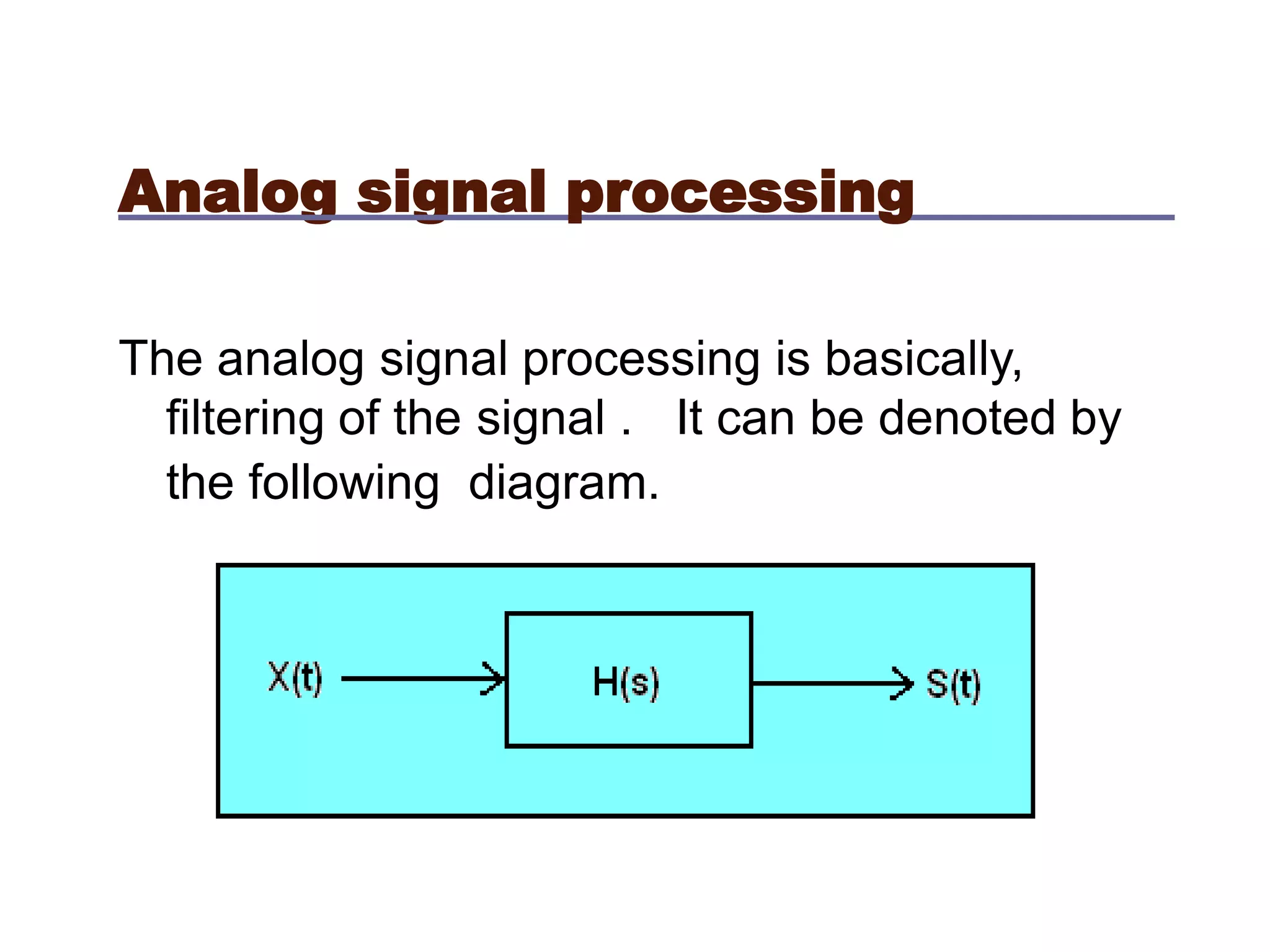
Analog signal processing
The analog signal processing is basically,
filtering of the signal . It can be denoted by
the following diagram.
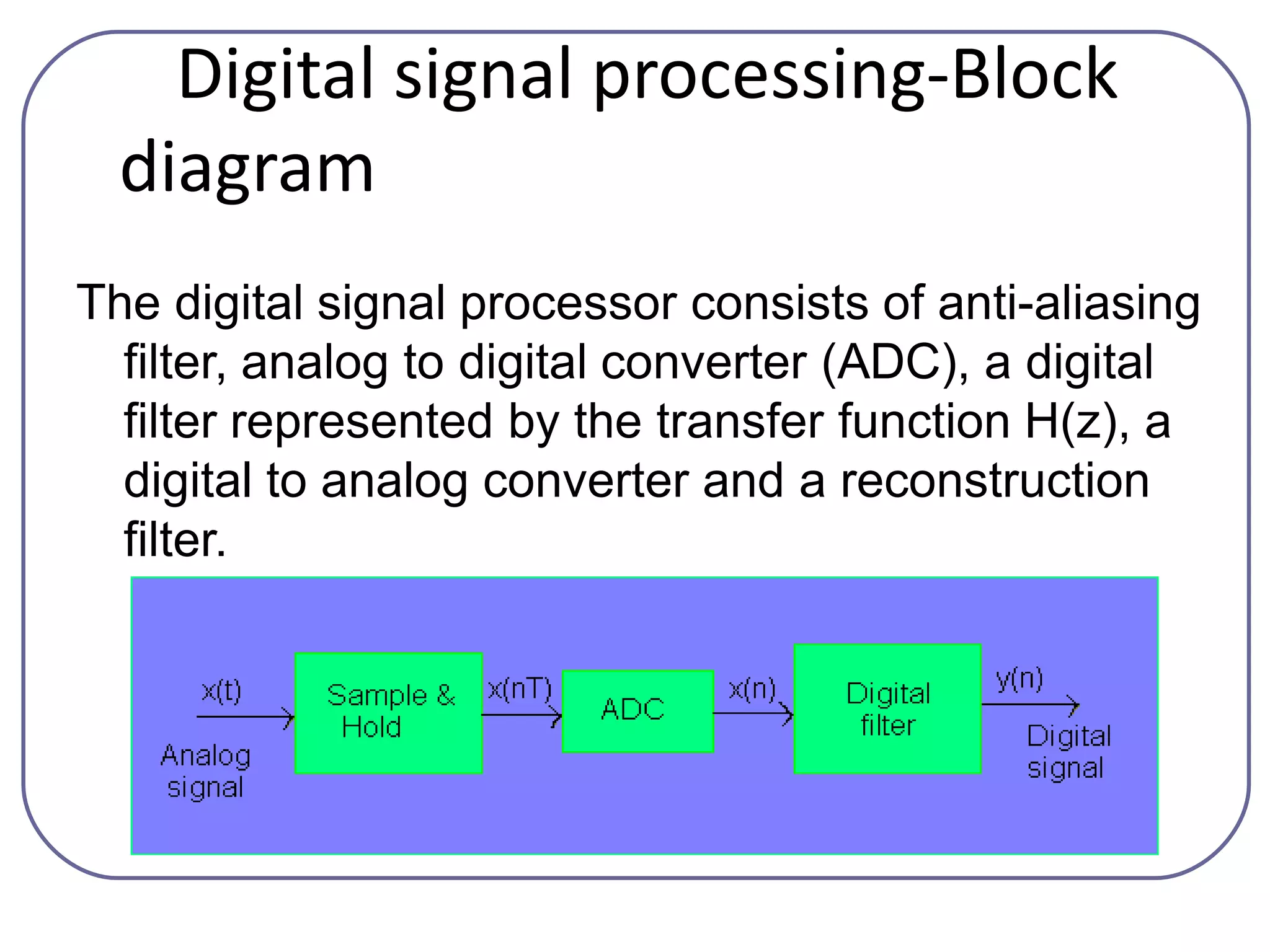
Digital signal processing-Block
diagram
The digital signal processor consists of anti-aliasing
filter, analog to digital converter (ADC), a digital
filter represented by the transfer function H(z), a
digital to analog converter and a reconstruction
filter.
Advantages of Digital over analog
signal processing
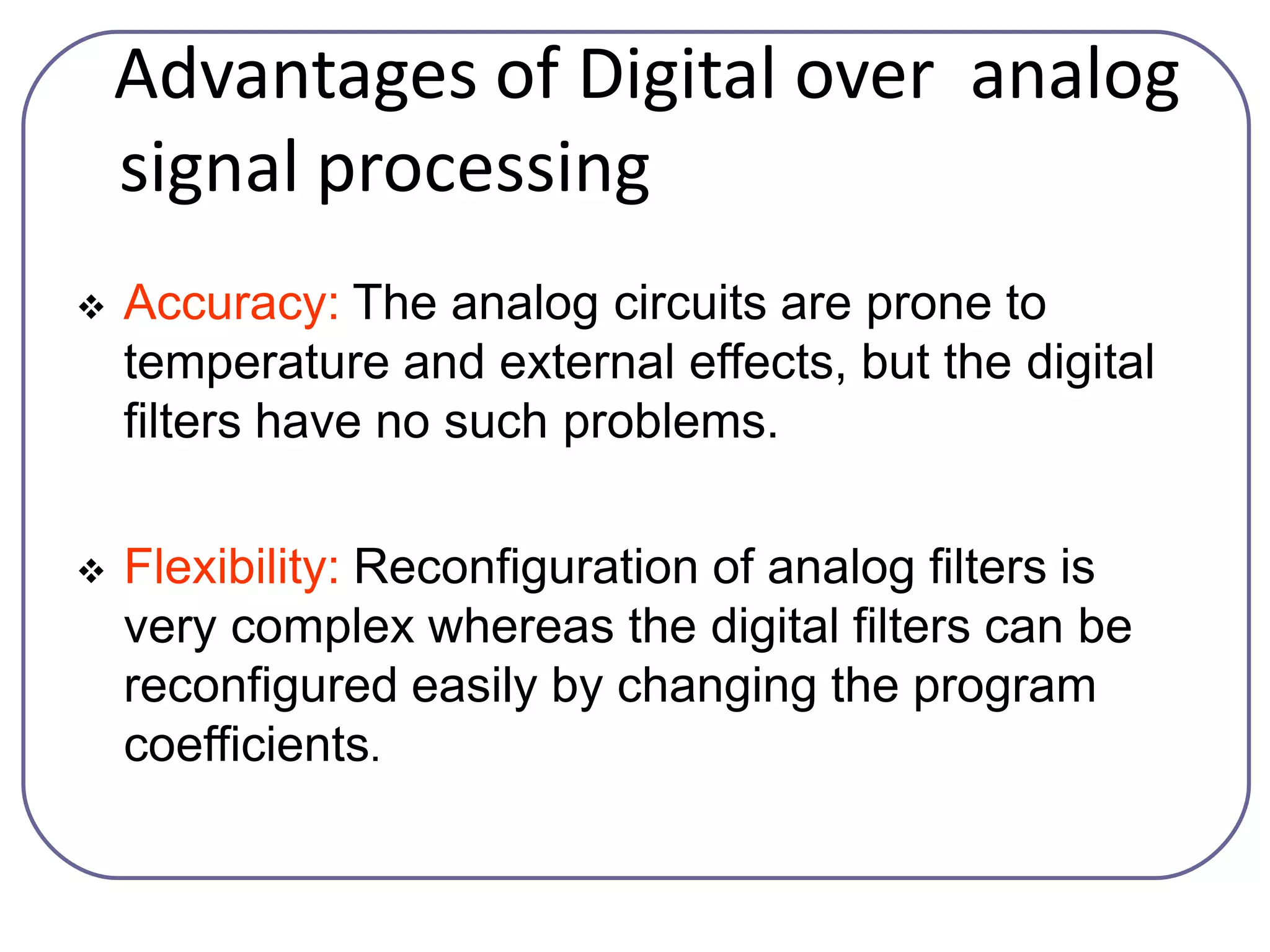
 Accuracy: The analog circuits are prone to
temperature and external effects, but the digital
filters have no such problems.
 Flexibility: Reconfiguration of analog filters is
very complex whereas the digital filters can be
reconfigured easily by changing the program
coefficients.
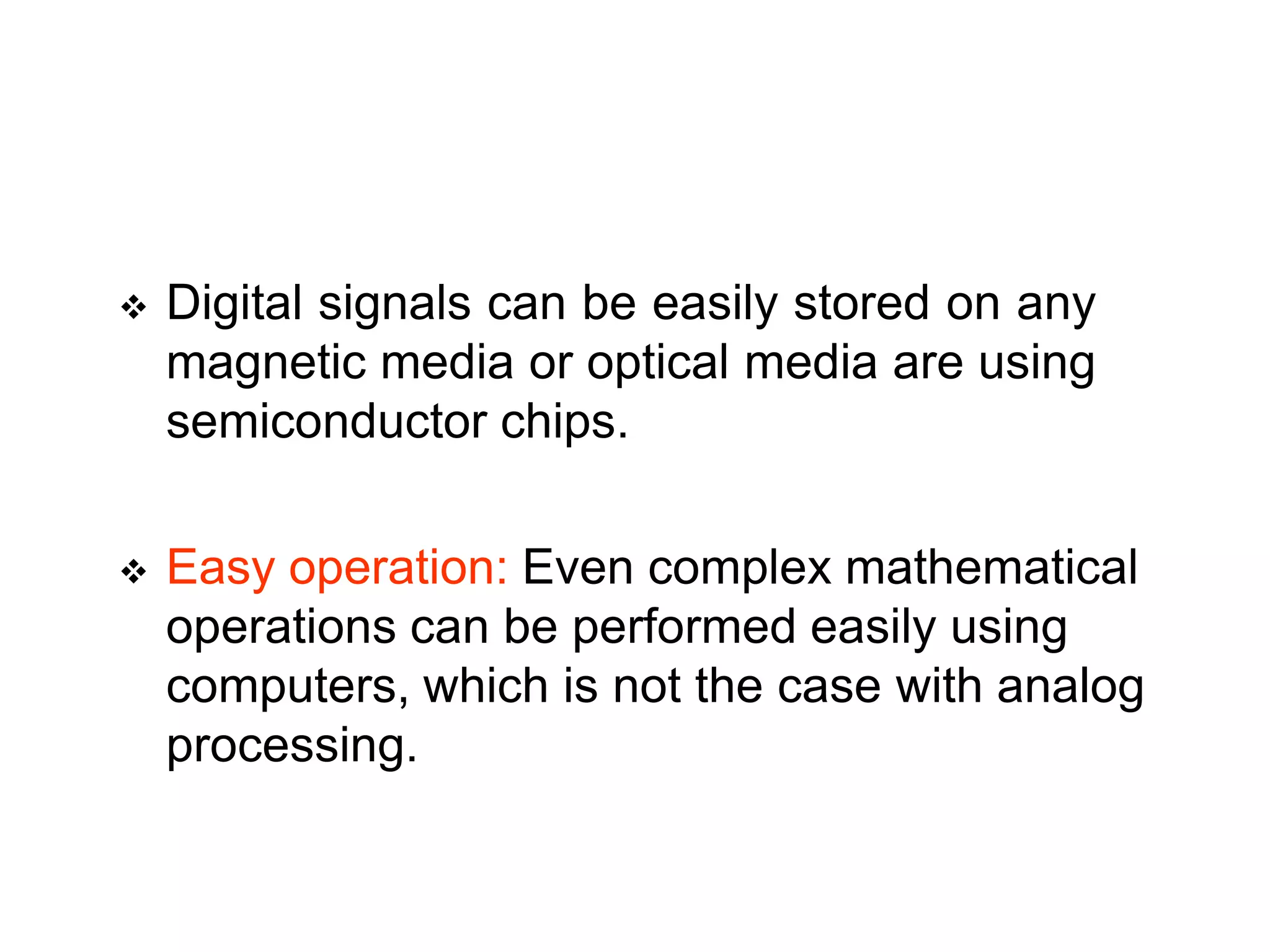
 Digital signals can be easily stored on any
magnetic media or optical media are using
semiconductor chips.
 Easy operation: Even complex mathematical
operations can be performed easily using
computers, which is not the case with analog
processing.
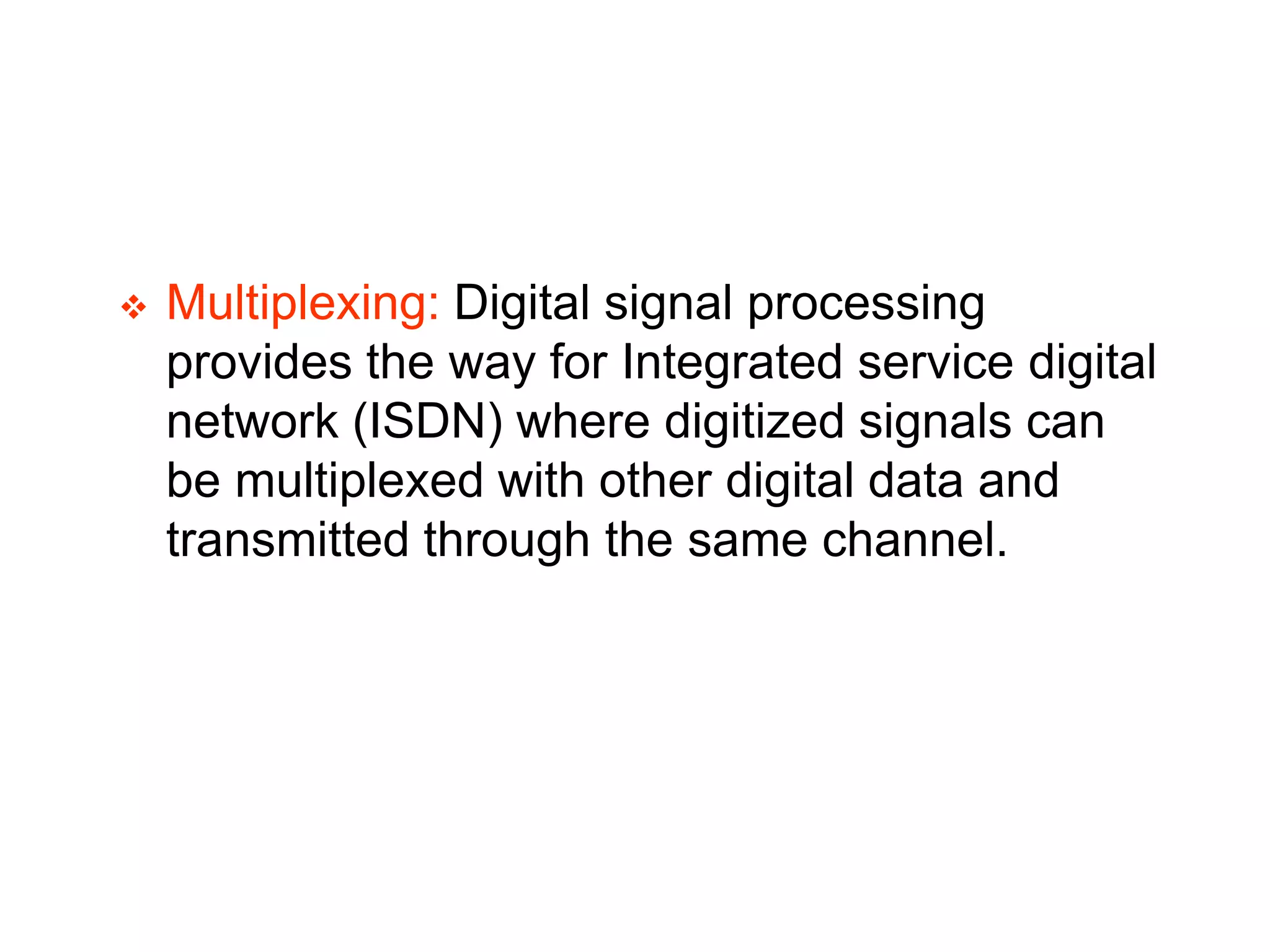
 Multiplexing: Digital signal processing
provides the way for Integrated service digital
network (ISDN) where digitized signals can
be multiplexed with other digital data and
transmitted through the same channel.

digital signal processing

  • 1.
    Topic-Dsp block diagram Name-Marmik Kothari (140410111027) Subject- Digital Signal Processing Branch/Year : EC LY
  • 2.
    What is Signalprocessing?  Signal processing is the analysis, interpretation, and manipulation of signals like sound, images time-varying measurement values and sensor data etc…  For example biological data such as electrocardiograms, control system signals, telecommunication transmission signals such as radio signals, and many others.
  • 3.
    Need of SignalProcessing When a signal is transmitted from one point to another there is every possibility of contamination /deformation of the signal by external noise. So to retrieve the original signal at the receiver suitable filters are to be used. i.e the signal is processed to obtain the pure signal.
  • 4.
    Categories of signal processing Analog signal processing — for signals that have not been digitized, as in classical radio, telephone, radar, and television systems.  This involves linear electronic circuits such as passive filters, active filters, additive mixers, integrators and delay lines.
  • 5.
     It alsoinvolves non-linear circuits such as compandors, multiplicators (frequency mixers and voltage-controlled amplifiers), voltage-controlled filters, voltage-controlled oscillators and phase-locked loops.  Digital signal processing — for signals that have been digitized, processing is done by general-purpose computers or by digital circuits such as ASICs, field-programmable gate arrays or specialized digital signal processors (DSP chips).
  • 6.
    So the processingof the signal helps to estimate characteristic parameters of the signal and also to transform the signal in to the desired form.
  • 7.
    Analog signal processing Theanalog signal processing is basically, filtering of the signal . It can be denoted by the following diagram.
  • 8.
    Digital signal processing-Block diagram Thedigital signal processor consists of anti-aliasing filter, analog to digital converter (ADC), a digital filter represented by the transfer function H(z), a digital to analog converter and a reconstruction filter.
  • 9.
    Advantages of Digitalover analog signal processing  Accuracy: The analog circuits are prone to temperature and external effects, but the digital filters have no such problems.  Flexibility: Reconfiguration of analog filters is very complex whereas the digital filters can be reconfigured easily by changing the program coefficients.
  • 10.
     Digital signalscan be easily stored on any magnetic media or optical media are using semiconductor chips.  Easy operation: Even complex mathematical operations can be performed easily using computers, which is not the case with analog processing.
  • 11.
     Multiplexing: Digitalsignal processing provides the way for Integrated service digital network (ISDN) where digitized signals can be multiplexed with other digital data and transmitted through the same channel.