1
Signal Integrity Testing
with a Vector Network Analyzer
Neil Jarvis
Applications Engineer
Agenda
 RF Connectors
 A significant factor in repeatability
and accuracy
 Selecting the best of several types
for application
 Compatibility
 Connectors are consumables
 limited lifetime
 damaged connectors are costly
 proper care maximizes lifetime
 VNA
 What is a Vector Network
Analyzer?
 How will a VNA help with Signal
Integrity?
 Calibrating and (De)Embedding
 What is TDR?
 The VNA approach to TDR
Connector Considerations

A significant factor in repeatability and accuracy

Selecting the best of several types for application

Compatibility

Connectors are consumables
o limited lifetime
o damaged connectors are costly
o proper care maximizes lifetime
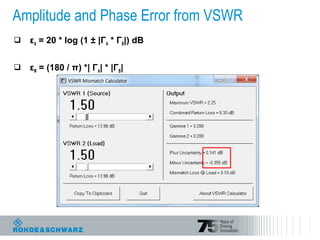
Amplitude and Phase Error from VSWR
 εA = 20 * log (1 ± |ΓA * ΓB|) dB
 εΦ = (180 / π) *| ΓA| * |ΓB|
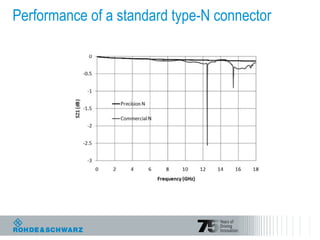
Performance of a standard type-N connector
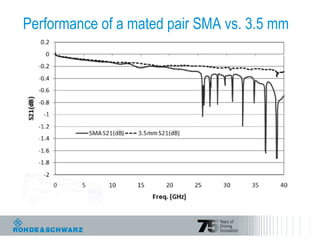
Performance of a mated pair SMA vs. 3.5 mm
-Introduction
-Detailed Views
-RF Connector Types
-Connector Grades
-Comparison of SMA and 3.5mm
-Connector Summary
-Cleaning
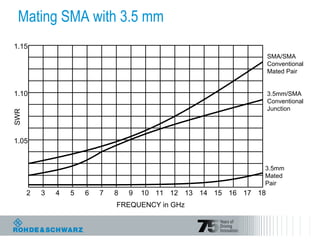
Mating SMA with 3.5 mm
SMA/SMA
Conventional
Mated Pair
3.5mm/SMA
Conventional
Junction
FREQUENCY in GHz
2 3 4 5 6 7 8 9 10 11 12 13 14 15 16 17 18
1.05
1.10
1.15
SWR
3.5mm
Mated
Pair
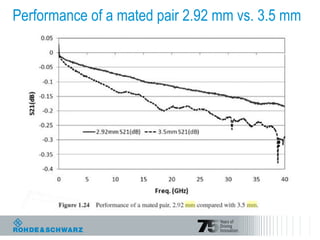
Performance of a mated pair 2.92 mm vs. 3.5 mm
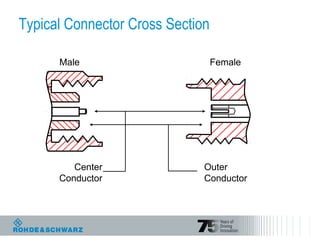
Typical Connector Cross Section
Male Female
Center
Conductor
Outer
Conductor
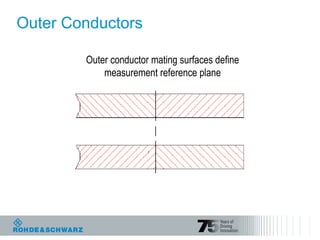
Outer Conductors
Outer conductor mating surfaces define
measurement reference plane
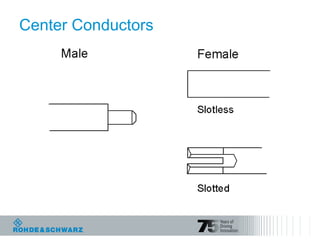
Center Conductors
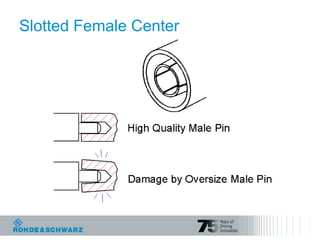
Slotted Female Center
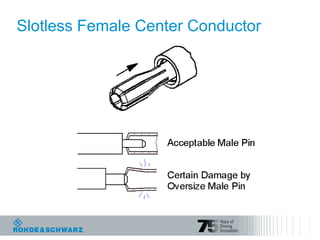
Slotless Female Center Conductor
Connector Grades
 Metrology
 Instrument
 Production (Field)
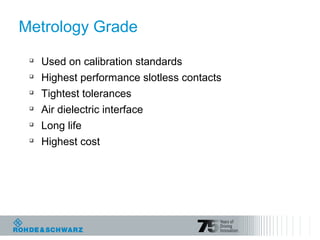
Metrology Grade

Used on calibration standards

Highest performance slotless contacts

Tightest tolerances

Air dielectric interface

Long life

Highest cost
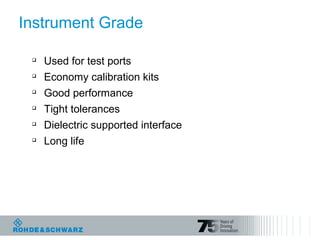
Instrument Grade

Used for test ports

Economy calibration kits

Good performance

Tight tolerances

Dielectric supported interface

Long life
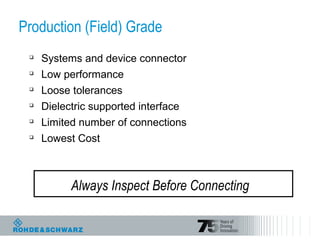
Production (Field) Grade

Systems and device connector

Low performance

Loose tolerances

Dielectric supported interface

Limited number of connections

Lowest Cost
Always Inspect Before Connecting
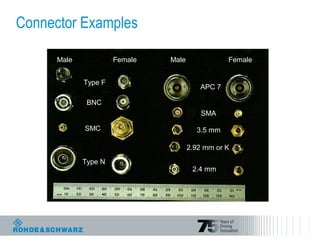
Connector Examples
Type F
BNC
SMC
Type N
APC 7
SMA
3.5 mm
2.92 mm or K
2.4 mm
MaleFemale FemaleMale
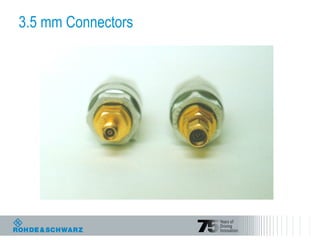
3.5 mm Connectors
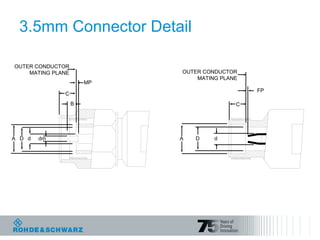
dmdDA
B
C
MP
OUTER CONDUCTOR
MATING PLANE
A D d
C
FP
OUTER CONDUCTOR
MATING PLANE
3.5mm Connector Detail
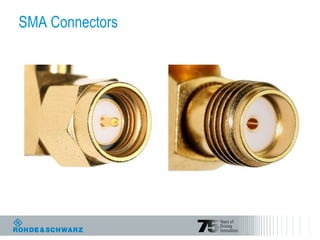
SMA Connectors
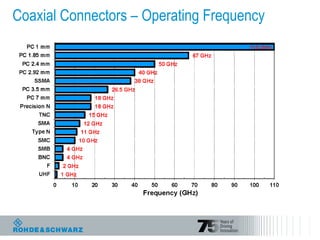
Coaxial Connectors – Operating Frequency
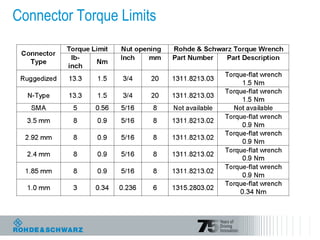
Connector Torque Limits
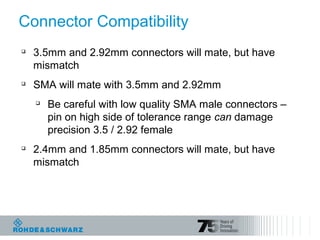
Connector Compatibility

3.5mm and 2.92mm connectors will mate, but have
mismatch

SMA will mate with 3.5mm and 2.92mm

Be careful with low quality SMA male connectors –
pin on high side of tolerance range can damage
precision 3.5 / 2.92 female

2.4mm and 1.85mm connectors will mate, but have
mismatch
Cleaning
 Apply a mild blast of dry compressed air or Nitrogen
 Use the minimum amount of pure alcohol
 Use lint-free cleaning tools (swab or brush)
 Do not use acetone, methanol, or CFCs (Freon).
Further Reading….
lResources:
lhttp://www.npl.co.uk/electromagnetic/
clubs/anamet/connector_guide.pdf
Agenda
 RF Connectors
 A significant factor in repeatability
and accuracy
 Selecting the best of several types
for application
 Compatibility
 Connectors are consumables
 limited lifetime
 damaged connectors are costly
 proper care maximizes lifetime
 VNA
 What is a Vector Network
Analyzer?
 How will a VNA help with Signal
Integrity?
 Calibrating and (De)Embedding
 What is TDR?
 The VNA approach to TDR
28
Why use Vector Network Analysis?
 Very low level signals can be measured more accurately with
narrow bandwidths
 Can measure very fast Rise Times
 The 4-port, single-ended S parameters have become a de-facto
standard for describing the electrical properties of any 4-port
interconnect.
ı For example, IEEE P802.3ap Task Force uses measured S-parameters as test cases
[9] for proposed solutions to the problem of 10 Gbit/s Ethernet over backplanes.
 What are the numbers in S..
o the first index being the going out port
o the second index is the coming in port.
o Example: Gain or Loss of Device is S21
29
What are we Actually Measuring?
 A network analyzer is an instrument that measures the
network parameters of electrical networks
 Network analyzers commonly measure s–parameters because
reflection and transmission of electrical networks are easy to
measure at high frequencies
 Measures Amplitude and Phase into and out of each DUT port
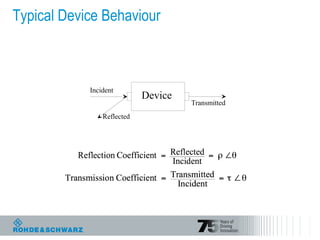
Typical Device Behaviour
Device
Incident
Reflected
Transmitted
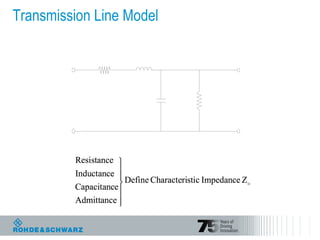
Transmission Line Model
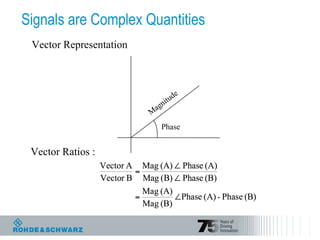
Signals are Complex Quantities
M
agnitude
Phase
Vector Ratios :
Vector Representation
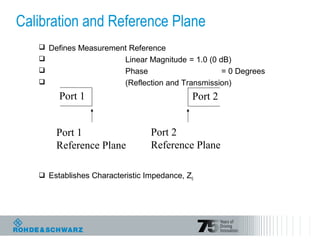
Calibration and Reference Plane
 Defines Measurement Reference
 Linear Magnitude = 1.0 (0 dB)
 Phase = 0 Degrees
 (Reflection and Transmission)
 Establishes Characteristic Impedance, Z0
Port 1 Port 2
Port 1
Reference Plane
Port 2
Reference Plane
What is a Vector Network Analyzer?
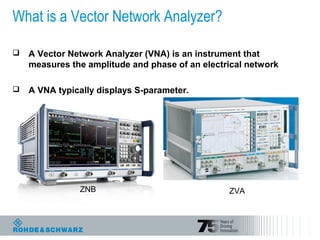
 A Vector Network Analyzer (VNA) is an instrument that
measures the amplitude and phase of an electrical network
 A VNA typically displays S-parameter.
ZNB ZVA
What is a Vector Network Analyzer?
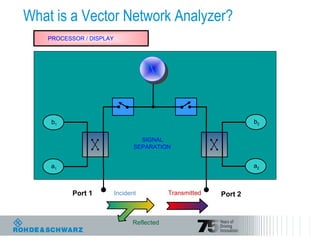
PROCESSOR / DISPLAY
INCIDENT
(R)
Incident
Reflected
Transmitted
a1
b1
a2
b2
Port 1 Port 2
SIGNAL
SEPARATION
What is a Vector Network Analyzer?
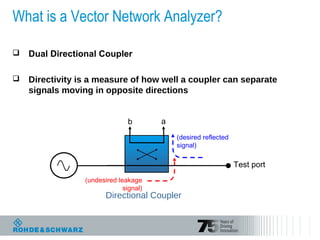
 Dual Directional Coupler
 Directivity is a measure of how well a coupler can separate
signals moving in opposite directions
Test port
(undesired leakage
signal)
(desired reflected
signal)
Directional Coupler
b a
What is a Vector Network Analyzer?
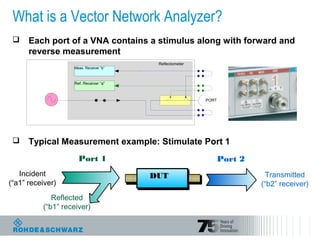
 Each port of a VNA contains a stimulus along with forward and
reverse measurement
 Typical Measurement example: Stimulate Port 1
PORT
Meas. Receiver “b”
Ref. Receiver “a”
Reflectometer
Incident
(“a1” receiver)
Reflected
(“b1” receiver)
Transmitted
(“b2” receiver)
Port 1 Port 2
DUT
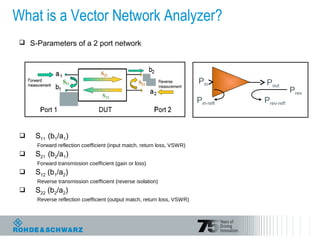
 S-Parameters of a 2 port network
 S11 (b1/a1)
Forward reflection coefficient (input match, return loss, VSWR)
 S21 (b2/a1)
Forward transmission coefficient (gain or loss)
 S12 (b1/a2)
Reverse transmission coefficient (reverse isolation)
 S22 (b2/a2)
Reverse reflection coefficient (output match, return loss, VSWR)
Pin-refl
Pout
Pin
Prev-refl
Prev
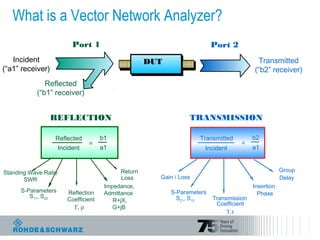
What is a Vector Network Analyzer?
Transmitted
Incident
TRANSMISSION
Gain / Loss
S-Parameters
S21, S12
Group
Delay
Transmission
Coefficient
Insertion
Phase
Reflected
Incident
REFLECTION
Standing Wave Ratio
SWR
S-Parameters
S11, S22
Reflection
Coefficient
Impedance,
Admittance
R+jX,
G+jB
Return
Loss
Γ, ρ
Τ,τ
Incident
(“a1” receiver)
Reflected
(“b1” receiver)
Transmitted
(“b2” receiver)
b1
a1
=
b2
a1
=
Port 1 Port 2
DUT
Measuring the Step Response
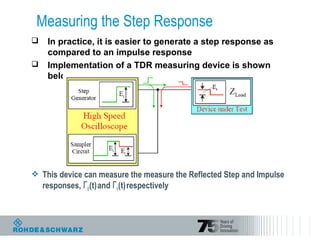
 In practice, it is easier to generate a step response as
compared to an impulse response
 Implementation of a TDR measuring device is shown
below:
 This device can measure the measure the Reflected Step and Impulse
responses, ГΘ(t)and Гh(t)respectively
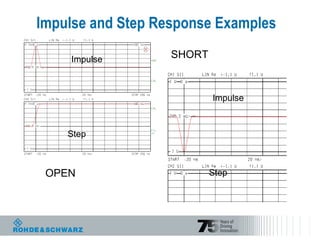
Impulse and Step Response Examples
OPEN
SHORTImpulse
Step
Impulse
Step
The VNA approach to TDR
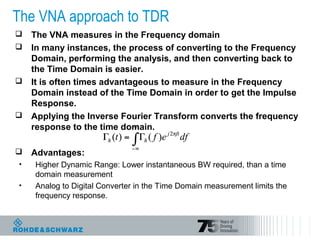
 The VNA measures in the Frequency domain
 In many instances, the process of converting to the Frequency
Domain, performing the analysis, and then converting back to
the Time Domain is easier.
 It is often times advantageous to measure in the Frequency
Domain instead of the Time Domain in order to get the Impulse
Response.
 Applying the Inverse Fourier Transform converts the frequency
response to the time domain.
 Advantages:
• Higher Dynamic Range: Lower instantaneous BW required, than a time
domain measurement
• Analog to Digital Converter in the Time Domain measurement limits the
frequency response.
Applications of TDR
 Examination of faults in transmission lines
 RF imaging for nondestructive evaluation
 Separation of echo from the wanted signal in case of
multipath propagation
 Moving the reference plane across unknown
irregularities
Measurements with VNAs on Cables
 Classical VNA measurements
 S-parameters
 Transmission, Reflection, cross coupling
 Fext, Next
 Group delay
 Electrical length
 TDR measurements
 Fault Location
 Rise Time
 Skew (interpair and intrapair)
 Impedance
 Quality of connectors
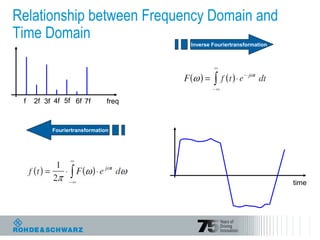
Relationship between Frequency Domain and
Time Domain
f 2f 3f 4f 5f 6f 7f freq
time
Inverse Fouriertransformation
Fouriertransformation
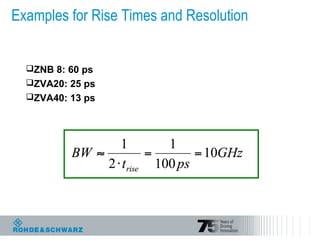
Examples for Rise Times and Resolution
ZNB 8: 60 ps
ZVA20: 25 ps
ZVA40: 13 ps
Time Domain Measurements
 Fault Location
 Skew
 Impedance vs Distance
 Gating
 Connector, Junction or Solder Charecteristics
 Resolution Enhancement
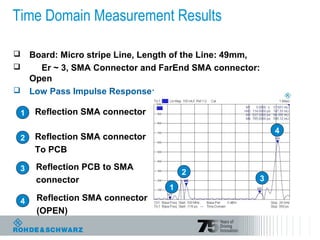
Time Domain Measurement Results
 Board: Micro stripe Line, Length of the Line: 49mm,
 Er ~ 3, SMA Connector and FarEnd SMA connector:
Open
 Low Pass Impulse Response:
1
1
2
3
4
Reflection SMA connector
2 Reflection SMA connector
To PCB
3 Reflection PCB to SMA
connector
4 Reflection SMA connector
(OPEN)
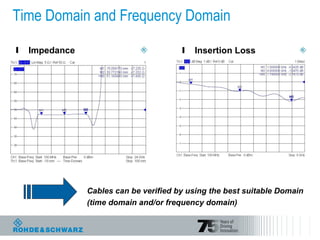
Time Domain and Frequency Domain
l Impedance l Insertion Loss
Cables can be verified by using the best suitable Domain
(time domain and/or frequency domain)
Measurement of a Connector with Time Domain
 Gating functionality can be used to suppress unwanted
reflections
 Gated time domain measurements can be re transformed
into frequency domain
 Typical application
o Test of the quality of a cable connector
Test of the Quality of a Connector
 Problem
o Test the quality of a connector soldered to a cable
o The other end of the cable has no connector at the other end to
solder it directly to a module
 Solution
o Isolate the connector by gating
o Measurement of the gated S11
52
Time Gating
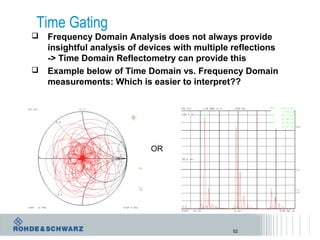
 Frequency Domain Analysis does not always provide
insightful analysis of devices with multiple reflections
-> Time Domain Reflectometry can provide this
 Example below of Time Domain vs. Frequency Domain
measurements: Which is easier to interpret??
OR
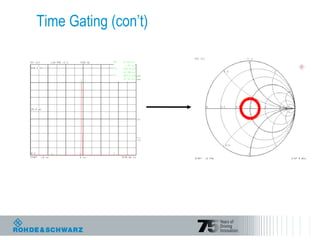
Time Gating (con’t)
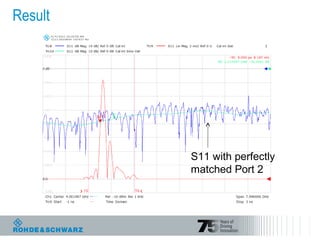
Result
S11 with perfectly
matched Port 2
Reslution and Resolution Enhancement Factor
0,00E+00
5,00E-02
1,00E-01
1,50E-01
2,00E-01
2,50E-01
3,00E-01
3,50E-01
-2,00E-09 0,00E+00 2,00E-09 4,00E-09 6,00E-09 8,00E-09 1,00E-08 1,20E-08
time [ns]
ReflectionFactor[U]
ZVA: 1 GHz - 20 GHz ZNB: 1 GHz - 8 GHz REF: 2.5
ZVA: Start: 10 MHz - 20 GHz
ZNB: Start 10 MHz - 8 GHz, REF: 2.5
fstep: 10 MHz

Design Con VNA

  • 1.
    1 Signal Integrity Testing witha Vector Network Analyzer Neil Jarvis Applications Engineer
  • 2.
    Agenda  RF Connectors A significant factor in repeatability and accuracy  Selecting the best of several types for application  Compatibility  Connectors are consumables  limited lifetime  damaged connectors are costly  proper care maximizes lifetime  VNA  What is a Vector Network Analyzer?  How will a VNA help with Signal Integrity?  Calibrating and (De)Embedding  What is TDR?  The VNA approach to TDR
  • 3.
    Connector Considerations  A significantfactor in repeatability and accuracy  Selecting the best of several types for application  Compatibility  Connectors are consumables o limited lifetime o damaged connectors are costly o proper care maximizes lifetime
  • 4.
    Amplitude and PhaseError from VSWR  εA = 20 * log (1 ± |ΓA * ΓB|) dB  εΦ = (180 / π) *| ΓA| * |ΓB|
  • 5.
    Performance of astandard type-N connector
  • 6.
    Performance of amated pair SMA vs. 3.5 mm -Introduction -Detailed Views -RF Connector Types -Connector Grades -Comparison of SMA and 3.5mm -Connector Summary -Cleaning
  • 7.
    Mating SMA with3.5 mm SMA/SMA Conventional Mated Pair 3.5mm/SMA Conventional Junction FREQUENCY in GHz 2 3 4 5 6 7 8 9 10 11 12 13 14 15 16 17 18 1.05 1.10 1.15 SWR 3.5mm Mated Pair
  • 8.
    Performance of amated pair 2.92 mm vs. 3.5 mm
  • 9.
    Typical Connector CrossSection Male Female Center Conductor Outer Conductor
  • 10.
    Outer Conductors Outer conductormating surfaces define measurement reference plane
  • 11.
  • 12.
  • 13.
  • 14.
    Connector Grades  Metrology Instrument  Production (Field)
  • 15.
    Metrology Grade  Used oncalibration standards  Highest performance slotless contacts  Tightest tolerances  Air dielectric interface  Long life  Highest cost
  • 16.
    Instrument Grade  Used fortest ports  Economy calibration kits  Good performance  Tight tolerances  Dielectric supported interface  Long life
  • 17.
    Production (Field) Grade  Systemsand device connector  Low performance  Loose tolerances  Dielectric supported interface  Limited number of connections  Lowest Cost Always Inspect Before Connecting
  • 18.
    Connector Examples Type F BNC SMC TypeN APC 7 SMA 3.5 mm 2.92 mm or K 2.4 mm MaleFemale FemaleMale
  • 19.
  • 20.
    dmdDA B C MP OUTER CONDUCTOR MATING PLANE AD d C FP OUTER CONDUCTOR MATING PLANE 3.5mm Connector Detail
  • 21.
  • 22.
    Coaxial Connectors –Operating Frequency
  • 23.
  • 24.
    Connector Compatibility  3.5mm and2.92mm connectors will mate, but have mismatch  SMA will mate with 3.5mm and 2.92mm  Be careful with low quality SMA male connectors – pin on high side of tolerance range can damage precision 3.5 / 2.92 female  2.4mm and 1.85mm connectors will mate, but have mismatch
  • 25.
    Cleaning  Apply amild blast of dry compressed air or Nitrogen  Use the minimum amount of pure alcohol  Use lint-free cleaning tools (swab or brush)  Do not use acetone, methanol, or CFCs (Freon).
  • 26.
  • 27.
    Agenda  RF Connectors A significant factor in repeatability and accuracy  Selecting the best of several types for application  Compatibility  Connectors are consumables  limited lifetime  damaged connectors are costly  proper care maximizes lifetime  VNA  What is a Vector Network Analyzer?  How will a VNA help with Signal Integrity?  Calibrating and (De)Embedding  What is TDR?  The VNA approach to TDR
  • 28.
    28 Why use VectorNetwork Analysis?  Very low level signals can be measured more accurately with narrow bandwidths  Can measure very fast Rise Times  The 4-port, single-ended S parameters have become a de-facto standard for describing the electrical properties of any 4-port interconnect. ı For example, IEEE P802.3ap Task Force uses measured S-parameters as test cases [9] for proposed solutions to the problem of 10 Gbit/s Ethernet over backplanes.  What are the numbers in S.. o the first index being the going out port o the second index is the coming in port. o Example: Gain or Loss of Device is S21
  • 29.
    29 What are weActually Measuring?  A network analyzer is an instrument that measures the network parameters of electrical networks  Network analyzers commonly measure s–parameters because reflection and transmission of electrical networks are easy to measure at high frequencies  Measures Amplitude and Phase into and out of each DUT port
  • 30.
  • 31.
  • 32.
    Signals are ComplexQuantities M agnitude Phase Vector Ratios : Vector Representation
  • 33.
    Calibration and ReferencePlane  Defines Measurement Reference  Linear Magnitude = 1.0 (0 dB)  Phase = 0 Degrees  (Reflection and Transmission)  Establishes Characteristic Impedance, Z0 Port 1 Port 2 Port 1 Reference Plane Port 2 Reference Plane
  • 34.
    What is aVector Network Analyzer?  A Vector Network Analyzer (VNA) is an instrument that measures the amplitude and phase of an electrical network  A VNA typically displays S-parameter. ZNB ZVA
  • 35.
    What is aVector Network Analyzer? PROCESSOR / DISPLAY INCIDENT (R) Incident Reflected Transmitted a1 b1 a2 b2 Port 1 Port 2 SIGNAL SEPARATION
  • 36.
    What is aVector Network Analyzer?  Dual Directional Coupler  Directivity is a measure of how well a coupler can separate signals moving in opposite directions Test port (undesired leakage signal) (desired reflected signal) Directional Coupler b a
  • 37.
    What is aVector Network Analyzer?  Each port of a VNA contains a stimulus along with forward and reverse measurement  Typical Measurement example: Stimulate Port 1 PORT Meas. Receiver “b” Ref. Receiver “a” Reflectometer Incident (“a1” receiver) Reflected (“b1” receiver) Transmitted (“b2” receiver) Port 1 Port 2 DUT
  • 38.
     S-Parameters ofa 2 port network  S11 (b1/a1) Forward reflection coefficient (input match, return loss, VSWR)  S21 (b2/a1) Forward transmission coefficient (gain or loss)  S12 (b1/a2) Reverse transmission coefficient (reverse isolation)  S22 (b2/a2) Reverse reflection coefficient (output match, return loss, VSWR) Pin-refl Pout Pin Prev-refl Prev What is a Vector Network Analyzer?
  • 39.
    What is aVector Network Analyzer? Transmitted Incident TRANSMISSION Gain / Loss S-Parameters S21, S12 Group Delay Transmission Coefficient Insertion Phase Reflected Incident REFLECTION Standing Wave Ratio SWR S-Parameters S11, S22 Reflection Coefficient Impedance, Admittance R+jX, G+jB Return Loss Γ, ρ Τ,τ Incident (“a1” receiver) Reflected (“b1” receiver) Transmitted (“b2” receiver) b1 a1 = b2 a1 = Port 1 Port 2 DUT
  • 40.
    Measuring the StepResponse  In practice, it is easier to generate a step response as compared to an impulse response  Implementation of a TDR measuring device is shown below:  This device can measure the measure the Reflected Step and Impulse responses, ГΘ(t)and Гh(t)respectively
  • 41.
    Impulse and StepResponse Examples OPEN SHORTImpulse Step Impulse Step
  • 42.
    The VNA approachto TDR  The VNA measures in the Frequency domain  In many instances, the process of converting to the Frequency Domain, performing the analysis, and then converting back to the Time Domain is easier.  It is often times advantageous to measure in the Frequency Domain instead of the Time Domain in order to get the Impulse Response.  Applying the Inverse Fourier Transform converts the frequency response to the time domain.  Advantages: • Higher Dynamic Range: Lower instantaneous BW required, than a time domain measurement • Analog to Digital Converter in the Time Domain measurement limits the frequency response.
  • 43.
    Applications of TDR Examination of faults in transmission lines  RF imaging for nondestructive evaluation  Separation of echo from the wanted signal in case of multipath propagation  Moving the reference plane across unknown irregularities
  • 44.
    Measurements with VNAson Cables  Classical VNA measurements  S-parameters  Transmission, Reflection, cross coupling  Fext, Next  Group delay  Electrical length  TDR measurements  Fault Location  Rise Time  Skew (interpair and intrapair)  Impedance  Quality of connectors
  • 45.
    Relationship between FrequencyDomain and Time Domain f 2f 3f 4f 5f 6f 7f freq time Inverse Fouriertransformation Fouriertransformation
  • 46.
    Examples for RiseTimes and Resolution ZNB 8: 60 ps ZVA20: 25 ps ZVA40: 13 ps
  • 47.
    Time Domain Measurements Fault Location  Skew  Impedance vs Distance  Gating  Connector, Junction or Solder Charecteristics  Resolution Enhancement
  • 48.
    Time Domain MeasurementResults  Board: Micro stripe Line, Length of the Line: 49mm,  Er ~ 3, SMA Connector and FarEnd SMA connector: Open  Low Pass Impulse Response: 1 1 2 3 4 Reflection SMA connector 2 Reflection SMA connector To PCB 3 Reflection PCB to SMA connector 4 Reflection SMA connector (OPEN)
  • 49.
    Time Domain andFrequency Domain l Impedance l Insertion Loss Cables can be verified by using the best suitable Domain (time domain and/or frequency domain)
  • 50.
    Measurement of aConnector with Time Domain  Gating functionality can be used to suppress unwanted reflections  Gated time domain measurements can be re transformed into frequency domain  Typical application o Test of the quality of a cable connector
  • 51.
    Test of theQuality of a Connector  Problem o Test the quality of a connector soldered to a cable o The other end of the cable has no connector at the other end to solder it directly to a module  Solution o Isolate the connector by gating o Measurement of the gated S11
  • 52.
    52 Time Gating  FrequencyDomain Analysis does not always provide insightful analysis of devices with multiple reflections -> Time Domain Reflectometry can provide this  Example below of Time Domain vs. Frequency Domain measurements: Which is easier to interpret?? OR
  • 53.
  • 54.
  • 55.
    Reslution and ResolutionEnhancement Factor 0,00E+00 5,00E-02 1,00E-01 1,50E-01 2,00E-01 2,50E-01 3,00E-01 3,50E-01 -2,00E-09 0,00E+00 2,00E-09 4,00E-09 6,00E-09 8,00E-09 1,00E-08 1,20E-08 time [ns] ReflectionFactor[U] ZVA: 1 GHz - 20 GHz ZNB: 1 GHz - 8 GHz REF: 2.5 ZVA: Start: 10 MHz - 20 GHz ZNB: Start 10 MHz - 8 GHz, REF: 2.5 fstep: 10 MHz

Editor's Notes

  • #4 Coaxial connectors enable us to repeatedly connect and disconnect instrumentation to devices or systems under test. For measurement purposes these connections must make as little change to the performance of the item being tested as possible and be consistent as well. Choosing which one of the several types of connectors to use depends on the measurement environment and applications, for example: production, 75 ohms, up to 1 GHz. With frequent use, connectors eventually wear and must be replaced and so must be considered as a consumable item. With care and proper technique, it is possible to maximize the useful lifetime for the more expensive measurement instrument connectors.
  • #8 Mating a Precision 3.5 mm Connector to an SMA Connector Using the following procedure very carefully, you can mate a precision 3.5 mm connector to an SMA connector. The two connectors have slightly different dimensions and mechanical characteristics. Mating a precision 3.5 mm connector to an SMA connector also affects electrical performance. Gage both connectors. The SMA connector must meet the precision 3.5 mm connector setback specifications. If not, it will damage the 3.5 mm connector. Carefully align the connectors and push them straight together. Do not twist either connector, just turn the male connector nut. Use a torque wrench for the final connection (56 N-cm (5 lb-in)). If you must make more than a few connections, use a 3.5 mm-to-3.5 mm adapter to protect the 3.5 mm connector. Electrical Performance The junction of two precision 3.5 mm connectors provides superior electrical performance compared to either the junction of two SMA connectors, or an SMA connector mated to a precision 3.5 mm connector (see Figure 3-31). When you mate an SMA connector with a precision 3.5 mm connector, the connection has a typical mismatch (SWR) of 1.10 at 2 GHz (less than that of two SMA connectors, but much greater than that of two precision 3.5 mm connectors).
  • #10 This is a cross section showing the major parts of a typical sexed connector. The typical connector type has a male version and a female version, depending mainly on the configuration of the center conductor. These are also called a plug and a jack, respectively. Important parts to recognize are the center conductors, the outer conductors, and the nut which tightens onto the female threads to bring the conductors into contact. The male pin slides into the female fingers. Electrical contact is made by the internal surfaces of the tips of the female center conductor on the external surface of the male pin and clean, physical contact of the outer conductors (mating plane). It is important that only the outer nut of the male port be rotated, since rotation of the male center conductor may damage the female fingers.
  • #11 In all connector types, the measurement reference plane is defined as the plane of contact of the outer conductors.
  • #12 The male center conductor of high grade connectors is a precision part which fits into the female center conductor. Notice that the male center conductor is machined to form a shoulder, then the diameter of the mating portion of the pin is reduced size and it may be tapered at the end for easy insertions. For high quality male connectors, the machined diameter of the mating portion of the male pin as well as the location of the shoulder is closely controlled. There are two types of female center conductor, either slotted, or slotless.
  • #13 The conventional female center conductor is slotted at the mating end. This forms a set of "fingers" that allow the female contact to expand so that the male pin can be inserted easily. For this design the fingers flex into whatever position the male pin diameter dictates. Using this type of female contact for the test port is only recommended for general use where the highest level of accuracy is not required. A fundamental problem is that the outer diameter of the female center conductor, thus, the characteristic impedance of the test port, can change depending upon the size of the male pin. For example, during calibration, when the male pin of the calibration standard is a precise size, the impedance of the connection will be exactly known; when the device under test is connected, since its male pin may not be the same size, the impedance of the connection will be different. This increases uncertainty and limits traceability of the measurement.
  • #14 The slotless female center conductor consists of a precision machined outer shell which accepts the replaceable inner contact. Notice how the fingers of the inner contact are constrained by the tubular inner conductor. If the male pin is of an acceptable diameter, the fingers of the inner contact can flex to make proper contact without changing the outer diameter of the female center conductor. An advantage of this design is that (within damage limits), the impedance of the connection remains constant over a wide range of male pin diameters. Of course, using this type of center conductor for the test port may require greater care during use. It is more expensive and is intended for use only where the best accuracy and complete traceability is required. The fact that the characteristic impedance of the male contact does not depend upon the diameter of the male pin is necessary when best accuracy and traceability is required.
  • #15 Offering up to three different grades in each connector family provides the flexibility necessary to choose the performance required for a particular application. This keeps the cost as low as possible. For the popular connector families, the device under test usually uses production grade connectors, the test set connectors and most adapters are instrument grade connectors, and most calibration kit and verification kit standards and special adapters are metrology grade. The precision of the connector dimension increases from production through metrology grades, thus cost increases correspondingly. Some specialized connector types may not have all three grades of quality.
  • #16 The metrology grade connectors have the highest performance and the highest cost of all the connector grades. This grade is used on calibration standards, verification standards, and precision adapters. Because it is a high precision connector, it can withstand many connections and disconnections, thus has the longest life of all connectors grades. This connector grade has the closest material and geometric specifications. Pin diameter and pin depths are very closely specified. Metrology grade uses an air dielectric interface and a slotless female contact, which provide the highest performance and traceability. In general, metrology grade connectors should not be mated with production grade connectors.
  • #17 Instrument-grade connectors are considered "middle-grade," and are mainly used in and on our instruments for most cables and adapters, and some calibration standards. It provides long life with good performance and tight tolerance. It may have a dielectric supported interface and therefore may not exhibit the excellent match of a metrology grade connector.
  • #18 This is the lowest grade connector. It is the connector most commonly used on the typical device under test. It has the lowest performance of all connectors due to the loose tolerance. This means that this grade should always be carefully inspected before connecting it to the network analyzer. Some production grade connectors are not intended to mate with metrology grade connectors. This connector has the shortest life and also the lowest cost.
  • #19 Here is a photograph of the more commonly used connector types.
  • #21 Type-N A type-N connector differs from other connector types in that its outer conductor mating plane is offset from the mating plane of the center conductor. Specifications Type-N connector critical mechanical specifications: A maximum protrusion of the female center conductor in front of the outer conductor mating plane. A minimum recession of the shoulder of the male contact pin behind the outer conductor mating plane (0.207 inches). A maximum recession of the shoulder of the male contact pin behind the outer conductor mating plane (0.210 inches). As type-N connectors wear, the protrusion of the female contact fingers generally increases, due to wear of the outer conductor mating plane inside the female connector. Check this periodically, because it decreases the total center conductor contact separation.
  • #24 While many HP RF/microwave connectors have been designed for rugged mechanical interfaces, the user must be aware that cleanliness of the surfaces and care in applying torque to the connector nut are crucial to long life and full signal performance. The table above shows the recommended torque for various connector types. Too much torque will result in deformation of the connector parts and probably a mismatch problem and not enough torque will yield a lossy connection with poor VSWR.
  • #25 All three grades are not available in all connector families. Sometimes manufacturing processes or the basic design of the connector do not lend themselves to producing the highest grade connectors. As an example, while the SMA family may include designs of several grades and prices, it can only be a production grade connector and the 3.5 mm connector family provides the instrument and metrology grade components. In contrast, the APC-7 connector was designed specifically for metrology type measurements and it is not desirable to design a lower grade connector.
  • #39 Talk about A1 is incident A is source 1 is port 1 B1 is reflected wave at port 1 B is reflected 1 is port one Review defiinitions for Sparmeters at the bottom Different terms for the same thing i.e. s11, return loss, vswr etc.
  • #41 Has anybody ever used a TDR like this? Does Rockwell have any of these?
  • #44 Ask the audience if anybody is familiar with these applications.
  • #53 Ask if anybody has used TDR.