Government Engineering
College, Bharuch
Digital communication
presentation
Pulse Code modulationPulse Code modulation
Prepared by :
Xyz
6th
Sem (E.C-A)
Pulse Code Modulation
• PCM is a method of converting an analog
signal into a digital signal. (A/D conversion)
• The amplitude of Analog signal can take any
value over a continuous range i.e. it can take
on an infinite values.
• Digital signal amplitude can take on finite
values.
• Analog signal can be converted into digital by
sampling and quantizing.
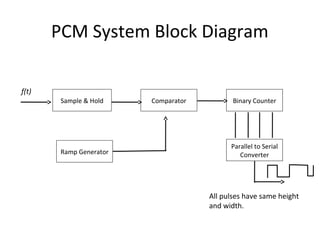
PCM System Block Diagram
Sample & Hold Comparator
Ramp Generator
Binary Counter
Parallel to Serial
Converter
All pulses have same height
and width.
f(t)
PCM of Speech Signals (very-important)
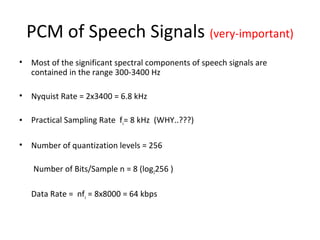
• Most of the significant spectral components of speech signals are
contained in the range 300-3400 Hz
• Nyquist Rate = 2x3400 = 6.8 kHz
• Practical Sampling Rate fs= 8 kHz (WHY..???)
• Number of quantization levels = 256
Number of Bits/Sample n = 8 (log2256 )
Data Rate = nfs = 8x8000 = 64 kbps
PCM of Speech Signals (very-important)
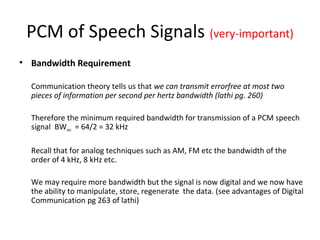
• Bandwidth Requirement
Communication theory tells us that we can transmit errorfree at most two
pieces of information per second per hertz bandwidth (lathi pg. 260)
Therefore the minimum required bandwidth for transmission of a PCM speech
signal BWmin = 64/2 = 32 kHz
Recall that for analog techniques such as AM, FM etc the bandwidth of the
order of 4 kHz, 8 kHz etc.
We may require more bandwidth but the signal is now digital and we now have
the ability to manipulate, store, regenerate the data. (see advantages of Digital
Communication pg 263 of lathi)
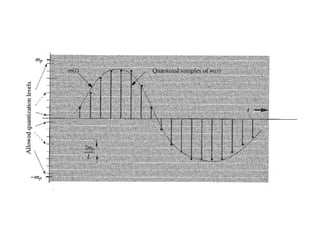
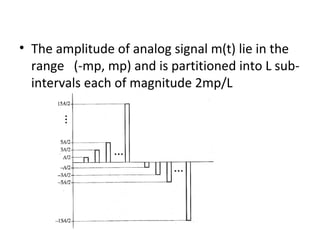
• The amplitude of analog signal m(t) lie in the
range (-mp, mp) and is partitioned into L sub-
intervals each of magnitude 2mp/L
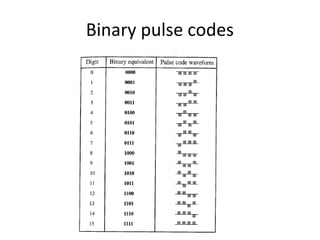
Binary pulse codes
Thank You

Pulse code modulation

  • 1.
  • 2.
    Pulse Code modulationPulseCode modulation Prepared by : Xyz 6th Sem (E.C-A)
  • 3.
    Pulse Code Modulation •PCM is a method of converting an analog signal into a digital signal. (A/D conversion) • The amplitude of Analog signal can take any value over a continuous range i.e. it can take on an infinite values. • Digital signal amplitude can take on finite values. • Analog signal can be converted into digital by sampling and quantizing.
  • 4.
    PCM System BlockDiagram Sample & Hold Comparator Ramp Generator Binary Counter Parallel to Serial Converter All pulses have same height and width. f(t)
  • 6.
    PCM of SpeechSignals (very-important) • Most of the significant spectral components of speech signals are contained in the range 300-3400 Hz • Nyquist Rate = 2x3400 = 6.8 kHz • Practical Sampling Rate fs= 8 kHz (WHY..???) • Number of quantization levels = 256 Number of Bits/Sample n = 8 (log2256 ) Data Rate = nfs = 8x8000 = 64 kbps
  • 7.
    PCM of SpeechSignals (very-important) • Bandwidth Requirement Communication theory tells us that we can transmit errorfree at most two pieces of information per second per hertz bandwidth (lathi pg. 260) Therefore the minimum required bandwidth for transmission of a PCM speech signal BWmin = 64/2 = 32 kHz Recall that for analog techniques such as AM, FM etc the bandwidth of the order of 4 kHz, 8 kHz etc. We may require more bandwidth but the signal is now digital and we now have the ability to manipulate, store, regenerate the data. (see advantages of Digital Communication pg 263 of lathi)
  • 8.
    • The amplitudeof analog signal m(t) lie in the range (-mp, mp) and is partitioned into L sub- intervals each of magnitude 2mp/L
  • 9.
  • 10.